Kathy Joseph's Blog, page 8
August 21, 2022
First Law of Thermodynamics: History of the Concept of Energy
The first law of thermodynamics is basically as follows: there are different types of energy, the energy of motion, the energy in a compressed spring, the energy of a rock lifted off the ground, the energy of heat, nuclear energy, etcetera.
Table Of ContentsEmilie du ChateletEmilie and VoltaireNewton’s BookEmilie du Chatelet’s Book: Lessons in PhysicsIdeas of Conserving “Living Force”Carnot’s DiscoveryJames JouleReferenceVideo Script Download...

August 17, 2022
( ∈ vs. ε): Why Physicists Use 2 Forms of the Greek Letter Epsilon
When I learned Maxwell’s equations in college, I was taught to draw the permittivity with a Greek letter epsilon that looked like a c with a line in it and not like a backwards 3 like usual.
Table Of ContentsWhy Physicists Use 2 Forms of the Greek Letter EpsilonImage ReferencesReferenceWhy Physicists Use 2 Forms of the Greek Letter EpsilonIt turns out that this alternative epsilon is a mistake that happened when an English printing company accidentally u...
August 2, 2022
Faraday Cage and Ice Pail Experiment Explained
Before I get into the nitty grities of the physics of the Faraday cage and the ice bucket experiment, I would like to start with a simple demonstration of the cage that I did with things around the house that I think is pretty amazing.
Table Of Contents Simple At-Home Faraday Cage Experiment History of Induction and Conduction Benjamin Franklin to Coulomb to Faraday The Gold-Leaf Electrometer Faraday’s 1843 Ice Pail Experiment EXPLAINED Faraday Cage vs. Static ...July 6, 2022
Magnetic Fields, Electric Fields, and Elector Magnetic Waves: Physics And History
I was working on a video on the physics of the Faraday cage and it became clear that not only do you need to talk about electric fields to explain the cage but that Faraday had actually created the idea of electric fields for that very purpose in 1837. Now I had known that Faraday had created the idea of magnetic fields which he called “lines of magnetic force” in 1831, and I knew that Faraday had added lines of electric force before 1846 when he admitted to the wild idea that maybe the ligh...
June 3, 2022
Michael Faraday : A Quick Overview of His Life and Inventions
Michael Faraday was born on September 22, 1791, in Newington Butts, London, England. He was the son of a blacksmith and a weaver. Faraday received very little formal education. At the age of 14, he became an apprentice bookbinder. He then became a chemist’s assistant.
In 1812, Faraday attended a series of lectures given by the chemist Humphry Davy. Davy was so impressed with Faraday’s abilities that he offered him a job. Faraday worked with Davy for the next nine years. He became a very skilled chemist.
In 1821, Faraday became interested in electricity. He began to do experiments on electricity and magnetism. Faraday made many important discoveries in this area. In 1831, he invented the electric transformer. This invention made it possible to transmit electricity over long distances. Faraday also invented the electric generator.
In 1835, Faraday became the director of the Royal Institution in London. He held this position until his retirement in 1858. Faraday was a very talented scientist. He made many important discoveries in the fields of electricity and magnetism. Faraday’s work helped to make electricity into a viable form of energy.
Michael Faraday’s Apprenticeship with Humphry DavyMichael Faraday was born in1791 in England. He was orphaned at a young age and was raised by his grandparents. When he was 14, he began an apprenticeship with a bookbinder. A few years later, he began an apprenticeship with Sir Humphry Davy, a famous chemist. Faraday was Davy’s lab assistant for seven years. During this time, he helped Davy perform many experiments, including experiments on gases and electricity. Faraday also learned how to write scientific papers. In 1821, Faraday became a professor at the Royal Institution of Great Britain. He continued to work at the Royal Institution for the rest of his life. Faraday is best known for his work on the electric motor and the electric generator.
Michael Faraday’s Contribution at the Royal InstitutionHe was a physicist and chemist who worked at the Royal Institution in London. Faraday is most famous for his work on electromagnetism. He discovered that an electric current can create a magnetic field, and that a magnetic field can create an electric current. This work formed the basis for the development of electric motors and generators. Faraday also did pioneering work on the study of electrolysis, the process of breaking down a compound into its individual atoms or molecules using an electric current.
This brings us to England and men named Michael Faraday and his mentor Humphry Davy. Humphry Davy was a famous Chemist and laughing gas aficionado who was arguably the most famous scientist in all of Europe at the time. Eight years previously, Davy had injured his eye and hired Michael Faraday, a young, uneducated, and poor bookbinder’s apprentice as his assistant. By 1820, Davy was promoted to president of the Royal Institution of London and Faraday had been promoted to the position of “Chemical Assistant” and was conducting some of his research independently of Davy.
Both Davy and Faraday (and frankly, every other scientist in Europe) heard about Oersted’s experiment and tried to figure out what it meant. Davy wrote his brother, “I have ascertained (repeating some vague experiments of Orsted’s) that the battery is a powerful magnet…I am deeply occupied in this.” Notice that Davy got an important fact wrong about Orsted’s experiment. The battery is not a magnet! It is tempting to think it must be as it often is in a similar shape to a bar magnet and the + and – signs seem so similar to the N and S of a magnet. In fact, the battery isn’t magnetic, but the current in the wire is. In April, Davy collaborated with his friend William Wollaston on this problem. Wollaston had agreed with Oersted that the current must spiral down the wire. They spent many hours trying to come up with an experiment to demonstrate this spiraling motion but to no avail. Supposedly, Faraday heard some of their discussions but never found them interesting enough to put in his notebook.
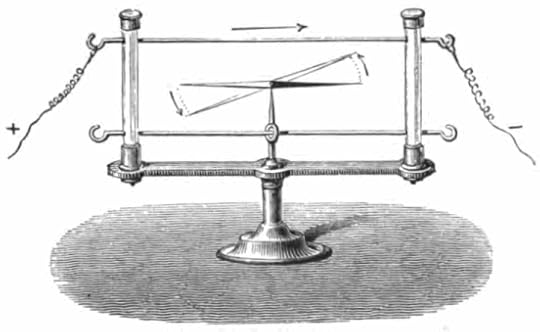
In the summer of 1821, Faraday was asked to write a review of the latest developments in electricity for a journal. Through painstaking experiments, Faraday determined that the wire wasn’t attracting either end of the magnet but instead orienting the entire magnet. He also determined that the force was purely circular around the wire not spiraling as Oersted thought. He decided that strange as it may seem, the current seemed to travel straight down the wire and somehow it made a circular force on a magnet around the wire. In return, Faraday also postulated that a magnet also made a circular force on a wire around it. In other words, “a wire ought to revolve around a magnetic pole and a magnetic pole around the wire”.
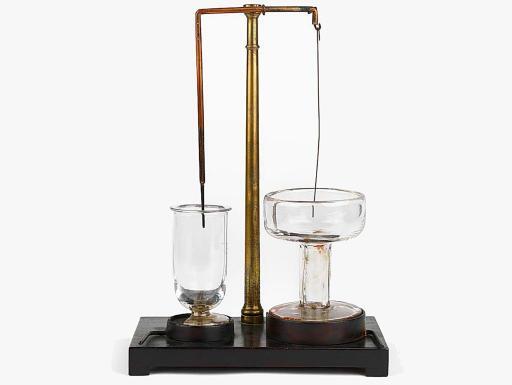
Faraday began looking for a way to demonstrate that a current-carrying wire will feel a force in a circle around a magnet. On September 3rd, 1821 he created a simple experiment in his laboratory to demonstrate this force. He had a wire drop down on a cup full of mercury (mercury is a conducting fluid) with a permanent bar magnet in the center. When he closed the switch the wire spun continuously. Supposedly, Faraday shouted, “There they go! There they go! We have succeeded at last!”
Technically, Faraday had just invented the electric motor as an electric motor is a device that changes electrical energy into motion. Of course, it wasn’t a particularly practical motor as it didn’t do any useful work (unless you want to electrically stir mercury). Luckily, Faraday didn’t invent the motor to do any work. He invented it to demonstrate that the current moves straight down the wire and the magnetic force is circular around the wire. As a motor, it was useless, as a demonstration of the nature of magnetic fields, it was quite efficient.
Faraday published his work on October 1st, 1821 to great acclaim. But within a week, he heard rumors that people were saying he plagiarized his material. The person shouting the loudest was his former boss and mentor, Humphrey Davy!
Faraday wrote to Wollaston, “I am anxious to escape from unfounded impressions against me and if I have done any wrong that I may apologize for it.” Wollaston wrote back and claimed to be unoffended; “you have no occasion to concern yourself much about the matter.” However, Wollaston didn’t publically defend Faraday and Davy publically attacked him.
It is hard to know, almost 200 years after the fact, why people did what they did and how they felt about it. Most modern researchers feel that Davy was jealous of his protégée’s success and felt that Faraday was too low class and uneducated to be an independent researcher. Davy was from a middle-class background but had been knighted as a baron in recognition of his scientific work. Therefore Davy might have been class conscious in a way that a person who has risen far from middle-class beginnings could be. However, it is also possible that Davy felt justified in his anger. Faraday was a person that Davy had plucked from obscurity and he did not give credit to his benefactor. And it is true that Davy and Wollaston had been trying to make a spinning device before Faraday did (although with a different motivation). Finally, it isn’t clear that Davy really understood what Faraday was proving with his experiments. Davy’s brother stated that his objections to Faraday were “an act of justice to Dr. Wollaston”, and it is quite possible that Davy felt that way for the rest of his life.
In May of 1823, Faraday was nominated to be a fellow of the Royal Institute to the strong objection of Davy (the secret vote was nearly unanimous with only one dissenter, probably Davy). In 1826, Davy fell very ill from using too much laughing gas or from inhaling dangerous chemicals in the laboratory and resigned from his job as a Chemist. Davy passed away three years later.
Meanwhile, Faraday was eager to continue his studies of electricity but instead, he was basically forced by the government to study how to make better optical glasses (a study that he found particularly fruitless, stating that the only results were his own “nervous headaches”). Therefore, Faraday was unable to return to electricity until 1831. The first person to really take Faraday’s idea to the next level was a newly retired soldier and boot maker named William Sturgeon. Sturgeon actually invented one of the first practical motors in 1834. First, however, he focused on another thing Faraday mentioned in his paper, that a helix of wire acts like a bar magnet. How Sturgeon invented the first practical electromagnet is next time on the secret history of electricity.
Michael Faraday’s Discovery and InventionsMichael Faraday’s Theory of Electrochemistry
While Faraday was performing these experiments and presenting them to the scientific world, doubts were raised about the identity of the different manifestations of electricity that had been studied. Were the electric “fluid” that apparently was released by electric eels and other electric fishes, that produced by a static electricity generator, that of the voltaic battery, and that of the new electromagnetic generator all the same? Or were they different fluids following different laws?
Faraday was convinced that they were not fluids at all but forms of the same force, yet he recognized that this identity had never been satisfactorily shown by experiment. For this reason he began, in 1832, what promised to be a rather tedious attempt to prove that all electricities had precisely the same properties and caused precisely the same effects. The key effect was electrochemical decomposition. Voltaic and electromagnetic electricity posed no problems, but static electricity did. As Faraday delved deeper into the problem, he made two startling discoveries.
First, electrical force did not, as had long been supposed, act at a distance upon chemical molecules to cause them to dissociate. It was the passage of electricity through a conducting liquid medium that caused the molecules to dissociate, even when the electricity merely discharged into the air and did not pass into a “pole” or “centre of action” in a voltaic cell. Second, the amount of the decomposition was found to be related in a simple manner to the amount of electricity that passed through the solution. These findings led Faraday to a new theory of electrochemistry. The electric force, he argued, threw the molecules of a solution into a state of tension (his electrotonic state). When the force was strong enough to distort the fields of forces that held the molecules together so as to permit the interaction of these fields with neighbouring particles, the tension was relieved by the migration of particles along the lines of tension, the different species of atoms migrating in opposite directions. The amount of electricity that passed, then, was clearly related to the chemical affinities of the substances in solution. These experiments led directly to Faraday’s two laws of electrochemistry: (1) The amount of a substance deposited on each electrode of an electrolytic cell is directly proportional to the quantity of electricity passed through the cell. (2) The quantities of different elements deposited by a given amount of electricity are in the ratio of their chemical equivalent weights.
Faraday’s work on electrochemistry provided him with an essential clue for the investigation of static electrical induction. Since the amount of electricity passed through the conducting medium of an electrolytic cell determined the amount of material deposited at the electrodes, why should not the amount of electricity induced in a nonconductor be dependent upon the material out of which it was made? In short, why should not every material have a specific inductive capacity? Every material does, and Faraday was the discoverer of this fact.
By 1839 Faraday was able to bring forth a new and general theory of electrical action. Electricity, whatever it was, caused tensions to be created in matter.
When these tensions were rapidly relieved (i.e., when bodies could not take much strain before “snapping” back), then what occurred was a rapid repetition of a cyclical buildup, breakdown, and buildup of tension that, like a wave, was passed along a substance.
Such substances were called conductors. In electrochemical processes the rate of buildup and breakdown of the strain was proportional to the chemical affinities of the substances involved, but again the current was not a material flow but a wave pattern of tensions and their relief.
Insulators were simply materials whose particles could take an extraordinary amount of strain before they snapped. Electrostatic charge in an isolated insulator was simply a measure of this accumulated strain. Thus, all electrical action was the result of forced strains in bodies.
The strain on Faraday of eight years of sustained experimental and theoretical work was too much, and in 1839 his health broke down. For the next six years he did little creative science. Not until 1845 was he able to pick up the thread of his researches and extend his theoretical views.
Faraday’s Electromagnetic Wave ExperimentIn 1831, Michael Faraday, performed an experiment that showed the relationship between electricity and magnetism. This experiment is known as Faraday’s electromagnetic wave experiment.
To perform this experiment, Faraday positioned a wire above a permanent magnet. He then connected the wire to a battery, which created an electric current. The electric current flowing through the wire created a magnetic field around the wire. This magnetic field interacted with the magnetic field of the permanent magnet, causing the wire to move.
Faraday’s electromagnetic wave experiment demonstrated that electricity and magnetism are two aspects of the same force. This force is now known as electromagnetism. Faraday’s experiment also showed that electromagnetic waves can travel through space. These waves are now known as electromagnetic radiation.
Michael Faraday Discovery of Electromagnetic Rotationone of his most significant was the discovery of electromagnetic rotation. This discovery has had a profound impact on the way we live today, and is a key component of modern technology.
Faraday’s discovery began with his experiments on electricity and magnetism. He discovered that a current of electricity produces a magnetic field, and that a magnetic field can produce a current of electricity. This led him to wonder if there was a way to convert one form of energy into another.
He began to experiment with rotating magnets, and discovered that they produced a current of electricity. This was the first time that anyone had ever demonstrated the conversion of mechanical energy into electrical energy. Faraday’s discovery of electromagnetic rotation was a major breakthrough, and it laid the foundation for the development of modern technology.
Michael Faraday Discovery in Gas Liquefaction and RefrigerationIn 1824, Michael Faraday began experimenting with the liquefaction of gases. He was the first to liquefy chlorine, and later oxygen and nitrogen. In 1834, Faraday liquefied ammonia, which he used to produce ice for the first time. In 1845, Faraday liquefied carbon dioxide, which he used to produce dry ice.
How Did Michael Faraday Discovered Benzene?Benzene is an organic compound with the chemical formula C6H6. It is a colorless and flammable liquid with a sweet odor. Benzene is mainly used as an additive in gasoline.
Michael Faraday is credited with the discovery of benzene. He is also known for his work on electromagnetism and electrochemistry.
In 1825, Faraday was working on a new way to produce hydrocarbons from coal. He was trying to convert coal into gas, and he noticed that one of the by-products of this process was a colorless and flammable liquid with a sweet odor. Faraday called this liquid benzene, and he was the first person to identify it as a distinct compound.
Benzene is a hydrocarbon, meaning that it contains only hydrogen and carbon atoms. It is made up of six carbon atoms bonded together in a ring. The benzene ring is very stable, and it is resistant to breaking down. This makes benzene a good additive for gasoline, because it helps to prevent the fuel from degrading over time.
Benzene has also been used in the manufacture of plastics, synthetic fibers, and other chemicals. It is a toxic compound, and exposure to high levels of benzene can cause adverse health effects.
Michael Faraday’s Law of ElectrolysisMichael Faraday’s Law of Electrolysis states that the amount of current passing through an electrolyte is proportional to the amount of chemical reaction taking place. This law was discovered by Michael Faraday in 1833.
The law can be expressed mathematically as:
I = kCR
Where I is the current passing through the electrolyte, k is a constant, C is the concentration of the electrolyte, and R is the resistance of the electrolyte.
The law can be used to calculate the amount of current necessary to produce a certain amount of reaction. For example, if you want to produce 1 mole of copper from copper sulfate, you would need a current of 1.118 amperes.
Michael Faraday’s Invention of the Faraday CageOne of Michael Faraday inventions is the Faraday Cage, which is a metal enclosure that blocks electric fields.
Faraday’s work on electromagnetism began in 1821 when he discovered that a changing magnetic field creates an electric field. Michael Faraday discovered that an electric current creates a magnetic field. These discoveries laid the foundation for electromagnetism.
In 1836, One of Michael Faraday inventions the Faraday Cage. The Faraday Cage is a metal enclosure that blocks electric fields. It is named after Faraday because he invented it. The Faraday Cage is used today in many different applications, including electrical engineering, medical technology, and military technology.
Michael Faraday’s Discovery of the Faraday Effect – a magneto-optical effectIn 1845, Michael Faraday discovered the Faraday effect – a magneto-optical effect. This occurs when a beam of light is passed through a magnetic field. The light is deflected and the direction of the deflection depends on the orientation of the magnetic field.
This discovery was Faraday’s first step towards the development of the electric motor. It showed that a magnetic field can affect the movement of light. Faraday went on to develop a theory of electromagnetism, which explained the interaction between electricity and magnetism. This theory formed the basis for the development of the electric motor and other technologies that rely on electricity and magnetism.
James Clerk Maxwell’s equations in 1864, which established that light is an electromagnetic wave.
Michael Faraday’s Electric Light BulbIn 1802, English scientist Michael Faraday discovered the principle of electromagnetic induction, which is the basis of the electric generator. This discovery led to the development of the electric motor, and eventually one of the famous faraday inventions the electric light bulb.
In 1808, Faraday built the first electric motor, which was a simple device that converted electrical energy into mechanical energy. In 1810, he built a dynamo, which is a device that converts mechanical energy into electrical energy.
In 1820, Faraday discovered that a wire carrying an electric current can be passed through a magnetic field, and that the magnetic field will cause the current to flow in a circular path. This discovery led to the development of the electric transformer.
In 1831, Faraday developed the first electric light bulb. His light bulb was a simple device that consisted of a glass bulb filled with a gas, a metal filament, and a metal plate. When a current was passed through the filament, it would heat up and emit light.
Although Faraday’s light bulb was not very efficient, it was the first practical electric light bulb. Over the next few years, other scientists developed more efficient light bulbs, and by 1879, the electric light bulb had replaced the gaslight bulb as the standard light source.
Faraday was a brilliant scientist, but he was also a humble man. He never patented his inventions, and he always shared his discoveries with other scientists.
Michael Faraday died aged 75 on August 25, 1867 in London. He was a great scientist and a great human being.
Read More about famous scientists like Alessandro Volta, John Dalton, James Maxwell, and Max Planck here.
The post Michael Faraday : A Quick Overview of His Life and Inventions appeared first on Kathy Loves Physics.
May 12, 2022
Faraday Cage: A Deep Dive In Its History
On February 22, 2022, I got to climb into something called the “cave of doom” and then stand there as it was hit by huge lightning bolts from a giant Tesla coil.
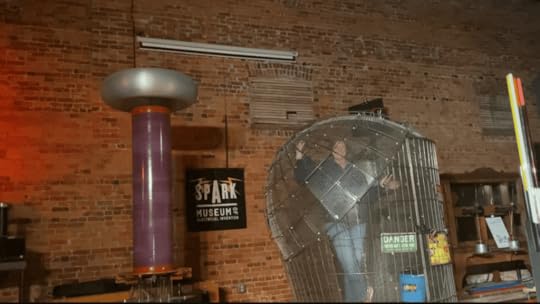
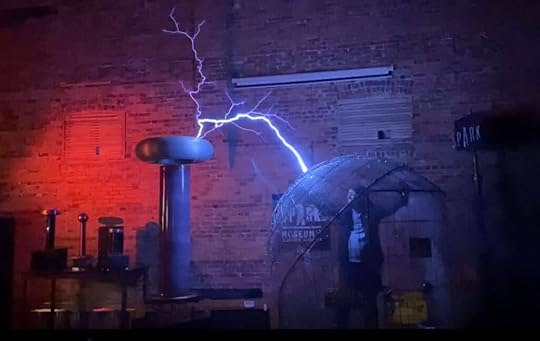
The reason I said: “I trust Physics… and Faraday” is because I was safe because the “cave of doom” was actually a Faraday cage that protected me from the electric effects of the coil. That brought up a really interesting question. How and why did Faraday build a giant cube or cage that was big enough for him to “live in” and why did he do this in 1837, 50 years before the discovery of Radio waves and 56 years before the invention of the Tesla Coil?
This story will be split into 4 parts. First, a little background of the people, namely Benjamin Franklin and Charles Coulomb whose experiments inspired Faraday.
The second is a description of what Faraday did in the 1830s to create the cage. Third, I will talk about how the actions of a young William Thomson (later ennobled Lord Kelvin) led over the years to the Faraday cage becoming popular and how their actions led to the cage being used with Heinrich Hertz’s radio waves and Nikola Tesla’s coil demonstrations. Forth I will go through a whirlwind overview of the influence of the cage: specifically, how knowledge of the Faraday cage led to the discovery of the electron and how it is used in the microwave oven and even EMPs and protection devices.
Table of ContentsFaraday Cage: InspirationFaraday and His Cage Development of the Faraday Cage Influence of the Faraday Cage Faraday Cage: Inspiration
In my mind, the story of the Faraday Cage does not begin in 1837, but 82 years earlier with Benjamin Franklin in 1755.
This was 3 years after Franklin had done his famous key and kite experiment in the electrical storm and he was still trying his best to figure out how storm clouds created and stored electrical charges.
For that reason, he conducted a lot of experiments electrifying different materials with different shapes and testing their charges. He knew that if a neutral object was placed near the outside of a charged jar, the neutral object would be attracted to the jar and, if it touched the outside of the jar, it would gain some of the electricity from the jar and then be repelled by the jar.
In this experiment, however, Franklin tried electrifying a silver jar and then lowered a ball into the *inside* of the silver jar to see if the charges were more concentrated on the inside. To Franklin’s shock, the cork was not attracted to the jar. Moreover, if the cork ball touched the inside and then retrieved the cork would remain neutral.
In other words, not only had Franklin demonstrated that the charges on a conducting object were to be found on the outer surface, but Franklin also accidentally found that the conducting silver jar somehow shielded the inside of the jar from any electrical effects.
Franklin was completely flummoxed by this result writing, “The fact is singular. You require the reason; I do not know it. Perhaps you may discover it, and then you will be so good as to communicate it to me.”
The reason that I know about this experiment is that 14 years later, in 1769, Franklin included his description of this experiment in the 5th edition of his book on electricity. Then, in 1776 Franklin went to France and used his fame from electricity to assist his efforts to gain French support for the American Revolution. This was a resounding success; Franklin was a superstar.
John Adams, a man who personally disliked Franklin, wrote that in France Franklin’s, “reputation was more universal than that of Leibnitz or Newton or Frederick or Voltaire, and his character more beloved and esteemed than any or all of them.”
In Paris, one of the many people interested in Franklin’s work and the visitor was a 40-year-old mechanical engineer named Charles Augustin Coulomb. It was when Franklin arrived in France that Coulomb learned about a contest to make a very sensitive compass which inspired him to not only create a compass but also study the twisting force and create the torsional scale.
Perhaps inspired by Franklin’s visit, or the memories of electricity that he learned in school, Coulomb started using his new torsional balance to study the electrical forces. By 1785 Coulomb experimentally determined that electrical force is proportional to one over the distance squared, which he declared to be a “Fundamental law of Electricity.”
The following year, in 1786, Coulomb relooked at Franklin’s experiment with the silver jar and, decided that, even with his new super accurate electricity meter, “when a conducting body is charged with the electric fluid [it] is only diffused over its surface, and does not penetrate into its interior parts.” It was Coulomb’s experiment that led Faraday to make his cage, which brings us to…
Faraday and his CageNow I would like to fast forward to Michael Faraday in 1831.
I picked that date because that is when Faraday discovered how to induce electricity with moving magnets or changing magnetic fields. His biographer and friend said that “after the discovery of magneto-electricity his fame was so noised abroad that the commercial world would hardly consider any remuneration too high for the aid of abilities like his.”
However, Faraday decided that he could not make money or have honored and still dedicate himself fully to science. As he said it was a decision between “wealth or science,” and with the support of his beloved wife Sarah, they choose science. Faraday thus declined every honor and financial reward that came his way, and, as his wish, “remain[ed] plain Michael Faraday to the last.”
Starting in 1831, Faraday wrote paper after paper about the “experimental researches in electricity” eventually writing 30 papers with that title, much of which affects our life and language to this very day. For example, in a single paper in 1834, his seventh on electricity in 3 years, Faraday created the names anode, cathode, electrolytes, electrodes, anions, cations, and ions.
When a friend wrote him a complimentary letter about his work in 1835, he responded: “Your letter was quite refreshing for I had begun to imagine that I thought more about Electricity and Magnetism than it was worth: and so a notion was creeping over me that after all, I was perhaps only a bore to my friends.” By the pivotal year of 1837, for his eleventh paper on electricity, Faraday decided to re-examine all of the old theories of electricity with all of this new knowledge.
As he put it, “the science of electricity is in that state in which every part of it requires experimental investigation; not merely for the discovery of new effects, but what is just now of far more importance, the development of the means by which the old effects are produced.”
Faraday had read Coulomb’s 1768 paper and for Faraday, the fact that the charges in a conductor move to shield the electric forces proved that the conductor wasn’t producing extra charges but just moving the charges until all the forces are balanced.
Faraday just saw it without math or even an explanation beyond a simple statement that, “the beautiful experiments of Coulomb … are sufficient, if properly viewed to prove that conductors cannot be bodily charged.”
Faraday wondered about insulators or non-conducting materials and declared that “with regard to …non-conductors, the conclusion does not at first seem so clear.” However, after various experiments, Faraday determined that it seemed true for insulators as well.
For example, if part of a piece of glass was electrified with one charge by contact or proximity to a charged conductor, “it was always found that a portion of the inner surface of the contactor…or another part of the glass itself was in an equally opposite state.”
To examine this further, Faraday decided to examine how air (an insulator) reacted to charge. For this reason, Faraday redid Coulomb’s and Franklin’s experiments and upped the size by making a giant cage. Here is how Faraday described it: “I had a chamber built, being a cube of twelve feet [each side or 3.6 meters].
A slight cubical wooden frame was constructed, and copper wire passed along and across it in various directions, so as to make the sides a large net-work… and supplied in every direction with bands of tin foil, that the whole might be brought into good metallic communication.” After various experiments inside the cage, Faraday turned it around and had his assistant conduct experiments outside the cage while he, as he dramatically put it, “went into the cube and lived in it.”
Faraday, therefore, discovered that when he was inside his cage, he was protected from all electricity that happened outside. “I put a delicate gold-leaf electrometer within the cube, and then charged the whole by an outside communication, very strongly, for some time together; but neither during the charge [nor] after the discharge did the electrometer or air within show the least signs of electricity.” He added that he couldn’t see any electric effects, “though all the time the outside of the cube was powerfully charged, and large sparks and brushes were darting off from every part of its outer surface.”
Faraday was happily convinced by this and concluded, “that non-conductors, as well as conductors, have never yet had an absolute and independent charge of one electricity communicated to them, and that to all appearance such a state of matter is impossible.” Soon after this experiment, in the same paper, Faraday wrote about how he recreated “the torsion balance electrometer of Coulomb… with certain variations and additions,” the biggest of which is that he coated his electrical measurement devices in stripes of tin foil so that they would be protected from stray electrical fields.
In other words, immediately after inventing a Faraday cage Faraday turned around and used one to protect his electrical devices.
Unfortunately, Faraday’s work started to slow by the late 1830s as he suffered from stress, anxiety, depression, and serious memory issues probably due to working with heavy metals without protective equipment (he spent 10 years trying to make high-quality glass lenses in the 1820s). In December 1839, his doctor recommended rest to keep him from a breakdown.
This did not help and In the summer of 1840, 48-year-old Faraday wrote to a friend: “This is to declare … that I am not able to bear much talking … being at present rather weak in the head, and able to work no more.” That is not to say that Faraday stopped making important discoveries, just that his work happened in fits and spurts.
Development of the Faraday CageThe biggest promoter of the Faraday cage was most likely an Irish scientist named William Thomson. Thomson learned about Faraday as a teen from his tutor and became, as he put it, “inoculated with Faraday fire,” and then met his hero Faraday at a conference in 1845 when Thomson was just 21 years old.
They became quick friends and Thomson then inspired Faraday to conduct an experiment that led Faraday to come up with the idea that light was a wave of electric and/or magnetic fields. Thomson did not like the idea of light being an electromagnetic wave, but it wasn’t enough to keep him from recommending Faraday to his younger friend James Clerk Maxwell, who ended up writing “Maxwell’s equations” based on Faraday’s ideas.
Meanwhile, Thomson talked about Faraday and his work and particularly emphasized Faraday’s cage. For example, in January 1860, Thomson complained that “even the best of ordinary electrometers hitherto constructed,” often give incorrect results, “as the inner surface of the glass… is liable to become electrified.” Thomson then lamented that “Faraday long ago showed how to obviate this radical defect by coating the interior of the glass case with a fine network of tinfoil; and it seems strange that even at the present-day electrometers…should be constructed with so bad and obvious a defect uncured by so simple and perfect a remedy.”
Thomson then added the term cage when he noted that: “a cage made like a bird’s cage…may be substituted with advantage for the tinfoil network.”
During this time, Faraday’s health continued to deteriorate and he conducted his last experiment on March 12, 1862, at the age of 70, and wrote a friend, “Again and again I tear up my letters, for I write nonsense. I cannot spell or write a line continuously.
Whether I shall recover—this confusion—do not know.” Faraday died on August 25, 1867, at the age of 75 and, as was his wish, had “a plain simple funeral, attended by none but my own relatives, followed by a gravestone of the most ordinary kind, in the simplest earthly place.”
A few weeks after Faraday’s death, the now knighted Sir William Thomson was on a committee to create standards of electrical resistance. In this report, Thomson stated again that it was a shame that people didn’t use Faraday’s system to protect their electronic equipment and added that the electroscope he was using was protected by using a “Faraday metal cage.” And, thus the term “Faraday cage” was born.
12 years later, in July of 1879, a 22-year-old German graduate student named Heinrich Hertz was told about a prize to experimentally prove “the theory of electrodynamics which was brought forth by Faraday and was mathematically executed by Mr. Maxwell.” It took Hertz eight years, but in 1887 Hertz discovered that if he added an antenna to an induction coil, it would make an invisible electromagnetic wave that he could “catch” across the room as a spark in a circular wire with a tiny gap in it. These waves were initially called Hertzian waves but by the 1920s they were called radio waves. As radio Hertzian waves were created by vibrating electricity and moved at the speed of light, this seemed like a validation of the Maxwell-Faraday theories of the nature of light.
When William Thompson heard about it, he thought that radio waves would make it through a Faraday cage saying, “we all know how Faraday made himself a cage… [and] he saw no effects on his most delicate gold leaf electroscopes in the interior [but Faraday’s] attention was not directed to look for Hertz sparks, or probably he might have found them in the interior.” What Thomson didn’t know was that in July of 1889, Hertz tested out the Faraday cage for radio waves and found that it blocked his alternating signals too. For when Hertz placed his spark gap in a wheel of wires, he found that “not the slightest electrical disturbance would be detected in the wire in whatever direction waves were sent through the apparatus.”
At around the same time that Hertz was playing with Faraday cages, Nikola Tesla learned about Hertz’s experiments and later recalled that “the publication of Dr. Heinrich Hertz’s results caused a thrill as had scarcely ever been experienced before.” Tesla then, “concentrated my attention on the production of a powerful induction coil,” which eventually led to the development of the very high voltage Tesla coils. To Tesla’s delight, his new coils would make great sparks and could even electrify fluorescent bulbs if they were held near the coil. Tesla burst on the scene with these amazing displays in 1891 that even 12 years later were described as, “the most remarkable lectures ever delivered before a scientific audience.” Tesla’s experiments and demonstrations were actually at lower frequencies than Hertz’s and it was quickly found that Faraday’s cage worked to block Tesla’s waves just as it blocked Hertz’s and were soon incorporated into some of the Tesla coil demonstrations, as they continue to do to this very day.
Influence of the Faraday CageBut that is not the only use and influence of the Faraday cage. For example, 6 years after the Tesla coil, in 1897, a shy Englishman named J J Thomson (no relation to William Thomson) used his knowledge of the Faraday cage to discover electrons. See, Thomson was confused because Heinrich Hertz (the same guy who had discovered radio waves) had been unable to move a beam in a cathode ray tube with electrified plates even though another scientist had determined that the cathode ray had a negative charge and it was well known that the beam could be moved with a magnet just like negative electrical charges moving in a wire. Thomson then realized that trace amounts of gas in the tube were becoming conductive and screening the cathode ray “from the effect of electric force, just as the metal covering of an electroscope screen off all external electric effects.” In other words, JJ Thomson realized that the air was ionized and acting as a Faraday cage. Thomson then devised a more powerful tube and removed more air so that there was not enough air to be a faraday cage and the beam could be moved with electric forces as well as magnetic forces. The interaction between these two forces (magnetic and electric) is how Thomson determined that the cathode ray was composed of tiny negatively charged particles that are in everything which he called corpuscles (but we now call electrons).
In addition, as we had more technological electrical devices, there was a corresponding need for Faraday cages to protect delicate items as well as ourselves. For example, one day in early 1945, a very nice man named Percy Spencer was working with microwave radar at different frequencies to see if he could improve them. I mention this because, on that particular day, Percy found that when he worked on his microwave radar the Mr. Peanut bar in his pocket melted! After testing it out with popcorn and an egg (which exploded!) Spencer realized that these waves, which are just high frequency (and therefore microwave) radio waves happen to have just the right frequency to make the water in food spin and heat food up. Spencer immediately filed for a patent for a microwave conveyer belt! Two years later, Spencer redesigned it into what he called a “microwave oven” where the oven was made of conductive material so that it would act as a Faraday cage and protect the operator.
Or another example, in July of 1962, the United States military tested out a 1.4 megaton hydrogen bomb (about 100 times more powerful than the bomb in Hiroshima) almost 250 miles above an island in the pacific. To the surprise of physicists, this caused circuit breakers to pop and burglar alarms to ring 800 miles away in Hawaii. By 1967 they determined that the bomb had interacted with the lower van Allen belt creating a huge electromagnetic pulse which they called by its initials EMP. However, at first, people weren’t too worried about EMPs as most of their equipment was built with vacuum tubes which are pretty impervious to damage from the very short spike of an EMP.
However, with the rise of semiconductor technology, there was more worry about damage from EMPs. By 1980, the secretary of defense publicly worried about “the widespread loss of connectivity which would be caused by a high altitude nuclear explosion and its resulting electromagnetic pulse.” By May of the following year, a science journalist named William Broad wrote a series of articles with the alarming subtitle of “a single nuclear blast high above the United States could shut down the power grid and knock out communications from coast to coast.” Many governments of the world took this seriously and made efforts to protect their vital electrical systems but the general public became convinced that all nukes would disable all electronics. Soon movies were showing planes falling out of the sky due to EMPs. My favorite is from a truly campy movie from 1994 called “Broken Arrow.” In this movie, an evil John Travolta detonates an underground nuclear device that destroys all of the operational electrical devices and causes a helicopter to crash. When he was told that the “shockwave took down the damn chopper” he responds “that was the EMP, electromagnetic pulse, nuclear blast sends it out for miles, everything electronic just shuts down including choppers and radios”
Note that this movie is just wrong. Small underground nukes do not make a big EMP, and even if they did, airplanes and helicopters tend to be pretty safe as they are made of metal and by themselves are Faraday cages (which is why they are safe when struck by lightning). In addition, it is possible to protect systems not in an airplane with a Faraday cage and/or surge protectors, which is called “hardening” the equipment. That is why most data centers and power centers are put behind metal gratings or metal walls. That is not to say that an EMP from a large nuke in the atmosphere is harmless as it takes money to protect equipment and it is too often skipped. For example, in 2019, the “Electric Power Research Institute” said that although the worst case EMPs could cause widespread electrical damage, “on the order of several states or larger…[However,] none of the scenarios that were evaluated resulted in a nationwide grid collapse.” Of course, in a large EMP blast, your personal electronic equipment could be fried, and statewide electrical failure would be pretty catastrophic which is why people sometimes buy or make Faraday cages to protect their equipment for such a scenario.
In addition, with the rise of wireless communication, there was also an increased interest in using Faraday cages to protect data from electronic snooping. This is another reason for the portable Faraday cages to protect your cell phone. That is why the US government created secure facilities called SCIFs which are a big Faraday cages to protect the people inside from outside interception of data. For all of these reasons, and many more, Faraday cages are abundant in electrical engineering.
So that brings us to the final question: what is going on with the electrons in the cage to cause it to protect the interior from both lightning and some electromagnetic waves but not others? I will use an 1843 experiment by our friend Michael Faraday with an ice bucket to explain the physics of the Faraday cage next time on the lightning tamers.
So that was the long history of the Faraday cage. If you want to learn more about these people and their experiments, I have A LOT of other videos out there on basically everyone I talked about before 1945 (I will get to the people after 1945 eventually) OR I am very excited to announce that on October 12, 2022, “The Lightning Tamers” my brand-new book about the electrical history and more will be available on Amazon, fine bookstores and even libraries!
The post Faraday Cage: A Deep Dive In Its History appeared first on Kathy Loves Physics.
Faraday Cage History: A Deep Dive
On February 22, 2022, I got to climb into something called the “cave of doom” and then stand there as it was hit by huge lightning bolts from a giant Tesla coil.
How and why did Faraday build a giant cube or cage that was big enough for him to “live in” and why did he do this in 1837, 50 years before the discovery of Radio waves and 56 years before the invention of the Tesla Coil?
Table of ContentsIntro Part 1: Inspiration Part 2: Faraday and his Cage ...May 1, 2022
How Electricity Got Its Name
What does Electricity have to do with jewelry? I’ll tell you and along the way, I will also talk about:
Gods,sheep,death by a thunderbolt,women who turn into trees,bleeding people for their own good,how compasses work,giant diamondsand creative insults.The story of electricity begins with jewelry. Not just any jewelry but jewelry made of amber. Turns out that if you rub amber with fur on a dry day it can pick up little pieces of fluff or small feathers like this. Cool eh? We would call this Static Electricity or even magic but 1600 years ago this amber effect inspired a Greek philosopher named Thales of Miletus to say, “all things are full of gods.”
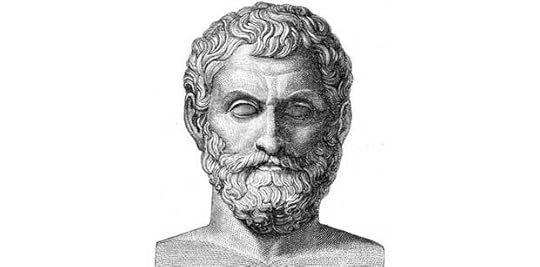 Thales of Miletus
Now how did Thales know about Amber? We don’t know. No books of his have survived, we mostly know about him through Aristotle and many of Aristotle’s books have also disappeared. We can only make an educated guess.
Sometimes people imagine Thales as this intrepid experimental scientist. One video I saw even had a cartoon of Thales wandering through the countryside rubbing sheep! (What!). But, Thales was not a scientist; he was a philosopher who interpreted the known world.
So, in Thales’s honor, let’s do a thought experiment: Imagine a jewelry salesman who stores his amber in fur to protect it and notices that it creates static cling. This smart individual decided to fold this property into an existing Greek myth. This is where Amber comes from according to Ovid: The sun had many children including a son named Phaethon.
One day Phaeton stole his father’s chariot for a joy ride and Jupiter (the god, not the planet) hit him with a thunderbolt for reckless driving and he fell off the chariot and drowned in a river. His sisters stood at the riverbank crying for so long that the gods got sick of all the negativity and turned them into trees and their tears into amber.
Although this story does not end well for Phaeton or his sisters, it does end well for the salesman, who could then increase the price of amber, as it was not just jewelry but also a small piece of the gods!
Irrespective of how it was discovered, nothing much happens with electricity for a further 2,000 years! That brings us to a doctor named William Gilbert practicing in Elizabethan England.
In 1600, Gilbert wrote a book on Magnets that was quite popular at the time. Gilbert’s popularity and success are a bit of a mystery as from his paintings we can tell he wasn’t very good looking and from his book, we can tell that he was cranky and not very charming. For example, he said that most of his contemporaries were, “lettered clowns, dramatists, sophists, spouters, and wrong-headed rabble, to be denounced, torn to tatters and heaped with scorn.”
His fame initially came from being an excellent doctor, which is hard to imagine as doctors at the time cured people by either bleeding them or giving them mild poisons! He must have been good at that as he practiced with “great applause” and was even made Queen Elizabeth’s personal doctor (although she was smart enough to not let him or any doctor touch her).
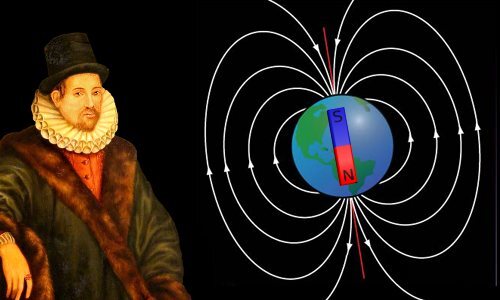
Anyway, like all Renaissance men, Gilbert had a hobby, and his hobby was studying magnets. See, many years before the Chinese had discovered that if a small magnet is placed on a pivot it will always face North (which is what a compass is). Gilbert was the first to think that compasses work because the Earth is a giant magnet and spent 18 years doing experiments.
In the middle of his studies of magnets, Gilbert turned to “the Amber effect” to see if it was a type of magnet because it seems kind of magnet-like. After careful study, Gilbert determined that Static Electricity is different than Magnetic. Yes, they both attract from a distance but 1) Magnets are permanent, and “Electrics” need to be rubbed 2) Magnets only attract certain metals and Amber attracts everything, and 3) Amber doesn’t work well on humid days and doesn’t work at all underwater and Magnets are unaffected.
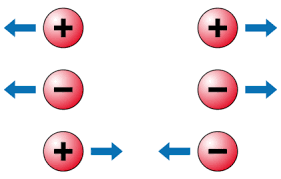
Gilbert then scoured the Earth for every substance available (from waxes to giant diamonds) and found that a whole bunch would attract light objects if rubbed. He knew that the Greek name for Amber was, wait for it, “Elektron”. He, therefore, named it the “Amber-like” force or the “electrius” force or in English “Electric force”.
For all of his careful study, William Gilbert made one major mistake. He noticed that magnets can attract or repel (you put a North and South together they attract, a North and North and they repel) but he didn’t realize electrics could repel too. It would actually take over 70 years and a really, well, stupid theory about a stinky ball on a stick to discover that “electrics” have this feature too, it is just a little harder to see.
The post appeared first on Kathy Loves Physics.
The Heaviside Patent Original Copy Free Download
I found the original Heaviside patent and found that he didn’t mention the word Faraday but he did want to use the sheath of wire to protect the inner wire as a Faraday cage.
Here is the copy if you want to see it for yourself or feel free to download the PDF File below.
Original Heaviside Patent PDF free download Download PDFThe post The Heaviside Patent Original Copy Free Download appeared first on Kathy Loves Physics.
April 30, 2022
The Real Origin of The Lightning Rod
Wait? I thought that Benjamin Franklin invented the lightning rod. Well, sort of. But before Franklin could get sparks
“After having thus set up the whole machine, unable to remain in the country to wait for the storm, I asked to make observations in my absence, an inhabitant of the place, named Coiffier, who served fourteen years in the dragoons, and upon whom I could also count for intelligence and for fearlessness. I had given him all the necessary instructions, either to observe the luminous aigrette which was to appear at the point of the iron rod or to draw the sparks of this rod with the tenon of an arch-wire, which had attached to the collar of a long vial to serve as a handle and by this means to guard him against the stings of those sparks which might be too strong.
I had also advised him to have some of his neighbors brought to the machine, and even to have the Prieur Cure de Marly, who had promised to be there as soon as time seemed ready, ‘thunderstorm.
On Wednesday, May 10, 1752, between two or three o’clock in the afternoon, my friend Coiffier heard a thunderbolt strong enough: he flies by the machine, takes the vial with the filarch, presents the tenon of the wire to the small brilliant spark emerges from the rod, and hears the sparkle; he drew a second spark stronger than the first and with more noise. He called his neighbors, and sent for M. le Prieur; the latter ran up with all his might; the Parishioners, seeing the precipitation of their parish priest, imagine that the poor Coiffier was killed with thunder; the alarm spreads in the village; the hail which occurs does not prevent the flock from following its shepherd. This honest Ecclesiastic came to the machine, and seeing that there was no danger, put his hand to work himself, and fired strong sparks. The cloud of storm and hail was not more than a quarter of an hour to pass at the zenith of our machine, and we heard only this single stroke of thunder. As soon as the cloud had passed, and no longer sparkled them from the iron rod, Monsieur le Prieur de Marly sent Monsieur Coiffier himself to bring me the following letter, “wrote in a hurry. “I tell you, sir, what you expect; the experience is complete. Today at two hours twenty minutes after noon the thunder roared directly at Marly; the blow was strong enough. The desire to oblige you, and curiosity, have drawn me from my own room, where I was busy reading: I went to Coiffier’s, who had already dispatched a child whom I met on the way to beg of me come, I have doubled my steps through a torrent of hail. Arrived at the place where the curved rod is placed, I presented the filarchal, advancing successively towards the rod to an inch. and a half or about; a small pillar of bluish fire, smelling of sulfur, which struck the tenon of the arch-wire with extreme vivacity, caused a noise like that which would be made by striking the rod with a key. I repeated the experiment at least six times in the space of about four minutes in the presence of several people, and each experience I did lasted the space of a pater and an ave. I wanted to continue; the action of fire has been gradually reduced; I approached nearer, and have drawn only a few sparks, and at last, nothing has appeared.
 Monsieur Coiffier
“The thunder which caused this event was followed by no other; all ended with an abundance of hail. I was so occupied in the moment of the experience of what I saw, that, having been struck on my arm a little above the elbow, I can not say whether it is by touching the filarch or at the rod: I have not complained of the harm done to me by the moment I received it; but as the pain continued, on returning home I discovered my arm in the presence of Coiffier, and we perceived a rotating bruise around the arm, similar to that which would be made by a telephone-call if I had had it been struck to nud. On my return from Coiffier, I met the Vicar, M. de Milly, and the schoolmaster, to whom I have related what had just happened; All three of them complained that they smelled an odor of sulfur, which struck them more and more as they approached me. I carried the same odor to my house, and my servants perceived it without their saying anything.
“Here, sir is a hasty, but naive and true account that I bear witness, and you can assure me that I am ready to bear witness to this event on every occasion. Coiffier was the first one who experimented, and repeated it several times; it was only on the occasion of what he saw that he sent me to pray to come. If other witnesses were needed than he and I, you would find them. Coiffier presses to leave.
“I am with respectful consideration, Sir, your, & c. signed Raulet, Prieur de Marly. 10. May 1752. “
It follows from all the experiments and observations which I have made in this memoir, and especially from the last experiment made at Marly-la-Ville, that the matter of thunder is incontestably the same as that of electricity. The idea that M. Franklin had of this ceases to be a conjecture; it is now a reality, and I dare to believe that the more thoroughly it will be studied in all that it has published on electricity, the more it will be recognized how much Physics is indebted to it for this part.
It only remains for me to say something of the advantages that can be derived from this important discovery. Since it is well known that a metallic tip presented at a certain distance from a body that is at present electrified, fires it, and discharges it entirely without noise, without explosion, and without commotion: since it is also verified that a rod of iron presenting its sharp point towards a cloud loaded with thunder, draws in silence the electric matter of this cloud, as soon as it is close enough for the rod to be in its electric atmosphere, this rod will suffice to discharge it entirely from all the fire which is retained there, and it will affect this good effect all the more surely and more easily as the stormy cloud will be nearer and longer to pass within reach of the point.
Hence the infinite advantages of dissipating the matter of thunder almost at will, and of preserving from its attacks both public and private buildings. I am persuaded that if, instead of finishing, as is usual, the roofs of the pavilions, towers, Spiers, and masts of vessels, by cockroaches, by cocks, by crosses, by parrots, & c. metallic points were erected in the manner in which it was explained above, and these buildings would be secured by lightning. In the very supposition that the points thus raised, by drawing fire from the stormy clouds, would be assailed by an excessive quantity, or, to use the usual expressions, when these points would divide the cloud and would attract upon them an entire storm, the wire fastened to their lower extremity would suffice to lead this fire to earth or water outside the buildings, without the lightning being able to touch them; the reason seems obvious to me. As the metal is less electric, and therefore more permeable to electricity than the stones, woods, and other materials which enter into the construction of a building, the electric fire will not leave this road except when it lacks it.
To calm the fears of those who, notwithstanding these reasons, might apprehend that the points raised on their houses would attract the fire of heaven, I will add here another means of putting them entirely in safety. It consists in raising in the vicinity around their castles or houses several of these same metallic rods on large trees, on towers, on eminences,…. “Perhaps no more than a hundred iron rods, thus erected and arranged in the different districts and in the most elevated places, would be necessary to preserve the whole city of Paris from lightning.”
How in the world was the lightning rod created to humiliate a rival? Well, I’ll tell you and along the way, I’ll tell you about: … and why Franklin was famous in France which helped America win the American Revolution. Ready let’s go.
Most people have heard of Ben Franklin flying a kite in a thunderstorm. However, most people don’t know that he wasn’t the first to prove lightning clouds are electric. In fact, a Frenchman named Coiffer got sparks from a metal pole in a storm on May 10th, 1752, five months before Franklin reported his kite experiment! Why did Coiffer do this? Well, he was paid by a man named Dalibard who was working with his friend the Compte de Buffon. Coiffer was a retired soldier and Dalibard and Buffon were naturalists or people who studied and catalogued biological systems. So, what would cause two naturalists to hire a retired soldier to experiment with lightning? Their interest in electricity was purely social: they liked Franklin’s theories because they contradicted the prevailing theories that were championed by their rival, a religious man named Nollet. This was to lead to the invention of the lightning rod and fame and success for Benjamin Franklin. How? Well, I’ll tell you in this video. Ready? Let’s go..
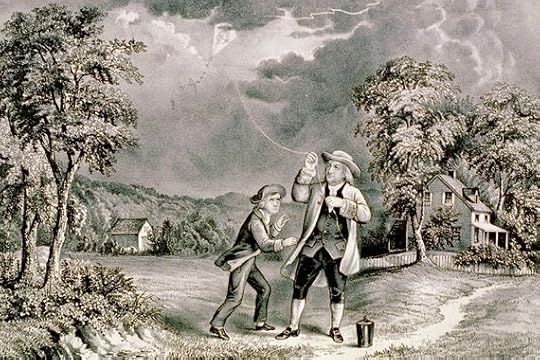 Franklin’s kite experiment
I am about to argue that America winning the American Revolution and the invention of the lightning rod might not have occurred without an astonishingly petty and longstanding rivalry between two Frenchmen: Jean-Antoine Nollet and a man named (ready for it) Georges-Louis Leclerc, Compte de Buffon. How would a rivalry lead to the lightning rod or influence a war? Well, I’ll tell you and along the way, I will talk about: how Franklin’s kite experiment really happened but happened five months after it happened in France, how blegh…
To understand how lightning was captured I first have to start with a rivalry between two Frenchman, Jean-Antoine Nollet and a man named (ready for it) Georges-Louis Leclerc, Compte de Buffon.
Jean-Antoine Nollet came from an impoverished background and joined the church as a young man. He then changed to science but insisted on being called Abbé Nollet (Abbe was a French method of saying Friar) for the social distinction and to remind everyone of his deep religious beliefs. He quickly moved up the social ladder due to his charm, wit, and delight in “shocking” experiments. Soon he became a palace favorite so much so that the King of France made him the tutor to his son. Nollet had been the assistant to a man named Cisternay DuFay who had made the first laws of electricity, which made Nollet the standard bearer for DuFay’s legacy after DuFay died from smallpox in July of 1739. DuFay had also been the curator of the King’s gardens called the Jardin du Roi (literally the King’s garden). Nollet thought that he would gain the position upon his mentor’s death. However, a rich nobleman, a freethinker, a drinker, a womanizer, and a sophisticate named Buffon got the position instead. It was the beginning of their lifetime of rivalry and acrimony.
Georges-Louis Leclerc, Compte de Buffon was in many ways, the epitome of the French Enlightenment. He was a brilliant writer, a lover of money, fame, popularity, and disturbingly young girls. Unlike the highly religious Nollet, Buffon was indifferent to religion, and his circle of friends included Voltaire and Diderot. Surprisingly, Buffon had no interest in electricity and instead was mostly known as a naturalist: studying plants and animals, inspiring Darwin for example.
This leads us to Benjamin Franklin. Franklin had been writing to his English friend named Collinson about his ideas on electricity. In 1749 they published their letters as a book. However, at first, it didn’t do well in England. The leaders in Electricity were loath to read new ideas in the field – especially from an upstart colonist. Franklin decided that he had learned a lesson with England that he was not going to repeat in France. This time, he decided to send his book to the rival of the leading authority in electricity. In other words, instead of sending his book to Nollet, he “asked Mr. Collinson to send one of the first copies to Mr. Buffon.”
Buffon was delighted to get the book. See, Franklin thought that everything contained charges and when you rubbed objects you moved charges: which he called positive and negative (and an equal amount to be neutral). This was contrary to the prevailing theory made by Nollet’s former mentor who thought that when you rubbed glass items you created one kind of electricity and when you rubbed wax it created another kind of electricity. Now, Buffon had no interest in electricity, but he was very interested in insulting Nollet. Buffon thus asked his friend Thomas Dalibard to translate it into French (although Dalibard didn’t know anything about electricity either). Dalibard made a translation with an “Abridged History of Electricity” in the preface, so abridged, in fact, that, “Nollet’s name did not even figure in it.” Buffon then hired a with the stage name of Delor to demonstrate the “Philadelphia Experiments” to the king.
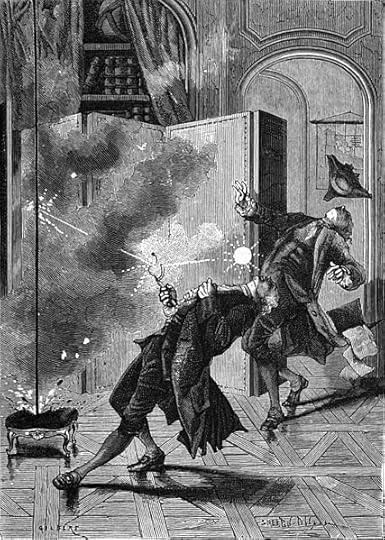
Nollet, as expected, was furious, “Mr. de Buffon is the promoter of the whole business. He does not appear openly himself, because he knows too little about the subject; he has two tradesmen in his service [Dalibard and Delor] who take care of everything.” Nollet even wondered if Franklin might have been invented whole cloth by his enemies just to embarrass him.
On February 3rd, 1752, Delor demonstrated Franklin’s theories to King Louis XV. The King was so impressed that the men gained “a desire of verifying the conjectures of Mr. Franklin upon the analogy of thunder and electricity”.
Towards that end, Dalibard decided to attempt Franklin’s lightning experiment. Franklin had written that if lightning clouds were electrified then if a metal pole was near the clouds then by induction the pole would get electrified and would produce sparks. So, Dalibard put a large metal pole on an insulated stand sticking out of a tent in his home in Paris as well as near his country house in the town of Marly-la-ville around 15 miles from Paris. He obtained the services of a retired soldier named Coiffier to manage the apparatus in Marly-la-ville for times when Dalibard was in the city. On the afternoon of Wednesday, the 10th of May, 1752, Coiffier heard thunder and ran to the tent managed to get a couple of good sparks, and called for his neighbors to fetch the local parish priest (called a curate). This is how an author and scientist named Priestly dramatically describes what happened only 15 years after the event, “The curate runs with all his might, and the parishioners seeing the precipitation of their spiritual guide, imagine that poor Coiffier had been killed with lightning. The alarm spreads through the village, and the hail which came on did not prevent the flock from following their shepherd. The honest ecclesiastic, arriving at the machine, and seeing there was no danger, took the wire into his own hand and immediately drew several strong sparks, which were most evidently of an electrical nature, and completed the discovery for which the machine was erected”
Three days later Dalibard reported the experiment to the Paris Academy, but Nollet objected to the paper and insisted that more research needed to be done, especially by “qualified” electricians before publication. Nollet thus inspired every electrician in Paris to repeat the experiment, up to and including even poor Mr. Nollet, “dying of chagrin from it all” as the ever-gallant Buffon put it. Buffon and his “crew” had thoroughly defeated Nollet on the issue of Benjamin Franklin making Franklin the toast of Paris in the meanwhile. Therefore, when Franklin went to France to try to get money and arms for the American revolution he arrived as a superstar. After such unprecedented success in humiliation, Buffon went back to his natural history studies and never dealt with electricity again.
Meanwhile, in October of 1752, Franklin wrote that he had heard of the “success of the Philadelphia experiment” in papers from Europe and that he had had similar success, “made in a different and more easy manner” with a kite. Here is the famous Franklin kite experiment. Franklin described in detail how to perform the experiment: he made a silk kite with a sharp wire sticking out the top of it. He used a line made of twine (tied to the wire) with a bit of non-conducting silk near the hand of the person flying the kite, and finally, at the juncture between the silk and the twine, he tied a metal key. Even though the kite was flown in the rain, the person and the silk rope and the key were under a doorway and kept dry so that no electricity would flow to the person holding the kite. Notice that, just like the previous experiment, the experiment works without the kite being struck by lightning! The idea is that if the clouds are electrified then the kite (and the wire and the twine and the key) will be electrified too. Franklin found that it worked very well. The sparks “stream out plentifully from the key on the approach of your knuckle. … the sameness of the electric matter with that of lightning completely demonstrated.”
Benjamin Franklin had literally captured lightning in a bottle, and it made him famous. It is hard to fathom today how influential Franklin’s experiment was at the time. In 1769, a historian described Franklin’s discovery as “the greatest, perhaps, that has been made in the whole compass of philosophy, since the time of Sir Isaac Newton”. Franklin’s book became, “one of the most reprinted and talked about books of the age”.
Another comment about these lightning experiments. Years later many people erroneously thought that Franklin’s kite was actually hit by lighting instead of flying on a stormy day without getting hit. Thinking that the kite was hit by lightning has caused many, many (many) people to mistakenly think that Franklin didn’t do the experiment at all. If it was a fake it was an odd one as he said that he had completed it after the French experiment and contained a lot of detail. Also, Franklin had no history of making up experiments or not taking science honestly or seriously. Now, just because it was possible to fly a kite in the rain doesn’t mean that it isn’t dangerous. In fact, on August 6, 1753, a German man named Georg Wilhelm Richman in St. Petersburg was looking at his “Franklin style” Sentry box device when it was struck by lightning and killed the poor man. His death was widely reported and remarked upon, in a strange way it was taken as conclusive proof that lightning was a form of static electricity. It certainly put a damper on doing lightning capture experiments.
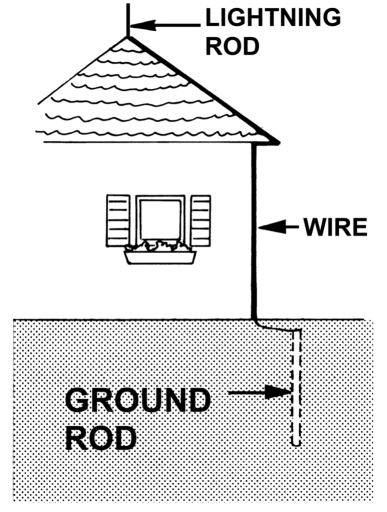
After proving that lightning is made of electricity, it was a natural result to try to use his newfound knowledge of how electricity moved to protect people from the dangers of lightning strikes with the lightning rod. The lightning rod is a ridiculously simple instrument: it is a metal rod placed on the top of a building with a wire connected to the ground. That is it. As a newspaper writer, Franklin had long noticed that lightning strikes tended to move in a pattern that went through metal, and that the “mischief” from lightning happened when the lightning burned through items like wood (or people). With a lightning rod, Franklin hoped that the lightning would be attracted to the sharpened tip of the rod and then safely flow into the ground. Franklin quickly placed lightning rods around Philadelphia and published how to install one yourself in his very popular yearly pamphlet “Poor Richard’s Almanac” in 1753.
Back in France, Nollet attempted to discredit Franklin directly with a series of letters but Franklin wisely decided to not respond and let his work stand on its own and be supported by other scientists. Nollet also fought against the lighting rod saying it was, “as impious to ward off Heaven’s lightning as for a child to ward off the chastening rod of its father.”
The lightning rod became very popular in Europe due to a totally unrelated development, an increase in the amount of gunpowder being used in wars. Because countries were fighting with more cannons and guns, they needed to create and store large amounts of gunpowder. Unfortunately, they would often store the gunpowder under Churches or other big buildings and when those buildings were hit by lightning it was often devastating. One of the most damaging was in August of 1769 in the town of Brescia near Venice, Italy where 207,600 pounds of gunpowder was blown to smithereens. “Three days have been spent in digging out the ruins of about two thousand bodies, and five hundred people, who thought they are still alive, are dangerously bruised. The fifth part of the city is entirely destroyed, and the rest is very much damaged”. That a simple bar of metal could save a town from that much destruction made it a necessity for all towns and, especially, all arsenals. Pretty soon the lightning rod (sometimes called “Franklin rods”) was ubiquitous throughout the world.
By the 1760s Franklin’s attention was diverted from science by politics although he continued to work on science for the remainder of his life. At the end of his life, Franklin was described as follows: “He snatched lightning from the sky and the scepter from tyrants.”
In 1785, a Frenchman named Charles Coulomb found an equation for the force between charges that looks strangely similar to Newton’s gravity equation. However, aside from that, once again it was a fallow period of electrical experimentation or discovery. That all changed in 1891 when an Italian anatomy professor happened to put a dissected frog near a static electricity machine in the most important experiment of all time.
The post The Real Origin of The Lightning Rod appeared first on Kathy Loves Physics.