Mia Sivan's Blog, page 2
November 18, 2024
Toledo Literary Research Trip
In November I went on my very first literary research trip. My husband and I were in Toledo, the capital of Castile-La Manche, where my next book is taking place.
Check out this panorama of the city.
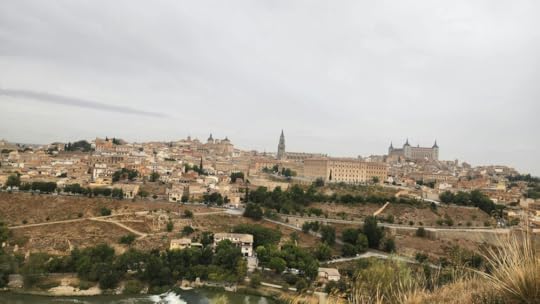
My story unfolds within many of the iconic structures visible here: the cathedral, the Alcázar (the fortress), and the Jewish quarter (La Judería).
I shared my trip on Instagram, you can follow me there for more pics and stories.
Another enjoyable part of this research journey has been ongoing for months: reading historical mystery novels set in the same era (though not always in the same place). Two female authors, Alys Clare and Sharan Newman, have crafted series set at the end of the 12th century, each featuring compelling female sleuths
Alys Clare writes about Abbess Helewise, who is in charge of Hawkenlye Abbey, in Kent. It is the English countryside, so naturally - mysterious deaths abound. The charming and tenacious Josse d'Acquin is her reliable sidekick. I'm on the ninth book of this series, which has humor, action and heart, and I couldn't recommend them enough.
Sharan Newman’s heroine, Catherine LeVendeur, stumbles through the mid-12th century, where dead bodies literally fall out of the sky on her. Catherine is half Jewish, and the constant tension between her Christian faith and her Jewish heritage is central to the series' strength. Her companion, Edgar, a tall, pale Englishman, adds another layer to the books, because what’s a historical mystery without at least one Englishman?
The book I'm writing is called Murder at the School of Translators, and it's a murder mystery set in Spain, circa 1194, featuring Rebecca, a feisty Jewish healer, and John, her English companion, a Christian crusader.
Here is a possible depiction of the pair:
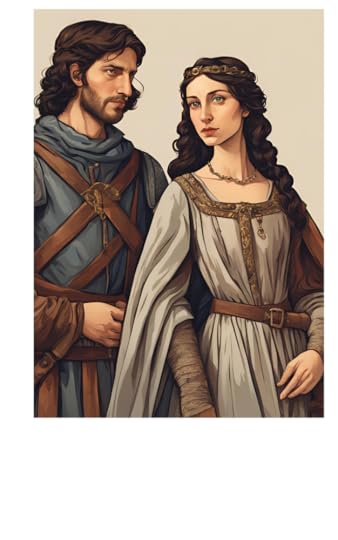
Ivanhoe meets Phryne Fisher in a woman sleuth medieval adventure
In 1194 Toledo, healer and heiress Rebecca is recruited by Queen Eleanor to uncover the truth behind a Jewish translator's death, even if it means jeopardizing the trust of her own community. She is joined by Sir John of Hampstead, a disillusioned crusader with secrets of his own. Together, they must overcome their mutual distrust, else the simmering tensions in this multireligious city will erupt and tear it apart.
I'm very excited with this book - it was tremendous fun to research and I'm already very advanced with my first draft. I'll share more of my research trip and pics here and in social media.


October 20, 2024
Weekly checkups and Safe Space
In June 2022 I went to an indie writers conference in Madrid. It was my first ever writers' conference, and the only one I’ve been to so far. It was a great experience, yet if you asked me today what I learned there in terms of creative writing or commercial tips, I wouldn’t be able to give you a clear answer.
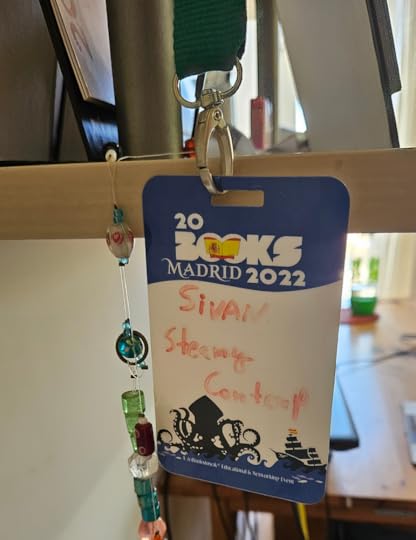
What has truly stayed with me, more than two years later, are the people I met, and the relationships that came out of it. Flying to Madrid and meeting professionals who share my new passion helped me start building a new network.
Everyone was an indie author. Some were best-selling authors, some were newbies like me. I shared a drink (alright, two, maybe three) with Steamy Romance authors, then had dinner with a group of Women Fiction female writers. We exchanged phone numbers and started a WhatsApp group chat.
This chat is alive and kicking to this day, providing a free exchange of knowledge, and a safe space to ask questions and receive help. Every Sunday morning, the group admin, who is a wonderful person called Sora (we’re meeting in person again next month, yay!), posts the same three questions:
1) What are your goals for the coming week?
2) What really worked well in the past week?
3) What didn't work? How will you change it?
The trick is to answer them truthfully, and to be willing to be vulnerable.
Answering them has become a part of my writing routine, helping me stay accountable. It’s not just about setting goals. It's about being honest with myself, and sharing it with others - especially when things don’t go as planned.
I’m sharing with you my answers from this Sunday:
1) What are your goals for the coming week?
Continue writing the story of Rebecca the medieval healer - she is getting closer to solving her murder mystery in 12th-century Toledo.
2) What really worked well in the past week?
Starting to write historical mysteries is already working for me - as a way to escape to a different time and place. I’ve also been pitching and appearing on podcasts these past few months. While I’m not sure of the results yet, each conversation helps me think about and refine my brand.
3) What didn't work? How will you change it?
Didn’t do enough physical exercise, neither walked nor did my Yoga. Need to flex that willpower muscle more.
What is your safe space? let me know in the comments.
October 11, 2024
Guest at Apollo Papyrus Podcast
Listen to my latest podcast episode, guesting at Apollo Papyrus Podcast.
Host Aaron Apollo Camp interviews authors, publishers, and other important people in the writing world, with guests coming from many different backgrounds.
Aaron and I discussed my transition from a career in investment finance to writing romance novels, the challenges of self-publishing, and my passion for creating empowering stories featuring mature female protagonists.
Here is a link to the episode:

And here is the transcript to some of the question and answers :
Mia: Okay, so first of all, great question. Second, I think Investment is a fulfilling profession in the sense that you can see pretty quickly the fruits of your work. Like, if you are right about the market going up or down, or this equity going up or down, etc, if your prediction is right, you usually proven right pretty fast. If you’re more wrong than right for more than one year, it usually means you're not very good at your job.
I find that becoming an author is a marathon. In more ways than one. It takes a very long time to produce a book that I like and want to put out in the world. It takes a very long time for people to hear about you.
Aaron: You write steamy romance novels in the women of Tel Aviv series, which has three novels currently published, Crunching Her Numbers, Pulling Her Resources and Analyzing Her Assets.
Mia: Okay, so I just want to say:
It's in Israel, and they all feature a financial scam of some sort. The first book I wrote about my experiences as a wealth manager, which is an investment manager for wealthy people.
The second book, Analyzing Her Assets is based on my experiences working in a very, very large company, managing lots of money. The third book is based on my experiences as a startup investor. I met a woman who lied to get money out of investors, and I based my book on that.
Many of the romances in the market are for 20 somethings, which makes sense, since we all fall in love and, you know, and do stuff between 20 to 30. But there is a very large chunk of womanhood that happens afterwards. I write for women that do not happen to find true love between the age of 20 to 30, and I speak about how it is to find love at a later age.
Mia:
The book does not explore her professional development, because
So she's really, really confident that she's smart, but she's very afraid of going into a relationship with the opposite sex.
The way I built it is that she doesn't go into a relationship, but into a bargain. Because, you know, she feels confident bargaining with her colleague, who is a man she's very attracted to. She learns to like herself through his eyes.
Mia: Okay, another great question. Actually, the first book was the easiest, and I'll say why: it just came out in a very organic way.
The second and third books are already like part of a career, so I enjoyed writing them, but not as much as the first book. There wasn't so much exploration.
And then they also took less time to write. I write pretty slowly, but the first book really took me forever. I really liked that the heroine of my third book was 45 years old. For me, that was a lot of fun to write, a heroine that is very close to my age.
A: I think everyone should go to the self publishing route. Traditional publishing, I'm not sure, really gives you what you need, unless you are very, very well known. Also traditional publishers are actually taking successful indie publishers and give them contracts.
I think everyone should Self Publish. And there are many free resources to learn about it on Facebook and on the internet. And once you start doing it, you learn. And you can learn by, you know, by trial and error, because it is your time and money, but at least you're doing something.
October 2, 2024
Tel Aviv - A Year Later
It’s the Jewish New Year’s Eve today, so Happy New Year to all who celebrate. May the next year not be worse than the last one - that would already be a great accomplishment.
This blog post is not political. Nor do I want to lecture, explain, or need you to take sides. This is for me. To process and share a little of my thoughts.
The prolonged war and the fact that there is no end in sight make it impossible to look back and reflect. I wish I were post-traumatic, 'cuz that would mean the trauma has passed. But as I write this, I really don’t know what tomorrow will bring. There is a Brazilian song “Sadness has no limits, happiness surely has.” (Tristeza não tem fim, Felicidade sim). It was translated into Hebrew by Ehud Manor in 1978 (became a huge hit), and the Hebrew version keeps playing in my head. Sadness is a limitless sea.
Yet, still, I’ve been able to carve out islands of happiness, with the help of family and friends. Walking with a friend along North Tzuk beach, then taking a dip in the Mediterranean. Meeting with a beloved sister for beer and pizza. Traveling with my husband to Greece for a four-day vacation (unsure until the last minute if there was going to be a flight). Gathering the whole family for Shabbat dinner, where my father makes the effort and joins us.
I’ve fallen in love all over again with Tel Aviv. My city has always been a center of diversity and democracy, but this year that spirit has been even more present. Even so, it has profoundly affected my writing, and I find it very hard to pen a fourth book about contemporary Tel Aviv.
I continued to edit and revise my third book, which I released in March 2024. But I was okay with that since it was written before October 7, before the ground dropped beneath our collective feet. And so, I could do it, thinking back to a time when I was so secure and ignorant. While the fourth book is half-written, I haven’t been able to continue with it. With the daily support of my writer friends, via Zoom, and my broader circles, via WhatsApp, I’m changing direction. I’ll still be writing about strong women facing challenges head-on, there will be mysteries to solve, and some romance, but the setting will be different. Historical rather than contemporary. I’ll share more with you in the coming weeks.
I’ll end this post with an excerpt from beautiful poem, because everything has already been said before me, and far more eloquently:
so this is the sound of you
here and now whether or not
anyone hears it this is
where we have come with our age
our knowledge such as it is
and our hopes such as they are
invisible before us
untouched and still possible
“To the New Year” by W.S. Merwin ( The poetry foundation )
Yours,
Mia
September 7, 2024
Two Truths and a Lie
We're going through challenging times here in Israel, but I wanted to take a moment to connect and share a bit of lighthearted fun.
Do you remember the game Two Truths and a Lie? One of the reasons why this game is so effective is its ability to swiftly create a sense of intimacy and openness within a group. As we share our truths and the occasional deceptive detail, we inadvertently reveal a part of ourselves that may not come up in regular conversations. It's a safe space to showcase our quirks, adventures, and even vulnerabilities.
I last played it a few years ago in Nepal, in a town called Pokhara. I was there with a group of my childhood friends, getting ready to trek the Annapurna. We all knew each other pretty well since we grew up on the kibbutz together, but as the years went by, we lost touch.
To get reacquainted, we played this game - each of us told two truths and a lie, and the rest had to guess.
One of my classmates claimed he worked as a bodyguard for Elizabeth Taylor and fooled us all. None of us guessed it was true!
Now, it’s your turn to guess. Here are three facts about me, my two truths and a lie:
I was basketball captain of my American high school team (I’m 160, that’s about 5.2 feet - and that’s not a lie).
I am personally acquainted with an Israeli rock star.
I once participated in a tango competition in Buenos Aires and won third place.
Use the comment section, write and tell me: which one is the lie?
August 24, 2024
Tu B'Av the holiday of Love
Tu B'Av, literally the 15th day of the Hebrew month of Av, falls on August 19 this year. It’s the Jewish “Holiday of Love.” Our own Valentine’s Day, if you will.
In biblical times, the unmarried women of Jerusalem would wear white on Tu B'Av, and go out to dance in the vineyards (which coincided with the grape harvest). There, they might be chosen as brides by the unmarried men. I guess, nowadays, we would call it a rave.
For years, Tu B'Av was not a major holiday in Israel. While it is mentioned in the Talmud and had some importance in ancient Israel, it hasn’t been widely observed in Jewish communities for many centuries. In all the years that I've been part of the romantic scene (shall we say, age 12 onwards), I've never celebrated it.
But for the past couple of decades, it's been growing in importance and promoted as the "holiday of love". Florists, jewelry stores, and other retailers promote special sales and products leading up to the holiday, just like on Valentine's Day. My generation likes to look down on it, thinking that its ascendance in modern Israel has to do with commercial reasons.

But being a cynic is not very romantic, and I am a romance author. After all, I wrote three books that celebrate love and romance in my city of Tel Aviv. There's got to be more to the holiday of love than just selling overpriced flowers.
Back in Passover, I told you of what kibbutzim did to adapt the Haggadah (the text that guides the Passover Seder, recounting the story of the Exodus from Egypt), in order to renovate the ancient text and infuse it with new traditions. A similar argument can be made for the revival of Tu B'av. There is a tie here to a broader cultural and national movement in Israel: the wish to reconnect with ancient traditions and create new ones that resonate with modern times.
I wanted to see if the buzz around the holiday was just hot air or if young people in Tel Aviv and Israel had truly embraced it. So, I did some "research" - I asked my 29-year-old daughter if she and her friends were celebrating. She said yes, every year. This year, with everything that's going on, they still decided to celebrate. Sort of a F*ck you to all haters, Tel Aviv's spirit won't be crushed.
I agree.
Let's seize every opportunity to celebrate love - whether it's dancing under the stars, sharing a heartfelt conversation, or floating on Gordon's salty water pool, with drinks and a DJ.

August 12, 2024
Productivity under high stress circumstances
There are some stressful circumstances right now - I live in Tel Aviv, and Iran as well as its proxies in Gaza, Lebanon and Yemen - are threatening a coordinated attack on my city and country. Which makes for a great excuse to not work, and instead stare into space, or burrow into my (very light) summer throw and wait till this is all over.
Sraring into space can get pretty boring. Life needs to be lived. I continue to take care of my family, write my stories, manage my author business, and maintain my newsletter and blog schedule.
To help with productivity, I was given the advice of setting micro tasks and then celebrate crossing each off. I decided to give it a try.
The new book I'm writing is very different than the books I've previously written, in terms of time period and setting. That means a ton of time spent on research, which can become very daunting.
By setting a simple micro-task, I can see both the beginning and the end. For example:
30 minutes researching common plants and their uses for my heroine, who is a healer.
And this I can approach with less timidity.
I need to create detailed profiles for characters - their backstory, personality traits, physical appearance, and motivations. That's so much work, right? But if I tell myself:
Spend 15 minutes filling out a character profile template for Rebecca to understand her motivations and conflicts better, it becomes manageable.
Then, that first rough draft needs to get down on paper. I have friends who write at least 5,000 words a day. A normal book page holds about 250-300 words, so prolific writers produce almost twenty pages a day. Setting this goal for myself would be both unrealistic and destructive to my self-esteem.
So instead, a micro-task:
A 15-minute writing sprint focused on a specific chapter or scene to get words down quickly without stopping or editing.
This is totally doable, and gets me going.
I write down those tasks at the beginning of the day, preferably the night before. I never start the morning without knowing my mini tasks.
I write DONE, next to each of them and highlight it in yellow. The highlighting, in particular, I find very satisfying.
Do you think this method of micro-tasking may help you with your work? Hit reply and let me know, I'd love to hear from you.
July 27, 2024
Graffiti and wall paintings in Tel Aviv
In my last email I asked you about the themes you most wanted to read about in my newsletter. Several of you wrote back saying you like variety, and declined to vote, but most of you did choose.
Here are the results and they are quite conclusive: 63% wanted to read more about Tel Aviv, 29% wanted to hear about my writing life. Not many share my love for finance: only 8% wanted to hear more financial reading.
Last week, I went to the south Tel Aviv neighborhood of Florentin to watch a football game in a bar.
Like many southern neighborhoods, Florentin is undergoing a process of gentrification, although it's certainly taking its time. When I first moved to Tel Aviv, back in 1991, Florentin was touted as the next big thing - the best real estate investment ever. Young couples and families were encouraged to move there. The longstanding bustle of Levinsky Market at the eastern edge of the neighborhood, worked in its favor. But it never came to be. Empty commercial slots, dark alleys, and the occasional homeless, make it a scary place for a woman alone. I was comfortable going there because my husband and two grown boys were with me.
But now its bohemian potential is starting to emerge. That scruffiness gives it an authentic air, and part of the charm comes from tons of graffiti. It is the most painted neighborhood in Tel Aviv. I want to talk about a specific piece. I was lucky enough to meet the artist, Victoria, while she was at work, take her pictures, and speak with her.
Victoria is an Israeli/ French painter, and holds creative workshops for other French immigrants. The municipality sanctions her creations, meaning that her paintings are legal and no one washes them off.
When I saw her at work, Victoria was working on a portrait of 24-year-old Tamar Goldenberg, who was murdered by Hamas terrorists at the Nova Festival on October 7.
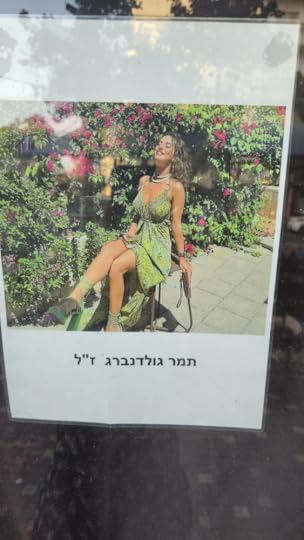
Victoria told me that just as she was finishing another project, Tamar’s family approached her. They wanted a happy memory of her, one that would last and bring joy to people. “You were always living in the moment. You didn’t care about anything materialistic… You did what you wanted and what felt right. “ Her sister wrote of Tamar.
Ortal owns a manicure salon in Florentin, and she was a good friend of Tamar’s: she had painted her nails especially for the Nova Festival. The family involved her in their commemoration efforts.
"Why not use this wall?" Ortal suggested, pointing at an ugly empty wall across the street from her nail boutique. Victoria, who had already had dealings with City Hall, volunteered to pave the bureaucratic way.
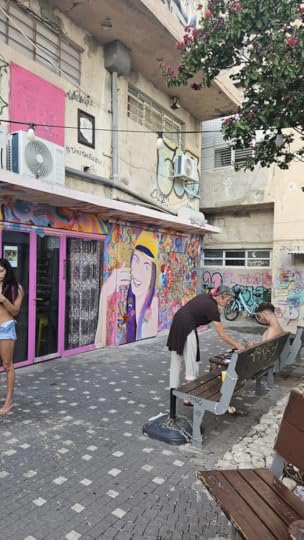
City Hall agreed to the location, provided the materials and also organized workshops for people who wished to take part in the painting. Victoria showed me where kindergarten children helped color part of the wall.
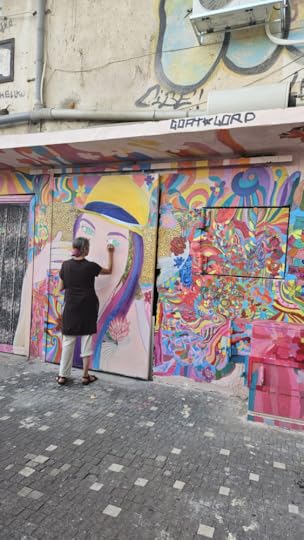
Tamar’s family wanted a beautiful image, not a dark one. Sunny, bright colors, with flowers everywhere.
I think Victoria nailed it.
June 19, 2024
My Journey from Finance to Fiction
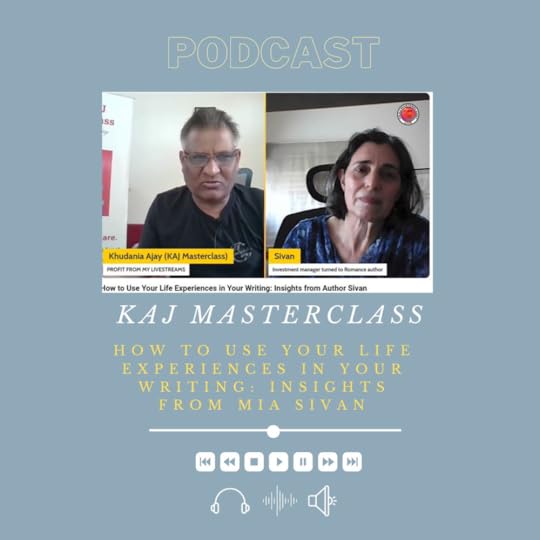
Ajay Khudania, the host of The KAJ Masterclass LIVE, interviewed me for his show. We talked about my experiences in the world of finance, putting real events into fictional books, and I even shared advice for aspiring authors.
Enjoy!
If you prefer reading to watching, below is an edited transcript:
Ajay: Tell us about yourself and your journey.
Sivan: I used to be a professional investment manager. I have a BA in economics and business administration and an MBA in finance and accounting. So, all my formal education was geared towards working in the finance industry.
I started working in 1991, and my first job out of university was in a firm managing OPM: Other People's Money. This is the big money—pension funds, provident funds, etc, you need a professional investor to manage it. I did that until 2007, and this gave me a perspective on how big money behaves. Also, you learn that you are treated differently when you manage this kind of money. People treat you as if it is yours, and you have to learn pretty fast that it isn't. You need to have respect for the money that you represent. And you need to be honest, which sounds trivial, but actually, a lot of scams and schemes in the finance world happen because people treat big money to manipulate the markets for their means.
The finance industry is affected by any and every crisis, as you need to address and think about them, and it wears you down. After nearly thirty years I decided to launch a second career. I chose writing because I used to get positive feedback on my writing.
My advice for beginning writers: when you just start out, write what you know. People feel your confidence through your writing.
In my first book, Crunching Her Numbers , I wrote about a strong woman, who some might call bitchy, and used a subplot about something that happened to me—a scam perpetrated by a very good friend of mine. Writing that book was writing about an environment that I knew and also about someone I knew and liked. I still like him, but he wasn't honest.

Ajay: I want to understand—what do you mean by strong woman and strong man? How have notions changed? Are masculinity and femininity the same or different?
Sivan: A strong man or woman, regardless of their gender, is someone who stands for their values or what they think is right. They don't cave in just because it might be better for them or even for their bank account.
As for women, for generations, women weren't allowed to show too much aggressiveness or decisiveness. It seems like when women say what they think and are very sure of themselves, they are not as well-liked as men who do the exact same thing. A man doesn't have to smile, but we expect a woman to do so—we think it is better if she does (smile).
We learn from a very early age that if we smile and speak less, it will be better for us. You know, there are studies that show that, in a meeting, if a woman and a man speak the same amount of time, she is perceived as speaking 30% more than him.
Ajay: When we think of big money, we generally think of places in the US or London. Israel, or Tel Aviv, is known more for its tech companies. Tell us how big money behaves in Tel Aviv and Israel.
Sivan: In investment management, there is what we call Home Bias, which means you are more likely to invest in your own markets. For example, India is a huge economy, but I’m not familiar with it at all; an Indian investor will be. But even with a huge economy like India, the capital market isn’t big. It's getting bigger—I think you're even almost as big as China in the emerging market world—but I’m sure big money, institutional money in India, is too big for the local market. Same in Israel: the institutional investors will allocate 30% in our home country and then you go out. Big money has to leave the small local market. Usually they invest in the United States, Europe, etc. The tech economy in Israel is very prominent, but Israeli tech companies are actually traded on the NASDAQ, not in Tel Aviv.
Ajay: How do you bring your own personal experiences and make them into an interesting story? Your mind will be boggled with so many of your personal experiences that it is very difficult to put all that into your characters. There is a danger of the story becoming boring with too many personal experiences and technical details.
Sivan: Your first draft is going to be very, very different from the final book. I actually had a lot more finance in the first few drafts of my first book than in the final version. I took an editor who knows nothing about finance and thinks it's the most boring thing in the world. And I kept editing out passages. So , what you need to do is hire someone, an editor, who doesn't think like you, doesn't like the same stuff as you, ask them for their honest opinion and be willing to cut out aggressively.
Ajay: Being from the investment industry and telling real stories, how do you maintain that balance of confidentiality and authenticity?
Sivan: Right. Even though I'm not in the industry anymore, I'm still compelled by confidentiality. Even now, I will never talk about past clients. All the scams in my books have already exploded, and they have newspaper articles about them. So I read the articles and make sure that I’m writing only what is public knowledge.
Ajay: So, people that know you, your former colleagues, do they ever recognize themselves or think they recognize others in your stories, and are they happy or not about it?
Sivan: First of all, yes, that happened. The first book I wrote very soon after leaving my place of work. I gave it to colleagues to read, and they came back to me and told me that when they first started reading the book, they thought they recognized our boss or the secretary, but after getting into it, they actually thought it was a different person. What I did is I took a little bit of that person, a little bit of the other, and did a mishmash. By the way - I also use real locations in my books, real addresses in Tel Aviv; I don’t make up squares, I use real squares and real streets.
Ajay: Your books are not only about finance; they also include steamy romance. Do you ever get reactions from real people like, "Hey, you used me in steamy scenes. I feel uncomfortable about it"?
Sivan: No, I don't because the main characters in my books are made up; they are not real. But you are correct that because I say I use real people, I get funny reactions. Like, one of the male characters in my first book is called Slava. And I get questions like, "Can we meet Slava?" No! He is totally made up. He is too good to be true.
Ajay: I want to understand, because you have dealt with big money and met people with big money, a lot of people say this big money thing is about control. What is your understanding of these people? There is a debate about controlling this power.
Sivan: Let’s separate two notions: institutional money is not like these billionaires you speak of. I did not meet Elon Musk or Jeff Bezos, so I don’t know how they think or why they do what they do. Institutional money is heavily regulated. There is an investment committee every two weeks, and there are rules and auditors. It’s big money, but it’s made up of a lot of small monies from small people, and it’s your responsibility to make it possible for them to live comfortably off their pension.
Ajay: You’ve seen the scams and scammers in the real world—what was in their minds?
Sivan: I have no good answer. It’s partly greed, partly excitement, maybe it was using their wits, and also they made money. I think it’s a combination. Also, I think they don’t think of the consequences when they do it.
Ajay: In today’s modern world, how do you feel women play a part?
Sivan: I don't know how it is in India, but saying 2024 is different from previous years is not true. Ninety percent of the CEOs in the S&P 500 are men. About 85% of the mutual fund money is managed by teams of all male investors. So, in my books, I want to reflect that. In my second book, Analyzing Her Assets , the female protagonist wants a job. She has much more experience than her male counterpart. She's very good at what she does; he came only last year, yet he's an equal competitor. If it were the other way around, they wouldn't even consider her.
What I'm saying is women still have a long way to go to reach equality, let alone majority. So I want to reflect that in my text. And I'm not trying to fix that. I want people to say: Oh, this is what she has to do to get the job. It is so much more than what he has to do. I don't give solutions in my books, I just want to make people think.

June 17, 2024
Taylor Swift and The magical power of the female P.
Last May I visited Lisbon (gorgeous city), where I attended a Taylor Swift concert (YAY!)
I was there with my daughter. I thought we would stand out, but I was wrong. Loads of mothers went with their daughters. Glitters and tiaras ruled the arena, since around 90% of the crowd was women: mothers, daughters, sisters, girlfriends. All flocked to the city in droves, willing and ready to have fun and spend some money while having it.
It made me want to look into the power of the female P—no, not that P! I mean Purse, as in dollars and shekels, as in Purchasing Power.
More than twelve years ago, Disney released “Frozen.” They hoped it would do well, but were completely unprepared for its success. It smashed the box office. You'd think they'd be prepared since Disney’s princess industry is old and lucrative. Yet despite its long experience with marketing to girls, the craze for Frozen caught the huge conglomerate with its proverbial merchandise pants down. It lost billions in potential earnings because it underestimated a demand that went on for months, and didn't have the goods in the stores.
Why did Frozen do so well?
Previous films that centered on female characters had just one leading lady, and her happy ending always involved a wedding—even in the case of the warrior Mulan. Frozen’s happy ending is a complete departure from that. It focuses on the reconciliation between the sisters rather than romance. Disney underestimated how much little girls would love the story of two strong, independent women and their relationship.
Last year, another ‘surprise’: Barbie became the highest-grossing film in the history of Warner Bros.
“The core movie audience is anyone who used to play with Barbie—90% of women and our teenage daughters,” Zoey Chance, who worked in brand marketing at Mattel, told Yale Insights, “But the real genius was the writer who understood and validated our powerful mixed feelings about Barbie.”
There are certainly mixed opinions about how feminist Barbie really is, but women felt they were in safe hands since the movie was produced by Margot Robbie and directed by Greta Gerwig: two women at the helm. The movie was fun and well made, and it carried a powerful message to women. America Ferrara's monologue is poignant and true, and it fell on willing ears.
Are you sensing a theme here? This movie, like Frozen, was for and entirely about women and their place in the world.
And it made a shitload of money.
Taylor Swift has matured into an opinionated and savvy businesswoman. Back in 2015 she challenged the way corporations treat creators, successfully changing Apple’s policy of not paying artists during the Apple Music trial period. She has re-recorded her songs so as to fully own the rights. Her choices and smart publicity forces to the light music industry’s quiet corporate machinations.
Her Eras Tour broke the all-time gross record at an “unprecedented” speed, reported Pollstar at the end of 2023. And it’s not over as Swift is set to perform 85 shows by the end of 2024. Taylor knows the power of the female P. Her influence on economies is so vast that in March 2024 Investopedia added a new value: Swiftonomics.
For me the conclusion is clear: corporations would do well to put us women at the decision-making table — producing, directing, telling our story, and owning our own cultural equity.