Beth Tabler's Blog, page 204
January 17, 2022
4 Books the Texas House Committee Doesn’t Want You To Read
In the United States, Texas State Representative Matt Krause has requested that schools state-wide advise him directly if their schools are carrying any of the books from a list of 850 books. Furthermore, Mr. Krause has asked specifically how much money was spent by the school board acquiring the books, and which schools are actually in possession of what books that are on the list.
According to Mr. Krause, he believes all of the 850 books on the list he has complied “might make students feel discomfort, guilt, anguish, or any other form of psychological distress because of their race or sex.” The assumption is – though in all fairness to my knowledge he has not explicitly stated this- if Mr. Krause had his way, he would have these books removed from being available for independent reading, and not be able to be used as reference with respect to teaching material, in the Texas school system. These books have wide ranging topics and titles. However, predominantly, the books discuss race, and gender. I am not here to spark a debate on censorship, or provide a long explanation on whether or not I believe the books on the list should be banned from the Texas school system, or any other school system. For the record, I do not believe they should be banned, however that is my opinion, and it may not be yours. If that is not your perspective, I respect that perspective, even if I differ with it. I won’t attempt to add much justification here for my opinion. If you wish to civilly discuss the topic, feel free to DM me. What I’m primarily here to do is shine a light on a lot of books that I think are worth reading, certainly as adults, 850 of them, to be precise. My viewpoint on the worthiness of these 850 books includes considering race, which the bulk of the books on the list touch upon. My wife is White, I am Black. For my part, my wife and I have seven children between us. Four of our children would identify as “Black”, and four of them would identify as “White”. Since our oldest child is aged thirty-two, and our youngest is aged seventeen, they are long past the age where they can decide precisely what they wish to read and what they don’t, as they are all essentially adults for reading purposes and intent. Admittedly, I have certainly not read all 850 books on the list. However, after a quick perusal of the titles, as a parent, I see nothing from a cursory look that I believe would be damaging to the mental health of any of my children (even when they were at the elementary school level) by reading them, irrespective of the colour of my children’s skin. I can speak directly to two of the books on the list, which I have read. Please all allow me to tell you about my thoughts on these books. By Author P.L Stuart The Texas List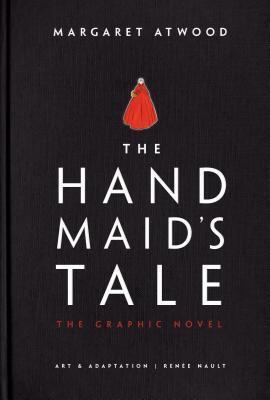 Link to purchase The Handmaid's Tale: A Graphic Novel by Renée Nault (Adapter, Artist), Margaret Atwood What is it about?
 Everything Handmaids wear is red: the colour of blood, which defines us.
Offred is a Handmaid in the Republic of Gilead, where women are prohibited from holding jobs, reading, and forming friendships. She serves in the household of the Commander and his wife, and under the new social order she has only one purpose: once a month, she must lie on her back and pray that the Commander makes her pregnant, because in an age of declining births, Offred and the other Handmaids are valued only if they are fertile. But Offred remembers the years before Gilead, when she was an independent woman who had a job, a family, and a name of her own. Now, her memories and her will to survive are acts of rebellion.
Provocative, startling, prophetic, The Handmaid’s Tale has long been a global phenomenon. With this stunning graphic novel adaptation of Margaret Atwood’s modern classic, beautifully realized by artist Renee Nault, the terrifying reality of Gilead has been brought to vivid life like never before.
Lorem ipsum dolor sit amet, consectetur adipiscing elit. Ut elit tellus, luctus nec ullamcorper mattis, pulvinar dapibus leo.
My Thoughts I am a proud Canadian, and I am proud of Canadian icons, like the illustrious writer Margaret Atwood. Her dystopian novel The Handmaid’s Tale was written more than three decades ago, and has since gone on to become one of the best-selling books of all-time. In the 21st century, the novel has become standard reading fare in many high school English curriculums in North American, including Canada, and including my own children’s classes. The original novel has since been adapted into an extremely popular blockbuster television adaptation for Hulu. The book is about Offred, the eponymous handmaid, who resides in the New Republic of Gilead, part of the future United States. In Offred’s society, women are wholly relegated to subservient roles to men, due to issues with falling birthrates, as per a government edict. Handmaids are designated among women as broodmares, for the sole purpose of providing children for military officers, and the sexual pleasure of those officers, who are part of the regime that controls the Republic. Wives are there for display purposes, something of the Stepford analogy. Men hold the power in Gilead, based on a Biblical model, and this patriarchy removes independence – financial and otherwise – from all women, including the ability to buy books and read them. It is a chilling tale, filled with sinister repression, violence, despair, and hope. The 240-page illustrated graphic novel is entirely based on the original book, and includes most of Atwood’s original words on the pages. I read the novel years ago, in university, and picked up the graphic novel by Renée Nault a few years ago. Both original and graphic novel are chilling, compelling, superbly written stories that remain poignant and timely today, in the backdrop of horrible issues surrounding misogny and violence against women, and the ongoing struggles against those issues, encapsulated by contemporary movements such as #MeToo.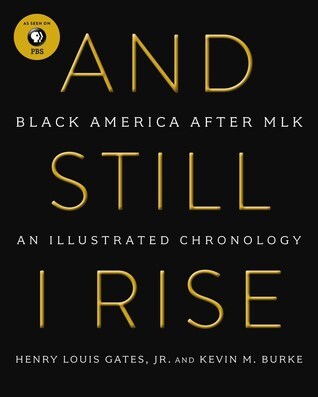 Link to purchase And Still I rise : Black America since MLK : An Illustrated Chronology by Henry Louis Gates Jr., Kevin M. Burke What is it about?
 The companion book to Henry Louis Gates, Jr.’s PBS series, And Still I Rise—a timeline and chronicle of the past fifty years of black history in the U.S. in more than 350 photos
Beginning with the assassination of Malcolm X in February 1965, And Still I Rise: From Black Power to the White House explores the last half-century of the African American experience. More than fifty years after the passage of the Civil Rights Act and the birth of Black Power, the United States has both a black president and black CEOs running Fortune 500 companies—and a large black underclass beset by persistent poverty, inadequate education, and an epidemic of incarceration. Harvard professor and scholar Henry Louis Gates, Jr. raises disturbing and vital questions about this dichotomy. How did the African American community end up encompassing such profound contradictions? And what will “the black community” mean tomorrow?
Gates takes readers through the major historical events and untold stories of the sixty years that have irrevocably shaped both the African American experience and the nation as a whole, from the explosive social and political changes of the 1960s, into the 1970s and 1980s—eras characterized by both prosperity and neglect—through the turn of the century to today, taking measure of such racial flashpoints as the Tawana Brawley case, OJ Simpson’s murder trial, the murders of Amadou Diallo and Trayvon Martin, and debates around the NYPD’s “stop and frisk” policies. Even as it surveys the political and social evolution of black America, And Still I Rise is also a celebration of the accomplishments of black artists, musicians, writers, comedians, and thinkers who have helped to define American popular culture and to change our world.
The freedom to learn, grow, and think critically is one of the greatest things a child can do to explore their world. Books adjust and change their worldview. They are windows into new worlds. When we take that away from a child, we deny them access; we stunt their worldview. We make their world smaller.
It is a form of control, and it is fundamentally wrong.
The world is a broad and beautiful place, and denying children access to the tools they need to be citizens of this world and understanding those different then them sends those children out into an ocean without knowing how to swim, especially if those children have questions regarding their identities.
A Time magazine article from November detailed some of the conservative efforts to ban access to books, mostly books that dealt with queer and race identities, “Since September, school libraries in at least seven states have removed books challenged by community members. Among the books most frequently targeted are Toni Morrison’s The Bluest Eye (1970), George M. Johnson’s All Boys Aren’t Blue: A Memoir-Manifesto (2020), Maia Kobabe’s Gender Queer: A Memoir (2019), Jonathan Evison’s Lawn Boy (2018), and Alison Bechdel’s Fun Home: A Family Tragicomic (2006). Most of the challenged books so far, across fiction and non-fiction, are about race and LGBTQ identities.”
The two books I chose are near and dear to my heart. The first novel is V for Vendetta by the great Alan Moore. Moore uses the novel as a place for political and social criticism in a fascistic world where the church and the government work in tandem to suppress free speech, free ideas, and those outside the church’s doctrine. Although the US is certainly not the Norsefire regime, I find it telling that Texas Matt Krause chose this book of all books to suppress. The only thing that would be more ironic is if he attacked Fahrenheit 451.
V for Vendetta has one of the most incredible introductions of a main character I have ever read, and please forgive me because it is long. You can see the level of linguistic gymnastics Moore employs in his prose:
“Evey: Who are you?
V. : Who? Who is but the form following the function of what and what I am is a man in a mask.
Evey: Well I can see that.
V. : Of course you can, I’m not questioning your powers of observation, I’m merely remarking upon the paradox of asking a masked man who he is.
Evey: Oh, right.
V. : But on this most auspicious of nights, permit me then, in lieu of the more commonplace soubriquet, to suggest the character of this dramatis persona. Voila! In view humble vaudevillian veteran, cast vicariously as both victim and villain by the vicissitudes of fate. This visage, no mere veneer of vanity, is a vestige of the “vox populi” now vacant, vanished. However, this valorous visitation of a bygone vexation stands vivified, and has vowed to vanquish these venal and virulent vermin, van guarding vice and vouchsafing the violently vicious and voracious violation of volition.
The only verdict is vengeance; a vendetta, held as a votive not in vain, for the value and veracity of such shall one day vindicate the vigilant and the virtuous.
Verily this vichyssoise of verbiage veers most verbose, so let me simply add that it’s my very good honour to meet you and you may call me V.
Evey: Are you like a crazy person?
V. : I’m quite sure they will say so.”
He says it all with V’s. He will bring down the virulent vermin with a fiery vengeance.
The second novel I chose is Laura Dean Keeps Breaking Up With Me by Mariko Tamaki, and art by Rosemary Valero-O’Connell. Where V for Vengeance is a fiery fist-pumping novel that sets the readers’ souls afire, Laura Dean Keeps Breaking Up with Me is a quiet, intimate, and beautiful slice portrayed as a series of moments in a toxic relationship that is emblematic of moments that we all feel growing up at one time or another. Tamaki gets at the heart of relationships and how sometimes love is not enough to sustain someone, especially if that love is abused.
“It’s true that giving can be a part of love. But, contrary to popular belief, love should never take from you, Freddy.”
Tamaki also wrote another lovely graphic novel calledThis One Summer is a beautiful slice of life. My review, “This book is a collection of smooth and quiet moments. For me when reading, not all moments have to jump off the page at you. Life isn’t like that, and neither should writing about life be. It is highs and lows, of which the author has written about so well.”
Both novels are for young and old people alike and should be taught and discussed. They are as far apart as one can get in subject matter, but they both have important lessons and I learned something from both novels.
By Beth Tabler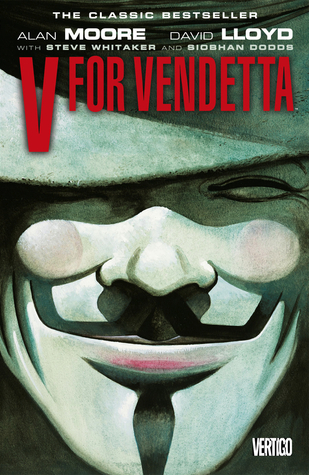 Link to purchase V for Vendetta by Alan Moore, David Lloyd (Illustrator) What is it about?
 “Remember, remember the fifth of November…”
A frightening and powerful tale of the loss of freedom and identity in a chillingly believable totalitarian world, V for Vendetta stands as one of the highest achievements of the comics medium and a defining work for creators Alan Moore and David Lloyd.
Set in an imagined future England that has given itself over to fascism, this groundbreaking story captures both the suffocating nature of life in an authoritarian police state and the redemptive power of the human spirit which rebels against it. Crafted with sterling clarity and intelligence, V for Vendetta brings an unequaled depth of characterization and verisimilitude to its unflinching account of oppression and resistance
Lorem ipsum dolor sit amet, consectetur adipiscing elit. Ut elit tellus, luctus nec ullamcorper mattis, pulvinar dapibus leo.
My Thoughts V for Vendetta is the kind of book that you can read over and over again, and get something different from it depending on the political climate. Right now we need powerful books and V for Vendetta is nothing if not powerful. V for Vendetta is a complex story filled with fully fleshed out characters that are experiencing watershed moments in their lives. The before and afters. If I could leave you with a single quote that could sum up this novel, it would be this:“Did you think to kill me? There’s no flesh or blood within this cloak to kill. There’s only an idea. Ideas are bulletbroof.”
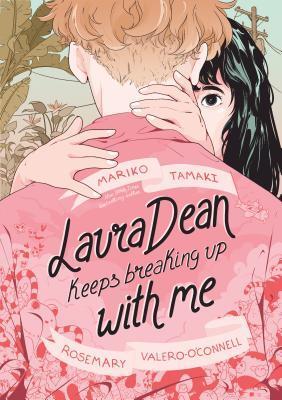 Link to purchase Laura Dean Keeps Breaking Up with Me by Mariko Tamaki, Rosemary Valero-O'Connell What is it about?
 All Freddy Riley wants is for Laura Dean to stop breaking up with her.
The day they got together was the best one of Freddy’s life, but nothing’s made sense since. Laura Dean is popular, funny, and SO CUTE … but she can be really thoughtless, even mean. Their on-again, off-again relationship has Freddy’s head spinning — and Freddy’s friends can’t understand why she keeps going back.
When Freddy consults the services of a local mystic, the mysterious Seek-Her, she isn’t thrilled with the advice she receives. But something’s got to give: Freddy’s heart is breaking in slow motion, and she may be about to lose her very best friend as well as her last shred of self-respect. Fortunately for Freddy, there are new friends, and the insight of advice columnist Anna Vice, to help her through being a teenager in love.
Mariko Tamaki and Rosemary Valero-O’Connell bring to life a sweet and spirited tale of young love that asks us to consider what happens when we ditch the toxic relationships we crave to embrace the healthy ones we need.
Lorem ipsum dolor sit amet, consectetur adipiscing elit. Ut elit tellus, luctus nec ullamcorper mattis, pulvinar dapibus leo.
My ThoughtsTamaki and Valero-O’Connell bring life to a series of moments in a person’s life. It shows that relationships, queer or otherwise can be abusive and toxic. The drawings are lovely and range from gray tones to splashes of pink. It has an overall sweet effect that belies the subject manner.
Freddy is in love with the wrong person, Laura Dean, who is aloof and plays with Freddy’s emotions. Freddy begins to treat her friend group like crap. This scenario is all too familiar.
The dialog and world that Tamaki and Valero-O’Connell creates has an authenticity to it and feels like how adolescents converse. I think this is a wonderful YA book that should be widely read and talked about.
The post 4 Books the Texas House Committee Doesn’t Want You To Read appeared first on BEFOREWEGOBLOG.


4 Books the Texas House Committee Doesn’t Want You To Read and Why You Should
In the United States, Texas State Representative Matt Krause has requested that schools state-wide advise him directly if their schools are carrying any of the books from a list of 850 books. Furthermore, Mr. Krause has asked specifically how much money was spent by the school board acquiring the books, and which schools are actually in possession of what books that are on the list.
According to Mr. Krause, he believes all of the 850 books on the list he has complied “might make students feel discomfort, guilt, anguish, or any other form of psychological distress because of their race or sex.” The assumption is – though in all fairness to my knowledge he has not explicitly stated this- if Mr. Krause had his way, he would have these books removed from being available for independent reading, and not be able to be used as reference with respect to teaching material, in the Texas school system. These books have wide ranging topics and titles. However, predominantly, the books discuss race, and gender. I am not here to spark a debate on censorship, or provide a long explanation on whether or not I believe the books on the list should be banned from the Texas school system, or any other school system. For the record, I do not believe they should be banned, however that is my opinion, and it may not be yours. If that is not your perspective, I respect that perspective, even if I differ with it. I won’t attempt to add much justification here for my opinion. If you wish to civilly discuss the topic, feel free to DM me. What I’m primarily here to do is shine a light on a lot of books that I think are worth reading, certainly as adults, 850 of them, to be precise. My viewpoint on the worthiness of these 850 books includes considering race, which the bulk of the books on the list touch upon. My wife is White, I am Black. For my part, my wife and I have seven children between us. Four of our children would identify as “Black”, and four of them would identify as “White”. Since our oldest child is aged thirty-two, and our youngest is aged seventeen, they are long past the age where they can decide precisely what they wish to read and what they don’t, as they are all essentially adults for reading purposes and intent. Admittedly, I have certainly not read all 850 books on the list. However, after a quick perusal of the titles, as a parent, I see nothing from a cursory look that I believe would be damaging to the mental health of any of my children (even when they were at the elementary school level) by reading them, irrespective of the colour of my children’s skin. I can speak directly to two of the books on the list, which I have read. Please all allow me to tell you about my thoughts on these books. By Author P.L Stuart The Texas List Link to purchase The Handmaid's Tale: A Graphic Novel by Renée Nault (Adapter, Artist), Margaret Atwood What is it about? Everything Handmaids wear is red: the colour of blood, which defines us.
Offred is a Handmaid in the Republic of Gilead, where women are prohibited from holding jobs, reading, and forming friendships. She serves in the household of the Commander and his wife, and under the new social order she has only one purpose: once a month, she must lie on her back and pray that the Commander makes her pregnant, because in an age of declining births, Offred and the other Handmaids are valued only if they are fertile. But Offred remembers the years before Gilead, when she was an independent woman who had a job, a family, and a name of her own. Now, her memories and her will to survive are acts of rebellion.
Provocative, startling, prophetic, The Handmaid’s Tale has long been a global phenomenon. With this stunning graphic novel adaptation of Margaret Atwood’s modern classic, beautifully realized by artist Renee Nault, the terrifying reality of Gilead has been brought to vivid life like never before.
Lorem ipsum dolor sit amet, consectetur adipiscing elit. Ut elit tellus, luctus nec ullamcorper mattis, pulvinar dapibus leo.
My Thoughts I am a proud Canadian, and I am proud of Canadian icons, like the illustrious writer Margaret Atwood. Her dystopian novel The Handmaid’s Tale was written more than three decades ago, and has since gone on to become one of the best-selling books of all-time. In the 21st century, the novel has become standard reading fare in many high school English curriculums in North American, including Canada, and including my own children’s classes. The original novel has since been adapted into an extremely popular blockbuster television adaptation for Hulu. The book is about Offred, the eponymous handmaid, who resides in the New Republic of Gilead, part of the future United States. In Offred’s society, women are wholly relegated to subservient roles to men, due to issues with falling birthrates, as per a government edict. Handmaids are designated among women as broodmares, for the sole purpose of providing children for military officers, and the sexual pleasure of those officers, who are part of the regime that controls the Republic. Wives are there for display purposes, something of the Stepford analogy. Men hold the power in Gilead, based on a Biblical model, and this patriarchy removes independence – financial and otherwise – from all women, including the ability to buy books and read them. It is a chilling tale, filled with sinister repression, violence, despair, and hope. The 240-page illustrated graphic novel is entirely based on the original book, and includes most of Atwood’s original words on the pages. I read the novel years ago, in university, and picked up the graphic novel by Renée Nault a few years ago. Both original and graphic novel are chilling, compelling, superbly written stories that remain poignant and timely today, in the backdrop of horrible issues surrounding misogny and violence against women, and the ongoing struggles against those issues, encapsulated by contemporary movements such as #MeToo. Link to purchase And Still I rise : Black America since MLK : An Illustrated Chronology by Henry Louis Gates Jr., Kevin M. Burke What is it about? The companion book to Henry Louis Gates, Jr.’s PBS series, And Still I Rise—a timeline and chronicle of the past fifty years of black history in the U.S. in more than 350 photos
Beginning with the assassination of Malcolm X in February 1965, And Still I Rise: From Black Power to the White House explores the last half-century of the African American experience. More than fifty years after the passage of the Civil Rights Act and the birth of Black Power, the United States has both a black president and black CEOs running Fortune 500 companies—and a large black underclass beset by persistent poverty, inadequate education, and an epidemic of incarceration. Harvard professor and scholar Henry Louis Gates, Jr. raises disturbing and vital questions about this dichotomy. How did the African American community end up encompassing such profound contradictions? And what will “the black community” mean tomorrow?
Gates takes readers through the major historical events and untold stories of the sixty years that have irrevocably shaped both the African American experience and the nation as a whole, from the explosive social and political changes of the 1960s, into the 1970s and 1980s—eras characterized by both prosperity and neglect—through the turn of the century to today, taking measure of such racial flashpoints as the Tawana Brawley case, OJ Simpson’s murder trial, the murders of Amadou Diallo and Trayvon Martin, and debates around the NYPD’s “stop and frisk” policies. Even as it surveys the political and social evolution of black America, And Still I Rise is also a celebration of the accomplishments of black artists, musicians, writers, comedians, and thinkers who have helped to define American popular culture and to change our world.
The freedom to learn, grow, and think critically is one of the greatest things a child can do to explore their world. Books adjust and change their worldview. They are windows into new worlds. When we take that away from a child, we deny them access; we stunt their worldview. We make their world smaller.
It is a form of control, and it is fundamentally wrong.
The world is a broad and beautiful place, and denying children access to the tools they need to be citizens of this world and understanding those different then them sends those children out into an ocean without knowing how to swim, especially if those children have questions regarding their identities.
A Time magazine article from November detailed some of the conservative efforts to ban access to books, mostly books that dealt with queer and race identities, “Since September, school libraries in at least seven states have removed books challenged by community members. Among the books most frequently targeted are Toni Morrison’s The Bluest Eye (1970), George M. Johnson’s All Boys Aren’t Blue: A Memoir-Manifesto (2020), Maia Kobabe’s Gender Queer: A Memoir (2019), Jonathan Evison’s Lawn Boy (2018), and Alison Bechdel’s Fun Home: A Family Tragicomic (2006). Most of the challenged books so far, across fiction and non-fiction, are about race and LGBTQ identities.”
The two books I chose are near and dear to my heart. The first novel is V for Vendetta by the great Alan Moore. Moore uses the novel as a place for political and social criticism in a fascistic world where the church and the government work in tandem to suppress free speech, free ideas, and those outside the church’s doctrine. Although the US is certainly not the Norsefire regime, I find it telling that Texas Matt Krause chose this book of all books to suppress. The only thing that would be more ironic is if he attacked Fahrenheit 451.
V for Vendetta has one of the most incredible introductions of a main character I have ever read, and please forgive me because it is long. You can see the level of linguistic gymnastics Moore employs in his prose:
“Evey: Who are you?
V. : Who? Who is but the form following the function of what and what I am is a man in a mask.
Evey: Well I can see that.
V. : Of course you can, I’m not questioning your powers of observation, I’m merely remarking upon the paradox of asking a masked man who he is.
Evey: Oh, right.
V. : But on this most auspicious of nights, permit me then, in lieu of the more commonplace soubriquet, to suggest the character of this dramatis persona. Voila! In view humble vaudevillian veteran, cast vicariously as both victim and villain by the vicissitudes of fate. This visage, no mere veneer of vanity, is a vestige of the “vox populi” now vacant, vanished. However, this valorous visitation of a bygone vexation stands vivified, and has vowed to vanquish these venal and virulent vermin, van guarding vice and vouchsafing the violently vicious and voracious violation of volition.
The only verdict is vengeance; a vendetta, held as a votive not in vain, for the value and veracity of such shall one day vindicate the vigilant and the virtuous.
Verily this vichyssoise of verbiage veers most verbose, so let me simply add that it’s my very good honour to meet you and you may call me V.
Evey: Are you like a crazy person?
V. : I’m quite sure they will say so.”
He says it all with V’s. He will bring down the virulent vermin with a fiery vengeance.
The second novel I chose is Laura Dean Keeps Breaking Up With Me by Mariko Tamaki, and art by Rosemary Valero-O’Connell. Where V for Vengeance is a fiery fist-pumping novel that sets the readers’ souls afire, Laura Dean Keeps Breaking Up with Me is a quiet, intimate, and beautiful slice portrayed as a series of moments in a toxic relationship that is emblematic of moments that we all feel growing up at one time or another. Tamaki gets at the heart of relationships and how sometimes love is not enough to sustain someone, especially if that love is abused.
“It’s true that giving can be a part of love. But, contrary to popular belief, love should never take from you, Freddy.”
Tamaki also wrote another lovely graphic novel calledThis One Summer is a beautiful slice of life. My review, “This book is a collection of smooth and quiet moments. For me when reading, not all moments have to jump off the page at you. Life isn’t like that, and neither should writing about life be. It is highs and lows, of which the author has written about so well.”
Both novels are for young and old people alike and should be taught and discussed. They are as far apart as one can get in subject matter, but they both have important lessons and I learned something from both novels.
By Beth Tabler Link to purchase V for Vendetta by Alan Moore, David Lloyd (Illustrator) What is it about? “Remember, remember the fifth of November…”
A frightening and powerful tale of the loss of freedom and identity in a chillingly believable totalitarian world, V for Vendetta stands as one of the highest achievements of the comics medium and a defining work for creators Alan Moore and David Lloyd.
Set in an imagined future England that has given itself over to fascism, this groundbreaking story captures both the suffocating nature of life in an authoritarian police state and the redemptive power of the human spirit which rebels against it. Crafted with sterling clarity and intelligence, V for Vendetta brings an unequaled depth of characterization and verisimilitude to its unflinching account of oppression and resistance
Lorem ipsum dolor sit amet, consectetur adipiscing elit. Ut elit tellus, luctus nec ullamcorper mattis, pulvinar dapibus leo.
My Thoughts V for Vendetta is the kind of book that you can read over and over again, and get something different from it depending on the political climate. Right now we need powerful books and V for Vendetta is nothing if not powerful. V for Vendetta is a complex story filled with fully fleshed out characters that are experiencing watershed moments in their lives. The before and afters. If I could leave you with a single quote that could sum up this novel, it would be this:“Did you think to kill me? There’s no flesh or blood within this cloak to kill. There’s only an idea. Ideas are bulletbroof.”
Link to purchase Laura Dean Keeps Breaking Up with Me by Mariko Tamaki, Rosemary Valero-O'Connell What is it about? All Freddy Riley wants is for Laura Dean to stop breaking up with her.
The day they got together was the best one of Freddy’s life, but nothing’s made sense since. Laura Dean is popular, funny, and SO CUTE … but she can be really thoughtless, even mean. Their on-again, off-again relationship has Freddy’s head spinning — and Freddy’s friends can’t understand why she keeps going back.
When Freddy consults the services of a local mystic, the mysterious Seek-Her, she isn’t thrilled with the advice she receives. But something’s got to give: Freddy’s heart is breaking in slow motion, and she may be about to lose her very best friend as well as her last shred of self-respect. Fortunately for Freddy, there are new friends, and the insight of advice columnist Anna Vice, to help her through being a teenager in love.
Mariko Tamaki and Rosemary Valero-O’Connell bring to life a sweet and spirited tale of young love that asks us to consider what happens when we ditch the toxic relationships we crave to embrace the healthy ones we need.
Lorem ipsum dolor sit amet, consectetur adipiscing elit. Ut elit tellus, luctus nec ullamcorper mattis, pulvinar dapibus leo.
My ThoughtsTamaki and Valero-O’Connell bring life to a series of moments in a person’s life. It shows that relationships, queer or otherwise can be abusive and toxic. The drawings are lovely and range from gray tones to splashes of pink. It has an overall sweet effect that belies the subject manner.
Freddy is in love with the wrong person, Laura Dean, who is aloof and plays with Freddy’s emotions. Freddy begins to treat her friend group like crap. This scenario is all too familiar.
The dialog and world that Tamaki and Valero-O’Connell creates has an authenticity to it and feels like how adolescents converse. I think this is a wonderful YA book that should be widely read and talked about.
REVIEW – THE BONE SHARD DAUGHTER BY ANDREA STEWART
 check it out here
 BOOK REVIEW
THE BONE SHARD DAUGHTER by ANDREA STEWART January 17, 2022 10:00 am 2 Comments Facebook Twitter WordPress “I was Lin. I was the Emperor’s daughter. And I would show him that even broken daughters could wield power.”“The Bone Shard Daughter”, “The Drowning Empire”, Book 1, is Andrea Stewart’s highly accomplished debut novel. As with any such applauded book, sometimes it’s a tricky thing for the reader, such as myself, coming in with some preconceived notions that the book should live up to the accolades and hype surrounding it. Thankfully, I did truly enjoy this book, and I believe it has earned the laurels readers and critics alike have bestowed upon it. It was an amazing read.
If one is going to write a book with multiple POVs (assuming the characters are not immediately connected in some way), the most harrowing task is how to tie together sometimes disparate narratives at some point in the story so that they blend with some degree of harmony. Stewart did this exceptionally well with “The Bone Shard Daughter”, while leaving some tantalizing threads dangling where she did not put the different POV characters quite in each other’s orbit but set things up nicely for intriguing meetings in future installments.
The main POV in the book is that of Lin, daughter of the Emperor of the Phoenix Empire, and the eponymous Bone Shard Daughter. Lin is haunted in her efforts to capture lost memories, and because she cannot remember properly, the Emperor qualifies her as “broken”, and not ready for escalating responsibilities until she can somehow recapture those memories.
The Emperor, Shiyen, has ruled for decades, virtually uncontested, but his rule has been brutally imposed through the use of an absolutely petrifying, eerie type of magic: using bone fragments from his subjects to propel macabre Frankenstein-like creatures, called “constructs”. These constructs are fabricated from bits and pieces of dead animals and humans, sewn together, and brought to life by the bone shards implanted in them.
The bone shards – which are forcibly taken from the Emperor’s citizens – are the equivalent of computer programs, as they are engraved commands that define the constructs’ behaviour: defining them as spies, guards, even military or economic advisors. The Emperor is the Frankenstein-like mad scientist, with the ruthless determination and skill to ensure he has sufficiently numerous and powerful constructs to keep the populous under heel.
Furthermore, removal of the bone shards from the citizens is a death sentence; either dying right away during the procedure as children, or slowly wasting away as adults when the constructs begin to fully animate and grow into their own. The Emperor rationalizes his brutal experiments and subjugation of his people in giving away their very lives, in that the presences of his constructs ensure a safe and orderly society. The old “for the greater good” argument.
Lin is supposed to be Shiyen’s heir, but Shiyen has adopted a foster ward, Bayan, and put Bayan in direct competition with Lin, seemingly to bring out the best in her abilities, and make her prove herself worthy to inherit the throne. The widowed, despotic Emperor is cold and emotionally distant from Lin, but as many children would, Lin still seeks affection and praise from her father, and sees her means to secure that affection and praise is to master control of her father’s constructs, demonstrating she is a worthy successor.
But Bayan is a capable adversary, and brilliant in his own right with learning mastery of the constructs. Lin feels compelled so seek out help from the common folk of the empire in her quest to inherit the throne and win her father’s approval, but this sets off a chain of events with disastrous consequences. Yet Lin is resolved to get the better of her father, and find out the real truth as to why her memories have been so challenging to recapture.
“I could have waited, one part of my mind told me. I could have been obedient; I could have done my best to answer my father’s questions, to heal my memories. But the other part of my mind was cold and sharp. It cut through the guilt to find a hard truth. I could never be what he wanted if I did not take what I wanted…. He’d not left me with any choice other than to show him I was worthy in a different way.”
I found the other POVs to be just as transfixing as Lin’s, though it become obvious during the novel that Lin’s fate is central to the fate of the other characters given agency to tell their own tales.
The second POV is that of Jovis. Jovis is a smuggler by trade, but he has a compassionate streak, and has been devoting – dangerously – his missions to saving children from the “Tithing Festivals” where youngsters are forced to give up their bone shards to power the Emperor’s constructs. Thus Jovis is a highly wanted fugitive from the Empire’s justice. Jovis is also searching for his long-lost wife, and is determined to find out what happened to her.
Phalue and Ranami’s POVs are intertwined. They are lovers, and Phalue, an aristocrat, warrior, and another daughter who is heir to her father’s titles, is beginning to have doubts, thanks to Ranami, as to whether Phalue’s father’s rule is just. Ranami, meanwhile, joins the underground resistance against the Emperor’s rule, the “Shardless Ones”, forcing Phalue to chose between love, her values, and her father.
Finally, Sand has the most obscure POV. She resides, with people like her, on the remote edges of the Empire, labouring hard in picking coconuts, without the ability to understand why their tasks are so important, how they got to their current location in the first place, or any memory of their past prior to arriving. The picking of the coconuts seems to be the only purpose Sand and her compatriots exist for, but Sand is determined to break through the fog of amnesia and discover her true identity.
Phenomenal world-building, a plot that builds to a fascinating crescendo, deft prose, and entrancing themes, Stewart has crafted an epic, groundbreaking, emotionally engaging fantasy, with deeply engrossing characters. I loved the magic, intrigue, love stories, and unsettling, unsettling bone shard magic. Revolt and rebellion against authority has always been a fascination of mine: why people do it, how and if they succeed, whether or not they can put a better system in place in the aftermath than the previous one, or if it’s just more of the same, under a different guise.
Also just as riveting for me were the themes explored by Stewart surrounding privilege, obligation, classism, and what makes a good ruler. Finally, the aspects of what defines memory, knowledge, identity, and how they equate to power and self-determination, was very absorbing as well.
Overall, “The Bone Shard Daughter” is an intricate, thoughtful, and very memorable novel that deserves to be considered as one of the top fantasy books written in the past while. Awe-inspiring, highly recommended, and please, bring on Book 2, “The Bone Shard Emperor!” Five plus very glowing out of five stars!
Check Out some of our other reviewsReview – The Final Girl Support Group by Grady Hendrix
Review – The Devil and the Dark Water by Stuart Turton
Review – The City We Became by N.K. Jemisin
The post REVIEW – THE BONE SHARD DAUGHTER BY ANDREA STEWART appeared first on BEFOREWEGOBLOG.
January 16, 2022
REVIEW – Where the Drowned Girls Go by Seanan McGuire
 check it out here
 BOOK REVIEW
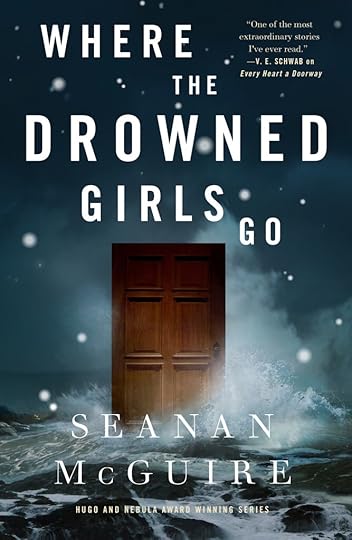
Where the drowned girls go by Seanan McGuire January 16, 2022 10:44 am No Comments Facebook Twitter WordPress “If they are being locked, they are being locked. We don't have a key.""Sometimes, you don't need a key", said Sumi. Her smile verged on feral. "Sometimes, a crowbar is good enough."There is a lot of magic in Seanan McGuire’s Wayward Children series and her newest addition, Where the Drowned Girls Go. Magic in the characters’ hearts and magic in the worlds and doors she has built. And that magic comes through in every lyrical word spoken by the characters. It is an impressive feat to be this far into a series, book 7 to be exact, and still be impressed by the story. But I very much am.
While novels have a long time to tell a story, it has a chance to zig-zag, twist, and curl around, coming to a climax that is 400 or 500 pages in the making; novellas aren’t like that. They do not have the luxury and word count to dance around. They need to be tight where every word is a choice, and every character’s action is exacting. This tightness is why this particular series is so powerful. McGuire tells a lot, builds whole worlds behind hidden doors with a short page and word count.
The seventh book of the series, Where the Drowned Girls Go, builds a world, but it isn’t behind a door but at a new facility. Instead, McGuire creates The Whitethorn Institute, A school that is the antithesis of Eleanor West’s Home for Wayward Children. There are old characters that readers of the series have gotten quite fond of and new ones to meet and get to know.
Cora, a girl who has gone through a door and returned, is desperate for change. She is desperate to move on. However, The Drowned Gods of the Moors have her number and torment her nightly, begging her to give herself over to them—something she will not do. Cora decides that the only way to get away from them is a drastic change. She leaves Home For Wayward Children to The Whitethorn Institute.
Mcguire was able to describe The Whitethorn Institute in very few words. For me, it resembled a “therapeutic” Boarding school for Problem Children that use questionable methods. Cora decides that she needs to go there and forget because The Whitethorn Institute teaches you to forget.
It is not what she imagined it to be. The school is much, much worse.
This story has many themes, very much like the other books in the series that adolescents and adults face in their lives. Where the Drowned Girls Go deals with self-image, weight, and bullying. And much like the other books, McGuire does not bash the reader of the head with the themes. Instead, she weaves them into the story, so they make up the story’s fabric. I left Where the Drowned Girls Go, remembering my issues with bullying as a child and an appreciation for Cora as a character.
In conclusion, check out Where the Drowned Girls Go but only if you have read the entire series. Reading the first six books gives you a full appreciation for the worlds McGuire has created and a heightened enjoyment of Where the Drowned Girls Go. There is true beauty in McGuires writing, and the Wayward Children Series can take you out of this world and through the doors into new ones.
Check Out some of our other reviewsReview – Come Tumbling Down by Seanan McGuire
Review of Fissure by Tim Daniel, Adrian F. Wassel, and Patricio Delpeche
 Beth Tabler RATING 4/5
 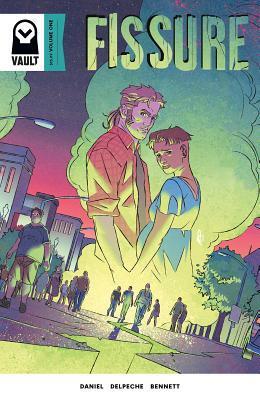 Fissure by Tim Daniel, Adrian F. Wassel (Editor), Patricio Delpeche (Contributor) Purchase Here
 By Tim Daniel, Adrian F. Wassel (Editor), Patricio Delpeche (Contributor), FissureAvery Lee can tell you about what was down there, but I’ll warn you now, she don’t like talking about any of this very much ―

by Tim Daniel, Adrian F. Wassel (Editor), Patricio Delpeche (Contributor), Fissure Stats Paperback, 112 pagesPublished May 7th 2019 by Vault ComicsISBN1939424178 (ISBN13: 9781939424174) Images From the Graphic Novel Story Synopsis “The artwork from Patricio Delpeche is flawless… This is what a winner looks like in small publishing folks.” –Dusty Good, ComicCrusaders.comI want to know the TRUTH, what happened to El Sueno? ―
Written by emerging master of horror, Tim Daniel, with stunning art by newcomer Patricio Delpeche, FISSURE is a horrifying, politically relevant look at what happens when everything we’ve built our lives on literally crumbles beneath our feet.
PUBLISHER’S SYNOPSIS: El Sueno, Texas was a single street town withering under the shadow of the Mexico–U.S. Barrier. Then the pavement split, and a massive crack spread from one end to the other, rapidly swallowing El Sueno whole. Young couple Avery Lee Olmos and Hark Wright fight to escape the mysterious sinkhole and the malevolent force that beckons from its depths. My Thoughts
Vault is my new favorite comics publisher. With many of their titles, they combine socially relevant ideas and science fiction/horror/fantasy that gives their stories a more profound meaning while still being entertaining and thought-provoking. The initial idea of portraying race relations as a chasm is what drove me to buy a copy of Fissure by Tim Daniel in the first place.
El Sueno was always a divided town. On one side you have the US and the other side we have Mexico. One day, a mysterious gas erupts from the ground with a rumble, and the mental divide that had always split the town is now a physical one. Many townsfolk fall into the chasm, while others are driven by some force that attracts them. At the heart of the story is Romeo and Juliet lovers, pregnant Latina Avery Lee Olmos, and Hark Wright. The conflicts, familial, and cultural that keep them apart turn into physical and horror laden. What lies in the abyss of that sinkhole will test a young couple’s ability to survive. They need to join together to survive the chasm. Something wicked lays at the bottom of that hole, something not quite human.
There are a lot of well-done aspects of this story. First and foremost is the excellent writing done by Tim Daniel (Enormous, The Plot). Daniel managed to capture the tension and nuances of a community divided by politics in a way that was not heavy-handed. It was apparent what the struggles were that El Sueno faced as a community, without coming out and slamming the readers face in it. The Romeo and Juliet type love story also fits well within the context of a divided society. Again it wasn’t heavy-handed, but sweet. Hark and Avery could have been any couple that struggled with the divide of culture and politics. Instead, because of the excellent writing, they came off as real people rather than caricatures of a Latina and a southern white man. Also, the story is told partially in Spanish. I loved that. It is a rare thing to have multiple languages in a graphic novel, and second, it is appropriate for the story and a city that straddles Mexico and the US.
The graphics are gorgeous. Each of the panels has a slight tinge of a supernatural green to them, letting the reader know that not all is right. Again, I didn’t find this to be heavy-handed. Instead, it added a sinister, almost sickly quality to the graphics that let me know that not all was right with El Sueno.
My only slight complaint was that Fissure could have been longer. There could have been more story told. Near the end of the book, the story felt a little rushed. I wanted to know more about Avery and Hark’s struggle to escape. I wanted to learn more about the creatures and why they were there.
Overall, Fissure was a great addition to the Vault catalog. It had everything a horror comic needs plus a lot more to make the issues more substantial and memorable. Also, because Daniel is such a great writer, I will be checking out some of his other works.
Check out Fissure and let me know what you think.
ProcurementI purchased a copy of this for my own library.
 About the Author
  Creator, writer, and designer, Tim Daniel, got his start in comics writing The Walking Dead: Survivor’s Guide for Robert Kirkman’s Skybound Entertainment. (He later became a zombie himself in the show’s pilot episode.) In 2012, Tim’s first original comic, Enormous, was published by Image Comics. Enormous later returned to print in 2014 as an ongoing series from 215Ink. Since then, Tim has written and co-created Burning Fields and Curse (both with BOOM!), as well as Skinned (Monkeybrain). If You Liked This Article - Please Share the Love
 The post Review of Fissure by Tim Daniel, Adrian F. Wassel, and Patricio Delpeche appeared first on BEFOREWEGOBLOG.
Review of Fissure by Tim Daniel, Adrian F. Wassel (Editor), Patricio Delpeche (Contributor)
Beth Tabler RATING 4/5 Fissure by Tim Daniel, Adrian F. Wassel (Editor), Patricio Delpeche (Contributor) Purchase Here By Tim Daniel, Adrian F. Wassel (Editor), Patricio Delpeche (Contributor), FissureAvery Lee can tell you about what was down there, but I’ll warn you now, she don’t like talking about any of this very much ―
by Tim Daniel, Adrian F. Wassel (Editor), Patricio Delpeche (Contributor), Fissure Stats Paperback, 112 pagesPublished May 7th 2019 by Vault ComicsISBN1939424178 (ISBN13: 9781939424174) Images From the Graphic Novel Story Synopsis “The artwork from Patricio Delpeche is flawless… This is what a winner looks like in small publishing folks.” –Dusty Good, ComicCrusaders.comI want to know the TRUTH, what happened to El Sueno? ―
Written by emerging master of horror, Tim Daniel, with stunning art by newcomer Patricio Delpeche, FISSURE is a horrifying, politically relevant look at what happens when everything we’ve built our lives on literally crumbles beneath our feet.
PUBLISHER’S SYNOPSIS: El Sueno, Texas was a single street town withering under the shadow of the Mexico–U.S. Barrier. Then the pavement split, and a massive crack spread from one end to the other, rapidly swallowing El Sueno whole. Young couple Avery Lee Olmos and Hark Wright fight to escape the mysterious sinkhole and the malevolent force that beckons from its depths. My Thoughts
Vault is my new favorite comics publisher. With many of their titles, they combine socially relevant ideas and science fiction/horror/fantasy that gives their stories a more profound meaning while still being entertaining and thought-provoking. The initial idea of portraying race relations as a chasm is what drove me to buy a copy of Fissure by Tim Daniel in the first place.
El Sueno was always a divided town. On one side you have the US and the other side we have Mexico. One day, a mysterious gas erupts from the ground with a rumble, and the mental divide that had always split the town is now a physical one. Many townsfolk fall into the chasm, while others are driven by some force that attracts them. At the heart of the story is Romeo and Juliet lovers, pregnant Latina Avery Lee Olmos, and Hark Wright. The conflicts, familial, and cultural that keep them apart turn into physical and horror laden. What lies in the abyss of that sinkhole will test a young couple’s ability to survive. They need to join together to survive the chasm. Something wicked lays at the bottom of that hole, something not quite human.
There are a lot of well-done aspects of this story. First and foremost is the excellent writing done by Tim Daniel (Enormous, The Plot). Daniel managed to capture the tension and nuances of a community divided by politics in a way that was not heavy-handed. It was apparent what the struggles were that El Sueno faced as a community, without coming out and slamming the readers face in it. The Romeo and Juliet type love story also fits well within the context of a divided society. Again it wasn’t heavy-handed, but sweet. Hark and Avery could have been any couple that struggled with the divide of culture and politics. Instead, because of the excellent writing, they came off as real people rather than caricatures of a Latina and a southern white man. Also, the story is told partially in Spanish. I loved that. It is a rare thing to have multiple languages in a graphic novel, and second, it is appropriate for the story and a city that straddles Mexico and the US.
The graphics are gorgeous. Each of the panels has a slight tinge of a supernatural green to them, letting the reader know that not all is right. Again, I didn’t find this to be heavy-handed. Instead, it added a sinister, almost sickly quality to the graphics that let me know that not all was right with El Sueno.
My only slight complaint was that Fissure could have been longer. There could have been more story told. Near the end of the book, the story felt a little rushed. I wanted to know more about Avery and Hark’s struggle to escape. I wanted to learn more about the creatures and why they were there.
Overall, Fissure was a great addition to the Vault catalog. It had everything a horror comic needs plus a lot more to make the issues more substantial and memorable. Also, because Daniel is such a great writer, I will be checking out some of his other works.
Check out Fissure and let me know what you think.
ProcurementI purchased a copy of this for my own library.
About the Author Creator, writer, and designer, Tim Daniel, got his start in comics writing The Walking Dead: Survivor’s Guide for Robert Kirkman’s Skybound Entertainment. (He later became a zombie himself in the show’s pilot episode.) In 2012, Tim’s first original comic, Enormous, was published by Image Comics. Enormous later returned to print in 2014 as an ongoing series from 215Ink. Since then, Tim has written and co-created Burning Fields and Curse (both with BOOM!), as well as Skinned (Monkeybrain). If You Liked This Article - Please Share the Love
January 15, 2022
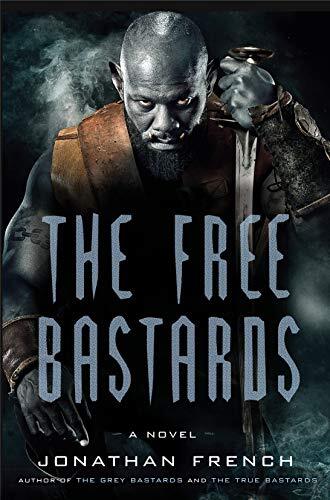
Review – The Free Bastards by Jonathan French
 check it out here
 BOOK REVIEW
THE FREE BASTARDS by JONATHAN FRENCHREVIEW BY WHITNEY REINHART
January 15, 2022 10:00 am No Comments Facebook Twitter WordPressCrafty spread his hands, “I ask you, I ask all of you, what is in your heart for this place?… When a land and its people hate you so, how can you be anything but stained by that hatred and begin to reflect it?… No matter who has ruled from that seat, their intention has ever been to enslave you. And to kill you if you dare rise. How can you feel ought but hate when confronted with such a truth?”
I confess to anxiously waiting for the third installment of The Lot Lands series by Jonathan French. I could barely contain my excitement when the book finally launched, and The Free Bastards does not disappoint! Fabulously filthy and fun, Fetching, Jackal, and Oats grudgingly partner with Crafty, the half-orc wizard who they feel is responsible for the disintegration of their hoof and their way of life, to take on Hispartha, and wrest control of their home, the Lot Lands, away from the crown. The mongrels come into their own and realize their potential in this exciting trilogy conclusion.
Unlike Book One, The Grey Bastards which focused on the story of Jackal, how he was tricked by a wizard named Crafty, and how he came to be in debt to one of the halfling Gods, or Book Two, The True Bastards which centers on the new Hoof Chief, Fetching, and her desperate struggles to hold on to her dreams of freedom and equality for all Lot Landers, The Free Bastards lands squarely on the broad shoulders of Oats. Oats is the thrice-blood, half-orc, unofficial Sergeant-at-Arms and enforcer for their Hoof. Life-long friend and loyal adopted sibling to both Fetching and Jackal, Oats ultimately finds himself in an uncomfortable new role as diplomat to the Hisparthan court.
His mission is to negotiate the continued independence of The Lots and ensure the freedoms of all who call the southern wasteland home. Before he can test his skills in diplomacy, he must fight against those who recoil at the idea of a united coalition of half-orcs at their borders. Along the way, he finds himself partnering with those who were once enemies, trusting those who’ve proven to be untrustworthy in the past, facing a singularly formidable foe in the Maiden Spear of Magritta, and wielding a deadly plague to protect those he loves. Through his ordeal, his faith in their goal, his mission of freedom, wavers and Fetching responds.
“You’re wrong. Today, on this hill, we showed Hispartha that they can kill us, but they cannot cage us. We showed them that we will accept death before we will return to chains. We showed them that we will come for our own and slay armies to liberate a handful. Remember that. The frails will.”
While it does take some effort to reconcile the passionate, loyal friendships and family ties of the Lot Lands half-orcs with the rich trove of orc canon we’ve been provided by the likes of Tolkien, Salvatore, and Dungeons & Dragons, French’s fresh, tongue-in-cheek approach to orc life is exhilarating and thoroughly new. The relationships are genuine, the love is true, the humor is appropriately crass, and the struggles are all too human to dismiss as mere flights of fantasy. I hope French continues to let us follow along as the Hoofs and their allies forge a new life in the Lot Lands. If he does, I will read each and every story without regret or remorse.
Until then, “Live in the saddle, Die on the Hog,” my friends!
Check Out some of our other reviewsReview – The Curse of the Mistwraith by Janny Wurts
REVIEW – Dames for Hire by S.C. Jensen
Whitney Reinhart
Whitney Reinhart is a reader, writer, sometimes editor/coach currently pursuing an MFA in Creative Writing because she believes every one has at least one story to tell. She lives (for now) in eastern Arkansas with the world’s smartest man and two Siberian Huskies posing as study buddies. Her work can be found on PocketFiction.co.uk and Fleas on the Dog. .
WHERE TO FIND HERVisit her website, meanderyme.com, for links, book reviews, writing tips, and sign up for her monthly newsletter, Wanderings
If You Liked This - Please Share the LoveJanuary 14, 2022
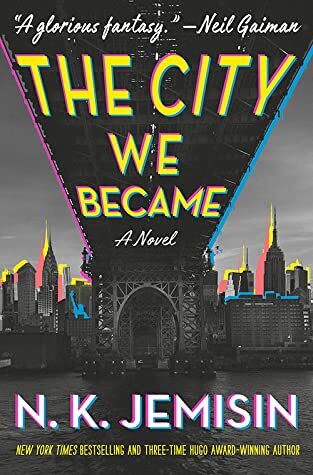
Review – The City We Became by N.K. Jemisin
 check it out here
 BOOK REVIEW
THE city we became by n.k. jemisin January 14, 2022 10:00 am One Comment Facebook Twitter WordPress “People who say change is impossible are usually pretty happy with things just as they are”The exceptional urban fantasy-horror novel “The City We Became” by multi-award winning, bestselling, and highly lauded author N.K. Jemisin is a timely, thought-provoking book about how the future of cities is one of diversification, multiculturalism, and standing up against racism, misogyny, and intolerance.
Most of us know Jemisin as one of the most talented authors of her generation, a brilliant academic, and someone who is unflinching in her social commentary, especially on matters of race, marginalization, and bigotry.
This is on full display in “The City We Became.” For the only author to win three consecutive Hugo Awards (one of the most prestigious literary awards anywhere) and who had to actively combat and shine a light on forces trying to prevent her from winning (due to her gender and race), there is no doubt she is a courageous writer. Jemisin has demonstrated she has no qualms whatsoever about calling out members of the literary establishment, vocally in interviews, and of course in her actual novels, when she feels it is justified.
The premise for “The City We Became” is that all cities, eventually, evolve into essentially sentient beings, and through humans, create avatars to protect them from “the enemy”, who originates from an alternate reality. In the case of Jemisin’s novel, the overall city has an avatar. However when that avatar is injured combating the enemy, the avatars of each individual New York City borough are awakened, to take up the fight, and protect their beloved metropolis. Jemisin implies that all cities either manage to emerge triumphant over the enemy, or they are destroyed, i.e. Atlantis, Pompeii, Tenochtitlán.
The avatars who protect New York City are for the most part all from racialized backgrounds: a neophyte to New York, suffering from memory loss, who is also a financial expert, and happens to be a gay Black man (Manhattan); a Black woman, employed as a high-ranking civil servant, who is a former rapper (Brooklyn); a queer, compassionate native American (Bronx) with a desire to help the downtrodden; a Tamil mathematics graduate student (Queens); and the overall avatar of the city, a queer, transient young Black man, who is a gifted graffiti artist.
The notable exception is the Staten Island avatar, who is a sheltered white female, whose police officer father is bigoted. Because the enemy epitomizes racism, the Staten Island avatar seems to be more susceptible, due to her upbringing, to be courted by the city’s malevolent nemesis, and this avatar shuns the other avatars, for that reason.
The novel is part homage, part condemnation of the city that is New York, the “melting pot”, the symbol of positives like altruism, being welcoming, providing great opportunity for immigrants, diversity, and – seemingly for Jemisin – evils like colonialism, white supremacy, privilege, gentrification, and racial injustice. And of course, what is happening New York is clearly depicted as a microcosm for what is happening in the greater United States.
Admirers of H.P. Lovecraft be warned; Jemisin blatantly calls out Lovecraft in the book, citing the enemy as being inspired by Lovecraft’s work, thus casting Lovecraft’s work in a xenophobic, bigoted light.
While I have enjoyed some of Jemisin’s other works better (“The Hundred Thousand Kingdoms” is one of my top 5 all-time favourite novels) I cannot deny the luminosity that is Jemisin. It took me a bit to connect with the characters, but in time I did – that is why this is not greater than 5 stars for me (only with someone like Jemisin does one expect to bust through the nominal rating chart with every book she writes).
But everything else is in very fine order, and then some.
Timely humour, chilling action scenes, biting social commentary and important themes, epic worldbuilding, engaging characters, evocative writing, and the ability to downright terrify while at the same time inspire are skills that no one save Jemisin can do quite the way she does it. And she does all of that and more in “The City We Became”.
Jemisin continues to be a master and “The City We Became” is a masterpiece. The book narrowly missed gaining Jemisin her FIFTH Hugo, and still won the equally distinguished Locus for best fantasy novel. Very well deserved, in my opinion, and I will continue to read anything and everything that Jemisin writes.
If you are looking to read a fierce and unapologetic fantasy novel, extremely inventive and well-crafted with themes that will likely hit home in light of recent world events, read “The City We Became”.
Check Out some of our other reviewsReview – The Final Girl Support Group by Grady Hendrix
January 13, 2022
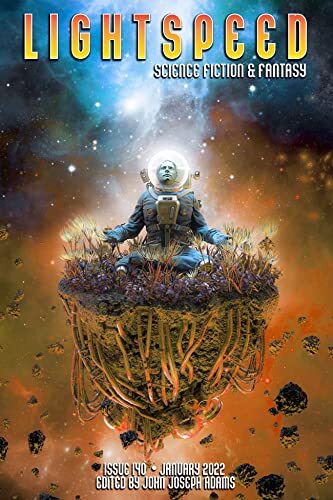
Short Story Review – Dissent: A Five-Course Meal (With Suggested Pairings) by Aimee Ogden
 check it out here
 BOOK REVIEW
Dissent: a Five-Course Meal (with suggested pairings) by aimee ogden January 13, 2022 10:00 am No Comments Facebook Twitter WordPress “Amuse-Bouche: a pungent sourness builds at the back of your throat..."”When you read Dissent: A Five-Course Meal ( With Suggested Pairings), you read it on two levels. The first level is obviously around food. This story is a menu for a five-course meal, and much like a menu, it has sensual writing that evokes the flavor and scent of the offerings of both the dish and of a moment in time.
However, the second level is the story between the bites and scents of the meal that link both the story and the food directly to the diner. “A pungent sourness builds at the back of your throat, slowly at first then with a crescendo of intensity as you flip through the authorized news stream.” There is a lot between the bites—a queer couple fighting for their rights and fleeing the protest site ahead of gas clouds. The smell of Trimethylamine from dead fish along the stream banks as they cut the wire fences and make a run from a work camp. Now in prison, and the copper taste of blood when you slice your cheek on your chipped and broken teeth. Each has a dedicated course. Each is a dedicated moment in time linking all of your senses.
It is a powerful story told in a unique way.
Check Out some of our other reviews
Short Story Review – Little Free Library by Naomi Kritzer
Short Story Review – Metal Like Blood in the Dark by T. Kingfisher
January 12, 2022
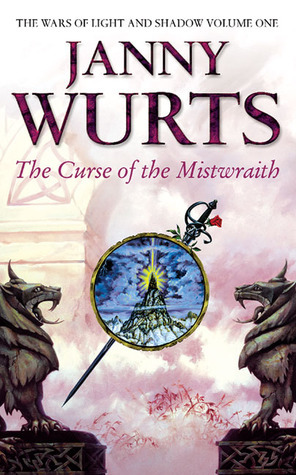
Review – The Curse of the Mistwraith by Janny Wurts
 check it out here
 BOOK REVIEW
THE CURSE OF THE MISTWRAITH by Janny wurts January 12, 2022 10:00 am No Comments Facebook Twitter WordPress
“The Wars of Light and Shadow were fought during the third age of Athera, the most troubled and strife-filled era recorded in all of history. At that time Arithon, called Master of Shadow, battled the Lord of Light through five centuries of bloody and bitter conflict. If the canons of the religion founded during that period are reliable, the Lord of Light was divinity incarnate, and the Master of Shadow a servant of evil, spinner of dark powers. Temple archives attest with grandiloquent force to be the sole arbiters of truth”…”
“Because the factual account lay hopelessly entangled between legend and theology, sages in the seventh age meditated upon the ancient past, and recalled through visions the events as they happened. Contrary to all expectation, the conflict did not begin on the council stair of Etarra, nor even on the soil of Athera itself; instead the visions started upon the wide oceans of the splinter world, Dascen Elur. This is the chronicle the sages recovered. Let each who reads determine the good and the evil for himself.”…”
And so begins one of the most epic high fantasy books, and the opening entry in one of the greatest epic fantasy series, EVER.
For years, I had planned to read the illustrious Janny Wurts. To be clear, Janny Wurts is often heralded as one of the best fantasy writers of all time, yet somehow I did not get to any of her extensive collection of books. No longer. Now that I have read “The Curse of the Mistwraith”, I understand why Wurts is mentioned in the same breath, in many circles, as Tolkien, Martin, and many of the truly elite fantasy authors. https://www.ranker.com/crowdranked-li… .
So, without further ado, let me attempt to do justice to the phenomenal “The Curse of the Mistwraith”, Book One of The Wars of Light and Shadow, in my review.
PLOT SYNOPSIS
The beauty, for me, of the plot of the book is that, at its heart, it is simple. Some would even consider the plot full of tropes. Yet those tropes are wrapped in immeasurable nuance and complexity. I have never seen tropes meshed and threaded with such skill that one would cease to forget about the tropes themselves, and focus solely on how deftly written the book is. Until I read this book.
In the world of Dascen Elur, a war exists between two rival kings. One king is a flamboyant and notorious pirate king, the other is a cold, ruthless but highly capable monarch. The queen of the latter monarch, has a son (named Lysaer) with that particular king. Lysaer grows into the Master of Light. But the queen absconds on her husband, and runs off to have an affair with the pirate king, and bears him a (illegitimate) son as well, named Arithon. Arithon evolves into the Master of Shadow.
The queen’s husband is obsessed with being a cuckold, and vows to destroy the pirate king, his wife’s bastard son, and the pirate king’s naval forces. While the pirates are indeed a military threat to the rival king, it is the shame and humiliation of his wife’s betrayal that fuels his desire to annihilate the pirate king and his son.
Lysaer grows up to be the perfect prince and heir to the throne: handsome, courageous, intelligent, a natural leader and ruler, with an innate sense of justice. Lysaer also is eager to rule, and prove his worth. Yet Lysaer knows he possessed untapped, untutored magical powers, that he will only truly begin to uncover in another world.
Meanwhile Arithon, a lover of music and gifted musician, is raised as a mage, and trained in the arts of magic by his paternal grandfather. Arithon shuns inheriting the pirate king’s realm, and does not want to be tied to the burdens of sovereignty.
Though the queen eventually dies, the conflict continues to rage between the two rival kings. Finally, the pirate king is slain, and the Master of Shadows is captured by his enemies, eventually winding up in the hands of his half-brother, Crown Prince Lysaer.
Hate simmers between the two siblings, as Lysaer takes Arithon to Lysaer’s father, and Arithon is tortured, humiliated, and eventually banished from Dascen Elur. But Lysaer ends up being inadvertently exiled as well, to the world of Athera, and alternate reality, that can only reached via one-way magical portal.
There, initially, the brothers are forced to put their enmity aside and work together, under the guidance of wizards led by the mysterious Asandir, his apprentice Dakar (called the Mad Prophet) and other sorcerers belonging to the Fellowship of the Seven.
For Athera is clouded in permanent shadow and misery for the past 500 years, cursed by a Mistwraith, a powerful and malevolent being that is a blight upon the universe. No sun or stars can be seen in Athera, while the Mistwraith holds the land under its sway. Only the combined powers of Light (wielded by Lysaer), and Shadow (wielded by Arithon) can vanquish the Mistwraith, and bring an end to the curse.
Yet the curse is only one small part of Arithon and Lysaer’s issues. Another society of female magic-users, the Koriani, scheme against the Fellowship of the Seven, and have their own plans for the brothers. And the Fellowship themselves appear to be manipulative, secretive, and the reader will wonder if they truly have the best interests of the brothers at heart, or if the brothers are merely pawns in their designs.
Additionally, both princes are part of generational dynasties of which they are the heirs to in Athera. They have kingdoms and subjects that await their coming, like some sort of messiahs. Moreover, the blood feud between the two princes transcends into the new world of Athera. Will one prince be destroyed by the mutual hate? Will both? And will the world be destroyed with it?
CHARACTERS
The sophistication of Wurts’ characterization is truly a thing to behold. There are so many amazing, fascinating secondary characters that surround the two princes, most of whom very much have their own agendas, and are extremely grey in their perspectives and ambitions. There some downright despicable people too, but there are also some very “good” characters, who the reader will root for. But be warned – don’t get too attached. Like GRRM, Wurts has no compunction whatsoever in making noble characters suffer or die, and the final battle scenes of the book are of the tear-jerking variety, as lovable characters fall.
The princes are brilliantly drawn as counterpoint to each other at times, and at times their similarities cannot help but be noticed. Driven by forces beyond their control, played against each other by human and non-human agendas, and unsure of the players and game they are part of, one can’t help but feel sorry for Arithon and Lysaer. Their faults and positive attributes are both to their detriment, and it seems only disaster can await them both, with no pragmatic way to happiness and peace, based on the high destinies that ride on their shoulders.
PACING
This book, for me, is nothing if not a character-driven novel. That means the pacing, like many books of this nature, can be very slow-burn. There are plenty of fantastic action sequences, and the beginning and end of the novel are thrilling in terms of excitement. But the middle of the novel takes its time in drawing the reader into the politics, introducing the characters, how the magic works, the history and backstory, the settings, lining up all the chess pieces, then moving them. The book is a tome, coming in around 800 pages, yet I was never bored for one minute despite the length. Still, for those who treasure the sprint, not the marathon, it may not be for you. It is a dense, absorbing read, that requires the reader to proceed carefully, and virtually read every word.
WORLD-BUILDING
While this book is just the beginning of the journey this series seems destined to take me on, I am hard pressed to recall as immersive world building that is constructed by Wurts ANYWHERE in modern fantasy that I have read thus far. I’m talking Tolkien, Steven Erikson, GRRM. Wurts’ dizzingly real world is replete with lush ancient history, backstory, lore, a variety of current and defunct kingdoms, ethnicities, races (including centaurs!) and cultures, and complex mythologies clans, magical guilds, complex royal genealogy, prophecy that transcends millennia, unique languages, complex magic systems and mysticism.
I could go on, but I think you get the idea. I have not read anything like it, and all indications is that the first book merely scratches a bit of the surface of what Wurts has in store for the remainder of what is a huge series. I am flabbergasted by Wurts’ imagination, skill, and depth of research taken to create such an intricate and complex place, featuring a splinter world, main core world, and more. The end product is superlative, and second to none. For someone like me who craves detailed world-building, I have found exactly what I was looking for in a fantasy book.
PROSE
I understand that for some, Wurts’ prose may be too much of a good thing. For me, simply put, it is a thing of extreme beauty, a revelation. To say it is evocative is a paltry compliment. Her style of writing is classical, lyrical, poetic at times, stuffed full of detail, description, subtleties. You can read and appreciate the writing for its sheer loveliness, but in truth, you would literally be missing out.
That is because Wurts weaves clues to sub-plots or major plot points, innuendoes, sometimes even double-meanings into her words, that if the reader fails to pay attention – either completely mesmerized by the prose itself, or overwhelmed by the depth and breadth of it – things will be missed, and misunderstood. There is such a delight in the way Wurts writes, that I know I will be re-reading “The Curse of the Mistwraith” several times, just for the loveliness of the prose alone.
But I will also be re-reading to capture things that I know I neglected to pick up on the first read – it is that type of book. Wurts is a master at the craft of writing, and I cannot say enough about her abilities in this regard. She will make you work hard to comprehend the full picture, but I feel the payoff is well worth the effort on the part of the reader.
THEMES
Predestination, the “end justifies the means”, what it means to embrace leadership, the price and consequences of magic, loyalty, family, and lust for power, prestige, and glory are all compelling themes that you will find in “The Curse of the Mistwraith”. Also, the fact that nothing is ever as it seems, and the reliability of all the perspectives in the novel being cast in doubt at various points, makes for highly intriguing and thought-provoking reading.
The prologue holds some of the key to the point of the book – and is reminiscent of GRRMs (to paraphrase) “A villain is a hero of the other side”. This is particularly relevant when we consider the main two characters, the princes. The reader will in one chapter detest and be angry with Arithon, and then next chapter empathise with him, cheer for him and pray for his survival. Then they will turn around and feel the same about Lysaer. At least in this first entry in the series, though readers will likely come to have their favourite brother, I found myself hoping somehow both could co-exist, if not find lost familial bonds of love and harmony.
But this book, make no mistake, is a DARK book overall, and I do not predict any happy endings for either brother in the series. The two brothers are positioned for failure, and seemingly, catastrophic death for themselves, if not also the world around them.
Yet this is part of the genius of Wurts, as she has the reader caring for what happens to both men on opposite sides, and fretting over the fact that – while they seem to race towards inevitable doom – they are being manipulated by sorcerers and sorceresses, evil spirits, ambitious humans, and almost everyone and everything around them.
Perhaps the scariest thing about the book is that Arithon and Lysaer’s fate seems almost completely pre-determined, with only a few alternate probably outcomes. So, as the reader, one is reading the book (and the series, it would seem) for the journey, not the ultimate destination, perhaps. But that journey is so luxuriant, so verdant with artistry, splendour, and magnificence, that I am more than willing to just enjoy the scenery, and keep reading Wurts’ “The War of Light and Shadow” to its conclusion.
CONCLUSION
This book got me in the feels on EVERY level. The writing is rapturous, the world-building was mind-blowing, the characters were superbly drawn, and the themes were spellbinding. It was a true feast of the senses, and if this book was just the beginning, the series truly promises greatness. “The Curse of the Mistwraith” was breathtaking and has me clamouring for more, much more of Wurts’ craftsmanship.
Wurts is a scintillating writer, one of the best in fantasy, who needs to be heralded in the same class as the Sandersons, Jordans, et all. I will be devouring anything she writes from now on. It won’t be long, I’m sure, until I am reading the next book in the series, “The Ships of Merior”
Check Out some of our other reviews