Beth Tabler's Blog, page 198
March 16, 2022
The Books That Made Us – As I lay Dying by William Faulkner
I was your average high school nerd, more interested in D&D than books, though I read a fair amount of fantasy and horror and the like. I did enjoy some of the classics I read at school, and I have fond memories of tackling Dickens as a freshman, along with the entire Bible (Catholic school, whaddyagonnado?). But when a friend of mine started talking about a literary book he was reading that blew his mind and was NOT for school, I got more than a little curious. And so, I checked William Faulkner’s As I Lay Dying out of the library, and my world changed.
 I was used to reading books that told stories. Where the story was the point. Wild, I know. I sort of assumed that was the whole reason books existed. But the narrative of As I Lay Dying was almost incoherent to my teenaged brain. There are fifteen point-of-view characters—FIFTEEN! Who does that? And most importantly, why? And oh, the best chapter in the whole book? I can recite it from memory:
My mother is a fish.
Mind. Blown. It was like all my reading life I had just been making out with books, maybe a doing a little dry-humping, but suddenly this book was making love to my brain. It changed me in ways it took a long time to unravel. Everything I thought I knew about reading was a lie, and this new truth revealed an entire world that had been lurking beneath the surface.
As much as the unusual narrative structure, it was the writing that made me. Faulkner has a way of cramming countless clauses of impenetrable brilliance into sentences seemingly without beginning or end. I found myself rereading sentences and paragraphs and entire pages several times because, though I understood all the words, they were locked together in hermetic patterns, and I needed to level up as a reader to make sense of them. And that’s exactly what happened.
Though the book clocks in at a svelte two hundred ten pages, it contains multitudes. I surely read every page more than once, unlocking new doors in my mind with each nugget of genius crafted from the great word-hordes of old. I emerged on the other side of that slim volume a different person. A child had read the first page, but it was an adult who closed the back cover and leaned back with a dreamy sigh.
I know not everyone digs Faulkner. Hell, my wife absolutely hated that book. And that’s wonderful. I love the fact that this author, this book, which touched me so deeply, repulsed the person I most love in the world. That’s the power of literature right there: forming a unique relationship between a reader and a book that can never be duplicated. That, my friends, is why we read.
Check Out As I Lay DyingRead Some of Our Other Articles in This SeriesThe Books That Made Us – Author Influences by Janny Wurts
The Books That Made Us – Dragonlance Chronicles by Margaret Weis and Tracy Hickman
About The Author – Dan Fitzgerald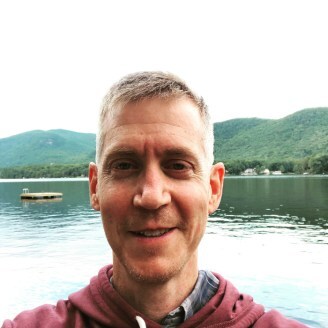 Fantasy author of the Maer Cycle trilogy (low-magic fantasy) and the Weirdwater Confluence duology (sword-free fantasy).
I write non-epic fantasy books in which you will find:
Mystery. Darkness. Wonder. Action. Romance. Otherness examined and deconstructed. Queer and straight characters living and fighting side by side. Imaginary creatures and magic with a realistic touch.
What you won’t find in my books:
Wholesale slaughter. Sexual assault. Unquestioned sexism or discrimination. Evil races. Irredeemable villains. Predestined heroes. An ancient darkness that threatens to overspread the land.
Catch me on Twitter or Instagram as danfitzwrites.
The post The Books That Made Us – As I lay Dying by William Faulkner appeared first on BEFOREWEGOBLOG.


March 15, 2022
The Books That Made Us – The Name Of The Wind by Patrick Rothfuss
You’ve got a great career ahead of you…
I pan my gaze across an ocean of neon lights, fast-talking business folk, and false promises. Hidden in the depths of my backpack: a single book, waiting patiently for the moment I escape.
 Day One
“You’ve got a great career ahead of you,” she says. We stand on the corner of a carpeted trade show floor surrounded by the omnipresent ringing and dinging of a thousand slot machines. They vie for attention here as much as they do in an actual casino.
Here, they won’t siphon your money. Just your time and attention.
“Here” is a greasy place, embodied by parties “where deals are made” and middle-aged white-guy handshakes. The kind that glisten with sweat and squeeze just a bit too hard.
Behind me, those same guys circle the show floor like sharks sniffing for blood. Salesmen in too-big suits chase after sandals-and-socks wearing “entrepreneurs” who were gifted high ranking pseudo-jobs at casinos because they knew someone who knew an industry “power player.”
I snap back to the imminently ending conversation. She’s saying goodbye and wishing me the best. “Say hi to the rest of the team for me!”
“Sure thing, and it was SO great to see you!” I force a bright smile, making sure it reaches my eyes. She turns and wobbles away, shoes digging into the unforgivingly soft carpet. My face shifts from jovial to indifference-bordering-on-anger, and I walk in the opposite direction. I won’t say a damn thing to the team.
A slow 360-degree twirl bathes my eyes in an iridescent rainbow of company logos and marketing imagery hanging from displays on the ceiling. Funny how everyone always seems to have the latest and greatest gambling technology.
I carry on, slumped over. My lack of insoles shouts up my leg and into my lower back. And I’m only four hours into day one.
I meander through the labyrinth of glittery screens boasting scantily clad animated fever dream girls meant to entice “young people”—people like me, by the industry’s standards—into feeding the machine with a wad of Washingtons. I press the buttons, I pull the levers, I spin the reels. I wonder why these show-goers think they’re important. Is it because their livelihood depends on people pressing these buttons, pulling these levers, and spinning these reels?
A friend and former colleague stops me. He’s with a different company now, and he wants to show me some of the “fun” stuff they’ve been working on. I’ve seen it a million times before. Dragons intertwine on the screen as fiery symbols ignite the reels, ushering a big win bonus round or some shit like that. A gaggle of cartoonishly stylized babies busts open a pot of gold coins to celebrate a two-dollar win.
“This one’s really volatile,” my friend tells me, “Made for the bonus chasers.” A beer-league Greek God knock-off oversees this spin of the reels. The spin ends with no wins. The God smiles.
My friend’s genuine enthusiasm drains me.
This convention center collects a hoard of self-important people who make this show out to be the event of the century. It’s fruitless to remind them it happens every year.
My third go-around leaves me tired and shaky. I glance behind the black curtains that comprise the border of the show floor. Behind them, a sea of concrete pillars. A few rolling garbage bins. A forklift. Mostly, it’s empty space. Half the building consumed by “heavy-hitters,” the other half left to gather dust as the salespeople “make headway with potential leads.”
I venture back to my booth. “My company spent $4,000 for me to be here,” I think. Or maybe I whisper it to myself.
My department’s section of the booth is dim and empty. My sales colleagues are meeting with customers. They boss me around because they know I won’t refuse. This is the one week per year when they’re the superstars. This show is the time of year when they can write “I’m awesome” in the memo line of their commission checks.
“We need more fidget spinners on the table,” says the boss-baby-looking guy who called me an idiot just one day before for getting fidget spinners in the first place. He also told my boss to “buy that kid some new pants.” I unload the nearest box of fidget spinners onto the table. I find another box, slide into the coatroom, and dump its contents into his computer bag.
Two minutes later, I’m back at our booth. The fidget spinners are gone. I load more.
Night OneI order room service. Chicken noodle soup and french fries. The food comes to me on a metallic platter adorned with condiments and salt packets.
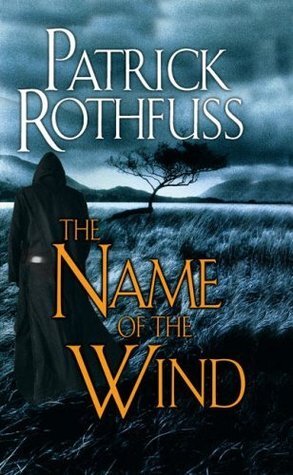
Belly full, I prop my bloated self up with a glob of pillows and crack open The Name Of The Wind. Kvothe regales me with his exploits and adventures. I pine for more stories like this. I long for my story to feel more like his. In a swirling mass of corporate jargon and unrealistic expectations, I struggle to stay afloat.
Nobody asks me what I want. They tell me what they need, and they expect it to be done. The Name Of The Wind asks nothing of me, and I feel a change broiling within. Long basking in the ease of young adult fantasy, I now crave challenge and complexity.
Ravenous, I read 200 pages in a single sitting, until my eyelids start to pull me to a world between sleep and waking. For a stretch, The Name Of The Wind makes me happy. I smile, drearily progressing through my bedtime routine, and imagine plucky, melancholy melodies resounding through a tavern as I fall asleep.
Day TwoAlison walks up to me. “How are you doing?” She asks. Alison is the booth model assigned to my department. They’re necessary because they’re models, you see. And if you don’t have models for your booth, then what reason will all these casino owners have to visit your booth packed with gambling products?
Alison is nice. I’ve told her multiple times I have nothing for her to do other than collect business cards or reload the fidget spinners. I apologize again for the lack of excitement she’ll inevitably endure over the next two and a half days. She takes it in stride. “They pay me either way,” she says. She hands me a small stack of cards and I slot them into my little folio, which I carry around because I am a professional.
Those business cards are on a one-way trip to the single-stream recycling plant. And the people who handed them to Alison certainly expected their contact info to reach the desk of our CEO. I pretend to feel sad for them as I dump their cardstock identities into the recycling. Maybe they’ll become a Starbucks cup.
“This game isn’t loading.” Our content lead can’t hide the shimmer of gleeful disappointment in his eyes. “How come it’s not working?” I can tell he’s happy to blame me, a writer, for this malfunctioning mix of math, code, and art.
“Well, you gave me the latest links to those games yesterday, and those are the links I uploaded to this device.” I tell him. “If the game doesn’t work, it means you gave me the wrong link or your game is faulty.”
“It should be working, though.”
“If you had given me the right link, maybe it would be.”
He storms off. Apparently, the sixth and nowhere-near-final installment of this leprechaun game is crucial to his next meeting. Pin your problems on someone else, buddy.
Two hours later, our sales lead wanders into the whitewashed meeting room I reserved for an interview. The reporter has a camera and a microphone in hand, ready to go.
“You didn’t tell me this was gonna be a video,” blurts the interview subject. The reporter blinks. I prepared for this. I show him a screenshot of the very email chain in which I informed him of this video interview and to which he responded: “Sounds great, looking forward to it.”
I see righteousness flee his eyeballs. Anger rushes in for an instant to replace it, then makes way for a poor attempt to recover from his screw-up. “Just messing with you,” he says, squaring his shoulders happily. He’s thrilled with his lie. I am too, but only because I caught him mid-complacency and forced him to perform verbal gymnastics to cover for his own idiocy.
He answers the questions and hits the talking points. Sounds of the show floor bleed into the thin-walled meeting room and the cheap leather chair squeaks as he shifts in his seat.
My boss and my senior team members will think this interview is a game-changer. Something that will set us apart. In two years, the same man will respond to the same questions with the same answers. “This one’s a game-changer,” they’ll say. And we’ll continue the game until someone finds out I’m faking it and fires me.
I have a great career ahead of me, though.
Night TwoI tell my boss and one trustworthy coworker not to bother contacting me this evening. I have plans.
I walk through the labyrinthine show floor and hitch a cab to my hotel. I stock up on Chinese food and venture to my room. The Name of the Wind rests on my nightstand. A chunk of pages is starting to look worn. The sort of worn that only a well-loved book can be. The wear and tear of use, the slow degrading of something I love because I wring out of it every drop of joy I can.
When I finish the book, all of its pages will look darkened, warped, and used. I will display it on my favorites shelf just like that for years to come, its cracked and weather spine poking out between special editions of other stories I’ve loved.
Tonight, I read 400 pages. I am up far too late, but the story is far too good. I sense a transformation. My eagerness to read has returned after years of being tempered by society’s expectations, responsibilities at work, and a lingering uncertainty that I wasn’t truly enjoying the material I so often engaged with.
The Name of the Wind is different. It is what I need in this moment. When this one passes, I’ll seek other moments. I know I will find them, but for now, this one will do. In this moment, I begin to grasp the parts of myself I’ve locked away for the benefit of others. I understand for a glorious instant that my identity isn’t tied to a dead-end job.
Day ThreeHaggard, pale faces haunt the aisles between loud, clanging machines. Feet shuffle across the carpet, collecting static and frizzing once-gelled hairdos. Croaky whispers recount last night’s escapades, the deal-making parties to which I was (thankfully) not invited.
Hungover ghosts float between the booths from meeting to meeting. It’s a forced slog. A deathly procession.
I scroll through my texts. Last night, I ignored a few invites to “team dinners” that would surely have degraded into benders bursting with peer pressure and unsolicited career advice.
The crowds disperse over the hours, and the very important business people catch their early flights home. I count the 15-minute increments until I can leave. I have to pack up the fidget spinners and ship them back to my office. It’s a highly important task only befitting a marketing associate.
The show floor closes, the slot machines go dark, and the union workers file in to disassemble the hodgepodge of machinery, cheap furniture, and electrical equipment. I weave and bob, careful to stay out of their way as they haul 1500-pound money-suckers into crates six times my size. I shove the fidget spinners into a box and steal some duct tape to secure the package. I address it, set it somewhere I hope the trade show team will find it, and leave.
Night ThreeOn my flight home, I read about Kvothe, who kills kings and performs beautiful songs for thousands. I wonder briefly if I consume so much because I’m terrified to create. I contemplate what would happen if I applied myself to a passion. I close the book, brush off the thought and let the motion-sickness pill lull me into an uneasy mid-flight sleep. I don’t need to create when I have a job that lends me such valuable opportunities. After all, I have a great career ahead of me.
The post appeared first on BEFOREWEGOBLOG.
#SPFBO Review – The Forever King by Ben Galley
Ben Galley’s The Forever King is the start of the second trilogy in his Emaneska series. It picks up 20 years after the end of the first trilogy and follows the heroes’ and villains’ continuing journey, while introducing some new characters along the way.
 Now, all SPFBO entrants need to be standalone, or the first in a series, and, despite its chronology, The Forever King does indeed work as the start of a series. Much like the original Star Wars drops us into a fully-realized, extant world and expects us to pick up pieces of the past along the way, so too does Forever King. I never felt lost as Galley deftly covered all the necessary backstory in the same hushed tones of Alec Guinness talking about the Clone Wars.
The story proper follows Mithrid, a young girl left an orphan when evil forces destroy her idyllic seaside village. From there she is drawn into the war between Malvus Barkhart the current – and quite evil – Emperor, and Farden, the titular, rebellious Forever King, both having endured the status quo at the end of the original trilogy. Mithrid is found to possess a power with the promise to end the cold war between the foes and bring victory to one side or the other. Either outcome will drastically alter the world of forever.
And what a world it is! The Forever King feels like the platonic ideal of the word ‘fantasy’, weaving in absolutely everything you would expect: Warring Kings, Magic, Armies, Demons, Dragons, Rogues, Minotaurs, Gods, and so on. It’s a bright, colorful tapestry of wonderful world-building that will leave fans of traditional fantasy (like me) more than satisfied. Galley’s prose and dialogue also sparkle in the process, providing us with characters as vibrant as the world they’re in. Think more the wit of Locke Lamora versus the relative stodginess of classic Tolkien.
Galley’s world and character-building also rely heavily on Norse influences, which provides a very interesting tinge to his settings and people. But, personally, there are times where I feel this goes too far, ruining my immersion in his otherwise creative and beautiful world. The most egregious of these -again, to personal taste – is the inclusion of Loki as a secondary character. Loki as a concept has suffered from a bit of over-exposure in the past decade-and-a-half due to the MCU, and that is felt here. I found myself wishing Galley had created his own gods to play with, rather than drawing from real world myth, as it feels like a thorn in the side of his otherwise great world-building.
Another prominent thorn is that I feel the book is simply a smidge too long. But I think that’s just because I’m not the best audience for chonkers. I prefer my fiction tight and pacy, with as little fat as possible. And, for the most part, I thought Galley succeeded, but there were stretches toward the second half where my interest began to wane a bit and I felt the inclusion of certain set pieces and scenes felt a little more self-indulgent than absolutely necessary to the story. But, admittedly, this is a minor gripe, as they were still fun.
Ultimately, The Forever King is a must-read for fans of classic fantasy looking for a new series with a bright, colorful edge to it. It gave me everything I wanted and more, leaving me more than immersed enough in the world to want to go back and read Galley’s original trilogy, as well as continue on with this one.
9/10
The post #SPFBO Review – The Forever King by Ben Galley appeared first on BEFOREWEGOBLOG.
March 13, 2022
Short Story Review – Mr. Death by Alix E. Harrow
I have one child, one child that I carried, all 12 pounds of her, and had her pulled from me, squalling into this awe-inspiring and cruel world. All of my love, hopes, and dreams for the future lay upon her tiny shoulders. As the saying goes, “my heart lives outside my chest.” This is why Mr. Death by the always incredible Alix E. Harrow smacked me around a bit emotionally. I empathized with both the reaper and the parents. Two sides of the same coin, and in the middle is a little boy, age two, whose soul shines like the sun.
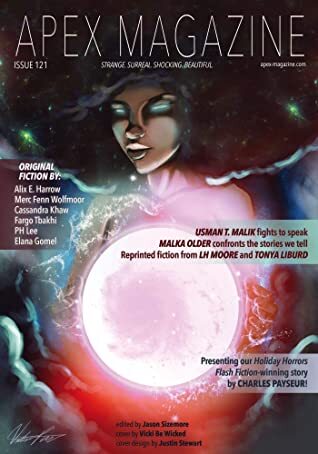 You know from the first line of the story, “I’ve ferried two hundred and twenty-one souls across the river of death, and I can already tell my two-hundred-and-twenty-second is going to be a real shitkicker.” Mr. Death is about a reaper who gently ferries souls from their bodies to the river and the after. Sam Grayson, the reaper in question and the main protagonist of the story, is a father grieving the loss of his own son years before when he is taken by lung cancer. While waiting in the breakroom for his next assignment, He is handed a manilla envelope. Thin, to thin, with this information printed on it:
Name: Lawrence Harper
Address: 186 Grist Mill Road, Lisle NY, 13797
Time: Sunday, July 14th 2020, 2:08AM, EST
Cause: Cardiac arrest resulting from undiagnosed long QT syndrome
Age: 30 months
As a reader, his response and mine are the same, “Jesus Christ on his sacred red bicycle. He’s two.” Sam visits the child, supposedly invisible, but for some reason, Lawrence can see him. Sam’s heart aches in solidarity for the upcoming earth-shattering pain he will have to inflict upon these loving parents and the pain of his own loss. But all bodies will eventually die, and when it is your time, that is an unassailable fact. Or is it?
Harrow has pulled just enough of the raging thunderstorm of grief into this story to make you empathize and believe the situation. Instead of maudlin, it is heartfelt. It is a lovely read and pretty obvious why it is now nominated for a Nebula. Awards seem to stick to Harrow like magnets these days, and rightly so. Check it out.
Check Out Mr. Death Check Out Some of Our Other ReviewsReview- A Spindle Splintered by Alix E. Harrow
Review – Autobiography of a Traitor and Half Savage by Alix E. Harrow
Review – Witch’s Guide to Escape: A Practical Compendium of Portal Fantasies by Alix E. Harrow
The post Short Story Review – Mr. Death by Alix E. Harrow appeared first on BEFOREWEGOBLOG.
March 12, 2022
The Books That Made Us – Time of the Twins (Dragonlance Legends) by Margaret Weis and Tracy Hickman
One of the things Before We Go’s reviewers have been revealing is that a lot of us share the same books that made us the lovers of fantasy we are. Ryan Howse did a fantastic job talking about what the Canticle books by RA Salvatore meant to him. Jodie Crump talked about the wonders of the Dragonlance Chronicles.
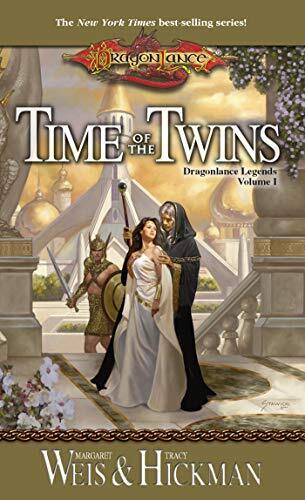 For me, however much I liked these books, the ultimate book series was Dragonlance Legends: Time of the Twins, War of the Twins, and Test of the Twins. These were the sequel books to the Dragonlance Chronicles but I actually read them first. Furthermore, they were not only my first exposure to Dungeons and Dragons fiction but they were my first fantasy novels ever. I mean, not counting Narnia and the Hobbit when I was in grade school.
The premise is the big epic heroic battle against the forces of darkness is over. The forces of good are triumphant and the forces of evil are defeated. I always thought that was a tremendously clever way of opening a campaign setting because, even then, I knew enough about high fantasy to be bored of epic battles against good versus evil. Indeed, it was such a clever idea that I pretty much copied it with Wraith Knight (shh). A war of light and dark can usually end only one way while the aftermath can go anyway you want it to.
War hero Caramon Majere, who I misread as Cameron for a decade, is a fat drunk who is barely keeping himself from being abusive. While the rest of the Heroes of the Lance have gone on to bigger and better things, he’s allowed himself to wallow in self-pity as well as regret. There’s also some undiagnosed PTSD but there isn’t exactly much in the way of psychology on Krynn. The biggest regret Caramon has is his brother Raistlin Majere turning to the Dark Side (or Black Robes in this case).
Raistlin Majere. Man, if there has been a more influential character to my writing then it’s either Harry Dresden or no one. Raistlin was the man when I was a fourteen-year-old nerd thinking he was smarter than everyone else. As a teenager, you think the entire world is out to get you and everyone is jealous of your superior intellect–or maybe that was just me. As an adult, I look back on Raistlin Majere with different eyes. Perhaps the eyes of wisdom. A genius, indeed, but so self-absorbed and misanthropic that he made 90% of his own problems.
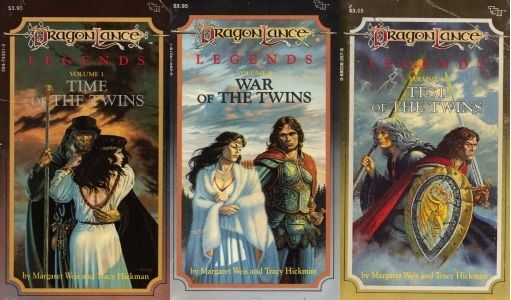 In a way, Raistlin also serves as an excellent rebuttal for all those dark and tragic romances out there. He and the cleric, Crysania, have all the hallmarks of a bad boy/good woman romance but the books never shy away from what a terrible person he is. He could have happiness with her but to do so would require him to give up his self-agrandizing plans that have no real purpose to him. Raistlin wants to be a god but, really, why? What’s he going to do once he’s a god? It was an interesting concept to present to a teenager.
I also loved the character of Crysania who was a spoiled and somewhat arrogant woman but possessed of a genuine empathy as well as faith. She wants to help Raistlin but also has own ambitions that are guiding her somewhat foolish actions. I also love the story of Caramon Majere as he struggles to overcome his trauma as well as addiction. He also needs to divorce himself of his toxic relationship with his brother that was, previously, his only reason for living.
Fantastic series and everyone should read it.
Purchase The Dragonlance SeriesCheck Out Some of Our Other Articles in This SeriesThe Books That Made Us – Author Influences by Janny Wurts
The Books That Made Us – Dragonlance Chronicles by Margaret Weis and Tracy Hickman
The post The Books That Made Us – Time of the Twins (Dragonlance Legends) by Margaret Weis and Tracy Hickman appeared first on BEFOREWEGOBLOG.
March 11, 2022
Review – Red Sonja by Gail Simone
RED SONJA is one of the classic characters of sword and sorcery who has inspired a hundred imitators as well as helped make action girls more acceptable in Modern Fantasy. However, she’s unfortunately suffered from being effectively reduced to a joke about her infamous chainmail bikini.
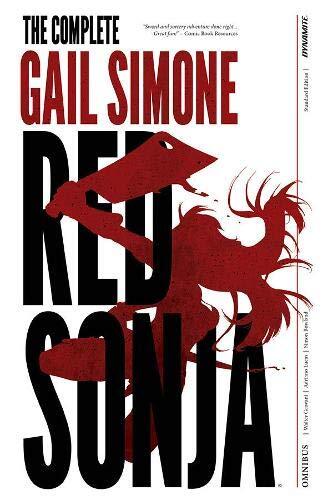 Part of this is due to the inherent silliness of it and the inherent double-standard when it comes to sexualization. Conan can run around with a loin cloth and not be sexualized but every part of Sonja is scrutinized and often deliberately highlighted. After all, Roy Thomas assumed he was primarily selling his creation to teenage boys.
Gail Simone opens her omnibus discussing this dichotomy with the fact that she was part of the periphery demographic of comic book readers that absolutely loved Red Sonja as an ass-kicking, deep, and fascinating character in her own right. Yes, this small and ignored group of people called women that compromised half the human population as well as a significant chunk of comic book readers. In fact, had always been so. When given the chance to write the character, she lept at the chance and decided to put her own spin on it.
Gail Simone’s issue with the She-Devil isn’t that she wears the chain-mail bikini or fanservice. There’s quite a bit of both in the book, though Sonja wears quite a bit more clothes and armor than usual. No, her primary issue is with the other thing that she was most infamous for: her rape backstory, empowerment by Scathach, and the oath to never be with a man unless he beats her in battle. Her opinion on that? “That is the stupidest thing I have ever heard in my life.”
Indeed, Red Sonja is deliberately not chaste in this reboot of her character and spends a not-insignificant portion of Simone’s run trying to get laid. Gail Simone throws quite a number of humorous obstacles to explain why Red Sonja, looking like the original swimwear model, has difficulty with this and it is always hilarious. More controversially, Gail Simone makes it clear that Sonja is bisexual as well. Which perhaps was done due to the character’s somewhat checkered history with queer representation.
 Gail Simone perhaps goes a bit too far in reinventing the She-Devil with a sword. While I don’t think too many readers will mourn the fact she is no longer sexually assaulted in her backstory, being away from the massacre when it happens, the lack of Scathach and changes to her personality are a bit more noticeable.
Fine, let Sonja be horny and a party animal but Gail Simone flat out makes her seem dumb at times as well as a caricature of Conan–who was, himself, never dumb save when caricatured. To seasoned Conan pastiche readers, you’d know that Conan is Chaotic Neutral occasionally bordering on Chaotic Good while Sonja was always Chaotic Good, occasionally bordering on Neutral or even Lawful Good.
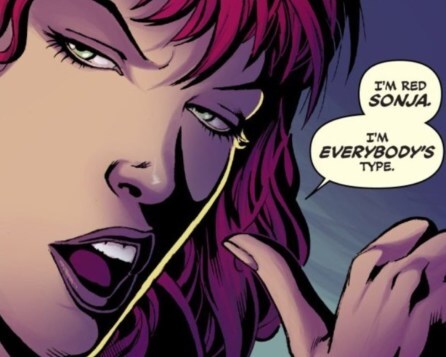 The first of the stories, “Queen of Plagues” is a surprisingly intricate storyline that reboots Sonja’s backstory as well as well as deals with an ex-lover/rival Dark Anissa who has now become the head of an army of zealots who kill all people who may carry a devastating plague. “The Art of Blood and Fire” is a hilarious zany comedy about Red Sonja trying to assemble seven artisans for a pharaoh’s death party in order to free a thousand slaves. It is one of the best comics I’ve ever read in my life. “The Forgiving of Monsters” is the only dud in the group as it suffers from the Spider-Man 3 problem that it wants the heroine to let go of revenge while their object of revenge remains a complete scumbag continuing to commit crimes.
In conclusion, I definitely recommend this book for fantastic art, fantastic action, and something that goes a long way to reminding readers while Sonja is a beloved fantasy icon. However, I feel it goes a little too far in changing her backstory as I always liked the Scathach connection. I also don’t think it was a good idea portraying Sonja as sometimes bordering on a complete dumbass. Which has never been part of her characterization.
Purchase Your Copy of Red Sonja Herecheck out some of our other reviewsReview – The Legend of Vox Machina
Review – Dead Things by Stephen Blackmoore
The post Review – Red Sonja by Gail Simone appeared first on BEFOREWEGOBLOG.
March 10, 2022
#SPFBO Review Legacy of the Brightwash by Krystle Matar
Oh, man. This book is not for me.
Krystle Matar’s Legacy of the Brightwash is a long, bleak, Gaslamp fantasy that focuses on the world of the Dominion – a grim and gritty setting with late 19th and early 20th century technology, with one important difference: the existence of humans with limited magical capabilities. These ‘Tainted’ (or ‘Talented’, depending on who you ask), are effectively mutants with the ability to heal, or generate electricity, or run machines, or other similar useful tasks. Of course, the human government of the Dominion has seen fit to register them and tightly control the use of their ‘talents’.
 Brightwash follows Tashué Blackwood – a regulation officer who registers and tracks the Tainted– after he finds the mutilated body of a young Tainted girl wash up on the banks of the Brightwash river, sparking his investigation on where this child came from and who was responsible.
Now, while you would think this mystery would be the main thrust of the plot, it actually quickly takes a backseat as the book shifts gears entirely and delves deep into the politics of the Dominion and Tashué’s place within them, while he begins an emotional and eventually physical affair with Stella Whiterock – one of the Tainted he’s charged to monitor. The novel devotes the majority of its very considerable page count to the complex interpersonal dynamics between the various characters introduced in the narrative and their place in society before coming back to, and wrapping up, the mystery of the mutilated child in the back 20%.
This makes Brightwash a slow, sad, depressing, trudge through the dark world of the Dominion and the even darker inner world of its protagonists and secondary characters.
And that’s what makes it so painfully, soulfully, and beautifully human. Brightwash uses fantasy like a safecracker’s tool to break its characters open and lay their contents out with the lightest of touches.
Matar’s prose is deep, mournful, and gorgeous, able to bring out both the deep physical and emotional wounds the characters experience throughout the story. And although the world is light on its fantastical elements, Matar manages to make it feel absolutely strange and familiar all at once – books like Caleb Carr’s The Alienist and China Miéville’s The City and The City come to mind. This is dark stuff written so beautifully that you can feel the grime on the walls and the grit in every crevice – both in the world and the characters themselves.
As I said, this book is not my cup of tea. Its a light fantasy frame around a long, introspective look at the human condition and our power structures that left me feeling absolutely emotionally drained and uncomfortable.
But that’s what all good art is supposed to do.
9/10
Check Out Some More Of Our Reviews#SPFBO7 Burn Red Skies by Kerstin Espinosa Rosero
#SPFBO Review and Cut = Skyview: Lord of the Wills by M. Sheehan
Purchase Your Copy HereThe post #SPFBO Review Legacy of the Brightwash by Krystle Matar appeared first on BEFOREWEGOBLOG.
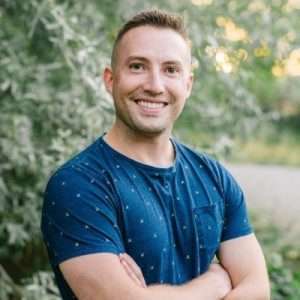
An Interview with Scott Drakeford, Author of Rise of the Mages
Scott Drakeford’s highly anticipated release of Rise of the Mages has many fantasy lovers buzzing about the intricate storytelling, revenge plot, and gripping fight scenes. Scott was kind enough to sit down with us and tell us a bit about Rise of the Mages and the path he took to get the story released.
 [BWG] First, thank you so much for taking some time and answering these questions for us! Rise of the Mages is a fantastic book, and I am happy we get a chance to talk a bit about it with you.
Thank you! I’m honored by your interest in my work. Thank you for giving me and Rise of the Mages a shot.
[BWG] You have a degree in mechanical engineering, which uses a different kind of logic and creativity than writing and story creation. Do you feel like your experiences in mechanical engineering complement your ability to write and put scenes together?
Honestly, engineering was extremely boring for me. I thought I’d get to solve problems and build awesome machines, but it was so much more mundane than that. Like, imagine studying advanced math and science for years and years just to end up on a team of people designing screws or fancy zip-ties as wiring harnesses. And that’s your life. You spend years calculating the best material, size, thread count and pitch. Then you pray to whatever god you believe in that when the rocket/car/plane/whatever blows up, it was something else that failed, not your screws. God, I hated it.
I did, however, learn to pay great attention to detail. I learned to value extreme consistency, continuity, and logic. Engineers have great use for creativity in solving problems or applying technology but have no use for the implausible. I think that heavily influenced my brand of writing, and certainly it affected how I write. With everything from my fictional magic system and characters to my plot and prose, logic and details matter. Maybe a little too much.
[BWG] What is a significant way Rise of the Mages changed since the first draft? Did the story organically evolve as you worked on it?
This book changed a lot over the years. I learned to write with the first ten or so drafts of this story that only I ever saw. I learned to edit and rewrite when I let my wife, dad, and brothers read it to tell me what worked and didn’t. That probably resulted in another draft or five. I then did another three or four drafts with my awesome agent Matt Bialer and his talented assistants (one of whom is now a bestselling author). Then I did another two or three drafts with my editor Jen and her awesome team (thanks Molly!). It has been a long journey, a ton of work, and I’ve had a lot of help.
Another big factor in the evolution of the story was my own evolution as a person. I changed a ton over those ten years. I completely switched careers, had a child, left a religion, and changed my entire worldview. We moved across the country, and I quit my job two years ago to be my child’s primary caretaker during the pandemic (poor kid) so my wife could take her dream job.
So… yeah. Rise of the Mages evolved A TON as I evolved both as a writer and as a person. I would guess that every single word in the book has been rewritten at least two or three times. I even threw away the middle 50% or so and completely replaced it with a new story at one point. Just about the only constants from beginning to end of the process were Emrael, Ban, and Jaina’s roles as core characters.
[BWG] Did you have to do any research for the story? If so, did you go down any interesting rabbit holes?
I did some research on earth’s magnetic field, what we think causes it, and why ours is far too weak to use as an energy source. I learned how radios in particular work on a theoretical level, which is neat. Human discovery of electromagnetic energy and subsequently using it to create technology like radios, televisions, the internet, etc, is just crazy when you take time to consider all the different discoveries that had to happen. For all the current reasons to doubt the merits of humanity in general, our history of progress is amazing. I hope to see many more breakthroughs in my lifetime. I just hope we can continue to stay ahead of our mistakes.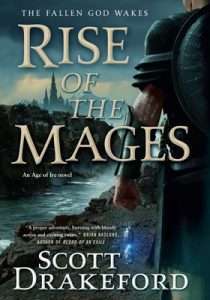
[GdM] What was your writing schedule like when writing Rise of the Mages?
Well, it has changed a lot depending on my life circumstances. I started writing in the early evenings when I didn’t have a child. In the thick of raising a child and working long hours at a corporate job, I wrote a lot at lunch when I had time to take lunch off-site. Basically, anytime a normal person would be relaxing or socializing, I tend to be writing, editing, or similar.
[BWG] Scott Drakeford is a nom de plume and an ode to your father. How did he influence you and turn you into a reader?
Well, my dad reads more than just about anybody I know, and certainly faster than anyone I know. A 400-page book probably takes him a few hours at most. When I was about eleven years old, he convinced me to read The Belgariad. Ever since, we’ve shared a love of reading, fantasy in particular. We still share books and recommendations often.
[BWG] The Rise of the Mages reads like the classic fantasy I read and was excited about growing up. Books like The Belgariad and the Wheel of Time had a significant impact on me as a reader. What classic book influenced you as a writer?
I have to tell you, I’m ecstatic to hear that Rise of the Mages evoked some of the same feelings as The Belgariad and The Wheel of Time. Those two series were really key in my formative adolescent years. I’m pretty open about this, but the Wheel of Time in particular became my happy place. I was very, very into that series and I still love it.
L.E. Modesitt’s Recluce series is another that I consider “classic” that I’ve been reading for decades. He’s very, very good at crafting an entire life for his characters, and at showing the everyday details that go into even figures who end up changing their world. One of the best authors out there.
[BWG] I read that Rise of the Mages took a total of ten years from start to finish. Can you tell me about the beginning? What was the impetus of the series?
There are many catalysts that resulted in different characters, storylines, and themes in Rise of the Mages. But the thing that got me to put pen to paper in the first place was simply feeling stuck in a career I didn’t love (see: engineering discussion above). I needed an outlet for creative expression. I needed to feel like I was creating something that mattered. And few things have mattered more to me than the wonderful stories that have inspired and influenced me throughout my life. So shortly after I graduated from college in 2012, I started writing the story that would become Rise of the Mages.
[BWG] What did you do to celebrate finishing the final draft of Rise of the Mages after a decade of hard work?
Well, in publishing it’s really difficult to ever really feel like anything is truly done, I think. When my editor told me I couldn’t change things anymore, it was honestly kind of painful. I did buy a bottle of Glenlivet 18 that I opened that night, but it didn’t feel as celebratory as I would have liked. I’m hoping launch day will be more fun.
[BWG] Can you tell us a bit about the plot of Rise of the Mages?
Two brothers attend a school for engineers and military leaders. A powerful political leader from a neighboring province seizes the school in order to use their technology to bolster his own international war efforts against a technologically advanced nation, Ordena. One brother, an engineer, is captured and enslaved. The other brother, a student of military arts, sets out to rescue him.
It’s a story about relatively powerless individuals banding together to fight against the injustices of the current power structure. Of course, there are political, social, and personal complexities involved, but that’s the primary purpose of the plot. Rage against the machine, as it were.
[BWG] Rise of the mages has an elaborate magic system. Can you talk a bit about its creation and how it works?
The magic system in Rise of the Mages is very closely related to the primary energy source, called infusori, that powers most of the world’s technology. I’m far from being an expert on biology, chemistry, or physics, but the roles of chemical energy and electromagnetic energy (and even the processes that convert one into the other) were something I wanted to explore.
In Rise of the Mages, the core idea is: what if humans evolved to be able to metabolize electromechanical energy in a similar fashion to our chemical metabolism? And further, electromagnetism being inherently less contained in nature, what if humans could use said energy to affect the world around them?
I think the basic laws of physics as we currently understand them in our world play very well here with what makes an interesting magic system in second-world fantasy, and that just felt right to me. I had to take some further liberties, of course, but I like that the tech and magic are at least somewhat close to obeying the natural laws that govern our current reality.
[BWG] Along with an intricate magic system, you also have political machinations and upheaval of warring factions and cultures. I found the Ordenan culture fascinating. Did you model it after any known cultures or histories?
The Ordenans are probably my favorite culture as well, and they feature more and more heavily as the series goes into books two and three. I’ll try not to spoil too much for you, but where this first book is very solidly an action/adventure quest, the following books expand to incorporate more political intrigue and larger-scale conflicts.
The inspiration for Ordena wasn’t so much any single culture in our own world as much as it is a symbol of imperialism and the cultures throughout our world’s history that have propagated such philosophies and policies. You could point at Britain, ‘Merica, Spain, Portugal, Germany, Rome, the Crusaders, Japan, China, the Soviet Union, France, the Ottomans, the Egyptians, even ancient American societies; really any civilization that reached a point where they had the power to take advantage of another population, or eradicate them to take what they had, or even those who engaged in such conquest for religious reasons. Ordena is a little bit of all of those: their religion is centered on preserving and furthering ancient knowledge that they believe to be from their two Deities, the Silent Sisters. A big part of that is a holy war against another civilization they believe to be evil, and to some extent they are right. But I hope to explore how such stark beliefs and “justified” conflicts often turn out to be not so purely motivated after all, and why much of such conflict is due to a willful misconstruction of “the enemy” – optics, as it were – to hide the true motives.
Or are their gods really behind all of this mess? Read and find out, I guess. [image error]
[BWG] Have you worked out how many books will be in Age of Ire?
For now, it will be three books. Book two has been written and is in revisions – it doesn’t have a firm pub date just yet, but will likely be out sometime in 2023. Book three should close this phase of the story, and in a relatively timely manner.
[BWG] One of the most compelling characters in the story for me was Jaina. She was both a master of fighting and war and a teacher and a devout believer; she had a significant depth of character. Was she modeled after anyone specifically? How did her character come about?
I try very hard not to project myself too much on any one character, and I similarly try not to model any given character after a particular person in my life.
That said: I can’t speak for other authors, but I believe that each of my primary characters logically must come from somewhere inside me, or at least from somewhere inside my conscious (or unconscious) experienced reality. At the very least, it’s easier for me to write convincingly when I understand motivations and personalities on some level.
As for Jaina’s character? I can be a very stupid person on occasion, and particularly in my younger years, I was prone to strong (often incorrect) opinions and brash actions. Intelligent, strong, amazing women in my life have always been there to show me a better way, to provide an example of leadership, accomplishment, and relationships done right. My mother and my wife, in particular, are just unreasonably good at life and I am so lucky to have both of them in mine. But I’ve had incredible grandmothers, aunts, female cousins, bosses, mentors, just so many women that have been anchors at various stages of my life. Jaina is all of them, and none in particular.
She is my hero, and so are the women in my life.
[BWG] Finally, what exciting things are you currently working on?
Book two revisions! I really love how the second book turned out, but now it’s time to make sure that my editor, agent, and all of my beta readers can connect with it as well. I find it best to edit myself to at least the point that grammar is correct, the prose flows well at all levels, and at least the core elements of character and plot are in place and work for me. Then Kailey (my wife), Matt (my agent), Jen (my editor), my dad, my three brothers, and a small group of other superb beta readers all get their turns tearing my soul to shreds. Then I rebuild myself and my book, and hopefully, neither process takes too long.
Interview Originally Appeared in Grimdark Magazine
READ RISE OF THE MAGES BY SCOTT DRAKEFORD
The post An Interview with Scott Drakeford, Author of Rise of the Mages appeared first on BEFOREWEGOBLOG.
March 9, 2022
The Books That Made Us – Author Influences by Janny Wurts
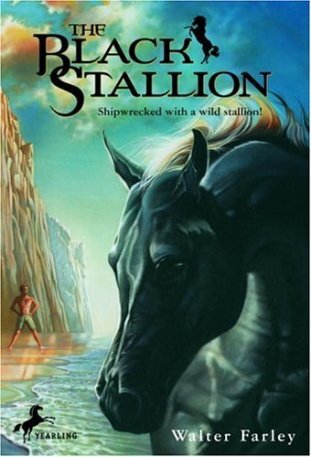
Ground floor, as a child, I would have become a non-reader if not for Walter Farley’s Black Stallion series. As a horse crazy kid in love with the outdoors, those books gave me a reason to read, and opened the gates to a lifelong passion, though as a third grader I had to sneak into the teen section after school hours to check them out. Fairy tales and myths were my first introduction to magical reading, and I could not get enough of that.
 After that, I literally read the fiction library in the small town where I grew up. Every sort of fiction: thrillers, historicals, mysteries, authors from every walk of life and background, if the printed page had a story, I devoured it. I read everything from Irving Stone’s Agony and the Ecstasy to Costain, Mary Stewart, Howard Pyle, Robert Louis Stephenson, Mary Renault, Morris L. West, Dick Francis, and everything naturalistic by Daniel P. Mannix. I read Rosemary Sutcliff, Lindsey Davis, romance authors, poets – the gamut. I swiped my father’s books and read the likes of John D. MacDonald, Conrad, Clancy, Hemmingway, and mixed those up with Jane Austin and Ngaio Marsh, and signal works of nonfiction, like Cry, The Beloved Country and Bury My Heart at Wounded Knee.
I did not grow up reading SF and fantasy because the library did not carry those titles, although, rare for them, they did shelve Roger Zelazny. That was my first brush with SF, and it was a thrill beyond the pale of anything I’d ever encountered. I immediately started collecting his work.
The JRR Tolkien smashed the glass. I was transported by the idea that stories could be told in made up worlds, and that shifted my perspective permanently. I fell in love with fantasy before everything else, and after that nothing ever connected the same way again. I pursued Norton, LeGuin, Stephen Donaldson, Tanith Lee and Jack Vance with a will that burned up the pages.
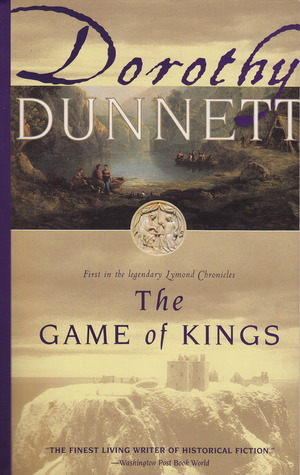 Along the way, there have been other significant milestones. My encounter with Dorothy Dunnett’s historical Lymond Chronicles left a major impression, to the point where I am still in awe. Her way of depicting events, places, and above anything, depth of character and shattering plot twists opened the floodgates of deeper possibility. Joseph Kessel’s very fat The Horsemen immersed me into another culture and world view in a stunningly vivid way. Edith Pargeter’s The Heaven Tree and the shaded nuance to her characters involved in the building of a cathedral sketched an antagonist whose downfall memorably earned the readers’ sympathy.
Today, I stand on the shoulders of such giants. They taught me the ropes, and gave me the enriched vocabulary for precision I use in my writing today. While fantasy and SF continue to be my first love, my reading still wanders all over the map. I read debut talents as readily as older classics, and every encounter sparks the insatiable, maverick urge to continuously break the envelope.
Check Out Some of the Books Mentioned by JannyAbout the Author
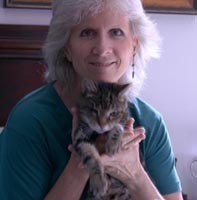 Janny Wurts is the author of War of Light and Shadow series, and To Ride Hell’s Chasm. Her eighteen published titles include a trilogy in audio, a short story collection, as well as the internationally best selling Empire trilogy, co authored with Raymond E. Feist, with works translated into fifteen languages worldwide. Her latest title in the Wars of Light and Shadow series, Destiny’s Conflict, culminates more than thirty years of carefully evolved ideas. The cover images on the books, both in the US and abroad, are her own paintings, depicting her vision of characters and setting.
Website http://www.paravia.com/JannyWurts
Twitter jannywurtsThe post The Books That Made Us – Author Influences by Janny Wurts appeared first on BEFOREWEGOBLOG.
March 8, 2022
An Interview with John Birmingham, Author of The Cruel Skies Series
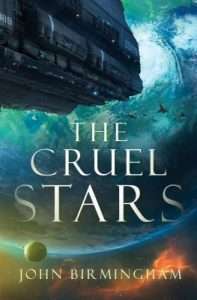
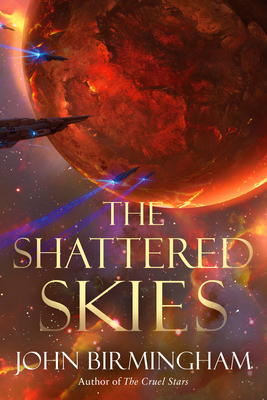
Over the years, John Birmingham has had his finger in many pies. He is an author that has penned over 30 books that run the gamut from humor to military science fiction. Recently he has released his second novel, The Shattered Skies, in his wild sci-fi space opera The Cruel Stars trilogy. In The Cruel Stars, a group of ragtag fighters come together and battle against fascists in space.
John was kind enough to sit down with me and discuss his writing career and his newest series, The Cruel Stars.
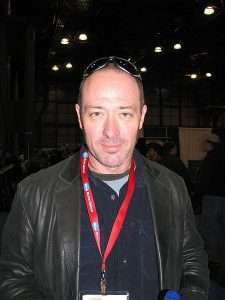 [BWGB] You have a degree in International Relations; if you had decided not to be a writer, what would you have done with that education?
Nothing good, I’m afraid. I started my working life as a researcher for the defence department. One of my flatmates and good friends from that time is now the secretary of the department. His fingerprints are all over that recent nuclear submarine deal. I imagine if I had stayed in my original lane that’s the sort of shenanigans I would’ve been up to.
[BWGB] When you were first published in the Semper Floreat at the University of Queensland in Brisbane, was that the moment you got the writing bug?
Oh no, I had it years before. I think I had it almost as soon as I learned to write in primary school, but I remember applying myself to the work of writing when I was in high school. I’d sit up late, like really late, on school nights, copying out huge slabs of text from books that I really liked. I was trying to reverse engineer them, to see how they worked. I learned later that Hunter S Thompson did the same thing with William Faulkner. So maybe I shouldn’t be too embarrassed by it.
[BWGB] You have stated that you started as a horror writer and were heavily influenced by Stephen King, and reading your catalog, you can see a lot of that in the Dave Hooper series. I have to ask about your first horror novel. What was the premise, and is your first horror book still located at the State Library of New South Wales?
Hahahaha. I can’t remember the exact premise of the book, but I do know it was a terrible and embarrassing homage to Stephen King’s The Stand. An end of the world novel with demons. I guess, given how the Dave Hooper series turned out, the rotten apple didn’t fall too far from the tree. But God, that handwritten first high school novel was hot, shameful garbage. Anybody who’s in Sydney can feel free to drop into the state library and read it in it’s original hand written form. Especially young writers. They would see then that there is nothing magical about being a published novelist.
[BWGB] Tell me a bit about your site Cheeseburger Gothic. I would love to know how it got its name and the story of how it started.
The origins of the name are lost to time, I’m afraid. But I wouldn’t be surprised if they had something to do with that old TV series, American Gothic. I quite liked it. And I really like cheeseburgers. So, you know…
It started as a diary on an old blog site called journalspace, and I do remember I started writing there because a guy called Steve Murphy had written a review of Weapons of Choice on his journalspace blog. He picked me up on a couple of egregious technical errors, which was fair enough. But otherwise the review was really nice. I guess it drew me into that community.
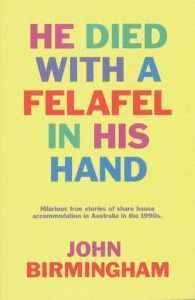 [BWGB] I have a friend from Sydney who introduced me to Falafel, the play, and the movie. Could you talk a bit about He Died with a Felafel in His Hand and how that came about?
I was working at a magazine called The Independent Monthly, and we were quickly going out of business. The deputy editor took me aside one day and said he had this plan to spin up a publishing company. He wondered if I could write him a funny book as a stocking stuffer for the Christmas market. I shrugged and told him that I had a few flatmate stories, and we were off to the races. It was weird, really. I took it on like a magazine commission, rather than a book. And it totally died in the arse when it came out. Nobody bought that fucking thing for about six months, but there was this one guy an independent book distributor, who really liked it and who kept a box in the back of his car, forcing it onto bookstores everywhere he went. After six months it took off. I reckon that guy was the reason.
[BWGB] How has your writing changed from the days of Falafel to now? Is it the same process?
My process has been, er … refined. It had to be. I had no process when I started. I wrote Felafel in five weeks, mostly after midnight, on cheap red wine, hot chips and amphetamines. It sounds cool, but it wasn’t. It was stupid and unsustainable. I’m all about the time management now. Pomodoro technique, Cal Newport’s deep focus, all of that shit. I try to write, and I mean write, not ditz about on Twitter, for at least four hours a day, every day. I track my time. I block my access to social media. I try to know what I’m going to write before I write it, and I execute on that plan like a motherfucker.
[BWGB] Reading Falafel and Stranger Thingies, you seem like a man who can find the funny in every situation—even dark ones. How do you approach comedic writing? How do you take something dark and see the humor in it?
To be honest, I don’t know. I don’t know why I see the humour in things, or maybe that I can simply extract the humour in things and put it on the page or the screen, when others can’t. When I realised that I could do something that would earn a bit of money I even tried studying it, buying how-to books by comedians and comic authors. I can tell you mechanically why something is funny, but not why some people are able to engineer those lulz on the screen or onstage and others aren’t.
[BWGB] Is it true that you wrote your David Hooper series because the Movie Reign of Fire pissed you off so much?
Yes. Yes it is. I was promised helicopter gunships versus dragons, and I was really looking forward to seeing some dragons get their asses kicked. I was gravely disappointed.
 [BWGB] How many years have you practiced Jujitsu? Has that helped you create and choreograph your fight scenes?
I first started training in my early 20s, for a very sad reason. A friend of mine was murdered. I felt bad I hadn’t been there for her, but I also knew that if I had, I probably would have been killed too. I’ve been training on and off, ever since, whenever I can find a good Dojo. I went about 12 years in Sydney without training at all because the nearest Dojo was four hours away. I got back into it when my kids were old enough to train, about 4 and 6 respectively.
And yes, it really does help with writing fight scenes. A lot of the training we do in our school is scenario based. Fights in stairwells. Attacks in train carriages. That sort of thing. It’s nice being able to understand how the angles work. Although, to be honest, most fights in real life are over within two seconds. And they’re not particularly pretty to look at. But that’s not the sort of thing which sells books or movies.
[BWGB] You have many strong female characters in the Cruel Stars. Women who kick-ass, have swagger, and lead teams of warriors. I also read you have a daughter you are training to be “an unstoppable killing machine of death when she leaves home.” In science fiction, women used to be portrayed as insipid and weak. They would rather scream than beat the monster. Are there any female characters you thought were watershed moments for science fiction? For me, it was Ripley’s “get away from her, you Bitch.”
Yeah, Ripley is acknowledged as occupying an inflection point in popular culture. She is hugely significant. But there were female characters before her, and obviously there have been plenty since. It’s almost a whole genre now. I think the Doctor Who companion Leela was really important in her own way. And obviously Buffy the Vampire Slayer wrote a whole new rulebook. Pity about Joss Whedon, though, innit.
[BWGB] The second book in the Cruel Stars series drops this month called Shattered Skies. Can you explain a bit about the series for the uninitiated and some things we get to look forward to in Shattered Skies?
Hmm, lets see. There are space Nazis, space zombies, which the space Nazis created, to overthrow the ruthless corporate space empires. There’s space lesbians, space marines, angry robots, a Princess, a 700 year old foulmouthed Scotsman, and a young woman called Lucinda who’s in over her head. Until she starts shooting people, and then she’s way more chill. The space Nazis turned up in The Cruel Stars, and they broke a lot of things and hurt a lot of people, but the lesbians, the Princess, the Scotsman, the angry robot and Lucinda opened a whole can of whoopass on them. There’s more whoopass in book two. And consequences. So many consequences.
[BWGB] Was it a unique challenge to write The Cruel Stars with characters who lived such long lives due to recorded consciousness? A character now might not have been the same person 400 years ago.
That was less the challenge than a provocation. This particular trope has been worked over a couple of times now by authors as good as Peter F Hamilton. So I didn’t have to reinvent the wheel, I just wanted to gaffer tape some really wicked blades to it.
 [BWGB] You do highly detailed research in your books. What are some technology rabbit holes you went down in researching Cruel Skies?
Machine intelligence and neural nets. Like, actual wiring in the brain. Elon Musk is deep into that shit, and with good reason. He’s worried about the machine singularity. At one point I found myself reading, re-reading and taking notes on this insane 45,000 word essay deep diving into Musk’s Neuralink project. And then I would remind myself, dude, just write the book.
[BWGB] What are you writing or have going on at the moment?
The third and final book in the series, natch. The Forever Dead. And some screenwriting, which I can’t talk about, because screen guys are really uptight. But for my own amusement, I have been playing with a TV adaptation of The Cruel Stars. I’ve also been working on a new Axis Of Time series, over on my Patreon page. That should start coming out on Audible sometime in the next six months. And I have an idea for some crime novels. It’s enough to be getting on with.
Interview originally appeared in Grimdark Magazine
READ THE SHATTERED SKIES BY JOHN BIRMINGHAMCHECK OUT SOME OF OUR OTHER REVIEWSReview 36 Streets by T.R. Napper
Review – Dead Things by Stephen Blackmoore
The post An Interview with John Birmingham, Author of The Cruel Skies Series appeared first on BEFOREWEGOBLOG.