Beth Tabler's Blog, page 162
October 3, 2022
The Books That Made Me – Guards! Guards! by Terry Pratchett
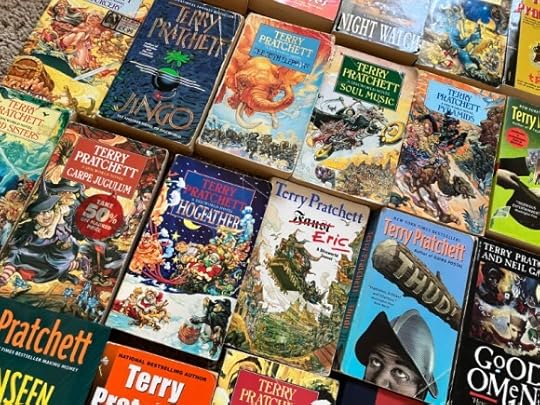 I spent my high school years crossing the Pacific Ocean on a sailboat, which was awesome—so awesome, in fact, I turned my senior year into a 24-month odyssey by slow-rolling through my snail mail correspondence program.
After I (somehow) graduated, cyclone season forced us to New Zealand, where I faced an ultimatum: if I hoped to attend college in the USA, I needed to take the SAT.
We found a testing center in Auckland, so I traveled south, bound for South African friends who promised shelter and a braai (epic BBQ). To my delight, the room they offered me boasted a groaning bookshelf! I thumbed through the books, searching for a story (preferably Star Wars-related) to ease my nervousness about my looming exam.
Whimsical cover art caught my eye. A dragon attacking soldiers? Color me intrigued.
“Guards! Guards!” by Terry Pratchett. Hmm.
I flipped the book open and read the first words from a man who would become my favorite author:
“This is where the dragons went.”
Shortly thereafter, I met Captain Vimes, a watchman who would someday make me cry when he discovered the truth of Koom Valley.
Next, Sir Terry busted out his signature use of dialect to create authenticity and emotion.
I turned the page, met the Librarian, and toured the Unseen University. Interesting…
When I witnessed a secret society trade non-sensical passwords with deadly seriousness, I was hooked.
I stayed up far too late, reading through the night. The next day I took the SAT and my friends sent me home with a parting gift: their copy of “Guards! Guards!”.
This book is more than a storytelling masterclass, it’s a gateway drug to one of the richest fantasy worlds of all time: Discworld.
Reading a Discworld novel means diving into prose that makes you laugh on the surface and weep when you plumb its depths on your ninth re-read. Sir Terry took no prisoners as he skewered humanity’s foibles and lay unspoken truths bare.
Death, a recurring character, taught me how precious the strands of life are.
Granny Weatherwax, a witch, taught me the power of faith.
Vimes, a stone-faced cop, taught me how to be a father.
Carrot, an adopted dwarf, taught me how to sacrifice.
Tiffany Aching, a young witch, taught me to do what needs doing.
Cohen the Barbarian taught me how to grow old.
Nobby just made me laugh.
Sir Terry’s work made me want to become an author. He gave me the courage to embrace absurdity as I tackled heavy themes. I named my first novel “Debunked” in tribute to his penchant for punchy, short titles.
After Sir Terry died, I waited months to read the final installment in his Tiffany Aching series because I wasn’t ready for our story to end. His voice had comforted me when I was a worried young man and shepherded my journey into fatherhood. Along the way, he taught me to love words and treasure life.
NOTE: You may notice that “Guards! Guards!” isn’t present in this photo of my Discworld collection. That’s because I loaned it out to yet another friend who was looking for a good book. I always smile as they flip through its pages because I remember the journey it started for me. This book didn’t just Make me—It Unmade me, then built me from the ground up.
Thanks for the ride, Sir Terry.
Buy from Amazon
Guards! Guards!•Guards! Guards!•Guards! Guards!•Guards! Guards!•Guards! Guards!•Guards! Guards!•Guards! Guards!•Guards! Guards!•
The post The Books That Made Me – Guards! Guards! by Terry Pratchett appeared first on BEFOREWEGOBLOG.


October 2, 2022
Review – ARVEKT by Craig Lea Gordon
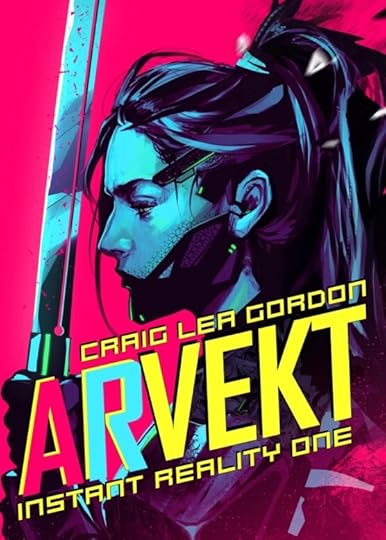 ARVEKT by Craig Lea Gordon is a kinetic action-filled cyberpunk thriller that I absolutely love. If anyone anything about me, they’ll know that I am a huge fan of the cyberpunk genre. It is my favorite thing to read and write alongside superhero fiction. However, there’s a lot of what I term to be “falsely advertised” cyberpunk that claims to be about the gritty dark dystopian futures of the world with transhumanist themes but is usually just Lit-RPG by another name. There’s plenty of good Lit-RPG out there but very little of it is cyberpunk.
I’m pleased to say Arkvekt is the exception to this rule as it is a fantastic novel that is square within the hole of what I consider to be “true cyberpunk.” It is a bit more Ghost in the Shell than William Gibson, but I don’t consider that a bad thing. Cyberpunk can be a bunch of crazy borged-out ninjas fighting government conspiracies just as much as it can be dark and skeevy alleyways where people have more implants than food.
The premise is that Tannis Ord is a young soldier working for a mysterious black ops organization that protects the world from hackers as well as AI cultists and terrorists. It’s a brutal business and Tannis has a history of mental illness that has seemingly not stood in her way of continuing to serve as their assassin. Apparently, the Director just thinks they can erase the trauma and related issues with a wave of their hand.
Something is rotten in the state of the future, though, and Tannis can’t help but question her reality. In what is probably a nod to The Matrix but the more practical Augmented Reality, she struggles with seeing things that are not there as well as gaps in her memory. It could be related to her previous breakdowns, or it might be her mind rebelling against the reality that she has been presented.
Tannis is not the only character, though, and there’s multiple other interesting individuals trying to deal with the sense that things are not as they seem. My favorite is a Senator for the world government that is absolutely hell bent against giving the control of the world to the mysterious Ix that already runs most of the world’s functions. Indeed, I like that he’s as perplexed as anyone as to why so many people want to do it in the first place.
The book is excellent for slowly doling out its worldbuilding. You always have a bunch of information that gives you context for what is happening but there’s a lot of mysteries that keep you speculating. I especially liked the allusions to past tragedies and conflicts that brought humanity to this present state of authoritarian technocracy.
Arvekt is a book filled with twists, turns, fake-outs, and illusions. Many times, I thought I had a handle on where the book was going, only for it to surprise me by revealing it was going someplace entirely different. I occasionally got lost in the technology and jargon but that helped make the book feel like it was taking place in a wholly different world.
Buy from Amazon
arvekt•arvekt•arvekt•arvekt•arvekt•arvekt•arvekt•arvekt•
The post Review – ARVEKT by Craig Lea Gordon appeared first on BEFOREWEGOBLOG.
Review: Horrorstör by Grady Hendrix – A Tale of Retail Hell
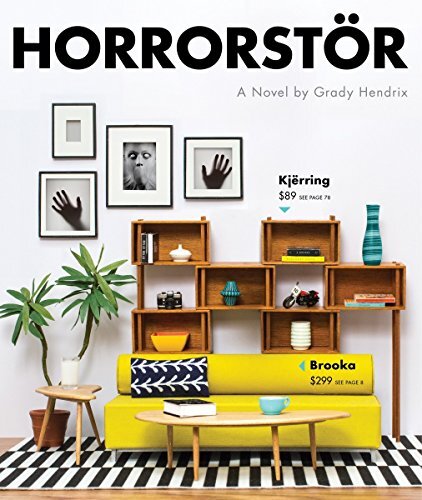
Grady Hendrix, HorrorstörAboutLet’s make sure it’s really raining before we worry about floods.―
Something strange is happening at the Orsk furniture superstore in Cleveland, Ohio. Every morning, employees arrive to find broken Kjerring bookshelves, shattered Glans water goblets, and smashed Liripip wardrobes. Sales are down, security cameras reveal nothing, and store managers are panicking.
To unravel the mystery, three employees volunteer to work a nine-hour dusk-till-dawn shift. In the dead of the night, they’ll patrol the empty showroom floor, investigate strange sights and sounds, and encounter horrors that defy the imagination.
A traditional haunted house story in a thoroughly contemporary setting, Horrorstör comes packaged in the form of a glossy mail order catalog, complete with product illustrations, a home delivery order form, and a map of Orsk’s labyrinthine showroom.
My ThoughtsGrady Hendrix, the author of Horrorstör, is fast becoming one of my favorite authors. The books I have read thus far, We Sold Our Souls, and now Horrorstör are a combination of the ridiculous, the scary, a hell of a lot of fun.
As someone who worked retail in and outside of IKEA, I felt this book on a deeply visceral level. I feel like Hendrix wrote this for my poor bedraggled retail battered soul. And, even though IKEA as a company is better than others, it can get a bit Stepford Wives in upper management. IKEA has inane terms and culture; there is constant upselling and forced smiles and a vast rat-maze-like store trying to funnel you as much as possible.
If you have been told that your presentation is not IKEA, you don’t have that coworker attitude; your feet hurt constantly, you have been called names by customers, yelled at for policies, and must do it all again with a smile, this story is for you.
“The more Amy struggled, the faster she sank. Every month she shuffled around less and less money to cover the same number of bills. The hamster wheel kept spinning and spinning and spinning. Sometimes she wanted to let go and find out exactly how far she’d fall if she just stopped fighting. She didn’t expect life to be fair, but did it have to be so relentless?”
― Grady Hendrix, Horrorstör
The book is set up as an IKEA catalog, same size, and same general heft. Every few chapters, there is an advertisement for a piece of furniture that is bound to make your life better and more ORSK. ORSK being the fictional lifestyle and furniture company that is a direct knock off of IKEA and the setting for the much of the story. Amy, the main protagonist, is a struggling 20+ associate that is on the fetid hamster wheel of life. The harder she struggles, the further she gets behind.
Amy is about to lose her home due to late rent and is feeling the desperation of not having anywhere to go. Plus, she feels her boss Basil (I have never read a more perfect name for a character) is about to fire her for not being ORSK enough. Amy has put in her transfer, all she has to do is stay away from Basil for the next three days, and she is free of this ORSK store. One problem though, Basil would like to do some special one on one coaching.
This is usually shorthand for firing. But, instead of firing Basil as an offer: stay overnight and patrol the store. See what is going on, stop whoever is shitting on the couches at night, and vandalizing the bathrooms. In exchange, Basil will grant her transfer request and give her 200 dollars cash. She thinks that this might save her, but things get a whole lot more complicated overnight and chockful of horrors instead.
Grady Hendrix, HorrorstörHere was the other option: the tranquilizing chair. It was always waiting for her. It always wanted her back. It always wanted her to quit again, to sit down and never get back up. In the end, Amy thought, everything always comes down to those two choices: stay down or stand up.―
ORSK is as a beautiful piece of fruit with worms inside. We occasionally see a colossal rat scurrying about. Or, there is a general feeling of unease when you walk the beautifully lit and European-esque halls lined with furniture. Could it be that this building this built on the ruins of an insane asylum with a mad doctor who tortured and killed his patients? It sounds like a crazy plot jump, but trust me, Hendrix makes it work.
“I know this is your religion, but for me, it’s just a job.”
― Grady Hendrix, Horrorstör
I loved this book, as I said, Hendrix is becoming one of my favorites. It is a perfect mix of horror, current events, with just the right touch of the insane to keep me turning page after page. Check it out, and next time you are at IKEA, remember this book.
Check Out Some of Our Other REviewReview Lil Classix: Little Women by Grady Hendrix, Louisa May Alcott, and Ryan Dunlavey
Review My Best Friend’s Exorcism by Grady Hendrix
If You Liked This – Please Share the Love
The post Review: Horrorstör by Grady Hendrix – A Tale of Retail Hell appeared first on BEFOREWEGOBLOG.
Review – The Blueprint by Wesley Cross
Corporate warfare.
Buckle up for a wild ride.
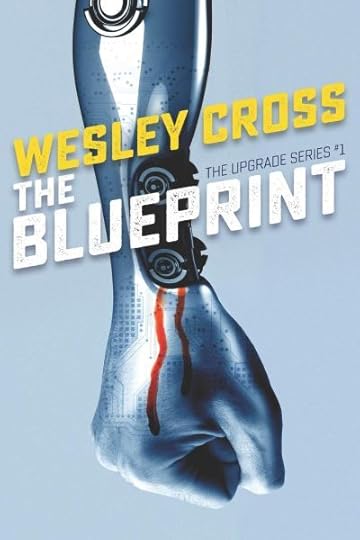 THE BLUEPRINT by Wesley Cross is a cyberpunk political thriller and corporate conspiracy. The former is virtually unknown in the genre while the latter is usually, “guys bust in to steal stuff” not “a bunch of guys use illegal stock manipulation in order to facilitate a hostile takeover. Actually, no, they did that in HARDWIRED by Jon Walter Williams and that may be the only time in history that the heroes successfully beat the megacorporations in a way I completely believe.
The premise is that it is the near-future, maybe a couple of decades, with 9/11 as well as the 2008 Banking Crisis in recent memory. Corporations have become even more powerful and started using mercenary teams to eliminate competitors as well as intimidate businessmen into selling their property to those attempting to buy them out. The police have grown so jaded about the prospect that they don’t even respond to these sorts of calls.
Jason Hunt manages to barely survive an attempt on his his and wife’s life when she accepts a job offer from a cybernetics developer. This is only the start of his problems as they’re soon faced with a cancer scare, people determined to put him underground, and a potential coup happening in the United States government. The conspiracy webs are thickly woven throughout the story and I was reminded pleasantly of Tom Clancy without a cyberpunk sheen. Wesley Cross lacks the former’s excesses, though, like lecturing the reader and using ten words when one would suffice.
I really enjoyed the characters and watching them try to figure out how to deal with enemies who have billions of dollars and a bunch of surprisingly well-developed sociopaths on their payroll. This includes attempting to get their own resources and making contact with other people they think might be able to help. The technology level is established firmly here as well. It’s not a bunch of chrome cyborgs punching things but setting up that to occur in the future.
Despite its somewhat more grounded premise, I wouldn’t say this is a particularly “realistic” book. In addition to its fun action scenes, some of the events stretch reader credibility like the fact that anyone wouldn’t think Jason Hunt is a massive fraudster after his hostile takeover using computer hacker trickery. The thing is, “realism” is overrated and the story benefits strongly from the believability of the characters, which is more important. Besides, a lot more overt fraud has been gotten away with in RL.
Wesley Cross also notably eschews the usual moral ambiguity of the genre as his protagonists are very good and his antagonists are complete scum. A warning that a sexual assault is implied to happen in the book as part of the villain’s activities for those who are sensitive to said things. However, generally The Blueprint is an action and intrigue-filled thriller that will appeal to both fans of spy fiction as well as those who like near-future sci-fi.
I was well and truly engrossed by the book at the end and eager to pick up the next installment of the series. Cyberpunk is too often limited to street punks trying heists against megacorporations while this gives us an unusal hero in a white collar businessman as well as some ex-veterans. I think it adds a very different sort of feel and I could easily see this adapted to a regular network television show rather than streaming. The Blueprint is a great book and I think a good example of its genre.
Buy from Amazon
blue print•blue print•blue print•blue print•blue print•blue print•blue print•blue print•
The post Review – The Blueprint by Wesley Cross appeared first on BEFOREWEGOBLOG.
October 1, 2022
Review – The Witch and the Vampire by Francesca Flores
 Francesca Flores is an author who I believe to be severely underrated. I first came across her when I received a Netgalley ARC of her debut Diamond City, a story about a bad ass assassin named Aina Solis. That book and its sequel Shadow City stole my heart and really made me fall in love with Francesca Flores’ writing.So you can imagine how excited I was when I found out that she was writing a third book. With the release date being announced as March 21, 2023, I had the honor of receiving an early ARC to read and review.The Witch and The Vampire is a sapphic Rapunzel retelling/reimagining. In this story, our Rapunzel (named Ava) is a vampire with root Witch abilities who is trapped in a tower by her mother. Her ex best friend Kaye is a Root Witch hell bent on finding out what vampire killed her mother and exacting revenge. As a Root Witch, Kaye also has a duty to prevent vampires from breaching the barrier wall surrounding her village.She and Ava cross paths once again, and Kaye finds out that Ava is a vampire. On the night that Ava manages to escape her tower, Kaye follows her and convinces her to travel together into the forest, while secretly planning to turn her in. Ava agrees, with the hope of rekindling the friendship (and maybe the potential romance) between them from the past.As they travel, they realize the forest is dying and trying to attack them. They must learn to trust one another while making this treacherous journey. But can they?What I really enjoyed the most about this book was the atmosphere. I really felt the forest come alive and could almost see the decay and rot permeating throughout. There was always tension on every page, between our main characters and their distrust for one another, and the enemies they kept encountering.Every element and plot point of this story felt crucial to both Kaye and Ava. the different internal battles they fought, and the comparisons that were made between mortals and vampires was so interesting and complex.To me both Ava and Kaye felt really fleshed out and their behavior towards one another felt wholly realistic. I was rooting for both throughout the entire book and couldn’t wait to see how their story progressed.Another thing that was well done in this book was the yearning. If you are looking for a passionate fantasy romance where things get hot and heavy, I wouldn’t recommend this book. Instead, there was so much delicious secret longing between both characters that had me on the edge of my seat. ever subtle brushing of the hands, every observation Ava and Kaye would make about the other, every poetic line the they thought about one another had me absolutely feral. it just made their relationship that much more believable and I wanted nothing more than for them to finally be together.I’m not sure if there are plans for a second book, because this did end satisfyingly as a stand alone. However, I definitely would not be opposed to a sequel, because i feel there is a lot of potential for Kaye and Ava’s story.Overall, if you are the type of reader who is looking for a sapphic fantasy that is light on romance but heavy on action and yearning, I would highly suggest you pick this up. As for me, the Witch and Vampire has solidified Francesca Flores as one of my top authors, and I can’t wait for her next book.
 Buy from Amazon
the witch and the vampire•the witch and the vampire•the witch and the vampire•the witch and the vampire•the witch and the vampire•the witch and the vampire•the witch and the vampire•the witch and the vampire•
The post Review – The Witch and the Vampire by Francesca Flores appeared first on BEFOREWEGOBLOG.
Review – Ogres by Adrian Tchaikovsky
Ogres are stronger than you.
Ogres rule the world.”
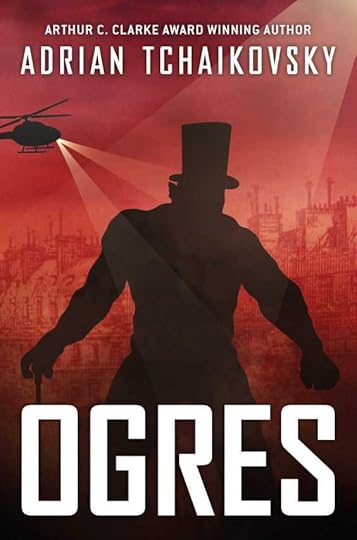 Adrian Tchaikovsky takes on a dark satire in Ogres.
Adrian Tchaikovsky, the uber-talented, multi-genre author, has brought us a new novella that delves deeply into a science fiction dystopia where humans are bifurcated between the “haves” and “have nots.” The “haves” are those that exist modification free. They are societies workers, cooks, maids, and craftsmen. They serve the “haves,” who are the lords and ladies of all by blood and economic level and they only eat the “have nots…” occasionally.
“But when you’re property, it doesn’t matter if your owner treats you well or badly. The ownership is all. We don’t split hairs about who is a better slave master. And you would have been the best owner of all, and that still isn’t enough reason to keep you alive once you’ve decided that owning people is fine, just so long as it’s you that owns them.”
Torquell is the protagonist of Ogres, and while he is tall and over 6′, he is undoubtedly not an ogre. “But when the headman’s son, Torquell, dares lift his hand against the landlord’s son, he sets himself on a path to learn the terrible truth about the Ogres and the dark sciences that ensured their rule.” I wish I could say more, but this is a concise and tight book. It would ruin the conflict, surprise, and resolution. But let’s just say that Ogres is such a surprising book. Tchaikovsky writes about the power inblalances such a system would cause and the slow realization Torquell has as everything he knows comes crumbling down. It is superbly written. I have never read a Tchaikovsky story that missed the mark. Stories that are long-form, serial, novella, or short story, he nails it, and this is no exception.
I loved this story, and I finished it in a single sitting once I picked it up.
Buy from Amazon
OGRES•OGRES•OGRES•OGRES•OGRES•OGRES•OGRES•OGRES•
The post Review – Ogres by Adrian Tchaikovsky appeared first on BEFOREWEGOBLOG.
September 29, 2022
Interview with Chuck Tingle
 I had the distinct pleasure to interview smut peddler and internet sensation Chuck Tingle, who recently signed with Tor for two books: Camp Damascus (2023–pre-orders are live here!) and Bury Your Gays (2024).
This interview contains #nsfw language and content, so if that’s not your thing, feel free to move along!
Thank you for joining me! I’d like to start with the most important question: How is your mental health these days?
DANG i do not think chuck has ever started interview this way but this is a kind question that cuts to the heart of all our trots i suppose so thats nice. i would say my way is particularly good as man name of chuck i have found ways to balance myself and maintain gratitude, which seems to be a key for my trot. fortunately that comes easy to chuck for some reason i have always been able to find perspective in dire times. but also it is difficult to complain when you get to spend your days making art and proving love and just writing joyful stories. really cant complain about that buckaroo
Do you remember the first piece of erotica that you read, and what the experience of reading it was like?
no i do not remember this but honestly chuck does not read very much at all. did a little when younger but not much but now i have recently started to listen to audiobooks which is nice. i would say chucks medium of consumption is FILM this is where i learned about things like story structure and characters and all that. also most of my time is taken up by WRITING i write all day and night so theres not much time left over to read. anyway long story short i dont remember reading first erotica because i do not have THAT many memories about reading anything.
When did you first start writing erotica, and how long did it take before you became comfortable publishing it?
as man name of chuck i have been interested in sexuality in art as long as i can think of MAKING art because i have always been interested in taboo trots and things that have a mysterious social presence where they are always here but tucked away as if they are NOT HERE. also always enjoyed things that pushed the boundaries of any one medium to say ‘i am going to redefine this in my own way and let the viewer or reader question is THIS the art or is THAT the art?’ and so i think questions about what is ‘pornography’ are going to be part of that because legal definition of pornography in united states according to supreme court is something without ‘artistic value’ which is just ABSURD to chuck. i do not think such a thing exists. anyway just exploring these realms has always been a comfortable place for me. reason i did not publish what i was writing is because i just didnt think of it, until a bud came along and suggested it.
In addition to being a beloved author, you are a popular social media presence. How much enjoyment do you get out of the social media game?
well speaking of WHAT IS ART i very strongly believe that social media and online communication is also art. i understand why some buckaroos do not enjoy this way but chuck has always thought of art as not just what is in the book or painting or song but the things that swirl around it, so i would say i very much enjoy social media. also in PRACTICAL way just good way to connect with buckaroos all over the world and cant really complain about that, that just makes it easier to prove love is real
Since it’s spooky season, I’d like to ask about your Halloween tingles like The Sentient Physical Manifestation of Halloween Eats Me Out, The Handsome Physical Manifestation Of Autumn Turns Me Gay, and Scary Stories to Tingle Your Butt. What is it about Halloween that makes us want to fuck it/be fucked by it/eat it out/be eaten out by it, etc. more than the other holidays?
this is interesting question because there are actually plenty of holiday tinglers there is hanukkah and christmas and july 4th and valentines day books HOWEVER you are correct i think there is probably disproportionate amount of halloween tinglers out there. answer becomes clear when you consider that chuck is releasing horror novels with nightfire now and answer is: old chuck just really enjoys writing about spooky things. have always liked horror and maybe that goes with what i was saying earlier about enjoying taboo art that pushes boundaries, sexual art does this but so does frightening art.
People love to guess as to your “real identity.” While we can all agree that this method of envisioning reality is deeply flawed on an epistemological level, what is your favorite theory you’ve read about who you “really” are?
yes you are correct i have torn relationship with this as the idea of OUTING is very bad, but i also understand this physiological drive deep down in buds in a PLAYFUL way, where they do not really want to know but actually would just like to GUESS. i suppose this fun all depends on whether or not worlds greatest author chuck is even KNOWN without my dang mask on and i can say that i am IN FACT known in some ways. chuck did a lot of trotting around before settling in billings and now city of devils and during that time i have become known enough outside of my masked way that im sure one or two buds would say THATS HECKIN CHUCK WOW DANG. so i can confirm this fact for buckaroos and hopefully this truth at least lets them know there is small answer to this question that is more than just ‘oh thats just some dang guy down the street’. but all that being said it is not really kind question to get too SERIOUSLY wrapped up in, as you have said. i think all guesses i have seen are pretty fun there have been one or two where chuck knows BEHIND THE SCENES this person is a scoundrel so i do not really like if buds think i am those ones. but i will say FAVORITE theory is probably chris pine theory because it is correct OR IS IT just kidding OR AM I?
If you could recommend just one tingler and one novel of yours as a primer to your larger œuvre, what would you recommend, and why?
get asked this a lot and honestly would say best tingler is one that strikes your interest. they are very diverse and feature buds from across the queer spectrum. maybe since it is spooky season would recommend HORROR NOVELLA name of STRAIGHT or if you want to prepare for spooky season next year you can preorder CAMP DAMASCUS
You have recently signed with Tor for several books, including Camp Damascus in 2023 and Bury Your Gays in 2024. What differences might readers find between these upcoming books and your previously published work?
well biggest difference between CAMP DAMASCUS or BURY YOUR GAYS and other chuck books is that these are horror and i think most buckaroos know my work as erotica writer. but really core of everything chuck makes is to PROVE LOVE IS REAL and write from a place of love when exploring these ideas. i think if this resonates with you then you will find something that you will very much enjoy in chucks horror writing. also there is THROUGHLINE where across any genre i am often exploring queer themes and queer issues, so that is something that is also similar. CAMP DAMASCUS will also be first HARDCOVER book i have released so that is pretty dang cool, it is out for preorder and it is a dang BEAUTIFUL hardcover book so if you enjoy my way and would like to support chuck that is great way to do it.
What are you reading right now and how spicy is it?
as mentioned chuck does not read very much but TRYING to get some of that reading in. so i am not reading anything at moment but did just finish NIGHTMARE FUEL by nina nesseth and i enjoyed reading this very much but i would say not spicy more sciencey thats okay sometimes too
Read my review of Rescued by the Married Monster Hunters, an MMF fantasy hurt/comfort romance
Pre-order on Amazon
Add on Goodreads
The post Interview with Chuck Tingle appeared first on BEFOREWEGOBLOG.
Review – A Cup of Tea at the Mouth of Hell (Or, an Account of Catastrophe by Stoudemire McCloud, Demon) by Luke Tarzian
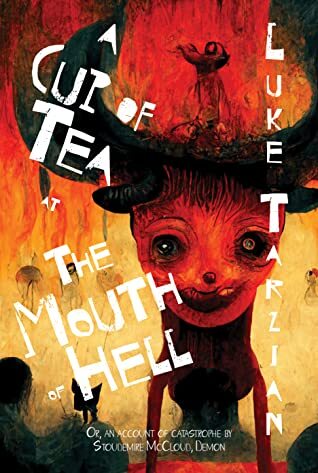 Luke Tarzian has made a name for himself with psychological fantasy through both Vultures and his Adjacent Monsters duology (The World Breaker Parable and The World Breaker Requiem). His new book, A Cup of Tea at the Mouth of Hell, is a quick novelette that at first glance, seems more absurdist and comical but quickly becomes both more sincere and metafictional.
The first few chapters feel kin to what the book originally promises, a lure until the trap snaps shut.
The plot, as it begins, is that the tea kettle they use to introduce newly damned souls to Hell with has disappeared. Hell is also not the place of fire and brimstone (which is deemed Heavenly propaganda by the narration). While it’s never made explicit, it seems that Hell is the absence of God, and Hell has been made worse because Heaven has absconded with their kettle.
Stoudemire McCloud, a demon and secretary to Lucifer Morningstar, starts the story off as a sort of put-upon assistant who nonetheless narrates the tale with a very aristocratic, Victorian pomp. As the story proceeds, that affect fades and the story is narrated in a much more casual manner. The story at this point could have went for a tricky bartering session between Heaven and Hell, or a heist in Heaven to retrieve it, both of which could have maintained the story’s previous tone. But instead at this point the story changes from whimsy to despair.
The in-text explanation for the change in narration is that Stoudemire is stressed but it’s at this same point that the whimsy takes a definitive back seat in the story and is replaced by something achingly sincere. Lucifer’s mind seems consumed with thoughts of The Fall, and his thoughts drift back to Stoudemire’s advice: trauma isn’t just a bad memory but the reaction to that memory.
The tea kettle is not a tea kettle. It is clearly a representation of the things we wanted that we can never have again. Life before the Fall. To barter with heaven or to steal from them could make a fun story, but it would be a lie. Tarzian instead faces that head on, detailing grief and loss in a vivid way. It’s not the story expected. It’s better.
Buy from Amazon
a cup of tea•a cup of tea•a cup of tea•a cup of tea•a cup of tea•a cup of tea•a cup of tea•a cup of tea•
The post Review – A Cup of Tea at the Mouth of Hell (Or, an Account of Catastrophe by Stoudemire McCloud, Demon) by Luke Tarzian appeared first on BEFOREWEGOBLOG.
Books that Made Me – The Name of the Rose by Umberto Eco
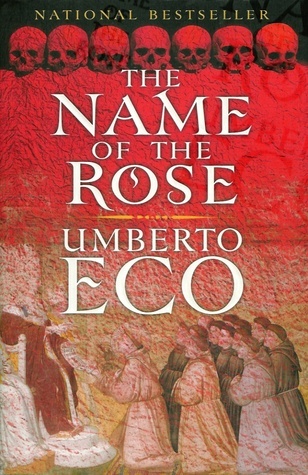 The Name of the Rose is Umberto Eco’s bestselling 1980 debut novel set in a 14th century Italian monastery. At its surface, the story is a Sir Arthur Conan Doyle-style murder mystery in which the English Franciscan friar, William of Baskerville (an obvious nod to Sherlock Holmes), and the novice Adso (in the Dr. Watson role as narrator/sidekick) investigate the suspicious death of a Benedictine monk. But there are many layers to Eco’s masterpiece, including in-depth discussions of theology, semiotics, and the conflicting philosophies of rationalism versus dogmatism. Umberto Eco’s prose is elegant, erudite, and remarkably accessible given its high information density.
For me personally, reading The Name of the Rose was a transformational experience, reigniting my love of reading and opening new doors of literary discovery. As part of “The Books That Made Me” series, this post is not meant to be a review of The Name of the Rose, but rather my own personal journey that led me to this book as an undergraduate student, and the profound impact it has had on me since.
My love of reading began at a young age, encouraged by my parents, and especially by my mother, who worked as a kindergarten teacher for over 30 years and always knew the best children’s books. I have such fond memories of reading as a young child, especially Eric Carle’s The Very Hungry Caterpillar and P.D. Eastman’s Go Dog Go. As I grew older, I graduated to the Old Mother West Wind tales by Thornton W. Burgess, checking out well-worn copies from my local public library.
My first exposure to fantasy came with The Hobbit by J.R.R. Tolkien during my sixth grade English class taught by my mother’s cousin-in-law, who was also an outstanding teacher. I immediately fell in love with Middle-earth and subsequently devoured The Lord of the Rings multiple times. Although I also enjoyed C.S. Lewis and Lloyd Alexander, nothing could compare to The Lord of the Rings.
Unfortunately, as is the case for many teenagers, my love of reading gradually faded away during a series of uninspired high school English classes, which focused on the usual set of tired American classics, ignoring world literature and anything related to fantasy or science fiction. One can only take so much Nathaniel Hawthorne and Herman Melville before reading itself becomes a chore.
Salvation came during my undergraduate studies at Alfred University in upstate New York, where I experienced the joy of taking two classes from Dr. Fiona Tolhurst, a young assistant professor of English. Fiona was a passionate medievalist whose research focused on feminist interpretations of Arthurian literature. She single-handedly restored my love of reading in classes where we covered both medieval literature such as The Mabinogion and medieval-inspired fantasy including T.H. White’s The Once and Future King.
But the most impactful book for me was The Name of the Rose by Umberto Eco. I fell in love with Eco’s beautiful prose, thematic depth, and engaging plot that kept me glued to the pages. I loved it, and I wanted more.
The Name of the Rose led me to discover other authors who would rank among my favorites. Umberto Eco naturally led to fellow Italian author Italo Calvino and his heartfelt, magic-tinged stories of love and loss. From Calvino, I discovered the world of magical realism, first with Latin American authors and then within Japanese literature, leading to one of my favorite authors in Haruki Murakami. Over the following years, my literary world expanded exponentially, ultimately bringing me back to my love of fantasy and to another favorite author, Mark Lawrence, noted for his ingenious infusion of dark fantasy with sci-fi elements, all told in a subtly interconnected universe. But The Name of the Rose was the initial catalyst that triggered all these subsequent discoveries.
Of course, I owe all of this to my favorite English professor from Alfred University, Dr. Fiona Tolhurst. After I graduated from Alfred, Fiona’s academic career brought her to Switzerland for several years and then back to the United States, where she became department chair at Florida Gulf Coast University. We stayed in touch over the years, and I always tried to express my gratitude for what she taught me.
Unfortunately, tragedy struck just before Christmas in 2021, when Fiona unexpectedly passed away at the age of 53. It’s still beyond my comprehension how someone so full of life could be taken from this world so suddenly. In the weeks following her tragic death, I felt that the best way to honor her legacy would be to take it as my personal mission to share my love of reading with the world, just as Fiona shared hers with me. Every time I write a review or recommend a book, I am doing this in memory of Fiona, hoping that her impact can live on and amplify even after her untimely death. This brought me, ultimately, to join the staff at Grimdark Magazine, where I’ve met so many friends who share that same passion.
To me, The Name of the Rose is more than just a book, as it became my gateway to a lifelong love of literature. It is also my constant reminder of the indelible impact one teacher can have on a student’s life.
Buy from Amazon
the name of the rose•the name of the rose•the name of the rose•the name of the rose•the name of the rose•the name of the rose•the name of the rose•the name of the rose•
The post appeared first on BEFOREWEGOBLOG.
September 28, 2022
Bjørn Again – Author London Price
 In 1969, Carol Hanisch published an essay titled “The Personal is Political.” It’s never been more true than in 2022. The left engages in internal microbattles about microaggressions. The right simply responds with aggression. The left fights about who is allowed to write what. The right indiscriminately removes books from libraries. The left tells people to “educate themselves.” The right can’t wait to teach them. (Conspiracy theorists are people who went and educated themselves.) The left has Twitter. The right has the Supreme Court. Their motto is “hate everyone who doesn’t hate everyone.” Ours is… what?
I wish some people would educate themselves – on topics I consider important. I also know I’m completely ignorant about many other topics, because I can afford to be. The easy way out is to pretend they don’t exist. I want to learn, though, and not from Professor YouTube. Which is why I asked London Price to explain certain things to me – using words no longer than four syllables.
Some of what I ask below is purposefully stupid or rude on purpose. Some isn’t. Probably. Do I even know what I don’t know?
London: the teacher
Good morning. What are your pronouns?
Good afternoon! My pronouns are she/her.
Is this how I should approach a stranger?
I think that depends entirely on the stranger… I know some cisgender heterosexual people who would (wrongly) be offended by that question, perhaps reading into it that their gender presentation is somehow not standardized. I can see it being threatening. But I see it as a lovely way to just check in and get on the same page before a conversation starts. It takes a little humility to ask that, really.
Can you explain “gender presentation being somehow not standardised”?
I think there’s a lot of religious or cisgender people who still see gender as only “male” and “female,” despite plenty of others telling them that’s not their experience. Maybe they’re truly not interacting with genderqueer people or maybe their own bias or religious edicts are overriding those thoughts. But they see binary gender as the standard, and anything outside of that applied to themselves might feel like a threat to that delicate worldview. They’re forced to reconcile with an experience they really don’t understand. In some ways, can’t understand.
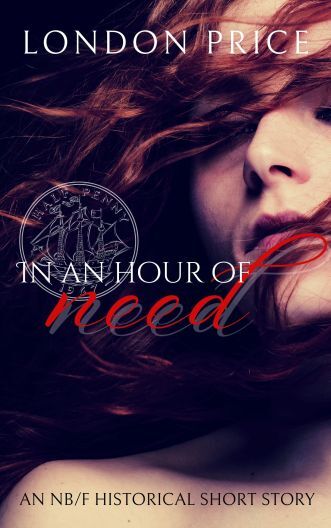 I’ve seen people using “he/they” – what’s that about? They’re not sure?
Without being able to dialogue about it, I would guess that it means that the person wants both used. Just one doesn’t quite encapsulate who they are, and he wants to share both of his identities. (See how easy that is?)
Is it really so awful to be “misgendered” when someone fails to use “ze/hir” when the Supreme Court takes everyone’s right to abortion away? Aren’t we fighting a wrong battle?
Battles can have a lot of fronts, I think. It’s all part of the same war. It’s a simple but profound truth that “we’re not free until we are all free” (Martin Luther King Jr.). It’s all body autonomy, right? It’s all about respect for persons and their right to lead their one precious life as they see fit, such that it’s not hurting anyone. And what does it hurt to use a different word? My wife likes to quote the scene from Star Trek Deep Space Nine where a Klingon (warlike, angry species for those who don’t know) meets a Trill who’s had a symbiont put into a different body. “Kurzon, my old friend!” the Klingon booms, and she smiles and hugs him. “It’s Jadzia now.” And with just as much enthusiasm, he booms out, “Jadzia, my old friend!”
I loved this scene so much.
Me too! We can all get battle fatigue, and I think that’s something to guard against–I know my counselor has cautioned me to pick my battles when it comes to changing people’s minds, because arguing with the delivery guy over pronouns doesn’t matter much. I try to save my energy for people and relationships that matter to me. But yes, I think inclusive language does matter. Sometimes, I think it matters more than anything–words have the power of life and death.
Sadly, a large percentage of trans people are suicidal before they transition–that’s how deeply this matters to them. And the rates of depression, anxiety and suicide among kids who are in unaffirming situations regarding their sexuality or gender are staggering. So I think it’s a good battle to fight.
London: the person
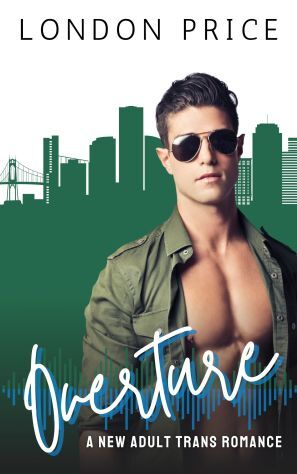 Your wife is a trans woman. How did she realise that – and how did you feel when she told you?
She came out to me about three years ago, long before any public coming out. She demonstrated so much fucking courage and trust in me. I really wasn’t ready to hear it; I had a few trans writer friends on Twitter, which is the only reason I had any sympathy or compassion. But it freaked me out at first. I wasn’t sure if she’d still be attracted to me (not yet knowing gender and sexuality aren’t the same). I wasn’t sure if I could handle being married to someone who looked like a woman. That time was a true gift; I was able to really share in her evolution and watch her blossom into the awesome, still-nerdy lady she is now.
She originally started thinking about it based on a podcast, actually. There were several trans people on, and they were talking about how to name yourself (which is *much harder* than you might think!). And some of the body dysphoria comments that were made sort of made a lightbulb go on in her head, like “there’s a name for the way I feel?” But she tried to shove it down, because we worked for a religious organization, and there was specific language in their handbook about how no employee would be allowed to transition at work…
Wait, what?! How is that legal?!
Our state is largely Republican, and the laws are very open about what employers can require, and given that it’s a religious organization, I think that gives them extra latitude about what they can do.
So – rather than lose her job to explore this, she just stuffed it down harder. We backburnered any future plans and decided to just let her be herself at home. And of course, gender euphoria is a lovely drug that once tasted, you just want more of. So here we are after a slow journey: picking a new name (two years ago), starting to wear different clothes (eighteen months ago), me telling her she can’t borrow my clothes because they look better on her (eighteen months ago minus one day), all that fun stuff.
Outside work, how did people react to Mrs. Price? Was there purposeful deadnaming, or something well-meant, yet offensive?
 My wife is a fascinating person, so she actually prefers the term “birth name” to “deadname.” To her, it’s not so much a person who’s gone as a person who’s evolving away from some false impressions put upon her at birth. Since most of our friends are part of our religious community, I expected some nastygrams, some “you’re going to hell” type messages. Instead, what I got was almost more hurtful–silence. And I do wish people would say something. Tell me you don’t agree; I can handle it. But to share my heart and the deepest secret of my life with you and get no response at all communicates that you don’t want a relationship with me at all going forward. That’s the only way I know how to read that. A few people’s spouses said “they didn’t know what to say,” but you don’t really have to say anything profound. “Thanks for letting me know.” “Thanks for sharing your story.” It can be as simple as that.
And actually, I didn’t really get any reactions that I’d “correct.” Her grandma who’s in her early eighties responded immediately with the new name and said, “I’ve loved you since the moment I laid eyes on you and only ever wanted you to be happy.” So obviously that made me cry. But it can be that simple. Love wants the best for the other.
A friend of mine, whose spouse reacted the same way you did, is a trans man. That journey took years of soul-searching, suffering, work. There was no backlash, though. Why is it so different for trans women? Who are TERFs – and why are TERFs?
Trans men sometimes don’t get as much hate, but they’re also…weirdly invisible, at least in literature? I do think it’s a byproduct of male privilege and also the apparently inherently threatening nature of penises, because that’s the whole thing about bathrooms, right? “They could rape someone!” Lady, trust me, my wife just wants to pee without a bunch of dudes around.
So TERF stands for Trans Exclusionary Radical Feminist, and the idea is that it somehow diminishes womanhood to include trans people in it. I can’t pretend I understand that idea at all, but there it is. All I can imagine is that it somehow threatens their “in group,” the idea that women have to stand up against patriarchy, and then there’s someone they still consider part of the patriarchy in their group? Which is…silly? Because I know cisgender men who are feminists, so even if you don’t consider being trans “a thing,” you should be able to include them.
It seems to me like trans people became more visible in the last few years. There’s more awareness.
I would agree that more trans people have been coming out publically, but interestingly, once you know what an “egg” looks like (the trans term for someone who hasn’t cracked “why they’re like this”), you start seeing them everywhere. Not that I’m judging or anything, but when I see someone who’s almost trying too hard to fit the binary presentation–i.e. full beard or a lot of makeup–I do sometimes wonder. But I think whether there’s more awareness largely depends on where you look. In my Book Twitter circles? Sure. But in other parts of the internet? Or (gasp) real life? I’m not sure. I’ve only met a few other trans people in person, but that may be a product of where we live.
I’ve got a full beard and wish it could be fuller! When I was eight, I didn’t know queer people existed – “queer” was an insult I didn’t even understand, I just knew it was wrong, and I was wrong too. So I put on my Mum’s dress and heels, and couldn’t take them off quickly enough. I had no idea what “gay” meant until I turned 13. How does a 13-year-old realise “maybe I’m not a gay man and I am not a woman” in the very much binary – outside social media – world?
I think community helps. It feels a bit strange to quote C.S. Lewis in this conversation, but it’s like he said, “Friendship is born at that moment when one person says to another: “What! You too? I thought I was the only one.” As with any kind of self-discovery, it helps to find that sense of resonance with other people’s experiences, to be able to talk and to try things. I would love to see a day when it can be explored more freely without judgment. There’s so many ready to be critical and jump down people’s throats for trying it out–I look forward to a day when there’s more understanding that surgery is not an imperative or inevitable, that there’s many ways to be comfortably trans. If people want surgery, great! But if they don’t, that can hold a stigma. Basically, less stigma would be nice. And again, I’m just a cis ally–trans people could answer this question better, I’m sure. I can’t speak for everyone, just my own observations.
 Did you have to learn how to be an ally?
For me, it’s been helpful to read memoirs and other books by trans people to try to wrap my head around it. It is a very singular thing, I think, to feel uncomfortable in your own body in that way. The first book that broke me was Tomorrow Will be Different by Sarah McBride. She narrates not only meeting her spouse (who soon after died of cancer), but her fight for equal rights in her home state of Delaware. Up until then, I really didn’t understand how unequal rights were for trans people. And like many people, her relationship was with another trans person, so that was interesting to hear about. The next one I’d recommend was A Year Without a Name by Cyrus Grace Dunham. That one was sad, too, but a truly vulnerable deep dive into what it felt like to be feeling your way through the gender transition process on hands and knees in the dark. There’s no manual for this.
I thought the rainbow was there to unite us all, but at last count I could fly at least four flags at once. That’s a lot of pride for me to carry. Is there a word for spouse-of-a-trans-person? What’s your flag?
I don’t have a flag, and this is one of the tricky parts for a lot of trans partners who are cisgender, I think. I’ve thought of myself as heterosexual and cisgender my whole life, but now I’m in love with a lady. Definitely not a lesbian, but I’m sure it appears that way, and I don’t want to make it seem like I think sexuality is a choice. On the other hand, I think love is always a choice. I haven’t gotten through 21 years together with this person without choosing her a few times over and over, and I’m still choosing her now because she’s mine. Society’s boxes don’t fit me, though.
I’m using the word queer because I do identify with “identities that break the norm” (which feels to me like basically what LGBTQIA means) and because I love a lady and that appears different? But inside, I feel basically the same. I don’t know if that makes sense. My wife tells me I’m a good queer person (a bit feisty with not a lot of fucks to give).
Aha, so you tell people you’re bisexual?
Not to sound like I’m shitting on anyone, but…is it anyone’s business but mine? Yes, bi-erasure is a problem, and I know with Colby in Acoustics I was intentional about showing that he’s bi, but in my real life, it just doesn’t feel relevant to anyone I’m not pair-bonding with. I guess I’m a rather private queer person. Also, I’ve never been attracted to another woman but mine. I think that would be…misleading.
London Price: the authorYour pronouns are she/her. However, you have written a romance novel, where one of the characters is non-binary – I have never read anything like this before. What makes you qualified to write about that? Don’t you think someone non-binary should have written it instead of you?
Yes, I do think someone non-binary should’ve written it instead of me–I don’t have that identity. But what I do have is experience writing outside my lane. I’ve written Black characters, autistic characters, heck–even male characters. And when care is taken, in this case in the form of a LOT of research and multiple sensitivity readers, I felt good enough about it to put it out into the world.
I hope the intention was understood that I wanted to bring trans joy to the forefront of what can be such a difficult experience. I’m sure some will say I failed, and that’s fine–I hope someone takes it as a challenge and does it better. I would love to read that book. I was willing to publish it because my sensitivity readers did say that it was affirming and resonated in some positive ways, so that’s success for me. I’m always writing to affirm people.
Oh. The word “instead” was meant to be a provocation. In traditional (legacy) publishing there is, indeed, a limited number of “slots.” You self-publish, though. So why not “as well as”?
I see what you’re saying about the less finite possibilities for indie publishing, but I still want to hear from more queer creators, and I hate the idea that my work is supplanting anyone. I mean it more as inspiration than replacement, but I want to read trans people in their own voices. I think the world needs that more than it needs my approximation of it. Imagination is powerful, but it is limited by experience. I would love to see more literature reflect a trans imagination and experience, even if that meant pulling my own books.
Which the conservatives already do… You’ve mentioned writing Black characters. Shouldn’t someone Black write them instead? I write female characters, you know. How to reconcile “diversity” and “lived experience”?
That’s something I really wrestle with, all the way around. Yes, it would absolutely be better if Black creators wrote their own books. But we all know that indie publishing is not as accessible to everyone as we’d like it to be–so in some ways, I hope I’m using my own financial privilege to make the world a better place. Not that I intended to write diversely–it just came out that way. I wouldn’t erase characters, because I think there’s always something to be learned there. They pop in for a reason. But the line is muddy. We’re always writing outside our experience in some ways–and readers have shared with me how much it meant to them to see a Black prince with a big, loving family or an autistic doctor who’s everyone’s heartthrob.
A few people have told me that I didn’t do it well enough. And since I have ADHD, there’s a segment of me that responds to rejection absolutely illogically and takes that criticism to heart when I shouldn’t. Does it matter that more people have told me how much they loved it? No. Because art is about putting your heart on the page, it’s necessarily vulnerable, and I’ve been jabbed a few times. Another part of art, I think, is always wanting it to be better. We hit this chasm as creators where we analyze someone else’s work and just think, “I’ll never be that good.” When in reality, when I go back and read my earlier work, I *can* see how far I’ve come. So I guess I’d rather always want it to be better than be complacent.
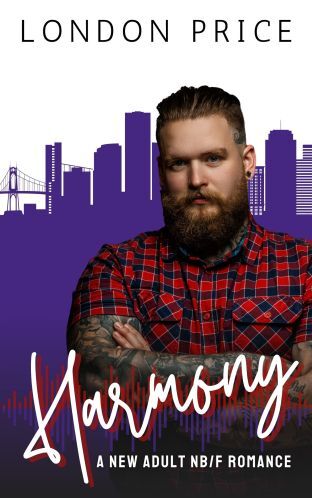
When you were writing a non-binary character, Glenn, in Harmony – how did you decide what their wardrobe, voice, behaviour… well, everything… should be? What was the most difficult part?
I wanted to show the margins of trans society; there’s a strong bias against trans people who don’t physically transition, so I wanted to show a genderqueer person who was content with their body (little to no dysphoria), but not with their gender presentation and perhaps the way their body was treated/handled by others. Pronouns were indeed difficult–I know I’m personally coded toward identifying a bearded person as male, so even though I was only imagining them in my head, I misgendered them sometimes. But they were based on friends and acquaintances on Twitter and sort of showed up fully formed when I considered who’d be a good match for Hillary. So I was happy they did.
Is there a “male/female ratio” on the non-binary spectrum? Does Glenn have a preference for dresses or trousers? What about shaving?
I guess I thought about it more like categories than percentages–I asked Glenn how they felt about clothes, about grooming, about names. They kept their birth name. And knowing they were artistic, their clothing was an important expression of who they are. They wear skirts, but also jeans, but see no reason to conform to female grooming norms like shaving, since they’re not female. I don’t think I really assigned those things as much as observed them about nonbinary people I know.
In Harmony, there’s a scene I love where Glenn shares with Hillary about seeing a sculpture of Moses in Italy.
“Michelangelo sculpted Moses, too? All we ever hear about is David.”
“If that’s true, it’s a tragedy. I don’t know how to describe it, Hil. But it was one of the seeds that led me toward authenticity in my life. Moses is sitting there, and you know it’s a statue, but he just looks so pissed, like he’s holding back. And he’s tucked these tablets under his arm, but he’s also got his fingers tangled in his beard like a security blanket, like he doesn’t know what to do. And I’d been thinking a lot about gender while I was there, and seeing those strong fingers in that stone beard that looked so real…I realized I wanted to keep my beard. Some of the stuff I’d been doing like the tattoos and the piercings, they were meant to mask my softer side. But I loved my beard.”
Have you had someone wrongly accuse you of being ignorant?
Yeah, just a few times. There was one early reviewer of Acoustics who was upset by the way Chase refers to his genitals and felt it was very unrealistic. My research said that many trans people rename their parts to fit more into their gender identity, which I think is brilliant. In fact, I pulled the exact word from someone’s personal essay, so I know it’s reasonable. But it obviously didn’t fit with his experience.
Some people want to be known as queer and some people don’t. Some people enmesh it into their identity and some would never hang a pride flag or a trans flag on their wall or windows. It didn’t resonate for him, and that’s fine.
 I loved how you presented an autistic doctor in one of your books… only they’re not written by “London Price.” You write sweet small-town romance – and books with very explicit sex scenes featuring a non-binary person. How do your “old” readers react to the “new” books?
Very few readers know about both my pen names, and that’s intentional. When I started my career, I had a strong sense of guilt about writing sex scenes, because like many people, I have a lot of religious baggage about sex and marriage. I also had a strong sense that I wanted to show healthy sexual relationships, though – it isn’t something that religious people are often exposed to, in my opinion. So my original goal was to write books that talked about/modeled healthy communication around sex without showing it.
But that went out the window when I wrote my first honeymoon bonus scene. Being able to show my autistic doctor and his wife parsing sex for the first time–which can be understandably overwhelming for someone who’s sensory sensitive–was really important to me, and I ended up really enjoying the scene. About half my fans downloaded it, and that’s been consistent across all the steamy bonus scenes.
But I never intended to start a steamy pen name. One of the hard things about us being closeted for so long is that I had no outlet for wanting to be part of the queer “community,” so I started writing about it. And particularly focused on queer joy, because I feel there’s a lack of that in novels. I guess I could have written it sweet, but I think it would be ill-received, and frankly, I didn’t feel the burden of other people’s expectations anymore.
Bio
London Price is a queer, cisgender author who writes light trans romance. She and her wife live in the Pacific Northwest.
Links
Twitter: https://twitter.com/lpriceauthor
Instagram: https://instagram.com/authorlondonprice/
Website: https://londonpricebooks.wordpress.com
Amazon: https://amazon.com/London-Price/e/B09C8YWLHN
Goodreads: https://www.goodreads.com/author/show/21870238.London_Price
National Centre for Transgender Equality
https://twitter.com/HEAforTransKids
Buy Acoustics: A Forbidden M/M Romance from AmazonBuy Harmony (Portland Symphony Book 2) from AmazonBuy Overture from Amazon
LONDON PRICE•LONDON PRICE•LONDON PRICE•LONDON PRICE•LONDON PRICE•LONDON PRICE•LONDON PRICE•LONDON PRICE•
The post Bjørn Again – Author London Price appeared first on BEFOREWEGOBLOG.