
Stephen K. Ray's Blog, page 65
January 15, 2023


January 14, 2023
January 13, 2023
Thanks Cardinal Pell for Speaking the Truth about the Current Leadership of the Church
 Thursday, January 12, 2023“This pontificate is a disaster…” The final testament of George Cardinal Pell (d. January 10, 2023)
 George Cardinal Pell prays before the body of Pope Benedict XVI lying in state, January 2023.
George Cardinal Pell is dead.
As a man, Cardinal Pell stood accused of grievous sins before several earthly tribunals. He was convicted of some of those crimes in secular courts, and as a result, spent over a year in prison—much of it in solitary confinement. He was later acquitted and released when the High Court of Australia unanimously overturned his convictions saying that the jury likely made its decision based on faulty evidence, and that there was a significant possibility that an innocent person had been convicted.Was Cardinal Pell guilty of the crimes he was accused of? Or was he targeted for destruction by enemies who would stoop even so low as to manufacture false sins? In this world, we will never know.But now, Cardinal Pell has taken his stand before the Just Judge from whom nothing can be hidden. Whether his sins warranted mercy or damnation is in the hands of Christ, and all the faithful can do is pray that our gracious Lord will have mercy on him.What is clear is that George Cardinal Pell did not go out with a whimper, but with a resounding bang.
Less than a week before he died, Cardinal Pell wrote an article in the UK Spectator that is nothing less than a clarion call. The title of the article says it all: The Catholic Church Must Free Itself from this “Toxic Nightmare.”
What toxic nightmare is he referring to? That would be the so-called Synod on Synodality—that useless and wasteful meeting of bishops that seems to be the very embodiment of the unofficial motto of the current pontificate: “¡Hagan lío!” or “make a mess!” Regarding the 45-page document put out by the Vatican explaining the “listening” stage of the synod, Pell calls it: “one of the most incoherent documents ever sent out from Rome.”
After offering a point-by-point deconstruction of the document, Pell is left scratching his head:
What is one to make of this potpourri, this outpouring of New Age good will? It is not a summary of Catholic faith or New Testament teaching. It is incomplete, hostile in significant ways to the apostolic tradition and nowhere acknowledges the New Testament as the Word of God, normative for all teaching on faith and morals. The Old Testament is ignored, patriarchy rejected and the Mosaic Law, including the Ten Commandments, is not acknowledged.
This is a pretty harsh condemnation that should be taken very seriously by all serious Catholics.
But it gets better.
In the spring of 2022, an anonymous letter was said to be circulating among the Cardinals signed by someone called “Demos” or the Greek word for “the common people.” It was a sober reflection upon and harsh criticism of the numerous scandals which have proliferated over the past 10 years within the Church, with an unusually pointed critique of the Francis papacy. The opening sentence gives the reader a sense of what follows:
Commentators at every school, though for different reasons, with the possible exception of Father Spadaro SJ, agree that this pontificate is a disaster in many or more respects, a catastrophe.
It was revealed today that the author of this letter was none other than George Cardinal Pell.
This letter is not merely a litany of the failures of Pope Francis. It is a road map for his successor. Indeed, the second half of the letter reads more like avuncular advice from an experienced elder churchman to a man who will be faced with cleaning up a gigantic mess not of his doing.
The entire letter is well worth reading, but the following point seems to be the most important of all, encapsulating what has gone wrong and the attitude necessary to fix it:
The new pope must understand that the secret of Christian and Catholic vitality comes from fidelity to Christ’s teachings and Catholic practices. It doesn’t come from adapting to the world or money.
This point is followed immediately by another that lays out the steps necessary to return from the present chaos:
The first tasks of the new pope will be the restoration of normality, the restoration of doctrinal clarity in faith and morals, the restoration of just respect for the law, and the guarantee that the first criterion for the appointment of bishops is acceptance of apostolic tradition. Theological competence and culture are an advantage, not an obstacle for all bishops and especially for archbishops. These are necessary foundations for living and preaching the Gospel.
More than anything else, the faithful need doctrinal clarity. Indeed, we thirst for it, as one can not drink the muddy slurry churned up by “¡Hagan lío!”
Pell’s “Demos” letter reads like an encyclical letter written by one of the Church Fathers when faced with an ecclesiastical crisis.
Thank you, Cardinal Pell, for speaking like a believing Catholic, reminding us of our patrimony, and for standing up for the devout who have spent the past nine years taking abuse from those tasked to nurture them in faith and teach them the Gospel of Jesus Christ.
With men like Benedict XVI and Cardinal Pell passing into eternity, ordinary devout Catholics pray that Christ will raise up other bishops and cardinals with the fortitude to keep the current mess from spreading and leading even more souls to perdition.
May the Holy Spirit, in His good time, bestow upon us a new pope who will come armed the charism of Saint Francis of Assisi who was commanded by God to “restore my Church which is falling down.”
The post Thanks Cardinal Pell for Speaking the Truth about the Current Leadership of the Church appeared first on Defenders of the Catholic Faith.
January 12, 2023
Coming to America: Solzhenhitsyn on “Group-think Control”
This episode is in Alexandr Solzhenitsyn’s Gulag Archipelago, Vol. 1. It shows the stupidity and mind control that totalitarian, socialist and intolerant governments and groups can impose upon people. It shows what can happen if we move toward socialism and Communism in our country with the liberals and the Far Left pushing their agenda a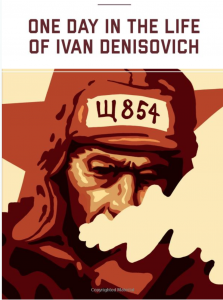 nd being very vocal about it.
If you haven’t read Solzhenitsyn you should acquaint yourself with him. He was a devout Russian Orthodox Christian. Start with his One Day in the Life of Ivan Denisovich which won the Nobel Prize in Literature in 1970. It is a short novel but very powerful.
The episode below from his Gulag Archipelago fascinated me so I decided to share it with you.
**********************
Here is one vignette from those years as it actually occurred. A district Party conference was underway in Moscow Province. It was presided over by a new secretary of the District Party Committee, replacing one recently arrested. At the conclusion of the conference, a tribute to Comrade Stalin was called for.
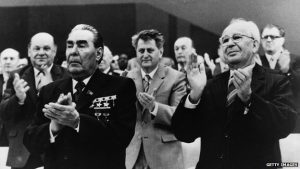 Of course, everyone stood up (just as everyone had leaped to his feet during the conference at every mention of his name). The small hall echoed with “stormy applause, rising to an ovation.” For three minutes, four minutes, five minutes, the “stormy applause, rising to an ovation,” continued.
But palms were getting sore and raised arms were already aching. And the older people were panting from exhaustion. It was becoming insufferably silly even to those who really adored Stalin. However, who would dare be the first to stop?
The secretary of the District Party Committee could have done it. He was standing on the platform, and it was he who had just called for the ovation. But he was a newcomer. He had taken the place of a man who’d been arrested. He was afraid! After all, NKVD men were standing in the hall applauding and watching to see who quit first! And in that obscure, small hall, unknown to the Leader, the applause went on —six, seven, eight minutes! They were done for! Their goose was cooked! They couldn’t stop now till they collapsed with heart attacks!
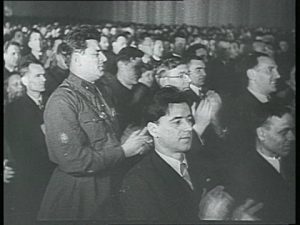 At the rear of the hall, which was crowded, they could of course cheat a bit, clap less frequently, less vigorously, not so eagerly—but up there with the presidium where everyone could see them? The director of the local paper factory, an independent and strong-minded man, stood with the presidium. Aware of all the falsity and all the impossibility of the situation, he still kept on applauding! Nine minutes! Ten! In anguish he watched the secretary of the District Party Committee, but the latter dared not stop. Insanity! To the last man!
With make-believe enthusiasm on their faces, looking at each other with faint hope, the district leaders were just going to go on and on applauding till they fell where they stood, till they were carried out of the hall on stretchers! And even then those who were left would not falter. . . .
Then, after eleven minutes, the director of the paper factory assumed a businesslike expression and sat down in his seat. And, oh, a miracle took place! Where had the universal, uninhibited, indescribable enthusiasm gone? To a man, everyone else stopped dead and sat down. They had been saved! The squirrel had been smart enough to jump off his revolving wheel.
That, however, was how they discovered who the independent people were. And that was how they went about eliminating them. That same night the factory director was arrested. They easily pasted ten years on him on the pretext of something quite different. But after he had signed Form 206, the final document of the interrogation, his interrogator reminded him:
“Don’t ever be the first to stop applauding!”
Solzhenitsyn, Aleksandr I. The Gulag Archipelago Part I (NY: Harper & Row, Publ., 1974), 69-70.
The post Coming to America: Solzhenhitsyn on “Group-think Control” appeared first on Defenders of the Catholic Faith.
January 9, 2023
Seems Coffin has crossed the line into schism (becoming a sedevacantist) following the death of Benedict XVI
Given that we’ve already addressed this argument elsewhere, why bring it up again? For two reasons. First, Benedict’s death clarifies something that Coffin and others misunderstood. In his final general audience, Benedict asked for prayers “for the new successor of the apostle Peter” and then again asked “each of you to pray for me and for the new pope.” That Benedict was declaring himself no longer the pope was unambiguous. But he also said something else, which has led to a great deal of confusion:
The “always” is also a “for ever”—there can no longer be a return to the private sphere. My decision to resign the active exercise of the ministry does not revoke this. I do not return to private life, to a life of travel, meetings, receptions, conferences, and so on. I am not abandoning the cross, but remaining in a new way at the side of the crucified Lord. I no longer bear the power of office for the governance of the Church, but in the service of prayer I remain, so to speak, in the enclosure of Saint Peter.
This line is supposedly the key proving that Benedict didn’t really resign. But this gravely misconstrues what the pope meant.
In the year 451, after Pope St. Leo the Great intervened at the Council of Chalcedon to clarify the orthodox understanding of the natures of Christ, the assembled bishops cried out, “Anathema to him who does not thus believe. Peter has spoken thus through Leo.” Were the bishops at Chalcedon trying to claim that there were two rival popes, Leo and Peter? Not at all.
They were acknowledging that Jesus had entrusted Peter with the care of the whole flock of Christ (John 21:15), and that this entrustment still mattered even after Peter’s martyrdom. (The idea of “patron saints” is rooted in this same spiritual reality. St. Patrick, for instance, didn’t suddenly stop caring about the Irish once he went to heaven.) This is recognized in the liturgy as well: popes on the liturgical calendar are listed as “Saint X, pope,” and there are special prayers for honoring saintly popes.
In other words, when Benedict XVI said that “the ‘always’ is also a ‘for ever,’” he meant just that: forever. Something is gained in becoming pope that is never lost, not by resignation and not even by death. Ironically, this is clearer in Benedict’s death than in his life. We’re now free from the cumbersome term pope emeritus and can return to calling him simply “Pope Benedict XVI,” since it’s now clear what is (and isn’t) meant by that title.
This spiritual reality—which he perceived but which so many Catholics missed—also stands behind so many of his other decisions. Many thought that “the term ‘pope emeritus’ has no precedent and is confusing.” But in a letter to Cardinal Walter Brandmüller, Benedict clarified that he had opted against going back to being called Cardinal Ratzinger because he didn’t want to be “constantly exposed to the media as a cardinal is—even more so because people would have seen in me the former pope.”
Instead, “with ‘pope emeritus,’ I tried to create a situation in which I am absolutely not accessible to the media and in which it is completely clear that there is only one pope.” Benedict wanted us to hear emeritus, while so many people insisted on hearing only pope. But this is the real key: facing relatively uncharted territory, Benedict tried to find a way of expressing both that his resignation didn’t undo his papacy and that he was no longer the reigning pontiff.
The second reason to return to Benevacantism is more distressing. Upon hearing of Benedict’s death, Coffin announced that he had become a sedevacantist, saying, “The pope has entered eternity, RIP. The impeded See is now vacant. May the pre-2013 cardinals do the right thing, and avoid yet another antipope.”
Why is that so alarming? Because this line of reasoning makes for a clear collision course for schism and heresy. Here’s why.
Only cardinals under the age of eighty can vote, and Benevacantists don’t accept the legitimacy of the cardinals created by Pope Francis, since they don’t accept the legitimacy of Pope Francis. That leaves only forty-four of the 224 cardinals in the College of Cardinals who are old enough to have been made a cardinal by John Paul II or Benedict, but young enough still to be voting age.
Under the rules laid out by Universi Dominici Gregis, a papal conclave must be called within twenty days of the death of the pope. So if you think Pope Francis is an antipope, the only way out of that situation is if, by January 20 of this year, those forty-four cardinals (a) conclude that Pope Francis is an antipope, and that none of the cardinals he appointed is really a cardinal, and (b) somehow form a papal conclave to begin the process of electing a new pope. We’ll leave aside all of the implausible logistics of such a suggestion (like where such a conclave would even convene, since Pope Francis presumably won’t offer the Sistine Chapel).
Imagine for a moment that, despite its implausibility, this occurred. Would that bring peace and unity to the Catholic Church? …
For the rest of the insightful article and response, click HERE.
The post Seems Coffin has crossed the line into schism (becoming a sedevacantist) following the death of Benedict XVI appeared first on Defenders of the Catholic Faith.
January 8, 2023
Apologetics Isn’t Dead: Cameron Bertuzzi’s Conversion to Catholicism
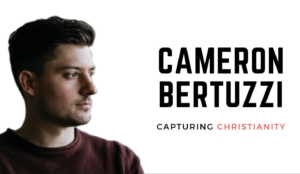 Recently, Cameron Bertuzzi, the man who runs the YouTube-based ministry Capturing Christianity, announced that he recently entered RCIA at a Catholic Church and will formally enter the Church this Easter. Besides being an occasion of joy, Bertuzzi’s conversion offers an opportunity to reflect on a somewhat controversial topic: the role of apologetics in evangelization.
Bertuzzi runs Capturing Christianity, which seeks to “expose you to the intellectual side of Christian belief.” The primary focus of his channel is to defend what C.S. Lewis called “mere Christianity”—that is, the most important and foundational elements of Christian belief: God’s existence, the divinity of Jesus, the historicity of Jesus’ Resurrection, and similar matters.
Bertuzzi’s channel has featured some of the most prominent scholars, both atheist and Christian alike, including William Lane Craig, Graham Oppy, Edward Feser, and many others. Bertuzzi himself has engaged in debates with other leading atheist apologists, like Alex O’Connor and Stephen Woodford.
Throughout these interviews, discussions, and debates, Bertuzzi shows his great zeal for truth and his willingness to seriously engage arguments—even ones that cut strongly against his own views. This trait would present itself again in his conversion to Catholicism.
His ConversionEarly on in his conversion, Bertuzzi had many intellectual objections to the Catholic faith. As an Evangelical Protestant, Bertuzzi offered various objections regarding the Eucharist, divine simplicity, and hell. He engaged in debates with Matt Fradd, host of “Pints with Aquinas,” on a number of these issues, and he slowly grew to appreciate the Catholic point of view.
Bertuzzi also brought in leading scholars—both Catholic and Protestant—to discuss various topics. He talked with Catholics such as Trent Horn, Suan Sonna, and Joshua Sijuwade, as well as Protestants such as James White, Jerry Walls, and Gavin Ortlund, all of whom are prominent Protestant thinkers. Over time, as he talked with friends who were helping him in his process of discernment, he realized that the papacy was the central issue of his investigation.
Cameron Bertuzzi’s conversion to Catholicism was unusual in that it was so public. Throughout the process, Bertuzzi openly engaged in talks with Catholics and Protestants alike, and he made public where he stood regarding his views and potential conversion. Thus, unlike many other conversion stories, we have a clear view of Bertuzzi’s thinking, challenges, and experiences throughout the process. For instance, in a talk with the Matt Fradd (roughly at the 33-minute mark) just a couple months before his conversion, Bertuzzi said that, as a result of his research, he was “93.8% certain” of the truth of the papacy.
While this number might strike us as oddly specific, it illustrates precisely how seriously and thoughtfully Bertuzzi was reasoning about the papacy and which factors he thought weighed in favor of it and against it. We can clearly see that it was his mind that was seeking the truth of Catholicism by focusing on one of the Church’s most distinct characteristics.
One of the arguments he found most persuasive was the biblical typological argument linking the giving of the keys to Eliakim in Isaiah 22 to the keys which Jesus promises Peter in Matthew 16. Bertuzzi weighed this and other evidence for and against the Catholic doctrine of the papacy and put them into a Bayesian analysis (hence his very precise probability). Ultimately, Bertuzzi became convinced that the Catholic teaching about the papacy was true, and he decided to enter the Church.
Apologetics, Beauty, and TruthNothing above should be construed to say that the arguments alone persuaded Bertuzzi to convert. He was also drawn to the beauty of the Church, in her Liturgy, architecture, and other ways. Matt Fradd made a point of taking Bertuzzi to a Byzantine Catholic church, showing him the beauty of the Eastern liturgy. This interest in beauty is seen when Bishop Barron was on Bertuzzi’s channel in September of 2020.
Bertuzzi marveled at the beauty of Word on Fire’s Evangelization & Culture journal. As a photographer himself, beauty was something that drew him to the faith along with its truth. Nevertheless, if we take Bertuzzi at his word, it was the arguments and evidence for the papacy which were the primary reason for his decision to convert.
God, in his wisdom, uses many means to draw his people into relationship with him. God’s knowledge is so intimate that he knows exactly what would be most effective in bringing about that relationship. For Bertuzzi, someone drawn so zealously towards truth, God used philosophical and theological arguments to show him the truth of the faith.
Is this the manner in which most people are converted? Experience may answer in the negative, but there clearly exists a small but sizable minority for whom arguments are an important means of bringing them closer to God. It is for these individuals that apologists labor, refining their arguments, and searching out new evidence for the faith.
Cameron Bertuzzi’s conversion can offer some consolation to apologists that their work matters. God can and does use arguments and evidence to bring people to the faith. Cameron Bertuzzi is neither the first to be converted in this way nor will he be the last. Let’s thank God for this recent convert and pray for him as he continues his journey of faith. Who knows, perhaps soon it will be “Capturing Catholicism.” He wouldn’t even have to change the logo.
The post Apologetics Isn’t Dead: Cameron Bertuzzi’s Conversion to Catholicism appeared first on Defenders of the Catholic Faith.
January 6, 2023
Answering Seventh Day Adventists
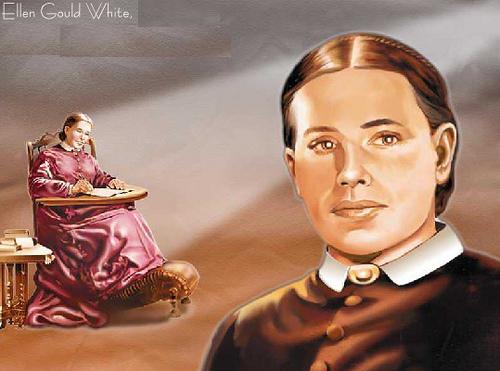 I found this great little summary of errors of Seventh Day Adventism. This sect of Christianity claims that Christians should not worship on Sunday, which is the “sign of the beast’, but that we should all worship on Saturday, the Jewish Sabbath.
This article summarizes their beliefs, errors, thoughts on Catholics and how to respond. Enjoy. It begins:
There are two major distinctive claims of Seventh Day Adventism, which separate it from the rest of Christianity:
First, that Christians are supposed to keep Saturday, the Sabbath, holy. They oppose worshiping on Sunday, arguing that it’s against the Ten Commandments and generally anti-Scriptural.Second, that the founder of Seventh Day Adventism, Ellen G. White, was a prophet.The official Seventh Day Adventist website declares:
One of the gifts of the Holy Spirit is prophecy. This gift is an identifying mark of the remnant church and was manifested in the ministry of Ellen. G. White . As the Lord’s messenger, her writings are a continuing and authoritative source of truth which provide for the church comfort, guidance, instruction, and correction.
But as we’ll quickly see, White was no prophet, and her works are riddled with errors. Let’s look at two of her major claims about the Sabbath, both from her supposedly-inspired book, The Great Controversy. I. When Did Sunday Worship Begin?
For the whole article, click here.
The post Answering Seventh Day Adventists appeared first on Defenders of the Catholic Faith.
January 5, 2023
Pilgrimage Final Day Comments and Farewells
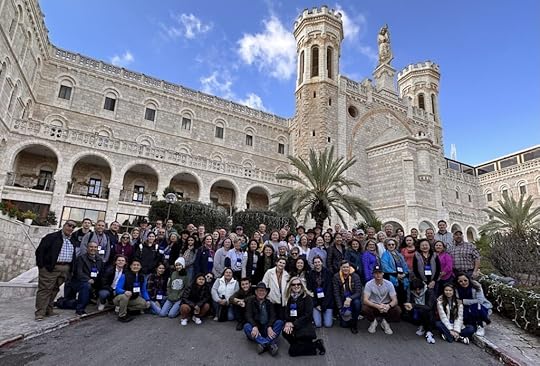
It has been a great pilgrimage, and it finally has come to an end, though it seem to go very fast. I had a few people wanted to share their comments and thoughts on the trips and their farewells.
The post Pilgrimage Final Day Comments and Farewells appeared first on Defenders of the Catholic Faith.
A Letter and My Answer: “What Must a Person Do to Be Saved?”
Today I received what I hope was an honest, searching e-mail — so I took the time to give a short response. Below you can read the questions in blue and my answers in black.
Mr. Ray,
I am an Evangelical Christian and have read your book “Crossing the Tiber” and listened to a CD about your testimony. (St. Joseph’s Communications) Both of these were given to me by a Catholic. I don’t think either of these resources were intended to explain how a person could have their sins forgiven by God and know that they would spend eternity in heaven. In Roman Catholicism, how does this happen? What must a person do?
Hello Friend:
My book Crossing the Tiber and my audio conversion story were not meant to be “Gospel Messages” per se, as is common in evangelical circles. Rather, they were a record of my search into “what is the Church?” and “What is the fullness of Christianity?”
I was asking myself “What does the Bible teach and how did the very first Christians understand Christianity, salvation, the Sacraments, and the Body of Christ – the Church?
However, even though Crossing the Tiber is not specifically about how do we get saved, the second section on Baptism has a good deal to say about salvation both as taught by the Bible and practiced by all Christians for the first 1500 years. I would encourage you to read that section, and the section on the Eucharist at the end.
About salvation, it is really quite simple. One must “believe on the Lord Jesus Christ.” That is the Catholic gospel in a nutshell — faith in Christ. But then, we must ask what “believe” and “faith” mean. In biblical times believe meant more than the simplistic definition it is often given today. In biblical language, the opposite of “believe” is to disobey (Jn 3:36), meaning that “believe” was a very pregnant and meaningful word.
Paul begins and ends his book on Romans referring to the “obedience of faith” (Rom 1:5 and 16:26) and in Galatians he ways “faith working through love” (Gal 5:6).
We are saved by “the obedience of faith” based on the propitiatory death and merits of Jesus Christ, but not by faith alone — unless of course we mean faith and all the things that are included within that word.
Jesus says that one is born again by “water and spirit” (Jn 3:3-%) and Peter said on the day of Pentecost not “ask Jesus into your heart as your personal Lord and Savior”; rather he said, “Repent and be baptized to wash away your sins” (Acts 2:38). Paul heard the same thing in Damascus when Ananias said, “Why do you tarry, arise and be baptized and wash away your sins, calling upon his name” (Acts 22:16). I could multiply the passages about the need for baptism.
Salvation by faith cannot be separated from the necessity of baptism, obedience, holiness (Heb 12:14) , and other elements the Bible and the Church have made very clear.
 Consider this: if you go to a restaurant and ask for a hotdog, and the waiter dropped a frozen hotdog on the table, what would you think? You would be shocked and angry! But you asked for a hotdog and a hotdog is what you got. But you expected the waiter to have some cultural literacy — to know that a hotdog was shorthand for a plate, silverware, a napkin, a hotdog in a bun, chips, ketchup, and everything else that goes with a “hotdog.”
“Believe” and “faith” are similar to the hotdog — they are shorthand for what it means to place our full confidence and trust in Jesus Christ. They imply and include all that one must do when they bow the knee to a king — full obedience and submission.
Jesus is the one who says that new birth — becoming “born again” — is accomplished through “water and Spirit” and since he had JUST been baptized by going into the water and having the Holy Spirit alight upon him, he expected his listeners and US to understand that baptism was a necessary element in obtaining salvation.
So, that is a quick summary. Read the section in Crossing the Tiber on Baptism and get back with me if you are still interested in pursuing this matter.
You can order my talk on “Born Again? Faith Alone?” by clicking here; you can also listen to my talk on-line by clicking here.
The post A Letter and My Answer: “What Must a Person Do to Be Saved?” appeared first on Defenders of the Catholic Faith.
A Letter and My Answer
Today I received what I hope was an honest, searching e-mail — so I took the time to give a short response. Below you can read the questions in blue and my answers in black.
Mr. Ray,
I am an Evangelical Christian and have read your book “Crossing the Tiber” and listened to a CD about your testimony. (St. Joseph’s Communications) Both of these were given to me by a Catholic. I don’t think either of these resources were intended to explain how a person could have their sins forgiven by God and know that they would spend eternity in heaven. In Roman Catholicism, how does this happen? What must a person do?
Hello Friend:
My book Crossing the Tiber and my audio conversion story were not meant to be “Gospel Messages” per se, as is common in evangelical circles. Rather, they were a record of my search into “what is the Church?” and “What is the fullness of Christianity?”
I was asking myself “What does the Bible teach and how did the very first Christians understand Christianity, salvation, the Sacraments, and the Body of Christ – the Church?
However, even though Crossing the Tiber is not specifically about how do we get saved, the second section on Baptism has a good deal to say about salvation both as taught by the Bible and practiced by all Christians for the first 1500 years. I would encourage you to read that section, and the section on the Eucharist at the end.
About salvation, it is really quite simple. One must “believe on the Lord Jesus Christ.” That is the Catholic gospel in a nutshell — faith in Christ. But then, we must ask what “believe” and “faith” mean. In biblical times believe meant more than the simplistic definition it is often given today. In biblical language, the opposite of “believe” is to disobey (Jn 3:36), meaning that “believe” was a very pregnant and meaningful word.
Paul begins and ends his book on Romans referring to the “obedience of faith” (Rom 1:5 and 16:26) and in Galatians he ways “faith working through love” (Gal 5:6).
We are saved by “the obedience of faith” based on the propitiatory death and merits of Jesus Christ, but not by faith alone — unless of course we mean faith and all the things that are included within that word.
Jesus says that one is born again by “water and spirit” (Jn 3:3-%) and Peter said on the day of Pentecost not “ask Jesus into your heart as your personal Lord and Savior”; rather he said, “Repent and be baptized to wash away your sins” (Acts 2:38). Paul heard the same thing in Damascus when Ananias said, “Why do you tarry, arise and be baptized and wash away your sins, calling upon his name” (Acts 22:16). I could multiply the passages about the need for baptism.
Salvation by faith cannot be separated from the necessity of baptism, obedience, holiness (Heb 12:14) , and other elements the Bible and the Church have made very clear.
Consider this: if you go to a restaurant and ask for a hotdog, and the waiter dropped a frozen hotdog on the table, what would you think? You would be shocked and angry! But you asked for a hotdog and a hotdog is what you got. But you expected the waiter to have some cultural literacy — to know that a hotdog was shorthand for a plate, silverware, a napkin, a hotdog in a bun, chips, ketchup, and everything else that goes with a “hotdog.”
“Believe” and “faith” are similar to the hotdog — they are shorthand for what it means to place our full confidence and trust in Jesus Christ. They imply and include all that one must do when they boy the knew to a king — full obedience and submission.
Jesus is the one who says that new birth — becoming “born again” — is accomplished through “water and Spirit” and since he had JUST been baptized by going into the water and having the Holy Spirit alight upon him, he expected his listeners and US to understand that baptism was a necessary element in obtaining salvation.
So, that is a quick summary. Read the section in Crossing the Tiber on Baptism and get back with me if you are still interested in pursuing this matter.
You can order my talk on “Born Again? Faith Alone?” by clicking here; you can also listen to my talk on-line by clicking here.
The post A Letter and My Answer appeared first on Defenders of the Catholic Faith.
Stephen K. Ray's Blog

- Stephen K. Ray's profile
- 27 followers

