Stephen K. Ray's Blog, page 21
October 14, 2024
Paul Cruise 8 Philippi and Kavala (biblical Neapolis)
We were the first group off the ship to arrive where Paul baptized Lydia, his first European convert, at the Zigotus River. Beautiful outdoor Mass site along the water. From there, we went to the archaeological site of ancient Philippi, to whom Paul wrote his epistle to the Philippians.
We saw the prison in which Paul and Silas were kept in Act 16 and I gave my talk at the ancient theater “What Must I Do To Be Saved? which was asked of Paul in Acts 16:31.
From there we went on the old Roman Egnatian Stone Road, back off the main modern road to again “walk in the footprint of Saint Paul“. A walk-through Kavala, which is the biblical Neapolis to see the monument to Saint Paul as he first arrived here on European soil 2000 years ago.
Then back to the ship for my talk “The Life and Travels of Saint Paul“. Another lovely dinner and a free evening to enjoy the ship’s amenities.
The post Paul Cruise 8 Philippi and Kavala (biblical Neapolis) appeared first on Defenders of the Catholic Faith.


October 12, 2024
St. Damian: Clerical Sodomy Past and Present and Confronting the Clergy
There seems to be homosexuality and approval for sodomy in the ranks of prelates in Rome. It is not mentioned, not rebuked. Unhappily it seems to be ignored and condoned. Very few bishops have mentioned or addressed it. Laicized pervert McCarrick and his collaborators and protectors are good examples. He advanced all the way to the top and those at the top knew it and did nothing.
For those who consider homosexual practice acceptable, it would be good to study Scripture and the ancient and continual tradition of the Church (Rom 1:25-27; CCC 2357).
Now I know a lot of priests and — all good and holy men! The vast majority of the clergy are good men, faithful, celibate and true. I feel sorry for these great clerics because the reprobates among them cause a cloud to overshadow them all. We need to support and encourage those who are faithful to their vows.
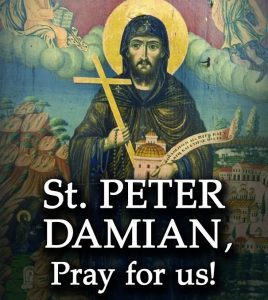
 The same thing was happening a thousand years ago. But a courageous cardinal spoke out against homosexuality and sexual perversion in the ranks of the clergy, pointing to bishops, priests and deacons. His name was Peter Damian. He was raised to Cardinal and Doctor of the Church. He was charged by the papacy with fighting against this scourge of sexual perversion and sodomy. I wish our Pope would do the same.
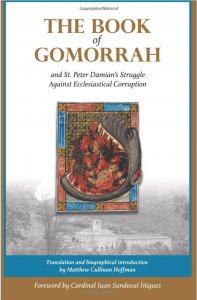
St. Damian wrote a document entitled The Book of Gomorrah which was completed in 1054. It exposed the sodomy and perversion in the ranks. I suggest people get this book and read it today and pass it around. Pope Leo IX responded to this extensive letter with unreserved praise. He said, “everything that this book contains has been pleasing to our judgment, being as opposed to diabolical fire as is water.”
For an excellent review of the book and interview with the translator in Catholic World Report, click here.
Here are quotes from his book. The first is describing the sins (and is a bit graphic)
“So that the whole matter might be presented to you in an orderly way, I distinguish four types of this nefarious sin. Some pollute themselves, others are soiled by fondling each other’s male parts, others fornicate between the thighs or in the rear, and these ascend by grades, such that each one is worse than the previous.
 Accordingly, the penance that is imposed on those who fall into sin with others is greater than those who dirty themselves alone by the discharged contagion of semen, and those who contaminate others in the rear are more strictly judged than those who copulate between the thighs. The skilled machination of the devil thus contrives these grades of corruption, so that the more it ascends them, the more deeply the unhappy soul may be plunged into the depths of hell” (pg. 83).
The second is an overview of what needs to be done. And needs to be done again today.
“Alas, it is shameful to speak of it! It is shameful to relate such a disgusting scandal to sacred ears! But if the doctor fears the virus of the plague, who will apply the cauterization? If he is nauseated by those whom he is to cure, who will lead sick souls back to the state of health?
The cancer of sodomitic impurity is thus creeping through the clerical order, and indeed is raging like a cruel beast within the sheepfold of Christ with the audacity of such liberty, that for many it would have been much more salutary to be oppressed by the yoke of worldly duties than to be surrendered so freely to the iron rule of diabolical tyranny under the pretense of religion.
It would have been better to perish alone in secular dress than, having changed one’s clothes but not one’s heart, to also drag others to destruction, as the Truth testifies, saying, “He that shall scandalize one of these little ones that believe in me, it is expedient for him’ that a millstone be hanged about his neck, and that he be drowned in the depth of the sea.” And unless the force of the Apostolic See opposes it as quickly as possible, there is no doubt that when it finally wishes for the unbridled evil to be restrained, it may not be able to halt the fury of its advance.”
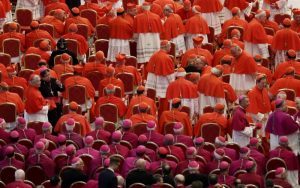 There is a lot more to this book. I have only provided two short passages. But St. Damian goes through it all and confronts it head on — with both mercy and judgment in the proper balance.
Another document from an even earlier period in Spain.
In A History of the Councils of the Church the author details many of the laws promulgated in the Church at the time. I found this law concerning sodomy among bishops, priests and deacons interesting. The Intro to the actual laws states, “In Spain, so rich in Synods, on May 2, 693, was opened the sixteenth Synod of Toledo, in the Church of SS. Peter and Paul. There were present fifty-nine bishops out of all the ecclesiastical provinces of Spain, besides five abbots, three representatives of bishops, and sixteen secular counts. King Egiza appeared personally…”
Law 3, “The prevalence of sodomy makes severe punishments necessary. If a bishop, priest, or deacon commits this sin, he shall be deposed and banished for life. Moreover, the old law remains in force, according to which every such sinner is excluded from all communion with Christians, scourged with rods, deprived of his hair in disgrace, and banished. If they have not sufficiently done penance, the communion is not to be administered to them even on their deathbed.”
(Charles Joseph Hefele, A History of the Councils of the Church, trans. William R. Clark, vol. 5 (Edinburgh: T&T Clark, 1896), 245.)
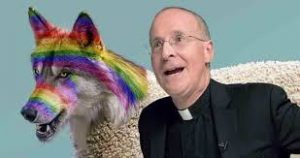 What we are facing is nothing new. What is new is that it is being accepted and even approved. We have priests going around promoting tolerance for the LGBTQ lifestyle even within the Church. We have a papacy and magisterium that is silent about the problem. We must pray for our Church and defend her.
When cancer invades a human body it is unloving to ignore it. What if the doctor says, “We don’t want to operate since that is invasive and painful.” The best thing for the patient is to deal with the cancer and do what is best for the patient. Lovingly remove the cancer for the health of the whole body.
St. Peter (Cardinal) Damian, Doctor of the Church, pray for us!
The post St. Damian: Clerical Sodomy Past and Present and Confronting the Clergy appeared first on Defenders of the Catholic Faith.
Paul Cruise 6 Athens Cathedral Mass, Mars Hill, Parthenon, Boarded Ship
We have all been anticipating the beautiful ship for our cruise. Today is the day!
We started our day with Mass at the Cathedral of St. Dionysius who was the first bishop of Athens after hearing the preaching of Saint Paul. Next was a city tour of Athens on our buses before arriving to Mars Hill (Areopagus, Acts 17) and ascended the Acropolis to view the 2,500 year old Parthenon.
Local Greek foods for lunch and then we boarded our beautiful ship and settled in our cabins. Great dinner on Deck 8 and we’re all full of anticipation.
The post Paul Cruise 6 Athens Cathedral Mass, Mars Hill, Parthenon, Boarded Ship appeared first on Defenders of the Catholic Faith.
October 11, 2024
Great New Didache Bible from Ignatius Press
The Didache Bible Is Here, Article by Dr. Jeff Mirus
[Steve’s Comment]: I posted this a while ago, but want to make sure new readers are aware of this excellent new Bible with the right footnotes, maps, etc. This is my choice if I had only one Catholic Bible.
[Miras’ article]: This Bible uses the 2nd Edition of the Catholic Edition of the Revised Standard Version, widely regarded as the best translation available today. This means it was last revised according to the principles promulgated in Liturgiam Authenticam in 2001. The printing is well done—clean, clear and easy to read—and the accompanying commentary and additional resources are superb. However, the prospective reader needs to realize that this edition’s resources are primarily devoted to highlighting and clarifying the teachings and practices of the Church as found in the Word of God and as more fully articulated in the Catechism of the Catholic Church.
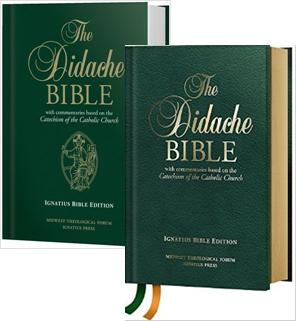 This purpose was inspired by the Midwest Theological Forum’s Didache Series of religious education textbooks, and it makes this edition of the Bible the best one to use in connection with religious education, or by readers who want to understand both the teachings of the Church and their foundations in Sacred Scripture.
It would not be the best edition for those who know Catholic doctrine very well and are now interested in exploring the origins and development of the Biblical books, the surrounding history with which the texts interact, or the full range of perspectives on the meaning of difficult passages.
The Didache Bible includes the following preparatory resources as front-matter:
Foreword by Cardinal Francis George on the general relationships among the Catechism, Vatican II’s Dogmatic Constitution on Divine Revelation, and Sacred Scripture.Preface by Fr. James Socias of the Midwest Theological Forum on the fundamental purposes of this edition.Introduction on Biblical inspiration and the various senses of Scripture.A brief guide on how to read the Bible.A brief summary of the major themes of all the books of the Old and New Testaments.A chronology of the Old Testament.A chronology of the New Testament.A thematically-organized list of Scripture passages for personal meditation.Of even greater interest are the resources which accompany each of the books. There is a one-page introduction to each book which covers authorship, dating, audience and main themes. Then, page by page as the Biblical text unfolds, we find:
Extensive commentary, verse by verse, on the meaning of the text and its significance for understanding Catholic teaching and practice.Call-out boxes which briefly highlight key Biblical and theological concepts to aid the reader in understanding the full significance of the text.Lists of related Biblical passages (these cross-references visually separate the text from the commentary).Periodic full-page apologetical explanations of important Catholic concepts, teachings and practices, placed at appropriate points along the way. There are over 100 of these longer explanations.Finally, following the last book of the Bible, the back-matter includes:
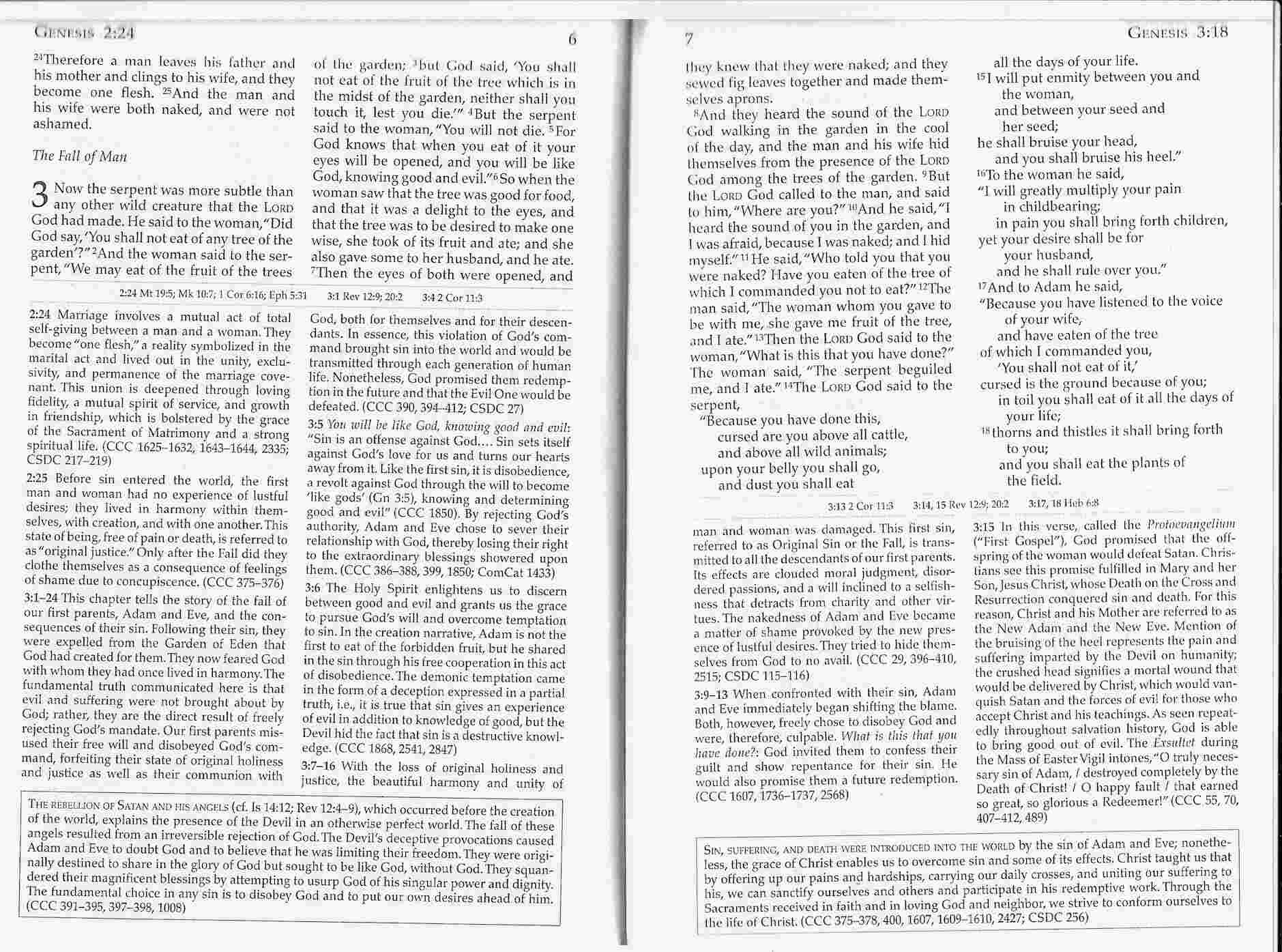
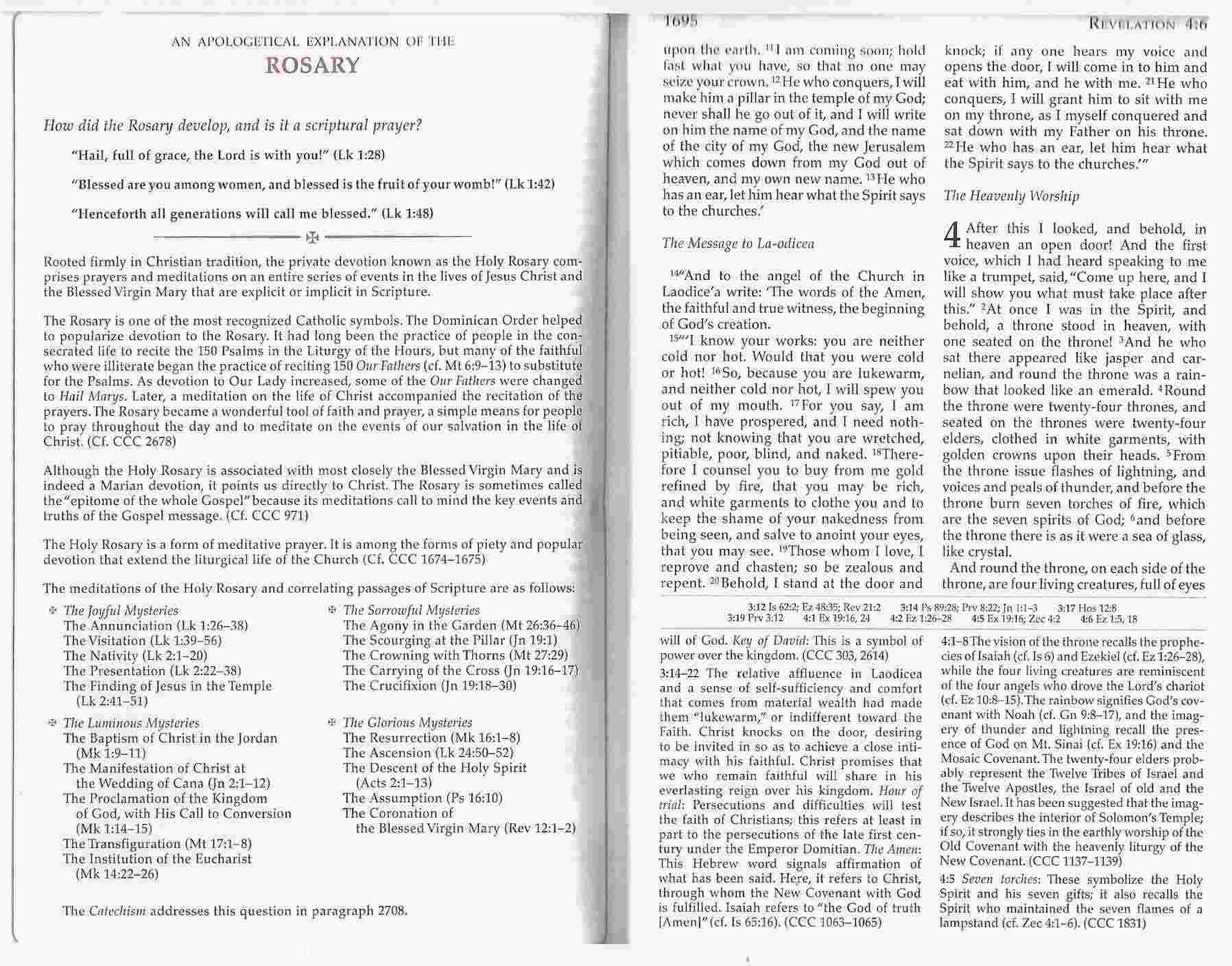
24 full-color maps providing geographical orientations for both the Old and New Testaments.A 44-page glossary of Biblical names and terms.Index to the maps.Index of apologetical explanations by title.Index of apologetical explanations by subject.A 23-page index of subjects, including Biblical names, which leads to the Biblical passages in which they appear.I’ve attached two rough, home-made double-page scans. One shows pages from the Book of Genesis as an example of the presentation of the text, the Biblical cross-references, the extensive commentary, and the boxed highlights. The other shows pages from the Book of Revelation as an example of how an apologetical explanation (on the Rosary) interfaces with a page of text (again with its characteristic chapter and verse numbers, subtitles, cross-references and commentary).
The Didache Bible is currently available in a sturdy hardbound edition with two ribbons. I give this Bible my highest recommendation for all those who wish to understand both Sacred Scripture and Catholic teaching more fully, including the deep links between the two. I would say it is the best edition to give as a first Bible to Catholics who have not yet made an extensive study of their Faith. It is the ideal Bible for them to have when they go off to college or out into the world, where they will eventually be challenged—not least about the relationship between Sacred Scripture and the Catholic Church.
I have provided our usual Amazon link below, but the Bible is currently on sale directly from Ignatius Press. I am checking on the availability of the deluxe leather-bound edition that was also originally planned.
The post Great New Didache Bible from Ignatius Press appeared first on Defenders of the Catholic Faith.
Paul Cruise Day 5: Arrivals in Athens and First View of The Parthenon
 Seventy of us pilgrims from Rome joined up with 60 new arrivals in Athens to embark on the ship tomorrow. This video is mainly for the family and friends of those pilgrims who are tracking their adventures.
But it is a fun video anyway with our first glimpse of the Parthenon and the four wonderful priests we have with us. We’re off to a great start!
The post Paul Cruise Day 5: Arrivals in Athens and First View of The Parthenon appeared first on Defenders of the Catholic Faith.
October 10, 2024
St. Paul Cruise 4 Lanciano Eucharistic Miracle, Catacombs, Navona to Athens
Early start today because we’ve got a lot to accomplish. The Eucharistic Miracle of Lanciano is a highlight of this pilgrimage. We had Mass in front of this oldest and most spectacular of the Eucharistic Miracles. In the 700s a priest was doubting the Real Presence of Christ in the Eucharist, and when he held up the host, the blood dripped on the altar and what was left in his hands was physical heart muscle and AB-type human blood. They are now on display and we got right up close.
We drove back across beautiful Italy and through the mountains and, like yesterday on Bus 2, we did our pilgrimage version of Catholic Answers Live on Bus no. 1. We also prayed the Rosary and have a good time. Lunch in Rome and free time a the Parthenon and Piazza Navona before we descended into St. Sebastian’s Catacombs. From there, we flew from Rome to Athens.
The post St. Paul Cruise 4 Lanciano Eucharistic Miracle, Catacombs, Navona to Athens appeared first on Defenders of the Catholic Faith.
October 9, 2024
The Technology of Scripture Study: The Middle Ages (and a hilarious video at the end)
“I am an ecclesiastical historian by training and a Bible software guy by trade. Which, I think, puts me in the unique position to write about the history of the intersection of technology and Scripture study in a series of posts.”
 Written by my friend Andrew Jones PhD:
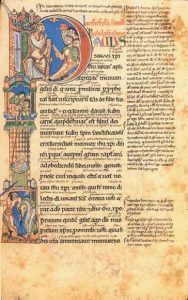
“We might start with a description of the Bible we are all used to. It is a stand-alone, printed volume of 73 books (give or take a few), with a more or less fixed text translated from the earliest and best manuscripts. Because of its size, Mass production, and the fact that nearly all of us are literate, we tend to think of the Bible as a self-contained work that is readily available and can be read by anyone and anywhere.
The Bible was a very different thing in the Middle Ages. That may seem like a bold statement, but let me explain.
Medieval Christianity was profoundly sacramental, focusing on an encounter with Christ that was both spiritual and physical.
As the theologians of the period frequently remarked, Christ was the Word of God in both His “doing and teaching” (Acts 1:1). For the medieval Christian engagement with the spoken Word of God was not divorced from physical engagement with Christ’s Body, and so the Bible was, above all else, a liturgical book.
 In the liturgy, the priest read the Scripture, brought the text to life through preaching, and then confected the Eucharist on the altar, introducing Christ’s physical presence. The Word of God in its totality was made present and the encounter with it was total: intellectual, physical, and social.
In the liturgy the Christian was understood as united vertically with God and horizontally with his fellow man—all together, the Body of Christ.
This was the context in which medieval Christians studied the Scripture. Indeed, they often evoked Eucharistic imagery. They “chewed” the Word and “swallowed” it. This was an act of deep reading and meditation on the text that culminated in memorization.
But they did not understand memorization as do we. We tend to think of the memory as a hard drive, and memorization as an act of rote drilling that leads to data retention. To the people of the Middle Ages, however, the act of memorization was that of “digesting” the Scripture so that it became a part of who they were.
Like how the Eucharist became a part of the body, the Scripture became a part of the mind. Amazing feats of memory are documented, such as being able to recite the Bible backwards……..
For the whole article, visit HERE.
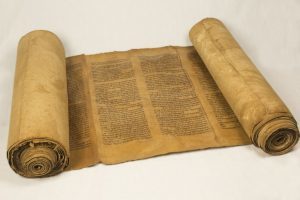
For a very funny video on Scripture study in the Middle Ages, watch this. Switching technology from scrolls to codex (books). I had tears in my eyes I laughed so hard.
ANOTHER VERSION:
The post The Technology of Scripture Study: The Middle Ages (and a hilarious video at the end) appeared first on Defenders of the Catholic Faith.
St. Paul Cruise 3 Manoppello and Facecloth of Christ
Not such an early start this morning and we packed up to leave the Michelangelo and drive east across Italy to Manoppella and then spend the night at Lanciano. Lunch in Manoppello at L’Angolino.
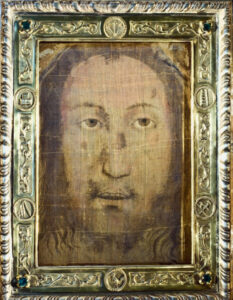 Manoppella is the city up in the mountains that houses the great treasure which Padre Pio said is one of the great treasures of our time. Pope Benedict XVI visited this small church many times himself. Ignatius Press published a book by journalist Paul body entitled “The Face of God” which is an excellent story and reads like a detective novel.
Inside is the Volto Santo — or the Holy Face — which is an image of Christ on a miraculous image of Christ on a silken cloth. The cloth is made of mussel fibers, and the image is not painted or inked, and like the Shroud of Turin is non-reproducible and unexplainable. It shows the face of Jesus Christ at the moment of his resurrection. This was the face cloth that was folded up in the tomb when John and Peter first went in (John 20:6-7).
We celebrated Mass in front of the Holy Face. From there the short distance to Lanciano, where we stayed at the Hotel Villa Medici. Tomorrow we have Mass in front of the oldest and the grandest of the Eucharistic miracles in Lanciano.
The post St. Paul Cruise 3 Manoppello and Facecloth of Christ appeared first on Defenders of the Catholic Faith.
October 8, 2024
Demon of a Riddle, but which demon?
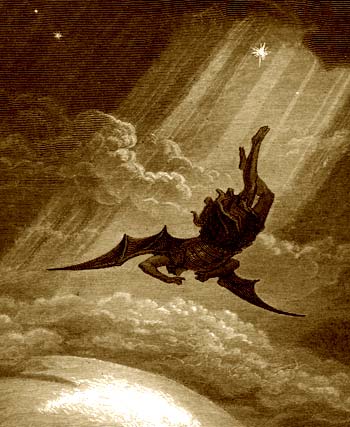 From where God placed me I did fall,
I knew the Christ and knew of Paul.
They showed great power, this is true,
But I would never flee from you.
For though your number was complete,
I was not one you could defeat.
When you told me to go my way
I thought I’d have the final say.
When the time came you did flee
With wounds exposed for all to see.
For in your clothes you could not hide
You left without a show of pride.
I was a demon, this is true
All I asked was “Who are you?”
After you give up, if in fact you do 
Read Acts 19.
The post Demon of a Riddle, but which demon? appeared first on Defenders of the Catholic Faith.
Stephen K. Ray's Blog
- Stephen K. Ray's profile
- 27 followers