
Stephen K. Ray's Blog, page 25
August 16, 2024
Free Timeline of 1st Century Christianity
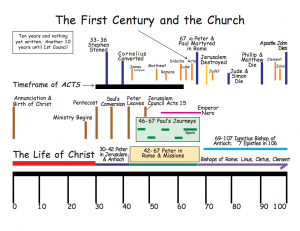 The past is shrouded in a fog for most people. What was really going on in the 1st century during and after the live of Christ and the birth of the Catholic Church? Here is my simple Timeline of First Century Christianity.
I created the Timeline to help my students understand their heritage as Catholics. It shows the key events that took place in the first Christian century. Understand your history!
Click here or on the image to right and download and print the PDF file. Free for the using (but not for selling).
The post Free Timeline of 1st Century Christianity appeared first on Defenders of the Catholic Faith.


August 15, 2024
A Good Riddle Few Can Figure Out – except kids
compared to 17% of Stanford University seniors.
The post A Good Riddle Few Can Figure Out – except kids appeared first on Defenders of the Catholic Faith.
Another Heroic Movie – Gather the Family!
As you know, I like to recommend great movies for Catholic families to watch since there are so few of them. Today on the plane home from Ireland, we watched a movie that had Janet and I in tears and clapping on the plane. It was entitled One Life starring Anthony Hopkins.
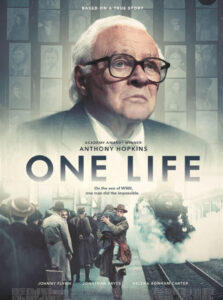 This man save 669 children out from under the nose of the Nazi’s from Czechoslovakia who were sending them to the concentration camps. The ending of the movie you need to make sure you have Kleenex.
This movie demonstrates how all of us should look back at life when it’s time to go. We may have to make these same choices, starting with the pro-life cause.
https://en.m.wikipedia.org/wiki/One_Life_(2023_film)
https://www.rottentomatoes.com/m/one_life
The post Another Heroic Movie – Gather the Family! appeared first on Defenders of the Catholic Faith.
August 13, 2024
Cross vs. Crucifix
(A letter Steve wrote to an Evangelical friend asking for an explanation of the Crucifix)
Dear Protestant Friend:
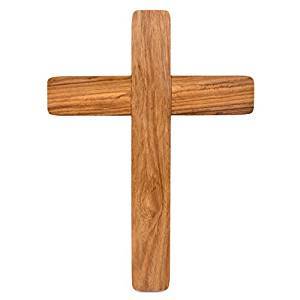 You display a bare cross in your homes; we display the cross and the crucifix. What is the difference and why? The cross is an upright post with a crossbeam in the shape of a “T”. A crucifix is the same, but it has Christ’s body (corpus) attached to the cross. As an Evangelical Protestant, I rejected the crucifix—Christ was no longer on the cross but had ascended to heaven. So why do I now tremble in love at the site of a crucifix? Let’s examine the history and issues surrounding the two.
I will start with the Old Testament and the Jews’ use of images and prohibition of idols. I know in advance that it is not a thorough study, but it will give a general overview of the issues. I will try to provide a brief overview of the Cross and the Crucifix, the origin, the history, and the differing perspectives of Catholic and Protestant. It will try to catch the historical flow and include the pertinent points. The outline is as follows:
The Three Main Protestant Objections to the CrucifixImages and Gods in the Old TestamentImages and Images of Christ in the New TestamentThe Cross in the First CenturiesThe Crucifix Enters the PictureThe “Reformation” and IconoclasmModern Anti-Catholics and the CrucifixEcumenical ConsiderationsThe Three Main Protestant Objections to the Crucifix
Let me begin by defining “Protestant” as used in this article. First, it is used to describe the first Reformers who tore down crucifixes and crosses in the first years of the Reformation; and second, it refers to general American Evangelical-type Protestants. Granted there are many Anglican and “high” Lutherans and others that do not object to the crucifix or other Christian symbolism. With that behind us, let’s begin.
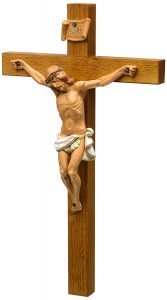 The first major objection of the Protestant regarding the crucifix (an image of Christ on the cross) is that Christ is no longer on the cross–He is risen. I was raised with this observation and my friend would ridicule the Catholic traditions. My friend also challenged us when we first became Catholics, commenting, “We serve a risen Christ, not one that is still on the cross.” Unfortunately for them, since childhood my mother had valued her beautiful Christmas crèche scene. I asked the obvious: “Do you serve the risen Christ or one still in the manger?” (I also had to comment on the cute little statue of Our Lady standing over the plastic baby Jesus, along with the animals.)
Second, Protestants see the image of Christ on the cross as a violation of the command to make no graven image. The Reformers were big on this. Protestants now utilize plain crosses in their “churches,” on their walls, and around their necks, just as they have pictures of Jesus (always with soft skin and melodrama) on their walls. (I was raised with this feminine Jesus presiding, ever so romantically, over our dinner table.
After spending time in the Holy Land, driving through the Judean wilderness, and ascending Mount Tabor, which he and his disciples frequented, I doubt he was so dainty and delicate; he probably had calves like a bear and smelled a bit like one as well.) However, at the turn of the last century, the Protestant churches (excluding Lutheran) were still pretty much opposed to displaying of the cross, even the bare cross. The bare cross was not in wide use until recently, though current Protestants don’t know their own history on the matter and that their predecessors opposed it as much as they did the Crucifix.
Third, they object to the Crucifix because it is Catholic and to condone or display the Crucifix is to make a statement in favor of Catholicism. No one of “Reformed” persuasion would want to be identified as a Catholic. A bare cross seems to be generic, which is what most Protestants like–generic Christianity–with no history to criticize or Church to obey.
Images and Gods in the Old Testament
Since the people in olden ages worshiped idols made of earthly materials [Endnote 1], God forbade the children of Israel to possess such “gods”. “Then God spoke all these words, saying, “I am the Lord your God, who brought you out of the land of Egypt, out of the house of slavery. You shall have no other gods before Me. You shall not make for yourself an idol, or any likeness of what is in heaven above or on the earth beneath or in the water under the earth. You shall not worship them or serve them; for I, the Lord your God, am a jealous God’” (Ex 20:1-3).
To read this whole 14-page article, click here.
To read Steve’s other articles, click here.
For Steve’s talk “The Pain of the Crucifixion,“ click here.
The post Cross vs. Crucifix appeared first on Defenders of the Catholic Faith.
Ireland 8: walk thru Stephen’s Green, Mass at St. Teresa’s, St. Patrick’s Cathedral, Victorian Pub
Walk through St. Stephens’s Green, celebrate Mass at St. Teresa’s Church. Visit to St. Patrick’s Cathedral.
Extensive driving tour of Dublin including Merrion Green and sassy image of Oscar Wilde.
Lunch and free time in the afternoon for shopping and sightseeing. We end our pilgrimage with a Traditional Irish Farewell Dinner at Nancy Hands Victorian Pub with food, drink, music and dancing!
The post Ireland 8: walk thru Stephen’s Green, Mass at St. Teresa’s, St. Patrick’s Cathedral, Victorian Pub appeared first on Defenders of the Catholic Faith.
August 12, 2024
What My Grandpa Said About the Pope – A Boy’s Story
 My grandpa is a nice old gentleman, with gray hair, and gold spectacles, and very fond of his little grandson Billy—that’s me. Grandpa and I often go out to walk together, that is, on fine days, because on cloudy days he never goes out of the house, but stays at home to keep “comfortable with the gout”, as he says.
One day we strolled along the edge of the woods and into the park, and after walking about for a while we sat down on a nice sunny bench. Grandpa took out a newspaper to read. As his eye glanced down the columns, he suddenly gave a grunt and hit the ground very sharply with his cane.
“Got the gout, Grandpa?” I asked.
“No, my dear, it’s nothing but the old Pope again.”
“Who is he, Grandpa?” I inquired.
“I am sorry to say he’s a bad man, and always has been my dear,” replied Grandpa, looking at me over his spectacles.”
“Why don’t the police pick him up then, and put him in jail?” I asked.
“Because there are so many people that think he is a good man,” answered my grandpa, “and as for trying him, Billy, there’s been plenty of that, if you only understood it; but as often as he is brought up in court, the fewer witnesses you can get to appear against him, and he always manages to come away not guilty.”
“How many people believe he is a good man, Grandpa?” I asked. “Probably ten or twelve?”
“A dozen!” laughed the old gentleman, “see here,” and he commenced drawing figures on the sandy path with his cane. “There,” said he pointing to his numbers scratched in the sand, “what do you think of that?”
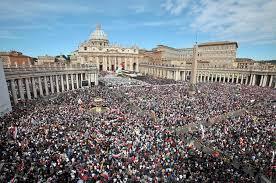 “There’s a “1” with nine zeroes after it, I said, “Why, Grandpa, that’s over a billion people!”
“That’s about it, my dear.”
I thought it was rather funny that so many people could not find out that he was a bad man, and said so; to which my grandpa answered:
“It’s because they are all blind and superstitious Billy.”
“Are these people really that stupid, Grandpa? What kind of people can they be?” I asked.
“They are called Catholics, my dear.”
“Oh! I know,” I said, “I heard Pastor Roland preach about them, and that’s what Mr. Andrews became when he left our church. Why don’t you tell him, Grandpa, that the Pope is a bad man?”
“No use in that,” he replied; “he would only laugh at your grandpa, and tell him just what I have told you, that there are over a billion people who believe the Pope to be a good man; nearly four times as many as all us Protestants together who think he is bad.”
“What makes the Pope a bad man?” I asked, “did he steal something?”
“Yes, my dear Billy,” answered Grandpa, banging his cane down with each word, “he stole too much power and authority, and made himself the so-called head of the Christian Church over the whole world.”
“But,” I said, scratching my little head, “why don’t some of the billion people find out he is not the head of the Church, and tell the rest of the people?”
“They could not find out that he is not, when he actually is now, could they, little whipper-snapper?”
“I don’t mean that, Grandpa,” said I, “but why don’t they find out that he has no right to be the head of the Church, and find out when he stole all the power and authority?”
“Because nobody knows when or how he did it.”
“How do you know it then, Grandpa?”
Grandpa was suddenly seized with a violent fit of coughing, which made him very red in the face. I was afraid he was having a heart attack. My grandpa is rather fat, and has a short neck; and short-necked fat people always die of heart attacks, you know. In my fear I forgot all about the Pope, and ran to the drinking fountain to get some water for him, when who should come along but Mr. Andrews himself, whom we had just been talking about.
“Oh Mr. Andrews!” I cried out, “my Grandpa is very bad! Come quick!” Mr. Andrews looked over at my grandpa coughing on the bench; he cautiously said hello. Grandpa had stopped coughing and looked just fine now. Mr. Andrews smiled down at me, and said:
“Your Grandpa is not bad, little Billy, but very good, as everybody knows.”
“Oh! I don’t mean he’s a bad grandpa, “I responded, “but I thought he was going to die of a heart attack when I asked him about that bad man, the Pope.”
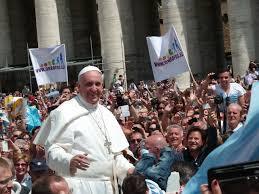 My grandpa didn’t know quite how to respond so he said, “Little Inquisitive here. He’s been asking me about the Pope, and I told him what I firmly believe, Mr. Andrews, that the Pope assumes an unfounded authority over the Christian world, and that it’s a wicked assumption. How could you, brought up in this enlightened country, and in an Evangelical church to boot, submit yourself to it?”
“Simply because I found out that (contrary to what you and I were taught in our early days) the Pope not only is, but always was the visible head, and earthly governor of the Christian Church; and that not until a comparatively late date in history was it ever doubted. To be called a Christian and acknowledge the Bishop of Rome as the chief pastor of Christ’s flock was one and the same thing. So after some research I concluded that I must either submit myself to his pastoral authority or be cut off from the Christian Church altogether.”
“You had plenty of Christian Churches you could join without coming to that silly conclusion,” growled my grandpa.
“You are right, there are plenty that call themselves the Christian church, over twenty-eight thousand to be exact,” replied Mr. Andrews, “but Jesus Christ told us there should only be one fold, and one shepherd” (Jn 10:16).
“I know” said my grandpa, “that those words about the ‘one flock’ seem to condemn us Protestants outright, but you see the truth is, no matter how many divisions there are, we’re all Christians, and Jesus Christ is our one shepherd.”
“All alike in theory maybe, if you will,” said Mr. Andrews, “but surely you won’t pretend to say that the Christian religion as Catholics believe it, and the Christian religion as Protestants believe it is just alike?”
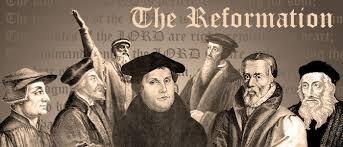 “Of course not. Heaven forbid!” gasped Grandpa, “Our blessed Reformers cut us loose from your doctrines and your Pope too, and we escaped from your slavery, sir.”
“Grandpa,” I asked, “why didn’t everybody run away too?”
“Ha! ha!” laughed Grandpa, “very good! ha! ha! V e r y good, Billy; and left the old Pope all by himself! That’s a capital idea!”
Mr. Andrews pointed over in the direction of the hillside, and said: “I’m afraid we’d all be in the same predicament as those sheep over on the hillside if they took it into their silly heads to run off from their shepherd.”
My grandpa stopped laughing at this, and his face went blank, at least I thought so.
“St. Paul says,” continued Mr. Andrews, “that Christ is not divided,” and it is plain that the Church ought not to be divided, as you admit it is. ‘One Lord, One Faith, One Baptism,’ says St. Paul again (1 Cor 1:18; Eph 4:5). Now we Catholics are all under Christ, have one faith, and one baptism; and we are all in one church, governed by one head, but you Protestants are divided not only from us, but even among yourselves, with multitudes of faiths, different baptisms, acknowledging no head of your churches, and for ever quarreling and competing among yourselves.”
“I admit you have the Scripture on your side,” said my grandpa, “but then you push it too far, my dear Mr. Andrews. There is Peter’s name, now, which just because it happened to mean a rock, and because our Lord said He would build His Church on a rock, you say that He must have meant Peter.”
“I beg your pardon,” answered Mr. Andrews, “his name did not happen to be Peter, but Simon: and Jesus specifically changed it to Cephas, which is, interpreted, Peter, or Rock, as the Scripture says, because He meant to make him the foundation rock of the visible Church (Jn 1:42; Mt 16:18). Cephas, you know, is Aramaic for rock, and Peter is Greek for rock. But it is plain our Lord made St. Peter the head pastor over his flock, for He said, ‘Simon, son of John, feed my sheep, tend my lambs’; and you cannot deny that He said to St. Peter, ‘I will give you the keys of the kingdom of heaven’” (Mt 16:19; Jn 21:15-17).
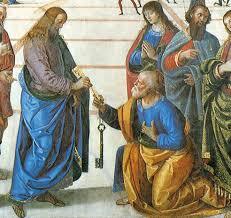 “No,” replied my grandpa, “I don’t deny it, because it is in the Holy Bible plain enough, but I don’t believe the Pope has got them, the keys that is.”
“Who else does then?” asked Mr. Andrews.
“Nobody has, and nobody wants them,” answered Grandpa, rather gruffly.
“What use did St. Peter make of them, and what did he do with them when he was martyred?”
“I don’t know, and I don’t care”; and Grandpa, and when he said that, took up his newspaper again as if he did not wish to talk any further with Mr. Andrews. I was very anxious to know who had the keys of the kingdom of heaven, as any little boy would be, so I asked Mr. Andrews if he knew, and what St. Peter did with them. “St. Peter had the keys of the kingdom of the kingdom of heaven because he was the first head of the Church, and whoever is head of the Church in St. Peter’s place must have them now,” said Mr. Andrews.
“That is the Lord and Savior, my son, and not the Pope,” said my grandpa.
“Why, grandpa, didn’t you say the Pope was the head of the Church now, only he had no right to be?”
“Hold your tongue boy,” retorted my grandpa, “hold your tongue. What do you know about theology?” He then turned to Mr. Andrews (and I was glad he did, for that big word “theology” quite frightened me), and said:
“My dear Mr. Andrews, why can’t you Catholics get along without any man as the head of your Church?”
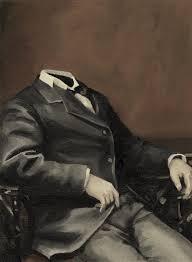 “Because,” replied Mr. Andrews, “nothing can get along in this world without a head. A headless Church would be as ungovernable, as shaky and as liable to go to pieces as a state, or a family, or an orchestra, or an army, or any other association without a head. Even Protestants have “heads” or pastors for each of their ‘churches’ to keep order and lead the flock. In principle there is no difference.”
“But I don’t want any such human head in my religion,” said my grandpa. “I want to be able to decide things for myself, to be my own head and-”
“Your own Pope,” interjected Mr. Anderson.
“And do my own thinking,” continued my grandpa, not noticing the interruption.
“And so you get what you’ve gotten,” said Mr. Andrews, “as many religions and sects as you have heads to think.”
“And you have given up being an enlightened and free American and Evangelical, and you let the Pope do your thinking for you, eh?” said my grandpa sneeringly.
“Not at all!” answered Mr. Andrews. “The Pope is as much obliged to believe and obey the same one, holy, Catholic, and apostolic truth, as it was first taught by Jesus Christ, ‘the faith once delivered to the saints’ (Jude 3), as I am, or the least one of the over one billion Christians who acknowledge him as their spiritual pastor.A truth, moreover, to which neither the Pope, nor even the whole Church can either add any thing new, or take anything away.
And as for freedom, friend Simon,” (Simon is my grandpa’s name), “I have never known what it is to be truly free in my faith, though at one time like you I thought I did, until I became a Catholic; for I am now bound to the opinions of no man or set of men, but only to those sure and settled universal principles and truths which the whole Church is bound to, and has always believed in every age of Christianity. Outside of these, I can believe as I will, and I’m bound only by common sense and decency. ‘You shall know the truth,’ said our Lord, ‘and the truth shall make you free’. The Church has always been faithful to preserve the truth of the Lord Jesus and His apostles.”
“I must say, Mr. Andrews, that you put things in rather a new light for me; and if what you say is true, it is worth thinking over,” said my grandpa.
“Yes, it is worth thinking over, Mr. Simon,” and with that Mr. Andrews dipped his hat and bid my grandpa and I a “Good morning,” and walked on.
My grandpa seemed to lose interest in his newspaper, folded it up, and we returned home. As we walked along he kept talking to himself and appeared to get so agitated that I was afraid the gout was rapidly coming on. When we arrived at the door of our house, we saw old Mick Mooney chopping up a load of wood on the sidewalk. My grandpa stopped right before Mick and he asked:
“Mick, who is the head of the Church?”
“Jesus Christ, sir, and visibly, the Pope who represents him as pastor, your honor, bless his holy reverence,” replied Mick.
“But,” said Grandpa, “our church has no Pope. What is the use of your Church having one?”
“How could we ever know the difference between Catholic and Protestant then?” asked Mick.
“I don’t understand you,” said my grandpa.
 “Sure, if it wasn’t for the Pope, the Protestants might be calling themselves Catholics, and pretty soon everyone in the Catholic Church would be going off in a billion directions and lose their way. Then no one would know who was in the true fold at all, and no one would be there to direct them, begging your permission, sir.”
“But the Bible,” said Grandpa, “could tell you, Mick, better than the Pope too, whether you were of the fold of Christ or not.”
“I’m afraid not sir, begging your pardon,” replied Mick. “For there are lots of Protestants, very fair and wonderful folks they are too, honorable gentlemen, but the Bible don’t seem to tell them.”
“Why, Mick,” said my grandpa, “you talk as if you thought all us Protestants were out of the true Church because we don’t submit to the Pope. You might as well say we are all heathens for the same reason.”
“I believe,” said Mick humbly, “that our Savior said something like that, too. ‘He that will not hear the Church, let him be to you as a heathen and a publican’, and St. Paul, bless his soul, said the Church was the ‘pillar and foundation of the truth’ (1 Tim 2:15.), whereas I would suspect that you, Mr. Simon, would probably give those honors to the Bible alone.”
“The Church. Oh! yes, well, um,” said my grandpa. “Very true, but the Church is not the Pope.”
“You’re kidding me, right Mr. Simon, you’re just joking around.” answered Mick, with a curious look on his face, “You couldn’t hear the Church, I’m thinking, if the Church didn’t speak, and how is she to speak without a head and a mouth?”
 “There’s some truth in that,” said my grandpa. “And I guess the Pope is the pastor of the Catholic Church. In principle, I can’t argue because I don’t know of any Protestant church that doesn’t also have a pastor to lead it.”
My grandpa thought deeply for awhile and then said, “Come, Billy, the Pope has been in court again, and came out ‘not guilty’ again, as usual;” and taking my hand, he led me into the house, and into the living room and sat down.
“Now,” he said, turning to me, “you see now what has become of your bad old Pope, little Billy?”
I began to tremble, for I was afraid something very dreadful had happened to the Pope, yet I managed to stammer out “Dear Grandpa! what has happened to him?”
“Why, just this, that your stupid old gouty grandpa is very much inclined to think that those one billion Catholics may not be so stupid after all. They may be right after all; and-” he continued, going to the window, and waving his cane like he was yelling to someone in the street-”what a blind old fool I have been, like a old mole, not to have seen this all before. We must thank God for His mercy and compassion, even for a gouty old man like me!”
The post What My Grandpa Said About the Pope – A Boy’s Story appeared first on Defenders of the Catholic Faith.
Ireland 7: Dublin! Mass at Pro-Cathedral, Trinity College, Book of Kelly, Tour Guinness Brewery
Departed for a tour of Dublin and Mass at Dublin Pro-Cathedral. Visited Trinity College, see the magnificent Book of Kells, an illuminated copy of the Four Gospels.
After lunch a tasting tour of the Guinness Brewery and Storehouse. Then the late afternoon and evening for some much deserved free time.
The post Ireland 7: Dublin! Mass at Pro-Cathedral, Trinity College, Book of Kelly, Tour Guinness Brewery appeared first on Defenders of the Catholic Faith.
August 11, 2024
Pastor Bob “Preaches the Word” (Discussing A Sermon on Baptism)
Pastor Bob Preaches The Word (or does he?)
By Steve Ray
 Josh left Sunday services full of excitement, anxious to discuss Pastor Bob’s sermon with his sister Jennifer who had recently converted to the Catholic Church. The pastor had explained how salvation was by “faith alone” and not by rituals and works. He was anxious to discuss this with his sister; he was irked by her conversion to the “traditions of men” and “salvation by rituals.” How could she leave a Bible-believing Church to join the Catholics? Armed with Pastor Bob’s verses, he met his sister for lunch.
After ordering grilled salmon, Josh got right to the point. “Sis, I am dismayed that you have abandoned the Bible to follow Rome. Last Sunday Pastor Bob preached about Baptism right straight from the Word of God. I wish you could have heard him.” Jennifer smiled. Josh continued, “He showed how the Catholic Church ignores the Word of God.”
Josh pulled out his black leather Bible. “Baptism does not save you, Sis. Look at this verse.” After quite a few verses he turned to Genesis 15:6 which said that ‘Abraham believed God and it was credited to him as righteousness’. “Where do you see anything about Baptism?” After listening patiently for a while Jennifer interrupted the litany of out-of-context proof texts with a sisterly word of advice.
 “You know Josh, you flip through that Bible with very little regard for the context. You treat the Bible as though it were a book of numbered quotations randomly collected and unrelated to each other. Did you know that the chapter and verse divisions were not part of the original text of Scripture?” Josh was more interested in finding the next verse than in listening to Jennifer.
“Remember Josh, even in Hebrews, when quoting the Old Testament the writer says that “one has testified somewhere, saying” (e.g., Heb 2:6) because there was no easy way of refer to the passage. The Old Testament Scriptures were written on huge scrolls that had to be unrolled-just straight text with no divisions. The New Testament writings were handwritten on papyrus or parchment. For more than 1500 years verse divisions, which we take for granted, did not exist.”
“Come on Sis, what does that have to do with Baptism? Verse numbers make it easier to use the Bible. I just gave you a lot of verses that prove my view of baptism, and you give me a history lesson.”
Jennifer smiled, “My point exactly Josh! Chapter and verse divisions have made it easier to abuse the Bible since people too often view the Bible as a collection of “sayings” divided numerically into bite-sized sound bits. You are a good example-just look at your list of proof-texts about Baptism. You treat the Bible as though it were a collection of unrelated, numerically arranged sentences to pluck out at will. The Bible is actually made up of whole writings to be read in context. Remember that ‘A text without a context is a pretext’. “
“Sis, let’s get back to Baptism. How can you believe that Baptism is necessary for salvation when the Bible says we are saved by faith alone? Read John 3:16 and you’ll see that ‘whosoever believes in Him should not perish but have everlasting life.’ Do you see anything about baptism in that verse? Only faith!”
“You’re right Josh, you cannot find the word “Baptism” in that particular verse. But are you willing to set aside the practice of “proof-texting” and look at the whole context? You don’t start reading Gone with the Wind in the middle of the book and then skip around willy-nilly reading individual paragraphs do you? Of course not! Then why misuse the Bible that way. Let’s stop for a minute and look at the whole picture-what is St. John saying in context?”
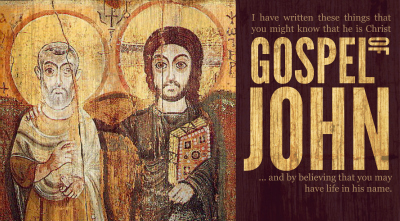 Josh protested, “Jennifer, I have more verses about salvation by faith without mentioning baptism than you have that mention Baptism.” “Really,” said Jennifer, “so you feel we can ignore verses-cut them out-if they don’t fit our theology to balance the verses that do? Come on Josh, that’s not honest. Jesus doesn’t divide it into either faith or baptism. as you do; rather, He proclaims salvation through both faith and baptism. Don’t divide what God puts together. Let’s take a look at what the New Testament actually says.”
Josh agreed and they sat for almost an hour reading the text of St. John and comparing it with the other New Testament writings. Fortunately for us, they took good notes which we are able to pass on to you. Let’s see what they discussed.
********************************************
Biblical Context:
John 3: What does one have to do to avoid perishing and gain eternal life (Jn 3:16)? How are faith and sacraments both necessary, not mutually exclusive (CCC 161; 1236)? How does one become a child of God (Jn 1:12-13)? How does Jesus explain birth from God to Nicodemus (Jn 3:3)? What must take place for one to “see the kingdom of God” (Jn 3:3)? How does Nicodemus misunderstand Jesus (Jn 3:4)? In order to be “born from above”, what two elements are necessary (Jn 3:5; CCC 720; 1215)? Does Jesus describe “faith alone” as the means of New Birth (Jn 3:5)? How does the Catholic Church continue Jesus’ teaching (CCC 1238; 1257)?
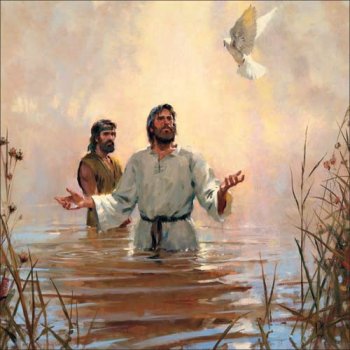 All of John: What had previously happened to Jesus that was still fresh on the mind of Jesus’ listeners and John’ readers (Mk 1:9-1; Jn 1:29-34)? How were “water” and “Spirit” involved in Jesus’ baptism? After speaking with Nicodemus about being born again through Baptism, what does Jesus begin doing immediately (Jn 3:26; 4:1)? What did “believers” in Jesus do to obey Him and be born again (Jn 4:1)? How does this “framework” of John three explain St. John’s meaning about being born again, believing, and being baptized? (For more on the context of St. John, see Crossing the Tiber.)
The New Testament: How does Peter conclude the first Gospel message (Acts 2:38)? Does he mention “water” and “Spirit”. What did Ananias tell Paul to do after Jesus confronted Paul-when were his sins washed away (Acts 22:16)? How does Paul later describe this experience of “water and Spirit” (Titus 3:5; CCC 1215)? According to Peter, what saves us now (1 Peter 3:21; CCC 1219)? What does Mark say (Mk 15:16)? How would the Jews have understood the Prophets on this matter (Ez 36:25-27)? Is context important (CCC 109-114)?
For more on this, see my article “Are You Born Again?”
********************************************
Context from History and the Fathers and even Martin Luther
Historical Note on Chapter Divisions: Archbishop Stephen Langton (d. 1228). Verse divisions: Robert Stephens in 1551. First Bible with chapter and verse divisions: 1555 edition of the Latin Vulgate.
Tertullian (c. 160-c. 225)
“Happy is our sacrament of water, in that, by washing away the sins of our early blindness, we are set free and admitted into eternal life” (On Baptism).
Tertullian (c. 160-c. 225)
“Now this heresy of yours does not receive certain Scriptures; and whichever of them it does receive, it perverts by means of additions and diminutions, for the accomplishment of it own purpose; and such as it does receive, it receives not in their entirety; but even when it does receive any up to a certain point as entire, it nevertheless perverts even these by the contrivance of diverse interpretations. Truth is just as much opposed by an adulteration of its meaning as it is by a corruption of its text” (Prescription against Heretics, 17).
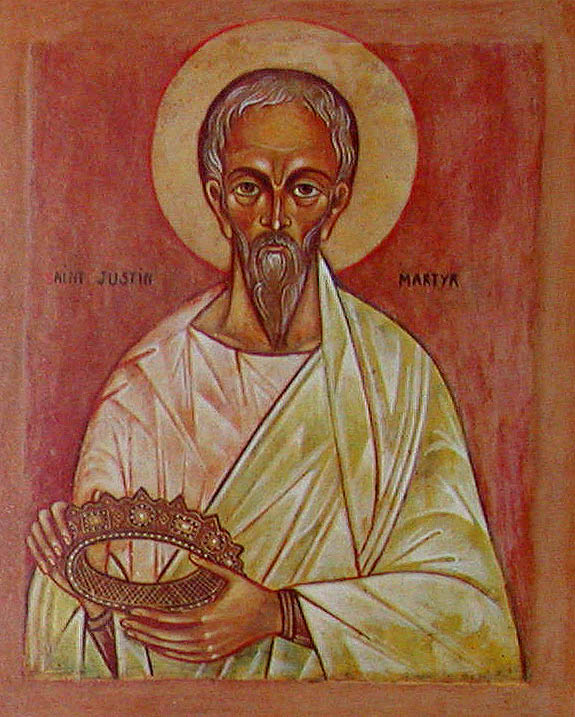 Justin Martyr (martyred AD 165)
“They are brought by us where there is water, and are regenerated in the same manner in which we were ourselves regenerated. For, in the name of God, the Father . . . and of our Savior Jesus Christ, and of the Holy Spirit, they then receive the washing with water. For Christ also said, ‘Except ye be born again, ye shall not enter into the kingdom of heaven’. . . . And for this [rite] we have learned from the apostles” (First Apology).
Origen (c. 185-254)
“Let us remember the sins of which we have been guilty, and that it is not possible to receive forgiveness of sins without baptism.”
Origen
“The Church received from the Apostles the tradition [custom] of giving Baptism even to infants. For the Apostles, to whom were committed the secrets of divine mysteries, knew that there is in everyone the innate stains of sin, which must be washed away through water and the Spirit.
St. Augustine (354-430)
“Who is so wicked as to want to exclude infants from the kingdom of heaven by prohibiting their being baptized and born again in Christ?” (On Original Sin).
Martin Luther
“This fountain might well and properly be understood as referring to Baptism, in which the Spirit is given and all sins are washed away” (Luther’s Works, ed. Jaroslav Pelikan [St Louis: Concordia, 1973], 20:331).
Martin Luther
“If the world last long it will be again necessary, on account of the different interpretations of Scripture which now exist, that to preserve the unity of the faith we should receive the Councils and decrees [of the Catholic Church] and fly to them for refuge” (Letter to Zwingli).
Catechism of the Catholic Church
“In order to discover the sacred authors’ intention , the reader must take into account the conditions of their time and culture, the literary genres in use at that time, and the modes of feeling, speaking and narrating then current· Be especially attentive ‘to the content and unity of the whole Scripture.’ Different as the books which comprise it may be, Scripture is a unity by reason of the unity of God’s plan·” (110, 112).
The post Pastor Bob “Preaches the Word” (Discussing A Sermon on Baptism) appeared first on Defenders of the Catholic Faith.
Ireland 6: Kilkenny, Mass at Cathedral, Glendalough, Dublin
Sad to leave this exceptional Lyrath Estate but we have a busy day. Celebrated Mass in St Marys Cathedral in Kilkenny followed by a guided walking tour of this historical and lovely city’s center. Time for lunch in the pubs and restaurants and visiting the Kilkenny Design Center.
Traveled over the Wicklow Mountains to the 6th Century Monastic site of St Kevin at Glendalough for a guided tour. It is always encouraging and challenging to see the deep faith and commitment of these Irish Catholics through the centuries, and often times with deprivation and persecution.
Then arrived at our Iveagh Garden Hotel in Dublin. Great day!
The post Ireland 6: Kilkenny, Mass at Cathedral, Glendalough, Dublin appeared first on Defenders of the Catholic Faith.
August 10, 2024
Ireland 5: Blarney Castle, Rock of Cashel, Mass at Holy Cross Abbey, Kilkenny
Traveled over the Cork/Kerry border to Blarney Castle with its famous Blarney Stone. Time to kiss the Blarney Stone for those who wished to and visiting the extensive Blarney Woolen Mills.
Then the Rock of Cashel, Ireland’s most famous ancient religious site related to St. Patrick. After the guided tour Steve gave his short talk on the impressive life and accomplishments of this great Catholic saint.
Mass in the beautifully restored Holy Cross Abbey which houses a relic of the True Cross, then on to Kilkenny to check in at the luxurious Lyrath Estate for dinner and the night.
The post Ireland 5: Blarney Castle, Rock of Cashel, Mass at Holy Cross Abbey, Kilkenny appeared first on Defenders of the Catholic Faith.
Stephen K. Ray's Blog

- Stephen K. Ray's profile
- 27 followers

