
Matthew Carr's Blog, page 15
March 30, 2023
Braverman's Last Laugh
In a decadent and intellectually-lazy country like the UK, every chest-beating pub bore and bilious expat columnist can rail against ‘human rights nonsense’, ‘woke human rights scams’, and other toxic variations on the same theme, and find a place on GB News or the Mail. Such pronouncements are almost always delivered in the context of ‘illegal’ immigration. Criticise the inane cruelty of UK immigration policy and you immediately define yourself as a paid up member of the human rights brigade.
Suggest that a ‘foreigner’ who has lived in the UK all his life, and has just been released from prison after serving a full sentence for GBH say, should not be deported to the country he was born in but has not seen since childhood, and these moral pundits will roll their eyes and shake their heads at yet another example of human rights gone mad.
Whatever the immediate cause, the core message is tediously familiar, ground out year after year, with the same weary knowing bitterness by the likes of Nigel Farage, Richard Littlejohn, and so many others.
It goes like this: you, the humble and hardworking, instinctively generous taxpaying British voter are being taken for a ride by slippery migrants who break our laws and then use European human rights legislation to protect themselves from the fate we all know they deserve - expulsion to the place they came from, or any other place our benign government wants to send them.
These devious infiltrators, backed up by an army of woke ‘lefty lawyers’ or ‘activist lawyers’ are preventing us from ‘protecting our borders’ through vexatious and politically-motivated appeals. All this is ‘human rights nonsense’, they cry, and it’s got to stop I tell you.
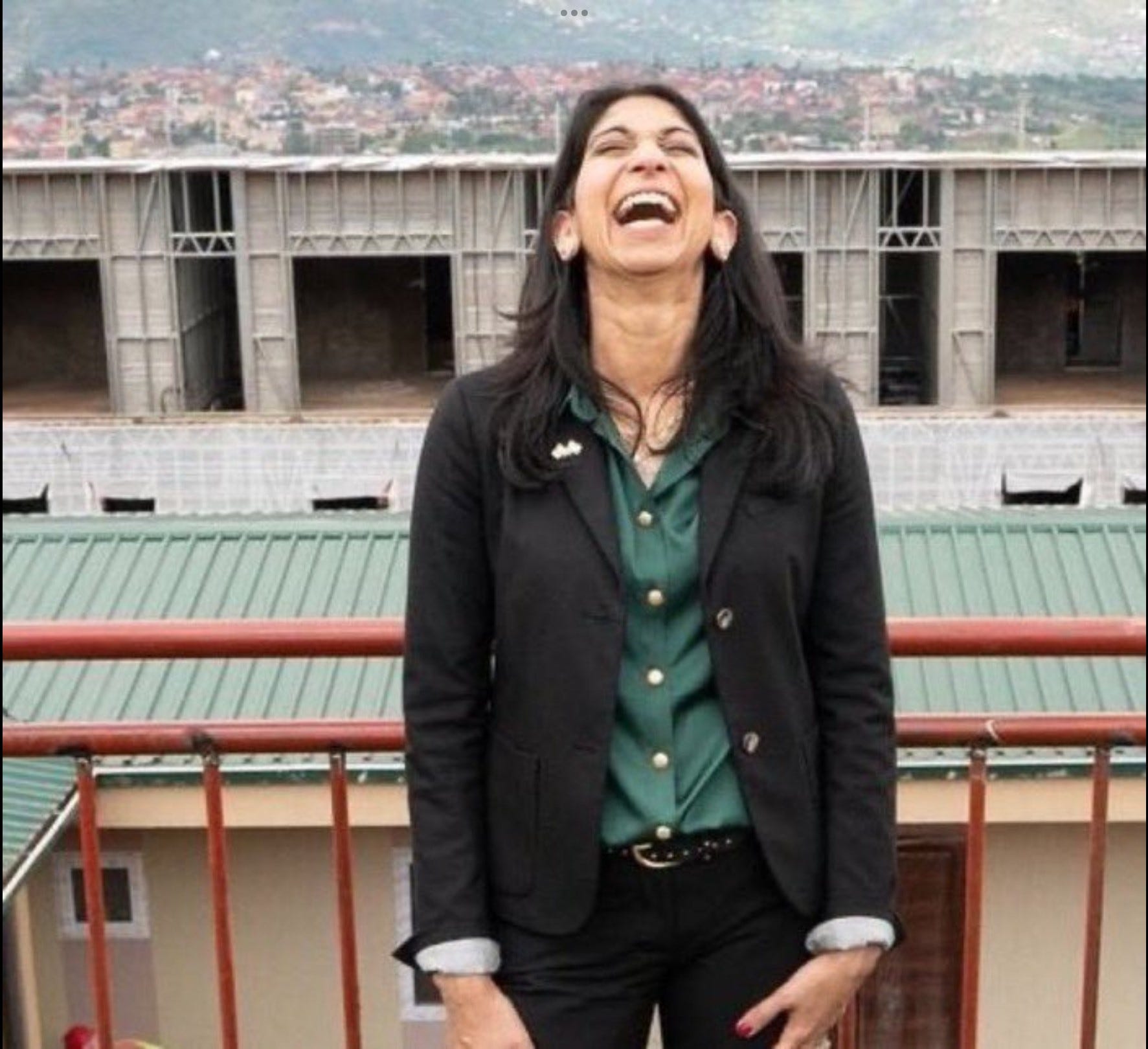
But now, hurrah! We finally have a government so contemptuous of the very concept of human rights that the Home Secretary is prepared to have herself photographed letting out an affected - or should it be infected - joyful laugh, while standing in front of a detention centre in Rwanda, in front of a carefully-picked selection of very rightwing journalist/courtiers who lap this kind of thing up.
I’ve often thought about that picture, travelling through Argentina these last few weeks, because this is a country where human rights really do matter. What human rights? you ask. Well the right not to be held without trial by the state security forces for one - or ‘held at the disposition of the national executive power’, as the 1976-83 military dictatorship used to put it, on the rare occasions when it admitted to holding anyone at all.
Then there is the right not to be ‘disappeared’ by the same security forces. Or the right not to be tortured. Or the right to a trial for whatever crimes one might have been accused of.
In Argentina, all these rights were massively violated by the military government that ruled the country from 1976-83, and you can’t go far without being reminded of these violations. Argentina is probably the only country in the world where you can find a barracks, with a large sign identifying it as a centre for clandestine detention, torture, and murder.
I saw this in the city of Neuquen, in northern Patagonia, and there are many other signs like it across the country, drawing attention to ‘little schools’ and detention centres where tens of thousands of people died at the hands of their own government, in addition to other monuments and ‘Spaces of Remembrance’ for the people who disappeared at the hands of the military.
In La Plata I saw faces of the high school students murdered by the military in September 1976 because they had the temerity to campaign against an increase in bus fares, painted on the walls of the local arts college.

In the central square in San Carlos de Bariloche, dozens of headscarves commemorating the Mothers of the Plaza de Mayo are painted on the ground along with the names of victims of the dictatorship.
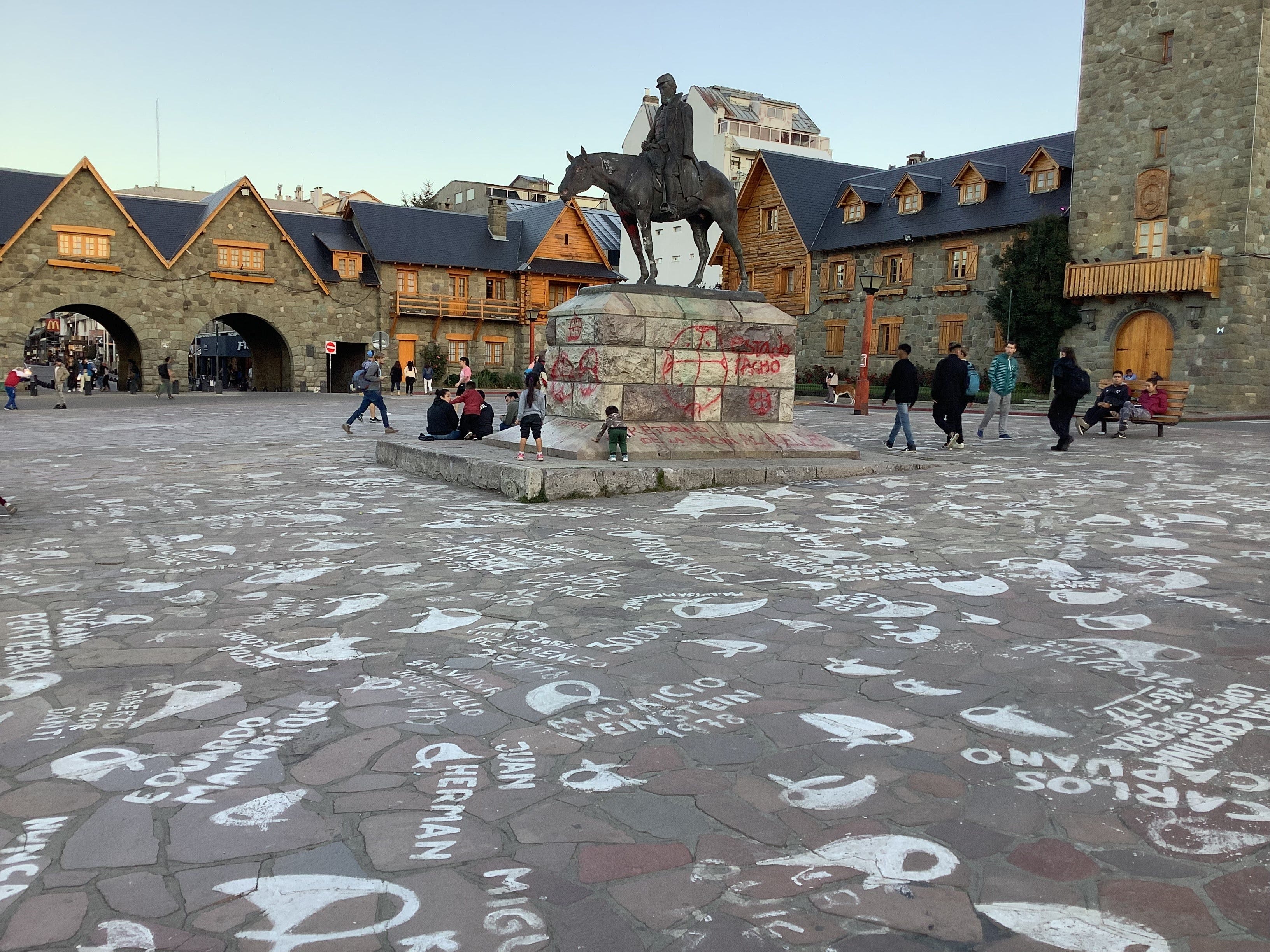
These memorials have been hard-won. The army barracks in Neuquén did not want a sign outside their base identifying their predecessors as murderers and torturers. The fact that such things can happen is the result of years of painstaking and relentless campaigning by Argentinian human rights activists, politicians, and municipal authorities, who have refused to allow the crimes of the dictatorship to be forgotten, and tried to use the memory of those crimes to ensure that the slogan ‘never again’ becomes firmly implanted in the collective memory of the Argentine people.
It’s thanks to these efforts that every year, on March 24, Argentina commemorates the victims of the dictatorship on the anniversary of the 1976 coup, with a public ‘Day of Remembrance for Truth and Justice’.
Argentina, as the writer Marcelo Valko told me, is very unjust country, but it’s also a country that understands the value of human rights, and has learned in the most horrific way what can happen when they are taken away, and when every citizen becomes the potential victim of a predatory state operating without legal accountability.
This is a country where men and women were kidnapped in the streets by security forces who never admitted that they were doing any such thing; where their relatives were also ‘disappeared’ if they demanded to know what had happened to their loved ones; where ‘activist’ and ‘lefty’ lawyers were secretly killed if they invoked habeus corpus who tried to uphold the laws that their own government was secretly breaking.
At the height of its power, the Argentine dictatorship also mocked ‘human rights nonsense’ with an World Cup sportswashing campaign that used the slogan ‘Somos Argentinos y somos derechos’ (‘We are Argentines and we are right’) to counter the condemnations of Argentina’s human rights violations from Amnesty International and other international organisations.
So Argentina’s acts of remembrance are intended to ensure that the past is not forgotten or misremembered, and they also shape the way Argentina responds to the persistent injustices in the present. In most large cities and small towns, posters and murals call for justice for murdered women and trans people; for Mapuche activists shot by the military; for the young ‘peon’ Daniel Solano, who was kidnapped and murdered by the police in the town of Choele Choel in 2013 because he denounced the financial malpractices of his employers.
The last testament of General VidelaOf course there are those who don’t want to remember the past in this way. Last week, in the run up to the Day of Remembrance, Twitter was awash with tweets praising the military dictatorship and downplaying its crimes, or listing the bombings and assassinations carried out by leftwing ‘urban guerrilla’ organisations in the 1970s in an attempt to establish a spurious moral equivalence between the state and its opponents.
Some of these accounts have the same kind of profiles you find in the US or the UK: pro-Trump, pro-Bolsonaro, patriots etc. But some of it comes from people who were alive during the dictatorship, and still regard the trials of its leading protagonists as a travesty.
Nor are these criticisms of ‘human rights nonsense’ merely a social media phenomenon. During the recent presidency of Mauricio Macri, leading Argentine human rights organisations criticised the desprecio - contempt - for their work emanating from state institutions such as the Supreme Court, which voted to reduce the sentence for a man convicted in 2013 for kidnap and torture during the dictatorship. In the first year of his presidency, Macri called the human rights policies of his predecessor Christina Kirchner a ‘scam.’
To some extent these ‘wars of remembering’ are a specifically Argentinian response to the horrors of its all-too-recent history. In an interview in prison shortly five years before his death in 2013, the former general Rafael Videla looked back without regret at the crimes committed by his regime. At one point he told his interviewer
Let’s suppose for the sake of argument that there were seven thousand and eight thousand people who had to die in order to win the war against subversion; we couldn’t shoot them. Nor could we bring them to justice.
If these people who ‘had to die’ but could not be shot, Videla’s argument implied, then it was perfectly logical and even essential for the state to kill them in secret. The figure that Videla gave was a gross and deliberate understatement, which was echoed by many of the pro-dictatorship tweeters last week. And his logic is equally fallacious and dishonest.
It is not for a handful of generals to decide who ‘has to die’ and then kill them their own citizens in secret. It is entirely disingenuous to equate the crimes carried out by urban guerrilla groups with the crimes of a state that wilfully and deviously abandons the rule of law in order to be able to murder its own citizens for their real or imagined political views.
To suggest that organizations like the Montoneros are as guilty of ‘human rights violations’ as the regime that set out to annihilate an entire political generation, is twisted sophistry and cynicism of the kind that the right tends to specialise in - in Argentina and in many other countries.
And this is where we come back to Suella Braverman’s performative chortle, because she represents a government for cynicism and cruelty come naturally, and not only through their sordid willingness to tickle the bellies of the worst people in the country in order to save their own wretched political skins. If I mention the likes of Sunak, Gullis and Braverman in the same breath as Videla, it isn’t because I place them on the same level of depravity as the murderous inquisitors who once terrorised Argentina.
But in seeking to remove their Rwanda policy from international legal scrutiny, Braverman and Sunak, like Videla and his cohorts, are constructing - whether they realise it or not - a class of people that has no rights and no institutions to protect them. The refugees who may be sent to Rwanda may not be the disappeared. They are not being tortured or killed. But their ‘removal’ to Rwanda will transform them into non-people, for whom no government bears responsibility, not the countries they fled from or the country they appealed to for safety, or the country where Braverman posed for a laugh in front of a detention centre.
In removing them from legal scrutiny and the possibility of legal representation, the Sunak government is attempting to strip them of will rights that took many years to develop and recognise, which they will not be able to recover. This is what Sunak and his gurning ‘populists’ are doing, though it’s a moot point whether they fully understand the full consequences of what they are doing.
In seeking to evade their own obligations, they are withdrawing the UK from a set of legal and moral obligations developed by the ‘international community’ - with the help of Conservative British governments - in the wake of World War II, in response to the dictatorships of the 1930s.
The more enlightened members of these democracies recognised the need for new internationally-recognised legislation that could be invoked to protect individuals from the arbitrary power of the state not just on the basis of political rights pertaining to national citizenship, but to broader rights associated with a common humanity that both included and transcended what individual states might do, and which could not be solely dependent on the whims of individual governments.
By binding governments to international agreements, the architects of this new human-rights era attempted to ensure that ‘never again’ became a guiding principle. This is why the UN agreed on a Universal Declaration of Human Right. It’s why we got the Geneva Convention on Refugees, and the European Convention on Human Rights, and the institutions that - at least in theory - uphold the rights and obligations contained in these agreements.
It’s true that some of the countries that signed these agreements have not always observed them in practice, particularly during the wars of decolonisation, and have sometimes ignored violations by allied states for reasons of political expediency. But the underlying principles that dictated the ‘human rights era’ still represented a qualitatively hopeful and aspirational turn in international relations, and in our common understanding of the relationship between individuals and their national governments, and individuals who find themselves subjected to arbitrary state power beyond their borders.
Such principles do not become obsolete simply because Lynton Crosby had advised a collapsing government to transform ‘stopping the boats’ into a hot button issue, or because the likes of Jonathan Gullis and Lee Anderson want to save their seats. Yet here we are, in the swamp and sinking into it. And the fact that one of the leading architects of this new era is now walking away from the rights it once helped define, while chortling for clicks in front of the likes of GB News, is a testament to its ignorance as well as its moral vacuity.
And even if Braverman may not be Videla or Maseera, she is in its own way, an obscenity, whose stupidity and cruelty has received praise from fascist and extreme-right parties across Europe.
They don’t like this ‘human rights nonsense’ any more than the Argentine right does, or the likes of Richard Littlejohn and Jacob Rees-Mogg do. And the more they condemn it, the more it behoves all of us - left, right, and centre - who still believe in the universal principles that the post-war era once defined, to oppose these insidious attempts to lead the world into a new dark age, in a time when human rights are as essential as they were when they were first agreed upon.


March 23, 2023
Argentina: A Tale of Two Museums
In the late 19th century, Victorian-era scientists concocted and propagated a worldview in which ‘weaker’ or ‘inferior’ races were seen as the inevitable collateral damage of progress and modernity. Geologist, ethnologists, naturalists, and anthropologists all reinforced the morbid fatalism of these ‘dark vanishings’, as Patrick Brantlinger called them, in which ‘savage’ peoples were seen as predestined for extinction as a consequence of their inability to adapt to modern civilisation. Such disappearances might be lamented - up to a limited point - but more importantly, there were to be recorded and studied.
The more likely it was that a particular people was headed for extinction, the more valuable such peoples became as ethnological and anthropological ‘data’, or as pieces in a human origins puzzle that attempted to show lines of progress from ‘primitive’ to ‘civilised’ man, with the latter inevitably by occupied Europeans and their descendants. As European settlers and colonists pushed out into ‘empty’ lands across the globe, scientists and travellers followed in their wake, collating information about the customs, languages, and way of life of the peoples who were being marginalised, conquered, and displaced.
Some gathered physical ‘evidence’ of these disappearances, in the form of skulls and skeletons that could be studied and measured to prove this or that thesis, or exhibited in museums or personal collections as scientific trophies, whose value was increased by their rarity or their proximity to extinction. In some cases, human remains were robbed from indigenous tombs and burial grounds, or taken directly from the sites of battles and massacres.
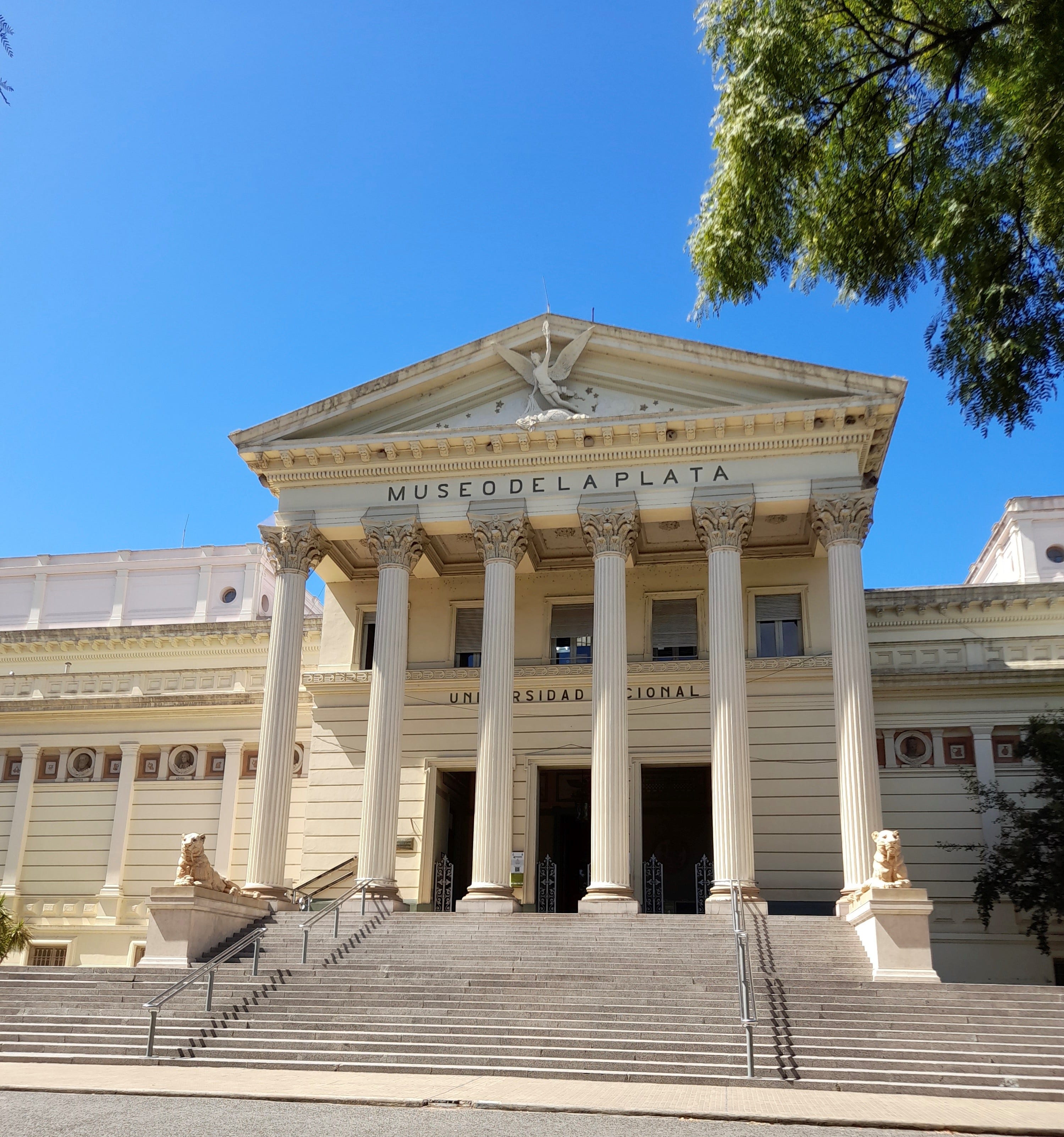
These tendencies reached an apotheosis of morbidity in Argentina, with the inauguration of the Museo de Ciencias Naturales (Museum of Natural Sciences) in La Plata in 1888. The museum was the brainchild of the well-connected Argentine naturalist and explorer Francisco ‘Perito’ (Clever or Learned) Moreno (1852-1919). An avid collector of paleontological animal and human objects since childhood, Moreno also took a keen and even obsessive interest in collecting the more recent remains of the indigenous peoples in his own country.
By the time construction on the La Plata museum began in 1881, Moreno had already acquired a huge collection of indigenous skulls and skeletal remains during his travels across the Pampas and Patagonia. Moreno was a peculiar character, who befriended Indians and sometimes sympathised with them, yet also fully embraced the extinction narratives of his peers in Argentina and abroad.
Even though some of his expeditions were made possible through safe conduct passes obtained from Indian caciques (chiefs), Moreno had no compunction about stealing the remains of people from Indian burial grounds, some of whom he had known when they were alive, and he sometimes seemed to be waiting for living people to die so that he could make off with their remains.
Moreno found no shortage of skulls and skeletons, at a time when the Patagonian and Pampean Indians were being decimated by smallpox and the southwards advance of the Argentinian military. Here, as was often the case in other countries, ‘extinction’ overlapped with ‘extermination’, as the Argentine armed forces cleared the Patagonian ‘desert’ for settlement by European immigrants and farmers.
At times, it’s difficult to determine whether Moreno’s motivation in acquiring these human remains was scientific or patriotic - insofar as science was seen as a means of acquiring national prestige for his country - or whether they were intended to advance his own personal reputation. Some Indian communities were aware of his interests and regarded him as a ghoul or malign spirit, and it is difficult to avoid the conclusion that they had a point.
Whatever his intentions, Moreno’s collection formed the basis of the museum’s exhibits when it was inaugurated in 1888. In addition to paleontological fauna, megatherium, dinosaurs and the like, the museum displayed the skulls and skeletons of Indians in glass showcases, who had died or been killed, with the names of high-profile caciques who Moreno regarded as notable trophies/exhibits.
In a grotesque twist on the extinction discourse of the period, Moreno even kept living Indians as exhibits, who lived in the basement of the museum. At least fifteen people were kept there, under Moreno’s aegis. Some of them helped clean the building or contributed to its construction. Others were expected to appear in public, weaving or sewing, in a variation of the ‘human zoos’ that were so popular in Europe at the time.
These Indians were painted and photographed. An Italian-Argentine sculptor took bronze casts of their heads. Some of them posed as subjects for the romanticised murals on the museum walls which show Indians living a life that their compatriots in the museum could no longer live, as a result of the Argentine army’s ‘Conquest of the Desert.’
‘Living exhibits’It is difficult to imagine what these ‘living exhibits’ must have felt living in these conditions. Bear in mind that most of them arrived at the museum as prisoners of war. Some had witnessed the violent destruction of their camps and settlements, the loss of their homes and the separation of their families. Others, like the cacique Inacayal, had been plucked from ‘deposits of Indians’ - essentially, concentration camps, and brought by Moreno to the museum:
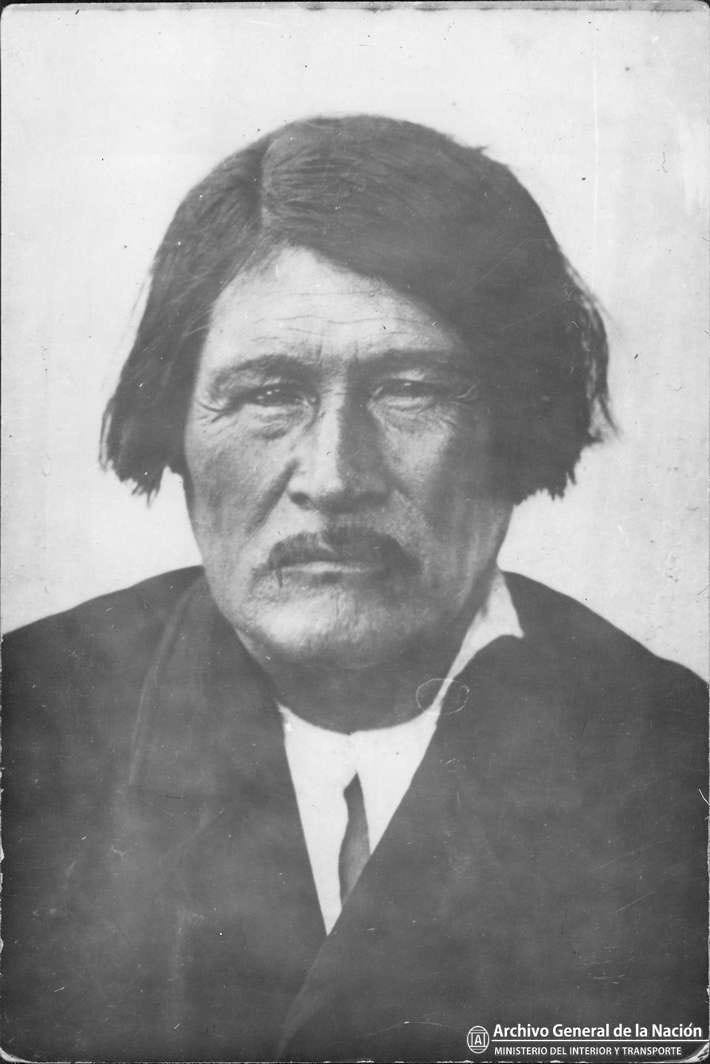
Inacayal, according to a Dutch anthropologist who worked at the museum at the time, was prone to angry rants about the lands and horses he had lost to the ‘huinca’ - white man. Other residents of the museum have left no written record of their time there, only their photographs, often accompanied by Bertillonage-style profiles which emphasise both their alien ‘otherness’ and their value as ‘data’ - the ‘last’ relics of indigenous Argentina vanquished on the battlefield and doomed to be replaced by waves of European immigration.
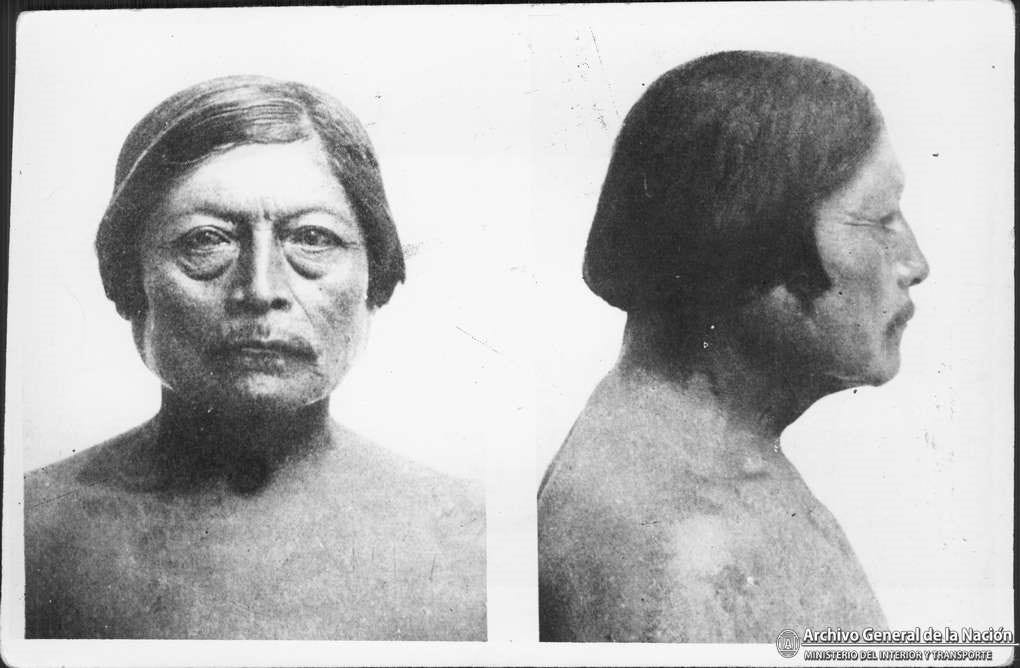

A few did manage to return to the lands they had been taken from. But others died in the museum basement, and their flesh was stripped from their bodies to provide new exhibits for Moreno’s display cabinets. When Inacayal died in 1888, his body was dissected, and various parts put on display.
Today the science that once stripped these men and women of their humanity and personhood has changed, and so have the political and cultural expectations from which these procedures emerged.
Since the early 1990s, the indigenous remains at La Plata have become the object of a powerful campaign for restitution, whose protagonists include the communities these men and women came from, anthropologists from the La Plata university, and human rights activists, all of whom reject the racial hierarchies that prevailed in Moreno’s time.
In 1994 the skull and bones of Inacayal were returned to his ancestral lands in the Patagonian province of Chubut, and given a ceremonial Mapuche burial. In 2014, his brain was returned to Chubut, together with other body parts and a poncho which he once gave to Moreno, following the 2006 National Law 25.517, which mandates the return of indigenous remains to the communities they came from.
Other restitutions have been completed, or remain pending. I went to the museum to discuss these processes with the museum director Dr Analia Lanteri and the head of Anthropology Dr Gustavo Barrientos.
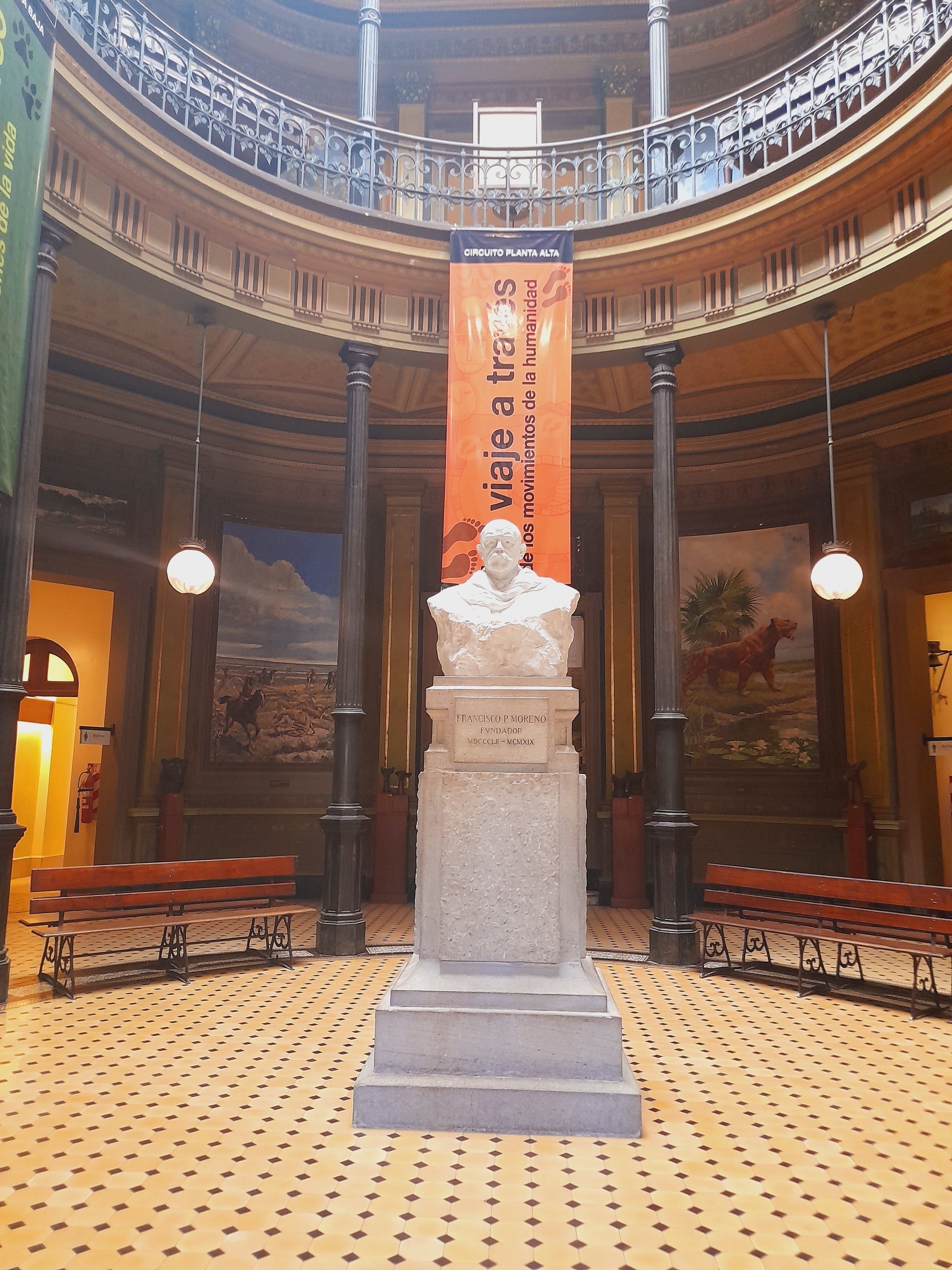
The museum itself is an incredible and imposing sight even today, with its great stone lions and neo-classical columns, and one can only imagine how it must have appeared in the late 19th century when La Plata barely existed. From the outside it looks like a temple, which is undoubtedly how Moreno and his fellow-Darwinians intended it. Inside it is equally impressive, from the bust of Moreno himself, which greets the visitor, against the background of the Indians he believed to be on the brink of extinction:
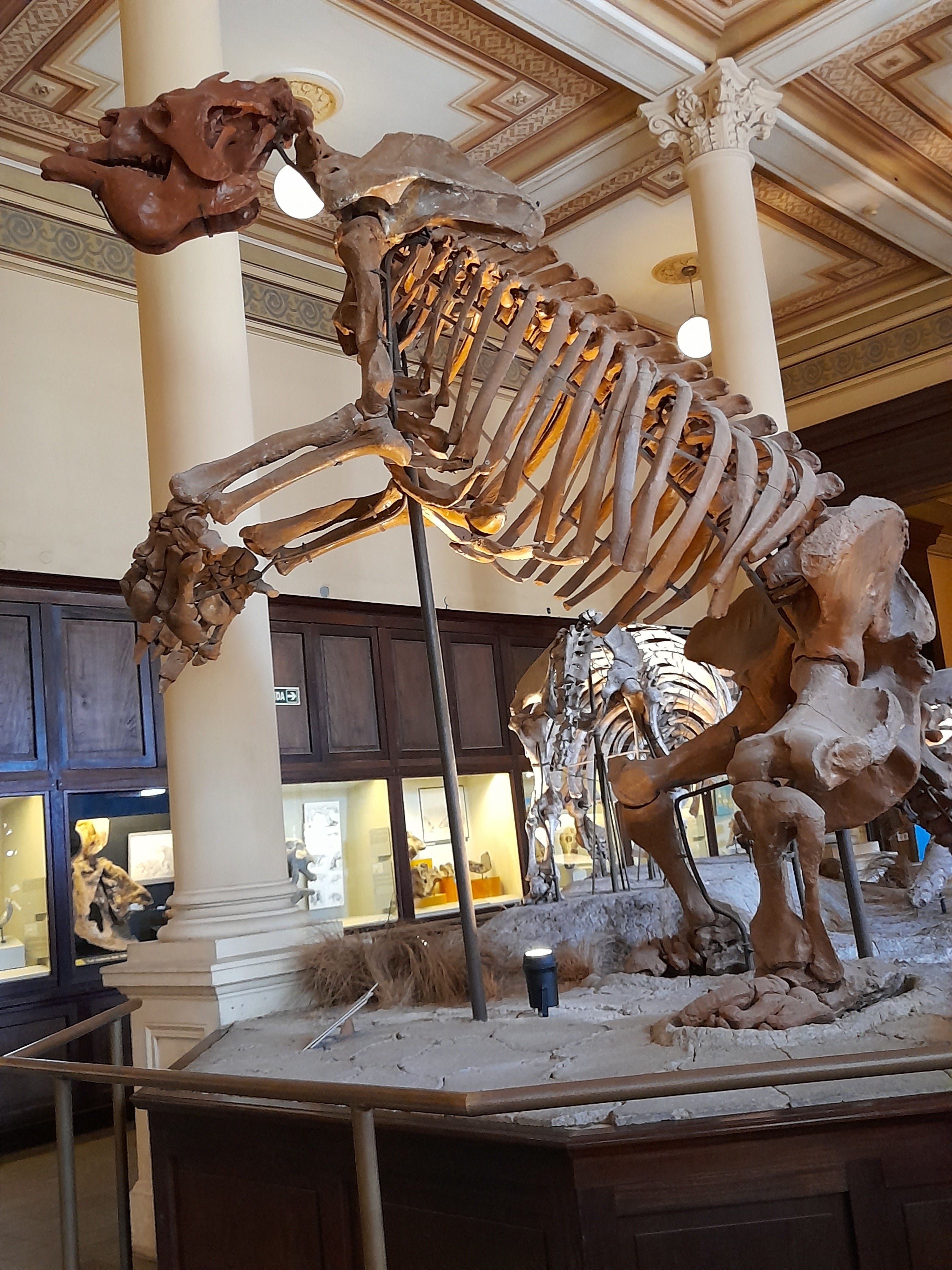
Or the awesome exhibits themselves, plucked from the Argentinian necropolis which once fascinated Darwin:

Today the displays of human skulls and skeletons that once accompanied these exhibits have long gone, and the museum’s ethnological section stresses cultural diversity, respect and survival in its indigenous exhibits. But the process of restitution raises all kinds of questions that I wanted to answer. What are the logistics involved? Who instigates the process of restitution? What are the legal norms through which this procedures are carried out? What takes precedence when new remains are found - science or the needs of communities? How has a museum with such a grim history adapted itself to the new ethical challenges of the 21st century and a new understanding of Argentina’s Pueblos Originarios (First Peoples).
These were some of the issues I discussed with Doctor Lanteri and Doctor Barrientos. Afterwards, I was allowed to see the basement where Inacayal and his fellow ‘prisoners of science’ lived out their last years.

I was shown the room where other indigenous remains are kept while awaiting decisions regarding their restitution. The restitution cases are kept in boxes with their names inscribed. They include the skull of Calfucurá, the ‘Napoleon of the Pampas’, which various indigenous communities have laid claim to, even though the museum’s scientists believe the skull belongs to someone much younger than he would have been.
It was an extraordinary moment, to see the names of caciques and Indians who I was already familiar with, on white boxes lined up on shelves in the basement where some of them had died, waiting to be returned to the places they came from. But the presence on those shelves also gives the lie to the expectations of Moreno and his peers. They are going back to their ancestral lands because their communities survived, and want them back.
In seeking to give them the dignity and the personhood that was once taken from them in the past, these communities are also looking for the respect, equality and humanity in the present that Moreno and his contemporaries were unable or unwilling to recognise. Clearly Argentina has changed, and science has changed too, but in a world where First Peoples from the Arctic to Tierra del Fuego are still fighting for recognition and survival, it is salutary to recall this dark and often forgotten chapter in the history of white supremacy, when scientists collected the remains of ‘savages’ as evidence of their inferiority and their imminent disappearance, and extinction was often a euphemism for extermination
Thanks for reading Matt Carr’s Infernal Machine! Subscribe for free to receive new posts and support my work.
Thanks for reading Matt Carr’s Infernal Machine! Subscribe for free to receive new posts and support my work.
March 16, 2023
Argentina: A Tale of Two Museums
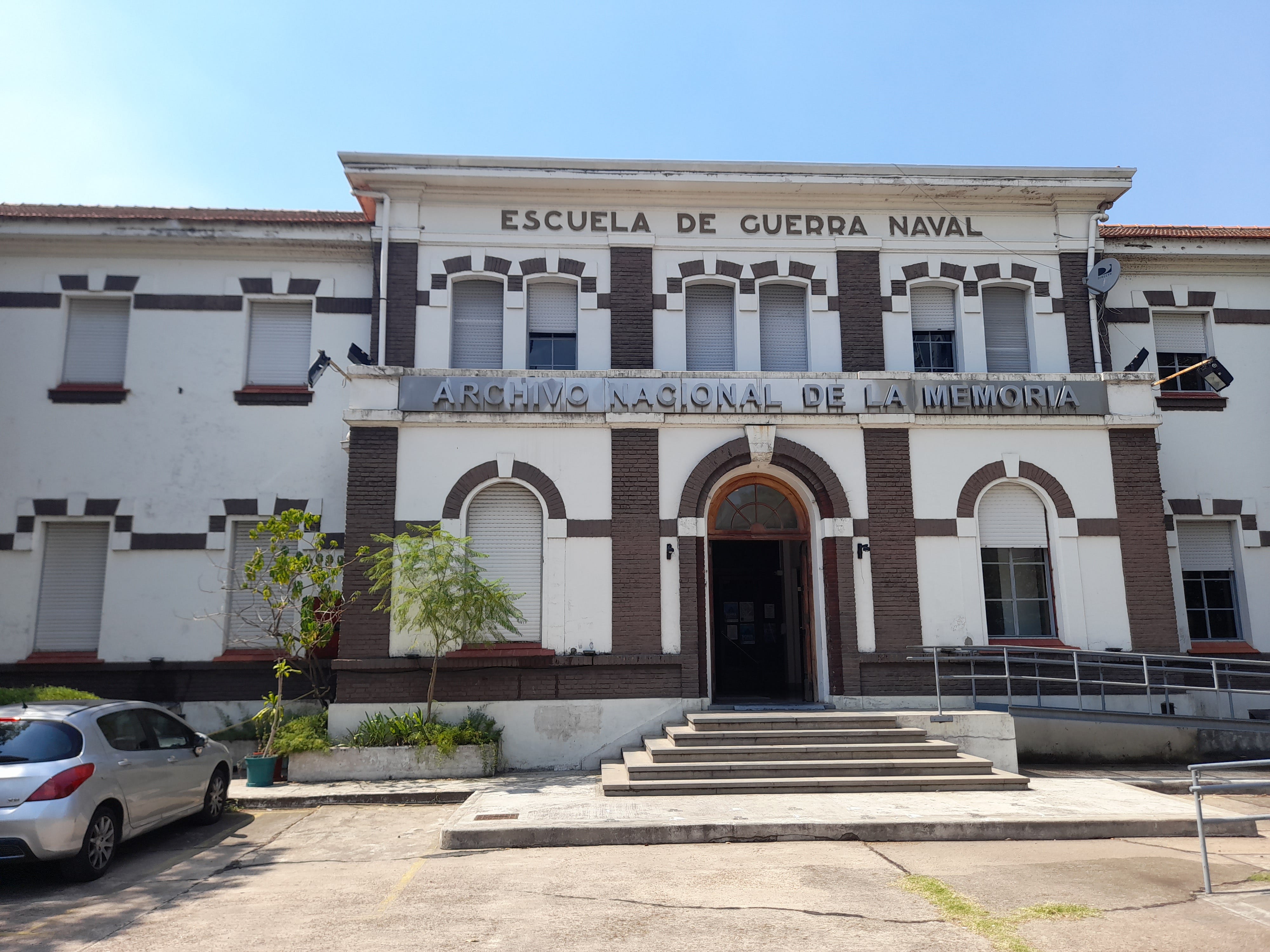
I’ve been in Argentina for two weeks now, and I’ve still got six weeks to go, so expect a few dispatches with an Argentinian/Patagonian/Chilean focus and flavour as I make my way southwards to Tierra del Fuego and back up to Buenos Aires.
One of the components of the book I’m compiling concerns museums, with an emphasis on the way that countries with ‘difficult’ histories remember or fail to remember the darker episodes in their past.
Argentina, as many readers will know, has had some very dark episodes to deal with, of which the most sinister and well-known is the 1976-1983 military dictatorship. I first wrote about the so-called ‘guerra sucia’ - dirty war - or ‘Process of National Reorganisation’, as the Argentine generals put it, in my book The Infernal Machine: An Alternative History of Terrorism.
This ‘war’ has come under new international scrutiny recently, as a result of the Oscar-nominated Argentina, 1985, and the documentary El Juicio (the trial). As a result of the former film in particular, audiences who know little about Argentine history have become familiar with the secret program of torture and mass murder waged by the Argentine security services against a plethora of leftwing ‘urban guerrilla’ groups, and anyone else perceived to be a critic of the regime. An estimated 30,000 people were murdered and/or ‘disappeared’ during the ‘Process of National Reorganisation’, as the military called it, in one of the cruellest and most pitiless programs of state terror ever in history.
The epicentre of this lawless machinery of extermination was a cluster of posh white buildings known as the Escuela Mecánica de la Armada (Navy Mechanical School), known as the ESMA. Originally created just after World War I as a technical training and passing out centre for Argentine naval officers, the ESMA became the most prolific of all the Argentine military’s secret archipelago of torture and murder centres.
Some 5,000 people were tortured and detained here before being ‘transferred’ - a euphemism for execution that could include being drugged and thrown in batches and thrown from helicopters, or shot and buried in a clandestine grave. Today the ESMA is a museum and a ‘Space of Memory and Human Rights.’
Photographs of the men and women - most of them young - who were taken there, cover a glass wall leading to the officers’ casino where detainees were ‘sucked up’. Their faces stare back from display boards in the gardens, accompanied by brief but moving biographies. Most of them are young, and whatever their political affiliations, none of them deserved the awful treatment meted out by a regime that regarded them as ‘enemies of Western civilisation’ who had lost their right to be treated as human beings.
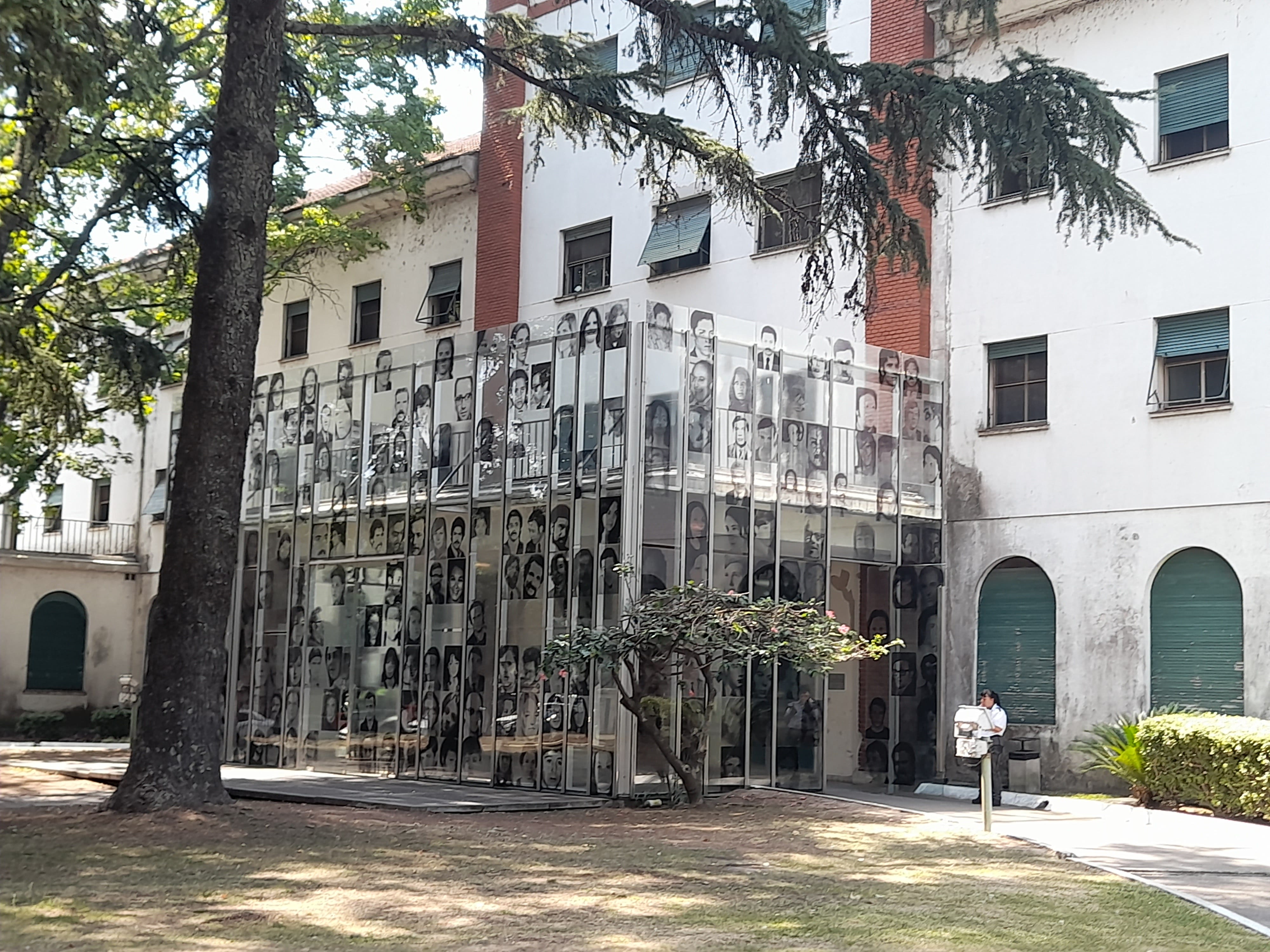
I knew about the ESMA from my previous readings. I knew pregnant women were kept there until their babies were delivered, after which their mothers were ‘transferred.’ I knew that Admiral Emilio Massera - a genuinely evil insult to humanity with a penchant for murder and pompous pseudo-intellectual pontification - organized a ‘press unit’ inside the ESMA, in which the prisoners his officers had tortured were forced to churn out political propaganda in order to live a little longer.
I knew that Alfredo Astiz, the naval officer known as the ‘Blond Angel of Death’ was a member of an ESMA task force when he shot a young Swedish girl in the back during a botched raid before taking her back to the ESMA, where she was killed in order to avoid embarrassment. Astiz and infiltrated the Mothers of the Plaza de Mayo and subsequently kidnapped 12 people connected with the group, including two French nuns who were taken to the ESMA and never seen again.
Nevertheless it was a sombre and dispiriting experience to wonder through the pristine white stone buildings, and contemplate the actual physical spaces where these atrocities had occurred. The ESMA is located in an upmarket district of Buenos Aires on the Avenida del Libertador, just up the road from the hockey pitches and sports facilities of the Club Ciudad de Buenos Aires.
On a searingly hot autumn morning, the white buildings looked dazzling and pristine, and apart from the sentry towers where the task forces had to give the password when they came back at night with their hooded prisoners, there is no obvious sign that the complex ever had a military purpose, let alone that the actual purposes to which it was put during the dictatorship.
The museum has gone to some lengths to explain exactly what it was used for. You can see the little room where pregnant women were kept in chains, waiting to give birth, after which they were killed. You can seen the room where navy officers played billiards, Andy the basement where prisoners were injected with tranquilisers before being taken out naked to helicopters or planes.
A young museum attendant guided us to the attic where detainees were kept hooded for months and even years, where a guard once allowed prisoners to take off their hoods for King’s Night. For a few hours the prisoners laughed, joked and talked about the King’s Nights they remembered from their childhood before the hoods were returned.
Such small gestures of humanity were rare at the ESMA. We saw the car park where the task forces parked the Ford Falcons they used to ‘chupar’ (suck up) their victims. A glass plaque bears the journalist and Montonero activist Rodolfo Walsh’s famous 1977 letter denouncing the crimes of the regime, which was sent out across the world, a desperate message in a bottle which only intensified the military’s determination to kill the man responsible.
In 27 March 1977 Walsh was cut down in a hail of machine gun fire, gun in hand, when a task force caught him posting letters in Buenos Aires, not far from the district where his daughter Vicky - also a Montonera - had shot herself six months earlier rather than surrender to the soldiers who surrounded their safe house.
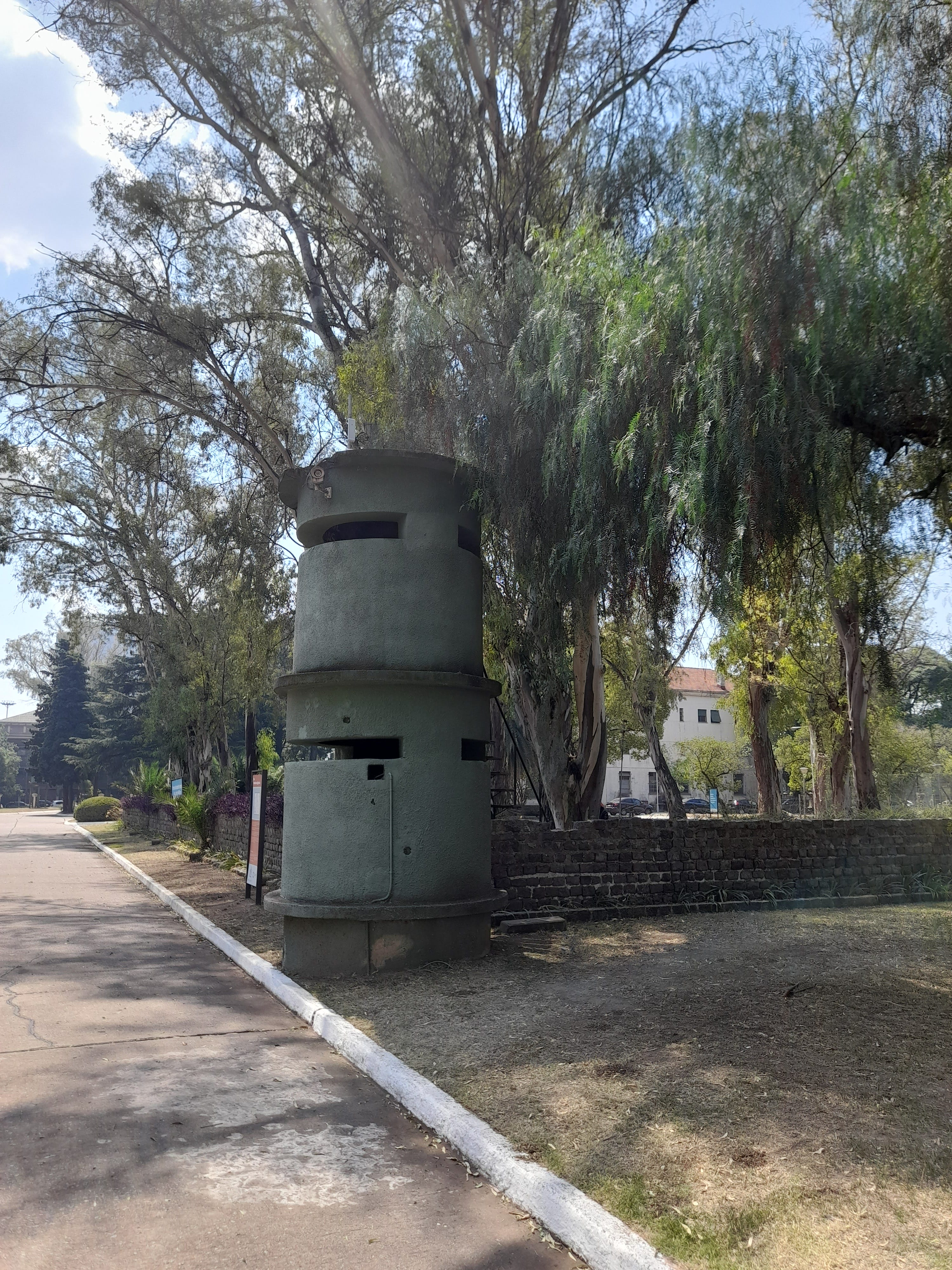
Had they been captured, Walsh and his daughter would have ended up here, in the former officers’ casino where prisoners were tortured and sent to their deaths. It’s startling to see how close these facilities were to the sleeping quarters and offices of the task force commanders who presided over this machinery of extermination.

The director of the ESMA, Admiral Rubén Chamorro, even had his family home next in some rooms in the casino. It’s about two minutes walk from the basement where prisoners were being tortured, to the parquet floors of the living quarters where Chamorro invited friends and relatives for barbecues at the weekends.

Such horrors strain credulity, just as Nazi concentration camps once tested the imaginations of those who entered and liberated their camps. The ESMA belongs to that same tradition of radical political evil, in which concentration camp officers can listen to classical music after a hard day’s work, and Auschwitz guards go on jolly group bonding weekends away to de-stress. At ESMA there was no liberation, and considering the scale of the crimes against humanity that took place there, very little punishment.
How could such things have happened? Why did a modern state that considered itself to be civilised and moral turn into Cronus and eat its young in the last decades of the twentieth century? Why do sordid, cowardly little murderers like Alfredo Astiz still insist that they were ‘defending the fatherland’ by killing nuns and teenagers? How could thousands of Argentine soldiers, naval officers and policemen have convinced themselves that it was legitimate and even necessary to annihilate an entire political generation?
The museum’s organisers have tried to answer these questions. You can watch taped extracts from the trials of the leading generals, and read quotes from detainees and former soldiers and naval officers, and an Argentinian cleric Catholic Church, who described throwing drugged prisoners out planes and helicopters as a ‘Christian’ way of eliminating the enemy according to the Bible.
It’s easy - and convenient - to attribute such acts to ‘Hispanic cruelty’, as the Cold War spook and ‘terrorism expert Brian Crozier once did. Argentine history is certainly not short on episodes of cruelty or injustice, whether in the civil wars that followed Independence, the regime of General Rosas, the wars waged against Argentina’s indigenous peoples or the massacres of Patagonian strikers and Chaco indigenous peoples in the 1920s.
But essentialising the Argentine people or Argentina as a nation doesn’t take us very far. It’s true that Argentina’s rulers, historically, have tended to respond to internal threats and political or social challenges from their underlings with extreme violence. It’s also true that the Argentinian armed forces - conveniently - conceptualised a fairly motley and occasional assembly of armed leftwing/Peronist guerrillas as a moral and civilisational ‘other.’
Algeria and the ‘French School’The methods adopted by the dictatorship and put into practice at the ESMA were not Argentine inventions however. The Argentine generals took inspiration from the ‘French school’ of counterinsurgency doctrine, which supposedly ‘reverse engineered’ Maoist/Leninist concepts of revolutionary war, so that the whole of society became a battleground against an invisible communist enemy against whom all methods were legitimate.
In this ‘war’, torture was simultaneously a means of obtaining specific intelligence information, a punishment, and an unspoken ‘phantom terror’ that paralysed and cowed Argentine society into obedience and submission. Torture made it possible to unlock the connections that held underground revolutionary organisations. By executing them without trial and in secret, the state was able to destroy its enemies and critics without every being bound by legal or moral norms, and without even acknowledging responsibility.
This is what the ‘gentlemen of the sea’ who worked at the ESMA set out to do, with terrifying efficiency. I was intrigued to see a quote on one of the information boards at the ESMA from a former naval officer, who describes how he and his peers were shown The Battle of Algiers as part of their training before the dictatorship came to power, and told that they should emulate the methods used by French paratroopers in Algiers: secret detention/torture/disappearances, and official silence.
So much for ‘Hispanic’ cruelty. This particular officer refused, and was kicked out of the navy as a result. Many of his colleagues did not, and went on to refine the methods taught to them by the French, and fully imbibed the US ‘National Security Doctrine’, which placed ‘national security’ above all other concerns in its response the armed urban guerrilla groups and the social movements they were connected to.
Having convinced themselves that they were at war with an internal enemy linked to a vast international conspiracy, these officers granted themselves carte blanche. Of course, such doctrines are always going to be appealing to certain individuals. Many task force commanders, including Massera himself, made money by stealing the possessions of their victims and even selling their flats and houses - or their children.
A lot of the violence at the ESMA was gendered violence directed against women, which always took very particular forms, whether it was rape or the grotesque practice by which some torturers instructed their female prisoners on how to wear make up and took them out on ‘dates’. A touring exhibition on the treatment of women in the ESMA, organised in association with the InteramericanHuman Rights Commision is currently touring Latin and North America. It demonstrates once again that these noble Cold War who dirtied their hands in the name of the patria weren’t as noble as they claimed to be, whatever fantasies they used to justify their grotesque and monstrous acts.
They were rapists, sadists, and murderers, who abandoned their own humanity even as they denied humanity to others. And if the museum teaches us anything, it is that under certain conditions, for example, in the toxic hothouse of a fascistic regime consumed by hatred and paranoia, human beings can be made or persuaded to commit any crime required of them, and the darkness that is mostly submerged in everyday society can be brought to the surface and unleashed with terrifying consequences. When I was there, the museum was holding a temporary exhibition, looking at the similarities between the ESMA and Robben Island during apartheid. In the past it has held exhibitions making connections between the ‘disappeared’ and the treatment of Argentina’s indigenous peoples.
The museum also contains a cultural centre in honour of the murdered writer Haroldo Conti who was last seen in the ESMA. Here you can read texts from Conti and some of the Argentinian writers who tried to imagine a way out of the nightmare of their country’s history.
Most of the museum staff are as young as the ‘terrorists’ who were brought here to be murdered. They were friendly and engaging, and clearly proud of the work they were doing, like the young researchers in Argentina, 1985.
Their presence brings light and hope to this place of darkness, and points towards an Argentinian present that is already very different to the madness that engulfed their country in the 1970s. And so does the building named after the writer whose gentle, bespectacled face adorned its walls. Conti was ‘sucked up’ coming back from the cinema with his wife, and there was no better tribute to this writer who loved rivers and water, than to turn the institution that had killed him into in a space where visitors can listen to poetry and music, dance, meet and talk, and hold the conversations we all need to have, in whatever country we come from, if the brittle crust of civilisation is to be preserved, and humanity can go forward without slipping into barbarism.
March 9, 2023
Kamel Daoud and the Rape of Europe

Following last week’s post about the 2015 sex attacks in Cologne, I’m recycling another post on the same subject that I wrote a month later, critiquing the brilliant Algerian writer Kamel Daoud’s controversial take on those events.
I’m a big fan of the Algerian novelist Kamel Daoud’s The Meursault Investigation, which I read last year. It’s a stunning deconstruction of L’Etranger, which brilliantly imagines the voice of the Arab colonial subject that was missing from the Camus’s novel. In doing so, it invites Camus’s readers to re-think the essential assumptions of a novel generally considered to a triumphant expression of 20th century humanism, and exposes the narrow prism through which Camus viewed colonial Algerian society, and which reduced its non-French members to props and bystanders in a supposedly universal existential fable.
The result is a combination of homage/critique and an essential companion piece to Camus’s classic, which fuses a profound meditation on the impact of French colonialism and French culture on Algerian society with an equally unsparing overview of the failings of post-colonial Algerian history, from the War of Independence to the Islamist surge of the late 1980s and the bloody civil war that followed.
To have achieved all this in 160 pages is no mean feat. It’s fearless, moving, and audacious. All the more disappointing therefore, to read Daoud’s response to the Cologne sex attacks in the New York Times last week entitled ‘The Sexual Misery of the Arab World.’
To say that Daoud’s article is not helpful doesn’t really begin to describe it. Where The Mersault Investigation challenged prejudices and received ideas, Daoud’s take on the Cologne attacks reinforces clichés, stereotypes and assumptions that routinely emanate from people far less intelligent than he is.
The ‘Arab Sickness’Daoud’s essential premise is that the attacks on Western women by Arab migrants in Cologne, Germany, on New Year’s Eve were an extension of the assaults and harassment of women that took place in Cairo’s Tahrir Square during the heady days of the Egyptian revolution. In reminding Westerners of these assaults, Daoud argues, the events in Cologne have led people in the West to realize that one of the great miseries plaguing the Arab world, and the Muslim world more generally, is their ‘sick’ relationship with women.
Daoud rightly attacks the brutal absurdities resulting from fundamentalist sexual repression in Algeria and other Arab countries, and the morbid obsession with female sexual behaviour at the heart of it. But his notion that what happened in Cologne was a product of a uniquely Arab sexual pathology seems oblivious and even indifferent to what actually took place, or to the utterly spurious interpretations placed on the horrific events of New Year’s Eve by commentators who had no interest in establishing what actually happened that night.
When news of the Cologne attacks first broke, they were initially blamed on refugees, and on Syrian refugees in particular. Across Europe Cologne was cited by the far-right as evidence of the cultural and civilizational incompatibility of Europe’s refugees, or the product of ‘Arab’ or ‘Muslim’ savagery.
In newspaper op eds, on Twitter and across the Internet, the outrage at the treatment of ‘our’ women was often combined with a gleeful we-told-you-so condemnation of Europe’s ‘bleeding heart’ liberals, who had supposedly led these savages into the metropolis only to be hoist by their own petard.
In some European cities, this outrage spilled into perverse acts of ‘chivalry’, in which fascists and motorcycle gangs established vigilante groups to defend European womanhood by attacking anyone who looked like a refugee.
The Cologne attacks also produced a special kind of 'cultural commentary, such as this ‘satirical’ image from Charlie Hebdo:
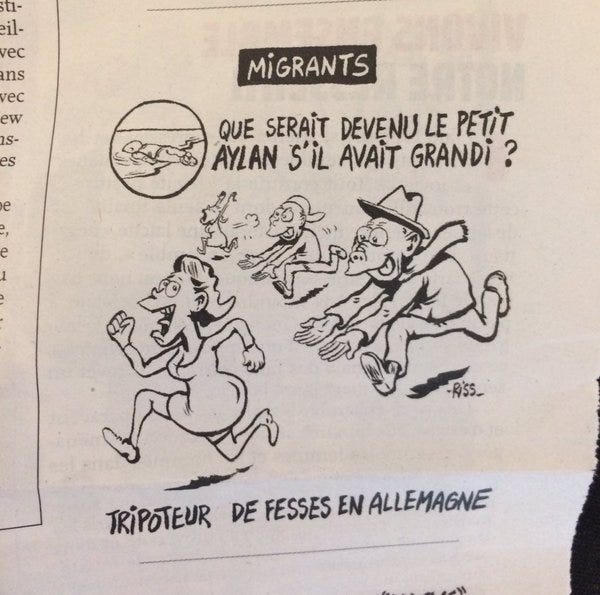
In some German cities local authorities handed out leaflets informing refugees how women should be properly treated. I suspect that the men who carried out the attacks in Cologne know perfectly well how women should be treated – they simply chose to ignore these norms, as some men will do pretty much anywhere when they get the chance.
Daoud however, sees these events as a product of a unique and explosive collision between the repressed and forbidden desires of the Middle East and the continual orgy that takes place in the liberated West. Why? Because
Paradise and its virgins are a pet topic of Muslim preachers, who present these otherworldly delights as rewards to those who dwell in the lands of sexual misery. Dreaming about such prospects, suicide bombers surrender to a terrifying, surrealistic logic: The path to orgasm runs through death, not love.
Of course it does. And Daoud also seems to believe that the path to orgasm runs through Cologne Central Station. Never mind that Cologne was not quite what it seemed to be, let alone what it was portrayed as being.
According to the Cologne public prosecutor, only three of the 58 suspects arrested in connection with these attacks were refugees. In addition, 600 out of 1000 reported incidents that took place in Cologne on New Year’s Eve were related to theft, and were not sexual attacks. That still leaves 400 incidents that were sexually-related, so we are still dealing with a major incident of sexual violence and harassment perpetrated mostly by men of Middle Eastern or North African origin.
But that does not support Daoud’s crass notion of a cultural and civilisational clash that comes straight out of the counterjihadist playbook:
… today with the latest influx of migrants from the Middle East and Africa, the pathological relationship that some Arab countries have with women is bursting onto the scene in Europe. What long seemed like the foreign spectacles of faraway places now feels like a clash of cultures playing out on the West’s very soil. Differences once defused by distance and a sense of superiority have become an imminent threat. People in the West are discovering, with anxiety and fear, that sex in the Muslim world is sick, and that the disease is spreading to their own lands.
Tommy Robinson and Pegida couldn’t have put it better. Neither they – nor Daoud – seem to care that this ‘disease’ was already present before the refugee hordes came here. As I’ve argued in a previous piece, women have been subjected to sexual harassment, rape and the threat of rape in liberated Europe for a long time. Many women in Europe continue to experience ‘anxiety and fear’ at the hands of men on a daily basis. German women are regularly assaulted at the Munich beer festival, amongst other events, yet such things only ever seem to become politically important when Arabs or Muslims are responsible.
Thanks for reading Matt Carr’s Infernal Machine! Subscribe for free to receive new posts and support my work.
Daoud’s intervention is no exception. He notes that ‘ The West has long found comfort in exoticism, which exonerates differences’, yet he himself merely reinforces spurious notions of cultural difference and incompatibility that are already reflected in magazine covers like this one:

That cover ‘exonerates differences’ alright, even as it references long-established cultural tropes about white women being sexually molested by brown-skinned savages as a kind of metaphor for the ‘Islamic rape of Europe.’ Daoud seems uninterested in why such things happen.
Where the likes of wSIECI have used the Cologne attacks to recycle racist imagery, he has used these attacks to support the notion of a cultural clash between a ‘sick’ Arab world and a sexually-liberated West.
It’s shallow, crude, and dangerous stuff. In The Meursault Investigation Daoud was an unsparing critic of colonial and post-colonial Algeria. Here he acts like the classic ‘native informant’, telling a Western audience what too many of its members already like to believe about themselves – and about the others who can never be like them.
March 2, 2023
The Knights of Cologne
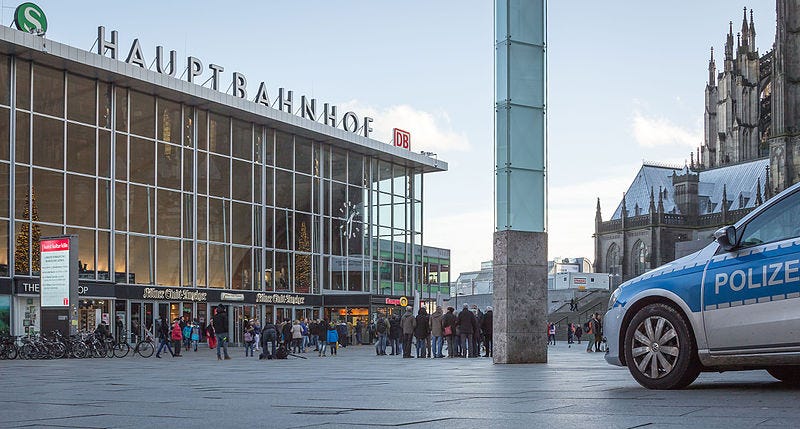
I’m abroad and on the road in South America at the moment, for reasons that will be explained in a future post. So I will be writing when I can. At a time when the rights of ‘our’ women are once again being used by the far right as a justification for terrorising asylum-seekers across the UK, I’m recycling an older blog post from January 2016, when very similar arguments were used in response to the horrific events that took place in Cologne.
No one should be surprised that the same essentialist arguments and accusations are still being used now against asylum seekers, in some cases by the same people who used them then, because these arguments have been around for a long time, and with the far-right and their ‘patriot’ cohorts, it’s always deja vu all over again
As a sixty-year-old man, I obviously can’t speak with much authority on what it’s like to be a young woman in Europe. Nevertheless I am the parent of a twenty-year-old daughter who likes to go out at night. Recently she told me how she was at a club when a stranger propositioned her. When she responded that she had a boyfriend, this fine upstanding specimen of twenty-first century manhood ordered her to kiss her boyfriend to prove it.
My daughter rejected these orders too, on the not unreasonable grounds that she didn’t have to prove who she ‘belonged’ to any man, let alone a complete stranger. This episode was one of countless similar incidents that she and her friends have experienced ever since she started going out. Over the years I have become accustomed to stories of her visits to clubs and pubs where men routinely grope and sexually bully young women with an alarming sense of entitlement.
Contrary to accepted wisdom in certain quarters, such behaviour is not limited to any particular age, nationality, culture or ethnic group. It includes the middle-aged Spanish men who somehow managed to infiltrate the Benicassim festival and ground themselves up against my daughter and her dancing friends when she was seventeen, and the middle-aged Italian who harassed her and a friend in a Genoa park when she was eighteen.
So my daughter, like so many young women, has learned to live with such behaviour. She knows that it is not safe to be on the streets unaccompanied at night in any European city, because a woman can be attacked anywhere and by anyone.
A YouGov survey for the End Violence Against Women Coalition found that 43 percent of women aged 18-24 were sexually harassed in public places in 2012, including girls as young as 12. According to Rape Crisis, 85,000 women were raped in the UK last year.
Today, in the early twenty-first century, violence, harassment and the sexual intimidation of women is as common as it was when the first wave of feminists began to challenge it with the ‘reclaim the night’ marches of the early 70s.
To point out that such behaviour is routine and even universal does not mean that it is acceptable, or that it should be treated as an inevitable expression of masculinity. When men behave like this, society needs to find ways to make them stop and ensure that women can feel safe from sexual violence and intimidation wherever they are.
Needless to say, that is not the debate that we have been having since the grim events that unfolded in Cologne on New Year’s Eve. The reports of what took place that night have been confused and contradictory. Nevertheless it is now clear that hundreds of mostly MENA-region men embarked on a drunken and semi-organized spree of robbery and rampant sexual violence, in which hundreds of women at the city’s train station were terrorised and assaulted, while the local police apparently stood by and did nothing about it.
This brutal and deeply depressing episode has acted as a wake-up call to chivalrous warriors across the continent, who have ridden out on their white steeds like modern-day Galahads and Lancelots to defend the flower of European womanhood from the infidel hordes.
They include men like Tommy Robinson, who flew in to a Pegida rally to tell protesters that ‘Islam is a cancer and Pegida is the cure’ and that ‘it is our God-given right and duty to protect our women. It’s what men do.’
And the group of ‘bikers, hooligans, and bouncers’ who organized a ‘human hunt’ in Cologne three days ago beating up any ‘foreigner’ they could find in order to ‘clean up the city’, because naturally the only logical response when ‘our’ women are attacked is to go out and beat up any dark-skinned man who may or may not be a ‘foreigner.’
Thanks for reading Matt Carr’s Infernal Machine! Subscribe for free to receive new posts and support my work.
And then there is Nigel ‘I’ve got so many women pregnant over the years’ Farage, who has linked the Cologne attacks to the ‘refugee crisis’ and said that we need to uphold ‘our values’ and prevent more of them from coming to Europe. And the Slovak Prime Minister Robert Fico, who has cited the Cologne attacks as evidence that ‘multiculturalism has failed’ and declared that ‘the migrants cannot be integrated. It’s impossible’.
Elsewhere men have been pouring forth their rage on comments columns, and Internet websites, such as “Hans-Werner Link” who wrote on Facebook: ‘Where were the girls screaming welcome this time? Those whores would certainly have loved to have their crotches or tits grabbed by countless hands.’
Noble sentiments, and the women of Europe can only be thankful they have champions like this to fight for them. There is a lot more where this came from. No one can be surprised that this horrific episode has been seized upon by the European right and far-right, because this is what always happens.
Just as paedophilia only becomes a ‘cultural’ problem when it is associated with ‘Muslim grooming gangs’, it seems that sexual violence against women is only significant when it can be blamed on the barbarian ‘sex mobs’ who are targeting ‘our’ women - and linked to a supposedly politically-correct liberal establishment intent on facilitating and protecting such behaviour.
Does this mean that the horrific events in Cologne should be minimized or downplayed? No. The men who carried out those attacks clearly regarded German women as fair game and somehow deserving of such treatment. It also seems clear that some of the perpetrators were asylum seekers, including Syrians. This shouldn’t be entirely surprising. Just because men have fled war zones to escape death or persecution doesn’t make them innately virtuous, and just because you have been a victim of oppression and violence does not mean that you become purged of unreconstructed sexism.
Refugees who come to Europe with attitudes like these will have to learn to think and behave differently, and when they break the law they should be punished according to the law. But the same expectations should be placed on all men.
The outrageous thuggery of hundreds of Middle Eastern or North African men, some of whom may have been recently-arrived migrants and asylum seekers, does not signify the ‘death of multiculturalism’, except in the minds of people who never wanted a multicultural Europe in the first place.
Let’s not allow ourselves to deluded into an us-and-them fantasy that presents sexual harassment as a uniquely Muslim, North African or Middle Eastern trait, and depicts asylum seekers as some kind of Trojan horse for ‘sex mobs’ and ‘rape gangs’ to enter Europe.
According to UNHCR, 49 percent of refugees worldwide are women, many of whom have been subjected to far worse sexual violence than what was seen in Cologne. The knights of Cologne who are buckling on their swords to defend Europe’s women would like to exclude and deport them too.
They would, in fact, like to exclude and deport all the migrants and refugees who have come to Europe if they could, and the Cologne ‘sex mob’ is just one more pretext and justification for doing that.
So let’s be angry at what happened on New Year’s Eve. But let’s not allow crucial issues of sexual violence and harassment to be hijacked and instrumentalized by the likes of Robinson and Fico and so many others, who only seem to be concerned with women’s rights in order to fuel the toxic hatred of the Muslim/Arab Other that is coursing through Europe right now.
February 23, 2023
Are We Stupid Yet?

One of the fundamental principles underpinning modern liberal democracies is the idea that politics is a rational activity, in which voters make choices based on arguments, explanations, and a basic understanding of reality to which we all subscribe to, regardless of our individual affiliations.
This principle applies to all voters, regardless of their IQ or their educational background. Democracies don’t say that only the most intelligent or the most well-educated can take political decisions, because such societies would be elitist and undemocratic, and even more susceptible to the misuse of privilege than they already are.
But most democracies assume - at least as an ideal to work towards - that there are certain fundamental things that all voters can agree on, and that even when they disagree, there is enough of an epistemological connection between them to be able to accept political defeat, and delegate to governments the right to take decisions on their behalf.
Without such assumptions democracy would be untenable, and government itself would become impossible. Of course the idea of democracy as a ‘reality-based community’, as one of George W. Bush’s team once contemptuously described it, is not rock-solid or immune to manipulation. But even if it falls short, it should remain as an ideal that we should all be working towards.
Needless to say, this is not an ideal that can be applied to our new era of rightwing populism. Some readers may be old enough to remember the Illuminatus! trilogy from the early seventies, with its fusion of pop culture, satire, science fiction, Pynchonesque paranoia, and long-form conspiracy theory, all washed down with lashings of sex, drugs and rock and roll.
Immanentizing the EschatonThe novels revolved around an evil conspiracy by a rock band called the American Medical Association (!) to ‘immanentize the eschaton’ by way of a mass human sacrifice that would produce enough ‘life-energy to confer eternal life on a group of initiates, including Adolf Hitler.
It was nonsense, but fun, which is more than can be said about the seemingly endless torrent of conspiracy theories pouring through 21st century politics, and which shows no sign of abating. We are now living in a golden age of conspiracy in which every kind of evil that can be imagined, will be imagined and also believed.
Take for example, last week’s protests in Oxford to condemn a traffic-calming experiment by Oxford City Council, which protesters believed to be a precursor to the ‘15-minute city’ concept devised by the Paris-based urbanist Carlos Moreno.
The basic concept of the 15-minute city is pretty simple. Moreno believes that cities would be healthier and more congenial and convivial places if their inhabitants could access basic services from shopping, cafes, exercise, and health within fifteen minutes of where they live.
Anyone who has ground their way along an endless rush-hour traffic queue or pushed a children’s buggy through an exhaust-filled road ought to be able to sympathise with this idea. Don’t we want our neighbourhoods to be more friendly to pedestrians and people in general? After the isolation of the pandemic, don’t we want to feel part of our neighbourhoods again? Wouldn’t it be a good idea not just for us, but for the environment, to have greener cities that we could walk or cycle around?
Of course there are legitimate reservations that you can have about how a 15-minute city might be rolled out, but these are not the criticisms that were being made in Oxford, whose basic precepts were as follows:

These are the principles that a plethora of far-right groups, YouTubers, newly-unfettered Twitterati, libertarians and ‘real conservatives’ have seized upon as their latest cause celebre that they want to save us from, or simply keep their constituencies whipped up in a constant state of outrage and horrified paranoia. The authors of the Illuminatus! trilogy once mocked people who weaved elaborate conspiracies from the weakest and most disparate components.
But these people are serious, at least they think they are. They see monsters everywhere, and monstrous conspiracies in everything. Covid? A ‘scamdemic’, cooked up somewhere in Wuhan or a biolab by the ‘global elite’ to bring about -what else? - total world domination.
Ditto, lockdowns and masks, which not only don’t ‘work’, but also constitute another indication of our descent into serfdom. Vaccines? How can they work against a virus that never existed?
Not only do they not work, but they are also intended by Big Pharma/Bill Gates/George Soros/the global cabal - you can choose your own nightmare here - to control you through 5G antennae or implants, while also killing your children and definitely killing more people than the pandemic ever did, which killed no one, since it never happened.
Like children at a pantomime, the Conspiracy Grifters scream ‘it’s behind you!’ and if you don’t believe them they call you sheeple or a blue-pilled communist, because there is no way out for you, buddy if you can’t see what Q or John Mappin or Neil Oliver or Laurence Fox or Alex Jones and so many liars, frauds and downright charlatans are telling you.
Thanks for reading Matt Carr’s Infernal Machine! Subscribe for free to receive new posts and support my work.
And what they are telling you is genuinely alarming. Because nowadays, it isn’t enough that governments should sometimes be corrupt, dishonest, incompetent, or even criminal. Not for these conspiracy theorists the banality of evil; what they seek is the evil in the banal. So everything governments - or at least liberal and left-of-centre governments - do must be utterly evil, or the product of monstrous conspiracies that used politicians as their pawns.
It’s all a game of psychotic peek-a-boo, in which city councils test-drive 15-minute cities in order to prepare you for dystopia, and international organisations hint at their evil plans with names like Agenda 30 or Global Compact on Refugees, without ever telling you what they really intend to do.
Spoiler alert: They want to control and enslave you. Maybe they want to replace you with immigrants. They definitely want to destroy your way of life, and if you laugh at this you haven’t heard the bad news; that your politicians are paedophiles, and not just your average billionaire paedophile like Jeffrey Epstein, but Democrats and media celebrity paedophiles, who hold cannibalistic sex orgies and eat the faces of children.
This is next-level evil, which makes ‘immanentizing the eschaton’ look tame, even if it takes some of its narrative components from a similar combination of pop culture, celebrity, and politics.
There are endless variations and points of overlap between these grand conspiracies, which might constitute a minor sociological and subcultural phenomenon, were it not for the fact that so many people are inclined to believe them. And many of these believers are also willing to apply their basic ‘puppet-master’ thesis to anything that happens, or at least anything that happens that they don’t like or which they feel oppresses or merely inconveniences them, like a pandemic say, or a war in Ukraine.
What explains this credulity and this willingness to embrace the most barking drivel? Don’t we live in advanced modern democracies where the benefits of mass education are available to everybody?
The most straightforward explanation is that there are a lot of charlatans out there, most of whom are on the right or even further out, who have a political and even financial interest in peddling even the most deranged fantasies, in the hope that they or their movements might benefit from them.
Without falling into conspiracy theories ourselves, we can certainly point out that the more insane conspiracies currently in circulation mainly emanate from the populist right. Asking ‘who funds you?’ or pointing the money that particular individuals make can explain their motives, but it doesn’t explain why so many people believe them.
Take this 2019 conversation, between the CNN presenter Anderson Cooper and a former member of the QAnon cult named Jitarth Jadeja.
This conversation was part of a documentary about the influence of QAnon in the Trump era, and Anderson had a personal interest in it because he had been identified by Q as a member of the ‘Pizzagate’ paedophile conspiracy that included Hilary Clinton, as he shows in this extract:
Cooper: Did you at the time believe that high-level Democrats and celebrities were worshipping Satan, drinking the blood of children?
Jadeja: Anderson, I thought you did that. And I would like to apologise for that right now. So, I apologise for thinking that you ate babies. But yeah, 100 per cent.
Cooper: You actually believed that I was drinking the blood of children?
Jadeja: Yes I did.
Cooper: Was it something about me that made you think that?
Jadeja: Because Q specifically mentioned you. And he mentioned you very early on. He mentioned you by name, and from there he often talked like for example about your family. And yeah, I’m going to be honest, it’s like people still talk about that today. There were posts about that just four days ago. Some people thought you were a robot.
Cooper: You really believed this?
Jadeja: I didn’t just believe that. I at one stage believed that QAnon was part of military intelligence, which is what he says, and on top of that that the people behind him were actually a group of fifth-dimensional, intradimensional, extraterrestrial bipedal bird aliens called blue avians. I was so far down in this conspiracy black hole that I was essentially picking and choosing whatever narrative that I wanted to believe in.
What struck me at the time about that conversation, apart from the nonsensical ideas that Jadeja had absorbed, apparently uncritically, from the Q phenomenon, was his willingness to choose ‘whatever narrative’ he wanted to believe in, no matter how ludicrously implausible. Why would you want to believe such things?
Jadeja did not seem particularly stupid, but in politics you don’t have to be stupid to embrace a stupid idea.
Believing that Trump - an alleged rapist and accomplice of Jeffrey Epstein - is a hero-messiah secretly fighting to save children from paedophiles is a stupid idea, yet many educated, supposedly intelligent people believed it and still do, and calling them stupid doesn’t necessarily explain why.
Some of them are in the upper echelons of the Republican Party. One of the most powerful figures in the GOP is Marjory Taylor Greene, a QAnon conspiracist who all but advocated civil war in an interview this week. Thousands of Trump supporters with similar ideas launched their own mini-civil war during the January 6th insurrection.
Many of these people loathed Antony Fauci, who they described as an agent of the ‘deep state’ , and that is another stupid idea. If you can believe that, you won’t have any trouble believing that 15 minute cities are a communist plot intended to plunge us into a surveillance dystopia, or that the Great Reset is a (secret) plot by the World Economic Forum to create a world government.
You might like to see this as a fringe social media phenomenon, in which some people have become trapped and entangled in their Twitter and Facebook bubbles. Perhaps you take comfort in the idea that if only these people had more information they would change their ideas.
But the fringe is no longer as far away from us as we thought it was. New technologies may have facilitated the spread of pantomime politics, and there are steps that could be taken to reduce the spread of toxic disinformation. But the likes of Elon Musk and Mark Zuckerberg do not in themselves explain the willingness of so many people to believe the most arrant nonsense about their governments and international institutions.
To some extent the age of conspiracy is an age of chaos and confusion, in which, as Marx once wrote, everything solid is melting into the air. Like the ancient Gnostic sects who believed that the material world in front of them was a satanic deception, the 21st century conspiracy theorists offer a branch to hold onto as the mountain gives way, and they also offer exciting explanations for the chaos of a world in which nothing has turned out quite like it was supposed to.
These intellectual snake oil salesmen offer you an endless stream of logical fallacies. They invite you to look ‘behind the veil’ to join the dots and take the magic pill. You too can ‘leave the Matrix’ by doing ‘your own research’ and seeking ‘the truth’, even if, like the hapless idiot who drove 400 miles to Washington with a carful of guns to save children from paedophiles in a pizza restaurant, you only find children and their parents eating pizza.
Because as in the X Files, the truth is always out there, even if it can’t always be found. In a world battered by constant crises and political problems that seem too complex to solve, the belief that all-powerful and utterly evil conspirators are secretly manipulating people and events like chess pieces provides a kind of order, however menacing.
But whatever bleak satisfactions these narrative choices may bring to individuals, when they break out of the basement into the political sphere, they become dangerous. They open schisms across society that cannot be repaired through the usual mechanisms of democratic consensus. They impede our ability to respond to a public health emergency, or the climate emergency, or the fallout from a vicious war.
They make it difficult even to make our cities nicer places to live in and bring some hope of a more positive future after two dismal years of the pandemic, by interpreting that aspiration as yet another plot by the evil ones.
There was an old sixties joke that said just because you’re paranoid doesn’t mean they’re not trying to get you.
Nowadays the reverse is true. Too many people are paranoid even though no one is trying to get them, and in their willingness to believe otherwise they are making it difficult to find solutions to the genuine challenges that all of us face in a century filled with very real dangers, not the least of which is the threat to democracy that comes from them.
February 16, 2023
White Riot
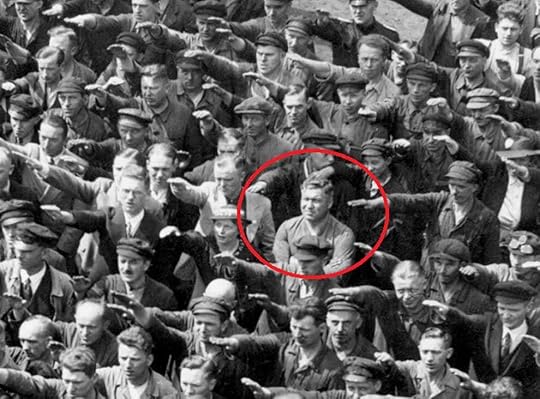
Many people will be familiar with the photograph of the lone German who refused to give the Nazi salute at a 1936 rally in Hamburg. First published by Die Zeit in 1991, this picture is fascinating, compelling and astonishing in equal measure, and it’s also something of an enigma.
Who was the ‘man who defied Hitler’ and what motivated him? What was he thinking in the moment this picture was taken? Was he angry or afraid? What effect did he think his gesture would have? What happened to him as a result?
Since the photograph was released, the lone man has been identified as August Landmesser, a shipyard worker who had been prevented from marrying a Jewish woman by the Nuremberg Laws. Another German family has claimed that the man in the photograph is a metalworker named Gustav Wegert, who refused to salute on religious grounds.
It isn’t necessary to know the identity of the lone man to be awed and amazed by his display of defiance that is on one level totally futile, and also breathtakingly courageous.
Other members of that crowd may well have felt the same disgust, but none of them dared show it. Most of us would like to believe that we would be like the lone man, but none of us can know for sure whether we would have had the courage to register our disapproval of a fascist regime that ruled by terror, violence, and intimidation.
Such bravery is rare even in better times. Perhaps we too would have found excuses to conform and done nothing, like so many Germans. Or confined our ‘resistance’ to private conversations in our own homes, hoping as Victor Klemperer and so many other ‘internal exiles’ did, that it would all turn out alright in the end.
We don’t know. But what we ought to be able to do, and what previous generations once promised in the aftermath of World War II that we would do, is prevent anything like this from ever happening again, so that no one will ever have to make such choices. And in order to be able to do that, we need to think not just of the terror and violence of fascist regimes in power, but of the ways in which fascist movements manipulate their way to power, and the ideas and attitudes that enable them to acquire it.
This exercise is particularly necessary in a country like the UK, where so many believed, even before the war and despite Mosley’s Blackshirts, that there was something intrinsic to the British ‘national character’ or rooted in our political institutions, which made us impervious to ‘continental’ political extremes.
Such complacency is ill-advised at the best of times, let alone in a chaotic, polarised and disruptive era like the one we are living through. Because the seeds of fascism may be present in every generation, but fascism is a protean political force. It doesn’t necessarily appear wearing black uniforms and leather boots and promising to eliminate Jews and Bolshevism. It might come wearing orange hair and waving a golf club, or a cloth cap and a Barbour jacket, or a white fur coat at a State of the Union address.
The Knowsley ‘Protest’Fascism may be lurking on the fringes, but in certain circumstances it will find its way into your community and your home town, and it will seek to stay there. Take last Friday’s riot outside the Knowsley Suite Hotel in Merseyside, which the Daily Mail calmly dismissed as a ‘protest’.
You somehow suspect that the Mail would have taken a different tone had Extinction Rebellion or Just Stop Oil protesters thrown fireworks at police and set fire to a police van, but then we can’t expect the same level of indignation towards an eruption of anti-migrant hatred that the Mail, more than any other single newspaper, has done so much to incite.
The UK is a country where the dehumanisation of migrants and asylum seekers by successive Tory governments, conservative politicians and much of the British press has become so routine and so toxic, over so many years, that you will struggle to find any acknowledgement of responsibility when a violent mob chooses to act in the name of what it thinks it knows.
Nor can we be surprised that the government has also sought to keep andiscreet distance from what took place at Knowsley, perhaps because it is guiltily aware of the extent to which its own words and actions have contributed to public perceptions of the ‘migrant crisis’. Or because so many politicians, including the new deputy chairman, have sought to weaponise anti-migrant sentiment in a last-ditch attempt to save their wrecked party from going under.
Even Sunak’s millionaires may be dimly aware that housing asylum seekers in a hotel in one of the most deprived boroughs in the country might not be the wisest thing to do. But they certain aren’t interested in doing anything about it, not when a potentially useful fight about Rwanda and the ECHR beckons.
Why should the government care that one in four residents of Knowsley is classified as income deprived? Or that nearly half of all secondary school children in the borough are in receipt of free school meals? No other conservative government has shown any interest in such matters, so why should Rishi and his cronies be bothered to help communities that are ripe for the kind of exploitation that fascism always specialises in?
Because if fascist movements do nothing else, they will always seek to turn poor people against each other poor people. This is what happened at Knowsley, and it’s what will continue to happen in other places like it.
Thanks for reading Matt Carr’s Infernal Machine! Subscribe for free to receive new posts and support my work.
In hard economic times, fascism will always try to find nationalist/racial outlets for legitimate economic anger and grievances. It will do this in various ways. It might tell you that your community is being ‘invaded’ by faceless brown intruders. It will tell you that ‘illegal’ migrants ‘of working age’ are staying in luxury hotels at taxpayers expense while you and your family freezes; that you can’t see a doctor, but migrants can; that your schools are overcrowded because they have migrant pupils; that none of the refugees who have arrived in your community are ‘genuine’; that we should always ‘put our own people first’.
It will tell you that ‘your’ country is not your country anymore, because shadowy woke ‘elites’ and ‘globalists’ conspired to flood your cities with foreigners and destroy your culture. If you listen long enough, it will tell you that immigration is in fact an instrument of ‘white genocide’, and that ‘indigenous people’ are in danger of being ‘replaced’ by dark-skinned ‘pedos’ and ‘nonces’ who rape and harass ‘your’ women.
It won’t necessarily say these things out loud, at least not at first, because 21st century fascism has learned how to be polite in public order to insinuate itself into local and national conversations in private.
When fascism comes to your town, it will present itself as your defender, even your saviour. It will hold its hand on its heart and call itself ‘Christian nationalist’ and ‘patriotic.’ It will wave the flag and promise to make you ‘great again’. It will gaslight its critics and tell you that ‘liberals’ and ‘lefties’ are the ‘real fascists’ and the ‘real racists’, who refuse to listen to the ‘concerns’ of ordinary people that were being ‘silenced’.
Fascism will always listened to ‘concerns’ directed at minorities and foreigners. In some countries, like Greece, fascists will set up soup kitchens to help those affected by economic crisis, on condition that their users are ‘indigenous’.
Unlike the fascist movements of the 1920s and 30s, the more savvy 21st century fascists don’t talk so much about waging war and establishing new empires. In his 1940 review of Mein Kampf, George Orwell described Hitler’s ‘pathetic, dog-like face, the face of a man suffering under intolerable wrongs. In a rather more manly way it reproduces the expression of innumerable pictures of Christ crucified.’
Today’s fascists also present themselves and their countries as victims of evil globalist conspiracies, whether directed by ‘George Soros’, the EU, or the WEF, or town planners promoting the ‘15 minute city’. They will tell you that your country is being invaded and humiliated by undesirable minorities and privileged ‘woke’ elites.
Unlike Hitler, they won’t not promise you ‘struggle, danger, and death’, as Orwell put it. They make seek to remind you of lost empires, but they won’t promise you new ones.
Instead of lebensraum, they will promise you high walls, border guards, detention centres, deportations, and endless displays of performative cruelty to appease your anger and resentment, because even 21st century fascists must have a victim/threat to direct their hatred - and yours - against. Like Trump, they will rage against immigrant ‘cesspools’ filled with foreign rapists, criminals and terrorists. Like Farage, they will stand on the white cliffs of Dover counting migrant dinghies through their binoculars and warning that Knowsley is a ‘portend’ of things to come.
They will present you, not with a vision of the future as a boot stamping on the human face forever, but a purged country living in a state of absolute sovereignty, where your everything is to what it was ‘before’ and you enjoy perfect ‘control’ with no obligations to any ‘global’ institutions or agreements.
They will do this because they care about you, the common man - and woman - ignored by the ‘cultural Marxist’ elite and cynically tossed into the maw of wokedom. Of course they understand your anger that an asylum seeker - or just a brown-skinned man, because in the end there’s not much difference - might ask a teenage girl for her telephone number.
And they will call it ‘resistance’ when you turn your attack the hotel where you think this man came from because they understand, as Tommy Robinson News suggested last Friday, that you are righteously angry with ‘ILLEGAL ECONOMIC MIGRANTS (from third world s***holes where kiddy diddling is fine)’.
So we need to recognise these signs when we see them, and we are seeing them now, in a country whose political class has crashed the country in an epic fit of pique and ideological delirium, whose economy is stagnating and failing so many, and whose governments seem more willing to weaponise racism and xenophobia for their own benefit than they are to oppose either.
We need to consider why far-right groups like Patriotic Alternative and Britain First are targeting hotels where asylum seekers have been housed, why they seeking to ‘defend’ the communities around them, and how - kindly assisted by the likes of Elon Musk and Zuckerberg - they are using social media to do this.
More than anything else, we need a broad campaigning movement of solidarity, education and resistance that, as in the 1980s, can help defend people under attack prevent the further disintegration and exploitation of the communities that surround them.
We need politicians and political parties that are not complicit in the weaponisation of the ‘migrant crisis’, who will recognise the gravity of the situation and speak out against those who are inflaming and exploiting the crisis.
Ultimately we need a national government and local authorities that are able and willing to redress the gross failures in the post-Brexit asylum process that has turned the people who came here in search of safety and protection into visible targets and potential scapegoats for distressed communities across the country.
Because if we can’t achieve these things, Knowsley will indeed become a ‘portend’ of dark things to come, as Farage the inciter-in-chief suggested. And we may one day find ourselves, like the lone German in the picture, stranded in a country that we no longer recognise, watching things take place that we once believed were impossible.
February 9, 2023
Always Crashing in the Same Car
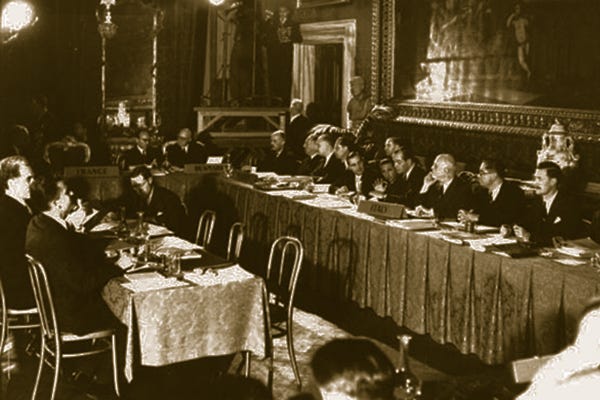
Some years ago I learned of the existence of a belief system called Breatharianism, whose adherents claimed to be able to live without food or water. This wasn’t just fasting. To be a Breatharian meant that you literally didn’t consume anything except oxygen, and you trained your body until it was able to like, just breathe man, as Jeff Bridges would say.
At first I thought this must be an urban rumour, but it turns out that some people have actually claimed to be able to do this, and some have died attempting to do it.
Why, I wondered, would anyone want to live like this? Being a vegetarian or a vegan is one thing, but living on air? Was it the same longing for ‘purity’ that you can find in New Agey scams like Gloop or in certain sections of the anti-vax movement?
Was this desire to escape the constraints of the flesh due to some quasi-religious impulse? Or could it be that Breatharians, like Kafka’s hunger artist, just couldn’t find any food they wanted to eat?
What has this got to do with Brexit? Bear with me. In 2017 the Financial Times compared Brexit to a Melanesian cargo cult. This isn’t actually a bad analogy, but I can’t help thinking that there is something distinctly Breatharian about the headlong pursuit of absolute sovereignty by Brexit hardliners, and their unwillingness to engage in any relationships with the European Union or any external institution associated with it.
Consider the current rumbling in the Tory Party and beyond with regard to UK’s membership of the European Convention on Human Rights. Tory hostility towards the ECHR is not entirely novel. As long ago as 2011 Theresa May presented the Party Conference with her infamous ‘cat speech’ as evidence of the supposed absurdity of the Human Rights Act - the vehicle through which the ECHR is translated into British law.
This intervention generated all the human rights-gone-mad headlines that it was intended to, and May wasn’t the only one to play at this game.
In 2013 Chris Grayling, the then-justice secretary (I know!) was at it again, claiming that the UK was looking to unshackle itself from an ECHR that had ‘lost its legitimacy’ in the UK.
In these early cynical interventions - generally made by Tory politicians looking to please the party’s rightwing base in order to boost their own profiles - we can see the same forces that helped pull the UK out of the European Union. Because the European Convention on Human Rights is often confused with the EU in the minds of rightwing voters, even though the two are not connected, and too many Tory politicians have no interest in making this clear.
Tory antipathy to the ECHR should be surprising, given the backing that none other than Winston Churchill once gave to the formation of a European Convention on Human Rights and a European court to enforce its provisions.
Never AgainThe idea of a ‘Council of Europe’ that would promote democracy, human rights and the rule of law and also create a legal instrument to bind member-states to its founding principles was first mooted during World War II by Churchill himself. In 1949 the Council was established by ten states, with strong British support, and its lawyers immediately began to draw up what Churchill called ‘a Charter of Human Rights, guarded by freedom and sustained by law.’
Among the architects of the charter that became the European Convention on Human Rights was the Conservative MP and lawyer David Maxwell-Fyfe, a former deputy British prosecutor at the Nuremberg trials, who also helped draft the United Nations’ Universal Declaration of Human Rights.
On the one hand the ECHR was a specifically European contribution to a wider commitment to enshrine human rights in national and international law after the horrors of the previous two decades, which also included the UN Declaration of Human Rights and the 1951 Geneva Convention on the Status of Refugees.
At the same time, British backing for the Council of Europe and the ECHR were given new impetus by the onset of the Cold War. For Churchill and his contemporaries, the creation of a ‘rights-based’ democratic bloc with legally codified moral values was not just an attempt to say ‘never again’; it was also intended to differentiate Western Europe from Stalinist practices in Eastern Europe, and provide a model that countries under Soviet occupation could aspire towards.
The result was the ECHR - a legal instrument with than 34 articles and protocols that members of the Council of Europe were intended to observe and implement within their national legislatures. Its provisions included prohibitions on slavery and forced labour and the use of torture, guarantees of freedom of assembly and association and the right to life, and a common obligation to respect human rights.
From the wars of decolonisation to Europe’s brutal treatment of refugees in the 21st century, European states have often looked to evade this rights-based framework or ignore its provisions in their treatment of ‘outsiders’ or colonial subjects, but at no point has any democratic government actually considered abandoning the ECHR altogether.
And the Convention has frequently proved its worth, binding signatories to judgements made by the European Court of Human Rights in Strasbourg which oversees its principles in practice.
In the UK the ECHR paved the way for the prohibition on corporal punishment in schools and later on enabled a second inquiry into the Hillsborough disaster. In other countries the Court has also ruled on societal issues, from the protection of journalist’s sources and homosexual relations between consenting adults, to domestic violence and domestic slavery.
Such a legal framework amounts to a kind of ‘pooled sovereignty’ that is anathema to Brexiter purists. Some of them like to say that no country needs an international framework like this in order to enforce provisions that should fall within the remit of national governments.
This may be true, in theory. But membership of a shared body of human rights legislation makes it more likely that such principles will be upheld. And the existence of a European court also provides a second ‘court of appeal’ that individuals can turn to when these commonly-agreed rights are breached.
This is why the Russian Federation was allowed to join the Council of Europe in 1996, despite Russia’s weak democratic institutions.
It’s also why Russia ceased to be party to the ECHR in September last year, because it didn’t want the ECHR to be an impediment to Putin’s tyranny. At that time Russia had failed to fully implement 2,129 judgements and decisions against it from the European Court of Human Rights, in addition to another 17,450 applications against Russia that the Court had not yet processed.
From a democratic perspective therefore, being a signatory to the ECHR, means that you agree to be part of a progressive legal framework that defines not so much the European Union, but Europe itself.
Given these aims, and given the strong Conservative role in the creation of the Council of Europe, the question inevitably arises as to why the British government has now suggested that the UK might have to leave the Convention that its predecessors helped to create.
Why has Nigel Farage, the Nag’s Head Churchill, announced that leaving the ECHR is ‘the new Brexit’ and called for a referendum on ECHR membership?
The most obvious answer is immigration. Long before Brexit the idea that European ‘nonsense about human rights’ was preventing the UK government from deporting ‘foreign criminals’ who deserved to be sent back wherever they came from had become received wisdom in the Tory Party.
The outrage that such suggestions inevitably aroused dovetailed seamlessly into hard-right suspicions of ‘globalist’ institutions undermining national sovereignty and the UK’s ability to ‘control its borders’.
For Brexiters, if sovereignty means anything, it means the ability to throw people out of the country regardless of what anyone else thinks. Where Breatharians live without food or water, Brexiters would like the UK to subsist on sovereignty alone, devoid of any exogenous elements or restraints that might pollute the body politic and curtail their saloon bar instincts.
Last year the ECHR ‘proved’ that the UK’s sovereignty is not yet complete by blocking the deportations of migrants to Rwanda, a policy on which the Johnson, Truss, and Sunak governments have all hung what remains of their reputations.
This is why Sunak, in his usual slippery disingenuous way, has once again been dropping hints that the UK may have to leave the ECHR in its own ‘long term interests’, while his sinister Home Secretary promises to push the ‘boundaries’ of international law with regard to Channel boat crossings.
When so many of the other supposed advantages that come with their hard-won ‘freedom’ have vanished into the ether, ‘Rwanda’ has become the sum of Brexiter hopes and aspirations.
This is why Farage is getting stuck into the ECHR. It’s why Lee Anderson, within hours of becoming deputy chairman of the Conservative Party (I know!), threw in his ten cents, or rather 30p on this issue:
pic.twitter.com/At7HZ8B7kH— Lee Anderson MP (@LeeAndersonMP_) February","full_text":"Pull Out The ECHR?\n\nThis would restore sovereignty to Westminster & stop Strasbourg rulings being enforced in UK law. \n\nIt would stop the small boats as well. I am not quite sure why anyone would object to this. \nIf there was a referendum on this it would be a 'leave' vote.\n\n. ","username":"LeeAndersonMP_","name":"Lee Anderson MP","date":"Sun Feb 05 06:36:42 +0000 2023","photos":[{"img_url":"https://pbs.substack.com/media/FoLvYceXkAIRVUX.jpg","link_url":"https://t.co/At7HZ8B7kH","alt_text":null}],"quoted_tweet":{},"retweet_count":1069,"like_count":5264,"expanded_url":{},"video_url":null,"belowTheFold":true}">pic.twitter.com/At7HZ8B7kH— Lee Anderson MP (@LeeAndersonMP_) February" target="_blank"> Lee Anderson MP @LeeAndersonMP_Pull Out The ECHR?This would restore sovereignty to Westminster & stop Strasbourg rulings being enforced in UK law. It would stop the small boats as well. I am not quite sure why anyone would object to this. If there was a referendum on this it would be a 'leave' vote..
  pic.twitter.com/At7HZ8B7kH— Lee Anderson MP (@LeeAndersonMP_) February" target="_blank">6:36 AM ∙ Feb 5, 2023pic.twitter.com/At7HZ8B7kH— Lee Anderson MP (@LeeAndersonMP_) February/likes" class="likes">5,264Likespic.twitter.com/At7HZ8B7kH— Lee Anderson MP (@LeeAndersonMP_) February/retweets" class="retweets">1,069Retweets
Anderson may not be well-versed in international law, but he could care less, because his ‘common sense’ appeals to the lowest common denominator, and these are the only voters the Tory Party has been bothered about for some time now.
By fusing the ‘stop the boats’ narrative with ‘leave the ECHR’, Brexiters hope to complete the perfect circle which they began in 2016 with Farage’s ‘invasion’ posters.
In equating the ability to enact the most viciously anti-immigration legislation with the chimera of untethered sovereignty, Brexiters hope to rouse their base into the state of perpetual outrage on which their own political survival depends.
Never mind the cruelty or the legality of the Rwanda policy, or the fact that their proffered ‘solution’ to the Channel crossings is only likely to involve a few hundred migrants at the most. Never mind that there is no demonstrable evidence that the Rwanda deportations will have any impact on ‘stopping the boats.’ Never mind that a Durham University report has found that Brexit itself is the main cause of migrant boat crossings.
The likes of Farage, Anderson - and Sunak - don’t care about any of this. They want a new cause celebre because they have nothing else. The more conspiracy-minded might think that scrapping the ECHR and the Human Rights Act is intended to pave the way for a new legislative race to the bottom.
Some Brexiters may well have that aspiration, but I suspect that very few of them have actually thought this through in the longer-term. For the time being, the prospect of a ‘referendum on the ECHR’ is more likely to be yet another wedge issue to divide the country and rally the troops, while also distracting from their multiple failures.
In other words, to ‘save’ the country from ‘illegal’ immigration that Brexit itself has increased exponentially, Brexiters are now preparing to abandon a legal framework that their own political predecessors helped to construct, and they are presenting this aspiration as another sign of ‘freedom’.
If all this seems a little sordid, disgraceful, counterproductive and downright mad, no one should really be surprised, because this is what the pursuit of absolute sovereignty can do to mid-sized countries that get too big for their boots.
It makes them poorer and weaker, economically and also morally, as they try to live on thin air, pursuing an illusory sovereignty that is unconnected to anyone or anything, even as their vital organs break down and, starved of nutrition from outside, they begin to eat themselves.
Thanks for reading Matt Carr’s Infernal Machine! Subscribe for free to receive new posts and support my work.
February 2, 2023
There is Power in a Union

Even in the deranged scorched earth wasteland of contemporary UK politics, there are still some things you can rely on, as surely as night follows day. Whenever there are strikes, even the most demoralised Tories will rouse themselves into a state of righteous indignation and reach for the yellowed Thatcherite manual that once helped them drive neoliberalism like a coach and horses through the crumbling legacy of 1945.
Like treasure hunters stumbling on buried gold, their voices have been heard up and down the country these last few weeks triumphantly braying the dreaded words ‘union barons’ in an attempt to terrify wavering voters with dark visions of a Labour Party in hoc to shadowy interests which mean to do the country ill.
Not everyone will be crass and downright moronic enough to call striking teachers ‘Commies and Bolsheviks’ intent on ‘making sure that kids suffer’, as the soon-to-be jobseeking Jonathan Gullis did last month when looking up from his coffee-stained resumé. But all of them will make that kind of case even if they use different words. Thus we hear that Oliver Dowden was ‘saddened’ by the teachers strikes yesterday. And the Daily Mail’s Mark Lehain berated teachers for ‘sacrificing the wellbeing of so many children on the altar of their political beliefs’.
Also in the Mail, and no one will at be at all surprised by this, Sarah Vine could be found earning her £200,000 a year salary with a plangent lament to a nation divided between ‘silent strivers and noisy strikers’, where ‘ordinary people’ who don’t have ‘nice gold-plated pensions’ are regularly shafted by ‘sharp-elbowed union reps’.
It’s always been like this since the dawn of Tory time, and no one can say it hasn’t been effective. But this time at least the gross insults, the phoney divisions, the hypocrisy, and the faux-concern for the common man don’t seem to be working.
For once the monsters in the Tory shop of horrors don’t seem to be scaring people, because these are different times of post-pandemic and infinite corruption, when energy companies make millions in profits while millions slip deeper into poverty through higher energy bills, when you would need a microscope with a revolutionary new lens to spot a Tory minister with a smidgeon on integrity.
In these new times the old horror flics of ‘the Seventies’ seem as dated as Carry On Films and muddy football pitches. In a dystopian hellscape of corruption when the likes of Baron Lebedev, Baron Moylan, Baron Moore, Baroness Mone and so many others have gained their titles through services to the Tory Party or to Boris Johnson, taunts about ‘union barons’ have all the rhetorical thrust of a fart in a thunderstorm.
Two days ago a poll from Sky News - no friend of striking workers - found to its amazement that public support for the strikes appears to have increased from 35 percent last November to 37 percent. Other polls last month showed that support was much higher when broken down amongst specific sectors such as nurses, ambulance drivers, and primary school teachers.
Something is clearly happening, and the likes of Gullis, Dowden and Vine don’t know what it is - or perhaps they do. Perhaps they know why the public overwhelmingly supports the tens of thousands of nurses, who have come out on strike demanding fair pay and improved patient safety. Perhaps Gullis - a former teacher God help us - knows why 20,000 teachers switched unions last week in order to be able to strike.
Perhaps these gilded commentators and low-grade attack dogs can sense the transformation that I witnessed in Sheffield yesterday, when some 6,000 strikers marched to City Hall. Because this wasn’t a gathering of the usual suspects calling for revolution now.
Teachers and teaching staff , civil servants and a delegation of fifty firefighters proudly marched together with the 500,000 workers who came out on strike across the country yesterday.
They joined the border guards, driving test examiners, barristers, university lecturers, Amazon workers, train drivers and Network rail workers, civil servants, bus drivers, firefighters, postal workers, paramedics and ambulance drivers, nurses, junior doctors, teaching assistants, and Eurostar security staff - all of whom have come out on strike in the last three months.
Don’t Say ‘Out of Touch’To see that a convergence like this is unusual in British politics would be understating it considerably. There’s been nothing like it in years, and perhaps the most surprising thing about this current concatenation of strikes is that it’s taken so long to reach such a critical mass, given the gratuitous damage inflicted on British society by successive Tory governments during these twelve dire years of austerity, incompetence and malfeasance.
I tend to resist the cliché ‘out of touch’ to criticise governments like this. It’s not just because this is an expression that has long since had whatever life it possessed beaten out of it by endless repetition. To say that someone is out of touch suggests that they once had the ability to be ‘in touch’ and somehow lost it.
But a party that has run down the NHS to the point when nurses and doctors are leaving the profession in droves, partly because they no longer feel able to guarantee patient safety, is not ‘out of touch.’
If Tory ministers aren’t bothered about this now, it’s because they never were particularly bothered. Perhaps the single exception was that brief period when the government’s political survival was dependent on photo ops of ministers clapping for the NHS workers who kept people alive even at the risk of their own lives, even as the government was handed out no-bid contracts of dodgy PPE to favoured insiders.
But that was then, and now ambulance-drivers are ‘shitbags’, as Kelvin McKenzie recently called him, and nurses, according to equally detestable Isabel Oakeshott, spend too much time hanging round the wards drinking tea.
People who talk like this are not ‘out of touch’ when they denigrate ‘lazy’ teachers who complain that excessive workload is burning them out, when polls indicate that nearly half of state school teachers plan to leave the profession within the next few years; when headteachers warned last October that nine in ten schools might run out of money within months; when footballers had to campaign for free school meals.
None of this may matter to the likes of Sunak, Johnson, Truss, and their tabloid armies, but it clearly matters to the people who are on strike, and it should matter to those of us who aren’t. Because if the concept of the common good means anything at all, it must surely mean that a country - particularly a rich country with means and resources - should be able to care for its sick, the elderly and disabled. Such a country should be able to ensure that its young people are educated by the best people it can find, and taught in the best conditions possible for both staff and pupils.
It should be able to ensure that those teachers are paid well and respected for what they do, and that their voices count for something when they complain of the burnout, overwork and demoralisation that is driving so many of them to leave the profession.
It should be able to ensure that you can see a doctor when you need to; that you don’t have to wait for hours in the street waiting for an ambulance; that your trains are safe, affordable, and work well; that pay rises at least keep up with inflation, instead of slipping backwards.
If a country can’t - or won’t ensure these things, then we have to ask ourselves what exactly is the purpose of it? What connections to its citizens have to each other and what is the point of belonging to it? What are the basic nuts and bolts that hold us together and prevent us from slipping into a kind of everyday barbarism?
What are we supposed to do together - sing God Save the King and Sweet Caroline? Shrug our shoulders and say ‘Ukraine’ or ‘there isn’t enough money?’ Do we simply allow some of the finest institutional examples of solidarity and public service to wither and die until some corporation comes along looking to make a profit out of them?
Is that it? Is that all we can do together?
Margaret Thatcher once said there is no such thing as society. She was wrong, and not only about that. Society exists, and public service is at the heart of whatever ‘ubuntu’ - humanity to others - the Tory vandals have not destroyed or undermined.
For too long we have allowed ourselves to forget this. We have allowed the worst people in our society to squeeze public sector workers to the last drop and convince us that somehow all this is for our own good and it will all work out in the end. We were taught to dismiss them as ‘lefties’ or ‘communists’ or ‘union barons’ when they raised concerns about their own working conditions and their ability to provide essential services.
And now our schools are crumbling, and nurses and doctors no longer feel able to live up to the duty of care, and people who would never normally go on strike are doing it for the first time.
We can and should blame the wanton social vandalism of the Tory Party for these lamentable social outcomes. But the fact that one of the richest countries in the world cannot provide these essential services is not the work of a single political party. It’s a collective moral failure, that has brought our society low and may bring it lower still.
For all the ‘union puppet’ accusations levelled at the Labour Party, there is little sign that the Labour leadership recognises the gravity of these multiple crises, as it tiptoes gingerly towards the next election like a child playing Grandmother’s Footsteps.
But yesterday’s strikes, and the support they are receiving, suggest that Starmer, like Sunak and his hapless team, may not be reading the room and that the tide may be changing. And in a country where ‘Money speaks for money/The Devil for his own’ we should be glad that there are more and more people willing to ‘speak for the skin and the bone’, who are discovering that there is power in a union.
So when the next Tory tries to stake out some fatuous binary between ordinary people and ‘strivers’ versus ‘skivers’’ and ‘unions’, we would do well to remember that these strikers are ordinary people just like us, that they also ‘strive’, not to make themselves rich, but to make society better.
And whatever the likes of Vine, Oakeshott, Gullis et al may say, we should keep in mind that these strikers are striking not just for themselves but for all of us, and they have already given us so much more than their accusers ever will.
Thanks for reading Matt Carr’s Infernal Machine! Subscribe for free to receive new posts and support my work.
January 26, 2023
In Defence of Virtue
 Image by: Eric Klee. Rally for the Common Good. Creative Commons
Once upon a time - it does seem a long time ago doesn’t it? - you didn’t get the kind of lying politicians we have now. Or at least we didn’t have so many of them, or so many people willing to support them. Of course there have always been governments that have told lies and/or twisted the truth, generally in order to achieve specific political or military objectives.
Tony Blair and New Labour come to mind, and are too often forgotten, along with the Bush administration’s manipulation of ‘stove-piped’ intelligence indicators regarding Iraq’s weapons programs. As long as politics have existed, there have been politicians who have lied in order to conceal some indiscretion or further their own careers.
But until relatively recently, you could not have had a president like Donald Trump, who began his presidency by lying about the attendance at his presidential inauguration, regardless of the fact that the entire world could see with their own eyes that he was lying - and lying with the full-throated support of his press secretary and his administration.
That lie, as the Washington Post has pointed out, was one of 30, 573 ‘false or misleading statements’ that Trump told during his four years in office. No mean feat, and it does at least show a kind of creativity, however twisted and malignant. But the most striking thing about Trump’s empire of lies is that his party and most of his supporters didn’t care. No matter how gross the lie, they didn’t bat an eyelid.
When Trump finally left office with the biggest lie of all, that he hadn’t won the election, millions of voters believed he was telling the truth, or at least didn’t care that he wasn’t.
And this is perhaps Trump’s greatest success as a ‘populist’ politician. He demonstrated that facts are no longer relevant to high office, that trying to tell the truth is no longer an essential aspiration for a political leader, which carries at the very least the prospect of some kind of moral reprobation or disapproval when politicians fall short.
He demonstrated, again and again, that the pursuit of truth or even the idea of a common agreement on what is true or false need not play any meaningful role in democratic life.
All of which leads us to George Anthony Devolder Santos - at least that’s what he says his name is - the recently-elected representative for New York's 3rd Congressional District. Within weeks of taking up his seat, Santos has established a record for serial dishonesty that even Trump must surely admire. Where Trump lied mostly to make himself look good, or at least stop himself from looking bad, Santos has lied about everything. I mean he has literally made himself up, or built a replica of himself from a kind of existential flatpack kit.

This is a man who said his relatives were Ukrainian Jews who had survived the Holocaust. They weren’t. Confronted with this false claim, Santos said he meant that his parents were ‘Jew-ish’ - he may not be Jewish but he doesn’t lack chutzpah. Santos lied about which school he went to, about jobs on Wall Street that he never had. He said that his mother was killed in the South Tower on 9/11 when she wasn’t even in the country.
A military veteran has even accused him of scamming of $3,000 from a GoFundMe campaign page raised for his dying service dog in 2016. Nice. And if you’re going to behave like that, you might as well claim to have attended Baruch College when you didn’t, and throw in the equally false claim that you played in the volleyball team and ‘slayed’ Harvard and Yale, because why the hell not?
Clearly truth is in the eye of the Devolder here, which gives him a kind of reptilian power that can take you a long way in US politics these days. There is something morbidly fascinating about Santos’s willingness to lie about big and small things, that could make him the subject of a movie one day - let’s call it The Wolf (Who Wasn’t) Of Wall Street or Blankman.
It would need someone like Peter Sellars to capture the weird combination of oily smoothness and yawning moral vacancy at the heart of this strange and clearly sociopathic character.
What should concern us most is not just Santos himself, but the wider context that has enabled someone like him to fly so high with no discernible moral compass and no aspirations beyond his own self-advancement.
What makes Santos a man of his times is not just his incontinent dishonesty, but the absence of any serious consequences when his lies were revealed, and his complete indifference to the fact that he has been well and truly exposed as an absolute unmitigated fraud. No one should be surprised that the hapless phoney Kevin McCarthy responded to the allegations of lying directed against Santos by saying ‘so do a lot of people.’
Er, dude, they really don’t. Not like this. And not only has the GOP taken no action against Santos, but McCarthy and his clique have put Santos on two low-level committees - a reward for aligning himself with the Marge-the-Nazi, Gaetz/Boebert wingnut caucus.
To paraphrase the Eagles, Santos may not be able to hide his lying eyes and his smile may be a thin disguise, but he ain’t goin’ nowhere.
He may not a great man, and he clearly isn’t a good man, but he is smart enough to know the kind of people he is dealing with. And the triumph of a political sociopath who is so weirdly comfortable with his own depravity is yet another symptom of the moral collapse of the Republican Party, and perhaps of the American Republic itself.
Because there is only so much a society can stand of men like Santos and Trump. The seemingly endless army of grifters who have gathered round them are not merely products of a ‘post-truth’ era; they are the consequences of a sustained attempt by the ‘new’ right to destroy any sense of honour, probity and decency in public service, and extinguish the notion of common good that is essential for any democratic society to prosper or even function.
Through their ‘culture wars’, their attacks on ‘wokeness’ and ‘virtue signallers’, they have tried to consign the notion of civic virtue to the dustbin of history. By virtue, I mean the idea of ‘ virtù’ that Craig Nelson once called the ‘holy grail of moderns’ in his biography of Tom Paine. As Nelson puts it:
With its origins in vir, the Latin word for man, and considered the ultimate goal of every meritocrat, virtù was originally translated as ‘public spirit’, for, as described by a line of philosophers from Aristotle to Montesquieu, it referred to someone so devoted to civic service that he became famous in his lifetime, and after death was remembered by history for his great and generous work.
It’s safe to say that Santos will not be remembered in this way, assuming he is remembered for anything at all. But his metamorphosis from anonymous nothingness into the King of Fakes is an inevitable consequence of a society - or a section of society - that no longer expects any notion of truth, decency or public service from the people it chooses to represent it.
‘Woke Wars’America isn’t the only place where this is happening. The British electorate elected a prime minister who was almost universally known to have no interest in the truth, who smirked and lied week after week, and was only forced from office when it became clear that his behaviour was harming his own party’s political prospects.
In Johnson’s downfall lies a ray of hope, however dim, but the Zahawi scandal is a reminder of his legacy. And yesterday, presented with accusations of dereliction of duty from the Home Office regarding the disappearance of asylum seeker children from British hotels, the thuggish neanderthal Jonathan Gullis shouted ‘they shouldn’t have tried to come here illegally.’
Not long ago, an elected politician would not have dared suggest that children who may have been kidnapped for sexual trafficking or forced labour somehow deserved it because they are ‘illegal’. But these are new times, shaped by a ‘new’ right that brazenly violates ethical standards and proclaims its callousness and cruelty, in the hope that the public will get into the sewer with it.
This is why its politicians and spokespeople batter away relentlessly at ideas and attitudes that they call ‘woke’ and ‘virtue signalling’. They want to lower the threshold of acceptability, so that men like Gullis can shout out whatever depraved thought comes into their tiny minds and call it freedom. This is why they gathered instinctively in support of a pimp-grifter like Andrew Tate over Greta Thunberg.
They are trying to change the rules of the game. They haven’t won, and there is no guarantee that they will win. Because human beings may not be as instinctively good as the left sometimes likes to believe, but they aren’t necessarily as bad as the culture warriors of the right would like them to be either.
Every society has to wage a battle between its worse instincts and its best. And even in our tormented and chaotic times, roiled as we are by algorithms and toxic platforms that seem to be constantly pushing at the barriers of the acceptable and unsayable, we don’t have to play the game they want us to play.
Florida may or may be the ‘place woke goes to die’, as Ron DeSantis put it, but the rest of the world doesn’t have to be that place. And the liars and fascistic grifters who have infested our rotten political structures and institutions these last few years should not put us off from the pursuit of truth and justice, or deter us from trying - even if we don’t always get there - from trying to live up to the best of ourselves, rather than succumb passively to the worst that our societies have to offer.
Some might call this aspiration ‘virtue signalling’, but it is so much more worth pursuing, and so much better for all of us, than the torrent of filth and lies that the likes of Trump, Santos, and Gullis would like us all to swim in.
Thanks for reading Matt Carr’s Infernal Machine! Subscribe for free to receive new posts and support my work.


