
Mitali Perkins's Blog, page 21
November 12, 2012
An Interview With Carol Antoinette Peacock, Author of RED THREAD SISTERS

Today I'm delighted to host Carol Antoinette Peacock , author of a new middle grade novel, Red Thread Sisters (Viking / Penguin). A well-paced, satisfying hero's journey, this moving book tells the story of Wen, an eleven-year-old girl who leaves an orphanage in China for a new home in Boston. Tween readers will root for the protagonist in her quest to find a home in America for Shu Ling, her best friend in China.
Red Thread Sisters doesn't gloss over the grief of adoption. Even as Wen fiercely advocates for Shu Ling, she battles for herself as well, grieving for what she left behind in China and taking stock of what she might gain—and lose—as she accepts her new family and home. A new friend Hannah, proficient with American culture and popular at school, is also processing a familial loss, evening out the power between the two girls and making their friendship credible.
The author skillfully switches from the narrator's fluent and honest internal voice, which we assume is in Chinese, to displaying Wen's emerging proficiency in English through dialog. This simile worked perfectly, for example, using a memory from the orphanage to describe the irritating struggle of language acquisition: "Wen strained hard to pick up any English she knew. The words seemed to buzz, like flies swarming over the babies' heads on the hottest days."

By the end of the story, this novel accomplishes the purposes of good "between cultures" stories: it widens hearts and builds bridges. I read it in one sitting and got choked up at two scenes (read the book to guess which ones). I hope you enjoy this chat with Carol as much as I did.
Could you sum up for us the dream response of a reader who knows little or nothing about international adoption?
For a reader unfamiliar with international adoption, I hope Red Thread Sisters will enlighten that reader about the challenges, but most important, the happiness of building a family through international adoption.
Although international adoption is far more common than years ago, some people still sense that these families are beset by racial prejudice and cultural differences. And of course, families created through international adoption do encounter these issues.
But what I wanted to convey to all readers was the joy of international adoption. Unexpectedly adopted, Wen must leave her best friend, Shu Ling, as close as sisters, behind. Wen promises she’ll find Shu Ling a family of her own, once she’s in America. But can Wen keep her promise? As the reader follows Wen’s valiant efforts to find Shu Ling a family, the power of Wen joining her own adoptive family emerges, too.
Later in the book, Shu Ling, begins to fear belonging to a family in America. Wen tells her, “Being with a family is better because if you get lost, they drive around in your car until they find you. If you feel sad, they try to cheer you up, even if they don’t really know what’s wrong. If you get sick, they sit by your bed and take care of you. And if things get hard, like maybe there’s less money, they still love you, no matter what, because they’re your family. That’s what’s better.”
I should add that I’m an adoptive mother of two Chinese daughters, so I have lived the joys and challenges of international adoption. As I wrote Red Thread Sisters, I realized I was actually writing about the power of connection, through families and through friendship.
Now let's move to the journey of getting the novel published. What was a high point? A low point?
Oh, what a good question! The high point of getting published was the day Leila Sales at Viking/Penguin, my editor, got the go-ahead to buy my novel. I’d done seven years of research and revising Red Thread Sisters. And now my book was going to be published! When I got that email from my agent, I screamed, I was so happy.
A low point? I wrote Red Thread Sisters, based on my own experience working with older children at my own daughters’ orphanage. I got input from so many helpful adoptive parents. And when the book kept getting rejected, I felt very discouraged. I wrote Red Thread Sisters from an inner passion. Each rejection felt like such a stab in the heart.
I'm glad you survived them. What was the biggest change you made in response to an editorial suggestion?
I gave the novel depth. My wonderful editor at Viking suggested I add more of Wen’s struggles to adjust to American culture. This was a very important change and improved my story enormously. Now I was writing not just a book about international adoption but a more nuanced novel, about cultural themes and a host of subplots. The scenes of American life broadened the book’s appeal and gave the book a much larger audience. Thank you, Leila!
Nothing like a good editor. Could you describe a fear you have about this novel that can or did keep you up at night?
I worried that no one will read my novel. I’m not kidding, even though Red Thread Sisters is getting good reviews, I still sometimes worry it won’t sell. I brood that I won’t be able to share my message and tell my story. Anytime readers tell me they loved my book, I feel so relieved and deeply gratified.
Please add me to the growing list of people who loved the book. What's next for Carol Peacock in the realm of children's books?
Another good question. I’m a practicing psychologist and have used my dog to help emotionally disturbed kids for years. I am thinking of writing about this experience, maybe including the perspective of the dog. I need to go walk the beach with my black Lab, Pepper, and immerse myself in my next book.
We'll have to walk our dogs together! I have a black Lab named Zipper! Thanks for joining me on the Fire Escape, Carol. I'm looking forward to your next book and will become your Facebook fan HERE (hint to my Fire Escape visitors).
Trailer:
Reviews:
“…provides a moving and engaging experience for readers. A fine addition to both the coming-of-age genre and books sensitively dealing with cross-cultural adoption.” — Kirkus Reviews
“….perfectly paced…heartwarming and joyous.” — School Library Journal
“This…intimate novel focuses on Wen’s difficult emotional journey…Wen’s selflessness and determination are poignant but not overly sentimental and the story’s truths about children in need are sensitively expressed…..” — Publishers Weekly
Come visit me on the Fire Escape!


November 3, 2012
More Encouragement from the Associates of the Boston Public Library
If you're the third person on the planet (the first two are my parents) to keep track of
Mitali's Events
, you'll remember the recent
Literary Lights tea at the Boston Public Library
with 400 or so Boston students, courtesy of the
Associates of the Boston Public Library
. Well, the encouragement from the Associates keeps coming. First, there was a beautiful engraved glass bowl.
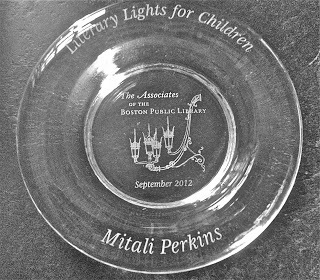
Talk about an unforgettable reminder of my vocational call.
Next came a package and a letter from Vivian Spiro, the Chairman of the Board of the Directors. Here's an excerpt of the letter, a keepsake in itself, which illuminates why this was such a special memory for me:
The package contained a gorgeous book, obviously chosen for me by someone who took the time to learn what I value.
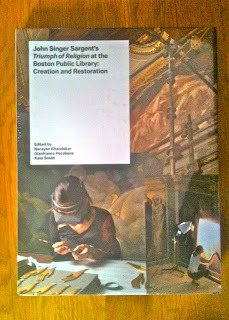
John Singer Sargent's Triumph of Religion at the
Boston Public Library: Creation and Restoration,
edited by Narayan Khandekar, Gianfranco Pocobene, and Kate Smith.
Thank you so much, Associates, for the outpouring of encouragement.
Come visit me on the Fire Escape!

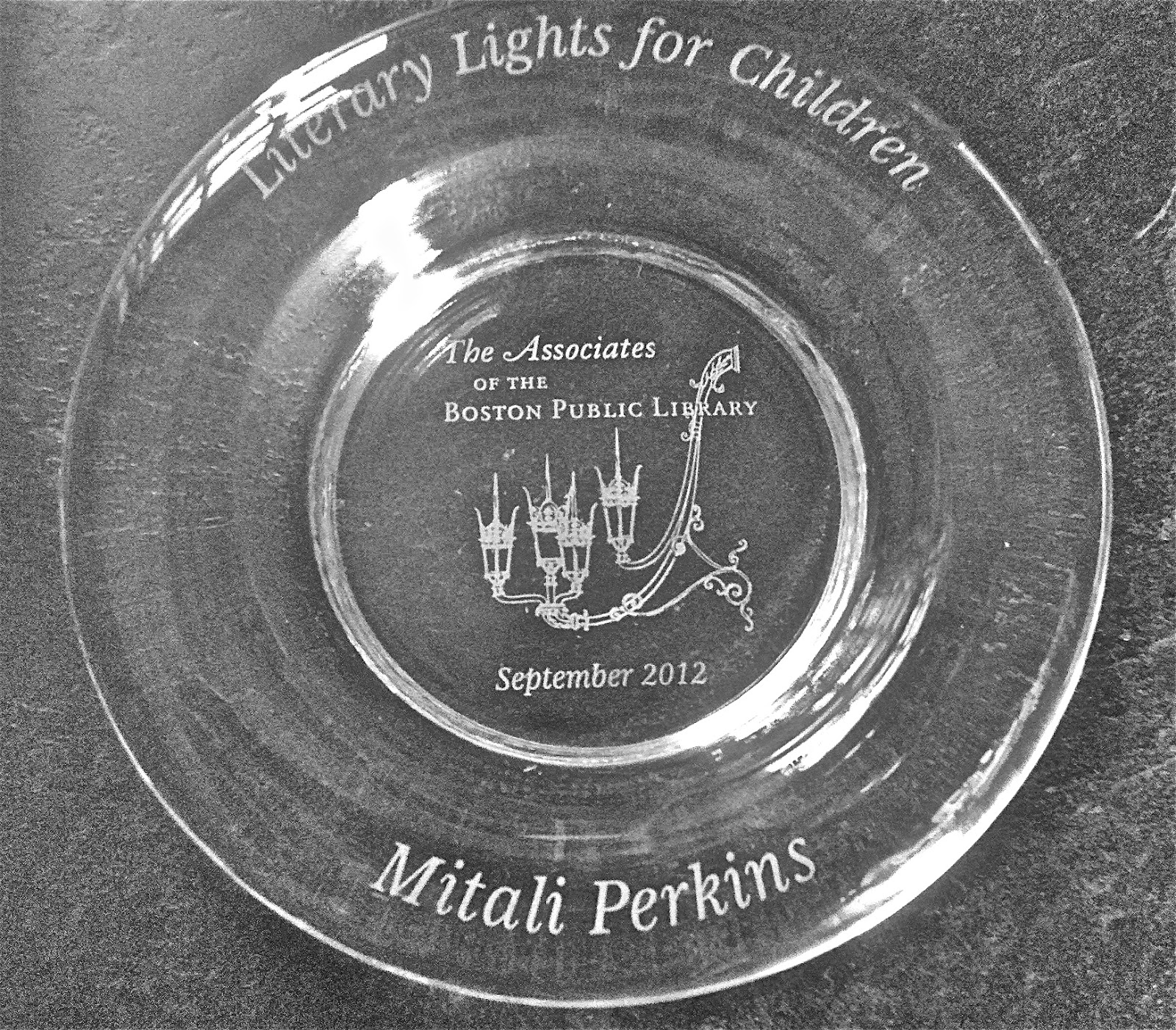
Talk about an unforgettable reminder of my vocational call.
Next came a package and a letter from Vivian Spiro, the Chairman of the Board of the Directors. Here's an excerpt of the letter, a keepsake in itself, which illuminates why this was such a special memory for me:
Your description of what it was like to grow up in a multicultural household; to have spent your childhood living in many different countries, never being able to put down roots; to have felt you had little in common with your classmates in school; to have felt alienated, even after realizing that you were smart ... All of what you said clearly resonated with those members of our audience who grapple daily with the felling that they are outsiders, that the hopes and ambitions of others are beyond their grasp, that regardless of their gifts, their striving will come to naught.
The package contained a gorgeous book, obviously chosen for me by someone who took the time to learn what I value.
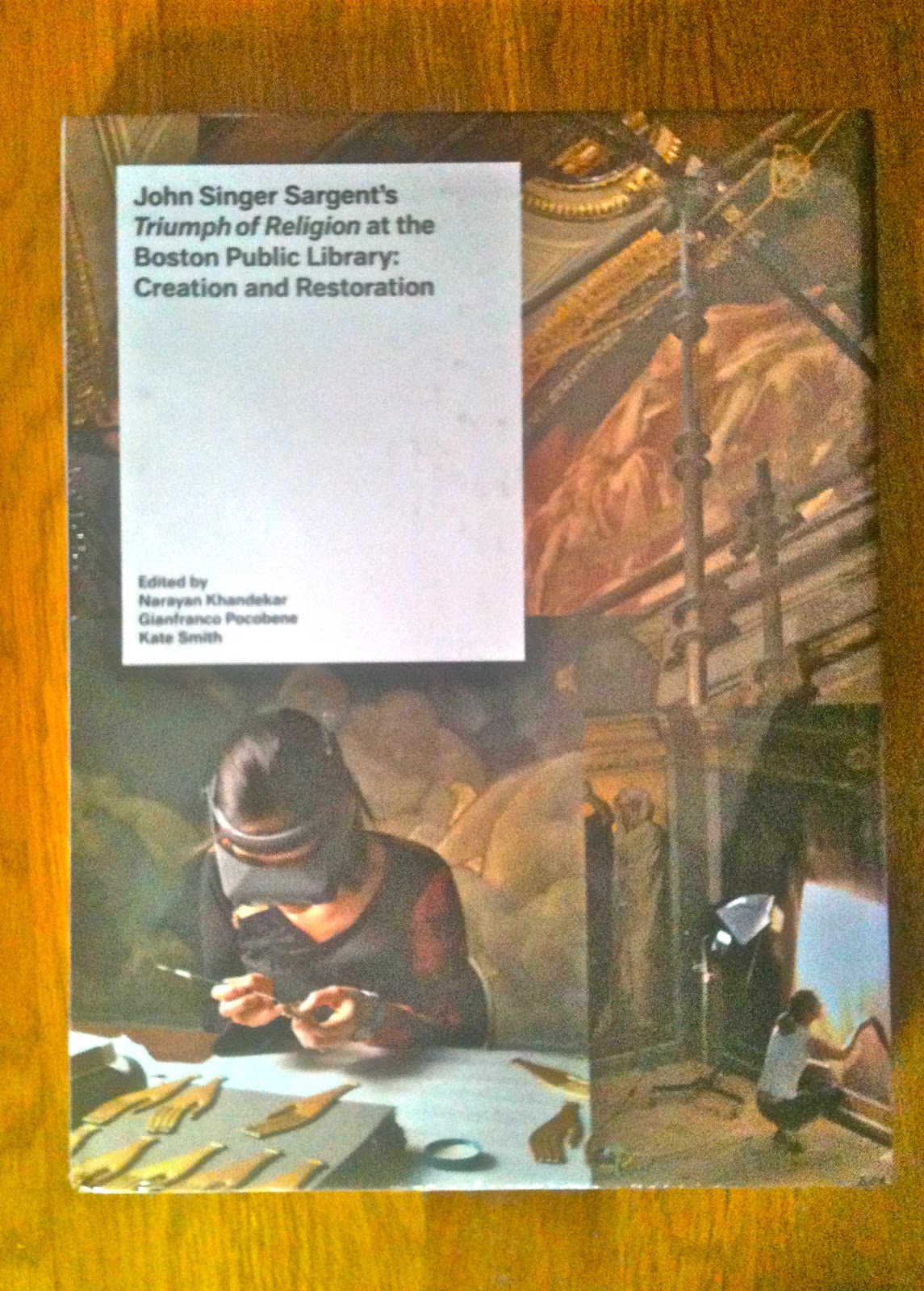
John Singer Sargent's Triumph of Religion at the
Boston Public Library: Creation and Restoration,
edited by Narayan Khandekar, Gianfranco Pocobene, and Kate Smith.
Thank you so much, Associates, for the outpouring of encouragement.
Come visit me on the Fire Escape!


October 31, 2012
Today I'm Grateful For Old-Fashioned Editors
In this fast-changing world of publishing, we hear about a future where writers will directly post content for digital downloading—no costly binding, no "middle-men," no meager 10-15% cut of a sale, no lengthy turnaround time until our next book is consumable.
Sounds great, right?
Not to me. Take TIGER BOY, for instance, coming in 2014 from Charlesbridge.
A year ago, I was in the doldrums of a newly-empty nest, wondering what to do now that I'd been fired as a Mommy. A mother-writer hyphenated vocation had been a good gig for years; how was I going to weather this transition? I had no creative sizzle, and when students asked the inevitable question during author visits—"Where do you get your ideas?"—my honest answer should have been: "No clue. Got nothing here."
That's when the phone rang. Yes, I got an old-school call. Not a text, not an e-mail, but an actual call on our landline.
I picked it up and grunted into the receiver, expecting a marketing robo-voice. Who else called that number these days?
"Mitali? This is Yo. How are you?" It was Yolanda LeRoy Scott, my Harvard-educated, drop-dead gorgeous editor at Charlesbridge . "I want to take you to lunch and talk about your next book."
"Okay, Yo, I'd like that." How am I going to tell her about my creative constipation? Get ready for the shortest working lunch ever, Mrs. Scott.
We met at Not Your Average Joe's in Watertown, right near Charlesbridge's offices, a mile or so from my house in the Boston area. "I'm stuck, Yo. I got nothing," I said, soaking up parmesan cheese and olive oil with freshly baked bread.
 "Just throw out some topics for me. Is there anything you've always wanted to write about? Or a new genre you want to try?"
Yolanda passed me the bread bowl, and I helped myself to another chunk of carb comfort. "Well, there is something. I've always wanted to write a picture book, and I've been thinking about Bengal tigers—how beautiful they are." I didn't add that one of our sons' walls was covered with posters of the creatures, because that would imply I was mooning around his room.
Her face lit up. "That sounds lovely. I'll write up a contract and send it to your agent."
"Really? Sight unseen?"
"I know you can do this, Mitali. This is your story to tell. Now let's talk babies. Mine isn't sleeping all that well. Got any tips?"
I slipped easily into my role of seasoned veteran as we chatted about mothering for the rest of lunch.
The contract came. I signed it. Somehow I eked out a picture book manuscript and sent it off. Yo's editorial letter came quickly: "I love it, but as usual you've got the start of a short novel with great potential here, Mitali. It could be the perfect companion to RICKSHAW GIRL." The letter continued with a list of brilliant questions and suggestions.
I felt a sudden spark in my latent imagination. A character leaped to mind—a skinny brown boy, like hundreds I had seen in the villages of West Bengal. Years ago, my own father had been one of them. Immediately, I named him: Neil. He loved tigers.
Yesterday I sent Yolanda a second revision of TIGER BOY, the novel. Thanks to her insights, it's become a real story now, with plot, characters, theme, place. It's going to take another round or two of changes and honing before I like it, but my imagination needs the breathing room of our back-and-forth collaboration.
Here's my question: will the future be a world without small publishers like Charlesbridge who champion stories across borders, without editors like Yo who encourage and nurture broken-down mid-career writers, without the time a story needs between revisions to improve?
If so, I'm never going to make it.
Can we be proactive and keep the best from the old publishing model as we explore new ways to deliver content to consumers? One non-negotiable is the input of an excellent editor who doesn't work for me, but with me.
Thanks, Yo. And thanks, Charlesbridge. Now on to the next story.
Come visit me on the Fire Escape!

Sounds great, right?
Not to me. Take TIGER BOY, for instance, coming in 2014 from Charlesbridge.
A year ago, I was in the doldrums of a newly-empty nest, wondering what to do now that I'd been fired as a Mommy. A mother-writer hyphenated vocation had been a good gig for years; how was I going to weather this transition? I had no creative sizzle, and when students asked the inevitable question during author visits—"Where do you get your ideas?"—my honest answer should have been: "No clue. Got nothing here."
That's when the phone rang. Yes, I got an old-school call. Not a text, not an e-mail, but an actual call on our landline.
I picked it up and grunted into the receiver, expecting a marketing robo-voice. Who else called that number these days?
"Mitali? This is Yo. How are you?" It was Yolanda LeRoy Scott, my Harvard-educated, drop-dead gorgeous editor at Charlesbridge . "I want to take you to lunch and talk about your next book."
"Okay, Yo, I'd like that." How am I going to tell her about my creative constipation? Get ready for the shortest working lunch ever, Mrs. Scott.
We met at Not Your Average Joe's in Watertown, right near Charlesbridge's offices, a mile or so from my house in the Boston area. "I'm stuck, Yo. I got nothing," I said, soaking up parmesan cheese and olive oil with freshly baked bread.
 "Just throw out some topics for me. Is there anything you've always wanted to write about? Or a new genre you want to try?"
Yolanda passed me the bread bowl, and I helped myself to another chunk of carb comfort. "Well, there is something. I've always wanted to write a picture book, and I've been thinking about Bengal tigers—how beautiful they are." I didn't add that one of our sons' walls was covered with posters of the creatures, because that would imply I was mooning around his room.
Her face lit up. "That sounds lovely. I'll write up a contract and send it to your agent."
"Really? Sight unseen?"
"I know you can do this, Mitali. This is your story to tell. Now let's talk babies. Mine isn't sleeping all that well. Got any tips?"
I slipped easily into my role of seasoned veteran as we chatted about mothering for the rest of lunch.
The contract came. I signed it. Somehow I eked out a picture book manuscript and sent it off. Yo's editorial letter came quickly: "I love it, but as usual you've got the start of a short novel with great potential here, Mitali. It could be the perfect companion to RICKSHAW GIRL." The letter continued with a list of brilliant questions and suggestions.
I felt a sudden spark in my latent imagination. A character leaped to mind—a skinny brown boy, like hundreds I had seen in the villages of West Bengal. Years ago, my own father had been one of them. Immediately, I named him: Neil. He loved tigers.
Yesterday I sent Yolanda a second revision of TIGER BOY, the novel. Thanks to her insights, it's become a real story now, with plot, characters, theme, place. It's going to take another round or two of changes and honing before I like it, but my imagination needs the breathing room of our back-and-forth collaboration.
Here's my question: will the future be a world without small publishers like Charlesbridge who champion stories across borders, without editors like Yo who encourage and nurture broken-down mid-career writers, without the time a story needs between revisions to improve?
If so, I'm never going to make it.
Can we be proactive and keep the best from the old publishing model as we explore new ways to deliver content to consumers? One non-negotiable is the input of an excellent editor who doesn't work for me, but with me.
Thanks, Yo. And thanks, Charlesbridge. Now on to the next story.
Come visit me on the Fire Escape!


October 29, 2012
Primary Source Celebrates Global Education
 I was delighted to be part of
Primary Source
's honorary committee at their annual
Gala for Global Education
, which took place at the Charles Hotel in Cambridge, Massachusetts last Friday evening. For those who don't know about this organization and their exciting work with teachers, here's their "about us" statement:
I was delighted to be part of
Primary Source
's honorary committee at their annual
Gala for Global Education
, which took place at the Charles Hotel in Cambridge, Massachusetts last Friday evening. For those who don't know about this organization and their exciting work with teachers, here's their "about us" statement:
Primary Source promotes history and humanities education by connecting
educators to people and cultures throughout the world. In partnership
with teachers, scholars, and the broader community, Primary Source
provides learning opportunities and curriculum resources for K-12
educators. By introducing global content, Primary Source shapes the way
teachers and students learn, so that their knowledge is deeper and their
thinking is flexible and open to inquiry.
At the Gala, Director Julia de la Torre gave an inspiring talk about the value of exposing educators to the world through travel and books. During a recent Primary Source trip to rural China, she was struck by the fact that teachers never travel alone, but "always bring their students along with them."
Librarian Jennifer Hanson has pulled together an incredible collection of resources and curriculum guides , coordinates global reads of children's and YA literature, and spearheaded the

President and Publisher Brent Farmer came to show how my friends at Charlesbridge Publishing are behind me.
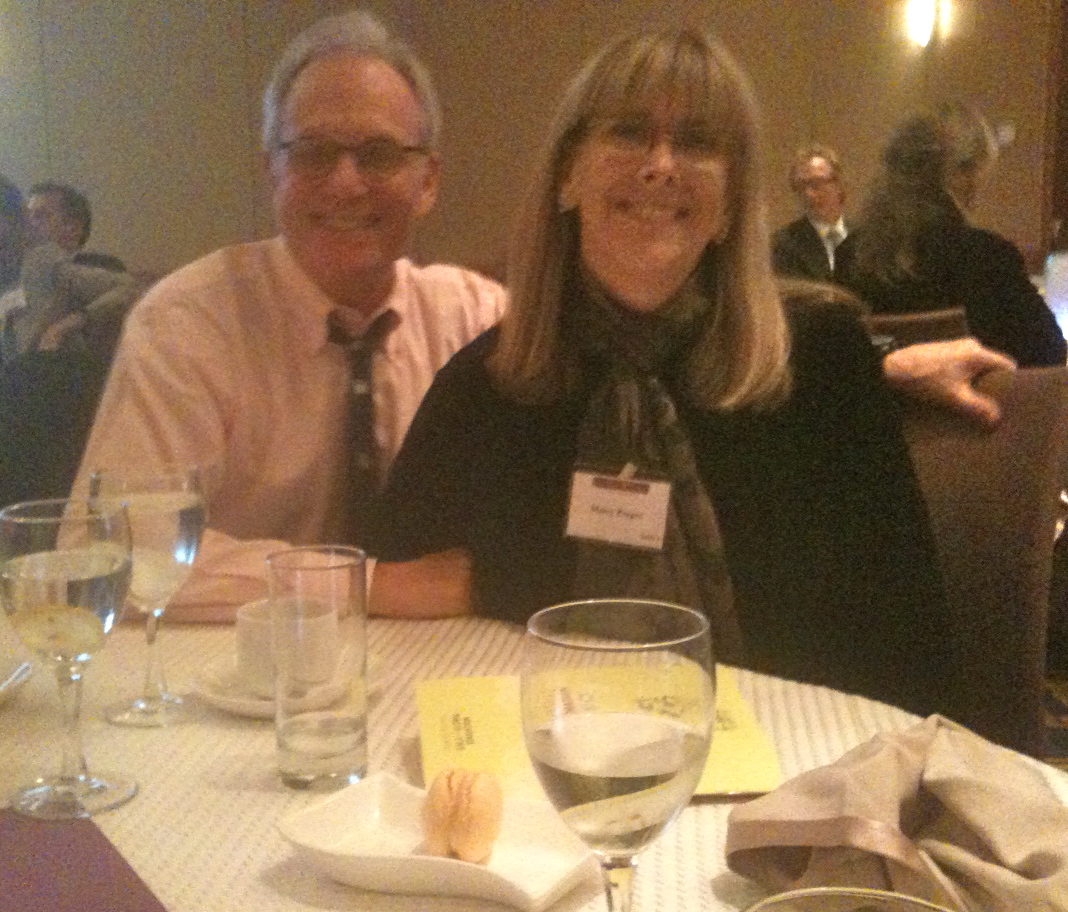
Long-time Brookline teacher Marcy Prager and her husband Robert are firm believers in global education.

Power librarian couple Ryan (Assistant Director of the Newton Free Library) and Jennifer (Primary Source's Librarian) Hanson enjoyed the wonderful evening.

My husband is always proud of me, and the feeling is mutual.
Come visit me on the Fire Escape!


October 23, 2012
Seven Dialogue Busters in Kid/YA Fiction
Last Saturday, I was honored to repeat a talk I gave on dialogue at the
New England Society of Children's Book Writers and Illustrators Spring Conference
. Jo Knowles, Cindy Faughnan, Karen Day, Mark Peter Hughes and I were invited to be part of
Encore 2012
, a one-day reprise of some of the workshops at the conference.
My job was to help us spruce up our dialogue, and I reviewed seven problems I see often in my own first drafts, giving examples of the opposite by reading aloud excerpts from some of my favorite books. Here's a summary of the "dialogue busters," as I call them (I promised I'd post them here on my blog), and writers who exemplify the better way:
Annoying Ascriptions (Laura Ingalls Wilder's Farmer Boy).
Abounding Adverbs (Sherman Alexie's Absolutely True Diary of a Part-Time Indian).
Badly-placed Beats. (Edward Eager's Half-Magic).
Random Reactions (L.M. Montgomery's Jane of Lantern Hill).
Pesky Pauses (Laurie Halse Anderson's Prom).
Disturbing Dialect (Maud Hart Lovelace's Emily of Deep Valley).
Irritating Information (Louisa May Alcott's Eight Cousins).
I left inspired by the other presenters and eager participants to dig into my own revision of Tiger Boy, coming in 2014 from Charlesbridge (revision due very, very soon).Come visit me on the Fire Escape!

My job was to help us spruce up our dialogue, and I reviewed seven problems I see often in my own first drafts, giving examples of the opposite by reading aloud excerpts from some of my favorite books. Here's a summary of the "dialogue busters," as I call them (I promised I'd post them here on my blog), and writers who exemplify the better way:
Annoying Ascriptions (Laura Ingalls Wilder's Farmer Boy).
Abounding Adverbs (Sherman Alexie's Absolutely True Diary of a Part-Time Indian).
Badly-placed Beats. (Edward Eager's Half-Magic).
Random Reactions (L.M. Montgomery's Jane of Lantern Hill).
Pesky Pauses (Laurie Halse Anderson's Prom).
Disturbing Dialect (Maud Hart Lovelace's Emily of Deep Valley).
Irritating Information (Louisa May Alcott's Eight Cousins).
I left inspired by the other presenters and eager participants to dig into my own revision of Tiger Boy, coming in 2014 from Charlesbridge (revision due very, very soon).Come visit me on the Fire Escape!


October 19, 2012
I'm a Girl Scouts Storyteller!
When the
Girl Scouts
asked about my stories, here's what I had to say:
Girl Scouts Storytellers Series: Mitali Perkins from Lexan Rosser on Vimeo.
Come visit me on the Fire Escape!

Girl Scouts Storytellers Series: Mitali Perkins from Lexan Rosser on Vimeo.
Come visit me on the Fire Escape!


October 16, 2012
DEAR TEEN ME: Authors Write Letters To Our Teen Selves

I'm delighted to be a contributor to DEAR TEEN ME , an anthology of letters to the younger versions of many young adult authors. The book is edited by Miranda Kenneally and E. Kristin Anderson and is available this month from Zest books. The blog tour to spread the word begins today, and 138 bloggers will chime in with their opinions about the book. Check out one of three trailers featuring the authors' words of wisdom (my Bollywood-esque head move is somewhere in there):
Come visit me on the Fire Escape!


October 9, 2012
Malala: The Pen Is Mightier Than The Sword
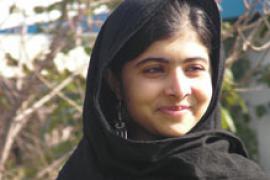
Malala Yousafzai
student, writer, freedom fighter
When I got up I was very happy knowing that I will go to school today. At school some girls were wearing uniform whereas others were in casual clothes. During assembly girls looked extremely happy and were hugging each other.
After assembly the headmistress advised us to cover ourselves properly and wear the burqa because it is a condition put by the Taleban.

This entry is from the BBC Diary of Pakistani Schoolgirl , written by Malala Yousafzai, a 14-year old living in Swat, Pakistan.
According to the BBC:
Private schools in Pakistan's troubled north-western Swat district have been ordered to close in a Taleban edict banning girls' education. Militants seeking to impose their austere interpretation of Sharia law have destroyed about 150 schools in the past year. Five more were blown up despite a government pledge to safeguard education, it was reported on Monday. A seventh grade schoolgirl from Swat chronicles how the ban has affected her and her classmates.
To my horror, I heard this morning that the Taleban tried to execute this brave writer . Would you join me in praying for Malala? Don't miss this short video to catch a glimpse of her courage:
For ideas about how to support writers like Malala, fighting for freedom with the power of words, visit Freedom to Write at PEN America. Come visit me on the Fire Escape!


October 1, 2012
Literary Lights For Children | Boston Public Library
Yesterday I was delighted to be one of four authors invited to attend the Associates of the Boston Public Library's 2012
Literary Lights For Children
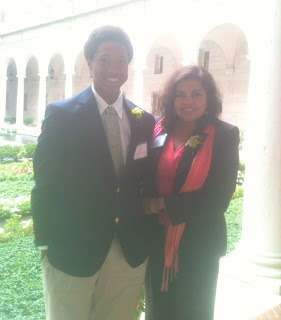
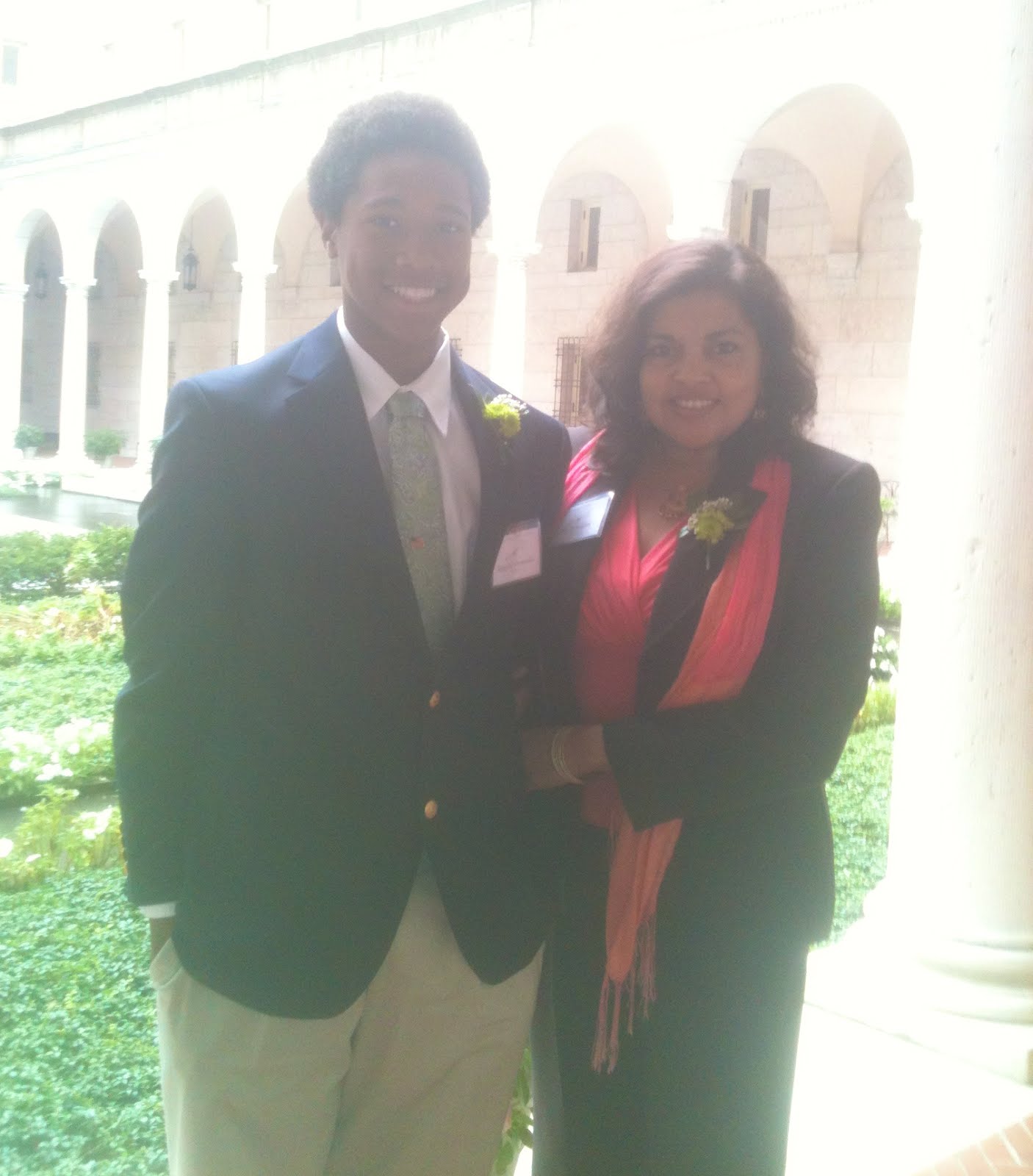
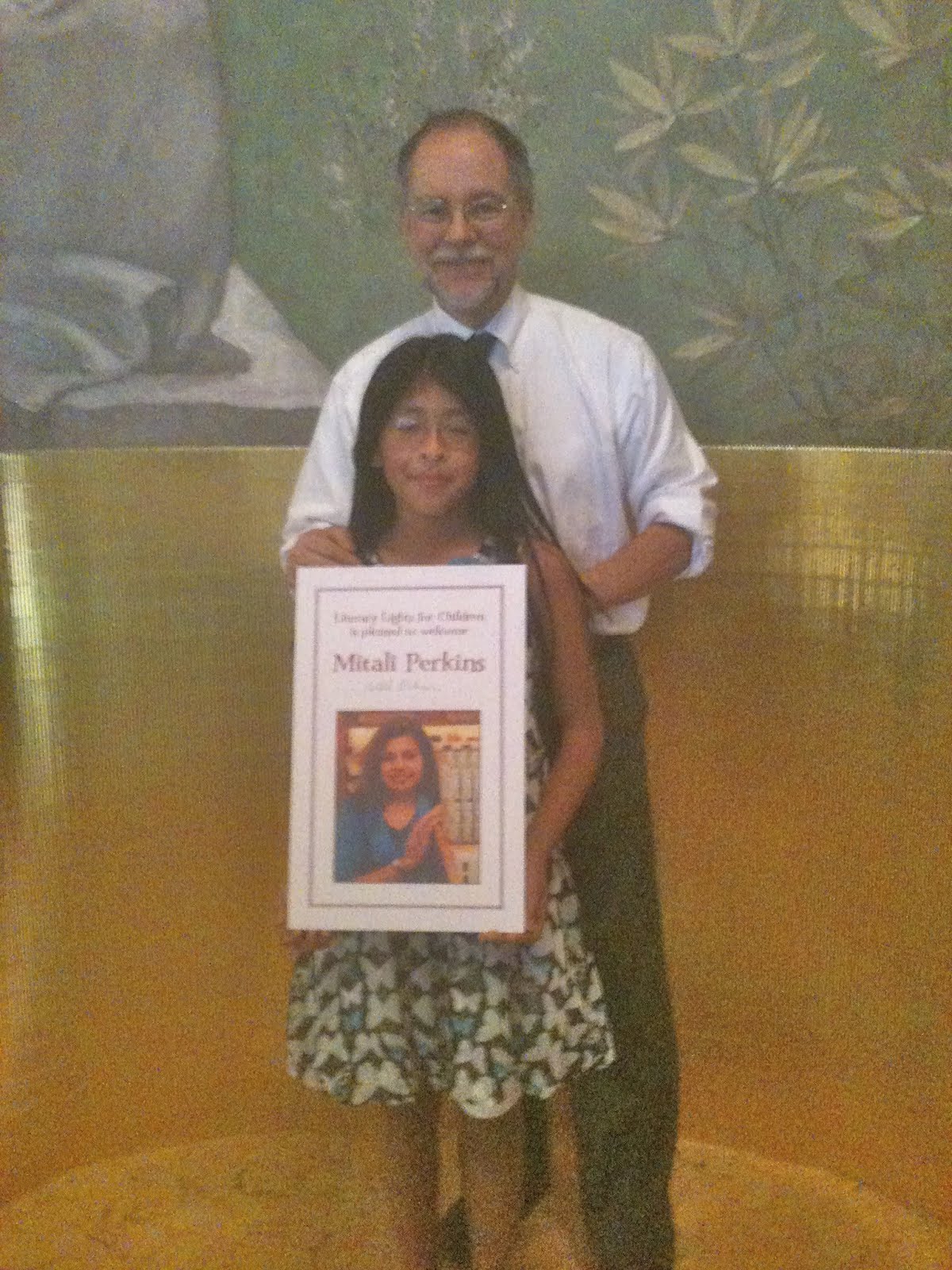
tea party. Each author (Kevin Hawkes, Christopher Paolini, Gary Schmidt, and myself) was introduced by a Boston middle schooler, and asked to speak about how we became readers and writers. My host was a dapper, delightful 8th-grader from Chelsea:
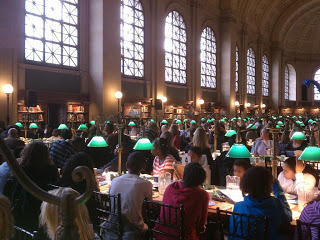
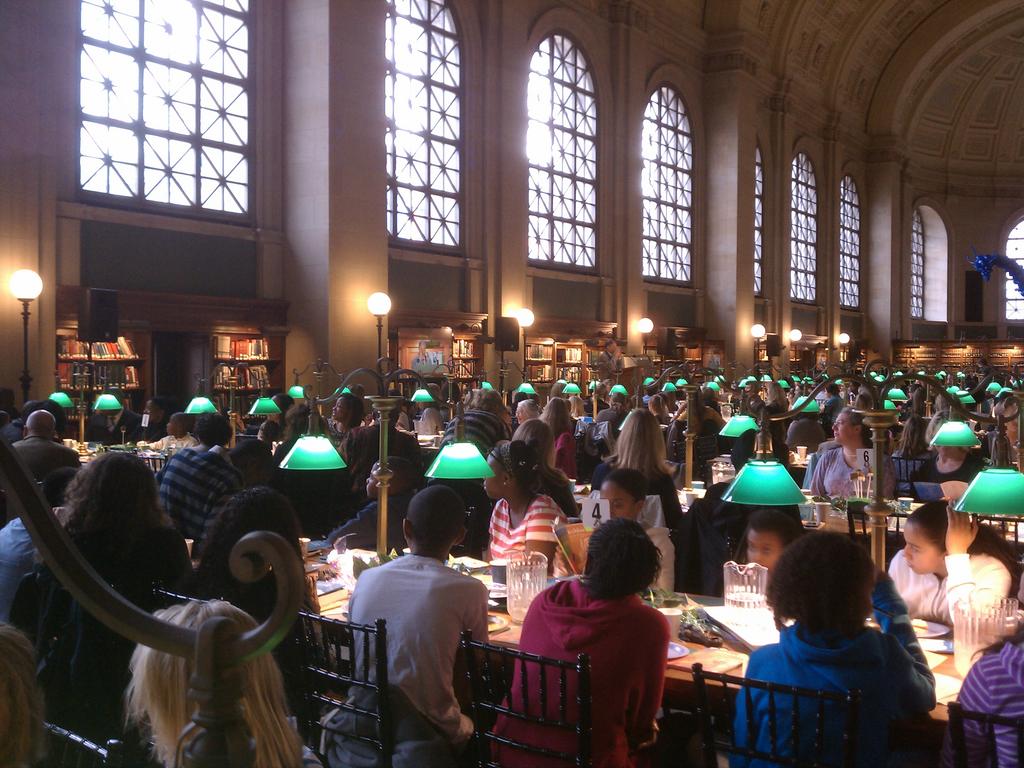
The Bates Reading Room in the Boston Public Library was packed (photo courtesy of Newton South High School's Denebola newspaper staff):
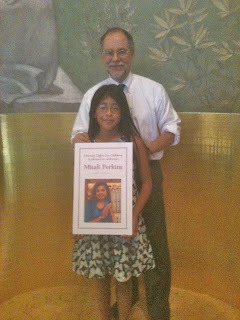
Host and emcee Gregory Maguire (WICKED) and his daughter were there to cheer us on:
I spoke second, and here's my introduction and talk, again courtesy of the Newton South High School Denebola newspaper staff (my bit starts about halfway through):
What a marvelous event, encouraging and uplifting, and in such a beautiful venue—a must-see if you visit Boston. Thanks to the Associates, to Charlesbridge (my publisher) for donating books, and to all who attended.
Come visit me on the Fire Escape!

The Bates Reading Room in the Boston Public Library was packed (photo courtesy of Newton South High School's Denebola newspaper staff):
Host and emcee Gregory Maguire (WICKED) and his daughter were there to cheer us on:
I spoke second, and here's my introduction and talk, again courtesy of the Newton South High School Denebola newspaper staff (my bit starts about halfway through):
What a marvelous event, encouraging and uplifting, and in such a beautiful venue—a must-see if you visit Boston. Thanks to the Associates, to Charlesbridge (my publisher) for donating books, and to all who attended.
Come visit me on the Fire Escape!


September 28, 2012
Jane Addams Children's Book Award Award Ceremony
The Jane Addams Peace Association and
the Women’s International League for Peace and Freedom
invite you to the
Jane Addams
Children's Book Award
59th
Annual Award Ceremony
Friday, October 19th at 2:30 PM
New York City
777 United Nations Plaza (2nd Floor)
on the corner
of 44th St. and 1st Ave.
Join us for a memorable afternoon of award
presentation and responses by authors and illustrators. Come meet and talk with the honored guests,
including Award winners Winifred Conkling, Susan L. Roth, and Cindy Trumbore
and honorees Anna Grossnickle Hines, Calvin Alexander Ramsey, John Holyfield,
Bettye Stroud, Kadir Nelson, and Thannha Lai. Enjoy a reception, hosted by The
Hastings Peace and Justice Fund, and an opportunity for book signing after
formal presentation of the awards. All the award books will be available for
purchase.
This event is free and open to
all.
Reservations are not
needed. Please come and enjoy!
The Award Winners
Sylvia and Aki by Winifred Conkling, Tricycle Press, an imprint of Random House
is the winner in the Books for Older Children category. The
Mangrove Tree: Planting Trees to Feed Families written by Susan
L. Roth and Cindy Trumbore with collages by Susan L. Roth, published
by Lee & Low is the winner in the Books for
Younger Children category.
The Honor Books
Heart and Soul:
The Story of America and African Americans by Kadir Nelson,
published by Baltzer &
Bray, an imprint of HarperCollins, and Inside Out and Back Again
by Thanhha Lai, Harper, an imprint of HarperCollins are
honor books for Older Children. Belle, the Last Mule at Gee’s Bend by
Calvin Alexander Ramsey and Bettye Stroud and illustrated by John Holyfield,
published by Candlewick Press and Peaceful
Pieces: Poems and Quilts About Peace by Anna Grossnickle Hines, published
by Macmillan, an imprint of Henry Holt, are honor
books for Younger Children
For additional information about the Jane Addams Children’s Book Awards
and a complete list of books honored since 1953, see www.janeaddamspeace.org For more information about the
Award event, contact JAPA Executive Director Linda B. Belle, 777 United Nations
Plaza, 6th Floor, New York, NY 10017-3521; 212-682-8830; japa@igc.org.
Come visit me on the Fire Escape!


