Don Graumann's Blog, page 7
April 19, 2023
Being verbose has a cost
Emails that are clear and concise are read and considered.
Emails that are vague and verbose are scanned and forgotten.


April 6, 2023
Systems over Plans

Instead of making plans,build systems. While striving to make intelligent decisions, you should bethinking in systems. Let me explain.
Systems beat Plans
When you make a plan,the best outcome is what you defined when you made the plan. You are trying toget from point A to B and determine that it takes steps 1, 2, 3, 4, and 5. Ifthe plan is executed and unfolds perfectly, you are at point B. You canactually do better.
When you build a system,the resulting process (the “how”) can more efficient than a plan. You aretrying to get from point A to B. You can see that the path is likely 1, 2, 3,4, and 5. But, you should assess the situation at each step. If you are drivingto a destination, what if the road conditions changed? Maybe the rough dirtroad shortcut you were avoiding is now paved? If you stuck to the plan, youwould have missed an opportunity to shorten the trip.
Another example is loadingdata into a spreadsheet for analysis. The task might also be expressed as A toB in steps 1-5. The insight from the analysis enables your team to takeadvantage of opportunities or remediate risks. Thus, shortening the cycle timeis a critical business objective. If it is long-running process, you shouldseek more efficient paths than business as usual. Maybe there are unleveragedfeatures of the spreadsheet that could help? For example, recognizing that thedata contains delimiters could completely eliminate steps 2, 3, and 4. I thinkyou get the point. But, it gets better.
When you build a system,the resulting outcome (the “what”) can be more effective than a plan.Continuing the example of loading data into a spreadsheet, frame the task as “Ato B?” with an emphasis on the question mark. Also, maybe the steps are “1, 2,3, 4, and 5?” with the emphasis on the question mark. If the overarching objectiveis being able to make intelligent decisions as quickly as possible, maybeanalyzing the data in a spreadsheet is not the right B (destination). Maybeloading it into a business intelligence (BI) application would be better? Maybethe BI tool can provide data visualization that also allows you to shorten thetime needed for the analysis? Even better, maybe it enables the discovery of insightsbeyond the capability of a spreadsheet that have an even greater impact on the business.
Systems, not plans, giveyou the opportunity to improve your initial destination, the what, and journey,the how.
Reinforce Guardrails
For your teams and foryourself, strive to build systems versus make plans. Thinking through plansprovides critical input in building systems. In fact, you may put a system inplace and the outcome is the same as the plan. That is not a bad thing. Itmeans you validated it was the best destination and path. But, if you startedwith the plan, you closed the door to considering alternative destinations andpaths that might be superior to the plan.
As I strive to lead, Iseek to build systems. I view it as putting and reinforcing guardrails for theteam and myself. If the team knows the objectives and understand theguardrails, they can drive to the destination.
Minds and Hands
Another way to thinkabout systems over plans is in terms of your team’s minds and hands. If yourely on setting plans, you are largely using only your team’s hands. Yes, theymight have input when you are setting up the plan. But, once the plan is set inmotion, they are executing…only using their hands.
If you reinforce guardrailsand the objectives (build a system), you are leveraging your team’s minds andhands. The wisdom “none of us is as smart as all of us” applies. Like expressedearlier, they may end up at B using steps 1-5. But, they might surprise you by determininga more relevant destination and better path. For example, how often does aclient ask for something specific that is not what they actually need? If youare executing plans, the client gets what they asked for, but not what theyneed (the best outcome). If you build systems, the client benefits frommeaningful value add.
Also, while you are theboss and think you know the right path, remember that you used to be where yourteam is. You leveraged your mind and hands that justified rising to your level.Give your team the same opportunity. It only reflects well on you. Do not closethe door to adding ever-increasing value by insisting on your plan (versusbuilding a system).
Initial Unknown is OK
One area plans beatsystems is initial certainty. With plans, you who the specific and intendeddestination when you start. With systems, the initial intended destination isdirectional. You might end up someplace else. There is unknown. If control isyour priority, you will struggle with systems. If your management does notappreciate systems, you will struggle with systems. Given the ever-acceleratingrate of change, plans become obsolete more quickly than ever. So, be OK withthe unknown. Be ready to pivot in the face of new intelligence. Commit tosystems over plans.
Build systems, not plans.You end up at a better destination, the what. You optimize the path, the how.You empower your team by leveraging their minds and hands. They are the onesdriving. You are the seldom noticed guardrails.
March 15, 2023
“I sent an email” is a bad excuse
Without acknowledgement, a sent email does not assign responsibility. Don’t be someone who hides behind “I sent an email.”
March 1, 2023
Pause before Resetting Expectations
When you lower expectations, you increase the probability of meeting them. But, are you also settling for something incremental vs transformational?
February 16, 2023
Ruthless Prioritization
Most days do you get ahead, stay even, or fall behind? If the latter two, you might be trying to do too much. Consider practicing “ruthless prioritization” to ensure you are focused only on what is truly important?
January 31, 2023
Can you be a Servant Leader AND an Executive?

Over the last two years,I have been struggling with something. My personal leadership model is based onservant leadership. My professional role is at the executive level. To me,these two things seemed to be in conflict. If they are, it means that thecareer path of servant leaders is capped. Yet, I know that is not true becauseI have studied leaders at the highest levels who are clearly servant leaders. Inresponse, I think I have found the path through. I am growing as a result. Thispost shares how my thinking has evolved.
What is ServantLeadership?
If you are a servantleader, your top priority is your team. You fully recognize that it is yourteam that delivers the value and drives the business. You understand that ifthe business is dependent on your individual contributions, it is not scalableor sustainable. Your team always comes first. There is an implication ofengaging at a low level.
What is Executive Leadership?
If you are an executive,you are responsible for broad scope. You are a leader of leaders. You areresponsible for strategy. Strategy is setting long-term objectives and workingwith the team to set up the system to accomplish them. Note I said “system”versus “plan.” That is another interesting topic for a future post. Being anexecutive means that you are engaging at a high level.
The Conflict
Why did I believe thatservant leadership and executive leadership were in conflict? It stems fromlevel of engagement.
As a servant leader, youdo not ask your teams to do anything that you would not do. You excitedly “rollof your sleeves” and work “shoulder to shoulder” with your teams. You haveretained some ability to understand and add value on a tactical and operationallevel. Put another way, you are intimately in touch with the day-to-day. If youare able to do it, the credibility you build with the team is very deep.
If you are an executive,your responsibility is varied and large. There are many areas you cannot godeep because you do not know that aspect of the business and the sheer size. But,you know that selectively going deep still builds credibility with the entireteam. Since you believe in servant leadership, you go deep. But, there is acost.
You are dedicating ameaningful focus and time understanding and contributing to the day-to-day.That time and focus is not being aligned to strategy. Worse, you might actuallybe undermining your leaders who are responsible for the areas where you havechosen to go deep. That is the opposite of what a servant leader would want.
Another drawback is thatyou are likely overextending yourself. If you go deep here, why not also tryand go deep there? It leads to back-to-back-to-back meetings and very long days.It leads to burnout.
The Solution
How am I combating theconflict between servant leadership and being an executive? I am focused onthree things:
Deprioritize Insecurity : Your teams greatlyappreciate your servant leadership. Your presence in the day-to-day is a tangibleexample that you care about them. And, in my experience, they express thatappreciation. While it is not your goal, the external affirmations feel good.Once you get used to it, it feels like something is wrong if it slows down. If youtruly are an executive, the positive feedback will lessen. You are less intouch with the day-to-day and you are in contact with fewer people (because youare trusting your leaders to lead their teams). You will have to make decisionsfocused on the long-term that have visible short-term negative implications. Asa result, you actually start getting some negative feedback. To combat this, youfocus on your decision quality, communicate appropriately, and drive forward. Inother words, if you are objectively confident that you are doing the rightthing for the long-term, press forward. Trust your Leadership Model : If you have anexplicit and simple leadership model, empowering and aligning your leaders andteam will be foundational. You have isolated the principles and methods youbelieve drive sustainable results. It is what “Strategic Pause,” my leadershipbook, is all about. “Trust the System” would be another way to express thispoint. Your system versus your personal level of engagement is how you practiceservant leadership. Be Strategic : As an executive, your job is to be strategic.You assess the market, articulate the value proposition, set the long-termobjectives, empower and align your leaders, and reinforce the guardrails of thesystem. In today’s world, change continues to accelerate. This makes being an executivemore challenging than ever. Recognize that and align your time and focusappropriately. If you are going deep in the name of being a servant leader orto counter your insecurity, you are stealing from your executive role. Do yourjob.Opportunity, NotConflict
Believing in servantleadership and being an executive responsible for large scope is an opportunitymore than a conflict. It is the chance to further servant leadership morebroadly. It is the opportunity to further your leadership model, your way. Itrequires practicing servant leadership through your system and direct lineleaders versus your individual contribution on a lower level. Taking this approachis being strategic. Is it strategic servant leadership.
© 2021 Don Graumann. All Rights Reserved. Other than personal sharing, please do not redistribute without permission.January 26, 2023
Being wordy hurts more than you think
If your communication is inefficient, it does not take long for it to also become ineffective. More and more of your audience will lose patience and not do the work to dig out your important points. This tweet could be more efficient.
January 19, 2023
Don’t mess with Flow State
Do not step away from flow state (or “being in the zone”) and expect it to be there when you get back. If you are flowing (and creating your best work), strive to remove obstacles so you can keep rolling.
January 5, 2023
Prioritize Thinking
When do you think? As needed or when you have time? Dedicate the time. Make the rest of your calendar work around it versus the other way around. It is the difference between being on your toes versus on your heels.
December 7, 2022
strategicpause:“Strategic Pause” was launched 1 year ago. My...
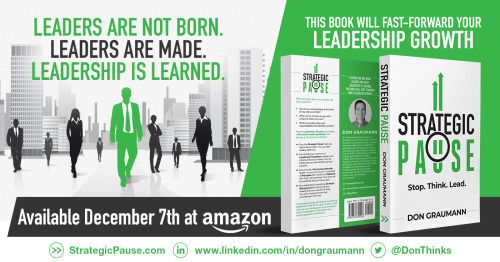
“Strategic Pause” was launched 1 year ago. My passion project 20 years in the making. I am humbled by the stream of feedback that my book is accelerating leadership and personal growth. The principles and methods apply to work and life in general.
Are you or someone you know ready to take a Strategic Pause?
Get it at Amazon and many other places.
Today is the 2nd anniversary of “Strategic Pause” being published!If you could pop open my head, it is my leadership operating system. Practicing the Strategic Pause and building a personal leadership model should be your leadership operating system too.
And, it also makes a great winter holiday gift!
“Strategic Pause” on Amazon.