Raquel Stecher's Blog, page 7
June 23, 2022
Hot Saturday (1932)

Bank clerk Ruth (Nancy Carroll) is a prized date for a "hot Saturday". Fellow bank employees Archie (Grady Sutton) and Connie (Edward Woods) have their eye on Ruth. But they're about to face major competition with rich playboy Romer (Cary Grant). He's invited the bank employees and all their friends for a weekend party at his lakeside mansion. It's an opportunity for Romer to get some extra time with the beautiful Ruth who attends the party with Connie. When Ruth rejects Connie's advances, he plants a false rumor that Ruth slept overnight at Romer's mansion. Aided by Ruth's archnemesis Eva (Lilian Bond), the rumor spreads like wildfire causing chaos. Her old love interest Bill (Randolph Scott) wants Ruth to marry him, much to the delight of her parents Ida (Jane Darwell) and Harry (William Collier Sr.) but what will happen once he finds out about Romer?
Directed by William A. Seiter, Hot Saturday (1932) is a vivacious jazz age drama that explores sexual politics and how rumor and scandal had devastating effects on women in society. This is Cary Grant's first leading role. It's an unusual characterization of a wealthy playboy. Romer is a genuine guy throughout. He has no machinations and his character doesn't have to overcome any moral failings to win the girl. Romer genuinely likes Ruth. This contracts with Connie, played by Edward Woods of Public Enemy fame, who isolates Ruth and comes close to sexually assaulting her. Nancy Carroll plays into the sweetheart role as a young middle class woman who gets caught up in a bad situation. Randolph Scott's character doesn't appear until half way through the movie. Bill has the appearance of being a nice guy but he ends up being just as toxic as the rest of them. It's interesting that both the playboy and the nice guy do not meet our expectations of their roles in the story.
This film is a pre-code but it lacks some of the spice that comes with movies from that era, especially ones that deal directly with sex and morality. Carroll does the typical undressing scene that we've all witnessed in many a pre-code (she also partially undress her teen sister Annie, played by Rose Coghlan but the camera moves away so we don't see anything). Ruth sleeping with Romer is boldly suggested a few times throughout the story. She's also put in various precarious positions where she is vulnerable to sexual assault. Otherwise, it's a very tame pre-code film.
For those who love the era, Hot Saturday (1932) is a time capsule of early 1930s frivolities. Cary Grant's character Romer is driven by a chauffeur in this car with what almost looks like a rumble seat. Romer and his date sit with their laps covered by a partial hood which the chauffeur has to lift it up to let them out. (If anyone has more details on this car please let me know!). It's fascinating to look at but seems quite dangerous. At Romer's lakeside mansion party, he has a custom made hot dog/milkshake cart which is wheeled around the party to serve the guests. Carroll wears a variety of fun outfits including cloche hats and secretary style blouses and dresses.
Hot Saturday (1932) is available on Blu-ray from Kino Lorber. It includes subtitles in English, a reversible cover (see both sides below) and commentary from film historian Lee Gambin. The commentary was really fascinating. There is a lot of cultural context given and some really interesting insights into how the film portrays the societal mores and gender politics of the time. There were times I didn't agree with Gambin's perspective. He notes that Edward Woods comes off as a good guy in the role of Connie and then he takes an unexpectedly dark turn. As a woman I knew from the very first scene that Connie was up to no good so his character's story arc was no surprise. This is definitely a movie that women and men will interpret differently.
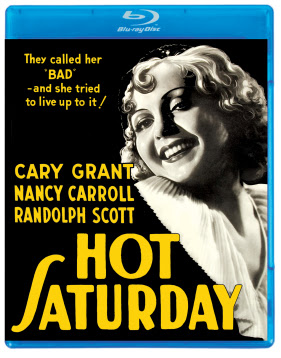

Amazon — B&N — Deep Discount — Kino Lorber
Thank you to Kino Lorber for sending me Hot Saturday (1932) for review!
All content is property of Out of the Past: A Classic Film Blog. Copyright © 2007-2022

June 2, 2022
Camera Man: Buster Keaton by Dana Stevens

Camera Man Buster Keaton, The Dawn of Cinema, and the Invention of the 20th Century
By Dana StevensAtria BooksHardcover ISBN: 9781501134197432 pagesJanuary 2022
Amazon — Barnes and Noble — Powell's
“I think I have had the happiest and luckiest of lives. It would be ridiculous of me to complain… I count the years of defeat and grief and disappointment, and their percentage is so minute that it continually surprises and delights me.” — Buster Keaton
You'd be hard-pressed to find a more beloved figure from film history than Buster Keaton. He's wowed generations of moviegoers, some born several decades after his death in 1966, with his physical comedy and incredible stunt work. And he did it all with a straight face. Who can forget the house frame falling over Keaton in Steamboat Bill Jr. (1928), the death-defying stunts in The General (1926), Keaton running over train cars and onto a water tower in Sherlock Jr. (1924) or the epic chase scenes in Seven Chances (1925)? He did it all himself, no stuntman needed and made it look effortless. Keaton was also a pioneer in filmmaking. He thrived in the era before studios took over Hollywood. With his years of vaudeville training, he knew what audiences liked and developed that on a bigger scale for moviegoers. With the birth of cinema, he learned as he went, preferring to work independently and often writing, "choreographing" and directing his own feature films and shorts. Today Keaton's work is appreciated by many, even those who are new to classic movies. You'll hear those who are normally adamantly against watching black-and-white movies from the past being open and willing to watching Keaton perform his magic on screen.
Film critic Dana Stevens offers a look at Keaton's life and career in her book Camera Man: Buster Keaton, The Dawn of Cinema, and the Invention of the 20th Century. This is a life-and-times style book rather than a traditional biography. And what I mean by that is the book offers the reader equal parts biography and cultural history which places its subject, in this case Buster Keaton, in context with the eras they lived through. You won't get a play-by-play on everything that happened in Keaton's life and career. Instead, Stevens offers a look at Keaton through a cultural history lens and readers with reap the rewards from all the historical context.
The chapters are thematic essays that follow the course of Keaton's life chronologically but each focus on a particular subject with a couple of context points. Some of these include women filmmakers, child cruelty regulations, the birth of radio, film and television, movie magazines, collegiate culture, racism, indie filmmaking vs. Hollywood studios, etc. There is also in-depth biographical information on key figures from Keaton's life and career including Keaton's three wives, Roscoe Arbuckle, Robert Sherwood, F. Scott Fitzgerald, Louis B. Mayer, Irving Thalberg, Charlie Chaplin and more. These context points make for some illuminating reading and really help readers understand Keaton's world.
Stevens is a fantastic writer and I kept stopping to write down a quote I liked. Here are a few:
“For Keaton, every potential home is a space of danger and transformation; no facade stays standing for long… The ephemerality of the built world reveals the foundational homelessness of Buster’s character, whose defining trait is his ability to move through chaos while remaining miraculously unperturbed.”
“The Hollywood economy was large enough that Wall Street, another institution that rose to new heights of power and cultural influence in the 1920s, had started to play a key role in the financial and creative decisions of the top movie moguls…the big banks of the East Coast, where the money side of the business was still based, got skittish about lending large sums to small studios with spotty box-office records. To get back their investment, they needed a reliable flow of commercial hits.”
“Buster Keaton was ahead of his time in many ways but when it came to the ambient cultural racism of the Jim Crow era, he was unfortunately very much a product of it.” "Some accounts of Keaton’s late life—the ones that want to frame him as a tragic figure permanently destroyed by Hollywood—present his time performing with the circus as some sort of comedown… in fact, he held the prize second-act slot at one of Europe’s most prestigious and innovative circuses…”
If you're a fan of Buster Keaton and love cultural history, then Camera Man is a must read.
Note: For those who will want a more traditional biography, author James Curtis' book Buster Keaton: A Filmmaker's Life also came out this year.
.png)
This is my first review for the 2022 Classic Film Reading Challenge.
Thank you to Atria Books for sending me Camera Man for review!All content is property of Out of the Past: A Classic Film Blog. Copyright © 2007-2022
May 25, 2022
2022 Classic Film Reading Challenge
2022 #ClassicFilmReading Challenge May 25th to September 15 2022
Today I'm thrilled to announce the 2022 #ClassicFilmReading Challenge! Every year I host this challenge to encourage you to read and review six classic film books this summer/winter (depending on where you live.
If you don't think you could read and review six books but could review one or two, I encourage you to still join! It's fun to participate even if you don't complete the challenge.
If you do finish all six books then you 1) get bragging rights and 2) are automatically entered into a giveaway to win a Kino Lorber Blu-ray or DVD of your choice. Open internationally!
Throughout the challenge I'll be sharing review round-ups here on the blog and sharing reviews on Twitter (@RaquelStecher). Make sure you use the official hashtag #classicfilmreading when sharing your reviews. And feel free to share your #classicfilmreading stack to showcase what you plan to you plan to read this summer/winter.
Here is how the challenge works.
Sign up for the challenge Read a classic film book Write a review and post it on your Blog, Podcast, YouTube, Instagram, LibraryThing or Goodreads. Must be a public post. Use hashtag #classicfilmreading on social media.Submit your review link (see form on the official page)Repeat until you have read and reviewed 6 books!Review 6 and be automatically entered to win a prize.
Challenge runs from May 25th until September 15th, 2022. Sign-up before July 15th.
All of the details of the challenge are on the official page including the sign up form, the book review submission form, rules, deadlines and what counts as a classic film book.
I hope you'll join me this year!
Visit the official page for more details and to sign up!
All content is property of Out of the Past: A Classic Film Blog. Copyright © 2007-2022
May 22, 2022
Dervish Dust: The Life and Words of James Coburn by Robyn L. Coburn

Dervish Dust The Life and Words of James Coburn by Robyn L. CoburnPotomac BooksHardcover ISBN: 9781640124059424 pagesDecember 2021
Amazon — Barnes and Noble — Powell's
“I take in all the impressions and information [about the character]. And when the time comes for action, I just let it go. It’s jazz acting. It’s like when Sarah Vaughan sings a song. She sings the lyrics, but she doesn’t sing it exactly the way it was written. It bears her style. That’s the way it is with roles. Each character has a style. Once you find out the character’s style it becomes really simple.. You don’t think about it. You just let it flow.” — James Coburn
James Coburn was one of the coolest actors to ever grace the silver screen. With his tall, lanky frame, wide grin, distinctive deep voice and personable nature, you can't help but be drawn to him. He just seemed like the sort of guy that you could hang out with and come away with a really cool story or two to share. Coburn made some great movies, and some not so great ones, and he elevated each of them with his magnetic screen presence. His career was bookended with some fantastic roles as either supporting player or the central star in films like The Magnificent Seven (1960), The Great Escape (1965), Our Man Flint (1966), A Fistful of Dollars (1971), The Last of Sheila (1973) and The Affliction (1997), the latter of which earned him an Academy Award. Beyond acting, Coburn dabbled in screenwriting, producing and directing. He was skeptical of television but the medium brought him great exposure and an opportunity to appear in numerous shows and made-for-tv movies. Here was a man who was devoted to his craft, eager to take on new challenges and beloved by his fellow cast members. At the end of his life, he still worked tirelessly as an actor, enjoying a new wave of enthusiasm for his work after earning his Oscar. He and his second wife Paula created the James and Paula Coburn Foundation (JPCF) "with the aim of supporting several arts and medical charities" which is still active to this day. The world lost James Coburn two decades ago but what remains is a joyful legacy.
“Coburn’s intense desire to control his own career and not be part of projects that were subject to the misapplied priorities, as he saw them, of the studio bigwigs... When possible he liked being hired early so he could influence the development of the script and characters.” — Robyn L. Coburn
Dervish Dust: The Life and Words of James Coburn by Robyn L. Coburn is an excellent biography that really captures the spirit of its subject. The author is Coburn's daughter-in-law, who is married to Coburn's son James H. Coburn IV. The book avoids the trappings of a familial biography with its straightforward approach and honest look at Coburn's life. The focus is primarily on his acting career but there are also plenty of stories about his childhood during the Great Depression, his education, his marriage to his first wife Beverly, their two children, the subsequent bitter divorce, his many romances, his second wife Paula and his debilitating rheumatoid arthritis. Among Coburn's hobbies were studying Eastern culture and medicinal practices, collecting art, smoking marijuana, training in martial arts with his friend Bruce Lee and riding his beloved Ferraris. The Coburn portrayed in the book is a complicated man who was both good natured and highly driven.
 Jennifer O'Neill and James Coburn in The Carey Treatment (1972)
 James Coburn with one of his Ferraris.
According to the author, Nancy Mehagian was recording conversations with Coburn in 2002 for a potential memoir. Unfortunately, Coburn died that same year. Dervish Dust is the Coburn memoir we never got to read. The author adeptly uses those recordings to channel Coburn's voice throughout the book. It gives the biography a more intimate feel. Overall, this was a compelling and informative biography. There was lots to glean from it. My only small complaint is that I wish they had used an image of James Coburn wearing his signature grin on the cover.

If you love James Coburn as much as I do, make sure you check out Dervish Dust and let me know what you think!
A big thank you to Potomac Books for sending me a copy of Dervish Dust to review.
All content is property of Out of the Past: A Classic Film Blog. Copyright © 2007-2022
May 4, 2022
Undercrank Productions: Little Old New York (1923)

What would you do for a million dollars? For Patricia O'Day (Marion Davies), she would go as far as live her life as a boy so that her family could inherit what was rightfully theirs. When Patricia's rich American uncle passes away, she and her father John (J.M. Kerrigan) are visited in Ireland by the uncle's proprietor. The uncle's will stipulates that the sole heir of the $1 million fortune is Patrick O'Day (Stephen Carr), Patricia's brother. Patrick has two months to travel to New York to claim the inheritance or lose it forever. However, Patrick is gravely ill and won't survive the treacherous journey over the Atlantic.
Upon arrival, Patricia plays the part of her brother by donning a page boy haircut and boys clothes. She meets Larry Delavan (Harrison Ford, the other one!) whom everyone, including Larry himself, thought would inherit his step-father's fortune. The story follows Patricia as she plays the part of Patrick, enters high society, invests in steamboat technology, gets caught up in the world of sports gambling, faces an identity crisis and falls in love.
Little Old New York (1923) was a box office hit for star Marion Davies. The film was so popular that it beat box office sales for the previous record holder Robin Hood (1922). Based on the play by Rida Johnson Young, the film adaptation was produced by William Randolph Hearst's company Cosmopolitan Corporation and filmed at his studio on 127th Street and 2nd Avenue in New York City. A fire broke out at the studio while filming was still underway. The negatives for the film, which at that point was two-thirds complete, were miraculously salvaged. However, costumes and sets had to be recreated.
A big marketing push for the film included a press conference with Davies, an invitation for the public to be extras in one of the scenes and having theater usherettes dress like characters in the movie (not sure if they were made to mimic Marion Davies' boy look or the other female characters wearing 19th century garb). The film premiered at Hearst's Majestic theatre in Columbus Circle and a couple months later premiered in London. Little Old New York was remade in 1940 with Alice Faye in the lead role.

Marion Davies is absolutely charming as the lead character. She uses her feminine wiles and masculine energy to adeptly play this binary role. I'm really drawn to stories about gender representation especially when they spotlight stereotypes in a way that criticizes them (whether intentional or not). I would recommend this film to fans of silents, Marion Davies and period pieces.
At 1 hour and 47 minutes, Little Old New York feels a bit too long. A natural resolution to the story could have happened much earlier in the film. Overall, the movie watched more like chapters in story of Patricia/Patrick O'Day's adventures rather than one cohesive feature film.
Little Old New York (1923) is available on DVD from Undercrank Productions, in association with Edward Lorusso, and features a lively original score by accompanist Ben Model. According to Undercrank's website, the film is presented from a 2k digital scan made from the Library of Congress's 35mm nitrate print. The DVD is a result of a Kickstarter campaign and also includes an excerpt from Hold Fast (1916).
Shop Little Old New York (1923) DVD at the following retailers.
Amazon — Barnes and Noble — Deep Discount — Movies Unlimited
Thank you to Undercrank Productions for sending me a copy for review!
All content is property of Out of the Past: A Classic Film Blog. Copyright © 2007-2022May 1, 2022
2022 TCM Classic Film Festival: Day #4 Recap

Waterloo Bridge (1940)
Bright and early on the final day of the festival, I headed over to the Chinese Multiplex for a special screening of Waterloo Bridge (1940).


The film was introduced by author Sloan De Forest. I'm a big fan of her books and it was great to finally see her in person (had a great chat with her afterwards!). Waterloo Bridge (1940) stars Vivien Leigh and Robert Taylor as two lovers from completely different social sets who get separated during WWI only to have a devastating reunion sometime later. It's based on a 1930 play and was adapted to screen as a pre-code in 1931. Unbeknownst to us and even to De Forest, the print being screened was the British censored version which cut out the more suggestive scenes in relation to Vivien Leigh's character.
Club TCM
A brief visit to Club TCM helped me rest and recharge for the final hours of the festival. On display were costumes from a few notable classic films. It was difficult to take pictures so I did my best to snap one of these costumes Ingrid Bergman and Paul Henreid wore in Casablanca (1942)


Live Read: I Married a Monster from Outer Space (1958)

I've never been to a live read before so I jumped at the chance to attend this one. Led by Dana Gould, a group of comedians reenacted the cheesy sci-fi movie I Married a Monster from Outer Space (1958). The script was read by actors David Koechner, Laraine Newman, Jonah Ray, Janet Varney and Baron Vaughn. Musician Eban Schletter performed live music and sound effects for the event.
I wasn't sure what to expect but I did think they would show the actual movie, or at least clips of it, during the live read. Instead, it was just the actors taking turns at the mic to read the dialogue with a static background on the screen behind them.
The live read was a helluva lot of fun. I was in the second row with some friends and we had the best view in the house.


Coffy (1973)
The closing night movie was one of my top selections for the festival. There was a massive line to get in and I'm glad I made it. The event started with an interview by TCM host Prof. Jacqueline Stewart and Coffy star Pam Grier. I think Stewart only got two questions in because Grier had much to say and a lot of love to share. And what better way to enjoy this blaxploitation classic for the first time with the film's star and a lively crowd in attendance.

Closing Night Party
The closing night party is always bitter sweet. It's an opportunity to catch up with anyone you may have missed and to say goodbyes. I didn't stay long because the poolside party was quite crowded. I did get an opportunity to chat with former child star Gordon Gebert. (A big thanks to Laura who helped get his attention for me!). This was a real joy. I was able to tell him how much Holiday Affair (1949) means to me. He must have heard that a million times that evening. He was so gracious and told me stories about working with Robert Mitchum, Janet Leigh, Burt Lancaster and Norman Lloyd.

So you may be asking, what was the best part of the TCM Classic Film Festival? The people of course! I got to spend so much quality time with good friends, acquaintances and complete strangers. The festival is like a big reunion for me and I cherish all the moments I get to spend with all of my far away friends. I didn't share much about my friends in these posts. However, I shared plenty on my social media. Make sure to head over to Twitter and look up #TCMFF @raquelstecher to see all the fun we had during the festival. I appreciate the TCM staff as well as all my amazing friends for making this a festival to remember.
I hope you enjoyed my TCMFF coverage!Day #1 RecapOpening Night Red Carpet EventDay #2 RecapDay #3 RecapTCMFF YouTube VideosAll content is property of Out of the Past: A Classic Film Blog. Copyright © 2007-2022
April 30, 2022
2022 TCM Classic Film Festival: Day #3 Recap
The Flame and the Arrow (1950)
My day started with an impossible time block. There were so many good events happening at the same time and it was difficult to chose. It came down to one person: Gordon Gebert, the child star of one of my all-time favorite movies of all time, Holiday Affair (1949). It was imperative that I see him in person! And he was going to be at the special screening of The Flame and the Arrow (1950).


This swashbuckler starring Burt Lancaster, Virginia Mayo, Nick Cravat, Norman Lloyd and of course Gordon Gebert, was being screened at the Hollywood Legion Theatre. Ahead of the film there was a special presentation by visual effects artist Craig Barron and sound designer Ben Burtt in which they discussed the film's use of color, forced perspective and painted backgrounds and the various sound effects. They also shared the story of Lancaster and Cravat's working relationship as acrobats turned actors and their lifelong friendship and we were treated to some rare home video clips of the two palling around.
The presentation was followed by an interview with Gordon Gebert who delighted us with all sorts of stories about being a child actor working for Warner Bros. and RKO, being on set of The Flame and the Arrow, his stunts in the film and learning archery and ballet for certain key scenes. After the presentation and interview we were treated with a 1960s Technicolor print of the film. It was a fun movie made better by the amazing cast and Jacques Tourneur's direction.
The French Way (1940)

The next block was a difficult one too. I had to choose between several amazing options, including seeing The Hustler (1961) with Piper Laurie in attendance. But I opted for the Josephine Baker film The French Way which was made in 1940 but released in 1945 due to the war. Film historian Donald Bogle gave a presentation which included lots of background information about Josephine Baker herself. We were also treated with an archival interview of Baker on a cruise ship and a beautiful restoration of the film by Jeff Joseph of SabuCat Productions. International films are few and far between at the festival and I'm always delighted to catch at least one during my festival experience.
 Donald Bogle
The French Way was a beautiful little film. Baker shines despite the fact she's given limited screen time and no love interest. Micheline Presle is also in the film playing a young French woman debating whether to elope with her beau. Filmed during the French occupation, the story includes the characters preparing for air raids including a scene where Josephine Baker of hobo Leon (Lucien Baroux) to help tape up her windows and several scenes in bomb shelters.
Blue Hawaii (1961)

My goal at this year's festival was to attend all three of the poolside screenings, even if I didn't stay for the whole movie. The third and final screening was the Elvis movie Blue Hawaii (1961) which is quite perfect for the poolside setting. Attendees dressed up Hawaiian shirts, wore leis and sipped on Blue Hawaiian cocktails. I was planning on leaving early to attend to attend the special screening of Drunken Master II (1994) but alas after having a few of those cocktails I was quite literally too drunk to go see the other film. After a couple of really tough years, this was just the sort of evening I needed.

Stay tuned for more TCMFF coverage!
Day #1 RecapOpening Night Red CarpetDay #2 RecapTCMFF YouTube videosAll content is property of Out of the Past: A Classic Film Blog. Copyright © 2007-2022April 28, 2022
2022 TCM Classic Film Festival: Day #2 Recap

Festivities on the second day of the TCM Classic Film Festival kicked off with a hand and footprint ceremony honoring actress Lily Tomlin. Hosted by TCM and held on the courtyard of the TCL Chinese Theatre (formerly Grauman's Chinese Theatre), the event began with introductions by TCM host Ben Mankiewicz and actress Jane Fonda as well as a speech by Lily Tomlin herself. Special guests included producer George Schlatter, actress Rita Moreno and fellow Grace and Frankie star June Diane Raphael. In addition to her hand and footprints, Lily Tomlin added small footprints and signature commemorating her character Edith Ann from Rowan and Martin's Laugh-In.
Check out my YouTube video of the ceremony below (and make sure to subscribe to my channel!).

 Ben Mankiewicz, Lily Tomlin and Jane Fonda
 Lily Tomlin, George Schlatter and Jolene Brand
 Rita Moreno and Lily Tomlin
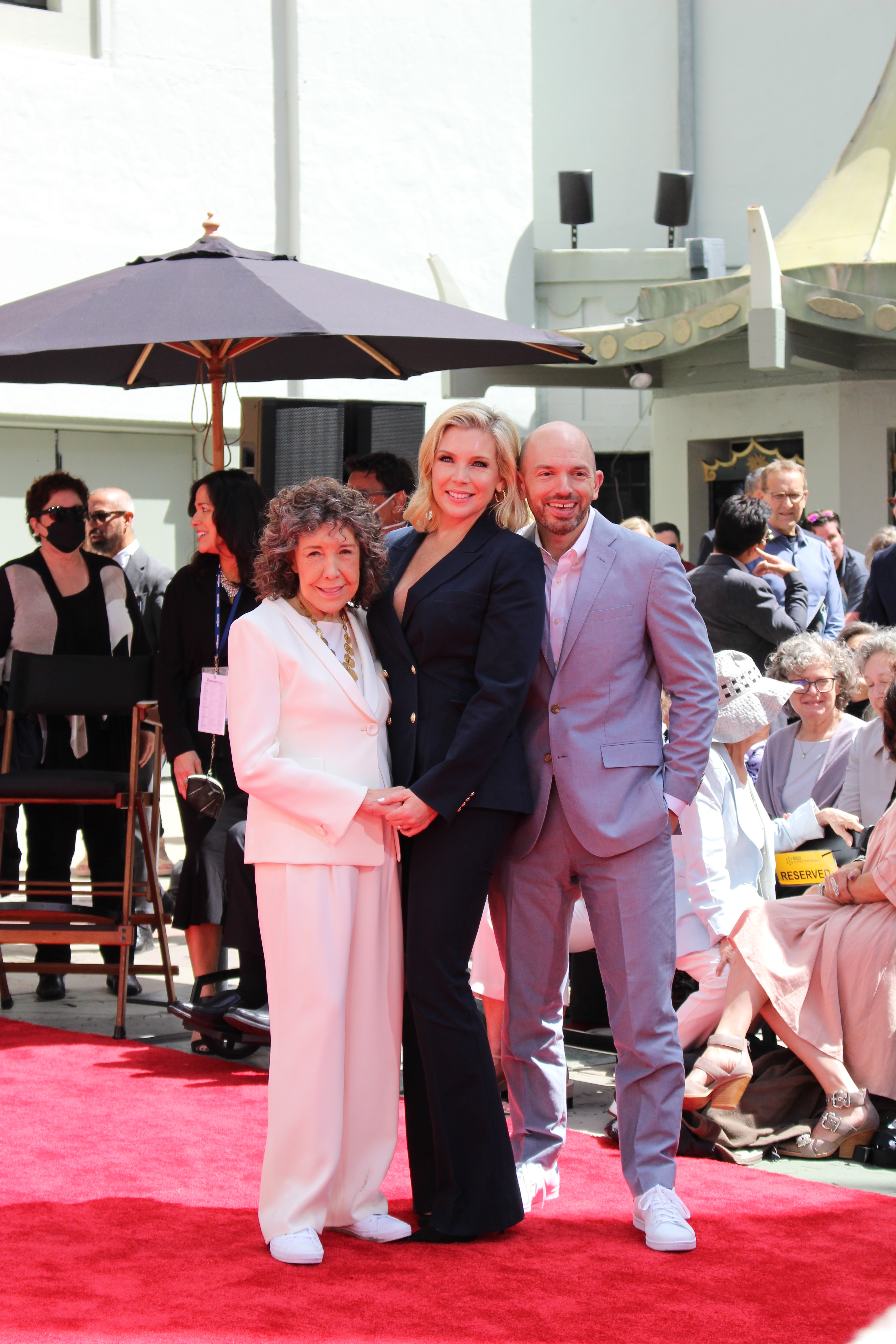 Lily Tomlin, June Diane Raphael and Paul Scheer
A Little Song, A Little Dance
Afterwards I headed over to the Chinese Multiplex to attend A Little Song, A Little Dance, a one-hour presentation hosted by Paramount archivist Andrea Kalas. We were treated to a selection of musical numbers from a variety of Paramount feature films and shorts. The highlights for me were seeing a clip of the Will Mastin Trio, including a young Sammy Davis Jr., and a sing-a-long to Dinah performed by my personal fave, The Mills Brothers!

A Conversation with Bruce Dern

I wasn't able to stay for the whole thing but I did enjoy the first half hour of TCM host Ben Mankiewicz conversation with actor Bruce Dern. The event was held at Club TCM, which is the Blossom Ballroom of the Hollywood Roosevelt Hotel. Dern spoke at length about working with Elia Kazan and Alfred Hitchcock, his early career as a track athlete and his training as an actor. The biggest takeaway for me was that Dern equates acting to the ability to be "publicly private" something he learned during his early days in The Actor's Studio.
Soylent Green (1973)
 My friend Pam and I at the poolside screening of Soylent Green.
I headed over the Tropicana Bar for a special poolside screening of Soylent Green (1973). April 22nd was Earth Day so it was fitting to screen this dystopian film especially with its powerful environmental message. Guests were treated to Soylent Green cookies (don't worry they didn't contain actual people!). Actress Leigh Taylor-Young, who stars in the film as Shirl, was interviewed by William Joyce about her experience making the film, working with actors Charlton Heston, Edward G. Robinson and Joseph Cotten and the film's ecological message and its bizarre misogyny.
Cooley High (1975) Reunion
 Left to Right: TCM host Prof. Jacqueline Stewart, actors Cynthia Davis, Garrett Morris, Steven Williams, Lawrence Hilton-Jacobs, Glynn Turman and director Michael Schultz
I took the complimentary shuttle to the Hollywood Legion theatre to catch a very special screening of Cooley High (1975), one of the most influential black films of the 20th century. This coming-of-age story is one of my personal favorites and it was such a thrill to see the majority of the cast reunited for this screening.
TCM host Prof. Jacqueline Stewart sat down with director Michael Schultz and the cast to discuss the making of the film and its representation of black youth and its setting Chicago. This reunion was extra special because it was the first time since the making of the film that anyone had seen Cynthia Davis, who plays Brenda in the film. It was a lively conversation and I could tell there was a lot of love and respect between everyone involved. And an added bonus, Garrett Morris and Glynn Turman briefly reenacted one of the pivotal scenes from the film. What a joy! I was the most excited for this event and it did not disappoint.
 Lawrence Hilton-Jacobs, Glynn Turman and Michael Schultz
 Cynthia Davis, Garrett Morris and Steven Williams
Stay tuned for more TCMFF coverage!Day #1 Recap
Opening Night Red Carpet EventAll content is property of Out of the Past: A Classic Film Blog. Copyright © 2007-2022
TCM Classic Film Festival: Day #2 Recap
Festivities on the second day of the TCM Classic Film Festival kicked off with a hand and footprint ceremony honoring actress Lily Tomlin. Hosted by TCM and held on the courtyard of the TCL Chinese Theatre (formerly Grauman's Chinese Theatre), the event began with introductions by TCM host Ben Mankiewicz and actress Jane Fonda as well as a speech by Lily Tomlin herself. Special guests included producer George Schlatter, actress Rita Moreno and fellow Grace and Frankie star June Diane Raphael. In addition to her hand and footprints, Lily Tomlin added small footprints and signature commemorating her character Edith Ann from Rowan and Martin's Laugh-In.
Check out my YouTube video of the ceremony below (and make sure to subscribe to my channel!).
Ben Mankiewicz, Lily Tomlin and Jane Fonda
Lily Tomlin, George Schlatter and Jolene Brand
Rita Moreno and Lily Tomlin
Lily Tomlin, June Diane Raphael and Paul Scheer
A Little Song, A Little Dance
Afterwards I headed over to the Chinese Multiplex to attend A Little Song, A Little Dance, a one-hour presentation hosted by Paramount archivist Andrea Kalas. We were treated to a selection of musical numbers from a variety of Paramount feature films and shorts. The highlights for me were seeing a clip of the Will Mastin Trio, including a young Sammy Davis Jr., and a sing-a-long to Dinah performed by my personal fave, The Mills Brothers!
A Conversation with Bruce Dern
I wasn't able to stay for the whole thing but I did enjoy the first half hour of TCM host Ben Mankiewicz conversation with actor Bruce Dern. The event was held at Club TCM, which is the Blossom Ballroom of the Hollywood Roosevelt Hotel. Dern spoke at length about working with Elia Kazan and Alfred Hitchcock, his early career as a track athlete and his training as an actor. The biggest takeaway for me was that Dern equates acting to the ability to be "publicly private" something he learned during his early days in The Actor's Studio.
Soylent Green (1973)
My friend Pam and I at the poolside screening of Soylent Green.
I headed over the Tropicana Bar for a special poolside screening of Soylent Green (1973). April 22nd was Earth Day so it was fitting to screen this dystopian film especially with its powerful environmental message. Guests were treated to Soylent Green cookies (don't worry they didn't contain actual people!). Actress Leigh Taylor-Young, who stars in the film as Shirl, was interviewed by William Joyce about her experience making the film, working with actors Charlton Heston, Edward G. Robinson and Joseph Cotten and the film's ecological message and its bizarre misogyny.
Cooley High (1975) Reunion
Left to Right: TCM host Prof. Jacqueline Stewart, actors Cynthia Davis, Garrett Morris, Steven Williams, Lawrence Hilton-Jacobs, Glynn Turman and director Michael SchultzI took the complimentary shuttle to the Hollywood Legion theatre to catch a very special screening of Cooley High (1975), one of the most influential black films of the 20th century. This coming-of-age story is one of my personal favorites and it was such a thrill to see the majority of the cast reunited for this screening.
TCM host Prof. Jacqueline Stewart sat down with director Michael Schultz and the cast to discuss the making of the film and its representation of black youth and its setting Chicago. This reunion was extra special because it was the first time since the making of the film that anyone had seen Cynthia Davis, who plays Brenda in the film. It was a lively conversation and I could tell there was a lot of love and respect between everyone involved. And an added bonus, Garrett Morris and Glynn Turman briefly reenacted one of the pivotal scenes from the film. What a joy! I was the most excited for this event and it did not disappoint.
Lawrence Hilton-Jacobs, Glynn Turman and Michael Schultz
Cynthia Davis, Garrett Morris and Steven WilliamsStay tuned for more TCMFF coverage!Day #1 Recap
Opening Night Red Carpet EventAll content is property of Out of the Past: A Classic Film Blog. Copyright © 2007-2022
April 26, 2022
2022 TCM Classic Film Festival: Day #1 Recap

The festivities kicked off on Wednesday, the day before the 2022 TCM Classic Film Festival began. First up:
Academy Museum of Motion Pictures


We trekked over to the Academy Museum for a pre-festival visit. I was very excited to visit as I'd heard great things since it officially opened in September of 2021. And unfortunately, it was a disappointment. I was hoping to see a rich array of artifacts from Oscar history on display. Instead the museum offers an immersive experience that is visually interesting but ultimately superficial. It focused more on the experience of the Academy Awards and also spotlighted a handful of filmmakers, both old and new. There was little by way of context and anyone not familiar with the history of the Academy Awards would leave not that much wiser. There were some elements I enjoyed including Pedro Almodovar's curated gallery, the display of Oscar statuettes (including Sidney Poitier's for Lilies of the Field), getting to see Rosebud from Citizen Kane up close and the overall focus on diversity. While the museum allows for photographs in all galleries except for one, the installations are difficult to photograph, especially since so many are active screens, so I didn't end up taking that many. There are several levels that lead to an observatory with fantastic views. And next to the museum is a dedicated theater. On the day we visited, they were preparing for the season premiere of the hit tv show Euphoria.
I have a phobia of oversized murals and installations and museums like this are incredibly triggering. While, I couldn't enter some of the rooms and I did my best to at least peak into the ones that I couldn't access and lingered in the ones that I could spend some time in. If you're sensitive to flashing lights, dark spaces and oversized installations, you may want to skip the museum.


Hollywood Boulevard
Before heading back to the Hollywood Roosevelt, the headquarters of the festival, we took a trip down the boulevard. It's gone through many changes during the pandemic, hardly any of them good. The Egyptian was closed for remodeling after Netflix acquired the property. The Pig & Whistle is no more but from what I understand the new owners plan to maintain the historic elements of the building.
While walking down the boulevard, we took a short detour to pay our respect to the late great Robert Osborne at his star.

Then we made it over to Larry Edmunds Bookshop which is a must for every TCMFF trip. They were hosting a book signing, had movie posters on displays and shelves stocked with all sorts of classic film books. I purchased a copy of Eartha & Kitt: A Daughter's Love Story in Black and White by Kitt Shapiro with Patricia Levy.

TCM Classic Film Festival Media Reception

After the bookshop, I headed over to the media room at the Hollywood Roosevelt hotel to pick up my press badge and swag bag. The clear plastic tote came with a bottle of TCM merlot in a special carrier bag, a small tumbler, a copy of Danger on the Silver Screen: 50 Films Celebrating Cinema's Greatest Stunts and an issue of Movie Maker magazine. Due to COVID protocols, I also had to submit health information in order to get a wristband for entry into any and all TCMFF events. I had to wear this through the four days of the festival.

Members of the media were treated to a reception where we heard the big announcement that actress Pam Grier will be the subject of TCM's next season of The Plot Thickens podcast.
After we mingled with media and the TCM hosts, Pam Grier made a surprise entrance towards the end of the event. The video below offers a couple of clips of her appearance and chat. It's NSFW due to the subject matter discussed so put on those headphones!
Opening Night Red Carpet
On the first official day of the festival, I spent all day preparing for the opening night red carpet. Make sure you check out my previous post where I share photos of all the special guests I got to interview or photograph. Videos coming soon!

Fast Times at Ridgemont High (1982) Poolside Screening
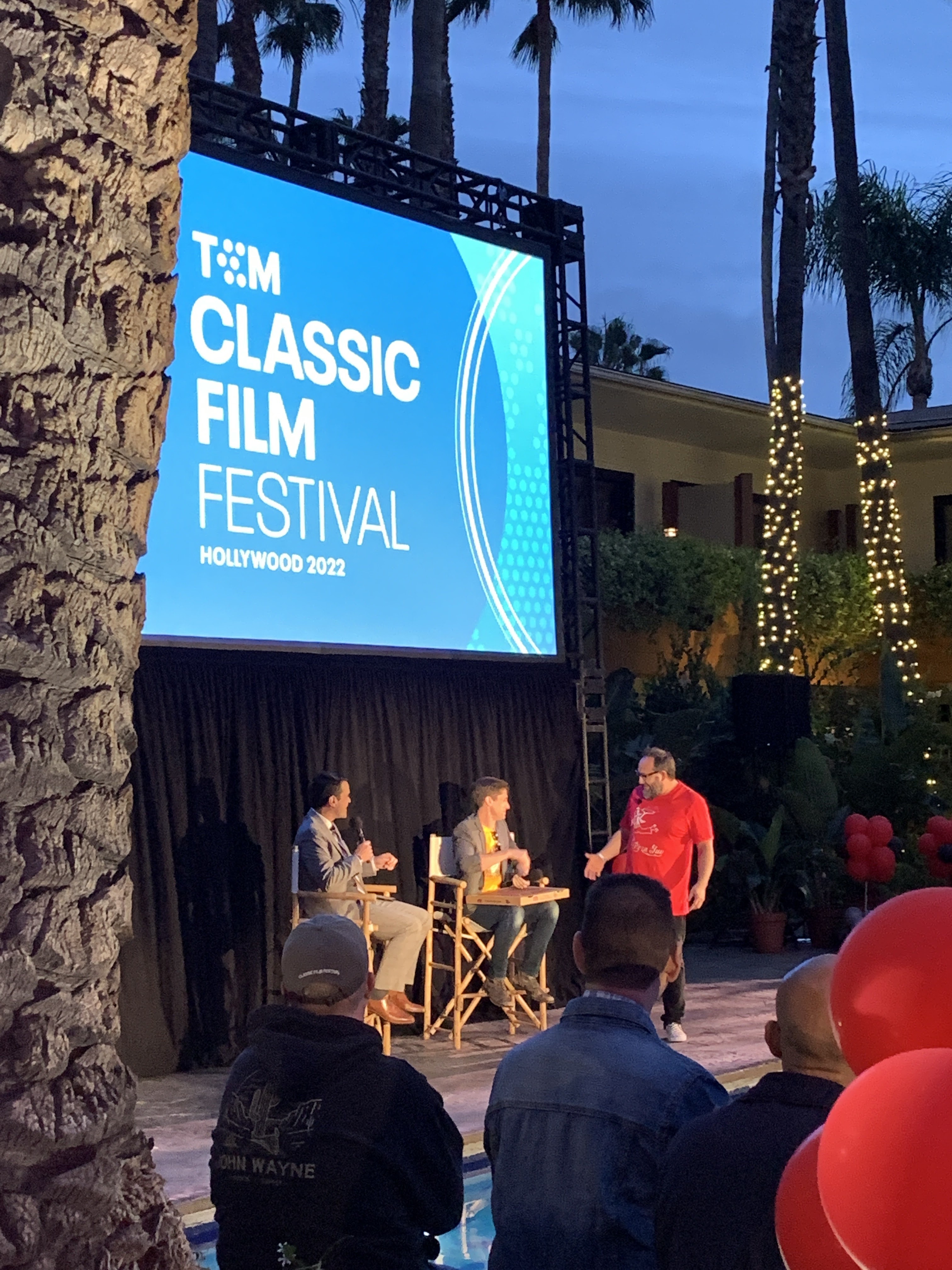
I wasn't able to get to the screening of The Slender Thread in time. So after the red carpet, I headed over to the pool at the Hollywood Roosevelt hotel for the 40th anniversary screening of Fast Times at Ridgemont High (1982). Dave Karger interviewed Topher Grace who is not only a huge fan of the movie but also was inspired by it to make his own film Take Me Home Tonight (2011). Karger and Grace's conversation was interrupted by a pizza delivery!

Stay tuned for more coverage of the festival!
All content is property of Out of the Past: A Classic Film Blog. Copyright © 2007-2022