Sorry, you must be a group member to see those polls.
Peter Smith's Blog, page 63
December 22, 2019
I can now bore for England …
The scaffolding for our loft conversion went up on June 3rd. The decorators finally left a few days ago. So we’ve been living with workmen around, with some short gaps, for over six months. But it has, in the end, all been really worth it.
And let me leave the story more or less there. I can now bore for England on the subject of loft conversions; but it’s the sort of thing which is of all-consuming interest if you are in the middle of it yourself, but of very little interest to everyone else (“is it still not finished?” friends say solicitously, before quickly moving on). If anyone local to Cambridge wants advice and recommendations, I’m your man! But here, all I’ll say is that things went more or less as smoothly as one could hope, and the result is quite terrific. Which is a mighty relief.
But the combination of almost continual low-level disturbance at home (and occasionally a lot more) and the energy-sapping business of knocking IFL2 into shape means I get to the end of 2019 having done a heck of a lot less than I’d have liked, in lots of ways, particularly on various logic matters. So some battery-recharging over the holidays next, and then I must fix on A Sensible Plan for 2020: I really don’t want to hang up my logical boots just yet … But I need to focus. So why have I just ordered a stack of books in the OUP sale?
The post I can now bore for England … appeared first on Logic Matters.


December 17, 2019
Kirby, An Invitation to Model Theory
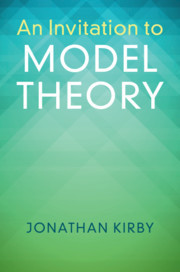 I very briefly noted Jonathan Kirby’s An Invitation to Model Theory (CUP, 2019) when it was published earlier in the year. I put it aside to look at later, and (I confess) forgot about it entirely when recently updating the TYL Study Guide! Belatedly, I have now dipped into quite a lot of this short book; how does it compare as a first introduction to model theory?
The aim of the book is described like this: “[T]raditional introductions to model theory assume a graduate-level background of the reader. In this innovative textbook, [the author] brings model theory to an undergraduate audience. The highlights of basic model theory are illustrated through examples from specific structures familiar from undergraduate mathematics ….” Now, one thing that usually isn’t familiar to undergraduate mathematicians is any serious logic: so, as you would expect, Kirby’s book is an introduction to model theory that doesn’t presuppose or seamlessly continue on from a first logic course. By contrast, in the TYL Guide, I suggest as a route into the area the long last chapter ‘Some use of compactness’ from Goldrei’s excellent logic text, and/or the more expansive but equally logic-based book by María Manzano.
The Invitation is divided into six parts, each comprising five or six short chapters (the main text of the book is only 176 pages long), with dependencies very well signalled — the book is a model of clear structuring. The first part ‘Languages and structures’ gives the logic-less student some basics about the ideas of a first-order language and interpretation in a structure, and then introduces the ideas of embeddings, substructures etc. The next part proves a compactness theorem and gives some first applications. Part III, ‘Changing models’ proves downward and upward Löwenheim-Skolem theorems, gives some applications, gives examples of theories which are countably categorical (or categorical in other cardinals), and in particular use the back-and-forth method to show that countable models of the theory of dense linear orders with endpoints are isomorphic. Part IV starts by proving some results about quantifier elimination …
And we are now about 100 pages into the book. Is this perhaps beginning to sound a bit action-packed? Manzano, for example, takes over 200 pages to get about as far. And I do suspect that for self-study Kirby’s book would make for tougher going for many students. Not that Kirby is unclear in what he does say; on the contrary, he writes beautifully clearly. But he could/should have said at least a little more. A few more classroom asides, a few extra illustrative examples of key concepts, etc. could have made a significant difference.
For example, Part V is on types; and surely the student reader would have welcomed more explanation and motivation for the introduction of the notion than they get in §23.1. An extra paragraph or two here would have helped a lot. And as this part of the book continues, the level of difficulty seems to me to ratchet up markedly. I would have thought that by the time we get to §26.3 on zero-stable theories, or to a sudden invocation of strongly inaccessible cardinals in §27.3, many student readers could be losing the plot. (It’s not that the relevant notions aren’t clearly defined: but the motivations and significance may well pass them by).
The book finishes with five short chapters on the model theory of fields, applying earlier techniques, and leading up to a proof of Hilbert’s Nullstellensatz: interesting for algebraists, and pointing forward towards an important area of model theory — but maybe more than the logic-oriented reader will want in a first introduction to model theory.
Overall, then, I will stick to the TYL recommendations: those such as the likely readers of this blog, coming from a logic background, should begin model theory in company with Goldrei and Manzano. Kirby’s book will then make for useful revision/re-inforcement material as necessary.
The post Kirby, An Invitation to Model Theory appeared first on Logic Matters.
December 16, 2019
The Rise of Analytic Philosophy, 1879–1930
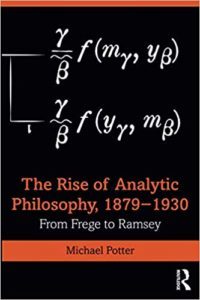 It is very good to see that my friend and one-time colleague Michael Potter’s book The Rise of Analytic Philosophy, 1879–1930: From Frege to Ramsey (Routledge) is now out. And given it is over 500 pages, the paperback is pretty reasonably priced by modern standards.
I suppose some might complain that there is a slight suggestio falsi in the title, for the thematic route through the concerns of Frege, some time-slices of Russell, early Wittgenstein, and Ramsey is only part of the story of the rise of what we now think of as ‘analytic philosophy’. But let’s not argue about that! This familiar route is certainly of central interest and importance, and students need an accessible, readbale, and reliable guide taking them along it. The interpretation of all four philosophers is a contentious business, so no doubt those who know more about the debates than I do will find things to cavil with. But I enjoyed reading quite of the bit of the book in draft, often found it illuminating, and can warmly recommend it.
The post The Rise of Analytic Philosophy, 1879–1930 appeared first on Logic Matters.
December 15, 2019
Once upon a time, in a world long ago …
Anna Karina: 22 September 1940 – 14 December 2019
The post Once upon a time, in a world long ago … appeared first on Logic Matters.
December 11, 2019
Teach Yourself Logic 2020!
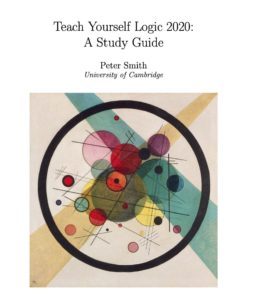 Short version: there is at last, after three years, an updated version of the TYL Guide. Click on the cover picture for links!
Long version: The title gives it away! — this is an annotated guide to logic books and other resources suitable for self-study, starting a step up from ‘baby logic’ and going though to quite advanced stuff. It is a PDF, now over 90 pp., formatted for onscreen reading, with a lot of live links.
The TYL page is the most visited page here on this site (with 70K visits last year), with the Guide getting thousands more visits too at its academia.edu location. So there is evidently more than enough interest in the Guide to make it well worthwhile maintaining it, and trying to improve it.
This new version is a ‘maintenance upgrade’. Its overall structure has been clarified by dividing it into three parts, some entries have been revised, and a few new recommendations added. But there are no new sections, and I haven’t found myself wanting to change many main recommendations this time. Have any stand-out books been published in the last three or four years which really ought to have shot to top of any reading list? As always, comments and suggestions are most welcome.
The post Teach Yourself Logic 2020! appeared first on Logic Matters.
November 29, 2019
Book sale! — including a fine book on Ramsey
Far be it from me to encourage you to add yet more books to your groaning shelves, but … You might well find something of interest in the “cyber sale” from Palgrave Macmillan — each and every title is now £9.99. Given the usual list price of many of their books is around £80, this means that there are some real bargains here.
Or at least, there are bargains if there are books in their massive catalogue which are actually worth having. Looking through their philosophy backlist, I didn’t find much to appeal to me, other than perhaps some of the titles in the history of analytic philosophy series. But I will mention one book which I know to be really very good indeed, Steven Methven’s Frank Ramsey and the Realistic Spirit (2015). Don’t take my word for it: read Cheryl Misak’s very warm review.
The sale is only on for a few days, until 3rd December. If you spot other titles you’d like to recommend to readers of this blog, then do comment below!
The post Book sale! — including a fine book on Ramsey appeared first on Logic Matters.
November 27, 2019
Clive James
Clive James’s death at his home in Cambridge on 24 November has just been announced. He survived to his surprise and gratitude ten years after a first terminal diagnosis, thanks to the wonders of the hospital here. He leaves, along with much else, a wonderful late flowering of poetry. Here, for now, “Japanese Maple” (2004).
Your death, near now, is of an easy sort.
So slow a fading out brings no real pain.
Breath growing short
Is just uncomfortable. You feel the drain
Of energy, but thought and sight remain:
Enhanced, in fact. When did you ever see
So much sweet beauty as when fine rain falls
On that small tree
And saturates your brick back garden walls,
So many Amber Rooms and mirror halls?
Ever more lavish as the dusk descends
This glistening illuminates the air.
It never ends.
Whenever the rain comes it will be there,
Beyond my time, but now I take my share.
My daughter’s choice, the maple tree is new.
Come autumn and its leaves will turn to flame.
What I must do
Is live to see that. That will end the game
For me, though life continues all the same:
Filling the double doors to bathe my eyes,
A final flood of colors will live on
As my mind dies,
Burned by my vision of a world that shone
So brightly at the last, and then was gone.
The post Clive James appeared first on Logic Matters.
November 26, 2019
Back to categories
IFL2 is off to the proof-reader. So, for some weeks, time to think of other things.
A while back, I constructed a webpage linking to online materials on category theory at an introductory/middling level, including lecture notes, (legally available!) books, and videos of lectures. Here it is!
I initially wrote this really for my own use, to keep track of things I found. But the page has got over 25K visits in the last year, so obviously some others are finding it useful too.
This page of links hasn’t had much attention in recent months while IFL2 was occupying my mind. However, I’ve just now updated it, removed a couple of dead links and corrected some others. Please do let me know of appropriate recent materials I should be adding to the list — and do spread the word to students who might find it useful.
The post Back to categories appeared first on Logic Matters.
November 19, 2019
Structuralism in the Philosophy of Mathematics
Just to note the arrival at the Stanford Encyclopedia of a new entry ‘Structuralism in the Philosophy of Mathematics’ by Erich Reck and Georg Schiemer.
Two features of this entry are potentially particularly useful. First, there is an attempt to provide a helpful taxonomy of the many varieties of structuralism about mathematics. Second, there’s a discussion of the relation between category theory and structuralism.
There’s quite often a problem of level and speed of coverage with SEP entries. I’d say that might apply here — the piece necessarily goes quickly over a lot of ground, and I’d guess that many a last-year undergraduate/first-year graduate student wanting a way into the topic will find that this entry goes too fast. For just one example, I don’t imagine someone getting much of an idea of Charles Parsons’s position from the brief discussion here. My guess is that an entry perhaps 30% longer, going more slowly over the same material, could have been 100% more useful to many student readers.
However, if you do already know a little about structuralism in the philosophy of mathematics, and want a well organized guide to help you get to know a lot more (and to spur you on, perhaps, to finding out something about category theory!), with very helpful pointers to the literature, then this will be a quite excellent place to start.
The post Structuralism in the Philosophy of Mathematics appeared first on Logic Matters.
November 11, 2019
Status report
Status report:
Political absurdities being worried about. Too many and too depressing to list.
Intro logic text still being worked on. Things have been slow at the CUP end, because the press has been short of production managers. But things are now moving along, with techie/designer checks on the PDF this week, and then at last off to the proof reader soon after. So IFL2 may yet be off my desk before Christmas. I’ve not been complaining about the delay with CUP as it has given me time to read through the book again, change a sentence here and there, and check the end-of-chapter exercises. Also web-pages for the second edition are slowly taking shape here. You’ll now find more of the book’s exercises online with some quite discursive solutions pages, plus a few other materials, as well as the ‘missing’ chapters on truth-trees. The new version of the book, recall, is now natural-deduction based: if you are curious about the particular Fitch-style system I adopt, I link to two pages with diagrammatic versions of the PL and QL rules used in the book.
The Teach Yourself Logic Study Guide still needing revision. This has really had almost no attention for eighteen months though it continues to be much downloaded from here. So an early task as soon as IFL2 really is done and dusted must be to revisit the Guide. One decision I need to make before I do, however, is whether to keep it as One Big PDF, or divide it into a bunch of webpages (if anyone has any ideas on the pros and cons either way, I’d be glad to hear them!).
Category Theory, time to start thinking again! The Gentle Introduction has also been on the back burner (well, even that is an exaggeration, as it has hardly been simmering away). But I hope to reheat my interest in category theory again after Christmas, and then see what I think about it all, and whether to press on with what was beginning to look like a draft book.
Logic-related books being read. Leon Horsten’s The Metaphysics and Mathematics of Arbitrary Objects has left me completely unconvinced that the project is anything but misguided. Nils Kürbis’s Proof and Falsity, by contrast, so far strikes me as an interesting and well-argued engagement with a set of real issues about proof-based semantics for logic. I’ll try to have more to say about these books in due course (though life is short, and of the making of many books, there is no end).
Wine being drunk. Rather too much, see the first bullet point again.
The post Status report appeared first on Logic Matters.