Sandy Rosenthal's Blog, page 8
January 17, 2023
“Katrina” Remains the Terrible Apex
 This month, the National Hurricane Center (NHC) adjusted Hurricane Katrina’s official cost of damage to $186.3 billion making it the costliest hurricane on record.
Also, the death count for the 2005 storm was adjusted from just over 1800 to just under 1400.
Despite the downward adjustment, Hurricane Katrina remains the deadliest storm in the past 50 years.
According to the data that the NHC relied on for its update, Katrina, “stands apart not just for the enormity of the losses, but for the ways in which most of the deaths occurred.”
Levee failure.
“…levee failures allowed water to fill parts of the New Orleans area to great depth, leading to the deaths of hundreds of people…”
This is why the exact truth and circumstances about the August 2005 event need to be put in front, and kept in front, of the American people.
What many people call “Hurricane Katrina” was in fact, a calamitous engineering failure. And the responsible party is the US Army Corps of Engineers.
Environmental reporter Mark Schleifstein wrote this good story about the NHC updates.
The post “Katrina” Remains the Terrible Apex first appeared on Levees.Org.

January 5, 2023
Founder Rosenthal featured on Elizabeth Bachman show
This week Levees.org founder Sandy Rosenthal is featured on Elizabeth Bachman’s show “Strategic Speaking for Results.”
This episode was Ms. Bachman’s selection to be the first guest of the year 2023.
Rosenthal discusses how she and her group Levees.org took on the organization responsible for the engineering design flaws in New Orleans’ levees –– the US Army Corps of Engineers

December 7, 2022
Why New York Waits

Replica of flooded home in New Orleans after the nearby London Avenue Canal breached in August 2005
Ten years ago, Hurricane Sandy’s storm surge flooded twenty-four US states, particularly New York and New Jersey.
Prior to landfall, the Associated Press reported that experts predicted a billion dollars in damage in the US. It turned out to be $43 billion (1).
Now, near the 10th anniversary of what is unofficially known as Superstorm Sandy, NBC Channel 4 TV in New York City devoted a 5-minute segment to address this question: “Why shouldn’t we be all protected?” (2)
This question is posed while observing that after Hurricane Katrina in 2005, the US Army Corps of Engineers built a new system––including a massive regional surge barrier––in under eight years in Louisiana.
But for New York, and for New Jersey, the Corps is still debating the best approach to battle storm surge, ten years out.
Without a full handle on the facts, this is a reasonable question.
In our view, there are two major reasons for the starkly contrasting responses from the Corps to the two hurricanes where the associated storm surges precipitated highly unanticipated results:
1. The original levee system in New Orleans failed due to design and construction mistakes on the part of the US Army Corps of Engineers.(3)
2. There was less uncertainty on how to best protect the greater New Orleans region. The primary errors were identified as allowing storm surge to enter the heart of the city via large drainage canals, and also via the Inner Harbor Navigation Canal. The new system has floodgates gates at the mouths of those canals and a surge barrier east of the city.
In the case of Sandy, the Corps is not faced with the debris of its own mistakes. And according to the Corps, there are “geographical and urban/rural differences” between the two regions.
In the north, the Corps has proposed a network of smaller sea barriers rather than the locally preferred plan to build one massive harbor wall from Breezy Point, NY to Sandy Hook, NJ.
For the survivors of Sandy, like shop owner and vintner Marco Pasanella who lost 10,000 bottles of wine which were swept out to sea, the disaster feels like it was yesterday. (4)
Our hearts go out to everyone affected. And we will be closely watching the progress in New York and New Jersey.
Sandy Rosenthal, founder of Levees.org
H.J. Bosworth Jr,. P.E. lead researcher Levees.org 1421 Soniat Street, New Orleans, LA 70115 504-722-8172
1. Seth Borenstein. “East Coast readies For Frankenstorm monster” Associated Press. Oct 26, 2012. LINK.
2. Chris Glorioso, “Post Katrina New Orleans Built Surge Barrier in 9 Years. Decade After Sandy, NY Still Waits”, NBC Channel 4 New York, October 25, 2022. LINK.
3. Campbell Robertson and John Schwartz, “Decade After Katrina, Pointing Finger More Firmly at Army Corps,” New York Times, May 23, 2010 LINK
The post Why New York Waits first appeared on Levees.Org.November 12, 2022
Levees.org hero receives major award

Dr. J. David Rogers
Dr. J. David Rogers was recently awarded the Schuster Medal for his decades of work in geohazards (geologic conditions capable of causing widespread loss of property and life).
“Robert Schuster inspired me to deepen my involvement in the field,” says Rogers, the Karl F. Hasselmann Missouri Chair in Geological Engineering at Missouri S&T. “I want to help the world define problems and find solutions.”
Dr. Rogers is also a major Levees.org hero.
In 2015, Dr. Rogers was lead author in the eye-opening paper laying bare who was responsible for the levee breaches during Hurricane Katrina.
This watershed paper retracted wrong conclusions made in the initial levee investigation reports about what caused the levee failures during the 2005 storm.
The paper––published in the official journal of the World Council––describes how the levees failed mainly due to mistakes the Army Corps of Engineers made in the 1980s when interpreting the results of their levee load test study.
A story about the paper appeared in a front page above-the-fold New York Times story on Sunday May 24, 2015
Learn more about Dr. Rogers and the prestigious award.
The post Levees.org hero receives major award first appeared on Levees.Org.September 8, 2022
Founder Rosenthal on 50 episodes of hosting her weekly Beat the Big Guys podcast
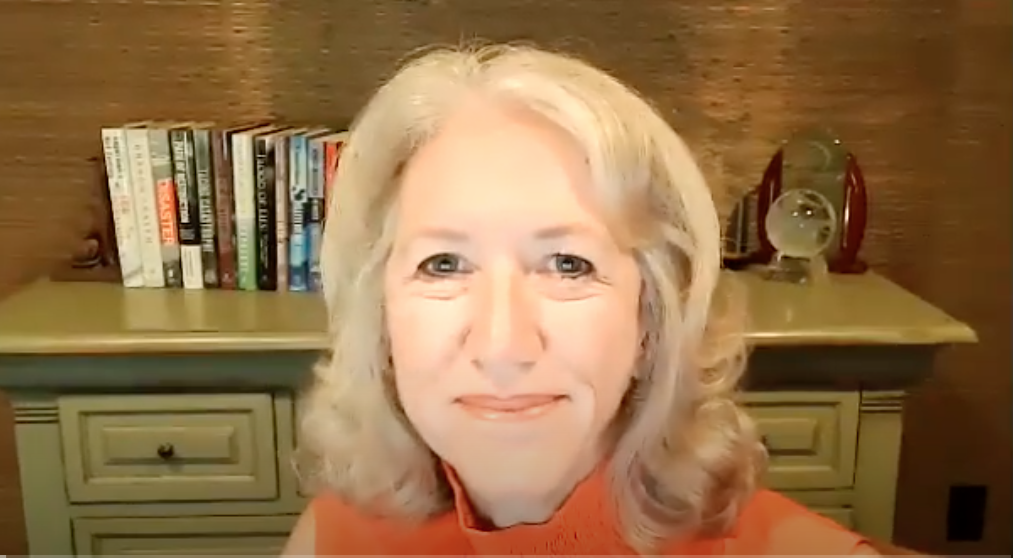
Sandy Rosenthal on Beat the Big Guys.
On August 8, 2022, founder Sandy Rosenthal interviewed her 50th guest on her weekly podcast, Beat the Big Guys.
Every week except on holidays, Rosenthal has coached her national base of listeners on how to take on the Big Guys in their own communities. Using an interview format, Rosenthal asks each of her guests to tell their stories. Then she identifies the tools, tricks and tips her guest used and then helps listeners take on their own Big Guys.
After interviewing 50 knowledgeable and heroic guests, Rosenthal discovered that all the Big Guys shared a common characteristic. In every story, the “big guys” were no different from the typical bully in the playground in the 3rd grade.
These are the general characteristics of a 3rd grade bully: 1) they are physically larger, 2) they have low self-esteem and 3) they are not smarter than the children they bully.
Let’s compare a 3rd grade bully to large company like Dupont, Monsanto or the Army Corps of Engineers; 1) They believe they are so big they are unstoppable, 2) They are petrified that something might hurt their reputation and goodwill, 3) They are not smarter than the people they are trying to exploit.
Rosenthal also discovered that the Big Guys all play out of the identical playbook. They stall, meaning they refuse to provide data or information. And they refuse to address the issue.
Rosenthal’s final advice to her listeners after interviewing fifty guests is to: 1) recognize that those “Big Guys” are really not that big. And 2) that one must not allow the Big Guys to stall when answering questions nor avoid addressing the issue at hand. It’s that simple!
Beat the Big Guys can be downloaded from all of the major podcast platforms. You can also listen here. And you can view the video versions here.
The post Founder Rosenthal on 50 episodes of hosting her weekly Beat the Big Guys podcast first appeared on Levees.Org.June 29, 2022
Questions Still Not Answered About Faulty Pump at London Avenue Canal
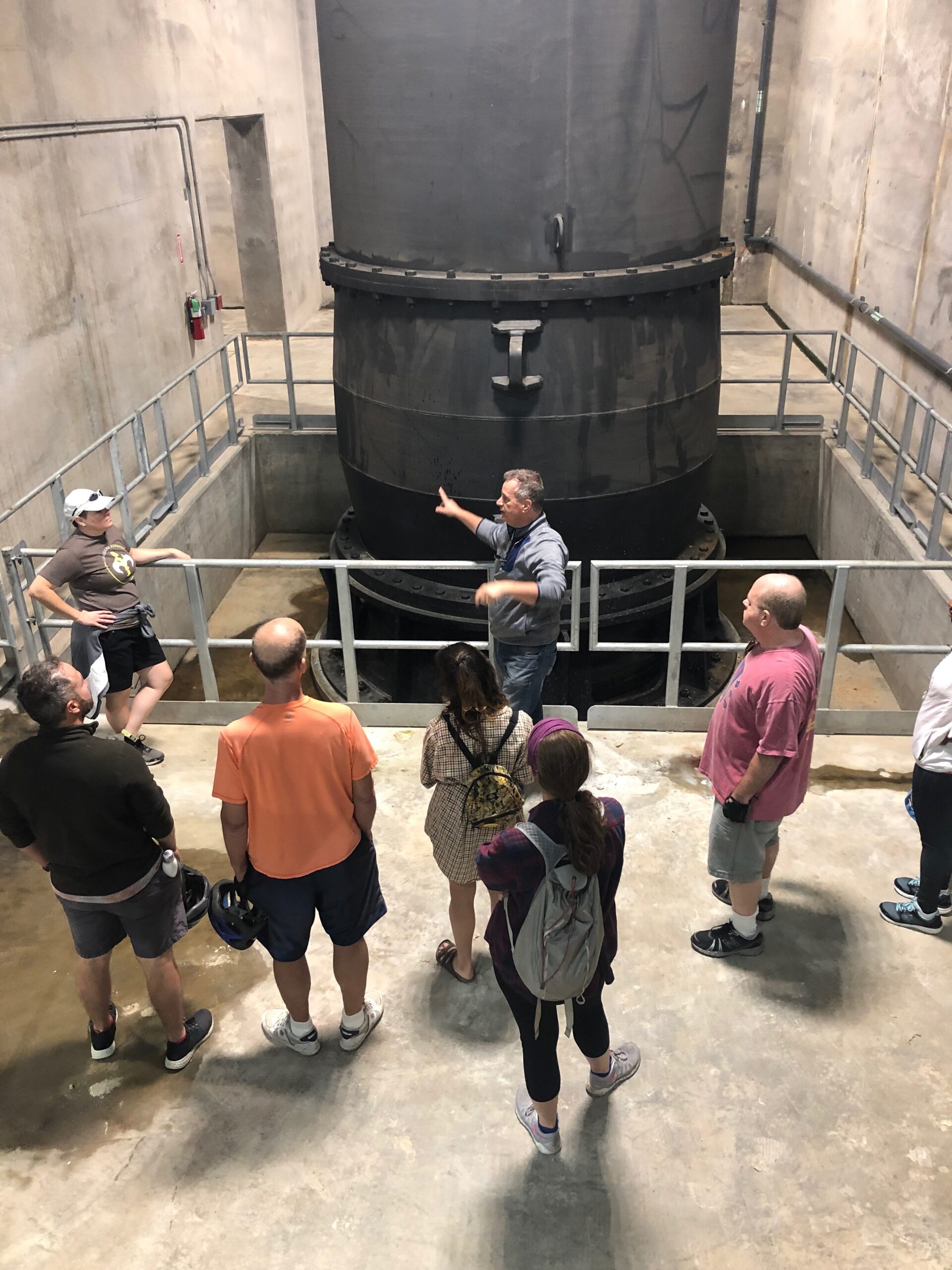
These people are 24 feet below sea level at the London Ave pump. The large pipe draws water up from the bottom of the canal. Photo/Sandy Rosenthal
Six weeks ago, we learned at the board meeting of the Levee Authority East that there’s a problem with the pump station at the London Avenue Canal.The problem is one of the larger pumps; the bearing at the bottom was found to be overheating when operating. And there is no back up.
We immediately sent an email to the Chief of Public Affairs for the Army Corps of Engineers (USACE) New Orleans District, Ricky Boyett. We had three questions about the faulty pump. We did not receive a response.
So next we filed a formal request under the Freedom of Information Act and again, asked our three questions about the faulty pump. The corps responded exactly three weeks later; to wait longer would have been against the law. In the response the corps said I was asking questions and therefore needed to contact the Public Affairs office and just ask.
But this is exactly what we had already done and received no response! And now we are back to square one. So, we wrote AGAIN, to the Public Affairs office headed by Chief Ricky Boyett. Meanwhile, there’s a faulty pump at the London Avenue Canal. And no back up pump.
The Corps is the entity that designed and built the pumps. Based on the way, we, members of the public have been treated, we feel the corps is playing a game. We don’t like this game.
The post Questions Still Not Answered About Faulty Pump at London Avenue Canal first appeared on Levees.Org.June 25, 2022
Stark difference between Surfside condo collapse and New Orleans levee breach disaster
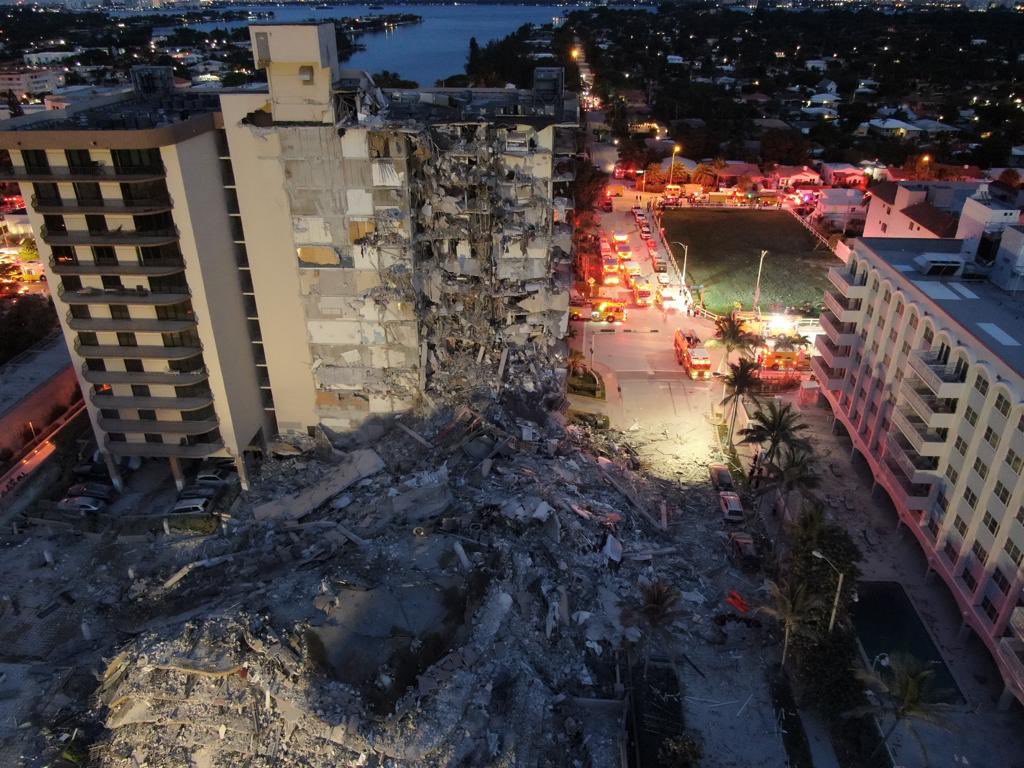
This image shows the aftermath of the Surfside condominium building collapse which occurred on June 24, 2021.
This week, Miami-Dade circuit judge Michael Hanzman gave final approval to a settlement for victims of the Champlain Towers South condominium collapse in Miami a year ago.
The families of 98 people who were killed will receive over a billion dollars in a settlement in addition to those who lost one of the 136 units in the beachfront building.
We see a glaring difference between the condo collapse in Surfside, Miami and levee breach event in New Orleans:
––Quick acknowledgment of the problems that lead to the disaster.
––Rapid declaration that the building was dangerous and must be demolished.
––Within one year all parties came together to compensate the victims.
The people of New Orleans who lost 1500+ loved ones, their homes, their businesses, their neighborhoods did not receive a dime from the organization responsible for the levee breach event in August of 2005––the Army Corps of Engineers.
In Florida, Judge Hanzman praised the lawyers for avoiding what could have been years of litigation.
We also note that Florida will now require statewide recertification of condominiums more than three stories tall under new legislation that the governor signed into law last month in response to the disaster.
Further details about the settlement can be found here.
The post Stark difference between Surfside condo collapse and New Orleans levee breach disaster first appeared on Levees.Org.May 20, 2022
A problem at the London Avenue Canal pump station
File photo April 2019. People are 24 feet below sea level at London Ave Canal pump station. Photo/Sandy Rosenthal
We learned at the board meeting of the Levee Authority East that there’s a problem with the pump station at the London Avenue Canal.
Normally, the pump station––built after the levees broke in 2005––can pump about 9000 cubic feet of water per second (cfs).
We’ve learned that currently, two weeks prior to hurricane season, that the pumping capacity is reduced to 7200 cfs.
This is because the bearing at the bottom of one of the larger pumps was found to be overheating when operating.
This problem was discovered by the Orleans levee district when they performed their routine maintenance as directed by the Army Corps of Engineers.
The Corps is the entity that designed and built the pumps. To best of our knowledge, in response to this issue, the Corps is working to figure out what to do next.
The post A problem at the London Avenue Canal pump station first appeared on Levees.Org.May 18, 2022
Levees.org Rolls Out New Self-Guided Levee Breach Bike Tour
We’re rolling new maps for our Self-Guided Levee Breach Disaster Bike Tour.
There’s an interactive detailed Google Map!
Click on the icons, and see a detailed story about each site.
And there’s also a downloadable printable PDF map!
The self-guided tour allows anyone, at any time, an opportunity to view two major breach sites and the adjacent neighborhoods nearly destroyed by the worst civil engineering disaster in US history. The tour follows marked bike routes.
The two-mile tour starts at the corner of Mirabeau Blvd and Warrington Drive at a Louisiana State historic plaque and proceeds to the:
* Flooded House Museum (4918 Warrington Dr)
* Breach site of the London Avenue Canal and
* Levee Exhibit Hall & Garden (5000 Warrington Dr)
Next is several points of interest and a second breach site on the west side of the canal. The final stop is a view of a permanent pump station built by the Army Corps of Engineers.
The post Levees.org Rolls Out New Self-Guided Levee Breach Bike Tour first appeared on Levees.Org.April 14, 2022
How the Titanic disaster is similar to the Levee Breach catastrophe

Der Untergang der Titanic
April 15 is the 110th anniversary of the Titanic disaster.
Fifteen hundred plus souls were lost on that day due primarily to human arrogance.
The captain was attempting to complete the maiden journey in record time, despite reports of icebergs. And there were too few lifeboats.
One hundred and ten years later, we still talk about the disaster that changed maritime laws as we know them. No longer are ships allowed to turn off their radios. No longer are ships required to provide lifeboats only for the wealthy. No longer does breaking speed records matter more than lives.
One hundred and ten years from now, it is Levees.org’s hope that people are still talking about the worst engineering disaster in the history of the United States – the breaching of levees in New Orleans in 2005.
Congress reacted to the bona fide catastrophe––which took the lives of fifteen hundred plus souls––by passing laws making life safer for the nearly two thirds of Americans who live in counties protected by levees.
These included the creation of a national database of federal and non-federal levees, a new levee safety inspection tool using global positioning technology and a 16 member levee safety committee.
The catastrophe also highlighted the need for a National Levee Safety Program which is being rolled out this year.
One hundred and ten years ago, the Titanic sank and no one blames the iceberg.
Hopefully, one hundred and ten years from the Levee Breach Event of New Orleans in 2005, no one will blame the hurricane.
The post How the Titanic disaster is similar to the Levee Breach catastrophe first appeared on Levees.Org.