Brian Murphy's Blog, page 10
December 6, 2024
Season of the Witch, Grave Digger
No frills on "Season of the Witch." Atmospheric opening, a nicely building song with a great guitar tone, heavy, with a wonderful little chorus supported by excellent backing vocals. Given the subject matter of the song I suppose I should have slotted this into October.
Observation: These German power metal bands (Edguy, I'm looking at you) have slightly off-beat lyrics, occasionally non-sequitur, betraying English as a second language. Its slightly word salad and generic fantasy, but nevertheless carried along by the wonderful instrumentation and a powerful vocal performance. Enjoy.


December 3, 2024
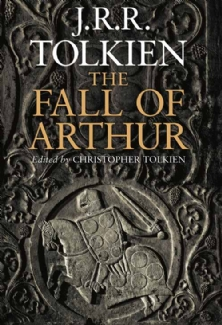
Sons of Albion awake: Of J.R.R. Tolkien’s The Fall of Arthur and Iron Maiden
 You'll probably want to read this.The King Arthur myth is ubiquitous and timeless because it is powerful and its themes universal. The Arthurian myths speak to us subconsciously, on deeper levels than we can readily articulate.
 We feel their powerful call, and many have sought to capture their magic in diverse adaptations. These include authors separated by long gulfs of time—Malory and T.H. White, for example—and artists working in very different mediums.
J.R.R. Tolkien and Iron Maiden.
I just got finished reading Tolkien’s The Fall of Arthur. It’s a curious little volume, 233 pages, of which the actual centerpiece poem is incomplete and only comprises 40 pages. The rest is critical apparatus by Tolkien’s son Christopher.
But what a poem it is.
40 pages of 14th century alliterative verse rendered into modern English metre, telling the story of Arthur’s journey into far heathen lands before he is summoned back to Britain to quell an uprising by the traitor Mordred. Of Guinevere’s flight from Camelot and a great sea battle.
This is no tale of formal courtly love or restrained codes of chivalry, but resembles something out the pages of The Iliad, the Goddess singing of the rage of Achilles:
Thus the tides of time to turn backward
and the heathen to humble, his hope urged him,
that with harrying ships they should hunt no more
on the shining shores and shallow waters
of South Britain, booty seeking.
As when the earth dwindles in autumn days
and soon to its setting the sun is waning
under mournful mist, then a man will lust
for work and wandering, while yet warm floweth
blood sun-kindled, so burned his soul
after long glory for a last assay
of pride and prowess, to the proof setting
will unyielding in war with fate.
There is no magic, no romance, just vengeance, hard combat, lust, and doom.
… then a man will lust for work and wandering… so burned his soul after long glory. Not exactly words Bilbo comfortably enjoying cakes and tobacco Bag End. Yet Tolkien wrote The Fall of Arthur contemporaneous with his much more famous work.
Tolkien began the poem in the early 1930s and there is evidence to suggest he may have continued working on it as late as 1937, when The Hobbit was published. He spent a lot of time getting the words right, and his effort was not wasted—its words ring with power. Christopher says his father drafted some 120 pages before settling on the final text presented in the book. “The amount of time and thought that my father expended on this work is astounding,” he says.
Given the effort expended it remains a mystery why Tolkien abandoned the poem, though Christopher offers up a possible explanation: He was turning his whole thought to Middle-Earth.
After the publication of The Lord of the Rings Tolkien expressed a desire to return to the poem, but the effort failed. It’s a shame the poem remained unfinished but Tolkien’s unbounded genius outstripped his available hours.
But the extant work is remarkable, and as Christopher demonstrates in the additional material served as likely inspiration for the great Middle-Earth legendarium, including the voyage of Earendil and the fall of Numenor.
 Arthurian Eddie.What makes these stories so potent? For that answer I need to turn to Iron Maiden and Bruce Dickinson.
Arthur was taken to Avalon to be healed after his great wound suffered at the hands of Mordred at Camlann. The story from there varies; in some versions he does not make the voyage but dies and is interred in an abbey graveyard at Glastonbury. But in others he seems to reach the fabled isle, where one day he will return, healed, to unite a divided land.
Maiden refers to the legendary properties of the isle in “Isle of Avalon” off of 2010’s The Final Frontier.
The gateway to Avalon
The island where the souls
Of dead are reborn
Brought here to die and be
Transferred into the earth
And then for rebirth
This same Isle of Avalon prefigures Tolkien’s Tol Eressea, the Lonely Isle, accessible only by a Straight Path out of the Round World denied to mortals, that led on to Valinor.
Arthur, gravely wounded, bides in Avalon/Tol Eressea. His return is promised in the old rituals and the enigmatic enduring standing stones of Britain, as depicted in “Return of the King,” a track appearing on the expanded edition of Bruce Dickinson’s 1998 solo album The Chemical Wedding.
What is the meaning of these stones?
why do they stand alone?
I know the king will come again
From the shadow to the sun
Burning hillsides with the beltane fires
I know the king will come again
When all that glitters turn to rust
The song is a powerful cry for Arthur’s return, one that I feel.
We’re all engaged in the eternal struggle. As human beings we're possessed of own individual desires and wants and enjoy our freedoms, but must balance that as members of a civilization that provides purpose and joint safety, but in exchange saddles us with restrictions and obligations. The Arthurian myths speak directly to this great tension.
Arthur is a man with earthly desires, including his great love for Guinevere, but must subsume them to greater obligations owed to his kingdom. Launcelot is a heroic figure whose martial prowess and love for Guinevere can be viewed as the Chivalric ideal, but his base desires and human weaknesses undo a kingdom.
All the same struggles play out today. There is no clean resolution, just a balance that must be struck with compromise.
I think we’ve have tipped too much into individualism. We create and curate our own virtual realities in our smartphones. We distrust institutions. Civic engagement has sharply declined. Some of this institutional skepticism is warranted. But if everyone reverts to selfish individual interests the center cannot hold, and civilization falls apart.
We need the return of a king to unite this fragmented land.
In “The Darkest Hour” when Bruce/Winston Churchill exhorts the besieged people of England to turn their ploughshares into swords and take up arms against tyranny (“You Sons of Albion awake, defend this sacred land”). Perhaps we one day we may unite under a common cause and create a new shining kingdom from the wasteland, a “Jerusalem” on earth:
I will not cease from mental fight,
nor shall my sword sleep in my hand,
till we have built Jerusalem
In England's green and pleasant Land.
November 21, 2024
Immaculate Scoundrels by John Fultz, a review
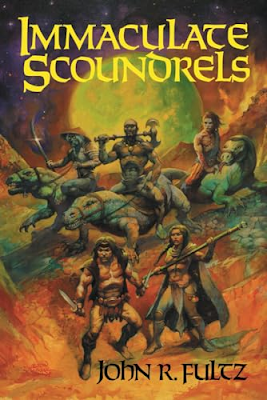 An immaculate cover.When it appears in sword-and-sorcery anthologies, John Fultz is a name that I look forward to reading.
Why?
His “Chivane” (Worlds Beyond Worlds), “Evil World” (Neither Beg Nor Yield), and “The Blood of Old Shard” (A Book of Blades) are terrific, ranking among the best of modern sword-and-sorcery that I’ve read (and I haven’t read it all, I can’t keep up). I recommend any modern S&S reader seek out Worlds Beyond Worlds, which collects 11 of his fantasy tales published during 2010 to 2020. Almost all of the stories in it are good.
But despite his reputation for short fiction, John recently started a series, Scaleborn, of which Immaculate Scoundrels (2024) is the first.
It is well done fantasy, blending epic fantasy with sword-and-sorcery. It boasts a nice cast of characters and a lot of action. The prose is clean and unadorned, modern, and dialogue-heavy. It reminded me more of Joe Abercrombie than the stylized Jack Vance shaded with ornate Clark Ashton Smith flourishes that I was used from his prior works.
I think the style of Immaculate Scoundrels probably works best for longer, multi-series works. Or perhaps Fultz, who once described his literary influences as Lord Dunsany, Howard, Lovecraft, Smith, Tolkien, Tanith Lee, Darrell Schweitzer, and others, has finally found his voice.
Regardless, he’s a good writer. He really understands pacing and story, too.
Speaking of Abercrombie, the main character of the work, Thold, reminds me a little bit perhaps of Logen Ninefingers. Very deadly and with a reputation that proceeds him. He’s a well-drawn character, as is the sorceress Yuhai, the two of whom get most of the ink here.
“Scoundrels” describes the cast of characters that populate the book, many of which have baggage, flaws, or ulterior motives at odds with the cohesion of the group. Nevertheless as their paths cross they stick together through to the end, drawn by necessity or perhaps a higher fate.
There is a distinct Asian flavor to the world of the Scaleborn. Yhorom is not your traditional Medieval European fantasy 101. Fultz does a nice job creating a world that feels both dirty and visceral and familiar, but also alien. War is its unending drumbeat.
It’s also got great fight scenes and inventive magic. A fun and atmospheric tomb raid, and a desperate final battle with a high body count, higher than I was anticipating for a series. I won’t spoil any of that here but you’ll be surprised, methinks. Plus cannibal tribes and weird monsters. And of course we are introduced to the race of Scaleborn, which are mostly human in appearance but with patches of scaly skin. They are a marginalized, dwindled race, and often brutalized by human captors. But we get just a little bit of that here with much left to the imagination, presumably to later entries.
Despite being a multi-character series, Immaculate Scoundrels feels much more S&S than high fantasy. As noted, the scoundrels are mostly rogues who enjoy the sordid side of tavern life, and a few have made a living as hired thieves or assassins. Outsiders and rogues, making a hard living. This isn’t A Wizard of Earthsea or The Belgariad, though there are definite higher powers (or at least greater forces) at work.
All that said, this one did not land quite as squarely for me as the best of his shorter S&S pieces. I suspect this is largely due to preference; I am that rare bird that prefers short stories and standalone novels. I find most multi-series fantasy to be padded out unnecessarily. Immaculate Scoundrels feels a little more expansive than I typically prefer. There are several threads that Fultz leaves open-ended, a budding romance unconsummated, all of which my impatient self would prefer to get now, in one book.
I can and do recommend it, however. Immaculate Scoundrels is a fun, strong, good read, a promising start of a new series that fans of independent authors and sword-and-sorcery should support.
TL;DR, read some Fultz, people.
November 15, 2024
Start the Fire, Metal Church
Nothing subtle about this one, just a great example of classic mid-late 80s metal. The main riff kicks ass, decent guitar solo, and the late David Wayne puts on a terrific vocal performance.
Nothing else needs to be said.
Have a kick-ass weekend, in The Dark.
November 11, 2024
A review of Iron Maiden, Nov. 9 2024, Prudential Center, Newark New Jersey
 Me, Scott, and $22 beer.Last week I was hanging out with some younger colleagues at a work retreat, and a few expressed amazement to learn that I had tickets to see Iron Maiden Saturday night.
“Iron Maiden? Aren’t those guys like, a hundred years old?”
“In their 60s and still rocking. Selling out arenas, in fact.”
Incredulous faces. But I get it.
They don’t know what I know. What all metal fans know.
Iron Maiden is not just one of the biggest metal acts on the planet, they’re one of the biggest bands on the planet, full stop.
 Banged out show.Age does not seem to be a barrier for Maiden. Someday father time will catch up to them, as it does for all of us. Time it waits for no man.
But not this night.
Long review short: Maiden was awesome. They never disappoint. They did not fail to meet even my higher than usual hopes for this concert. My favorite Maiden album is Somewhere in Time, and The Future Past World Tour features a heavy rotation of songs from both that album and their latest studio release, Senjutsu.
Past and future.
That’s what we got, a lot of past and future hits. From the past and future king(s).
Bruce leaned heavily into the time travel theme. He put on a long coat from deep in the Maiden archives, one he last wore circa 1986. This was part of a fun monologue which led appropriately enough into “The Time Machine.”
After the opening Vangelis theme from “Blade Runner” (a favorite film of mine which inspired the iconic and dystopian Somewhere in Time album art), Maiden hit the Stage like a tornado to “Caught Somewhere in Time.”
Then it was on to my favorite song off the album, “Stranger in a Strange Land.”
These days I’ve taken to leaving my cell phone in my pocket. Like many others for a time I’d record chunks of concerts, but I found myself never going back and listening to the clips, which inevitably disappointed me. Today I prefer to I live in the moment. Besides, someone always winds uploading a superior recording on YouTube.
But I had to capture Adrian Smith’s “Stranger in a Strange Land” solo, perhaps my favorite in their catalog. Here it is.
As with all cell phone recordings this does not do it justice. It’s a pale replica but nevertheless I offer it here for the curious.
The rest of the set list is below.
Maiden famously never played “Alexander the Great” live, until this tour. So I can now check that off the bucket list. It was great, one of the highlights of the show. Cyborg Eddie made I believe three appearances on stage, including once for a laser cannon duel with Bruce. Bruce by the way was in a cracking good mood, which is not always a guarantee. His banter was fun and positive, and he left with the comment that they’d 100% be back next year (European tour dates already announced) because us fans “were the only friends they’ve got.”
Was I surprised with anything on the setlist? Not really, except that perhaps they did not play their usual closer “Hallowed be thy Name.” No songs from Powerslave, one from Seventh Son, and one from Piece of Mind was perhaps a bit of a surprise, but I’ve heard heavy doses of these albums on prior tours.
I was quite satisfied.
One good, unexpected surprise: “Hell on Earth” in the encore. It’s a terrific song and worked very well live.
I could see “Wasted Years” coming from a mile away. It’s the most recognizable song on Somewhere in Time if not their entire catalog. But a satisfying conclusion.
I drank a giant $22 IPA (a price that included tip, but so laughably overpriced that I had no choice but to buy it) and had a blast crowd watching. Again, the place was sold out, which is fucking remarkable, so I enjoyed many memorable sights and fan nonsense.
The only lousy part was my cranky right knee which flared up in agony halfway through the set. I was unable to extend it due to the tight seating, requiring me to leave my seat and walk it off on the concourse. I returned to my seat, but the bright pain resumed with three songs to go. Likely arthritis.
It sucks getting old, and time is not on my side, but hey, it might mean I’ll have my own cyborg components soon.
Caught Somewhere in TimeStranger in a Strange LandThe Writing on the WallDays of Future PastThe Time MachineThe PrisonerDeath of the CeltsCan I Play With MadnessHeaven Can WaitAlexander the GreatFear of the DarkIron Maiden
Encore:Hell on EarthThe TrooperWasted Years
October 23, 2024
Rest in peace, Paul Di'Anno
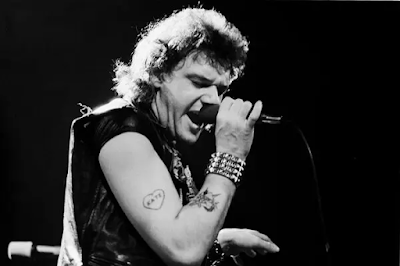 He's running free...Punk music bloomed in the mid 1970s and by the end of the decade had permeated the popular culture. Just as Iron Maiden was forming and ready to burst onto the scene as the premier act in the New Wave of British Heavy Metal.
Maiden’s first two albums are a compelling fusion of punk and heavy metal, blending everything that made that moment in time unique. And that made Paul Di’Anno just what Maiden needed as a lead vocalist.
Di’Anno had an unpolished, angry, raspy style, perfect for songs like “Prowler,” “Running Free,” “Wrathchild,” and “Killers.” He brought a menace to the stage and looked like he might kick your ass after completing the set.
But that’s probably underselling Di’Anno, who also could straight out sing in an emotive, soulful way, as evidenced with songs like “Remember Tomorrow” and “Strange World.”
I am someone who firmly believes Bruce Dickinson greatly elevated Iron Maiden. Founder and bassist Steve Harris wanted someone with greater vocal range, stage presence and professionalism, and found him in Dickinson. Maiden would not have achieved the heights it reached had Bruce not joined the band.
But that does not diminish Di’Anno’s contributions in the slightest. They are immeasurable. And those first two albums are still damned good. Today they sound as fresh and unique as ever, and still make it into my rotation.
RIP Paul, and thanks for the music.
October 19, 2024
Stephen King's The Shining, book and film
I’m a big fan of The Shining, book and film. Both work really well, for slightly different reasons.
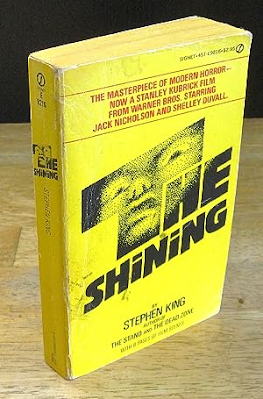 My grandfather owned this edition.I encountered the book first, discovering it along with many other horror and men’s adventure titles through my grandfather. He used to keep a few shelves of well-worn paperbacks behind his easy chair and down in his basement, and when my parents would visit or drop us off for a night of babysitting I’d inevitably find something good to read.
Among the titles that stand out from this time are Whitley Striber’s The Wolfen and Stephen King’s The Shining.
I “read” both as a kid, skimming here and there for the good parts. Both scared the shit out me. My grandfather’s edition of The Shining had the added bonus of stills from the movie, so I had a visual representation of Jack Torrance, Wendy and Danny.
Eventually I would view the film, which also scared the shit out of me as a kid and later bring me great artistic pleasure as an adult. But the film has been so successful and vivid in the public imagination that it has in many ways surpassed the book and become the definitive version of the story. So, I decided to revisit the novel, deep as I am in the Halloween season and struck as usual by the need to indulge my horror sensibilities.
There are many similarities between film and book. The deep isolation of The Overlook, its history. Danny’s ability to “shine,” his precognition as well as knowledge of things that have passed. Jack’s instability. The major plot points and beats of the book are there in the film, too. The endings differ greatly, though people make a little too much of this. Both Danny and Wendy escape, and Jack does not, even if the “how” is quite different.
The book however departs from the film in other interesting and important ways, perhaps principally in that it’s a character study of Jack Torrance. He’s not the sole POV character (Wendy and Danny, and minor characters including Dick Halloran get their turns, too), but it’s mostly Jack’s story. A man battling his demons—career frustration, artistic failures, domestic chafing including resentment for his wife--all fueled by the demon of alcohol. Danny’s “shining” gets a much deeper, fuller treatment in the book. He can detect not only moods but whole thoughts in the heads of others. The motivation for the Overlook wanting him is therefore much stronger in book than film.
I’ve mentioned before that films and books have their unique strengths.
The film does some things better than the book. Stanley Kubrick’s long, panoramic shots of the approach of the Torrance family in their VW bug, and the hotel interior, empty hallways and ballrooms and kitchens, lend the film a sense of physical isolation that the book cannot quite match. The iconic shots of the murdered twin girls and the tsunami of blood from the elevator are so strikingly rendered in film that they surpass the book, too.
But the book gets us inside Jack’s head in a way no film can. I found myself understanding and even sympathizing with book Jack on a much deeper level than Jack Nicholson’s portrayal. I love Nicholson in the film (his work approaching Wendy on the staircase--“Wendy, gimme the bat”) and later crashing through the bathroom door with an axe (“here’s Johnny!”) are fantastic, but he’s pretty much unhinged from the get-go, a veneer of normalcy papered over an unstable lunatic that needs very little psychic urging from the hotel to erupt. In the book we get much more of the why behind Jack’s vulnerabilities, including his childhood traumas with an abusive father, creative frustrations, self-loathing and guilt, and his deep struggles with alcohol.
In short, I love both versions, but the book serves as another example of why I appreciate both mediums and don’t privilege one above the other.
October 11, 2024
More (mediocre) content is not better than no content: A rant
For me, it’s … angry blogging! Friday rant incoming.
What’s gotten under my skin?
The incessant need for “more content.”
I’m hearing this in the cries of Rings of Power defenders, many of whom admit that while the show is mediocre at best, and plays fast and loose with Tolkien lore in nonsensical ways, they nevertheless continue to watch. Because “its more Tolkien content, and I need more Middle-Earth. I need more content.”
Actual quotes.
This chaps my ass.
No one needs “more content.” Not of this sort.
To me it sounds like infantile and babylike cries of, “more food, mama!”
How about, more art, please.
Stop consuming cheap and disposable shit, and begging for more. Find the good stuff that already exists, and enjoy that instead.
There’s more content right now than anyone can consume in a lifetime.
If everyone stopped producing content tomorrow—if somehow we implemented a worldwide ban, and you could only consume content that’s already been made—you’d have enough for 50 lifetimes.
You’ve got way more than enough. I’m not advocating this, BTW, just making a point.
I hate the need for more, at any cost. I also strongly dislike the word “content” when it comes to media. “Content” is the stuff we expel from our bowels. Probably not what we should be feeding our minds with.
We do need good art. But corporations don’t make art. Corporations make content, on an industrial scale, for undifferentiated masses, in order to make loads of cash. As we see with Star Wars and now (unfortunately) The Lord of the Rings “franchises.” Corporations buy franchises and expect massive ROI on their investments. In Amazon’s case, it’s all about getting more Amazon Prime subscribers, converting to product consumers. The Lord of the Rings becomes a means to an end, a power grab, which is the opposite message of the book.
When you consume poorly made “content” produced by corporations it encourages more of the same behavior. Instead:
Support independent artists and small businesses producing new material. Discuss thoughtful and well-made art. Appreciate it. Encourage creation of more of that sort of art. Or, explore the good, old, time-tested stuff.
If you adopt these practices worry not, you still have near infinite options.
More “content” comes with a cost.
It devalues the historical wealth of riches we already have. I have a bias here; I’m a historian. I do wonder: Who talks about Fritz Leiber anymore? Clark Ashton Smith, Leigh Brackett, Poul Anderson? Very few, in comparison to the new and shiny content of the moment. Hell even Ursula LeGuin, once a household name, is starting to slip into the past.
I worry these men and women will be lost to time under an avalanche of new “content.”
“More content” chokes out the magic of what makes old properties special in the first place. The avaricious need for more content causes every timeline, every side character, every magic item or scroll, every byway, to be fully filled in. Until the magic is gone.
We no longer need to wonder how the force operates. We no longer need to speculate about the Blue Wizards and what they were doing.
They’ve all been spelled out, like an adult paint by numbers, in the pursuit of feeding the content machine.
We need dark places in the woods, unexplored realms beneath the seas.
And we need white space on the page.
Obviously, I enjoy modern adaptations. Obviously, I consume some of them. Perhaps that makes me a hypocrite. But I’m definitely more judicious these days with what I watch and read, because I know that you are what you eat. And I’m not a big fan of eating shit.
I’m not advocating closing off possibilities. What I do advocate is, mindful consumption. Read or watch deeply instead of broadly. Then share that out. Celebrate the good. And stop giving your time and attention to the mediocre.
October 3, 2024
The haunting season is here, in Lovecraft Country
 Heading to a trail behind my home, in Essex County."It is the night-black Massachusetts legendary which packs the really macabre 'kick'. Here is material for a really profound study in group neuroticism; for certainly, none can deny the existence of a profoundly morbid streak in the Puritan imagination."
--HP Lovecraft
October is here and I couldn’t be happier. I love this time of year.
I live in Lovecraft Country. I’m surrounded by horrors.
To the west, Arkham University. To the east, Innsmouth and Kingsport.
The South, Salem, which needs no fictional fears. Along with Danvers State Mental Hospital. Or at least the façade, now that the main body has been turned into haunted condominiums.
For good measure, to the North is New Hampshire, home to America’s Stonehenge. Northwest is Vermont, setting of ‘The Whisperer in Darkness.”
 I’ve been reading some Lovecraft to get in the mood for the season, Bloodcurdling Tales of Horror and the Macabre. The 1982 Del Rey edition with the wraparound Michael Whelan cover that serves as the main canvass for the subsequent line of paperbacks.
I have read most of Lovecraft’s stuff, but it’s been a few years. So it always leaves me very pleased to see the plethora of local towns called out in the stories.
Newburyport, which I visit quite frequently. Rowley. Ipswich. Marblehead. Athol. Portland. We still have a handful old Puritan homes with small dark windows and the long sloping roofs that nearly touch the ground, the haunted architecture that served as inspiration for stories like “The Picture in the House.”
I’m minutes away from some of these locations. In about 10 minutes I can be in Newburyport, home to several scenes in “The Shadow Over Innsmouth.” My wife and I love to eat there and stroll along the wharf. In “Shadow” a decrepit bus takes passengers on a little-used route to Innsmouth, home of a strange, mutated race of fish-men and the Order of Dagon Hall.
Which makes it not impossible for a Deep One to have wandered over and taken up residence in this still pond just a short walk behind my house. Where I took these photos, today, while getting outside for fresh air.
These photos are a minor piece of Lovecraft Country.
Nothing too extraordinary, but in a few weeks they’ll look a whole lot more suitable as the orange and red leaves begin to pop. And perhaps a few Mi-Go. What’s the sound? I think it’s the Music of Erich Zann…
 Home to a Deep One?
 Don't cross that gate...
 Alone on the path?
September 20, 2024
Neither Beg Nor Yield, a review
 This book can have none more attitude.Neither Beg Nor Yield is an ass-kicking sword-and-sorcery anthology that you should read.
This thing is a beast, an obvious labor of love. 456 pages. 20 stories. Illustrated throughout. An incredible lineup of authors. How the hell did editor Jason Waltz manage to land this group, a who’s-who of fantasy writers? Each story gets an outro penned by Waltz, a smattering of biographical info coupled with his insights on what makes each story fit the prescribed “sword-and-sorcery attitude” that unites each of the stories.
This book has attitude.
Did we mention attitude?
Waltz plants an Iwo Jima-esque flag for what sword-and-sorcery means to him. It can be summed up in one word. Attitude, with a capital A. Always. Stories of vital, never-say-die protagonists, shouting “enough talk!” before contemptuously hurling a dagger into their garrulous foe (this actually happens in one story). Think of Conan cutting down a magistrate and hacking his way free of a corrupt courtroom, or running down a cruel Frost Giants’ Daughter in the snowy wastes. “An indomitable will with the passion to live,” Waltz proclaims, in his introduction to the volume “It’s Not Gentle.”
This attitude accurately describes a large swath of S&S, and undoubtedly draws many fans under its bloody banner. Including me.
It’s an interesting and compelling way to look at the subgenre, even if it does circumscribe S&S a bit more narrowly than I’d prefer. I suspect it might leave out the Clark Ashton Smith weird/antiheroic strain of Satampra Zeiros that I enjoy, for example. I’m not sure if it permits a story like “The Best Two Thieves in Lankhmar,” or most of the Elric stories. I fear something like HP Lovecraft’s fuck around-and-find-out, dreamy and atmospheric “The Doom That Came to Sarnath” would not make the cut.
Even Conan realizes the pen is often mightier than the sword, and diplomacy is needed.
On the other hand Waltz’ theory allows for a story like “Suspension in Silver,” a story set in the present in which werewolves attack a tattoo parlor that most probably would not consider S&S. So in another sense, it’s permissive.
Sword-and-sorcery can mean different things to different people, and readers gravitate toward it for many reasons. Though it is admittedly a relatively narrow subgenre dominated by men and women of action, there are different strains within it, not all flush with attitude.
We can decide what sort of S&S we prefer. And that flexibility allows an editor to curate a vision for what type of stories he or she wants to publish.
Waltz plants a firm fucking standard in the ground with NBNY. A giant middle finger at the sky, drenched in blood. I commend him for this.
Are the stories any good?
Of the 20 tales, I liked at least 13 of them. S&S anthologies are never perfect and I consider this a very good hit-miss ratio.
My absolute favorites included:
• Soldier, Seeker, Slayer, John C. Hocking. A powerful story with an end that hits like a ton of bricks. A mercenary who has lost his memory has it all come crashing back.
• The Stone from the Stars, Chuck Dixon. This was well-told, amusing, and entertaining start to finish. Reminded me of a Fafhrd and the Gray Mouser story with a little more gross-out action.
• Evil World, John Fultz. Fultz is one of the best S&S writers working today and delivers the goods every time I read him. This story taps into the mythic, with battles against external evil and weakness within.
• Reckoning, Keith Taylor. Taylor is an excellent author, full stop, one of the best of the S&S “silver age” or whatever you want to call it, late 60s to early 80s. The author of Bard takes us back to his sweet spot, Dark Ages Ireland for a tale of Nasach. The combat is 10/10. Great little tale.
• Bona Na Croin, Jeff Stewart. I don’t believe I’ve read anything by Stewart before but I loved this gritty story from an unknown to me author. Very Taylor-esque with its ancient Celtic setting, good use of grit and historical realism that makes its irruption of weird magic powerful and horrifying.
• Virgins for Khuul, Steve Goble. Another new name I was pleased to be acquainted with. This was like a much better told Death Dealer story, over the top but in a fun way. Includes a massive snake and a protagonist with the moniker “Slaughter Lord” … but it all works.
• The Last Vandals on Earth, Steven Erikson. Erikson is a great author even if I have no intention of wading through his Malazan series. Powerful and well-written with an emotional charge, dying letters written in blood never fail to move me.
• Maiden Flight, Adrian Cole. Very apropos ending for the book. Concerns a Valkyrie and a warrior not ready to depart for the halls of Valhalla. The Northern thing never fails to land with me and this one stuck the landing.
Five other stories were good, entertaining if not as unqualified good as the ones above. Seven failed to land with me, likely a matter of taste and style. The only disappointment I want to mention is the Joe Lansdale story. I am a HUGE Lansdale fan and was greatly anticipating this one, but I bounced off its gonzo style and (very) strange subject matter. It reminded me of his The Drive-In, which I also did not particularly enjoy. I love Lansdale’s Hap and Leonard stories, and several of his standalone novels including The Bottoms. He writes humor better than any author I’ve read, save Douglas Adams. He can do pathos and action with equal facility. I’m firmly in Joe’s fan club and he can take the critique. Other reviewers seem to like “The Organ Grinder’s Monkey” so make of this what you will.
TL;DR, get this book and read it. You will be entertained, and your testosterone levels will increase. It’s pretty metal.
Rock on.