Brian Murphy's Blog, page 42
August 12, 2020
Checking in with Tom Barber
 Tom outside his home.
This past week I had the privilege of dropping in for a visit with the great Tom Barber. As followers of this blog might know, Tom was a prolific fantasy and science fiction illustrator in the 70s and early 80s, with credits on a wide range of paperback titles and magazines like Galileo, Heavy Metal and Amazing Science Fiction. He did that wonderful skull with the rat that we all love, adorning the cover of the Lin Carter paperback revival of Weird Tales(he was never paid for this piece by the way, thanks to a shady agent).
You can find a couple write-ups of my previous meet-ups with Tom here:
https://thesilverkey.blogspot.com/2019/08/a-meeting-with-tom-barber-sword-and.html
https://thesilverkey.blogspot.com/2019/09/a-meeting-with-tom-barber-part-2.html
Tom dropped out of painting for a few years while battling alcohol addiction, but has since returned with a vengeance, getting some steady work from Bob McLain over at Pulp Hero Press. One of his recent projects was the cover of Flame and Crimson. I was incredibly honored to have someone of Tom’s caliber on the book.
Tom is a fun, interesting dude. We talked for a couple hours about some experiences he had meeting the likes of Harlan Ellison and Andrew J. Offutt at conventions (Ellison purchased one of Tom’s paintings at WorldCon in Phoenix), meditation and Zen states and humanity stuck in cycles of violence, checks bouncing for work he sold to Amazing Science Fiction, and the tension artists face trying to reconcile illustrating for money vs. pursuing their true muse. All while outside on his front lawn, socially distanced of course, and enjoying the sunny 80 degree weather.
The coolest bit to come out of our meet-up is the news that Tom is working on a short memoir of his own for Pulp Hero Press, one that will focus on his addiction years (his “drinking years”) and eventual recovery. The working title is Artists, Outlaws, and Old Timers. As befits the author it will be illustrated throughout with Tom’s own artwork. Tom is still writing the manuscript but is nearing completion. It will contain some amusing scenes from his early days in the late 1960s attending art school and breaking into commercial work, convention life, crazy bohemian days in Arizona, and recovery and lessons learned.
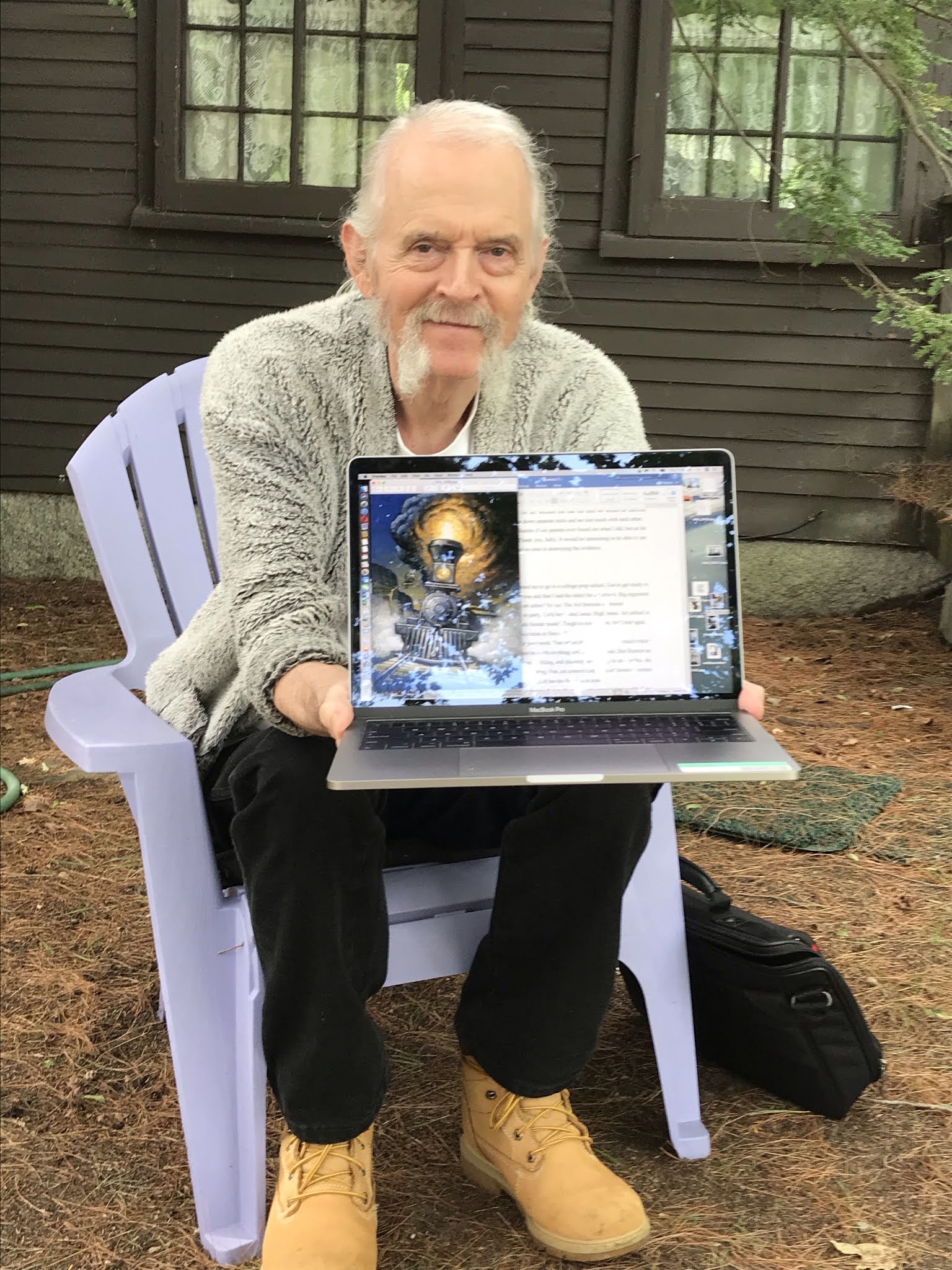 Train to Nowhere
Tom also gave me a look at some of his recent pieces, scanned onto his PC. These include the cover for an upcoming novel by Adrian Cole (a piece called Train to Nowhere; I’m not sure if this will be for a reprint of Cole’s previously published short story or a collection).


August 9, 2020
My Father, The Pornographer: A Memoir
 Andrew J. Offutt was a complex, deeply flawed man. A resident of rural Kansas, Offutt was a husband and a father who supported his family with a successful insurance business, a job which he did not love and ultimately abandoned to make the bold leap into full-time writing. He was at one time a promising science fiction writer. He also subjected his children to emotional neglect, held baseless grudges against various personages, lacked a full emotional maturity and cohesive personality, and held a life-long obsession with pornography.
 His son, author Chris Offutt, tells his father’s story with incredible bravery and honesty and a raw, pull no punches style in My Father the Pornographer: A Memoir (2016). I found this book to be absolutely fascinating and extraordinarily well-written, and burned through it in a matter of two days.
Andrew J. Offutt was “controlling, pretentious, crude, and overbearing” and spent most of his hours “in the immense isolation of his mind,” according to Chris. He demanded dead silence in the house while he hammered away in his office at this typewriter, churning out content. Chris often took to the woods to escape a stifling home existence.
When he died in 2013 Chris went through his father’s voluminous effects and eventually brought with him back home to Mississippi more than 1800 pounds of paper, his father’s life work, which formed the basis for this memoir. Chris meticulously reconstructs the father he never had, after his death. This includes both Offutt the man and his considerable bibliography of fantasy, science fiction, and pornography, which is included in full in an appendix to the book.
Offutt wrote and published more than 400 books under 18 different names. This included six science fiction novels, 24 fantasies, and one thriller. The rest was pornography. Offutt worked like a fiend. At the height of his writing intensity he once turned out 96 pages of content in two days. Porn paid the bills for the Offutt household, and it was a source of both outward pride and hidden obsession for Andrew. He assumed pen names with pride, becoming the character of “John Cleve” and boasting of his accomplishments in porn at conventions. But he also wrote and illustrated troubling sex-torture comic books on his spare time, never intended for publication, but rather to satisfy deep and dark needs of his own. “He didn’t collect these books, he made them. Here was the world he carried inside himself at all times—filled with pain and suffering. I had no idea how miserable he had truly been,” Chris writes. This internal vs. external dichotomy created deep and unseen emotional rifts in his family life. Andrew loved his wife and never struck her or his children, but they “feared his anger, his belittling comments and inflictions of guilt.” Andrew Offutt could not bear disagreements or being perceived as wrong on any point, and structured his life to avoid conflicts, ruthlessly cutting out anyone who he perceived to have slighted him.
Your heart aches for Chris, who despite all this saw his father as a deeply fractured but three-dimensional human being. The book describes for example how the two passed one pleasant Saturday afternoon turning two empty cardboard boxes into castles. My eyes stung with tears during a scene where Chris weeps for the talent his father once had, pre-porn. Andrew had some early artistic successes, including an appearance in the anthology World’s Best Science Fiction for his story “Population Implosion,” which led to an invitation to attend the World Science Fiction Convention of 1969. In 1972 he had a story published in the Harlan Ellison anthology Again, Dangerous Visions, a highly anticipated sequel to the wildly popular Dangerous Visions. In 1974 Offutt presided over the Hugo awards at World Con, but a minor run-in with Ellison (a minor episode blown way out of proportion by Offutt, leading to a lifelong grudge by the latter) made it his last national convention.
Fans of sword-and-sorcery get a few glimpses of that side of Offutt—a glimpse of his fantasy-bedecked office and its effects, including a poster for the movie Barbarian Queen hung over his work desk, medieval weapons adorning the walls including a broadsword, battle-ax, knives, dagger, and a dirk, and his collection of adventure novels by the likes of Robert E. Howard, Edgar Rice Burroughs, and Alexander Dumas. Chris and his siblings were often dragged along to various local conventions by his father and mother, and the book paints a simultaneously charming and dark picture of early 1970s convention life, wonderful and strange and sad. Offutt and his wife swapped partners at times. Chris grew up with a deep misunderstanding of sex and relationships, and himself suffered child abuse at the hands of “the fatman,” a transient predator.
The dead no longer speak and I hold no grudges toward Offutt the man, and will continue to read and enjoy the likes of Swords Against Darkness and The Tower of Death. He was, in the end, a man cursed with many flaws, but that same epitaph can be written on the gravestones of an uncountable string of deceased before and after him. And I recommend My Father, The Pornographer to anyone who appreciates honest writing or a well-crafted memoir.
August 1, 2020
The "later Leiber"
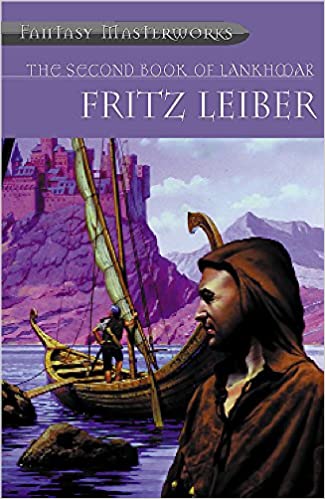 Yech... fugly, bland cover.The review got so long and detailed that I split it into two, then offered it up to the honorable Dave Ritzlin of DMR Books. If you haven't been checking out the excellent works Dave has been pumping out, you're missing out. Follow their blog here.
I am told that the posts will appear on DMR Blog on Monday and Tuesday.
The Second Book of Lankhmar includes the later works of Fritz Leiber, including The Swords of Lankhmar (1968), Swords and Ice Magic (1977), and The Knight and Knave of Swords (1988). These latter two in particular are not among Leiber's more popular or well-regarded Fafhrd and the Gray Mouser stories at least among S&S fans. They are certainly far removed from Leiber's pulp roots and his days writing for the likes of Unknown, and are in my opinion only loosely sword-and-sorcery/heroic fantasy. There is little to no swordplay, they meander, and the adventures are more inward than outward facing.
But I think they are interesting, and well worth reading at least once. And thinking about. Enriching my reading was Bruce Byfield's Witches of the Mind, which makes a clear-cut case for the considerable influence of Carl Jung on Leiber's stories, particularly after 1960.
July 31, 2020
Of sword-and-sorcery, politics, and the Flashing Swords that wasn't
But please for the love of God keep your overt political rants out of my fantasy. It's lazy and I don't like it.
I tried very hard to stay away from politics in Flame and Crimson and restrict my analysis to S&S as an art form, along with the artists, broad themes and conventions, and publishing facts and figures. For many reasons, one of which was made evident today.
Editor Robert Price could have and should have used this opportunity as editor of Flashing Swords 6 to talk about Lin Carter's legacy, the importance of the previous 5 Flashing Swords anthologies, and introduce some hard working new authors to a new readership. Instead he chose to pen an ugly, divisive, political screed, one that will win no one over to his side and is guaranteed to alienate more than than 90% of the book's intended audience. That includes anyone who identifies as a liberal, or a progressive, would prefer to live and let live, is female, or who has a daughter. Or frankly, has a brain.
Sword-and-sorcery appeals to strength, wish-fulfillment, acknowledges our species' fascination with violence, and celebrates self-determination. The subgenre has a history of muscular dudes lording over mounds of corpses, often with a scantily clad female clinging to their muscular thigh. I'm on record as saying I'm OK with all of this--its gorgeous art, I'm a sucker for all things retro, and moreover it's a product of its time. I also think that its OK to like stories about kicking ass, and getting the girl, and carving out one's path from street level thief to King of Aquilonia.
But I think these old S&S tropes can be successfully re-imagined for a modern audience. The anthology Heroic Visions (1983, so not exactly yesterday) for example was based around the thematic concept of strength, whether male or female, mental or physical, and proved that S&S could result in powerful new stories that did not require a muscular barbarian in a loincloth to prop them up.
For the record I don't like censorship. I don't like the implication that, because I enjoy Conan or Kane, I must be a misogynist. When I read old stories that contain casual generational racism or sexism, I apply historical context and move on. I wish more people would do the same.
But Price's introduction is poor, confusing, laughable, completely out of place, diminishes and tarnishes sword-and-sorcery, and has no business kicking off and celebrating what should be a nice relaunch of an old beloved series. We've got to do better. The genre that also gave us C.L. Moore, and Leigh Brackett, and powerful heroines like Valeria and Jirel of Joiry, deserves better.
Feel free to hit me up here or over email with your thoughts or comments. But don't expect more politics on the blog.
July 27, 2020
Feeling SAD on a Monday? Listen to this
 Dangers galore in these old books...By SAD of course I mean Swords Against Darkness, that awesome 1977 Zebra anthology of sword-and-sorcery edited by Andrew J. Offutt. I got to spend a nice hour+ talking about it with the hosts of the Appendix N Book Club podcast.
The episode is now live. Listen here or on your favorite podcast app.
Here is a sampling of what we covered:
Reading fantasy fiction as a kid, writing about swords and sorcery, second generation sword and sorcery authors, the understated prose of Poul Anderson, O. Henry’s sword and sorcery, multiclass characters, the collected Ryre stories, elves and dwarves in swords and sorcery, sword and planet, and much more!
July 24, 2020
Ideas are a dime a dozen. It's all about execution.
Heard on the intranets recently... "Gary Gygax ripped off Dave Arneson! Dave is D&D's true creator!"
My response: Horse shit.
Ideas are like a@#$holes. We've all got one, and most stink. I can sit here in the calm quiet of my living room and fire off a dozen. "Weight loss app." "Online mentoring program for pediatricians." "Telehealth scheduling interface." "Dying Earth role-playing game."
They mean (almost) nothing. What matters is the execution.
You've got an amazing idea for the next 7 volume epic fantasy series? Great. It means nothing ... unless you write it. And it's good.
That awesome weight loss app idea? Great. Now program it. Market it. Sell it. Until then, your idea is so much vapor.
Back to Gygax-Anderson. The idea of taking tabletop military wargames and altering the scale to make a tin soldier representing a unit of 1,000 men a single hero you control and imbue with personality, is a pretty cool one. Whoever conceived that idea, whether Gygax or Anderson (or some other unnamed wargamer), remains up for debate, though Arneson was definitely part of the conversation. His fictional game world of Blackmoor inspired Gygax, and together the two men went on to co-develop the original D&D game rules.
But Gygax took the idea and created TSR, turning an idea into an industry. Without Gygax, there would be no D&D.
That's the power of execution vs. ideas.
Home work (outs)
 Heavy metal.Since the outbreak of the COVID-19 virus I've switched to working out from home and dumped the commercial gym. And I'm loving it.
In addition to weights and a bar I bought a Rogue R-3 power rack. It's been worth every penny. It actually has adjustable safety pins (imagine that), an item which my prior semi-shitty box gym did not possess. Near criminal for a business that ostensibly exists to get people strong.
The result of this equipment and the knowledge that if I fail a heavy lift I'll be fine, plus having no one waiting on me or interrupting my routine with inane babble, has been a small PR. Today using a below parallel/hips below the crease of the knee squat, I hit 455 x 2, followed by 405 x 7. Not bad for a 47 year old dad and desk jockey.
I'm into sword-and-sorcery and heavy metal, so lifting heavy goes hand-in-hand. I was raised on Arnold Schwartzenegger films and Frank Frazetta barbarian physiques and wanted to look like that. For the record I don't, but I believe in exercise and the physical fueling the mental.
July 20, 2020
Some recent arrivals
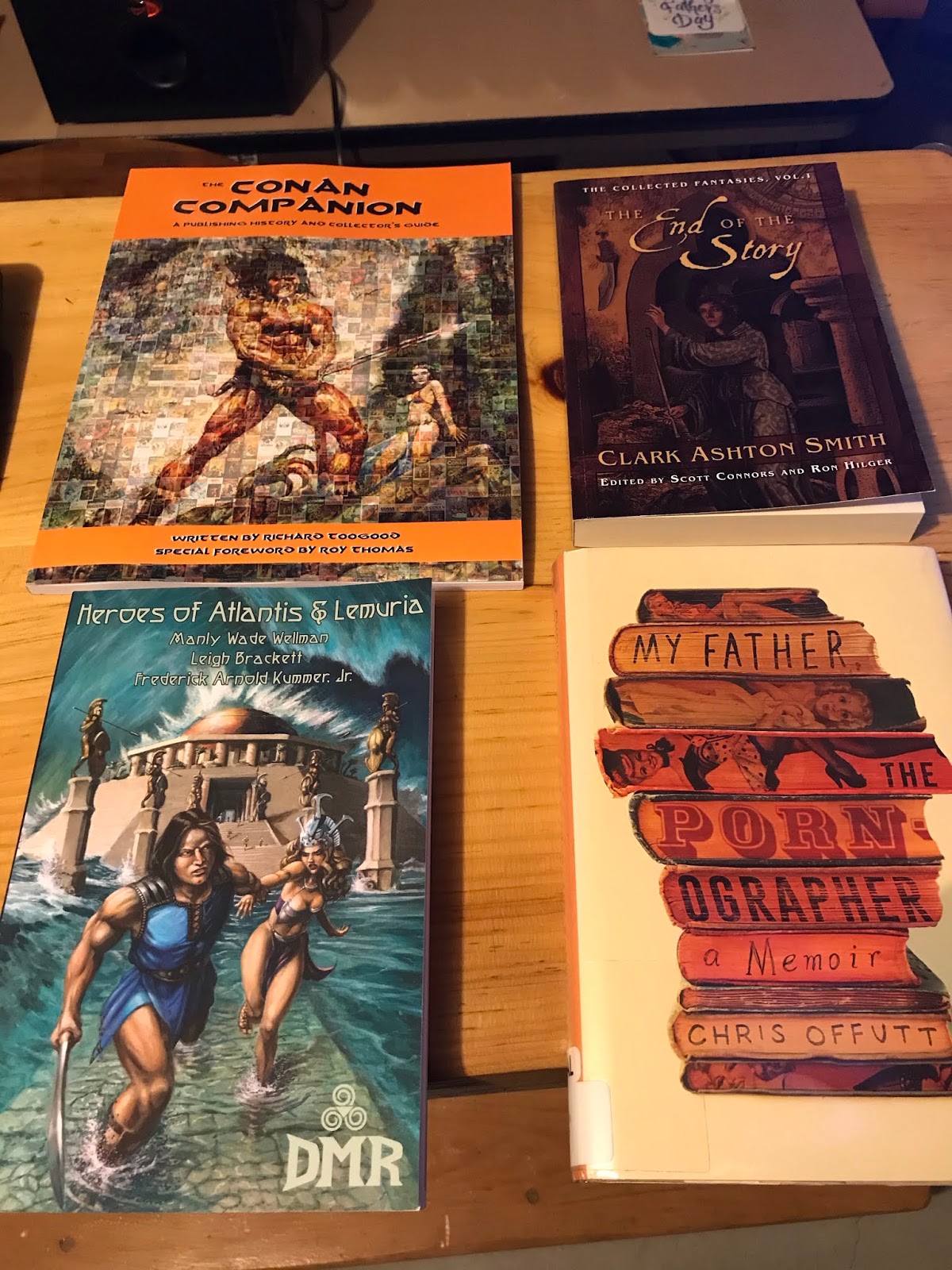 Thanks Amazon!I'm looking forward to digging into these, in particular My Father The Pornographer, Chris Offutt's memoir of his father Andrew. Though perhaps best known for his work editing the Swords Against Darkness anthologies and as an author of some S&S, horror, and science fiction titles, Andrew Offutt apparently made most of his income writing porn novels under pseudonyms. This one was prompted by my recent re-read of Swords Against Darkness for the Appendix N Book Club Podcast.
Happy to support DMR with this purchase of Heroes of Atlantis and Lemuria. I've been slowly adding to my collection of CAS and The End of the Story is a welcome volume.
Finally, The Conan Companion is at first glance and one cursory thumb-through a beautiful book and a detailed publishing history of Conan.
More to come on these later.
July 9, 2020
Halls of Valhalla, Judas Priest
Fierce is the gale
From the north sea
We drink and rejoice from the chalice
Holding the course
Through long nights and days
The ice and the hail bear no malice
Tow the line
Keep it fine
Every man seeks this end
Valhalla - you are calling
I had forgotten how good this one was, until I hit upon it during a Youtube search while getting under the bench press today. I was able to hit another rep on my top set at 320 (x8 reps), right as the intro kicks into high gear at around the 40 second mark. See if it won't do the same for you.
Redeemer of Souls (2014) seems relatively forgotten after the more smashing success of Firepower (2018). While I do admit the latter is a better all-around album, Redeemer has a few monster tracks, including "Dragonaut," "Redeemer of Souls," "Sword of Damocles," "Battle Cry" and of course, "Valhalla." It was Priest's first album without the great K.K. Downing, who decided to retire and get into the business of opening a country club, but Richie Faulkner (The Falcon!) reinvigorated the band, and Halford proved he still had a lot left on the fastball. See the 4:28 mark.
I saw Priest play in support of this album in 2014 at the Tsongas Arena in Lowell MA, and got to meet three of the band members back stage. That story is too long and too good to be told here so shall wait for another day.
I have a confirmed fetish for anything Viking and this song definitely gets me ... aroused. I think Poul Anderson would have approved of it. Hell I think Ragnar Lodbrok would have drank mead from the skulls of his enemies with this one as the soundtrack.
July 7, 2020
Some notes on Swords Against Darkness and the Appendix N Book Club Podcast
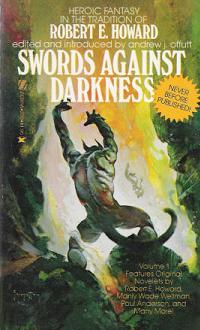 Not a volume of Robert E. Howard
stories, despite the large
"Robert E. Howard"
This past Sunday I had the honor of joining hosts Jeff Goad and Ngo Vinh-Hoi for an episode of the Appendix N Book Club podcast. This is one of my very favorite podcasts, and a must-listen if you’re interested in pulp fantasy, sword-and-sorcery, or exploring the literary roots and inspirations of Advanced Dungeons and Dragons. Subscribe today.
We reviewed a classic, Swords Against Darkness, the first in a series of five S&S anthologies edited by Andrew Offutt. It had been a few years since I last read SAD and upon re-read I found it even better than I remembered.
What follows are some rough notes I made for the show, not a polished essay. I hope the guys from Appendix N don’t mind the preview. This is just a taste of what we covered.
The episode is supposed to drop on July 27. My computer audio gave out at least 2x during the program which was a source of considerable frustration (and likely some annoying post-production). Jeff and Ngo, thanks again for the opportunity.
General commentaryThis is quintessential sword-and-sorcery. Quite the roll-call of S&S heroes—Kardios of Atlantis, Simon of Gitta, Ryre, Vettius, etc.
Editor Andrew Offutt is perhaps best known these days as the subject of My Father, the Pornographer: A Memoir. But he wrote many credible S&S stories for the likes of Thieves’ World, three Conan novels, Cormac Mac Art stories including a couple with Keith Taylor (When Death Birds Fly and Tower of Death, which I have on my bookshelf), and of course served as the editor of Swords Against Darkness.
Swords Against Darkness II has a helpful introductory essay by Offutt, “Call it what you Will,” which was among the many essays I referenced in Flame and Crimson. A relevant quote from that essay, “As to ‘sword & sorcery’—sometimes the tale contains no sword—or no sorcery! Or, more rarely, neither. (Sword and supernatural might come closer, if we’re to discuss, haggle, or bicker”)
This collection is perhaps more accurately heroic fantasy, due to historical nature of some of the stories. But I’m not going to bicker or get pedantic. Much.
Cover is noteworthy for the blurb, “Heroic Fantasy in the tradition of Robert E. Howard”—very common to namedrop Howard on S&S covers, which is indicative of general popularity of REH /Lancers/Conan in general. Zebra for example had a line of REH reprints—Tigers of the Sea, Worms of the Earth, A Gent from Bear Creek, etc. Zebra later adopted “swords and sorcery” on its spine. And it’s got Frazetta cover art of course, though I’m not as fond of this piece as most of his other work.
“Nekht Semerkeht”Offutt did same thing here that Carter/De Camp get shat upon for, finishing an REH story. For the record I’m OK with this practice, as long as it’s clearly called out.
Page 16—This line “The new world and the old personified in the two men,” an interesting clash of the conquistador de Guzman and native American. Double meaning in that North America is the new world, but also alludes to civilized vs. barbarian, at the same time. Paragraph is exquisite.
Page 17—The Indian read “the ultimate doom of his race—REH was sympathetic of natives and critical of rapacious conquerors (a point of contention in his letters with HPL).
Page 18—Beautiful metaphor of expedition as a ship adrift on the open sea. REH’s love of the west is plain here. He was writing this very late in his life circa 1936 when westerns were his passion. And suicide was weighing heavily on on his mind (“the game is not worth the candle”). This extended dialogue puts to rest the simplistic notion that REH only killed himself due to his mother passing. He was meditating on the futility and sordidness of existence long before his mother’s death, and suffering from depression.
Attackers of the city Tlasceltec are slain are slain by necromancy, a blue cloud of death. This city received tribute from Montezuma? Wow.
A lot of weirdness going here—Feeders from the sky, children of darkness with hairy bodies and hands of a woman (WTF?)
S&S is both historical and a-historic, the intrusion of the weird into the everyday makes it more horrible and alien
P. 42—here is why gunpowder does not mix with S&S—one shot kills a sorcerer. “I am dying, of a weapon that ends prowess and cleverness and will harden man all the more.”
P. 43—“false foolishness of patriotism.” Shot across the bow by Howard at flag-wavers.Cool that De Guzman “sat and conversed” with Nekht Semerkeht (an deeply ancient sorcerer from ancient Egypt), who returns the favor by attempting to guide him into a pit of rattlesnakes. Not cool.It’s a dark end for the city, and none fit to rule it—certainly not De Guzman who is portrayed as a brutal conquistador. S&S “heroes” are not always that.
“The Tale of Hauk”Language of Saga—structure and cadence. “Geirolf came again.” Short, clipped, prose, understated.
Clash of pagans and encroaching Christianity. Oaths, and oathmaking. Geirolf wishes to be freed from a “straw death.”
Historical—King Harald Fair-Hair, first King of Norway, King Alfred, etc.
Page 66—so deliciously creepy—“the skipper’s come again.” Geirolf “riding the ridge pole” on the roof—what imagery.
“Drow and Lich” used interchangeably to describe Geirolf—of course very different than D&D.
Hauk has 18/00 strength, no doubt.
“The Smile of Oisia”Suffers from early infodump
Ship owner Fafnir finds the corpse of master clerk Brumus, who has been tortured to death.
Sorceress wants the mask of Karmik—top 89 she is described as a 9th level witch, but pooh-poohed as weak? She is marked for death as a sacrifice to Oisia, goddess of chance. Chance in S&S—not epic destinies.
94—This is pure S&S—adventure for women and gold
Tower raid is like the Tower of the Elephant, Kessak and Nalcon echo Fafhrd and the Gray mouser … Story feels derivative of S&S template, too self aware perhaps. But good.
“The Pride of the Fleet”Weird selection as its sword and planet (actually references ERB/Dejah Thoris). But S&P is S&S cloaked in the guise of SF. John Carter stories huge influence on S&S, etc.
Female protagonist meets a rather vicious end.
Author Bruce Jones did work and art for Red Sonja, and pokes fun at chainmail bikini stereotype—perhaps he was fed up with having to write these stories? Like prior story, shows self-awareness of S&S.
“Stranger from Atlantis”Manly Wade Wellman—a legend whose Kardios stories recently reprinted by DMR. Pulp author with huge bibliography of adventure, horror. Total of I believe 5-6 Kardios stories across various anthologies.
Atlantis has sunk—after Kardios kissed the queen, as prophecy foretold. Odd.
Nephol are race of giants, clumsy, Kardios quick and dangerous in comparison. Serve him feet of an elephant to eat?
Has a sword and harp—D&D bard, and obviously he has some high stats
Monster is Fith, a blob from the sky that consumes. Needs a magic sword to kill it—feels like plot contrivance—giants try to give him a mace, oh yeah, we also found this weird blade of unknown metal that fell with it.
Lowered into a well, upside down, with torch and sword—badass. Plus the torch is cool, flames inside a piece of cane.
Danger of “bowing to someone” and Kardios’ rejection of authority, his sword his preferred companion, are both very S&S.
“Ring of Set”Richard Tierney—one half of the Red Sonja series author along with David Smith. Smith wrote first draft and outline, Tierney completed them.
Historical, feels like REH with the timeline advanced. And it is. Ring of Set is from “The Phoenix on the Sword”
Again very historical, elite Roman guards Praetorian Guard, etc.
Simon of Gitta is another classic S&S hero. More than 15 appearances, I believe this was his first. As recent as 2018 in Robert M. Price anthology The Mighty Warriors.
Has some magic—again would be a D&D multi-class, with a few levels of illusionist.
Magic is very S&S, turns on its wielder. You don’t use the Ring of Set lightly.
“Largarut’s Bane”Odd, quiet little story about a fishing village leader whose “bane” is his pride—he has angered a god and it places a curse on his kin (daughter Eriel), whom he has been babying/ignoring/not letting grow. A slow grower but it works
A witch aids Laragarut by drawing him away and having his daughter confront her (and his) literal demons; Eriel passes the test. Strong female empowerment here—not what one would consider typical S&S, and yet it is—it’s about strength, and might prevailing over sorcery/horror.
“Dragon’s Teeth” First appeared in Midnight Sun (need a copy)
Vettius, Roman Legionaire officer, 6-7 stories set in late Roman Empire. Again historical.
Drake wrote one of my all-time favorite S&S stories, the heavily reprinted “The Barrow Troll”
Civilization is still portrayed as disgusting, even though it’s told from a Roman perspective. Sarmartians are the barbarians, but Romans aren’t much better. Very S&S
Hydaspes, a hedge wizard with a monkey on his shoulder like a living ventriloquists’ dummy. What a cool character.
“The Sustenance of Hoak”Lovecraftian tale, horror but with more characterization and humanity than is typical in HPL
Ryre stories appeared in Whispers, Savage Heroes, but largely in Swords Against Darkness
I recommend Far Away and Never (Necronomicon Press, 1996) which also includes an original Ryre story by Campbell.
Prefigures Glen Cook’s the Black Company and Grimdark in general. Death of Glode is straight out of Abercrombie. Dirt and blood and mire.