Brian Murphy's Blog, page 41
October 6, 2020
Steve Tompkins at 60
Deuce Richardson at DMR Blog asked me to write something to commemorate what would have been Steve Tompkins 60th birthday today, had he had not passed at the far too early age of 48 back in March of 2009.
I chose for the occasion a look back at Steve's first official post on the old Cimmerian blog. "Maybe Not a Boom, But a Drumbeat" isn't a classic, sprawling, deep essay like the ones Steve carved out a legacy writing, but it's a fun, witty, inside look at the state of Howard scholarship and questions regarding his legacy circa 2006.
Check it out here if you're interested. RIP Steve (and since I'm in a mourning mood, RIP to the great Eddie Van Halen, who today passed at 65 after a long battle with cancer).


September 27, 2020
Heavy metal party and The Priest, part 3
(This is a story about how from 2011-2018 I hosted the ultimate heavy metal party and survived to tell the tale. Read parts 1 and 2 here and here).
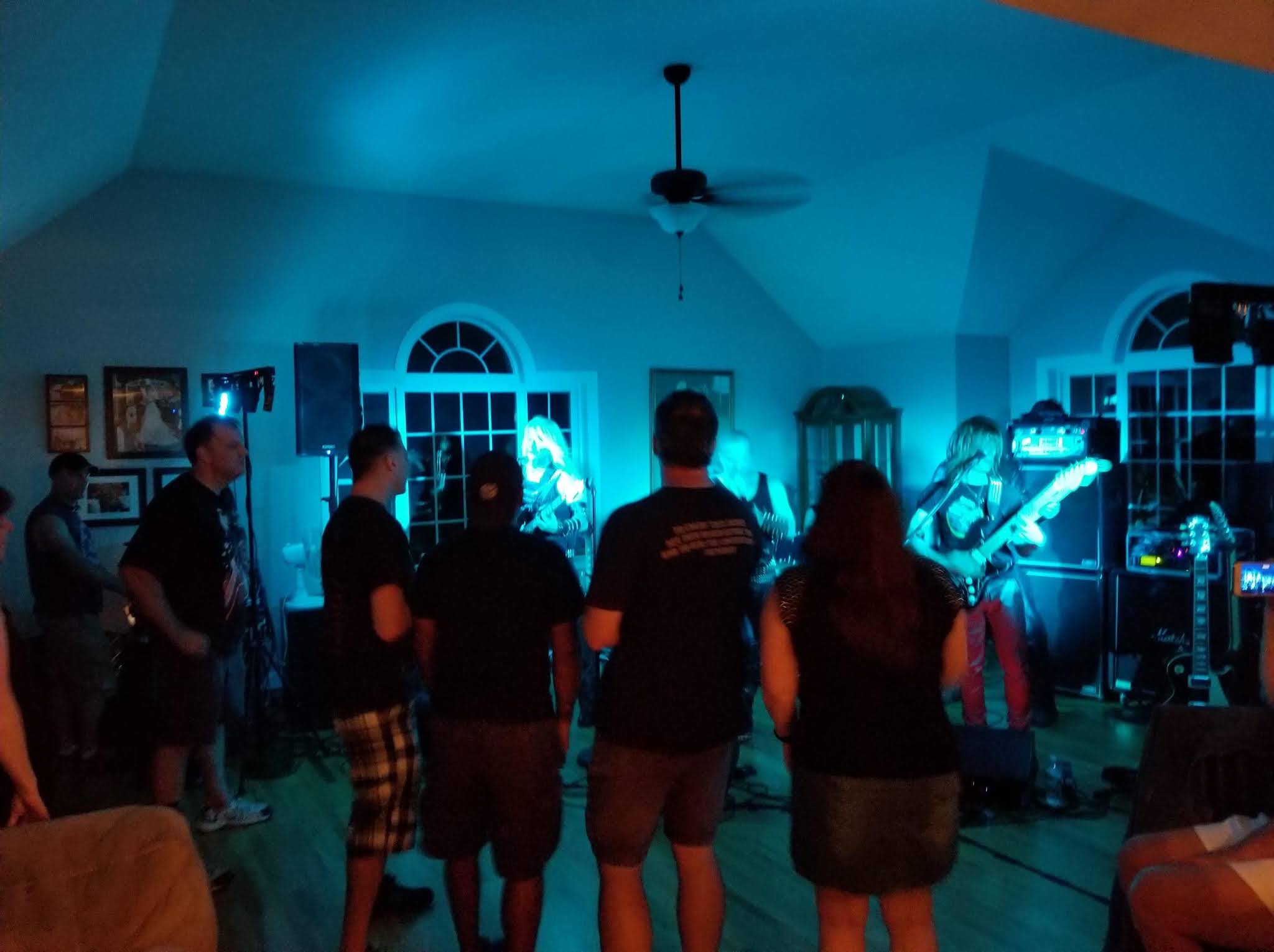 Are you ready for some
Judas Priest-style heavy metal?
Despite the metal party to end all metal parties in 2016, my house was not destroyed, my neighbors did not unite to force the sale of my home, and so the metal party would return in 2017. As always it was a blast. We upped the costuming. I went with Gene Simmons face paint and an Iron Maiden T-shirt. Others showed up with big hair, leather pants, and denim jackets with back patches. We sang karaoke. Late night featured a bucket of ice cold Zima, that semi-nasty clear malted beverage which made a reappearance after disappearing from the shelves for more than a decade (after drinking one, I quickly came to the realization that it was probably better off staying retired). I suppose I didn’t need those Fireball shots at the bar but we did them anyway. KISS or Fiction made another appearance.
Later we voted on which videos had the hottest chick: “Kiss me Deadly” with Lita Ford, a recut version of Cinderella’s “Shake Me” featuring a gorgeous stripper, or “Here I Go Again” with Tawny Kitaen (if I recall, the latter won). We also cast our votes for worst heavy metal video ever, with Manowar’s “Gloves of Steel,” Thor’s “Anger is my Middle Name”, and King Kobra’s “Iron Eagle (Never Say Die)” competing for the dubious title. Thor was a runaway winner, for the record this video is bad beyond belief and I don’t recommend subjecting yourself to it, unless you’ve imbibed 6-8 Zimas to numb the pain.
But despite the fun I couldn’t help but compare the party to the year prior, when we had nearly blown the roof off the house with a live band. In hindsight it seemed rather anticlimactic.
For 2018, I once again put in a call for The Priest.
They responded, Screaming for Vengeance.
Moving in
I had upped my game and so had The Priest. They brought with them a roadie to help set up and break down, as well as a dedicated dude to run the sound board. It was more equipment, more lights, more everything. And it was glorious.
In addition after a one year absence Vin was back with the Tahoe, bigger and better than ever. Here are some photos to give you some idea of what this truck was packing in the back.
It was also a record turnout, with 46 total bodies at the party, band included. My street was loaded with cars, filling all of the circle in the cul-de-sac, and both sides of street, about midway down the straightaway.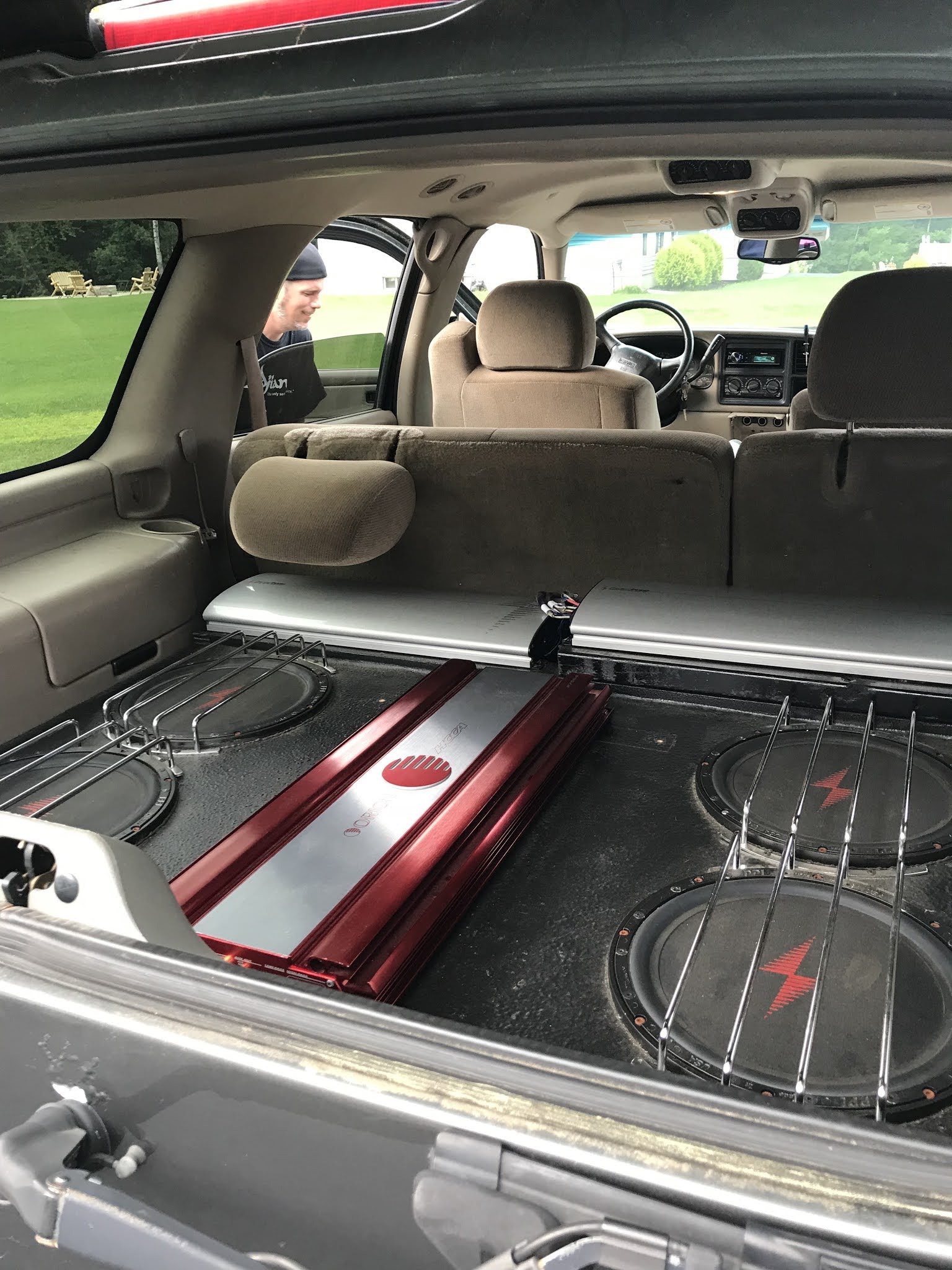 The Tahoe
I felt far more prepared than 2016. I knew what The Priest was bringing and the space they needed. More importantly, I knew who they were, and I knew the band members by name. I felt far more at ease with their coming, they were no longer strangers, and as a result my guard was down, and I was able to warmly welcome them. In 2016 I had invited a group of (to be honest, rough-looking) strangers into my home to play music. Now I knew these guys, and two years later it felt like a homecoming. I had the right mindset going into the party, that it was not about the music, or the spectacle, but the people. My mind was on appreciation, not debauchery.
I dubbed 2018 “For the Love of Metal” and it was that, but it was also something more.
I had engaged in the unknown, took a risk, and it paid off.
I had opened up myself—a piece of me, laying bare a part of who I was, who I’ve always been, to a big crowd. I’m a pretty quiet and reserved guy, despite what these stories may tell. This was a unique expression of me.
I celebrated a group of people who I love, and who I was so happy to host, like a Viking jarl in his mead hall. My speech (see below) reflected that.
As I type this I realize it sounds cheesy and the stuff of Hallmark movies, and probably overblown, but it’s honestly how I felt. And still do.
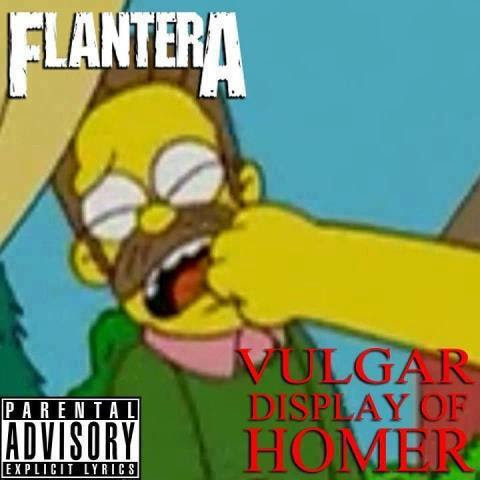
Will I host the metal party again? I don’t know. I’m 47. I have done something I wanted to do, and in a bad-ass way. For a few hours I was like Homer Simpson punching the respectable Ned Flanders right in the face, revealing a side of myself that hides beneath a veneer of white middle class low key suburban dude.
2018 in particular felt cathartic, like a farewell to all that. The growth of the party placed a stress on me, and on my wife (which in turn lends added stress to me). There is always a minor risk of accident or property damage. In 2019 I took a voluntary and needed break. After eight straight years there would be no metal party.
2020 of course has been the ultimate party and live music killer, so nothing this year either.
But I’m SO GLAD I did all this. I made memories to last a lifetime. My closest friends still talk about 2016 and 2018 with a “I can’t believe that happened” air and incredulity.
Sometimes, neither can I.
My speech
There are many things that have brought us here together tonight. Vin’s Chevy Tahoe for one. Let’s raise our glasses to the Tahoe, which is a basically a giant fucking stereo on four wheels!
Who knows the song TNT? AC/DC? I’d like to talk to you about PMP, and why we are here. People, metal, and … I’ll explain the third P in a minute.
Let’s start with the people. There are some damned cool people in this room.
· It’s a chance to hang out with Wayne Coffill for four hours! That alone is worth it. But seriously, Wayne is one of my oldest friends, I’ve known him since grade school, and since then we’ve seen dozens of metal shows together. Maybe 40-50 KISS shows alone. It’s rare to have a friend like that in your life. So here’s to Wayne!
· My sister. Lauren Jurta. Let’s hear it for my freaking cool sister, who is a party in and of herself. Lauren almost couldn’t make it but pulled it out at the last second, with an assist from her husband, a firefighter and an active member of the U.S. military. Cheers to him. Also, you may not know it, but today, is her birthday!
· Let’s hear it for Janet Wyman, who is, by far, the biggest Judas Priest fan here in this here room. Sorry guys in the Priest, maybe you can make a case, but if I had to bet money it would be on Janet. Any else here have a Judas Priest tattoo, or tapestry? Let’s get out that fucking tapestry one more time!!
We’re also here to celebrate the M--metal—heavy metal, the greatest genre of music ever conceived by god or man. My actual goal with this party is not to hang with friends, eat chicken wings, or drink to excess. Though I am currently doing all these and will do all of the above. No, the real reason I do this every year is the since hope that I will convert at least one person to the cult of heavy metal, and in particular Judas Priest.
Who here is a fan of metal? I’ve probably been to 70-80 shows, at least. Some great ones, I’ll bore you with later, but let me tell you about a local show, at the Chit Chat Lounge in Haverhill, when I saw a band called The Priest.
I had a great time, and they were good—outstanding musicians. There are guys in this band that have played gigs in Europe and had a video on MTV’s Headbangers Ball. But they were missing something. Then they landed a guy named Ron Finn, and when I saw them again at Uncle Eddie’s in Salisbury—I was blown away. The pieces came together.
So enjoy this great music from this talented band. And welcome to the cult of Judas Priest.
Finally its about our final P.
For years I was afraid to throw this party. For years I thought, how fucking awesome would it be, to host a heavy metal party? I kept waiting for someone to do it, and then hoped I’d get an invite. Neither happened. So you know what? I did it myself.
Judas Priest has a song called Heading Out to the Highway.
Like all good songs, it works on multiple levels. The highway is a metaphor, you see. It’s your life. There is a verse in the song, and it says:
I’m going to do it my way
Take the chance before I fall
The chance … before I fall.
So I ask, what chances are you going to take, before you fall? Before you grow too old and settle in to a comfortable life watching Law and Order reruns on the couch? Before you’re on your deathbed and it’s too late, and you’re full of regrets, and thinking, I wish I had done this, or that?
I’ll tell you what I’m going do, which is the second P and the purpose of this party—its an expression of me, and I’m doing it because I love my life. Metal is a passion. One life, and I’m going to live it up. Purpose and passion, manifesting in this party.
As Judas Priest said in “You’ve Got Another Thing Coming”:
If you think I'll sit around as the world goes by
You're thinkin' like a fool cause it's a case of do or die
Out there is a fortune waiting to be had
If you think I'll let you go you're mad
You've got another thing comin'
September 22, 2020
A review of Tom Shippey’s Laughing Shall I Die: Lives and Deaths of the Great Vikings
 The man, the myth... Tom Shippey
As a Professor Emeritus of Saint Louis University, Tom Shippey understands the current trends shaping historical research, far more than I. For example, I did not know that historians have been re-interpreting the record to paint Vikings as well, less Viking-y. Less savage, more tame. Less raid-y, more farmer-y and trade-y. Many of the corny old myths surrounding Vikings—horned helmets and drinking wine from skulls of their enemies and the like—have rightfully been reframed as romantic sentiment rather than historical reality, but I didn’t realize the extent to which this re-evaluation of the Viking character was working overtime in the halls of academia.
Laughing Shall I Die: Lives and Deaths of the Great Vikings (2018, Reaktion Books) is Shippey’s semi-bombastic rebuttal to the revisionists and whitewashers. It’s not that Vikings weren’t also great traders, or slowly shifted from raiders and slave-takers to land-owners and eventually settlers, but Saga literature and even the archeological record paints a picture of savagery and warrior ethos that can’t be so easily explained away.
“Academics have laboured to create a comfort-zone in which Vikings can be massaged into respectability,” Shippey writes. “But the Vikings and the Viking mindset deserve respect and understanding in their own terms—while no one benefits from staying inside their comfort zone, not even academics. This book accordingly offers a guiding hand into a somewhat, but in the end not-so-very, alien world. Disturbing though it may be.”
Shippey lays out these uncomfortable facts in entertaining style in Laughing Shall I Die. This book takes a close look at the old Norse poems and sagas, and uses them to create a psychological portrait of the Viking mindset. But it also goes a step further: It interprets the findings from archeology and recent excavations to lend these literary interpretations tangible and physical reinforcement. For example, Shippey describes the discovery of two recent Viking Age mass graves in England, one on the grounds of St. John’s College, Oxford, the other on the Dorset Ridgeway. Both were organized mass executions, the latter the single largest context of multiple decapitations from the period. Fearsome stuff.
In Old Norse, the term vikingr means pirate, or marauder. “It wasn’t an ethnic label, it was a job description,” Shippey writes. “If people weren’t raiding or looting (and land-grabbing, and collecting protection money) then they had stopped being Vikings. They were just Scandinavians.” Many modern studies embrace the Scandinavian aspect and shy away from murder and plunder, “retreating to the scholarly comfort-zones of exploration, trade, urban development and distanced narrative history. All of which is admittedly part of the story. Just not the only part,” he adds. So too were shield-walls and slave-taking and trading, even human sacrifice.
(This might be a good time to boast that I met Shippey at a sci-fi and fantasy convention in Boston 10 years ago. Recap here).
I can’t say that this book is of the same extraordinarily high quality of his Road to Middle-Earthor Tolkien: Author of the Century. Those books set a standard in Tolkien criticism that has yet to be surpassed, at least in my estimation. Shippey knows Tolkien, and I learned more about the art of philology and Tolkien’s use of that discipline to build Middle-Earth from reading Shippey’s works than I would in a semester of study.
Shippey also knows Vikings, but this book was not full of the stunning revelations I learned in The Road to Middle-Earth. Still, it was an entertaining read, and full of some startling details about this incredible culture of sea-borne raiders that wreaked havoc across England, Scotland, Ireland, and into Eastern Europe and parts further. Vikings didn’t always win and occasionally suffered terrible defeats, including at the likes of Clontarf and the Battle of Stamford Bridge in 1066, the latter of which saw the death of the great King Harald Hardrada and essentially ended the Viking age. But what made them so unique was their fearlessness, fueled by a culture which valued stoicism, inflexible honor codes, and a belief in the myth of Valhalla, in which they would die on the battlefield but be reborn into a violent and eternal afterlife in the Halls of Odin, until Ragnarok and the ending of the world. Something akin to a “death cult” in Shippey’s words.
Laughing Shall I Dieis also a very accessible, readable book and a great way to experience the stories of the likes of Hrolf Kraki and Egil Skallagrimsson, Signy the Volsung and Gudrun the Nibelung, Ivar the Boneless, Ragnar Lodbrog, Skarphedin Njalsson, and others. In other words, mainlined “Northern Thing” for those that enjoy such things.
September 19, 2020
Heavy metal party and The Priest, part 2
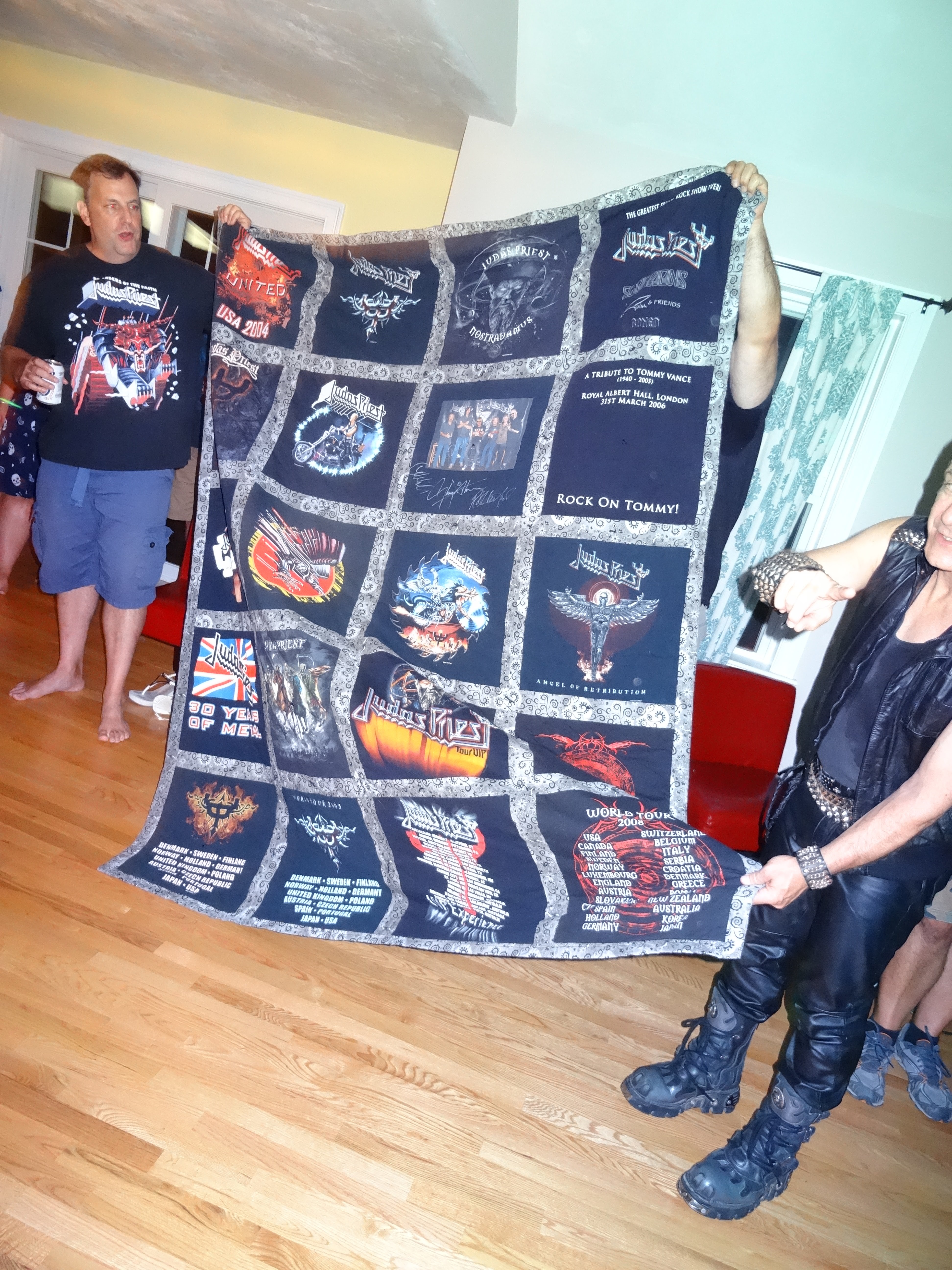 The Quilt, made of Judas Priest concert TsMurph's 6th annual Metal Party is back, and this one goes to 11! The can't-miss metal event of year will feature the live music of The Priest, New England's premier Judas Priest tribute band. Wear your faded concert t-shirts and denim jackets and strap your leather cod pieces on tight. Prepare for yet another round of "classick" metal trivia, bad late night videos, and oft-told, slightly exaggerated stories of metal concerts from decades past. Metal rules, my friends, so "head out to the highway" to celebrate.
 Food, some booze, and locale provided, but bring your own favorite drinks and apps or desserts welcomed. Hat will be passed around to defray some costs of band.
--Description from the Facebook page of Murph’s Metal Party, 6th annual
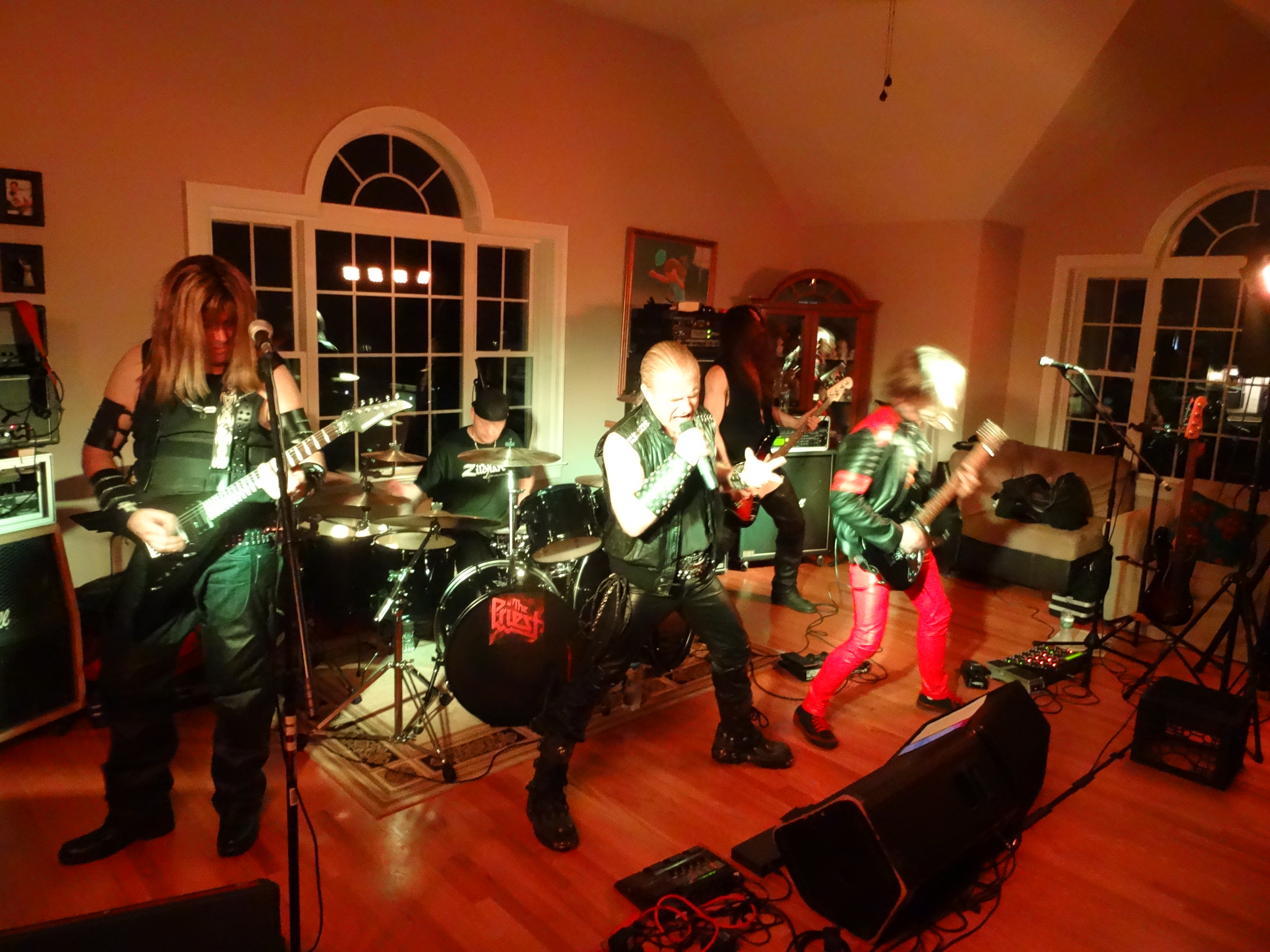
I knew I was in trouble when Tom, aka, KK Downing, pulled into my driveway with a minivan LOADED with equipment. I mean, this thing was jammed floor to ceiling with amplifiers, sound board, wires, guitars, god knows what.
“Holy shit, you guys brought a lot of equipment,” I said, bug-eyed as I stared at the pile of noise generating electronics that would soon be making its way into my living room.
“Oh no, that’s just mine,” Tom replied. His face was utterly dead pan and humorless.
Oh shit, I thought.
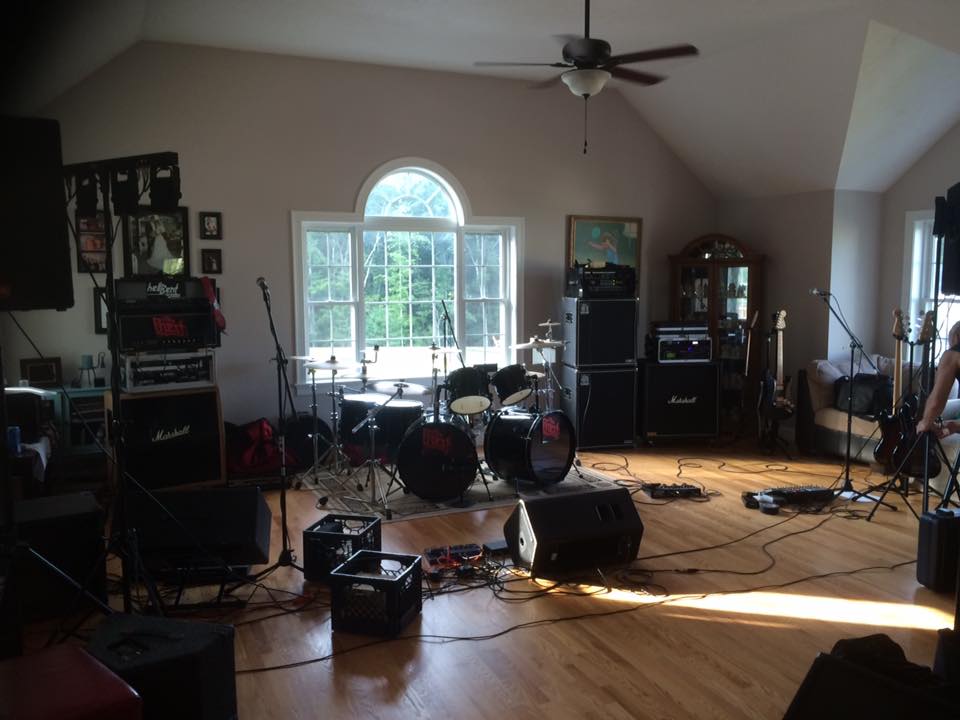
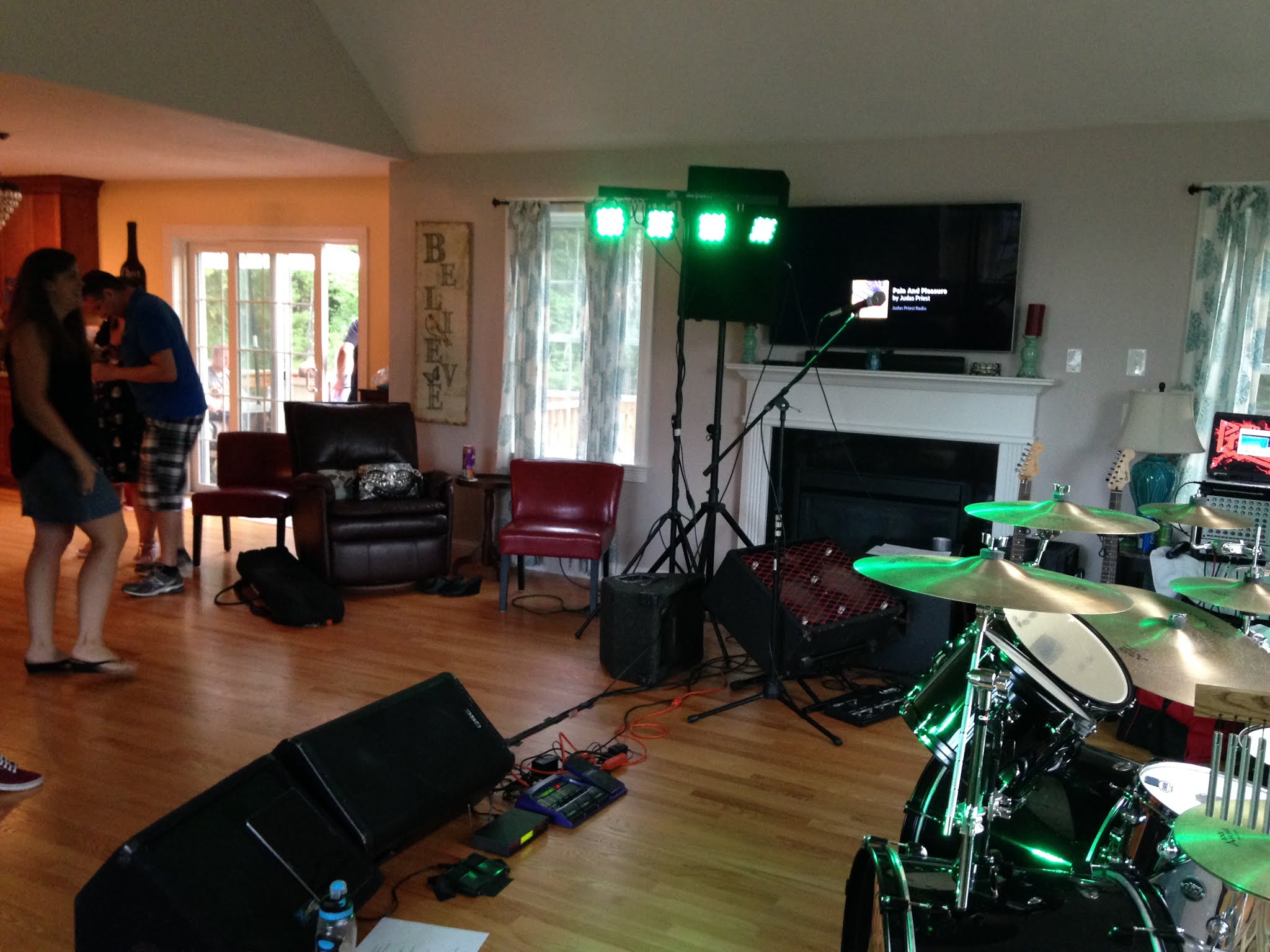
Tom “KK Downing” was the first to show up on July 30. He was there EARLY, before even my friends. But I had no idea how much setup was required. My friends began to trickle in, and we stared in awe as the great room filled up.
We watched them do some sound-checks in shorts and t-shirts, including a brief bit of “Breaking the Law.” We’d hear the full version later. We were in awe, just of the equipment.
It was AWESOME. There was so much anticipation and energy in the air, as the band members mingled for a while and had a few drinks. During this time I busted out trivia. Later the band made their way downstairs to change into full leather, wigs, arm bands, and other paraphernalia circa early 80s Priest. I walked downstairs to grab a beer and caught a couple of them in mid-change, awkwardly throwing up my hand to avert the sight. Fortunately (to quote Nigel Tufnel) they were only “semi-nude.”
Then it was time.
We started the chant, me and a couple friends. Eventually the whole crowd of party-goers, some 25-30 strong, all got in.
“Priest! Priest! Priest!”
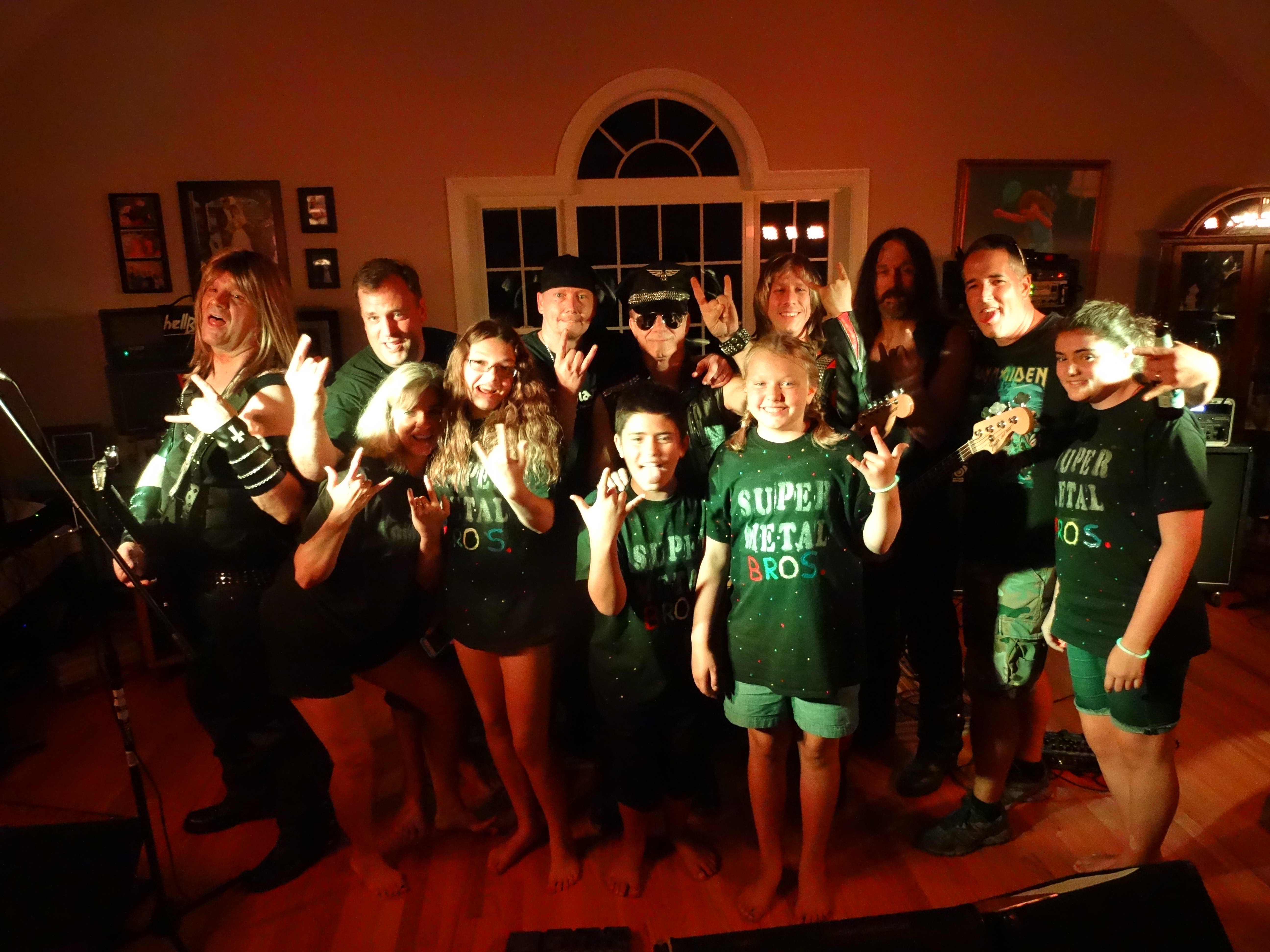
One by one, each band member came up from the basement and made their way through a cheering crowd, in MY FUCKING HOUSE (did I mention this), and took their place at their respective instrument. Tom aka, “KK Downing,” Bryan aka, “Glenn Tipton,” Everett aka, “Scott Travis,” Dave aka, “Ian Hill” and of course, Ron Finn aka. “Rob Halford.”
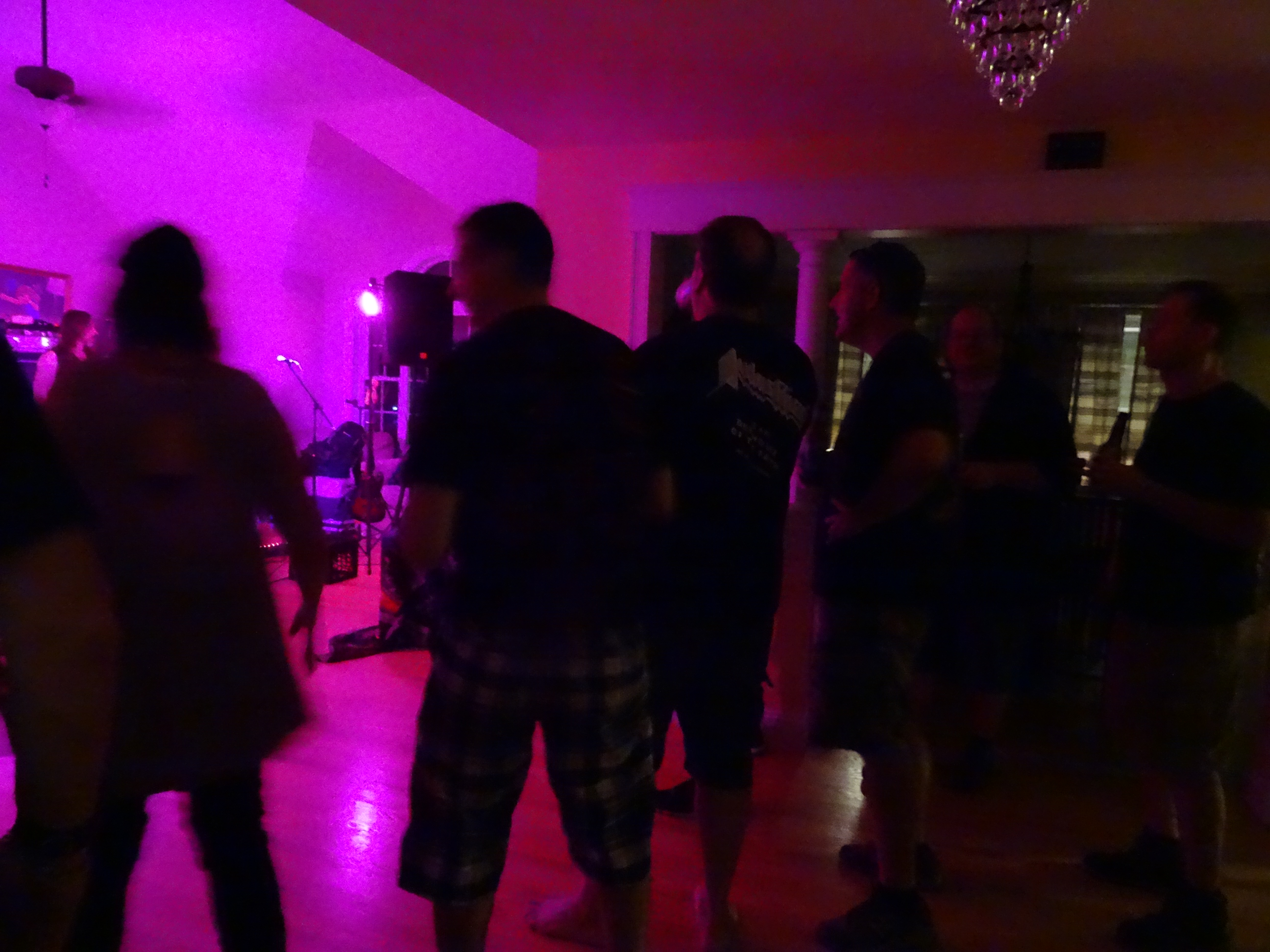
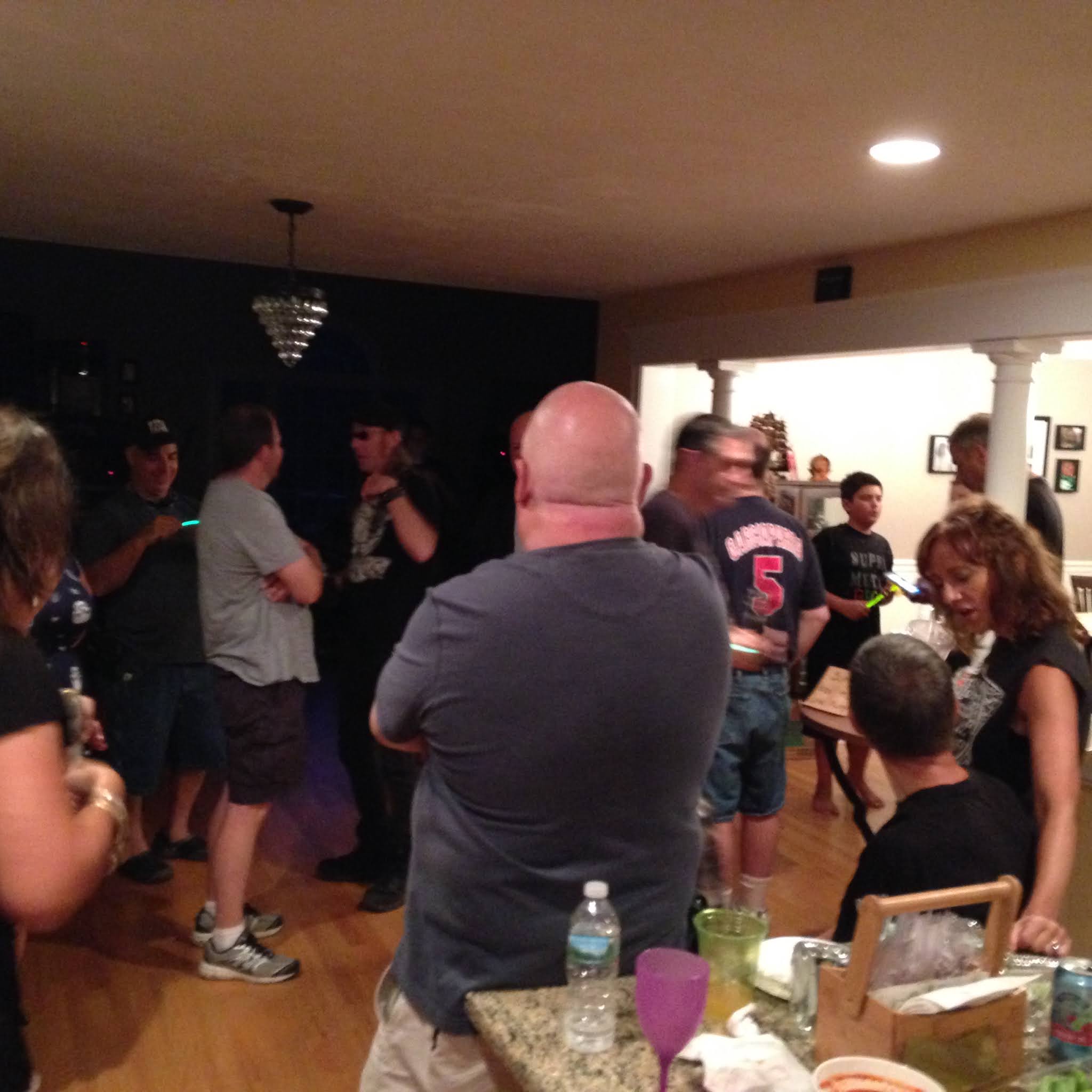
At this point I’m going to let the pictures, and videos, speak for themselves. Anyone who has ever captured concert footage on a crappy cell phone knows that the post-video does zero justice to hearing it live, and the same goes with these clips. But they’re not bad for all that. Give them a listen.
During the show my brother in law opened up a few windows strategically to make sure the sound could escape, or something. Maybe he was accommodating a few of my neighbors who had showed up to watch the show from outside. It was loud enough for them to hear it, and the light towers flashing purple and blue and red through my great room window made for a hell of a visual.
In case you’re wondering, yes, I sang Turbo Lover with the band playing.
No, you cannot hear a clip of this J
The Priest took a well-deserved intermission during which I delivered my annual metal speech. I barely remember delivering it, so I’m including the full transcript below.
It was three hours of sheer fucking volume and power and awesomeness. I should add that not everyone who came liked metal, or perhaps liked only the likes of Bon Jovi or Poison. They left impressed.
I think I made a couple new Judas Priest fans.
The band did play until just after midnight, so technically we were “Living After Midnight.” Breaking down and carrying out took a lot less time. Afterwards they hung out with me and a few die-hards. I stayed up until almost 3 a.m. with my brother-in-law, Ron, Dave the bassist, and Bryan/Glenn Tipton, sitting around a fire and shooting the shit about life and metal.
What is best in life? That experience. It was so worth it. A peak, top 10 memory for me.
There is a Part 3 to this story… more madness, and the end of the Metal Party? Stay tuned.

My speech
So who here is a Defender of the Faith?
Donald Trump wants to make America great again, we are here to make metal great again.
I’ve been a fan of the genre the whole of my adult life. KISS was my first love and while they are hard rock for the most part, not metal, they were a gateway to the harder stuff. Soon I was listening to bands like Iron Maiden, Metallica, and eventually Judas-fucking Priest!
It was the late 80s! I was thin and had most of my hair, was 30 pounds thinner and better-looking, and life was good.
But times change, and fast. Metal fell into steep decline starting around 1992. Within a couple years Bruce Dickinson left Iron Maiden, Rob Halford left Judas Priest, and Metallica cut their hair. Immortal acts like Hootie and the Blowfish and the Spin Doctors ruled the airwaves, and Pearl Jam was being declared the next Beatles. And I started a slow decline into the sad mass of flesh you see before you now.
It was dark times for my favorite genre, and for me. I still listened to metal in my dorm room, shivering under a crusty blanket while strains of Pearl Jam’s “Jeremy” echoed down the hall, but there were no Dio posters to be found, no Exodus t-shirts, no denim jackets with Manowar back patches. My favorite bands were gone underground or on life support.
It was my first realization that, to quote Axl Rose, Nothing lasts forever.
But neither do the hard times, or the cold November Rain. People got sick of flannel and hackey sacks, and songs about teen angst and how bad the world sucks. Soon grunge was happily becoming passe. And by 2000 or so, metal was back. You can’t keep a good thing down. The music, as it turns out, was pretty damned good after all.
And I’m proud to say I never left it. I stayed a Defender of the Metal faith through the dark times, and I still am. But that experience made me realize how fragile this all is.
And so I got tired of waiting for the party I always wanted to attend. And I threw the one I always wanted tonight!
I learned something in this process: Get rid of your restraint. Do the big, grand, over the top gesture. Do what you love to do, as long as you don’t hurt anyone else.
Recently I’ve finally come to the realization about who I am.
I’m a Rocker, and no one can take that away.
So let’s raise a glass to metal! And please keep that glass raised for a second toast for someone special—my wife, for putting up with this nonsense. She’s the best, and even though she’s not a heavy metal fan she’s metal in her own way. She’s made this party rock 10 times harder.
Let’s move on to the main event.
Judas Priest would make most self-respecting metal fans top three heavy metal bands of all time. They are not the first heavy metal band of all time—that was Black Sabbath, by most counts—but they were the ones who created the template for metal as most of us know it today. Twin guitars, operatic vocals, a sound of clean steel, divorced from the blues. A sound like roaring motorbikes and lyrics about Sentinels from some distant apocalyptic future. Also revolutionary was their leather and studs look.
If you want to understand what metal is all about, start with Judas Priest.
We first saw Hell Bent for Judas a couple years ago playing the Chit Chat Lounge in Haverhill. I remember being very impressed with how tight they were. Since then they’ve added a new lead singer and renamed themselves The Priest. I called Ron Finn back in April to ask if he’d play a private event, Tom and I worked out the details, and here we are. He’s awesome, they all are.
At the 6th annual metal party we’ve turned it up to fucking ELEVEN.
So let’s head on out to the highway! What do you say? Are you ready for some Judas Priest style heavy metal? I give you The Priest!!

September 14, 2020
Heavy metal party and The Priest, Part 1
 For five years, from 2011-2015, I hosted an annual heavy metal themed party. And had a blast. Ultimately it grew into something much more. Here’s the story…
 It started out modest, a gathering of 8-9 buddies. My wife and daughters were out of state visiting my sister-in-law, a girls’ weekend. To celebrate my short-term bachelorhood I decided what I needed was a guy’s weekend, a gathering to drink beer and listen to heavy metal with some dudes. No more no less. We’ve all been there.
That first year we drank too much beer and ate ribs off the smoker. My old man did the cooking and stuck around for a few cold ones. I threw a few bags of chips on the table. We may or may not have ended up at a gentlemen’s club late night. No different than your average guy’s hangout. If there was one underlying commonality an outsider to the gathering might have noticed, it was the soundtrack and the garb: We listened exclusively to heavy metal, and many of us were wearing metal t-shirts.
A theme began to coalesce.
I think it was my friend Scott who eventually dubbed the gathering “the metal party” because of the music, the general crude nature of the affair, and the scarcity of women (metal concerts are largely sausage fests). The name stuck, and an informal guy’s hangout became something more.
You bent over, baby, and let me be the driver(KISS. Yes, they wrote this little bit of brilliance for a song called “Burn Bitch Burn.”)
I’m like a pounding hammer and I wish you were the nail
Girl you’re not 18, but they can’t put my mind in jail
(Fiction—I made this one up. And am immensely proud of myself for doing so)
Aside: I am a huge KISS fan and think they are the best at what they do, which is theatrics, spectacle, and writing fun, entertaining rock songs. But if you can’t laugh at some of the nonsense they’ve put out over the years, you’re doing it wrong.
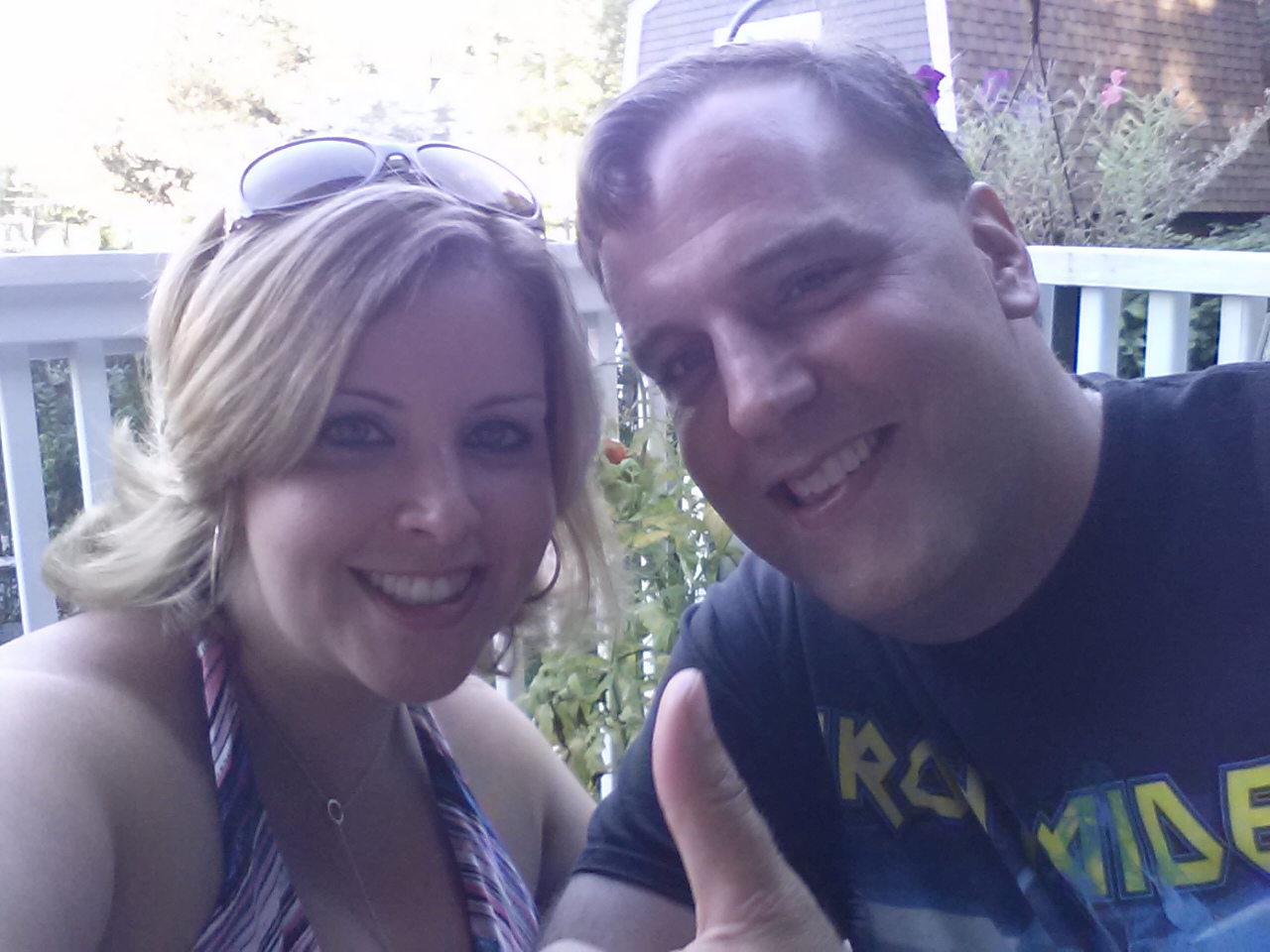 Rosie (left) was a good sport with "KISS or fiction"
We continued to layer on the fun over the next two years, adding a karaoke machine one year and belting out our favorite songs in my living room. The list of attendees began to grow, including our friends Janet and Allen, who drove down from New Hampshire and brought with them a Judas Priest tapestry, made by hand from dozens of concert t-shirts. We had a grand unveiling and worshipped its magnificence. We did Jello shots, stuffed a bathroom, someone brought metal-themed cookies. I started doing a rambling kickoff speech, celebrating friendship, and heavy metal, roasting various attendees with embarrassing anecdotes from our past, and in general making an ass of myself.
In I believe 2014 my friend Vin showed up in his tricked out Chevy Tahoe, basically a stereo on wheels. I have no idea what type of equipment he hooked up in this rig, but I can tell you there was no room for groceries—because the entire storage compartment was jammed full of speakers. Recently I asked him to confirm the technical specs, and here’s what he said:
Dual batteries, Dual alternators, 2/0 ga power cable, 300A main fuse, Orion HCCA sub amp pushing 4 precision power PRO12 4 ohm carbon fiber flat piston subs wired in paralled 1ohm and 1200 watts bridged.
The sub box was 6 cubic feet, had 6 gallons of fiberglass body filler and weighed over 300 pounds. Vin needed to run air shocks in the back for support, and it needed a second battery and alternator to run the stereo and the car at the same time.
It put out 3000 watts of power.
For the record I have no idea what most of this means—only that it was REALLY FUCKING LOUD. We opened up the back, rolled down the windows, and cranked songs like “Raining Blood” and “Revolution Calling” loud enough to rattle teeth. The appearance of the Tahoe and our gatherings in the driveway quickly became a highlight.

In short, the metal party was rocking, hard. But changes were afoot.
I’ve always been a big concert goer and in October 2014 Janet made my year when she got me a pair of tickets to a backstage meet-and-greet with Judas Priest. That’s a story that will have to wait another day, as it’s too good to tell here. I’ve always loved Priest, but this singular event kicked up my appreciation of these metal gods to new levels.
A couple weeks after that, Chris alerted me that a Judas Priest cover band called Hell Bent for Judas was playing over at the Chit-Chat Lounge in Haverhill, barely 15 minutes away. Priest being in my top three favorite bands of all time, and flush off the high of the Lowell show, I didn’t want to miss the occasion.
Hell Bent did not disappoint. As my buddy Chris and I left the club, ears ringing and a shit-eating grin on our faces, he turned to me and said, “the metal party is always fun, but I’m starting to think it’s a little stale and needs something else. Wouldn’t it be awesome to have a live band?”
Brilliant, I thought. “Yeah, that would be awesome,” I replied. “I bet these tribute bands do private gigs.”
A seed was planted. I found Hell Bent for Judas’ Facebook page and followed and liked them.
In 2015 the lead singer of Hell Bent for Judas (a nice bloke, but an average talent at best) left the band and/or was booted out, and replaced by a more talented singer. He too left, within a few short months (this band was going through lead singers like Spinal Tap goes through drummers), replaced by a third dude named Ron Finn. Ron is a local legend, a hugely talented singer perhaps best known as the frontman of Wildside, a fun and talented party band known for 70-80s covers, mainly hair metal and classic hard rock like AC/DC. Ron also recorded a few albums with his band Easy Rider, and experienced some moderate fame and following over in Europe. Ron has one of those voices with huge power and range and sustain. I’ve heard him crush everything from Whitesnake to Quiet Riot to Rainbow. The guy can sing.
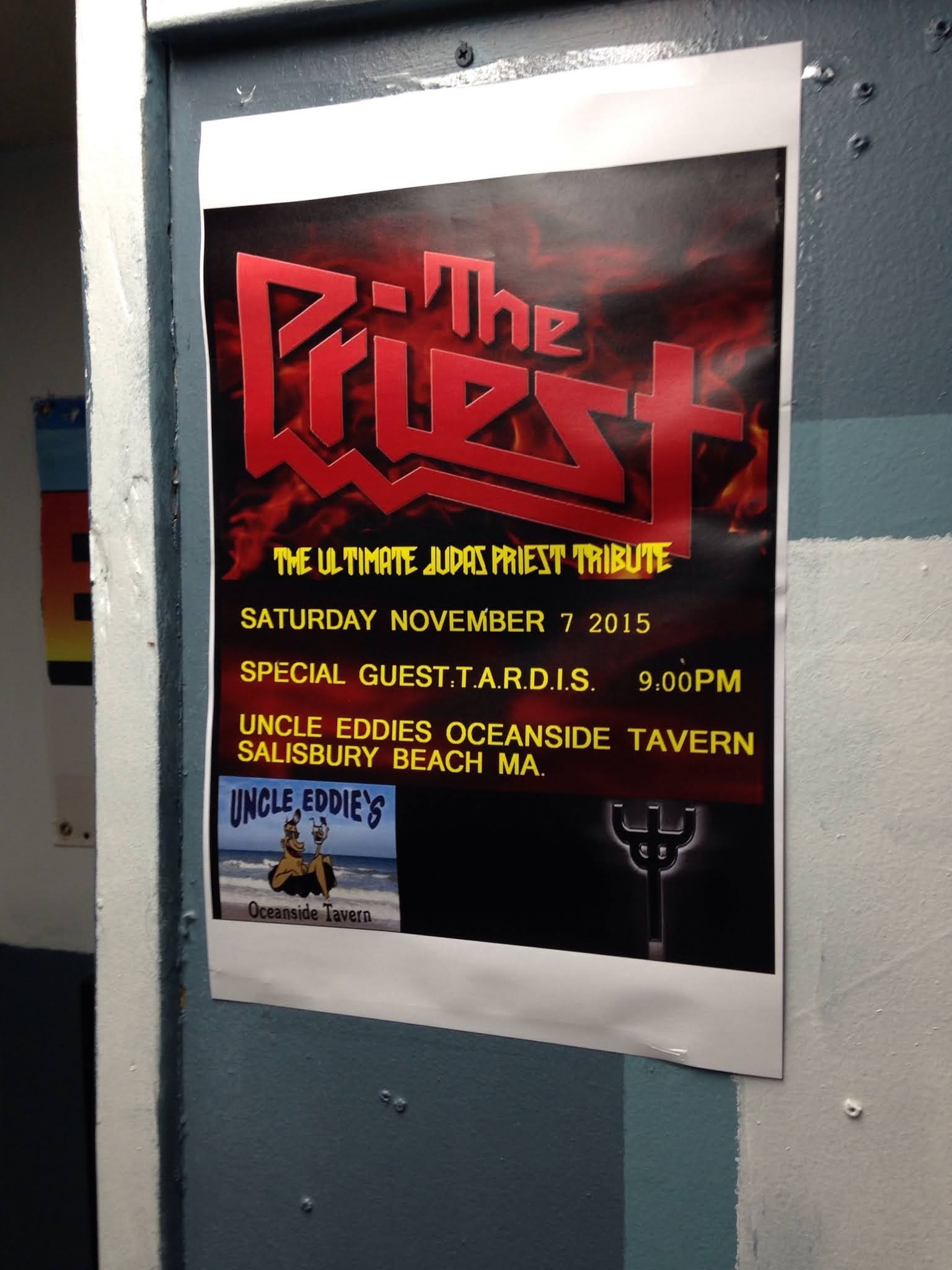
Redubbed as The Priest, these guys tore the roof off another semi-shady but fun local venue, Uncle Eddies on Salisbury Beach, that we attended in June of 2015. I was blown away watching them play classic Judas Priest hits like “Desert Plains” and “Devils’ Child.” I was mesmermized and screamed along with the crowd as Ron nailed Rob Halford’s high-pitched scream at the end of “Victim of Changes” (you know the one). I remembered Chris’ words from the Chit-Chat, and during intermission of the show we revived the conversation.
“I’m going to do it man, I’m going to see if I can get these guys to play the metal party,” I said. “This is who I would want to play. The Priest!”
Fast forward a few months later. Sitting in the calm of my living room, my finger hovered over the “contact the band” button on their website.
I’ll just ask some questions, satisfy my curiosity, I mused.
Press.
The metal party was about to go to 11.
September 11, 2020
Heavy metal. It's coming.
I've got a hell of a story to tell, that I'm working on for the blog. Will be a few more days. Stay tuned.
September 4, 2020
Farewell to Charles Saunders
Word spread on Facebook last night that Charles Saunders, author of Imaro, has passed away. It is being reported he died in May. Odd that an obituary search turns up empty.
Let's hope it may be a rumor, but it does not appear that way. Author Milton Davis, who continued in Saunders' "Sword-and-Soul" tradition, broke the news, and many authors, friends, and peers have chimed in since.
Imaro and its subsequent volumes deserves a longer post than I have time for at the moment, but I consider these terrific works of sword-and-sorcery. If not at the level of Howard/Leiber/Moorcock/Anderson, they rank up there with Henry Kuttner, Karl Edward Wagner, David Drake, and many other fine authors.
I regret not contacting Saunders when I had the chance to let him know how much I enjoyed his work. Nyumbani, Saunders' fantastic parallel of Africa, is a rich and sharply realized setting worth exploring, and Imaro is a memorable character with a dark past whose relentless search turned inward, far more than most sword-and-sorcery heroes. As a black author working in a largely white field, Saunders was a pioneer and penned many thoughtful essays on his complex relationship with fantasy fiction and sword-and-sorcery ("Die Black Dog!" is worth seeking out). His stuff absolutely deserves a bigger following. The late Steve Tompkins of The Cimmerian website was one of Saunders' biggest champions and found a rich, mythic layer to the Imaro cycle.
Rest in peace.
August 30, 2020
Masculinity in S&S? It’s complicated
Sword and sorcery is strongly masculine and appeals to men. We can see this same ethos in the Arnold Schwarzenegger movies of the 1980s and early 90s. Take a look at this scene from Predatorand ask yourself what it plays to.
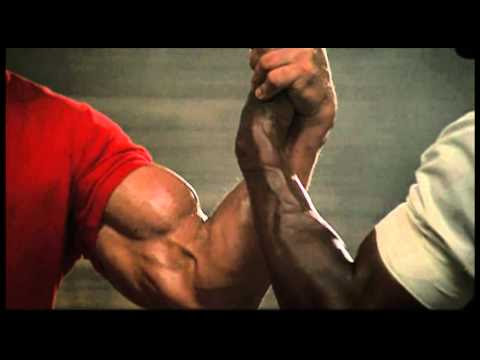 The most manly handshake ever, bar none.
And then ask yourself, is this cool? Is it OK to like this? My answer is an emphatic hell yes. Men who read S&S tend to like fictional depictions of violence and strength. As I’ve said elsewhere, dynamism, power, and muscular strength are among the elements that draw me to the work of Frank Frazetta, for example.
Make no mistake: I love this stuff. I was drawn to it as a kid, and inspired to pick up weights to try to look like my heroes of the comics and silver screen. Today I continue to champion and defend it. I push back, hard, against censorious critics who want this type of fiction memory-holed. You can pry my sword-and-sorcery from my cold, dead fingers. There’s a reason I and if I daresay the broader “we” are drawn to tales featuring swordplay, bloodletting, and fast-paced action. These stories tap into the same psychological wellsprings and biological impulses that help explain our love for professional football, boxing, and strongman sports.
Sword-and-sorcery is loaded with beefcake and masculine heroes. Here is a typical description of Conan, from “The Devil in Iron”:
As the first tinge of dawn reddened the sea, a small boat with a solitary occupant approached the cliffs. The man in the boat was a picturesque figure. A crimson scarf was knotted about his head; his wide silk breeches, of flaming hue, were upheld by a broad sash which likewise supported a scimitar in a shagreen scabbard. His gilt-worked leather boots suggested the horseman rather than the seaman, but he handled his boat with skill. Through his widely open silk shirt showed his broad muscular breast, burned brown by the sun.
The muscles of his heavy bronzed arms rippled as he pulled the oars with an almost feline ease of motion. A fierce vitality that was evident in each feature and motion set him apart from common men; yet his expression was neither savage nor somber; though the smoldering blue eyes hinted at ferocity easily wakened.
I’ll stick my neck out a bit, risk the critical axe of politically correct criticism, and say that as a result of its emphasis on violence and power, sword-and-sorcery appeals to boys and men, in far larger quantities than women.
But like life, art, and politics, even sword-and-sorcery is not this simple.
The hyper-masculine, ass-grabbing sword-and-sorcery hero is a crude trope perpetuated by some of the most derivative writers of the genre. Lin Carter’s Thongor is the poster-boy for this type of S&S hero; dumb, cloddish, prone to hack his way out of every situation. This type of hero, while a fun read that I continue to enjoy (just as I adore ridiculous over the top films like Commando, and still cheer when Sully gets dropped off the cliff), helped contribute to the genre’s downfall in the 1980s. If you believe Brak and Thongor and Kothar are the height of S&S and superior to the likes of “Ill Met in Lankhmar” or “Beyond the Black River,” more power to you, art is subjective. I happen to disagree.
S&S has a much broader tradition than mere brawn and brawling. It contains multitudes. Weird decadent races like the Melniboneans. Dark sorcerers like Ningauble and Sheelba, who pull the heroes’ strings and manipulate their destinies, subtly. Lost cities, demon-summoning sorceries. All of these elements attract readers to the genre too, arguably as much as manly action and brawn.
It can be dark and fatalistic. Consider the sword-and-sorcery of Clark Ashton Smith. Is Satampra Zeiros a masculine bad-ass? How does the hyper-macho-ness of Lord Ralibar Vooz of “The Seven Geases” avail him in the end?
I like the underlying bleakness and darkness of S&S, and I think, if you look close enough at the best stories, you will find commentary on the limitations of unchecked ambition, and its blind spots. Consider Kane in Bloodstone. Dude is too drunk on power and out of control technology, and gets reined in hard. The unrestrained man, who would take all due to some inherent natural right, broader society and consequence be damned, is a problem. If you think the likes of Mark Zuckerberg are beyond reproach as paragons of the free market, I can’t help you.
Or consider Fritz Leiber’s “The Two Best Thieves in Lankhmar.” At the conclusion of the story Fafhrd and the Gray Mouser—whom we naturally assume are the “two best thieves” in the city—are outwitted by a pair of the actual best thieves, who happen to be a pair of women. Oops.
Moorcock’s stories of Elric contain a not-so-subtle warning shot across the bow of imperialism and unchecked power. There is a balance that must be maintained.
Even old Conan is headed down the path of oblivion. Old age is coming, and eventually, a great cataclysm is coming.
Rather than a refuge of hyper-masculinity, I prefer to think of sword-and-sorcery as a subgenre that celebrates strength and autonomy. C.L. Moore proved in the nascent days of S&S that the genre was not the sole province of men or male heroes. Many subsequent female sword-and-sorcery authors added their own verses to the genre in the late 70s and early 80s. See Jessica Amanda Salmonson’s Amazonsand Marion Zimmer Bradley’s Sword and Sorceress.
The best sword and sorcery portrays women as complex, three dimensional, with elements of the masculine and feminine. Take a look at this depiction of Valeria from “Red Nails,” and note some striking similarities with Howard’s depiction of Conan, above:
She was tall, full-bosomed and large-limbed, with compact shoulders. Her whole figure reflected an unusual strength, without detracting from the femininity of her appearance. She was all woman, in spite of her bearing and her garments. The latter were incongruous, in view of her present environs. Instead of a skirt she wore short, wide-legged silk breeches, which ceased a hand's breadth short of her knees, and were upheld by a wide silken sash worn as a girdle. Flaring-topped boots of soft leather came almost to her knees, and a low-necked, wide-collared, wide-sleeved silk shirt completed her costume. On one shapely hip she wore a straight double-edged sword, and on the other a long dirk. Her unruly golden hair, cut square at her shoulders, was confined by a band of crimson satin.
Against the background of somber, primitive forest she posed with an unconscious picturesqueness, bizarre and out of place. She should have been posed against a background of sea-clouds, painted masts and wheeling gulls. There was the color of the sea in her wide eyes. And that was as it should have been, because this was Valeria of the Red Brotherhood, whose deeds are celebrated in song and ballad wherever seafarers gather.
Let’s circle back and wrap this up.
I push back against cries of helplessness and victimhood. I embrace the Extreme Ownership of Jocko Willink, the hyper-masculine navy seal whose work has dramatically changed my life for the better. I believe there is deep, abiding truth in the theory and works of Carl Jung and Joseph Campbell, and their “heroes’ journey” of brave self-discovery and self-transmogrification, today championed by Jordan Peterson. I wish more people would stop thinking of themselves as powerless, in need of handouts, and instead take the necessary and hard steps to live a better life. In short, leading the life of a sword-and-sorcery hero—if not literally, at least figuratively.
I love sword-and-sorcery imagery. I like the bad S&S films of the 80s, at least in an ironic MST3K way. I embrace the genre for what it is, warts and all. But I refuse to pigeonhole sword-and-sorcery as a refuge for macho buff dudes. Masculinity is an incomplete piece of the whole, emphasized in certain works and de-emphasized in others.
Sword-and-sorcery has recurring motifs, and boundaries, but if it does not offer infinite possibilities, it offers far more to the careful and close reader, and far more thematic diversity, than its adherents (and detractors) realize. Real men recognize the limits of power and ambition. Like Conan in “The Phoenix on the Sword” they understand the power of the pen, and the need to negotiate alliances.
To sum up: Please don’t hijack my favorite genre as masculine beefcake only. You’re doing it an injustice and moreover, painting a limited and partial picture of its diverse and complex tradition and influences.
Postscript: Some might interpret this post as wanting to have my cake and eat it too. In full disclosure I’m a political moderate and recoil from dogmatism.
August 22, 2020
The best heavy metal guitar solo ever
I'm not qualified to render this judgement. I've got the time in to make an educated guess, as I've been listening to heavy metal since the mid-1980s, some 35 years I'd guess. But what I lack is the required breadth. I'm not a big fan of death metal, or black metal, or doom, or some of the other peripheral subgenres, and so can't speak to any solos that might exist in these far-flung corners of metal. Nor was I ever a fan of the true guitar virtuosos. I admire and respect the craft of the Steve Vais, Yngwie Malmsteins, and Joe Satrianis of the world, and admit they are probably the most talented guitarists to come out of metal, but I find I lack an emotional attachment to their music that keeps me from being a fan.
Most damning of all I don't play guitar. I cannot tell you what makes one solo better from another from a learned musician's perspective, and I lack the technical vocabulary to analyze music properly.
So to make a long story short your mileage may very well differ.
But for me, my favorite heavy metal guitar solo and the one that continues to leave me speechless with wonder is Marty Friedman's solo in "Tornado of Souls." I appreciate guitar solos that don't insist upon themselves. I love it when they fit the song, take off from a logical place and return to the rhythm. Friedman's solo almost breaks that spell, but does not.
I recommend not jumping immediately to 2:10 where the madness starts to build, or 3:09 where it becomes a solo proper, 3:28 where it blasts straight up into the stratosphere and parts beyond, or 3:48 where you're like, "what the fuck?" Do it if you must, but realize that this solo works best as the orgasmic culmination of an awesome song. It's worth the 5 minute investment. His skill and artistry and sound are evident right from the electric shocks of the opening notes.
If you're a metal fan and somehow have missed this one, I beg you to rectify that right now. For non-metal fans who appreciate great guitar work, I realize that Dave Mustaine's voice can be off-putting, but don't let that stop you. Just listen.
August 19, 2020
A Canticle for Leibowitz, a review
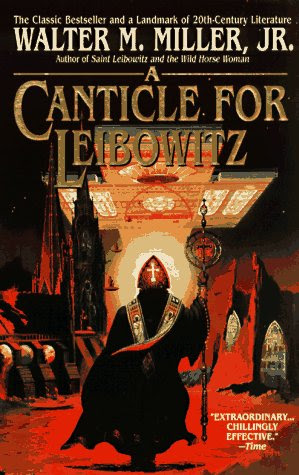 A nuclear firestorm has caused the downfall of civilization, followed by a wave of benighted barbarism and book-burning. But the wake of the holocaust sees a slow unearthing from oblivion. Monks transcribe the literature of a lost age of mankind over centuries, cloistered in monasteries in the arid landscapes of the Southwestern United States.
 This is the world of Walter M. Miller Jr.’s wonderful A Canticle for Leibowitz (1959) which I recently had the pleasure of re-reading after a span of many years.
A Canticle for Leibowitz is a fragmented read, consisting of three discrete stories separated by centuries of time. Each were short stories originally published in The Magazine of Fantasy and Science Fiction. As a novel this stitched-together structure helps to reinforce one of Miller’s central messages: The painstaking, fragmentary, and precarious state of knowledge transmission and preservation.
At its heart Miller’s book is a re-imagining of what the medieval monks did with classical Greek and Roman literature, transcribing it laboriously and preserving the flame of past knowledge until it could be used in a more enlightened age. While historical monks survived barbarian predation and Viking raids, in Miller’s novel nuclear war and predatory radiation-scarred scavengers are the equivalent of barbarian invasions circa 476 AD. The survivors of the nuclear exchange are subject to a brutal period called the “Simplification,” where mobs of bitter, vengeful survivors attempt to eliminate any trace of the science that led them down the path to oblivion. Books and men that dare to read them are burned and destroyed.
This scenario is played out again in A Canticle for Leibowitz, with the monks of Albertian Order of Leibowitz carefully preserving the old scientific literature, resurrecting an arc lamp from old electrical blueprints. By the second and third act technology has again risen from the ashes.
But Miller’s book is dark. History is cyclical, and so as in the works of Robert E. Howard apocalypse and barbaric overthrow will ultimately triumph. Man is fallen, and fallible. At the end of the book (unknown date but I believe the late third millennium AD), nuclear annihilation again envelops the earth, and mankind’s priceless artifacts and knowledge survive only by being taken to another planet, where starship pilgrims attempt to give civilization another shot.
Throughout the book Miller drops many wisdom bombs worthy of pondering. For example, the only way that we as a species can truly evolve, and stop endless cycles of war, is to “give up the bitterness.” It’s a Christian concept, turning the other cheek. This is of course easy in principle but extraordinarily hard in practice, as old grudges, distrust (leading to the need to strike first in a nuclear war), make this almost impossible to achieve in practice. See the Israelis and Palestinians. We fail because the evil we succumb to is not suffering, but the unreasoning fear of suffering. Nature has given us all the tools we need to live and die with grace, but our craving for worldly security is the root of evil. From the book: “To minimize suffering and to maximize security were natural and proper ends of society and Caesar. But then they became the only ends, somehow, and the only basis of law—a perversion. Inevitably, then, in seeking only them, we found only their opposites: maximum suffering and minimum security.”
The book presents a dark vision of humanity. And we are seeing its vision play out today with our unbridled pursuit of technology and political utopias while abandoning the meaningful conversations: What is it all this for, what should a just society look like, what is our ultimate end and purpose? Our species is unwilling to accept responsibility, which starts by looking at oneself. We’d rather find enemies to blame, and start the war, then do the painful work of self-introspection. Again from the book: “The trouble with the world is me—No ‘worldly evil’ except that which is introduced into the world by Man—me thee Adam us—with a little help from the father of lies. Blame anything, blame God even, but oh don’t blame me.” Our species has to “forgive God for allowing pain, for if he didn’t allow it, human courage, bravery, nobility, and self-sacrifice would all be meaningless things.”
Miller portrays the peace-loving and preservationist Monks sympathetically but not uncritically. A visiting atheist scientist chastises them for not doing anything with the knowledge they preserve. It’s not enough to mindlessly copy it and embellish it with art around the edges and seal it in tombs, the scientist says, but it should be used to improve humanity. But here the scientists errs, because he fails to temper his desire for progress with wisdom. Technology must be balanced and kept in check with our higher order principles—wisdom, charity, mercy. Because life here on earth will never be Eden. We have eaten of the fruit of knowledge, the serpent is among us and within us.
After a limited nuclear exchange scientists round up the most grievously wounded and hopelessly sick from radiation exposure and admit them to a camp, where they can end their pain with assisted suicide. The monks protest with homemade signs that evoke Auschwitz: Not work will set you free, but Abandon all hope ye who enter here.
At the end of the book the Abbot Zerchi (the A-Z is interesting, the monk’s alphabet has reached its end) encounters an old tomato farmer who lives around the periphery of the chapel. She has been deformed by radiation and has a “twin” growing out of her shoulder, a small, dormant second head which she calls Rachel. With Zerchi pinned under the wreckage of a blast, his life blood draining away, he sees the woman, whose Rachel head has awakened with eyes of pure innocence—a new Eve in this hellish garden. Rachel refuses Zerchi’s formal blessing of the cross on her forehead. Perhaps she represents humanity starting over again, this time without the old prior hurts and wounds, religious and scientific baggage that prevents us from advancing to a higher stage of development. Or perhaps Rachel is the promise of resurrection, the image of Jesus and his (possible) return for which we have been waiting for millennia.
Postscript: This re-read of A Canticle for Leibowitz was prompted by the Online Great Books Podcast, one of my favorite podcasts. I highly recommend checking it out. The hosts are entertaining, bright, forthright, and not plagued by political correctness. They always plug the next book they plan to read on the prior show, and when I heard they were going to do A Canticle for Leibowitz I wanted to read the book in advance and “participate” in the conversation.