Maria Yrsa Rönneus's Blog, page 10
May 7, 2021
Bling in the Time of the Regency
Dear Reader, one of my favourite elements in writing about the upper classes in the Regency is designing my characters’ jewellery. In this as in everything else, I try to move within the bounds of what reasonably could have existed, researching what materials were available, what tastes prevailed and so on. The one thing I don’t have to care about is money, which makes a welcome change to reality.
The two main characters in ‘Orbits of Attraction’ are both natural philosphers so it was a natural choice to go with an astronomy theme for the bespoke wedding-ring the groom orders.
An armillary sphere is an obsolete astronomical tool, consisting of a set of rings which form the celestial sphere formerly imagined surrounding earth and later the sun. In the 16th and 17th centuries miniture armillary spheres became popular amongst learned people (men) to wear as rings as tokens of status and knowledge. Pictured below are two examples from the British museum’s collections.

In the Georgian era heart rings of two halves were very popular, often the two drops were crowned by a bow or a crown.
In my fictional instance I imagine it as is in pic above, mounted on a hinge of an armillary ring. The existing diamond and opal is swapped for aquamarine and moonstone (pictured to the sides of the heart ring) because it suites the story better. The date inscription would go on one band and then there are words as well on two or so others. The following is a quote from ‘Orbits of Attraction’.
“Placing her hand in his, a whimsical sunbeam bounced off her wedding-ring. A drop of aquamarine, sparkling like a sunlit ocean, merged with the pearly, blue sheen of a drop of moonstone, to one perfect heart. Surrounded by small rubies in red gold, it crowned the hinge of an armillary ring, which bands could be fanned out to form an orb – a universe, a perfect whole. At once a token of his respect for her scientific pursuits and of his eternal love, Lord Giles had instructed the jeweller to engrave their wedding date 18 8 1818, separated by tiny, enamelled stars, vertically along one of the inner bands so that the eights laying down were also the mathematical symbols of infinity. On two others were written: By force of attraction, our orbits entwined, forged by love into an infinite universe, as everlasting as the stars. Romantic and poetic in his own words, it was sublime!”
Dear Reader, I hope to have the 4th volume of my Regency Tale published and available on Amazon and Kobo in the next weeks.
And with this, I wish all of you, a happy Friday!


May 6, 2021
Arsenic and old fish to fry…
Just in time for the bicentenary of Napoleon Bonaparte’s death in 1821, the British once more are sending the Royal Navy to the channel to deter the French. This time it is the French fishing fleet, protesting the new regulations under Brexit that are threatening to besiege the island of Jersey if their demands are not met. Funny and ludicrous as it may seem, the fish in British waters are political hot potatoes. The Brits are very keen to keep their fish n’chips.
But, Dear Reader, I am not here to fish in troubled waters, a quick cruise to St Helena is more my poison.
Napoleon’s final place of exile may be a remote island in the Atlantic and a far cry from the imperial splendour of his glory days in Paris, yet his last abode was not just any old prison. As arrogant as ever, he felt himself ill treated in the house decorated in his favourite colour where he spent his last years designing a garden and writing his bombastic memoirs.

Other shades of green based on copper arsenite had been around for some time, but none so brilliant nor so toxic as the pigment first known as Schweinfurt green. After the town where two Bavarian chemists began commercial manufacturing in 1814. Later it was called Emperor green, after Napoleon had taken a fancy to it and, once arrived in England, “Paris green”.

In 1817, it was the must-have of the season, and the London ton could not have enough of it. In 1823, another German chemist, J. von Leibig, and French chemist Henri Braconnot, each published independently the recipe as a warning for its use. It didn’t help, the brilliant pigment was irresistible, and in following decades it was used not only for cloth and paint, but for print paper, wallpaper, toys, soap, and even for confectionary. By the latter half of the century its toxicity was so well known that it was used as a potent insecticide and pesticide. Yet it would take many decades and many deaths before it was recognized as a health hazard to humans.
On May 5th 1821 the former emperor expired, aged 51. The cause of death being stomach cancer, believed resulting from the arsenic, green walls that surrounded him. He ended his days a whale in a goldfish tank, a curiosity that tourists came to gawk at. Whether the British treatment of him was unduly lenient or unjustly degrading was and remains a topic of contention. Few people have had such impact as individuals on the shaping of history and, although perhaps not always immediately obvious to us 21st century beings, his actions shaped the future for Europe and its colonies and impact us still today.
My upcoming novel ‘Orbits of Attraction’ was actually written before the three others in the series (I can make neither fish nor fowl of it either). Although I have now lost the source, a horrendous story I stumbled on whilst doing research for it has stayed with me. It was told by an exasperated physician writing in the 1830’s of a working class family who had managed to scrape together enough money to refurbish their humble house. Inspired by the posh and wealthy, they too wanted bright green wallpaper. But in this family they probably all slept in the same room, and when one by one their children started dying they refused to believe that it was the pretty wallpaper that poisoned them.
Set in 1818, ‘Orbits of Attraction’ revolves around Miss Juliet Wynne and her artistic family. Being scientifically gifted, she corresponds with scientists all over Europe, which is how she is aware of the dangers of the bright green colour although it was not generally known at the time. When her mother redecorates her salon, she takes Juliet’s advice and picks blue instead of green; Juliet’s little sister, however, is contrary and happily wears a dress of Paris green.
It is unlikely that a gown would have poisoned its upper-class wearer to any life-threatening degree. Gowns were worn over layers of undergarments which would have separated the fabric from the skin and, since few of these colours were washable, any gown was rarley worn more than a handful of times. After that they were normally handed down or sold to be worn by actresses or prostitutes – women who may well have worn them often enough to become seriously ill.
Brexit is not the first incident to occasion the Royal and French Navies to flex their muscles in the channel. In the mid-19th century oyster dredging was big business. English fishing boats arrived en masse and both sides were… erm, fishing for a piece of the action. The French hijacked a Jersey fishing boat, the Jersey fishing fleet took revenge by invading the French town of Granville, sabotaging boats and equipment. It is safe to say that the situation was toxic. Meanwhile the oysterbeds were threatened by extinction so the authorities imposed fishing bans. The ban was ignored and the Jersey militia had to resort to firing cannons at the fishing boats to make them comply.
Dear Reader, I close this poisoned letter by wishing you a pleasant Thursday away from deep waters!
April 4, 2021
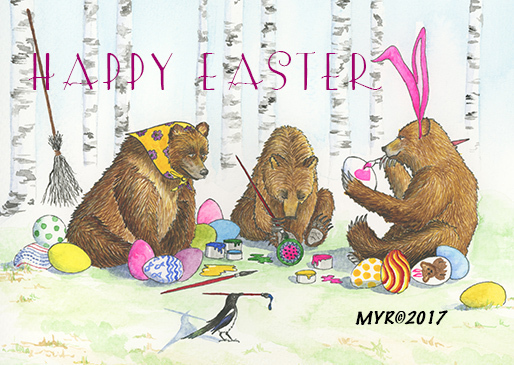
April 2, 2021
Return from Blockula
Good Friday morning is rough for witches in Scandinavia; fornicating with the Devil takes its toll, for that, Dear Reader, is what legend has witches do on Maunday Thursday night. Well, vigorous ones with the most stamina may be at it until Easter Day.
The origin of this belief can be traced to the 17th century witch hunts in the wake of the reformation. At Easter, as is commonplace around all the major Christian holidays, all sorts of creatures abound: gnomes, trolls, elves, and witches.
The witches travel by broom, always in the company of a cat – preferably black – riding pillion and a coffee kettle dangling from the broom handle in front of them. Witches clearly know what the important things in life are! Their desitnation is a place called Blåkulla, anglicized Blockula, meaning Blue or Black hill. Several physical places have been claimed as the site of the witches annual orgy, Blocksberg in Germany or the island Blå Jungfrun in Sweden. The place is neither here nor there, however, Dear Reader, for if you aren’t invited, you aren’t likely to find your way there anyway.
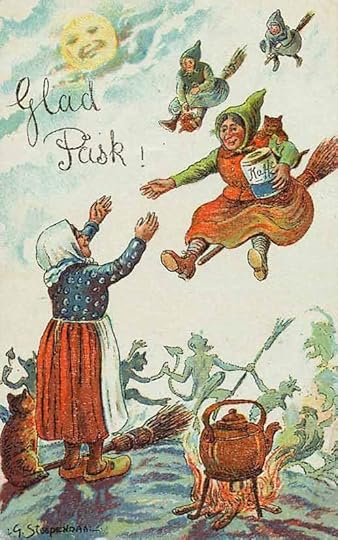
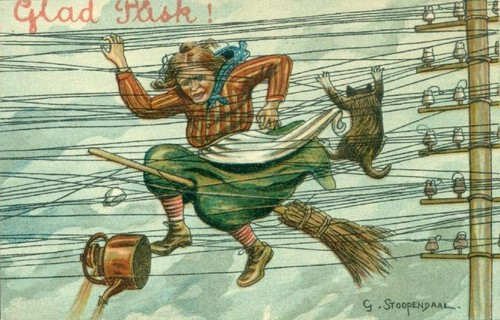
These days, we tend to leave the witches to fly about their business. We might wave at them as they fly by, we put them on Easter greeting cards, and children dress up as them. Sometime in the beginning of the 19th century the tradition of going påskkärring (lit. Easter hag) started. A few days before Easter Thursday are spent painting and drawing “Easter letters”, essentially drawings with Easter greetings, then on Thursday (sometimes Easter Saturday) one goes round knocking on neighbours’ doors handing them out. The reward is a few candies in one’s coffee kettle.
It is not the same as the American trick or treat custom at Halloween, because there is no trick or threat element involved. Our witches are way to nice for that.
 Greetings from 1974.
A proper Easter witch should be dressed in bright colours, have a kerchief about her hair, a broom, an old kettle, and typically mom’s lipstick smeared on her or his cheeks.
With that, Dear Reader, I’ll leave you to have a fabulous Friday. Me, I’m off to wash the travel dirt off my broom.
April 1, 2021
April Herrings
April Fool’s pranks have been around since at least the 16th century in Europe, but exactly how it started is long lost in the mists of time. Folly, however, is much older. Charles Dickens wrote in 1869 in The Gentleman’s Magazine: “That all Fools should have a day set apart for their special honour, is reasonable and intelligible enough, there are so many of them…”
In the Regency, April Fools pranking was a widespread thing, so much so in fact as to each year trigger a spout of angry letters to the editor of various magazines, condemning the practise. In those days, the pranks were normally what we in the 21st century would call classic slap-stick and deem harmless enough: the dropped item in the street attached to a string, pinned signs to somebody’s back, sending others on sleeveless errands.
–’Excuse me madam, you have something on your face.’
–’On my face? Where? What?’
–’Your nose, madam!’

However, some “pranks” were more sinister. In 1817, a French lady with unfortunately sticky fingers, nicked a watch from a friend’s house and, when charged by the police, claimed that it was a Poisson d’Avril (An April Fish, as the French expression goes.) That this was a red herring can hardly be doubted, and neither did the the court which imprisoned her for exactly one year.
Rhyming of herrings is what Swedes do when the joke is revealed: “April, april, din dumma sill!”, which means “April, April, you silly herring!”
A prank can land you in a pickle without being illegal, as Old Charlie points out: “…it occasionally happens that immediate and painful physical vengeance is wreaked upon the incautious joker.” Being an avid prankster, I can vouch for the truth of it; not everybody appreciates being made sport of. I have had my (sometimes fair) share of earfuls from unhappy prankees, Dear Reader, and I have learnt that a really good April Fools joke is one that leaves everybody laughing. Yet Old Charlie was no fan, he spent no less than six pages waxing critical of London street boys’ mischiefs. Well, boo-hoo, you old prank pooper!
The fourth part of the Regency Tales, ‘Orbits of Attraction’, centers around Miss Juliet Wynne and her boisterous family. Not unexpectedly, Dear Reader, they are much amused by playing various pranks on each other.
“On his way out on the Wednesday, Mr Wynne turned to his youngest daughter in the hallway.
–’Despite this day previously having held a curious temptation for some members of my household, I shall trust that this year, we may endeavour to rise above such childishness and see the day to close without resorting to playing tricks upon our fellow men.’ Assuming an obviously counterfeit air of innocence, Viola nodded.
–’Of course, papa.’
Whistling into the clear sky, Mr Wynne strolled down the street. He was not fooled for a minute; at least three of his children would not be able to resist the temptation, but to-day he would have his long time coming revenge.”
All rights reserved ©2021
Even then newspapers printed spoof stories to prank their readers. One recurring story was the invite to attend the washing of the lions in the menagerie at the Tower. Dating from 1698, it was such a sucess that the prank was repeated several times in history, and on both sides of the Atlantic. By the latter half of the 19th century, Londoners had long since ceased being fooled by it, but tickets for the washing were still sold to gullible tourists.
Sadly in recent years, newspapers have stopped printing April Fools stories for fear that they be taken seriously in the increasing flood of misinformation and fake news. Personally, Dear Reader, I find that an alarming sign of our time when apparently we are, at once too stupid to be guided by common sense and too proud to occasionally have some egg on our faces.
Life is much too serious to be taken seriously and a good prank every now and again which occasions a proper belly laugh surely is a superb medicine. For after all: “The highest form of bliss is living with a certain degree of folly”, as Eramus wrote in the world’s longest theological prank ever written. Jane Austen seemed to echo that sentiment, giving Mr Bennet voice to ask in Pride and Prejudice “For what do we live, but to make sport for our neighbours, and laugh at them in our turn?”
With that Dear Reader, I wish you a very merry All Fool’s Day!
March 22, 2021
Regency Tales Teaser
The Regency Tales centers around four young ladies, friends since their school days; in the third part the main character is the shy and insecure Lady Odyssa. The story follows her facing challenges in her adult life as she seeks to find happiness and her own voice.
Find out more about the series on its website, or shop directly on Amazon or Kobo.
In Odyssey of Attachment, we first meet adult Lady Odyssa at Lady Haversham’s annual ball:
“–’Whysleigh!’ Their hostess’s shrill bray could have drowned out an operatic crescendo. Lady Odyssa inhaled sharply. No, no… Please, let it be his brother! She begged inwardly; her anxiety grew with the knot in her stomach. […] He was the last man in the world whom she wanted to see, her nemesis; yet she was unable to avert her eyes. Brushing over the crowd, his gaze locked in hers. Until that moment she had never known that ice could be brown.”
(M.Y. Rönneus ©2021 All rights reserved)
Read an “interview” with the main character, Lady Odyssa, here.
With this little teaser, I wish you a happy Monday, Dear Reader!
March 21, 2021
Interview with a Fictional Character – Lady Odyssa
–’I’ve been writing about you, you know.’ Her soft, hazel eyes widen.
–’Me!? Whatever for?’ It is my turn to stare at her. I can almost see her. She sits straight-backed on my plump Ikea couch, her hands primly on her lap. Her mustard pelisse is neat and of good quality. The colour suits her, but the one frivolous thing in her appearance is the happy, primrose bow under her chin that fastens her bonnet. She is beautiful, but she has no idea. She is capable and clever, yet she struggles with feelings of inferiority and lack of self-esteem.
I recognize myself in the awkwardness, sympathetic of the feeling of always being weighed and measured and found wanting. Not that I ever was as pretty as she, but I certainly was prettier than I thought.
Her story is one of great strength and moral integrity in the face of hardship and, as it is vastly different from that of any average Regency lady, it is well worth telling.
–’Your life is very interesting’, I say diplomatically. ‘And you have accomplished a great deal…’ Shaking her head slightly, she makes a vague gesture that is both warding off my words and an indication to the cup of coffee on the table before her.
–’Forgive my rudeness, but I do not suppose that there is any chance of tea? And milk?’
–’Oh.’ I smile sheepishly. ‘I do apologize, but I’m afraid not.’ We are devout coffee-consumers in this house, with dairy intolerances. I don’t tell her that, it would be indelicate to speak of bodily functions. ‘Biscuit?’ She accepts and, gingerly balancing the store-bought, glutenfree danish on a paper-napkin, she takes a small bite and holds back a grimace. I can’t say I blame her. I wouldn’t eat them either if I didn’t have celiaki. Another thing I can’t discuss with her.
–’Your family, they are in good health?’ I enquire in my best imitation of posh English.
–’Why yes, thank you, my husband…’ A pretty blush rises in her cheeks. ‘…is very well.’ Unwittingly, her hand cradles the lower part of her belly. It doesn’t show yet, but I know it’s a boy.
–’What news of Herefordshire?’, I ask. ‘Is life there still as charmed?’
–’Oh yes, it certainly is! When the Cannop sisters can be avoided.’ I laugh at this but she looks uneasy. ‘That was not very charitable of me’, she adds. ‘The Dowager House is currently being done up for Mrs Makewell and her sergeant, and poor Tilly has only dropped one earthenware jug this week. So far.’ She smiles with warmth. ‘It is Teddy’s seventh birthday soon and he is getting a puppy. Sergeant Light bought it from Sir Gorsley.’ She shudders. ‘There is plenty ill which could be said of him, but really he is just a sad, lonely creature.’
–’Did he ever write to your father?’
–’I should not think so, but really I have not the smallest idea, I am not privy to my father’s correspondence.’ I can see how the topic still pains her and she makes an effort to keep her composure. ‘We are still waiting to hear from the bishop regarding opening a school, but for now we are teaching the children on the estate inofficially. The youngest Owen brother really is a clever, little chap, learnt to read and write in a jiffy. Which reminds me…’ She says shrewdly. ‘May I interest you in a subscription to our charity scheme helping disabled veterans to find decent and dignified work?’ How can I refuse? It is all my own ideas after all and she wheedles fifty fictional pounds from me. Though a small sum in the 21st century, to her it’s a substantial amount. Ah, what the hell, I think, make that five grand! After all, I am made of fictional money. Lady Odyssa is all speechless gratitude, but I ward it off by asking after her friends.
–’It is my sole complaint’, she says with a slight sigh, ‘that my friends should be so far from me.’
–’It’s not that far to Miss Wynne’s uncle’s estate in Worcestershire, merely some 30 miles…’
–’Yes’, she lights up. ‘Still, it is not the same as seeing them every day, and I dread to think what shall happen when Juliet removes into Sussex.’ I ponder her question, pleased with my own plots and designs for her friend. When I look up again, she has faded. The coffee in her fictional cup is cold and the danish has an ever so small nick in it. The sagging couch was bought second hand and isn’t really Ikea either.
Pensively, I chew my danish whilst I post an update to my blog.
Lady Odyssa (née Langston) is the main character in the 3rd volume of Regency Tales, ‘Odyssey of Attachment’.
March 20, 2021
Vernal Paradox
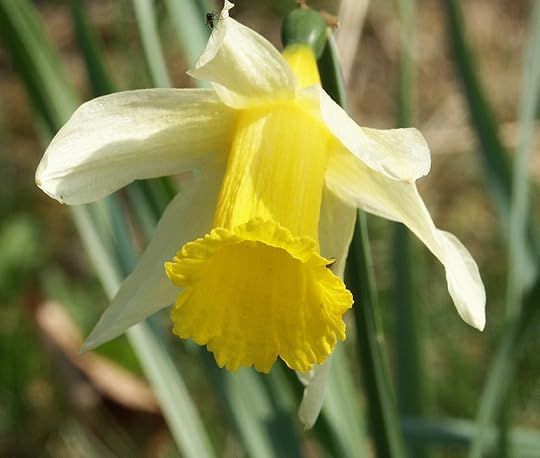
On my latitude, Dear Reader, it feels, more often than not, paradoxical to gleefully proclaim the arrival of spring whilst the snow is still falling. Nevertheless, today is the vernal equinox and in some fortunate southerly climes daffodils are already in bloom.
The word ‘daffodil’ comes from the Middle English affodill or asphodel from Latin asphodelus. Folklore would have it that ‘daffodowndilly’ is an old English West Country name for our beloved yellow trumpets, but whether that is true, Dear Reader, I could not say. What is true is that A. A. Milne (who was born in the Greater London-area) wrote a famous poem by that name in the first half of the 20th century.
It is still under copyright but widely shared and spread across the internet. Click here to read. I hope you enjoy my illustration of it.

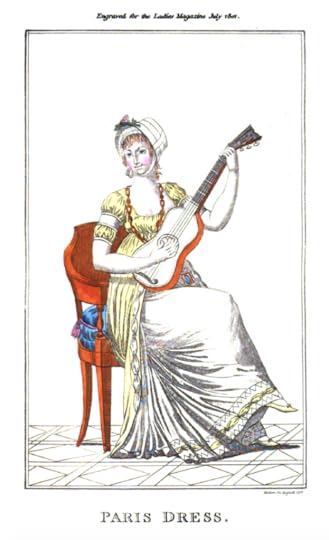
In Georgian times daffodils were often referred to by another name ‘jonquil’ from French. By the late 18th century the word also denoted the colour; it was the must-have of ladies’ wear in the season 1801.
However, it was a much paler colour than what you might now picture in your head, Dear Reader. The reason being that wild daffodils, which were once much more common than the now dominating garden varieties, have paler yellow petals.
David Lloyd George, 1st Earl Lloyd-George of Dwyfor, served as PM to the United Kingdom 1916-1922. He is said to have sought to introduce the daffodil as the national flower of Wales to replace the earlier leek. Perhaps he did not think the leek quite grand enough for such honour.
In an ironic twist of linguistics, the daffodil is also known in Welsh as ‘Peter’s leek’. Well played, leek! Well played.
Daffodils’ may sooner owe their present association to Wales to the Black Mountains and the Welsh borders being some of the last bastions of the wild daffodil alongside a thriving commercial cultivation of daffodils in Wales.
Writing a post about daffodils and the Regency without mention of Wordsworth is nigh on poetic sacrilege, although, however brilliant his famed poem is, it is a bit worn by now. You can read it here, Dear Reader.
In my upcoming novel, ‘Orbits of Attraction’, the hero and heroine are flirtatiously bantering:
“It was indeed a lovely March afternoon. Beneath the lime trees’ bare branches, an orchestra of daffodils and crocus performed their grand crescendo. It was easy to see where Wordsworth had gotten his inspiration.
–”And then my heart with pleasure fills, and dances with the daffodils”, Juliet quoted.
–’What bliss the shared gaiety is, delivering one from the gloom of wandering lonely as a cloud.’ Lord Whysleigh paraphrased in jest.
–’You are venturing dangerously close to reciting a poem, my lord’, Juliet teased him and his pale eyes sparkled naughtily.
–’Giles.’ He corrected. ‘I daresay your jocund company brings out the daredevil in me.'”
Meanwhile, Dear Reader, in Sweden March A.D. 2021 we are making due so far with yellow crocus until we may enjoy “the jocund company” as well.

With that, Dear Reader, I wish you a jocund, jonquil spring!
Sources:
etymologyonline.com
wales.com
woodlandtrust.org.uk
The Lady’s Magazine; or Entertaining Companion for the Fair Sex (1801)
Image credits:
wikipedia.com
pixabay.com
March 11, 2021
Snowfall
There stands a golden-chain tree outside my window; a curiosity of bluetits flit about in it. They seem unbothered by the postcard snowfall of heavy, fluffy lumps. But one bluetit in particular, seems most eager to find out what I am doing. He watches me when he doesn’t think I see him, but as soon as I look up or take up my phone, he scrambles away. He is very camera-shy.
In the 4th book of my Regency Tales, ‘Orbits of Attraction’, two commitment-phobic “natural philosophers” meet and collide in love. To that end, I was trying to glean something of Regency era physics when this poem came to me.
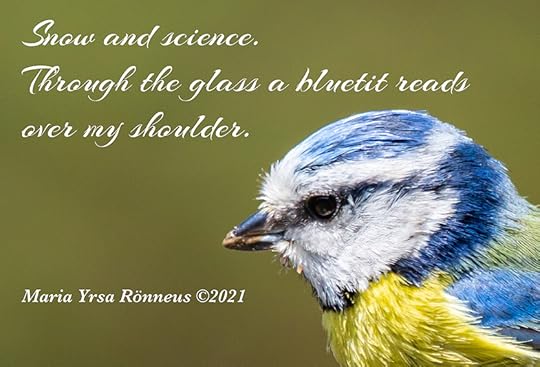
With that Dear Reader, I return to the wonders and woes of Newtonian mechanics, and wish you a beautiful Thursday!
(Source credit: pixabay)
March 9, 2021
Cats in March
Victorians loved their cat memes as much as we do, but they were not the first to lovingly banter with our furry darlings. Georgians loved their kitties too.
Anyone familiar with the springtime serenades that unneutered cats treat us to below our bedroom windows in the wee hours, can easily recognize the humour of the musical alley cats in the lithograph below.
A hundred and fifty years before Aristocats, it was published by Rudolph Ackermann in the July issue 1817 of his ‘Repository of Arts, Literature, Fashions, Manufactures &c’.

It was accompanied by the following address to Madame Cat:

There is something about the light tone and the twist in narrative at the end which reminds of T.S. Eliot’s ‘Book of Practical Cats’. Although written in 1939, over a hundred years after this publication, one cannot help wonder if perhaps Eliot chanced upon an old copy somewhere. No insult intended to Eliot’s genius; his poems are clearly original and sifted through the modernist influences which where the hallmarks of his day – but we all get our ideas from somewhere, and the works of those who have gone before us have always inspired those in their path.
Eliot’s works are still copyrighted which prevents my published any here to illustrate my point. Copyright is indeed both a blessing and a curse. But that is perhaps a post for another day.
It also ties in well with the 4th novel in my Regency Tales series, ‘Orbits of Attraction’:
“Mrs Wynne had quickly been dethroned and Mother Cat was now Queen of the Household. Warm, safe, and well fed, she thrived, and held court in the good chair by the fireplace, whence she reigned supreme. Initially, the pugs held to the idea that she was their new toy, but scratched noses and bit ears soon ensured their subordination. The kittens were exploring the vastness of their wooden crate on wobbly legs; one minute all squeaks and trembling tails, in the next, drowsy nods and milk-sated bellies.” (All rights reserved ©2021)
Currently working last edits and a few rewrites, I hope to get this out in time for Easter.
With that I am high-tailing it out of here for now and wish you, Dear Reader, a cosy, purring night!