David Gillespie's Blog, page 9
March 14, 2016
Childhood Cancer – Stealing our Future – Part 3
Part Three – Childhood cancer
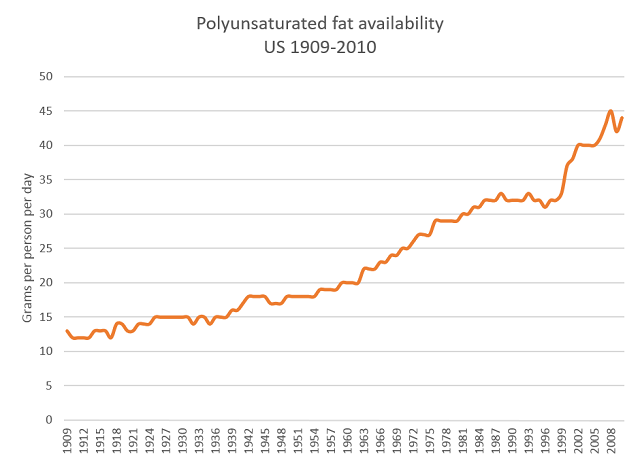
We are massively overconsuming Omega-6 fats. This is largely because we eat too much ‘vegetable oil.’ The dangerous varieties of vegetable oil don’t come from vegetables. They are the oils extracted from seeds like Canola, Rice-Bran, Grapeseed, Sunflower and Almonds or legumes like peanuts and soybeans. And we are eating too much of them (usually without even being aware of it) because these incredibly cheap oils dominate the 21st century food supply.
If you purchase anything to eat outside the home, almost all the fat components will be these oils. The mayo on your takeaway sandwich will be made from sunflower oil (as will the margarine). Anything fried will have been cooked in cottonseed or canola oil (no matter how flash the joint you purchased it from). All the breads and pastries will have been made using seed oils and so will all the dressings, dips and sauces.
In Part One of this series I showed how rampant oxidation caused by the omega-6 fats in these oils destroys male fertility by lowering sperm count and quality. And in Part Two I showed how the same process also significantly increases risk of testicular cancer.
Make no mistake, we are in the midst of an unprecedented decline in our ability to reproduce and that decline is driven by the profits from cheap vegetable oil laced foods.
The oxidative stress caused by the Omega-6 fats doesn’t simply disrupt the fertilizing capabilities of sperm, it also attacks the integrity of the DNA carried by the sperm. Normally a cell which is so damaged that its DNA is fragmented by oxidation will not function at all. Unfortunately, this is not the case with sperm. Human sperm retain the capacity for fertilization even when their DNA are severely damaged.
We know this for certain because of studies done in men who smoke. And even though those studies have shown smokers are much less fertile than non-smokers, they are not always infertile.
The sperm of those smokers who remain fertile have DNA that has been damaged by oxidative stress (caused by the inhalation of chemicals which promote oxidation). And because DNA-damaged sperm are still able to create viable embryos, the consequences can be cataclysmic. We have known since at least 1997 that the children of fathers who smoke heavily are four to five times as likely to develop childhood cancers.
The studies also clearly show that omega-6 fat consumption is at least as powerful a source of oxidation as smoking. Given that, we should expect childhood cancer to be increasing in societies (like Australia) where vegetable oil consumption is at its highest level ever (and increasing).
Childhood cancers are defined as those diagnosed before the child turns 15. Together, leukaemia (blood cell cancers), brain tumours and lymphomas account for more than two thirds of all childhood cancers, but leukaemia is by far the most common.
One in 500 Australian children will develop cancer. That’s 2 new cases every day. Two children every day! Three Australian kids die from cancer every week. It is a devastating blight upon our community and it is getting much worse very quickly.
With most cancers we only have reliable statistics on incidence (new cases every year) going back to the early eighties in Australia and only slightly earlier in the UK and the US. But sadly, because until the early 1960s, leukaemia was a certain death sentence, mortality statistics are a reasonable proxy. And those go all the way back to 1911. It is not a pretty picture.
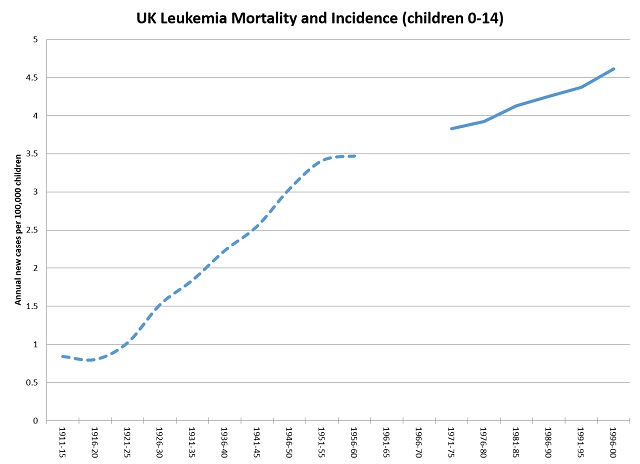
Children in the UK are now 6 times more likely to suffer from leukaemia as children just one hundred years ago. Modern Australian statistics show identical trends. And while smoking undoubtedly played its part in pushing that rate up in the middle of the century, the rapid reduction in smoking rates has done little to slow the rapid growth.
The genetic damage that lies behind most childhood cancer is caused by oxidation of sperm DNA. As oxidation fuel increases (in the form of vegetable oil in our food), then so too will the rate of childhood cancers. For as long as that oxidation fuel supply increases, we can expect to see the rate of those cancers continue to climb dramatically.
The good news is that at an individual level the science suggests it is very easy to change these outcomes. Men produce a completely new set of mature sperm every 90 days. This means that we can massively reduce the chances of genetic damage in our children by simply abstaining from vegetable oils (and smoking) for 3 months before we get anyone pregnant.
Unfortunately, it is not just genes implicated in cancer which are being affected. In the next part I will be looking other types of oxidation induced genetic damage in offspring.
Infographic from The Kids’ Cancer Project


How Vegetable Oils are Stealing our Future (Part Three)
Part Three – Childhood cancer
We are massively overconsuming Omega-6 fats. This is largely because we eat too much ‘vegetable oil.’ The dangerous varieties of vegetable oil don’t come from vegetables. They are the oils extracted from seeds like Canola, Rice-Bran, Grapeseed, Sunflower and Almonds or legumes like peanuts and soybeans. And we are eating too much of them (usually without even being aware of it) because these incredibly cheap oils dominate the 21st century food supply.
If you purchase anything to eat outside the home, almost all the fat components will be these oils. The mayo on your takeaway sandwich will be made from sunflower oil (as will the margarine). Anything fried will have been cooked in cottonseed or canola oil (no matter how flash the joint you purchased it from). All the breads and pastries will have been made using seed oils and so will all the dressings, dips and sauces.
In Part One of this series I showed how rampant oxidation caused by the omega-6 fats in these oils destroys male fertility by lowering sperm count and quality. And in Part Two I showed how the same process also significantly increases risk of testicular cancer.
Make no mistake, we are in the midst of an unprecedented decline in our ability to reproduce and that decline is driven by the profits from cheap vegetable oil laced foods.
The oxidative stress caused by the Omega-6 fats doesn’t simply disrupt the fertilizing capabilities of sperm, it also attacks the integrity of the DNA carried by the sperm. Normally a cell which is so damaged that its DNA is fragmented by oxidation will not function at all. Unfortunately, this is not the case with sperm. Human sperm retain the capacity for fertilization even when their DNA are severely damaged.
We know this for certain because of studies done in men who smoke. And even though those studies have shown smokers are much less fertile than non-smokers, they are not always infertile.
The sperm of those smokers who remain fertile have DNA that has been damaged by oxidative stress (caused by the inhalation of chemicals which promote oxidation). And because DNA-damaged sperm are still able to create viable embryos, the consequences can be cataclysmic. We have known since at least 1997 that the children of fathers who smoke heavily are four to five times as likely to develop childhood cancers.
The studies also clearly show that omega-6 fat consumption is at least as powerful a source of oxidation as smoking. Given that, we should expect childhood cancer to be increasing in societies (like Australia) where vegetable oil consumption is at its highest level ever (and increasing).
Childhood cancers are defined as those diagnosed before the child turns 15. Together, leukaemia (blood cell cancers), brain tumours and lymphomas account for more than two thirds of all childhood cancers, but leukaemia is by far the most common.
One in 500 Australian children will develop cancer. That’s 2 new cases every day. Two children every day! Three Australian kids die from cancer every week. It is a devastating blight upon our community and it is getting much worse very quickly.
With most cancers we only have reliable statistics on incidence (new cases every year) going back to the early eighties in Australia and only slightly earlier in the UK and the US. But sadly, because until the early 1960s, leukaemia was a certain death sentence, mortality statistics are a reasonable proxy. And those go all the way back to 1911. It is not a pretty picture.
Children in the UK are now 6 times more likely to suffer from leukaemia as children just one hundred years ago. Modern Australian statistics show identical trends. And while smoking undoubtedly played its part in pushing that rate up in the middle of the century, the rapid reduction in smoking rates has done little to slow the rapid growth.
The genetic damage that lies behind most childhood cancer is caused by oxidation of sperm DNA. As oxidation fuel increases (in the form of vegetable oil in our food), then so too will the rate of childhood cancers. For as long as that oxidation fuel supply increases, we can expect to see the rate of those cancers continue to climb dramatically.
The good news is that at an individual level the science suggests it is very easy to change these outcomes. Men produce a completely new set of mature sperm every 90 days. This means that we can massively reduce the chances of genetic damage in our children by simply abstaining from vegetable oils (and smoking) for 3 months before we get anyone pregnant.
Unfortunately, it is not just genes implicated in cancer which are being affected. In the next part I will be looking other types of oxidation induced genetic damage in offspring.
Infographic from The Kids’ Cancer Project
March 5, 2016
Testicular Cancer – Stealing our Future – Part 2
Part Two – Testicular cancer is exploding
In Part One of this series I looked at male fertility. Men exposed to Western diets are becoming dramatically less fertile. And the cause is the rapid increases in our consumption of vegetable oils made from seeds.
Vegetable oil made from seeds (Canola, Rapeseed, Sunflower, Corn, Safflower, Grapeseed, Rice Bran and Soybean for example) – seed oils – are a relatively new addition to the human diet. Unlike oils made from fruit (Olive, Avocado and Coconut) and animal fats, they are very high in something called an Omega-6 fat.
They are also incredibly cheap to make, which is why you will find them in just about every food on the supermarket shelf and in every deep fryer in the land. Because of this, we are currently consuming 10 times as much as we actually need.
Consuming up to 10 times too much of a substance that plays a critical role in the construction of sperm is having a massive and continuing effect on our ability to produce them. But that is just the beginning of the damage being wrought by these substances.
The fats in vegetable oils are highly volatile. They react quickly with oxygen and they do so even more rapidly when the temperature is high (in a human body for example). When that happens our body enters a state called oxidative stress. And oxidative stress is a known cause of damage to our DNA that results in cancer.
We can massively increase our risk of cancer by introducing any substance which damages DNA. Smokers for example, have 10 times the rate of lung cancer because they inhale a cloud of compounds which can produce DNA damage in the lining of the lung. And the compounds produced by oxidised vegetable oils damage cellular DNA in a similar fashion. Eating those fats is like smoking but the damage is transmitted to every part of the body, not just the lung.
Healthy sperm need to be flexible (for speedy tail flicking) and so have much higher levels of the ‘bendy’ polyunsaturated fats found in vegetable oils than the average human cell membrane. So sperm cells (and the cells that make them, called germ cells) are awash with fats from the vegetable oils we consume.
If any organ in the body were to be affected most dramatically by the massive increases in our consumption of vegetable oil, it is likely to be the Testes. Given that you would expect to see the rates of testicular cancer rising just as fast as male fertility has been falling. And you would not be disappointed.
Oversupply of omega-6 from vegetable oil in the Testes causes a cascading chain of oxidative stress which ultimately ends in random destruction of our sperm and germ cell DNA. In most cases this results in the death of the sperm and germ cells (hence the massive declines in sperm counts discussed in part One). But every now and then just the wrong mutation happens and cancer develops (usually in the germ cells).
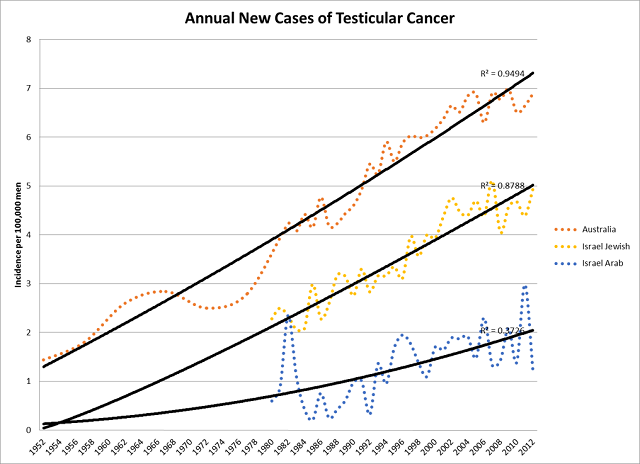
The Australian incidence (number of new cases per year) of testicular cancer (the most common cancer in men under 50) has quintupled since 1952. A man alive in Australia today is 5 times (!!) as likely to have testicular cancer as that same man in 1952. Similar rates of increase hold in the US and the UK. If genetics was the only cause of testicular cancer, we would expect the rate to be exactly the same. The fact that it isn’t, tells us an environmental factor is at work and the science set out above, tells us that environmental factor is vegetable oils from seeds.
Because of a decided preference for non-animal fat sources, Israeli Jews have close to one of the highest rates consumption of vegetable oil in the world (about 12% of calories). The science says this is why they are at the bleeding edge of the decline in male fertility. It is also likely to be why the incidence of testicular cancer among Israeli Jews is climbing as fast as it is in health conscious (and equally infertile), vegetable oil soaked Australia.
Because it is often diagnosed early and the treatment (usually removal of a testicle) is highly effective, testicular cancer is one of the most survivable cancers (98% of men are free from it 5 years after diagnosis). And if sperm never left the male body, that would be the end of this series. But they don’t so this isn’t.
Vegetable oils are destroying male fertility and driving supercharged increases in testicular cancer but sadly the trail of destruction does not end there. Some damaged sperm do make it all the way and they are capable of creating an embryo. In the next instalment I look at the disease cascades from those damaged sperm.
Photo courtesy of 2006 advertisement of the British Heart Foundation

How vegetable oils are stealing our future (Part Two)
Part Two – Testicular cancer is exploding
In Part One of this series I looked at male fertility. Men exposed to Western diets are becoming dramatically less fertile. And the cause is the rapid increases in our consumption of vegetable oils made from seeds.
Vegetable oil made from seeds (Canola, Rapeseed, Sunflower, Corn, Safflower, Grapeseed, Rice Bran and Soybean for example) – seed oils – are a relatively new addition to the human diet. Unlike oils made from fruit (Olive, Avocado and Coconut) and animal fats, they are very high in something called an Omega-6 fat.
They are also incredibly cheap to make, which is why you will find them in just about every food on the supermarket shelf and in every deep fryer in the land. Because of this, we are currently consuming 10 times as much as we actually need.
Consuming up to 10 times too much of a substance that plays a critical role in the construction of sperm is having a massive and continuing effect on our ability to produce them. But that is just the beginning of the damage being wrought by these substances.
The fats in vegetable oils are highly volatile. They react quickly with oxygen and they do so even more rapidly when the temperature is high (in a human body for example). When that happens our body enters a state called oxidative stress. And oxidative stress is a known cause of damage to our DNA that results in cancer.
We can massively increase our risk of cancer by introducing any substance which damages DNA. Smokers for example, have 10 times the rate of lung cancer because they inhale a cloud of compounds which can produce DNA damage in the lining of the lung. And the compounds produced by oxidised vegetable oils damage cellular DNA in a similar fashion. Eating those fats is like smoking but the damage is transmitted to every part of the body, not just the lung.
Healthy sperm need to be flexible (for speedy tail flicking) and so have much higher levels of the ‘bendy’ polyunsaturated fats found in vegetable oils than the average human cell membrane. So sperm cells (and the cells that make them, called germ cells) are awash with fats from the vegetable oils we consume.
If any organ in the body were to be affected most dramatically by the massive increases in our consumption of vegetable oil, it is likely to be the Testes. Given that you would expect to see the rates of testicular cancer rising just as fast as male fertility has been falling. And you would not be disappointed.
Oversupply of omega-6 from vegetable oil in the Testes causes a cascading chain of oxidative stress which ultimately ends in random destruction of our sperm and germ cell DNA. In most cases this results in the death of the sperm and germ cells (hence the massive declines in sperm counts discussed in part One). But every now and then just the wrong mutation happens and cancer develops (usually in the germ cells).
The Australian incidence (number of new cases per year) of testicular cancer (the most common cancer in men under 50) has quintupled since 1952. A man alive in Australia today is 5 times (!!) as likely to have testicular cancer as that same man in 1952. Similar rates of increase hold in the US and the UK. If genetics was the only cause of testicular cancer, we would expect the rate to be exactly the same. The fact that it isn’t, tells us an environmental factor is at work and the science set out above, tells us that environmental factor is vegetable oils from seeds.
Because of a decided preference for non-animal fat sources, Israeli Jews have close to one of the highest rates consumption of vegetable oil in the world (about 12% of calories). The science says this is why they are at the bleeding edge of the decline in male fertility. It is also likely to be why the incidence of testicular cancer among Israeli Jews is climbing as fast as it is in health conscious (and equally infertile), vegetable oil soaked Australia.
Because it is often diagnosed early and the treatment (usually removal of a testicle) is highly effective, testicular cancer is one of the most survivable cancers (98% of men are free from it 5 years after diagnosis). And if sperm never left the male body, that would be the end of this series. But they don’t so this isn’t.
Vegetable oils are destroying male fertility and driving supercharged increases in testicular cancer but sadly the trail of destruction does not end there. Some damaged sperm do make it all the way and they are capable of creating an embryo. In the next instalment I look at the disease cascades from those damaged sperm.
Photo courtesy of 2006 advertisement of the British Heart Foundation
February 21, 2016
How vegetable oils are stealing our future – Part 1 – Male Fertility
Part One – Male fertility is plummeting
Around one in six Australian couples meet the World Health Organisation definition of infertility (unable to conceive after 12 months of unprotected sex). And in about half of those cases it is because the male is infertile. This is the first in a series of articles examining how seed oils affect our reproductive organs (and the disastrous potential consequences for our children).
A sperm count is an old fashioned, but still highly reliable way of measuring a man’s ability to produce children. Anything over 100 million sperm cells per ml is considered a premium vintage and anything under 15 million means the man is very unlikely to reproduce. The only trouble is that men with high octane semen are getting harder and harder to find.
In 1992 researchers from the University of Copenhagen published a study of sperm quality trends over the preceding half century. After reviewing 61 trials, the scientists came to the shocking conclusion that average sperm count had halved in just 50 years (from 113 million in 1940 to 66 million in 1990).
An even more comprehensive analysis of almost 27,000 French men published in 2005 confirmed the trend is continuing. In that study average sperm counts dropped from 74 million in 1989 to 50 million in 2005 (a rate of 1.9% a year). If that rate of decline continues, there will be no French men capable of making babies by 2072.
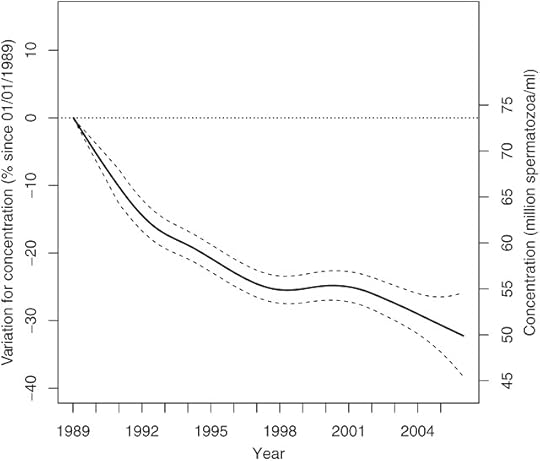
Similar numbers and rates of decline are now being reported in all Western countries (although alarmingly at a decline of 3% a year, Australia is at the high end). But in one country, the sperm count disaster makes the French look pretty damn virile.
Sperm banks in Israel are reporting that there is an alarming drop in sperm quality amongst Jewish inhabitants. Those that would have rejected about a third of applicants in the 1990s (because of low sperm count) are now turning away 80 to 90%. With a measured rate of sperm count decline approximately twice that of any other Western country, experts are predicting that by 2030, average Jewish Israeli sperm counts will drop to a level where reproduction is likely to be impossible.
There are as many theories about why this is happening as there are scientists researching the problem. Perhaps it is the increased levels of oestrogen in the diet, perhaps it is exposure to pesticides or perhaps it is the use of BPA plastics. But only one has produced convincing evidence of causation – dietary omega-6 fat consumption. And that evidence goes a lot further than noticing that Israel is the highest consumer of omega-6 fats in the world.
Omega-6 fat is the dominant fat in the ‘vegetable oils’ used in every processed food. These oils are not made from vegetables at all. Rather they come from seeds (like Canola or Rapeseed, Soybean, Sunflower, Safflower, Rice Bran and Grape).
Unlike other kinds of fat, humans cannot make Omega-6 oils. We need them to properly run our immune system and (just like Omega-3 fats) must get them from plants that we eat. Fortunately, we don’t need much and we are more than capable of getting everything we need from normal unprocessed food.
Less fortunately (a lot less fortunately), Omega-6 based seed oils are the fat of choice for the processed food industry (because they are a lot cheaper than fats from animals and exotic fruits like olives, avocados and coconuts), so Western consumption of Omega-6 fats has at least tripled in the last century. And as a consequence, the ratio of Omega-6 fats to Omega-3 fats has soared from about 3:1 to 26:1.
We’ve known for some time that in experimental animals, high omega-6 fat consumption lowers sperm count and significantly impairs the quality of those that remain. But a 2009 study in humans has taken that research one step further.
In that study, 82 infertile men were compared with 78 (proven) fertile men. Detailed profiles of the fatty acid makeup of each man’s semen were prepared. The results were unequivocal. Infertile men had a significantly higher ratio of Omega-6 to Omega-3 (15 to 1 versus 6 to 1 in fertile men). And critically, the higher the omega-6, the lower the sperm count. The amount and ratio of Omega-6 also dramatically and negatively affected the other two primary measures of sperm quality, the motility (ability to move) and morphology (the shape).
It is likely that the reason for the sperm cell destruction relates to rampant oxidation caused by the overconsumption of omega-6 fats. Unfortunately, that kind of oxidation damage leads to the wholesale DNA destruction that can result in cancer. That direct effect on testicular cancer rates is the subject of the next instalment in this series.
Get all the studies and articles mentioned in this series here.
Photo by Mobilus In Mobili . Distributed under the Creative Commons License.

How vegetable oils are stealing our future (Part One)
Part One – Male fertility is plummeting
Around one in six Australian couples meet the World Health Organisation definition of infertility (unable to conceive after 12 months of unprotected sex). And in about half of those cases it is because the male is infertile. This is the first in a series of articles examining how seed oils affect our ability to reproduce (and male wedding tackle in general).
A sperm count is an old fashioned, but still highly reliable way of measuring a man’s ability to produce children. Anything over 100 million sperm cells per ml is considered a premium vintage and anything under 15 million means the man is very unlikely to reproduce. The only trouble is that men with high octane semen are getting harder and harder to find.
In 1992 researchers from the University of Copenhagen published a study of sperm quality trends over the preceding half century. After reviewing 61 trials, the scientists came to the shocking conclusion that average sperm count had halved in just 50 years (from 113 million in 1940 to 66 million in 1990).
An even more comprehensive analysis of almost 27,000 French men published in 2005 confirmed the trend is continuing. In that study average sperm counts dropped from 74 million in 1989 to 50 million in 2005 (a rate of 1.9% a year). If the rate of decline continues at the same rate, there will be no French men capable of making babies by 2072.
Similar numbers and rates of decline are now being reported in all Western countries (although alarmingly at a decline of 3% a year, Australia is at the high end). But in one country, the sperm count disaster makes the French look pretty damn virile.
Sperm banks in Israel are reporting that there is an alarming drop in sperm quality amongst Jewish inhabitants. Sperm banks that would have rejected about a third of applicants in the 1990s (because of low sperm count) are now turning away 80 to 90%. With a measured rate of sperm count decline approximately twice that of any other Western country, experts are predicting that by 2030, average Jewish Israeli sperm counts will drop to a level where reproduction is likely to be impossible.
There are as many theories about why this is happening as there are scientists researching the problem. Perhaps it is the increased levels of oestrogen in the diet, perhaps it is exposure to pesticides or perhaps it is the use of BPA plastics. But only one has produced convincing evidence of causation – dietary omega-6 fat consumption. And that evidence goes a lot further than noticing that Israel is the highest consumer of omega-6 fats in the world.
Omega-6 fat is the dominant fat in the ‘vegetable oils’ used in every processed food. These oils are not made from vegetables at all. Rather they come from seeds (like Canola or Rapeseed, Soybean, Sunflower, Safflower, Rice Bran and Grape).
Unlike other kinds of fat, humans cannot make Omega-6 oils. We need them to properly run our immune system and (just like Omega-3 fats) must get them from plants that we eat. Fortunately, we don’t need much and we are more than capable of getting everything we need from normal unprocessed food.
Less fortunately (a lot less fortunately), Omega-6 based seed oils are the fat of choice for the processed food industry (because they are a lot cheaper than fats from animals and exotic fruits like olives, avocados and coconuts), so Western consumption of Omega-6 fats has at least tripled in the last century. And as a consequence, the ratio of Omega-6 fats to Omega-3 fats has soared from about 3:1 to 26:1.
We’ve known for some time that in experimental animals, high omega-6 fat consumption lowers sperm count and significantly impairs the quality of those that remain. But a 2009 study in humans has taken that research one step further.
In that study, 82 infertile men were compared with 78 (proven) fertile men. Detailed profiles of the fatty acid makeup of each man’s semen were prepared. The results were unequivocal. Infertile men had a significantly higher ratio of Omega-6 to Omega-3 (15 to 1 versus 6 to 1 in fertile men). And critically, the higher the omega-6, the lower the sperm count. The amount and ratio of Omega-6 also dramatically and negatively affected the other two primary measures of sperm quality, the motility (ability to move) and morphology (the shape).
It is likely that the reason for the sperm cell destruction relates to rampant oxidation caused by the overconsumption of omega-6 fats. Unfortunately, that kind of oxidation damage leads to the wholesale DNA destruction that can result in cancer. That direct effect on testicular cancer rates is the subject of the next instalment in this series.
Photo by Mobilus In Mobili . Distributed under the Creative Commons License.
January 31, 2016
How to get lung cancer from a frypan
Vegetable oils are highly unstable. When they interact with oxygen, they release neurotoxic, DNA mutating chemicals which are known to cause cancer (at least). Recent improvements in measurement technology have now thrown a spotlight on the quantity of these chemicals released by normal use. And the results are truly terrifying.
Vegetable oil made from seeds (Canola, Sunflower, Corn, Safflower, Grapeseed, Rice Bran and Soybean for example) -seed oils – are a relatively new addition to the human diet. Unlike oils made from fruit (Olive, Avocado and Coconut) and animal fats, they are very high in something called an Omega-6 fat.
They are also incredibly cheap to make, which is why you will find them in just about every food on the supermarket shelf and in every deep fryer in the land.
These Omega-6 fats are known to cause oxidative stress in humans. Oxidative stress occurs when the reactions between these fats and oxygen overwhelm our anti-oxidant defences and a chain reaction gets under way.
That chain reaction results in the production of some highly toxic chemicals which include MDA (Malondialdehyde) and 4-HNE (4-hydroxy-2-nonenal). They are dangerous because they interact destructively with our DNA and cause cancer.
But that is, by no means the least of it. Because of their neurotoxic capabilities, they are likely to be heavily involved in Alzheimer’s disease, MND, Multiple Sclerosis and Parkinson’s disease. They are also implicated in chronic inflammation, stroke and heart disease.
While the MDA and 4-HNE we make ourselves (from consuming too much Omega-6) is devastating enough, it is now becoming abundantly clear that we can make them even more dangerous than they already are. All we need to do is heat them before we eat them.
A study released late last year found that when oils containing Omega-6 fats are heated at a normal cooking temperature (of 180⁰C), they create significant quantities of MDA and 4-HNE (amongst other highly toxic chemicals). And each time the oil was re-used the concentration increased massively. The study showed that by the fifth day of oil re-use it had 5 times the concentration of these chemicals that it had on the first (which was already alarmingly high).
These premade cancer bombs are directly ingested every time we eat a food which was cooked in those oils (for example, anything fried in seed oils) or which used heated seed oils in the recipe (for example baked goods). They are even lurking in products which are sold cold but were made using heated seed oils (like margarines).
But worse than that, the researchers also made the point that all they could measure was the amount of these chemicals left in the oil. Since they are highly volatile, they are constantly escaping into the air around us when the food is being cooked and even when it is being eaten. It is likely that this explains the stubbornly high rates of lung cancer among women in Asian countries (where smoking is rare among women, but wok frying with Canola oil is a daily task).
According to a 2014 report from the WHO (World Health Organisation), more than forty three thousand Australians died from cancer in 2012. And despite huge advances in treatment, it is now the single biggest cause of death in Australia.
The report reveals that in the nine years the report covers, cancer diagnosis in Australia increased by an alarming 14 per cent. In 2003, 274 Australians per day were diagnosed. In 2012, it was 312 people. Per Day! Worse than that, the authors of the report expect that number to almost double in the next twenty years.
In countries exposed to the Western Diet for most of the last five decades (such as Australia), the number of new cases of Multiple Sclerosis recorded per year (after adjusting for population increases) has quadrupled and the numbers of people with the other diseases associated with these lethal chemicals has also been pushing steadily higher.
Prevention is clearly the key to changing a future full of untimely death from horrible chronic disease. Unfortunately those charged with advising us are blind to the real cause of these lethal epidemics.
Worse that that they are frequently the people responsible for us consuming the oils in the first place. McDonald’s for example switched from frying in Beef Fat to Canola oil in 2004 after incessant pressure from the Heart Foundation. And KFC followed suit in 2012
Every day there are thousands of teenagers standing over vats of frying canola oil for 8 hour shifts at every fast food restaurant in this country. Every day, there are people cooking with high temperature seed oils in woks (seasoned with seed oil). And every day there are industrial quantities of heated seed oil being poured into commercial baked and frozen foods.
And that is set against background of terrifying increases in cancer incidence in this country. Today’s 312 new cancer sufferers are not theoretical. They are your neighbour, your sister, the kid next door.
That this is allowed to continue when the science is so clear, is not merely a shame or an embarrassment. It is an outrage and a tragedy.
You can’t stop the food processors putting these carcinogens in your food and you can’t stop the Heart Foundation and the Cancer Council encouraging them to do so, but you sure can stop that food being put in you. Isn’t it time you did?
Photo courtesy of 2006 advertisement of the British Heart Foundation

Why more women who don’t smoke are getting lung cancer
Vegetable oils are highly unstable. When they interact with oxygen, they release neurotoxic, DNA mutating chemicals which are known to cause cancer (at least). Recent improvements in measurement technology have now thrown a spotlight on the quantity of these chemicals released by normal use. And the results are truly terrifying.
Vegetable oil made from seeds (Canola, Sunflower, Corn, Safflower, Grapeseed, Rice Bran and Soybean for example) -seed oils – are a relatively new addition to the human diet. Unlike oils made from fruit (Olive, Avocado and Coconut) and animal fats, they are very high in something called an Omega-6 fat.
They are also incredibly cheap to make, which is why you will find them in just about every food on the supermarket shelf and in every deep fryer in the land.
These Omega-6 fats are known to cause oxidative stress in humans. Oxidative stress occurs when the reactions between these fats and oxygen overwhelm our anti-oxidant defences and a chain reaction gets under way.
That chain reaction results in the production of some highly toxic chemicals which include MDA (Malondialdehyde) and 4-HNE (4-hydroxy-2-nonenal). They are dangerous because they interact destructively with our DNA and cause cancer.
But that is, by no means the least of it. Because of their neurotoxic capabilities, they are likely to be heavily involved in Alzheimer’s disease, MND, Multiple Sclerosis and Parkinson’s disease. They are also implicated in chronic inflammation, stroke and heart disease.
While the MDA and 4-HNE we make ourselves (from consuming too much Omega-6) is devastating enough, it is now becoming abundantly clear that we can make them even more dangerous than they already are. All we need to do is heat them before we eat them.
A study released late last year found that when oils containing Omega-6 fats are heated at a normal cooking temperature (of 180⁰C), they create significant quantities of MDA and 4-HNE (amongst other highly toxic chemicals). And each time the oil was re-used the concentration increased massively. The study showed that by the fifth day of oil re-use it had 5 times the concentration of these chemicals that it had on the first (which was already alarmingly high).
These premade cancer bombs are directly ingested every time we eat a food which was cooked in those oils (for example, anything fried in seed oils) or which used heated seed oils in the recipe (for example baked goods). They are even lurking in products which are sold cold but were made using heated seed oils (like margarines).
But worse than that, the researchers also made the point that all they could measure was the amount of these chemicals left in the oil. Since they are highly volatile, they are constantly escaping into the air around us when the food is being cooked and even when it is being eaten. It is likely that this explains the stubbornly high rates of lung cancer among women in Asian countries (where smoking is rare among women, but wok frying with Canola oil is a daily task).
According to a 2014 report from the WHO (World Health Organisation), more than forty three thousand Australians died from cancer in 2012. And despite huge advances in treatment, it is now the single biggest cause of death in Australia.
The report reveals that in the nine years the report covers, cancer diagnosis in Australia increased by an alarming 14 per cent. In 2003, 274 Australians per day were diagnosed. In 2012, it was 312 people. Per Day! Worse than that, the authors of the report expect that number to almost double in the next twenty years.
In countries exposed to the Western Diet for most of the last five decades (such as Australia), the number of new cases of Multiple Sclerosis recorded per year (after adjusting for population increases) has quadrupled and the numbers of people with the other diseases associated with these lethal chemicals has also been pushing steadily higher.
Prevention is clearly the key to changing a future full of untimely death from horrible chronic disease. Unfortunately those charged with advising us are blind to the real cause of these lethal epidemics.
Worse that that they are frequently the people responsible for us consuming the oils in the first place. McDonald’s for example switched from frying in Beef Fat to Canola oil in 2004 after incessant pressure from the Heart Foundation. And KFC followed suit in 2012
Every day there are thousands of teenagers standing over vats of frying canola oil for 8 hour shifts at every fast food restaurant in this country. Every day, there are people cooking with high temperature seed oils in woks (seasoned with seed oil). And every day there are industrial quantities of heated seed oil being poured into commercial baked and frozen foods.
And that is set against background of terrifying increases in cancer incidence in this country. Today’s 312 new cancer sufferers are not theoretical. They are your neighbour, your sister, the kid next door.
That this is allowed to continue when the science is so clear, is not merely a shame or an embarrassment. It is an outrage and a tragedy.
You can’t stop the food processors putting these carcinogens in your food and you can’t stop the Heart Foundation and the Cancer Council encouraging them to do so, but you sure can stop that food being put in you. Isn’t it time you did?
Photo courtesy of 2006 advertisement of the British Heart Foundation
October 18, 2015
No, it’s not your imagination. A lot more kids are being severely injured playing sport.
Many more kids than ever before are suffering permanently debilitating sporting injuries – the kinds of injuries that only hard-core sporting adults worried about in the past. And the science says that bottle of blue goop the kids swill at half time is likely to be the cause.
The dreaded ACL injury is a tear in the anterior cruciate ligament, one of the four ligaments that hold our knee together. The ACL is inside the knee joint connecting the bottom of the thigh bone (the femur) to the top of the lower leg bone (the tibia). It is attached to the tibia by a little spit of bone called the tibial spine.
Twenty years ago kids didn’t tear their ACL, they broke the tibial spine. This was because in growing children the bones are not at full strength, but the ligaments are. In a stressed situation, where the ACL is yanking on the tibial spine, the bone gave way before the ligament, hence the fracture.
Orthopaedics textbooks from the nineties warned doctors to look for tibial spine fractures because children don’t tear their ACLs. In essence, they thought they were immune to ACLs by virtue of being children.
But that has all changed swiftly, and not just in children. The numbers of people suffering ACLs has been rapidly increasing in the last two decades. The rate increased by a third between 1996 and 2004 (and almost doubled in women in that period). The increase was even more dramatic in children under 17 years of age.
One recent detailed review at just one US hospital found ACL tears in children increased by 11% every year between 1999 and 2011. In the same period the numbers of tibial spine fractures barely changed.
All of a sudden our kids are not making ligaments strong enough to break their developing tibial spine’s – the ligament tears instead.
Even after adjusting for increases in sports participation there is a very nasty (for the victims and the health system) trend developing at very high speed.
ACL’s can be repaired (by transplanting other ligaments) but even a well repaired ACL is likely to have severely debilitating long term consequences. One recent study found that half of all adult Swedish soccer players who tore their ACL had developed severe arthritis of the injured knee within 14 years.
Apply that timeline to an 8 year old and it means they will spend most of their lives battling severe debilitation. And that’s from an injury that 8 year olds are supposed to be ‘immune’ to.
Fortunately there is good science that tells us why our ACLs are suddenly failing. Sugar.
The massive increase in our consumption of sugar is responsible for us producing substandard ligaments and cartilage. If we make knees out of rubbish material its little wonder that they are suddenly not up to the job.
Sometimes sugars we eat are accidentally attached to proteins by our body. When that happens, the process is called glycation. Glycation can result in the formation of all sorts of unpredictable (and haphazard) molecules called AGE’s (Advanced Glycation End-products).
All sugars can form AGE’s but the fructose half of table sugar (sucrose) is ten times as likely to do so as glucose (the other half).
Our bodies are used to garden variety (glucose-produced) AGE’s. And we are pretty good at breaking them down and disposing of them. But even so, over time they accumulate in our organs and tissues and we, well, age (the acronym AGE is very much on purpose).
Unfortunately the AGE’s made with fructose molecules are resistant to our disposal system. So not only they made at 10 times the rate, they hang around.
AGE’s are dangerous because they bond easily (and randomly) to each other and to other proteins in a process called cross-linking. Cross-linking significantly degrades the quality of the protein.
Long-lived proteins such as collagen, elastin (both used in ligaments), lens crystallins (used in the eyes) and cartilage are much more susceptible to the effects of AGEs because once we make a bad batch, they’re part of us for an awfully long time.
Collagen degraded by AGEs makes less elastic ligaments. And substandard ligaments, rather like rubber bands left in the sun, tear much more easily.
ACLs and other ligament and cartilage damage are now a standard part of sporting (and increasingly non-sporting – 30-40% occur while not playing sport) life because fructose is being consumed at unprecedented rates (ironically, particularly by those playing sport).
But here’s a tip, if you prefer to watch your kids on the sports field rather than in an ambulance, do what the NSW cricket team has just done and swap Gatorade for water.
Photo by Carolyn Tiry. Distributed under the Creative Commons License.

September 23, 2015
No, we don’t need a sugar tax
Sugar taxes are all the rage, but the evidence that they deliver better health is non-existent. Fortunately there is a much easier way to get all the benefits (and more) without introducing a great big new tax.
Jamie Oliver and the Australian Heart Foundation are two prominent current advocates for a tax on sugary drinks. Their reasoning is clear, sin taxes (like those on tobacco and alcohol) clearly change behaviour. And sugar consumption is definitely a behaviour that needs to change. The research is unequivocal – sugar is a primary player in the vast majority of chronic disease epidemics sweeping the world.
For every 10% increase in the price of a pack of ciggies, we can expect a 4% decrease in consumption (in high income countries and as part of a general package of actions against smoking). And we know that similar maths is at work when it comes to sugar water. Mexico implemented a 10% ‘soda Tax in January 2014 and by the end of that year, consumption had decreased by 6%.
Smoking tobacco is the primary cause of lung cancer. So convincing people not to smoke is likely to (and does) result in a measurable health outcome. The substitute for cigarettes is nicotine patches and sprays. They still deliver the addictive substance but without the health impacts of cigarettes.
Unfortunately the same cannot be said for sugar. Sugar is the addictive substance and is also the substance causing the damage. Taxing one source of sugar will certainly reduce consumption from that source but detailed studies have been so far unable to detect a significant health benefit.
This is likely to be because people simply find another source of sugar. Or, as the author of one recent study put it people simply “find alternate ways to offset the added cost of the tax, by buying in bulk or choosing generic brands.” I would add, or, get their sugar from the other 90% of the food supply containing sugar.
In recognition of that loophole, Sarah Wilson wants to tax more than just sugar water. She is campaigning for a tax on “soft drinks, their artificially sweetened alternatives and all foods and beverages that contained hidden sugars.”
The good news for Sarah is that John Howard anticipated her call and implemented just such a tax in Australia on 1 July 2000. The bad news is that it has failed to positively change behaviour or health outcomes in the 15 years since.
The GST applies a 10% tax to all food and beverages except:
all meats for human consumption (except prepared meals or savoury snacks)
fruit, vegetables, fish and soup (fresh, frozen, dried, canned or packaged)
bread and bread rolls without a sweet coating (such as icing) or filling
unflavoured milk, cream, cheese and eggs
tea and coffee (unless ready-to-drink)
bottled drinking water
baby food and infant formula
cooking ingredients, such as flour, sugar, pre-mixes and cake mixes
fats and oils for cooking
spreads for bread (such as honey, jam and peanut butter)
spices, sauces and condiments
fruit or vegetable juice (of at least 90% by volume of juice of fruit or vegetables)
breakfast cereals.
To make the GST a perfect sugar tax, we’d need to remove breakfast cereals (why are they even there? – I smell a lobbyist), sugar as an ingredient, cake mixes, juices, sauces, condiments and some spreads from the list of exemptions (and add unsweetened yoghurt). But it is otherwise pretty close and I suspect that tinkering would be (politically) significantly easier than convincing the public to swallow a whole new tax on everything.
The big question is, would it change behaviour? Unfortunately based on evidence to date, the answer would have to be resounding no. When everything in a food category contains sugar, taxing sugar gives the consumer no choice but to pay more tax (and buy sugar anyway).
Luckily there is a simple way for a government (that really cared about our health) to do something about sugar consumption. Simply require our supermarkets to tell us the lowest sugar choice in any food category. The label above is my amateur vision of what that might look like.
Shelf labels allow customers to vote with their wallet by buying the product that has the least sugar. Companies who want part of that action will ‘reformulate’ quickly and the market driven race to the bottom should persistently drive down the sugar content of the food supply.
One other teeny tiny change would be necessary. Foods which are not subject to the sugar tax (aka the GST) must pass that saving on to the consumer. Shops would not be permitted to sell tax free bottled water at the same price as taxable coke (as they currently do).
We don’t need more tax, we need a way for the consumer to reward companies that make foods with less (or no) added sugar. Shelf labels are simple, direct, inexpensive and likely to produce material long term change in our food supply and our health. So let’s put the tax stick away and reach for the information carrot to get this mule moving.
Also published on RendezView