
David Gillespie's Blog, page 13
June 2, 2014
Not all Big Macs are created equal
In the fast paced global economy of the 21st century the weary traveler often yearns for something that reminds them of home. And one thing that is sure to be available anywhere a jet can land is a Big Mac. But not all Big Macs are created equal when it comes to sugar content.
In the graph above, I’ve charted some samples of the sugar content of Big Macs around the world. If you want more than two teaspoons of sugar added to your burger then the US & Canada is the place to dine, with the UK and Ireland not far behind.
The Italians dial it down a little and Australia takes it down even further but the place where a Big Mac contains the least sugar is in New Zealand. Go the Kiwis!
If you want to find out how to avoid the sugar in processed and take-away food, then you’ll find it easy if you have my Sugar Free Shopper’s Guide. Australian and UK versions are now available with the US version coming soon.


May 21, 2014
The first 7 ways fructose will mess you up
Last month I threw together an infographic on the 12 Ways Fructose Destroys Your Body. It’s a good summary, but the lawyer in me loves footnotes. So here is the detail behind the claims that picture makes. Well, it’s the detail behind seven of them. The rest will come in the next post on this topic.
1. Fructose rots your teeth
The first part of your body that fructose touches is your teeth and they are usually the first to go in its path of destruction.
The statistics are clear. Populations exposed to sugar for the first time go from ‘background’ levels of decay (of around 4 cavities per 100 teeth) to ‘modern’ levels of around 24 cavities per 100 teeth. The mechanism is known and the science is uncontroversial. Not even Coca-Cola dares deny that sugar and tooth decay go together like peas and carrots.
Tooth decay is caused by bacteria called S. Mutans (Streptococcus Mutans). S. Mutans loves a good feed of sugar. And after it gets some, it produces lactic acid as a waste product. It’s that lactic acid that can do the damage to our teeth. But if the only sugar in our diet is glucose or carbohydrates that are converted to glucose, our saliva quickly neutralizes the acid and we regenerate any damaged enamel. This means t0oth decay is kept to the minimum.
But, if there is some fructose available as well as glucose then through a quirk of evolutionary biology, S. Mutans can build itself a saliva proof home.
We call this little anti-saliva shield, plaque. Plaque binds S. Mutans to each other and to the tooth enamel. It traps the lactic acid against the tooth surface, protects it against the waves of saliva and gives it time to eat through the enamel.
2. Fructose inflames your gut
Our small intestine can become inflamed when toxic molecules normally attached to bacteria (endotoxins) escape through our intestinal walls and into our bloodstream. Our immune system has an inflammation reaction to endotoxins.
Binge drinking alcohol will produce exactly that effect. Unfortunately so will overconsumption of fructose. If you drink alcohol all day every day then fructose will not be noticeably adding to the problem, but if you are like most people and your daily poison choice is sugar, then it is probably responsible for your inflamed gut.
Unfortunately both alcohol and fructose also appear to increase the populations of bacteria which produce endotoxins in our intestines (something charmingly termed bacterial overgrowth). So we get the double whammy of more endotoxins in our gut and doors left ajar (gut permeability) to let them into our bloodstream.
3. Fructose destroys your liver
After absorbed fructose hits your bloodstream, next stop is the liver. We are adapted to a diet where most carbohydrates are glucose or glucose based. So we have exquisitely finely tuned feedback loops which tell us we are full when we’ve taken on enough glucose.
Those loops don’t fire for fructose, so our liver will merrily convert any that it finds straight into fat. That fat is stored in the liver and exported into our bloodstream. Because we all have such a high fructose diet more than a third of Adults now have (NAFLD) Non Alcoholic Fatty Liver Disease as a result. NAFLD can then progress through various disease stages and ultimately end in cirrhosis requiring a liver transplant.
By the way there is interesting speculation that the trigger for converting mere fatty liver into cirrhosis is an immune response to endotoxins leaking from the gut.
4. Fructose takes out your pancreas (and your eyes and limbs)
Our bodies convert most carbohydrates to glucose. In healthy people that glucose is pumped out to the cells that need energy via our bloodstream. Cells that need energy, signal their desires by moving glucose receptors to the cell surface (kinda like hanging out the “this room needs servicing” sign in a hotel).
But when fructose-fat accumulates in the liver and bloodstream, it affects something called insulin sensitivity. The receptors never get to the cell surface (or if they do, it’s in smaller numbers). The result is that the glucose goes sailing by. The maid doesn’t know the room needs her and our bodies starve in a sea of food.
Because the glucose doesn’t get used by the cells (or not as many of them), it stays in the bloodstream longer and the result is a longer than normal high blood sugar concentration. This is called insulin resistance or pre-diabetes.
Our body usually responds to insulin resistance by pumping up the insulin levels until the glucose is cleared. If we ask our body to run on overdrive like that for years, for most of us, our pancreas (the insulin maker) will pack it in and we will need to get daily insulin injections to live. Along the way, the persistent high blood glucose will result in blindness and limb amputations for many sufferers.
5. Fructose makes us fat
Our appetite control hormones are exquisitely balanced to ensure we have just the right amount of energy on hand.
But when that balance is disrupted, our fuel management system can veer wildly out of control. A disrupted appetite control system can store too little or too much fuel. Too little looks like anorexia, too much looks like, well, most of us. Obesity is a symptom of a failure of the balance of hormones controlling how much food we take in.
When the pancreas attempts to cope with elevated blood glucose (caused by fructose derived fat) by ramping up insulin, it is only fixing the immediate problem. All that extra insulin doesn’t make the damaged cells any less insulin resistant, it just means that undamaged cells use the insulin to make fat. In other words the blood glucose is cleared from the bloodstream by making us fatter.
Just for good measure, fructose also interferes directly with leptin signalling. Leptin is our long term energy storage hormone, the one that tells us not to eat between meals. Fructose makes us less sensitive to that hormone and as a result we eat more of everything.
This double dose of hormone dysfunction causes us to store too much fat in our cells, but the body is not aware the fat is there and keeps demanding food. Our appetite control system thinks we are starving even while we have more than enough fat being packed away (usually in very unsightly places).
When an obese person restricts the amount of food they eat, they are not changing the underlying error in the appetite control system. The body thought it was starving before the diet, now it’s really starving. It will not use the fat store to satisfy its need for food because the hormonal disruption means it doesn’t even know it’s there.
The hormones will force the body to sacrifice muscle and even organs to make up for the missing calories. And the whole time, the dieter will feel like they are starving to death.
6 & 7. Fructose messes up your kidneys (and gives you gout)
When fructose is converted to fat by our liver, a significant amount of a waste product called uric acid is produced. Our kidneys are our built in pool filter for removing waste products like uric acid. But they can be overwhelmed by the quantities that will be produced by the amount of fructose in the modern diet. When that happens our kidneys start to fail. And this is likely to be why excess uric acid has been associated with significant increases in kidney disease in a long line of rat studies and more recently in human trials.
Kidney disease is massively debilitating. The only effective ‘treatment’ is getting hooked up to a dialysis machine three times a week. Meanwhile the number of people needing that treatment is growing at the rate of 6 per cent every year. The only ‘cure’ is replacing the kidneys (if you’re lucky enough to get to the head of the transplant queue (currently the wait is about four years) before you die.
A side effect of that failure to remove uric acid is that it accumulates in the joints of the feet and ankles, causing a form of acute arthritis called gout. If you suffer from gout, then it might be time to get your kidney function tested.
And that’s the first 7 ways fructose wrecks your body and health. I’ll detail more in the next post, but if you want a preview check out my infographic – 12 Ways Fructose Destroys Your body.

May 19, 2014
Whoops – Australia accidentally privatised its education system
Australia is sleep walking into a privatised education system that will deliver massive inequity, steadily declining results, and cost vastly more. Last week the Federal Treasurer gave us a giant shove further down that road. In deciding to remove $5 billion from the State Education budgets, he is telling the States (who run the government schools) to make do with less. The inevitable result of this will be to accelerate the rush to private education and ultimately, the destruction of our once great school education system.
According to the APC (Australian Productivity Commission) in 2012 Australian Taxpayers spent $8,546 per student per annum on educating children in non-government schools. And according to the ABS (Australian Bureau of Statistics) taxpayers spent $11,980 per child in government schools. Neither number includes capital expenditure, which was about the same per child in both systems. In other words, the average non-government school student costs the taxpayer 71 per cent of the average public school student.
And therein lies the core argument for boosters of private education in this country (unfortunately including our Education minister). You see, the argument goes, children at non-government schools are actually saving the taxpayer money. They are transferring the cost of their education from the community to their parents (and church congregations presumably). They are choosing to participate in a user-pay community. And even if it does only amount to a 29 per cent saving, they are doing us all a favour.
But those average numbers hide some pretty big gotcha’s for the public system. The government schools are overwhelmingly the ones providing education to Australia’s most remote students. They teach 7 times as many students classified by the ABS as living ‘very remotely’ and 4 times as many students classed as being ‘remote.’ When it comes to children with special needs, once again it is the Government schools doing the heavy lifting, educating 3.3 times as many children with a disability as their non-government brethren. Unlike public schools, non-government schools are exempt from the provisions of Australia’s discrimination laws. They are permitted by law to pick and choose who they will and will not be bothered trying to educate.
Educating the hard-and-expensive-to-teach students is undeniably a task that is increasingly falling to government schools but strangely it is in the non-government sector that the costs (to government) are exploding. Over the decade prior to 2012, per student government recurrent spending on government schools increased by just 19 per cent. At the same time government funding for ‘private’ students increased by 28 per cent (both numbers after inflation).
That means that if current funding trends continue, it is inevitable that the taxpayer contribution to private schools overtakes the contribution to government schools. And that is notwithstanding that the Government schools are the ones educating the vast majority of the children with special needs, in remote locations or with behavioural difficulties.
The small and decreasing taxpayer ‘saving’ is the reward we have reaped for the decision to destroy the equity (and the achievements) of our education system. In the half century since Australian taxpayers started funding private education choices, our school education has been progressively failing.
Even though we now pay five times as much (after inflation) to educate a student, by the time that student reaches Year 9 they are 3 months behind where the same student was in 1964. And if that’s not bad enough, when we compare that same student to the world’s highest performing educators, we find they are more than two years behind. The leaders in education (a group that used to include us) have marched forward and we have slid slowly backwards.
Some people might be able to justify that destruction if the privatised part of the system was setting the world on fire. Unfortunately not even that is true. All Australian schools performed terribly in the latest round of international comparative tests. But our best private schools did even worse than everybody else.
And while (after adjusting for socio-economic disadvantage) all Australian schools performed equally badly overall, there were significantly less really high performing students in the nation’s private schools. There were no changes in the numbers at those levels in government schools. If private schools are supposed to cultivate the best and brightest, those results suggest they are failing dismally.
The privatisation of education, just like the privatisation of healthcare, results in islands of underperforming privilege amongst a sea of despair and it drags the whole system down. We have systematically created a school education system which performs worse for everyone (even the better off) than the system it replaces. That’s quite an achievement, but it is not irreversible. We can return to a high equity, high performance system. Unfortunately it appears the current Government is hell-bent on doing exactly the opposite.
Also published in The Courier Mail
Letters to the editor in response appear here.
Image courtesy of Stuart Miles / FreeDigitalPhotos.net

May 17, 2014
The 2014 British Sugar Free Shopper’s Guide
The 2014 British Sugar Free Shopper’s Guide is the must-have navigator for your local supermarket if you plan to buy anything in a package.
The guide contains comprehensive listings of the most commonly purchased categories of packaged food available in British stores. Each category has been scoured for brands that have less than 3 grams of sugar per 100 grams.
It’s a guide that removes all the bad products from the supermarket shelf and makes it easy for you to select simply and quickly from the good ones that are left.
But wait. There’s more. It also includes a similar analysis of the popular fast food options on offer in most UK cities.
 (Paypal also accepted just click the button above)
Also available for Kindle – click here
Use the buttons above to get the guide for the introductory price of £3.95 (normally £6). You’ll be emailed the PDF immediately so can have it on your smartphone, iPad or tablet or print it out if you prefer and have it with you all the time.
Alternatively you can subscribe to howmuchsugar.com and not only get the shopper’s guide (and updates as part of your membership) but also detailed sugar guides to the sugar content of all foods in a given category, great recipes that you can make at home, the members forum to share your experiences and extras such as the Vegetable Oil Ready Reckoners and other handy shortcut tools that I regularly create and share with members.
Like this product? Spread the word about it and earn 30% of the purchase price on sales you refer. Click here to join David Gillespie’s affiliate program »

April 30, 2014
The 2014 Australian Sugar Free Shopper’s Guide
It’s Finally Here!
The 2014 Australian Sugar Free Shopper’s Guide is the must-have navigator for your local supermarket if you plan to buy anything in a package.
The guide contains comprehensive listings of the most commonly purchased categories of packaged food available in Australian stores. Each category has been scoured for brands that have less than 3 grams of sugar per 100 grams.
It’s a guide that removes all the bad products from the supermarket shelf and makes it easy for you to select simply and quickly from the good ones that are left.
But wait. There’s more. I’ve also included a similar analysis of the popular fast food options on offer in most Australian cities.
(Paypal also accepted just click the button above)Also available for Kindle
Use the buttons above to get the guide for the introductory price of $6.95 (normally $9.95). You’ll be emailed the PDF immediately so can have it on your smartphone, iPad or tablet or print it out if you prefer and have it with you all the time.
Alternatively you can subscribe to howmuchsugar.com and not only get the shopper’s guide (and updates as part of your membership) but also detailed sugar guides to the sugar content of all foods in a given category, great recipes that you can make at home, the members forum to share your experiences and extras such as the Vegetable Oil Ready Reckoners and other handy shortcut tools that I regularly create and share with members.
Like this product? Spread the word about it and earn 30% of the purchase price on sales you refer. Click here to join David Gillespie’s affiliate program »

April 24, 2014
12 Ways Fructose Destroys Your Body
In the early 1800s the average person ate about 1.3 teaspoons of sugar a day. Now the average person eats somewhere between 35 and 45 teaspoons of sugar a day. But the irony is that the modern adult probably thinks they barely eat any at all. Our food supply has been so completely and totally polluted with sugar, that it is almost impossible to buy packaged food that doesn’t contain it.
One half of that sugar tsunami is a substance called fructose. It doesn’t matter whether the sugar is made from corn (called High Fructose Corn Syrup), beets (called Beet Sugar) or cane (called Cane Sugar or often just Sugar), it is all half glucose and half fructose. And because we have never before in our evolutionary history as a species been exposed to significant quantities of fructose, our bodies are incredibly poorly adapted to dealing with it.
Consume serious quantities (like that contained in 35-45 teaspoons of sugar a day) and the chronic diseases caused by the maladaptation start to pile up. The picture above shows the 12 biggest disease states that science has currently linked to fructose consumption.

April 13, 2014
Time to focus on the private school elephant in the pool
Tony Abbott’s hand-picked head of the Audit Commission, Tony Shepherd wants to end middle-class welfare but the Family Tax Benefits he’s targeting are just a sixth of the value of the annual subsidy paid to ‘private’ schools. In 1963 Australian taxpayers contributed less than a brass razoo to private education. Now we pay over $10 billion per year in recurrent funding. On top of that we taxpayers build fabulous facilities on private property (with capital funding) that very few of us have the right to access. It’s time the Audit Commission looked at the real middle class welfare, private schools.
Educating the children of prisoners (or guards) was not a priority in the early Australian colonies. And because it was charitable work, it was left to the churches to do with as they pleased.
As the population changed from largely prisoners to largely free colonists and the demands for education increased, the churches were able to negotiate significant government aid for their efforts. Unfortunately this resulted in a large amount of competition (and school choice) for easy to reach students in the cities and no education for everyone else.
In Australia, the market can deliver most things efficiently in the cities. But huge distances mean no profits to private providers and consequently no services for the rest of us. That particular ‘market failure’ is exactly why Australia found it necessary to have a state funded bank, a state funded telecommunications company and a state funded broadcaster.
Towards the end of the 19th century, the Australian colonies solved this problem in schooling by withdrawing their funding from church run schools and investing in their own ‘state schools’. The aim was to provide a free education to every citizen no matter where they lived (or what brand of religion they favoured).
The Catholics opted out and decided to run their own schools (on a shoestring) and there were a few Anglican secondary schools who continued to rely exclusively on private fees. But for almost a century, Australian governments refused to fund private choices about school education. And for almost a century we had a high equity, secular education system which was the envy of the world.
It was mostly fear of an electoral backlash that kept the politicians at bay. But when Sir Robert Menzies won the 1963 election with a promise to fund science blocks in non-government schools, the can was open and the worms tasted freedom. There was no backlash. The electorate no longer cared.
There is no better way to target a marginal parliamentary seat than selectively distribute largess among school communities. School funding is the laser guided vote buyer. The pollies had entered pork barrel heaven. And Australia has incessantly increased funding to ‘private’ schools ever since.
But the annual funding is just the tip of the money-berg. In addition to the cool $10 billion the taxpayer forks out every year to run ‘private’ schools, we are buying Olympic swimming pools, cricket ovals that the ICC would envy, fabulously appointed gymnasiums, fantastic science facilities and computer labs to die for.
The total bill for all this extra taxpayer generosity between 2005 and 2010 was just a smidge under $5 billion (on top of the $10 billion a year in running costs).
Over the same time frame we invested about $10 billion in government school infrastructure. And while those ratios are roughly in line with the respective numbers of each, they don’t take account of the fact that after the money is funnelled through the state government bureaucracies, $1 buys you about 60c worth of building work in a state school.
In 1964, DOGS, (the Council for Defence of Government Schools) was formed to protest the decision by the Australian Government to fund private schools. Their campaign against ‘schools with pools’ goes on to this day.
A favourite publicity stunt of the early DOGS protests was to turn up to the pools their money had purchased and ask for a swim. They were swiftly given the bum’s rush. These are not like other tax payer funded gyms, pools and libraries. These gorgeous facilities are not open to the public (that would be you).
Taxpayer funds have been used to significantly improve the value of private property and provide educational facilities that no government school could ever afford. Yet ordinary taxpayers are not allowed anywhere near them.
So the next time you peer over the hedge of the local ‘private’ school at the new Olympic pool, remember this was built using (upper?) ‘middle class welfare’. The Audit Commission will ruthlessly target all manner of what it deems to be unnecessary government spending but I guarantee you it will coyly avert its gaze from the ‘private’ school elephant wallowing in the pool.
Also published in The Courier Mail
Image courtesy of markuso / FreeDigitalPhotos.net

April 12, 2014
What Vegetable Oil is that?
Food Manufacturers are not required to identify the exact fats that they are using in a product, but they are required to tell us the Total Fat in grams per 100 g and the Saturated Fat in grams per 100 g. Using those two numbers and the chart below the trained seed oil detective can have a good guess as to the fat being used based on the amount of saturated fat in the product.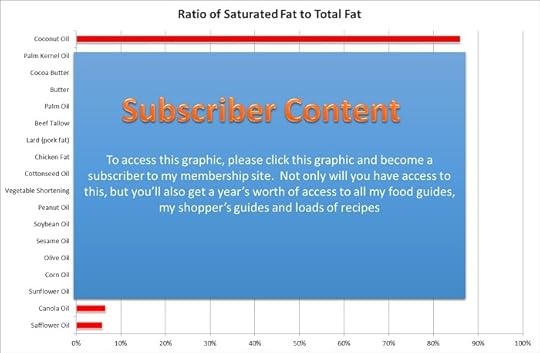
To obtain access to this graphic and a worked example of how to use it in the supermarket, become a member. You’ll also get access to loads of other premium content, such as recipes, detailed guides to sugar content and handy calculators to help you show for low seed oil foods.

April 10, 2014
Every drop of vegetable oil takes us further along the path to Parkinson’s Disease
Michael J Fox has it, Muhammad Ali has it, Billy Connolly has it and more than 100,000 Australians have it. About 30 new cases of Parkinson’s disease are being diagnosed every day in this country. If you want to avoid adding your name to that list there is one thing you should do. Don’t eat seed oils.
James Parkinson, surgeon, geologist and palaeontologist first described what we now call Parkinson’s disease in his paper on shaking palsy in 1817. He was born on April 11, 1755, which is why April 11 is World Parkinson’s Day. Dr Parkinson described a condition which caused involuntary tremors when a limb is at rest, rigidity, slowness of movement and a propensity to bend forwards and slow gait when walking. There was no known cause or cure.
We now know that Parkinson’s is caused by the death of cells in our pars compacta –the part of our brain which controls motor function (the Substantia nigra pars compacta if you want to get all technical). That part of the brain is a central switching room for movement, attention, learning and reward-seeking (which makes sure we keep eating and having sex).
The pars compacta exerts its control using dopamine. When everything is working well, our bodies are inhibited from moving by the part of our brain which contains the pars compacta (the basal ganglia for Latin freaks). When we decide to move something (our eyes or limbs etc), the pars compacta squirts out dopamine to take the brakes off.
If the neurons responsible for producing the dopamine are damaged, Parkinson’s disease is the result. Our brain is pretty durable, because we lose around 50% of our dopamine manufacturing neurons before there are any symptoms. But once they are gone, these neurons are gone forever. As the numbers decrease, a Parkinson’s sufferer has to exert greater and greater effort to produce movement.
The only effective treatment is medication which can increase dopamine production by squeezing a little more out of the remaining neurons (we can’t just give dopamine as it isn’t able to cross the blood-brain barrier). Obviously if the destruction of the neurons continues (as it does in most) that is only a temporary solution. Before medication was introduced in the 1970s a Parkinson’s patient was expected to live 9.5 years after diagnosis. The drug assisted life expectancy is now 15 years.
Because the disease is the result of cumulative destruction, it is most prevalent in people over 50 but 20 per cent of cases are diagnosed between 20 and 50. Michael J Fox was diagnosed when he was just 30.
There are very few places in the world where accurate long term statistics have been kept on the incidence of Parkinson’s disease, but they have done just that in Olmstead County, Minnesota (pop: 100,000). There, researchers have concluded annual new cases almost doubled between 1944 and 1984 (using consistent diagnostic rules). And like Type II Diabetes, other studies tell us that Parkinson’s occurs much less frequently in populations not exposed to a Western Diet (processed food).
The official position on the cause of Parkinson’s disease is that nobody has the slightest clue what causes the dopamine producing neurons to die. The only official risk factor is age. But I think some dots need joining and when that is done the culprit becomes very clear.
We know that a diet high in seed oils causes the levels of Omega-6 fats in our cell membranes to rise rapidly. Those fats react quickly with oxygen and push the body into a state of cascading cell damage called oxidative stress. We also know that a major product of the oxidation of omega-6 fats is something with the charming name of 4-Hydroxynonenal (I’ll just use its street name of 4-HNE). And we know that 4-HNE, whilst generally dangerous, is especially toxic to the neurons responsible for producing dopamine in our brain.
There, dots joined (it wasn’t that hard was it?). Eating seed oils (or anything which contains large amounts of omega-6 fats) induces the production of a molecule which we know kills the neurons we depend upon for dopamine production. Kill enough of them and you have Parkinson’s disease.
Thanks to the efforts of the processed food industry (aided and abetted by the Heart Foundation), our diet is now completely saturated with omega-6 fats. Everything in a package uses it. Every deep frier uses it. Every baker uses it. And every little bite of it is taking out the neurons you depend on to keep you from the ravages of Parkinson’s disease.
Nothing I can say will restore the neurons you’ve already killed but I can stop you killing any more.
Don’t eat seed oils.
Image: A man with Parkinson’s disease displaying a flexed walking posture pictured in 1892. Photo appeared in Nouvelle Iconographie de la Salpètrière, vol. 5. By Albert Londe (1858-1917) [Public domain], via Wikimedia Commons

April 4, 2014
Magda proves commercial diet programs are a waste of money.
According to the Australian Women’s Weekly actress and comedian Magda Szubanski was paid $32,692 per kilo to lose 26 kilos in 2009 ($850,000). It appears the solution was temporary so now Magda is reportedly receiving $1.25 million to have another go.
Magda joins a long list of celebrities who’ve fallen off the Jenny Craig wagon. But continuous failure doesn’t seem to harm their brand at all. Indeed failure seems to sell more, Magda’s first attempt increased Jenny Craig sales by 307 per cent.
So, does Jenny Craig work (for people who are not celebrities)?
The Jenny Craig diet has been tested in only one randomised, controlled trial. That is a little surprising (and dare I say, suspicious), given it is one of the largest diet programs in the world.
In this kind of trial, the participants are randomly assigned either to a group following the diet or a group not following the diet (the controls), and the progress of each group is directly measured against the other. The trial compared Jenny Craig with what they called a ‘self-help group’. The self-helpers were given information on losing weight and offered a follow-up counselling session with a dietitian, but otherwise left to their own devices.
The study was funded by Jenny Craig, who also provided all the meals and counselling sessions free of charge. Participants also had access to free weekly one-on-one counselling sessions with a Jenny Craig consultant. If they’d had to pay for all this luvin, it would have cost them $718 for the counselling and $6,240 for the food. Because of all these factors, the study is not a completely real-world example. Throw in $1,500 a month for a personal trainer and a million dollar pay day and you might almost replicate the experience of a celebrity dieter.
In the real world, we’re supposed to pay for the diet, not the other way around. Given that, this study probably represent the best possible scenario in terms of keeping people motivated and sticking to the diet for the entire length of the study, which was two years. Even so 9 per cent of participants had dropped out by the end.
After two years of free Jenny Craig meals, intense calorie restriction (the diets were between 42 and 68 per cent of their normal calorie intake) and weekly counselling, the average dieter managed to drop from 92.2 kilograms to 84.8 kilograms (which means they were still obese – in this trial defined as anything above 81 kilograms). Even the self-helpers managed to drop 2 kilograms!
The good news is that if you can convince Jenny Craig to pay for your food and weekly counselling (don’t hold your breath), you can expect to lose about 7 kilograms in two years. If you started out obese, you’d still be obese and you’d have been starving for two whole years but your pants might fit a little better.
And it seems this astounding lack of success is not a one-off observation.
A 2007 UCLA review of 31 credible long term weight loss studies found that most people on calorie restricting diets (such as that promoted by Jenny Craig and Weight Watchers) initially lost 5 to 10 percent of their body weight. But they also found that the majority of people regained all the weight (plus a bit more) within 12 months. Sustained weight loss was found only in a very, very small minority of participants.
Clearly Jenny Craig understand that since their diet doesn’t work very well, people need to be assured that their inevitable failure is something shared by the best and brightest (by that I mean celebrities, in case it wasn’t obvious).
All of this relies on the punter buying into the myth propagated by the Health and Diet industry that being fat is a character defect. They need us to believe that we put on weight because we are weak willed or lazy (or both). This means that any failure of a diet product is those character defects overcoming our willpower and not that the product was a load of rubbish.
This is, of course, utter nonsense. We are fat because we are addicted to a substance (sugar) which makes us fat. This addictive substance is embedded in everything we eat by the processed food industry so they can move more product (if they could use nicotine they would, but sugar will have to do). We are not fat because we are gluttonous or slothful (or any of the five remaining deadly sins).
If a product doesn’t actually work as promised and the company selling it knows this, then we are well on the way to outrageously unethical (if not downright immoral) corporate behaviour. But I won’t hold my breath waiting for any corporate regulator to do anything about it. Luckily we don’t have to. We have a choice. We can buy into the latest Jenny Craig (or any other diet program’s) weightless yo-yo. Or, we can just stop eating sugar.
Image by Eva Rinaldi from Sydney Australia www.evarinaldi.com (Magda Szubanski) [CC-BY-SA-2.0 (http://creativecommons.org/licenses/b...)], via Wikimedia Commons




.png)