Sneha Jaiswal's Blog, page 241
January 16, 2022
Billion Dollar Whale – Book Review
Party-fatigue. That’s what I had by the time I got done with the Prologue to this book. And I didn’t even attend a party.
Here’s the thing. I understand why Leo DiCaprio appears on every other page in this book. He sells. And I’m pretty sure the other celebs peppered throughout the book add big bucks as well. But come on, this book is about a massive financial fraud. And not just any fraud. A sovereign fraud. Executed with the help of the then-sitting Malaysian Prime Minister. And yeah, DiCaprio is awesome but god, WHY.THE.DETAILED.DESCRIPTION.OF.SO.MANY.PARTIES????!!!
The Billion Dollar Whale is about the 1MDB financial scandal. Summary: Malaysian national Jho Low and his accomplices allegedly siphoned off billions from a Malaysian sovereign wealth fund to bankroll his (and their) extravagant parties, real estate purchases, setting up a Hollywood movie production company (that financed The Wolf of Wall Street – oh, the irony!), ex-PM Najib Razak’s 2013 election campaign and the PM’s wife – Rosmah Mansor’s jewellery hoard.
The authors – WSJ’s Wright and Hope – covered the scandal for the financial daily. They have covered good ground in their reporting, but I would have liked it better if they had focused more on how the fraud was perpetrated and not so much on the types and bottles of champagne served at every party. It would have also resulted in a more compact narrative.
Loved the part in which the original Wolf – Jordan Belfort – attends a pre-launch party and comments along the lines of “wow, something stinks..” (not the exact comment).
On a separate note: #TILs of the book – Switzerland has a massive, sorta-secretive warehouse complex known as the Geneva Free Port zone patronised by the uber-ishly-uber-most-wealthy (that’s like the 0.01% of the fabled-1%ers.. kinda). It contains some of the world’s priciest privately-held art, vintage cars and god knows what else. And I thought Switzerland was focused on stashing just money – good on them for diversifying!
Review summary – Nice book. Too many parties. Could be hella shorter.
Rating: 3/5
This book review is by @arcana_reads (Click to follow on Instagram).
Subscribe to our podcast on YouTube by the same name – AbstractAF
Ep 64 – 15 Random but Great Book Recommendations


January 15, 2022
What Went Wrong With ‘Eternals’?
So the 2021 movie ‘Eternals’ is now available to stream on Disney Hotstar Premium. And even though I do have a subscription, I am not going to watch it. Why?
A few weeks ago, someone on the Q&A site ‘Quora’ asked ‘What Went Wrong With Eternals?’. And my answer went –
What went wrong with Eternals? – What If…?
Let me explain.
DC/Marvel comic-books came at a price-tag that was considered ‘exorbitant’ for most of us middle-class 90s kids. Although I did watch a little bit of X-Men on Cartoon Network in the early 2000s. The comic books were never an affordable option. So like a lot of average movie fans I wasn’t even aware that Jack Kirby created ‘Eternals’ way back in the 20th century (makes it sound more dramatic and old doesn’t it?). The characters made their first appearance in 1976. Below is the cover from back then, taken off Wikipedia[1] –
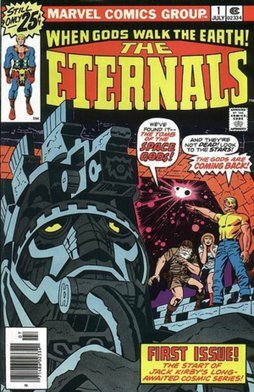
Needless to say, it wasn’t a rage as such, and the series was cancelled. But every few years, the guys at Marvel would revive ‘Eternals’ as a mini-series. And finally in 2021, we got an ensemble cast film. By then, I was so saturated with Marvel content – I couldn’t care less. Especially because it came right after “What If…?”, the animated series, which was actually fun (I loved the Zombie themed episode – unpopular opinion). It had ALL POSSIBLE alternate universes, and all of them were at threat, and yet, the legendary Eternals NEVER MAKE AN APPEARANCE. They are never mentioned, never considered as an option to save the universe(s). And then we have an entire movie with them, which just seemed so bloody pointless.
So for me, what went wrong with Eternals was ‘What If…?’. It makes them look unnecessary. If you’ve seen the mini-series, you’d know what I mean. Kind of makes me not want to watch the movie at all. And the trailer was not very impressive either.
January 14, 2022
The Tea Dragon Society – Quick Review
Imagine being able to have tiny dragons with leaves and flowers spouting of their heads/horns as pets. That’s precisely what ‘The Tea Dragon Society’ by Kay O’Neill is about.
The book starts off with the protagonist Greta working with her mother, who tells her about how blacksmiths used to be as important as magicians ‘once upon a time’. That very day, Greta rescues a lost little dragon, that’s supposedly a ‘tea dragon’, whose leaves can be used in making a great brew. She soon finds and befriends the dragon’s owner and learns about their ways.
Kay O’Neill keeps everything very gender-fluid in the book, you have women blacksmiths, men with long braided hair who love making tea, basically characters that you cannot immediately put under a ‘he’/’she’ bracket immediately. Everything is colorful, cute and dreamy. But the plot is not all that coherent – it’s just a bunch of people having tea, swapping stories and chilling with cute little dragons, some of who reminded me of Pokemon characters. The author doesn’t take a lot of effort with names and simply labels the dragons after types of tea – like ‘Jasmine’, ‘Ginger’, ‘Peppermint’, ‘Earl Grey’…. you get the gist. But well, they are tea dragons after all, so guess it’s not that bad to have such obvious names.
The artwork is bright and super adorable, although I feel like some of the dragons could’ve used more detailed features. Overall, ‘The Tea Dragon Society’ is a cute, adorable book, but not something that will stay in one’s memory for long. It’s a 3/5 from me.
Subscribe to our podcast on YouTube by the same name – AbstractAF
Ep 63 – Author Balaji Vittal on Pure Evil – A Guide To Bollywood Villainy
The Tea Dragon Society – Quick Review
Imagine being able to have tiny dragons with leaves and flowers spouting of their heads/horns as pets. That’s precisely what ‘The Tea Dragon Society’ by Kay O’Neill is about.
The book starts off with the protagonist Greta working with her mother, who tells her about how blacksmiths used to be as important as magicians ‘once upon a time’. That very day, Greta rescues a lost little dragon, that’s supposedly a ‘tea dragon’, whose leaves can be used in making a great brew. She soon finds and befriends the dragon’s owner and learns about their ways.
Kay O’Neill keeps everything very gender-fluid in the book, you have women blacksmiths, men with long braided hair who love making tea, basically characters that you cannot immediately put under a ‘he’/’she’ bracket immediately. Everything is colorful, cute and dreamy. But the plot is not all that coherent – it’s just a bunch of people having tea, swapping stories and chilling with cute little dragons, some of who reminded me of Pokemon characters. The author doesn’t take a lot of effort with names and simply labels the dragons after types of tea – like ‘Jasmine’, ‘Ginger’, ‘Peppermint’, ‘Earl Grey’…. you get the gist. But well, they are tea dragons after all, so guess it’s not that bad to have such obvious names.
The artwork is bright and super adorable, although I feel like some of the dragons could’ve used more detailed features. Overall, ‘The Tea Dragon Society’ is a cute, adorable book, but not something that will stay in one’s memory for long. It’s a 3/5 from me.
Subscribe to our podcast on YouTube by the same name – AbstractAF
Ep 63 – Author Balaji Vittal on Pure Evil – A Guide To Bollywood Villainy
January 13, 2022
‘Sputnik Sweetheart’ – Book Review
‘I remember very well the first time we met and we talked about Sputniks. She was talking about Beatnik writers, and I mistook the word and said ‘Sputnik’. We laughed about it, and that broke the ice. Do you know what ‘Sputnik’ means in Russian? ‘Traveling companion’. I looked it up in a dictionary not long ago. Kind of a strange coincidence if you think about it. I wonder why the Russians gave their satellite that strange name. It’s just a poor little lump of metal, spinning around the Earth.”
These lines are from Haruki Murakami’s novel ‘Sputnik Sweetheart’, which help reader understand the significance of the title. It’s drawn from a conversation between two of the protagonists – Sumire and Miu.
The plot of the book is almost like a traditional love triangle, with some magical realism thrown in to add some mystery to the tale. The narrator of the book is simply referred to as ‘K’, who is a school teacher and is in love with his friend Sumire, an aspiring writer and his junior from college. However, Sumire falls hopelessly in love with the much older Miu, a married businesswoman. The two meet at a wedding and things are never the same for Sumire.
Like with Murakami’s other works, the writing is lucid and flows smoothly like a calm river. Murakami captures the sentiments of unrequited love through both K and Sumire quite beautifully. K serves as Sumire’s ‘3 am friend’, she is always calling him late in the night, to vent about her life or to ask all sorts of questions. Sumire and Miu on the other hand forge a more formal relationship, as the latter starts working for the older woman. The two often travel together for work too, and this only makes it even more difficult for Sumire to keep her feelings in check.
The story goes strong for the first 60% of the novel and then just get a little bizarre. Murakami’s use of magical realism only serve to confuse the readers, although, there are limited interpretations to what’s happening in the story. However, after keeping the story limited to the K-Sumire-Miu triangle, a significant amount of pages are dedicated to K’s fling with a different woman, that just felt unnecessary and annoying. As a reader, you just don’t care about a fleeting relationship K decides to have with someone.
The climax like most of Murakami’s works is cryptic and the reader had to draw their own conclusions. While that’s not a problem at all (a lot of us love drawing our own conclusions), I just didn’t enjoy how the book diverges towards the end to focus on some random things that don’t bear much importance. Also, we barely get enough glimpse into Sumire and Miu’s relationship. I was just left quite disappointed by the end of the novel.
It’s a 3/5 from me.
Subscribe to our podcast on YouTube by the same name – AbstractAF
Ep 63 – Author Balaji Vittal on Pure Evil – A Guide To Bollywood Villainy
January 12, 2022
Encanto Quick Review – Cute, Colorful But Lacks Depth
The 2021 animated film ‘Encanto’ which is available to stream on Disney Hotstar makes for a perfect weekend pick to watch with the family, especially for kids.
Plot overview – Set in a small town tucked away from the rest of the world, Encanto is ruled (sort of) by the Madrigals, a family where each member has special magical powers, except for the kind-hearted Mirabel. So when their house, which is considered the sources of their powers, starts showing signs of crackings, it’s up to Mirabel to save her family.
Encanto is visually quite the treat, with lots of color, diverse characters, and cute animals. There are a lot of strong women characters, like Mirabel’s older sister, who has Hercules like super-strength, so everybody in town keeps going to her for fixing/lifting things. Her other sister can grow plants and flowers at will, while their mothers is a healer. And at the top of the Madrigal clan is their Abuela (grandmom), the matriarch of the family, who runs the show.
Most of there characters get their own songs, and the tracks sometimes get a little too much. And the makers try to stuff in so many characters that none of them get enough space, so the viewers don’t have time to warm up to anyone. Unlike say a ‘Luca’, or even ‘Raya and the Last Dragon’, both animated movies that came out in the same year. It doesn’t help that the primary conflict of the story comes across as half-baked and underwhelming.
Regardless, it makes for a fun watch. Might get a little tedious for those who aren’t big fans of musicals.
It’s a 7/10 from me.
Subscribe to our podcast on YouTube by the same name – Abstract AF
Listen to Episode 59 for 9 great animated film recommendations.
January 11, 2022
Chandigarh Kare Aashiqui – Quick Review
Manu Munjal, a body builder who co-owns a gym with his friends falls in love with their new Zumba teacher Maanvi Brar. The new girl in town seems to be perfect in every way, so much so that Manu’s entire family cheers for the two to date. But Maanvi has a secret – she used to be Manu too, Manu Brar.
Contrary to assumptions, the 2021 film ‘Chandigarh Kare Aashiqui’ starring Ayushmann Khurrana and Vaani Kapoor isn’t ‘transphobic’. If anything, director Abhishek Kapoor promotes trans-positivity in the movie, in typical Bollywood fashion of-course; but better than most of us expected. That Maanvi is a trans-girl isn’t dropped like a bomb at the climax, instead, her identity is well laid out right from her introduction scene, where she is shown putting on make-up and popping pills (estrogen pills most likely). And Maanvi at no point is apologetic about her trans identity.
Vaani Kapoor is brilliant in capturing the nuances of a trans-woman fighting hard for acceptance from her near and dear ones. At no point does she reduce her character to a caricature of sorts, something that we are so used to seeing with trans characters in Bollywood films. Khurrana on the other hand seems straight of a Chandigarh gym. He smoothly slips into the skin of the bulking Manu Munjal, who has a hard time seeing life beyond his biceps. In-fact, one wonders why an intelligent girl like Maanvi has to settle for him. Even though some characters in the story seem to consider her ‘lesser than’ others, because she is trans.
I liked how they showed Maanvi’s father (Kanwaljit Singh in a small cameo) to be the more supportive parent than the mom. It was just a nice change to not have the mother on a high pedestal, even though the dad isn’t exactly a role model. There were a few sub-plots that seemed unnecessary, but would probably be amusing for most viewers. The first half is light, fun and entertaining, while things gets a little too ‘filmy’ towards the second-half. You have a cheesy predicable ending, however it’s pretty much on par with most modern day romantic comedies.
It’s a 7/10 from me.
Subscribe to our podcast on YouTube by the same name – AbstractAF
Ep 64 – Why ‘Diary of A Bad Year’ Was Bad Reading Experience
January 10, 2022
Midnight in Chernobyl – Quick Book Review
Midnight in Chernobyl by Adam Higginbotham is a detailed description of the events to the run-up of one of the worst man-made disasters in human history.
The book is divided into two parts: one devoted to the disaster and the second to what happened since then. The epilogue logs events till 2016, so Google is your best friend if you (like me) are curious about what’s happening now.
Higginbotham underpins the events that transpired on 4 April 1986 by chronicling the then-Soviet Union’s secretive and hyper-patriotic environment (“dear motherland”), the corrupt and corpulent bureaucracy, and the incomprehensible national urge to be the “first” – all of which contributed to a literal and figurative explosion on that fateful day.
As a non-STEM person, I’m grateful that Higginbotham dedicated an entire detailed chapter to the concept of nuclear fission, fissionable materials as also separate chapters on the evolution of nuclear power plants globally. While this sort of technical detail might not appeal to everyone, if you stick with it – you can appreciate the events that caused the explosion and the reaction to the incident much better. (Eg: a quick mention of naturally-occurring nuclear fission in Gabon BLEW MY MIND!)
On a separate note, I’ve been on a non-fiction kick lately thanks to audiobooks. BUT, I would not recommend this particular book’s audio version. I suspect the paperback version might contain maps of the Chernobyl plant layout, which might help a reader comprehend the events much more clearly.
Also, as expected, the book is riddled with an exhaustive list of scientists, engineers, bureaucrats, first responders, etc. (“Cast of Characters”), which would be easier to reference if you are holding a paperback in hand. The audio version is also responsible for the only negative point for brilliantly researched work – the narrator could’ve been better. He reserved the same tone of voice for almost all direct quotes in the book, and just his general narrative tone was too languid for the text. Note: Netflix’s Chernobyl series does not adhere exactly to actual events. Google Higginbotham’s interviews on it to know more.
Rating: 4.8/5
This book review is by @arcana_reads (Click to follow on Instagram).
Subscribe to our podcast on YouTube by the same name – AbstractAF
Ep 64 – Why ‘Diary of A Bad Year’ Was Bad Reading Experience
January 9, 2022
The Amulet of Samarkand Review – Entertaining AF!
For one whole day, I was curled up in a corner of our couch, reading away ‘The Amulet of Samarkand’ by Jonathan Stroud. The first book in the Bartimaeus trilogy (there’s also a 4th title, a prequel that came out later), which is about an over-ambitious young boy summoning an ancient demon to do his bidding.
Plot overview – 5000-year-old Djinni Bartimaeus finds himself at the beck and call of 12-year-old Jonathan who is an apprentice of a spineless Minister. While the Djinni hopes the boy has some silly errands for him to do, turns out Jonathan plans on going against one of the most powerful magicians in London. Neither of them are prepared for the dangerous consequences that are going to come their way.
Jonathan Stroud spins a witty, fun tale, where readers will be rooting for the non-human titular protagonist till the end. The chapters flit between the boy and the Djinni in a linear fashion and with a limited roster of protagonists, there’s very little scope of confusion. It’s pretty much the perfect kind of story-telling for readers who have a hard time dealing with are too many characters. You know, the sorts (like me) who need the author to draw a family tree on the first page.
Stroud cleverly inserts Bartimaeus’ past with real historic figures through centuries, so the Djinni has several hilarious anecdotes to recall and amuse the readers. Also, this is probably the first time in a novel where the footnotes are funny AF and are an integral part of the plot; not just tedious explanatory notes that you would want to skip.
One just wishes the antagonist of the tale – Simon Lovelace – had a little more space in the book. He doesn’t appear a lot and there are times when it’s Jonathon that comes across as the villain. In-fact, despite being a decent sized book – almost all characters lack depth and the climactic chapters feel underwhelming and rushed. The big twist at the end was almost disappointing, but Stroud writes so well, that most readers will find themselves turning page after page.
Both the boy and his Djinni are grey, not your ideal ‘hero’ sort of protagonist. If anything, it feels like Jonathan will grow up to be just like the Lovelace – conceited, power-hungry, with zero morals. Bartimaeus is not exactly an inspirational figure either, he is all about ‘self-preservation’, more than happy to have anybody sacrificed, as long as it saves his skin from burning in hell. It’s a pretty good change really, not having ‘holier than thou’ type of leads, that’s what makes ‘Amulet of Samarkand’ such a fun read.
Even though the book leaves one wishing for more, I was thoroughly entertained and invested in Bartimaeu’s tale. It’s a 4/5 from me.
Subscribe to our podcast on YouTube by the same name – AbstractAF
Ep 64 – Why ‘Diary of A Bad Year’ Was Bad Reading Experience
January 8, 2022
The Wasteland Review – Muddled Execution Wastes Potent Story
Set sometime in the 19th century, in a war torn Spain, the 2021 Netflix film ‘The Wasteland’/’The Beast’ (El paramo) is about a family pitted against a creepy demon.
Directed by David Casademunt, this movie is so slow that it took me two days to finish it. Roberto Alamo plays Salvador, the patriarch of the family, who wants his son Diego to be braver and tells him the story of a demon who feeds on fear. Inma Cuesta (who is an interesting mix of Monica Belluci and Penelope Cruz) is Lucia, the lady of the house, who isn’t very happy with Salvador’s attempts to make Diego learn the violent ways of men. The story heavily relies on child actor Asier Flores, who plays Diego. Because circumstances make Salavador leave home, and it’s up to the little boy to help his mother and grapple with a demon too.
While the basic premise is interesting enough, the execution is muddled, and as a viewer you keep hoping for something more concrete to happen.
The biggest problem lies in the fact that it feels like the makers couldn’t decide what they want to do with the plot –
A) Did they want to make a psychological thriller about a family losing their marbles living isolated in a ‘wasteland’?
B) Did they want to make a horror movie about a demon that terrorizes people, forcing a little boy to grow too soon?
For a horror/thriller film, the lead cast is quite talented and get their parts right. However, the pace is slow and tests your patience. It doesn’t manage to build much dread and could’ve used more background story for the characters, because you don’t feel too much for them. It doesn’t help that some things that happen don’t make sense at all. Like there is a scene where Diego makes his mother Lucia sit at one place, seconds later she isn’t there. Less than two minutes later, she has changed clothes and has gotten herself a hair-cut too. What??
The climax is partly predictable but ends on a poignant note. Asier Flores has done a fantastic job as the lead character. Too bad the film isn’t gripping enough. It’s a 5/10 from me.
Subscribe to our podcast on YouTube by the same name – AbstractAF
Ep 63 – Author Balaji Vittal on Pure Evil – A Guide To Bollywood Villainy