
Rachel Barenblat's Blog, page 220
June 20, 2012
Teacups and Torah
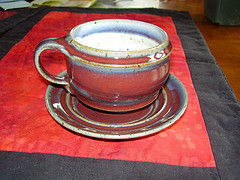
Ceramic teacup by Chris Warren.
Back in the days when Ethan and I studied Isshin-Ryu with Sensei Steve Buschman, we learned the parable of Nan-in and the teacup. (I heard it again at some point during my hashpa'ah training.) Here's how it goes:
A zen student came to the zen master Nan-in seeking wisdom, and they sat down to tea.
Nan-in poured tea into the student's cup. And then kept pouring. And the tea overflowed. Eventually the student could not contain himself, and exclaimed, "Can't you see that the cup is already full?"
"Just so," said the Zen master, "You are already full of opinions and certainties. I can't teach you until you first empty your cup."
In spiritual direction a few days ago, I re-learned that the Baal Shem Tov, the founder of Hasidism, taught that it is necessary to "give over" Torah -- to teach Torah to others -- in order to open oneself up to receive more Torah. When one teaches Torah, that act stimulates the flow of more Torah from on high.
(This is what kabbalah calls itaruta di'l'tata -- Aramaic for "arousal from below." When we give over Torah, when we give over blessings, our action "arouses" the divine will, and God pours more Torah and more blessing into the world.)
In order to receive more Torah, one has to give over the Torah one has already received. In order to receive the wisdom of zen, one must first empty one's teacup: relinquish preconceptions in order to receive that which is new.
They're not quite the same teaching. Nan-in was interested in clearing the mind of preconceived notions and assumptions in order to make space for new learning, new insights, new understandings. The BeShT was interested in the act of teaching, of giving-over Torah to students, as a mystical stimulus which would open the divine spigot and cause more Torah to flow into creation.
But I love the way that, in each of these paradigms, it's important to notice when one's teacup is full, and to share what one has with others, in order to make room for more. If one hoards blessings, then new blessings can't flow. If one maintains a full teacup, then there's nowhere for new tea to go. The only way to receive more is to give what you have.


June 19, 2012
Summer solstice and Rosh Chodesh Tamuz
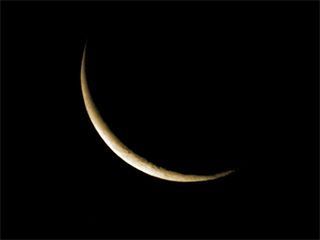 Tonight at sundown we'll enter into the new lunar month of Tamuz. In a day or two, we'll reach the solstice -- in the northern hemisphere where I live, this is the summer solstice, the longest day of the year which is also always the beginning of the days starting to shorten again. The name of this month on the Jewish calendar recalls the Sumerian deity Tamuz, who died at this season and went into the underworld. Like Tamuz, we too will experience a kind of remembered death during the season to come, as we descend into mourning for the temple which has long fallen.
I've spent the past few weeks collecting teachings about the month of Tamuz in Jewish tradition (the Tammuz page at Tel Shemesh is extraordinarily helpful) and about the summer solstice in Jewish tradition (hat tip once again to Rabbi Jill Hammer; also to Rabbi T'mimah Ickovitz for her solstice teachings) and preparing a short ritual for the new moon of Tamuz which is also a ritual of havdalah, separation, between the spring now ending and the summer we're about to begin.
Tonight (many of) the women of my congregation will gather in my backyard for this havdalah new moon ritual and then for some learning about this new moon and about the solstice in Jewish tradition. There are some tough things about Tamuz. In the coming month we'll remember the breaching of the walls of Jerusalem; we'll enter into the Three Weeks, the period called bein ha-meitzarim, "between the narrow straits," during which we prepare ourselves to mourn the fallen temple and the broken world at Tisha b'Av.
And yet this month contains blessings, too. Rosh Chodesh Tamuz is the birthday of the patriarch Joseph. Like the Sumerian god Tamuz, Joseph descended into the earth -- not into the underworld, but into a pit, and then into Egypt. And it was because of that descent that he was able to ascend so high, and to bring his entire people with him. May our descent during this season also be for the sake of ascent!
For those who are interested: here are two pages of collected teachings about Tamuz and the summer solstice, and also a two-page ritual for entering into summer / celebrating havdalah ha-tekufah, a solstice havdalah. (This is what we'll be working with at our Rosh Chodesh group tomorrow night, so if you're part of that group, you might want to skip these downloads in order to encounter the ritual and the teachings fresh. Or, you might want to download them in advance in order to spend more time with them! As you prefer.) I am deeply indebted to Rabbi Jill Hammer, from whom this ritual is adapted. Feel free to use and enjoy. Chodesh tov / a good new month to all.
Download RoshChodeshTamuzRitual [pdf]
June 17, 2012
For our teachers and our students
This past weekend we had two celebrations of bat mitzvah at my small shul: one at Shabbat morning services, and one at a mincha/maariv/havdalah service. At both services, many of those in the kahal were not Jewish and had never been to a synagogue before. It was a long day for me, and a tiring one both physically and spiritually, but it was also a wonderful day.
I love inviting up anyone who has never seen the inside of a Torah scroll, and asking them how this differs from the books they usually read (it's in Hebrew; it's a scroll; it's handwritten; it's on parchment; oh, and by the way, there are no vowels in this text) before the b'nei mitzvah kid reads from the Torah. I love seeing the parents and grandparents of our b'nei mitzvah kids beaming. Most of all, I love seeing our young people shine.
As it happened, this particular weekend I received some very gratifying feedback. People came up to me after services and told me that the service felt welcoming, that they understood what was going on, that they felt included, that they felt at home. It made me really happy. The desire to help people gain access to some of the beauty of Judaism is one of the reasons I became a rabbi.
Maybe the most powerful response came from a relative of one of the b'nei mitzvah, an older woman who lives in Israel. I could see during the service that she was following me into the prayers -- I saw her nodding, smiling, looking surprised. She came up to me afterwards and said: I have never seen anything like this before. The energy, the warmth, the joy, the understanding of what the prayers really mean. This is extraordinary.
I told her that her words meant the world to me, and that I would pass them up the chain to my teachers, because it is thanks to my teachers that I am able to do what I am able to do. I am able to open the doors of Jewish tradition and share its sweetness because of those who trained me.
Thank you to everyone with whom I studied during my years as an ALEPH student. Thank you to the teachers at DLTI; thank you to the ALEPH va'ad; thank you to my mentors, both long-distance and (formerly) local. When I am able to lead services in a way that connects people with Jewish tradition, with Torah, with community, and with God, it is because of you.
There is a prayer traditionally recited after the completion of learning. It's called the kaddish d'rabanan: the "kaddish of the rabbis" or "kaddish of the teachers." In the contemporary vernacular version written by Debbie Friedman (may her memory be a blessing), the prayer says:
For my teachers
and my students
and for the students of my students
I ask for peace and lovingkindness
And let us say, amen.
And for those who study Torah
here and everywhere:
May they be blessed with all they need
and let us say, amen.
May there be peace and lovingkindness
and let us say, amen!
I offer this prayer now, in honor of my teachers, with all the gratitude of my heart.
June 15, 2012
The voices of American Muslim men
 "Those who seek the divine want to make this world a better place, which first requires that we communicate." That's Congressman Keith Ellison in his introduction to All-American: 45 American Men on Being Muslim.
I pre-ordered this book as soon as I heard about it from my friend Ayesha Mattu, co-editor of Love Inshallah: The Secret Love Lives of American Muslim Women. (Which I thought I had reviewed here, but apparently I didn't; shame on me! I was blessed to receive an advance copy before publication, and in response I wrote to the book's editors that "[t]hese essays are meaningful, poignant, and powerful. I'm so grateful for these glimpses into the lives of American Muslim women, all of whom feel to me now like cousins I'm glad to finally know." The book merits a full review; I'll try to write one soon.)
Anyway: having savored that collection of writings by American Muslim women, I wanted to also read a collection of writings by American Muslim men. (I've since learned that there is a collection of essays by American Muslim women which is more directly parallel to this one -- I Speak for Myself: American Women on Being Muslim -- which I suspect I would also enjoy.)
When my copy of the book arrived, I turned immediately to the table of contents, since I knew that at least one of my friends had an essay here: Hussein Rashid of Islamicate, who I first met at the Progressive Faith Blog Con back in 2006. I read his essay first, with great delight. (More about that below.) Then I read the one by Shahed Amanullah of AltMuslim, who I've likewise known for years; he notes that "[i]n the end, all the PR in the world won't convince our fellow Americans of our worth any better than a typical Muslim can do by simply being a friend to their neighbor." Then the one by Svend White of Akram's Razor, about growing up as a white Muslim kid in Boston. The one by Aziz Poonawalla of City of Brass (who writes that "there's more to integration than making Halloween halal.")
And then I started opening the book at random, reading stories which caught my eye. Jason Moy's "Disable Your Cloaking Device," about making wudu (the ablutions required before prayer) as a captain in the Army, deployed in Afghanistan. Shakeer Abdullah's "Memoirs of a Mighty Mite Muslim," in which he explains (humorously but also with obvious truth) the similarities between Islam and football. Tynan Power's "Stepping Across the Gender Divide," which begins with the story of a trans Muslim man going to Friday prayer before having his gender reassignment surgery. Baraka Blue's "Manhood," which explores how interacting with Muslim men around the world empowered him to own his emotions.
This is terrific stuff. Wide-ranging, diverse, heartfelt, often surprising. I would expect nothing less from any collection of essays by any religion's practitioners. But because Islam is so often misunderstood in America -- especially in this post-9/11 era -- this book's variety of voices and experiences becomes all the more valuable to have in print. (If only I thought the people who fear Islam most would pick this volume up!)
Because I've been blessed to know Hussein for years, I paid special attention to his essay. He writes eloquently about growing up "painfully normal" in Queens, New York. His grandmother and his grade school were both located in Forest Hills, Queens, "one of the most diverse Jewish communities at the time." He writes about how he developed racial identity consciousness first, and religious identity consciousness later. (Indeed: as a good second-generation American teenager, he rebelled against his parents, which naturally meant steering away from religiousness. For a while.)
From a Columbia University professor -- a former Jesuit of Syrian descent -- Hussein learned about Islam as an adult, and it spoke to him in new ways. He learned, he says, that he was "part of a larger spectrum of Muslims and their cultures." He writes:
The Jewish community I knew, from the Iranian Jew I bought my comics from, the Syrian Jews who played music in the area shows, the Bukharan Jews who ran the area restaurants, and the Ashkenazi Jew who was my best friend, made more sense to me. They had different religious understandings, food, dress and languages, but they could all respect each other as Jews. That had not been my experience as a Muslim because there was never a place with that many different Muslims in my life. Unexpectedly, through this choice of Islam as a humanities course, I came to understand my place amongst Muslims.
No surprise that that particular paragraph resonates with me, eh? I love the mental image of young Hussein admiring the pluralism of the various strains of Jewish community he had encountered (and I wish every Jewish community could be as welcoming, and as diverse, as the one he describes.)
I asked Hussein how he became involved with the project; he admitted that he doesn't entirely remember! This book was a long time in production, and he's not sure how he first connected with the project. He often uses essays from the first volume in the classes he teaches, and he knew some of the contributors and one of the editors of that first volume, so when this idea was floated he knew he wanted to contribute.
"I wanted to be involved because it's a great idea and I think the series has a lot of potential," he told me. "It was a lot harder than I thought it would be. I'm an academic. I write. A lot. The few hundred words we were given, I thought would be easy." I hear that! And I can imagine some of the ways in which writing this kind of personal essay -- especially feeling freighted, understandably, with the expectation of explaining the American Muslim experience to readers who might be entirely unfamiliar with the subject -- could be difficult in different ways than writing an academic paper or a journal article.
As much as he admires the intent of the series -- showcasing individual Muslim voices, each of which is the voice of a person who speaks for themselves, not for "all Muslims" -- he added that he also feels an obligation to the others to whom he is connected, and the others who don't have this opportunity to speak. "I am part of several larger, interlocking communities, starting with my family," he noted. "I am privileged to be part of this work, and that means I have a responsibility for all those who aren't. And I am trying to speak for those who don't have the ability to speak for themselves, but are still being spoken for."
What, I asked him, are your hopes for the book? In response, he said:
I'd really just like people to pick-up the book, flip to any story (and they all are quite good), and learn something. I think all good books should make you think, and I think there are lots of essays in here that will do that. It's not about the American Muslim experience, it's about the American experience, and we happen to be Muslim. I also love how the anthology opens with disbelief and ends with the complexity of faith. We are not one, and thank God for that.
Of this collection, co-editor Wajahat Ali -- playwright of The Domestic Crusaders -- writes:
The American Muslim men profiled within these pages eradicate antiquated assumptions of what it means to be "Muslim," "American," and even a "man." This may be a book of essays, but it is most simply a gathering of voices who are telling stories. It is fitting that the protagonists of these tales are American Muslim men who finally get the chance to tell their story to us, instead of having their story told to them by others with a political agenda, a well-intentioned yet naïve myopia, or sensationalistic headlines willing to exploit stereotypes for the sake of selling papers or gaining Facebook likes and re-tweets. // In traditional times in Muslim lands, the storyteller was more valuable than the swordsman.
This book is a terrific addition to any bookshelf. I'm so glad to have a copy in my office at the synagogue, available for anyone who wants to read.
With whatever is best
The Holy Ari (Rabbi Isaac Luria) teaches us that our every intention and acton changes the whole world, either driving us away from God or bringing us closer, either healing the world or harming it.
So writes my teacher Rabbi Shaya Isenberg in his essay "Blessings in the Darkness" (in Writings from the Heart of Jewish Renewal, a publication of ALEPH, 2003.) In that essay he introduces something he calls the Chesed (lovingkindness) Meditation. He and his wife Bahira adapted it from Rabbi Jeff Roth, who adapted it in turn from a Buddhist metta meditation. I first experienced this meditation at a Tuesday afternoon mincha service on retreat at Elat Chayyim in 2005.
Reb Shaya writes:
This is how we do it:
Begin with yourself. As you inhale, say internally, "May I be blessed with..." As you exhale, imagine yourself as you finish the blessing, "shalom, peace and wholeness."
Continue that breathing/imagining pattern. "May I be blessed with...simcha, joy. May I be blessed with...r'fuah, healing. May I be blessed with...whatever is best."
Why begin with yourself? It is the airplane principle: before you help someone else with her oxygen mask, put yours on first. If I am under-blessed, how can I bless? So resist the temptation to skip that part. Don't feel it's too egocentric, but rather that we all deserve to be blessed! All of us!
After going through this with oneself, Reb Shaya teaches, one can offer this meditation with someone else in mind. Imagine a loved one, and as you breathe, think to yourself: may this person be blessed with wholeness. May they be blessed with joy. May they be blessed with healing. May they be blessed with whatever is best.
If that's easy -- and it may be -- stretch yourself a little. Imagine being at the grocery store, in traffic, at a gas station, and seeing someone you don't know. Can you find it in yourself to say these same silent blessings for a stranger? (I would add: imagine interacting with someone online: a blogger, a commenter, the people who comment on news articles. Can you offer these blessings for them?)
Reb Shaya doesn't stop there. It's our obligation, he writes, to offer these blessings even for those we actively dislike:
Because someone who feels fully blessed would not do the things they do! We want those who play the role of the enemy for us to be truly happy. Happy people don't intentionally harm and destroy. It's critical that when I'm blessing someone difficult, I am not hating them. When we bless we channel the holy energy of blessing through us. In the very act of blessing another, especially one whom we feel the least like blessing, the intensity of blessing required to overcome our own inner resistance spills over into the world.
Maybe my favorite part of this practice is the final line: "...with whatever is best." I may not know what's best for me. I may not know what's best for you, or for the stranger in the check-out line at the grocery store, or for the person I can't help finding challenging. When I offer this blessing, it's an opportunity for me to relax gratefully into the humility of not needing to know what's best. I'm not in charge. At best, I can try to make myself a conduit for blessing, but the nature of the blessing -- that's not up to me.
We offered this blessing this morning toward the end of our Friday morning meditation minyan. I hadn't looked at this essay in a while, so I didn't remember that one of the lines is a blessing for healing; now I'm not sure what I offered this morning, though I think it was the quartet of peace, joy, wholeness, and whatever is best. (Same general principle, anyway.) It was a really sweet practice, and when it was over, after the closing niggun and the closing meditation bell, we sat in the sanctuary and beamed at each other. What a lovely way to begin the ending of my week.
June 14, 2012
Review of two books by Reb Zalman
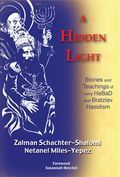

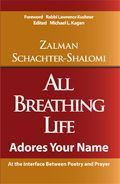
If you read the Forward, you may already have seen this; but I wanted to share it here just in case! I recently had the lovely experience of getting to review two books by my teacher Reb Zalman (Rabbi Zalman Schachter-Shalomi) for the Forward, and that review is now published. One book is A Hidden Light, a compendium of tales and teachings about the early Hasidim; the other is All Breathing Life, a collection of prayerful poems.
Here's a taste of the review -- first, of A Hidden Light:
A tremendous amount of knowledge is distilled into these pages. The sheer number of names, rebbes, dynasties and towns may overwhelm readers. To Schachter-Shalomi, each of these is an intimate friend.
The authors interweave the life stories of Nachman of Bratzlav and of Schneur Zalman of Liadi, founders, respectively, of Bratzlav Hasidism and of HaBaD (also known as Chabad; in the HaBaD spelling, the capitalized letters represent a Hebrew acronym for three different aspects of God), with their parables and teachings. In one anecdote, Zalman tells his son that as a young man, he had the choice of studying with the Vilna Gaon or with the Maggid of Mezritch: “In Vilna, they teach you how to study, and in Mezritch, they teach you how to pray.” Of course, the binarism is overstated, but Zalman’s choice — and Schachter-Shalomi’s — is clear.
And here's a taste of the second part of the review, about All Breathing Life:
At the core of Shachter-Shalomi’s teaching is the attempt to open up the possibility to feel really connected with both God and community through these Hasidic prayers and teachings, despite all the ways in which neither I nor many of its intended readers fits the classical Hasidic mold.Post-it notes proliferate on my copy of “All Breathing Life,” showing which poems I most often use in my own prayer life: “Ana B’Khoach,” “Nishmat Kol Chai,” “We Are as Clay,” Psalm 27. (Many of these are also available as audio recordings on the publisher’s website.) I share these with my congregation and with my blog readership. Sometimes I pray them by myself...
You can read my review of both books here: Hasidic Tales and Prayer-Poems. Thanks, Forward!
June 12, 2012
The moment, here and gone
 The crib. June 2012.
I can't count how many times this happened when Drew was an infant. Someone would see me holding him, their face would go soft with nostalgia, and they would say something like, "oh, these days are so precious, and they're over so fast. Treasure every moment." And I would find some way to politely laugh or deflect, thinking: you must not remember these days at all. Because if you did, you would not be reminiscing about them in such bucolic tones.
We didn't have the easiest time of infancy. Drew had colic; I suffered postpartum depression. In hindsight, it's no wonder I had a snarky internal response to the "treasure each moment!" refrain. Yes, babyhood is over quickly in the grand scheme of a kid's lifetime -- but when one is experiencing depression, sleep deprivation, an infant whose cries are difficult to soothe, and time appearing to pass at the speed of cold molasses, it doesn't seem as though it's ever going to be over at all.
On the whole, infancy is a time I don't mind having behind us. Having a toddler -- really, these days, a kid; a growing boy -- is far more fun. So I've been surprised to discover that, as we've begun preparing to transition Drew into a crib, I've had some pangs of nostalgia. Remembering rocking in the silent bedroom, quite pregnant, wondering what it would be like when we had an actual baby to put in that crib. Remembering that first winter, when Drew was a wee comma punctuating the crib mattress's great expanse.
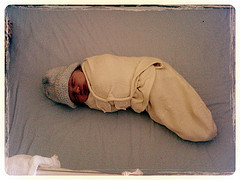 Drew in his crib. December 2009.
My memories move in and out of measurable time. Hour after hour I glided with Drew in the rocker in the grey almost-dark of the nursery, my hand stroking his head, and then when he was asleep set him gingerly back in the crib and tiptoed away. I remember the nursing snack plates Ethan would make for me every night, so that when I nursed and nursed and nursed I would have something tasty to consume to keep my own blood sugar up. I remember nursing, and cuddling, for endless hours. The orbit of rocker to couch to crib, rocker to couch to crib.
There are shadow versions of these memories, too. I remember the baby monitor waking me again and again, the exhausted shuffle down the stairs to his room, the nursing and rocking, the tentative attempts to place him back in his crib so I could get one more precious hour of sleep. I remember being so exhausted one morning that I placed him in his vibrating bouncy seat and lay down beside him just for a second. Ethan found me some time later, fast asleep on the nursery floor. I remember that when people made wistful noises about the joys of infancy, often I wanted to scream.
Now that the big-boy bed sits in boxes in our entry foyer waiting to be assembled, I'm discovering that I wasn't exactly correct when I swore I would never miss those early days. There are things I miss, though most of them are hard to verbalize -- like his peachfuzzed baby head with its scent of milk. When Drew needs comfort now, it's a bit of a struggle to fold his long-limbed body into mine, his head onto my shoulder. When I put him to bed now, hefting him up into my arms and over the bar into the crib, I know our days of this particular bedtime routine are numbered. There's a poignancy in that.
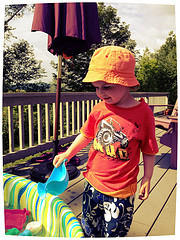
Tall, grown-up boy. June 2012.
It's possible, it turns out, to feel nostalgia for something that wasn't comfortable while it was happening. In retrospect, those first months of infancy feel to me like an extension of childbirth: exhausting, hard, seemingly infinite (and sometimes seemingly unbearable) -- but once over, worth every instant. More than worth it, to be blessed with Drew.
I went into parenthood with the aspiration of finding the blessing in all things. I know I have often failed to live up to that imagined grace. But sometimes knowing that a change is coming enables one to wake up to the sweetness of what is about to pass. I suspect I am reconnecting with the love and the yearning that the crib represents because I know it's about to be gone.
No one can treasure everything. Maybe all we can really do is try to notice a few instants in every day, each one a single still in an unfolding slideshow. Click: tiny Drew in my arms, swaddled tight. Click: Drew lies at the foot of the crib, playing a kick-piano with his feet. Click: Drew sleeps peacefully in the crib, limbs akimbo. A moment is here and then gone, tucked into memory like a flower petal into a book.
But each one offers an opportunity for waking. Kairos time rather than chronos time, as Glennon Melton put it. Or, using the language of my own tradition, mochin d'gadlut -- spacious mind, expanded consciousness -- rather than mochin d'katnut, small mind. I can aim to wake up and treasure this moment. One expanded moment, containing everything. And then it is gone.
Weekend in the Toddler House
Today you oscillated between Pocoyo
and Kai Lan, roared like a dinosaur,
insisted I swing alongside
when I looked away for an instant
you tried to shuck your shorts
to play in the sprinklers
we whirled between blocks and trains
deck, kiddie pool, swingset, ball
a book and a cuddle, then off again --
and finally this gloaming, citronella
burning brighter as the veery thrush calls,
as evening's curtain cloaks the hills
I bless the fruit of the juniper bush
as the white noise machine ferries you
to the far shore of your own sea.
It's been a few weeks since I last posted a toddler house poem. Here's the latest installment in the series. This is probably the fourth or fifth draft; it's undergone a fair number of changes, and I'm still not sure that this is its final form, but I think it's decent enough to share.
I'm finding it an interesting poetic challenge, trying to capture the constant motion of an active toddler -- maybe especially because the times when I sit down to write are the times when Drew is asleep or at daycare, when his energy and movement are elsewhere.
All thoughts / feedback welcome, as always.
June 9, 2012
G. Willow Wilson's "Alif the Unseen"
 I still remember how I felt when I first read Neal Stephenson's Snow Crash in college. Its blending of internet imagination and ancient Sumer, the power of text and the power of code, felt as though it had been written just for me. I felt the same way reading G. Willow Wilson's Alif the Unseen.
I've written here about Wilson's work before -- her graphic novel Cairo; her beautiful memoir of choosing Islam and living in Egypt, The Butterfly Mosque -- and given how much I enjoyed both of those, I knew I was going to like this one. But I didn't know how much. (A lot.)
Alif the Unseen interweaves a story about jinn, and about the power of stories, into a story about a young man who's chosen the nom-de-internet Alif, the first letter of the Arabic alphabet. Alif is a "grey hat" hacker who offers his services to those whose online speech is otherwise in danger, whether they be Islamists, dissidents, or pornographers.
I don't want to spoil the book for you -- its twists and turns are so delicious! -- but Alif's programming choices get him into trouble with the dangerous government figure known colloquially as the Hand of God. He and a childhood friend wind up on the run. And his world turns out to be much bigger than he, and likely also the reader, imagined.
As I read, I kept marveling at places of intersection between Willow's religious tradition and mine; the notion that angels are like computers, e.g., devoid of free will. Or the sense that the holy language in which scripture was revealed has its own kind of power, and that the words of holy text are uniquely rich because they contain endless unfolding meaning.
Of course, I'm a religion geek and a rabbi with a longstanding interest in the places where Islam and Judaism mesh; it stands to reason that I would dig that stuff. But I'm also a longtime lover of comics, a SF geek (there's a moment in the book where a jinn archly references the original Star Wars movie, which made me literally laugh aloud), and a denizen of a handful of different online worlds -- and this book works equally well for me on those levels, too.
Alif the Unseen is a gorgeous expression of the post-Arab-Spring world -- which is prescient, since (here's a quote from a post at Wilson's blog:)
The titular character is a hacktivist in an unnamed emirate who battles shadowy, oppressive state security forces using methods both digital and arcane. (There are jinn involved, and ancient texts that are supposed to be hoaxes but aren’t. And at least one car chase.) While I was writing, even I thought I was maybe overdoing it just a little, and assigning too much importance to hackers and internet junkies in the Middle East. But I was fresh off a visit to Cairo, where a group of guys I’d met through Twitter organized a signing for me at a bookstore that was packed to the gills. We talked about comics and politics and the media, and I walked away with my heart pounding, thinking “this is really going to work.” I wasn’t even sure what “this” was.
Five months later, those same kids were overthrowing the government. I finished Alif the Unseen just as Mubarak left office, Tunisia was under new management, and uprisings had begun in Libya and Syria, in what would come to be called the Arab Spring.
Anyway. If anything I've said here appeals to you, you will almost certainly dig this book, as I did. Get a copy, read it, and then feel free to come back here and tell me what you think! I had a blast reading it, and I can't wait to foist it on several friends, Ethan first among them. (Given that he just gave a talk entitled Cute cats and the Arab Spring, I think I can safely say that he's going to enjoy this.)
Still need more convincing? The first chapter of the book is available online: Excerpt, Alif the Unseen. Enjoy!
June 7, 2012
The new Koren Talmud Bavli
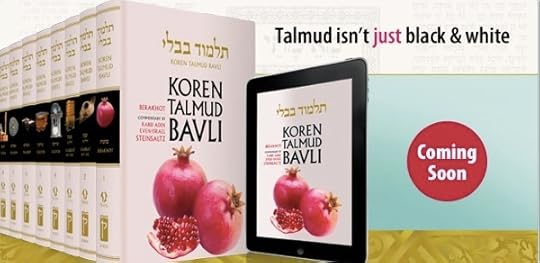
I just got my copy of the first volume of the new Koren Talmud, Volume א: Berakhot. One of my bat mitzvah students was in my office this afternoon and caught sight of it on my desk. "What is that?" she asked, so I opened it up -- first from the right-hand side, to show her a page of Talmud, which she had never seen. (I think she was mostly impressed by the columns of non-English characters.) And then I flipped it open from the other end, to show her what it looks like in English. "Wow," she said. "It has pictures!"
Indeed it does. Here's how the publishers describe it:
The Koren Talmud Bavli is a groundbreaking edition of the Talmud that fuses the innovative design of Koren Publishers Jerusalem with the incomparable scholarship of Rabbi Adin Steinsaltz. The Koren Talmud Bavli – Standard Edition is a full-size, full-color edition that presents an enhanced Vilna page, a side-by-side English translation, photographs and illustrations, a brilliant commentary, and a multitude of learning aids to help the beginning and advanced student alike actively participate in the dynamic process of Talmud study.
(The new Koren Talmud is available for $50 a volume -- a reasonable price, though of course at 41 volumes, it'll add up -- but this first volume is currently selling on Amazon for half that.)
It's a beautiful edition. If you open it from the right (like a Hebrew book), you get tractate Brakhot ("Blessings") in the original: mishna and gemara, marginal commentaries, all arranged in the classical Vilna format, with Koren's typical eye to readability. If you open it from the left (like an English book), after a few introductions, you get mishna and gemara in Aramaic neatly lined-up alongside English translation, and in the margins there are contemporary commentaries explaining, for instance, what the text means when it uses the word תרומה (terumah, an offering made for the consumption of the priests), or the implications of language about time, or bios of the various rabbinic personalities who appear in the text.
The commentary on the English side of the book bears a bit of explanation. Rabbi Adin Even-Israel Steinsaltz spent a lifetime translating the Talmud into modern Hebrew; for those who can read and understand Hebrew, his translation is the gold standard. The English material in this new Koren Talmud is an English rendering of Rabbi Steinsaltz's Hebrew. (Still with me?)
And while the pages are primarily taken up with text (as is only appropriate!), there are also illustrations which illuminate aspects of what the text is talking about. A depiction of the knot on the tefillin shel rosh when the text alludes to God's own tefillin; a full-color illustration of the coiled-clay-snake stove known as the oven of Akhnai (which plays quite a central role in a fabulous, and rightfully famous, set of Talmudic stories); a diagram of early synagogue layout alongside a passage about entering two doors in order to pray.
Koren Talmud Bavli Sneak Peek #2. If you can't see the embed, you can go directly to it at YouTube.
Will this edition entice those who are maybe otherwise a bit intimidated by Talmud to give it a try? I can only hope. Of course, it's not the first bilingual edition; but this one is made with Koren's characteristic attention to beauty and to detail. In places where the text offers us poetry (prayers, quotations from psalms, etc), the English-language text is laid-out like English-language poetry, a visual cue which tells the reader something meaningful about the text at hand. This is one of the reasons why my pocket Koren siddur is my standard daily siddur -- as a poet, I can't help loving a siddur (and by extension a publishing house) which makes poetry look like poetry! -- and I love that they've done that here, too.
My real question now is: do I invest in the whole set of beautiful hardbound editions, or via the forthcoming iPad app? The bibliophile in me wants the tangible books (and I love the translucent paper book jacket with the pomegranate on the cover); the part of me that loves shiny new technology (and portability!) wants the multimedia capabilities and searchability of the iPad version. (Please don't tell me to buy both, unless you feel like giving me the $2000 a full set will cost.) Nu: it's a good problem to have.
Kol hakavod (all the honor) to the folks at Koren for putting together this truly beautiful, truly readable, truly usable bilingual Talmud. I can't wait to spend a lifetime diving in.
For another perspective (and many terrific photographs), try Andrew Greene's post Review: The Koren/Steinsaltz English Talmud Bavli.
Rachel Barenblat's Blog
- Rachel Barenblat's profile
- 6 followers

