Chris Penhall's Blog, page 13
September 1, 2017
TAMAMBO – ALL THE WORLDS A STAGE
It only takes one visit to a salsa club, and if you get it, you really get it, then in only one heartbeat, it’ll get you right down into the heart of you. And the mystery of it is, it doesn’t matter where you’re from or who you are or what you do, this Latin sensibility is in you somewhere, some whisper of a memory, a dormant gene, a long forgotten shared past. And that’s it. You enter a great big melting pot – the kind of world you wish the real world was. If only.
And for Tamambo, Iraqi of origin, Liberian of birth, Dutch of nationality, and Spanish for part of his upbringing, it was partly this longing for something he took for granted in his childhood that drew him in to salsa.
“I grew up in the Canary Islands,” he explained, when I caught up with him at SOS in London recently, “and after fourteen years of living in Spain, when I left there was a great emptiness in me. Although, when I was there, I hated Latin music! I realsised I missed Latin culture, and when I first touched salsa, I realised I had found that missing connection, and dived into it.”
“I love salsa,” he continued,” because I not only understand what I’m dancing to, but I can also either feel or relate to the music.”
Tammam moved from salsa hobby to salsa job because, as he said, “I realised that dancing made me happy and I found it fulfilling as a hobby. I worked as a sales and marketing director for a graphic design business and I saw an opportunity to switch industry, but not career. So, I went into organising events in Holland”
The move to the UK came when he met Irene Miguel through Leon Rose, and they decided to compete in the Corona European Salsa Competition. They won. He then met Sarah, who became part of Tamambo and Salsara, they became a couple, and so in the UK he stayed.
He’s been teaching, performing, coaching and choreographing ever since. And he loves them all.
He said, “I love teaching because it was a hard road for me – I struggled to find people to explain things to me the way I needed them explaining. Not everyone learns in the same manner, so I ensure I explain it in different ways to enable everyone to understand.
“And my new-found passion,” he continued, “ is in coaching new talent. I do it at the moment in Slovenia, Croatia, Poland, Germany and the UK. I find it very fulfilling – every time I see them on stage it gives me a sense of pride that I have contributed in some form to their success and made them better.”
But above all he “loves performing more than anything else in the world.” And in performing solo to Sofrito, by the Fania All Stars, he’ changed the emphasis of what he does, albeit temporarily.
“When dancing to Sofrito,” he explained, “I disappear and dance like there’s no-one watching. In every other performance, the purpose has been solely to entertain, but this is different. This was more meant to contain a message and in the process of appreciating it I hope people will be entertained as well.”
The dance is about many things, including Tammam’s experience of being an Arab in Europe. At the time he choreographed it, in 2005 his mother was still in Baghdad “The music,” he said made me think about my life and how it fitted in the current world we live in. My mother was living in Baghdad back then with multitude of attacks taking place in the area she lived in.”
The “Sofrito” experience, however, was a one-off, and he’s back to partner dancing, although, says Tammam, “never say never…”
But living as an Arab in Europe and having access to people of all cultures has given him, he believes, a unique opportunity to break down barriers..
“As an Arab in Europe things have become really hard nowadays, since any Arab is branded as a potential terrorist. However, I have always had the belief that if one person got to know me really well, I would have convinced five of their friends that we are not all the way we are portrayed in the world. I have managed to stand in front of audiences around the world as they watch me perform and teach and show them who I truly am, hoping that one day they will all become my friends.”
“If dancing brings people together, let us teach the whole world to dance.”
The post TAMAMBO – ALL THE WORLDS A STAGE appeared first on Chris Penhall.


TONY LARA – ON THE RIGHT (BACHATA) TRACK
When he was a child Tony Lara had the firm belief that he could be a professional dancer, and as he says, “Sometimes belief is everything.”
Belief may be everything, but sometimes life blows you off course a bit. Well, we all know that, we’ve all experienced that, but its allowing the breeze to guide you back in to your dreams that’s the secret.
And yes, Tony Lara did veer off a bit, but then again he did veer back again, and along with Daniella is touring the world spreading the Bachata word and raising money for a good cause in the process.
“Flamenco is in the family,” explained Tony when I caught up with him at the Mambo City Five Star Congress. “My mother was a flamenco dancer, and when we were kids our parents made us dance in front of other people, so I was always up dancing.
“From an early age I wanted to be professional dancer,” he continued, “In fact, I wanted to be one of the Benny Hill dancers. I just thought it would be great to be a professional dancer.”
But, as in all good stories, boy has dream, boy loses dream, boy finds dream again.
Said Tony, “When I left school I lost the path to professional dancing. But I did go out for a while with a girl who wanted to do ballroom dancing. Somehow we ended up doing salsa instead.
“I learned at Vila Stefanos and was more or less hooked first time. But I did it for fun; I didn’t look at it as a job.”
But fate took a hand and Tony lost his proper job when the company changed hands.
“I was a regular DJ at Havana in St Albans”, he continued, “and they needed a teacher on Tuesdays. I decided to give it a go…..then I opened another class in Ealing,” and the rest, as they say, is history.
“I moved to Italy with Daniella five years ago and opened up a professional dance school in Bari where we teach different dance disciplines.”
As he says, “the opportunity was there, so we took it.”
And the Bachata? What about the Bachata – his signature dance.
He explained, “It’s a popular dance in Italy and Paul Young wanted to introduce other disciplines to the UK Congress; so we decided to teach it and it took off from there. The work started to come in, then kept coming in, and now we’re teaching Bachata internationally.”
But there is another element to Tony dancing Bachata. When I‘d seen him earlier in the day he had a beard, when I interviewed him, he had not. In the interim he had been held hostage on stage whilst money was collected to make him have it shaved off. He did it to raise a substantial sum for the children of the Dominican Republic – a regular collection at events he an Daniella appear at.
Why this cause in particular?
“Bachata is fulfilling some of my dreams,” he explained, “and helping me travel, meet people and be in the public eye. The dance originates from the Dominican Republic and we wanted to do something for the children; so we started to do collections. We wanted to make a difference.”
And advice to salseros?
“Get out there, learn as much as possible, enjoy it as much as possible, and that’s what its all about.”
And don’t forget to put some coins in that collection tin.
Copyright Chris Penhall 2007
Article originally appeared on Salsa-UK website
The post TONY LARA – ON THE RIGHT (BACHATA) TRACK appeared first on Chris Penhall.
March 3, 2014
Keeping the Wheels Spinning – March 2014
With International Women’s Day taking place on March 8, Chris Penhall tells the story of two inspirational Essex women who have, in varying ways, made a difference to cancer sufferers.
March 8 is International Women’s Day, and events will be held all over the world celebrating the achievements of women past, present and future. Over the years, the county of Essex has been well blessed with inspirational women. One such example is Helen Rollason, the BBC sports and news presenter who helped set up the Helen Rollason Cancer Charity before her death in 1999. Her legacy lives on in the work the organisation bearing her name continues to do today, helping to improve the day to day lives of people living with cancer.
2014 marks The Helen Rollason Cancer Charity’s 15th birthday, and to celebrate the charity has launched Ride for Helen, its first annual bike ride which takes place on Sunday May 11. The choice of routes are 15, 30 and 60 miles long, each starting and finishing in Hatfield Peverel, and the funds raised will help the cancer charity to continue the vital support it gives to individuals with the disease, their families and their carers.
Essex paralympian, broadcaster and motivational speaker, Danny Crates, will be among those cycling the 60-mile route. Danny explains: “Taking part in the Ride for Helen bike ride is not only a great way to spend the day riding around the beautiful Essex countryside, but you will also be raising money for a charity that really does have a positive impact on the lives of people living with and fighting cancer. All this in a very special year for the charity. So sign up and let’s get active and raise some money to carry on Helen’s great work.”
Someone who has received invaluable help from the charity and can attest to its success is Nikki Brewer from Chelmsford. Nikki, who has three young daughters, found a lump under her arm in September 2011 and within two weeks of first visiting her doctor was told it was breast cancer. She was 28 years old at the time.
Nikki says, “My first thought was that I was going to die and leave the girls. I didn’t think it was real; I used to live in this bubble where I thought that people who had cancer were all older than me.”
Nikki had chemotherapy from October to February and throughout this time would visit Rochelle House in Springfield, one of the charity’s Cancer Support Centres, which offers counselling and treatments such as reflexology, aromatherapy and massage.
“You are very panicky when you are in that situation,” Nikki continues. “It helped having something for myself and made me relaxed. Rochelle House felt like a second home. My dad always came with a book and the staff used to look after him, too.”
The fact that Nikki had someone to speak to who was not a member of her family or a friend was also invaluable in allowing her to open up about her fears and feelings.
“My counsellor was absolutely amazing,” adds Nikki. “We did sit there some weeks and I wouldn’t need to say a lot. It’s easier when you are going through this to speak to someone you don’t know. She was away from the situation. I didn’t want to upset my partner, Ben so I’d unburden myself to her.”
The charity made such a positive difference to Nikki’s life that she organised a charity fun day in Galleywood to raise funds to help ensure others could enjoy the support she did.
“The Helen Rollason Cancer Charity helped me to stay positive. You meet such amazing people and they are so upbeat and help you so much that you want them to be able to help other people.”
Nikki sees Ride for Helen as a great opportunity to get involved in raising money for the charity that has had such a strong impact on her life.
“They are so amazing and they need all the support they can to continue to do the good they do,” says Nikki. “If you can help by taking part or sponsoring someone, you will be making a huge difference to someone like me and my family affected by cancer.”
FIND OUT MORE
If you would like more information on The Helen Rollason Cancer Charity or details on how to take part in the Ride for Helen event, visit www.helenrollason.org.uk
From Essex Life Magazine March 2014
The post Keeping the Wheels Spinning – March 2014 appeared first on Chris Penhall.
April 22, 2013
The Humans Being Project – 2013
Click to view original article
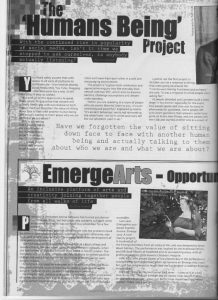
With the continued rise in popularity of social media, isn’t it time we stopped to ask ourselves, is anybody actually listening?
You could safely assume that with access to all sorts of platforms to communicate – from mobile phones, social media sites, You Tube, blogging – that everyone has a way to tell their story if they so wished.
But with all of this opportunity to speak, there comes no guarantee that anyone will actually listen, and with our reliance on technology, have we forgotten the value of sitting down face to face with another human being and actually talking to them about who we are and what we are about?
This is something that Lynette Curtis, the co-ordinator of the Humans Being project, is recreating. This community story telling project encourages people to get together and listen and learn from each other in a safe and encouraging environment.
The project is a “grass roots celebration and appreciative enquiry into the everyday business of common life”, which aims to dissolve barriers, challenge assumptions and deepen understanding.
“When you are speaking in a room of people who are purely there to listen to you, it’s overwhelming and powerful,” explained Lynette. “It’s ancient behaviour: we’re not reinventing the wheel here – we sit in circles and story tell like our ancestors used to do.”
Lynette ran the first project in October 2011 as a response to things that were going on around her.
“Friends were feeling frustrated and unheard,” she said. “It was a response to what people were asking for.”
18 people attended and Lynette built a little stage in her kitchen especially for the event. Five people spoke and time was factored in afterwards for questions. Some people left with more questions than answers, some have gone on to try new things, and one person left their job and started another one as a result of participating in Humans Being.
The idea is to listen to people properly and have the opportunity to learn from those you may not encounter otherwise and actually find out about them and what’s going on inside, rather than making assumptions about what they are like based on what they do for a living and how they look.
“It’s really a dialogue project,” said Lynette. “It’s about valuing people’s space and it’s a two-way process – the listening is as important s the speaking.
“Unless you belong to a club or therapy group, where do people go to get that unconditional attention?”
Artist Aoife, who attended the first meeting said of the experience, “I learnt a lot and sorted out some thoughts in my head. So worthwhile, simple, real and easy.”
And photographer, Tim Vogt, said, “No mush, no lip-service, no mystic visions – just a real window with a different view of the world in front of me.”
Published in Level 4 Magazine – Issue 13 – April-June 2013
The post The Humans Being Project – 2013 appeared first on Chris Penhall.
September 28, 2012
Julian Woollatt – Nov 2012
Click to view original article
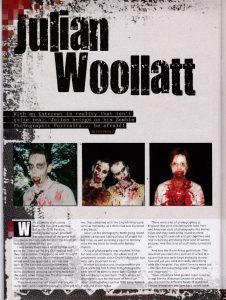
With an interest in reality that isn’t quite real, Julian brings us his Zombie Photographic Portraits…be afraid!
With a Zombie Walk along Southend Pier and a Zombie Ball at the Cliffs Pavilion, photographer Julian Woollatt was way ahead of the game with his Zombie Portraits exhbibition at the Pouch of Douglas in Westcliff last year.
“I was aware there was a lot of Zombie stuff going on. I went to the Big Chill festival and they had a zombie thing going on and I thought I’d do that,” explained Southend-based Julian, whose work has appeared in publications such as The Face and Guardian Weekend. This interest in reality that isn’t quite real goes back to his childhood growing up in Weymouth in the 1960’s when things like The Prisoner and The Avengers were on TV.
“They were externalised places that are not really real…and it was that unreality that got to me. That, combined with the English fairground carnival mentality, so I think that was ingrained in my blood.”
Julian cut his photography teeth going round holiday camps and taking photos of people for key rings, as well as taking a squirrel monkey onto the sea front for shots with holiday makers.
“A lot of photography was involved in that, but also a lot of theatre, the whole kind of amusement arcade kitsch English thing that was very, very important to us.”
A move to London and involvement in the Punk scene led him further into photography, after which he went to West Surrey College of Art and Design in Farnham. That is where he developed a love for the work of American street photographers such as Fritz Lang, Robert Frank and Diane Arbus.
“There were a lot of photographers in England that were emulating this New York and American style of photography like Homer Sykes and they were going round to these bizarre English carnivals and get togethers and Morris dancing doing these kind of surreal pictures. And that kind of stuff really turned me on.
“And also the Diane Arbus portraiture. This idea that you could do a portrait of a face in a square that was quite large and quite in your face and yet you were still really identifying with the character. You didn’t have to move out – the face did everything, and I thought that was important.”
These influences have guided Julian towards things like his Historians project in which he documented the different facets of Historical battle re-encators and goes back to this other world – “It doesn’t really live then, it doesn’t really live now.”
Looking at Julian’s website, you can see this fascination for the theatriccal and other-worldliness in the portraits he’s done, including a selection from the Portchester Hall Drag Ball to the Lewis Bonfire Carnival.
The Zombie Portraits extend these ideas further, and that surreality of The Prisoner and the kitsch of the fairground carnival world that touched Julian in his childhood combined with the anything-goes dark theatricality of punk, all meld together to portray a fascinating “alternative world” that people are compelled to make for themselves.
To see Zombies and Julian’s other work, visit https://www.facebook.com/JulianWoollattPhotography
Published in Level 4 Magazine – Nov 2012
The post Julian Woollatt – Nov 2012 appeared first on Chris Penhall.
January 27, 2012
Pocket History: William Penn
Essex and Pensylvania do not at first glance have many similarities, but they do have an important connection – William Penn.
The Quaker founder of the American state attended Chigwell school in 1685 when his father served in the navy.
His interest in the New World began when, as a lawyer, he enthusiastically encouraged other Quakers to emigrate, and even toured Holland and Germany persuading more to tdo the same. In 1677 he wrote The New Jersey Concessions and Agreements Charter which had an important effect on the formulation of the American Constitution.
His personal involvement came through his family. Charles II owed his father money, and paid off the debt by granting Penn the lands behind the Delaware River; the payment to the king was two beaver skins per year.
Upon arrival in his new province in 1682, naming Pensylvania after his father, he wrote his first frame of Government. It set out his ideals, which anticipated the Declaration of Independence….”men being born with a title to perfect freedom and uncontrolled enjoyment of all the rights and priveleges of the law of nature.”
Also in 1682, he and his fellow Quakers negotiated a famous treaty with the Indians – one of peace and friendship – unheard of in the New World.
He died in England and is buried in Berkshire, a long way from the country whose ideals he helped to formulate. But the American Constitution is a lasting monumement to his beliefs, as is the city he named after the Greek word for brotherly love – Philadelphia.
Featured in Go! Essex Chronicle
The post Pocket History: William Penn appeared first on Chris Penhall.
August 31, 2011
Embracing the Olympic Spirit: The Everyman Olympian – August 2011
When Leigh on Sea’s Boris Wozstock decided to get fit, it started a chain of events that has seen him embark on a unique Olympic Challenge
With the London 2012 Olympics only 12 months away, interest in the games is beginning to hit fever pitch. But there is one Essex man who deserves a medal before the first event even starts.
Boris Wozstock, 34, from Leigh on Sea has been dubbed The Everyman Olympian. Like many of us, Boris observes the athletes preparing for the Olympic games with awe and admiration, tempered with the knowledge that competing in the Olympics could never become a reality for him. But Boris was so determined to become a part of the Olympic experience that he took up a unique challenge that wasn’t limited by talent and could be achieved with sufficient drive, ambition and imagination.
Unique challenge
Boris has set himself the target of participating in every single one of the Olympic 2012 sports before the opening ceremony in London next July.
It all began as a simple effort to lose weight and get fit. “I was in a hotel room in Dublin,” explains Boris. “I was hung-over and the cheap polyester sheets had made me hot and sweaty. I looked in the bathroom mirror and was not best pleased with what I saw. I decided to sort myself out.
“I decided to start to exercise, but I’m often away and can’t do things consistently, so it’s difficult to be structured and disciplined. I decided changing sports would be perfect, so the idea started to compete in 12 sports in 12 months. Then I would get fit and lose weight off the back of it.”
However, somewhere around the weightlifting challenge, with offers of help coming in and Boris’s achievements building up their own momentum, 12 sports became 26, which translated into 38 different events. This means that he has to complete two sports every month to meet the deadline, making managing time as much of a challenge as completing the sports themselves.
But Boris has already come a long way from the reflection he saw in that bathroom mirror in Dublin.
“I am already so much fitter now than I ever was,” says Boris. “Before I would go to sleep or watch television instead of training. Now I roll out of bed and wake up as I run.”
As Boris tackles events he would never even have considered trying a few months ago, doubts inevitably creep in.
“I do have a bit of doubt and trepidation with a few. I’ve never really done anything combat wise, so when judo was coming up, that was really on my mind. I have the diving to do,” he continues,” and people are saying you must be so fearful of the fall. The fall takes care of itself – the water’s going to be there anyway. It’s only really technique I’ve got to worry about, so when you break it down it becomes manageable.”
Help is at hand
Sports completed so far include rowing, badminton, running, weightlifting, cycling, tennis, canoeing, judo and swimming. To help him on his way he has had help and encouragement not only from friends, but also Olympic athletes. Training him for the shooting events is the captain of the Welsh national team and Boris has also had a lot of help via email from Canvey Island decathlete Dean Macey, who won a gold medal at the 2006 Commonwealth Games and was fourth in the Beijing Olympics. Support has also come from 400metre medal winner Iwan Thomas and Derek Redmond and former javelin world record holter, Steve Backley.
Looking ahead, Boris is searching for help with his other events, particularly someone to help him with dressage.
“Learning to ride a horse is not going to be done in a month. Then I’ve got to jump with it and dance with it! Some events bring other challenges. Running around in Lycra for gymnastics for example. I’m going to look like Peter Kay or something.”
Much more to do
Then there are the team events, for which he needs coaching and competitors, such as hockey, basketball, volleyball and handball.
The whole experience, still with some months to go, has already changed his perceptions and opinions of sport.
“I would love to go to the Olympics,” explains Boris, “but I no longer have favourite events. There are events I now see differently, like shooting, for example. I wouldn’t have given it a second glance in the past, but now I know people who do it I’m really interested. I look at sports people differently now. From when they wake up, everything is programmed and focused on their sport and their dedication is amazing. They can’t just pull the curtains closed on Sunday mornings and stay in bed.”
And from waking up one morning a little worse for wear in Dublin and embarking on an unexpectedly life-changing challenge, Essex’s Everyman Olympian has embraced that Olympic spirit himself. Because he no longer can or wants to pull the curtains closed on a Sunday morning either. There is too much training and too many sport to conquer.
Follow Boris on Twitter: @EveryOlympian
From Essex Life Magazine August 2011 edition (words only)
The post Embracing the Olympic Spirit: The Everyman Olympian – August 2011 appeared first on Chris Penhall.