
Dimitra Fimi's Blog, page 5
November 30, 2017
Tolkien Sessions at IMC Leeds, July 2018
I am very pleased to announce that all six sessions on J.R.R. Tolkien I proposed for the International Medieval Congress at Leeds 2018 have been accepted! This will be the fourth consecutive year of papers on J.R.R. Tolkien at IMC Leeds, after a successful series of sessions in 2015, 2016 and 2017. Leeds is, of course, a Tolkien-related location, and it is very fitting that his work will be once again explored in this prestigious conference. Many thanks to Professor Thomas Honegger for his help with the IMC 2018 organizing. I am looking forward to a series of brilliant sessions and papers from well-established Tolkien scholars, alongside new voices and perspectives!
Here are the sessions titles, abstracts, papers, speakers and times:
Session 127
Title: Memory in Tolkien’s Medievalism, I
Session Time: Mon. 02 July – 11.15-12.45
Sponsor: Cardiff Metropolitan University
Organiser: Dimitra Fimi, Department of Humanities, Cardiff Metropolitan University
Moderator/Chair: Brad Eden, Christopher Center for Library & Information Resources, Valparaiso University, Indiana
Memory, Lore, Knowledge in Tolkien’s Legendarium
Thomas Honegger, Institut für Anglistik, Friedrich-Schiller-Universität Jena
World-Building and Memory in The Name-List to the ‘Fall of Gondolin’
Andrew Higgins, Independent Scholar, Brighton
The Smith, the Weaver and the Librarian: Sub-Creating Memory in Tolkien’s work
Gaëlle Abaléa, Centre d’Etudes Médiévales Anglaises (CEMA), Université Paris IV – Sorbonne
Tolkien’s Typological Imagination
Anna Smol, Department of English, Mount Saint Vincent University, Nova Scotia
Session 227
Title: Memory in Tolkien’s Medievalism, II
Session Time: Mon. 02 July – 14.15-15.45
Sponsor: Cardiff Metropolitan University
Organiser: Dimitra Fimi, Department of Humanities, Cardiff Metropolitan University
Moderator/Chair: Andrew Higgins, Independent Scholar, Brighton
Tolkien Remembering Tolkien: Textual Memory in the 1977 Silmarillion
Gergely Nagy, Independent Scholar, Budapest
Remembering and Forgetting: National Identity Construction in Tolkien’s Middle-Earth
Sara Brown, Independent Scholar, Conwy
Longing to Remember, Dying to Forget: Memory and Monstrosity
Penelope Holdaway, Department of Humanities, Cardiff Metropolitan University
‘Forgot even the stones’: Stone Monuments and Imperfect Cultural and Personal Memories in The Lord of the Rings
Kristine Larsen, Department of Geological Sciences, Central Connecticut State University
Session 311
Title: ‘New’ Tolkien: Expanding the Canon
Session Time: Mon. 02 July – 16.30-18.00
Sponsor: Cardiff Metropolitan University
Organiser: Dimitra Fimi, Department of Humanities, Cardiff Metropolitan University
Moderator/Chair: Dimitra Fimi
‘I will give you a name’: Sentient Objects in Tolkien’s Fiction
J. Patrick Pazdziora, College of Liberal Arts, Shantou University, China
Tolkien’s ‘The Lay of Aotrou and Itroun’ and The Lay of Leithian
Yvette Kisor, School of American & International Studies, Ramapo College of New Jersey
Invented Language and Invented Religion: Tolkien’s Innovative Symbolic Systems and New Religious Movements
Nathan Fredrickson, Department of Religious Studies, University of California, Santa Barbara
The Grammar of Historical Memory in Tolkien’s Legendarium: The Tale of Beren and Lúthien
Christian F. Hempelmann and Robin Anne Reid, Department of Literature & Languages, Texas A&M University, Commerce
Session 749
Title: Tolkien: Medieval Roots and Modern Branches, I
Session Time: Tue. 03 July – 14.15-15.45
Sponsor: Cardiff Metropolitan University
Organiser: Thomas Honegger, Institut für Anglistik, Friedrich-Schiller-Universität Jena
Moderator/Chair: Anna Smol, Department of English, Mount Saint Vincent University, Nova Scotia
Some Boethian Themes as Tools of Characterization in J.R.R. Tolkien’s Lord of the Rings
Andrzej Wicher, Zakład Dramatu i Dawnej Literatury Angielskiej, Uniwersytet Łódzki
Eldest: Tom Bombadil and Fintan Mac Bóchra
Kris Swank, Northwest Campus Library, Pima Community College, Arizona
Under the Wings of Shadow: Mental Health and the Price of Civilization in The Lord of the Rings
Hilary Justice, Ernest Hemingway Collection, John F. Kennedy Presidential Library, Boston, Massachusetts
Hobbits: The Un-Recorded People of Middle-Earth
Aurélie Brémont, Centre d’Études Médiévales Anglaises (CEMA), Université Paris IV – Sorbonne
Session 849
Title: Tolkien: Medieval Roots and Modern Branches, II
Session Time: Tue. 03 July – 16.30-18.00
Sponsor: Cardiff Metropolitan University
Organiser: Thomas Honegger, Institut für Anglistik, Friedrich-Schiller-Universität Jena
Moderator/Chair: Thomas Honegger
Longing for Death: Tolkien and Sehnsucht
Anna Vaninskaya, School of Literatures, Languages & Cultures, University of Edinburgh
Tolkien’s Agrarianism in its Time
Joshua Richards, Faculty of English, Williams Baptist College, Arkansas
Frodo Surrealist: André Breton and J. R. R. Tolkien on Dreams
Claudio Antonio Testi, Independent Scholar, Modena
A Man of His Time?: Tolkien and the Edwardian Worldview
Brad Eden, Christopher Center for Library & Information Resources, Valparaiso University, Indiana
Session 949
Title: Tolkien in Context(s): A Round Table Discussion
Session Time: Tue. 03 July – 19.00-20.00
Sponsor: Cardiff Metropolitan University
Organiser: Dimitra Fimi, Department of Humanities, Cardiff Metropolitan University
Moderator/Chair: Dimitra Fimi
Participants:
Yvette Kisor, School of American & International Studies, Ramapo College of New Jersey
Kristine Larsen, Department of Geological Sciences, Central Connecticut State University
Irina Metzler, College of Arts & Humanities, Swansea University
Gergely Nagy, Independent Scholar, Budapest
Sara L. Uckelman, Institute of Medieval & Early Modern Studies, Durham University


November 12, 2017
Celtic Myth in Contemporary Children’s Fantasy announced as runner-up for Katharine Briggs Folklore Award
Last Wednesday I traveled to London for the Katharine Briggs Lecture 2017, and the announcement of the Katharine Briggs Folklore Award. My new monograph, Celtic Myth in Contemporary Children’s Fantasy, had been shortlisted for this prestigious international award, previously won by such giants in the field as Marina Warner, Jack Zipes, and Hilda Ellis Davidson.
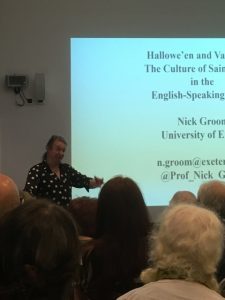 The lecture, titled “Hallowe’en and Valentine: The Culture of Saints’ Days in the English-Speaking World”, was given by the brilliant Professor Nick Groom (University of Exeter). Professor Groom argued for the influence of printed literature on the shaping (or reshaping) of folklore (from Shakespeare to the 18th century) and a lively discussion followed.
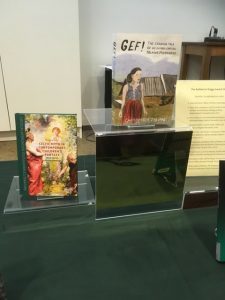 When the awards were announced after the lecture, I was absolutely delighted to find out that my book was the runner-up for the Katharine Briggs Folklore Award! The worthy winner was Christopher Josiffe, for his Gef! The Strange Tale of an Extra-Special Talking Mongoose (Strange Attractor Press, 2017). Given that there were nine shortlisted books, some of them by scholars I have been admiring and following for years, I was really proud that my book was the runner-up! And it was so nice to see so many colleagues and friends at the lecture and the reception that followed!
Many thanks to the judges and the Folklore Society!
Here is the shortlist in full:
Bronner, Simon. Folklore: The Basics (Routledge, 2017)
Constantine, Mary-Ann, and Éva Guillorel. Miracles & Murders: An Introductory Anthology of Breton Ballads (Oxford University Press, 2017)
Davies, Owen, ed. The Oxford Illustrated History of Witchcraft & Magic (Oxford University Press, 2017)
Dillion, Jacqueline. Thomas Hardy: Folklore and Resistance (Palgrave Macmillan, 2016)
Fimi, Dimitra. Celtic Myth in Contemporary Children’s Fantasy: Idealization, Identity, Ideology (Palgrave Macmillan, 2017)
Hannant, Sara, and Simon Costin. Of Shadows: One Hundred Objects from the Museum of Witchcraft and Magic (Strange Attractor Press, 2016)
Heaney, Michael, ed. Percy Manning: The Man Who Collected Oxfordshire (Archaeopress Publishing, 2017)
Josiffe, Christopher. Gef! The Strange Tale of an Extra-Special Talking Mongoose (Strange Attractor Press, 2017)
Williams, Kelsey Jackson. The Antiquary: John Aubrey’s Historical Scholarship (Oxford University Press, 2016)
And here is a news story my university (Cardiff Metropolitan University) shared when my book was shortlisted: Literary nods for Cardiff Met fantasy and folklore academic
October 22, 2017
Philip Pullman in Cardiff: La Belle Sauvage, Lyra’s world, and the writer’s craft
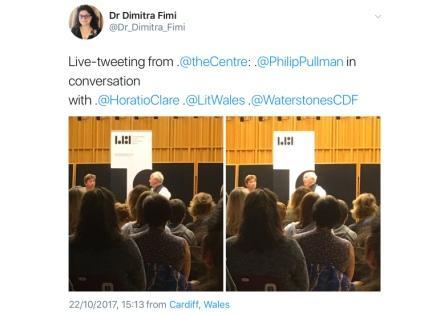
This afternoon I was fortunate to attend a brilliant event organised by Waterstones and Literature Wales. Following the publication of La Belle Sauvage on Thursday, Philip Pullman visited Cardiff to talk about the new book and his creative process more generally. The event was held at the BBC Hoddinott Hall, Wales Millennium Centre, and the room was full to capacity.
During the first part Pullman answered questions posed by Horatio Clare, and also read to us two extracts from La Belle Sauvage. Then the audience has a chance to ask further questions.
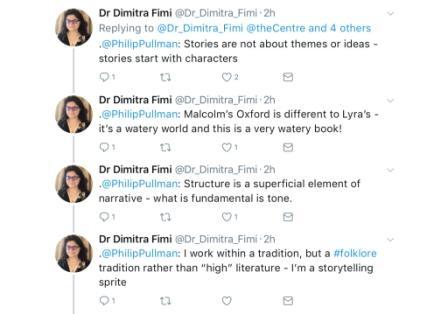
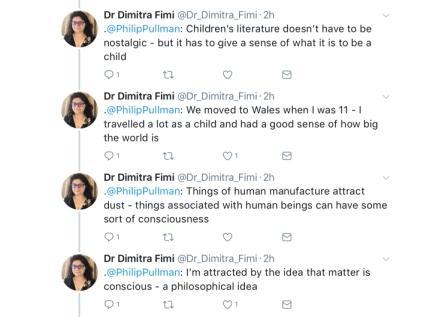
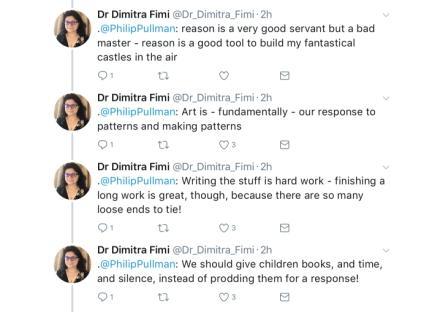
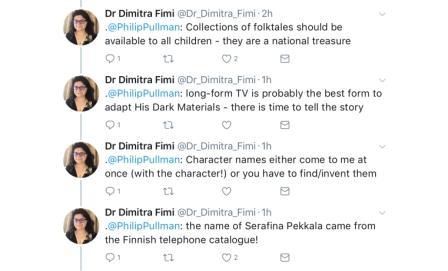
Pullman talked about the characters of La Belle Sauvage, the world of Lyra, children’s literature, folklore, and the craft of writing more generally. Here is my Twitter thread with quotations and comments from Pullman during the Q&A:
Many congratulations to Waterstones and Literature Wales for a wonderful event!
October 12, 2017
CFP: The Celtic Obsession in Modern Fantasy
CFP: The Celtic Obsession in Modern Fantasy
You are invited to submit a paper for an edited volume tentatively titled The Celtic Obsession in Modern Fantasy Literature to be submitted to Palgrave Macmillan.
Scholarship on Celtic-inspired fantasy literature has mostly focused on source-studies of pre-1980s texts (e.g. Sullivan, 1989; White, 1998). Dimitra Fimi’s recent Celtic Myth in Contemporary Children’s Fantasy: Idealization, Identity, Ideology (2017), has widened the discussion by engaging with the Celticism vs. Celtoscepticism debate, focusing on constructions of “Celtic” identities in children’s and young adult fantasies from the 1960s to the 2010s.
This edited collection will take the debate further by focusing on post-1980s Celtic-inspired fantasy for adults. The “Celticity” of each fantasy text can be interpreted broadly to include:
Creatively re-using heroes and mythological motifs from medieval Celtic texts, such as the Welsh Mabinogion, the Irish Táin Bó Cúailnge, etc.
Engaging with perceptions of the “Celts” in classical sources such as Strabo, Herodotus, and Polybius, Tacitus and Caesar.
Imaginatively utilizing insights from Iron Age archaeology, often dubbed “Celtic”
Adapting folklore traditions from Celtic-speaking countries
Evoking a looser notion of “Celtic”-like society, religion, folklore, etc., including in para-textual or marketing material
We acknowledge that the dividing line between children and adult fiction is not always clear. Papers can focus on the work of fantasists such as:
Kate Forsyth
David Gemmell
John Gwynne
Katharine Kerr
Stephen R. Lawhead
Ilka Tampke
Tad Willaims
(This is not an exhaustive list)
Although heroic or epic fantasy may seem to fit better the scope of this collection, we are open to considering proposals on other sub-genres of fantasy literature, such as urban, magical realism and SF/fantasy crossovers.
Please submit a title and abstract to the editors by: 15th December 2017
Essay due: 1st June 2018
Editors:
Dr. Dimitra Fimi, Cardiff Metropolitan University (dfimi@cardiffmet.ac.uk)
Dr. Alistair J.P. Sims (booksonthehill@gmail.com)
References:
Fimi, Dimitra. Celtic Myth in Contemporary Children’s Fantasy: Idealization, Identity, Ideology. London: Palgrace Macmillan, 2017.
Sullivan III, C.W. Welsh Celtic Myth in Modern Fantasy. Westport, CT; London: Greenwood Press, 1989.
White, Donna R. A Century of Welsh Myth in Children’s Literature. Westport, CT; London: Greenwood Press, 1998.
August 30, 2017
The value of English literature at GCSE (really? do we even need to argue this?)
Last week, Owen Sheers rightly drew attention to the perilous consequences of removing English Literature as a core subject from GSCE requirements in Wales: http://www.bbc.co.uk/news/uk-wales-41043551
I was asked to share my two penneth in a BBC Radio interview for Good Evening Wales. You can listen to the entire story below (my contribution starts at 01:40).
For those of you who asked, here’s the exact wording and full reference for the Irish Murdoch quotation I used:
Prose literature can reveal an aspect of the world which no other art can reveal, and the discipline required for this revelation is par excellence the discipline of this art. And in the case of the novel, the most important thing to be thus revealed, not necessarily the only thing, but incomparably the most important thing, is that other people exist. (Murdoch, 1959, p. 267)
Murdoch, Iris (1959) ‘The Sublime and the Beautiful Revisited’, Yale Review, 49, 247-71. (Full text available here: https://msu.edu/course/eng/487/johnsen/murdoch.htm)
http://dimitrafimi.com/wp-content/uploads/BBC-Radio-Wales-Good-Evening-Wales-25-Aug-2017-GCSE-English-Lit.mp3
August 21, 2017
Alan Garner’s The Owl Service has its 50th anniversary today!
(romance, sexuality, intergenerational and sibling conflict, etc.).
Having been published in 1967, I knew that the book was going to be 50-years-old at some point this year, so I got in touch with HarperCollins to find out the exact date. Thanks to their archivist, Dawn Sinclair, I now know that The Owl Service was published on 21st August 1967, so it celebrates its 50th anniversary today. Dawn very kindly tracked for me the relevant page in the Collins Complete Book Catalogue, Autumn 1967:
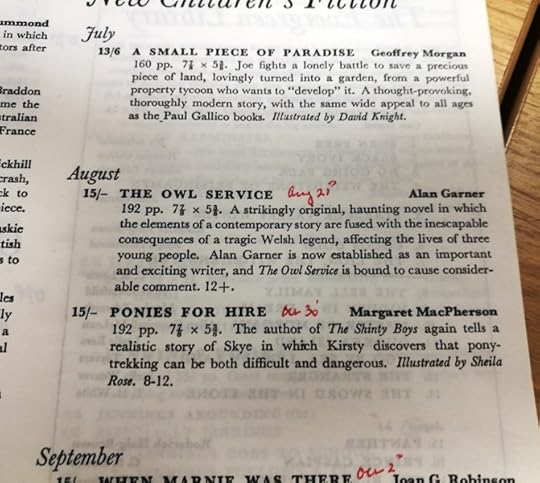
Photo courtesy of HarperCollins Publishers Archive
To mark the 50th anniversary of The Owl Service, I contributed this article to the Times Literary Supplement (TLS) online today: https://www.the-tls.co.uk/articles/public/alan-garner-owl-service-fifty/
I look forward to teaching the book again this year and to sharing its haunting qualities with my students.
August 13, 2017
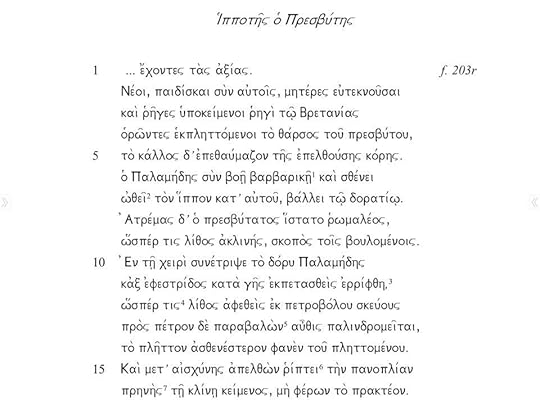
A Medieval Greek Arthurian Poem: The Old Knight
I’m in Greece right now, enjoying the sea, and pistachios (my parents have pistachio trees in their orchard), and watermelon, and figs, and all the lovely summer things. And I thought this would be a good moment to share a little recording in Greek!
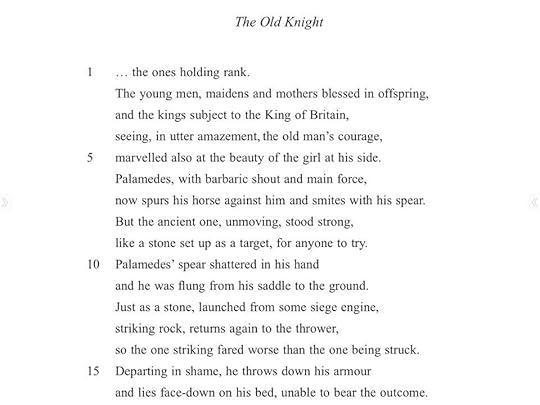
A project that came to fruition recently (after MANY years of working on it, on and off!) is a new edition and translation of a little-known medieval Arthurian poem (mid-15th century) – the only known example in Greek! I worked on the translation of this 307-line poem in collaboration with Thomas Crofts of East Tennessee State University, so I’m credited as co-translator (Thomas did all the hard work of editing, introduction, commentary, notes, etc.) The conventional title of the poem is “Ιππότης ο Πρεσβύτης” (The Old Knight) and the venue is the (very well-respected) journal Arthurian Literature. The story is a loose translation into Greek of the first part of the first episode of Rustichello da Pisa’s 13th-century French prose Compilazione (Rustichello is best known for “The Travels of Marco Polo.”)
In his introduction, Thomas notes
All other western-style, political-verse romances… are in ‘vulgar’ Greek (also called ‘impure Greek’ by the grammatikoi), reflecting the language as spoken in everyday life. But The Old Knight is composed in the high-literary ‘Atticizing’ register of the intellectual, professor or grammarian. Within this rarefied idiom, furthermore, the poem contains a rhetorical performance only the trained ear could have appreciated: that is, a chivalric romance – with a good deal of comedy – narrated with an epic fullness of expression, complete with Homeric syntax and diction. (p. 167)
To give a flavour of the language of the poem, I’ve recorded the first 16 lines (well, strictly speaking lines 2-16 as the first one is incomplete and I omitted it). Try to listen for the metre (the decapentasyllabic line still used today in Modern Greek folk poetry), and for the “Homeric” extended simile (lines 12-14).
http://dimitrafimi.com/wp-content/uploads/Record_0029.m4a
Here’s a link to the press release about this publication by East Tenessee State University: http://www.etsu.edu/news/2017/04-apr/nr_crofts_thomas_old_knight.aspx
You can read a preview of this edition and translation here: https://www.academia.edu/31492424/The_Old_Knight_An_edition_of_the_Greek_Arthurian_poem_of_Vat._gr._1822_preview_
Reference:
Crofts, Thomas H. (2016) ‘Ιππότης ο Πρεσβύτης: The Old Knight: An Edition of the Greek Arthurian Poem of Vat. Gr. 1822, by Thomas H. Crofts, with a translation by Thomas H. Crofts and Dimitra Fimi’, Arthurian Literature XXXIII, pp. 158-218.
July 9, 2017
George MacDonald and one of Tolkien’s most quotable lines
I’ve been re-reading many of the works of George MacDonald recently, in preparation for my keynote lecture at the George MacDonald’s Scotland conference at the University of Aberdeen next week (https://gmdscotland.wordpress.com/). My lecture is titled “George MacDonald and Celticity”, and – among other works – I’ve just finished re-reading Sir Gibbie, one of MacDonald’s “realistic” novels with a Scottish setting (and extensive use of Scotch in the dialogue).
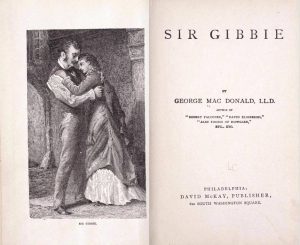
Just as I was about to start wrapping up my notes, I was struck again by these few lines, towards the end of the novel:
The one secret of life and development, is not to devise and plan, but to fall in with the forces at work—to do every moment’s duty aright—that being the part in the process allotted to us;…
Well, this time round, I know what it was that made these lines stand out for me the first time I read them! They brought to mind this exchange:
‘I wish it need not have happened in my time,’ said Frodo.
‘So do I,’ said Gandalf, ‘and so do all who live to see such times. But that is not for them to decide. All we have to decide is what to do with the time that is given us.
Though I know the emphasis of each extract is rather different (and so is the context!) the argument seems to me ostensibly the same. And knowing that Tolkien (and C.S. Lewis) read George MacDonald, one of the two main “grandfathers” of modern fantasy literature (the other is William Morris) makes the link even stronger in my mind.
I’ll leave this small observation here for you to ponder!


