Blake Charlton's Blog, page 5
February 19, 2011
Writer on the Verge: Howard A. Jones
The Writers on the Verge series interviews the new faces in the fields of SFF. This one is a crosspost at Tor.com; click through to join the discussion there. Also check out past WotV interviews of Peter Orullian, Sam Sykes, Mary Victoria, and Saladin Ahmed.
* * *
As I've noted in past interviews, 2011 is looking like a boom year for fantasy—and not only in the 'urban' and 'epic' tradition of fantasy. This month, Howard Andrew Jones is publishing The Desert of Souls, a historical sword-and-sorcery debut novel set in eighth-century Bagdad. Jones promises a sweeping adventure, pitting his scholarly Dabir and martial Asim against murderers, Greek spies, and a search for the lost city of Ubar—the Atlantis of the sands. The adventures of Dabir and Asim have appeared in Jones's short stories for the past ten years in publications such as Jim Baen's Universe and Paradox. In addition to writing short stories, Jones has served as the managing editor of Black Gate magazine since 2004. In the below interview, Howard shares his thoughts on his debut, literary inspirations, and writing and editing.
Howard, welcome and thank you taking the time to chat.
Thank you for the invitation. It's a true pleasure to be here.
To get the ball rolling, I always like to hear how authors think of their work. How would you describe Desert of Souls in your own words?
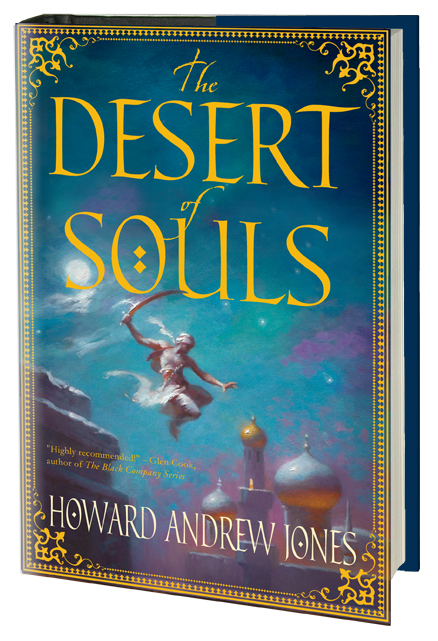 The blurb writer for The Desert of Souls actually did a far better job succinctly describing the plot than I've ever managed. Black Gate's John O'Neill once said it's like Sherlock Holmes crossed with The Arabian Nights except Watson has a sword, which is pretty apt, although the novel's as much an adventure as a mystery. I think if you combine that description with Kevin J. Anderson's blurb calling it "a cross between Sindbad and Indiana Jones" you get pretty close to the feel.
It's an origin story of how Asim and Dabir come to trust and rely upon one another to face a terrible evil. Things start small, with the discovery of a peculiar golden tablet that they're charged with investigating, but before long they're swept up into a dark plot that threatens not just Baghdad, but the entire caliphate. Sorcery, necromancy, sinister secrets, djinn, swordplay, they're all in there, along with the requisite villain, who has legitimate grievances, and the clever Sabirah, who I couldn't help but fall in love with a little myself.
What first inspired you to write a historical fantasy set in eighth-century Baghdad?
Neil Gaiman and P. Craig Russell took me to ancient Baghdad in issue 50 of The Sandman, but it didn't occur to me until years later that I could take anyone there myself. I know a lot of my choice stems from immersing myself in the historicals of Harold Lamb and Robert E. Howard. Both men did an excellent job bringing their Muslim protagonists to life. Still, I can't say it was especially careful deliberation that brought me to Baghdad — it just felt like the place Asim came from when he stalked out of my subconscious and started dictating his tales. Perhaps it all fell together when I realized that Haroun al-Rashid himself appeared in some of the Tales of the Arabian Nights.
Robert E. Howard, Harold Lamb, and Scheherazade—that sounds like three rich sources of literary inspiration. Could you tell us what about each compelled you? How you tried to emulate or adapt each?
Every adventure writer should spend some time studying the best of Robert E. Howard's work. That man had an incredible narrative drive. And his prose is extremely vivid — he brings an entire scene to life with just a few phrases. He was so talented I could, and have, draft entire essays about his strengths as a writer, but I'll just mention a few aspects that really impress me. For instance, I don't know that anyone else has ever been capable of so clearly portraying the clash of entire armies as REH could, seamlessly moving his camera across the battle between knots of figures and important protagonists. When you write and edit all the time it's hard not to turn off that "word architecture" part of your brain where you're constantly analyzing the words. Howard's one of the few authors whose work can still sweep me up so completely that I fall through the words and into the story. REH could craft lovely prose poetry when he wanted, but he knew when to sharpen focus and let the verbs do the heavy lifting. He was one of the best adventure writers we have, and I wish more fantasy writers would look deeper into his canon. Some of his lesser known stories are just as good, and even better, than the best of his Conan work. We're fortunate that the recent Del Rey books have collected so much of it.
Harold Lamb didn't have as much natural poetry in his soul as Robert E. Howard, but he was a fine craftsman with a natural cinematic pace who was far ahead of his contemporaries. He was also quite even-handed with most foreign cultures, writing without prejudice from the viewpoints of Mongols and Cossacks and Muslims and Hindus. All of that is laudable, but there's more — he sent his characters into real world places so fantastic and unfamiliar to westerners that they might as well have been other planets. Like Howard, he could bring a strange setting to life with just a few choice phrases. Many of his protagonists were wily, and it is delightful to see Lamb back them into a corner and watch them think their way out with unexpected solutions. The fact that there's almost always swordplay involved in those solutions make the stories all that much more exciting. Lamb was, simply, a writer of grand adventures, one who really should be studied by all adventure writers wanting to hone their craft, and celebrated by all those who love any flavor of heroic fiction.
When it comes to the Arabian Nights, I guess I was thrilled by what most of us have always enjoyed about them, the sheer joy of adventure, fantastic places, dark magics, the clash of blades, the flash of lovely eyes. As to emulation, I've worked hardest to understand how Howard and Lamb could swiftly paint settings and keep the story moving forward, and how they brought unfamiliar settings to life. I studied all three sources to see how they conjured images of glittering treasure, mighty foes, and places of wonder. I gave up long ago trying to sound exactly like any of the three of them, much as I'd like to be able to draft an action scene like Howard at his savage best.
Are there other novels that inspired this series? Perhaps in unexpected ways?
Well, the books I've read the most times are probably Leiber's collection of Lankhmar stories, Swords Against Death, and Zelazny's Amber books, although it's been years since I've done so. While there are other Lankhmar stories I like just as well as those in Swords Against Death, I've always thought that particular volume had the strongest run of tales from the Lankhmar cycle. As a teenager I probably read it seven or eight times. I was just as devoted to Roger Zelazny's first Chronicles of Amber. Five books sounds like a lot to re-read multiple times, but all of them together are probably the size of one modern fantasy paperback.
As a result, I can't imagine that Leiber and Zelazny haven't had a lasting influence upon me. I love the world building and pulp noir sensibilities of Leigh Brackett, queen of space opera, who was writing of Firefly like characters twenty and thirty years before Han Solo every reached the silver screen. C. S. Forrester's Hornblower stories were another favorite of mine, and later I fell under the spell of Jack Vance, Lord Dunsany, and Catherine Moore. All of these influenced me to greater or lesser extents, along with the original Star Trek, which I watched devotedly. I probably saw most of those episodes a dozen times. I loved the interaction between the central characters. In the best of episodes the dialogue brought them to life in a way I never really saw in the later series. Which reminds me; Butch Cassidy and the Sundance Kid is one of my very favorite movies. I love the interaction between the protagonists. I guess there's a theme there…
Do you have personal connection to the Arab World?
I can't claim to have much contact with the Arab world save for immersion in old texts. I hope to return to my study of Arabic in the next year, but I have a few books to finish before I can pretend to have any spare time.
How did you go about researching this book? Eighth-century Bagdad seems like such a rich and complex area that it'd be hard to know where to start.
I've been a gamer since my junior high days, and as a result, when I first began my research I already owned two nifty source books set in the era, one from GURPS (Arabian Nights, by Phil Masters) and another from Iron Crown Enterprises (also titled Arabian Nights, by John Cambias). Non-role players might not know just how much information can be packed into a setting guide. A good one has to describe daily life, information about the culture and its religion, names, maps of famous places, etcetera.
These books were excellent starting points. When I really got serious I turned to John Howe's translation of Andre Clot's Harun al-Rashid and the World of the Thousand and One Arabian Nights, and to translations of writings from the period. The journals written by travelers and warriors were especially enlightening.
Have the current social and political dialogs regarding Islamic cultures affected how you've portrayed your characters and story?
Dabir and Asim have been seeing print for more than ten years in various short story venues, and they were not designed to be symbols of any particular political philosophy. They are brave and virtuous men from a culture some westerners fear and distrust, so I suppose by that fact alone I have ventured into the socio-political sphere. My intention is to tell adventure stories with compelling characters, not to lecture about morality, politics, or religion, but I suppose its inevitable that some of my own contentions will color my fiction – the simple one, say, that honorable folk can be found in the ancient middle-east.
Given that that many of your sources for inspiration come from American or European perceptions of eighth-century Bagdad, when writing this book were you concerned with issues of cultural appropriation?
It's certainly something to be alert for. I strive to create characters, not characitures, and to portray real cultures, not idealized or villified representations of them. One of the things I admire about Lamb was the way he showed heroes and villains on both sides of cultural divides; folk from different places were human, with flaws and virtues arising from their character and upbringing rather than because of the color of their skin. I follow Lamb's lead and work very hard to show real people, not stereotypes. I would hope that my efforts keep me from the worst excesses of cultural appropriation. I am constantly trying to learn more so I can present the people and places with greater accuracy.
How would you say your career as an editor at Black Gate has helped shape you as an author?
That's an interesting question. I suppose it's gotten me to think about the starts to stories even more than I was already. I see a lot more beginnings than I do endings, to be honest. That's just the way it works when you're reading submissions. The biggest impact, though, probably comes from the number of people I've had the privilege to meet thanks to Black Gate's John O'Neill. He's the one who established the magazine — I didn't come on board until issue 10. He's opened up countless doors for me and has been extremely generous with his time and energy. I think my writing career would have had a much harder time getting launched without my work with the magazine and the Harold Lamb collections.
Huh, as a writer, I always find I'm a horrible editor; my desire to rewrite the story my way is always too strong. Do you find it difficult to switch authorial and editorial hats? Any tips for folks who are interested in both editing and writing?
Well, I was a professional editor for at least ten years before I ever joined the Black Gate staff, and that's probably made it easier for me to switch hats. I cut my teeth editing all manner of computer books, from Idiot's Guides to high level programming manuals (and no, I'm not particularly good with computers). To this day I still enjoy revising my work more than hammering out rough drafts. All those years playing with text, I'd guess. Tips – I suppose the best thing to do is to realize you shouldn't attempt to make everyone sound the same. But then at Black Gate I work more as a developmental editor than a copy editor. If I like something and the pacing is off, I offer a few suggestions then toss it back to the writer rather than revising it heavily. I think that makes everyone happier, even if it sometimes takes multiple back and forth exchanges. I usually only do heavy revising with non-fiction, if I'm trying to help prop up some solid material from a less experienced writer. Anyone who's submitting fiction needs to be able to fix the problems themselves. It's just my job to point the way.
Howard Jones…hrmm…How often, if ever, are you—no doubt affectionately—nicknamed "HoJo?"
Almost never. I have one or two friends that occasionally refer to me that way in e-mail, but it doesn't happen much, and I certainly haven't encouraged it. I've never really had any nicknames. Only my father, one of my sisters, and an old friend (hey Gina!) ever managed to call me "Howie" without being irritating, so I've discouraged that as well. I just go by Howard. Two syllables; pretty easy to say.
Well, How-ard, thank you kindly for your time and the interview!
Heh. Thank you for your time and some questions that really got me thinking. I enjoyed myself.


February 18, 2011
Endosymbiont on the Air
Dearly Beloved You All:
As you might recall from this post, I'm very passionate about read-aloud fiction. For that reason, I'm especially proud to announce that the distinguished Escape Pod podcast has produced a performance of my novella, Endosymbiont. (If you're a reader more than a listener you can read an online copy of the story here or pick up a hardback of the Seeds of Change anthology)
It's the story of a very opinionated, sometimes foul-mouthed young woman who's trying to cope with brain cancer when she discovers that she's in a hospital for the dead. Things get stranger as the story goes one. It was inspired by two patients I encountered as a first year medical student (another post on that upcoming) and on my father's struggle with cancer. It was also the first bit of fiction I ever published.
In a way, Endo never felt like my story; rather, it felt like the story of cancer survivors I encountered. I made up my mind then to donate any money I might make off of the story to cancer treatment and research. So the cash that Escape Pod paid to me has gone to the American Cancer Society. If you'd like to get involved, I'd encourage you to visit their website at www.cancer.org.
February 9, 2011
Belated, Updated
Dearly Beloved You Guys:
My high school football coach was fond of the zen phrase "There are no excuses; only reasons." Problem was, he belted out said gem of tranquility while exhorting me and other semi-armored pubescents to compromise each others' skeletal systems. Not. So. Zen. Like.
But these days, I've found that phrase bouncing around in my head, not so much because I've been feeling the need to sprint an oblong leather ball into a wall of my peers—though there was a moment in the DMV when said action seemed rather attractive—but because there's a lot that I've had to stop doing in the past two months. Chief among them, blogging. *Le sad French sigh*
Let me explain. In January, I began the clinical phase of my medical education. This consists of discreet 'rotations' into the major branches of medicine (surgery, pediatrics, internal medicine, etc). While on a rotation, nearly all of my attention is dedicated to helping my patients, learning, and not sounding (too) dumb in front of my attending physicians. There's also minimal progress to be made on my novels and research projects. That doesn't leave much time for navel gazing…or sleep. So non-essential activates, such as blogging, tweeting, facebooking, plotting world domination, etc., fall by the wayside. I'm not trying to make an excuse, only supply a reason. ::Tiny gong of football coach zen::
In the future, I'll post when I'll be away from the blogosphere and provide a diversion link to some wonderful blogs, such as How to Kill Your Imaginary Friends, for example.
Happily, this month is a research month and so I'm able to catch up with the online world. As such, I've got some wonderful bits of news to share. Here they all are:
Yesterday, I mailed off the completed copy edit for Spellbound to my editor at Tor.
Presently the US publication date for Spellbound is set as September 13th 2011.
Caveat: Publishers often move dates around by a few weeks.
I should have a UK publication date (and cover art) to announce fairly soon.
I'm honored that Spellwright has been nominated for two awards!
The David Gemmell Legend award for best fantasy, and
The David Gemmell Morningstar award for best debut fantasy.
The UK Hardbacks of Spellwright have sold out! If you'd like one, better search for a bookseller that has them on the shelves or in stock; there's not to be another printing of the book with extra U's until the UK paperbacks roll out in March.
The Dutch version of Spellwright (De Taal der Spreuken) is sold out and going into a second printing!
Nicodemus is now misspelling the German language! (Nicodemus Der Zauberverschreiber)
My novelette "Endosymbiont" is going to be translated into Polish by Nowa Fantastyka.
I've managed to make a few more posts on my research team's website, and it might be of interest to any medical types out there.
January 5, 2011
Blake at Writers With Drinks
Dearly Beloved Peoples,
Should you be in the Bay Area this weekend, come out to the hippest literary event in the city, Writers with Drinks, featuring famous people and (somehow) me.
Saturday, January 8, 2011
3225 22nd. St., San Francisco CA,
From 7:30 PM to 9:30 PM, doors open at 6:30 PM.
Here's the 411 about the other authors from the glorious hostess, Charlie Jane Anders:
About the readers/performers:
Jane Wiedlin co-founded The Go-Go's, the first ever all-girl group to write their own songs, play their own instruments, and become immensely popular doing it. She also released six solo albums, which included the hits "Rush Hour", "Blue Kiss" and "Tangled." She became an ordained minister in 2009 is now performing wedding, commitment and vow reaffirmation ceremonies. She co-starred in the Women In Prison movie Stuck, and also appeared in the
films Bill and Ted's Excellent Adventure and Clue, as well as the television series The Surreal Life. Jane is currently working on herdirectorial/screenwriting debut, the short film "THE PYREX TALES". Release date is set for 2011. In addition, she has written two musicals: 'A NIGHT WITH BETTIE PAGE" and "LADY ROBOTIKA: A SPACE OPERA." She's also released a Lady Robotika comic.
Ethan Watters' latest book is Crazy Like Us: The Globalization of the American Psyche. He's also the author of Urban Tribes, an examination of the mores of affluent "never marrieds" and the coauthor of Making Monsters, a groundbreaking indictment of the recovered memory movement. A frequent contributor to The New York Times Magazine, Discover, Men's Journal, Details, Wired, and PRI's This American Life, he has appeared on such national media as Good Morning America, Talk of the Nation, and CNN. His work has been featured in the Best American Science and Nature Writing series.
Jesús Ángel García is the author of badbadbad, a transmedia novel (forthcoming on the printed page in 2011) about sex, God, rock 'n' roll and the social web. Excerpts have appeared in MonkeyBicycle and 3:AM Magazine. "Finnegan's Wank," a bawdy parody of James Joyce, won HTMLGIANT's "When Writers Get Off" contest.
January 4, 2011
Writer on the Verge: Peter Orullian
Here's another entry in the Writer's on the Verge series I've been working on. This one's a crosspost at Tor.com; click through to join the discussion there. Also check out the WotV interviews of Sam Sykes, Mary Victoria, and Saladin Ahmed.
* * *
2011 is shaping up to be an, shall we say, "epic" year for fantasy literature, with offerings from a diverse field of authors ranging from established stars to promising debuts. In April, Peter Orullian will make his entrée with The Unremembered, the first book in The Vault of Heaven series. Peter has already stirred up interest in the world of Unremembered with his online short story Sacrifice of the First Sheason. Interestingly, Peter brings his unique background as a musician to epic fantasy. Recently Peter and I chatted about writing, music, and The Vault of Heaven.
Welcome, Peter. Why don't we open the interview by asking you about how you broke in to publishing. What's the backstory of The Unremembered ?
I wrote The Unremembered, then entitled The Ledge of Restoration, in about 2001. I had an agent at the time who was very prominent in the field of fantasy and science fiction. I sent it to him, and some months later, when he was in Seattle on business, we met over lunch to catch up. I asked him about the book—he'd not emailed me (I went months without hearing back from him)—and he showed me the first few pages of my book with his notes. Essentially he said I should shelve this book and move on to write other things. Specifically, he wanted me to write some of the thriller and suspense novels I'd talked to him about. It became clear that he was trying to build diversity into his agency and client list. He wanted more writers working in other genres. I could say that he was flattering me, because he liked my work with those other kinds of books. But the truth is, he never read any of these novels and his motivations weren't focused on my work. He never once sent the fantasy out to an editor to try and sell it.
He and I later parted company (surprise) and I began to query other agents. The irony is that I queried my current agent with a thriller that I wrote while following the guidance of agent number one. That book wasn't right for agent number two. (One cool aside here though; my current agent told me he found the thriller very Dickensian, and it led to a book proposal I wrote that he liked so well that he's asked me to write the book for him.) Anyway, on with the story…I mentioned to him that I knew he'd represented a fantasy author and that I had a fantasy novel. He said to send it. I did. In a few weeks he offered me representation. A few weeks after that Tor made an offer on the first three books of the series.
I've gleaned several lessons from all this. I don't need to spell them out for people. But needless to say, my slight bitterness at having sat on the book for all those years is more than made up for by the fact that I now have a great agent and a great publisher. Who knows, maybe the universe conspired for it all to come together now. I'm just not one to give the universe that much credit. Still, I'm very fortunate, and equally excited about what lay ahead.
I'm always curious about how authors describe their work. The synopses put out by publishing houses don't always represent how an author thinks about a book. How would you describe The Unremembered?
You hit on something interesting there. I work in marketing and PR and product management, so I understand positioning and messaging and all that junk. As a company, like any company, a publisher has to think about how they talk about a book, and not just to a single audience. I mean, they have a sales force, book buyers (the ones for the book chains, e.g. B&N, etc), reviewers, readers, etc. What this all can mean is that a single synopsis may not perfectly suit each audience.
My thing is that I can't recall reading a good synopsis of any book—I usually just turn to the first page and start reading. To me, they're tantamount to that question—one which most music listeners are guilty of—when hearing about a new band (you know what's coming, don't you?): "Who do they sound like?" What these folks are saying is that they want a taste before diving in. But the truth is—at least for me and how I like to enjoy any entertainment—you gotta try it for yourself. When folks ask me that about a band, I usually reply with something snarky like, "They sound like themselves," or "They sound like music."
So, what does that have to do with how I think about The Unremembered? Well, just this: I find it a huge challenge to distill the book down. My publisher wrote a synopsis; I took a hand at creating another. You can check those out here. But as I've said before, I think you can summarize to such a point that you miss the point. I'm not terribly good at synopses. That said, and because I'm not going to punk out on the question—though I was tempted to do as National Lampoon did when they summarized a Stephen King novel thusly: Plot, plot, boo!—I'd describe The Unremembered as a mix of the familiar and the strange.
I'd say I'm pretty firmly in the "epic fantasy" camp with The Vault of Heaven series; and that being the case, I definitely make use of some of the conventions or tropes (the familiar). But I did this deliberately to try and ground the reader in some things before I start leading them into what I think are new (or strange) places. (Would that be like turning the heat up on a pot of water in which the frog sits contentedly? Never mind.) But I took some risks in doing that. Not real risks, not firefighter or combat soldier risks. But the overarching story, which will play out across multiple volumes, let me tinker with some of those conventions. Meaning, what you see isn't necessarily what you're going to get. There'll be a fair amount of turnabout with respect to the familiar stuff.
On the strange side, well, I can tell you I took time to craft my own races, that there are multiple magic systems—some not appearing until later books—and that I punish my characters in some rather unique ways.
Last thing I'll say is that after the initial draft, I realized one of the themes that seemed to have grown out of the book organically were ones of choice and consequence. Once I saw this, I nourished it a bit. The topic fascinates me, actually. What and how someone decides something, and the repercussions that result for good or ill…love that stuff. And as it turns out, I've put my characters in some very difficult situations, between Scylla and Charybdis, so to speak. And while there are battles and bad guys and political agendas and torturous histories in the book, the parts that make my own blood race are those where there's something important on the line and someone has a choice to make and the right choice is not clear.
Let's go back to when you first started working on the book. Did the idea for it come to you as a sudden "aha!" moment? Or did it come when connecting several ideas? Something more unusual?
I don't think there was an "aha!" until I figured out the ending. I love the genre, and I knew I wanted to write something epic, which to me meant that I needed to spend some time developing a world, and that the stakes had to be high. (And not just that the world was in peril—though that can't hurt—but that personal character stakes had to be high, too.) I spent a long time drawing maps, creating glossaries, writing historical scenes, creating back story, etc, before I sat to write. All that pre-work gave me a kind of license to go off the reservation, if you take my meaning. Plenty of the stuff I planned made it into the book. But once I set foot into the world I'd created, more came. Sweet! There were some fundamental things for me, though; I started with characters. It sounds cliché, maybe, but I began by thinking about the people.
The first time I met my editor, he took me on a tour of the Tor offices, and then we went to lunch. I'll never forget our conversation, particularly on the way back to the Flatiron Building. As we crossed 23rd street, he said to me, "What is it with you? You torture your characters so." I'm not sure if he understood that I took that as high praise. I didn't say it out loud, of course, since I kinda get how that could sound. But what it also indicated to my warped mind was that perhaps I'd succeeded in what I set out to do when I first began thinking about the characters in my story.
The other choices I made early on were that I wanted to create, as I mentioned, my own races and societies, with their own troubled histories; I wanted it to be gritty and emotionally taut—my world's a rough place for kids (not to mention the rest of the folks); I knew I wanted some semblances of good and evil, but I worked to create a kind of construct that would help me later blur those lines. I'm not one for spoilers, so I won't go any deeper there; but I'm kind of echoing my answer to your first question, in that things aren't always as they seem. There are clues to some of this in book one.
But, as I mentioned, I did have an "aha!" moment. I was halfway through the first draft of book one, and the ending of the whole shebang (the whole series) hit me like a load of bricks. I was listening to a Dream Theater song and BAM! It unfolded in my mind like nothing ever has. It was like watching a movie, no lie. I've never taken a hit of acid, but you know, now I don't think I need to. I was high for days after that little episode. Once my agent sold the book, and I'd gotten underway with my editor, it took him several weeks to pry that ending out of me. He said he had to know. I finally let him in on it. If something happened and he let it slip, I'm pretty sure I'd go all Jack Bauer on him.
You are, of course, also a musician. Which art form—literature or music—fascinated you first? How do you feel your practice of one art informs the other?
Wow, yeah. Impossible to say. My whole family is pretty musical. Bedtime as a kid was stories and songs. Songs tell stories, and language (to me) is musical. So it's kind of like the two halves of me. Though, early on, I did a ton of athletics, too, played all through high school, and walked on during my vaunted university days. I felt sure I would be at the plate in the fall classic at some point with the score tied and two outs in the bottom of the ninth. I had to let that one go. And it's a good thing MMA wasn't widely known when I was a younger man; I've enough hind-brain in me to know I'd have probably given that a go.
But back to your question. I was making up stories extemporaneously and telling them to my little sister when I was like six. And I remember likewise making up songs to sing to myself while I weeded the garden at the same tender age. I never got serious about either until later on—college timeframe, when reality starts to stare back. What's fun for me is to trace my tastes (and dare I say, growth) over time. That'd make this reply way too long. But what's relevant is that the one has always influenced the other. I mean, as an eleven-year-old, I was putting on Mannheim Steamroller and going into what can only be described as writing fugues. How's that for geeky? Besides Chip Davis's blinding awesomeness, his tunes have virtually no lyrics—great for writing to. And then—hold on to your hat—when I heard "Pull Me Under" by Dream Theater, yowza!, I was hearing medieval war machines, their wooden axles turning as they were pushed to some final confrontation. Music is very visual for me. I see things. It really is transportive. That sounded kind of lamey. But what the heck.
And more materially, in The Unremembered, I've shown the first bits of a magic system based on music. Music as magic isn't a brand new thing, but I think my take on it offers something unique. What I didn't do, though, was force the full revelation of how the magic works into the first book, just to get it in there. While I may not always succeed, I try to have these kinds of worldbuilding things come out naturally in the story, which means that much of the nitty-gritty for how this music magic system works is something readers will get much more of in book two, when it makes sense.
One other interesting thing I'm working through right now as a writer is what I might call the musicality of language. I've got a great, hands-on editor. He's a stickler for information flow and word choice. Good things, to be sure, but sometimes proper syntax and forgoing colloquial uses of words has me reworking a sentence to try and get back the music I heard in it when I first put it down but got a bit of the other stuff wrong. Ah well, there are worse things. Anyway, my editor and I have had long conversations around those bits, which are absolutely important, reconciling what is most logical with a use of the language that has—to my mind—better rhythm and pace and tone. I'm actually writing an article series on my website about the relationship between music and fiction to work through and lay out these distinctions, which has been a lot of fun. I'm also writing a concept album to go with the novel. It's not one of those lame retellings of the story. I don't get a lot out of those, personally. Rather, there is this thing in my world called the Song of Suffering, and this became the leap point for a recording project I've become really excited about. So, yeah, music and fiction. Can't choose.
Interesting. You mentioned other magic systems based off of music. Were there any that inspired you? Any that, though unrelated to your work, do a great job of it?
Well, the idea itself predates most of the fantasy novels I can think of. Creation through music was an essential part of Pythagorean philosophy, which suggested the universe was created and bound together by a music known as the "harmony of the spheres." This was all related to the Greek notion of Logos—the Word—which interestingly is another magic system in my series, and which also has a long, rich tradition in the genre—and one, specifically, in which you and I both are sharing.
But as to music magic systems, I can recall a little of Scott Card's Songmaster, Modesitt's Spellsong Cycle, and Alan Dean Foster's Spellsinger series—which is cool for the fact that Jon-Tom can do magic by playing rock music. Love that! However, I think I'm most partial to Terry Brook's Wishsong of Shannara; I have fond memories of reading that book.
All of these do a pretty good job, I think, of finding a way to make the combination of music and magic interesting. But they're definitely different from what I'm doing. I think I've taken it as a more central part of one of the plot threads, which ladders up to have a grand-scale impact in the series. That, and as The Vault of Heaven progresses (like in book two, which I'm almost done writing), I get into some of the real specifics of how this magic system works. There's a place where those who have this ability can study, and many of my favorite scenes are those where instruction is taking place. I was able to call on these two sides of myself to do something which I think is pretty original. At the very least, it's been a lot of fun to write!
Have you a favorite novel that describes music or musicians? Inside or outside of SFF?
You know, I don't. But it is, for me, what I call a "reader cookie," like cookies on a web browser. There are just certain things that if a writer does, I'm in! Or at least I'll give that writer more leeway, because I'm always eager to see where they'll take it. Music is one of these reader cookies for me.
But I will say that not long ago a really cool volume on Frank Sinatra called The Sinatra Treasures was released by Bulfinch Press. All kinds of correspondence and mementos and old photos and playbills and tickets and set lists and things. Because I love Frank, it was really cool to walk through his life in that way.
Let's change gears a bit and talk about the rest of the series. Do you have a set number of books in mind? Or do you plan to let the story evolve and see where it ends?
Ahhhh, that question. I can practically hear a few fantasy-readers' neck muscles tightening, as they cringe to think about yet another endless investment of time. Well, here's the deal. I know pretty solidly what's happening in books two and three—that's how many Tor bought. And I have the whole ending in my head. Then, I know the broad strokes between book three and that ending. My sense is that it's six to eight books.
And I guess your query gets a little at the question of am I more an Architect or Gardener type of writer (to borrow George R. R. Martin's metaphors)—architects being those writers who plan it all out meticulously in advance vs. gardeners who plant something and watch it grow, perhaps shaping a bit. I'm pretty firmly in the middle. I definitely do a lot of worldbuilding up front. And then when I get ready to write a book—at least with these fantasy novels—I do some outlining (kind of a chapter by chapter sketch—mind you, sometimes this "sketch" is a single word). That part of the process is for me very creative. I'm creating story much as one might who has fingers on the keyboard. Then once I have something of a blueprint, I get rolling. The cool thing is that while a great deal of the story I create in the initial stage makes it into the book, the blueprint itself gives me a kind of license that's hard to explain. What it means, though, is that quite a lot of new story stuff happens along the way—coloring outside the lines, so to speak. It actually never ceases to surprise and delight me. (Okay, delight is a pretty "dandy" word, but I guess I'll stick with it.)
The uber point, I suppose, is that I'm not planning to pad it out. Sure, some folks will feel like some of it is, in fact, padding. All I can say is that I try to take a critical eye to every scene and make it answer at least three questions. I don't always succeed, but I can tell you if it hits just one, and usually even two of those questions, it's out. I tend to think that given this approach, the books will remain tight.
The series will end when the story's over—how's that for a politician's answer? But really, if I get to book four or five and its winding down, I'll finish it. Because I already have three other big projects waiting to be written, and I'm just as excited about those as I am The Vault of Heaven. In fact, ideally, if things pan out, I'll start one of the other projects and write it concurrent with VoH. Right now, though, that'd be suicide, as I work 12 hours a day in the games and entertainment division at Xbox.
Thanks so much for the chat, Peter. I enjoyed it greatly and will look for The Unremembered on the shelves in April.
December 15, 2010
Spellwright's French Cover & a New UK Cover
Tis the season for cover art. As you might have seen, Spellwright recently received a beautiful German cover with Nicodemus in full kick-ass mode. Today, I'm very proud to unveil the book's eye-catching Frech cover.
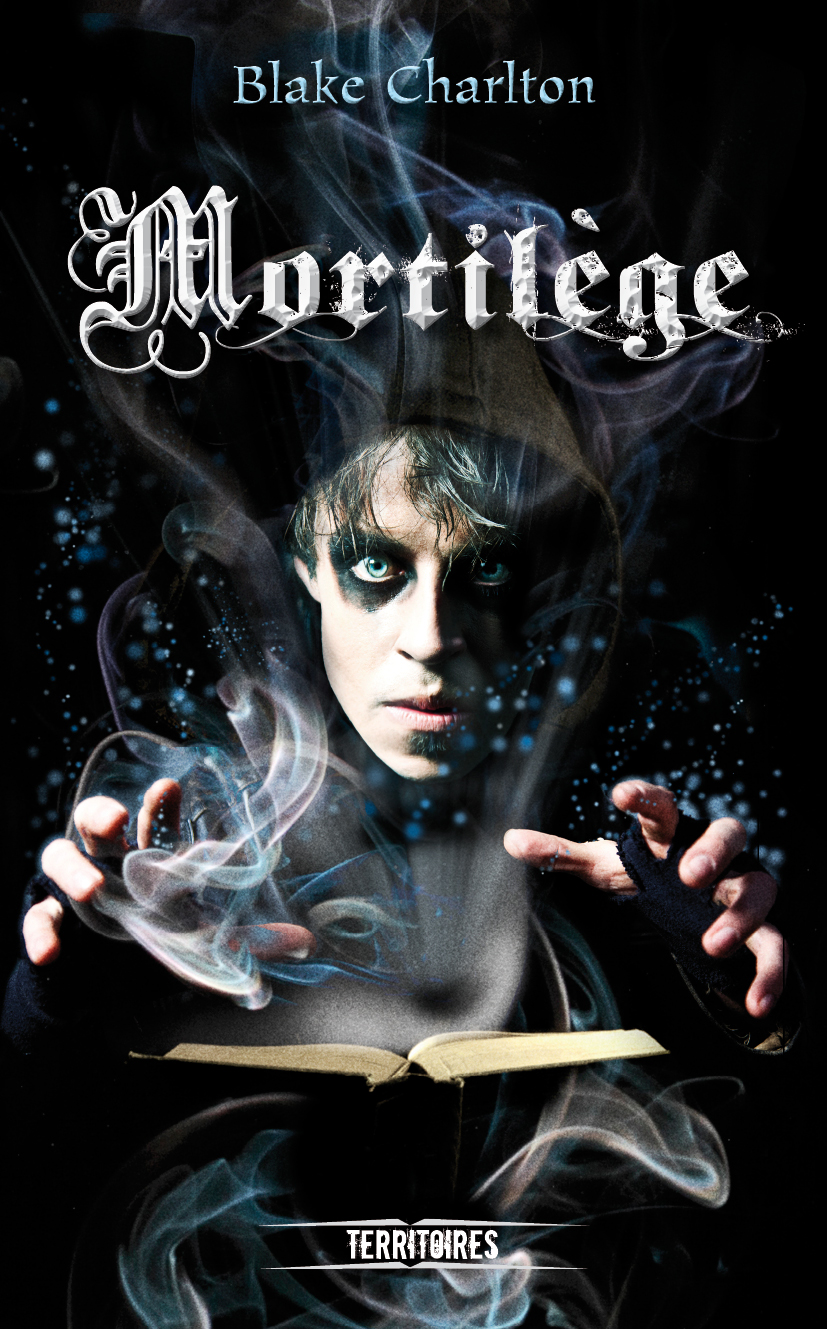
I'm very happy to report that Mortilège–a melange of sortilège (spell) and mort (death)–is one of the titles that will launch the Territoires list of young adult novels from Fleuve Noir. How do I feel about the book being marketed as YA? I love it. How do I feel about books that appeal to young people (especially young men) in in general? You already know I think they're vitally important. But in particular, I love this representation of the book. This isn't Nicodemus in his bad-ass mode; this is Nicodemus right before he attempts a spell he will most likely dangerously misspell. The model's expression perfectly captures the cross between a sensation of wonder and that "Ohhhhhh shit!" feeling I often felt when contending with my disability. It's a darker cover to the story, one I appreciate.
Also in the wonderful things-wonderful in December is Voyager's new cover art for Spellwright. No disrespect to the old UK cover; it served us well. But I admire the clean lines and the focus on textuality this cover presents. It's a beautiful depiction of the the Numinous language. I think, unlike any other cover, this one captures the scientific nature of the world's magic system.

I can't share it yet, but I've seen the cover art for Spellbound, and it provides a wonderful continuation of the theme by illustrating the magical language that drives the plot of Spellbound forward.
December 13, 2010
Risingshadow.net Interview (diversion post)
Dearly Beloved Y'all,
I'm taking a break from posting today, mostly because after an embarrassing number of months working on it, I have at long last finished a wonderful interview for Risingshadow.net. Click through for a preview of Spellbound, a peak at the French cover, then stay for the wonderful literary community there.
December 10, 2010
Spellwright's German Cover!
I showed this wonderful bit of artwork off on Facebook and Twitter yesterday, but thought it'd be nice to have a higher res version here. The book 's title is "Nicodemus Der Zauberverschreiber" and will be published by Klett Cotta in February (pre-order here). See below for my thoughts and check back next week for my French cover–a very different take, but equally awesome.
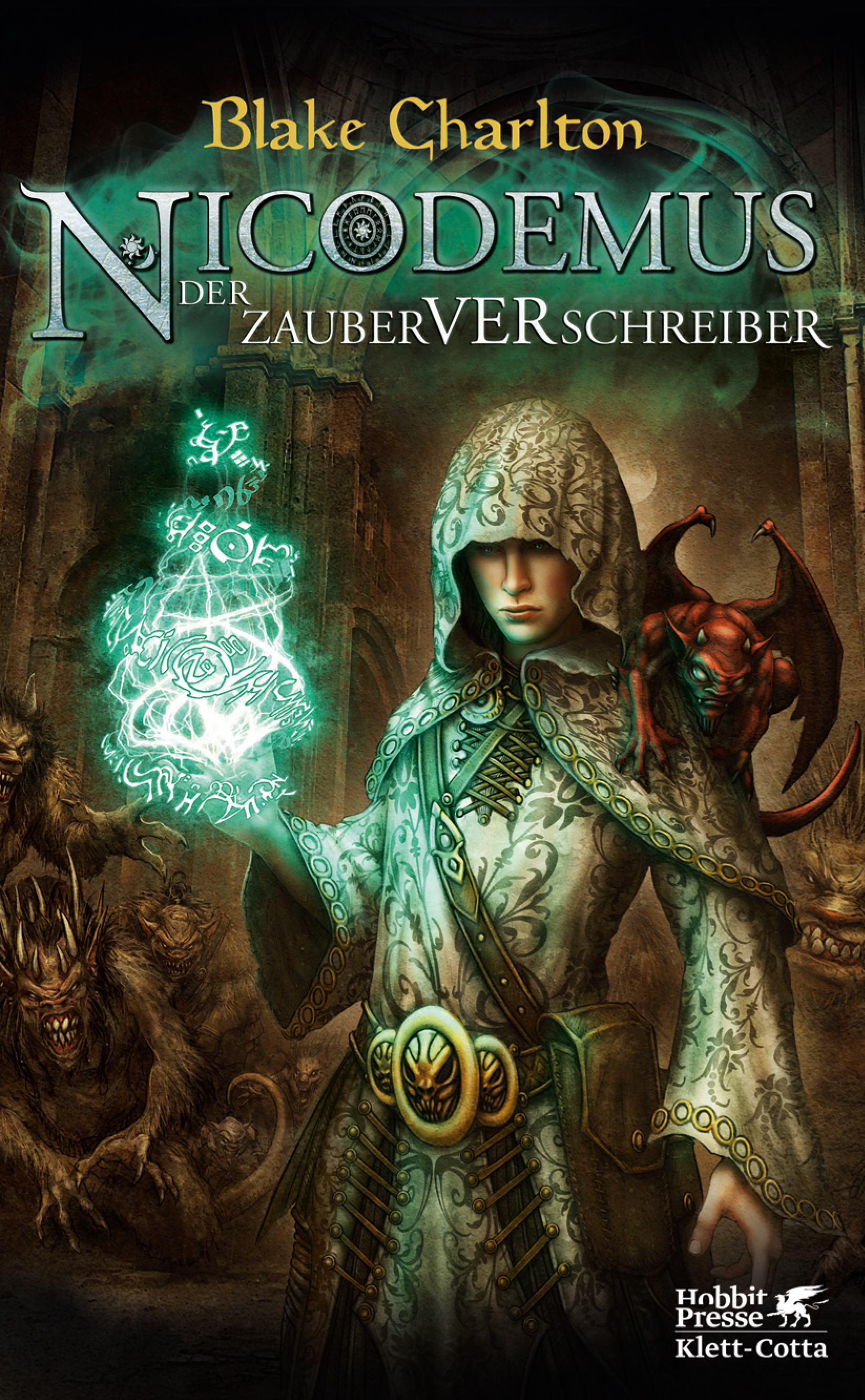
My thoughts? I love it! It's definitely an imagining of Nicodemus in one of the few situations when his disability does not affect him, and his complexion is pale compared to the olive brown describe in the text. But the ambiance of Starhaven and the living gargoyles are beautifully rendered. Most impressive is the luminescent Magnus spell he's holding. Wunderbar!
December 9, 2010
Writer on the Verge: Sam Sykes
A while back I started interviewing up-and-coming fantasy authors with my "Writers on the Verge" feature. First time round I chatted with Saladin Ahmed before he fully burst onto the scene. After that it was a Q & A with New Zealand's rising star Mary Victoria. And I've an upcoming interview with Peter Orullian.
I intended to interview Sam Sykes (self proclaimed Angriest Man Alive) back when he was on the verge. However…well…things go pretty crazy making sure that my second book got in on time. So…Sam is not longer on the verge; he's been over the verge with the publication of his first novel Tome of the Undergates, far afield really, then he came back and dug his way under the verge, declared war on the verge, and then brokered a secret pact of peace while putting the finishing touches on his sequel Black Halo. Though, the interview took me too long to get together, it turned into a lively discussion. Check it out.
Okay, Sam, I hear you're good. Let's find out how good. Pitch Tome to me without using a single passive verb or adjective while incorporating the phrases "just like the Battle of Agincourt" and "as soggy as a waffle left in the rain." Ready, go!
 Tome of the Undergates is the book that is made out of questions and paper and hatred. It is the book that speaks to us in harsh, whispering tones that we're not always sure the meaning of. Did it ask us what the weather was like in Cairo? Did it ask us to kill in its name? Tome of the Undergates offers no answers. Tome of the Undergates gives no answers. That is for the reader, the reader that Tome of the Undergates seeks to devour, chewing up pulped meat in papery jaws and nearly breaking its spine to consume your tender little head and as your soft brains slide down its gullet, Blake Charlton, it spares a single, razor edge to gently caress your hairless pate before it spits you back out.
There. I just threatened to have my book cannibalize you. It doesn't GET less passive than that, Charlton!
Also, it is about adventure, celebrating the fine art of swordsmanship, plundering, racial xenophobia, religious doubt and the fine art of crotch-stomping that Kenneth Branagh pioneered in so many of the battles he won for France, just like the Battle of Agincourt.
I think that settles it…wait, no! I was supposed to talk about waffles! I HAVE FAILED. Charlton, you will be my second. When the pain of ritual disembowelment becomes too much, hack off my head and bury it deep, lest it come back to you one night and talk about Ducktales while you're trying to sleep.
…anyway.
Did you happen to catch the latest healthcare reform fantasy? It's a stunning little story in which a struggling med student named Blako Baggins is tasked with the chore of finding and destroying the Opposition Bill by hurling it into the fires of Mount Congressional Resume before the armies of Sauron Palin can find him. It's guaranteed to be a bestseller, if it passes a majority vote.
Oh, yes, my friend, we shall be victorious. We have enlisted the ancient elves of The Daily Shadowvale, lead by Steven Colbert-ron. Oh yes, my friend, victory is neigh.
Anyway…
Let's take a moment to smell the garden that is epic fantasy. Possibly the phenotype most in bloom at the moment is "gritty" epic fantasy, or what you will, but there are other types "classic" epic fantasy, "hard" epic fantasy, "meaningful bipartisan healthcare reform in America" fantasy…okay, so maybe that last one was me being a cynical medical student. But where do you see Tome fitting in the garden of epic fantasy? How do you see the genre developing, good and/or bad?
But you want serious answers, don't you? Tome has been called "gritty" before, and I certainly don't dispute most of those charges: it's got violence; it's got gore; it's got people who are very clearly not intended to be white knights atop steeds. But it doesn't quite have the same morality as others. "Gritty" usually implies a sort of messy morality, and while a lot of epic fantasy has moved away from
Black-and-White moralities; I think a lot of them are just as neat and tidy as before. They simply took a step to the right so now we have Black-and-Blacker moralities in which the sole distinction is varying
degrees of assholitude. Tome has jerks, Tome has wicked people, but it also has people trying their damnedest to do good. Whether or not they succeed is up for debate, of course.
Epic fantasy has been going pretty well, I feel, since a lot of it is moving into the realms of character-driven stuff. It's no longer the quest that defines the story, but the people who do it and how they cope with it. I'm quite pleased and confident that Tome will continue to add to that tradition.
Sam, I realize the following statement will likely incite you to try to gnaw the cerebral vasculature out of my brain; however, I must tell you: In the above answer, I normalized your punctuation. I want you lay back on a leather couch, think about your childhood, and for exactly 15 German-accented words tell me how that makes you _feel_.
As to your normalization…well, you would do that, wouldn't you? You normie.
Okay, now that I'm done being bitchy, let's get back to your comment about epic fantasy shifting from black-and-white to black-and-blacker (or gray-and-grayer? All characters are gray, but GRRM's are Grayer?). So if in this new mode of 'gritty' we still have good guys and bad guys, has the genre essentially changed at all? Do we necessarily _want_ a radical change in epic fantasy?
Maybe some of us don't want a radical change in epic fantasy, but I think we need it. As I mentioned in a blog recently, whenever we feel constrained by rules, the genre as a whole stagnates and suffers. We need to keep challenging the norms and we need to keep doing what we want, rather than what other authors would do. But that doesn't mean that we need to forsake good and evil, gritty or ambiguous morality. Rather, we need to embrace what we want to do without rules and if that means white hats and black hats or black hats and gray hats covered with blood, so be it.
Though I do think that adopting this idea of 'gritty' could be interpreted as putting more rules on a genre that should never have any. If someone writes a character who feels empathy, sympathy and saves orphans and gives to charity, he shouldn't discard that character because he feels his book should have grittiness. Those people do exist in the world and, while they may be hard to find, they're every bit as interesting as the hardened badass who spanks whores and villains alike. They just need to be explored.
Ever feel the need to get away from the work? What's Sam Sykes do to get away from it all?
I don't get away from it all. I just bleed quietly.
So, here's a question I ask merely for self-interest: Now that you've broken into publishing, what's your plan for staying in the game? More in this series? Start another? Another flavor of angriest man alive books?
Big news coming up on that front. Stay tuned.
Give us a brief report about your second book Black Halo: Where's it in the production line and what might we expect from it?
 Black Halo is currently just leaving copy editing and might even be out by the time you read this, considering the pace we interview at. It's a book that goes more in-depth to the characters we met in TOME. We learn more about their lives, their motives, their hates and their loves and each one is explored pretty thoroughly as they try to come to grips with just why they're together and just why they can't leave each other.
Set this against a three-way war between demons trying to resurrect their bloated mother, purple-skinned sadistic Darwinists trying to stop them and a sect of violently xenophobic tattooed lizardmen as well as betrayal, love and loincloths and that's basically how it goes.
Well, the best of luck to you, Sam. Thanks for chatting. No doubt our paths will cross again on the way to glory doom the convention hotel's bar.
December 8, 2010
Help Me Name My Third Book
Dearly Beloved You People:
So as we put the polishing touches on Spellbound, it's time to start thinking more seriously about the third and final book in the Spellwright Trilogy. I have a good chunk of the book already written, but a recent realization sent me back to the beginning. Much of what is written will survive but in a different form. It's not the most fun every to discover a missed step in a manuscript, but it is the way of the creative process, at least for me.
A far simpler problem is the matter of titling the third book. Since I first pitched the book, I've been using the working title Disjunction, which like the two previous titles works a name on several levels—likely most that're reading this have realized that Nicodemus is the spellwright who can't spell right. (As for how the title Spellbound figures into the story of book 2, well, it'll hopefully hit you as something of a surprise.) Anyway, a bunch of friends have suggested I use the book's alternate title, Disspell, which works okay thematically and has the added advantage of giving the whole trilogy a continuity of names—Spellwright, Spellbound, Disspell. I must admit the name is growing on me.
But let us ask the Dearly Beloved You People. If you'd be so kind, take a second to vote on the following poll.
View Poll
In other book three news: The coming year is going to be a wild one, as I tie up the trilogy and finish up medical school by completing my 'clerkship' rotations. I won't do anything so rash as guess when book three will hit bookshelves, but I'm expecting to take a bit more time with this one. And that's not only because of med school; in my mind, ending a series is a very delicate matter and cannot be rushed. I want to give myself the time to end this trilogy the right way. That said, I made similar, very conservative estimates last year, and things seem to be working out just fine there. Fingers crossed for a threpeat.