Matt Kaplan's Blog, page 4
November 1, 2017
Driven by digestion
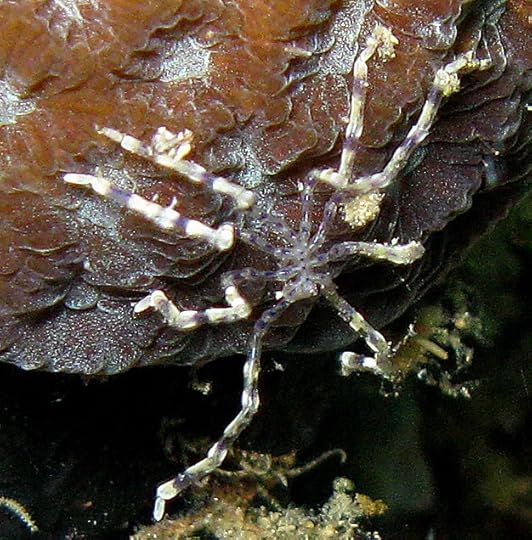
Heartless beast.
Image courtesy of Steve Childs.
Sea spiders are an ancient group of animals that have a number of odd traits. Perhaps the most notable is that many of them either have teeny tiny hearts or no hearts at all. This has led many researchers to question how they get their blood to move around their bodies but, to date, nobody has been sure. Now a new experiment is revealing that they manage this vital task with guts... literally. Peristalsis, the process that moves food through our intestines, appears to be the primary force that swishes oxygen-carrying blood around the bodies of sea spiders. You can read more in The Economist article that I wrote on this here.


October 27, 2017
Colour me dangerous
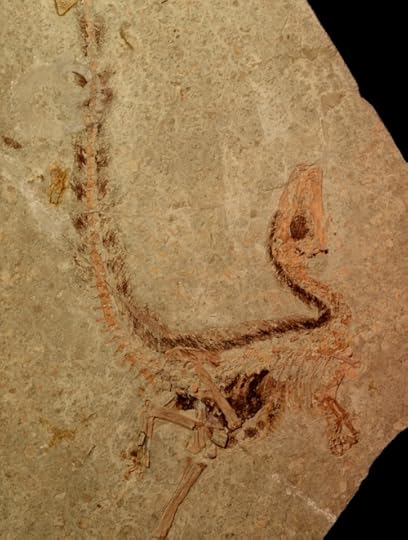
Captured bandit.
Image courtesy of Jakob Vinther.
The "bandit mask" is a common colour pattern found on the faces of animals living in the open plains. With nowhere to hide, these species depend upon their mask communicating the important message that they are not to be messed with. In the case of the badger and the wolverine, the message is a simple "do not judge me by my size, I will rip your arms off." In the case of the skunk and the teledu, the message is "touch me and I will nauseate or blind you with nasty juices stored in my anal glands!" Many birds, including kingfishers, osprey and falcons also have dark bands covering their eyes both to prevent prey animals from spotting their dark eyes staring at them before an attack and to reduce glare from intense sunlight. Thus, it is fascinating that a new study is revealing that the dinosaur Sinosaurpteryx had a bandit mask on its face too.
The new research revolves around a pigment analysis that was conducted on three exceptionally well preserved fossils of Sinosaurpteryx. While the species is known as one of the many toothy, meter-long and semi-feathered kin of Tyrannosaurus rex found in the Jehol formation of China, details about how it led its life have remained unclear. The assumption was that it lived as a forest ambush predator since the Jehol was once heavily forested but the colouration patterns on Sinosaurpteryx challenge that notion. Aside from the presence of the bandit mask, which needs to be easily seen by would be predators to be effective and would not function terribly well in a dense forest, Sinosaurpteryx also shows some lovely evidence of counter-shading. Counter-shading involves an animal having a light coloured belly and a dark back that helps mask the three-dimensional shape of its body by reducing self-shadowing, decreasing conspicuousness and thus helping to avoid detection by both predators and prey alike. Like the mask, counter-shading would be of little use in a dense forest and, indeed, it is rarely seen in such environments.
October 25, 2017
Sun cream vs multiple sclerosis
That multiple sclerosis (MS) is less common near the equator than it is in upper latitudes has led teams in recent years to explore this oddity and led one group to find that ultraviolet light (UV) suppresses the disease. Keen to take a closer look at this, a researchers applied sun cream to mice with the rodent version of MS just before exposing them to UV light. They fully expected the sun cream to block the protective effect of the light but this is not what happened. Instead, the cream granted further protection against the disease.
This surprising discovery led the researchers to run a follow up experiment with many sun creams. They found that not all were equal in their ability to suppress MS but that the few that did have a beneficial effect worked even when the mice were not exposed to UV light. Fascinated, the team broke the MS suppressing sun creams into their component parts and applied them one by one to the mice. You can read more in The Economist article that I wrote on this here.