Matt Kaplan's Blog, page 2
December 7, 2021
Ironwood
Since the dawn of time we relied on wood to create tools and build shelters. Yet, in just about every science fiction depiction of the future, wood is almost entirely absent. This is because wood has been eclipsed in recent decades by a range of alloys that are harder and more durable. While these tough alternatives are certainly useful, they are both expensive to produce and non-renewable. Indeed, there has long been interest in finding a sustainable and low-cost alternative to these materials. Now new work is revealing a way for wood to be hardened in a manner that will bring it back into use once more.
Metals are not the only materials to have replaced wood. Plastics, concrete and ceramics have also come to be used for the construction of products that were once made of wood. This is definitely not for the best. Many of these materials pollute the environment when produced and when junked at the end of their usable life. This has resulted in materials derived from wood seeing a resurgence since they are both cheap to make and quick to decompose when disposed of. The only catch is that wood materials cannot be used where strength and durability are essential.
Teng Li at the University of Maryland found this conundrum vexing since cellulose, the main structural component of wood, is reasonably strong to begin with and low in density. This struck him as encouraging since a low density meant that there was potential for a mix of chemistry and physics to make cellulose much harder by forcing its molecules into a smaller space and thus dramatically increasing its density. Keen to explore this, he worked with a team of colleagues to invent a procedure for creating wood that would be as hard as metal.
The researchers worked with samples of basswood, a timber that is both abundant and cheap. They suspected that they would need to remove a portion of the structural compounds lignin and hemicellulose to make it easier for the cellulose molecules to be compacted together. To do this, they soaked basswood samples in a solution of sodium hydroxide and sodium sulphite until they were completely saturated and sank to the bottom. Next, the solution was brought to a boil to accelerate the chemical removal of lignin in particular. Once this was done, the samples were rinsed with de-ionised water and then put under a hot press machine that exerted 20 megapascals on them for six hours to squeeze out excess lignin and drive out water that had migrated inside. The wood was then put in a 105 degree Celsius chamber to fully dry it before being immersed in oil for two days to make the surface water resistant.
When all of this work was complete, Dr Li and his colleagues ran a test on their creation known as the Brinell hardness test whereby a carbide ball was pressed into the modified wood at increasing pressures until it made a dent of 200 micrometers in size. This revealed that they had enhanced the hardness of basswood from a meagre value of 1.32 to a respectable 31.21. That value is not in the same league as steel, which has a Brinell hardness of 120 but it is twice that of aluminium, which has a value of 15, and close to the value of copper, which has a value of 35.
Pleased by this result, the team created table knives and nails with their hardened wood to try and determine how practical this material would be for being used in these sorts of items. When they examined the knives that they had made under the microscope they found that theirs were three times sharper than steel dinner knives that they had purchased at the store. This increased sharpness is because compacted cellulose molecules form a better edge than metal ones. As for the nails that they created the researchers found that they were easily smashed into timber with a hammer and did not break in the process. Given that such nails are lighter than steel and will never rust in the rain, the future may have a great deal more wood in it than many were expecting. This just published online in Matter. I wrote it up as a short piece for Economist Espresso.


October 12, 2021
Going with the flow
In a world trying to wean itself off of fossil fuels, power generation from other sources is becoming ever more important. Energy collected from ocean waves is getting increasing attention. The most common method employed in ocean energy harvesting is based on electromagnetic generators. These devices unquestionably work but they depend upon there being big waves to be effective. This has made them successful in places with choppy waters but lots of locations need energy and only have small waves for most of the time. These small waves carry energy too but are being ignored. Now new work is revealing a clever way to tap them.
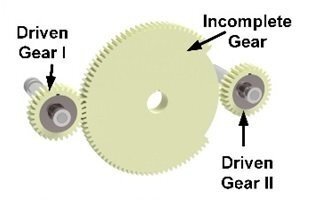
Designed for catching some waves…
The device that the team behind this work have created is essentially a pendulum generator with a gear in the centre that is connected to the pendulum and a flywheel attached to a gear on either side of it. What makes this device special is that the gear in the centre is incomplete on one side. In other words, roughly one third of the gear lacks teeth (take a look at the image). This means it only makes contact with one flywheel gear when ocean waves are weak. However, when the waves get large, the pendulum swings far enough to drive the teeth of the incomplete gear to reach the second flywheel gear. At this point, both flywheels are being driven into action and creating resistance for the central incomplete gear.
The whole thing is rather cunning in that the contact with just a single flywheel keeps resistance low when waves are calm and thus is supportive of rather efficient power generation in mild conditions while large waves force contact with both flywheels, increasing resistance and power generation. All told, it is a generator that is adaptable in a way that current wave generators are not and it is this that gives it promise. You can read more in The Economist article that I wrote on this here.
September 21, 2021
Yet another reason to protect sea turtles and dugongs
We all know that land plants depend heavily on animals to distribute their seeds but what about plants in the ocean? While we don’t think about them much, ocean plants do flower and many of them produce fruits. But are there animals in the ocean that are eating the seeds of these fruits and dispersing them? Details on this have remained murky for years but now new work led by Samantha Tol at James Cook University in Australia published in Biotropica last month is revealing that large marine herbivores play a pivotal part in helping to distribute and germinate the seeds of seagrasses.
Seagrasses are incredibly important for providing fish that we depend upon places to live and for helping to control erosion by using their roots to bind sediment together that would otherwise just float away. And, like all plants, they have also long faced a problem. To pass along their genes to a new generation they must reproduce but, given that they don’t move once they have rooted down, a parent plant dropping seeds adjacent to itself immediately threatens its own offspring with competition for sunlight, water and soil nutrients. Some plants get around this problem by having seeds that drift off on the wind (like dandelions) or float away on water (like coconuts). Many others convince animals to do the job for them. While wind and water can send seeds a long way, animals are generally a better bet for long distance dispersal. This is the reason why so many plants have seeds that readily snag on fur or are encased in sugary fruits that entice animals to swallow them.
Seeds that are swallowed on land almost always depend upon the digestive tract of the animal to chemical induce the seed to begin the germination process. Dr Tol knew that seagrasses, of which there are 72 species in the world, produce fruits containing seeds that are often ingested by large herbivores like sea turtles and dugongs. She also knew that these animals would sometimes end up over a hundred kilometres away before excreting them. This led her to wonder if travel through turtle and dugong digestive tracts was important for seagrass seed germination. Curious, she decided to run an experiment with a team of colleagues.
The researchers went boating in Gladstone Harbour and Cleveland Bay in north-eastern Queensland where seagrasses, dugongs and sea turtles are common (along with man-eating salt water crocodiles). While carefully avoiding the crocodiles, they collected dugong and sea turtles faeces that had floated to the surface (their poo is buoyant). They then brought these samples back to the lab chilled where they were mined for tiny seagrass seeds. The team also collected seeds directly from the seagrass meadows at Gladstone Harbour.
Both seeds collected from faeces and seeds collected from the seagrasses were placed into mesocosms that replicated the marine meadow environment. To also explore the role that temperature might have on seagrass germination and explore the possibility of global warming harming seagrasses in the future, some of these mesocosms were set at 19 degrees Celsius, some were set at 26 degrees and some were set at the very warm temperature of 32 degrees that climate models suggest the region may commonly experience in the future.
After 60 days of monitoring the team saw that seagrass seeds benefitted greatly from travel through the guts of large herbivores. More specifically, 73% of the seeds collected from faeces that were placed in the cool mesocosm germinated, 87% germinated in the medium temperature tank and 83% germinated in the very warm tank. By comparison, these figures were only 29%, 20% and 36% respectively for the seeds that had not been consumed by turtles and dugongs. Germination time was also substantially sped up when it had gone through the digestive tracts.
The findings reveal that dugongs and sea turtles are vital partners for seagrass ecosystems. That alone should encourage conservation efforts to be increased for these threatened species but there is a financial reason to look after them too. Seagrass communities provide a number of ecosystem services including food production from healthy fisheries, nutrient recycling and sediment control by enhancing seagrass spread that binds sediments together. Indeed, it is estimated that losing seagrasses equates to a cost of more than US $28,000 per hectare per year. For this reason alone it would be a very expensive mistake for us to allow dugongs and sea turtles to go extinct. All the more reason for them to be given better protection.
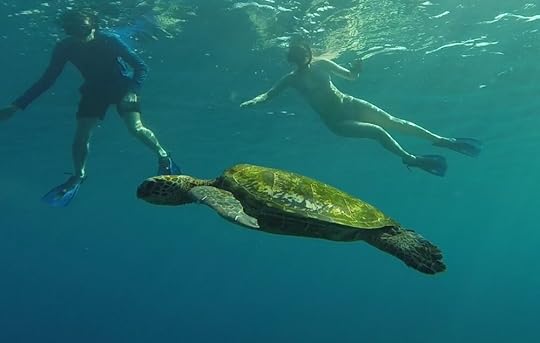
Far more than just a tourist attraction.
Seeds that are swallowed on land almost always depend upon the digestive tract of the animal to chemical induce the seed to begin the germination process. Dr Tol knew that seagrasses, of which there are 72 species in the world, produce fruits containing seeds that are often ingested by large herbivores like sea turtles and dugongs. She also knew that these animals would sometimes end up over a hundred kilometres away before excreting them. This led her to wonder if travel through turtle and dugong digestive tracts was important for seagrass seed germination. Curious, she decided to run an experiment with a team of colleagues.
The researchers went boating in Gladstone Harbour and Cleveland Bay in north-eastern Queensland where seagrasses, dugongs and sea turtles are common (along with man-eating salt water crocodiles). While carefully avoiding the crocodiles, they collected dugong and sea turtles faeces that had floated to the surface (their poo is buoyant). They then brought these samples back to the lab chilled where they were mined for tiny seagrass seeds. The team also collected seeds directly from the seagrass meadows at Gladstone Harbour.
Both seeds collected from faeces and seeds collected from the seagrasses were placed into mesocosms that replicated the marine meadow environment. To also explore the role that temperature might have on seagrass germination and explore the possibility of global warming harming seagrasses in the future, some of these mesocosms were set at 19 degrees Celsius, some were set at 26 degrees and some were set at the very warm temperature of 32 degrees that climate models suggest the region may commonly experience in the future.
After 60 days of monitoring the team saw that seagrass seeds benefitted greatly from travel through the guts of large herbivores. More specifically, 73% of the seeds collected from faeces that were placed in the cool mesocosm germinated, 87% germinated in the medium temperature tank and 83% germinated in the very warm tank. By comparison, these figures were only 29%, 20% and 36% respectively for the seeds that had not been consumed by turtles and dugongs. Germination time was also substantially sped up when it had gone through the digestive tracts.
The findings reveal that dugongs and sea turtles are vital partners for seagrass ecosystems. That alone should encourage conservation efforts to be increased for these threatened species but there is a financial reason to look after them too. The ecosystem services that seagrass communities provide to fisheries fisheries and they role they play in sediment control equates to a cost of more than US $28,000 per hectare per year. For this reason alone it would be a very expensive mistake for us to allow dugongs and sea turtles to go extinct. All the more reason for them to be given better protection.
August 23, 2021
Tortoises with a taste for blood
We like to think of tortoises as herbivorous gentle giants. Indeed, most people (myself included) assume that their behaviours are simple because of their slow moving lives, . Now new work is revealing that at least some tortoises hunt and eat baby birds.
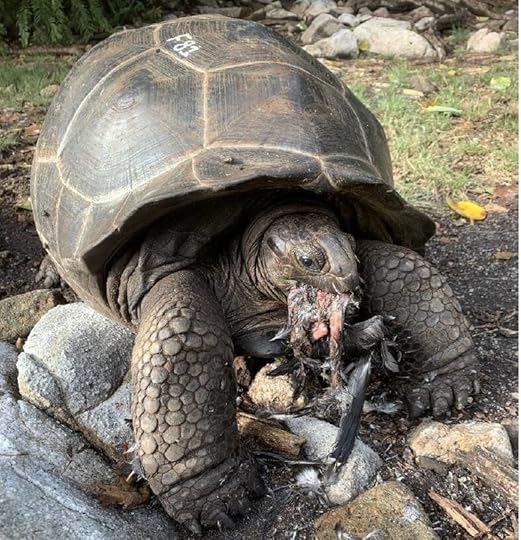
Tastes like chicken…
Those who study tortoises full time know that these reptiles are not strictly vegetarian. One species of semi-aquatic tortoise was spotted a number of years ago eating frogs in captivity. Several wild tortoise species have also been seen consuming bones and snail shells which many experts assume is done to increase their calcium intake. There have even been a few anecdotal reports of Galapagos giant tortoises squashing birds under the weight of their heavy shells but nobody has been sure whether this squashing accidental or deliberate.
The new work published in Current Biology is revealing (in video format no less) the deliberate hunting of a tern chick by a female tortoise in the Seychelles. In the video the tortoise walks directly towards the tern and reaches out with her mouth open when the chick is in reach. The chick , being no dummy, recognises an attack when it sees one and runs up a log to get away from the reptilian menace. The tortoise pursues while continuing to bite at the bird. The chick tries to defend itself by pecking at the tortoise and fluttering its wings but it is all to no avail. The relentless tortoise carries on attacking, driving the chick further and further along the log. At the end of the log the flightless chick is too high off the ground to jump off and gets pinned at a dead end. Sensing that she finally has her quarry cornered, the tortoise closes her jaws directly on its head killing it. The chick drops and the tortoise eats it.
This whole encounter was a long one (to be expected from an animal known for moving slowly). From first approach to the death of the chick, the interaction is seven minutes in length.
What is particularly notable here is that during the attack the tortoise approached the chick with its jaws wide open and the tongue retracted. Apparently, this is typical of aggressive tortoise behaviour and is in contrast to their normal feeding where the tongue is stuck out. The direct approach to the chick on the log also hints that the tortoise had experience at being able to capture a chick in such a situation by cornering it well above ground-level.
While this is the first documented incidence of a wild tortoise hunting, killing and eating a bird, the team have had their suspicions that this was going on as they had occasionally seen a few tortoises in the areas nibbling on bird carrion and observed what they thought looked like bird hunting behaviour. Now they are certain that at least this population of tortoises has turned omnivorous. Why this has happened and whether it is more widespread remain unclear. This just published in Current Biology and my article on it will be published in The Economist shortly.
August 4, 2021
Guided by poison-wielding rodents
We know that, long ago, our kin dispersed out of Africa through the Middle East many times but whether they crossed under a forest canopy or across a scorching desert has been a matter of fierce debate. The answer to this question matters because crossing through a forest would have been easy. Crossing a desert would have been hard and required technology, like pottery, to carry water. Now new work studying the fossils of the world's only poisonous rodent is revealing convincing evidence that forested corridors granted a pathway out of Africa.
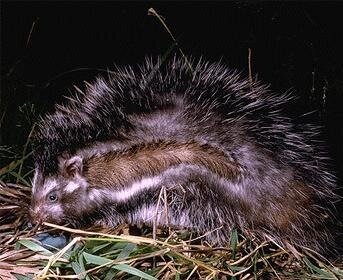
Follow me, I know the way!
Image courtesy of Kevin Deacon.
The new work focuses upon the African crested rat, a bizarre species that rubs the sponge-like hairs on its back against poison collected from poison arrow trees to keep would be predators away. Found in the highlands of Kenya and Ethiopia today, these rats thrive in wet and densely vegetated woodlands where the poison arrow trees that they depend upon for protection grow well. Given that they are definitely not desert dwellers, the researchers were surprised when they realised that a whole bunch of rodent skulls that they had dug up in sediments of the southern Judean Desert were all an extinct subspecies of this very odd rat.
Fascinated by this discovery, the researchers used species distribution models to estimate the timing and location of habitats that would have been suitable for these poisonous rats to live in the region. The results suggest a brief period when forested corridors connected eastern Africa to the Middle East across the present-day Judean Desert, facilitating the dispersal of crested rats and, more importantly, our ancestors, out of Africa. This just published online in Proceedings of the National Academy of Sciences. My coverage of it in The Economist will publish shortly.
July 29, 2021
Falcon shades
Like American football players, many birds of prey have dark black markings just below their eyes. Most of these birds are falcons and all of them hunt flying animals. Given this, ornithologists have argued for years that these markings, known as malar stripes, help prevent light from bouncing off of feathers just below the predator's eyes and blinding them on sunny days. It is a nice idea and makes a lot of sense. The problem is that there hasn't been any proof that this is how the birds actually use these markings... until now.
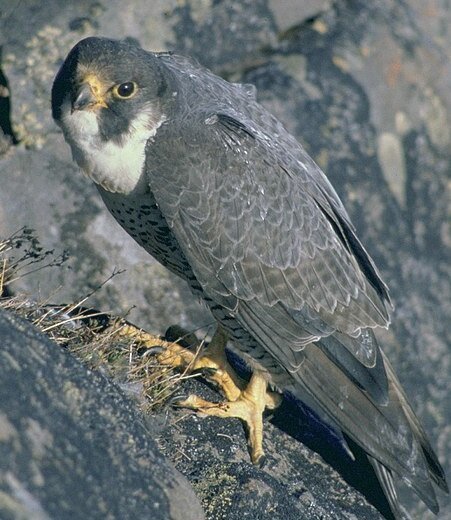
Got my sunnies on!
Image courtesy of US Fish and Wildlife.
The team behind the new work reasoned that if malar stripes really evolved to reduce solar glare, then they should be bigger and darker in regions with particularly high annual solar radiance than they are in areas with less radiance. To test this out, they turned to the most widespread falcon on the planet: the peregrine.
The peregrine falcon is present almost everywhere globally*. As such, the researchers set up an international effort to source photos of peregrine populations that have long been established in locations with radically different levels of annual solar radiation. They found that the size and prominence of the malar stripe was greater in areas with lots of annual solar radiation and lesser in areas with considerably less annual brightness.
So we now know that, aside from being able to fly at speeds of 390 kilometres per hour, these birds are also effectively wearing sunglasses. You can almost here the Top Gun theme playing…
This published online in Biology Letters in June.
*Which is really saying something given that we almost drove the bird into extinction with DDT poisoning during the 1960’s.
July 13, 2021
Cultural magic resistance

The Ebbinghaus illusion.
A two centimetre circle surrounded by six four centimetre circles looks larger than a two centimetre circle surrounded by eight one centimetre circles. Known as the Ebbinghaus illusion, this bit of visual trickery is difficult for people to see through. Indeed, most struggle to see that the two central circles are actually the same size. An exception to this are the Himba. Found in the Kunene Region of Namibia, the Himba people are semi-nomadic pastoralists and, when presented with visual illusions by a team of psychologists in 2012, they proved remarkably resistant to this illusion. At the time, the team suggested that there was something about their intimate relationship with nature that was leading them to respond to illusions so differently from people living in the developed world*. Now new work is revealing that the relationship with nature that the Himba have is irrelevant here. Instead, their cultural resistance to this illusion appears to stem from having slower reaction times and being much less easily distracted.
The new work presented participants with a range of illusions and asked them what they saw at different points in time. For some illusions, like the Ebbinghaus, the power of the illusion weakened over time and with increased concentration by the participants. For others, like the double-decrement contrast illusion grey-scale contrast illusion, the power of the illusion strengthened the longer participants were presented with it and the more they concentrated. These findings alone are interesting in that they reveal some illusions as strengthening the longer they are studied and some weakening. Yet, where this work gets really interesting is when it is applied to the findings with the Himba.

The double-decrement contrast illusion.
The researchers in 2012 bribed the Himba people to participate with bags of sugar and flour. While a bag of sugar or flour might not seem all that exciting to you or me, these commodities were valuable to the Himba and the experience of being presented with visual illusions was an exciting novelty. This made more engaged in the task and led them to spend much more time studying the illusions than the British students in the control group. This, they argue, is why the Himba so consistently saw through the Ebbinghaus illusion while the British students could not. Lending support to this theory is Himba performance on a grey-scale contrast illusion that the new research shows gets stronger with time and attention. Unlike the British, who easily saw through this illusion, the Himba were almost always deceived by it.
All told, the findings reveal that the power of illusions varies with cultures and that a key force behind this variance is the novelty of the illusion itself and whether it is one that strengthens or weakens with increased attention.
This just published online in Psychological Science.
*They used a bunch of British students as a control group.
June 3, 2021
Melons in ancient Egypt
Watermelon is off the menu for me. Just a couple of bites and I am in the emergency room with anaphylactic shock. That being said, I hear wonderful things about the fruit. As a science journalist I also hear lots of bad news about the future of watermelons. The crux of the problem is that melons are facing a host of new diseases and pests as the climate warms and may soon go extinct. Fortunately, a team of researchers have just identified help for the watermelon by studying ancient Egyptian art.
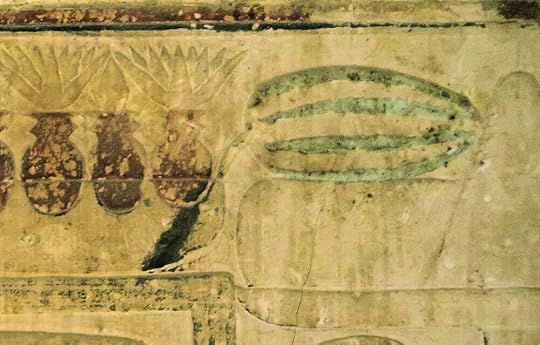
Already a sweet success.
Image courtesy of Dr Lise Manniche.
The researchers behind this work started by engaged in an extensive genetic analysis of domesticated watermelons from around the world and compared what they found to the genetics that they obtained from six other melon species. They also had historians on their team who examined ancient artistic depictions of melons (we're talking about stuff like Egyptian art) to try and understand when the fruit's flesh became red, when it gained its iconic green stripes and when it developed a sweet flavour.
All of this work revealed that the Sudanese Kordofan melon, which has whitish pulp and does not taste terrible*, is the closest relative of the modern watermelon and is likely the precursor of all domesticated watermelons. The researchers think that early farmers likely cultivated variants of this melon and that it obtained its sweet flavour and reddish colour over time. As for when the watermelon actually became sweet, the team identified illustrations from two Egyptian tomb paintings dating to around 4,450 years ago portraying oblong fruit with dark green stripes on trays and tables with other sweet foods like grapes, suggesting that watermelon as we know it, had come to be by that time.
While this might all sound rather academic, it is not. The watermelon of today has been extensively bred to be sweet and easy to grow. All of the genes that the plant once had for fighting off diseases and insects of days long ago have been lost. It is for this reason that identifying the Kordofan melon as the wild relative of the watermelons is such a big win for botanists looking for disease and pest resistant genes that can be brought into this crop to keep it healthy as the planet goes to hell. You can read more in The Economist article that I wrote on this here.
*Yeah, I know that isn’t selling much but most wild melons need to be boiled with sugar to be edible. The Kordofan can at least be eaten raw.
April 24, 2021
Heat tolerant coffee
Coffee is a multibillion dollar global industry that supports the economy of several tropical countries all on its own. Roughly 100 million farmers depend upon this crop for their survival. Unfortunately for them and for the countless millions who savour coffee every morning, the plant is under significant threat from climate change. Now a team is reporting some welcome news by revealing that they have found a wild coffee species that can both put up with higher temperatures and produce beans that taste good.
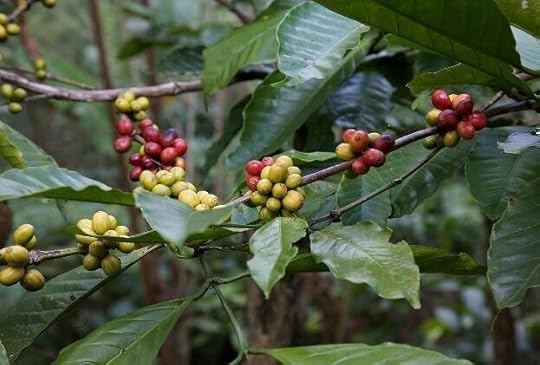
But can they take the heat?
Image courtesy of JM Hullot
The two coffee species that dominate the world market are Arabica and Robusta. Arabica is, to put it bluntly, screwed. It grows poorly in high temperatures and the only way it can continue being farmed is through a mix of farm engineering with shading and cooling measures being taken to keep crops alive as temperatures soar. Arabica can also be kept on life support by moving farms up mountains but this is expensive and socially challenging since it will require transplanting low elevation communities to places where it will be harder to survive. Robusta, as its name suggests, is a tougher variety of coffee and can put up with warmer temperatures than Arabica. The catch is that is requires a lot of rainfall and is not as tasty.
Given the problems, the search has been on for another coffee variety. There are 120 other known coffee species. Many grow in warmer and drier environments relative to Robusta and Arabica but all were thought to taste terrible. The new work reveals a species that is climate change tolerant, farmable and (most importantly) delicious.
The species, known as C. stenophylla, grows wild in Guinea, Sierra Leone and Ivory Coast. It was tasted by late Victorian explorers and they noted that coffee made from the beans was good but those reports have been ignored for years (we had Arabica so who cared?). Indeed, there has been no published taste description of this coffee since the 1920's due to its rarity in the wild and absence on farms. Worse it is threatened with extinction in the wild as Robusta coffee that has escaped from farms is currently out-competing it.
The researchers argue that, properly managed, this wild coffee can be grown on farms and used to continue generating a coffee supply for the world as temperatures rise. You can read more in The Economist article that I wrote on this here or listen to my podcast with The Intelligence on this topic here.
February 28, 2021
Inception... only real
Dreams take people to a different reality, a hallucinatory world that feels as real as any waking experience. These often-bizarre episodes are emblematic of human sleep and yet, the research community knows more about the moon than it does about dreaming. A key problem here is that, unlike an astronaut returning from the lunar surface who can recall what they saw with reasonable accuracy, the dreams that people have quickly get distorted and forgotten when they wake up. Given these challenges, there has been an intense interest in working out how to ask dreamers questions while they are dreaming and have them answer without waking them up. Now a team led by Ken Paller at Northwestern University is revealing that they have figured out how to do this and, yes, the results are straight out of the film Inception.
The researchers took aim at lucid dreams as these are dreams where people are vaguely aware that what they are experiencing is not quite real and have some level of consciousness. This led the researchers to suspect that, if done right, they might be able to get questions heard by dreamers and possibly answered too. To manage this, they worked with 35 people. Some had a long history of frequent lucid dreaming and some were given exercises that helped them to lucid dream more often. All participants were trained to make eye movements or contract facial muscles to answer questions when they encountered them.
The questions were all basic counting or mathematics queries. They were delivered via light flashes, touch (taps on the arm) or audio. In total, the team attempted two-way communication during sleep in 57 sessions. In 26% of these sessions, participants successfully signalled that they received the message. In 47% of these signal-verified lucid-dreaming episodes, the team obtained at least one correct response to an experimental query.
After they had woken up, all participants correctly reported when they had received experimenters’ questions, however, the events of communication were often recalled in a distorted manner. Many participants reported that signals sent by the researchers were transmitted through components of the dream. For example, one participant reported that an audio question was heard as if played through a radio during a party while another reported that four flashes of light sent by the researchers manifested as a light in the dream flickering on four times. Intriguingly, details of communications that were recalled in dream reports taken afterwards often diverged from the recordings made during the dream. For example, participants frequently reported a mathematics problem that differed from the one that had been presented to them (i.e. they would say they saw five or six flashes when only four were given) even though they actually gave a correct response of four with their eye movements whilst dreaming.
These findings refute the common belief that it is pointless to try to communicate with people who are asleep to gain knowledge about their dreams. On the contrary, the collection of results described by Dr Paller constitutes proof-of-concept of two-way communication during sleep. he argues that this opens the door to a new approach for scientific exploration of the dream state.
You can read more in The Economist article that I wrote on this here or listen to my podcast with The Intelligence on this topic here.