
Susan M. Weinschenk's Blog, page 32
April 13, 2015
The Neuro-Aesthetics of Hillary’s Campaign Logo

hillaryclinton.com
Yesterday Hillary Clinton announced her candidacy for President of the US, and before 24 hours went by I had a media request to talk about why people were reacting so strongly (in a negative way) to her logo.
I’m in the middle of writing my next book (100 MORE Things Every Designer Needs to Know About People) and I’ve just sent in the chapter on Visual Design which contains some new research on neuro-aesthetics — how our brain reacts to certain visual design elements.
Based on the research, here’s the brain science behind the vitriol:
People prefer objects with curves and you can even “see” the preference in brain scans. This field of study is called neuroaesthetics.
Moshe Bar (Director of the Cognitive Neurosciences Laboratory at Massachusetts General Hospital) and his team used images of everyday and abstract objects to see if people have a preference for objects with curves. In one of their early studies Moshe Bar and Maital Neta (2006) showed 140 pairs of objects. Some were concrete objects such as watches or couches (the A objects in the picture below), some were abstract objects (the B objects) and some of the objects had both curves and edges. These last objects acted as baseline controls (the C objects).
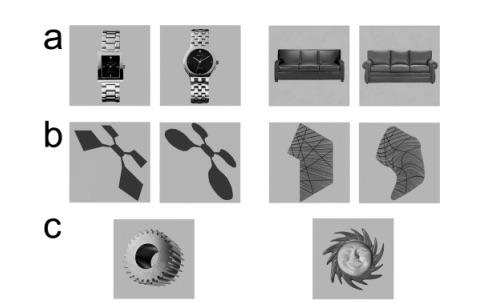 People gave higher “liking” ratings for the objects that had curves. Bar and Neta’s theory was that the sharp and angled images would convey a sense of threat.
Ed Connor and Neeraja Balachander took this idea into a neuro imaging lab. They took an abstract shape similar to the shape on the left in the picture below and then made a series of similar but elongated shapes as shown in the rest of the picture below.

Not only did people prefer the softly rounded shape like the one on the left — there was more brain activity in the visual cortex with shapes that were more curved and more rounded.
We could talk about the problems with red and blue on top of each other, which produces chromostereopsis too. I’ve got another blog post about that.
But from a brain science point of view, the main reason Hillary’s logo is getting a lot of negative comments?: NO CURVES!
If you’re interested in the research I’ve got some references below, and check out 100 MORE Things Every Designer Needs to Know About People the new book which will be out in October of 2015 and is available for pre-order!
What do you think? No curves? Chromostereopsis? Something else?
References:
Bar, M., & Neta, M. (2006). Humans prefer curved visual objects. Psychological Science, 17(8), 645-648.
H. Leder, P.P.L. Tinio, and M. Bar (2011) Emotional valence modulates the preference for curved objects. Perception, 40, 649-655.
Paul J. Silvia and Christopher M. Barona, “Do People Prefer Curved Objects? Angularity, Expertise, and Aesthetic Preference”, Empirical Studies of the Arts 01/2009; 27(1):25-42.


February 24, 2015
Digital Expectations Report From Razorfish
 If you haven’t checked out the new report by Razorfish: DIGITAL DOPAMINE: 2015 GLOBAL DIGITAL MARKETING REPORT, you may want to check it out sooner rather than later. And I’m not just saying that because I’m in it! (The report contains a one page interview I did with one of their staff — page 29). It’s an interesting report based on a survey of 1600 millennials and gen-exers from the US, UK, Brazil, and China, as well as some in-depth interviews.
Here are some of my favorite data points:
“56% of U.S. Millennials say their phone is their most valuable shopping tool in-store compared to just 28% of U.S. Gen Xers.”
“59% of U.S. Millennials use their device to check prices while shopping compared to 41% of U.S. Gen Xers.”
“Advertising is most effective when it is part of a value exchange. Consumers are now aware of how much their attention is worth to marketers, and they expect to be rewarded for it. They look to be compensated with loyalty programs, free content or useful tools that solve problems.’
“Over half of consumers in the U.S. and U.K. and 69% of consumers in China say they do anything they can to avoid seeing ads. What’s more,they’re actively availing themselves of technology to do so, with a majority of TV lovers using a DVR
to skip through ads (U.S.—65%, U.K.—73%, China—81%).” Brazil is the outlier on this one: “Fifty-seven percent of Brazilian consumers endorse TV, radio and print ads as most influential,”
My favorite point is this one: “Seventy-six percent of people in the U.S., 72% in the U.K. and 73% in Brazil say they are more excited when their online purchases arrive in the mail than when they buy things in store.” I have heard the same comments in my behavioral science research. And the reason has to do with the anticipatory centers of the brain. I wrote about this recently in my report “Why You Should Do Behavioral Science Research At Least Once This Year”.
The Razorfish report is comprehensive. I think it’s worthy reading if you design or produce digital products, marketing or advertising.
And don’t forget to check out page 29!
What do you think? Does any of this data surprise you?
February 16, 2015
7 Success Factors For Getting Innovation Going In Your Organization
Do you have innovation initiatives where you work? There are seven critical factors you need in place in order for innovation to start, thrive, and stick. Here’s a short video on the seven factors:
The seven factors are:
1. OK to iterate — The culture has to be tolerant and accepting of trying something out, then adjusting it or withdrawing it and trying something else.
2. The A-Ha! moment – You can’t just teach people an innovation process. They have to have an a-ha moment where they “get it”. You’ve got to engineer training and situations so people have that a-ha moment.
3. Autonomy – People need to have some control over what they innovate and how they do it. You can’t micromanage innovation.
4. Constraints – Although people need some autonomy, they also need some constraints. Research shows that people are MORE creative if they have some constraints they are working within.
5. Top-Down and Bottom-Up – You need both the top and the “in the trenches” people to buy in to innovation. If the push to innovate is coming from top management only, it won’t thrive and stick; likewise if innovation comes from the trenches, but doesn’t have support from above.
6. Trust – Being innovative is being vulnerable. If your corporate culture is one of mis-trust it will be hard to get innovation going.
7. Use innovation to plan the innovation – If you are charged with getting innovation going, start by using innovation techniques and processes to figure out your implementation plan.
What do you think? Have you found these factors to be important in your innovation plans?
February 15, 2015
Growing User Experience In Your Organization
If you are interested in growing the user experience group or capabilities in your organization, then you might want to watch this webinar recording. Jeff Horvath and I discuss five success factors to pay attention to when/if you want to grow UX. The video is an hour long, so get a cup of coffee or tea and settle in!:
Here are the five points for Growing UX that we discuss:
1. It’s a process, not a product
2. It takes great leadership
3. Be flexible
4. Be resourceful
5. It’s a culture thing
What are your challenges and successes you’ve had in growing UX capabilities in your organization?
January 30, 2015
Creative Market’s 10 Must-Read UX Books
I was thrilled to see that 100 Things Every Designer Needs To Know About People made Creative Market’s “10 Must-Read UX Books”.


Check out the book on Amazon if you aren’t familiar with it. Here’s the link to Amazon: 100 Things Every Designer Needs to Know About People.  And you may want to go to Creative Market’s list and see how many of the 10 books you’ve read.


