
Tracy Cooper-Posey's Blog, page 5
April 28, 2024
The Highest Glass Bridge in the World

I came across my notes about this bridge in my notebooks this morning, and paused to study it again.
This is the Zhangjiajie Grand Canyon bridge in China. And yes, it is made out of glass. So as you walk across the very deep canyon, you can see the bottom right through the glass under your feet.

My notebooks contain weird and interesting bits like this, that eventually make their way into stories. For instance, the world’s deadliest and highest mountain pass, the Abano pass in Georgia (right).
I have a pretty good head for heights, but I get a little woozy looking at this pass.
It’s four-wheel drive only, and only wide enough for one car. If you study the image to the left, you can spot a single car on it, down in the bottom right of the image. That will give you a sense of scale.
It is the only way into and out of the parks in the high Caucasus Mountains, and it shuts down in winter (thank you for that, at least!).
The image of the Abano Pass stayed in my notebooks for years. I was dying to put it into a story just because it was so cool.
And eventually, I did.
In my daytime disguise as the fantasy author Taylen Carver, I just released the last book in one of Taylen’s series, and apart from bricking the entire world, I also had the main characters having to drive up and down the Abana Pass.
So much fun. (I also got to use one of my other obsessions, volcanoes. A lot.)
Back to the Zhangjiajie Grand Canyon bridge.
There is a video on YouTube showing people swinging sledge hammers against the glass that is flat-out sick making:
As I said, I’m generally good with heights, but walking across this thing…mmm, I would be tentative, all the way across. No bouncing, no heavy steps….

So, this morning, when I found the entry in my notebooks, I paused and thought about
…and nope, right now, I can’t think of a single story I could put it into. But for sure, one day I will.
Because it’s just too cool and freaky to not find a story for it.
Perhaps I’ll just make a story, wrapped around the bridge, just to have it out there, making readers like you feel as woozy as I do, looking at it.
Enjoy!


April 21, 2024
Where to Find Fantasy Romance

Regardless of which retailer you use to acquire new books, do you shop for books via the categories? Or the search bar?
Often, you know exactly what book you want, and a quick search is good for that. The title has been recommended, or you read a review.
But when you’ve run out of TBR books, or you’re itching for something new and fresh, do you ever browse the categories? Or do you put “fantasy romance” in the search bar and look through the results?
BTW, two quick side tracks, here:
I do not like the sobriquet “Romantasy”I’m trying to get used to it, because everyone seems to be using it. I don’t hate it, but it makes me cringe every time I hear it. “Romantasy” sounds demeaning. It reduces the Fantasy Romance genre down to a cute little name that strips it of dignity.
It’s like calling Robert “Bob”. Robert could run a country. Bob runs away from mad kitties.
The nickname “Romantasy” is demeaning. So I’ll probably hold out, stiff-necked, and continue to call the genre Fantasy Romance, which sounds far more elegant than Romantasy.
There’s a lot of backhistory playing into this, by the way. I’ve been writing and publishing romance for 25 years, and the disdain and derision that I have seen the publishing industry, the media, men, and not a few non-romance-reading women hand out to romance books, readers and writers, has been astronomical.
So anything that tries to diminish the genre is not okay, not for me.
And the second sidebar:
The search bar on Amazon doesn’t workThe search bar on Amazon only appears to work.
The results you get when you do a search will have half a page of “sponsored” results – that is, books that people have paid to have show up in the search results for that phrase you just used.
Then you’ll get a quarter page of listings in “relevance” order…that is, books that Amazon thinks you should see. They will put Kindle Unlimited titles ahead of non KU titles. They will put books that are trending ahead of others…even if that trending book is only tangentially related to what you searched for.
So the chances of a book exactly matching your search phrase, that isn’t in KU, and isn’t a book that Amazon wants to push today, showing up on the first page of search results is extremely thin.

And at the bottom of the first page, you get another bunch of paid-for placements.
And every page of search results beneath page 1 are built the same way.
This is why you can never find anything new and interesting. It’s not because no one is writing the stuff you like. It’s just that most of the time the new and interesting titles are buried so deep, you can only find them if you know the exact title and the name of the author.
And even then, you may not find the book with a direct search. I’ve done direct searches for books with the name of the author included, and the book I was looking for was fifth on the list…underneath the books that Amazon was pushing at me.
I’ve also done direct searches where the title didn’t show up at all, because I didn’t get the author’s name exactly right, or I mistyped a word in the title, but because I didn’t know either the name or the title very well, I just thought the book wasn’t available and moved on. I only found out later that I made a typo.
So just searching on “fantasy romance” or “romantasy” will give you the same tired titles you’ve been seeing everywhere for years.
How to mine a bookstore for ALL the booksI suggest that if your search for new books in a genre doesn’t give you decent results, your next tactic is to browse the categories themselves.
But NOT the best-seller lists.
This is specific to Amazon, by the way. All the other bookstores will let you browse all the books in a category, and they will let you find the categories without hacks and tricks to get to them.
Amazon has two ways of showing you a category. The best seller lists are the ones they prefer to show you. They will give you the best-seller list if you click on a book’s ranking number.
And there are two different sorts of best-seller lists in their top menu, too.
But the best-seller lists are limited to 100 books, most of which are Kindle Unlimited titles because Amazon favours and inflates KU titles over non-KU books.
The hack, here, is to head for the non-best-selling categories; this is the basic catalogue of all books on Amazon, and you can keep clicking for pages and pages, as most categories have hundreds of thousands of books in them.
How to find the browse categoriesHead to Amazon.
Another tip: Even if you prefer to buy your books on a different retailer, you can still window shop on Amazon, especially if your chosen bookstore has a limited list of categories (Kobo) or a stunted search/browsing function (Apple Books), or otherwise won’t let you drill down into a category.
On Amazon, click on the hamburger icon at the top left, just beneath the Amazon logo:

Then choose Kindle E-readers & Books:

Slide down to the second group of options under the “Kindle Store” heading and choose Kindle Books:

On the page that results, click on the little down arrow beside “Categories” on the sub-menu:

Have a look at the categories available there. Theses are the major sub-categories of fiction and non-fiction books on Amazon.
Take note of three of them:
Science Fiction & FantasyLiterature & FictionRomanceWe’ll be coming back here in a minute.
Now click on Romance in that pop-up box.
You’ll get this page:

This is Amazon being deceptive again. If you click on any of the “Popular Romance Categories” you’ll be taken to the best-seller lists, that Amazon manipulates to show you what they want you to see.
The same with the “Featured” lists.
You have to scroll and scroll down the list of options here, passed all the “Kindle Unlimited”, “Audiobooks” and “New Releases” boxes, to reach the pure browsing categories, which are called “Departments”:

Ta-dah!!
You can click on the Fantasy link and on the right, you’ll get a bunch of books that have “Fantasy Romance” listed in their metadata as one of the categories.
But even here, Amazon tries to choke you off. There’s only a dozen books and they’re all “best-sellers” or “relevant” titles. Don’t let “relevent” fool you. It’s not a way of saying these books match the link you just clicked on. It’s purely titles Amazon wants to show you.
You have to scroll down a bit to find the “See All Results” link:

When you click on that, you’ll finally have a list of every book in the Fantasy Romance genres:

There are no sponsored books in this list (i.e. advertising). The list IS sorted from highest rank to lowest, but ranking is essentially meaningless on Amazon because they manipulate the ranks to favor certain books.
But this browse category lets you see every single book in the category.
And there are a lot:

400 pages of results!!
That should keep you busy for a while!
Even more places to find Fantasy RomanceI mentioned that the browse categories include books that have “Fantasy Romance” chosen by their publisher as one of the categories the book fits into.
Publishers and indie authors are permitted to choose three categories where their book will appear.
So if only one of a book’s categories is “Fantasy Romance”, where else might a fantasy romance novel be shelved?
Other categories where Fantasy Romance could be hiding.Remember when I said to pay attention to the major categories in the drop down list?
You can head to this list at any time, and browse any category or sub-category, or sub-sub-category you want.
You can also navigate to the major categories by clicking any parent category at the top of the category you’re currently browsing, in the Departments list:

In this case, you could click on “Romance” and get all the major sub-categories in romance, or if you know you’re done looking at romance for now, you could click on the Kindle eBooks link and go back to all the major subcategories of books in the store.
You can also drill down to sub-sub-categories, if a department has them.
Other categories where Fantasy Romance can be found.Finally, I’m getting to my point! LOL!
Because an indie author or publisher can choose three different categories for their books, they will try to find two other categories that might put them in front of entirely different types of readers, if those categories are appropriate for their book.
And sometimes a book that deserves to be a fantasy romance doesn’t use that category at all.
So it pays to check the other categories where Fantasy Romance hangs out.
Here’s a list of alternative categories. You can navigate to each of them using the links or the drop down box, that I described a moment ago.
Science Fiction & Fantasy-FantasyRomance-Romantic ComedyScience Fiction & Fantasy-Fantasy•RomanticRomance-FantasyScience Fiction & Fantasy-Fantasy•EpicScience Fiction & Fantasy-Fantasy•Paranormal & UrbanRomance-ParanormalRomance-Paranormal•Werewolves & ShiftersScience Fiction & Fantasy-Fantasy•Sword & SorceryTeen & Young Adult-Science Fiction & Fantasy-FantasyLiterature & Fiction-Horror•Dark FantasyRomance-Paranormal•Witches & WizardsRomance-GothicRomance-Paranormal-VampiresScience Fiction & Fantasy-Fantasy•Fairy TalesScience Fiction & Fantasy-Fantasy-New Adult & CollegeScience Fiction & Fantasy-Fantasy•HumorousLiterature & Fiction-Erotica•Romantic EroticaTeen & Young Adult-Science Fiction & Fantasy-Fantasy•EpicScience Fiction & Fantasy-Fantasy•Coming of AgeMystery, Thriller & & ShiftersScience Fiction & Fantasy-Fantasy-Dragons & Mythical CreaturesRomance•Paranormal•Demons & DevilsScience Fiction & Fantasy-Fantasy-Metaphysical & VisionaryScience Fiction & Fantasy-Fantasy•Myths & Legends-Norse & VikingTeen & Young Adult-Science Fiction & Fantasy-Fantasy•Dark FantasyTeen & Young Adult-Romance•paranormal & FantasyLiterature & Fiction-Mythology & Folk Tales-MythologyScience Fiction & Fantasy-Fantasy•Myths & Legends-Greek & RomanRomance-Paranormal-MagicThat’s a lot of other places to find Fantasy Romance!
These are in descending order of relevence – in this case, “relevence” means exactly what it sounds like. The higher up on the list the category is, the more Fantasy Romance titles were found in it, compared to categories further down the list.
While this list is Amazon categories, hunting for a genre in alternative categories works on all book retailers, only they make it much easier to find the browse categories, and they don’t have as many alternative categories.
If those stories use BISAC categories (Google and Apple, for example), you can also browse and search the categories on the BISAC site, and figure out what alternatives might be, before you get to the store itself.
Or, as I’ve mentioned, you can use Amazon to find potential titles, then buy them at your preferred store.
This works for any other romance genre, too.Actually, this works for any other genre, period. There are other places to find a genre you like, beside the main category listing for it. ALL the bookstores allow publishers to choose multiple categories. Barnes & Noble lets an author choose six, and their categories are even more labrynthine than Amazon’s.
And perhaps the genre you like doesn’t have a central category at all, like Paranormal Women’s Fiction, which can be found in a dozen different categories.
Happy hunting!
April 14, 2024
A Most Romantic Sinking

Today, in 1912, and very close to midnight, the RMS Titanic grazed past the iceberg that would eventually sink her, nearly three hours later. Tomorrow will be the 112 anniversary of the sinking of the Titanic.
Most of us have a romanticized perception of the Titanic, thanks to the James Cameron movie. But the Titanic was romanticized long before Cameron told his version of the sinking. The size of the ship (the biggest ever Transatlantic ship made), the pedigree of the passengers, and the tragedy of losing the ship on its maiden voyage all contributed to making the Titanic legend even larger than the ship itself.
There are many equally poignant and interesting sinkings throughout history. Slightly less famous is the sinking of the Edmund Fitzgerald, which was immortalized by Canadian singer-songwriter Gordon Lightfoot, in “The Wreck of the Edmund Fitzgerald.” No one knows for sure what happened to make the ship sink.
I have dived over one of Western Australia’s many famous wrecks, The Batavia, which sank off the coast in 1629, and gave its name to that section of coastline.
Much closer in history, though, was the 1915 sinking of the HMS Lusitania (a sister ship to the Titanic), which was shelled by Germans and sank in 18 minutes, with a loss of 1,198 passengers. The Germans claimed at the time that it was a legitimate act of war as the ship was carrying weapons and materials of war. Recent research has established that this was actually the case, but at the time, the sinking was part of the Casus Belli that the US used to enter the Great War.
The USS Arizona was sunk during the bombing of Pearl Harbour in 1941, while the USS Indianapolis was sunk in 1945, shortly after delivering components of the atomic bombs used upon Japan.
The sinking of the German Wilhelm Gustloff in 1945 by a Soviet Navy submarine, with an estimated loss of about 9,400 people, remains the deadliest maritime disaster ever.
The oldest known wreck is the Dokos shipwreck which has been dated to the second Proto-Hellanic period, 2700–2200 BC. Nothing remains of it now but the clay pots it was carrying, which were discovered by archaeologists in 1979.
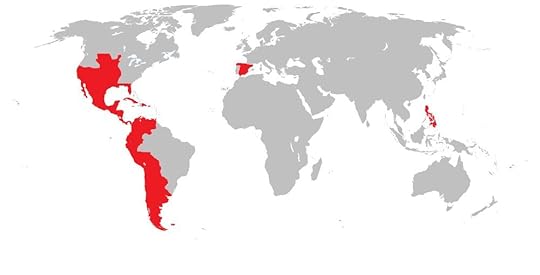 The extent of the Spanish Empire. By Ostiudo – Own work, CC BY-SA 3.0, https://commons.wikimedia.org/w/index...
 The Spanish Empire, from 1566 to 1790, ran a fleet of ships called the Spanish Treasure Fleet, that collected and carried mind-boggling wealth from its American possessions back to Spain.
Over the century and a bit that the fleet operated, there were numerous wrecks and lost ships, yet the fleet is considered to be one of the most efficient and effective transport systems in history.
Peter Benchley, in 1970, was assigned by National Geographic to research and write a story about Bermuda’s history via its shipwrecks. While he was researching, he met a salty old sailor who escorted him to the most famous wrecks around the islands.
That sailor, and his stories about sharks and wrecks, became the inspiration for Quint, when Peter Benchley wrote Jaws a few years later. (Played brilliantly by Robert Shaw in Steven Speilberg’s movie.)
Peter Benchley’s old salt escort also told him about three ships that were all wrecked right on top of each other, and Benchley actually dived over them. Benchley didn’t think anyone would believe that three ships would all settle in the same place, so when he wrote The Deep, he reduced it to two ships. And the older ship, buried beneath the WWII munitions ship and its deadly cargo, was one of the Spanish Treasure ships, that was the real treasure the honeymooning protagonists were looking for.
The 1977 movie, by the way, (currently on Netflix) is fabulous, and in one of life’s interesting twists, Robert Shaw also plays the salty old sailor who shows Jacqueline Bisset and Nick Nolte the way around the double wreck. [And that movie’s theme music is, for me, one of the most evocative pieces of music out there. John Barry, who wrote it, captured the exact sensations and mood of skin diving. The sway of currents, the low-key muffled sounds, the slow rise of bubbles, the washing back and forth of seaweed on the floor of the ocean.]
There are a lot of shipwrecks, and even more ships that have simply gone missing.
Were you aware of any of these wrecks and sinkings?
Yet everyone knows the Titanic story.
What shipwrecks do you know about, that I haven’t listed here? Tell their story in comments.
April 7, 2024
Other Places to Find Good Books: Book Bundlers

This is Part Eight of a series:
Part 1: Kobo
Part 2: Barnes & Noble, Google, Apple Books
Part 3: Ask an AI
Part 4: Smashwords
Part 5: Subscription Services
Part 6: Fiction Apps
Part 7: BookFunnel & StoryOrigin
Book bundles are enormous fun. You get a stack of books for a price that is usually much less than you would pay if you bought each book individually.
Retailers will also bundle books — usually all the books in a series. Google Play and Amazon do this quite well. I bundle books on my store, too. But these are a little different from the bundles I’m talking about today. They usually are not discounted from the full retail. They’re just a convenient way to include all the books of a series or collection into your shopping basket — that doesn’t give you one hefty, parred-down file that clogs up your ereader.
The type of bundles I’m talking about today are a distinctly different way of finding good books. These bundles are not usually available on retail stores, but on their own sites, and that’s the only place where the bundles are available.
StoryBundle.comThe bundles on Storybundle are only available for a short time.
Each bundle is usually put together by a well-known editor or author, who curates the bundle. They invite authors to provide books that fit the theme of the bundle.
You as a a reader can pay what you want for the bundle, with some limitations. Part of the revenue from the bundle goes to a charity, too.
There are not a huge number of bundles available at any one time (three is unusual).
I signed up for StoryBundles’ notification list, so I hear about new bundles when they first go up, as I don’t like to miss out. 
HumbleBundle have a different way of bundling. They have far more bundles available at any one time, and don’t use guest curators.
They also offer a lot of game and software bundles. This influences their book bundles, which have a LitRPG and anime vibe (mostly). But they occasionally put up very interesting bundles, such as (at the moment) a knitting pattern bundle. So it’s worth subscribing to their blog or their newsletter to hear about new bundles.
Their bundles also are short-term.
The Book BundleThis site is UK based, and they have a different approach to bundling. They offer bundles of series by well-known authors, and the bundles are not short-term.
There are a lot of official boxed sets on offer, but they also have collections of books by authors that have not been put into boxed sets.
The other factor that makes them different: They’re selling print bundles, not ebooks.
There are not many bundling services, which is a shame. I love buying bundles of books this way!
Enjoy.
March 31, 2024
It’s Just a Job: Fairies (2024)

An update on a very old post! (As this site goes back twenty years now!) –t.
Fairies, or the Fae, have multiple sources within mythology, and come in a vast range of shapes and sizes, from small pixie-type creatures to human-sized ones, from fair to ugly, to human in guise, to demonic-looking.
Fairies can come with wings or without them, or can choose to display them or not.
There are seal fairies, tree fairies, flower fairies, brownies, and more.
And this buffet of fae species existed even before popular fiction authors began to add to the list.
When it comes to the purpose and work of fairies, then the range again explodes. Some fairies have specific tasks in life: Tooth fairies are one example.
Other fairies move outside human affairs and never mingle, managing their own complex worlds while barely hiding their disdain for humans.
There are fairies who steal children, others who simply steal objects, some who seem bent merely on causing mischief.
Fairies sometimes spend their time doing good: caring for trees and flowers, or animals, or certain humans assigned to them.
And fairies are also good at making war and fighting, when they need to.
Some fairies are seen as essentially harmless and playful, while at the other end of the scale, some fairies can be considered generally malevolent towards humans and far more powerful. These fairies, when roused, make very bad enemies, especially with their good fighting skills.
No matter what type of fairy, however, they all have a common trait: All fairies have supernatural abilities. The types and degree of these powers are dictated by the author, but no fairy goes without at least some magical power.
The vast number and types of fairies to be found in fiction shows how popular they are among readers. Authors keep inventing new twists on old variations and coming up with something unique to delight readers all over again.
I’ve never written about the fae in any of my paranormal or fantasy books…at least, not as Tracy Cooper-Posey.  Under one of my pen names, I have two entire series that feature the fae, among other magical creatures.
Do you have a favourite romance series that features the fae or fairies? What is the most unusual portrayal of fairies that you’ve seen in fiction? Comment below so that other readers can check out your recommendations!
March 24, 2024
More CROSSROADS Blog Tour Dates

I have the rest of the dates for the Crossroads Magic blog tour.

March 25 Fang-tastic Books
March 26 I Smell Sheep
March 27 Lisa’s World of Books
March 28 Roxanne’s Realm
March 29 The Creatively Green Write at Home Mom
April 1 The Book Junkie Reads
April 1 The Bookworm
April 2 Momma Says: To Read or Not to Read
April 2 Sapphyria’s Books
April 3 Westveil Publishing
April 3 Angel’s Book Nook
April 4 Hollies, happiness, and healing
March 21, 2024
Crossroads Magic is out Everywhere…and even more!

It’s out!
Phew…! Crossroads Magic is now available on all retail bookstores and on mine, too. And that’s not all!
Barnes & Noble have picked up the book and will be promoting it on all their Nook devices throughout the end of March and the first half of April.  If you’re a Nook reader, and spot the book on your device, please send me a screenshot!
Plus, I am guesting on a bunch of book blogger sites over the next few weeks, talking about the book.
Here’s the site and dates for this week (and visiting them might give you new sources of information about must-have books, too!);
March 21 Other Worlds of Romance
March 21 Liliyana Shadowlyn
March 22 Kenyan Poet
March 22 Supernatural Central
More dates on Sunday, when this blog gets back to normal schedule.
Here’s more about the book:
I’m just an ordinary, middle-aged woman, and my life is falling apart….When did I become such a cliché? I’m divorced, working a crappy job, living on next to nothing, and wondering how it all went so wrong. Then it goes even more wrong. My grown daughter turns up after not speaking to me for two years, with stunning news of her own, and to cap it off, I’m summoned to a tiny, isolated hamlet in northern New York called Haigton Crossing, where my mother has lived for decades. Haigton Crossing looks like a throwback to another time. For such a small place, it is stuffed full of secrets. The people there are different, including the town’s doctor, Benedict Marcus. And Haigton Crossing is way, way too small to host a murder….
This book is part of the paranormal women’s fiction series, Witchtown Crossing:
1.0: Crossroads Magic
…with more to come!
A Paranormal Women’s Fiction novel.
___
Praise for Crossroads Magic:
Love this new series. Once I started reading, I didn’t want to put it down.
Now I must wait for the next book which is pure torture.
Nice to read about a woman starting over after her daughter has grown.
As I adore everything Tracy writes…I am on cloud nine with the start of a new series.
It was wonderful to read a book about a woman who is closer to my age facing problems that I might actually have.
She explains the sights, sounds and smells in a way that makes you feel like you are there. I am eagerly awaiting the next book in this series!
What a delight! A heroine with some life experience, with real world problems.
A NEW Series From TRACY!!! EEEK!
Tracy’s strong suit in her writing is her character development and knowing when a good twist and turn is needed to further captivate her audience.
An excellent beginning to what promises to be a most intriguing series, Crossroads Magic is a fascinating story in itself, though there are so many different directions this series could take.
__________
Get your copy of HIS PARISIAN MISTRESSMarch 10, 2024
How A Book Gets Published, These Days

My mum is visiting from Australia at the moment. She’s super patient with me, as I’ve got work pouring in from all angles. So she sits in the recliner next to me and reads (my books!), while I work.
Only, yesterday, she put her finger in between her current pages, and looked at me. “How, exactly, do you publish a book?”
It occurs to me that you might not know how that happens, these days, either. So I thought I’d do a brief potted history of how a novel gets published.
In the beginning…Just kidding!
But really, up until around 2007, there was only one way for authors to get their novels published. They had to write their story to match a publisher’s submission requirements. Then, depending upon who they wanted to publish with, they had to find a literary agent, which could take months or years.
Once they had an agent interested in representing them, the agent would then submit their manuscript to the publisher. Or, they could submit their novel directly.
Then (especially at the start of this century) wait for a year or more to get a response.
Once a publisher said yes (which happened about once every few thousand book submissions), a contract was signed between author and publisher, and the publisher’s editor would edit the book, then it was laid out for printing. This printing layout can be printed on normal office paper, which becomes an Advanced Review Copy — which is sent to trade reviewers.
The layout is sent to the printing plant, and the book is printed.
I used to work as a project coordinator for the biggest printing company in North America. I well remember watching magazines and books being printed and it was an awe-inspiring view. Commerical printing presses are huge, taking up entire warehouses.
Once all the forms of a book (batches of pages) have been printed, the book is taken to the binding area, where the forms are put together in the right order, and the spine is glued. The cover is wrapped around the spine.
At this point the book looks nothing like the finished product. The edges of the pages are jagged, and many of them are folds. The cover hangs off the edges. There’s no nice smooth edge on three sides.
The book then goes through “trimming” — the three edges of the book are put through the equivalent of an industrial stretch guillotine. Then the edges are ground down a little, to give them a uniform and smooth appearance and feel. The books are then packed into shipping cartons and shipped to their destination, which is usually a warehouse controlled by the pubisher, where the cartons or individual copies are then sent to bookstores who order them.
Each stage is checked for quality, and wonky copies tossed. But sometimes, quality assurance misses duds, which is why you might occasionally receive a print edition that looks strange, or crooked, or has jagged edges.
Most print runs these days are only a few thousand copies. In their hey days, for their bestselling authors, publishers would print hundreds of thousands of copies or even millions of copies (and that would be a public announcement, too.) It could take up to a month to produce that many copies, too!
Where are ebooks in all this?
Up until the mid-oughts, publishers didn’t bother with ebooks. They wanted (and still want) readers to buy print books, preferably from bookstores, not online.
They only reluctantly sell ebooks these days, simply because readers demand them. If your ebook from a traditional publisher is missing a cover image or has formatting issues, this is why. Ebooks are given scant attention; they’re a secondary product, and an annoyance to the big publishers.
The publishing process for traditionally published authors hasn’t significantly changed since the last century. But response times and release periods have hugely increased. All authors are waiting years for responses, these days.
The birth of ebooksYou might be surprised to learn that Amazon did not invent ebooks. Nor were they the first retail platform to sell ebooks.
I actually got into ebooks from my very first professional novel sale. In 1999, I sold Eyes of a Stranger to Hardshell Word Factory, who sold ebooks only. They sold them on cute 3.5″ floppy disks (remember those?), or by direct download from their website.
There were a small handful of ebook retailers around, but sales were slow because most readers wanted print.
One of my favourites was FictionWise, which had an amazing reward points program that let you earn free books — and I bought and bought to get my freebies (nothing was free, back then). I loved FictionWise and the reward program so much, that when I opened my own store on Stories Rule Press, I bought a plug-in that would let me offer the exact same reward points program.
Then in 2007, Amazon introduced the Kindle reading device, and opened their doors to authors to upload their books directly. This galvanized the popularity of ebooks, and launched the indie publishing industry.
How Indie Authors Publish BooksFor every step that traditional publishers follow to produce a print book and release it, there is an equivalent step that indie authors must take to release their ebook, except that they have no need of literary agents for the publication of ebooks, nor do they have to submit to a publisher for approval. They can publish what they want.
Often, the indie author is doing everything. More usually, an indie author will hire a cover artist and an editor, at the bare minimum. This is what I used to do. These days I have a bit more help, although it’s all family who is helping me, except for my cover artist, Dar Dixon.
First, I plot and then write the first draft of the manuscript, and then put it aside to “chill” for a bit (if I can afford the time). It is at this point, I request a cover from Dar, as she needs time to build it.
Then I go through the manuscript three or four times, cleaning up my prose, fixing scenes, killing typos wherever I spot them, and cleaning up the basic formatting of the book. I do this in Microsoft Word. Other indie authors might use Scrivener, or other writing-specific text editors and programs. Word works for me, as all the other programs I use to produce a book need a Word file to import the text. So I start where I will end up.
Once I have cleaned up the book as much as possible, and straightened up the formatting, it goes off to the editor. Getting the formatting right at this stage is important, because all the styles are imported into the applications used in the next stages — if the formatting is screwy, it makes for a disaster at the next stage, and a lot of work to fix everything.
While the book is being edited, I use the clean, unedited version of the manuscript to create a “master file” — this is another Word file that contains everything you see inside an ebooks — title pages, content pages, descriptions, about the author, acknowledgements and dedications, lists of other books by the author, and, most important!, a link to the next book in the series (if there is one yet).
This is where the formatting (heading fonts, sizes, alignments, justification, etc.) are all finalized to what should appear in the book.
The Master file is then put through a formatting application (I use Jutoh. There are others.) The app produces ePubs and Mobis. And the cleaner the master file, the less troublesome is the compiling to ebooks.
The ebooks, along with high definition covers, and the book description, are uploaded everywhere I sell ebooks — Amazon, Apple, Barnes & Noble, Draft2Digital (who in turn distribute to a dozen other bookstores, including Smashwords, Hoopla, etc), Google Play Books, Kobo (who distribute to Overdrive for libraries, and also put the books into their subscription program, Kobo Plus). And finally, I upload copies to BookFunnel, who provide those copies to anyone who buys books directly from me.
Once the original Word file has been edited, I go through the edits and accept or reject them (the editor is not always right!), and make any extended changes that might be necessary, or that the editor has suggested that I think would make a better book.
This usually happens several weeks after the book has gone up for pre-order.
Once I have a “final” edited Word file of the book, the text is inserted into the Master file, replacing the unedited version. The Master file is again put through the formatting application to produce final ebooks, which are once more uploaded to all retailers.
And now that there is a final, edited master file, the print edition can be laid out.
I do this myself, because I’ve been trained for it, but many indie authors hire print formatters to do it for them. Many also use programs like Vellum that will automatically make print PDFs. But I’m a touch rebellious and like my print editions the way I like them (blame my print coordinator experience), so I use a desktop publishing program to lay out print editions by hand, where I can control all aspects of the layout.
Once the interior of the book is laid out to everyone’s satisfaction, a print PDF is created. And because we now know how many pages will be in the interior, the cover wrap can have its spine adjusted to exactly match the width of the page count, and is put into a print quality PDF, too.
These two files (cover PDF and interior PDF) are both uploaded to the dashboards of retailers who print books “on demand”. That is, they don’t print in batches. They print a copy when someone buys it. They print just one copy, which is possible only because of electronics and smart technology.
These POD printing presses are at least half the size of the traditional presses I used to work with. Some are even smaller than that (although they’re slower at producing a book, too). I’ve seen a POD press that fitted inside an average room! It was cute as hell to my giant-press-trained eyes!
At the moment, the POD presses/retailers we use are Amazon, Barnes & Noble and a printing company called BookVault, who print and send you the books you buy directly from us on Stories Rule Press. There are other POD companies; you might have heard of Ingram Spark, and there is one called Lulu Press that is also reputable.
All this postproduction work (that is, everything that happens after I write ‘the end’ in my first draft) has to be scheduled to take place at least a few weeks before the official release day so that the retailers don’t get stroppy, and so the street team have time to read their copies in order to leave a review on release day.
Postproduction happens while I’m writing the next book.I don’t stop writing new stories just to get the last book published. Postproduction all happens while I’m writing the next book. I chop up my day into sections, or buckets. One bucket of time I use to write the first draft of the next book. And another bucket of time is devoted to all postproduction activities. Another is for marketing.
I might have four or five books in different stages of postproduction at any one time. And while a book is in postproduction, the earliest marketing tasks take place, too.
I sometimes think it was fate that let me get the job as a print coordinator, and a job before that as an magazine advertising coordinator, and a job after that as a magazine editor…all the day jobs I’ve ever had have given me skills and experience to be able to produce my own books, while other indies must hire experts to do the work for them.
But that is how a book is published, these days.
Does the process match what you thought it would be like?
March 3, 2024
Other Places to Find Good Books: BookFunnel/StoryOrigin

This is Part Seven of a series:
Part 1: Kobo
Part 2: Barnes & Noble, Google, Apple Books
Part 3: Ask an AI
Part 4: Smashwords
Part 5: Subscription Services
Part 6: Fiction Apps
I suspect that many readers are familiar with acquiring books via BookFunnel promos. StoryOrigin is similar. Authors collectively provide a book each, sometimes more than one, for a group promotion. A landing page is built with all the books in the promotion on it. Then each author in the promotion tells their readers about the promotion and sends readers to the landing page, where readers can pick which books appeal to them from all the authors’ books arrayed on the landing page.
Group promotions like this come in two flavors.
There are giveaways, where all the books are free. Often, you have to agree to be subscribed to the author’s email list to get the free book.
The other type of group promo is the sales promo; the books offered on the landing page will lead you to your preferred retail store or, sometimes, the author’s direct sales store, where you buy the book.
Sales promos don’t collect email addresses. In addition, the books in the group promo may or may not be discounted in some way.
Discounts can be dictated by the coordinator. In this case, the authors can only participate if they discount their title by the amount the coordinator demands. This is often reflected in the title of the promotion, for example: “99c Historical Romance Sale”.
If the coordinator hasn’t set a discount criterion, the individual authors can set their own. I nearly always provided a 15% or 20% discount coupon code for every book I put into a sales promo, for example.
Sometimes, the only way to learn about a book’s discount is to click on the book’s cover and check the landing page that opens up, where the author will announce any discounts.
What Group Promos are Good ForGroup promos such as BookFunnel and StoryOrigin are great for discovering new-to-you authors and new titles from favourite authors, because each promo only has a few to a few dozen books in it, so you’re not overwhelmed by hundreds of titles the way you can be on retail sites.
Plus, the discounts that authors and promos provide via these group promos are often only available via the promos.
And the books that are given away in the group promos are sometimes only available for purchse, elsewhere.
So there are some exclusive opportunities available for readers!
How to find these promosIf you are subscribed to the email list of an author who participates in BookFunnel or StoryOrigin promos, then the author will provide news about new promos in an email. If none of the authors you follow do these group promos, you can instead watch on social media for authors who publicly announce their promotions.
You might find some current promotions mentioned on social media, too.
Another way to learn about group promotions is to ask other readers if they know of any, and to share their link.
Once you have signed up for an author’s email list via a group promotion, you will hear about future promotions that author participates in, that you can browse, buy, and download.
February 26, 2024
It’s Just A Job–Wood Elves (2024)
An update on the 2011 post

Elves as they appear in modern fantasy fiction were plucked from Norse mythology, where there were High and Dark Elves, and the Dark Elves were the forerunners of Dwarves as we know them in fantasy fiction.
But Wood Elves were not part of Norse mythology. They have evolved from the light and dark Norse elves and become their own special species.
There are five groups of wood elves that are perhaps more well known than any others in modern fiction, as listed by Wikipedia:
Silvan Elves – a fictional race in J.R.R. Tolkien’s Middle-earth of northern Mirkwood and Lothlórien.Wood Elves (Warhammer) – a fictional race in the Warhammer universe.EverQuest – a player character race in the video game series, similar to those of Tolkien’s fiction.Wood Elves is a playable character in the game SacredWood Elves are also found in The Elder Scrolls series, known as Bosmers.
Certainly one of the best-known wood elves, thanks to the popularity of movies, would be Legolas, from the The Lord of the Rings trilogy of movies, who was a prince of the Mirkwood Realm.
In general, drawing from similar traits across all the fictional universes, Wood Elves are similar to High Elves. They are a slender, tall and noble, with pale skin and often pointed ears. Wood elves live in deep forests and are guardians of the natural world. They work with trees and try not to damage natural forestation. Wood elves are extremely agile. Their main method of attack is the bow, but they will use hand-to-hand fighting. Wood elves like to use stealth as there are fewer of them compared to the High Elves and Dark Elves. Wood Elves prefer not to wear armour, as this allows them to move more rapidly through forests. They tend to wear fabrics in greens and browns to blend with their surroundings.
As I write this, there are no novels I could find using advanced search tools that specifically feature wood elves, on either Ellora’s Cave, or indie-published.
If you know of any, please let me know via comments.


