Andy Burnham's Blog, page 227
July 31, 2019
Hengistbury Head
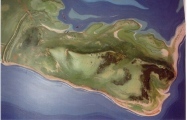
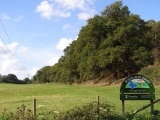
Performing the Past, Monday 5 August to Friday 9th August, Walk and Art/Craft Events at the new Hengistbury Head visitor centre. Evidence of a very long period of occupation with evidence of palaeolithic and mesolithic hunters, 13 Bronze Age barrows and an Iron Age promontory fort in Dorset. Numerous finds particularly from the period after 7th century BC when the area became a major port trading with Gaul and the Mediterranean.
Published on July 31, 2019 14:37
Buckland Rings
Video Talk: Will Buckland Rings Reveal its secrets? Josie Hagan, Bournemouth University, and various other New Forest related talks, from the New Forest Knowledge Conference 2017. Buckland Rings, a Scheduled Ancient Monument on the outskirts of Lymington, has impressive earthworks comprising three banks or ramparts and two ditches enclosing a rectangular area of about 4.5 hectares. The ramparts and ditches are substantially complete except on the east side, where in the 18th century, a farmer levelled the banks to gain easier access to the interior. The only original entrance was on this side and traces of it are still visible to the trained eye.
Published on July 31, 2019 11:28
July 28, 2019
Ydby Hede Barrow Cemetery
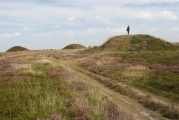
Prof Susan Oosthuizen: Alignments of Bronze Age barrows in prehistoric Jutland were used to guide transhumant (nomadic) herds making their way between settlements & far-distant pastures, and as statements of common rights to specific areas of grazing. More in the comments on our page. This Oldtidskirkegården or 'old graveyard' is a collection of 32 barrows from the Bronze Age. It is the largest surviving cluster of large mounds in Denmark. In the nearby Dover Plantation, a reforestation area, there are 14 round and two long barrows. On the other side of Boddum Bæke, a stream valley, there are another 12 barrows.
Published on July 28, 2019 05:40
Necrópolis Megalitica de Panoria
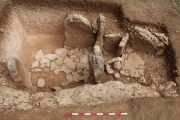
The megalithic necropolis of Panoria was discovered in 2012. It consists of at least 19 graves, all are essentially polygonal or rectangular burial chambers built with large stone slabs that are accessible via short and narrow aisles. 5 of these were excavated in 2015 by the GEA Research Group (Department of Prehistory and Archeology at the University of Granada).
Published on July 28, 2019 05:38
Las Tascas Cromlech
Published on July 28, 2019 05:34
Lady Cross (Egton Low Moor)
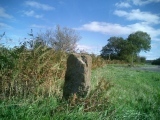
A wayside cross in North Yorkshire which marked an old route, which bears no semblance to modern routes. The south face has what is supposed to be undecipherable mirror writing on it, and the north face still has some discernible text.
Published on July 28, 2019 05:31
Torhousekie stone circle
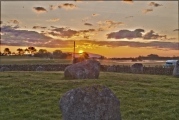
Photo by Energyman: First Gleam on the 7th July 04:10 on an alignment with 3 stones. . One of the most easily accessible and yet most complete stones circles in Britain. This is a wonderful site consisting of a ring 19 stones surrounding 3 in the centre. A row of three stones can be seen on a hillock on the opposite side of the road. It is very reminiscent of Castlerigg, but on a smaller scale with the stones all graded in height with the tallest to the south-east. A number of the stones have large chunks of quartz embedded into them.
Published on July 28, 2019 05:27
Thor's Stone
Prof. Howard Williams visits Thors Stone on Thurstaston Common - more in the comments. A large natural outcrop, and the highest point on the Wirral. Gives it's name to nearby Thurstaston.
Published on July 28, 2019 03:40
July 23, 2019
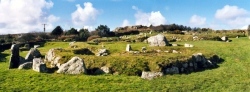
Carn Euny Village
The remains of an Iron Age settlement, with foundations of stone huts and an intriguing curved underground passage, or fogou. 1.5 miles southwest of Sancreed off the A30, then an extremely narrow single-track lane. Park and walk a short distance uphill.
Published on July 23, 2019 14:36
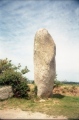
Lannoulouarn Alignement de Menhirs
A group of 4 menhirs, of which only one stands today, almost 6 metres in height. There were once many other menhirs, a dolmen and polissoir here too.
Published on July 23, 2019 14:36