Hûw Steer's Blog, page 11
February 11, 2024
Under Siege
I’m incredibly excited for this afternoon, because I’ve managed to orchestrate a medieval siege. (In Dungeons and Dragons. But still.)
I spent last weekend with my parents, ostensibly for the purpose of getting rid of a load of old stuff I didn’t need so there was space in my room for the old stuff I do need. The main thing I jettisoned were my old university notes, which I’d kept in the vain hope that one day I would need to refer to them. (Of course I never have, and if I do ever need to look up a topic I studied I can just consult all the lecture reading lists and the many gigabytes of articles that I’ve still got saved digitally. And I’ve kept the essays and important stuff like that too.)
But what I did keep, weirdly enough, were some books from my GCSEs – which definitely weren’t 13 years ago, how dare you – because thanks to the vagaries of different exam boards, I actually got to study interesting things back then. No 20th-century politics for me – we got the history of medicine, cowboys, and a local history project. And for a school in the old Welsh Marches, that could only mean one thing. Castles.
There are more castles on the Welsh border with England than there are anywhere else in the world, because my ancestors were professionally irritating – which meant that we as students got to spend many glorious hours studying and visiting them. Ludlow Castle was our nearest one, and is still a favourite: I worked festivals there, saw plays, wandered endlessly within its high stone walls. It’s even where I got my sword, and in unreleased fiction I have both besieged and blown it up. But there were many more within easy reach: Chepstow, Eastnor (even though it’s not really a castle), Clun, the list goes on.
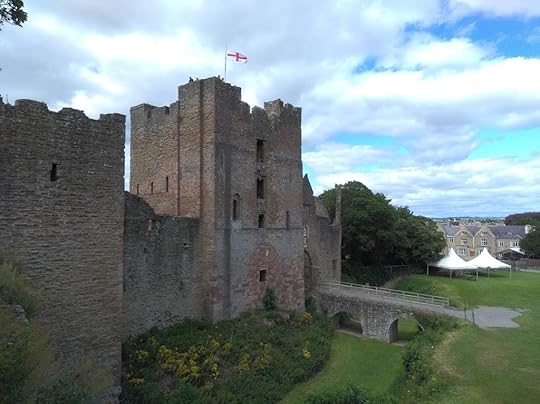 The inner bailey of Ludlow Castle, 2017.
And so I have studied them all. I learned all the intricacies of mottes, baileys and keeps; the benefits of different tower shapes, how to defend a wall-top, what a machicolation is and what it’s for. Arrow- and rifle-slits, volley fire, the list goes on – but not before mentioning my favourite feature, the batter, which is the angled bit at the bottom of a wall that lets you safely drop rocks off the top and have them bounce into an attacker’s face. At college I studied some seriously big sieges in the Crusades – most notably Antioch – and how a vast army can be stymied by something as simple as a big wall. And in more recent years an awful lot of Sharpe has taught me how a siege changes when you can blow stuff up.
And, y’know. Helm’s Deep has lived in my head in its entirety for decades now.
So when, in our last DnD session, our characters managed to infiltrate and steal a small fort from under our enemies’ nose, when we realised that we could now hold this fort against our enemies when they came back… I just started talking. For about 5 uninterrupted minutes. I ordered trenches dug, barricades built; I deployed the magicians and archers high and the heavy hitters at the front, with multiple fallback positions and chokepoints so we can make the bad guys pay for every inch of ground we give. I painted hidden range markers for our various bows and spells and scattered them in the open ground. I drew two maps.
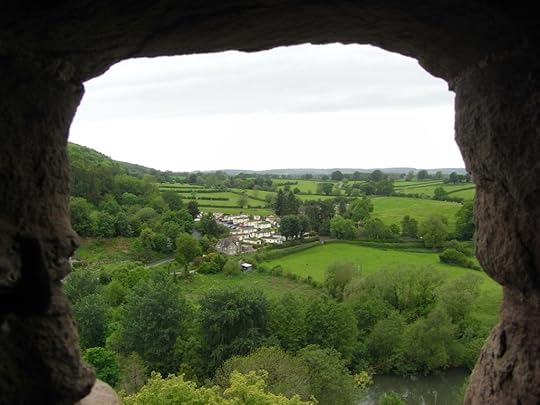 They’ve really gotten sloppy at Ludlow; get rid of all those trees, your sight-lines are awful!
And this was all in character, mind; Sir Geoffrey is a former soldier with siege training and experience. He knows what he’s doing… because I’ve studied all this for years and I think I know what I’m doing, and Geof is, when you take away all the fictional life experiences, an extremely silly version of me at his core.
When I’d finished talking, I looked around the group, somewhat embarrassed, and asked if anyone minded awfully if we had a go at this obscenely detailed plan. And because my friends are the best, and because, as our game master admitted, I did seem to know what I was talking about both in and out of character, they gave an enthusiastic yes.
Quietly, our GM told me that my eyes lit up like a kid at Christmas, and they could all tell it meant a lot to me. So thanks, guys.
Now I just have to hope that I do vaguely know what I’m talking about and am not about to get all our characters killed. We’re about to find out…


February 4, 2024
Review – Analog Science Fiction & Fact, Jan/Feb 2024
Wow, it really has been a while since I wrote any proper book reviews, hasn’t it? The Riftwar Re-Read took it out of me. But what better way to start again than with something very recent, and relevant: the latest issue of Analog Science Fiction & Fact?
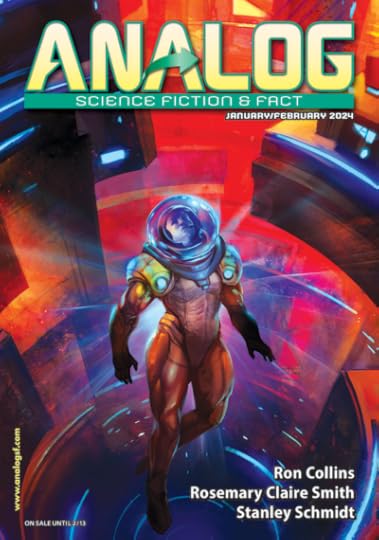
This is my first full issue of Analog, and it’s a pleasantly chunky thing, absolutely packed with content – 21 stories and poems of various lengths as well as 4 beefy factual pieces. I will confess that much of the hard science went straight over my head, though there were some interesting bits and pieces. New supercolliders! Microbial ‘soft cities’! Moon habitat stuff!
But I’m here for the sci-fi, so let’s get cracking on that.
As I just mentioned, 21 stories! Many were excellent, all were at least good, though some didn’t land so well for me. I’m not going to review every single one, and not in detail, but I thought I’d briefly go through some of my favourites. Because there were some great pieces in there.
‘Kagari’ by Ron Collins was a fantastic start to the magazine. We’re dropped, to my initial surprise and delight, straight into a fantasy story, where a society of medieval-ish bird-people are celebrating their prince’s coming of age, in a high mountain aerie overlooking the strange soil of an alien world. The prince, Rythane, is conflicted; his high position in a caste-based society is breaking his relationships and forcing him to grow up much too fast.
And then “a small, featherless creature”, “a wild avatar of the Sky Gods”, is brought to him, and Rythane begins to learn that the universe is a much bigger place than he had realised.
Collins conjures a beautiful world here. An alien culture of alien beings is deftly realised with barely any exposition, and Rythane is a genuinely sympathetic character. It’s a fine writer who can turn the ‘human explorer in an alien society’ trope on its head so well, and to make the token human character feel so alien in their own right, so well constructed is the rest of the world. A very good start indeed.
Next of note for me was ‘Homesick’ by H.A.B. Wilt, which takes the form of an interview with an astronaut in the wake of a Gravity-style orbital debris crisis. It’s a short piece, but elegant and highly emotional: this is an astronaut confronting the fact that she’s never going to be an astronaut again. But the optimism of it all regardless – the idea that the human drive to explore will never be fully quenched – was briefly, but beautifully, presented.
In a break from the science fiction, ‘Microbes, Interstellar Travel, and Protocells: A Conversation with Dr. Rachel Armstrong’ was an interesting read. Again, a lot of the scientific minutia whistled over this ancient historian’s head at great speed, but the idea of microbial ‘soft cities’ and the complexity of their natural systems, as well as some of Armstrong’s concepts for the applications of microbial technology in a more sustainable future, was rather intriguing. (I’m almost certainly going to misappropriate the ‘soft city’ concept for a short story some day, so thank you, Rachel…)
Back to the sci-fi: ‘Song of Nyx’ by Sam W. Pisciotta was a really inventive piece. A marine biologist with brain implants is taking dictation for the last surviving humpback whale. The story has a nice arc contrasting the biologist’s own personal problems with the loneliness of Nyx, the last whale, but it was the concept of whale mythology that grabbed me: the idea that these majestic creatures with their enormous brains are fully sentient, with their own creation myths, their own stories, which we simply can’t understand the telling of. I hope it’s true, which is about as fine a bit of praise I can give a piece of speculative fiction.
Then there was ‘Tepid War’ by Jay Werkheiser, which very much appealed to my dark sense of humour. It’s a perfectly ordinary business story, with some tech company employees trying to get the edge on their competition while dealing with some inter-team friction. Except that this is a world at war, with the US, Russia and China throwing high-tech drones at one another in the streets of San Francisco and beyond… and nobody bats an eyelid. Thanks to guided smart bullets and seriously advanced surveillance tech, this war can be waged above civilian heads with no civilian casualties whatsoever. It’s a very clever bit of background worldbuilding: the core business story is related to the war but didn’t have to be. The characters proceed about their daily lives, completely ignoring the robotic battles happening right in front of them. It’s a masterful bit of writing when a character is more worried about being late for a Zoom meeting than about the drone exploding outside his bedroom window. I liked this one a lot.
And then there’s the last story in the magazine, right at the back… ‘A Vintage Atmosphere’ by Hûw Steer. A farmer brings in his oxygen harvest from fields of lichen and algae, before a disaster at his local space marketplace throws him into a thick of the action he’d rather avoid.
Now I haven’t read through this story properly since I wrote it. And I’ve certainly not read it as a ‘reader’, divorced from the writing and editing perspective. So I approached this with a little trepidation.
And, honestly? It’s alright. I think the core concept of farming oxygen holds up, and I like how I extended the concept to the market, to the people who need to buy oxygen for space travel and habitats and what their particular tastes might be. I definitely waffled too much near the beginning in particular; there were a good few hundred words that I could have cut, and I kept wincing as I unnecessarily repeated turns of phrase in close-together sentences. But overall it’s still a decent story: it’s got some drama, some rise and fall, and I’m still proud of the worldbuilding. Not the best story in the magazine, but not the worst either, I reckon.
There we go. I’m seriously considering subscribing to Analog myself now: I rather like the idea of new short SF arriving every other month. And I will admit a selfish desire to keep an eye on the letters section at the back, in case anyone has anything to say about ‘A Vintage Atmosphere’…
January 28, 2024
What I’m Reading – January 2024 Edition
2 RPG sessions and a TBRCon panel down, but I’m still not done; I’m off to sing for the BBC today, so this morning I blog at speed. And so instead of talking about what I’m writing, I thought I’d share the current list of what I’m reading. It’s been Christmas, after all, and so a small stack of tomes awaits my attention. (Though when doesn’t it?)
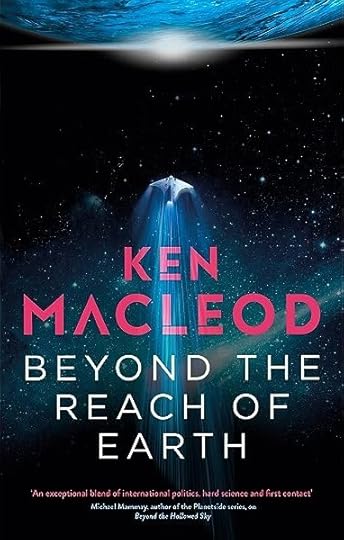
Ken MacLeod – The Lightspeed Trilogy
I’ve liked Ken MacLeod since I was a teenager, when my old English teacher donated a chunk of his own bookshelf to the school library, including the Engines of Light trilogy. While a lot of the socialist themes went rather over my head as a kid, subsequent re-reads have absolutely held up, and so when I spotted the first book of a brand-new trilogy just after my birthday last year I snapped it up straight away.
A new future, where new national conglomerates are already scrapping over the Earth before someone comes up with (a very cool spin on) FTL travel and expands their reach to new stars, is magnificently explored. You’ve got humanoid robots who don’t know they’re robots, an omnipresent AI that might not have all your best interests at heart – and, as is MacLeod’s custom, a vision of a future, socialist Scotland that confronts this new future head-on. I’ve got book 2, Beyond the Reach of the Earth, sitting waiting on the pile.
Christopher Paolini – Murtagh
Oh, I do love the Eragon books. This is another fixture of my childhood; I devoured each book as soon as it came out, absolutely loving the classic hero’s journey of Eragon and the dragon Saphira, and the vast world that span out of that core tale over the course of four hefty books. I was picking up sample chapters of Inheritance months before the final book came out (which gave me an early glimpse of just how much can be rewritten during the editing process, as none of those chapters or their implied plot threads ended up in the finished product). It was a staple epic of my youth. The short stories of The Fork, The Witch and The Worm were a pleasant surprise a few years ago – but not half as much as seeing the truly massive tome that is Murtagh, the novella accidentally turned standalone sequel to the original 4 books.
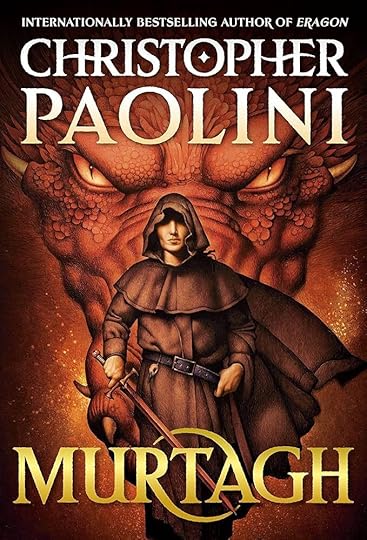
And, come on. Murtagh was always cool. Yes, he was a bit of an edgelord, but you can’t not love a hard-bitten mercenary with an unexpectedly dark past, coming to terms with the new world he reluctantly helped create with his Darth Vader-esque turn to the light at the end of the original series.
(Also, I love how the image of Murtagh’s dragon Thorn on the cover is the very same one as on Eldest, his first appearance).
The only reason I’m not halfway through this book already is because it’s way too big to carry to work every day…
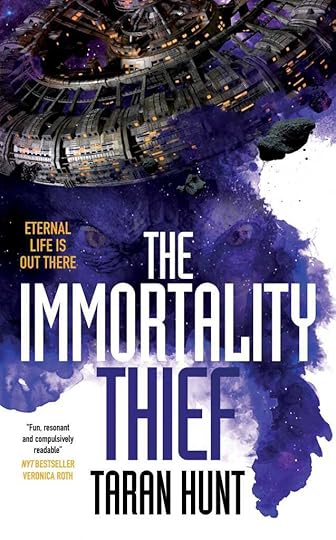
Taran Hunt – The Immortality Thief
Having discussed worldbuilding at length with a panel of excellent authors, I’m trying to catch up with the books they were discussing, and next on the list after Marina J. Lostetter’s Noumenon is The Immortality Thief by Taran Hunt. I’m only a little way in, but it appears to be, at its core, a space heist – which is definitely good material even without the themes of far-future archaeology, sinister aliens and a crew of thieves whose hearts may not be as golden as they try to pretend.
Analog Magazine
And then there’s the latest issue of Analog, which is proving to be a bloody good read so far. Some very informative factual bits and bobs, and a particular highlight is the royal court of a magnificent species of birdlike aliens and their contact with human explorers in Ron Collins’ ‘Kagari’. I’ll do a proper review of this later, I think, especially when I get to the last story; the author’s name is familiar somehow…
January 23, 2024
TBRCon 2024 – Sci-Fi Worldbuilding Panel Link
At the time of writing, I’m on in 15 minutes. If you’d like to join me, or catch up after the fact, here’s the video link.
January 21, 2024
Stage Fright
In many forms and many places, I’ve done my fair share of performing. And I’ve done enough now to be able to basically academically document my own form of stage fright. I know exactly how I get anxious before a show of any kind – which doesn’t stop me getting anxious, of course, but it at least means that I’m consistent enough to manage myself.
Since the long-gone days of my teenage band, I got to observe variations of stage fright. Our bassist would get nervous the day before a gig and then be completely relaxed, our guitarist would be fine up until about half an hour beforehand and suddenly get the shakes, and our drummer would be utterly chilled until halfway through the first song, when he would suddenly realise that we were in fact onstage and not just jamming in his parents’ spare room.
And then there was me. My stage fright methods carried me through all that music and through four years of plays and comedy at university, and of course only got worse as I ended up directing some of the stuff I was performing. I was around a whole new group of people who coped with nerves in different ways; we were adults now, so we could have a pint to settle ourselves if we chose, and many of us did.
Not me. Never me. I’ve never taken to the stage anything but cold sober, because I spend the day of a show – pretty much from waking up, through all the setup, the soundchecks, the rehearsals, the waiting – being absolutely insufferable with nerves. I pace, I run lines – and when I’m directing I force other people to do the same endlessly, for which I apologise to three generations of comedians – I check props, I micromanage absolutely everything I possibly can to distract myself from the crippling fear of what I’m about to do.
This was something that did reduce a bit with repeated performances, like runs at the Edinburgh Fringe, but it never went away. And thankfully when I’ve been onstage with Ready Singer One of late it’s a largely absent fear – being part of the Great Entity that is a choir of 40-80 people does wonders for one’s individual nerves. But it’s still there a bit.
And when I have to go solo – when I’m running an RPG session, which I’m doing twice this week, or when I’m doing a TBRCon panel this Tuesday with a bunch of significantly more accomplished authors and feeling very much like a small fish in a very big pond – then it all comes flooding straight back. I’ve got a lot on this week: the aforementioned two RPG sessions, the panel, and a concert on Sunday with BBC Sounds; and it is very much fair to say that I’m pretty bloody nervous.
But it’ll be fine. I know it’ll be fine. Because the other thing about my stage fright, the important thing, is that the moment I step onstage – the moment the first note is played, the moment I open my mouth to speak, the moment I actually start to perform…
Then, it all just washes away. The nerves vanish like they were never there, and I’m absolutely in my element. Because for all that it ruins my nerves on a regular basis, for all the controlled panic beforehand, and no matter what form it takes, I love performing like nothing else in the world.
See you on Tuesday. Unless you’re in my RPG group or my choir, in which case you have your own dates.
January 14, 2024
TBRCon 2024
If you’ve been reading this blog for a while, you know that in-between actually showing you stuff I’ve written, I spend much of my time rambling about aspects of writing: character, worldbuilding, description, all that sort of thing. It seems to be interesting to you lot, and it’s good for me to actually get my thoughts down on (virtual) paper. When you’re stuck on something or there’s an idea that’s almost there, writing about it can be what tips the balance and makes it fully realisable.
But I don’t spend a lot of time actually talking about this stuff. I’ve done a few interviews to chat about books I’ve written but mostly they’re in text. And it’s not like I’m in high demand on the TV circuit or anything – I’m a writer, I write things down. It would be a significant event to catch me actually talking live about the craft and all that jazz.
Well.
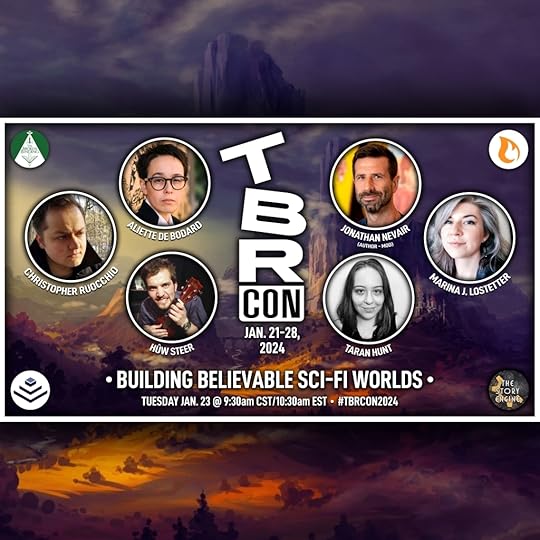 I need to actually send people my updated author photo…
That event is TBRCon 2024, hosted by FanFiAddict on the 23rd of January, and I’m on the ‘Building Believable Sci-Fi Worlds’ panel! This is, I suppose, a positive indictment of Ad Luna and my SF short stories; at least one of them must be sufficiently believable. Which given Ad Luna is about space elves and their giant bird friends on the Moon, is… interesting.
But yes: I’m going to be talking, with other human authors, about worldbuilding and sci-fi, which is honestly brilliant. It’s one of my favourite topics to ramble about, and for the sake of maintaining most of my friendships I don’t tend to ramble about it much in person. (Except for some of you poor people. You know who you are.) There’s so much I can dig into with just about my own work, and there are 5 other excellent authors on the panel with me! We have:
Christopher RuocchioAliette de BodardJonathan NevairTaran HuntMarina J. LostetterAnd meRather intimidating authors, honestly. All of them have written some extremely well-received books (which I’m trying to read a bunch of in time for the panel…). Some of them have Wikipedia articles. And I am also there, with my handful of shorts and one very, very weird published SF book. The whole TBRCon lineup is pretty stacked – Adrian Tchaikovsky! Mark Lawrence! – and I’m feeling rather like a very small fish in a very big pond.
But it’s going to be a lot of fun. I’m excited to get to discuss my favourite things with some excellent contemporaries, and if you want to watch too you can tune in to the panel on Tuesday the 23rd at 3.30pm UK time. (Or you can watch the recording too – I’ll post it on here probably.) The con itself starts on Sunday the 21st and runs all week – everything’s live-streamed and free, and there are some really cool panels on the lineup that I’m going to do my best to attend in-between work and all that jazz.
So yeah. I’m on a panel. It’s going to be fun. Come watch.
January 7, 2024
A Fresh Start
So this is the weird few weeks where I’ve not really got much to talk about, writing-wise, because I’ve only just gotten started with the year. And unlike last year, I’ve not currently got a massive novel manuscript on the go.
It’s… weird. Really weird. I’ve been writing Boiling Seas stuff for so long now, and even when I took breaks before to write shorts or children’s books or what-have-you, the manuscript always loomed before me, unfinished, waiting. And obviously it’s still not finished, because I’ve got all the editing to do – a process that will probably be far more time-consuming than the writing of the whole thing – but it looms in a different way now. Still there, still a huge thing on the horizon, but a little further away. A little less urgent. It’s nice.
So: how am I spending my Boiling Seas sabbatical so far? Well for starters, I’m writing up the session #2 material for my semi-homebrewed Warhammer 40k RPG campaign, which my players have been very patiently waiting for for months now. I have a plan, I have a plot coming together, as well as a bit of a ‘hub level’ for them to wander around, which was accidental but I think will add a little more flavour to the whole experience – and flavour, in stories like these, is everything. There is now an orangutan. Don’t ask questions.
It’s second-person writing, too, which is always an interesting challenge. I sit there and tell the story – thought it’s not like I’m just reading big chunks of prose while the players just sit there. For all that I’ll spend hours writing thousands of words, I’ll barely actually read any of them. This writing down is an exercise in getting the structure of the story and how it might go out of my head so I can tinker with it – and then when we actually play, I’ll throw half of that plan away and use the rest of the prose as notes to bounce my players off.
All I need to do now is finish the story bit, then figure out the rules for stealth combat and draw up some level designs…
But my progress was stalled by an unexpected blockage. Well, I say blockage: I got distracted by another idea. I rediscovered (thanks to the excellent Tom Scott’s excellent newsletter) NASA’s Astronomy Picture Of The Day website, which of course meant that the other day I stumbled across a very interesting astronomical phenomenon I’d never heard of before. And now, of course, I’m writing a story based around it. In the same vein as a few of my other SF pieces (I had to stop myself spoiling an upcoming release there), it’s basically taking some real science and mashing it into a completely different scenario. Like oxygen production and farming, for instance.
Not telling you what the phenomenon is yet. Have a look through the last week or so of pictures and see if you can figure it out.
That’s me for the next few weeks sorted, anyway. I’ll let you know how I’m getting on when it’s done. But for now, it’s a few small things, before the monolith begins to loom again.
December 31, 2023
Resolutions: 2024 Edition
It’s that time of year again – let’s look at what I did this year, what I didn’t do, and what I want to achieve next year. In writing, I mean. Not just life. You don’t need me to ramble about that.
It’s been a pretty good year, all things considered. After an empty 2022, I had four short stories published this year, and two more picked up for publication next year into the bargain. In particular, A Vintage Atmosphere is a big feather in my cap. I’m in Analog – a magazine approaching 100 years old, one of the biggest in the SF&F industry. I’m not resting on my laurels by any means but it shows that I’ve come a lot further in the last year and a bit – my time as a ‘proper’ author, as I’ve been thinking of it – than I first thought. So that’s good.
In the long-form arena… yeah. Writing – well, concluding – a trilogy is a lot harder than I thought it would be. Boiling Seas 3 is not, as I had hoped, published.
But I have finished… the first draft.
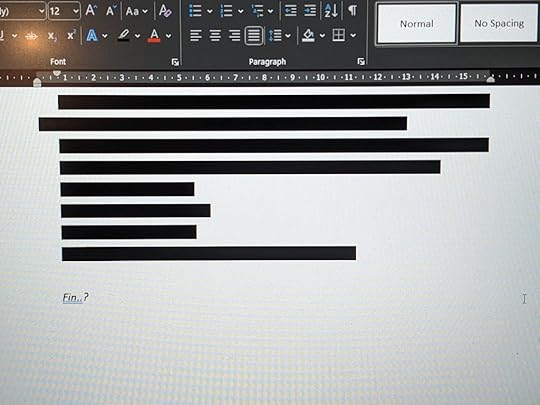 Spoilers.
I got to the end. And it’s a long, messy manuscript, meandering, mad, but it’s done. It feels very strange. Even though I know I’ve got a lot more work to do, even though it’ll look very different when it’s really done… I’ve finished the story. I’ve been working with Tal, Max and Lily for about 7 years, all told. It’s weird, knowing that this huge story of theirs is finished.
But it’s a good ending. That, I can promise.
And, of course, there’s The Singer, which I did publish, and seems to be going down well. So that’s alright. In terms of actually selling books, I did well! More than 600 people bought one of my books, and some of those weren’t even for free! It’s my best-selling year so far, so onwards and upwards, with a bit of luck.
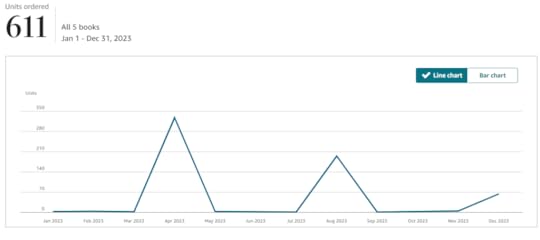 Number Go Up.
A pretty good year, on the face of it. But this time last year I made 4 resolutions, so let’s see how I did at those.
1 – Do Another BookWell. I did publish another book, it just wasn’t the one I planned to publish. The Singer is doing fairly well in its first month or so of existence, and while I didn’t publish Boiling Seas 3, I did at least finish the first draft. So half a point, I’d say.
2 – Write ReviewsI didn’t do as many of these as I’d like, outside the big Riftwar Re-Read, but I did do a few indie reviews – I just did shorter ones than I’d post on here for Goodreads and Amazon. Those are the places they need to go, after all!
3 – Write Short Stories – and Edit Them. And Submit Them.Editing? Yes, I think so, if I’m remembering which stories I had in the pipeline a year ago correctly. Submitting? Always. Writing? Less productive – I was quite busy with Boiling Seas 3, in fairness. But I reworked The Scar for its publication in The Pinch, I got one of those unedited stories polished and accepted for future publication, and there’s another one out in the world under consideration. But the submission tracker is looking a little empty lately (though that’s because I had to remove the published stories from the ‘Accepted’ column to make space, which is a very nice problem to have).
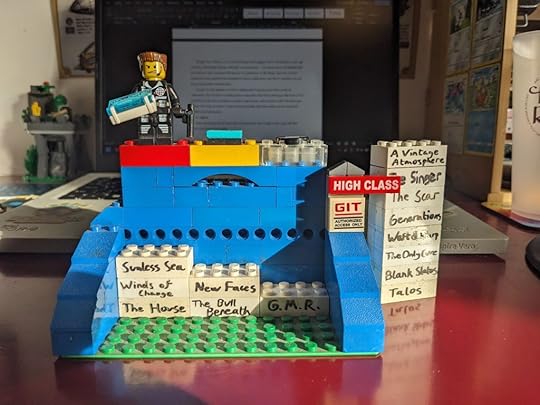 Dash Justice is also here now. Yes, that really is his name.4 – Agents
Yep, still plugging away at manuscript submissions, and chasing the various people to whom I submitted many months ago and still haven’t gotten back to me. Such is the querying life, unfortunately.
So what about this year’s resolutions? Well, they may be predictable, but here they are:
1 – Boiling Seas 3Not allowing myself any leeway here. Boiling Seas 3 comes out next year. I’m going to let the finished draft sit for a couple of months just to cleanse my creative palate, and then I’m right into editing. I will try to ignore the voice in my head that’s been saying ‘but the draft is so long, you might as well release it as 2 parts’, and actually cut the damn book down. I suspect that even so it’ll be a much beefier volume than I’d originally intended. But it’ll come out.
2 – Write More ShortsAs part of that creative palate-cleansing, I’ll get some more short pieces down. My quiver is almost empty, and the challenge of writing good, concise stories is always a welcome one. I have various ideas – let’s see how we go.
3 – MarketingI am not very good at marketing my own work. I post, I share stuff… that’s about it. I need to get better, if I’m actually going to make any kind of name for myself. There are indie authors much better at publicity than me – it’s time to properly take a leaf out of their books.
4 – AgentsCan’t give up now. I will keep plugging away.
5 – Something NewI’ve been writing the Boiling Seas for a while. It’s time to dive into a new world for the next novel after BS3. Again, I have ideas. Let’s see where they take me.
There we are, then. Nothing too excessive. Just writing short stories, starting another novel, actually getting good at publicity, and editing down a 150k+ manuscript and actually publishing it, and all the associated formatting, cover art and title…
It’d be really handy if I’d done some of that already, wouldn’t it?
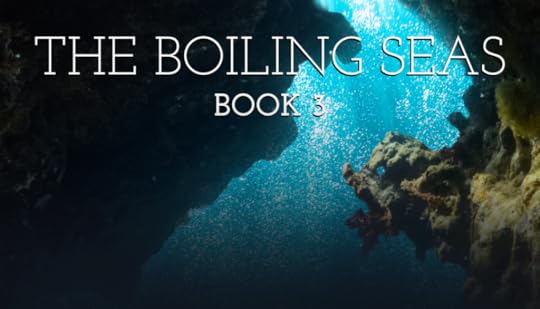 More spoilers.
Well, I never said I was going to show you yet.
Happy New Year.
December 24, 2023
Festive Sale
I’m back home with the family for a few days now, and have immediately become so Festive and full of food that I completely forgot it was Sunday.
I won’t keep you long – it’s Christmas Eve after all (or hopefully an equivalently relaxing time for those who don’t celebrate Christmas), but some of you might like to know that ALL of my ebooks are now either free or cheap for the next few days.
The Blackbird and the Ghost is FREE, and sequel Nightingale’s Sword is just £0.99 (while I try and finish the third manuscript before the new year…)
Fancy some SF instead? Ad Luna is £0.99 too.
Children? The Fire Within is £0.99 as well.
And my new release The Singer? FREE!
All these discounts are in place until the 27th, so if you want to fill up any new e-readers or use some gift cards, take a look!
I’ll be back next week with my usual end-of-year reflection – until then, have a lovely Winter Festive Time, one and all.
December 20, 2023
New Story – A Vintage Atmosphere
To my genuine surprise, I’ve got one more story out this year – and in the venerable Analog magazine to boot!
(Silly me assumed that the January/February 2024 issue would in fact come out in January or February 2024, but it’s available now!)
This is a long story, the result of an idle idea that bloomed into something much heftier: what if, in the future, we farmed oxygen?
A Vintage Atmosphere covers just that. If you’ve got yourself a starship or and space station or habitat, you’ll need breathable air to fill them with. And where there’s a need, there’s a business; and where there’s a business, there are producers. Enter the farmers of the future – growing oxygen, not crops.
I go into much more detail about the story in a Q&A over on Analog’s own blog. It was a very fun story to write, because I got much more into the nitty-gritty of scientific detail than normal and had a great time doing it.
If you fancy reading the story for yourself, it’s available here in the latest issue of Analog.
(I’m quite chuffed with myself for this: Analog‘s been around since 1937 and it’s got serious pedigree as a result. This is probably the biggest break as an author I’ve had so far. Here’s to some more.)