Hûw Steer's Blog, page 2
October 5, 2025
New Story – The Bull Beneath
When the Romans left Britain, they left a lot behind. They left roads, they left fortresses, they left whole cities. London, Londinium-as-was, was a thriving place under Rome, the biggest city in the country, home to thousands.
And then the Romans left. And so did everyone else. By the 5th century Londinium was abandoned; it wouldn’t be fully settled again until Alfred the Great, 400-odd years later. For whatever reason, despite there being a perfectly good city sitting there waiting to be lived in, the Saxons built their own city at Lundenwic, about a mile next door. They refused to live in old London itself. Why? Why not move in? Why leave it ruined?
There are doubtless many historical reasons why; I’m a historian, I should know more of them. But personally, and for my own purposes, I like to think it was because of the ghosts.
Because even if there weren’t really any, imagine how creepy it would be: setting foot in a city that was once the greatest on the whole island, the foremost outpost of what was then the foremost civilisation in Europe, a bastion of the Roman Empire. Left empty. Abandoned. Crumbling to dust, its churches tumbled down, its walls sagging. Its streets filled with nothing but echoes. I can imagine the Saxons exploring those buildings, knowing objectively that they were almost sound, that a bit of roofing work would leave them with enough room for thousands of people, with ready-made marketplaces and even bathhouses, if they felt like it. They could have shored up those Roman walls and been safe as houses behind them. And I can imagine them starting at every shadow, too. I can imagine how it might have felt, walking in the footsteps of all those vanished Romans… and I can imagine why they decided to walk away instead.
But what if the Romans left behind more than ruins? What if they left secrets? Treasures, riches untold, lurking in those forgotten churches and temples, gold and silver and more besides? What if there was a reason to set foot in abandoned Londinium once again, and come out with a fortune in your pack?
And what if there was another reason that you really, really shouldn’t risk it? What if those ghosts weren’t so metaphorical after all?
That’s what my trio of Saxon treasure-hunters find out, in the pages of The Bull Beneath, which has just been published in the latest issue of Grimdark Magazine.
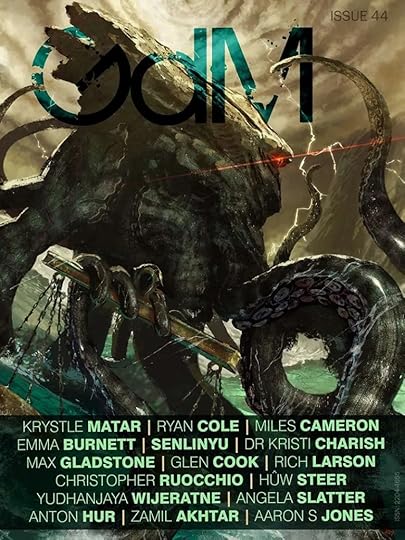 Cover art by Carlos Diaz, Kamyu Digital Arts, based on Zamil Akhtar’s ‘The Salt Apostle’
I don’t write horror very often (or dark fantasy, or whatever you call this sort of thing). I don’t write historical fiction very often either, if this counts. But when I do, Grimdark keep liking it. And I really do enjoy it. For all that many of my stories have their happy endings, I like to get twisted; I like to push my characters to and beyond their mental limits and watch them squirm. Salvage 7 is going to be a prime example of this, whatever it ends up becoming – there are some delightfully evil sections of that book for sure.
The Bull Beneath was an opportunity to do that, in short-form. And being able to base that story on real history – in some more specific real locations too, which you might be able to figure out if you read it – was great fun. I felt a bit like a historian again writing it. And I felt very evil, too.
So thanks, Grimdark. I’m rather proud to be in your pages again.
Pick up a copy of issue #44 here. I know I’ll be reading soon. It’s always a twisted treat.


September 28, 2025
The Nothing Days
You may have noticed that this post is coming to you significantly later in the day than normal. This is because I’ve been sitting here staring at a blank page for about seven hours, broken only by an attempt to jog my thoughts into order by going to the shops that didn’t work in the slightest.
This is one of those days where I just feel… empty, creatively, and there’s not a lot that I seem to be able to do about it. There is nothing in me that seems to be worth writing down, and I have to tell you it’s bloody annoying. I want to write. I want to be able to write. I want the motivation to be there today, to write and to throw out some submissions and even maybe an agent query or two. But I’ve got nothing. Hence the sitting here, the staring, and ultimately this rambling, largely for an excuse to put words on paper.
It’s probably because I had a couple of rejections last night/this morning, which is always a recipe for tipping me into a rapidly expanding gloom no matter how much objective good writing news I have also received this week. I finally had a contract for one of my upcoming short stories, for instance, and while it’s by no means a spectacular month for book sales I have at least sold a copy of 4 out of 6 books, plus the someone who read the whole of a fifth book on Kindle Unlimited, which ain’t half bad for me. There are many months when I will sell nothing at all. There are many months when I will hear nothing from anyone about any stories of mine, good or bad. It’s been fine.
This knowledge does not help, of course. A few bits of bad news is pretty much all it takes for a nice spiral into general writing miserableness for me (probably not helped in this instance by quite a lot of Very Serious Life Admin going on in the background). For every story acceptance or contract there are two or three rejections and even more delays; for every book just about sold there is a distinct lack of any feedback coming in for anything; for every piece of marketing I attempt there is a distinct lack of success.
This is not a mood that sparks particular creativity in me, to sum it up. I try not to bring the mood down on this blog if I can help it, but, equally, this is where I talk about my experience of being a writer. And a lot of that experience is… well, days like this. I spend my life trying to get words out into the world and having them largely not get read – or if they are, never hearing what the reader thought about them. Sometimes being a writer feels like shouting into a cave and not even getting an echo.
I’ll be fine tomorrow. I have stories to tell and they will not wait for me for long. Eventually there will be an event in the waiting game that is the writer’s life. It’s just not today.
I have, however, managed to trick myself into at least writing this, which may be a small victory but is at least sufficient to make me feel less guilty about uploading the post and immediately going to sleep on the sofa.
September 21, 2025
The Three Results of Time Off
So. Did I manage to do all those things I claimed I was going to do in my week off?
Largely, yes. Hooray!
Despite being distracted by a sudden and alarming amount of life admin – for good stuff, at least, but still a lot to deal with – I did actually get pretty much everything on the list done, and also most of the various non-writing-related tasks too. Most of them. The important ones. Mostly.
Task the First: Finish Stuff
‘The Package’ is done. Almost 30,000 words out of a 24-word prompt. Not bad, if I do say so myself. What am I going to do with that story now, I hear you ask? No idea. Because it accidentally became a sequel to some stories from over a decade ago that have been in desperate need of rewriting since approximately the moment I wrote them, ‘The Package’ now occupies a very weird niche. Would it stand alone? Probably? Would it be better with the context of those other stories behind it? Probably. So sorting them out is now on the list of future writing tasks.
Most importantly, though, I had fun with it. These were old characters and visiting them again was a pleasant experience. Once I’d knocked the rust off we had a grand old time. So if I never end up doing very much with this story at all… it’ll still be worth it.
Task the Second: Audiobook
Done. I listened to the whole draft of The Fire Within audiobook, and over the course of about three hours I realised that… it’s a pretty good book. Because once I’d gotten over the weirdness of hearing my own words and just let my narrator take over, it was good; honestly, much better in audio than it ever was on paper, in my opinion. It’s a story that needed telling with an actual voice and it’s all the better for it.
Plenty of work still to do, of course; a few actual technical fixes, some minor tweaks, and a lot of admin to do as I figure out how audiobook publishing works, but this project is, at last, finally moving forward. Now that I’ve actually done my bit of the work. Whoops.
Task the Third: The Redraft
Salvage 7 isn’t a long book. Until you add in all of the Part 2 that I never quite finished, that is. But taking all of that, and all the notes I had, and all the new ideas that I spent a few days this week coming up with, and you end up with something that has the potential to be a very long book indeed. So it’s probably a good thing that my new outline has some cuts in it.
Obviously I haven’t rewritten an entire novel and a bit in the space of a week, but I have started. I have a new structure planned out, I know roughly which bits of the old books I want to keep and which will have to go, and my head is already filling up with new ideas on how to connect my bulletpoints together and make everything coherent. This is another group of characters who I haven’t worked on in a good while, and I’ve been getting to know Salvage Unit 7 again, getting to know what they do and how they react. They are… less pleasant people than those in ‘The Package’, let’s put it that way. They also, in fairness, have much more stressful lives and jobs, so I can cut them a little slack. And they will now have a significantly more stressful journey to go on, if this outline is anything to go by. Their odds of making it out alive have improved… slightly. For some of them. Maybe.
But it’s underway. I’m on it. And it’s going to take a while, and that’s ok, as long as I end up getting this story told.
Progress. It’s nice to have some for a change. Now all I have to do is keep it up.
September 14, 2025
The Three Tasks of Time Off
Alright everyone, it’s time for me to set some targets and for you to hold me accountable for them.
I’m off work this coming week, and so, as is tradition, I must Get Some Writing Done. Or at least some writing-related things, for not all my tasks directly require me to sit down at my keyboard. (I must also get a bunch of other stuff done, largely to do with houses and whatnot, but that’s neither interesting nor relevant to you.) In the interest of actually getting that done properly, I voice these tasks to you, dear reader, so that when I sit down this time next week to report on my progress you can appropriately lambast or congratulate me depending on what actually happens in the week.
Largely, these tasks have been waiting for a while. They don’t have actual deadlines, but if they did, they’d be so very overdue. So I really do need to get on with the following:
Task the First: Finish StuffI started a short story when I did my author interview for Indiosyncrasy back in… well, bloody ages ago. April, maybe? I have been working on it off and on ever since, and while there’s a nice tight 3000 words up on the Indiosyncrasy website… there are about 25,000 more now in my own version. I should finish that story. I’m almost at the end, in fairness, but I should wrap things up. And I should take a look at the previous 3 stories in that world – because yes, this has secretly been a sequel the whole time. Not that anyone reading it would know because nobody has read those stories but me, because I wrote them about 15 years ago and while the ideas are good, the prose is… not. But once I’ve wrapped that one up I can actually get on with other stories. This will be important later in this post.
Task the Second: AudiobookEarlier this year, I was chatting with an actor friend at a party. They mentioned that they’d been trying to get into voice acting and narration and that sort of thing; I mentioned that I wanted to do some audiobooks, they mentioned that they were house-sitting for a friend with a recording studio, and a few pints later I’d sent them a manuscript. And a few weeks later, they sent me a full recording of the book. And several months later… I still haven’t listened to the whole thing.
Now this is not, as I have since mentioned to the friend in question, because it’s not a good recording: it is, so far, excellent, they’re a great narrator with some inspired voices. I haven’t listened to it not because of the narration but because of the words – my words, which, it turns out, feel very uncomfortable to listen to. Listening back to your own work is very different to reading it back (and I don’t even do that in full most of the time). Especially when said work is already published, which means that no matter how much I dislike the construction of a sentence I can’t really change it now, can I.
But it is a good recording, and I need to finish listening to it so I can give my narrator notes, and we can actually get on with the process of uploading and releasing it. Ideally this year. It’d be nice to have Two Big Things in the same year, especially after having last year off for all that editing.
Oh, it’s The Fire Within, by the way. Should have mentioned that at the top, probably.
Task the Third: The RedraftLast year was a really busy year. I mostly just got editing and getting married done. It pushed some stuff back. And for most of this year I was also busy editing, and also being on my honeymoon, and generally getting ready to release – and releasing – The Owl in the Labyrinth. Which pushed back one fairly significant thing that’s been on my back burner for a long time now, and that is Salvage 7. I’ve been sending that book around various agents for a couple of years now, and many months ago I actually got a response, from an agent who read the whole manuscript. And didn’t take it, sure, but did tell me exactly what I should do to make it a hell of a lot better and more sellable, and told me to send it back to them for another read when I’d done so.
I have thought about this feedback. I have made some plans. I have not, however, made much progress. That changes this week. Because now I am entirely married, and I’ve been away, and I’ve finished Owl, and I’ve finished a very busy summer of work, and I am out of excuses and possessed, this week, of time. I’m not going to get an entire novel rewritten in a week, but I am going to get properly started. After all, I have most of the original Part/Book 2 already written, and the whole first one to tinker with and combine and generally turn into something better.
It’s been a long time coming. I think it’ll be worth the wait and the work, though. I hope all of these tasks will be.
See you in a week for a progress report.
September 7, 2025
What I’ve Been Reading – September 2025 Edition
Never mind what I’ve been writing – what have I been reading?
I haven’t done one of these posts in… wow, over a year. I can confirm that despite this I have been reading a lot of books, and I have been leaving reviews for my fellow indies as I go. For the last few months and the most part, though, I have been reading a lot of comics, for two main reasons: the Superman movie came out and spurred me to devour a bunch of those comics; and because I got a new iPad and so I could actually read comics in higher fidelity, and thus I did. A lot. I will not, however, spend this entire post talking about Superman again, because I have some much bigger highlights of the last few months of reading.
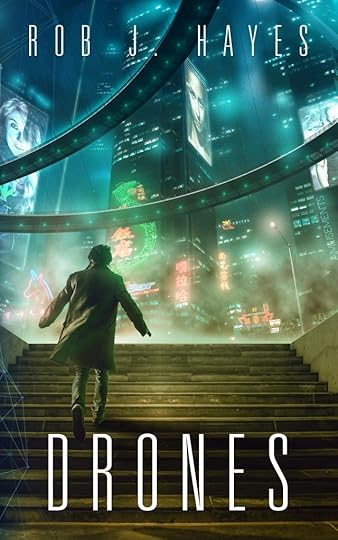
Let’s start with a nice bit of indie SF: Drones by Rob J. Hayes. Welcome to a future dystopia where there’s a black market for human emotions. It’s a very solid premise and has a lot of room for interesting stories, and Hayes does a good job of exploring some of them – though not all, and I hope that maybe one day he thinks about going back for more. We follow emotion-mule and former spec-ops bloke Garrick, whose effective addiction to not having any emotions, while needing to go out and feel desirable ones, is a really strong centre for the story. Like I said, it’s a really strong core idea and I’d love to read more about it. In fact it’s such a strong idea that a similar-but-different dystopia is the subject of one of my own upcoming stories. Great minds, or something. Very much worth reading.
Next, and actually my most recent read, was The Mars House by Natasha Pulley. Pulley’s previous books are some of the best writing I have ever encountered; The Watchmaker of Filigree Street and its sequels are absolutely beautiful. It’s a good bit of prose that can make me cry. The Mars House is not quite on that level, but it’s still really well written. And again, it’s another book with a great core concept: normally, when humans get sent to Mars in SF, their power in low gravity is a good thing. In The Mars House, ‘Earthstrong’ humans are literally banned from going outside unless they restrict themselves physically, because if they don’t then they end up accidentally punting frail Mars-born humans through walls with light slaps.
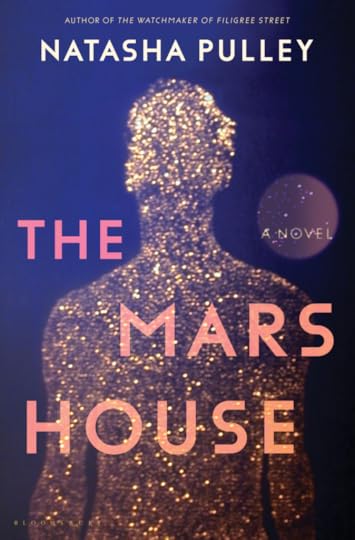
Much politics, of course, ensue, and the story follows an Earth-born ballet dancer reluctantly living alongside a Mars-born, bigoted, anti-Earther politician. It’s all a delicate and well-written allegory for all sorts of current social issues, especially immigration and xenophobia. But it doesn’t quite go the way I would have expected such a book to go, at various points, and I’m not completely sure how I feel about the ending, though overall it’s probably positive. These are delicate issues, after all, and there’s a lot of ambiguity in Pulley’s presentation. However, there are also talking mammoths, and this is excellent.
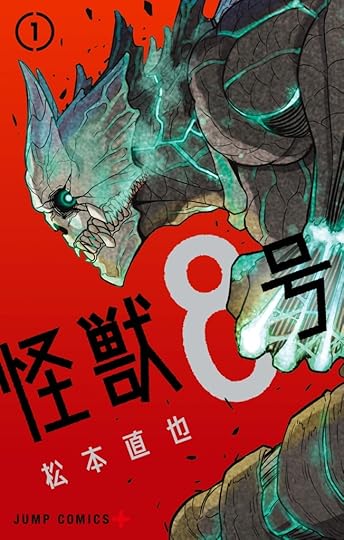
Now I know I said I wouldn’t talk about comics, and technically I am talking about manga, which is different, honest, but I can’t not talk about these two. Kaiju No. 8 by Naoya Matsumoto is a cracking series, at least for the first 4 volumes that I’ve read. (Someone else appears to be very slightly ahead of me on my digital library app so I’m sitting and staring at the next few volumes on hold and waiting.) To summarise the plot: kaiju regularly show up around Japan and the world, which leads to two things. Firstly, a Kaiju Defence Force with awesome power-suits and crazy weapons running around blowing the giant monsters up… and secondly, an entire industry devoted to cleaning up their mess.
Straight away, I love it, and part of me wishes that said cleanup crew had their own full series because it’s stuffed with potential. The main series, however, follows two Kaiju cleaners who apply to join the Defence Force, and get to use their experience in cleaning up the mess to their advantage over their professional soldier colleagues.
But of course one of them is turned into a Kaiju after a big fight, and can’t let anyone know, because they’ll take him into a back alley and blow his head off. Given his new powers make him superhuman, and he has to keep using them to save his friends and the city, this is not ideal. So far this is a really solid manga – with great artwork, of course, but a cracking premise that keeps delivering. I still want Kaiju-cleaner shenanigans as its own series, though.
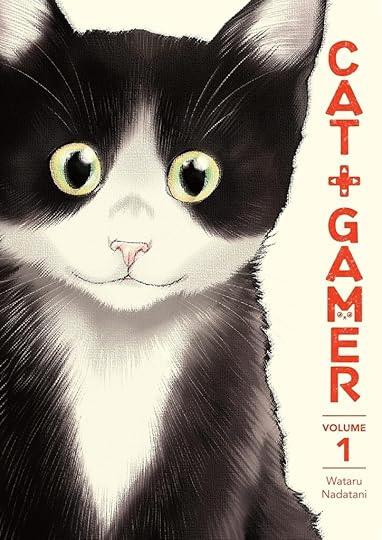
And the second manga, before I get to my highlight of the last few months of reading, is Cat + Gamer by Wataru Nadatani (and translated by Zack Davisson). It’s about a gamer who gets a kitten. The kitten is adorable. Later on, another kitten shows up. It is also adorable. There are shenanigans, and the art is lovely, and it’s just extremely wholesome. If you just want to read something that makes you feel better, read this manga.
Finally, then, some stories that I really did not expect to be this damn good. I have read a lot of Warhammer 40,000 books. I have read standalone 40k books, which are excellent, and I have read standalone 40k books were released to promote new games or sets, which are really, really not. So when I picked up the Blackstone Fortress anthology, largely by Darius Hinks but with short stories by half the Black Library stable, and written specifically to build more hype for the Blackstone Fortress boxed game, I expected ‘fine’ at best and ‘awful’ at worst.
Blackstone Fortress and Blackstone Fortress: Ascension are among the best 40k books I have ever read.
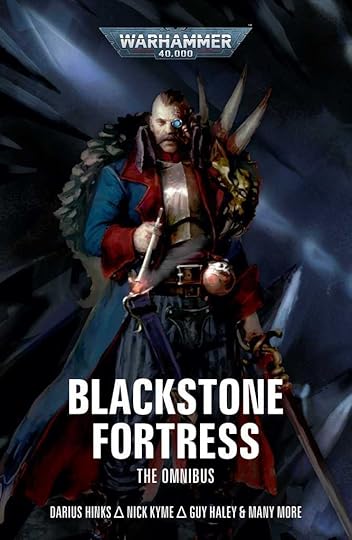
There are ancient space stations, out in the dark reaches of the galaxy; moon-sized constructs wrought by hands unknown, lying dormant for now, but with the power to crack planets in half when roused. These are the Blackstone Fortresses. This one in particular is a new mystery. Its corridors are ever-shifting, its technology unknowable; it is ancient beyond imagining and deadly even to set foot upon. But it is filled with secrets, with treasures beyond value, with technology and knowledge that could change the galaxy. And so a whole society has built up on the ramshackle Precipice station, around those bold treasure-hunters who dare to brave the Blackstone to seek their fortunes… if they come back, of course.
It’s a cracking idea to start with, and like the best 40k stories it would be a really good bit of SF without having to have Space Marines turn up at some point or people shouting about the Emperor. But Precipice is not your average 40k setting: normally literally everyone in the galaxy hates each other, to the point of the Imperium largely shooting all aliens and most other humans on sight. On Precipice, however, things are different. Human and alien and even heretic will – however reluctantly – work side-by-side to plumb the depths of the Blackstone Fortress. Its treasures are worth the xenophobia, basically, and this leads to fantastic interactions that would almost never happen anywhere else in the vast 40k universe. The main characters include a pompous space-dandy, a pair of literal fire-and-brimstone priests, a flesh-eating birdman and two sniper hobbits, who all dislike each other intensely but like the Fortress more. And because the Fortress is such a mystery, because the whole point of the game and the setting is that it’s unimaginably weird, there is no baggage from the overarching lore. Evil space elves can drink at the same bar as their deadly enemies, the normal space elves. Yes, eventually the weird Chaos cultists show up, and nobody likes them, but even so, that’s everyone else versus Chaos, which normally devolves into everyone versus everyone else. And of course there are betrayals, and plots, and schemes, but they are interesting ones, not just for the sake of someone being from a different faction to someone else.
My only criticism, really, is that whoever formatted the omnibus edition I read decided that they would put the first book first, then the second book, and then all of the standalone short stories that fill the gaps between the two. This is a terrible order to read them in. If you decide to pick up Blackstone Fortress, read book 1, then the short stories, then the concluding novel.
It feels like someone at Games Workshop told Darius Hinks that this was his corner of the 40k galaxy and he could just go and play, and he did, and it was excellent. From such things are the best 40k stories made – that’s how we got Dan Abnett’s Inquisition and Gaunt’s Ghosts books, which are the very best in 40k fiction. It’s good sci-fi that happens to be set in the 40k universe. And it gets real weird in parts, and that’s all to the good. Even if you don’t like Warhammer, this is a good book.
There will be more posts like these in the future. I read a lot, and when it’s good, I like talking about it. I have some stuff queued up on my Kindle from the Narratess sale that I haven’t started yet but have a good feeling about, and plenty more besides. There are always more books to read.
August 31, 2025
Aesthetic Storytelling: Deus Ex
Every so often, I find my brain tinted gold. I find myself thinking of grimy streets and shining metal, of neon signs and towering buildings. The internal soundtrack of my brain is replaced by atmospheric synth. I catch myself searching for ‘gold sunglasses’ online. I wish I could pull off a frock coat.
And eventually I give in to the inevitable, and sit down to play Deus Ex again.
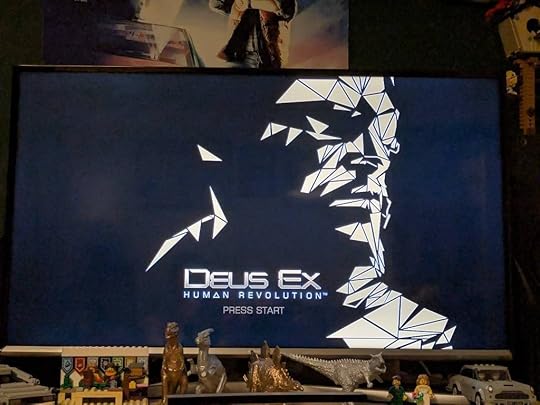
I have talked about these games before, at some length, but I will never not be willing to do so again. Human Revolution and its sequel Mankind Divided – and, incidentally, the handful of interquel novels and comics floating around, most notably Black Light – are some of my absolute favourite stories ever committed to disc or page. I love cyberpunk in all its forms – love me my Gibson and my Blade Runner and all things besides – but I might just love Deus Ex most. I will not wax lyrical about the story today – I’ve done that before, and while it’s a very well-written spiral into conspiracy, revenge and revelation that’s not quite why I picked up a controller again this time. This time, I just wanted to immerse myself in the vibe.
This is Human Revolution we’re talking about, the first of the modern Deus Ex games, which, distressingly, was released 14 years ago. And is set in 2027. It’s about to actually happen and we still haven’t got our cool robot arms; corporate overlords, you have let us down as a species. I do own this game in its Director’s Cut form on PC – but this time, I dusted off my Dualshock and turned on my good old reliable PS3 copy. Partly, I wanted the bigger screen; partly, my hard drive is too full of Baldur’s Gate 3 to download it again. But mostly, it was this:
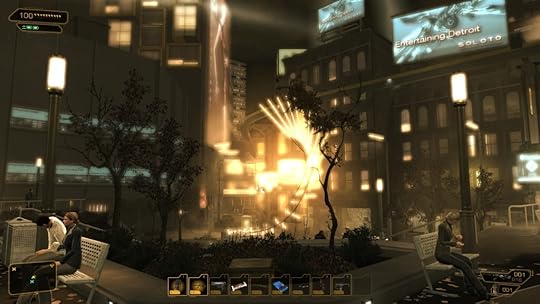 Image credit (and gold filter mod credit) goes to Silent.
This is how Human Revolution is supposed to look. Everything, and I mean everything, has this gorgeous golden tint: the UI is golden, the object highlights are golden, most of the game takes place at night or in the evening so it’s all sunset and streetlights. Not everyone, however, thought that this was a nice effect, and so when the PC version came out, the ‘piss filter’ was removed. And the game looks terrible. Because it’s not just a cosmetic change: the gold is there for a reason. This is the Second Renaissance, or so the supporters of human augmentation consider it: this is the dawn of a new age of humanity, with riches and splendour just around the corner. The golden light plays beautifully with the classical wardrobes and elaborate patterns that pro-aug characters sport, with their old-fashioned architecture, with their conscious echoing of that first Renaissance in their every aesthetic choice. The golden light is the light of that new dawn.
Or, if you’re a critic, then perhaps it’s the sunset; perhaps it’s the end of humanity as we know it, perhaps it’s the exact opposite. Perhaps this is our last glimpse of what it means to be a normal ‘human’. The constant evening setting of the game helps keep this theme in mind: it is very much not all sunshine and roses in the world of Deus Ex. Your first proper mission is against anti-aug terrorists, you spend much of the game debating those against augmentation, and given the circumstances in which Adam Jensen was altered, it’s hard not to think that they have a point.
And even without all that context weighing it down, the colour palette of the game serves a vital story purpose towards the end. Jensen spends the whole game in this golden twilight, sinking deeper into the dark as he unravels the conspiracies around him. The player’s eyes get used to it, to this sunrise/sunset world.
And then, without warning, when the revelations are building to a head, you are dumped into a pure white room.

Not a scrap of gold to be seen, on any surface; pure, cold white lighting, no sun, no streetlights; still opulent but without a speck of that colour your eyes have been taking for granted for hours of gameplay now. Even the always-golden computer screens are greyscale. It’s visually jarring, genuinely shocking every time no matter how many times I play this game – and it is, of course, accompanied by one of the biggest revelations of the whole plot. Jensen’s world is shattered in that white room. Using the colours of the environment itself to unsettle the player at the same time is a stroke of genius. It’s storytelling through pure aesthetic. I love it.
Also, black and yellow is just a very good colour scheme.
Removing that filter just… didn’t work for me. To the point that when I got the PC version I played about 5 minutes before I sought out a mod to put the gold back in, and was far happier with it. There is no Deus Ex for me without that twilight feeling, that evening ambience of potential and decline, all at once. It’s a masterclass of storytelling without having to use a single word, without even having to use an object, though they help.
Hard to do in prose, I’ll admit. But I hope that I can come close, even if I am limited by clumsy language.
To quote the game: “It’s not the end of the world, but you can see it from here.”
August 24, 2025
Stuff Is Happening – Sales and Shorts
It’s a quick announcement-y blog today, mainly because I’ve got a wedding in a few hours and I have Things to Do at it. But by happy coincidence a few things have actually happened in the last few days and thus I have things to talk about. Huzzah!
Firstly: anyone wanting to read good books should head over to indiebook.sale right now to check out the latest Narratess sale, in which you will find over 300 excellent bits of SF&F for little or no money. You have until Monday the 25th to fill your e-readers with as much as they can carry.
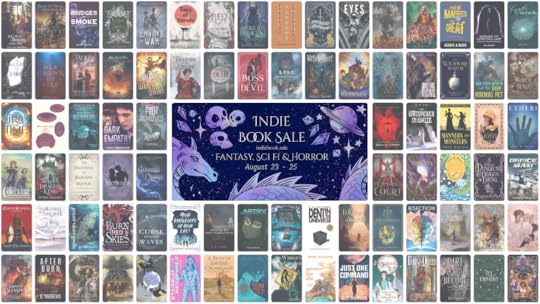
And if you wanted, say, to get started on my own Boiling Seas trilogy, then you’re in luck, because The Blackbird and the Ghost is free for the duration of the sale. Pleasingly, at the time of typing 102 people have grabbed a copy – join them, and provide me with the dopamine I need to continue writing weird stuff for years to come.
But on other fronts, I also have news – sort of news anyway, because I’ve only just heard it and I’m not sure if I’m meant to fully talk about it yet. I had two short stories rejected this week, which is disheartening, but fine; there are plenty of other markets in the sea and I’m well used to it by now. One of the stories had been held for a long time, so I’m a bit more annoyed about that – but equally it was a reprint so it’s not like it’s not already out there!
Yesterday, however, I got a doubly unexpected email. Firstly, it was a story acceptance – itself doubly unexpected news because I only heard about the call the day after it closed and submitted purely on the off-chance an editor was feeling generous. Which they seemingly were. Ta! Secondly, it was a story acceptance for an anthology which is apparently coming out in less than a month, because this press, it seems, works damn fast. Almost worryingly fast, honestly.
So that’s rather nice. It’s an anthology, which is a change for me – I’ve only had magazine publications for the last many years since Making Monsters, so it’ll be nice to be slotted in a themed collection. It’s also a royalty-share thingy rather than an advance, which is also a new arrangement for me but I figured it’d be worth a go, and I’ve heard good things from some previously featured authors… and ultimately what I want is for more people to read these nonsense words I keep writing down, and this is another way for that to happen. Add to that the other one or two upcoming stories that I’ll be shouting about as soon as I know when exactly they’re happening, and the end of this year is shaping up to be a good one for me. More credits on the increasingly unwieldy list, at least.
So that’s it, really: go get a free Blackbird, and a bunch of other books while you’re at it, and watch this space for short story stuff. Now if you’ll excuse me, I have to go and probably cry at my friends being in love.
August 17, 2025
Small Stories
I feel the urge to write about lighthouses.
This may appear to come entirely out of nowhere but I know exactly why: we took the kids at work to the theatre this week, to see a lovely little play called Tales From The Lighthouse. 2 actors, one of whom spent most of the time lurking offstage and playing the accordion, clever puppetry, good music and a nice simple message of ‘sometimes stuff gets overwhelming, but try to be kind’. If you’re in London I’d recommend it, honestly. I’m especially always a sucker for well-done puppetry and the like on a small stage; bring me your big blue sheets and model boats on a stick to evoke the endless ocean, show me those surprisingly elaborate water-horses. And most importantly, of course, the children had a good time in that little conjured world. I do love the theatre.
But I love… small stories, I think I’d call them. I love a sprawling, epic narrative as much as the next SF&F buff, and I read my fair share. I love action, I love high stakes, I love grand conspiracies, I love all the things that I often write – the things I’ve been writing lately, in short. I’ve been jumping between a cyberpunk mystery, a diamond heist and the conclusion to an RPG campaign that could very much still end in an entire city exploding if my players don’t get their act together sharpish. These are not small stories. They might not all be as grandiose as my last example but they don’t fit this bill.
I mean things like The Singer, things like my other ‘walking stories’, or like the old novella I dusted off the other week for a likely-looking submission. Slow stories, contemplative stories, stories that feel no need to rush or raise the stakes. There’s an emotional core to most of them, but it doesn’t have to be hard-hitting in the slightest. It can just be watching the world go by and loving it, if needs be. These are stories that evoke a kind of peace in me, when I read or write them – or watch them, as in the case of the aforementioned Tales From The Lighthouse. These are stories that build a world and just… let the reader sit there for a while.
I like doing that. I always do that in my writing, to some extent – but sometimes the building of the world is all the plot has time for. Sometimes my characters are busy. Sometimes there’s too much going on to simply sit back and smell the roses, or the sea breeze. But even then, sometimes one can start small and find stakes later – I’d count ‘A Vintage Atmosphere’ in this category even if stuff does start exploding in the second act. It’s still a story built on a slowly constructed landscape that I lavished a lot of detail – almost certainly too much – on describing. The story, in a way, is secondary to that setting. I wrote it because when I thought of it I wanted to feel like I was there. Same with The Singer. Same with a fair few others.
Not lately, though. I’ve been plotting and scheming and I really do need to get on with more plotting and scheming for a story that is anything but ‘small’. But sometimes one needs a break, and I find that as a writer I can make one for myself while still working. Sometimes I just need an escape. So I find a setting, and I write it, and sometimes something approximating a plot turns up along the way, but always there is the world, as rich and real as I can make it.
The play made me feel that way, while I was there, watching. So I think it’s time to see if I can conjure another world like that, someday soon. Maybe it’ll just be a lighthouse, maybe it’ll be in space, maybe it’ll be a ‘darkhouse’, which is purely a word and not even slightly a concept right now but it’s wearing a hole into the back of my brain with the weight of potential. Maybe it’ll be something entirely different.
Maybe you’ll see it. Maybe it’ll just be for me. We’ll see.
August 10, 2025
Ode to an iPad
First things first: go get a copy of Ad Luna for a mere 99p. You’ve got until Tuesday the 12th. Do it.
If there’s one thing I do well, it’s relentlessly anthropomorphise almost every object I own. And this is apart from the myriad Little Guys that lurk on every corner of my desk that are actually designed to represent some manner of creature: I mean the normal things, the things that I’ve owned for so long that they’ve taken on a life and personality of their own for me. Sometimes I don’t realise they’ve done this, until they go wrong, or break, and I have to mend or replace them and the stakes of swapping out a battery suddenly become far higher than I was expecting. I had a taste of this earlier in the year, when I finally upgraded from my ancient 2010-era Kindle to a still old but significantly less old model – but given that was actually the third Kindle of that model I’d owned and used until it gave out, replacement had lost its sting.
This week was different. This week I had to retire a very old friend. Because for my 18th birthday, almost 12 years ago, my godmother bought me an iPad, and I have used that machine every single day since, until finally I had to bite the bullet and admit that its working days were done.
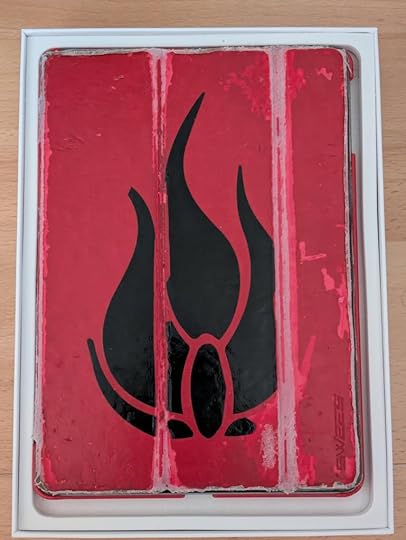 Its second case and its second RWBY sticker.
That old tablet has served me impeccably in a dozen different ways for 12 years. I have watched thousands of hours of content on it; I have played thousands of hours of games; I have read thousands of pages of books and comics. For the entirety of my time at university that iPad was the repository of every piece of lecture reading I was ever given and more besides – whole periods of history were held on that machine, ready to be perused at the touch of a button. In those days my actual laptop was an elderly beast, only kept functioning by raising it off my desk with LEGO tyres so that the fan could get enough air to not overheat. Even when I replaced that, with the laptop before the one on which I write this post, it was with a hefty, heavy machine, impractical to cart around to every lecture. Not so the iPad. It was only about 5 years after I left university that I actually cleared out all the history reading from the drive to make space for other stuff – over 1500 articles and book chapters. (That I still haven’t gone through and sorted out, because while I could see the thumbnails and titles on my iPad, on my computer almost all of the PDFs are called 1012389235297343.pdf and I have no idea what they’re actually about. One day.)
In the days when my phone was rubbish, which was a very long time, my iPad was the only decent bit of portable technology I had. I awkwardly carted it around to take photos on holidays and at conventions; I once had a friend film one of my job applications with it; I recorded thousands of images of friends and family with that too-big-to-comfortably-hold screen. I used it for scripts – every Fringe show and play I performed in was held on that machine, for which it actually was very practical. In these last few twilight years it was reading, as well as watching videos and stuff like that, that kept the iPad alive and useful for me; bugger squinting at a little phone screen, I want a proper page to turn.
And I wrote on it. For any short trip that didn’t justify lugging the laptop around, the iPad was my portable solution. Every story I’ve written in the last 12 years has, at some point, been copied over to that iPad for a few thousand words of additions. And then transferred back, and fiddled with, because the formatting always got changed slightly and no matter how many settings I tweaked it would always come back to Word as US not UK English. I wrote three whole books on that iPad – novellas, sure, but whole damn stories that one day I’ll rewrite and throw out there into the world. I remember vividly when I started the first of them, sitting in an airport in New York waiting for a delayed flight, looking out at the nightscape and realising that I had all I needed to just write at the tips of my fingers.
It served me well, that iPad. And it never broke. Beyond a couple of glitches that just required a quick reset to fix it never once went seriously wrong, in 12 years. Despite the overall tone of this post I am not an Apple fanboy: I have always used Windows computers and Android phones and I genuinely dislike using their Apple equivalents; I don’t like how restrictive they are in terms of their programs and I especially don’t like how phenomenally overpriced they are. But I have to admit that Apple makes their machines to last. My wife’s old Macbook lasted a decade; my iPad 12 full years. That’s more than I can say for any other computer I’ve had by a factor of two, at least.
But times change. And this iPad is 12 years old, and though its hardware was perfectly functional, software is not so long-lasting. One by one, apps stopped working, because the OS wasn’t sufficiently up to date. I could deal with losing a few games; I had access to most by other means. I could deal with having to run BBC iPlayer in browser. I will forever salute Netflix and Channel 4 for maintaining legacy versions of their apps that keep working with older OSes (and I think that every app, particularly big streaming things like them, should have to do the same, especially the damn BBC). I could, after a while, adjust to having to run YouTube in browser, as irritating and clunky as it was. I could even just about cope with the Kindle app being unusably laggy, and having to separately offload my comics to another app to even read what I owned. I could handle the big button getting stuck and not working, forcing me to use that floaty onscreen accessibility one to close or open anything.
But all of that together was getting old. And I held on, for as long as I physically and financially could, because these things are expensive and these books don’t really pay the bills. And because over 12 years I’ve grown attached to this venerable, reliable machine, that has never once let me down.
12 years, though. It was time.
So this week I bought not a new iPad, because those prices are crazy, but a refurbished one. Only 4 years old is a lot better than 12. It arrived on Tuesday. And, of course, it was instantly and immediately better in every way. All the apps work, and are actually up to date; I can install things like Disney and Dropout, apps that didn’t exist when my iPad was new and so have never worked with it; the Kindle app is fully functional and all my comics are back at my fingertips. The keyboard doesn’t lag when I try to type in Pages. The battery is much better. The big button is no longer broken. There’s a tool that lets you do automation/shortcut stuff so I can, for instance, automatically pause my VPN when I open iPlayer so that the BBC remembers that I’m actually British. I can actually install my VPN.
It’s faster, and slightly bigger, and superior in every way. I will doubtless use it for another 12 years until the relentless advance of technology forces me to go through all this again. I remember, now it’s in my hands, just how many things that my old machine could once do that I’d forgotten about.
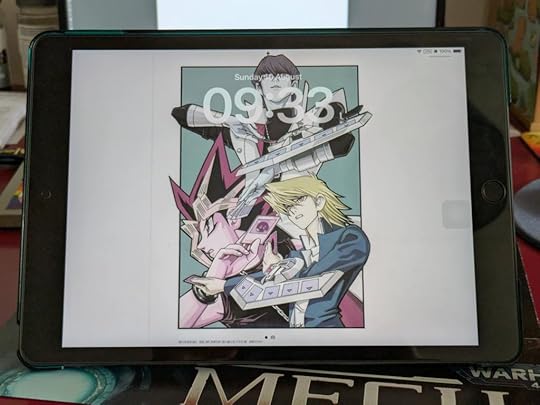
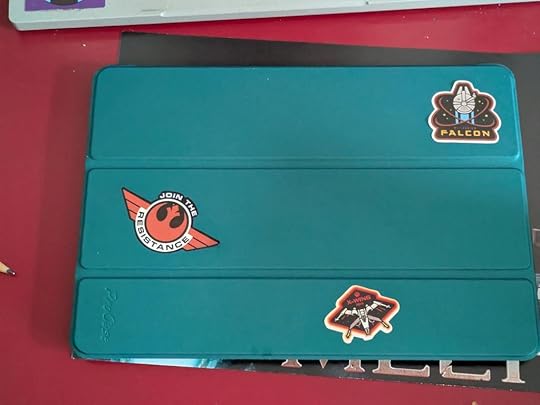 Felt like a new machine meant a new look. It’s not pretending to be the old one, after all.
 And I turned the old iPad off, once everything was installed. I put it away. And I was sad, because it has done so much for me, that little glass box. I’ve done so much with it. After 12 years it’s impossible not to get attached to something like this. It has been reliable, and constant. It has seen me through almost half my life. If software updates hadn’t forced me to change I would have used it for another 12 years. It is an old friend, that iPad, and I will always be grateful for it, and to my godmother for getting it for me.
But of course I’m not getting rid of it. Recycling obsolete technology that I’m almost certainly never going to use again? Insanity! That iPad will sit forever next to my old Kindle, and my old phone, and my old laptop in the blue plastic box that is the Old Device Retirement Home. They can sit there and swap stories about the days when software was simpler, when batteries held charge, when screens didn’t get black lines across them for no reason. And they can do that for as long as they like. Because if, if, if something goes wrong, if modern technology fails me as, it seems, the world is going to force it to, if I am ever in dire need… those old, reliable machines will be there. That old iPad will still be there, and even if that day comes in another decade’s time, I’ll bet anything you like that it’ll still work. Slowly. After a judicious recharge and a dusting-off. But it’ll work. It always has. It probably always will.
August 5, 2025
Embers Rising Indie Sale – 5-12th August
The fabulous Cindy L Sell just released the second book in The Last Draegion saga, Embers Rising – so a bunch of we indie author types have gotten together to celebrate with a cheeky sale. 10 authors, 10 books, and less than 10… whatever your currency is for the lot. (By which I mean 0.99 each.) Not bad, right?
My own Ad Luna is up for grabs, as are:
The Heir of Swansgrove by K.J. Pritchett
A Distortion of Fate by M.J. Lindsey
Dust And Crown by Havelah McLat
The Dark Side of Happiness by Coley Taylor
Qetran Odyssey by Derrick Hall
Beyond the Darkness by Avra Blake
Star Spire by E.R. Donaldson
Unnatural by H.M. Duvall
And of course Remnants of a Scarlet Flame (and Embers Rising!) by Cindy L. Sell
So why not grab a book or few this week? Go on. You know you want to.