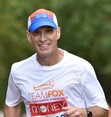
Joe Drake's Blog, page 4
September 8, 2022
Showtime in the Blue Ridge Mountains
 Taken from blueridgerelay.com
I remember in my engineering days whenever I was deep into the excitement and turmoil of a project and while juggling the time pressures and task interdependencies, some smartass upper management type would like to find out how it was all going by asking, “What is the one thing that keeps you up at night?”
I am thinking about this now because it is 2 am Thursday, September 8 in Charlotte, North Carolina and I am wide awake writing these words. When day breaks, I meet up with the rest of Team Synapse, all but two of whom I have never before met in person, and we will drive off together to West Jefferson where we spend the night before taking on the Blue Ridge Relay (BRR).
What’s keeping me up? Well, Parkinson’s disease (PD) for one. Parkies tend towards insomnia. My teammates are all living with PD as well, perhaps some of them are sleepless at the moment, too. But there’s more than that going on right now of course.
I like to manage complex projects. It’s just something that I do. When I joined Team Synapse in April, our captain and instigator, Bill Bucklew, had requested some help from the team on logistics and planning. I very happily volunteered and since then I’ve coordinated some, maybe most, of the details of transportation, lodging, and relay leg assignments for the runners. My teammates seem to be OK with this arrangement. I guess I will know for sure when I meet them tomorrow.
Since April, Bill has held a series of online meetings with the team to discuss various aspects of the project, which is unprecedented. Bill has assembled a team of 12 athletes living with PD to run in the BRR, a 208-mile, non-stop event that has to be run at an average pace of 10 minutes per mile on a 24-hour basis in order to meet the race’s 35 hour time limit.
Bill and the rest of us have promoted the event in the media, social and otherwise, to raise awareness of exercise as the only therapy effective at slowing the progression of PD. We also have a fundraising goal of $100,000 which will be donated to the Michael J. Fox Foundation for Parkinson’s Research.
All of this is heady stuff and it is going fairly well with significant resonance in the Parkinson’s community. I don’t think that I misrepresent the team when I say that all of us feel that what we are doing is of major impact.
What part of this, then, is keeping me up right now? That is, beyond the fact that at 2 am on any given night, I am likely to be wide awake anyway.
Well, we are coming up on showtime. There are a lot of moving pieces involved in getting 12 relay runners, each of whom have to run three non-consecutive segments of the race, into position at the right time and place with adequate hydration, fueling, and recovery from their prior segment in order to successfully complete this race. Our margin for finishing under the time limit is slim. Hiccups put success at risk. I believe that the whole team is aware of this.
One of the team, Steven Eury, asked in our last on line meeting how confident I was that the routes that runners will have to follow, especially in the dark of night, will be adequately marked. I wasn’t able to give better than a vague answer but Bill seemed very confident.
Steven’s question is the thing I am pondering right now. I want to reposition it a bit now, though, and because I like to be a positive guy, I want to answer it in a way that is unmistakably clear.
The answer: I am 100% confident that at some point during the course of the race, something will go very wrong in a way that no one anticipated. The challenge, then, is to anticipate all possible problems and all of them are scurrying around like little gremlins in my head right now.
It’s now 9:25 pm Thursday and I am tired. It has been a busy day. For now the gremlins have not done too much mischief.
All of us successfully managed to meet at the prescribed location, Vaulted Oak Brewery in Charlotte, before piling into vehicles for the trip to West Jefferson, where we will be staying during the weekend. Vaulted Oak is owned by Chuck Kistler, also a Team Fox athlete, who also happens to be running the relay on another team. The profits from one of Chuck’s beers is donated to Team Fox.
Four teammates, Peter, Jason, Jared, and Rhonda, flew into the Charlotte Airport on Thursday morning. Scott, Chris (our alternate runner), and I arrived the day before and the three of us stayed at the Springhill Suites near the airport. I had rented a van on Wednesday and used it to shuttle every one to Vaulted Oak.
Bill and Greg were also in town Wednesday night. Steven, and Allison who live nearby picked up Greg in their own car while Renee grabbed Janet (one of our support/drivers) and Bill in the second van and all of them converged on Vaulted Oak as well. Jacqui and Laura (the other support/driver) bypassed Vaulted Oak and headed straight to West Jefferson.
Jared is a cook and made us a delicious dinner of salmon with a wilted spinach white wine sauce and brown rice. Chris prepared a salad. I had brought chocolate chip cookies from Seattle where I had baked them the day before. I mad one batch vegan style and the other, well, the animal cruelty kind.
I held a meeting to go over the details of the race logistics while Jared, Chris, Bill, and Peter finished preparing dinner. To the best that I can tell, everyone knows what is expected of them for the race.
To recap: We all got to the Airbnbs in one piece and in the process began the bonding process by traveling, shopping, and preparing food together. This bodes well for the main event coming up. At 5 am we all head to the start line and the real beginning of this adventure. Wish us luck.
You can follow along with our progress on the Team Fox Instagram page.
I have some campaigns again this year that could use your support.
If you share the passion that The Michael J. Fox Foundation and I have for finding a Parkinson’s cure please consider contributing to any combination of them. All donations are meaningful and greatly appreciated.
First, if you want something tangible in exchange for your contribution, think about purchasing my book. It is an enjoyable read and all profits from its sale are donated to The Michael J. Fox Foundation. It can be purchased at my author’s website:
Next, there is the Blue Ridge Relay that I mention above. You can donate at the following page:
https://www.uncorkedadventures.org/blue_ridge_relay/
Finally, I am a charity runner again for Team Fox in the Chicago and New York City marathons. The links to my donation pages are below:
https://fundraise.michaeljfox.org/chicago-marathon-2022/joesgottarun
https://fundraise.michaeljfox.org/nyc-marathon-2022/joesgottarun
[image error]

August 29, 2022
Running Hot and other Coming Attractions
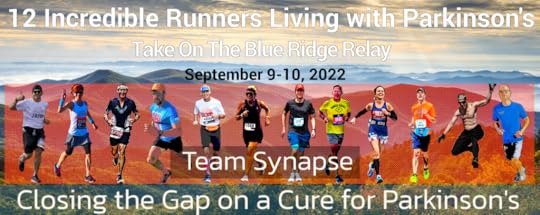 Image obtained from https://uncorkedadventures.org/blue_r...
Man takes his spear and goes in search of dinner. He spots a tempting kudu and takes up the chase. The kudu darts away. A species of antelope, the kudu can hit speeds of 43 mph. Man hasn’t a chance. Right?
Guess again. Man’s pursuit is relentless. He runs after the much faster quarry, always keeping the kudu in sight. The pursuit may last for more than 20 miles during which time Man keeps to a constant pace. The kudu can’t maintain its top speed and stops to rest frequently. It runs off whenever Man and his spear come dangerously close.
It’s hot. Air temperature is greater than 100 degrees. Both animals feel the heat. But herein lies a difference.
The kudu is cloaked in a continuous layer of fur that doesn’t allow it to perspire. The only way the kudu can control its body temperature is by panting through its mouth. It’s a highly inefficient process.
Man, however, has very little hair covering his skin and perspires freely. Upon evaporating from his skin, his sweat pulls off vast quantities of heat compared to the kudu’s panting.
Man, with his superior cooling capacity, can maintain his running pace nearly indefinitely. The kudu, on the other hand, is finding it hard to maintain any pace at all.
Eventually, its inability to deal with its rising body temperature renders the kudu powerless to move. Man approaches his motionless prey and kills it easily with his spear. Dinner’s on.
We’ll get back to the implications of Man vs. kudu in a bit but first a few announcements.
Readers of this blog know that I ran six marathons in a span of six weeks during the fall of 2021 including the World Marathon Majors held in Berlin, London, Chicago, Boston, and New York City. To round out the six, I did a virtual marathon in my hometown of Seattle as a stand-in for the Tokyo Marathon that wouldn’t allow non-residents to participate.
Last week I launched my book about that experience entitled Run With It: A True Story of Parkinson’s, Marathons, the Pandemic, and Love. It is available for purchase on my author’s website (https://joesgottarun.com). All profits from the sale of the book will be donated to The Michael J. Fox Foundation for Parkinson’s Research. Besides raising funds for the foundation, I hope that the book inspires more people living with PD to embrace vigorous exercise as therapy to slow the progression of the disease.
In addition, I have three running events this fall that could use your support.
Perhaps the most exciting of these is my participation on Team Synapse, a group of 12 runners all living with PD, who are competing in the grueling, ‘round the clock, 208-mile Blue Ridge Relay. The project is the brainchild of Bill Bucklew who I met during my marathon effort last year. He recruited me and the other runners.
It is a fascinating bunch. Our goal is unprecedented: a team of twelve athletes all suffering from Parkinson’s disease taking on one of the toughest relays of its kind in the country. I am very eager to get to know my teammates and hope to introduce them to my readers in future posts as I recap the race.
Until then, you can learn more about us and the race on our website https://www.uncorkedadventures.org/blue_ridge_relay/. Besides raising awareness of exercise as therapy for PD, we hope to raise $100,000 for the MJFF through this event. Please use the link to find our donations page.
Furthermore, I will be running as a charity entrant with Team Fox in the Chicago (October 9) and New York City Marathons (November 6). Links to my donation pages can be found below. I had hoped to run in Berlin and London again this year too but opted out in favor of Team Synapse and the Blue Ridge Relay.
Unusually high temperatures have been recorded all around the world in the past few months. As such, there have been a steady stream of articles on my digital feed regarding techniques for running in the heat.
It is a business opportunity that is heating up (sorry). I’ve seen all sorts of devices and vests that are designed to better control the body’s core temperature while working or exercising in high temperatures. Many aim to lower the core temperature through application of ice packs. Others are intended to enhance the evaporative cooling technique than humans employ.
Simpler approaches were endorsed recently by Jeff Dengate, Runner’s World Runner-in-Chief. Jeff suggested wringing out your sweaty T-shirt and dunking yourself in cold water.
All this came to the fore on a 9 mile workout last week. About halfway in, the temperature, which started at 73 degrees, had risen and it was doing some damage. I felt crappy enough that I entertained the idea of calling it quits and walking the remaining 4 miles home.
Literally dripping with sweat, I started thinking of my soaked T-shirt.
The sodden garment was preventing any further perspiration from cooling my body. Without the opportunity for evaporation, I’m like the doomed kudu. Although it was unlikely that anyone was coming to end it for me with a spear, continuing like this might nevertheless render me as roadkill.
I don’t like to run shirtless. I suspect that in my prime that was a view that some found appealing. Nowadays though, I can’t feel good about subjecting neighbors to the sight of my 61-year-old man-flesh flapping every which way. How does one unsee that?
Nonetheless, in this case, discomfort and scientific curiosity forced my hand. I stripped off my shirt and started running again. It was like magic. Okay, maybe more like a parlor trick.
I felt immediately better and running became relatively effortless. Stay cool to run faster.
I obsess a lot about running during hot days. It is a problem especially severe for people living with Parkinson’s disease. When I did those marathons last fall, three of them were during heat that dramatically affected my performance.
I have more such events coming up and I need a better way to deal with them. Especially significant is the Blue Ridge relay where all of us will be running three segments during the race each separated by 10–12 hours. Some of these segments will be at high temperatures and it will be critical for us to recover from one segment quickly enough to perform well in the next.
Among other concerns, success means paying strict attention to the body’s core temperature.
I’ve already mentioned the need to cool the body while running. On longer runs when I carry a hydration vest, I put ice cubes in my electrolyte drink. The ice on my back helps to cool my body for the time until it has melted completely. I will do that during the relay and I also intend to carry an extra dry shirt with me on each segment to allow for a quick change if the one I am wearing gets sweat-soaked.
But what about after a segment? The effects of over-heating can last for hours and must be curtailed efficiently.
I have a theory. Though not a physician, I have thought it through, did some research, and performed relevant experiments. It all points to this:
The autonomic nervous system has two parts: the sympathetic nervous system (SNS) and the parasympathetic nervous system (PNS). The PNS is responsible for rest and recovery. It is the part that must be engaged in order to recover from a workout.
The SNS gets in the way of rapid recovery. It is also known as the “fight-or-flight” system. In order to focus energy towards any current physical or emotional threat, the SNS will shut down all PNS activity. A high core temperature is one such threat that must be eliminated before the PNS can seize control and begin the recovery process.
The best way that I know of to eliminate the threat of a high core temperature is to do as Jeff Dengate suggests and douse the body with cold water. Now after every run I immediately take a cold shower. The effect is astounding. For the rest of the day of a hard workout, I feel far more energetic than without the cold shower.
Might be a placebo, though. Don’t care. The Placebo Effect is very powerful. Bring it.
During the Blue Ridge Relay, I may not have access to an immediate shower after each of my segments. In this case I will try swabbing my body with ice and cold towels.
I’m looking forward to giving this a try in 11 days.
I have some campaigns again this year that could use your support.
If you share the passion that The Michael J. Fox Foundation and I have for finding a Parkinson’s cure please consider contributing to any combination of them. All donations are meaningful and greatly appreciated.
First, there is the Blue Ridge Relay that I mention above. I am running with Team Synapse and you can donate at the following page:
https://www.uncorkedadventures.org/blue_ridge_relay/
Also, I am a charity runner again for Team Fox in the Chicago and New York City marathons. The links to my donation pages are below:
https://fundraise.michaeljfox.org/chicago-marathon-2022/joesgottarun
https://fundraise.michaeljfox.org/nyc-marathon-2022/joesgottarun
Finally, if you want something tangible for your contribution, think about purchasing my book. It is an enjoyable read and all profits from its sale is being donated to The Michael J. Fox Foundation. It can be purchased at my author’s website:
[image error]April 30, 2022
Boston 2 Big Sur 2022, Part 2
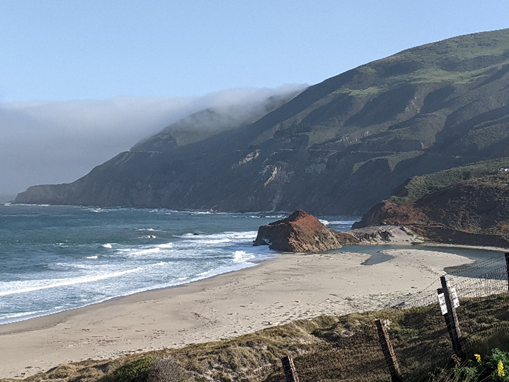 Along the Big Sur Marathon Course (photo by the author)
I’m detecting a trend upon returning from Boston.
As was the case in October, I caught a cold on my flight to the West Coast after running in last week’s Boston Marathon. The mask mandate on air travel in the US had already been lifted the previous week but, not wanting to take chances, I masked up on both of my flights. Nonetheless, something got through to me. I tested myself, it wasn’t COVID.
I felt fine most of the day Thursday, the day after the flight, and even got in a four-mile recovery run. But then in the evening the sore throat came on and by morning the cold had taken root.
We had stayed in Palo Alto with friends Wednesday and Thursday and then Lynn and I drove down to Carmel on Friday. The Expo for the race was in Monterey, which is a bit north of Carmel so we stopped there to grab my race packet before continuing on to our hotel.
By the time we arrived in Carmel, the cold had wiped me out and I spent the rest of the day and night in bed. Saturday, the day before the race, I felt a little better so Lynn and I walked around downtown Carmel and spent a few minutes on the beach. A short shakeout run was out of the question as I felt it better to conserve energy for the marathon.
Carmel is a lovely seaside town, very artsy, very touristy, that has resisted any attempts to change its small-town ambience. Big box stores have no place in it and although there is the occasional monster house, most of the homes are quaint, modestly-sized yet well-appointed cottages. Lynn and I have always enjoyed taking the family there for quiet, relaxing weekends when we lived in Palo Alto.
Though pleasant, the walk around town wore me down so I headed back to the hotel for more sleep while Lynn continued to check out the town. This cold had derailed my plans for the two days leading up to the race. I had hoped to do a rigorous carbo load but lost focus. Also, I had wanted to go back to Monterey Saturday evening for the race’s pasta feed and to socialize with other runners but couldn’t muster the necessary enthusiasm. We grabbed an early dinner at a downtown Carmel restaurant instead.
Fortunately, the extended bed rest did not trigger a back spasm like it usually does. Therefore, I did not have to deal with back pain during the marathon -just lingering fatigue from my cold.
The marathon course is point-to-point starting in Big Sur Station and ending in Carmel a few miles south of the tourist-heavy downtown area. A Marathon Finish Village was erected complete with portable toilets, VIP tents, and various concessions. A fleet of buses were commandeered to bring runners from towns near the finish line (Carmel, Monterey, Seaside, Pebble Beach, and Pacific Grove) to the starting village.
The marathon was not the only game in town. There were races of other lengths occurring simultaneously including 21 miles, 11 miles, 12K and 5K, as well as a marathon relay. All of the races used the same finish line and the portion of the course, along coastal California Highway 1, appropriate for the length of the race. That aforementioned fleet of buses was responsible for depositing nearly 7000 runners at their corresponding starting locations along the route. After all the runners were properly distributed, all of those buses were to clear out to allow the races to take place.
The massive distribution of buses and runners takes time. Bottom line: For my wave’s 6:40 am start time on Sunday morning, my bus left downtown Carmel at 3:30 am. After getting dropped off at Big Sur Station, runners hunkered down for the two hours wait for the starting gun.
My recent practice has been to pass the time waiting for the start by chatting with other runners. But my cold, together with the ungodly early bus departure, sapped me of the requisite energy. This was my biggest regret of the day because I have come to appreciate that sharing stories with other runners is the best part of these events.
The view of the California coast along Highway 1 is stunning. The world class scenery is the big draw for the race. There’s no room for spectators, though. Runners are shunted to the left lane and the right lane is kept open in the event emergency vehicles need access. Therefore, unlike the Majors that I have been running lately, there are hardly any spectators along the route.
That made me wistful for Monday’s Boston Marathon and the Wellesley Scream Tunnel, the Team Fox cheer sections, and my friends Darien, Ela, and Max who waited to urge me on from Coolidge Corner.
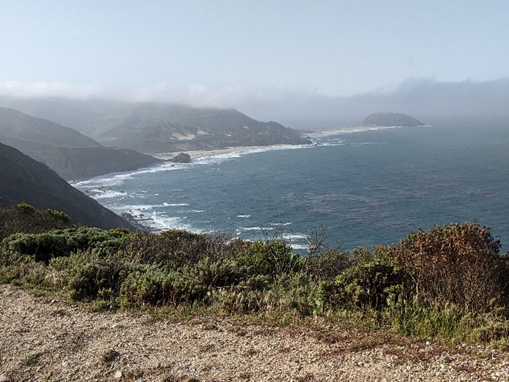 Along the Big Sur Marathon Course (photo by the author)
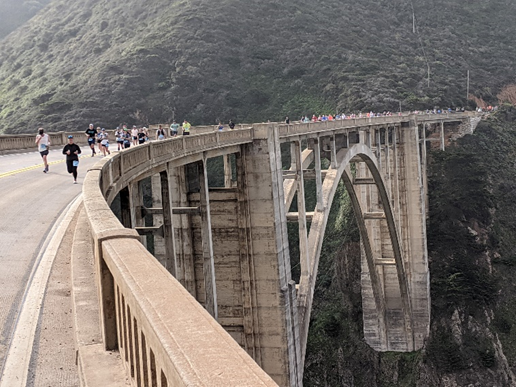 The Bixby Bridge on California Highway 1 (photo by the author)
Nonetheless, besides the scenery, there were other pleasant diversions as runners made their way north. At mile 11, the Taiko Drummers banged out a virtuoso cadence and at mile 13 Michael Martinez was set up with a Yamaha grand piano to play a classically stylized version of Billy Joel’s Piano Man with enough amplification to allow runners to enjoy the music well before they came upon the piano.
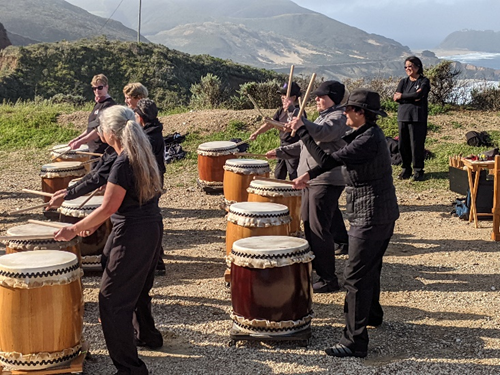 Taiko Drummers at mile 11 (photo by the author)
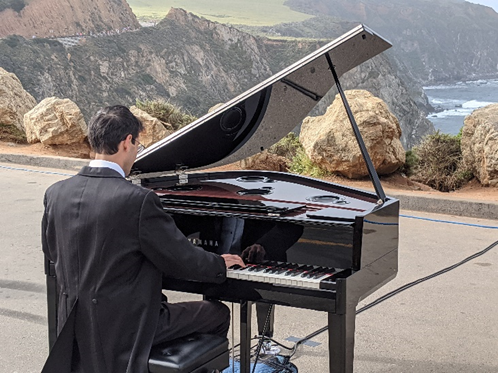 Michael Martinez on a grand piano at mile 13 (photo by the author)
The course is difficult. There is over 2000 feet of elevation to conquer as well as the corresponding quad-challenging downhills. On top of that, we had a cold headwind from about mile 5 to the end. I kept my pace fairly steady but my cold tamped down any attempts at speed.
As I did in Boston, I got my carbs from maple syrup packets from Untapped. Big Sur allowed hydration packs on the course and so I was able to sip from mine throughout the race. The water I carried was spiked with electrolytes from dissolved Nuun tablets.
But for the first time I tried SaltStick tablets for my electrolyte needs. I’m glad that I did. Total gamechanger. This product eliminated the cramps that have plagued me at every marathon so far. Even after the race and driving to our next destination, when a cramp started to come on, I would take another tablet and within seconds the cramps would stop.
These capsules include calcium, magnesium, chloride, sodium, and potassium — a smorgasbord of electrolytes. Suddenly I now had a solution for one of my most difficult running problems. I decided to try these tablets because several runners I met in Boston had raved about them. However, I could not help feeling foolish for never having learned this trick in the past two years.
Spectators were allowed to line the last quarter mile or so of the course and they cheered loudly and enthusiastically. At the Marathon Finish Village, entrants in the Boston 2 Big Sur (B2B) challenge were allowed access to the VIP tent for food and drinks. Besides earning the marathon finisher’s medal, B2B runners also received a special medal for the combination of the two marathons and a rather nice jacket commemorating the achievement.
My finish time for Big Sur was 4:33:54. Together with my Boston finish time this gave me a cumulative 8:51:52 for the two marathons. By contrast, the winner of the B2B challenge was Jordan Tropf, age 30, who finished with a combined time of 4:51:32. Clearly, I don’t live in that world. The fastest runner in my cohort (male 60–64) was Allan Van Dyne who’s combined time was 6:43:24. Oh well.
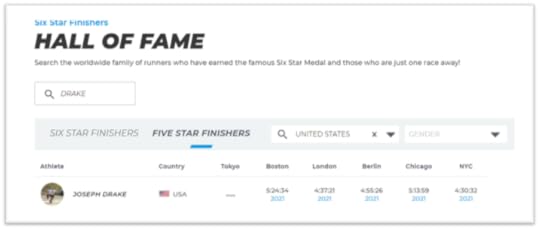
Readers of this blog may remember that my original goal one year ago was to run all of the 2021 World Marathon Majors in a single year. But Tokyo did not cooperate and although I did a virtual marathon in Seattle in its place, officially I only managed five of the six stars I was aiming for.
I have trouble giving up on goals. That’s well established. I expect to get my deferred entry into Tokyo in its 2023 edition so perhaps I could set my sights on 2023 to bag them all.
But I already have Boston now and within a year I should also have Tokyo. And the rest of them? Well, for 2022, they are all lined up just like they were in 2021 but without that pesky consecutive day Chicago-Boston doubleheader. See where I am headed?
So, game on! Boston done. Berlin, London, Chicago, and New York City in the fall and Tokyo next March. All six majors in less than one year’s time.
Last year it took me a cumulative 29 hours 23 minutes and 47 seconds to run all six of the marathons. This time around, given the more relaxed schedule, I should do better than that. Originally, I thought I would go for a cumulative time of one day (24 hours). That means averaging four hours for each of the majors. That might still be achievable but because of my 4 hour 14 minute finish in Boston, I have some work to do. I haven’t given up on 24 hours but it may turn out to be 25 hours (one day and one hour).
Hence my new goal: Six majors in one year, one day, and one hour.
I will be running the four majors in the fall for Team Fox again. To all of those readers who helped me out so much last year with financial contributions, thank you!
I will be reaching out to you again for my 2022 effort!
As mentioned in the previous post, I am writing a book about my Fall 2021 Marathon Majors. The intent is to help people within the Parkinson’s community, patients and support people, to deal with PD through exercise and positive thinking. I also hope readers of all types will draw inspiration from the exploits, mine and those of other athletes, described in the book.
Much of the book draws from my blog stories but I have restructured that material so that it is more suitable for book format. I hope to publish sometime during the summer of 2022. Any royalties I earn from book sales will be donated to the Michael J. Fox Foundation.
[image error]April 22, 2022
Boston 2 Big Sur 2022, Part 1
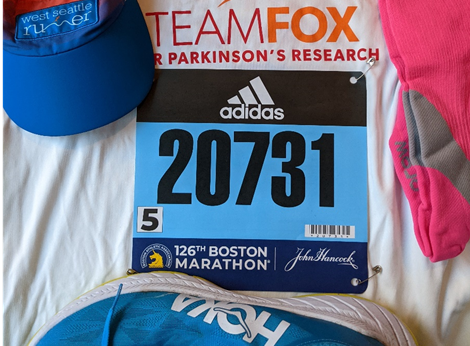 Photo by the author.
My journey continues but it has been given an additional purpose. That’s fine with me. Whatever comes my way is all part of the adventure.
Yet, I’m still doing more of the same. Right now, I’m in the midst of a marathon challenge called Boston 2 Big Sur (B2B). It’s a combination of running the Boston Marathon and then, six days later, the one in Big Sur, California. After running the Chicago and Boston marathons on consecutive days last year, this one seems almost routine. Yeah, right.
While on the Boston leg of B2B, I took the opportunity to reconnect with some of the people I met through the 2021 WMM challenge. Back then I started out as a nobody. For the most part, I’m still a nobody.
However, there are some now who refer to me as the other guy who did what Shalane Flanagan did. That has given me some status and a platform for stating my views on and experience with Parkinson’s disease. On a few occasions lately, I have been asked to speak on the subject and I am always happy to do so in hopes that others will derive benefit from my words. It seems that there are too few Parkies who are willing to share their experiences publicly and I can speak with some certainty on the benefit of exercise as a therapy.
And I continue to make the effort to meet new friends. That’s one thing that hasn’t changed: Marathon runners are great people.
On the plane to Boston, I sat next to Peter who lives on Bainbridge Island. He started running Boston in 2009 and has kept his streak going since. “Streakers” who have run ten or more consecutive Boston Marathons are not subjected to cutoff times, a nice advantage. Peter was a software engineer at Amazon who started there in 1998. No surprise, then, that he was able to retire two years ago at age 50.
We discussed many things about running and family life and eventually I thought to ask him about the Boston in 2013, the year of the bombing. He had already finished and was showering when the bombs went off so he didn’t hear them. But his phone was inundated with messages from friends and family wondering if he was OK. Normally runners proudly wear their finishers’ medals around town after the race but he couldn’t bring himself to do so that year.
He was touched and impressed with Boston’s resolve to bring the race back the next year undeterred. If anything, he reported, the energy was greater in 2014 than ever before.
My Airbnb was in the South End very close to the Hynes Auditorium, where the Expo was held, and also well-placed with respect to the finish line, the Public Garden, and the Common. It was a great location for the various activities I planned for the weekend.
I am a subscriber to Runners World+ (RW+) which allows me access to their on-line knowledge base covering everything having to do with running. As a special perk, RW+ invited subscribers running in Boston to a Saturday morning group shakeout run and coffee afterwards.
Marathoners like to do one or more “shakeout” runs before race day. These are short, slow-paced workouts of three to four miles intended to keep the body alert. Until now I had always done my shakeouts solo but by doing so, I have missed the opportunity to meet other runners. Marathons are opportunities to socialize so this time I decided to take advantage.
We met on Boylston Street close to the marathon finish, which also served as the finish line for the BAA 5K race. After watching the 5K the finish, we headed out for the run. RW+ sent a sizable crew of maybe eight uniformly pleasant and friendly staff members including the Runner’s World Runner-in-Chief Jeff Dengate. Jeff was kind enough to look me up on Strava and sent a congratulatory note in response to my post of Monday’s marathon.
Another RW staff member I met, Jesus Ruiz, from Texas also started following me on Strava which turned out to be an almost sacrilegious experience. Strava notifies subscribers when new athletes start following their posts so in this case my notification was:
“Nice! Jesus is now following you!”
Heady stuff for someone raised as a catholic. And on the day before Easter no less.
I had the chance to chat with some other runners on the shakeout. Eamon was one who lived near Portland so he and I were familiar with some of the marathons held in the Pacific Northwest. If memory serves, he got his Boston qualification time (BQ) at the Portland Marathon which has an insane course map. On the route there are 75 right angle turns. Difficult to establish and maintain a strong pace through that maze.
I also fell into conversation with Craig, a dairy farmer from Toronto. This was an education; I learned a lot about dairy farming in general and about Canada’s policies regarding the industry. According to Craig, Canada, unlike the US, likes to keep their farms small so as to preserve the country’s culture. By this measure, Craig’s farm is large with 83 cows.
What really fascinated me though was the robotic milking system he used. Craig used his phone to show me a live video feed of the system in action. The robot literally does everything so that Craig doesn’t need to hire extra help. And because a robot can milk the animal around the clock, he gets 25% more yield from a cow than with a human milker.
It made me think of John Henry and his futile battle with progress in the form of the steam drill. If I was a little more quick-witted, I would have sung something to Craig along the lines of “Before I let that machine beat me down, I’ll die with Bessie’s teat in my hand.”
After the shakeout we all sat down for coffee at Pressed Café in the Prudential Center. RW+ had reserved a separate room for us and offered breakfast, a very thoughtful gesture. I just had some coffee, a treacherous thing given my snobbery about the stuff and the fact that I was to meet another runner, Carita, a little while later for more coffee. I was destined for the jitters and motor-mouth the rest of the day.
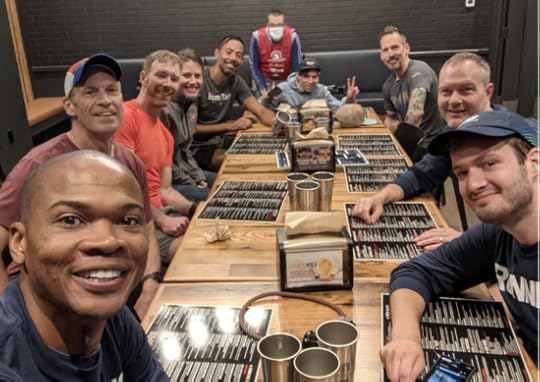 Coffee with Runner’s World (photo is property of the author)
RW likes to highlight stories about some of their subscribers so as each of us left the cafe, they did a video interview of them to gather potential material. I did my usual shtick about my 2021 WMM challenge and what not. Maybe I will hear back from them.
I met Carita near the marathon finish line and we caught up over espresso and latte. We first became acquainted totally by chance while on line at the Expo for Boston 2021 in October and since then we have followed each other on Strava. Just two weeks earlier she took part in the Marathon des Sables, the famous 250 kilometer multi-day stage race in the Sahara Desert. She struggled with a heavy pack carrying all of her food and bedding, 100+ degree heat, sand storms, and here she was running the Boston marathon immediately afterwards. Amazing.
Carita has sarcoidosis that affects her lungs and breathing which makes her running feats all that much more astonishing. She regaled me with tales from the desert and urged me to try it sometime. (Not likely, I think.) We share a perspective though. We both have diseases that have influenced our views on life and impel us to make the most of what we can while we can. As she says, “The alternative is to get depressed and end up living on the couch.”
Darien, my hero from the October race for transporting me from Logan Airport to my Airbnb after returning from the Chicago Marathon, hosted a carb-heavy lunch gathering along with his wife Ela at their home in Brookline. He invites locals to such gatherings whenever college friends come to town and I have been happy to be the impetus this time as I was in October.
He assembled a large crew: Mark and wife Alex, Andreas and wife Jen and daughter Greta, Steve and his date Trina, Rich and daughter Lizzie, and Hauke. We caught up and discussed running and upcoming vacations. Most of us are nerdy and so the non-nerds in attendance had to indulge us while we debated Wordle strategies.
Afterwards, I had just enough time to get to the Expo before it closed to retrieve my race packet. It was a much more relaxed atmosphere than in October. All runners required proof of vaccination prior to registering so there was no vaccination-check tent this time around. The Expo was larger also but by the time I got there the booths were mostly unmanned so I didn’t linger very long.
At the Airbnb I topped off my carb loading for the day with pasta and a baked potato. On the course I planned to consume maple syrup packets sold by Untapped, a Vermont-based (of course) company. I’ve found them easy to consume and they don’t bother my stomach. As they are liquid they should digest quickly also.
Sunday morning was another shakeout run, this time with the “Run Farther & Faster” group led by Julie Sapper and Lisa Levin. Julie and Lisa featured me in one of their November podcasts and invited me to join them for their shakeout. It was great to finally meet them and they introduced me to the rest of the group as the other guy who did what Shalane did in the fall.
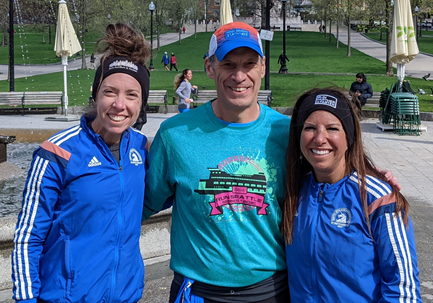 Lisa, Joe, and Julie (photo is property of the author)
Karyn, who I met in Berlin, was there and so we got a chance to talk again. Her husband, Mark, stayed home with the kids this time. Another runner, Jessica, introduced herself and thanked me for the example I was setting with my openness about PD. We chatted while running and she told me of her sister who kept her diagnosis of MS secret from everyone for more than a decade. She felt as if her sister might have benefitted from a more open approach as would her family.
Afterwards I met up with Suzanne from Southern California for more coffee. We met in Berlin in September. She also ran in London and Boston in the fall and we have been following each other on Strava. She says she doesn’t train all that hard but nevertheless qualified for the Abbott age group world championships again this year, a considerable feat. I do meet a lot of amazing people when I go to these marathons.
I found myself thinking of how relaxed this day was compared to the day before October’s Boston Marathon. In fact, for the previous race my shakeout run was the Chicago Marathon. I even had some free time in the afternoon that I used for a baked potato lunch and a relaxing nap in preparation for the pre-race dinner with my friends from Team Fox.
I qualified for Boston this time around but nonetheless Team Fox invited me to all their parties. Every year they ask a dedicated member to speak at the pre-race dinner to offer words of encouragement to the team and to share what Team Fox means to them. Katie Casamassina wrote to me saying, “We would be honored if this person was you!”
Such requests have been coming my way as of late because of my exploits with the World Major Marathons last fall. Newly diagnosed Parkinson’s patients have contacted me for one-on-one discussions and some groups have asked for presentations. It has only been a handful to date but I am glad for the opportunity.
My speeches and presentations are still a little rough but I am getting better at it with experience. I go into some detail about how running has slowed the progression of PD for me as evidenced by dramatically reduced symptoms and the fact that I have not increased my medications in the past two years. Then I make the case for keeping a positive mindset for two reasons.
First, positivity is necessary for putting in the training. Running requires mental as well as physical training. Lack of discipline in either the mind or the body will derail the effort.
Second, the decrease in a Parkie’s dopamine levels, besides its effect on motor functions, can bring on mood problems and it is common for PD patients to suffer from depression. I can give examples how I have deliberately altered my mood by dismissing negative thoughts and I can also attest to the positive energy coming from friends, family, and strangers who cheer me on during the marathons that I run.
I also like to slip in a plug for the book I am writing about my 2021 WMM journey, which expands on these themes. (You didn’t know I was writing a book? Sorry about that. I hope to publish this summer; all my royalties, if anyone actually buys the book that is, will go to the Michael J. Fox Foundation (MJFF).)
I think that my speech at the pre-race dinner had the desired effect. Katie and the rest of the Team Fox organizers were effusively grateful as was Skip Irving, the MJFF Board Chairman, who had also addressed the group. Some in attendance mentioned to me afterwards that they were moved to action as a result of my words. These words are music to my ears. Tops off my own dopamine tank.
Runners amassed at the edge of the Boston Common for the bus ride to Hopkinton for the start. With the larger field size compared to October (30,000 runners vs. 20,000) the scene was more chaotic than the last time around but everyone was courteous and patient. In fact, it is safe to say that the energy level in Boston throughout this weekend was noticeably higher than in October. It seemed the city and its people were eager for the event’s return to April.
I rode on the bus next to Kevin, an elementary school principal from Bellingham, Washington, and his daughter, Andrea. They are both accomplished runners but Kevin’s priority was for them to cross the finish line together. Reminded me of some of the triathlons I did together with my daughter, Kinsey. But they had a practical side to their goal. Kevin was not going to hold Andrea back if he could not keep up with her pace.
Hopkinton had a very large Athletes’ Village set up with portable toilets and room to spread out, stretch, and otherwise prepare for the race. The waves were called out in order so as to effect an orderly start. This was much different than October’s rolling start where runners were deposited closer to the start line and just started the race on their own timeline. Most of the runners I talked to about this preferred the rolling start as did I.
While in the Athletes’ Village, in search of a short line for a toilet, John, who I met in Berlin in September, flagged me down. We had been trying to connect all week but never could get our schedules in sync. But out of the 30,000 runners in the village he spotted me. Our wave was being called so we decided to use the alternative group of toilets that we would pass en route to the starting line. A good plan because the lines there were much shorter .
John was there with other runners from his PRx running group from Houston including Brooke who I also met in Berlin. Her husband, James, and son, Cooper, were going to cheer for them when they got close to the finish line.
The energy along the route was also higher than in the October race. Crowds were bigger, the cheering was louder and more enthusiastic. This, I felt, was what Boston wanted to be and the October race was a more tentative ad hoc version.
My goal for the race was to finish in under four hours. This is well off my personal record of 3:42 but I had to be realistic about saving something for the next weekend when I would be running the Big Sur Marathon. I was hopeful; I was still at that pace all the way to mile 19. But then things went south.
When I go for a run, I plan ahead for the medications I need to take along the way. I bring a small zip lock bag for storing the pills because one time I carried them loose in a pocket and my sweat dissolved them completely.
I program my watch alarm as a reminder. I’ll take a Sinemet tablet at 10 am and 2 pm and an Eldepryl at noon. But sometimes I won’t take the pill immediately when the alarm goes off and I’ll wait until the run is over.
When my 2 pm alarm went off at about the 20-mile mark, just shy of Heartbreak Hill, I reasoned that I could wait until the finish line to take my Sinemet pill. The four-hour goal was tantalizingly close and I couldn’t afford the seconds it would take to unwrap the pill.
Within a few more minutes my legs and feet started cramping horribly and my pace slowed. Cramps late in a marathon are typical for all runners and I sometimes think that it may be worse for me because they are a common symptom of PD. In fact, I should have been thinking about this when I decided to forgo the medication. So, I took the pill and the cramps got better but they didn’t vanish.
I ended up missing my goal time by 14 minutes. Was it because I didn’t take the medication on time? I will never know. I think that my fueling was otherwise okay; I didn’t really hit a wall but the slower pace belied a potential carb deficit. I am pretty sure though that if I ever solve this cramping problem, I will be able to turn in some satisfying marathon times.
Just before the famed “right on Hereford, left on Boylston” stretch to the finish I had one of those surreal moments that I’ve come to expect from this journey. On this short stretch of Commonwealth Avenue just after crossing underneath Massachusetts Avenue, I passed Shalane Flanagan, that other person who ran all of the majors in the fall of 2021.
This may sound like a triumph for me but it wasn’t. Rather, it was an enormous triumph for Shalane. She was acting as a support runner for Adrianne Haslet who lost a leg in the bombing at the 2013 Boston Marathon and who suffered serious injury when struck by a car while training in 2018. Shalane coached Adrienne to her goal of finishing in under six hours and helped her on the course as well. These are incredible, inspirational women.
There was a big crowd at the Team Fox post-race party including the runners and all of their friends and family who came along to support them. I reconnected with some of the people I met at the pre-race dinner and met many new faces. One pleasant surprise was meeting KyAnn who lives in West Seattle very close to where I do. She and her cousin Yvonne, who has 56 marathons in her resume including all of the 50 states, will run the Berlin Marathon in September and we hope to meet up there.
Oh, right, I have more majors on my schedule this year again. More to come on that topic in my next post.
My mind was still a bit numbed by the race and so I did a sloppy job of taking down names and noting the connections amongst the people at the party. I am embarrassed by that. But that didn’t seem to bother the folks I met. Katie and my other friends at Team Fox have hyped me up as some sort of a legend and I was occupied during the whole party meeting, greeting, chatting, and exchanging contact information with a lot of folks some of whom wanted to contribute to my fall campaign (again, more on that next time). Many of them thanked me for my speech at the pre-race dinner and wanted to know more about my book.
I was so happily pre-occupied at the party that by the time it broke up at about 7 pm I realized that I hadn’t eaten anything. There was a French bistro right around the corner from my Airbnb so I decided to grab dinner there before calling it a day. At the bistro, Michael, another Team Fox runner who I met at the pre-race dinner and who skipped the post-race party, was at an outdoor table with his husband Jonathan and their friend Steven. Michael called me over and the four of us talked for another hour about Parkinson’s, marathons, my book, etc.
At 8:30 pm I was at last happy to sit down for a dinner of steak frites and profiteroles for dessert.
The next day, Tuesday, was a languid rest day for me as I recovered from the marathon and packed for my flight to San Francisco. My wife, Lynn, had driven from Seattle and would pick me up at SFO on Wednesday afternoon. We spent the next two nights in Palo Alto with our friends Dan and Evelyn before heading south on Friday for Big Sur and the second leg of this challenge.
Stay tuned.
[image error]November 16, 2021
Epilogue: It’s About More Than Just the Running
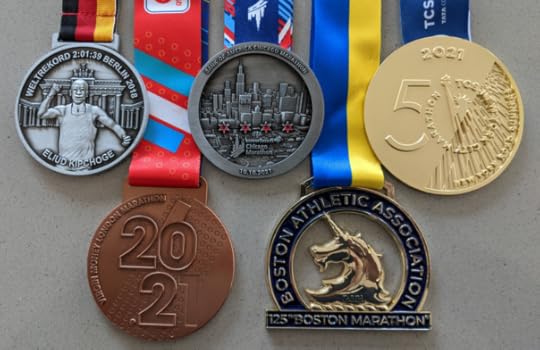 Photo by the author
If you are a regular reader you know that this is the last of the planned twenty blog posts documenting my effort to run all of the World Marathon Majors in 2021.
The endeavor was largely successful. I ran six marathons in 43 days including all of the Majors that were held this year (Berlin, London, Chicago, Boston, and New York City). Tokyo postponed until March 2022 so in its place I ran a virtual marathon in Seattle on October 17.
Focusing my training on rapid recovery was a good call. It’s almost as if running marathons on consecutive weekends is routine now. On consecutive days, i.e. Chicago-Boston, not so much.
Admittedly, though, my training approach hindered my speed. All those long, slow, heartrate-limited miles at the expense of speed training makes for a relatively pedestrian pace. Though I was not intending to set any personal records, I did manage to extend my personal worst to well over five hours.
Along the way, we have done a fine job raising money for Parkinson’s Research. My original commitment to the Michael J Fox Foundation in exchange for entries into the London, Boston, and New York City races totaled $26,000. As of this writing we have raised $37,645. Well done you!
As a bonus I received my fifteen minutes of fame. My family and I have appeared live, in on-line digital media, and in print in the local newspaper. Just in time for the holidays. Heck, I should be able to milk this at gatherings of friends and family for decades.
It’ll be like what Don Larsen, an otherwise ordinary player who pitched the only perfect game in World Series history, said when asked if he ever tired of speaking about it: “No, why should I?”
As significant as all this was, it was more or less expected. One sets goals to achieve them, no matter how preposterous they may at first appear. And it’s not as if I didn’t appreciate that the rarity of this feat would garner some attention.
Of course, there is yet some unfinished business. Tokyo, pesky and elusive, remains on the “to do” list though I have not given up hope that I can gain entry to the March 6, 2022 race.
But what I will cherish forever from this journey are the pleasant surprises, the unanticipated details, that I encountered along the way.
From the very first race in Berlin and beyond I met the warmest, most generous, and thoughtful people I could have imagined.
They cheer you on, they share tactics with you, they want to know how your race went, they follow you on Strava, they enjoy a beer with you, they pick you up (literally) when you fall down.
Who knew that marathon runners were so cool?
And with all of this running it’s very likely that my positivity has never been better. More often than not I come away from a workout or race feeling fantastic.
Sure, this may be attributed to the “runner’s high” that we hear so much about. Possibly. But I’m not sure that it’s that simple in the case of someone with Parkinson’s Disease.
What I do know is that it is common for victims of Parkinson’s Disease (PD) to suffer from depression. Dopamine, the chemical that is in short supply due to the disease, has a role in how one feels pleasure in addition to its job facilitating motor functions. It has become accepted in modern neurology that vigorous exercise stimulates the release of dopamine from parts of the brain that are not affected by PD.
So, running makes me feel good while potentially slowing down the progression of the disease. All good.
But what about when I’m not running? Is there a reciprocal effect? If exercise-induced dopamine release improves positivity, can positivity also stimulate dopamine release?
I have no idea. I’m not a neurologist. And I haven’t come across such a theory in what I’ve read.
Doesn’t mean it’s not worth pursuing. I’ve come to believe that striving for a positive mindset is a good idea notwithstanding.
So these days I try harder at it. When I recognize dark emotions I work towards spinning them to their positive counterparts. For a native New Yorker this is no trivial task.
Love instead of hate. Generosity instead of greed. Hope, not despair. Smiles, no frowns. I don’t pretend that this would work for everyone, but it makes me feel better. Does it slow down PD? Well . . . sure, let’s go with that.
Here’s an example. Shalane Flanagan was the 2017 New York City Marathon champion who retired from professional racing in 2019. Then on September 20, 2021, just six days before Berlin, she announced her plan to run all of the same races I was doing. It was dubbed by Nike as Project Eclipse.
I had always assumed that there’d be others who recognized the once in a lifetime (ok, hopefully, once in forever) opportunity that the pandemic-induced compressed Majors schedule represented and that I would not be the only one attempting it.
Yet I admit to struggling with resentment. Shalane got a lot of press and support from Nike and here I was wallowing in anonymity despite attempting a similar goal. The seeming unfairness was gnawing at me and I needed to turn it around.
So I switched to admiration.
I know as well as anyone how hard it was to train for this challenge. However, I am retired and our kids are on their own. Besides my marriage I have no other high priority demands on my time. Shalane is a full-time mom and a coach; hats off to her for taking on this challenge as well.
And, I hope I am not misrepresenting her, the effort rekindled her love for the sport. Relieved of the pressure to reach the podium, she could enjoy the freedom of running for the fun of it. This might be the inspiration that anyone who suffers burn-out needs to renew the perspective that got them into running in the first place.
Oh and, by the way, she ran each of these marathons in well under three hours. Only in my dreams would I be capable of that.
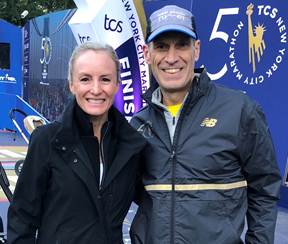 Shalane and Joe (photo by Kinsey Drake)
Admiration feels a lot better than resentment. Generates way more dopamine too, I suspect.
I did manage to catch up with Shalane just before the New York City Marathon. She was kind and gracious but I don’t believe she was aware of anyone else attempting the same feat that she was. When she heard what I was doing she said, “We should have joined forces.” Awesome. Could not have said it better myself.
Certainly not the least of the blessings I take away from this challenge is the mind-boggling support I have received from my friends and family. I am, and always will be, overwhelmed by your kindness.
You encouraged me all along the way and never doubted my resolve thus giving me no reason to doubt myself either.
You provided my entries into some of the races (looking at you Team Fox).
You contributed to my charity campaign so as to secure these entries.
You read the regular updates to my blog responding that you enjoyed the writing and were inspired by it.
You shared these blog posts with others thereby expanding my circle of friends and supporters.
You helped me with travel arrangements and well-considered accommodations (yes, that’s you Lynn Drake, my love).
You tracked my progress on each of the races, anguishing when my pace slowed or stopped and rejoicing when I finished.
You dispatched the relative loneliness of my Seattle virtual marathon by just being there (thanks Erika, George, Beth, Jim, Owen, Amy, and Milo).
And when possible, you came to the races to cheer me on.
In many ways, through all of your help, I come away from this journey thinking that you did most of the work. Hell, I just did the running and wrote about it. You did everything else. This story is as much yours as it is mine.
Thank you.
 Screenshot from worldmarathonmajors.com[image error]
November 10, 2021
Runner in the New York City Marathon Sheds a Few Tears
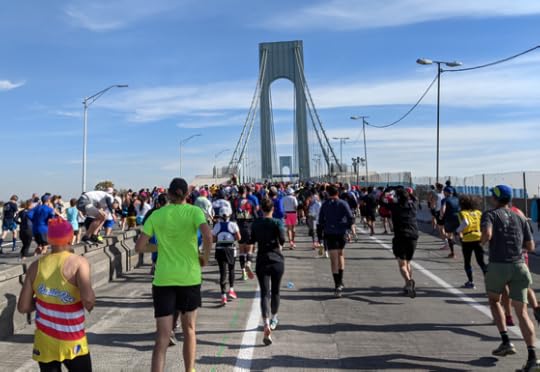 Photo by the author
News of my Marathon Majors challenge has spread since my Team 50 designation two weeks ago and that has led to the inevitable comparisons. I’ve been asked, “Which of these races was your favorite?”
The question came up several times before running in New York City yet my answer was that I expected that this last one would be the best. I had heard so much about how awesome New York spectators were and the weather forecast called for a cool 51 degrees at race time, far more favorable to running than what I experienced at any of the others.
Turned out I was right about NYC being the best. But as has been the case many times these past six weeks the details surprised me. In fact, the whole experience just blew me away.
All of the Majors this year had their strengths in terms of logistics and operations in view of the ongoing pandemic.
New York was very efficient. I especially liked the race packet pick-up process wherein each runner was told to select a one hour time slot for their visit to the Expo thus huge crowds were avoided. I had my bib and finisher’s shirt within 10 minutes of arriving.
And all of the volunteers at the Expo, on the course, and at the Start and Finish lines were unfailingly polite and helpful.
I would have preferred, though, to have the bus to the starting line deposit me on Staten Island a little bit closer to my wave start time. I was warned of this by other runners but, still, I couldn’t help but think that the four hours of shivering that I did leading up to the start was eating significantly into my glycogen stores.
All of the races also arrange for some kind of escort for the elites. This helps to protect them from the crowds while also providing valuable on the spot information as to the position and separation of the lead runners. In New York City the escort is provided by well-trained bicyclists.
My brother, Bob, has been a bicycle escort for the marathon for years now. Pretty cool to have him performing that critical role only just a few hours ahead of where I was pounding the pavement.
The Public Relations arm of New York Road Runners arranged media coverage for their Team 50 runners. I think of Laura Paulus and Samantha Miller with NYRR Public Relations as my “agents”. They set up print interviews with Runner’s World and The Seattle Times and a live streaming interview with the new Fox Weather channel on Friday evening two days before the race.
I’m happy to report that Fox Weather is not like Fox News. Fox Weather, though clearly seeking to entertain, is not opposed to science and has serious segments related to climate change.
Originally they pitched to me the idea of my reporting on how the weather effects a marathoner’s performance. That did not actually come up in the interview and the focus was more about a runner doing six marathons in six weeks despite having Parkinson’s.
I’ve no prior experience with TV and, having not yet seen a clip of my segment, I have no idea how I came across. But I very much enjoyed the adventure and the attention.
As was the case with all of the Majors, thousands of locals turned out to cheer on the runners.
Team Fox set up three cheer stations on the course. I did not spot the one in Brooklyn at about mile 7 but I understand that I was seen by them yet was oblivious to their rallying cries.
Maybe that was due to the distraction caused by the overall awesomeness of the spectators lining the course. I wore my name on my shirt and throughout the race I was urged along with a steady stream of “You got this Joe!”, “I see you Joe! Looking good!”, “Keep it up Joe, almost there!”, and so on. It’s easy to feel as if everyone there came just to see and help you.
The cooler temperature was a welcome gift and I was still going at a relatively strong pace coming up to the second Team Fox station on 1st Avenue and 86th (about mile 17.5). Strong, that is, until I crested 86th and came upon the sight that took my breath away and nearly stopped me in my tracks.
My family made up eight “Joe Heads” (photographs of my face attached to yardsticks) and were displaying them merrily as I approached the cheer station. My wife, Lynn, was in on it but I had no idea.
I slowed down long enough to give high fives to everyone and I hope I managed to choke out how awesome they all were. Then off I went towards the Bronx wishing someone would hand me a tissue so that I could wipe my eyes.
The inevitable wall came at mile 21 and I decided to walk mile 22. Knowing that there was another Team Fox/Team Drake cheer station coming up at 5th Avenue and 93rd (about mile 23.5), I felt that a short rest would help me look good for this next one.
As planned, my family and friends moved over to 5th Avenue in time for my arrival but this time there was no way I was going to pass by without stopping to take a photo. It’s a classic that will live on in Drake lore for generations.
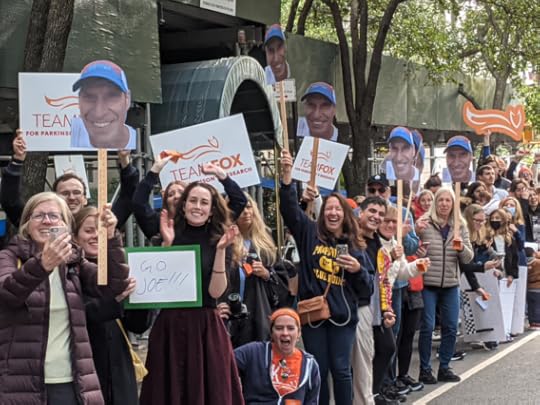 Photo by the author
I was prepared for the second “Joe Head” forest so the emotion was not as moist as I headed into Central Park with nearly three miles to go. These last few miles were tough. I really wanted to finish strong but I just was not feeling it. I slowed to a walk a bit shy of the 25 mile mark.
And then the photographers showed up.
Race photographers, of course, are sprinkled about the entire route so that at the end of the race each runner has dozens of photos to commemorate the event. But Runner’s World sent two contract photographers to get my image for the article.
I knew that this was going to happen and even had Samantha Miller send them a photo of me in one of my other races so that they‘d know what I looked like. Naively, I thought that this would be something like a single shot as I ran by.
But that is not how it’s done. As I came into view the photographer would set up for some shots then as I got close they’d turn around and sprint up ahead to set up for some more shots.
And, certainly, walking would not do. I picked up the pace so that, once again, I would look good for the cameras. And smiles only, please. No need to advertise one’s pain.
The first photographer stalked me for about half a mile and seemed to get his fill at about mile 25. We high fived and then he left and I figured that was that; I could relax a bit to the finish. I had understood that Runner’s World was only sending one photographer to capture me on the course.
Then I came up on another one starting at about a half mile from the finish line. His job it seemed was to track me all the way to the end. Same deal: suck it up, look good for the cameras, repeat.
I’m actually grateful for their work. Because of them I finished faster than I would have otherwise and no doubt looked better doing it. The second one, Johnny Zhang, stayed long enough to document my receiving the medal. By the time he was done, though I ached, I was feeling pretty good about the whole day.
The elation took a darker turn as I made my way from the finish line to the AirBnB where Lynn and I were staying. As the crow flies my return path was less than a mile eastward across the park but due to crowd control and road closures my trip home took more than an hour as I was shunted westward then forced south to give the park, and runners still on the course, a wide berth.
Yet, even the death march turned out to have a surprisingly enjoyable angle. My finisher’s poncho gave me away and so random folks would shower me with congratulations, smiles, thumbs up, and what have you as I trudged along. When did New Yorkers become so pleasant?
I could not have imagined a better finale to my adventure than the way the New York City Marathon turned out. Besides the enthusiasm of the thousands of New Yorkers lining the route and the devotion of the Team Fox people supporting the runners, I also experienced the joy of having friends and family on the scene chasing after me.
Lynn, and our daughter, Kinsey, were there along with brothers Tom and Bob, and sisters Charlotte, Christine, Marcia, and Pat. Tom brought his wife Sue, Christine brought her daughter Samantha, Kinsey brought her friend Janet, and Kinsey’s friend Eric was ready for me in Brooklyn. And in a last minute appearance, our friend Rich bicycled in from New Jersey to join in the fun. And many, many others were tracking my progress from afar.
The fun did not stop with the race. I have seen countless photos of Joe Heads popping up all over the city: Joe Head on the subway, Joe Head in a floral display stopping to smell the roses, Joe Head being interviewed by a local TV crew, random parents of other runners cradling Joe Heads, dancers dancing with Joe Heads, etc. You get the picture. My family knows how to have fun.
And, seriously, I have Parkinson’s Disease to thank for all this. I’m a lucky guy.
Shalane Flanagan ran NYC in 2:33:32 to my 4:30:32 so I met this watered-down, factor of two goal of mine in five of the six marathons we both ran.
I also met Shalane the day before the race during some opening ceremonies of which she was taking part. She was very kind and gracious. More on this in next week’s (final) post.
I ran the London, Boston, and New York marathons this year as a charity entrant. There’s still time to contribute to my cause (assuming that you have not already done so).
If you share the passion that the Michael J Fox Foundation and I have for finding a Parkinson’s cure please consider contributing to any of the WMM I am running in as a member of Team Fox (links below). All donations are meaningful and greatly appreciated.
fundraise.michaeljfox.org/boston-marathon-2021/joesgottarun
fundraise.michaeljfox.org/londonmarathon2021/joesgottarun
fundraise.michaeljfox.org/tcs-nyc-marathon-2021/joesgottarun
[image error]October 27, 2021
Team 50 of the New York City Marathon
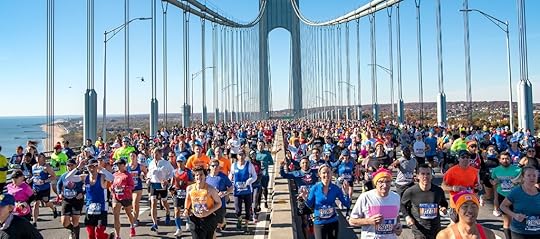 Photo from nyrr.org
At its start I intended this blog to comprise twenty posts and this is the 18th. The next one, to be published the week of November 8, will recap the New York City Marathon. My final story documenting this journey will be posted the following week.
This one is about some exceptional individuals and groups involved in the 50th Running of the New York City Marathon.
It’s been a two-year crash course in marathon running for me and with the final 2021 World Marathon Major in New York City next week I am nearing the end of this stage of the adventure.
I spent a lot of time researching best practices and integrating them into my training strategy. Perhaps with some changes I might have performed better but on the whole I’m satisfied with my preparation.
One thing that I was not prepared for was the tacit and unbridled support that runners have for each other.
It’s so unlike other, particularly American, environments where trash talk and intentional divisiveness run amok.
At some intrinsic level, marathon runners acknowledge that theirs is not a zero sum game. One runner’s success in no way diminishes the achievements of others. All efforts are celebrated.
Arguably this may not be the case for the elites where there are only so many podium positions and, for example, a very limited number of Olympic berths to compete for. I couldn’t say for sure having never been in that position. But for the overwhelming majority of us the atmosphere is one of mutual, generous support.
And it’s not just fellow runners who promote this environment. Race directors, municipalities, volunteers, and spectators, to say nothing of friends and family, are all aligned to help bring out the best performances from each athlete.
Think of it as institutionally supported audacity. It is no wonder that under these conditions individuals shrug off obstacles and their own limitations to say, effectively, “I belong here. I can do this.”
The organization that puts on the New York City Marathon, New York Road Runners (NYRR) gets it. Their mission is to help and inspire people through running. To commemorate the 50th edition of their marathon, NYRR announced Team 50, an impressive group of runners taking part in this year’s race.
The NYRR Public Relations team had the daunting task of selecting Team 50 from among the 30,000 entrants. A member of the PR team, Laura Paulus, herself a runner, shared with me the team’s point of view that on marathon day it is about much more than just the running. The composition of Team 50 reflects this.
Here are just a few of Team 50 members who I find to be particularly audacious:
Last year, Chris Nikic became the first athlete with Down Syndrome to complete an Ironman Triathlon. This year he’s added the Boston Marathon to his accomplishments and, less than three weeks later, will also be running in New York City. He’s using his newly earned notoriety to help dispel the stigma associated with people having physical and intellectual handicaps.Aaron Lee Burrows was shot five times while saving the lives of three of his co-workers during a workplace shooting. Formerly an ultramarathoner, Aaron now struggles with shorter distances due to the lingering effects of his wounds. Undeterred he is in the process of raising $50,000 for the St. Jude Children’s Hospital while running 50 marathons in 50 states over the course of 50 weeks. With the NYC marathon he’ll be bagging number 30+.Zahra escaped Afghanistan five days before it fell to the Taliban. Though she ran three marathons in Afghanistan before the fall, women have since been banned from sports and from educational opportunities. She’ll be running in NYC with the charity Free to Run which enables women and girls to engage in outdoor activity in conflict-affected regions.Sara Zutter is a special education teacher and children’s running coach in New York City who encourages her students to exercise to keep their hearts healthy. She speaks from experience having been diagnosed with atrial fibrillation and undergoing heart surgery at age 30. The surgery gave her a second chance to realize her goals of completing all six of the Marathon Majors and competing in triathlons. Then in 2019 she was diagnosed with a uterine myoma, polyps, menorrhagia, and anemia. While training for the NYC marathon she had the myoma and polyps removed yet is still on track to run the race next week and expects to raise awareness about heart diseases and reproductive system disorders.Micaela (Mica) Naibryf and Amnon Liebowitz will be running the race together to honor the memory of Mica’s brother, Ilan, who died in the Champlain Towers collapse in Surfside, Florida. Ilan was in town to attend the funeral of a friend’s father and spent the night in the Towers. Amnon is a structural engineer from Israel brought in to assist with disaster relief and was the one who recovered Ilan’s body.Shalane Flanagan, the race’s 2017 champion, and I are on the team for running all of the World Marathon Majors this year. Shalane is highlighted for completing each of them in under three hours while I am mentioned for Parkinson’s and for raising money for the Michael J Fox Foundation as a member of Team Fox.
It’s difficult to feel worthy of the juxtaposition but, nevertheless, I am delighted and honored to have my name associated with these heroes.
For more details about Team 50 and the other amazing, inspiring people on the team, check out the following press release:
https://www.nyrr.org/media-center/press-release/20211021_team50
Shalane did her Virtual Tokyo Marathon in Portland, Oregon on Monday October 18, the day after I ran mine in Seattle. Her finish time was 2:35:14 while mine was 4:41:55. So after failing to meet my factor of two objective in Boston I am now back on track with this one.
I am a charity runner in the London, Boston, and New York marathons this year. There’s still time to contribute to my cause (assuming that you have not already done so).
If you share the passion that the Michael J Fox Foundation and I have for finding a Parkinson’s cure please consider contributing to any of the WMM I am running in as a member of Team Fox (links below). All donations are meaningful and greatly appreciated.
fundraise.michaeljfox.org/boston-marathon-2021/joesgottarun
fundraise.michaeljfox.org/londonmarathon2021/joesgottarun
fundraise.michaeljfox.org/tcs-nyc-marathon-2021/joesgottarun
[image error]October 18, 2021
Tokyo is Virtually in Seattle
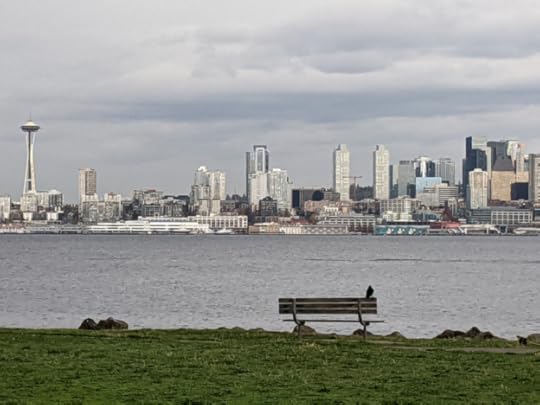 Photo by the author
My luck ran out on the flight back to Seattle from Boston.
It started with a sore throat. By nightfall it was a full on cold and the next two days I was wiped out and bedridden.
Being in bed for a long time risks triggering a chronic back condition I’ve had since my twenties. That risk was realized. By Saturday October 16, the day before I planned to run a virtual substitute for the Tokyo Marathon, I was still shaking off the lingering cold and my capricious back made for painful walking.
All the COVID-safe protocols in Chicago and Boston should have protected me from contagion. It makes me wonder how a cold got through all that. Lynn managed to avoid it despite the fact that we did nearly everything together since I came back from London.
Maybe it had something to do with running mile after mile amidst thousands of others through city streets lined with tens of thousands of additional spectators. I’ll never know.
What I did know was that, by bedtime October 16, running a marathon the next day was borderline folly. But then again, what part of this whole campaign hasn’t been?
Virtual road races came on strong in 2020 as the COVID-19 pandemic disrupted social gatherings of all sorts. The process is familiar: register for the race with one’s name, pay a registration fee, run and get a finish time, and collect a T-shirt or the like and perhaps a medal for the effort.
The difference is that there is no start or finish line and no pack of runners to run with. One simply runs wherever desired for the prescribed distance then logs the finish time on the race’s online results page. Typically there is a specific date window during which the race must be run.
Although it’s possible for a runner to compare her results to others, places and standings are not so meaningful given that the courses are not equivalent.
To soften the blow of the cancellation and/or downsizing of the in-person events, in 2020 all of the Majors held virtual marathons with fewer, if any, restrictions regarding who may register.
Many runners, including myself, found the virtual races to be an acceptable if not entirely satisfying outlet for the substantial training they had been doing for races that were summarily cancelled. I personally ran a 5K, two 10K’s, a 15K, two half marathons, and a marathon virtually in 2020.
Despite the return of the in-person events, race coordinators continue to find a place for virtual races even now. It helps to offset the high demand for some races that are hard to get into.
By augmenting the in-person event with a virtual race, for example, the London Marathon promoted a worldwide event with 35,300 runners on the streets of London joined by another 24,000 running at venues all around the world. It appears that London will continue to make the virtual race an annual fixture.
Tokyo, having postponed its marathon to March 6, left runners only the virtual option for the scheduled October 17 race.
I was loathe to stray from the schedule I set for my Virtual Tokyo Marathon so on the morning of October 17, feeling at maybe 70% capable, I decided to go for it. At worst I would call it off midway and make it up some other day. As always, I had no finish time pressure; if it took six hours to complete so be it.
I chose a course similar to one I’ve used for some of my 20-mile long runs. Using roads and trails along the perimeter of West Seattle it’s replete with breathtaking Puget Sound and downtown Seattle views. I threw in a few loops around Lincoln Park to top off the distance to 26.2 miles.
My first few strides were not promising. Each footfall was accompanied by a painful jarring of my back. Nonetheless, I headed for Lincoln Park hoping that it would loosen up with a few more miles.
At the park I met up with Mike and Erika, two gazelles that I’ve befriended on Strava and through working at the running store, West Seattle Runner. They both ran Boston and turned in finish times on the order of an hour faster than mine. Erika ran it in 3:31:41 and Mike ran a 3:16:02.
Erika joined me for a few miles in the park throttling back her blistering pace for my benefit and gave me a much needed lift as I plodded along still hoping for my back to thaw out.
At the halfway mark, well after Erika peeled off for home, things were not going much better. Then at around mile 17 the miracle that I was hoping for came through. The ache in my back vanished and my pace picked up to sub 10 minutes per mile and I was able to sustain that through the end of the race.
I finished the second half a full 17 minutes faster than the first. No walking, no cramps, and no wall. My overall time was no great shakes but it was enormously gratifying to put this one in the books.
 Cheering squad, photo by the author
But the real thrill was that on this lonely, mostly solo run I actually had spectators cheering me on! On passing Constellation Park at mile 17.5 there were signs urging me on placed by my neighbors, Owen and Amy and their son Milo. George and Beth were there as well cheering for me as I passed.
It was as emotionally energizing, if not more so, as any of the support I received at the in-person marathons I had just run.
They were still there when I returned to Constellation Park for the finish as was Jim cheering from his balcony overlooking the scene. I couldn’t have asked for a better day than this one.
I know from history that my back problems are not over. The relief I felt during the latter half of the run is temporary. For a few more days I will have trouble walking not to mention continuing with my training.
All good things come to an end though. On November 7 is the finale: the last of the Majors, the New York City Marathon.
I don’t know how Shalane fared with her Virtual Tokyo Marathon. I’m sure that it will be announced at some point but I have not yet found her results on line. I did go to the results page of the Virtual Tokyo Marathon 2021 but did not see her entry. (I did not register for that one in time so I chose the Seattle Virtual Marathon instead.)
That portal suggested that results could be entered through 5 pm October 16 Japan Standard Time so if Shalane ran her virtual as per her reported schedule she would not have been able to enter her result. Of course, it may have been a different virtual marathon that she entered.
I ran my virtual in 4:41:55. In order to maintain my goal relative to Shalane’s time she would have needed to do no better than 2:20:58. Though she is certainly capable of that, she has not done so during these Majors so I’m hopeful that I met the objective this time around.
I am a charity runner in the London, Boston, and New York marathons this year. There’s still time to contribute to my cause (assuming that you have not already done so).
If you share the passion that the Michael J Fox Foundation and I have for finding a Parkinson’s cure please consider contributing to any of the WMM I am running in as a member of Team Fox (links below). All donations are meaningful and greatly appreciated.
fundraise.michaeljfox.org/boston-marathon-2021/joesgottarun
fundraise.michaeljfox.org/londonmarathon2021/joesgottarun
fundraise.michaeljfox.org/tcs-nyc-marathon-2021/joesgottarun
[image error]October 12, 2021
Back up to Boston
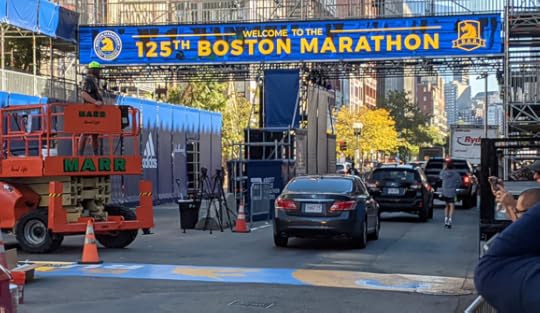 Photo by the author
After running the Chicago Marathon and arriving safely to O’Hare Airport in time (just barely) for my flight back to Boston, the next order of business was re-fueling for Monday’s race.
Because I would be eating on the plane, the simpler the food source the better. I came up with the idea of chicken fried rice, which turns out to have almost the ideal canonical 4:1 ratio of carbs to protein. I just needed to down about two pounds of the stuff and I’d be all set.
I brought the takeout I purchased the day before onto the plane but only got maybe a quarter of the way through it during the flight. The race left me nauseated and my gut needed some settling time before charging into the recovery plan.
Though slow and scarcely perceptible, adequate recovery from Chicago eventually did come. By about 5 am in the morning my leg cramps finally dissipated. And throughout the night, as my appetite returned, I got up every few hours to eat the rest of the chicken fried rice and everything else we had on hand.
My Boston start time was about 11 am, a blessing considering the 7:30 am Chicago start. Those few additional hours were sorely needed.
Boston does a rolling start in Hopkinton. Runners are loaded onto shuttle buses near the Boston Commons in wave start order and once deposited in Hopkinton they simply walk the three-quarters of a mile to the start line, stopping to use the portable toilets as needed along the way. Chip timing allows runners to decide for themselves when to cross the starting line to begin their race.
This is much different than the other races with their mass corral starts and announcements blaring out before each wave is launched. The rolling start was also helpful in accommodating the runners who arrived later than they expected because their shuttle buses got lost. (Yes, this did happen.)
As was the case in Berlin, London, and Chicago, the spectators were fantastic in Boston. It was a party along the whole route just like for the other races but Boston put on its own spin.
Like early on when one household along the route placed a string of half a dozen mini-trampolines curbside. Some runners stopped to do a few giddy bounces before heading off again.
And “Sweet Caroline” was the decided favorite for music along the route.
Some spectators offered alternative fueling strategies to the runners. Promising approaches that I sampled along the way included pretzels, Oreo cookies, salt, and orange slices. I am now seriously considering Oreo cookies as a mainstay for my fueling needs.
I do have to work on my fueling and hydration some more. I decided that the Gatorade from Chicago was not better than the Nuun/Maurten combination that I used in London so I reverted to the earlier strategy.
But my stomach became unsettled again midway through the race so I had no desire to eat the rest of my Maurten supply. Instead I grazed on handouts like the aforementioned Oreos and pretzels.
My run/walk strategy from London also was misplaced in Boston because I had several groups of supporters positioned along the route planning to cheer for me as I passed. I wanted to look good for them; I had to choose my walking stages carefully.
The first half of the course is mostly downhill and I was running well with a low heartrate up until mile 15 when the rolling hills began. With my heartrate spiking above 160 bpm I chose to walk mile 16. I then ran miles 17 through 21 well enough.
The crash came at the end of mile 21 and I had to walk for fear of passing out. It took nearly two miles of walking for my lightheaded staggering to recede enough to allow me to “run” again for the last two or so miles.
My struggles did not come without considerable reward. The personal support that I received along the route blew me away.
I missed the Team Fox pre-race meet and greet due to an appointment in Chicago so I was not able to meet the rest of the runners beforehand. But at the starting line one of them, Alexis, realized who I was from the Team Fox jersey I wore and gave me a big hug to get my day off to a great start.
A further lift came just before the halfway mark as I blew, and received, countless non-contact, socially distant kisses at the Wellesley Scream Tunnel.
Then at mile 14 and again just before Heartbreak Hill, separate Team Fox contingents, one of them joined by my friend Dave, cheered wildly as they saw me approach from far off and kept up the noise until I passed. The noise, the high fives, the photos all contributed to a heartfelt emotional lift.
At Coolidge Corner, about mile 24, my friends Darien, Ela, and Max helped me get up the strength to finish the rest of the race running.
My wife Lynn and our friend Joanna positioned themselves on Boylston Street close to the end. They cheered mightily but I did not hear or notice them, so focused I was on crossing the finish line.
One surreal, made for TV moment happened towards the end of the race that I only learned about afterwards. Friends and family on both coasts were using the race’s app to track my progress and a glitch made it look as if I had stopped cold at 40 kilometers just two kilometers from the finish.
Lynn was deluged with “Oh no, what happened?” texts. I think my selfie post to Facebook wearing a finisher’s medal put an end to the drama.
The Chicago-Boston doubleheader was more difficult than I expected it to be. Training in the cool climate of Seattle has given me a false sense of security. Although I was aware of how sensitive I am to the heat I had no idea the toll that it could take.
I suspect that Parkinson’s has some influence. One symptom of PD is heavy sweating and I do indeed sweat profusely making me more susceptible to dehydration. Getting the hydration right during a marathon, with the correct electrolyte dose, is a distinct challenge for me in the heat.
Relief is in sight, however. This Sunday, October 17, I will have returned to Seattle and the forecast is for temperature in the mid-50’s with a chance of rain during my virtual marathon. Ah, bliss.
And no one ever complains of warm temperatures at the New York City marathon. With a good chill in the air and a proper taper beforehand I hope to get close to a more respectable four hour finish time.
Shalane Flanagan ran Boston in 2:40:34 improving on a difficult day in Chicago by more than six minutes.
Meanwhile, I ambled in at 5:24:34, yet another new personal worst, and missed my factor of two goal by three minutes and 26 seconds.
I now have to say that I am not half the runner that Shalane is. But try again I will in New York City.
I am a charity runner in the London, Boston, and New York marathons this year. There’s still time to contribute to my cause (assuming that you have not already done so).
If you share the passion that the Michael J Fox Foundation and I have for finding a Parkinson’s cure please consider contributing to any of the WMM I am running in as a member of Team Fox (links below). All donations are meaningful and greatly appreciated.
fundraise.michaeljfox.org/boston-marathon-2021/joesgottarun
fundraise.michaeljfox.org/londonmarathon2021/joesgottarun
fundraise.michaeljfox.org/tcs-nyc-marathon-2021/joesgottarun
[image error]