Joe Drake's Blog, page 2
June 7, 2024
A deeper dive into the Cutoff Time for the 2025 Boston Marathon
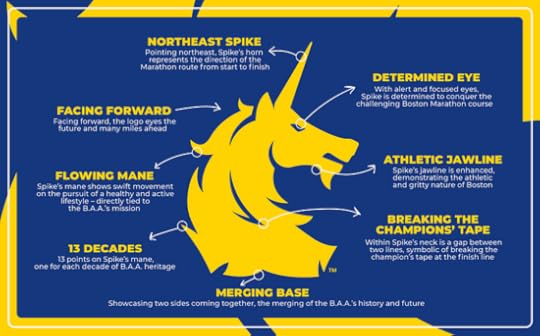 The new Boston Marathon Logo (acquired from www.baa.org)
In December 2023, I made an attempt to predict the cutoff time for the 2025 Boston Marathon. Then this past April, I updated my prediction after data from the 2024 Boston Marathon was available.
These posts received many views and some valuable comments.
One comment thread reflected a discomfort that my analysis was based exclusively on the number of BQ’s generated by the top North American qualifying races. Why was I ignoring the big international marathons? And why not, at the very least, take into account the rest of the World Marathon Majors?
It’s a fair point.
Some readers pushed further. One decreed that not all BQ’s are created equal. A BQ earned from one marathon might be much more likely to result in a Boston Marathon application than a BQ from another race. Yet my analysis weighted all BQ’s equally.
Indeed.
In fact, it is likely that some marathons are used almost exclusively to get into Boston. The downhill ones come to mind. And surely, there are races that are entered with no intent other than to run that race such that any BQ earned is irrelevant.
But I had no data to support or refute any of these arguments. To be sure, there are far more BQ’s earned each year than result in applications to the Boston Marathon. Why aren’t there more applications?
Or more to the point, from which qualifiers do the Boston Marathon applicants come from? Why not build a model based upon the BQ’s that are actually used for admission into Boston rather than the total number that are earned?
I get it. But, seriously, that’s a big job. Take, for example, the 2024 Boston Marathon.
It would mean that I would have to get a listing of all the entrants to the 2024 Boston Marathon then figure out how they got into the race.
Doing that would require downloading the results of a statistically significant number of Boston qualifiers and formatting the data so that it is compatible with the way the data is presented in the Boston entry list. From there I’d have to match names of runners from the various qualifiers to names of Boston entrants.
There would be issues. Multiple runners with the same name would need sorting. And matching names is not sufficient. The cutoff time has to be reviewed for each runner to verify they got in as a qualifer and not, perhaps, as a charity entrant. Also, allowance must be made for runners aging up to a less agressive qualification standard. The list goes on.
Anyway, that’s what I did.
I now have a database providing a partial list of the qualified runners in the 2024 Boston Marathon, the qualifier that they used for entry into the race, and their cutoff times.
Sounds tedious? Tell me about it.
It took me a few weeks to collect the data and wrangle it into submission. Good thing I am a marathoner. We live for tedium.
The B.A.A. has stated that “more than 528 qualifying marathons were utilized by athletes entering the [2024] Boston Marathon.” Absent unfettered access to the B.A.A.’s data, I am unable to identify and analyze all of these races. Nor would I want to. I am a marathoner, not an ultra-marathoner.
Alternatively, I use 50 of the top Boston Qualifying marathons (chosen with guidance from baa.org and marathonguide.com) as representative of the 528+ marathons alluded to by the B.A.A. Besides the top North American races, I have now included London and Berlin into the analysis. I would like to include Tokyo as well but those results are obscured by an impenetrable — at least for me — wall of Kanji.
From these 50 marathons (~10% of the total races used), I have identified 13,612 of the 22,019 qualifiers (61.8%) in the 2024 Boston Marathon and which race they used for their qualification. None of the marathons that I have excluded from this subset are heavy hitters according to B.A.A. press releases.
It’s like NASDAQ for the Boston Marathon. I posit that a few marathons can be used to represent the ups and downs of the Boston qualifying market. I’m calling it the “Bring it, Boston!” Index or BIB™. The races that I use to construct this index are the BIB50™.
For reference, the BIB soared to 467 (7 min 47sec, or 7:47) in 2021 upon returning from the pandemic hiatus to a field size reduced from 30,000 to 20,000. Then it crashed to 0 during 2022 and 2023 when, still reeling from COVID, there weren’t so many applicants. Folks either weren’t ready yet to brave the crowds or perhaps there weren’t enough qualifiers open for business.
Once the effects of the pandemic worked their way out of the system, the BIB rebounded to 329 (5:29) for the 2024 race.
Between races the BIB floats about. We don’t know where it will land until the fall when the B.A.A. tells us. In the meantime, any event that may affect the number of applicants received during the registration period may influence the BIB.
Some believe that holding the marathon the day after Easter, as is the case in 2025, pushes the BIB down. Others argue that race day being the 250th anniversary of the Battle of Lexington and Concord, which again is the case on 2025, props it up. I don’t know about either of these. Do runners care about such things? I suppose some do. Or their support crew might.
In my view, the big influencer is the one that I implied above — a marathon’s utilization rate. That is, the percentage of Boston qualifiers from a given marathon who actually apply to Boston during the registration period.
I don’t have all the applicant data I would like to have. Detailed information regarding denied applicants is unavailable. The utilization rate I calculate is for runners who met the 5:29 cutoff time and therefore were accepted into 2024 Boston. From a qualifying race’s utilization rate, I can estimate how many Boston Marathon applicants come from that race and, therefore, its influence on the BIB.
In turn, for each race in the BIB50, the utilization rate from the 2024 qualification period is applied to the number of the race’s BQ’s during the 2025 qualification period to project the number of applicants to the 2025 Boston Marathon.
What about the other 450+ qualifiers mentioned by the B.A.A? Though each of them may be small potatoes, in aggregate they account for almost 40% of the field.
I look at trends in the numbers of finishers and BQ’s of the BIB50 to estimate how many applicants will come from those 450+ other races. I am counting on the BIB50 to mirror the worldwide interest in getting into the Boston Marathon.
Here’s some interesting tidbits.
The six qualifiers with the top utilization rates, ranging from 56% to 75%, are downhill marathons. People run downhill to get into Boston. But I estimate that in total these six races account for fewer than 1,600 applications to 2024 Boston.
The qualifier that placed the largest number of athletes in the 2024 Boston Marathon is the 2023 Boston Marathon (4,657 by my count). But at a utilization rate of 41%, there were over six thousand 2023 Boston Marathon results meeting the cutoff time that were not used to get into the 2024 Boston Marathon. If Boston had a utilization rate like that of the downhill marathons the BIB would shoot up substantially.
The 2023 London Marathon had a surprisingly low utilization rate of about 15%. Again, thousands of acceptable finish times were left on the table. Berlin also has a low utilization rate of about 12%. I don’t have any data for Tokyo but I suspect it is in the same ballpark as London and Berlin.
The Chicago Marathon has a utilization rate of 31% while New York City’s is low at about 17%. New York City also has a low BQ rate (5.4%). It is a tough race and perhaps a deterrent for giving it another go in Boston.
If you have gotten this far into my post, you are probably wondering where I think the BIB is now. I will get to that. A few more comments first.
My earlier posts described the explosive trend in BQ’s this qualifying period, which led me to predict a longer cutoff time for 2025 than 2024’s. My new analysis changes the story a bit.
At present, all but 5 of the BIB50 have taken place. The picture is clarifying.
The increasing rate of BQ’s generated by the BIB50 is still a thing, but it is ameliorated by other factors.
The suggestion to include London was a good one. One reader noted that because the 2022 London Marathon was held in October, both the 2022 and 2023 London Marathons were in the 2024 Boston qualification period. With the return of London to April, only one of these very large and influential marathons will be used to get into 2025 Boston.
Weather has an influence. Ideal conditions in 2023 helped the BQ rate of the Boston Marathon to soar to 51.7%. The high temperature during the 2024 race whacked that back to a more traditional 38.4%. Difficult conditions led to cancellation of one BIB50 race, the Twin Cities Marathon.
Also, with the B.A.A. announcement this week of the registration period for 2025 (September 9–13), one of the BIB50, the REVEL Big Cottonwood Marathon, scheduled for September 14, now falls outside of the registration window and can’t be used for entry.
As it is a double-dip race, the 2022 results from REVEL Big Cottonwood can still be used. There’s a catch though. There are three double dippers in the BIB50 and all of them have a significantly lower utilization rate for the earlier one in the qualification period than the later one.
Hence, despite trends suggesting a substantial increase in cutoff time, my current estimate is more modest. Right now I have the BIB in the range of 312 to 359 (5:12 to 5:59).
As always, I welcome feedback. Together we can nail this thing. And if not, well then, we go back to guessing and the BIB goes the way of the dodo.
And with that, it’s my turn. In two days I will take on The Light at the End of the Tunnel Marathon, one of the BIB50.
Best of luck to you in your attempts.
[image error]

May 13, 2024
The 2024 Boston Marathon and the Making of an Ordinary Champion
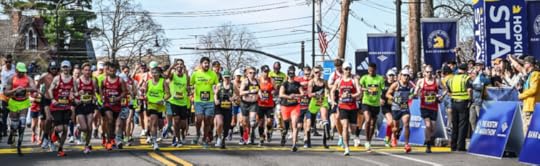 2024 Boston Marathon Para Athletics Division Start (courtesy of Boston Athletic Association).
Runners are delivered to Hopkinton riding the hardened bench seats of school buses. No one complains of the spartan conditions, though. In due time we would all be running in the Boston Marathon. What could be better?
Except this time, it was better. The bus was a comfortable Mercedes touring coach complete with air conditioning and a lavatory. And we weren’t destined for the sprawling Athlete’s Village where nearly 30,000 runners queue for porta potties or rest on the dew-dampened grass while waiting for their starting waves to be launched.
We were being taken to our VIP tent in the exclusive Hopkinton Common, the same staging area used by the elite racers.
One gentleman on the bus carried a large video camera. He was filming a documentary of visually-impaired runner Mark Rogerson in his pursuit of the Abbott World Marathon Majors Six Star Medal.
Mark is totally blind in one eye and has only partial sight in the other. He would be the second visually-impaired runner to earn a Six Star Medal. Anthony Butler was the first, having completed his six-star journey in London the year before.
Mark lives in the UK near Liverpool and his guide runner, Katie Garrity, lives in Chicago. Mark entered the Chicago Marathon in 2018 and needed a local guide that could match his pace. Katie fit the bill. They have run six marathons together spanning Europe, North America, and Japan. They train separately then get together a few days before the race.
I asked Katie about being a guide runner. I was curious how she managed to keep Mark safe amongst the hordes of other runners. She admitted that it was a challenge. They are tethered together and she must call out often to alert Mark of the potential hazards. But sighted runners know the drill and are mindful when they are in Mark’s vicinity.
I met Jeff Lampe while we were waiting in the VIP tent before the race. A motorcycle accident amputated Jeff’s left leg below the knee in 2011. Besides marathons he has competed in Ironman Triathlons and is a member of the US Para Skeleton team. Skeleton racing is like luge except the racer plummets down the icy track head first.
Jeff was fitted with one of those curved blade prosthetics as a stand-in for his ankle and foot. He removes to swim. For cycling his prosthetic is fitted with a special attachment that allows him to clip onto his pedal.
In the VIP tent at the end of the race, I struck up a conversation with Francesco Magisano, another visually impaired runner. He’s been totally blind since he was 14 years old, the result of eye cancer he had as an infant. Over the years the cancer progressively stole his vision.
Francesco said that some years ago he was negotiating a supermarket with his cane and a fellow from Achilles International approached him. Achilles International’s charter is to empower individuals with disabilities to compete in athletic events.
The Achilles guy said to Francesco, “You are blind. You should run.”
With that, Francesco started running. Now he works for Achilles International full time as the Director of the New York City Metro Region and helped build TriAchilles, the triathlon program.
Like Jeff, Francesco is also an Ironman Triathlete. (Para Athletes don’t accept limits, it seems.) His guide runner was with him in the tent and was happy to answer my questions. For the bicycle portion of a triathlon, the athlete rides tandem with their guide. Swimming is more complicated. There is bungee cord tethering the athlete to the guide. The guide’s job is to keep to a straight line. Tension from the bungee cord clues the athlete about stroke adjustments needed to stay alongside the guide.
I am barely scratching the surface. The runners on my bus and the VIP tents could have entertained me with their stories for days.
I surely did not belong with this crowd, yet, I was thrilled to be there.
How did this happen?
Indeed, having failed to qualify for the 2024 Boston Marathon and finding no success at obtaining a charity entry, I was resigned to be sitting it out this time thus ending my Boston streak at three races.
Then in December, Cristina Burbach, another runner with Parkinson’s disease posted on Facebook that the Boston Athletic Association (B.A.A) added two new Para Athletic divisions this year. One of these divisions was for athletes with coordination impairment, which includes Parkinson’s disease (PD). There would be prize money for the top three male and female finishers. She was hoping to get more runners with PD to enter the race so as to help make this division a success.
The prize money was intriguing but I’m too slow to give it much attention. Irrespective, competing in this division required a classification as a Para Athlete and I did not have that. Indeed, with all of the exercise I get, mainly running, my PD symptoms are hardly noticeable. I suspected that any attempt to be classified as a Para Athlete would be met with derision. “Get out of here, poser!” they would say.
However, Cristina’s post reminded me that runners with PD could also enter the marathon as an “Adaptive Athlete”. I’ve long known this but have never tried entering Boston this way. Again, I figured that the Adaptive program was for people whose struggle with PD was more severe than mine.
I decided it was worth a try, though.
I emailed Taylor Wilson at the B.A.A. who, upon receiving the proper paperwork from my neurologist, immediately sent me registration materials for entering the race as an Adaptive Athlete. I was in!
Taylor also let me know that she would move me into the appropriate Para division if I get classified before the race. She was working on having classification available in Boston during marathon weekend and put me on the list of hopefuls.
Again, I had no expectation of meeting the conditions for classification as a Para Athlete but that didn’t matter. The Adaptive Program was fine by me; I was happy to once again be running in the world’s premier marathon.
My appointment was on Saturday afternoon with the race on the following Monday. I met with two classifiers, Denise Hutchins and Trisha Yurochko, from Move United, which is affiliated with the U.S. Olympic & Paralympic Committee.
We started with a conversation about my experience with PD that included my date of diagnosis, symptoms at the time of diagnosis, current symptoms, and general chit-chat. That discussion went on a long time — I think that I was their last appointment and so there was no time pressure.
Afterwards there was a physical exam. While I lay face up on an examination table, Denise manipulated my limbs and called out numbers ranging from zero to three for Trisha to record. I have no idea what scale Denise was working with nor do I remember many of the numbers but I do recall that during one manipulation, my right arm, the one with a slight tremor, was given a zero.
Then there was a series of movement tests: heel to toe walking, single-leg balances, sprints, skips, jumps, sideways cross-over steps, and several others. Upon testing to their satisfaction, Denise and Trisha asked me to wait outside the examination room while they discussed the results.
During testing, they mentioned that I performed some movements very well. I let them know that many of the tests were the same as some drills I do regularly during training. I suspected that my performance would indicate that I did not meet the minimum criteria for the impairment.
Upon calling me back into the examination room, Denise and Trisha gave me a briefing on the T35–38 classification, which describes a range of impairments. T35 athletes are moderately affected in the legs, trunk, and/or arms. T36 refers to movement and coordination impairments in all four limbs. With T37, the impairments are restricted to one side of the body. T38 meets the criteria for minimum impairment and that is where they classified me.
As PD is a progressive disorder, my classification could change over time. They told me that I would have to be re-classified in two years.
I was very happy with the result. Adaptive Athletes get nearly all the same perks as the Para Athletes: a comfortable bus ride to Hopkinton, VIP tents at the start and finish, proximity to elite racers in Hopkinton, and an early (10:00 am) start wave.
Para Athletes start even earlier — 9:50 am, just after the elite women. Every minute counts on a day that was expected to warm up to the 70's.
Also, though it may expire before the 2026 Boston Marathon, the classification should get me into the 2025 race.
The impact to me, however, goes well beyond entry into the marathon. This was a very thorough examination that benchmarked the state of my Parkinson’s. I like to believe that I have stopped PD’s progression with the exercise I do. I have no accounting for this belief, however. When I am reclassified in two years, I will have definitive proof, one way or the other.
Whenever possible, I like to meet up with runners and other friends when I travel to a major marathon.
Saturday morning, I had coffee with Carita Wegner. We first met while queueing for the 2021 Boston Marathon Expo and have stayed in touch since then, reconnecting when our marathon schedules coincide.
Like me, Carita uses exercise to overcome disease. She has lung sarcoidosis and asthma along with some mysterious ailments causing pain and stiffness in her neck and back that have stymied a host of doctors. She recently found a specialist for the neck issues who shows promise but in the meantime, a steady diet of marathons and ultra-marathons keeps her medical issues in check.
Carita ran well in Boston the year before thus qualifying her for this year’s race. I described how I got into the race this year and briefed her on my upcoming classification appointment. Of course, at the time I did not know if I would meet the classification criteria.
She was excited by this news. “You are going to win!” she said. I told her, “No, that was unlikely, there are many fast runners in the Para Divisions.”
At that time, I really did not know the odds. I have since determined that there were only 36 Para Athletes running in the seven Para divisions. With first, second, and third prizes for each gender of each division that worked out to a total of 42 prizes to be spread about the 36 athletes. This is a program in need of heavy recruitment.
Lunch on Saturday was with Craig and Sarah Revie for lunch. The Revies were traveling from Scotland. Craig was recently diagnosed with PD and I met him through social media. Both of them turned to fitness after Craig’s diagnosis. They each lost 3 stone (42 pounds) on their new regimen. Diet-conscious now, they were struggling a bit with finding their preferred foods in this country. I gave Craig a tip on where he might be able to find some beetroot juice — Life Alive Organic Cafe in Harvard Square. The advice was spot on.
Earlier in the year, I encouraged Craig to run Boston in the Adaptive Program and sent him the contact information he needed. We learned that the classification to be offered later that day was only available to U.S citizens. He’s hoping to get the job done sometime in Scotland before next year’s race.
In 2021, just before the Chicago Marathon, I met the Jones family at the Michael J. Fox Foundation Team Fox pre-race gathering. Eric was running the next day and his sister, Julia, and parents, Rick and Inga, all came along to support him. I found the show of solidarity for Eric so touching. In turn, they were amazed at my 2021 World Marathon Majors campaign while under the influence of Parkinson’s.
We have kept in touch since. Inga and Rick are both pharmacists and Julia recently got her doctorate of Pharmacology at UCSF. Eric went on to meet his eventual fiance Sybil Sha (also a doctor) while interning and now they both live in New York City. I met up with Eric again at the 2023 New York City Marathon where he introduced me to Sybil.
Eric would be running in Boston and Inga, Rick, and Sybil came to support him. We got together Sunday for breakfast. I was again touched by their show of support for Eric, and by extension, for me. It impressed me how easily we fell back into conversation when most of our interaction over the ensuing years was through social media.
Rick and Inga remarked on all I have accomplished since we last met. I was happy for the kind words but insisted that, really, I am just an ordinary guy reacting to his new reality. This is important and it is how I prefer to present myself to others newly-diagnosed with PD. People living with PD can thrive; adversity enhances the adventure.
I had received my classification as a Para Athlete the day before. That meant that Eric, a very fast runner, would start 10 minutes after me in the first wave of qualified runners. I estimated that he would pass by me at about the three mile mark and urged him to look for the pink socks and say hello as he flew by.
Adaptive and Para Athletes were instructed to arrive at the Sheraton Hotel near Copley Square in Boston by 5:30 am Monday for the trip to Hopkinton. While waiting for the buses to load, I chatted with some of the other Parkies entered in the marathon.
I already knew Rhonda Foulds and Renee Trent from Team Synapse. Team Synapse is comprised of runners who are all living with PD. We have done two long-distance relay races together to raise funds for Parkinson’s research. Rhonda and Renee were classified for the Para Division but, because she used a guide runner, she was relegated to the Adaptive Division. Craig Revie joined her in that group.
Also in the Para Division were Cristina Burbach and Sara Whittingham. Cristina, who was instrumental is raising awareness of this opportunity for us, is an accomplished runner who earlier in her career flirted with elite status. Life and PD conspired to put an end to that.
Sara is a doctor and triathlete. She competed in the 2023 Ironman World Championship in Kona last October. Her medical background presents opportunities to raise awareness of Parkinson’s and the benefit that exercise provides in slowing its progression.
I was anticipating a rough day. Last year the temperature was a perfect 48 degrees throughout the race and I ran my best Boston to date (3:57:47). This time the forecast was for temperature in the 70’s.
I don’t do well in such heat. It’s one of the many symptoms of PD — I have battled dehydration and painful muscle cramps in most of the marathons I have run. But over the years I have developed solutions. First, I take SaltStick Electrolyte tablets liberally throughout the race, about one every mile. This allows me to keep up with the sodium I lose in my sweat. I have found that when I take enough of these tablets, I don’t get cramps.
Second, on hot days I resign myself to a slow pace. I know that I can always complete a marathon despite the heat as long as I don’t insist upon some arbitrary finish time goal. Boston is always a thrill regardless of how well I run.
It was a nice setup in Hopkinton. Our VIP tent was outfitted with chairs, refreshments, yoga mats, foam rollers, and our own array of portable toilets.
My favorite part was getting a glimpse of the elite women. They were escorted to the starting line right alongside our tent and I caught sight of some famous names: Sara Hall, Edna Kiplagat, Emma Bates. When it was our turn to be escorted to the starting line, we took our place behind these pros and watched as they darted off to the sound of the starting gun.
Never have I ever imagined that I would get this close to marathon greatness in action. As is the case with countless other thrills I have experienced over the past six years, I have Parkinson’s disease to thank for this.
Then it was the Para Athletes turn with the starting gun and we had the whole course to ourselves. As mentioned earlier, we were a rather small group. With no other runners present, the spectators lining the streets cheered exclusively for us.
Our time in the spotlight was short-lived, however. Ten minutes after us, the first wave of qualified runners were sent off and I anticipated their crush at about the two mile mark.
It was a stampede. I moved over to the side of the road so as not to interfere with the hordes as they barreled through. Eric Jones and I did not manage to connect. From the post-race timing mat data I saw that he flew past me just after the three mile mark.
Some friends from Seattle passed me by later but stopped long enough to greet me. Mike Marshino, who runs Boston every year, cheered for me as he cruised past at mile 8. Peter Vosshal, another perennial Boston participant, slowed down to chat with me for a minute or so at about 19.5 miles before dashing off. Peter was definitely feeling the heat, as was I. Seattle is not the place to prepare for a hot weather race.
In fact, there were runners in distress throughout the latter miles. I came upon a woman who shuffled to a stop, looked up at the sky, and slowly, twisting, began to topple over. I managed to catch her while she was still upright and loudly asked her if she was OK. She just silently stared up at me before some other, more savvy, runners took her to get medical assistance.
Against the odds, MarathonFoto managed to capture me at the Wellesley Scream Tunnel in a picture looking much better than I felt (below).
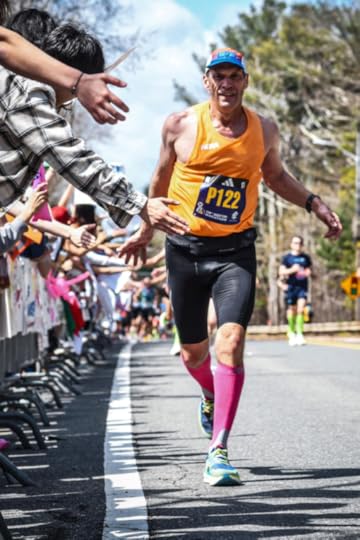 My new favorite race picture — passing by the Wellesley Scream Tunnel (courtesy of Boston Athletic Association).
The night before the race, I attended the pre-race dinner with Team Fox of the Michael J. Fox Foundation for Parkinson’s Research. They invite me to their events whether or not I am actually running for them. Their cheer station was set up just before Heartbreak Hill and they screamed mightily and gave me high fives as I ran past.
Darien Wood is a friend of mine from college who lives in Brookline near the course. He always stands ready at Coolidge Corner (~24 miles) to exhort me on while holding the same hand-written sign he has displayed at every one of my Boston Marathons. This year his son, Max, joined him. Yet, I always have difficulty remembering the location of his preferred cheer spot. Beginning at the top of Heartbreak, I scanned the sidelines hoping for them to appear and when they finally did I stopped to give them a sweaty hug. I told Darien and Max that I was very happy to see them. It meant that I only had about two more miles of torture left.
I didn’t expect any more targeted cheering the rest of the way. Then in Kenmore Square, with about a mile to go, I heard my name being yelled loudly and enthusiastically.
It was Chuck Kistler, who I met in North Carolina at our first Team Synapse relay in 2022. Chuck owns a pub in North Carolina and donates a portion of his profits to the Fox Foundation. I knew that he was in town but did not expect to see him. I stopped to give him a hug and to let him know that I was dying. He told me I looked great and to get on with it. “You are almost there,” he said.
There was more carnage on Boylston Street approaching the finish. I saw several collapsed runners on stretchers getting assistance. My finish time was 4:32:44, 35 minutes slower than the previous year when the temperature was ideal. Running in this heat is no joke.
After finishing, I went looking for the VIP tent at 500 Boylston. I wanted to sit down a bit and get something to drink. My bib number indicated my status as a Para Athlete, hence, volunteers directed me to our finisher’s chute separate from all the othe runners.
Another nice perk of the Para Division was that all of our gear that we took to Hopkinton was brought back to the finish for us. Other runners didn’t get this treatment. They have to either carry what they brought to the start with them or discard it in Hopkinton.
I entered the first tent I came to in search of my gear. The volunteers there asked if I was OK, how I was feeling, what I needed from them, and would I like to sit down. I just wanted my bag of stuff. And, yes, I wanted to sit down.
Unknowingly, I had walked into a medical tent. Because of the heat, the volunteers there were on high alert to get medical attention to the runners who came by. One of them figured out my confusion and told me where the VIP tent was and I stumbled in that direction and was given my Finisher’s medal on the way.
In the VIP tent, I had my conversation with Francesco Magisano and his guide. The subject of whether or not Francesco placed in his division came up. Curious, I decided to check my results and saw the following on the tracking app:
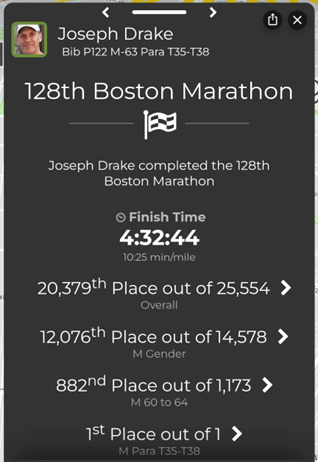 From B.A.A. Boston Marathon Tracking App.
I finished in First Place in my division!
Oh, wait . . . I was the only one running in my division.
Ah, well. Sometimes all it takes to receive good fortune is to show up.
The B.A.A. sent me a congratulatory email with instructions for collecting my prize at the Fairmont Hotel. Sheepishly, I headed off to Fairmont feeling a bit undeserved.
But the B.A.A. folks at the Fairmont, which included Taylor Wilson, did not act as if this award was in any way cheapened by being unopposed. One of them, Taylor I think, told me that I was the Inaugural Champion of this division and treated me like one. They handed me my trophy with the division engraved on it, had me wear a laurel wreath, and snapped photos (below).
Me? A Champion? Surreal doesn’t begin to describe it.
However odd the circumstances, it was the experience of a lifetime and I am grateful to the B.A.A for making it available and for Denise Hutchins and Trisha Yurochko for going out of their way to provide the Para Athlete classification.
The B.A.A. even posted a photo of me on Facebook and Instagram (the one at Wellesley) along with all the other Champions of the seven Para Divisions. Cristina championed the Female T35–38 division. Sara was runner-up and Renee came in third.
To be clear, all the Parkies in the T35–38 Division I mentioned above came home with hardware and prize money. There were no other competitors in T35–38. I will be donating my cash prize of $2500 to the Fox Foundation.
All of us are now motivated to spread the word about this division. We want it to be successful and lasting. That means that until next April, I will be recruiting the runner who will inherit my laurel wreath at the 2025 Boston Marathon.
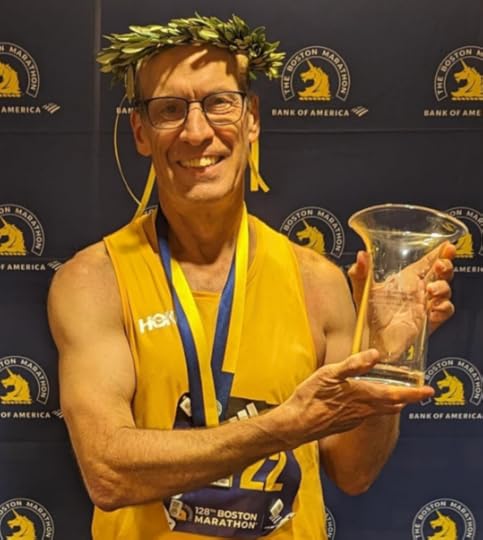 2024 Boston Marathon T35–38 Champion (taken with author’s camera).[image error]
April 26, 2024
Update to “An attempt to predict the cutoff time for the 2025 Boston Marathon.”
 Retrieved from runnersworld.com (photo by John Hamilton)
In the nearly three years that I have been writing this blog, each of my posts have received at best about 900 views.
Then, in December 2023, I made a prediction of the cutoff time for the 2025 Boston Marathon. To date, that post has received more than 11,000 views — far beyond the readership of my previous posts. Many readers are eagerly awaiting this new post wherein I provide an update to the earlier prediction.
(By the way, there is some good stuff in my earlier view-challenged posts. You may want to check them out. Just saying.)
This is new territory for me. I understand that some runners may modify their strategies based on what I write. I feel an obligation to be as thoughtful and as transparent as possible in providing this update.
Hence, before jumping in with my update, I’ll clarify the thinking regarding my method for arriving at a prediction. Readers’ comments on the earlier post suggested a need for the clarification.
As I pointed out in the December post, any attempt to predict the cutoff time starts with an estimate of the number of qualified runners (BQ’s) who will apply to run in the 2025 Boston Marathon. Given the fixed field of 30,000 entrants to Boston, the more applicants the larger the cutoff time.
Every year there are far more BQ’s achieved worldwide than there are Boston Marathon applicants. Why the difference? I can only speculate: runners with more than one BQ in a single qualifying period, runners who wanted to run in Boston but encountered a precluding conflict, fast runners who, remarkably, never had any intention of running in Boston, etc.
How does one pare down this list of BQ’s to arrive at a prediction for the number of applicants?
My approach was to look for correlations and I found one between the number of applicants and the total number of BQ’s achieved from the top 50 North American (NA) qualifying races, that is, the 50 marathons that rank highest in the number of BQ’s generated. Instinct suggests that many entrants chose these races with the sole intent of applying to Boston.
I found a strong correlation between this sample set and the number of applicants to Boston for the 2018, 2019, 2023, and 2024 races (I am excluding the pandemic-disrupted years of 2020, 2021, and 2022 because they aren’t analagous to the 2025 race.) The number of applicants to Boston fell into a range of 78.1% to 80.2% (call this the reduction factor) of the total number of BQ’s generated by the top 50 NA qualifying races.
If there were a better sampling approach to arriving at the number of applicants to Boston, I would happily use it.
One reader pointed out that my method does not account for international runners. That’s fair. In response, it is worth referring to Brian Rock’s excellent summary of the numbers from this year’s Boston Marathon and the raw data supplied by the BAA.
Of the 29,333 runners entered in the 2024 Boston Marathon, 20,051 reside in the United States. The largest contingent of international entries comes from Canada (1705) followed by the United Kingdom (1236).
An overwhelming majority of the entrants were from North America (21,756 of 29,333) so I feel justified in heavily weighting my sample set towards North America, which includes Canada.
One reader (Geogeec), brought to my attention that the qualification period for the 2024 race included two London Marathons (2023 and 2022 because the 2022 race was held in October) whereas the 2025 qualifying period only holds the 2024 London Marathon.
It’s an important observation suggesting that the number of UK, and by association international, runners may decrease in 2025 as a result. However, my guess is that the difference will not be significant enough to change my sampling approach. I state this because in 2023, which included only one London Marathon in the qualifying period, there were 890 UK entrants, only 346 fewer than the double-London dose of 1236 for the 2024 race.
I mentioned in my December post that 29 of the likely top 50 NA qualifiers had not yet occurred with the most significant omission being Boston itself. That is why I was waiting for last week’s Boston Marathon before providing this update.
In 2023, the Boston Marathon with ideal weather conditions generated 13,741 BQ’s. This year, in oppressive heat, only 9,814 runners BQ’d. Consequently, applying the algorithm from my earlier post, my high end estimate for cutoff time drops considerably.
There has been some minor shuffling of the top 50 NA qualifyers for the 2024 Boston Marathon compared to the 2025 Boston Marathon qualifying period. By my estimate, 34 of the top 50 NA 2025 Boston Marathon qualifiers have taken place and have yielded (according to marathonguide.com) 39,536 BQ’s compared to 36,564 BQ’s at the same point in the previous qualification period, an 8% increase.
This contrasts sharply with the 30% increase in BQ’s I reported in December. Interestingly, the 30% increase was holding up until Boston last week but the 29% year over year decline in Boston BQ’s deflated that trend.
As I did in December, I choose to bound my estimate for the remaining 16 qualifying races, the most significant of which is Grandma’s Marathon in June. At the low end, the remaining races will yield the same number of BQ’s as the previous year’s race. At the high end, those races will return to the super shoe-powered 30% increase in BQ’s.
My December model multiplied my estimate for BQ’s by a 78.15% reduction factor to arrive at the number of applicants for the 22,019 available bibs. Both the 78.15% and 22,019 data points came directly from the numbers associated with the 2024 Boston marathon.
I recognize that during the reference years 2018, 2019, 2023, and 2024, the reduction factor varied from 78.15% to 80.20% and the number of available bibs ranged from 22,019 to 23,267. I take into account these spreads in my updated cutoff time prediction as shown in the table below. I am fitting these data to the same normal distribution parameters that I described in my December estimate in order to extract cutoff time estimates.
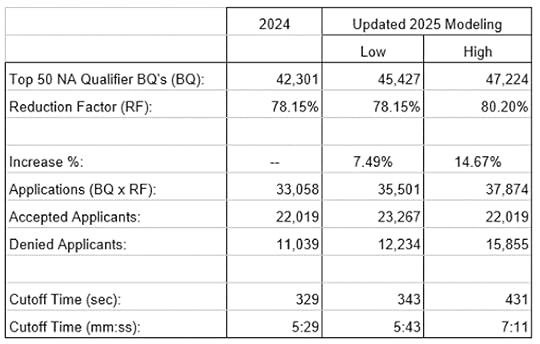 Author’s updated modeling results for 2025 Boston Marathon.
My December estimate ranged from 5:52 at the low end to 8:43 at the high end. The updated prediction for the 2025 Boston Marathon cutoff time is between 5:43 and 7:11.
The more recent data suggests that the 8:43 cutoff at the high end is no longer supportable by the results of the qualifiers that have taken place since December. Although many of the qualifiers have seen strong percentage increases in year over year BQ rate, most of them have too few entrants to make a big difference in the total number of applicants.
As always, I welcome comments and suggestions for improvements to the model.
[image error]March 9, 2024
The 2024 Tokyo Marathon and my second Six-Star Medal in one year
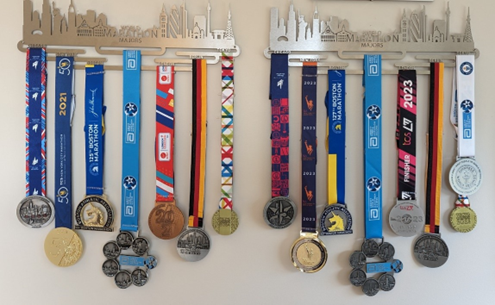 World Marathon Majors medals (photo by the author).
I have mentioned my theory that sometimes I crash during marathons because, unbidden, my brain reins in my body when it thinks I am on the verge of doing damage. Thus, the price of being able to run consecutive races with only a few weeks, or less, of recovery time between them is that nearly all of them are rather slow.
To be clear, I think my brain holds some capability in reserve. Maybe it thinks I’ve got another big run coming up or something.
Turns out, I am not the first to propose that theory and, in fact, it has been extensively studied. It is called the “central governor” and I have been reading about it in Alex Hutchinson’s intriguing book Endure: Mind, Body, and the Curiously Elastic Limits of Human Performance. Just as I thought — the autonomic nervous system, which pertains to involuntary physiologic functions, works in the background to limit threats to the body both environmental and self-imposed.
I think that my central governor is overzealous. I’m willing to risk some bodily damage for the sake of a faster marathon. Endure devotes many pages to strategies that have been explored for hacking the central governor with the intent of extending an athlete’s performance.
That is my opportunity — to outwit my autonomic nervous system. I mean, hell, it’s already compromised by Parkinson’s disease. Literally, it is not playing with a full deck. I can take this guy.
Unfortunately, this revelation comes too late to influence my performance in the 2024 Tokyo Marathon.
Travel to and around Tokyo has changed since coming here for the 2023 marathon. A year ago, Japan was just beginning to let foreigners in after their pandemic blockade. Cumbersome health and safety checks were in place causing confusion and bottlenecks at every step — customs, the Marathon Expo, the start area, and on the course.
All that has been lifted now and moving about Tokyo and the marathon venues was a breeze.
One thing that hasn’t changed is the ubiquity of great food in unlikely (from an American perspective) places. I ate very well from the fare — sushi, ramen, japanese-style fried chicken, etc. — at convenience stores like 7–11 and in the basements of large department stores.
I arrived in Tokyo Wednesday evening. The plan for Thursday was to get my race packet at the Expo and then meet up with Mai Takeuchi. Mai is a program manager for a start-up accelerator based in Japan that has offices and nascent startups in the US. I’ve been helping on an informal basis one of the startups involved with Parkinson’s-related wearable health management devices.
Last year the Expo had strict social distancing rules in place. For example, all visitor traffic was forced to follow the direction indicated by arrows painted on the floor. I tried to hop over some barricades and got busted.
This year it was just like any other Expo. No security and a lot of polite, friendly, helpful volunteers.
Mai also entered the marathon. As it was her first, she was expecting to be running slowly. She was concerned that she might not make it to some of the early checkpoints in time and get swept off the course. She also had an ankle injury and asked several of the people managing the booths for advice on how to deal with the injury. They sold her some high-protein food products.
At lunch, Mai told me a little of her story. She grew up in Japan and went to university there. But there aren’t many opportunities for women with ambition in Japan so in the midst of the pandemic she went to Babson College to get her MBA. She didn’t know any English at the time. Somehow she pulled it off, got her degree, and found a job in Silicon Valley (in Palo Alto, not far from where my wife and I raised our family). Now she is running her first maration in Tokyo. I told her by text that she is a badass but I don’t think that word translated well.
I had the whole day Friday available for rest and sight-seeing. Mai gave me some suggestions. Hence, I filled that time with a visit to the teamLab Planets exhibit and wandering about the Shinjuku area.
teamLab Planets is an immersive, interactive experience wherein visitors are treated to a series of rooms that feature knee-deep water with images of goldfish swimming about one’s feet, adult-sized inflated spheres rolling about, a forest of colorfully lighted glass rods suspended from the ceiling, and a dizzying array of flying objects projected onto the domed walls and ceiling.
 The Sphere Room in teamLab Planets (photo by the author).
After teamLabs and while waiting for a bus to Shinjuku, I chatted with Daniel and Lauren Fernandez. They were both running on Sunday and planned to leave their son, Dash, with a local nanny during the race. Daniel and Lauren have a social media presence as Wander Local. They travel about in an Airstream trailer and post about their adventures. They are both speedy runners but with Lauren three months pregnant they planned to take the race slowly. Daniel was expecting to record the whole event on his phone.
We got to talking about the Boston Marathon and the long cutoff time (5 min 39 sec) for the 2024 race. I mentioned that I blogged an analysis that predicts a much longer cutoff time in 2025. To my surprise and delight, Daniel said that he read that post and it influenced him to intensify his training. That’s the first time I came across a rando who read something of mine. To be sure, that post has had far more views than anything else I have written. At a gathering of marathon runners, odds are that I would meet someone who has see it. Still, chancing into someone who had gave me chills.
Afterwards, I strolled about in the Shinjuku Gyoen National Garden hoping for an early glimpse of cherry blossoms. But I was a week or two early for them. At the height of blossom season it gets very crowded and it is best to book a reservation for entry. Without any blossoms to show, there were just a few visitors, many of them marathoners enjoying the exquisitely tended landscape as I was.
I did a short shakeout run earlier in the week and on Saturday decided to join one of several local parkruns. Parkruns are free 5K (3.1 miles) community events for walkers and runners that take place every Saturday morning at more than 2,000 locations in 22 countries across five continents. Some are in the US but they are not as popular as elsewhere in the world. Often, participants go for volume and are celebrated when their total number of parkruns cross into the hundreds and thousands. The one in Tokyo would be my second.
I first heard about parkrun in the UK when a friend, Louise Dunn-Massey, suggested I join her at one in Worcester near her home. We were visiting with her and her husband, Steve, after last year’s London Marathon. It was fun — informal, cheerful, supportive, and a nice way to meet other runners.
I chose the Urayasushi sogo koen parkrun, a 50 minute subway and bus ride from my hotel. The course was along the harbor waterfront — cold and very windy. After the run, many of us, still shivering, went to a nearby coffee shop to warm up and chat.
Many of the runners were eager for intel on the other Majors as they were still short of achieving Six-Star status. I spoke with Ian Ruddick from Newcastle, who, after Tokyo, still needs to get Boston to complete his WMM journey. Boston is hard to get into and with the new trend towards higher cutoff times it is getting harder. But Ian is a fleet runner and missed a BQ in Tokyo by only 72 seconds; with some more work and a carefully chosen qualifier race he should be able to manage it.
I spent the remainder of the day resting up and preparing for Sunday’s race. Though it was cold Saturday, the forecast for the race was promising — low 40’s. That would suit me just as long as it didn’t warm up too much during the race.
Meaning, the temperature was good for running. It was not so good for waiting to run. I spent a lot of time shivering while I waited for the start.
Last year the starting area was congested. Moving around was difficult and the wait for the toilets was more than 30 minutes. Not ideal because most runners take at least two pre-race trips to the toilet. Tokyo adapted for this year’s race by increasing the number of porta potties, improving the queue strategy, and relying on a sizable number of male-specific urinals. These adjustments worked extremely well; I had time for three trips to the loo.
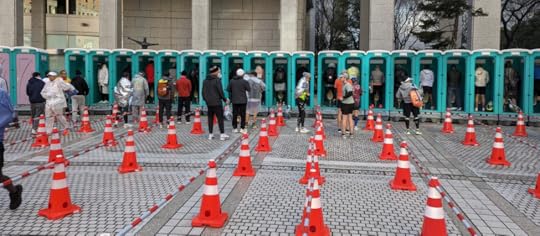 Porto-potties at the Tokyo Marathon (photo by author)
Last year, I noticed that the spectators lining the course were subdued compared to the throngs at the other Majors I have raced in. This year was different, though. The crowds seemed just as excited as at any other major.
At one point, I think about halfway, one runner was getting a lot of attention from fans. He waved, high-fived, and chatted with some spectators while a videographer tracked his every move. I bombed his video and then asked who he was. He just said, “soccer player”. Apparently a very popular one. But I didn’t get his name at the time and my google sleuthing has come up empty. I was hoping to see his video somewhere on line with me in it but no such luck.
My race was a virtual copy of last year’s Tokyo Marathon. I finished in 4:15:24, a mere 74 seconds faster than last year. Like last year, the morning started cool, low 40’s, then warmed up to 54 by the end of the race. That should have been fine for me but for some reason my central governor decided that 54 was too warm and in both races it executed crash protocol at about 17 miles in.
In an earlier post, I posited that my marathon crashes could be caused by inadequate sodium replenishment. I lose a lot of sodium in my sweat. However, during the race I took one SaltStick capsule (215 mg Na) each mile as per my plan and in accordance with my hydration meter sweat data. Hence, this time at least, it wasn’t about the sodium. I had no trouble with cramps during the race and afterwards so, in that respect, the SaltStick capsules worked well.
I wore my new HOKA Cielo X1 carbon-plated shoes, which showed some moments of effortless speed in some training runs. In fact, though my overall mile pace was 9:45, I pushed it on miles 12, 13, 15, and 16 to average 8:33 on those four miles.
Those miles were immediately before the crash — maybe that spurt of intensity wiped me out. I don’t know. The point is, I can get good speed out of these shoes under the right circumstances.
Nonetheless, I did earn my second WMM Six-Star Medal. The date of the race was March 3, 2024. I earned my first Six-Star Medal in Tokyo on March 5, 2023. Hence, both of them were awarded over a span of 364 days. Two Six-Star Medals in less than a year’s time. Cool!
There may have been others repeating as well. Due to the pandemic, the 2020 race was restricted to only elite runners, it was canceled in 2021, and in 2022 it was restricted to only Japanese residents. The backlog for runners seeking their sixth star in Tokyo was huge in 2023. The 3000+ who earned the Six Star Medal in 2023 set a Guinness World Record for six star finishers in a single race. But I heard that Tokyo 2024 was not far behind with 2600+ six star finishers.
I am based in Seattle and my local running store is West Seattle Runner. Through social media some of us who frequent the store realized that five locals were running that day. We attempted to get all of us together for a photo but with the chaos at the finish and with varying finish times only three of us found each other: myself, Sarang Shamshery, and Desmond Lee (photo below). We hope to get the whole crew together for a complete photo once we are all back in Seattle.
Next up is the Boston Marathon on April 15. That gives me five more weeks to spar with my central governor, probe its weaknesses, and plan a strategy to overcome it. Should be fun.
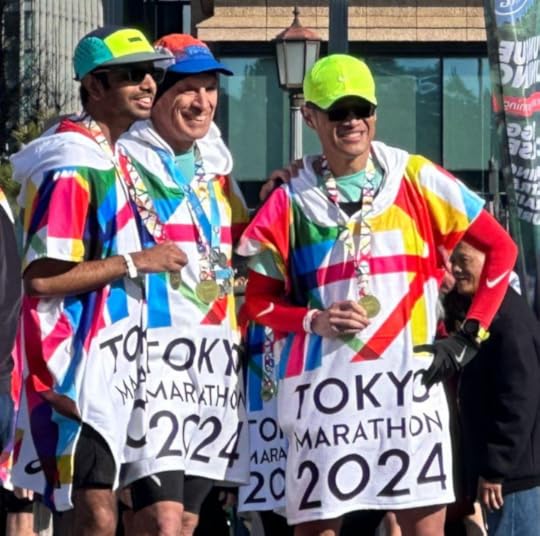 Some West Seattle Runners at the Tokyo Marathon finish (photo by friendly stranger).[image error]
February 22, 2024
Another way to bonk during a marathon — it’s not just about carbo-loading
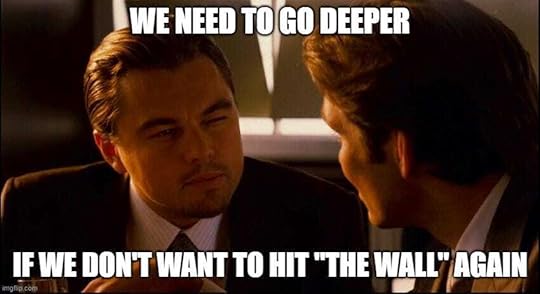 Created by author using imgflip/memegenerator.
I am going to go out on a limb and propose an alternative explanation for why some runners (e.g. me) crash during a marathon.
Normally, “hitting the wall” in a marathon is attributed to the point at which the runner’s body runs out of energy and they can no longer maintain their pace.
To avoid this fate, runners top off their body’s glycogen stores by carbo loading during the few days leading up to the race. Also, since even a full tank of glycogen will only last for 90 minutes or so, they will consume carbohydrates throughout the race to make up the difference.
I always carbo load voraciously and eat plenty of carbs during the race yet it is rare that I don’t encounter a crash at 17 miles or beyond. Of the 22 marathons I have run in the last four years, I hit the wall in all but 5 of them. Given how meticulously I plan my carbo loading, it is hard for me to believe that I have been depriving my body of sufficient fuel.
I believe that a more likely explanation for me is electrolyte depletion, or more specifically, an inadequate supply of sodium. I suspect that others may be suffering from this scenario.
On the surface, this is not earth-shattering. The requirement to replenish electrolytes during a long run is well known.
The part that I find revalatory, is the magnitude of the issue. Yes, it is important to replace the electrolytes one loses from sweating. But how much is enough? There are rules of thumb but these won’t apply to everyone. For example, I have Parkinson’s disease (PD). Does PD influence this issue?
PD can make it worse. One of the many non-motor symptoms of PD is the tendency for poor temperature regulation of the body. People living with PD often sweat much more than others when exercising and the additional perspiration further decreases the supply of electrolytes.
For now, let’s focus on sodium as it is the most significant of the electrolytes found in the fluid surrounding cells, the fluid that eventually makes its way into sweat. Sodium is essential for muscle contraction. Without sodium, muscles don’t work right.
Hyponatremia is the condition whereby sodium levels drop too low. Symptoms include fatigue, nausea, and muscle cramping. Drinking plain water further dilutes the extra-cellular fluid thus worsening the effect. Hyponatremia forces water back into the cell, which puts pressure on neighboring cells. This situation is most severe in the brain. It can cause encephalopathy and even death.
Hyponatremia is common. One study found that 13% of the runners in the 2002 Boston Marathon suffered from it.
(FUN FACT: Natrium is a latin-based word for sodium and is where we get Na as the chemical symbol for this element. It shows up in the terms “hyponatremia” (low sodium concentration in blood) and “hypernatremia” (excess sodium in blood). Similar wordplay goes on with kalium, the latin-based word for potassium, its chemical symbol K, hypokalemia, and hyperkalemia.)
I get those symptoms — fatigue, muscle cramps, and nausea — in most races and some of my longer training runs. It’s worse on hotter days. I have managed to corral muscle cramps somewhat, most notably by popping SaltStick Electrolyte capsules throughout the race. But a strategy for completely avoiding them has eluded me.
I have always suspected that I am a heavy sweater and, given my propensity for cramping, most likely a salty one. Now I have a means to quantify my sweating and the composition thereof.
My new toy is the hDrop Hydration Sensor that I have been wearing during exercise for the past two months. At the end of a workout, the hDrop app provides data regarding sweat rate, sweat composition in terms of sodium and potassium, and body temperature.
When I run, I sweat at a rate of about one liter per hour. That’s slightly above average for the general population. (I have averaged my data over 27 workouts including runs from 4 to 22 miles and temperatures from 26 to 65 degrees F).
But here’s the kicker: the sodium content of my sweat averages to 1455 mg/L. hDrop says that this is a very high sodium concentration compared to the average person. It works out to 263 mg of sodium lost for every mile I run.
That astonished me. To give some context, my practice has been to take one SaltStick capsule every 3 miles in a marathon. Each tablet has 215 mg of sodium in it. If all these numbers are correct, I have been replenishing less than one-third of the sodium I lose during a run! No wonder I crash!
Sometimes after a long hard workout I feel listless and nauseated. In such cases I have noticed that I feel much better after consuming up to 10 or more Nuun tablets dissolved in water. Each tablet contains 300 mg of sodium. With the data from the hDrop sensor, it all makes sense now.
And the data suggests a more aggressive replenishment strategy for my upcoming Tokyo marathon. I will at least double, and perhaps triple, the rate at which I pop SaltStick capsules and make certain that I chase these with the hDrop recommended water volume.
This strategy ought to help. I already proved it out on a 22 mile training run last week. But it won’t be sufficient if it is a hot day (65 F or greater). At such temperatures, the body prioritizes keeping itself cool and diverts blood away from muscles. Not much one can do in that case except help the cooling effort by slowing down and dousing oneself with water.
PLEASE NOTE: The author receives no compensation whatsoever for the products mentioned in this post.
[image error]December 7, 2023
An attempt to predict the cutoff time for the 2025 Boston Marathon.
 Included with permission from Mark Remy (dumbrunner.com)
Like most runners aiming to qualify for the 2025 Boston Marathon, I would very much like to know what the cutoff time will be before toeing the line at my chosen qualification race.
But that’s impossible; no one will know the cutoff time until the BAA (Boston Athletic Association) announces it after the registration period once they know how many qualified applicants there are.
It is the conundrum of all but the fastest of Boston Marathon aspirants. Unlike many of the other major marathons, wherein the field size may grow depending on demand, year after year Boston’s field size is fixed at 30,000 runners. In actuality, only 22,000 to 24,000 of those entries are allocated to qualified runners.
If there are more applicants than available spots, the BAA imposes a cutoff time and denies entry to all applicants whose BQ* was not at least the cutoff time faster than their qualification standard.
We were lucky in 2022 and 2023. Because of lingering upheaval from the COVID-19 pandemic, the number of qualified applicants was less than the number of spots allocated to them. Hence there was no cutoff time imposed in either of those races and many, including myself, qualified handily.
That quickly changed. A record 33,058 runners applied for the 2024 race, a cutoff time of 5 minutes 29 seconds (5:29) was imposed, and 11,039 runners were denied entry. Only the fastest 22,019 of the qualified applicants will be racing on April 15, 2024.
What happened? Is the 2024 race an anomaly such that we can expect a shorter cutoff time to return in 2025?
Sadly, the answer is almost certainly “no”. The cutoff time for the 2025 race will get longer and more qualified applicants will be denied entry.
Indeed it is possible, in fact likely, that the BAA will make their standards, across all ages and genders, more aggressive by 5 minutes as they did after the 2019 race when rising demand for entry resulted in a similarly long cutoff time.
The following is my reasoning for these sobering predictions.
Any attempt to predict the state of the 2025 Boston Marathon entry process must first anticipate the number of qualified applicants there will be and then describe their mathematical distribution.
Qualified Applicants for the 2025 Boston Marathon:
We could have seen this coming. There are websites that track the results of all marathons and the number of BQ’s among all the finishers. One of them (marathonguide.com) each year tracks the top 50 marathons in North America (NA) for total number of BQ’s and percentage of BQ’s (BQ%) among its finishers.
I’ve looked at these data and noticed that, in years not preoccupied with pandemics, the total number of BQ’s from the top 50 NA marathons tracks closely to the number of Boston Marathon applicants. The number of Boston applicants is consistently on the order of 78–80% of the number of BQ’s in the top 50 marathons.
For the 2024 race, the top 50 NA marathons yielded 42,301 BQ’s and the number of Boston applicants was 33,058 (78.1%). That was a significant increase over 2023 when the top 50 NA marathons produced 29,533 BQ’s and there were a manageable 23,267 Boston applicants (78.8%).
The list of top 50 NA marathons changes slightly every year but the heavy hitters — such as Chicago, New York City, California International, Grandma’s, Philadelphia, Houston, and Boston itself — are always on the list.
Of course, the qualification period for 2025 is not over yet and 29 of the top feeder races from the 2024 qualification period have not yet happened for the 2025 qualification period.
Yet for those 21 marathons that have happened, 24,365 BQ’s were produced compared to the 18,679 BQ’s for the 2024 period — a 30% increase! And this is despite the fact that one of them, Twin Cities, which in the previous year had 513 BQ’s, was cancelled this year due to adverse weather.
It’s worth it to dive a bit deeper into these numbers.
One might think that the number of BQ’s is going up because there are more people running marathons now. That’s true in part.
But in those 21 aforementioned races there were 151,180 finishers in the 2024 qualification period and 169,434 for 2025, an increase of only 12% compared to the 30% increase in BQ’s.
We can thank the advent of the super shoe for this statistic. Before they arrived, about 11% of all runners in the top 50 NA marathons BQ’d. Now the number is over 15%.
Historically, the Boston Marathon, a race comprised of mostly qualified runners yielded 30–35% BQ’s. (It is a harder race to run than it is to enter.) However, in 2024 that percentage jumped to 52%.
That’s huge! It real terms over 8,000 more runners in the 2023 Boston Marathon BQ’d compared to 2022. True, the weather was conducive to a good run that day, but still, that’s a big change.
The effect of the super shoe is being felt throughout the running world. Sub 4-minute miles at the high school level have become commonplace and it won’t be long until the official world record for the marathon drops below 2 hours. I believe that will happen in Berlin or Chicago in 2024.
For the remainder of 2025 Boston Marathon qualification period, 29 of the top 50 races from the 2024 qualification have not yet happened. It’s anyone’s guess as to how they will go.
I like to bracket my expectations. At the low end, Boston will yield its historical 30–35% BQ% and the rest of the top 50 NA races will not keep up with the blistering pace we have seen to date. These assumptions suggest 33,990 applicants for the 2025 Boston Marathon, a modest increase over the 33,028 applicants for the 2024 race.
At the high end, the 30% increase in BQ rate will carry through the rest of the qualification period on the remaining top 50 NA races and there will be an astonishing 43,121 applicants for 2025.
I can also think of a midpoint compromise — Boston stays at the 51% BQ% but the rest of the feeder races perform more like they did the last time around. These assumptions yield 37,502 applicants for 2025, still a very big number.
The BAA most likely is looking at these data also and may be loath to announce another huge cutoff time. Therefore, I expect that there will be a 5 minute adjustment to the qualification standards before the 2025 qualification period is over.
However, for the modeling that follows, I will continue to use the standards that are currently in place.
2025 BQ Distribution:
This next part is trickier. I have my guesses as to the number of applicants and I am going to use the number of acceptances to the 2024 race (22,019) as the target for 2025 acceptances. But predicting the cutoff time requires an idea of how the BQ time are distributed mathematically.
The BAA gave us a hint in their announcement of the 2024 cutoff time:
During the registration period, the breakdown of accepted Qualifiers was as follows:
6,182 Qualifiers met their qualifying time by 20 minutes, 00 seconds or more.8,858 Qualifiers met their qualifying time by between 10 minutes, 00 seconds and 19 minutes, 59 seconds.6,979 Qualifiers met their qualifying time by between 05 minutes, 29 seconds and 9 minutes, 59 seconds.11,039 qualifier applicants were unable to be accepted into the 128th Boston Marathon.These numbers can be used to generate a model for the BQ time distribution. Although presented in a stairstep manner, the actual data is undoubtedly smoother and most likely normal (i.e. Gaussian).
In the below chart, I have fitted the 2024 BAA data to a normal distribution. As plotted, with “Runners per second” on the vertical axis and “Cutoff Margin” in seconds on the horizontal axis, the area under any portion of the curve is the number of runners for that particular range of cutoff times. (Note that the 2024 cutoff time of 5:29 appears as 329 on the horizontal axis.)
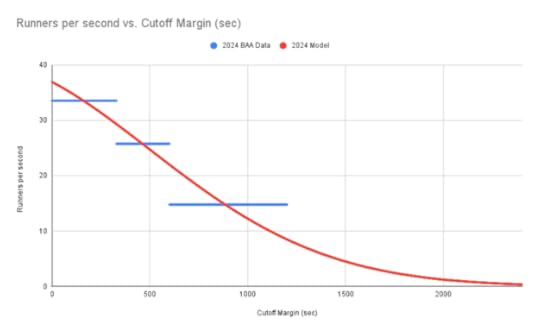 Author’s model of BQ distribution for the 2024 Boston Marathon plotted along with BAA supplied data.
The fitting parameters for the distribution are amplitude, mean, and standard deviation. The parameters I have chosen match the BAA-supplied data buckets to within 1% up to 20 minutes (1200 seconds) of cutoff margin. I have not attempted to match the BAA data for cutoff margins greater than 20 minutes. Those fast runners aren’t the issue here.
How should I adjust the fitting parameters to account for the additional expected applicants to the 2025 race?
I think it unlikely that the spread (standard deviation) of the data will change much year over year although one could argue that the mean might as more runners plunk down the big bucks for super shoes. However, to keep it simple I only adjusted the amplitude to account for the percentage increase in expected applicants. Below is the corresponding model for the 2025 race.
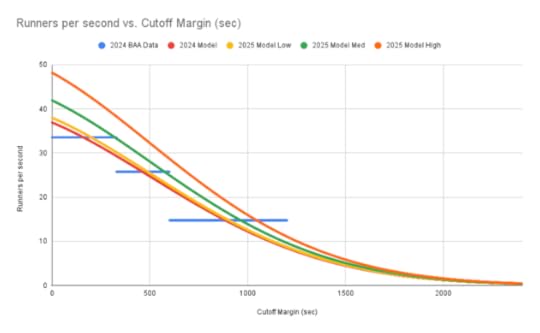 Author’s model of BQ distribution for the 2024 and 2025 Boston Marathons.
Prediction the 2025 Boston Marathon Cutoff Time:
As previously reported, the area under the curves describes the number of runners in any given range of cutoff margins. I have tabulated the various cases in the chart below. The cutoff time is determined by the area required to match the number of denied applicants.
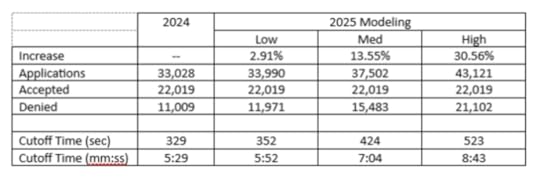 Author’s modeling results for 2025 Boston Marathon.
Given everything I have seen thus far in the data, I expect that the 2025 Boston Marathon will tend towards the higher end of my bracketed range. Thus, I think that the 2025 cutoff time will be between 7:04 and 8:43.
Obviously, there are opportunities for error in this prediction. I welcome debate and suggestions for improving the model.
I would love to see how well the model fits to the 2022 and 2023 qualification data but, for those zero cutoff time years, the BAA did not release any BQ distribution data. I will continue to track the data on the remaining feeder marathons and, of course, will review whatever data the BAA releases when they announce the 2025 cutoff time just to see how well the model performed and to determine if it can be used for 2026.
Remember, this started with my desire to get into the 2025 Boston Marathon. It is clear to me that the cutoff time will be longer than the 5:29 of 2024 and, I believe, considerably longer.
I will train with the intent of finishing in 3:40:00, which gives 10 minutes of cutoff margin for my 3:50:00 qualification standard. That would be a PR for me and at age 63, PR’s don’t come easy. I have to include a lot more strength training in my workouts.
Failing this, I get some relief in 2026 when my qualification standard jumps up 15 minutes to 4:05:00. But that’s as it stands now. Super shoes will only get better. I expect that the “aging up” advantage will likely shrink as further adjustments are made to the standards.
*BQ: A marathon finish time that meets the BAA’s qualification standard for a runner’s age and gender. As a male runner who will be 64 years old at the time of the 2025 Boston Marathon, my current qualification standard is 3 hours 50 minutes (3:50:00).
[image error]November 9, 2023
New York City’s Five Boroughs and the battery
 Included with permission from Mark Remy (dumbrunner.com)
While I was in Chicago for the marathon in October, Jessica, a running coach, remarked how lucky I was to have a body that can go from marathon to marathon with hardly any recovery time. I agreed but offered that, much like with running, there is a mental aspect to recovery. As in any effort, if the mind is game, the body will follow along.
That probably sounded boastful as if the preoccupation with weeks to months of recovery time was for sissies.
Dangerous talk. The irony gods listening in were primed for an easy smackdown.
Eleven days before my next race, the New York City Marathon, as I bent down to pick up my shoes for the day’s training run, I felt that familiar spasm in my lower back that heralds pain and incapacitation, and collapsed to the floor.
Shit.
Each of the World Marathon Majors (WMM) is unique. However, common to all is millions of spectators lining the course cheering the runners on.
In Tokyo, the spectators are unfailingly polite and on the quieter side. The course is unspectacular but with several out-and-back spurs, mid-pack runners sometimes get a glimpse of the elite pack flying past them in the opposite direction on the other side of the street. The crowds lining Boston’s course are considerably more boisterous than in Tokyo as runners make their way through eight Massachusetts cities and towns between Hopkinton and the finish on Boylston Street.
London does perhaps the best job of all the Majors of incorporating numerous city landmarks including Tower Bridge, the Cutty Sark, Buckingham Palace, among others. Berlin features some city landmarks most notably the finishing stretch with runners passing under the imposing Brandenburg Gate.
Chicago’s course is compact with many right angle turns designed to allow the runners to sample 29 of the city’s neighborhoods. The downside of that layout is the temptation it presents to supporters bent on crossing through the runners’ path in hopes of gaining multiple sightings of their favorite runners. Collisions between runners and spectators are common.
In New York City, for me, suggests transformation. I grew up on Long Island in the 1960’s and 1970’s and the city was a scary place back then. Now though, on marathon day, it is like Disneyland, the happiest place on earth. The entire city empties out of skyscrapers and tenements to give a warm and thunderous show of support.
In its first year, the course was four plus loops around Central Park. In 1976, in celebration of the country’s bicentennial, the race adopted the tour of the city’s five boroughs format that has been used since.
The course is distributed unevenly among the boroughs. Staten Island is prominent only in that the Start Villages are there, which means a lot of milling around time waiting for each wave’s starting gun (really, a very loud howitzer) to go off. Virtually no mileage is accumulated as runners immediately leave Staten Island for Brooklyn via the Verrazzano Bridge. Almost half of the race takes place in Brooklyn. Queens gets a touch more than two miles and other than a brief mile plus change interlude in the Bronx, the balance and climactic finish take place in Manhattan, as is appropriate.
Other than the finish in Central Park, the most famous part of the route is the entry to Manhattan from the Queensborough bridge at about mile 16. There are no spectators on the bridge. Hence, coming off it, runners are greeted with a thunderous wall of noise as they stride into the city’s most populous borough.
This was to be my third consecutive New York City Marathon and a record number of runners was to partake. I anticipated a raucous conclusion to my quest to complete all the majors in 2023.
Assuming, of course, that I could get my back to cooperate.
After the Chicago race, which went very well, I spent a lot of time with the data from my Garmin watch and ran mini-experiments on my behavior and training tactics to figure out how best to optimize my body’s readiness for New York.
This work gave me some ideas. It also pointed out how to deal with the back injury eleven days before the race.
The Garmin data — primarily resting heart rate, body battery, sleep data, and resting heart rate — all pointed to the one thing that I should do about my back spasm: nothing.
And that is what I did.
For two days, I lay in bed doing little more than sleeping, reading, and eating. By the third day, I felt good enough to have a normal day. I didn’t run but I walked the dog and went grocery shopping.
On the fourth day I felt fully recovered and ran a brisk four miles. All good. The day after that I put in 10.4 miles.
Who knew that idleness could be so recuperative?
In September, my son, Aidan, moved from Seattle to Brooklyn. Friday morning, my wife, Lynn, and I got together with him for lunch and some strolling about Times Square. Afterwards I headed to the Expo at the Jacob Javitz Center to get my race bib. Bib handout was very efficient; I had my race packet within 15 minutes of entering the Expo.
The highlights of the Expo came afterwards. First, I came upon Aaron Burros sitting at a table and stopped to introduce myself. Aaron and I were both recognized for our inspiring stories in 2021, the 50th anniversary of New York’s race. In 2015, Aaron took five bullets in the process of saving the lives of three of his coworkers in a workplace shooting incident. He was an accomplished ultramarathoner at the time but the injuries have compromised his ability to run. Nonetheless, in 2021, he was on a mission to run 50 marathons in 50 states in 50 weeks.
I think Aaron was impressed that I knew all this about him. We spent a few minutes chatting about the turns our lives have taken and our plans going forward. He gave me a copy of his book and signed it for me. When I get back home I will send him a copy of mine.
Next, I fulfilled a promise I made to April Bertram when I met her before the Berlin Marathon in September. She would be getting her sixth WMM star in that race and was hoping to see her name on the big wall of Six Star Finishers that Abbott displays at all the WMM Expos.
I told her that she had to run the marathon first before her name would appear. I knew that the updated board would be ready for New York City and I offered to send her a photo of her name displayed on it come November. This interaction was very brief, five minutes at most, with very little conversation.
At the Expo, I went to the Six Star Wall, took the photos, and sent them to her.
Meanwhile, April found an online article about me and my 2021 WMM exploits. That prompted her to buy a copy of my book and to share her story with me. Hers is like that of many other runners I have met recently involving the combination of a life-changing medical condition and marathons.
Her disease is Pulmonary Sarcoidosis and she took up running the Majors as a way to stay healthy. Earlier, in London, she ran for the British Lung Foundation. Hopefully our paths will cross again at another race sometime and we will have that conversation we should have had in Berlin.
Aidan and Lynn hung out together while I was at the Expo. Afterwards, we all went to Brooklyn to check out Aidan’s new apartment and neighborhood, meet up with his girlfriend, Corina, and some other friends of his.
Brooklyn had not been memorable during my previous New York City Marathons. That would change this year. Aidan planned to get a number of his friends together to cheer for me at McCarren Park. We went over the plan in detail so as to avoid the possibility — given the sheer volume of runners and spectators — of missing each other.
On Saturday, my priority was to rest up for the race. But before that Lynn and I went to the Team Fox pre-race lunch. There we met up with many of the Michael J. Fox Foundation friends I have made over the past two years as well as some of the other Team Fox runners.
Team Fox had 138 runners in the marathon. All but myself were running in honor of a friend or family member stricken with Parkinson’s disease and I met a few of those honorees. It is one of the things I like about these Team Fox events — I get the chance to be useful.
I have been very lucky with this disease. I caught it fairly early and it has responded well to medication and exercise. Also, my cognitive skills have not yet been affected thus allowing me to assimilate the current science regarding the disease. I have given guidance, based on my experience and knowledge base, to many others living with PD. It is a scary disease, yet, I am able to demonstrate how one can thrive in spite of it.
After the lunch, Lynn met up with Aidan and Corina for some sight-seeing while I went back to our hotel to charge my body battery.
Upon reviewing data from my other six marathons this year, I committed to a going all-in on having a high body battery level before Sunday’s race. Higher body battery levels were strongly correlated to stronger race performance. Again, doing nothing seemed to be the best method for getting to a high body battery.
That worked. On Sunday morning at 6:00 am by battery was at 79%, significantly higher than on any other race morning this year.
But start time was five hours later. My battery would discharge in the meantime as I traveled by subway, ferry, and bus to get from midtown Manhattan to the Start Villages on Staten Island. By the time my wave was sent off, my battery level had fallen to 43%, which would be tolerable on a cool day but troublesome if the weather turned warm.
It did warm up. Whereas the forecasts leading up to the race promised lows in the 40’s, the temperature climbed to the high 50’s as I waited for my start. Temperature, clearly, was going to be a problem and the low body battery made it worse.
In previous posts, I discussed my time goal for this year’s races. I failed in all my more aggressive goals leaving only one still attainable: get a personal best course time for each of the six Majors. For New York City that meant running it faster than 4:30:21, the time I achieved in 2021.
As is usually the case, I started out well at a pace that would easily meet that mark. But soon the temperature rose above 60 and that spelled trouble.
Brooklyn, however, was delightful.
At about mile 11, I thought I heard someone calling my name. Disbelieving, I continued on but heard it again repeatedly. Turns out a former neighbor of ours from Palo Alto, California, Ari Brownlee, was running alongside the course trying to get my attention. I eventually clued in and stopped long enough to thank them and get a selfie. I was overjoyed that they made the effort to track me down and cheer me on.
Ari stayed with me for about a block. Later, just short of mile 12, I came upon where Lynn and Aidan assembled their cheer team in McCarren Park.
All the Majors create tracking apps with the intent of allowing spectators to follow the progress of their favorite runners. When the app works well, it facilitates joyful meetups on the sidelines of the course. But the apps often fail due to the shear number of people accessing them and it did so on Sunday.
We anticipated this while planning the cheer station the day on Friday. I told Lynn and Aidan to expect me to run at a 9 to 10 minute mile pace. Given a 10:55 am start time, I should reach McCarren Park somewhere around 12:41 to 12:53 pm. They also knew to keep their eyes peeled for my trademark bright pink knee-high compression socks.
Worked like a charm. I arrived at McCarren at about 12:52 pm to a hero’s welcome.
It was the absolute highlight of the race for me not only for the joy they gave me at the time but also for the contrast with how things were about to go south as I headed north.
Aidan had assembled a large crew. Besides Lynn, Aidan, and Corina he managed to get six other of his friends to come along. Plus, my nephew Thomas and his fiance, Sydney, who have been living in Brooklyn for years, also joined in. I was thrilled and gave them all sweaty hugs, planted a kiss on Lynn, then trotted off teary-eyed.
This year, a new borough became the most thunderous. The wall of noise I expected coming off the Queensborough Bridge was subdued in comparison to the enthusiasm I felt throughout Brooklyn. The crowds there were off the charts this year.
I reached the halfway mark at about 2 hours and 6 minutes. Keeping to that pace would mean I would easily achieve my finish time goal. But the 60+ temperature was starting to drain me. I am quite sensitive to the heat as is common to those living with PD.
By contrast, Chicago stayed in the 40’s throughout the race and I ran its second half faster than the first. In fact, I realized at mile 17 in Chicago that I was hardly sweating meaning I could be cavalier about hydration.
Not so in New York City. After about mile 16 my legs were constantly on the verge of all out cramps that I held at bay by swallowing a SaltStick electrolyte tablet nearly every mile. My pace plummeted and I frequently updated my finish time estimate. By mile 20, as my mile pace became slower than 11 minutes, I was seriously concerned that I wouldn’t hit even my least aggressive finish time goal.
Many coaches and coaching guides advocate that runners ought to “listen to their body” for signs that it is time to back off. My body, much like its owner, is more inclined towards action than words. If it could speak, at this point in the race, it would have said, simply, “Stop!”
This may be the real reason why I am able to run multiple marathons with short recovery times between them. Whether it be back spasms during seemingly innocuous activities or leg muscle cramping during a race, my body finds a way to put the brakes on thus limiting the damage and presumably shortening the recovery time.
Beyond mile 20, it had become very hard to move my legs. At one point on Fifth Avenue, I heard someone yell, “Bend your knees!” and thought for sure it was directed at me. My calculations indicated that my 4:30:21 finish time goal was drifting out of reach.
But it was very close. I decided to push hard. I found that if I stopped a few seconds for water at the aid stations, I could leave the station at better than an 11 minute pace, keep that going up to the next station, then repeat the process. I did that through the end of the race while popping a SaltStick tablet at each stop.
It was just barely enough. I felt crappy during all of the final three miles in Central Park and, wobbling, nearly fell down after crossing the finish line but I managed 4:28:49 a scant 92 seconds ahead of my goal.
And here is why I wanted to achieve a course personal best on each of this year’s majors:
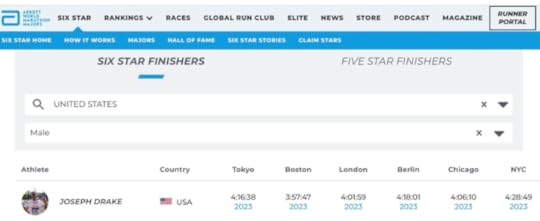 Screenshot from https://www.worldmarathonmajors.com/six-star/hall-of-fame
The Abbott WMM portal displaying Six Star Finishers only reports the fastest time for each of the Majors that a given runner has achieved in the event that they have run any of them more than once. I wanted to be able to demonstrate to any casual observer that I had run all six of the races in 2023 and one way was for the Abbott WMM Six Star portal to display only my 2023 races. To do that, I had to run each of them faster than when I ran them in 2021 and/or 2022.
As goals go, this is a silly one. But I think the result looks pretty cool.
Team Fox held a post race party for its runners and their supporters. Year after year they generously invite runners to invite an unlimited number of guests to the party. I took full advantage of this.
Thomas and Sydney had to bow out but otherwise my entire Brooklyn cheer station joined us at the Stout Penn Station restaurant for the party. It was a joy to see them again and to show off Aidan to my Team Fox friends. He towers more than six inches over me and that tends to spur all sorts of comments about the vagaries of genetics.
But perhaps the most astonishing attendees of the evening were Eric Jones and his fiance, Sybil Sha. I met Eric and his whole family — parents Inga and Rick and sister Julia — at the Team Fox 2021 Chicago Marathon pre-race party. I arrived late to that party and they invited me to their table and we spent the rest of the evening chatting. Eric was the Team Fox runner for the family and the rest came to support him. He was running in memory of Inga’s father who died after years of struggle with PD.
I was so impressed by the depth of love in the Jones family and we have kept in touch since then through social media. Eric was a med student at the time and since then graduated, met Sybil while both were working on their residency, and began practice in New York City. Recently, he and Sybil, who is also now practicing in NYC, became engaged.
I knew that they were in New York and suggested to Eric that they come to the party but realized that he may be too busy to do so. But he did come! And he brought along Sybil! It was so thoughtful of them to make the time to join us and it was wonderful to catch up and to meet Sybil.
Of course, I enjoyed seeing my Team Fox friends for what may be the last time for a while. They — Liz D., Katie, Liz B., Kristen, Jess, Maci — have always treated me so well and played an enormous roll in my journey thus far. I hope that we will still cross paths from time to time.
And I now have a dozen or so new contacts in both the running and Parkinson’s community to follow.
I first came up with the goal of running all the Majors in a single calendar year way back in 2019 after finishing my first marathon. The original plan was to run them in 2021 and although I came close, completing five of the six, Tokyo cancelled its race that year leaving me with the pang of unfinished business.
That ache has now been relieved. Thus ends this chapter of my journey with my new partner, Parkinson’s disease.
Going forward, the World Marathon Majors won’t disappear completely from my agenda. I will run Tokyo again in 2024 to get a second Six Star Medal. And I will try to get into Boston every year mainly to keep in touch with the many friends I have made these past two years. But the WMM will no longer be an obsession.
It is time that I begin a fresh, new obsession.
Many of you have asked me what is next and some have offered suggestions. Thank you for that. As of now, I have not yet come up with anything that strikes my fancy.
Note that I started all this shortly after my PD diagnosis when I believed that the disease dictated urgency. I did not know how long I had left before PD would make such endeavors impossible.
My timeline, however, appears to be longer than I originally thought. Outrageous physical exploits have, for all intents and purposes, stopped Parkinson’s in its tracks. Such goals have transitioned from bucket list items to medicine.
And therein lies the rub.
The combination of Parkinson’s and marathoning, ironically, has been great medicine for me, and I dare say, for others who have been inspired by my journey.
Whatever it is that I choose to do next must be of similar or greater value to others.
You can still donate to my New York City Marathon campaign ( click this link ).
However, I have another campaign for you. I’m running with Team Synapse again in one of those crazy non-stop, around-the-clock relays like the one we did in the Blue Ridge Mountains last year . This December it will be in Florida ( click this link ). Again, we are raising money for Parkinson’s research. If you share the passion that I have for finding a Parkinson’s cure please consider contributing. All donations are meaningful and greatly appreciated.
Alternatively, if you would like something tangible in exchange for a contribution, consider purchasing my book Run With It: A True Story of Parkinson’s, Marathons, the Pandemic, and Love . It was named as a Finalist in the 2022 Wishing Shelf Book Awards . It also received an Honorable Mention in the Eric Hoffer Awards and was rated “RECOMMENDED” in the US Review of Books .
All profits from its sale are donated to MJFF. It can be found on my author’s website and Amazon . It’s cheaper on my author site (for domestic shipping), a larger percentage goes to MJFF than for Amazon sales, and you get the option of having it signed by the author.
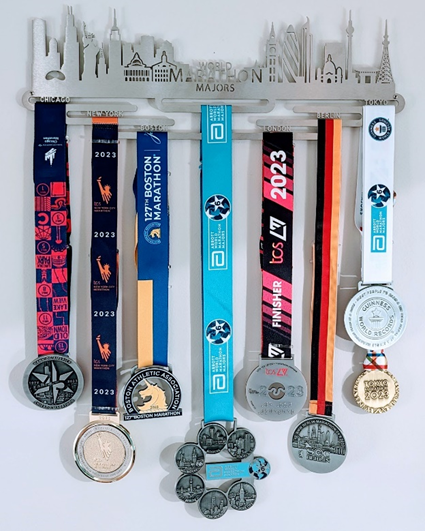 My 2023 Abbott World Marathon Medals (photo by the author)[image error]
October 11, 2023
Chicago Was Cool
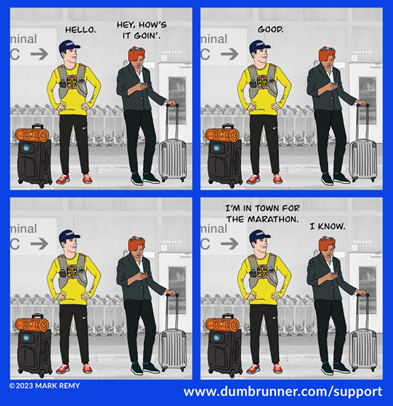 Included with permission from Mark Remy (dumbrunner.com)
I was getting excited the week leading up to this year’s Chicago Marathon. The heat and humidity in Berlin two weeks prior to Chicago were still fresh on my mind and so was the wall I hit in the second half of that race.
But the weather forecast for Chicago promised something much more pleasant. The conditions were looking ideal and I was eager for a better performance this time.
I flew into town on Friday afternoon, checked into my hotel, and headed to the Expo to get my bib and T-shirt.
47,000 runners were expected in the race, a huge increase from the 40,000 runners of 2022 and it showed at the Expo, which was choked with people and vendors hawking their wares. I might have avoided the show floor entirely but it was necessary to cross it in order to pick up my T-shirt after getting the race bib outside in the lobby.
It brought to mind the orderliness of the Tokyo Marathon Expo where visitors were forced to follow a strict path through the show and changing directions was prohibited. That wouldn’t work in the States. It was sedate albeit frustrating at times though I found that the Japanese were too polite to stop me from jumping the barriers when a shortcut presented itself.
The full court press suggested only a short stay at the Expo. Bib and T-shirt in hand the next order of business was carbo-loading. I decided on Eately, and its authentic Italian quisine, which was close to my hotel. The Tagliatelle alla Bolognese and Pizza Margherita were so good that I ordered some Cacio e Pepe for takeout and wolfed it down in my room.
It was chilly Saturday morning as I went out to pick up some salt bagels and cream cheese to fuel the day’s carbo load and sodium fix. Race day was forecasted for similar weather and I was delighted for the cool temperature. However, it occurred to me that I didn’t pack any expendable clothing to forestall shivering in the corral before the start. Rookie mistake. I resolved to get to a thrift store that day to rent a warm sweatshirt. I say “rent” because my discard would be donated right back to charity after the race.
Team Fox held a lunchtime meet and greet for its runners and supporters at Parson’s Chicken and Fish on Halsted. I wasn’t running for Team Fox this year but Katie Casamassina, who runs the Team Fox endurance events, always invites me to their parties regardless.
I totally enjoy these Team Fox gatherings. Besides being warmly welcomed by Katie and Maci Hanson, another Team Fox staff member, I got the chance to catch up with other friends I’ve made through the Michael J. Fox Foundation these past two years.
I met Chuck Kistler last year in North Carolina when I ran with Team Synapse in the Blue Ridge Relay. Chuck lent his microbrewery as a pre-race meet-up for Team Synapse. He donates some of the profits from this business to the Michael J. Fox Foundation. Chuck also ran Chicago this year and last for Team Fox.
Jared Koch and Jason Kopacz ran in the Blue Ridge Relay on Team Synapse. I first met Jason and his wife, Kristi, at a Team Fox dinner before the 2022 Boston Marathon.
Jared came into Parson’s showing some dyskinesia. Dyskinesia, a general lack of control of limbs and body that manifests as multiple tremors, is a common symptom of Parkinson’s. After an hour or so it settled down. Jared said that the stress of the hour drive to Chicago triggered it. Its intensity varies throughout the day but, happily, it doesn’t happen when running.
Jason and I are with Team Synapse again to run a relay in Florida this December. Jared would like to join us but had to back off so that he can prepare for Deep Brain Stimulation (DBS) surgery in January. He would really like to put this annoying dyskinesia behind him.
DBS has become more prevalent among the people I know who are living with PD. Electrodes are implanted into certain areas of the brain so as to apply high frequency electrical stimulation. A battery pack is embedded into the chest to power the electrodes. DBS can be quite effective at eliminating dyskinesia. The whole thing makes me queasy but the technology has improved greatly in recent times.
Jason has DBS and is quite happy with the system. He described to me how the patient is awake as the placement of the electrodes is done. When they are placed correctly and the stimulation is turned on, Jason reported, it is amazing how the body totally relaxes and the tremors fade away. Jared has been encouraged by such reports and is eager to get the procedure done.
Cheryl Denton came by to introduce herself and her husband, Jim, to me. Cheryl has been following my exploits and was happy to finally meet me in person. Cheryl is running and Jim came along to support her.
Jim had DBS surgery in January and you wouldn’t know to look at him that he has PD. He is very happy with his DBS results.
Jason told me that he still has to take the medications — DBS doesn’t eliminate that need. We talked a little bit about some of the medications he has used.
I recently attended an American Parkinson’s Disease Association (APDA) event where several pharmaceutical companies promoted their drugs that targeted a reduction in “off” time for people living with PD. “Off” times are when the meds have worn off and another dose is needed.
One such drug is Inbrija, an inhalable form of Levodopa. Levodopa is converted in the brain to dopamine, which is the neurotransmitter that Parkies are in short supply of. Levodopa is usually administered with Carbidopa as a way to minimize the side effect of dyskinesia. Inbrija is formulated without Carbidopa. As an inhalant, it is very fast, delivering the Levodopa within seconds compared to the 30–60 minutes required for a conventional the pill form (Sinemet, which includes Carbidopa).
At the APDA event, I challenged the Inbrija rep about the likelihood of dyskinesia because of the lack of Carbidopa in it. She couldn’t or wouldn’t give me a satisfactory answer.
My guess was confirmed by Jason who has tried Inbrija while running. “It’s like cocaine,” he said. The response to the inhalation is immediate and the dyskinesia is off the charts. Jason said that his arm started tremoring wildly and it totally disrupted his run.
Big Pharma likes to throw drugs at problems and addressing “off” time has been a lucrative target for them. I find it a discouraging situation. These drugs are not cures. I can’t imagine that Pharma wants a cure because a cured patient represents a lost customer.
While we ate some lunch I overheard a conversation at the next table about HOKA running shoes (my personal favorites) and had to insert myself. It turns out that one of the folks at the table, Joe Bennet, lives close to me in West Seattle. He was running in support of a friend and a brother-in-law both of whom have PD. I imagine we will soon cross paths again, literally, in West Seattle.
I chatted with Jessica Green, a running coach, who helps train Team Fox runners for endurance events. She has been suffering from knee pain since last November and is getting fed up with it all. She has avoided surgery but she eventually agreed with me that an arthroscopic clean-up of articular and meniscal cartilage might be a good option for her. I’ve done that several times decades ago and it always worked out.
After the meet and greet, I took a bus to the Salvation Army and picked out the perfect zippered hoodie for discarding the next morning. The rest of the day was spent resting in my hotel room and scarfing down the last of the bagels and cream cheese.
As was the case in 2021 and 2022, Team Fox runners gained access to the Goodman Center of Roosevelt University. Only two blocks from Grant Park and the entry to the Start Area, the Goodman Center is ideally situated for pre-race staging and post-race socializing.
I was able to see Chuck, Jared, and Jason again before we headed out to Grant. Anna Haber, who I met in 2022 at Goodman, was there also and gave me a big hug. She came along with her friend Jenny Luft who was excited to run her first marathon. Mike Debartolo and his daughter, Anna, were there to run the race together. Mike may be joining Jason and I at the Florida relay race. Of course, Maci and Katie were welcoming everyone and wishing all a great race.
As is always the case at the Majors, millions of spectators lined the course. The crowds were loud and enthusiastic. Folks with microphones encouraged the runners. At one point I was startled to hear “Sweet Caroline” (normally the anthem at the Boston Marathon) but it was not the familiar version. A live band was covering the song and playing it note for note with such accuracy that it felt surreal to hear their lead singer’s voice instead of Neil Diamond’s.
Tokyo came to mind again because absolutely no spectators enter the course during that race. Chicago may be the worst of all the majors for randoms cutting in front of runners to meet up with friends on the other side of the road. One had to be alert to avoid hitting babies in strollers and parents darting in front with toddlers in their arms.
Team Fox was set up with cheer stations at miles 7.5 and 24.5 and, as always, I got a great boost when I passed them as they roared for me, rattled their cow bells, and we exchanged high fives (and some low fives — there were a few children as well).
Chicago prides itself on routing the marathon course through its 29 distinct neighborhoods. Honestly, I normally don’t notice the distinctions. But this time I was hit with the smell of Kung Pao Chicken and Hot and Sour Soup at about 22 miles. I think that I didn’t notice Chinatown last year because it was four weeks after I got COVID and my sense of smell had not yet returned.
I had a good run. The weather was indeed ideal: 46 degrees and 72% humidity. Normally, I sweat heavily and that requires constant electrolyte replenishment or I suffer horrible leg cramps.
Not this time. Somewhere around 17 miles it dawned on me that I wasn’t really sweating very much. Hence I needn’t be so aggressive with the hydration.
My pace was steady throughout and I had enough left to pick it up the last few miles. I even felt good enough to exhort another runner, who was flagging towards the end, to race me for the final 200 meters. She was very appreciative of my help in getting her over the line.
Finish time was 4:06:10. I would have liked to go under four hours but I decided at the start that it was imperative that I not go out too fast. Starting at an unsustainable pace risked hitting the wall in the second half of the race. From there my pace would tank and I would likely miss my real goal of beating last year’s 4:11:48.
My second half was 62 seconds faster than the first. Having a strong finish makes all the difference. It makes running a marathon (dare I say it?) fun.
My friends seemed happy with their results as well. Chuck improved on his 2022 result by about 25 minutes. Mike and Anna were able to get their photo crossing the finish line together. Jared, Jason, Joe B., and Cheryl were satisfied although Jason didn’t like hitting the wall in the second half. Both Anna and Jenny were thrilled with Jenny’s debut.
I know that my day’s result was largely due to the cooperative weather pattern. Notwithstanding, it would be really nice to figure out how to improve my performance in less than ideal conditions.
The Garmin watch I wear calculates a parameter called “body battery”. Garmin has a proprietary algorithm (based on heart rate, heart rate variability, sleep cycles, etc) for calculating how the body recharges during sleep and discharges over the course of a day’s activity. Ideally, one would get a great night’s sleep to fully charge the battery to 100% then go run a marathon the next day.
Never happens for me.
On average, my morning battery level is 65% and although it occasionally gets above 80%, I have not figured out how to get it that high intentionally. The low numbers may have something to do with frequent (i.e. hourly) trips to the toilet at night.
Usually I ignore the body battery numbers because there have been times when Garmin tells me I just ran 15 or more miles on a dead battery. That’s obvious nonsense.
However, I looked at the numbers for the six marathons that I have run this year and there are some noteworthy trends. For example, upon waking up on race day mornings my battery averaged 56%. By the time the race starts the charge has dropped to about 40% on average.
Apparently, a 40% charge is not enough to get through a marathon. In fact, something like 45% appears to be my minimum. Anything below that and my battery goes dead on the course.
This year I avoided hitting the wall only in Boston and Chicago. In Boston, I woke up with a 68% charge. Making my way to Hopkinton eats up a fair bit of juice leaving me with 46% at the start line. But in Chicago, with less work required to get to the start, I woke up with 66% and still had 48% for the race. In none of the other four marathons this year did I have as much charge at the start.
Perhaps this is not nonsense after all.
How well might I run on a fully charged body battery and by what sorcery might I achieve that?
Pre-bed meditation for a better night sleep? More efficient carbo-loading? More coffee? Less coffee? Go to bed earlier?
Love to figure it out by November 5 when I run the New York City Marathon.
And I hope that it is another cool day.
I am running for Team Fox again this year. You can donate to my New York City Marathon campaign ( click this link ). I could use your support. If you share the passion that The Michael J. Fox Foundation (MJFF) and I have for finding a Parkinson’s cure please consider contributing. All donations are meaningful and greatly appreciated.
Alternatively, if you would like something tangible in exchange for a contribution, consider purchasing my book Run With It: A True Story of Parkinson’s, Marathons, the Pandemic, and Love . It was named as a Finalist in the 2022 Wishing Shelf Book Awards . It also received an Honorable Mention in the Eric Hoffer Awards and was rated “RECOMMENDED” in the US Review of Books .
All profits from its sale are donated to MJFF. It can be found on my author’s website and Amazon . It’s cheaper on my author site (for domestic shipping), a larger percentage goes to MJFF than for Amazon sales, and you get the option of having it signed by the author.
[image error]September 27, 2023
Return to the Berlin Marathon
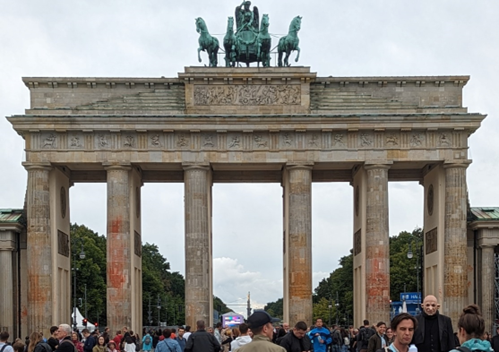 The Brandenburg Gate (photo by the author)
I’ve run 20 marathons in the past three years, nine months. I am proud of that collective achievement. Yet, I rarely feel good about my performance in any given race. In only three of them can I honestly say that I ran to my potential and I am constantly reviewing my copious notes and data hoping that the secret to replicating those results will reveal itself.
A great run is elusive. But that’s hardly center stage because there’s much more going on than the run. Marathons have an ability to draw together extraordinary people and uncanny coincidences. This year’s Berlin Marathon was no exception.
Here’s an example.
After running Sunday’s Berlin Marathon, I hung out as close to the finish line as the authorities would allow and waited to meet up with my friend Scott who was still on the course.
As I waited, a runner came along wearing a pineapple. Many other runners took selfies with him. I snapped the photo below.
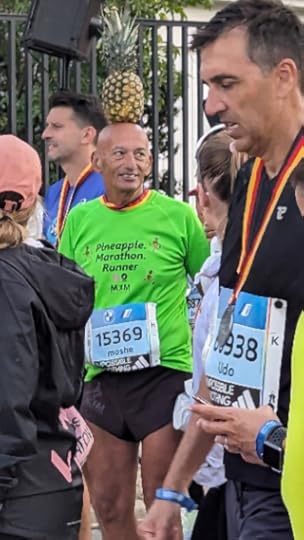 Moshe Lederfien, the Pineapple Marathon Runner, at the Berlin Marathon Finish (photo by the author)
His name is Moshe Lederfien and he is world famous for running entire marathons while balancing a pineapple on his head. He calls himself the Pineapple Marathon Man.
Within minutes of taking that photo, my daughter, Kinsey, nine time zones away, forwarded me the post below and asked me if I had seen this.
 IG post by @MilesPerHoward
Yes, it’s a small world and the marathon world is even smaller. But still, you can’t make this stuff up.
Scott and I didn’t manage to meet but we’ll have another chance in two weeks when we both run the Chicago Marathon.
As was the case in 2021 when I first ran the Berlin Marathon, I booked my entry into this year’s race through Marathon Tours and Travel (MTT). In 2021, the world was just starting to get normal after COVID and Berlin seemed very quiet, sterile even. Many folks were still not ready to come out of there homes then. That’s all changed and this time around the city was bustling like any other world capital city would be.
MTT hosted a reception for the runners and their supporters on Thursday night. I met up with Patti Shuster, another West Seattle Runner, and her husband Eugene at the reception. Patti and I often cross paths on our training runs and we traded texts leading up to the race as we sorted out our race strategies.
On Friday, MTT arranged a tour of the city but given that I took that tour in 2021, I opted out this time around in favor of resting up for the race.
I did, however, join in the Generali Breakfast run hosted by the city on Saturday morning. It is a traditional pre-race event and free for all participants. Runners and their supporters gather at the Charlottenburg Palace plaza, run the four miles to the Olympic Stadium where Jesse Owens (and a hero of my former Palo Alto neighborhood, Jim LuValle) kicked Nazi butt in 1936, and scarf up a free breakfast. The Generali was cancelled in 2021 due to COVID concerns so I was eager to witness it this time around.
MTT provided buses to and from the event. As hundreds, if not thousands, gathered at the Charlottenburg Palace, I struck up some conversations.
I noticed a young woman who, like myself, was decked in HOKA shoes and clothing and asked her about it. I mentioned that I am a HOKA Flyer — like a brand ambassador — in the States.
Léa lives in the north of France and she would like to be a HOKA ambassador there. She has applied for it but she says a large social media presence is a requirement and she doesn’t have enough followers yet. Léa was not running in Berlin but had just completed an Ironman triathlon and came to Berlin to support her friend who was running.
Next, I spoke with Amanda who was the runner and her husband Thomas who came along to support her. In an insane coincidence, they were from the town of Shirley on Long Island in New York close to where I grew up. I was amazed to learn that Amanda’s first long road race ever was a beer run that started and ended at the Blue Point brewery. Blue Point is the town where I grew up.
To save my legs for the marathon, I planned to walk half of the way to the Stadium. Starting out, a local walking her dog was startled to see such a huge crowd of runners on Saturday and asked me if there were two marathons this weekend. I let her know that, no, we were all just running to get a free breakfast.
While still walking, I chatted with Laura, a cybersecurity expert from Columbus, Ohio. Berlin was to be her attempt to get back into the running scene after a few tumultuous years wherein she had several bouts with COVID and lost her partner to ovarian cancer.
I started jogging with about two miles to go and entered the Stadium. Impressive, of course, and much modernized apparently since 1936. But the real spectacle was the feeding frenzy. In general, I have found runners to be great people. But everyone has their faults and for runners the prospect of free food undoes their otherwise exemplary manners. I chose to stay away from the brawl.
On the bus ride back to the hotel, I sat with Ildiko, a Hungarian who emigrated to the US in 1989 when the Communist block crumbled. She was in Med school at the time, finished her studies in the States, and set up her pediatric practice near Atlanta. Another marathon fanatic, she started running them eighteen years ago and Berlin was to be her 83rd. One week later she planned to run the Loch Ness Marathon in Scotland. Besides comparing our running resumes, we discussed the ridiculous cost of healthcare in the US and how Hungary, once the Western Media’s darling of the Soviet satellites in the 1970’s, has now become a scary and — for Americans — relevant example of how democracy can quickly slip into autocracy.
Saturday evening, MTT put on a pre-race dinner for the runners and their supporters. Months earlier I proposed to MTT that I address the audience at this dinner to describe my journey with Parkinson’s and how, through vigorous exercise, people living with Parkinson’s can thrive despite the disease. At the 2021 race a similar presentation was made by a runner whose wife had Alzheimer’s. The couple took to running marathons all over the world as therapy.
MTT ghosted me on that proposal and chose instead to have Tony Reed talk about his marathoning endeavors. In 2008, Tony became the first black athlete to run a marathon on each of the seven continents. Since then he became the first black runner to score what he calls the “Marathon Hat Trick”, which in addition to the seven continents, includes completing at least 100 marathons and running a marathon in each of the 50 states. Besides running, nowadays he also produces documentaries featuring black marathoners.
All right, I get it. His story is as humbling as it is inspiring. And I feel a bit sheepish.
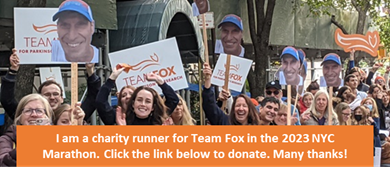 https://give.michaeljfox.org/fundraiser/4511868
For weeks leading up to the race, I had been monitoring the weather forecast for Berlin. In 2021, it was dreadfully hot. I and many other runners suffered on the course with the temperature in excess of 70 degrees.
This year the race would start out at a tolerable 56 degrees. It definitely was better than 2021 but with my 9:40 am start time the best of the chllier weather was gone early on and in the meantime humidity was a scary 83%. Several hoses sprinkled cold water down onto the runners along the course and I happily soaked myself in every one that I encountered.
My recollection is vague but it seemed that the spectators this year were fewer and less boisterous than in 2021. There were far more runners, though. In 2021, there were about 25,000 entries. This year it was nearly 48,000.
At one crowded stretch at about mile 17, another runner stepped on my heel sending me to the ground. No apologies but no great damage — just some blood on my knee and knuckles. My legs had already begun cramping, though, and it was a struggle to get back up. Another runner noticed my plight, helped me up, and made sure that I was good to keep going.
By then my pace had already fallen off. I was good until the halfway point but couldn’t keep it up. Often when I run out of steam my pace drops continuously through the end of the race. This time I was determined to avoid the death spiral and managed a fairly constant, albeit slower, pace for the second half.
I ended up with 4:18:01, more than 37 minutes faster than in 2021 but well off my sub-4 hour plan.
Many runners set several levels of goals for their races. “A” goals are the hardest and only happen when everything lines up perfectly for the runner. That includes their own preparation as well as circumstances beyond their control (i.e. weather). The lowest level goal is the minimum performance they could live with knowing that they tried their best.
My goals for my 2023 WMM campaign line up as follows:
“A”: Run in and finish each of the WMM in less than 4 hours.
“B”: Finish all six of the WMM within a cumulative time of 24 hours (i.e. average less than 4 hours for the six events.)
“C”: In 2023, finish each of the six WMM faster than any of my prior attempts on that course.
“D”: Run in and finish all six of the WMM in 2023.
My “A” goal was dashed right at the start with my 4:16:38 in Tokyo. And with Tokyo, Boston, London, and now Berlin in the books my cumulative time for the four races to date is 16:33:48, which means I would have to average 3:43:06 in Chicago and New York City to reach my “B” goal. Not gonna happen.
If I get to the start lines of Chicago and New York City, I will make it to their finish lines and get my “D” goal at the very least.
Can I achieve the “C” goal?
Maybe. So far so good. But, my previous best for Chicago is 4:11:48 and for New York City it is 4:30:32. Chicago will be tough with only two weeks of rest after Berlin. But I was able to run a 4:01:59 in London after only six days of rest following a 3:57:47 in Boston.
It’s possible but I sure would like it if everything lines up perfectly for me on October 8. Forecast calls for early rain, a high of 68, and a low of 55. Those are high-ish temperatures but, then, rain would be, oh, so very nice.
I am running for Team Fox again this year. You can donate to my New York City Marathon campaign ( click this link ). I could use your support. If you share the passion that The Michael J. Fox Foundation (MJFF) and I have for finding a Parkinson’s cure please consider contributing. All donations are meaningful and greatly appreciated.
Alternatively, if you would like something tangible in exchange for a contribution, consider purchasing my book Run With It: A True Story of Parkinson’s, Marathons, the Pandemic, and Love . It was named as a Finalist in the 2022 Wishing Shelf Book Awards . It also received an Honorable Mention in the Eric Hoffer Awards and was rated “RECOMMENDED” in the US Review of Books .
All profits from its sale are donated to MJFF. It can be found on my author’s website and Amazon . It’s cheaper on my author site (for domestic shipping), a larger percentage goes to MJFF than for Amazon sales, and you get the option of having it signed by the author.
[image error]August 13, 2023
Tunnel Vision
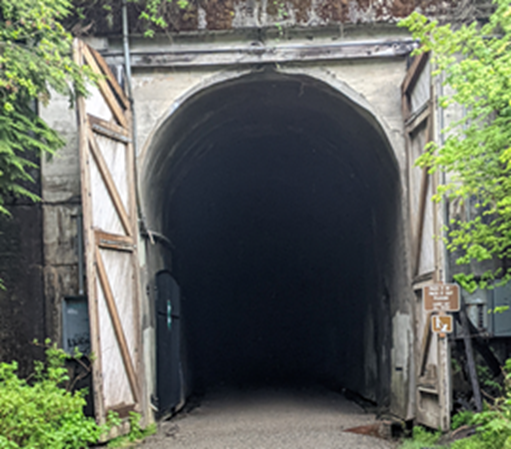 The Snoqualmie Tunnel (photo by the author).
It’s always the heat that kills me.
I think I can control the left knee patellar tendonitis that I’ve had since the London Marathon in April with Ibuprofen and a compression sleeve.
The back pain is problematic (note to self: don’t waterski while in the midst of marathon training). But the muscle relaxant I have been using (methocarbamol) helps. Also, I’ve run with back pain before and it tends to ease up after some number of miles.
My fitness is suspect as well. The knee and back injuries have limited my weekly volume to well below the 40–50 miles that I prefer. To help make up the difference, I’ve supplemented my training with some workouts on the Elliptigo.
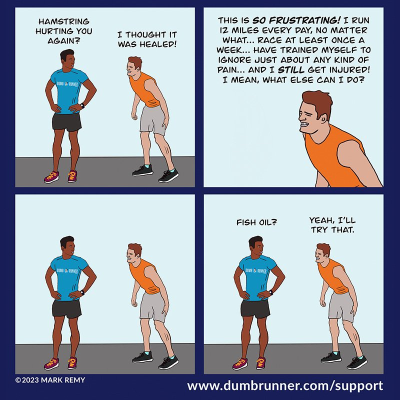 Included with permission from Mark Remy (dumbrunner.com)
The heat, though, is not so readily dismissed.
The forecast for my next race — tomorrow’s Tunnel Vision Marathon — calls for temperatures around 60 degrees at the start of the race and then it will heat up from there. At the finish line it will likely be in the 80's.
I don’t do well at high temperatures (see, for example, my recaps of the 2021 Berlin and Chicago Marathons.) As is common among people living with Parkinson’s disease, I sweat heavily. It’s extremely important that I hydrate properly and replenish my electrolytes while running. Granted, with the experience I’ve gained over the last three and a half years of marathoning, I’m far more savvy than I once was (see this post). Still, it is going to be a hot one.
 https://give.michaeljfox.org/fundraiser/4511868
Injuries? Inadequate training? Heat?
You may wonder why I don’t simply throw in the towel. Live to run another day. Perhaps, you know me well enough to answer to that question. It’s one of those pesky goals again.
In April, I ran in my third consecutive Boston Marathon. To keep that streak alive in 2024, I need a BQ (Boston Marathon qualifying time in a certified marathon) before September 15, 2023 — the end of the 2024 qualifying window.
Tunnel Vision of North Bend, Washington located just an hour’s drive from my home in Seattle, represents my best shot for a BQ. I’ve raced on this course before. Most of it takes place on a steady downhill slope. Using my Stryd data, I estimate that this race trims roughly 13 minutes from what my finish time would be on a flat course.
I need those 13 minutes; on a flat course I am likely to finish at right around 4 hours and for a BQ I need to do better than 3 hours 50 minutes (3:50). In the past two years there has been no additional imposed cutoff time but I can’t count on that for 2024. I’m thinking that I need at least three minutes of cutoff margin to feel confident of making the field. Hence, I would really like to finish within 3:47.
All things considered, I am giving myself no better than even odds of hitting the 3:47 mark.
Tunnel Vision is a small event of about 600 runners who start in two waves. I was assigned to the second wave that included a 3:50 pacer. Perfect. My strategy was to stick close to him through most of the race and then surge ahead near the finish in order to get my BQ with some cutoff margin.
The plan worked well enough at first despite the pacer somehow managing to stay 20 or so yards in front of me throughout the first half of the race. I decided to pick it up on the 14th mile so as to close the gap, which I did successfully.
It was a valiant albeit short-lived achievement. My mojo ebbed from there.
The pacer’s orange “3:50” sign gradually ran away from me. By mile 18, it was no longer visible. By mile 20, it was clear that I wouldn’t meet my finish time goal.
Though the heat was tolerable at first, as predicted it shot up during the second half. Leg cramps came on with a vengeance and I spent much of the last six miles walking on stiff and unbending legs. It was a painful and humbling end. I don’t have my official time yet but my Garmin indicated a 4:21 finish. Alas, no BQ and it’s the end of my streak of Boston Marathons (unless I choose to run as a charity entry.)
Let’s assess.
My injuries didn’t appear to factor in. The knee sleeve worked surprisingly well. I had a slight flare-up at mile 4 but that quickly faded. And my back pain similarly was a non-issue.
Was it inadequate conditioning that caused the poor showing or was it the heat?
Probably some of both. I suspect the Elliptigo training was insufficient to maintain my fitness while injured.
However, I suspect the heat was the main culprit given 1) the severe leg cramps I suffered and 2) the deep yellow color of my pee afterwards.
I drank plenty of water throughout the race and supplemented that with electrolytes from SaltStick tablets taken liberally throughout the run. Honestly, I don’t know what else I should have done. This strategy has worked well for me on other marathons. Dehydration brought on by running in heat is a heartless adversary.
Yet, I can’t overlook the possibility that either age or Parkinson’s has finally caught up with me. Maybe both.
In six weeks, I will run in the Berlin Marathon. Two weeks after that it’s the Chicago Marathon and then the New York City Marathon four weeks after Chicago. These three events are part of my plan to run all six of the majors this calendar year having already done Tokyo, Boston, and London.
Besides the goal of running all six of the majors this year, I hope to run them all in a combined time of 24 hours. My total for Tokyo, Boston and London comes to 12:16:24. I will need to average better than 3:54:32 in the fall marathons (Berlin, Chicago, and New York City) to meet my goal.
Today’s performance casts serious doubt on meeting this goal. But it is not impossible. I’ll have to double down on my training and I will need some help from the weatherman.
In 2023, I will be running for Team Fox again. You can donate to my New York City Marathon campaign ( click this link ). I could use your support. If you share the passion that The Michael J. Fox Foundation (MJFF) and I have for finding a Parkinson’s cure please consider contributing. All donations are meaningful and greatly appreciated.
Alternatively, if you would like something tangible in exchange for a contribution, consider purchasing my book Run With It: A True Story of Parkinson’s, Marathons, the Pandemic, and Love . It was named as a Finalist in the 2022 Wishing Shelf Book Awards . It also received an Honorable Mention in the Eric Hoffer Awards and was rated “RECOMMENDED” in the US Review of Books .
All profits from its sale are donated to MJFF. It can be found on my author’s website and Amazon . It’s cheaper on my author site (for domestic shipping), a larger percentage goes to MJFF than for Amazon sales, and you get the option of having it signed by the author.
[image error]