Joe Drake's Blog, page 3
April 25, 2023
Boston and London, Part 2
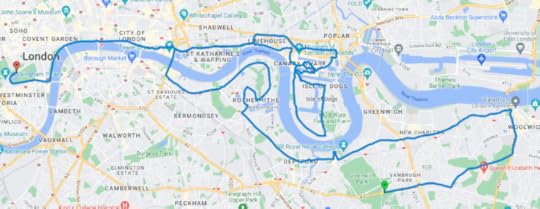 London Marathon Route (provided by author)
On the morning of the 2023 London Marathon, my wife, Lynn, set out in search of a spot along the course where she would cheer for me as I ran by.
Hundreds of thousands of other spectators were of the same mind hoping to catch a glimpse of their favorite runners.
It turned out to be a challenge perhaps greater than the marathon itself.
In London, I was a charity runner for Team Fox of the Michael J. Fox Foundation. Katie Casamassina and Liz Diemer of Team Fox planned cheer stations for their runners at the Cutty Sark Museum (Mile 6.5) and another one at Canada Square Park (Mile 19). Their idea was to shift from Mile 6.5 to Mile 19 at the appropriate time so they could exhort Team Fox runners twice, once at each cheer station.
Given the routing of the course, with some loops and swirls, these two viewing spots were relatively close together. On Canary Wharf, where Canada Square Park was, the course layout suggested the opportunity of multiple sightings between Miles 15 and 21.
That is, if it weren’t for all those thousands of other similarly-minded fans.
Lynn headed for the Cutty Sark cheer station at about 10 am. She had the London Marathon’s tracking app loaded on her phone. The app allowed users to see the current location of any runner and from that she knew that I had started my race at 10:40 and was likely to get to Cutty Sark at about 11:30.
At the Cutty Sark train station she met chaos.
It was wall-to-wall people. The logjam was nearly impenetrable getting off the train. The four flight climb to ground level was shoulder to shoulder. At ground level it was more of the same.
Lynn considered her options. She could succumb to the evident futility and give up on seeing me on the course. Or she could get back on the train and head to the second cheer station hoping for a different outcome.
She decided that she had to find another way.
In fact, this was true for everyone. The masses engulfing her clearly were not going to get into position to see any runners.
She approached two ladies, locals. They told Lynn of a foot tunnel under the Thames that came out at Canary Wharf. They all went off together.
Then, in the foot tunnel, another logjam.
For safety’s sake, an officer was limiting the number of people allowed in the tunnel at a time. Lynn actually appreciated this because the crush of people was beginning to feel claustrophobic.
She glanced at her phone. There was a new issue. The tracking app crashed making it appear as if I was frozen in place at Mile 6. The app was of no use in tracking me anymore.
Upon finally emerging from the foot tunnel onto the Isle of Dogs, she had maybe a mile or so to walk to get to the second Team Fox cheer station. But without the tracker app, how was she to find me? Would she be able to get to the cheer station in time? What if I ran by without her knowing?
Before it died, the tracker had me running at about 9 minutes per mile. Mile markers were set up on the course. She did a quick calculation then found a relatively uncrowded spot that was just shy of the Mile 18 marker.
Anxiously, Lynn camped out there and waited for the pair of telltale pink socks.
When they came by she shouted out “GO JOE DRAKE!! YAY TEAM FOX!!”
I was very happy to hear and see her. It was just what I needed: a huge emotional boost at a difficult time in the race. I did my best to look good for the photo she snapped.
Lynn was elated as I ran by. She turned around and pumped her fist. “YES!”, she said.
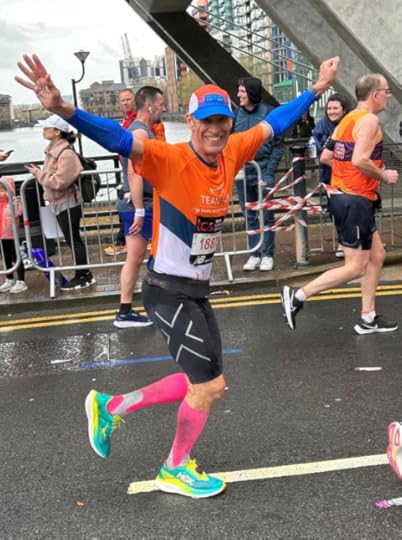 Joe at Mile 17.8 (photo by Lynn Drake)
Lynn then went on to the Mile 19 cheer station to greet Katie and Liz. They had not gotten there yet. MJFF’s local partner, Parkinson’s UK, were there but they had not seen their Team Fox counterparts. Lynn tried to reach Katie by cell phone but the cellular network was down.
Katie and Liz were still fighting their way to Mile 19. They wanted to see all the Team Fox runners pass them before leaving Cutty Sark.
I appreciated it. They were there when I ran by, holding Team Fox signs, shouting, and clanging cowbells. That, too, was a great lift for me. I couldn’t ask for a more dedicated, enthusiastic support team.
Besides providing race support, Katie and Liz organized a meetup and a pre-race dinner for Team Fox runners. The two of them flew in from New York City on the Thursday before the race. I had just seen Katie on Monday. She organized all of the Team Fox activities associated with the Boston Marathon.
There were a record number of Team Fox London runners this year, 18. It’s a reflection on the rapidity at which Parkinson’s is growing. Many people wish to contribute to a cure given that they have relatives and family friends who suffer from PD. This is true of the Team Fox London athletes I met this year. We raised a combined $164,830 for Parkinson’s Research through this race.
If it was not already obvious, the highlights of the race for me were seeing and hearing Lynn, Katie, and Liz shouting my name and urging me on. It is impossible to overstate how helpful that is when running a marathon.
I found out later that the 48,000 runners in the race was a record for the London Marathon and about 10,000 more than in 2021 when I last ran it. I felt the difference as a relentless crush of people. The course, much like it was for the spectators, was crowded with multiple bottlenecks. That alone could have added several minutes to my finish time.
The weather was fine. For me, that is. Cool in the low 50’s with periodic rain just like it was for Boston the previous Monday. Seattle training weather. All good.
My pace held fairly steady though I struggled the last 10 miles. Yet, I have to credit my Stryd app with dictating a sustainable pace in Boston that set me up for rapid recovery going into London. Stryd is legit; I will be working with it more in preparation for my fall marathons.
My finish time of 4:01:59 pushed me a bit further off my goal of running all the six majors this year in a combined time of 24 hours. I’m halfway through now and my total comes to 12:16:24. I will need to average better than 3:54:32 in the fall marathons (Berlin, Chicago, and New York City) to meet my goal.
Given that I have only one sub-4 hour effort among the eleven Majors I have run to date, this is a tall order. However, I am encouraged by that one positive result and the fact that I came oh, so close to hitting the mark again only six days later. With five more months to train, anything’s possible.
In 2023, I will be running for Team Fox again. You can donate to my New York City Marathon campaign ( click this link ). I could use your support. If you share the passion that The Michael J. Fox Foundation (MJFF) and I have for finding a Parkinson’s cure please consider contributing. All donations are meaningful and greatly appreciated.
Alternatively, if you would like something tangible in exchange for a contribution, consider purchasing my book Run With It: A True Story of Parkinson’s, Marathons, the Pandemic, and Love . I’ve heard it’s a good read. Most of the reviews are coming in at four to five stars and it recently was named a Finalist in the 2022 Wishing Shelf Book Awards contest.
All profits from its sale are donated to MJFF. It can be found on my author’s website and Amazon . It’s cheaper on my author site (for domestic shipping), a larger percentage goes to MJFF than for Amazon sales, and you get the option of having it signed by the author.
[image error]

April 19, 2023
Boston and London, Part 1
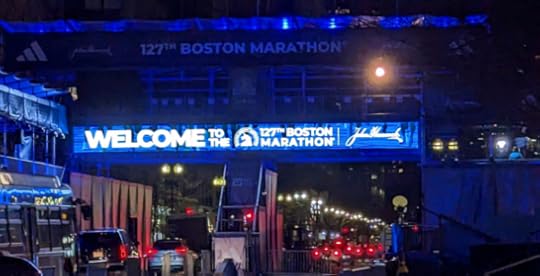 Photo by the author.
Ten years ago, Gerald (Jerry) Brown was picking up his gear check bag on Berkeley Street after finishing the 2013 Boston Marathon when the first bomb went off.
His immediate thoughts were about his wife and three daughters who cheered for him as he crossed the finish line. They had planned a post-race meet up close to the Boston Public Garden but Jerry wasn’t sure where they were as chaos descended upon the finish area.
After Jerry finished the race, his wife, Tami, and daughters Heather (24), Xandra (21), and Trilby (14) made their way towards the Public Garden. They stopped at a restaurant on Boylston Street to grab some take-out before meeting Jerry.
Upon leaving the restaurant, they heard the explosion. As Xandra turned around and headed back towards the center of the tragedy, the second bomb went off.
When he tells me his story, Jerry is overcome with emotion. His eyes tear up and his chin quivers. He needs a little time before he can speak again. I place my hand on his shoulder and tell him that he doesn’t have to continue. He shakes his head and goes on.
Jerry recalls how immediate and efficient the Boston first responders were. Within minutes the scene was in full medical and emergency support mode. He made it back to his hotel near the Public Garden and waited. Staff was checking everyone entering the lobby to verify that they all were current hotel guests. The city was now on high alert for any suspicious activity.
All cellular networks were taken off line for fear that phones might be used to trigger additional explosives. But just before his phone went dead Jerry received a text from his family that they are all safe.
His family had come to Boston solely to support him during the race. It’s overwhelming to think of the danger he nearly put them in.
On April 21, 2013, six days after the bombing, runners in the London Marathon wore black ribbons in solidarity with Boston and its citizens, the victims and the heroes.
There was constant activity near the finish line on Boylston Street on the weekend leading up to the Boston Marathon. This is normally the case for the world’s oldest marathon but this year was special and more hectic than usual.
Several observances took place with respect to the tenth anniversary of the bombing. Also, the current marathon world record holder, Eliud Kipchoge, had entered the race. It was his first time in Boston and he was highly favored to win. As befitting a star of his magnitude, there was much ado surrounding everything he did and, especially, what he didn’t do which was win. He finished a disappointing sixth.
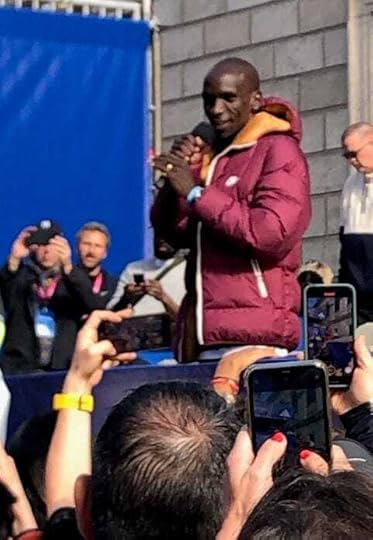 Eliud Kipchoge addressing the faithful (Suzanne Barron photo)
I attended some of the events but decided to invest a lot of my time into resting up for the race.
Nevertheless, my favorite thing to do at marathons is to reconnect with runners I have met over the past few years and to establish new contacts. In 2021, I met Suzanne Barron in Berlin and Carita Wegner in Boston.
Suzanne always finishes near the top of her age group, which usually nets her an invite to the AbbottWMM Wanda Age World Championships. This time was no different as she came in at 29th in her cohort (4:44:24).
When I met Carita, she was living with sarcoidosis that makes breathing difficult. As is the case for me, running is medicinal for her. However, she has had a host of other issues recently (neck pain, nausea, asthma) and she wasn’t sure that she would be able to run this year. Miraculously, she felt very good at the start and ended up running well beyond what she expected finishing in 3:48:49 thus qualifying for Boston next year.
Runner’s World (RW) magazine held some pre-race events as they had done the prior year and at the New York City Marathon in November, all of which I attended. A great group of folks (Runner-in-chief Jeff, Coach Jess, Pat, Andrew, Theo, Pavlina, Amanda, among others) most of whom know my name by now.
I met Jerry Brown at their pre-race “Coffee with Coaches” session. He and I swapped pacing strategies and contact info. He had a tough day on the course fighting through hip flexor pain. He finished but well off his usual time. I think that RW plans to do a feature on him given that 2023 was his 19th consecutive Boston Marathon and because of his experience with the race in 2013 I mentioned above.
RW also invited their subscribers to a pre-race shakeout run. I met Heather McCarthy at the one in New York City in November and we have followed each other on Strava since. This time she came with her father, Bill, and introduced him to me. Bill and I are both advocates for people who suffer our ailments. In Bill’s case, it is a rare congenital liver disease that forced him to get an emergency transplant recently. You wouldn’t know it from looking at him — he appears robust and cheerful — but the disease nearly killed him. Bill’s an athlete but not a runner and came to Boston to cheer for Heather who ran a very strong 3:43:12.
I qualified to run in Boston this year and so this time out I did not run for Team Fox of the Michael J. Fox Foundation. However, the folks at Team Fox (Katie, Jess, Courtney, and Abigail came to Boston this time around) seem to like me enough to invite me to all their events whether I am running for them or not.
Katie even went out of her way to give me a commemorative pint glass depicting the Tokyo Marathon in recognition of my completing that race in March and earning my Six Star Medal. Katie is headed to London after Boston and I will see her there again when I run for Team Fox in the London Marathon.
At the Team Fox pre-race dinner I met the Bell family. Madeline (Maddy) was running for Team Fox in her first ever marathon. Her parents, Ed and Denise (Ed’s father suffered from PD), and her partner, Brendan Glyn, came to cheer her on. Also joining us at the table was Jan Pruszak, a Parkinson’s researcher now living in Austria. We had a lively time. Denise did a fantastic job of keeping the conversation going and drawing all of those at the table into it. Regretfully, the Bell’s didn’t join us at the post-race dinner. Maddy had a very good marathon debut finishing at 4:36:31.
Jan, however, did make it to the post-race party. We exchanged information and expect to meet up again soon. He is doing fascinating stem cell research for PD. He is a natural runner and although he didn’t train as much as he wanted to, he ran very well with a 3:40:41.
Others I met at the Team Fox post-race dinner included Jesse Houchens and his wife Andrea. Jim’s father has PD. They also live in Seattle and therefore are likely to meet up again. Jesse is another natural, his time was 3:33:08 (he cheered for me on the course as he ran swiftly by). But major kudos go to Andrea who trundled their three young children out to cheer for Dad in the challenging weather.
Finally, there was Jim Allen and his wife Kay from Kansas City. Jim’s father also had Parkinson’s and I will see Jim again when we run in the Berlin Marathon in September. Jim is recently retired and like me, is spending a fair bit of his newfound free time running. Jim did very well to finish in 4:09:56 despite some leg cramp trouble in the latter miles.
Besides the attention paid to Eliud Kipchoge’s appearance and ceremonies marking remembrance of the bombing, the other newsworthy topic was the weather. Specifically, the forecast was for rain. Some were concerned that it could be a repeat of the 2018 race, when cold rain at high winds made for a miserable experience all around. My daughter, Kinsey, ran in Boston that year and it was awful.
I live in Seattle and therefore I train in rain. A forecast of rain doesn’t bother me. I would much rather have that than a hot day. Strong winds, however, would be a problem.
As the day approached, the forecast got progressively milder. By race time the weather had turned ideal, at least for me. Temperature was in the low 50’s, wind was on the light side and although there was rain it was of the kind that Seattleites thrive in.
Team Fox pulled some strings to allow me access to the building inside the Athlete’s Village where the charity runners hang out in Hopkinton before the race. It’s a warm and comfortable spot to pass the time before heading to the start line.
They also have a number of portable toilets there with shorter lines than in the main Athlete’s Village area. Always a plus, as I needed three trips to the toilet before getting to the start line.
One visit gave me an indelible memory. Just as I was about to sit down, there was a knock on the porta-pottie door. The previous user had come back because he had left behind his hat. We looked around and didn’t see it until I looked down into the belly of the beast. I had come very close to crapping on his hat. Not that it would have made much of a difference considering where the hat was. Nevertheless, the guy steeled himself and fished his hat out, apologized to me, and went off presumably to find some way to hose it off. Marathoners are tough folk.
The race itself was a treat this year. I had hoped that my preparation was good enough to come in under four hours, a first for me in any of the Majors. In fact, I felt strong throughout the whole race. My pacing strategy worked to near-perfection (a little more on that later) and I felt fresh enough to push myself hard through the last miles after Heartbreak Hill.
As I crossed the finish, I stopped my watch to get a first look at my (unofficial) finish time. A lady about my age who finished at the same time (I found her name later (Karen Mcgowan) through sleuthing the race photos) saw me check my watch and asked how we did. When I told her she was ecstatic for finishing in under four hours and in celebration she gave me a big, enthusiastic, muscular hug.
The finish area had some other lovely surprises. It was much better than 2022. For example, as is typical, volunteers handed out foil blankets to the chilled runners. As an added courtesy, though, runners were encouraged to turn their backs to the volunteers to allow them to drape the blankets around the runners’ shoulders. And a few steps later, another group of volunteers had the job of securing the blankets in place using tape thus freeing up the runners’ hands.
It was very sweet. And every once in a while I got spontaneously emotional, almost to tears, when I realized that I finally had a great run in a marathon and met my finish goal without feeling like crap at the end.
I employed some new toys in this race. One of them was a newly minted shoe from HOKA — the Rocket X2. It is HOKA’s latest entry into the “super shoe” category that has taken over the world of running footwear. It is very fast and my legs stay fresher for a longer time in them than any other shoe I have used.
The other new toy is my Stryd foot pod. I won’t go into the details of the technology (perhaps I will in a later post) but suffice to say that it helped me to avoid hitting the marathon wall in the latter miles. More than the Rocket X2, I credit Stryd with getting me a sub-4 hour time in this race.
My goal this year is to achieve what I wanted to do in 2021 — run all six of the Major Marathons in a single calendar year. In addition, my plan is to complete them all in a combined time of 24 hours. That is, six majors in a year and a day.
I got off to a bad start with my 4:16:38 in Tokyo six weeks ago. Finishing Boston in under four hours (3:57:47) moved the total in the right direction. Yet, to meet my goal I would have to average better than 3:56:24 in the remaining four races with the next one (London) coming up this Sunday, six days after Boston.
Should be fun.
In 2023, I will be running for Team Fox again. You can donate to my New York City Marathon campaign ( click this link ). I could use your support. If you share the passion that The Michael J. Fox Foundation (MJFF) and I have for finding a Parkinson’s cure please consider contributing. All donations are meaningful and greatly appreciated.
Alternatively, if you would like something tangible in exchange for a contribution, consider purchasing my book Run With It: A True Story of Parkinson’s, Marathons, the Pandemic, and Love . I’ve heard it’s a good read. Most of the reviews are coming in at four to five stars and it recently was named a Finalist in the 2022 Wishing Shelf Book Awards contest.
All profits from its sale are donated to MJFF. It can be found on my author’s website and Amazon . It’s cheaper on my author site (for domestic shipping), a larger percentage goes to MJFF than for Amazon sales, and you get the option of having it signed by the author.
[image error]April 10, 2023
Parallel Universes: Parkinson’s Disease and Running
 Mitochondria as depicted on medicalnewstoday.com, “Mitochondrial disease”.
Next Monday I will be running in the Boston Marathon. Six days after that I take on the London Marathon. Later, in the fall, I expect to toe the starting lines in Berlin, Chicago, and New York City.
My recent marathon efforts have been lackluster and this year’s challenge may further expose my inadequacies. Hence, I have spent some time researching how I might become a better runner.
I’m also curious as to why I am able to take on such exploits given my Parkinson’s disease (PD). Indeed, I have reported many times previously that vigorous exercise has been proven to slow the progression of PD. But why is that exactly? How does this work?
I recently pinged the internet for answers and in reply I got a plethora of technical publications. Reading through them is not for the technologically faint of heart; thankfully I am a man of science.
However I am neither a physician nor an expert in exercise physiology. In fact, I may have learned only just enough to be dangerous. To be sure, PD is like fingerprints, no two people have the exact same manifestation. Thus, you will want to run the following ideas by your medical care teams before embracing them. Please do and let me know what they say.
Notwithstanding, here’s the gist: In performing this research, I am struck by some similarities between what it takes to be a better runner and the strategies for slowing the progression of Parkinson’s disease.
It’s like living in the metaverse of Everything Everywhere All at Once and the verse-jumping point between these two realms is a tiny organelle that powers all cellular activity: the mitochondria.
Here’s to mitochondria!
Mitochondria are life-giving. They make ATP (adenosine triphosphate) from aerobic respiration and ATP is the energy source for many of the critical functions that go on in a cell.
Running requires a lot of energy. Thus, well-functioning mitochondria in sufficient number are necessary for peak performance during a run.
Moreover, when a cell’s mitochondria cease to provide the necessary energy to perform its functions, the cell dies.
Parkinson’s disease, the hallmark of which is a loss of control over motor functions, is caused by the death of certain neurons in the brain that produce the neurotransmitter dopamine. Dopamine is essential for proper motor control. The death of these neurons has been linked to dysfunction of their mitochondria from a variety of factors including mitochondrial clumping of the protein alpha-synuclein.
Protect them.
I’ve read some articles about practices for improving one’s mitochondria. The topic is somewhat controversial. However, a common recommendation is to reduce caloric intake and lessen the amount of highly processed carbohydrates (sugar) in one’s diet. The idea is to lower the stress on the mitochondria — it gets complicated and this post is already on the long side so I won’t go into the details.
But I will report this: There is a class of drugs used for treating PD called MAO-B inhibitors (Selegiline, Rasagiline, among others) that come into play here. MAO-B degrades dopamine such that it can’t be used effectively as a neurotransmitter. These drugs inhibit MAO-B thus increasing the availability of dopamine.
But that’s not all that MAO-B inhibitors can do for people living with Parkinson’s.
Interestingly, the degraded dopamine that MAO-B creates has been linked to processes that damage mitochondria. Hence, the use of MAO-B inhibitors has a protective effect on mitochondria and can therefore boost ATP production.
I have been using Sinemet, a combination of Carbidopa and Levodopa, since my diagnosis in 2018. Beginning in 2020, I have also been taking 10 mg of Selegiline daily. Last year, in an attempt to optimize my dosages, I experimented by stopping all medications for one week and then gradually re-introducing them. I anticipated that my training sessions would go better with the meds. True this, but I was totally surprised by how effective Selegiline was. I ran far better with the combination of the two drugs than with Sinemet alone. In hindsight, it seems likely that the improvement that I got from Selegiline was an enhancement of ATP production and utilization.
May they be fruitful and multiply.
It’s the strangest thing. The theory is that more than a billion years ago when they were both mucking about in the primordial soup, a primitive cell engulfed a bacterium. Their symbiosis became the ancestor of present day animal cells with the bacterium evolving into today’s mitochondria with the responsibility for supplying energy for the organism.
Consequently, mitochondria have their own genome separate from the cell’s nuclear DNA. Also, they are capable of replication, by fission, separately from that of a cell. Mitochondria will replicate due to the energy demands on them. Although there is still some debate about the ideal intensity for stimulating mitochondria counts, most runners and other endurance athletes understand that their workouts can increase the number of mitochondria in their muscles.
Improvement to an athlete’s VO2max — her ability to utilize the oxygen she breaths in — is driven by workouts that create more mitochondria.
Yet, brain cells also have a high demand for energy and it turns out that exercise promotes mitochondria replication in them as well.
Therein lies the best explanation I have at present for running’s ability to slow the progression of Parkinson’s disease. The aerobic exercise that has been shown to increase the quality and quantity of mitochondria in skeletal muscle also does the same for neurons in the brain. With more and better functioning mitochondria, death of the neurons is mitigated and the progression of PD is slowed. Additionally, credit Selegiline with a neuroprotective assist for its ability to pacify MAO-B.
I have only scratched the surface here. There’s more to say regarding the beneficial commonality of specific strength training exercises both to running and Parkinson’s disease. Perhaps I will go into that in later posts.
It’s too late for me to do much more with my mitochondria before my next races. But I’ve got plenty of time to work on this before my fall marathons.
I’ll let you know how it goes in Boston and London.
(Some references used for this post are cited below.)
In 2023, I will be running for Team Fox again. You can donate to my New York City Marathon campaign ( click this link ). I could use your support. If you share the passion that The Michael J. Fox Foundation (MJFF) and I have for finding a Parkinson’s cure please consider contributing. All donations are meaningful and greatly appreciated.
Alternatively, if you would like something tangible in exchange for a contribution, consider purchasing my book Run With It: A True Story of Parkinson’s, Marathons, the Pandemic, and Love . I’ve heard it’s a good read. Most of the reviews are coming in at four to five stars and it recently was named a Finalist in the 2022 Wishing Shelf Book Awards contest.
All profits from its sale are donated to MJFF. It can be found on my author’s website and Amazon . It’s cheaper on my author site (for domestic shipping), a larger percentage goes to MJFF than for Amazon sales, and you get the option of having it signed by the author.
Selected references:
Hutchison, A. (2016 June 17). How to Maximize Your Mitochondria. Retrieved from https://www.runnersworld.com/training/a20800596/how-to-maximize-your-mitochondria/Nilsson, M. I., & Tarnopolsky, M. A. (2019 May 11). Mitochondria and Aging — The Role of Exercise as a Countermeasure. Retrieved from https://www.ncbi.nlm.nih.gov/pmc/articles/PMC6627948/Ostadkarampour, M. & Putnins, E. E. (2021 April 30). Monoamine Oxidase Inhibitors: A Review of Their Anti-Inflammatory Therapeutic Potential and Mechanisms of Action. Retrieved from https://www.frontiersin.org/articles/10.3389/fphar.2021.676239/fullRisiglione, P., et al. (2021 May 11). Alpha-Synuclein and Mitochondrial Dysfunction in Parkinson’s Disease: The Emerging Role of VDAC. Retrieved from https://www.ncbi.nlm.nih.gov/pmc/articles/PMC8170894/Reynolds, G. (2011 Sept 28). How Exercise Can Strengthen the Brain. Retrieved from https://archive.nytimes.com/well.blogs.nytimes.com/2011/09/28/how-exercise-can-strengthen-the-brain/Toomey, C. E., et al. (2022 Sept 8). Mitochondrial dysfunction is a key pathological driver of early stage Parkinson’s. Retrieved from https://actaneurocomms.biomedcentral.com/articles/10.1186/s40478-022-01424-6[image error]March 9, 2023
Dashing Expectations in Tokyo
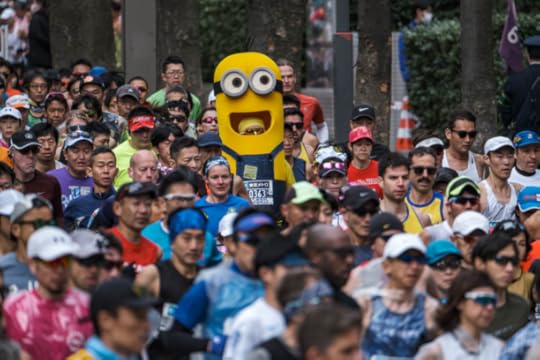 Photo from https://tokyo-in-pics.com/tokyo-marathon-2023/
I found out recently that astronauts are not allowed to get jet lag.
It makes sense. They travel, literally, all around the world on missions that cost billions of dollars. To be sure, very little of their time is spent beyond the Earth’s atmosphere; they frequently travel terrestrially as well. There’s a lot at stake and making an error due to the lethargy brought on by quickly traversing many time zones simply won’t do.
I learned this as I was researching strategies for mitigating the effects of jet lag upon my trip to Japan for the Tokyo Marathon. After landing I had only a few days to acclimate and I really didn’t want to be groggy during the race. We’re talking about a time shift of 17 hours between Seattle and Tokyo.
There’s a science to overcoming the malaise, astronauts practice the method routinely, and there is an app for it — Timeshifter.
The basis of the science has to do with the brain’s circadian clock and the trick is to reset this clock to be in sync with the new time zone as quickly as possible. Once that is done, the brain will once again instruct the body to sleep at night and be energetic during the day rather than on a schedule that is a skewed holdover from one’s time zone of origin.
Light exposure is the critical factor and the most important thing that the Timeshifter app does is tell the user when to avoid light and when to bathe in it. Light enters the brain through the eyes and a signal as to its presence is transmitted directly to the circadian clock (otherwise known as the SCN or suprachiasmatic nucleus) in the hypothalamus. Melatonin and caffeine usage are encouraged and scheduled by Timeshifter for when they can be most effective at keeping to the plan.
Some steps in the plan are awkward. For example, the app suggested I start the adjustment a few days before the flight by wearing dark sunglasses upon waking up, a sight that caused my wife to burst out laughing as I kissed her good morning.
And my time on the plane was spent mostly blindfolded. That didn’t necessarily mean I was sleeping, it just meant that I had to be in the dark (although I took melatonin to encourage some sleep). It’s odd to spend eleven hours on a plane without reading or taking advantage of the hundreds of in-flight video entertainment options.
But it worked. Jet lag was minimal in Tokyo and in Seattle when I returned the day after the marathon. I was out running again two days after the race.
In retrospect, this is not too surprising. My entire experience with Parkinson’s disease has shown me that the human brain can be hacked to great benefit. One just needs to know which levers to push.
I mentioned in previous posts the various regulations imposed by the Tokyo Marathon Foundation that triggered anxiety among many of the runners preparing for the event.
Every runner was required to bring their cell phone to the Start Area configured with a data plan that would allow access to the Global Safety app that must be installed on the phone.
Each runner was also required to record their daily body temperature and the results of two consecutive COVID-19 antigen tests into the Global Safety app.
The data on the Global Safety app would be checked at entry to the Start Area. Non-compliance with any of the instructions would result in disqualification.
Restrictions were placed on what was brought into the Start Area. Water bottles, hydration packs, and most foods were prohibited. However, unopened commercially available items were allowed.
Clothing was not to be discarded during the race. Anything worn to the Start Area must be carried by the runner to the Finish Area. Also, we were instructed to carry all trash with us while running. Handing trash to course volunteers and using the refuse bins at the aid stations was not permitted.
Runners were not to relieve themselves anywhere other than the toilet.
Apparently, the Tokyo Marathon Foundation received a lot of feedback about the rules. To their great credit, the Foundation demonstrated flexibility towards accommodating the desires of the runners. For example, they capitulated on the topic of extra clothing brought to the start area. As is the case at most marathons, they installed bins in the starting corrals to allow runners to discard excess warm-up clothing to be donated to charity.
Also, they set up a Wi-Fi network at the Start Area so that international runners did not have to worry about whether their roaming plan would work in Tokyo.
My intent was to get to the Start Area early because I suspected that there would be delays during check-in associated with the Global Safety app. On the way I passed by a few portable toilets that were labeled “Western Style”. I took a photo of them because I was curious about the need for specifying the style (Figure 1 left).
I got clarification shortly afterwards in the start area when I entered one that did not have that sign. Figure 1 on the right shows the interior of the “Non-Western” Style. Fortunately, a helpful placard on the back wall described the proper way to straddle the unit.
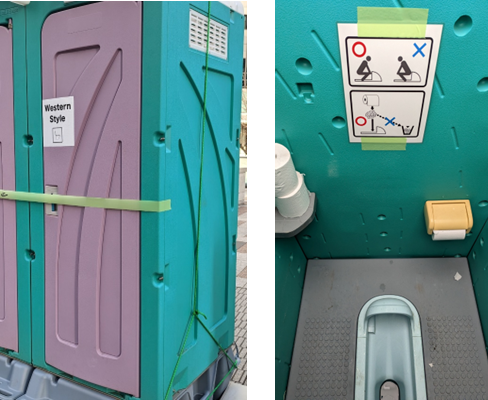 Figure 1. Portable Toilets in the Start Area, Western style on the left and Non-Western on the right (photos by the author)
My concerns about the Health Check turned out to be overblown at least for those of us who entered all the data properly into Global Safety. I suspect that the Wi-Fi system worked fine also but I didn’t need it. My phone uses Google Fi and that worked seamlessly throughout my trip. I did not have to explicitly connect to the Start Area Wi-Fi.
At check-in, large signs with QR codes were displayed (Figure 2). Scanning the code while in the Global Safety app called up a go/no-go image (Figure 3). I waved this image at a volunteer and zipped through this stage in seconds.
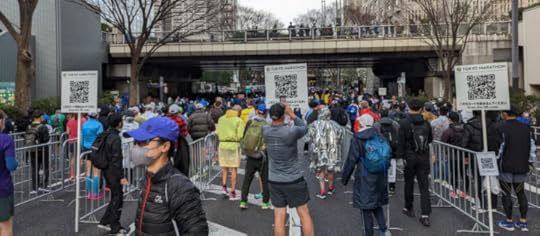 Figure 2. Health Check to enter the Start Area (photo by the author)
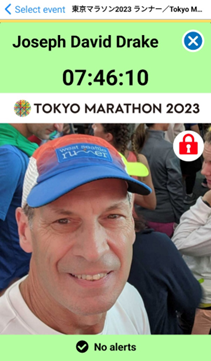 Figure 3. Screenshot from Global Safety App giving the all-clear (photo by the author)
I had some trouble at the Security Check (Figure 4 left). I carried very little with me hence no issue at the metal detector. But an enthusiastic volunteer demonstrated by crossing his arms into an “X” sign that my packaged Untapped Maple Syrup gels were forbidden. “No food,” he said.
However, I explained to him that unopened food packaged by the manufacturer was allowed as per the Runner’s Handbook. I let him inspect some of these packets. He agreed and gave me the necessary sticker to prove it (Figure 4 right).
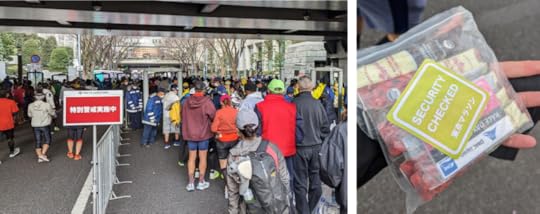 Figure 4. Security Check to enter the Start Area (photo by the author)
It took me a total of 20 minutes to walk the quarter mile from the hotel to the entry gate and pass through Health and Security checks. Everything was very well planned and executed.
Next step was to use the toilet before getting into my corral. As luck would have it, I got on the same queue as my friend Erika (also from West Seattle) and we chatted for a bit. Erika had gone skiing in December and tweaked her Achilles. The injury derailed her training for the race. She was also going for her Sixth Star Medal and had been at it for 12 years. After all this time she was determined to finish Tokyo even if it meant walking partway. She’s a tough lady and though she had hoped to do better she finished with a nifty 3:43:18 damaged Achilles and all.
While waiting in the corral, it was apparent that at least one rule was openly flaunted. With over half an hour of time to wait before the starting gun, some of the men chose to pee on the side of the road rather than wait for the first on-course toilets (Figure 5).
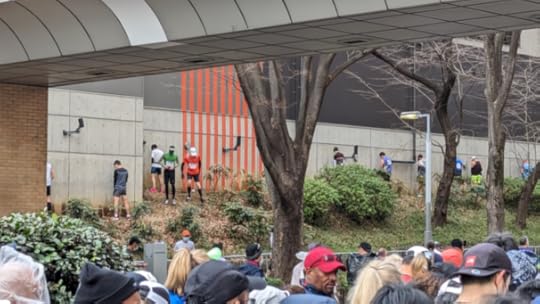 Figure 5. Scofflaws at the corrals (photo by the author)
You may wonder why I get so preoccupied with toilet practices at these races. Trust me, though, that for a marathoner it’s a serious concern. Most of us are out on the course for at least four hours. The downsides in terms of physical discomfort and the potential hit to our finish times encourages us to minimize the possibility of needing a pit stop mid-race.
For elite runners, stopping to enter a portable toilet during the race can eliminate (sorry) any chance of achieving a podium spot. In 2005, Paula Radcliffe won the London Marathon and set a women’s world record. But while doing so she stopped along the side of the road and pooped in full view of thousands of spectators. One does what one must.
Those of us not headed to the podium are nonetheless hoping to get the best result we can. In Tokyo, where the portable toilets are often a fair distance from the course with, consequently, unseen queue lengths, stopping can be distressing.
To be sure, relief from an overfull bladder can come without resorting to a toilet break. With proper choice of running shorts in terms of style and color, no casual observer would be the wiser. Just saying.
The Start Area efficiency set the tone for the race itself. Volunteers dispensing hydration were polite and efficient. But the course lacks the energy of some of the other majors. Spectators lined the course and cheered but it was nothing like the volume and intensity of New York City. Also, the scenery lacks the iconic landmarks like those of NYC or London.
The course did have one thing that I have never experienced in a marathon. It consists of multiple segments wherein the course doubles back on itself. Runners entering these segments can see faster runners passing them by as they exit in the other direction on the other side of the road.
In this manner, for the first time ever, I witnessed the lead pack of runners as they ran by when I was at 14.8 kilometers and they were at 30.8 (I worked these distances out after the race by comparing timing mat data).
It was a remarkable view. These runners flew by effortlessly. Sigh.
Otherwise, in many ways, Tokyo was much like any other Major I’ve run. The feared strict enforcement of rules didn’t turn out to be a factor. To some extent they were unenforceable. Would a volunteer really feel empowered to disqualify a litterbug runner?
My guess is that the unfailing politeness of our hosts meant that no one would be disqualified for such violations. 38,000 runners wield a lot of power and when all is said and done, marathoners will be marathoners.
One rule though — the mandatory seven hour cutoff time with its associated mid-race checkpoints — did not yield. Although I did not witness any of this, I’ve seen reports of some slower runners being “swept”; their race days ending early.
My own performance was less than I had hoped. I entered the race believing that my training had never been better and I entertained the thought of finishing significantly better than four hours. I was on track for that at the halfway mark but then the wheels fell off at about mile 16.
The last 10 miles got progressively harder although, as most runners do, I was able to pick it up just a touch for the last two miles. My finish time was 4:16:37.
Although I’m not sure what went wrong it has all the trappings of hitting the proverbial wall which means I was under-fueled due to insufficient carbo loading. Or my legs are weak. Or I started out to fast.
Gotta fix this. Boston is coming up in less than six weeks and London is a week after that.
I felt miserable at the finish line but felt a bit better while picking up my Six Star Medal and chatting with some of the other runners doing the same. Back at the hotel I soaked in a hot bath for half an hour, took an hour nap, and then feeling mostly recovered, headed out to the post-race parties.
My entry was through Marathon Tours and Travel and they hosted a post-race party at our hotel. There was a lot of food and drink but I was not ready to eat yet so I spent the time chatting with other runners about their day. Many of them thought they could have, should have, done better (I know the feeling) but were happy nonetheless to get the job done.
Although the Michael J. Fox Foundation did not host any entries in Tokyo, there were several Team Fox runners in Tokyo (Natan, Bill, Margo, and I). We met up the day before the race and then Natan, Bill, and I went to the party for Six Star Finishers at Hard Rock Cafe in Roppongi, one of the Tokyo neighborhoods.
Bill ran his race with a broken rib that he got from an aggressive golf swing. He had concerns over the cutoff time but I have learned over the years not to underestimate Bill. He beat the cutoff with plenty of room to spare.
Natan and his wife Caroline had spent the week before carting their toddlers, Arthur and Lillian around Tokyo with the help of a local nanny. Natan joked that the race was actually his time to rest. Caroline joined us at the Hard Rock as did Robin and Kristy, friends of Bill who also got their Six Star Medals.
The next day I was to fly home to Seattle but I had some time in the morning to do some gift shopping before heading to the airport. I decided to go to Isetan, a large department store a short bus ride from the hotel.
Shopping was a lot of fun. The salespeople were very polite and helpful despite the fact that we had no common language. One saleslady used a voice-to-text translator on her phone to communicate with me and with that I was able to get some lovely stuff for the folks at home.
One of the salesmen walked me upstairs to an office that helped me to get the tax on my purchases refunded as a discount to the purchase.
While I waited for the gifts to be packaged suitably for transport, I loaded the voice-to-text translator on my phone so that when the whole transaction was done I was able to have my phone tell the sales people “Thank you very much, you have been very helpful” in Japanese. They loved that and we parted with a lot of smiles and bowing.
One last story:
I brought 30,000 yen in cash (about $240) with me to Tokyo and had some of it left over. Haneda Airport had an efficient currency exchange right after security that allowed me to turn the remaining yen into dollars. They would only exchange whole dollar amounts so I still had 137 yen to use up.
Marathon Tours gave all of the runners Suica cards preloaded with 2000 yen to be used to ride the subway and I still had a balance on mine. In Tokyo, Suica cards can also be used in the ubiquitous vending machines. Hence, between the Suica and the 137 yen I was able to load up on snacks to take on the plane. In the end, I was able to bring my unusable leftovers down to 57 yen, which is about 40 cents. Not bad.
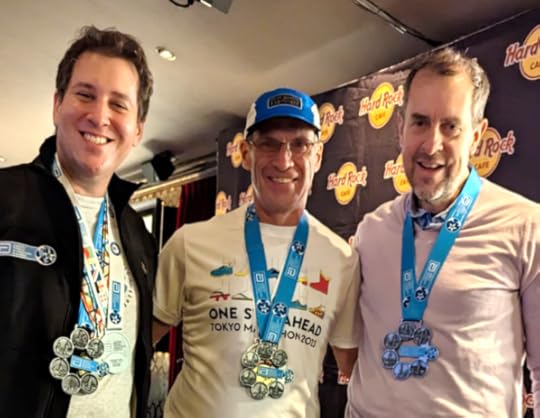 Figure 6. Team Fox Six Star Medalists Natan, Joe, and Bill at the Tokyo Hard Rock Cafe post-race party (photo by Caroline Hershey)
In 2023, I will be running for Team Fox again. You can donate to my London Marathon campaign (click this link). I could really use your support. If you share the passion that The Michael J. Fox Foundation (MJFF) and I have for finding a Parkinson’s cure please consider contributing. All donations are meaningful and greatly appreciated.
Alternatively, if you would like something tangible in exchange for a contribution, you may purchase my book Run With It: A True Story of Parkinson’s, Marathons, the Pandemic, and Love. I’ve heard it’s a good read. Most of the reviews are coming in at four to five stars and it recently was named a Finalist in the 2022 Wishing Shelf Book Awards contest. (Winners will be announced the beginning of April.)
All profits from its sale are donated to MJFF. It can be found on my authors website and Amazon. It’s cheaper on my author site (for domestic shipping), a larger percentage goes to MJFF than for Amazon sales, and you get the option of having it signed by the author.
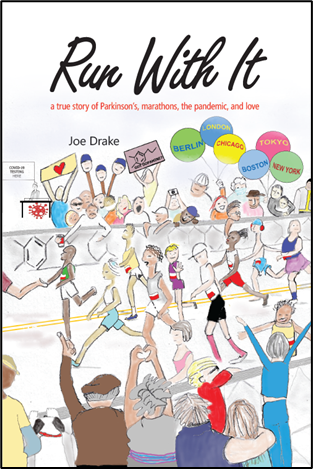 Book cover image provided by author (Patricia Snyder, artist)
 Finalist Certificate for the Wishing Shelf Book Awards (provided by author)[image error]
March 4, 2023
Tokyo Dispatch
 Samurai Kitty (photo by the author)
Upon arrival in Tokyo, I was detained in customs for about half an hour because of the drugs in my possession. It’s complicated but I will get back to that in a moment.
First things first. The Japanese are an astonishing people.
Here’s one example: In response to the deadly 1995 terrorist sarin gas attack in the Tokyo subway system, the city removed all municipal trash receptacles. To this day there are very few trash bins on the streets of Tokyo. One might think that such an action would lead to trash-strewn streets but that has not been the case.
Tokyo streets are virtually spotless. This is in a city of 12 million people mind you. When the bins were removed, the residents were instructed to carry their refuse with them until they got home where they could dispose of it properly. They complied.
The Japanese tend to act collectively; conformity is the norm in their culture. As a society they decide what is best and they act accordingly and in lock step.
By contrast, walk the streets of New York City and note the difference. Periodic sanitation strikes notwithstanding, garbage abounds always.
Tapping into their collective will allows the Japanese to achieve extraordinary feats. Clean streets is surely one thing but at a much larger scale consider their rapid rise to economic superpower after utter devastation from WWII.
Why do I mention all this?
Well, because, despite the demonstrated benefits of conformity in Japan society, things can get bogged down when currents turn awry. Individuals are not empowered to resolve problems when they come up. Rather, they seek out the next level in the hierarchy for resolution. Several levels of bureaucracy may need to be consulted before an impasse can be overcome. It’s a very slow process that is worsened when the non-Japanese come to town. As a rule, most foreigners don’t take kindly to waiting.
For the first time since the pandemic, foreigners are back in town. I am one of them and we are here to run in the Tokyo Marathon. Granted only about 10,000 of the 38,000 runners in the marathon are non-Japanese. But we don’t herd well. I feel that the Japanese may have forgotten what it is like to deal with us.
Or, perhaps, in response to the pandemic, they made some procedural changes designed to enhance safety that are only now getting tested against a flood of incoming tourists.
Back to my experience in customs.
In order to streamline the entry process in customs, Japan has made available an app (Visit Japan) that holds all of the information that would normally be hand-written onto the customs declaration form that flight attendants hand out upon landing at the airport.
The idea is that the traveler enters the information (name, passport number, items to declare, etc.) into the app at home before leaving for the airport. The app generates QR codes, which can be swiftly scanned in customs. This automation, in theory, saves a lot of time for both the traveler and the customs agents.
Maybe I misread or misinterpreted the instructions for entering information into the Visit Japan app. In any event, I declared my Parkinson’s medication that I brought with me in the “Declaration of Personal Effects” section. That raised a red flag.
At least three levels of bureaucracy were called in to ask me questions about the drugs I carried. All of the officials brought over to interview me studied my prescription drugs, asked if I had any documentation for them (I didn’t, other than the labels on the bottles), thanked me for my cooperation, and asked me to wait.
While I waited, another couple was detained for declaring the Xanax they brought with them.
I was not bothered by all this. I was in no hurry and all of the officials were very polite. I chatted with some of them about the upcoming marathon and at least one of them planned to run it. Of course, I was released eventually but I still have no idea what I did wrong.
The Japanese put a lot of faith in QR codes and the apps that generate them. A similar approach was used to check in runners at the Expo before they could receive their bib packets. Every runner is required to have the Global Safety app loaded on their phone and data — eight days of body temperature measurements, COVID test results, etc. — loaded into the app.
Once again, there were issues and long delays brought about by confusion amongst the runners as to how to properly use the Global Safety app created for this process.
Getting into the race itself tomorrow morning involves another check of the Global Safety app data and the QR code it generates. Most of the runners realize that it is highly likely that there will be issues. It’s causing some anxiety. The race documentation states that if the information is not entered into a runner’s phone then they will be denied entry into the race.
But, what if their phone dies? What if they can’t get on their network? What if the race Wi-Fi fails? Will race officials really disqualify runners for any of these offences?
We’ll know in a few hours. I plan to get to the start area early because I am expecting long delays.
In the meantime, I am having a lovely time in Tokyo.
As is always the case at the Majors, I have had numerous lively conversations with other runners. Camaraderie is easy: we all do physically nutty things and express sincere support for the nutty things others do.
Although the Michael J. Fox Foundation doesn’t host any entries for the Tokyo Marathon, Team Fox is nevertheless cheering on their athletes who are running tomorrow. Natan Edelsburg, Bill Bucklew, Margo Selby, and I are all going for our six star medals. We got together at the Imperial Palace to get a photo to send back to HQ in New York.
As advertised, the food in Tokyo is fantastic. I got a delicious bowl of ramen at a tiny over-packed restaurant after waiting in line for about an hour. Definitely worth the wait. I was the only white guy in the place but I did my best to fit in by slurping my noodles noisily.
And it is indeed possible to get great meals— rice balls, sushi, Japanese style fried chicken — for cheap at the 7-11’s.
Ramen, rice balls, sushi. Carbo loading made easy. As of right now it’s 11 hours to showtime and I feel ready.
In 2023, I will be running for Team Fox in some races again. You can donate to my London Marathon campaign (click this link). I could really use your support. If you share the passion that The Michael J. Fox Foundation (MJFF) and I have for finding a Parkinson’s cure please consider contributing. All donations are meaningful and greatly appreciated.
Alternatively, if you would like something tangible in exchange for a contribution, you may purchase my book Run With It: A True Story of Parkinson’s, Marathons, the Pandemic, and Love. I’ve heard it’s a good read. Most of the reviews are coming in at four to five stars and it recently was named a Finalist in the 2022 Wishing Shelf Book Awards contest. (Winners will be announced the beginning of April.)
All profits from its sale are donated to MJFF. It can be found on my authors website and Amazon. It’s cheaper on my author site (for domestic shipping), a larger percentage goes to MJFF than for Amazon sales, and you get the option of having it signed by the author.
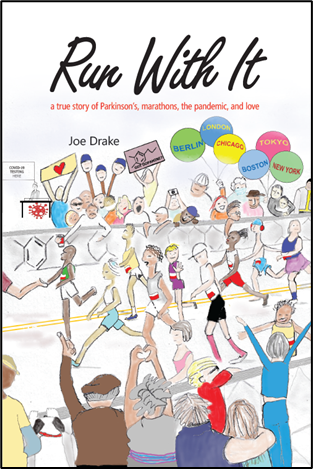 Book cover image provided by author (Patricia Snyder, artist)
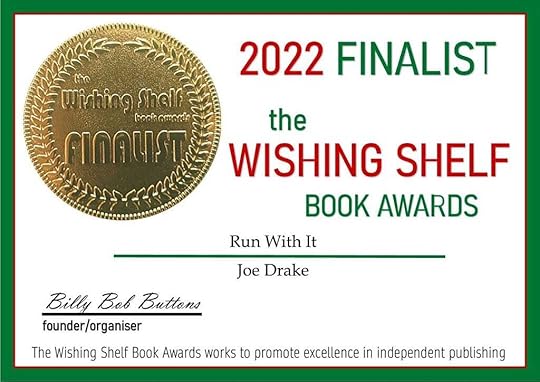 Finalist Certificate for the Wishing Shelf Book Awards (provided by author)[image error]
February 25, 2023
How do I do this again?
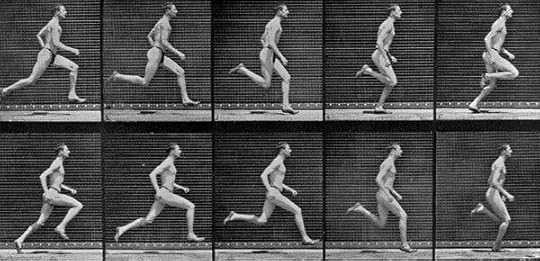 From nytimes.com, “Running Is a Total Body Affair” by Gretchen Reynolds.
Sometime in 2022, I forgot how to run.
I know this because I keep copious records of my training and races. In early 2021, running five or so miles at a sub-eight minute pace was pleasantly routine. By the end of 2022, however, an eight minute mile seemed out of reach.
Age could be a factor. In early 2021, I was still in my 50’s. Now, I am irrevocably in my 60’s.
Or perhaps Parkinson’s disease had doubled back to reclaim my vigor.
The passage of time and neurodegeneration are relentless adversaries. However, I’ve dealt with them before to modest success. I know they will ultimately take the top podium spots but before conceding this round I decided to consider the possibility that I had simply become sloppy.
Maintaining performance as a runner means doing more than just running. It’s important to frequently revisit that which makes a runner better. It’s a long list but for starters: form, mobility, strength, fueling, and challenging pre-conceived limits.
Complacency undermines progress. Just like in a marriage. Or writing. Or baking world-class cookies. Just about any human endeavor, really.
I set goals for myself in 2023 that begin with my performance in the Tokyo Marathon next week. What better time than now for a reset?
Since the start of this training cycle, which began one week after I completed the 2022 New York City Marathon in early November, I have worked on regaining my speed.
I have ample evidence that my form had gone to shit recently. It’s apparent in photos that were taken of me during my 2022 races. I lean forward at my waist too much, my hips are tight, my legs and arms show a lot of wasteful lateral motion, etc.
Some fixes come quickly. Standing up straighter and focusing on proper arm swing are no-brainers although they require constant reassessment and correction as the miles add up. Better posture also helps to tame squirrely leg motion.
My tight hips, though, required some research. Fortunately, there is no shortage of reference material on the web. I now do hip mobility exercises twice weekly along with hip-focused dynamic stretching before each run. My hips have opened up and become relaxed and my gait is smoother.
My friend, Ferguson, recently showed dramatic improvement in his pace and I asked him about it. He said that he has been focusing on strength training and quoted a coach as saying “There are no weak, fast runners.”
Back in 2020, I was doing regular strengthening exercises but I’ve lapsed since then. I’m back on the wagon now and do two strength workouts each week.
At first I was gung-ho to add a lot of weight training to my weekly schedule. Typical of me, I overdid it. I blew out my back during the first week. I decided to cut back to simple, sustainable yet highly recommended and effective body weight exercises: push ups, planks, lunges, step-ups, glute bridges, Bavarian split squats, and the like.
Interestingly, these are also good exercises for Parkinson’s. My leg and core strength as well as my balance have recovered significantly.
I found some improvement outside of gym work also. By accident, I got a renewed appreciation for proper fueling. In January, periodontal surgery on my lower lip left it very tender hence I ate much less than I normally do for a few days. The day after the surgery I had planned to run nine miles at a brisk pace but felt bonked right at the get go and called it quits after eight miles.
For the entire run it felt as if I had hit the proverbial wall; my legs just couldn’t respond. I attributed my poor run to under fueling. The lip quickly healed and ever since I’ve been mindful of my carb intake (I eat a lot of Ritz crackers now) and haven’t had the problem again.
I do more of my speed workouts on the local quarter-mile track now. That helps me monitor my week to week performance.
I considered how I might make use of the track for my longest runs. It occurred to me that because I typically limit my long runs to 21 miles, I may not be doing enough to get my body ready for the last few miles of a marathon.
Conventional wisdom states that running further than 20 or so miles on a training session is counter-productive due to the risk of injury. The soft, level track would be less dangerous than roads, however.
On a whim, then, I decided to take one of my long runs entirely on the quarter mile track and to make it a full marathon. That is, 26.2 miles translating to 105 laps.
I don’t think that this type of workout is often done. In fact most runners, myself included, would expect it to be mind-numbingly dull to run 105 laps on a track. However, that suggests an added benefit — a test of mental toughness. It really wasn’t so bad after all and, honestly, completing it was a great confidence boost.
All this work has paid off; I have exceeded my training plan’s mile, half-mile, and quarter mile pace targets. On January 26, I ran five one-mile intervals with three minute rests between each one at an average of 7:42 with the fastest one at 7:34. I’m no speed daemon but it’s a start.
On the whole, I feel more confident about my running than I have in a while. I am not quite peaked but I think I am on the right track (sorry).
My goals for 2023?
I mentioned in my last post that there are 8,143 athletes who have achieved Six Star status to date. Of these, only 84 have completed all six of the major marathons in a single calendar year. I hope to join this group. I’m guessing that there will be something like 20–30 of us aiming for this achievement in 2023.
After Tokyo on March 5, my schedule is Boston on April 17, London on April 23, Berlin on September 23, Chicago on October 8, and New York City on November 5.
Also, I want to run at least some of them in less than four hours. Although my PR is well under the four hour mark, I have yet to run that fast in any of the eight Majors I’ve entered so far. Maybe Tokyo will be the first.
Finally, I’d love to run each of the majors faster than I’ve done previously for reasons I may reveal later. Tokyo should be fine; I haven’t done that one yet. By definition it will be my fastest Tokyo Marathon. Others will be more challenging especially Chicago only two weeks after Berlin and London a mere six days after Boston.
First things first. I’m off to Tokyo.
In 2023, I will be running for Team Fox in some races again. You can donate to my London Marathon campaign (click this link). I could really use your support. If you share the passion that The Michael J. Fox Foundation (MJFF) and I have for finding a Parkinson’s cure please consider contributing. All donations are meaningful and greatly appreciated.
Alternatively, if you would like something tangible in exchange for a contribution, you may purchase my book Run With It: A True Story of Parkinson’s, Marathons, the Pandemic, and Love. I’ve heard it’s a good read. Most of the reviews are coming in at four to five stars and it recently was named a Finalist in the 2022 Wishing Shelf Book Awards contest. (Winners will be announced the beginning of April.)
All profits from its sale are donated to MJFF. It can be found on my authors website and Amazon. It’s cheaper on my author site (for domestic shipping), a larger percentage goes to MJFF than for Amazon sales, and you get the option of having it signed by the author.
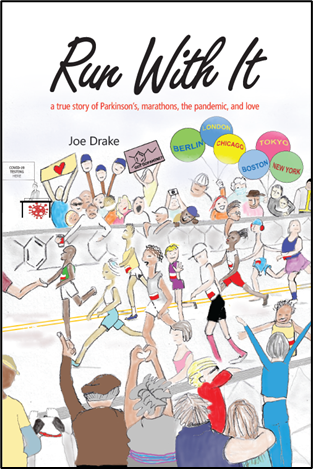 Book cover image provided by author (Patricia Snyder, artist)
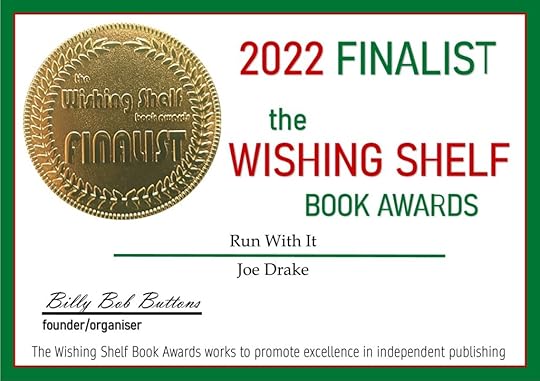 Finalist Certificate for the Wishing Shelf Book Awards (provided by author)[image error]
February 12, 2023
Tokyo’s Time
 Image from the Tokyo Marathon Foundation website
When I run the Tokyo Marathon on Sunday March 5, I will be aiming for a World Record.
Curious? Read on.
Any runner who completes all of the World Major Marathons (Tokyo, Boston, London, Berlin, Chicago, and New York City) earns the coveted Six Star Medal celebrating the accomplishment.
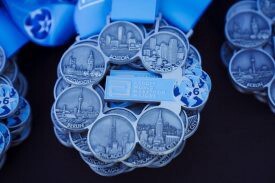 The Six Star Medal (image from Abbott World Marathon Majors)
A typical marathoner may need years, maybe a decade or longer, to fit all these marathons into their schedule. Hence, when the stars align and they bag that sixth race it’s a big deal for them.
The sponsor of this challenge, Abbott World Marathon Majors (AbbottWMM), hypes the accomplishment (as well they should). Months before any Major takes place, AbbottWMM determines who will be getting their sixth star. They will be ready at the finish line to award those runners with their bling. Big time photo op.
Usually, a few dozen to a few hundred of the participants will earn their Six Star Medal at a Major. In 2022, of all the Majors, Boston adorned the most Six Star Medalists (429).
Six Star Medalists are a rare breed. As of the end of 2022 there have been 8,143 athletes who have completed the challenge. Given that there are something like 1.1 to 1.3 million active marathoners in the world (based on the total number number of marathon finishers worldwide during recent pre-pandemic years), less than 1% of marathoners reach Six Star status.
The 2023 Tokyo Marathon may move that number north of 1%. Still rare, yes, but it is a significant upwards bump.
In many ways, the 2023 Tokyo Marathon will be unlike any that I or the rest of the world has seen. First and foremost, because of the pandemic, it has been four long years since the typical recreational marathoner has been allowed to run in Tokyo. Thus there has been an enormous backlog of runners who only need to bag Tokyo to get their Six Star Medal.
AbbottWMM reports that more than 3,000 of the 37,500 entrants to the 2023 Tokyo Marathon expect to earn their sixth star at this year’s race. (I am one of them. Yay me!) Abbott has let us all know that we are going for the Guinness World Record of “most people to earn a Six Star Medal at a single marathon”.
And for just $30, I can purchase the commemorative Guinness World Record Medal to receive at the finish line.
Hey, a world record is a world record! I don’t see anything on the horizon to suggest that I will get another shot at one. Count me in!
I mentioned the Tokyo Marathon will be unique. There are several significant logistical challenges for the runners. Undoubtedly, it will also be a lot of fun.
Several of my running peeps I’ve met over the past two years (Natan, Erika, Bill, among others) will also be getting their Six Star Medals. And there is at least one runner of worldwide fame getting hers: Joan Benoit Samuelson, the American who dominated the women’s marathon scene in the 1980’s. I need to save some smiles for all the post-race selfies I am anticipating.
The challenges begin with Tokyo’s policies regarding COVID-19.
Unlike the other WMM venues, Tokyo hasn’t totally loosened up their COVID policies. It is likely that the wearing of masks will be obligatory. And entry into Japan is subject to compliance with their distinctive protocols.
Procedures are being updated regularly so these may change. But as of now, entry into Japan requires all travelers to present evidence of at least three vaccination shots. I don’t want to sound disrespectful of my hosts but this is so 2021.
Runners in the marathon have additional rules that are already triggering anxiety among runners as per postings on various WMM Facebook groups. However, all the final details will not be available until February 17 when the official Runner’s Handbook is made available. Some very important issues, however, have already been drilled into us.
Specifically, runners must have their cell phones loaded with an official health app to be used to record one’s body temperature. Everyone must have their body temperature measured and recorded in the app daily for the week prior to the race. Each runner must display the app’s data to get into the Expo and to get into the starting area. They must carry it during the race as well. No cell phone, no data, no race for you.
At the Expo, each runner will be given two antigen test kits. Runners are to administer their tests at prescribed times and the (negative) results must also be loaded onto the runner’s cell phone to be checked by the race authorities in order to gain entry to the start area.
Another trigger involves the race cutoff time. All runners who don’t complete the course within seven hours will be disqualified.
All the Majors have cutoff times and “sweepers” are assigned the job of pulling runners off the course who are unable to meet the cutoff. The other races display a fair bit of flexibility and compassion towards runners in danger of missing the cutoff.
Tokyo is notoriously rigid with respect to the cutoff. Not only is there the overall seven hour limit but additionally there are checkpoints throughout the course that all runners have to achieve or face early disqualification.
For example, the cutoff clock starts ticking as soon as the gun goes off for the elite runners at 9:10 am. Many of the remaining runners may not reach the start line until 9:40 am and hence they have already used up 30 minutes of their cutoff time.
It appears that the first checkpoint will be at the 5.6 km mark (~3.5 miles) and runners must pass that checkpoint by 10:30 am. That’s readily achievable for most runners. But there’s a catch.
For example, stopping for a toilet break early in the race also chews up cutoff time. There are some nightmare scenarios documented by video on the web where runners in Tokyo have been disqualified early in the race because the checkpoint cutoff time elapsed while they were waiting to use a toilet. Imagine the disappointment! Entitled Americans can get quite belligerent when this happens to them. It’s important to plan ahead.
Tokyo’s strict discipline is not always an undesirable thing. In every other Major I’ve run, spectators on foot, bicycle, and wheelchair have at times entered the course in order to get to the other side of the road often at decidedly inopportune times. Runners have to be alert or risk collisions and potential injury.
This sort of thing does not happen in Japan. The course is for the runners; spectators do not enter it. It’s a cultural thing. Lovely.
Of course, irrespective of race and COVID protocols, there’s the issue of jet lag. Japan time is 17 hours ahead of Seattle and with my 11 hour flight I will be arriving at 3:10 pm local time just when my circadian clock will be signaling me to go to sleep (~10 pm West Coast time). I’ve dealt with a lot of jet lag these past two years but this trip will be the greatest acclimation challenge to date.
Running aside, by all accounts Tokyo is a fabulous city to check out. Word is that Tokyo has taken pains recently to provide English language signage everywhere and so getting around may be straightforward. And the food apparently is fantastic.
Consider the humble, uninspiring 7–11 of the United States. They are not known for fine dining. But in Tokyo they are, very much so. Same is true for all Tokyo convenience stores (“konbini”). It’s a great way for a jet-lagged traveler to grab some delicious food in the dead of night when sleep is not happening.
By all accounts, the food served in restaurants is astounding. From what I’ve read on-line I’m dreaming of carbo-load heaven! Tendon, Tsukemen, Soba, Tokyo buns, Omurice, the list goes on. Be still, my heart.
The Tokyo Marathon kicks off another year of self-inflicted challenges for me. Although not as nutty as my 2021 World Marathon campaign, my goals for 2023 are nonetheless . . . how should I put it? Entertaining? Let’s go with that.
I’ve learned a lot since my marathon debut in 2019 and I am eager to try some new things this year. More on all that in my next post.
In 2023, I will be running for Team Fox in some races again. You can donate to my London Marathon campaign (click this link). I could really use your support. If you share the passion that The Michael J. Fox Foundation (MJFF) and I have for finding a Parkinson’s cure please consider contributing. All donations are meaningful and greatly appreciated.
Alternatively, if you would like something tangible in exchange for a contribution, you may purchase my book Run With It: A True Story of Parkinson’s, Marathons, the Pandemic, and Love. I’ve heard it’s a good read. Most of the reviews are coming in at five stars. And all profits from its sale are donated to MJFF. It can be found on my authors website and Amazon. It’s cheaper on my author site (for domestic shipping), a larger percentage goes to MJFF than for Amazon sales, and you get the option of having it signed by the author.
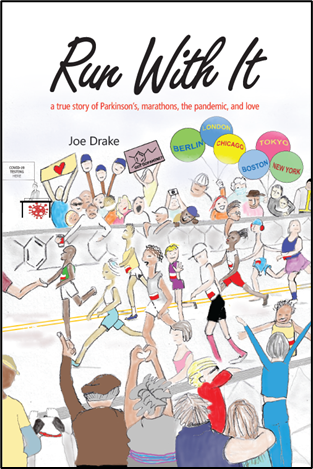 Book cover image provided by author (Patricia Snyder, artist)[image error]
October 13, 2022
Pain is just the French word for bread
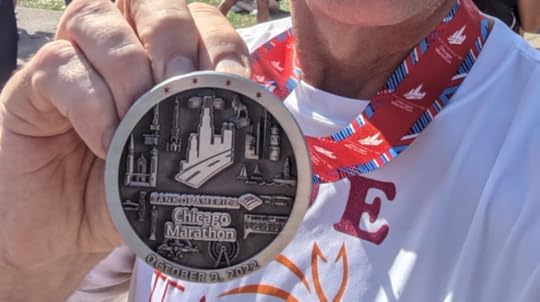 Photo by the author.
My back started nagging me on the flight home to Seattle. By the time I landed it was in full spasm and it was painful to sit, stand, or walk.
Odd.
I had no trouble at all immediately after running the Chicago Marathon. Following the race I covered more than five miles on foot pain free and even ran nearly a mile to make a dinner reservation.
I’m thinking, “Where have I heard this story before?”
Finally I put the pieces together. Here’s the theory: Running a marathon weakens my back in a stealthy way. It’s not enough to prevent light exercise but can cause problems if I choose to lift a heavy load.
That heavy load? My luggage I carried to the airport, especially the heavy backpack I wore. Walking up stairs carrying these things rather than using the escalator very likely contributed to the problem.
My back pain in London a few days after flying in from Berlin the day following the 2021 Berlin Marathon? And again in Seattle two weeks later upon flying back from the Boston Marathon?
See the pattern?
I’m sensing a collective, “Well, duh!” from the multitudes reading this.
Fine, be that way. To me, this is very good news. I can work with this. No more post-marathon back pain if I can just refrain from lapsing into tough guy mode afterward.
Running is a constant source of self-discovery. I’m a lightweight in this respect though. I regularly come across runners whose challenges far exceed mine.
This was my seventh Marathon Major in the past 13 months and I have fallen into a happy routine of enjoying short runs in local parks, visiting the expo, meeting up with friends, taking in some pre- and post- race parties, and running the race.
With only 28 hours to spare in Chicago last year, I didn’t have time for all that. But this time around I gave myself a full week and the city didn’t disappoint.
I hear that winters can be cold and bleak in Chicago but this past week was glorious. It’s understandable why Chicagoans love their city.
I took my training runs in the various parks along Lake Michigan (Grant, Millennium, Northerly Island), the Lakefront Trail, and the Riverwalk. Grant Park anchors the splendid lakefront attractions of the city, which also includes the Museum Campus (Adler Planetarium, Field Museum of Natural History, and Shedd Aquarium) and Soldiers Field (home of Da Bears).
This year I entered Chicago’s marathon as a charity runner with Team Fox of the Michael J. Fox Foundation (MJFF). As they like to do, Team Fox organized a pre-race meet and greet for the runners on Saturday, the day before the marathon.
The event took place at On Tour Brewing a bit west of the downtown area. I always get a big emotional boost when I go to these parties because 1) there are a lot of awesome people running for Team Fox and 2) I am treated somewhat like a celebrity.
My Team Fox friends that I spent time with in various venues over the past year — Katie, Liz, and Daryn — all greeted me with enthusiasm and hugs. I also met Gaby, a newcomer to the team, who apparently as part of her orientation was told that I walk on water. It’s hard not to like the star treatment I get.
This party also served as a mini-reunion of sorts for a some of us who took part in the Blue Ridge Relay (BRR) in early September (see my posts Showtime in the Blue Ridge Mountains and We Don’t Give Up). This included fellow Team Synapse members Bill and Peter.
Also present, and running the marathon for Team Fox, were Chuck and his friend Patrick. Chuck also ran in BRR but on a different (read, faster) team than Team Synapse.
Chuck was a big help to us in North Carolina. He opened up his brewery in Charlotte, Vaulted Oak Brewing, earlier than usual on the day before the relay so that Team Synapse could use it for our first in-person meeting. The team’s only interaction prior had been through on-line virtual meetings.
Chuck has family afflicted with PD. He has designated all the profits from the sale of one of his beers to go to MJFF. I spent some time hanging out with Chuck and Patrick. Great guys. They wanted to know all about my Majors challenge from last year and we also shared stories from BRR and our personal race strategies.
The party broke up early in the afternoon. I went back to my Airbnb to top off my carbo loading, prep my gear for the race, and grab an early bedtime.
As was the case last year, Team Fox had secured the use of the Goodman Center of Roosevelt University as headquarters before, during, and after the race. It’s very conveniently located two blocks from Grant Park where the race begins and ends.
Katie, Liz, Gaby, Daryn, Bill, Peter, Chuck, Patrick and I all arrived early and excited to kick off the big day. I also met with Anna, another Team Fox runner, with whom I had an on line conversation earlier in the week.
Anna had posted on Facebook in September that although she had run in Chicago the previous four years for the American Cancer Society, she decided to run for MJFF this year because her father, Denny, has PD.
She told this to some Team Fox runners at about 18 miles into last year’s race and was treated so thoughtfully by one of them that she was teary-eyed for a while afterwards. But she didn’t get that runner’s name and was hoping to connect with him this year.
I took an educated guess as to who that runner was and then reviewed last year’s timing mat data from the marathon website in hopes of finding evidence of the 18-mile crossing of paths and was able to determine that the thoughtful runner in question was my pal, and fellow Team Synapse member, Bill. I let them both know this and they were very happy to get reconnected.
Anna was grateful that I took the time to figure this out. She also pointed out that it was a rather nerdy thing to do. I agreed. But that is the kind of thing I do for fun.
Perhaps that helped to even up my karma balance. Earlier in the week I gave hasty transit directions to a non-English speaking tourist and loaded him onto an Orange line ‘L’ train only to realize as his train sped off that I sent him the wrong way. Still feel really bad about that. I hope he’s found his way back by now.
We all walked from the Goodman Center to Grant Park about an hour ahead of our scheduled wave starts. The organization within the park was outstanding. Helpful signage, volunteers, and portable toilets were ubiquitous.
As is the case in all of the Majors, the spectators were wonderful. I wore my name on my shirt and therefore received many personalized shouts of encouragement all along the course.
The race went well for me even though I wasn’t able to hold to my four-hour goal pace. I have some work to do.
Also, I should have been more thoughtful about the use of the pre-race toilets. I entered the starting corral too early and hence had 30 minutes to kill. By the time our wave was sent off, my bladder was uncomfortably full and I looked for a chance to make an early pit stop.
The first few opportunities on the course had long queues and I didn’t want to take a longer than necessary finish time penalty. It was six miles in before I came upon portable toilets without any lines. Lesson learned — wait as long as possible before entering the starting corral and frequent the pre-race toilets until then.
Nonetheless, my preparation seemed to work well enough though for sure the ideal temperature (46 degrees) was a pleasant factor. In addition, I think that I did a good job with carbo loading. I ran the second half of the race only 74 seconds slower than the first half so arguably I didn’t crash into the proverbial wall. I had some leg cramps but whenever they flared up either during or after race I took a SaltStick tablet and they miraculously disappeared.
Last year I finished the course in 5:13:59. I came in at 4:11:48 this year. The improvement isn’t as impressive as it may appear. The effect of the cooler temperature this year was enormous. Also, I started this year’s race without the physical burden of having run marathons on each of the prior two weekends and I didn’t need to hold back some energy for another marathon the next day as I did in 2021 when I ran the Boston Marathon afterwards.
Furthermore, I can’t ignore my inability to get anywhere close to my PR of 3:42:36 in any of the Majors. That PR was done on a downhill course, which I have previously quantified to provide an advantage of about 5 minutes in finish time relative to a flat course, an estimate that has become increasingly unsupportable. The downhill course advantage may even be as much as 30 minutes. To get to a 4 hour finish time on a flat course I probably need to commit to more weekly mileage or strength training or both.
The Team Fox runners regrouped at the Goodman Center after the race. Anna, Chuck, Patrick, and Peter all handled the race fine. Bill completed the course though his knee was causing him a lot of pain. He planned on following up with a visit to his orthopedist.
While at Goodman, I got a text from Vitor, a Google engineer I met in London the previous year. He was thinking of getting a beer so after another round of hugs with my Team Fox pals I went off to meet him at a brewhouse along the Riverwalk.
Vitor brought along his friend, Alex, who also works at Google. Alex also ran in the marathon though he prefers trail runs.
Vitor is extremely fast and ran the marathon in 2:32:27. In February, Vitor and his wife celebrated the birth of their twins. They also have a two and a half year old daughter. Marathon training for him now is a logistical challenge.
It was fun sharing stories about raising kids, training for marathons, working at Google, and living in the San Francisco Bay Area where both Vitor and Alex now live. It was my first time meeting Alex. Vitor prodded me to give Alex a synopsis of my Majors challenge from last year. Of course, I never tire of telling the story and if it bored Alex he was polite enough to not let it show.
To close out a busy day, I had dinner with Carita whom I met at the 2021 Boston Marathon the previous October. She wanted to try Pequod’s for Chicago deep dish pizza. (Note: There are many, many other pizzerias in town serving all styles of pizza but if you want the best, make your reservation at Pequod’s.)
Carita has sarcoidosis in her lungs which causes difficulty with breathing and can give her a persistent cough. She has been dealing with this for a number of years but continues to run marathons and ultramarathons despite the condition.
In April she ran in the Marathon des Sables (MdS), a multi-day 150+ mile ultramarathon in the Moroccan Sahara. Two weeks after finishing MdS she ran in the Boston Marathon. Later in the spring she caught COVID. She also has a nagging and mysterious neck injury that, although not painful, limits her ability to move her head.
Doctors have not figured out what is going on with her neck. Any one of several factors (sarcoidosis, MdS, Boston Marathon, COVID) might have brought it on. Undeterred, she expects to do an ultramarathon and the Marine Corps and New York City marathons in the next four weeks.
Carita ran the marathon with her friend, Phil. Last December, at age 46, a routine colonoscopy revealed that Phil had stage 4 colon cancer. He had been entirely symptom free at that point and only underwent the colonoscopy because medical guidelines had recently been updated to recommend screening at age 45.
The diagnosis motivated Phil to pivot to advocacy. He’s raised tens of thousands of dollars for cancer charities and regularly urges people to get their colonoscopies done. Phil ran the Boston Marathon in April and just two weeks before Chicago he underwent surgery to remove tumors from his liver.
During the marathon I saw several participants running with leg prostheses. I also witnessed a blind athlete running to the instructions spoken to him from his guide runner.
And to be clear, there is a wheelchair division for goodness sake.
There are those so beautifully fleet of foot who need no further affirmation. Watching them coast along effortlessly elicits awe and astonishment.
But out of 40,000 runners in a race such as the Chicago Marathon, there’s a relatively small number with genuine speed and a far larger contingent who manage on grit and determination. Among them is a sizable and inspiring number of athletes who are overcoming debilitating physical and medical conditions to participate in the race.
Running a marathon is a universally embraced form of self-inflicted validation. It’s as if the most natural thing in the world when confronted with lung or neurodegenerative disease, cancer, amputation, blindness, or what have you is to react by declaring “I’m going to run a marathon.”
No one would ever choose any of these afflictions if offered. Yet, ironically, like in any good origin story, they are the stuff from which super heroes are made. Just check out a marathon and talk to a sampling of some of the participants and you’d understand.
You can still donate to my Chicago and New York City marathon campaigns this year and I could really use your support. If you share the passion that The Michael J. Fox Foundation (MJFF) and I have for finding a Parkinson’s cure please consider contributing to either of them. All donations are meaningful and greatly appreciated. Follow the links below:
https://fundraise.michaeljfox.org/chicago-marathon-2022/joesgottarun
https://fundraise.michaeljfox.org/nyc-marathon-2022/joesgottarun
Alternatively, if you would like something tangible in exchange for your contribution, click on this link to purchase my book, Run With It. I’ve heard that it’s an enjoyable read and all profits from its sale are donated to MJFF.
[image error]October 8, 2022
Seeking Redemption in Chicago
 Cloud Gate (photo by the author)
It’s Friday, October 7, two days before the 2022 Chicago Marathon and it feels as if I am coming down with a cold. The illness is reticent, though, as if uncertain as to whether, or when, to come out in full force. My throat is a bit sore, I have a slight headache, and I feel lethargic. But my sinuses are clear and I don’t feel the urge to dope up with DayQuil as I normally would do for a cold.
I had planned to spend the day sightseeing. Maybe take in a river cruise. I decided, however, not to fight it. If my body just wanted some rest then who am I to argue? I took several naps and when not sleeping I worked on fueling for the race.
Taking some time out to sleep and eat two days before a marathon is not such a bad idea anyway. Fortunately, the Airbnb I booked near Chicago’s South Loop has a back-friendly bed (never a given for me) and a well-equipped kitchen.
I ran in the Chicago Marathon last year when circumstances were considerably different. Then, as now, my personal best marathon finish time was 3:42:36 yet it took me all of 5:13:58 to finish in Chicago, a personal worst that didn’t last long because I ran even slower in the Boston Marathon the next day.
I’m not attempting a personal best this year but it would be nice to lop off, say, an hour or more from my previous showing in this town. Getting under 4 hours would be very nice. I have yet to run under 4 hours in any of the Majors.
There may be a chance. A number of parameters that effect performance will be conducive to running better this time.
I never run well in the heat. Last year, it was unseasonably hot (70+ degrees) in Chicago. However, the forecast is looking fantastic this year. It’s expected to be in the high 40’s come start time on Sunday. Run cool to run fast.
Jet lag can be a factor but I wouldn’t know how to quantify it. Nevertheless, I’ve been in Chicago since Tuesday night. I think that I am acclimated to local time now. In 2021, I was in Chicago a grand total of 28 hours. I flew in from Boston the day before the race and the previous Sunday I was in London for its marathon. Who knows where my body clock was then.
Perhaps residual fatigue from London may have been a factor last year as well. This time it’s been all of nine weeks since I’ve run a marathon. That should do it.
In reviewing last year’s races, I’ve noted that I did not do a proper carbo load in any of them. During training for back-to-back Chicago and Boston marathons last year, I did practice with carbo loading between two consecutive 20 mile long runs and that worked out well. Nausea and other distractions prevented me from reprising the effort for the actual races.
The carbo loading rule of thumb is to consume 4 grams of carbohydrates for every pound of body weight for 2–3 days before the race. For me, that works out to 720 grams of carbs each day. That’s a god-awful amount of food. Today I got close. Between bagels, baked potato, and many bowls of rice, I estimate that I achieved 664 grams of carbs. I’ll shoot for roughly the same on Saturday. Last year’s Chicago wall hit me at about mile 17. Maybe I can push it out past 20 miles this time.
I’ve learned a bit more about mid-race fueling and hydration since last year. I’ll be carrying plenty of maple syrup packets from Untapped to eat on the course. Each packet has 26 grams of easily digestible carbs and I will knock down one of them every three miles or so. For electrolytes nowadays, I’ve heeded the advice from other runners who use SaltStick capsules to control dehydration and leg cramps. I’ll take one of these every three miles as well and supplement them with water from the aid stations. This strategy has worked very well for me on my long training runs.
Lastly, I plan to hold off on any alcohol until after the race. In writing my book about last year’s World Marathon Majors effort, I noted that I drank the day before almost all of them. Specifically, I mentioned a pre-race pint of Guinness in Chicago last year. The advice I have seen on-line recently is to lay off the alcohol until after the race. Will do.
Things are looking good.
Now if I can just hold off that cold, or whatever it is, for two more days. We’ll see. Stay tuned.
You can still donate to my Chicago and New York City marathon campaigns this year and I could really use your support. If you share the passion that The Michael J. Fox Foundation (MJFF) and I have for finding a Parkinson’s cure please consider contributing to either of them. All donations are meaningful and greatly appreciated. Follow the links below:
https://fundraise.michaeljfox.org/chicago-marathon-2022/joesgottarun
https://fundraise.michaeljfox.org/nyc-marathon-2022/joesgottarun
Alternatively, if you would like something tangible in exchange for your contribution, click on this link to purchase my book, Run With It. I’ve heard that it’s an enjoyable read and all profits from its sale are donated to MJFF.
[image error]September 14, 2022
We Don’t Give Up
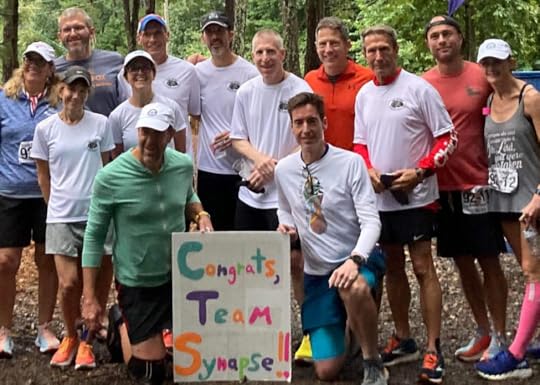 Photo courtesy of Team Synapse
About mid-way through her 9.3-mile third leg of the relay, Jacqui’s calves were screaming at her. I got my Theragun Mini out of the van and worked on her lower legs. Jacqui is petite and her calves felt no bigger than corn cobs as I worked to loosen the muscles. After a few minutes of massage she felt good enough to continue running.
This occurred at about 8 am on the second day of the Blue Ridge Relay. The first day was clear and dry but the rain started sometime after midnight casting a touch of gloom and discomfort on everyone’s last leg. Navigation became dicey in the dark and sometimes poorly marked route. We had just retrieved Jared who had the presence of mind to text us his location after realizing that he had taken a wrong turn and was a few miles off course. Reluctant to let Jacqui face the same outcome, we decided to shadow her in the van. That let her focus on running while we navigated for her.
Shadowing was against the rules as was providing the runner on-course support, such as massage therapy. We also violated the ban on indecent exposure (I had to pee) and the goal of finishing under the presumed 35-hour time limit was slipping away.
I was ecstatic. The Team Synapse story of 12 runners all living with Parkinson’s disease taking on the Blue Ridge Relay was becoming ever more captivating. We couldn’t have asked for a better scenario.
This was well before Greg broke his leg and we suffered an outbreak of COVID-19.
The Blue Ridge Relay is a 208-mile race that starts in Virginia’s Grayson Highlands State Park and ends in Asheville, North Carolina. The course is divided into 36 legs of unequal length. The difficulty of each leg is determined by the combination of its length and its elevation profile. Though the course drops more than 2000 feet from start to finish, there are intervening hills to climb to the tune of greater than 16,000 feet of combined elevation gain.
Each runner takes on 3 of the 36 legs and the combined mileage for each runner varies from 12.1 to 25.8 miles. A runner’s legs are separated by 10 to 12 hours, time which is spent hydrating, fueling, and resting. (If you are interested in more details of the race logistics, scroll down to the bottom of this post.)
We had two minivans on the course. Laura, who volunteered as a driver for the team, drove Van 1 which held Rhonda, Jared, Jacqui, myself, Scott, and Bill, who comprised our runners 1 through 6 respectively. Janet volunteered to drive Van 2 thus transporting runners 7 through 12: Greg, Peter, Renee, Jason, Steven, and Allison.
A brief digression is appropriate here: A single blog post can’t do this story justice. Full treatment would require at least 100 pages to relate all the character, story thread, landscape, and cultural details that permeate the adventure. Some day, maybe, but not now. For brevity’s sake, let’s focus on the last third of the race.
Exchange zones (EZ), where the “baton” (actually a slap bracelet) is passed from one runner to the next, are lively affairs. Large spaces that can facilitate parking, porta potties, and enterprising groups selling food and drink are employed. Many of them were churches of one denomination or another but there were also parks, schools, fire departments, etc. Team vans come and go while runners mill about preparing to run or cheer for incoming teammates.
Such was the case at EZ 18 when the runners of Van 1 finished the last of their second legs and the Van 2 runners took over for their second legs. The two vans would meet again at EZ 24 where the third and final legs began.
The rain, which had been threatening all of Friday, started at about 2 am Saturday while Van 2 was on the course and the occupants of Van 1 were catching a few z’s at an Airbnb in Burnsville. By the time Van 1 was on its way to EZ 24, the rain was coming down hard.
Upon pulling into EZ 24, it was clear that the nature of the race for us had become radically different. The contrast was striking. It was so desolate that it took us a few seconds to convince ourselves that we were in the right place. Two die-hard volunteers under a single pop-up tent checking off runners as they came in was the only official activity taking place.
What had happened while Van 1 runners were resting in Burnsville?
Clarity came from a conversation with the volunteers under the tent. We already knew quite well that Team Synapse was one of the slower teams entered in the race. Between our stops at EZ’s 18 and 24, nearly all of the other teams had passed us. We were one of at most 15 teams still on the course as far back as EZ 24.
Everything had changed. Early on, we’d been happily going about the course along with the other teams and actually improving upon our projected finish time, which was already within the course time limit. Towards the end, though, fatigue had slowed our collective pace so that meeting the time limit, never a slam dunk, had become precarious.
Allison came into EZ 24 and passed the bracelet to Rhonda who took off into the rainy darkness to complete her final leg. Allison had a tough time on her leg. She got drenched by passing cars and at one point stepped into a pothole twisting an ankle. Chris, who was our alternate runner in the event of a pre-race scratch, escorted Van 2 to the Burnsville Airbnb for some rest.
Rhonda’s run went well and she handed off to Jared. Van 1 went ahead to EZ 25 to wait for him. While there, some of us chatted with a runner waiting his turn. He related that his teammate currently on the course had gotten lost and the rest of the team had gone to look for her. It was disquieting news. Shortly afterward we received the text from Jared saying that he, too, had taken a wrong turn. With a race official’s blessing, Van 1 went to retrieve Jared to bring him to EZ 25. Jared had already run a distance beyond what his leg required so we were justified in moving him ahead to the end of his leg.
Two runners getting lost on the same leg had us a spooked. I don’t remember who first suggested it but Van 1 decided that from then on, rules be damned, we would shadow our runners through their legs. From a safety perspective, there was no point in chancing any more wrong turns.
It made me realize how foolish I was for not carrying my phone with me on my first leg. I also had missed a turn and ended up adding nearly a mile extra to my run thus penalizing the team by 9 minutes while I retraced my steps. If it hadn’t been for the kindness of another team’s runners who noticed my mistake and redirected me, the damage would have been far greater.
Yet, I consider my blunder to be a great contribution to team building. After belaboring the potential for such errors during our pre-race team meeting, the fact that I was the one to screw up took some pressure off of the others. Several members of the team expressed relief that it was me and not them who lapsed.
Jacqui took over from Jared and she was very pleased to have the van shadow her. Shadowing consisted of leapfrogging the runner — driving ahead to the next intersection then directing them through it while cheering for them. After the runner passes, the process is repeated. It gave the runner an emotional boost while allowing them to concentrate on running.
Jacqui also had a rough time. When she handed off to me she said that she was in a lot of pain.
My last leg was uneventful and I handed off to Scott for his final turn. In his earlier leg, Scott had been sideswiped by a car forcing him off the road whereupon he fell onto his shoulder. He was bloodied in a few spots and his shoulder ached. He soldiered on though despite the pain.
We drove ahead to EZ 29 and found . . . nothing. EZ 29 had closed up shop and went home.
By this time we may have become the last team on the course. We feared that the race director was contemplating yanking us from the course thinking that we no longer had any chance of finishing under the time limit.
It turned out that EZ 29 was the only exchange zone that packed it in early. It had me worried though. From that point on I took to chatting up the volunteers at each remaining exchange zone to tell them about our team of Parkies in hopes of garnering the sympathy vote in the event that it was needed to convince the race director to keep the course open longer.
As it turned out, chatting with the race volunteers, although delightful, had no bearing whatsoever on any decision by the race director with respect to letting us continue. In fact, as I would find out much later, there was an established and quite rigid protocol that the race director, Ken, was following and Team Synapse’s performance was dancing right on the edge of that protocol. To assist his decision-making, Ken turned to Bill, our team captain, for updates on our progress.
Bill took over from Scott and ran perhaps the most bizarre leg of the race. At one point he had to fend off a pack of tiny dogs bent on running him out of town. On top of this, dystonia in his left foot was making it painful to run. He tried taking off his shoe and that felt better but while running with one shoe in his hand and spying a race official up ahead watching his approach, he decided to toss the shoe off into the bushes along the roadside. He didn’t want to give the race official any reason to terminate the team’s effort (i. e. “They’re getting crazy now. Look, this guy’s running with his shoe on his hand!”).
While Bill was fighting off the dogs and dystonia, Van 1 and Van 2 converged on EZ 30. Bill was the last runner of Van 1 and Van 2 had come back to finish off the race. But there was some debate going on in Van 2. It was becoming clear that we weren’t going to finish by our 6 pm target, the rain was coming down hard, and the last 6 legs were going to be very difficult. At this point was it worth it to continue if we were just going to be yanked off the course anyway?
First Jared and then I worked on convincing the Van 2 runners to keep going. My argument was that our story was becoming so much better. We wanted to inspire people living with PD to exercise to overcome their challenges. Think of the message we would be sending if we held on now? Or the one we’d send if we quit?
This convinced everyone to keep going at least through the next leg. Bill handed off to Greg and then went to talk to the Van 2 runners. By the time Bill was done and after we conveyed that every runner would be shadowed from here on in so as to address any anxiety over becoming lost en route, all of the runners decided to carry on. If the race director forced us to stop, so be it. But we weren’t going to end our effort unilaterally. We had come too far to only get this far.
Each leg was assigned difficulty ratings based upon its length and its elevation profile. 34 of the legs were rated Easy, Moderate, Hard, or Very Hard. The two remaining legs had long stretches of very steep terrain and were rated as Mountain Goat Hard (MGH). Greg had just started in on the first of these MGH legs.
Greg’s leg was 6.7 miles of unceasing uphill with an elevation gain of 1405 feet (4% grade). Most runners choose to walk the route. Greg also walked at first but surprised us all by deciding to run the last mile. It was a noble effort that energized the rest of the team.
What goes up must come down. Peter took over from Greg for his 9.3 mile, 2074 feet downhill leg. Pre-race, Peter asked me about downhill running and I gave him a briefing on how to run downhill quickly without risking injury. Peter is a quick study. He flew down the mountain and handed off to Renee who faced the other MGH leg.
Renee’s MGH leg started with a 910 foot climb followed by a 678 foot drop. Over 5.3 miles this was a punishing run. Coming into EZ 33 she was moving slowly and weaving noticeably back and forth across the road. As she handed off to Jason, the team converged on her to offer aid.
Renee’s courageous effort put her in bad shape. She couldn’t stand on her own or walk and needed to find a place to sit down. Scott and I carried her into the exchange and placed her on a cooler that Allison set up for her. (Scott later remarked that he was glad that Renee didn’t reach for his damaged shoulder while he carried her.)
Touching her skin, I realized that Renee was overheated and needed to get her core temperature down. It wasn’t so hot during the race either day but the exertion on the MGH leg had its effect. I got some ice and ice water out of Van 1 and started massaging her back, legs, arms, neck, face, and head with them. Others helped out and we got some towels and applied cold compresses to her. Thankfully, Renee was conscious throughout and guided us in the treatment, which clearly was working. After a few minutes she was able to walk again and we got back to the course.
Whew!
Jason chose to run shirtless and that, no doubt, helped with his body temperature control. He crushed his goal pace and handed off to Steven.
Steven had some anxiety about his last leg. It was 9.4 miles and he had only run that distance once before. There were many turns, though, and a monster hill of 1146 feet and he feared getting lost and having to run even longer and/or higher as a result. Thus, while Van 2 went ahead to allow Allison, Steven’s fiance, to prepare for the race’s final leg. Van 1 shadowed Steven. Again, our goal was to free up Steven from any navigation duties so he could just run.
And run he did.
While Steven was on the course, Bill was in almost constant communication with Ken, the race director. It was a complicated dialog the details of which the rest of us learned only after conclusion of the race. As I mentioned earlier, there was a protocol, and Bill needed to convince Ken that our last few runners were strong enough to justify keeping the course open.
The rest of us went with the assumption that if Steven ran well enough to allow Allison to start before 6 pm, the course would stay open long enough to allow Allison to finish.
Thus, for a variety of reasons, we were all hoping for a convincing effort from Steven.
Steven’s run was indeed convincing. While Van 1 shadowed and cheered him on, he kept to a steady pace up the monster hill and back down it. His performance, especially on the uphill part, was enough to convince Ken to let us continue.
We just had one more leg to go. What could possibly go wrong now?
Well, for one, the course for this last leg was a mystery. We had a map but it was inconsistent with what signs that were still on the course. We had also heard that the officials had changed the route so that our map no longer applied. The actual course took a circuitous route apparently to top off the race to the prescribed 208 miles. Following this course would be a nightmare for Allison. Jared decided to help out. The rules allow companion runners who are part of the team and so Jared took it upon himself to run alongside Allison and help her deal with the course vagaries.
Allison and Jared made their way to the finish line in Asheville at the Highlands Brewery with in spite of some flawed guidance from those of us shadowing them in Van 1.
We had planned to cross the finish line as a team. Many of the team members from Van 2 had been waiting for Allison a few hundred yards from the finish line in anticipation of her arrival but Jared and Allison came around the back way to the finish area and ended up crossing the line with only the Van 1 runners. Eventually, everyone caught up and we had the emotional finish line ceremony that we had all hoped for.
It turned out that we didn’t miss the cutoff after all. We had a legitimate finish time that met with the established race protocol even though we finished a few minutes after 7 pm. The race’s website is somewhat enigmatic with inconsistencies but we actually were allowed 36 hours to finish the course.
We finished at 7:02:35 pm but we were not penalized for the extra 2 minutes 35 seconds because the race director acknowledged that the course markings on the last leg were a mess. We had hoped for an overall team pace of 10 min/mile but no one was disappointed in our final aggregate mile pace of 10:24.
People were waiting for us. A local Team Fox contingent (Michael J. Fox Foundation) were there to show their support and admiration of our effort. Jared’s parents were there, too. They had come from Illinois and managed to be at the start and finish of each of Jared’s legs as well as the finish.
Up until that point it was a very satisfying outcome.
After a few hours of drinking, eating, and socializing we loaded up the vans and headed back to our West Jefferson Airbnbs. My throat was sore, I lost my voice, and I became very groggy. I attributed these symptoms to all the cheering I did during the final legs and perhaps a cold coming on. Scott, sitting next to me in the driver’s row of the van, asked for gum and/or mints to deaden the bad taste in his mouth. All of us were very tired and eager for a few hours of sleep before checking out in the morning and catching our flights home.
We congregated at one of the three Airbnbs with the plan of gathering our belongings from the vans and heading to our previously assigned rooms.
The house were we met has a peculiar landscape feature. At the edge of the lawn leading to the front door is a sheer dropoff to another driveway that leads into a lower level garage. The dropoff at places is 6 feet high. In the dark, Greg didn’t see the dropoff and walked off it falling the 6 feet and landing on his right hip breaking his femur. We called 911 and helped the paramedics get Greg into the ambulance and off to the hospital.
Renee and Janet went with him and managed his belongings. Greg has family in North Carolina and we were eventually able to get hold of them so they could take over his care. In the morning, Greg had surgery and he now has a rod in his femur and faces a fair bit of rehab.
Around 2:30 am we had done all we could for Greg and headed off to sleep. I had an early start in the morning to catch my flight, transport five teammates to the airport, and return the rental van. By then my cold was very bad, my throat was extremely sore, and I could hardly talk. I decided to wear my mask in the plane to avoid giving anyone my cold.
Good thing because as it turns out, I was highly contagious. By next morning, Jacqui and Scott reported that they tested positive for COVID. I tested myself and found I also had the virus. As far as I know we are the only ones on the team to come down with it.
Life is an adventure. To enjoy it properly one must be willing to accept hardship and challenges and the occasional contagious disease. Overcoming them can be exhilarating. I am very much looking forward to the next one. Challenge, that is. I can live without more contagion.
I hope that everyone on Team Synapse feels the same way.
You can still donate to the Team Synapse Blue Ridge Relay campaign. Click here to get to the donation page.
Below are some other campaigns that could use your support. If you share the passion that The Michael J. Fox Foundation and I have for finding a Parkinson’s cure please consider contributing to any combination of them. All donations are meaningful and greatly appreciated.
If you would like something tangible in exchange for your contribution, click on this link to purchase my book, Run With It. It is an enjoyable read and all profits from its sale are donated to The Michael J. Fox Foundation.
Finally, I am a charity runner again for Team Fox in the Chicago and New York City marathons. The links to my donation pages are below:
https://fundraise.michaeljfox.org/chicago-marathon-2022/joesgottarun
https://fundraise.michaeljfox.org/nyc-marathon-2022/joesgottarun
Details of Race Logistics:
Each runner on our 12-person team is assigned a number from 1 through 12. For the first 12 legs, the runner runs the leg that corresponds to their number. The cycle then repeats. Hence, runner #1 will run legs 1, 13, and 25, runner #2 will run legs 2, 14, and 26, and so on ending with runner #12 running legs 12, 24, and 36. The rules forbid any shuffling of the legs to, for example, customize a runner’s total distance or difficulty.
On average each runner runs a bit more than 17 miles but because the legs are not of equal length, any given runner’s combined mileage for their three legs can vary from 12.1 to 25.8. Similarly, the total elevation gain each runner is responsible for varies significantly.
The race director assigns a difficulty rating to each leg based on an assessment of its combination of elevation and mileage. Nine of the 36 legs are rated Easy, 13 are Moderate, 7 are Hard, 5 are Very Hard. Two of the legs have long sections that are so steep that they are rated Mountain Goat Hard (MGH).
In general, Team Synapse is not comprised of fast runners though some are faster than others. In order to optimize our chances to meet the 35-hour time limit, the faster runners were assigned the longer total distances.
The race is run on a 24-hour basis and therefore, every runner spends some time running in the dark of night. I created a spreadsheet that used each runner’s estimated mile pace to predict the time of day when they would be on the course.
Each team has two vans to transport runners to and from defined exchange zones. Exchange zones are where the “baton” (actually a slap bracelet) is passed from runner to runner. It is the van driver’s responsibility to get the next runner in line to the proper exchange zone and to collect the previous runner as they finish their leg.
Six runners each were assigned to the two vans. At any given time during the race, one van was actively dropping off and picking up runners while the other went to one of the Airbnbs we booked to allow runners to rest and recover. The spreadsheet I created was updated on the fly as each runner finished their leg so as to give a real-time prediction for the following legs allowing the resting van a heads-up as to when to get back on the course.
Laura, who volunteered as a driver for the team, drove Van 1 which held Rhonda, Jared, Jacqui, myself, Scott, and Bill, who comprised our runners 1 through 6 respectively. Janet volunteered to drive Van 2 thus transporting runners 7 through 12: Greg, Peter, Renee, Jason, Steven, and Allison.
[image error]