
Chloe Carmichael's Blog, page 4
October 1, 2021
Terrorism, Anger, Anxiety: How to Manage Strong Feelings
What kind of reaction (or action) is most appropriate when we are faced with terrorism? I’ve been pondering reactions to anger and anxiety over terrorism seriously since the execution of American journalist James Foley, and one thing I’ve realized is that our feelings are important. The healthy function of emotion is to stimulate us to take action, and there actually are small but meaningful actions we can take regarding world events— so each time there is an event of terrorism I make a point to strengthen my resolve to fight feeling “frozen” with terror.
I wrote the blog below in 2014 as a way to sort out some intense feelings around a particularly disturbing event of terrorism, but the process I discovered around acknowledging emotions and finding healthy ways to respond to them would apply to similar events, whenever we are faced with acts of terrorism. I hope we never have to face these types of events or feelings again, but if we do then I hope you will find this blog helpful to manage the profound feelings that can arise when we encounter terrorism.
On Tuesday, August 20th, 2014, I was horrified to learn about the beheading of journalist James Foley by ISIS. I have to admit that my horror was so profound that it initially caused me to avoid basic and important facts about this act of terrorism. It felt almost too painful to think about. However, I don’t want to bury my head in the sand— John and Diane Foley don’t have that option, and really neither do I. When I do think about what happened, I experience profound and intense anxiety, as well as strong feelings of anger. As a psychologist who works with many clients dealing with anger issues, I know that anger often compels people to act inappropriately- but many times, clients also need support with learning to take appropriate action rather than “stuffing down” their feelings. While action can sometimes be dangerous and offensive to some people, I would like to suggest that inaction can sometimes be dangerous offensive too. In a parallel sense, anxiety can cause “analysis paralysis” in which we feel compelled to constantly analyze whether our feelings or reactions are okay or “politically correct”, instead of giving ourselves permission to have normal human reactions to fatal attacks that are openly aimed at our society and culture.
Political inaction is a huge issue today among people in their 20s and 30s. I, for one, tend to keep my political views private. I believe this is something we are taught as young people: to hide our political opinions out of a sense of “politeness.” But when it comes to terrorism, I’m horrified at how silent we are about politics. We need to risk disagreement and speak up. The motivation to do this can be found by being mindful about our reactions to terrorism.
Even though I can never understand the pain that John and Diane Foley, and the rest of James’ family and friends; as well as the family and friends of victims of the attacks in Paris or San Bernardino and myriad other attacks by ISIS are experiencing, I still experience horror, outrage, and anxiety. Instead of hiding from these feelings, I am working to be mindful of these feelings. As a psychologist, I know that feelings exist because they are trying to tell us something; they are essentially information about our experience. Feelings like anger and anxiety are often clues that we are sensing injustice. And oftentimes, taking action is an appropriate step for dealing with injustice.
Anger management clients often need to learn techniques that guide them to experience feelings of anger without acting on them, because sometimes anger is understandable but action is actually inappropriate. For example, is understandable to be angry when someone cuts you off on the highway, it is not appropriate to act on it- such action is not worth the potential consequences. However, in other situations, anger can mobilize us to take appropriate action— for example, we may become angry if we are witnessing an act of child abuse, and this anger can mobilize us to spring to action and aid victim. In these types of situations, taking action is actually the most appropriate and healthy response to anger. So, although it is difficult, I want to encourage us all to not hide from our reactions to terrorism, but rather let our reactions compel us to take appropriate action. In a similar sense, anxiety management clients are often so afraid of having a “wrong” or “inappropriate” action that they disallow themselves any reaction– which, ironically, only increases anxiety because they end up feeling paralyzed and “stuffing down” their feelings till they burst, often in the form of explosive anger or panic. So, what is the healthy way to deal with anger or anxiety vis a vis profound social injustice? The answer is actually that mindful action converts feelings into limit-setting behaviors to combat the injustice that initially provoked anxiety and anger.
What is appropriate action and behavior in the case of terrorism? I certainly have ideas about the answer to that question, but rather than use this blog to talk about my personal views on how we as people and citizens should respond to terrorism, I want to encourage you to think about how you feel about that question and then take what you evaluate to be appropriate action for you. We each need to think about this important question of appropriate action-based responses to terrorism in an open and mindful way.
How can we explore our feelings to determine appropriate action?
1. Use mindfulness and self-observation to notice your thoughts without judgement. Spend about 5 minutes focused on the topic of what actions you might want to take- don’t worry about whether you could or would actually do them– the idea is just to set your mind free to roam and then notice where it goes. Don’t filter or censor, just note down what comes to mind when you consider the topic of terrorism and what reactions (including action) feels appropriate for you. Action ideas could be anything from making donations to causes that align with your views, volunteering for veterans or refugees, organizing or attending a peace protest, joining the army or supporting troops overseas, writing to political leaders about your concerns, or having a book club focusing on authors writing about terrorism and or peacekeeping- the idea is just to notice and list your ideas without judgement. Write your ideas down without self-judgement, as if you were a secretary simply writing a log of what was said at a meeting.
2. Set your list aside and review next day. Next to each idea, write down your feelings about whether it is plausible, appropriate, proactive, or any other factors that are important to you. The goal here is just to notice your reactions to your ideas; don’t worry about choosing one yet. In Step One, the goal was to note down your ideas without evaluating them. In Step 2, we begin to evaluate the ideas to see which ones feel right for action.
3. You may want to review your list with family and friends. Feedback helps people sort ideas though, and it gives them a sense of community to cope with stress from challenging thoughts.
4. After as much consideration as you need, choose whichever action feels best to you. Use mindfulness and self-observation again to see how you feel after choosing the action (before even taking action, just choosing it) to confirm if it feels like the right idea for you.
5. Continue using mindfulness and self-observation to see how the action feels in practice, and choose a different action if need be.
Don’t worry about choosing “the best” course of action. Know that by going through a mindful process of exploring your feelings to evaluate what you feel is an appropriate course of action, you are practicing self-awareness and taking conscious action.
How to practice mindfulness and self-observation so we can notice our own thoughts in a non-judgmental way without reacting to them? We begin by observing the body and breath, and then work up to observing more complex things like thoughts about terrorism. I recently hosted a workshop on Yoga and Emotion, which included breathing and yoga to facilitate mindfulness and self-observation. If you’d like to see some footage from practice sessions I did with some of the therapists in my office, click below. Also below are links to my two appearances on Inside Edition to discuss the topic of anger management; along with a video of me leading an exercise on using the breath for mindful self observation.


September 16, 2021
How to HALT Bad Habits
Bad habits can be hard to kick. We all probably know the old saying that it takes twice as long to break a habit as it does to form one, so it isn’t surprising that having bad habits ingrained in our daily life can be pretty common!
If you’re ready to stop those bad habits that are affecting your personal (and professional) life, then there is an important acronym you need to know: HALT! When we are experiencing HALT, which stands for Hungry, Angry, Lonely, and Tired, we are most vulnerable to turning to bad habits. First, I want to explain why each item is included in our acronym, and then give you a tip to help recognize these issues and prevent the return to bad habits.
HUNGRY
Did you know that the gut actually manufactures 95% of the serotonin in our body? When we are stressed or struggling in some way, turning to food can be truly comforting!
If we aren’t organized with our meals as well, sitting down and eating something can actually feel like a productive accomplishment. Our hunger can encourage any bad habits we might want to turn to relating to food.
ANGRY
When we are trying to break habits, I have observed that sometimes people will actually turn back to an old habit (like texting an ex, impulse spending on items you really don’t need, or having that extra glass of wine).
When we experience anger, we sometimes do these things to punctuate our emotions and show to others (and ourselves) that this is a big deal to us. By turning to old habits, we are effectively saying “Wow, I feel really provoked by this emotion/event, so I’m going to show it by doing XYZ.”
LONELY
Many bad habits can actually revolve around connections and relationships. Think about it-bad drinking habits can be encouraged by drinking buddies, smoking can be encouraged by our co-workers all taking a smoke break together in the front of the building, and addictive relationships can become so toxic because two people can’t say no to each other.
Loneliness can be a hot button emotion when it comes to bad habits, because we can often find some sort of connectivity and community around our habits.
TIRED
When we are tired, our coping skills are weaker, our mind is fatigued, and our mindfulness skills are dulled. Because of this, we can be less self aware, and self awareness is key to changing our behavior.
If you find yourself having an urge to either participate in a bad habit or revisit an old one, I recommend taking a deep breath (you can find my tutorial on how to do a three part breath linked here). Take a big breath, scan your mental state and your body, and ask yourself: am I hungry, angry, lonely or tired right now?
If you are, try to think about what you might do to solve that. If you feel hungry, maybe try your hand at the new, healthy recipe you have bookmarked, or if you feel lonely, maybe that's a cue it’s time for a game night with your friend!
Even if you feel very focused on doing the bad habit, it might be good to ask yourself hypothetically: if I was feeling hungry, angry, tired, or lonely, what actions could I take to manage that emotion and step away from this habit? Thinking like this can help us prepare for future emotional states, and provides us with options we can turn to in the future.
Having an understanding and awareness of HALT can be key to identifying stressors that lead us to bad habits, and ultimately creating a healthier and more enjoyable life for ourselves!
https://youtu.be/9elNO9kxOVE?list=PLM...
September 10, 2021
Social Anxiety After Quarantine is Normal
As COVID restrictions get a little less and less frigid with the ongoing vaccination campaigns, a lot of us are very excited to resume some of our normal work and social life. At the same time, we may experience a burst of anxiety as we start to get out of quarantine-- after all, it’s been a really long time, right?!
To help ease up that anxious feeling, I’ve packaged some of my favorite pointers into an easy-to-remember acronym of S.U.N. to help you cope!
S - SCAN. When you enter a room full of people, it's normal that you might suddenly feel a bit jittery-- you likely haven't navigated group social settings in a long time. To help prevent an anxious monologue from taking over your thoughts, scan for five signs of social acceptance. These signs can be anything from a friendly smile, to open body language, to a simple “hello” or even just eye contact. The simple challenge of scanning for signs of social acceptance will train your brain to focus on connection with others rather than an anxious monologue.
U - UPDATE. Many of us have an old impression of COVID from over a year ago when all of this started. We were experiencing things like not enough groceries in the grocery store, concerns about not enough ventilators, and so many other fears. The good news is that if you’re someone who is reading this article, you likely now have access to three vaccines, a medical world that has a great body of knowledge about treatment, and a supply chain that has been largely normalized! We're in a new situation, and we need to mentally update our image of what COVID is because many of us are still mentally and emotionally responding to it the same way we did a year ago when we locked ourselves up in the house. We need to consciously update ourselves that it's a new day.
N - NORMALIZE that some anxiety is okay. The healthy function of anxiety is to stimulate preparation behaviors, and a certain amount of it just means that we care about what's going on around us. So try not to think about having anxiety as automatically being a bad thing, but rather as something that can help prepare and protect you, if you know how to use it properly. For example, a person with zero anxiety might not think ahead to prepare for the (almost inevitable) social anxiety that could arise after a long time in isolation. So don’t let mild anxiety snowball and turn into “anxiety about anxiety”. Recognize that a certain level of anxiety is to be expected, and will likely decrease over time as you start resuming your normal habits.
Conclusion
I hope the SUN system is helpful to you! Other helpful tips would include trying some deep breathing, inviting a buddy to accompany you on your first outing (or three!) and of course to always know that therapists or coaches are available if you feel the need for more individual support. Sometimes when a traumatic situation starts coming to a close, we suddenly need to go back and revisit feelings from the start of said traumatic event. It’s quite common to find yourself needing extra rest or downtime to process the closure of any major life event, and a year-plus of lockdown definitely counts. For more ideas on healthy ways to use anxiety in a constructive way, check out my book, Nervous Energy: Harness the Power of Your Anxiety.
https://youtu.be/7OGbpP1GLkM
September 3, 2021
Plastic Surgery: A Sign of Confidence or Low Self Esteem? - Dr Chloe Carmichael

When we think of plastic surgery, there can be immediate connotations, positive or negative, that come to our minds: our favorite celebrities, our guilty-pleasure reality TV shows, or even our friends and families who have had procedures. There tends to be an air of negativity around plastic surgery: assumptions about people’s motivations, and judgements about before and after transformations, can make plastic surgery feel like a taboo topic. While this blog focuses on plastic surgery, the same points apply to botox, fillers, and other cosmetic procedures.
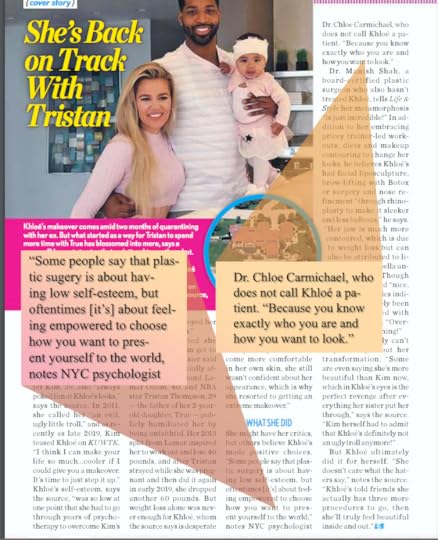 Recent news about Khloe Kardashian’s transformation through surgery has started an important conversation about why certain people choose to have procedures done. While I can’t speak for Khloe, since I do not work with her, I can say that it’s impossible to know someone’s motivations without knowing them personally, and, often, plastic surgery helps people maintain their confidence and self image. it’s important to remember that plastic surgery can be a source of positive change in someone’s life!
We don’t always know the reasons for someone’s personal transformation. There are many reasons a person could choose to have plastic surgery, and it can be hurtful to assume plastic surgery is a direct result of low self esteem. Plastic surgery can be a way for someone to increase their self confidence in their image, and feel more like themself. Often, it can be in pursuit of creating an outer appearance that matches the person inside.
Plastic surgery can empower a person to choose how they want to present themself to the world because they have a clear sense of self, and they know exactly how they want to look.
When people have dramatic surgeries, they might look like a completely new person to you. However, keep in mind that, to them, they are embracing the image of themself that they have always had inside. This kind of dramatic surgery can invite and open a new beginning for people who have undergone plastic surgery procedures.
If you are considering having plastic surgery, it’s important you know your own motivations! If you’re feeling uncertain about why you are going through with a procedure, you can ask yourself these questions to explore if you’re empowering yourself by choosing plastic surgery, or if you might be making a decision based on negative feelings about yourself.
Do you have a clear sense of what you want? Or do you find yourself scanning for ideas for future procedures, without a clear sense of what you want?
Are you being influenced? Are you doing it because anyone else in your life is telling you to do it?
Are you being safe and responsible? Are you compromising yourself financially for these procedures and/or going to doctors that you don’t really trust in order to save money because you want more procedures?
Whether or not you choose to have plastic surgery is a personal decision, but don’t let stereotypes or assumptions about these procedures stop you from becoming the person you want to be! If you are embracing the inner you by making an outer change, be empowered in that choice, and celebrate the transformation to a truer self!


