Rachel Manija Brown's Blog, page 8
February 10, 2025
The Moonday Letters, by Emmi Itäranta
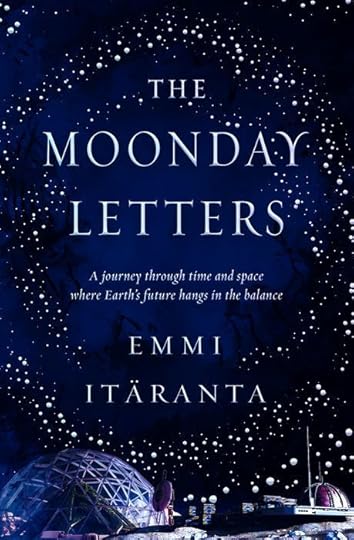
Isn't that a gorgeous cover?
The book is an odd, dreamy work of epistolatory science fiction/fantasy, mostly in the form of unsent letters written by Lumi to her nonbinary spouse Sol. She's in the habit of writing a journal of letters to Sol, as they both often travel separately throughout the solar system for work, and giving them to Sol when they reunite. But this time, their reunion keeps getting delayed, and she keeps arriving at places just after Sol has left. Is Sol evading their own spouse, and if so, why?
The plot sounds like a mystery, but it's structured as a quest and feels like an unusually detailed dream. Beautiful images swim in and out, and moments feel fraught with a meaning just out of grasp. At one point Lumi visits Europa, whose cities are under the sea and where everyone speaks only in whispers, and even those only when absolutely necessary, because loud noises could crack the ice. In true dream fashion, that doesn't really make sense, but it's vivid and compelling.
Lumi follows in Sol's footsteps, occasionally gaining clues, while thinking back on their relationship and realizing that maybe she doesn't know Sol as well as she thought. She's from an Earth which has been radically restructured and is largely a playground for wealthy visitors, while the people actually live there are poor and often desperate to get difficult-to-obtain passports out; she apprentices with a woman who does magical soul healing with a spirit animal, gets her own spirit animal, and also a passport to Mars; many years later, she's still uneasily conscious of her status as an immigrant.
Lumi travels often within the solar system as a soul healer, always accompanied by her cat Ziggy; the difficulties of traveling with a cat are realistically detailed, and Ziggy is very present in the story without ever affecting the plot. We eventually learn that she had another cat who was euthanized when the space station she and Sol lived on was shut down due to a plague, and only humans were allowed off. Is that why Lumi is so determined to never leave Ziggy behind? She doesn't say. Is Lumi's soul healing real? Sol doesn't believe in it, but Lumi's spirit animal feels as present, when it appears, as Ziggy. (Ziggy survives. Lumi's spirit animal may or may not, it's complicated.)
( Read more... )
I'm not sure if some of the book's oddities - Lumi's extreme calm, Sol's unknowability, the emotionally distanced feeling in a story whose action is entirely driven by a marriage, the very open ending - are flaws or exactly what the author intended. I enjoyed reading it a lot, because it's so atmospheric and I will forgive a lot for atmosphere, and it feels so different from most books.
Itäranta is Finnish and wrote her first two books in Finnish and English simultaneously! Not sure if she did the same for this one.
 comments


February 5, 2025
Book Recs Wanted for my bookshop
1. Books on autism, ADHD, and other forms of neurodiversity. They can be either general or geared toward self-help.
Criteria: 1) MODERN! They should ideally have been published within the last five years. 2) Written for laypeople, not scientists or medical professionals. 3) NOT looking for pure memoirs like "my life as an autistic person," though elements of memoir are fine.
2. Books on human behavior/neuropsychology that are NOT self-help - think Oliver Sacks, except not actually by Oliver Sacks.
Criteria: 1) Not by Oliver Sacks, V. S. Ramachandran, Atul Gawande, or Robert Sapolsky as I already know about them, but that's the sort of thing I'm thinking of. 2) MODERN! Ideally, published within the last five years. 3) Not bullshit, woo-woo, or otherwise totally unsupported by any factual evidence, I'm looking at you Julian Jaynes. 4) Not right-wing or misogynistic. No "evolutionary biology says women evolved to be sex slaves."
How are Sapolsky's more recent books like Behave? I've only read Why Zebras Don't Get Ulcers.
3. Mind-expanding biology books for laypeople. Like Ed Yong and Siddhartha Mukherjee's books, but not by them as I already know about them.
For all of these, I would particularly like books written by women if there's any suitable.
 comments
Criteria: 1) MODERN! They should ideally have been published within the last five years. 2) Written for laypeople, not scientists or medical professionals. 3) NOT looking for pure memoirs like "my life as an autistic person," though elements of memoir are fine.
2. Books on human behavior/neuropsychology that are NOT self-help - think Oliver Sacks, except not actually by Oliver Sacks.
Criteria: 1) Not by Oliver Sacks, V. S. Ramachandran, Atul Gawande, or Robert Sapolsky as I already know about them, but that's the sort of thing I'm thinking of. 2) MODERN! Ideally, published within the last five years. 3) Not bullshit, woo-woo, or otherwise totally unsupported by any factual evidence, I'm looking at you Julian Jaynes. 4) Not right-wing or misogynistic. No "evolutionary biology says women evolved to be sex slaves."
How are Sapolsky's more recent books like Behave? I've only read Why Zebras Don't Get Ulcers.
3. Mind-expanding biology books for laypeople. Like Ed Yong and Siddhartha Mukherjee's books, but not by them as I already know about them.
For all of these, I would particularly like books written by women if there's any suitable.
comments
February 4, 2025
Charles Waters & Hart Tanner (Middle Falls Time Travel), by Shawn Inmon
Charles Waters is a middle-aged accountant who's clearly autistic, though undiagnosed. He leads a solitary and uneventful life until he's given one month to live. He lives it and dies. Then he wakes up in the doctor's office, being given one month to live...
This is a fun and unusual riff on the Middle Falls formula, give Charles's very short time span in which to make changes. (The Universal Life Center, which annoys me as always, does eventually make some changes too, to give the poor guy a chance.) The story is about how Charles can live his life to the fullest and expand what he thinks are his limits without messing with his essential self. In this case, the key is friendship with a guy in his apartment building whose life is just as limited as Charles's was initially, but in a less obvious way. It's very sweet.
99% of the book treats Charles's unstated but obvious autism as just how he is, not something that needs to be fixed or makes him spiritually special or anything other than an important aspect of his character. There is one bit of dialogue that implies that maybe he's actually God (!!!), of course at the Universal Life Center, but that's never mentioned again and the Universal Life Center characters clearly have no idea what's really going on.
Content notes: Charles dies of cancer, but there's no real details.

Hart Tanner is an elderly con man, currently scamming and being the boy toy of even older ladies, until he dies a particularly miserable death. He wakes up a young man, before his life goes completely to shit, and quickly discovers that every time he dies, he wakes up at the same point. It's the perfect get out of jail free card! Except, of course, a life with no challenges or real relationships eventually gets boring...
The book doesn't go in the obvious direction of being about Hart growing a conscience, realizing how he hurt people, and turning over a new leaf; that does happen, more or less, but it's not what the story is about. Nor, when he meets up with his abusive mother, is it about forgiving and reconciling with her THANK GOD - how that does go down is very satisfying if you had bad parents. What's it mostly about is, as is usual with Middle Falls, creating and maintaining an important relationship. In this case, that relationship is mostly with a little rescue mutt named Mushu. There is dog death in the context of Mushu eventually dying of old age, but because of how time travel works, it's impermanent in a similar way to how Hart's deaths are impermanent. The whole story is really touching.
Both these books were very enjoyable and good examples of the series.
Content notes: Child abuse (mostly in the past), suicide (in the context of knowing you'll just immediately wake up in a new life), dog death (ditto, and peacefully of old age.)
 comments
January 29, 2025
The Fisherman, by John Langan
An old man whose wife died of cancer takes up fishing, and becomes fishing buddies with a younger man whose wife and kids died in a car crash. His friend finds a mysterious diary about a legendary fishing spot, and they drive to it. On the way they stop at a diner, where the owner tells them a very long story about the horrific history of that fishing spot. Then they go to fish it, and not unexpectedly, it does not go well.
Cosmic horror as nested tall tales by fishermen; about half or a third of the book consists of a single story-within-the-story. It's very well-written and the mythology is interesting, but I wish I'd read it without having experienced the hype around it, because while it's a good solid novel, I was not as wowed as I'd expected.
I loved the first third, which is very Stephen King-esque and mostly about grief and living anyway and making connections with other damaged people, with hints of creepiness in the background. The long diner story is objectively cool, but I really wanted to get back to the old widower. And while the weird fish he catches is an outstandingly creepy moment, the other stuff that happened felt more like just another horror story; it wasn't as original and mythic as the legendary figure of Der Fisher from the diner story or as intimate and touching as his ordinary life at the start.
It's a good book but not an outstanding one. The unusual structure didn't quite work for me - I would have liked it better as a pair of linked novellas.
 comments
January 27, 2025
Witchcraft for Wayward Girls, by Grady Hendrix
A group of pregnant teenagers at a home for unwed mothers in 1970 learn witchcraft. Sounds pretty awesome, right?
The home is miserable and emotionally abusive. They're slut-shamed constantly, made to work like Cinderella, and banned from doing anything entertaining. There's a ton of horrific medical abuse. The girls are all given fake names and banned from telling each other their real names or anything about their real life. They all - every one of them - obey this absolutely, with the exception of a few slips. (VERY improbable! Not a single one of them says "Screw this, when we're in private you can call me Linda.") Their babies are sold to adoptive parents. Girls who want to keep their babies are threatened with everything from homelessness to being locked up for life in an asylum until they give them up. But then one of them gets a book on witchcraft...
Based on the premise, I thought this would be about the girls banding together to get revenge on their abusers and forge better lives for themselves.
Haha nope! It's 80% pregnancy/abuse misery, 15% pregnant girls being exploited by witches, and 5% MAX pregnant girls doing anything for themselves including revenge.
I am not big on pregnancy in fiction. I did love the premise, but I assumed it would more about pregnancy being the thing that trapped the girls in a bad situation, and less about the physical details of pregnancy. It is EXTREMELY about the physical details of pregnancy. It has the most graphic birth scene I have ever read, and that includes in literal guides to childbirth.
I was really surprised by how little witchcraft there is. It doesn't even get introduced until about a quarter of the way in, when one of the girls gets a book on witchcraft from a librarian who is also a witch. Then there's a ton of time before they actually try a spell. Then, after they do a very successful spell - that they even use a blinded study on to make sure it's not a coincidence - all but one of the girls lose all interest in witchcraft and there's no more spells for ages. I think there's only three spells done in the entire (long) book.
Given the emphasis on how incredibly bored the girls are and how much they hate the people running the home, AND that the one spell they master is a very versatile one (Turnabout - give something you're experiencing to another person), this seems less in-character and more like Hendrix really didn't want to write the witchcraft, much as an erotica author might think, "Oh God, not another sex scene."
The afterword mentions that the first two drafts of the book did not have witches. That explains a lot. The book is mostly an expose on the horrific injustices done to pregnant teenagers pre-Roe (very earnest - Hendrix got the idea because this happened to two women in his family - but bordering on misery porn as a reading experience), plus tacked-on witches.
The witches/witchcraft elements are very inconsistent, as if Hendrix didn't know exactly what he wanted to do with them. The book on witchcraft has the kind of sisterhood and female empowerment rhetoric that was what I expected Witchcraft for Wayward Girls to be about, but the librarian-led coven (which wrote the witchcraft book) is a rag-tag group of basically homeless women who mostly seem pathetic and whose only interest in the pregnant girls is using the most powerful one for their own selfish ends.
Sometimes witchcraft seems very powerful, sometimes it seems useless. The pregnant girls are mostly not interested in using it, and have no imagination in terms of what they might be able to use it for. At one point they have spells they could use to turn invisible, fly, etc, and they don't even bother to try them because there's no spell that fits a very specific goal they have -- without even considering trying out the magic they do have as part of an overall plan to accomplish their goal! They keep saying it's pointless to do magic because it can't get them money and a home, but some of the spells actually could do that, if they were willing to say invisibly rob a bank.
In general, the depiction of witchcraft is very negative. Most of what we see involves exploitation, self-mutilation, and general misery. The pregnant girls are miserable, but the witches are also miserable. The Magical Negro cook who helps out the white girls (the one black girl renounces witchcraft very early on) uses magic to fight the witches, but doesn't consider herself a witch and thinks magic is evil (I guess except the magic she uses? very inconsistent!)
( Read more... )
The overall attitude to witchcraft is both inconsistent and annoying. The end implies that it's a metaphor for female empowerment, but nothing in the rest of the book supports that. Most of the time, the witches are evil or pathetic or both. When the protagonist finally has her baby, she thinks that bringing life into the world is the REAL magic that puts witchcraft to shame BARF FOREVER.
If you want a book where teenage girls get revenge and the upper hand, 99% of the book is not that. Also, the word "pregnant" is used about 5000 times, or maybe it just felt that way.
I generally like Grady Hendrix on women's issues, but WOW was this one a miss.
Content notes: Told not shown child sexual abuse. Upsetting depictions of medical abuse, emotional abuse, misogyny, slut-shaming, self-mutilation, and forcibly separating mothers from babies. THREE extremely graphic and horrifying birthing scenes. An absolutely classic Magical Negro. Pervasive and graphic pregnancy details.
 comments
January 23, 2025
Dr. C. Lillefisk's Sirenology: A Guide to Mermaids and Other Under-the-Sea Phenomenon
By Jana Heidersdorf.
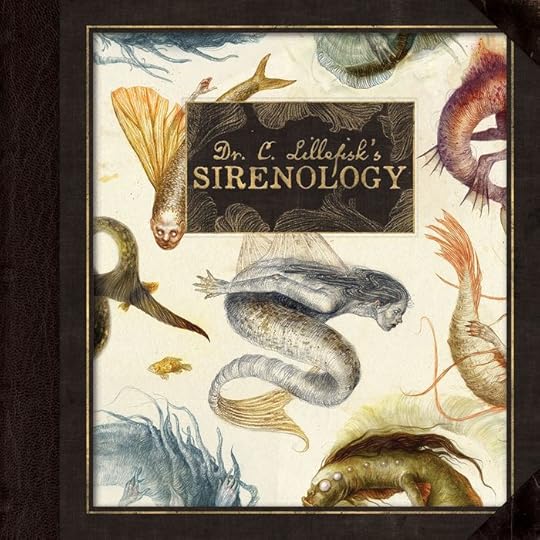
A gorgeous art-and-worldbuilding book - a small genre which I adore - purporting to be the sketch and notebook of a sirenologist studying mermaids. The mermaids are mostly not human-intelligent, or at least if they are, humans can't tell. Some are beautiful, some are eerie, some are strange, some are all three. The notes are fascinating, and the worldbuilding on mermaids is very original and interesting. Heidersorf put a lot of thought into how aquatic ecologies work, and there's a great balance of strange fantasy and inspiration from strange real creatures. The overall effect is like reading a guidebook to natural history from another world.
I loved this book and think it's absolutely worth the price.
This was based on her limited edition book "100 Mermaids", and you can see them here.
More mermaids, many of which didn't make the book but are just as cool as the ones that did.
https://www.boredpanda.com/weird-beautiful-mermaids-jana-heidersdorf/
 comments
A gorgeous art-and-worldbuilding book - a small genre which I adore - purporting to be the sketch and notebook of a sirenologist studying mermaids. The mermaids are mostly not human-intelligent, or at least if they are, humans can't tell. Some are beautiful, some are eerie, some are strange, some are all three. The notes are fascinating, and the worldbuilding on mermaids is very original and interesting. Heidersorf put a lot of thought into how aquatic ecologies work, and there's a great balance of strange fantasy and inspiration from strange real creatures. The overall effect is like reading a guidebook to natural history from another world.
I loved this book and think it's absolutely worth the price.
This was based on her limited edition book "100 Mermaids", and you can see them here.
More mermaids, many of which didn't make the book but are just as cool as the ones that did.
https://www.boredpanda.com/weird-beautiful-mermaids-jana-heidersdorf/
comments
January 21, 2025
The Return, by Rachel Harrison
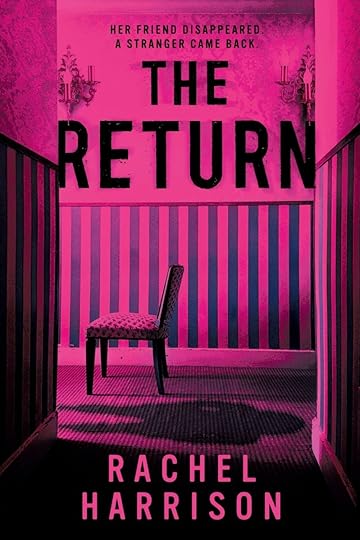
Elise, Julie, Mae, and Molly are best friends, until Julie vanishes without a trace. Two years later, Julie returns in very bad shape and claiming no memory of where she's been. Once Julie is more recovered, her friends arrange a girls' week at a fancy hotel to catch up and reignite their friendship.
It's immediately clear that Julie came back wrong, and there are strong suggestions that there's something wrong with the hotel too. But Elise, the narrator, and Mae, who arranged the trip, are extremely set on denying that anything is wrong. A lot of the book consists of Molly trying to get Julie to talk and trying to get the other two to admit that something is wrong, and Elise and Mae refusing to listen. This is the central issue of the entire book, which is about denial and trying to insist one's preferred reality into existence, but it's frustrating to read.
The September House does something similar, but it was a lot more tolerable as at least Margaret isn't denying that there's ghosts, she's just denying that the ghosts are a problem. In The Return, when blood drips from the ceiling, Elise insists that it's just tinted water from a rusty pipe. In The September House, when blood drips down the walls, Margaret cheerfully cleans it up and crosses her fingers that no one else will notice the stain.
The slow-burn horror is well-done and the truth about Julie is pleasingly weird and even kind of original. The ending is quite moving, and the friend group dynamics are plausible for a particular type of people who I find annoying - extremely self-obsessed people whose friend groups border on frenemies. (They're canonically in their late 20s, but they act more like they're in their very early 20s.) But ultimately it feels like Rachel Harrison moves in really different social circles than I do, and that's deliberate on my part because those people are maddening. They're basically the women that women's magazines are written for - not the actually good magazines like Teen Vogue, stuff like the modern equivalent of 1980s Cosmopolitan that assumes you have a high-powered job but are also very concerned with Goop, thigh-toning, and office gossip.
 comments
It's immediately clear that Julie came back wrong, and there are strong suggestions that there's something wrong with the hotel too. But Elise, the narrator, and Mae, who arranged the trip, are extremely set on denying that anything is wrong. A lot of the book consists of Molly trying to get Julie to talk and trying to get the other two to admit that something is wrong, and Elise and Mae refusing to listen. This is the central issue of the entire book, which is about denial and trying to insist one's preferred reality into existence, but it's frustrating to read.
The September House does something similar, but it was a lot more tolerable as at least Margaret isn't denying that there's ghosts, she's just denying that the ghosts are a problem. In The Return, when blood drips from the ceiling, Elise insists that it's just tinted water from a rusty pipe. In The September House, when blood drips down the walls, Margaret cheerfully cleans it up and crosses her fingers that no one else will notice the stain.
The slow-burn horror is well-done and the truth about Julie is pleasingly weird and even kind of original. The ending is quite moving, and the friend group dynamics are plausible for a particular type of people who I find annoying - extremely self-obsessed people whose friend groups border on frenemies. (They're canonically in their late 20s, but they act more like they're in their very early 20s.) But ultimately it feels like Rachel Harrison moves in really different social circles than I do, and that's deliberate on my part because those people are maddening. They're basically the women that women's magazines are written for - not the actually good magazines like Teen Vogue, stuff like the modern equivalent of 1980s Cosmopolitan that assumes you have a high-powered job but are also very concerned with Goop, thigh-toning, and office gossip.
comments
January 20, 2025
Bury Your Gays, by Chuck Tingle
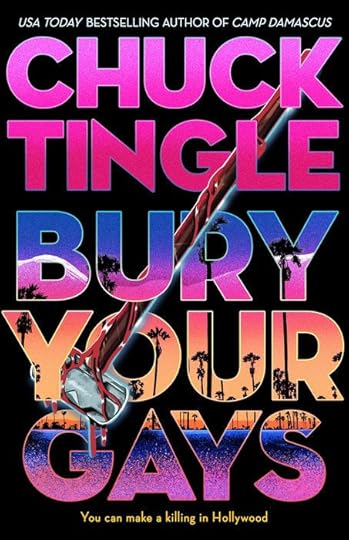
Misha, a closeted TV writer and screenwriter, has two characters he's been building up for a lesbian love story. This is personally important to him due to a traumatizing childhood experience with TV characters he thought might be gay before that rug got yanked, so when his producer orders him to either make them straight or kill them, he refuses. But then he starts getting stalked by the horror characters he created in previous movies...
This is a very fun book with a lot of heart-- it's both metafictional/satirical and very earnest. I enjoyed it quite a bit, but it suffered from being read immediately after Camp Damascus. The latter is just a better book. In particular, this book has several gaping plot holes while Camp Damascus didn't have that issue.
( Read more... )
I also liked the Camp Damascus characters and setting better. (Tingle said in an interview that he wrote them both more-or-less at the same time.) That being said, Bury Your Gays is good and inventive and worth reading in its own right. I particularly enjoyed all the media within the book - not just Misha's movies, but his once-beloved X-Files-ish childhood TV series and a homoerotic horror movie where sweaty Marines have to strip each other to cut out a deadly worm.
Content notes: Some intense violence, including a very graphic torture/murder scene. Upsettingly realistic flashbacks to being a queer kid in a homophobic environment.
 comments
January 18, 2025
I think he would have appreciated this
I dreamed last night that I was working on a David Lynch movie. It was called Slow Loris, and was a horror movie about a slow loris. He had fallen in love with the loris playing the loris, and went everywhere with it clinging to his shoulder, its enormous eyes slowly blinking.
 comments
comments
January 17, 2025
Trail of the Lost: The Relentless Search to Bring Home the Missing Hikers of the Pacific Crest Trail
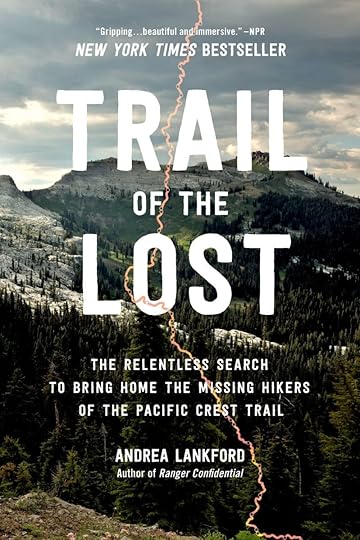
Park ranger and search & rescue leader Andrea Lankford gets interested in three seemingly unrelated disappearances of hikers on the PCH, and launches a multi-year effort to find them.
This is conceptually very up my alley and is an interesting topic, but I didn't love the book. Some of the details were intriguing, but Lankford's style bugged me. It's a bit melodramatic and promises things that are not quite delivered. For instance, early on she makes a big point of "ARE these cases unrelated? Isn't it suspicious that three unmarried young men vanished on the PCH, exactly one per year?"
No. No, it isn't. Hiking the PCH is an extremely strenuous, time-consuming, and male-dominated hobby involving being gone for up to six months. It self-selects for people who are young, unmarried, and male. That's not victimology, that's statistics. Also, there are others who vanish on the trail but eventually get found in very non-suspicious circumstances, and it's not uncommon for people to die on this fairly dangerous hike, so... no! It's not weird that some bodies don't get found.
Lankford makes a big deal of there being criminal activities and cults in the area, but the cult turns out to be pretty benign and not kidnapping anyone, and the big crime she uncovers is mushroom poaching. There's interesting stuff going on - her effort helps to uncover two other missing people, one dead and one mentally ill - but it feels like she wants to write a true crime book when there's nothing suggesting there ever was a crime. She also comes across a bit self-congratulatory.
The book is also not very well-organized. I kept losing track of which hiker they were doing what to find.
In the end, ( Read more... )
I file this with The Cold Vanish as a "missing persons in the wilderness" book that could have been better.
 comments