Stella May's Blog, page 20
December 10, 2021
Down on the Farm
from Catherine Castle
Some of my fondest childhood memories are of visiting my grandparents down on their farm.
Mom and Dad would pack us up in the car after Dad got home from work and we’d drive down into the hills of Kentucky for the weekend.
The house would always be dark when we arrived. Grandma and Grandpa didn’t have a phone, so they were never expecting us on our weekend trips. It was probably only nine or ten p.m. when we arrived, but my grandparents were farmers who went to bed with the chickens the minute it got dark outside.
 The moment Daddy pounded on the door, my grandparents awoke and the lights came on. After hugs and kisses, we were hustled into the kitchen for hand pies, cornbread, leftover shucky beans, and meat. It never failed to amaze me how much food Grandma had on hand, especially since it was only her and Grandpa there. The hand pies were half-moon pastries made from dried apples Grandma had preserved. The meat varied, depending on whether she’d killed a chicken or they had purchased beef from someone. The shucky beans were the item my mouth always watered for—and still does today. It’s been years since I’ve eaten them, but I remember the salty, silky texture of the once-dried bean.
You say you don’t know what shucky beans are?
Shucky beans are green beans that have been dried in the shell. Shucky beans were always on the table at Grandma’s house. In fact, I don’t remember ever eating any other kind of green bean when we visited her.
 Mom and Grandma always used white half-runner beans, although I do remember Mom using other green beans when she couldn’t get half-runners. Every summer we would visit Grandma and help her preserve the veggies from her garden. Getting the shucky beans ready was something I could do as a child, because Grandma preserved her beans the old-fashioned way. She strung them on cotton thread and hung them on the back porches until they dried.
The process was time consuming, but I don’t remember minding it at all. While the black-eyed Susans nodded in the breeze at the front of the yard, I strung my pan of beans sitting on the white porch swing, listening to the chains creaking softly above me and Mom and Grandma talk. There was something satisfying about watching the green column of beans grow on the thread, knowing I was going to enjoy the taste of them in the fall and winter. Grandma always shared some of the crop with us.
Below are the quick instructions for making Shucky Beans as given to me by my mother. Notice there are no amounts given for beans: Grandma and Mom just strung them until they were all picked from the garden. From my research I’ve discovered a bushel of fresh beans makes about 1 gallon of Shucky Beans.
Grandma’s Shucky Bean RecipePick white, half-runner beans when they have a bean in them. Do not wash beans. Break ends and remove the string from the beans. Using a sturdy needle and white cotton string, knotted on one end, string the beans. Pierce the bean pod and not the bean with the needle. When the string is almost full, tie the ends and place in a warm place to dry: an attic, porch, or in the direct sun.
Depending on how you plan to dry them, either tie the ends together to make a circle, or make a loop in one end, so they can be hung on a nail. You could also just knot the other end and drape over a clothes line. I know Grandma hung hers on the back porch, but I’ve read about other cooks drying their beans on sheets laid on patio tables, car hoods, and even spread in the back window of a vehicle. If you don’t want to do this the old fashioned way, you can use a food dehydrator. I actually dried a few of them last year on a rack on the kitchen table. I stored them in a glass jar. I haven’t cooked them yet. I just like to open the pantry door and look at them. It reminds me of Grandma and those lazy summers as a child.
Once the beans have dried, they can be stored in the freezer in plastic freezer bags. Just be sure they are really dry before you store them. When you can run your fingers through a batch and hear a rattling sound, reminiscent of the sound dried corn shucks make, beans should be dry enough to store.
 To Cook: Place the beans, strings and all, in a pot and boil for 30 minutes. Drain the water and rinse the beans. Take them off the strings and place in a clean pot with more water and seasonings. A cottage ham or slab of bacon works well as seasoning. Cook until tender, about 2-2 ½ hours.
Some recipes call for the beans to be washed before stringing. Grandma didn’t use pesticides, so she didn’t have to worry about chemicals. If you wash the beans before stringing, make sure they are hung where the air can reach all sides to prevent spoilage. Other recipes also suggest removing the beans from the string before boiling. I’m not sure which method works best, since I can’t recall what I did the one time I cooked the beans.
Have you ever eaten Shucky Beans? How did you like them?
While your beans are cooking, check out Catherine’s Romantic comedy with a touch of drama, A Groom for Mama available on Amazon and Barnes and Noble.
 Beverly Walters is dying, and before she goes she has one wish—to find a groom for her daughter. To get the deed done, Mama enlists the dating service of Jack Somerset, Allison’s former boyfriend.
The last thing corporate-climbing Allison wants is a husband. Furious with Mama’s meddling, and a bit more interested in Jack than she wants to admit, Allison agrees to the scheme as long as Mama promises to search for a cure for her terminal illness.
A cross-country trip from Nevada to Ohio ensues, with a string of disastrous dates along the way, as the trio hunts for treatment and A Groom For Mama.

Multi-award winning author Catherine Castle loves writing. Before beginning her career as a romance writer she worked part-time as a freelance writer. She has over 600 articles and photographs to her credit, under her real name, in the Christian and secular market. She also lays claim to over 300 internet articles written on a variety of subjects and several hundred poems.
In addition to writing she loves reading, traveling, singing, theatre, quilting and gardening. She’s a passionate gardener whose garden won a “Best Hillside Garden” award from the local gardening club. She writes sweet and inspirational romances.
You can find her award-winning Soul Mate books The Nun and the Narc and A Groom for Mama, on Amazon and Barnes and Noble.


December 3, 2021
Friday Feature Thanksgiving Memories

Thanksgiving is family, food, and thankfulness. It’s when you have this homing urge to join your people over a huge roasted turkey. When you were ten you punched your cousin in the nose for some remark he made. When you were eighteen, you were bored and wishing to be somewhere else, but mom made you stay. When you were twenty-eight, you were setting up the children’s table. And so it goes right down to Grandpa who at 90 announced he didn’t need to watch his cholesterol any more and reached for the butter dish. (I loved it when he did that.)
 Our turkey is carved in the kitchen, makes it easier for serving. But when the grandchildren were young, they always expected that rooster to make an appearance at Thanksgiving. It’s a tradition as such. They are grown-ups…
View original post 715 more words
THE HIDDEN DISORDER
by Eris Field
 Image by Deedee86 from Pixabay
 Hoarding is a clinical disorder that affects 5% of the population. It tends to start when the person is 12 to 13 years old, often after a loss—death of a loved one, parents’ divorce, or losing cherished possessions in a fire, flood, or hurricane. It has a genetic component. That is it tends to run in families. It also has a neurobiological basis. It has been found that there are abnormalities of certain brain structures (areas of the brain). These brain structures are involved in decision making, attention, organization, and regulation of emotions. Their impairment of functioning is evidenced in emotional responses, thinking, and behaviors that are different from people who do not have a hoarding disorder.
In addition to their compulsive hoarding disorder, 25% of people will have co-existing illnesses such as depression and anxiety. In addition, people with hoarding disorder often experience problems with planning ahead, making decisions, and having an unrealistic desire for everything to be perfect.
Symptoms of hoarding include:
• Experiencing severe anxiety over the thought of discarding possessions because the saved items give them a sense of security
• Buying or saving things that are unnecessary, worthless, or useless
• Accumulating huge amounts of objects that have little or no value such as old magazines, telephone books, clothing, shoes, hats, bottles, boxes, and empty food containers
• Having numerous animals such as cats that they cannot care for
• Inability to organize space for items—hoarded items take over space needed for activities of normal living
The effects of hoarding can be severe and often affect family relationships, work, health, and everyday life activities such as cooking, shopping, sports, and having friends, children or grandchildren visit.
Hoarding disorder often results in:
• Crowded, dangerous (risk of fires or falls), and unsanitary living conditions including the presence of vermin and mold that may endanger the person’s health
• Loss of a cooking space, eating area, and living room, bedroom, halls, closets, basement, garage, porches, and yard due to accumulations of hoarded items
• Loneliness
• Family conflicts and isolation from loved ones
• Inability to perform work as expected
• Financial problems related to compulsive purchasing of unneeded objects or the care of an accumulation of a large number of pets
• Legal problems such as threats of eviction.
What you can do to help:
• Encourage them to seek professional help
• Suggest self-help groups such as Clutterers Anonymous
• After treatment, help them with their belongings if they ask for help. Remember that many feel great anxiety if anyone touches their things
• Remember that hoarding is an illness like other illnesses such as diabetes or kidney disease,
• Don’t remove things without their permission
• Don’t expect perfection or constancy
My novel, The Gift of Love, is a story of hoarding and the perils of the disorder. I hope it helps you understand the problem so many people must face.

Laurel, a 26-year-old slightly impulsive pediatric nurse learned her survival skills through early years in foster care. Her life dream is to provide a home for six abandoned children. But, before she can do anything about the dream, she must sell the huge old house her adoptive parents left her. She must sell it before she falls even deeper into debt. To put it on the market, requires tackling the escalating compulsive hoarding of her reclusive half-sister who lives with her. Paper of all kinds is filling the rooms and hallways of the house. She has tried reasoning, nagging, and threatening. Now in desperation, she borrows from her Union’s Retirement Fund to go to a conference on the latest treatments for Compulsive Hoarding.
Andrew, a 39-year-old psychiatrist, is never impulsive. A reticent, somewhat austere man, he limits his interactions with people to his work. His life is strictly planned and modelled on the life of his grandfather who was one of hundreds of orphaned boys raised by Father Baker. Despite the scorn of his father, an entrepreneurial plastic surgeon, he prefers to practice psychiatry in the underserved communities of Buffalo, New York. Being handed Jamie, the mute two-year-old grandson of his father’s second wife, as he is about to leave for the conference where he has agreed to fill in for a colleague is definitely not part of his life plan.
When they first meet, a series of unfortunate events cause Laurel to view Andrew as arrogant, rude, but disturbingly attractive and Andrew to view Laurel as a dangerous distraction to be avoided. Faced with a crisis, they are forced to work together, but will they be able to put aside their protective armor and trust each other enough to let love in?
Amazon Buy Link
Eris Field was born in the Green Mountains of Vermont—Jericho, Vermont to be precise—close by the home of Wilson Bentley (aka Snowflake Bentley), the first person in the world to photograph snowflakes. She learned from her Vermont neighbors that pursuit of one’s dream is a worthwhile life goal.
As a seventeen year old student nurse at Albany Hospital, Eris met a Turkish surgical intern who told her fascinating stories about the history of Turkey, the loss of the Ottoman Empire, and forced population exchanges. After they married and moved to Buffalo, Eris worked as a nurse at Children’s Hospital and at Roswell Park Cancer Institute.
After taking time off to raise five children and amassing rejection letters for her short stories, Eris earned her master’s degree in Psychiatric Nursing at the University at Buffalo. Later, she taught psychiatric nursing at the University and wrote a textbook for psychiatric nurse practitioners—a wonderful rewarding but never to be repeated experience.
Eris now writes novels, usually international, contemporary romances. Her interest in history and her experience in psychiatry often play a part in her stories. She is a member of the Romance Writers of America and the Western New York Romance Writers. In addition to writing, Eris’s interests include: Prevention of Psychiatric Disorders; Eradicating Honor Killings, supporting the Crossroads Springs Orphanage in Kenya for children orphaned by AIDS, and learning more about Turkey, Cyprus, and Kurdistan.
Learn more about Eris Field on her website. Stay connected on Facebook. >.
December 1, 2021
Wednesday Special Spotlight Holiday divine desert
Talk about a dessert that delivers, this divine cheesecake takes…well, takes the cake! Whether you’re hosting the party or on board to bring something tasty, this dressed up treat will make heads turn, and mouths water. Perfect for holiday gatherings or celebrations, with a total prep and bake time of 5 hours and 30 minutes (includes refrigeration), this cheesecake easily serves a crowd of sixteen of your closest cohorts.
 Toblerone Caramel Cheesecake
1¼ cups Oreo Baking Crumbs
¼ cup butter, melted
3 packages (250 g/8.82 ounces each) brick cream cheese, softened
¾ cup packed brown sugar
1 tablespoon vanilla
3 eggs
⅓ cup caramel ice cream topping
1 bar (100 g/3.52 ounces) Toblerone Swiss Milk Chocolate, coarsely chopped
Preheat oven to 350° F.
Mix crumbs and butter in a small bowl. Press mixture onto…
View original post 372 more words
November 26, 2021
HITTING THE SAUCE
from Helen Carpenter
My husband and I like to hit the sauce at lunchtime—no, wait! That didn’t sound right! What I meant to say is we like barbeque sauce for lunch! At least, that’s my story, and I’m sticking to it.
While we’re not sauciers or even a saucier’s apprentice, we do enjoy experimenting with flavors, because we are well aware that what’s sauce for the goose may not be sauce for the chicken.
However, in the case of our Simply Saucy Crockpot Barbeque Chicken, we seldom think outside the box—the box being the carton brick of fresh, sun-ripened Italian tomatoes that is the base of this delicious recipe.
Tomatoes in a box? Yep. We highly recommend that you give your can the boot. Switching to the box will turn you into a superb saucy chef, and the effect on your condiments will be awesome sauce. Pretty soon you’ll be hitting the sauce too! (The barbeque sauce, of course!)
Simply Saucy Crockpot Barbeque Chicken

1 box (26.4 oz) finely chopped tomatoes
⅓ cup Parmesan cheese
3 tbsp. sugar or honey
1 tsp garlic salt
1 tsp Worcestershire sauce
1 tsp minced garlic
½ tsp black pepper
2-3 cups shredded cooked chicken
Put tomatoes, cheese, sugar, garlic salt, Worcestershire sauce, garlic, and black pepper in crockpot. Stir to mix.
Add chicken.
Cook on high setting for 2-3 hours; or low setting for 4-6 hours.
Serve on rolls, or eat as a main dish with a side of chips.
 Once upon a time there was a mother/daughter author duo named Helen and Lorri, who wrote as HL Carpenter. The Carpenters worked from their studios in Carpenter Country, a magical place that, like their stories, was unreal but not untrue. Then one day Lorri left her studio to explore the land of What-if, and like others who have lost a loved one the magical place lost much of its magic. But thanks to family, plus an amazing group of wordsmiths named Authors Moving Forward (AMF), the magic is slowly returning.
Helen Carpenter loves liking and sharing blog posts from other authors. She lives in Florida with her husband of many years and appreciates everyday, especially those without hurricanes.
Stay connected on her blog and Facebook .
November 24, 2021
November 19, 2021
THANKSGIVING MEMORIES
from Emma Lane
Thanksgiving is family, food, and thankfulness. It’s when you have this homing urge to join your people over a huge roasted turkey. When you were ten you punched your cousin in the nose for some remark he made. When you were eighteen, you were bored and wishing to be somewhere else, but mom made you stay. When you were twenty-eight, you were setting up the children’s table. And so it goes right down to Grandpa who at 90 announced he didn’t need to watch his cholesterol any more and reached for the butter dish. (I loved it when he did that.)
 Our turkey is carved in the kitchen, makes it easier for serving. But when the grandchildren were young, they always expected that rooster to make an appearance at Thanksgiving. It’s a tradition as such. They are grown-ups now, but they still search the china cabinet for the collection of salt ‘n pepper shakers, each person has his/her favorite set. Our dining room table is custom made wide at the bottom to seat two people comfortably. As a result, I have no matching pad. Straw oversized placemats do an admirable job of protecting the wood surface from the heated dishes. I use a table cloth, but still enjoy the colorful cloth placemats to echo the vibrant Fall colors. With the addition of fruit cups, water glasses, and matching candles, the table arrangement is complete, waiting only for the train of hot dishes and the blessing before the feast is begun.
 Turkey for everyone! White for the kids and dark meat for my hubby and me. They have always been convenient preferences. We reserve baked ham for Christmas dinner. Lima beans (butter beans) for my son, green bean casserole for my daughter. Each person has a favorite. I love yellow squash while my hubby adores sweet potato soufflé. My daughter makes all the pies, usually pumpkin and apple. The grands like the fruit cups that are sometimes surrounded by red Jell-O and sometimes by whipped cream. Dressing?? We make a raison (Crasins substitute) and walnut type topped by a couple of baked chicken parts. The recipe changes almost every time. There is a fresh veggie plate with tomatoes, celery, carrots, and sliced zucchini for nibbling. Other dishes may be added each year.
Once I had an idea to bake a mid-sized (huge) Hubbard squash and stuff it with a mixture of squash, onion with a touch of maple syrup topped with scrambled southern style sausage. It was so tasty, but a bear to get to the table. I dropped it from the menu. What memories does your family love each Thanksgiving get together?
Happy Thankful Day to you and yours from my home to yours.
Emma
How about a glimpse into my new Cozy Mystery, MURDER AT THE LOOKOUT while you digest your feast?
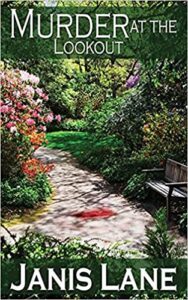 When is it not fun to be a blond?
What happens when a blond beauty hits town like a tornado stirring up memories and causing turmoil? Detective Kevin Fowler and his wife, the former Beverly Hampton, owner of the local newspaper, are settling into blissful married life. Although Beverly is sanguine over the demand on Kevin’s time by the good people of Hubbard, she is more than dubious when his duties include the escort of a drop-dead gorgeous female from his past.
There is some concern over the persistent vandalism of residential mailboxes, but an infamous arsonist has decided peaceful but dull Hubbard would make a great place from which to operate. He brazenly locates down the block from the detective and his wife.
What bait and tackle shop in the village has a dual purpose? Kevin ponders why two goons have invaded town shooting at and attempting to kidnap and murder three women. A state patrolman, aptly nick named Rooster, teases Fowler at the riotous scene of a traffic accident where the press, not the police, wins the day.
Another mystery and adventure with a satisfying ending unfolds in peaceful Hubbard, New York, small-town Americana, where Detective Kevin Fowler keeps an ever-vigilant watch.

Emma Lane is a gifted author who writes cozy mysteries as Janis Lane, Regency as Emma Lane, and spice as Sunny Lane.
She lives in Western New York where winter is snowy, spring arrives with rave reviews, summer days are long and velvet, and fall leaves are riotous in color. At long last she enjoys the perfect bow window for her desk where she is treated to a year-round panoramic view of nature. Her computer opens up a fourth fascinating window to the world. Her patient husband is always available to help with a plot twist and encourage Emma to never quit. Her day job is working with flowers at Herbtique and Plant Nursery, the nursery she and her son own.
Look for information about writing and plants on Emma’s new website. Leave a comment or a gardening question and put a smile on Emma’s face.
Stay connected to Emma on Facebook and Twitter. Be sure to check out the things that make Emma smile on Pinterest.
November 12, 2021
Sparking a Writer’s Creativity
by Leigh Goff
If I struggle with writing a descriptive scene, I know it’s time to step outside my present environment (the sofa, a hot cup of coffee, and a fluffy dog at my feet) and explore the world around me—really explore it. There’s something about traveling and sightseeing that stimulates my senses and creativity and it might be just what other writers need, too.
 Photo courtesy of Cody Board Unsplash
When I was little, I loved traveling to visit my grandparents every summer. I remember counting down the days and planning what to pack in my blue and red-striped suitcase. I remember the excitement of my first airplane ride and my first trip to Disney World. Disney was like nothing else I’d ever experienced. It went something like this—the Florida sun blazed hot against my skin while the magical kingdom around me smelled of caramel apples and mouth-watering vanilla waffles. And, oh, the stomach-whirling water rides and fantasy-filled adventures that swept me away while I was there. When I arrived home after that first visit, I wrote all about it in my diary, every scrumptious detail. I didn’t want to forget where I’d been and what it felt like to be there because if I didn’t go back ever again, I would be able to revisit that dream-like place in my diary.
I’m an adult now, however, I still need to explore different worlds in order to get my writer’s creativity flowing. Whether my travels include walking in the woods, trekking through London, or taking a ghost tour of the historic buildings and cemeteries in my hometown, every trip is filled with descriptive possibilities. I don’t know if a future main character will end up lost in a city café ordering escargots and later singing along to a street musician’s rendition of ‘Chevaliers de la Table Ronde,’ but I’ll be able to describe it with accuracy because I’ve done it.

One memorable sightseeing trip was to Paris, which included a stop at the Louvre. Breathtaking. I’m talking about the artworks—every single one I saw, including Leonardo Da Vinci’s Mona Lisa. The masterpiece was smaller than I’d imagined, but she was a rock star. Crowds lined up outside the salon for a glimpse of her. Finally, it was my turn. She was beautiful, mysterious, wise, and timeless.
As I stood there before her, I thought about the Da Vinci Code written by Dan Brown. I found myself recalling his vivid descriptions of the museum including its parquet floors, vaulted archways, glass pyramid, and the paintings’ gilded frames. Being there in person was amazing, but if I hadn’t had that experience, Dan Brown’s descriptions of the Louvre and a few of its precious contents were the next best thing to being there.
Writers create or recreate worlds with words and traveling experiences can be the spark for those words. As author Larry Brooks once said, “Writers experience the world…in a unique way. We look for meaning. We see it when we are not paying attention…We are scribes to the ticking of the days, and we have a job to do.” We just need to get out there and experience it for ourselves.
Here is a little from my latest novel for your reading pleasure.

Sixteen-year-old Hannah Fitzgerald has always known she is descended from a royal legacy of dark magic. Although a stranger to her coven in Annapolis, she is no stranger to grief and denial. However, when an ancient prophecy reveals the rise of a young, powerful witch and the impending death of another, she realizes she can no longer afford to suppress the magic that has taken away so much. She seeks out the frighteningly scarred, yet mysterious W who is destined to change her life, but even he cannot prepare her for the danger that lies ahead.
Engaged in a deadly game and not knowing whom her true rival is, Hannah isn’t certain she will survive, and if she loses, she may lose everything, including the ones she loves.
EXCERPT
The imposing entrance segued into the main part of the old family chapel. Shadows flickered across the white walls as candlelight streamed down from an ornate iron chandelier cradling clear-colored hurricanes. Angelic sculptures hung between the arched windows and beneath the cloud-painted ceiling that Michelangelo himself would have envied, four wooden pews graced each side of the aisle.
I tiptoed farther in and spotted another black-lined white envelope on the altar. I was definitely in the right place.
My fingers trembled as I traced the letters that formed my name. This was way beyond ordinary, but why and—more importantly—who?
“W?”
A hint of the Shadow’s amber and woods scent mixed with the faint candle smoke of the chapel. “No. Way.” I spun around ready to stomp right out of there.
In that moment, a heavy gaze fell on me and the air felt charged with electricity. I searched right and left, seeing no one. “W? Whoever you are, show yourself.”
“This will be the hardest thing you’ve ever done.” His potent voice reverberated off the walls and seemed to come from everywhere, including the inside of my head.
I locked my wandering gaze on the loft above the entrance where I spotted his silhouette. “Was leaving me in a burning wreck the hardest thing you ever had to do? Was it?” I raised my volume. “Who are you? Why did you leave me for dead?”
His intake of breath was audible. “I would never. I mean. I didn’t want to do that. I don’t.”
“Oh, lucky me.” I stuck my hands on my hips and tapped an impatient foot on the floor. “If you don’t want to finish me off, then you lured me here to do what, exactly?”
“To help you. I want to help you.”
“Ha!” The sarcastic laugh burst out before I could stop it. “You’ve done a bang up job inspiring my confidence and trust in that department.”
He simmered in silence for a moment. “What do I have to do to inspire you to follow my directions?”
Following someone else’s directions was definitely not my strength. I grimaced, but curiosity got the better of me. “What do you want?”
“You read the note.”
His desire to remain in the shadows was increasingly irritating. “I consider myself a very smart girl, so when a guy who left me in a burning car tells me he wants to help me take on a different deadly problem, I have to wonder if he’s not setting me up to fend for myself again. What’s your motive?”
I dropped my eyes to the envelope, turning it to and fro.
“Emme Blackstone is a mutual enemy and means us both harm.” A tinge of anger laced his tone.
The anger, I understood. After all, we were talking about Emme, but there was also a hint of sadness that intrigued me further. “Why do you think Emme means you harm?”
“It’s inevitable—because of what I am.”
What was he besides completely contemptible?
“It’s in her blood and I believe it’s in her destiny to wreak havoc, especially against someone who can challenge her in talent like you can.”
I dropped my hands to my sides, still clasping the enveloping. “Whoa. Like me? You don’t know me. You don’t know anything about me. How could you? I’ve been gone for the last year.”
A chortle caught in his throat. “What’s a year when you come from a bloodline with hundreds of years of history? A history that’s written down and available to certain people with the right—pedigree.”
Confused, I creased my brow as I continued to stare at his silhouette. “Have you been cyber-stalking me on Ancestry.com or something?”
“Hardly.” There was disdain in his voice as if he considered cyber-stalking to be worse than leaving a girl to die.
“Look, whatever you think you know about my family, I’m not like them. I’m not talented, and I don’t want to challenge Emme. I just want to live a normal life. Normal.” My voice escalated. “Do you hear me all the way up there?”
He huffed. “Normal? You don’t get to pretend to be normal when you’re not. It doesn’t work like that. Not in Annapolis. Someone always knows. Someone always unravels your secrets.”
I thought of the Witch’s Grave. I pictured the women’s slender figures dangling from sturdy, gnarled branches. Their tragic endings proved what I already knew. Magic only brought suffering and death. “You make it sound like I don’t have a choice. I’m telling you I do, and I won’t be a part of this.” I stomped my foot hard on the floor.
He shifted from the shadows into a dim ray of light, seething. “You read the note and you know Emme won’t stop. You need my help.”
I glared, trying desperately to make out the details of his face. “I don’t need anything from you.”
“You don’t have to like it, but that doesn’t change the fact that you are a part of this. You know you are or you wouldn’t have come here. However, if that’s how you feel then you should leave.” The cold in his voice crystallized.
My pulse escalated. “Yup. That’s how I feel. And I’m only leaving because that’s what I want to do, not because you suggested it. Bye.” I marched to the door and wrapped my hand around the knob. I yanked it open. From the moment I’d first laid eyes on him, he’d been nothing but trouble. Horrible, awful trouble. However, as much as I hated to think it, he knew about me and the other witches in town. He was full of answers—answers I needed. I shut the door and turned back around. “How do you know all this about Emme and me?”
AMAZON BUY LINKS KINDLE – PAPERBACK
Leigh Goff loves writing young adult fiction with elements of magic and romance because it’s also what she liked to read. Born and raised on the East Coast, she now lives in Maryland where she enjoys the area’s great history and culture.
Leigh is a graduate of the University of Maryland, University College and a member of the Maryland Writers’ Association and Romance Writers of America. She is also an approved artist with the Maryland State Arts Council. Her debut novel, Disenchanted, was inspired by the Wethersfield witches of Connecticut and was released by Mirror World Publishing. Leigh is currently working on her next novel, The Witch’s Ring which is set in Annapolis.
Learn more about Leigh Goff on her website and blog. Stay connected on Facebook, Instagram, Pinterest, and Goodreads.
November 5, 2021
Love, Food, and Magic
from C.D. Hersh
Our book Can’t Stop the Music opens in Woodstock and is filled with musical references of the era and food.
 Today we’re talking about love, food, and magic. Love was plentiful at Woodstock. Magic mushrooms were probably plentiful, also, but food not so much. The producers didn’t expect the overwhelming crowd that should up and the vendors ran out of food in a very short time.
But you don’t have to worry about that, because we’ve got a special treat for you today.
As writers, we know that love and food go together like romance and a happily-ever-after ending. Maybe that’s why in most of our novels the hero and heroine share a meal of some sort. There’s just something magical about a special dinner with the one you love. Don’t you remember that special dinner, or dinners, with your honey? On the first dinner Catherine made for Donald she accidently fed him a toothpick—which he unwittingly ate. Trust us, we remember that!
Like most humans, we like to eat, and food works its way into our stories. In our book, Can’t Stop the Music (The Soul Mate Tree Book 2) the hero cooks an Italian meal for the heroine that is positively orgasmic. Can’t Stop the Music is a nostalgic romance set in Woodstock 1969 and contains a paranormal element. The paranormal involves a magic Soul Mate Tree that grants soul mates to deserving persons.
The Soul Mate tree is
An ancient legend spanning eras, continents, and worlds.
To some, it’s nothing more than a dream.
To others, a pretty fairy tale handed down through the generations.
For those in critical need of their own happy ending, a gift.
And our heroine and hero are in definitely in need of a happy ending.
Speaking of happy, who doesn’t love a delicious pasta dish? We do, but pasta is something we don’t eat a lot of anymore because of the high carb content. Recently, we’ve begun experimenting with ways to make high-carb pasta meals friendlier, because we do miss our pasta. In the process, we’ve discovered things like lentil and soybean pastas that are great substitutes for wheat pasta. They have a high fiber to carb ratio, which not only puts more fiber in the diet, but slows the release of sugars into the blood stream, both which are great boons to people with insulin resistance issues. The soybean pasta is fantastic and has become our go-to pasta for spaghetti.
Unfortunately, we haven’t found a soybean lasagna. So, Catherine got creative and made a meatless version of lasagna that uses a smaller amount of lasagna on the bottom of the dish and substitutes sliced zucchini for the pasta in the other layers. Putting a single layer of pasta on the bottom provides the traditional taste of lasagna and helps the servings come out of the dish better, without the added high-glycemic carbohydrates. We made this lasagna recipe meatless, but you could use a meat sauce if you prefer. Bon appétit!
Mushroom Zucchini Lasagna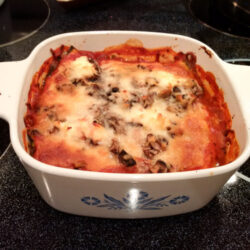 Serves four
2 sheets oven-ready lasagna pasta
½ jar (1 1/3 cups) spaghetti or marina sauce (any flavor you prefer)
2-3 oz. fresh baby spinach (2-3 handfuls)
1 8 oz. box sliced mushrooms
2 small zucchinis, sliced into scant 1/8 inch thick ribbons
1 cup shredded mozzarella cheese
12 tbsp. low-fat ricotta cheese
Trim ends of zucchinis until they fit inside a square 1-1/2 quart baking dish. Then slice zucchinis into scant 1/8 inch thick ribbons. Place on a plate and salt liberally both sides. Let stand about an hour to draw out the excess moisture. Rinse off salt and pat slices dry with a paper towel. Set aside.
Rinse mushrooms and place in a skillet or large saucepan. Using 2 sharp-bladed spatulas, coarsely chop mushrooms in the pan. (Alternately, you could use a knife and cutting board, but Catherine found this method to be quicker.) Sauté mushrooms in a couple tablespoons of water until the mushrooms darken and excess water from the fungi has appeared in the pan. Drain and set aside.
Fit the 2 sheets of pasta in the bottom of a square, 1-1/2 quart baking dish, breaking edges off as necessary so the pasta lays flat in the bottom. Remove pasta and broken pieces from the dish.
Pour 1/3 cup pasta sauce in the bottom of the dish and lay the pasta sheets and broken pieces on top.
On top of this base, layer 1/3 cup pasta sauce, 1/4 cup shredded mozzarella cheese, 1/3 cup mushrooms, a handful of spinach, torn into small pieces, and four tablespoons of ricotta cheese (dotted over the top of the spinach), and enough zucchini slices to cover the ingredients. Spread the ingredients so they are evenly layered. Repeat layers to the depth the dish allows, ending with a layer of zucchini, sauce, ricotta cheese and mozzarella cheese.
Bake 45 minutes.
Let stand and couple of minutes before cutting. Catherine found using a chef’s knife to cut the layers works best to cut through the zucchini without destroying the layers. Serve with a fresh salad and warm, Italian garlic bread.
Note: We went light on the cheeses, which gave each square of lasagna about 1 serving each of the cheeses. If you like a heavier cheese taste, add more cheese on each layer.
Serve the lasagna with a fresh green salad and some yummy Italian bread and you have a complete meal.
After the dishes are done and you’re ready to relax, download Can’t Stop the Music (The Soul Mate Tree Book 2) and take a trip back to Woodstock 1969 with our heroine Rose and her Italian stallion Dakota. To whet your appetite, here’s a peek at Rose and Dakota’s first meeting. Enjoy!
 As they made their way to the festival site, Rose and her friends grooved to the music coming from the stage.
When they reached the makeshift bridge over the road, someone yelled, “Hey beautiful! You with the red hair.”
She looked around to see if there was anyone else with red hair. Then she glanced up and spotted two guys, one blond and the other dark-haired, leaning over the side of the bridge.
“Yeah, you,” the blond called out as he caught her gaze.
Willow halted beside her. “He’s cute. How about him?”
Rose looked away, her gaze landing on the other guy.
He jabbed his companion in the ribs. “Quit trying to pick up every girl you see.” Then he leaned farther over the rail. “Don’t pay any attention to him. He’s high.”
“So she’s not beautiful?” Willow yelled to the hippie.
She poked her friend. “Stop it, Willow, you’re making a scene.” In spite of her protest, her gaze remained on the dark-haired guy.
He rested his elbows on the rail and stared back at her. The intensity of his expression shot heat into her belly.
“I didn’t say that, just that she shouldn’t pay attention to him.” He flapped a hand at his blond buddy, then tapped his own chest with his thumb several times as if to say, ‘Choose me!’
Does he want me to pay attention to him? Her heart thumped in rhythm to his jabbing thumb.
“Take that one,” Willow whispered. “He’s the real cutie.”
Before she could respond, the crowd pushed them forward. When they reached the other side of the bridge, she looked back, searching for the dark-haired hippie, but the spot where he’d stood was empty.
Just my luck. I see someone who’s intriguing and he disappears.
With a sigh, she continued the trek to the festival grounds.
 C.D. Hersh–Two hearts creating everlasting love stories.
Putting words and stories on paper is second nature to co-authors C.D. Hersh. They’ve written separately since they were teenagers and discovered their unique, collaborative abilities in the mid-90s. As high school sweethearts and husband and wife, Catherine and Donald believe in true love and happily ever after.
They have a short Christmas story, Kissing Santa, in a Christmas anthology titled Sizzle in the Snow: Soul Mate Christmas Collection, with seven other authors. Plus their paranormal series titled The Turning Stone Chronicles.
They are looking forward to many years of co-authoring and book sales, and a lifetime of happily-ever-after endings on the page and in real life.
Join them on social media:
October 29, 2021
Happy Halloween
Origins of Halloween

Halloween is a holiday celebrated each year on October 31 The tradition originated with the ancient Celtic festival of Samhain when people would light bonfires and wear costumes to ward off ghosts. In the eighth century, Pope Gregory III designated November 1 as a time to honor all saints. Soon, All Saints Day incorporated some of the traditions of Samhain. The evening before was known as All Hallows Eve, and later Halloween. Over time, Halloween evolved into a day of activities like trick-or-treating, carving jack-o-lanterns, festive gatherings, donning costumes, and eating treats.
Halloween’s origins date back to the ancient Celtic festival of Samhain (pronounced sow-in). This day marked the end of summer and the harvest and the beginning of the dark, cold winter, a time of year that was often associated with human death. Celts believed that on the night before the new year, the boundary between the worlds of the living and the dead became blurred. On the night of October 31, they celebrated Samhain, when it was believed that the ghosts of the dead returned to earth.
In addition to causing trouble and damaging crops, Celts thought that the presence of the otherworldly spirits made it easier for the Druids or Celtic priests, to make predictions about the future.
To commemorate the event, Druids built huge sacred bonfires, where the people gathered to burn crops and animals as sacrifices to the Celtic deities. During the celebration, the Celts wore costumes, typically consisting of animal heads and skins, and attempted to tell each other’s fortunes.
When the celebration was over, they re-lit their hearth fires, which they had extinguished earlier that evening, from the sacred bonfire to help protect them during the coming winter.
Article from History.com 2021