
Simon Ings's Blog, page 11
April 1, 2023
The monster comes from outside

Reading To Battersea Park by Philip Hensher for The Spectator, 1 April 2023
We never quite make it to Battersea Park. By the time the narrator and his husband reach its gates, it’s time for them, and us, to return home.
The narrator is a writer, living just that little bit too far away from Battersea Park, inspired by eeriness of the Covid lockdown regime but also horribly blocked. All kinds of approaches to fiction beckon to him in his plight, and we are treated to not a few of them here.
Each section of this short novel embodies a literary device. We begin, maddeningly, in “The Iterative Mood” (“I would have”, “She would normally have”, “They used to…”) and we end in “Entrelacement”, with its overlapping stories offering strange resolutions to this polyphonous, increasingly surreal account of Lockdown uncanny. Every technique the narrator employs is an attempt to witness strange times using ordinary words.
Hensher didn’t just pluck this idea out of the void. Fiction has a nasty habit of pratfalling again and again at the feet of a contemporary crisis. Elizabeth Bowen’s The Heat of the Day (the Blitz) dribbles away into an underpowered spy thriller; Don DeLillo’s Falling Man (the September 11 attacks) only gets going in the last few dozen pages, when the protagonist quits New York for the poker-tournament circuit. Mind you, indirection may prove to be a winning strategy of itself. The most sheerly enjoyable section of To Battersea Park is a “hero’s journey” set in post-apocalyptic Whitstable. Hensher nails perfectly the way we distance ourselves from a crisis by romanticising it.
Milan Kundera wrote about this — about how “the monster comes from outside and is called History” — impersonal, uncontrollable, incalculable, incomprehensible and above all inescapable.
In To Battersea Park, Hensher speaks to the same idea, and ends up writing the kind of book Kundera wrote: one that appeals, first of all — almost, I would say, exclusively — to other writers.
In the middle of the book there’s a short scene in which a journalist interviews a novelist called Henry Ricks Bailey, and Bailey says:
“When people talk about novels, if they talk at all, they talk about the subject of those novels, or they talk about the life of the person who wrote it. This is a wonderful book, they say. It’s about a couple who fall in love during the Rwandan Genocide, they say… It’s as if all one had to do to write a novel is pick up a big box of stuff in one room and move it into the next.”
This (of course, and by design) borders on the infantile: the writer boo-hooing because the reader has had the temerity to beg a moral.
Hensher is more circumspect: he understands that the more you do right by events — the endless “and-then”-ness of everything — the less you’re going to to able to interest a reader, who has after all paid good money to bathe in causes and consequences, in “becauses” and “buts”.
To Battersea Park reveals all the ways we try to comprehend a world that isn’t good or fair, or causal, or even comprehensible. It’s about how we reduce the otherwise ungraspable world using conventions, often of our own devising. An elderly man fills half his house with a model railway. A dangerously brittle paterfamilias pumps the air out of his marriage. A blocked writer experiments with a set of literary devices. A horrified child sets sail in an imaginary boat. It’s a revelation: a comedy of suburban manners slowed to the point of nightmare.
That said, I get nervous around art that’s so directly addressed to the practitioners of that art. It’s a novel that teaches, more than it inspires, and a small triumph, in a world that I can’t help but feel is gasping for big ones.


March 29, 2023
“The white race cannot survive without dairy products”

Visiting Milk at London’s Wellcome Collection. For the Telegraph, 29 March 2023
So — have you ever drunk a mother’s milk? As an adult, I mean. Maybe you’re a body-builder, following an alternative health fad; maybe you’re a fetishist; or you happened to stumble into the “milk bar” operated now and again by performance artist Jess Dobkin, whose specially commissioned installation For What It’s Worth — an “unruly archive” of milk as product, labour and value —
brings the latest exhibition at London’s Wellcome Collection to a triumphant, chaotic and decidedly bling climax.
Why is breast milk such a source of anxiety, disgust, fascination and even horror? (In Sarah Pucill’s 1995 video Backcomb, on show here, masses of dark, animated hair slither across a white tablecloth, upturning containers of milk, cream and butter.)
Curators Marianne Templeton and Honor Beddard reckon our unease has largely to do with the way we have learned to associate milk almost entirely with cow’s milk, which we now consume on an industrial scale. It’s no accident that, as you enter their show, an obligatory Instagram moment is provided by Julia Bornefeld’s enormous hanging sculpture, suggestive at once of a cow’s udders and a human breast.
Milk is also about Whiteness. In “Butter. Vital for Growth and Health”, an otherwise unexceptionable pamphlet from the National Dairy Council in Chicago (one of the hundred or so objects rubbing shoulders here with artworks and new commissions), there’s a rather rather peculiar foreword by Herbert Hoover, the man who was to become the 31st U.S. President. “The white race,” Hoover writes, “cannot survive without dairy products.”
Say what?
Hoover (if you didn’t know) was put in charge of the American Relief Administration after the first World War, and saw to the food supply for roughly 300 million people in 21 countries in Europe and the Middle East. Even after government funding dried up, the ARA still managed to feed 25 to 35 million people during Russia’s famine of 1921-22 — which remains the largest famine relief operation in world history.
So when Hoover, who knows a lot about famine, says dairy is essential to the white race, he’s not being malign or sectarian; he believes this to be literally true — and this exhibition goes a very long way to explaining why.
Large portions of the world’s population react to milk the way my cat does, and for the same reason — they can’t digest the lactose. This hardly makes dairy a “White” food unless, like Hoover, your terms of reference were set by eugenics; or perhaps because, like some neo-Nazis in contemporary USA, you see your race in terminal decline, and whole milk as the only honest energy drink available in your 7-11. (Hewillnotdivide.us, Luke Turner’s 2017 video of drunk, out-of-condition MAGA fascists, chugging the white stuff and ranting on about purity, is the least assuming of this show’s artistic offerings, but easily the most compelling.)
Milk also asks how dairy became both an essential superfood and arguably the biggest source of hygiene anxiety in the western diet. Through industry promotional videos, health service leaflets, meal plans and a dizzying assortment of other ephemera, Milk explains how the choice to distribute milk at scale to a largely urban population led to the growth of an extraordinary industry, necessarily obsessed with disinfection and ineluctably driven toward narrow norms and centralised distribution; an industry that once had us convinced that milk is not just good for people, but is in fact essential (and hard cheese (sorry) to the hordes who can’t digest it).
The current kerfuffle around dairy and its vegan alternatives generates far more heat than light. If one show could pour oil on these troubled waters (which I doubt), it isn’t this one. No one will walk out of this show feeling comfortable. But they will have been royally entertained.
March 22, 2023
The sirens of overstatement
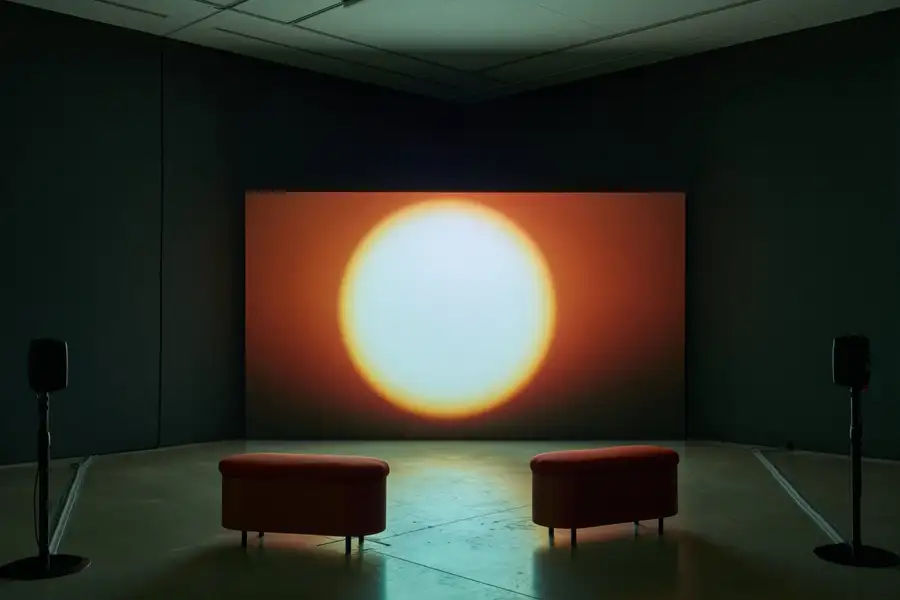
The Edge of Forever, one of four short films by Brighton-based video and installation artist David Blandy, opens with an elegaic pan of Cuckmere Haven in Sussex. A less apocalyptic landscape it would be hard to imagine. Cuckmere is one of the most ravishing spots in the Home Counties. Still, the voiceover insists that we contemplate “a ravaged Earth” and “forgotten peoples” as we watch two children exploring their post-human future. The only sign of former human habitation is a deserted observatory (the former Royal Observatory at Herstmonceux Castle in Sussex). The children enter and study the leavings of dead technologies and abandoned ambitions, steeped all the while in refracted sunlight: Claire Barrett’s elegiac camerawork is superb.
The films in Blandy’s installation “Atomic Light” connect three different kinds of fire: the fire of the sun; the wildfires that break out naturally all over the earth, but which are gathering force and frequency as the Earth’s climate warms; and the atomic blast that consumed the Japanese city of Hiroshima on 6 August 1945.
There’s a personal dimension to all this, beyond Blandy’s vaunted concern for the environment: his grandfather was a prisoner of the Japanese in Singapore during the second World War, and afterwards lived with the knowledge that, had upwards of 100,000 civilians not perished in Hiroshima blast, he almost certainly would not have survived.
Bringing this lot together is a job of work. In Empire of the Swamp
a man wanders through the mangrove swamps at the edge of Singapore, while Blandy reads out a short story by playwright Joel Tan. The enviro-political opinions of a postcolonial crocodile are as good a premise for a short story as any, I suppose, but the film isn’t particularly well integrated with the rest of the show.
Soil, Sinew and Bone, a visually arresting game of digital mirrors composed of rural footage from Screen Archive South East, equates modern agriculture and warfare. That there is an historical connection is undeniable: the chemist Franz Haber received the Nobel Prize in Chemistry in 1918 for his invention of the Haber–Bosch process, a method of synthesising ammonia from nitrogen and hydrogen. That ammonia, a fertiliser, can be used in the manufacture of explosives, is an irony familiar to any GCSE student, though it’s by no means obvious why agriculture should be left morally tainted by it.
Alas, Blandy can’t resist the sirens of overstatement. We eat, he says “while others scratch for existence in the baked earth.” Never mind that since 1970, hunger in the developing world has more than halved, and that China saw its hunger level fall from a quarter of its vast population to less than a tenth by 2016 — all overwhelmingly thanks to Haber-Bosch.
Defenders of the artist’s right to be miserable in face of history will complain that I am taking “Atomic Light” far to literally — to which I would respond that I’m taking it seriously. Bad faith is bad faith whichever way you cut it. If in your voiceover you dub Walt Disney’s Mickey “this mouse of empire”, if you describe some poor soul’s carefully tended English garden as the “pursuit of an unnatural perfection wreathed in poisons”, if you use footage of a children’s tea party to hector your audience about wheat and sugar, and if you cut words and images together to suggest that some jobbing farmer out shooting rabbits was a landowner on the lookout for absconding workers, then you are simply piling straws on the camel’s back.
Thank goodness, then, for Sunspot, Blandy’s fourth, visually much simpler film, that juxtaposes the lives and observations of two real-life solar astronomers, Joseph Hiscox in Los Angeles and Yukiaki Tanaka in Tokyo, who each made drawings of the sun on the day the Hiroshima bomb dropped.
Here’s a salutary and saving reminder that, to make art, you’re best off letting the truth speak for itself.
March 15, 2023
Moral good taste
Reading Humanly Possible by Sarah Bakewell for the Telegraph, 15 March 2023
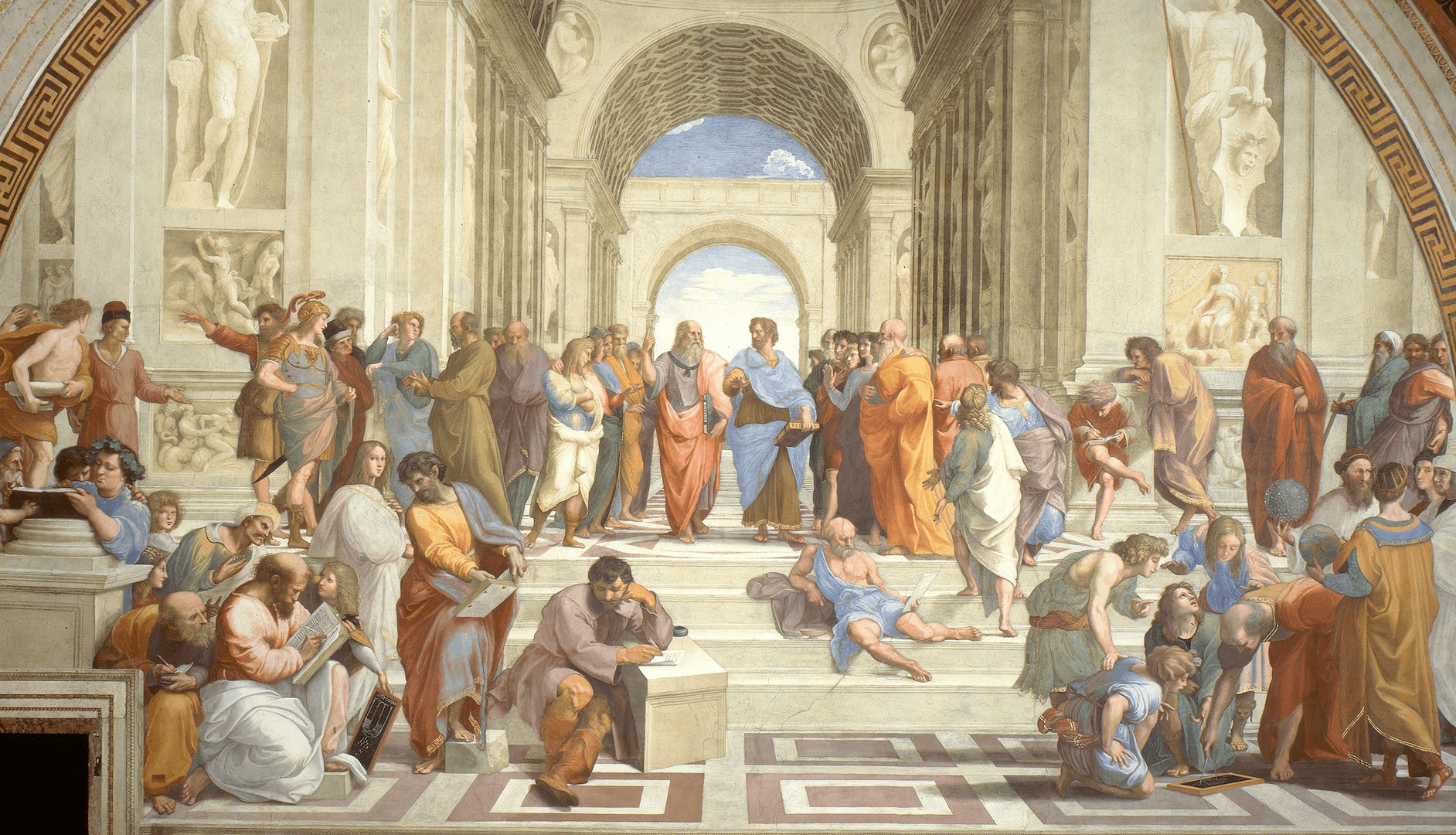
In 1362 Western literary culture took a swerve when Petro Petroni, a monk from Siena, told Giovanni Boccaccio of his recent vision: that if Boccaccio didn’t stop collecting non-Christian books (never mind writing them), God was going to kill him. Boccaccio, somewhat rattled, told his friend, the poet Petrarch, and Petrarch, being a bibliophile, was unimpressed: if Boccaccio did decide to take Petroni’s advice, would he mind giving him first pick of the discards?
Humanly Possible is an anecdotal history — witty, warm-hearted (here and there, gratingly matey) — of the Western mind’s seven-hundred-year effort to ignore priestly and sectarian blarney, so as to nurture its own voice, its own conscience, its own good. Humanists believe that we each of us have a spark of good will and that, fed on charity, education and civic effort, all these sparks can together enlighten society.
Bakewell acknowledges that such civilising efforts are traceable in many traditions, and have probably been going on for ever. (And I do mean forever. I remember the relief I felt once, walking through Athens’s Acropolis museum, as I left behind the dead-eyed, fatuously grinning statues of the Archaic period (550 BC) for the dignified, melancholy, humane creatures of the Classical era that followed.)
Bakewell’s is story of spiritual and intellectual triumph, beginning in Italy around 1300 and which, thanks to that bloody Twentieth century — its two world wars and litany of totalitarian atrocity — ends with a hideous and disturbing twist.
Organising Europe’s humanists into a “tradition” is rather like herding cats. Bakewell’s organisational ability deserves applause. Here, bibliomanes like Boccaccio give way to physicians like Vesalius, then, via memoirists like Montaigne and philosophers like Paine and Hume, to novelists like E.M. Forster, with his impassioned plea that we “only connect!” with each other. It’s an epic, spine-tingling, seamless account.
Bakewell, who used to look after early printed books at the Wellcome Library in London, has a melting love of all those joyful 16th-century recitations of human excellence, and does a terrific job of communicating the ethical achievements behind such apparent fripperies as the Third Earl of Shaftesbury’s “Inquiry Concerning Virtue and Merit”, which would replace stern religiosity and unthinking obedience with nothing more than “a kind of moral ‘good taste’”.
I was reminded here of Kenneth Clark, in the 1969 TV series Civilisation, trying to explain why the paintings of Watteau (of all people) represent some sort of ethical high-water mark for western civilisation. In both cases, the point is well made, and well received, but at the same time, both assertions feel a bit underwhelming. All that cultural effort, all that struggle and invention, suffering and heroism, led up to — good taste? (Bakewell, fully aware of the problem, quotes the Cambodian filmmaker Rithy Panh: “There’s also a banality of good; and an everydayness of good.”)
The argument against humanism goes like this: an unbeliever, guided purely by their own conscience, is a person without morals. If society tolerated such people, breakdown would ensue.
And the awful thing is that this argument is not altogether wrong. Sometimes, breakdown is exactly what happens. Josef Stalin didn’t see to the deaths of 20 million of his own people by being an anti-humanist. Not at all: he was one of the best-read men of his generation, obsessed to the point of madness with constant intellectual and (though he wouldn’t have called it this) spiritual self-improvement. All fascism’s John-the-Baptist figures — from Maurice Barres to Martin Heidegger — were humanists maddened by the alienations of heavy industry, looming automation and evident democratic failure.
It’s not that the humanist idea is flawed, so much as it is no defence against our self-fulfilling belief in our own badness (and that’s a switch that’s frighteningly easy to throw: Bakewell mentions Savonarola and “his bonfire of the vanities”, but, generously, turns a blind eye to Greta Thunberg).
In his autobiography, quoted here, the Austrian novelist Stefan Zweig talked of the humanists’ “beautiful error” — believing that “better learning, better reading and better reasoning would be enough to bring about a better world.”
Bakewell is too clear-eyed an historian, and too honest a writer, to gloss over the weakness of this pose. But she’s clear enough about the alternatives, too. They’re all species of harshness in Bakewell’s chatty and persuasive book — one form or another of force or war or slavery. We may feel jolly silly at times, waving Oscar Wilde’s love of curtain fabrics in the face of the world’s barbarity — but that might be as good a weapon as we’ll ever get.
March 8, 2023
A finite body in space
Reading Carlo Rovelli’s Anaximander and the Nature of Science for New Scientist, 8 March 2023
Astronomy was conducted at Chinese government institutions for more than 20 centuries, before Jesuit missionaries turned up and, somewhat bemused, pointed out that the Earth is round.
Why, after so much close observation and meticulous record-keeping did seventeenth-century Chinese astronomers still think the Earth was flat?
The theoretical physicist Carlo Rovelli, writing in 2007 (this is an able and lively translation of his first book) can be certain of one thing: “that the observation of celestial phenomena over many centuries, with the full support of political authorities, is not sufficient to lead to clear advances in understanding the structure of the world.”
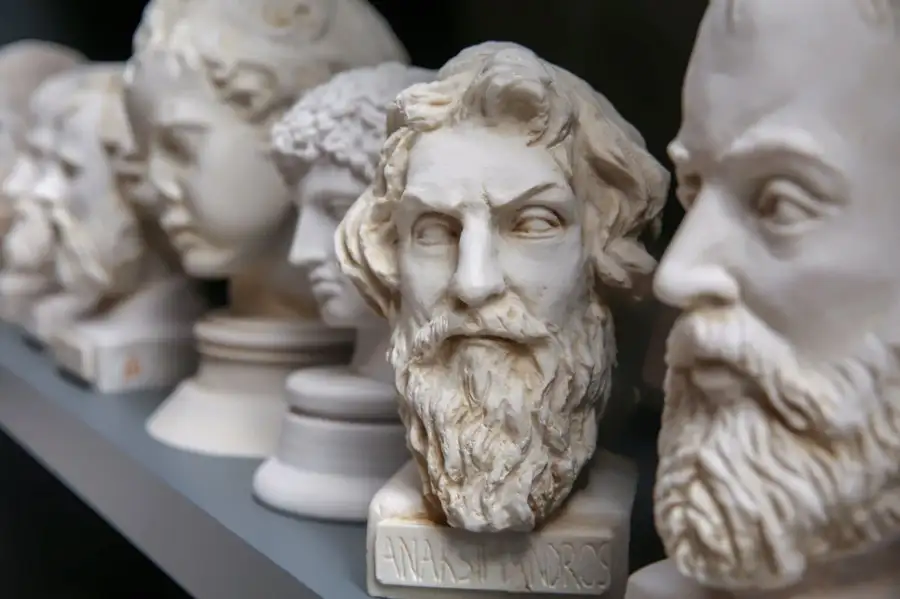
So what gave Europe its preternaturally clear-eyed idea of how physical reality works? Rovelli’s ties his several answers — covering history, philosophy, politics and religion — to the life and thought and work of Anaximander, who was born 26 centuries ago in the cosmopolitan city (population 100,000) of Miletus, on the coast of present-day Turkey.
We learn about Anaximander, born 610 BCE, mostly through Aristotle. The only treatise of his we know about is now lost, aside from a tantalising fragment that reveals Anaximander’s notion that there exist natural laws that organise phenomena through time. He also figured out where wind and rain came from, and deduced, from observation, that all animals originally came from the sea, and must have arisen from fish or fish-like creatures.
Rovelli is not interested in startling examples of apparent prescience. Even a stopped watch is correct twice a day. He is positively enchanted, though, by the quality of Anaximander’s thought.
Consider the philosopher’s most famous observation — that the Earth is a finite body of rock floating freely in space.
Anaximander grasps that there is a void beneath the Earth through which heavenly bodies (the sun, to take an obvious example) must travel when they roll out of sight. This is really saying not much more than that, when a man walks behind a house, he’ll eventually reappear on the other side.
What makes this “obvious” observation so radical is that, applied to heavenly bodies, it contradicts our everyday experience.
In everyday life, objects fall in one direction. The idea that space does not have a privileged direction in which objects fall runs against common sense.
So Anaximander arrives at a concept of gravity: he calls it “domination”. Earth hangs in space without falling because does not have any particular direction in which to fall, and that is because there’s nothing around big enough to dominate it. You and I are much smaller than the earth, and so we fall towards it. “Up” and “down” are no longer absolutes. They are relative.
The second half of Rovelli’s book (less thrilling, and more trenchant, perhaps to compensate for the fact that it covers more familiar territory) explains how science, evolving out of Anaximander’s constructive yet critical attitude towards his teacher Thales, developed a really quite unnatural way of thinking.
Thales, says Anaximander, was a wise man who was wrong about everything being made of water. The idea that we can be wise and wrong at the same time, Rovelli says, can come only from a sophisticated theory of knowledge “according to which truth is accessible but only gradually, by means of successive refinements.”
All Rovelli’s wit and intellectual dexterity are in evidence in this thrilling early work, and almost all his charm, as he explains how Copernicus perfects Ptolemy, by applying Ptolemy’s mathematics to a better-framed question, and how Einstein perfected Newton by pushing Newton’s mathematics past certain a priori assumptions.
Nothing is thrown away in such scientific “revolutions”. Everything is repurposed.
March 6, 2023
“What on Earth do you mean?”
Philosophy is a creature of split impulses. The metaphysicians (think Plato) wonder what things mean; and the analysts (think Socrates) try and pin down what the metaphysicians are on about. When they get over-excited (which is surprisingly often) the metaphysicians turn into theologians, and the analysts become pedants in the mold of Thomas Grandgrind, the schoolmaster in Dickens’s Bleak House, concerned only with facts and numbers.
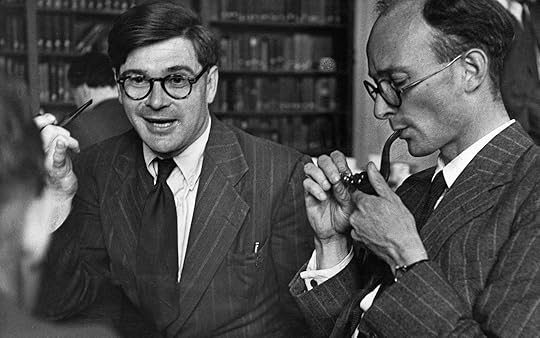
The “analytic” (or “linguistic” or “ordinary language”) philosophy practised at Oxford University in the first half of the last century is commonly supposed to have been at once pedantic and amateurish, “made a fetish of science yet showed an ignorance of it, was too secular, too productively materialist, too reactionary and somehow also too blandly moderate. The critics can’t, surely, all be right,” complains Nikhil Krishnan, launching a spirited, though frequently wry defence of his Oxford heroes: pioneers like Gilbert Ryle and A.J. Ayer and John Langshaw Austin, troopers like Peter Strawson and Elizabeth Anscombe, and many fellow travellers: Isaiah Berlin and Iris Murdoch loom large in an account that weaves biography with philosophy and somehow attains — heaven knows how — a pelucid clarity. This is one of those books that leaves readers feeling a lot cleverer than they actually are.
The point of Oxford’s analytical philosophy was, in Gilbert Ryle’s formulation, to scrape away at sentences “until the content of the thoughts underlying them was revealed, their form unobstructed by the distorting structures of language and idiom.”
In other words, the philosopher’s job was to rid the world of philosophical problems, by showing how they arise out of misunderstandings of language.
At around the same time, in the other place (Cambridge to you), Ludwig Wittgenstein was far advanced on an almost identical project. The chief lesson of Wittgenstein, according to a review by Bernard Williams, was that philosophy cannot go beyond language: “we are committed to the language of human life, and no amount of speculative investment is going to buy a passage to outer space, the space outside language.”
There might have been a rare meeting of minds between the two universities had Wittgenstein not invested altogether too much in the Nietzschean idea of what a philosopher should be (ascetic, migrainous, secretive to the point of paranoia); so, back in Oxford, it was left to dapper, deceptively bland manager-types like John Austin to re-invent a Socratic tradition for themselves.
Krishnan is too generous a writer, and too careful a scholar, to allow just one figure to dominate this account of over half a century’s intellectual effort. It’s clear, though, that he keeps a special place in his heart for Austin, whose mastery of the simple question and the pregnant pause, demand for absolute accuracy and imperviousness to bluster must have served him frighteningly well when interrogating enemy captives in the second world war.
While Wittgenstein concocted aphorisms and broke deck chairs, Austin’s mild-mannered, quintessentially English scepticism acted as a mirror, in which his every colleague and student struggled to recognise themselves: “What on Earth do you mean?” he would say.
Are kitchen scissors utensils or tools?
Why can we speak of someone as a good batsman but not as the right batsman?
Can someone complain of a pain in the waist?
Austin’s was a style of philosophy that’s easy to send up, harder to actually do.
It drove people mad. ”You are like a greyhound who doesn’t want to run himself,” A. J. Ayer once snapped, “and bites the other greyhounds, so that they cannot run either.”
But it’s not hard to see why this project — down-to-earth to the point of iconoclasm — has captured the imagination of philosopher and historian Nikhil Krishnan; he hails from India, whose long and sophisticated philosophical tradition is, he says, :”honoured today chiefly as a piece of inert heritage.”
Krishnan’s biographical approach may be a touch emollient; where the material forces him to choose, he puts the ideas before the idiosyncrasies. But his historical sense is sharp as he skips, in sixty short years, across whole epochs and through two world wars. Oxford, under Krishnan’s gaze, evolves from Churchman’s arcadia to New Elizabethan pleasure-park with a sort of shimmering H G Wells Time Machine effect.
John Austin died in 1960 at only forty-eight; this and his lack of easily-emulated Viennese mannerisms robbed him of much posthumous recognition. But by taking Austin’s critics seriously — and indeed, by stealing their thunder, in passage after passage of fierce analysis — Krishnan offers us a fresh justification of a fiercely practical project, in a field outsiders assume is supposed to be obscure.
March 5, 2023
Wandering off into a blizzard for no reason
Watching Creature, directed by Asif Kapadia, for New Scientist, 5 March 2023
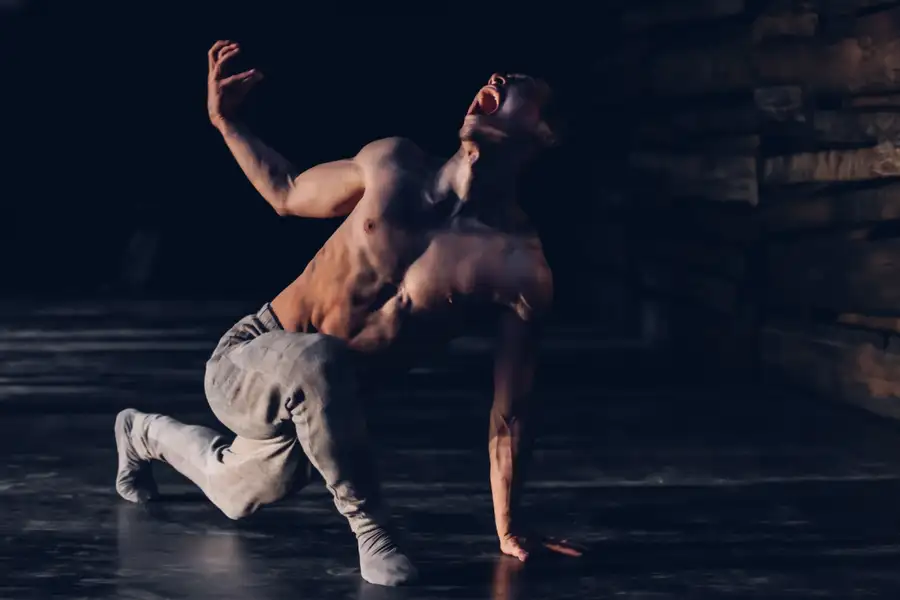
In an isolated research station, lost amid snow and ice, a highly disciplined team of would-be astronauts are putting an experimental animal through its paces. Will their Creature survive the tests they throw at it? The cold, the isolation, the asphyxia? A punctilious Doctor (Stina Quagebeur) palpates and measures the creature, summons handlers and equipment and calls for urgent aid when it looks as though an experiment has gone too far. She is meticulous, not malevolent, and when the Major in charge tears the creature from its one source of comfort, the station cleaner Marie (Erina Takahashi), and abuses her, the Doctor fears for the whole team.
It’s up to the captain to calm his superior officer down, and goodness knows he tries. Since this is a ballet loosely based on 19th-century dramatist Georg Büchner’s play Woyzeck — about the mental deterioration of a soldier so utterly beholden to his commanding officers, he agrees to medical experiments — it’s not likely that things will end well.
Jeffrey Cirio plays the Creature in this unusual project from English National Ballet — a collaboration between choreographer Asif Kapadia and filmmaker Akram Khan, best known for the documentaries Senna (2010) Amy (2015) and Diego Maradona (2019).
It’s a grim fable of human ambition and ruthlessness, superbly performed, and shot in a way that draws the audience fully into the action, capturing moments of private emotion and the subtlest of gestures without losing any of the spectacle of an ensemble piece.
For almost its entire length (the last five minutes are rotten) Creature explores its extreme set-up with tenderness and intelligence, slowly eroding the distinction between a somewhat simian test subject and its hardly less simian handlers. The Creature wants to copy its masters. We don’t have very long to wait, however, before its masters are learning to copy the Creature. Though the hierarchies of this isolated, militaristic society are clear, and the Creature’s expendability is never in doubt, the piece holds out the possibility of real communication here, and even trust, and even love.
And then, out of nowhere, all that subtle, clever, sensitive work gets thrown away. The Captain (Ken Saruhashi), who’s been keeping the Major contained, wanders off into a blizzard for no reason, and the Major (a jaw-droppingly arrogant turn by the dashing Fabian
Reimair) makes merry hell and gets away with whatever he likes.
Creature wants to be an indictment of cruelty, obedience and power, but its central metaphor will not hold. First, astronauts are notoriously disobedient. Second, space agencies are chronically underfunded. Really, only the point about cruelty might stick, and even here, I have my reservations. Do we sacrifice experimental animals to further our research goals? Certainly, though much less than we used to. And even in the bad old days, these creatures were honoured. Look at the statues to the space dog Laika (I know of at least two), or the remains of NASA’s chimp Ham, interred at the International Space Hall of Fame in New Mexico. You can argue that these gestures were insufficient, but you can’t say they were empty.
By the end, did Creature leave me impressed? Thrilled? Moved?
Yes, all three. It also left me aggrieved.
Here I was, preparing to sing the praises of a science-fiction ballet about our difficult relationship with other primates, and what I was left with, at the end, was a by-the-numbers glimpse of how horrid people can be.
It may be that expanding human efforts into outer space is a silly idea, but the show’s censoriousness left me cold. A shame, because the dancing — ironically enough — was out of this world.
February 22, 2023
“Our trained mediums are standing by”

Watching Mali Elfman’s Next Exit for New Scientist, 22 February 2023
From out of nowhere, a chink of light appears. With painful slowness, the light grows stronger: we are inching towards a half-open door. Beyond the door, everything seems normal. A little boy is playing a game of pretend. At least, that’s what we think. Soon enough, we learn what’s really going on: the boy is playing cards with his dead father.
Nothing else in Mali Elfman’s debut feature lives up to this unsettling opening sequence (though there’s a sight gag — two would-be suicides renting a car from Charon Vehicle Rental — that comes close).
Rahul Kohli and Katie Parker — actors who turn up regularly in work by horror director Mike Flanagan — play Teddy and Rose, driving across the US to an appointment with Dr Stevensen (Karen Gillan) who has promised them a clinically managed euthanasia. Teddy, a Londoner, has spent ten years trying and failing to make it in the United States, and figures that being turned into a pioneer ghost (his transition from life to death monitored with all the latest gear) will at least give his life some meaning. Rose is weighed down with guilty secrets, and just wants to be done with it all.
Mind you, even Rose is not as nihilistic as the man who, early on in the film, wonders in front of their hire car, and under their wheels, with a note pinned to his chest: “Thanks for the help”.
Suicides and homicides are common now, as Heaven beckons (or whatever passes as Heaven), and our hardscrabble lives on this ordinary Earth lose their preciousness and meaning. “Our trained mediums are standing by,” a radio advert announces, offering contact with the newly visible dead. This is a world lost to itself, snared by fantasies of the hereafter.
But what do these newly discovered ghosts really want, as they stream into our world through every available screen? Not every haunting is as touching as that of the boy and his dead parent. Rose guzzles bourbon by the bottle so as not to see her mother watching her from inside the motel pay-per-view. A friendly cop, caught up in a drinking game, confesses to a thoughtless on-duty prank that killed a family of five; not surprising then, that he thinks “they’re here to hurt us.” Karma, a hitchhiker Teddy and Rose pick up out in the desert, has her own doubts: ”Just because we can see them,” she points out, “doesn’t mean we understand them”.
It’s at this point, about half way into the movie, that the viewer’s heart, if it does not immediately sink, certainly begins to tip: surely this film has bitten off way more than it can possibly chew?
Teddy admits that what he really wants out of his own managed death is for the news to get back to his absentee father: “I’d rather kill myself than live the life you gave me.” This is not a bad line, but what follows is horrific, and not in any intended way: a stage-managed confrontation with Teddy’s dad; an impromptu psychodynamic therapy session in a filling station car lot. The script rights itself, but having lost all confidence after this compound pratfall, it delivers, in the end, only a low-key retread of Joel Schumacher’s 1990 flick Flatliners. (Judgement waits for us all; struggle gives life its meaning; you know the rest.)
Next Exit is a promising film, but not a good film. It warps the world into a very strange shape, to ask some valid — indeed, pressing — questions about where the value of life resides. But it loses its way. If the writing had exhibited half as much commitment as the acting, we might have had a hit on our hands.
February 4, 2023
Enacting the alien for the duration

Reading In Ascension by Martin MacInnes for the Times, 4 February 2023
In the course of Martin MacInnes’s long, dizzying, frustrating third novel, marine biologist Leigh-Ann Hasenboch sets sail to explore a vast chasm in the ocean floor, blasts off into space to pursue an errant space probe, and finally falls apart like a salmon, bleeding out of the real world altogether.
Or does she? Few writers can make the real world appear so elusive. Leigh, we’re told, grew up in Rotterdam, an environment as engineered and as managed as any space capsule. Her father told her not to dig too deep, and stared at her in horror when, playing by the sea, she once drove her plastic spade against the beach’s concrete foundation.
He also beat her, or that’s what she remembers, but there are few certainties in this book, and no guarantees: perhaps the child Leigh was glimpsing premonitions of the beatings she’d receive from the world itself: all those romantic disappointments and professional frustrations! She doesn’t have an easy time of it, and has a knack for taking the difficult path, even as she rises to become a world expert on space habitats and nutrition.
In Ascension is a science fiction vehicle driven with the literary brakes jammed on. Ecological mysteries (that newly discovered chasm beneath the Caribbean reaches deep into the Earth’s mantle) coincide with astronomical mysteries (an alien artefact appears, then disappears), and a somewhat conspiratorial plan is hatched to send an international human crew on a rocket to figure out what (if any) extraterrestrial grand plan is drawing humanity off their dying planet and in among the stars.
That Leigh, after the longest time, joins this project, and earns a place on the crew that will replace the replacement crew if that crew as well as the first crew somehow come to grief before launch, tells you much about MacInnes’s strategy. He has some wild malarky to sell, and he makes it digestible by stretching it out like dough. Science fiction writers, on the other hand, make their malarky acceptable by committing to it — and I can’t help but feel that there’s a moral difference here.
Afficionadoes of MacInnes’s first two books will argue that his unique combination of indirection and ecological speculation amounts to a metaphysical, or even supernatural form all its own, part Robert Macfarlane, part Ray Bradbury.
They’re not wrong. Few writers summon the uncanny as well as MacInnes, whether it be in the depiction of a research vessel, bobbing above the ocean’s limitless depths, or in throw-away lines about astronauts disappearing into clouds of irregular paperwork. And no-one but MacInnes captures so well the way we use social games (modish blather, bureaucracy, rationalism, science) to assemble a manageable reality, away from the wild world’s blooming, buzzing confusion.
MacInnes sometimes realises these preoccupations in splendid macguffins. As Leigh and her two crewmates pursue a 1970s-era Voyager spacecraft far beyond the bounds of the solar system on board their cramped spacecraft Nereus, we begin to intuit that their craft’s innovative propulsion system is not merely not of this Earth; it is, quite literally, unworldly. “The whole of the propulsion system will be sealed from the crew,” we’re told. “It isn’t just advisable. It’s essential. If you try to observe it, it disappears.”
There’s no doubt that MacInnes has fun driving Leigh — an unhappy, not very likeable research graduate — toward her space-and time-busting apotheosis. I just wish that his fun wasn’t taken quite so much at the expense of the reader. “The alien may be a particular way of calibrating energy,” Leigh realises, as she and her crewmates munch though bowls of genetically engineered algae and prepare for First Contact, “not constituted in any one of the properties that delivers the power, but in the act of delivery itself…. Then the alien exists for the length of time the journey endures, the process of realising a journey. Not arriving to meet the alien at the end, but enacting the alien for the duration.”
That’s sly enough, but not nearly as effective as Ray Bradbury’s “The Martians were there — in the canal — reflected in the water.”
February 1, 2023
“The solutions are not even in the works”
Reading Pegasus by Laurent Richard and Sandrine Rigaud for New Scientist, 1 February 2023.
“Fifty thousand?”
Edward Snowden’s 2013 leaks from the US National Security Agency had triggered a global debate around state surveillance — and even he couldn’t quite believe the scale of the story as it was described to him in the summer of 2021.
Whistle-blowers had handed French investigative journalists Laurent Richard and and Sandrine Rigaud a list of 50,000 phone numbers. These belonged to people flagged for attack by a cybersurveillance software package called Pegasus.
The journalistic investigation that followed is the subject of this non-fiction thriller: a must-read for anyone remotely interested in cryptography and communications, and a dreadful warning for the rest of us. “Regular civilians being targeted with military-grade surveillance weapons — against their will, against their knowledge, and with no recourse — is a dystopian future we really are careening toward,” the authors warn, “if we don’t understand this threat and move to stop it.”
Pegasus offers a fascinating insight into how journalism has evolved to tackle a hyper-connected world. Eye witnesses and whistle-blowers have better access than ever before to sympathetic campaigning journalists from all over the world. But of course, this advantage is shared with the very governments and corporations and organised crime networks that want to silence them.
To drag Pegasus into the light, Laurent’s Forbidden Stories consortium choreographed the activities of more than eighty investigative journalists from seventeen media organisations across four continents and eight languages.
The consortium got together in March 2021 knowing full well that they would have to conclude their investigation by June, by which time Pegasus’ creators at the Israeli company NSO were bound to twig that their brainchild was being hacked.
The bigger the names on that phone list, the harder it would be to keep any investigation under wraps. Early on the name of Jorge Carrasco cropped up: the lead partner in Forbidden Stories’ massive cross-border collaboration to finish the investigations of murdered Mexican journalist Regina Martínez. Then things just got silly: a son of Turkish president Recep Erdogan turned up; and then the names of half the French cabinet. Also the cell number for Emmanuel Macron, the president of France. Laurent Richard recalls, “Macron was the name that made me realise how truly dangerous it was to have access to this list.”
In a pulse-accelerating account that’s never afraid to dip into well-crafted technical detail, the authors explain how Pegasus gains free rein on a mobile device, without ever tipping off the owner to its presence. Needless to say it evolved out of software designed to serve baffled consumers waiting in long queues on tech support call lines. Shalev Hulio and Omri Lavie, who would go on to found NSO and create Pegasus, cut their teeth developing programmes that allowed support technicians to take charge of the caller’s phone.
It was not long before a European intelligence service came calling. Sold and maintained for more than sixty clients in more than forty countries, Pegasus gave security services an edge over terrorists, criminal gangs and paedophiles — and also, as it’s turned out, over whistleblowers, campaigners, political opponents, journalists, and at least one Emirati princess trying to get custody of her children. This book is not a diatribe against the necessary (or at any rate ubiquitous) business of government surveillance and espionage. It is about how, in the contest between ordinary people and the powerful, software is tilting the field wildly in the latter’s favour.
The international journalistic collaboration that was the Pegasus Project sparked the biggest global surveillance scandal since Snowden; it’s led to a European Parliament inquiry into government spyware, legal action from major technology companies, government sanctions against the NSO Group and countless individual legal complaints. But the authors spend little time sitting in their laurels. Pegasus may be dead, but demand for a successor is only growing. In the gap left by NSO, certain governments are making offers to certain tech companies that add zeroes to the fees NSO enjoyed. Nor do the authors expect much to come out of the public debate that has followed their investigation: “The issues… might have been raised,” they concede, “but the solutions are not even in the works.”
Simon Ings's Blog

- Simon Ings's profile
- 147 followers

