Robin Van Auken's Blog, page 2
June 21, 2020
Reimagining Celibacy with Tonya Anderson
Tonya Anderson is a writer, sacred therapist, and inspirational speaker. As a mental health counselor, she has vast experience working with people from all walks of life. She has a lot of wisdom to share, and h Save er latest project is one that will make you sit up and take notice.
 We’re talking about a new book in the works and a course that accompanies it.
Her new book is “Exquisite Sexuality: How We Make Sex Sacred Again”
Her Course is “Celibacy Reimagined.”
Tonya is the founder of An Exquisite Life. She helps people using mindfulness and sacred therapies to resolve stress/trauma in their lives, create balance, and frees them to live a life with renewed joy, love, and passion for life.
Thank You for Listening!
Ways to share your thoughts:
Use Facebook to leave a comment below.
Send Robin an email.
Be social with the link on Facebook, Twitter or Pinterest.
Ways to show your support:
Leave an honest review
on iTunes or Soundcloud or Google. Your ratings and reviews really help and I read each one.
Subscribe on iTunes or Soundcloud or Google.
Let’s talk books again next week!
Download the Audio File as an MP3
Want to listen on your own terms? Download the episode and take it with you.
 Tonya Anderson
Listen to Tonya Anderson as she explores her quest for spiritual freedom, her work with mindfulness and meditation, and finding the joy in living.
FACEBOOK:
Tonya Anderson
WEBSITES:
Learn about Tonya’s teaching platform, Exquisite Life Academy
Celibacy
Mental Health
Sacred Sexuality
Note: Affiliate links on this website are provided for convenience. See the full disclosure for more info.

This work is licensed under a Creative Commons Attribution-NoDerivatives 4.0 International License.Love to Write? Accept My Challenge!
[image error]
Have even more fun when you accept the 21-Day Writing Sprint Challenge. This process is one I use every semester with my college students, so I know it can kickstart your creativity and introduce structure to your writing schedule. Join today to access all of the free resources at Wholehearted Author.
Awesome! You're in. Now check your email to start downloading free resources.
There was an error submitting your subscription. Please try again.
Email Address
I'd like to receive the free email course.
JOIN TODAY!
/* Layout */
.ck_form.ck_naked {
/* divider image */
background: transparent;
line-height: 1.5em;
overflow: hidden;
color: #666;
font-size: 16px;
border: none;
-webkit-box-shadow: none;
-moz-box-shadow: none;
box-shadow: none;
clear: both;
margin: 20px 0px;
text-align: center;
}
.ck_form.ck_naked p {
padding: 0px;
}
.ck_form, .ck_form * {
-webkit-box-sizing: border-box;
-moz-box-sizing: border-box;
box-sizing: border-box;
}
.ck_form.ck_naked .ck_form_fields {
width: 100%;
float: left;
padding: 5%;
}
/* Form fields */
.ck_errorArea {
display: none; /* temporary */
}
#ck_success_msg {
padding: 10px 10px 0px;
border: solid 1px #ddd;
background: #eee;
}
.ck_form.ck_naked input[type="text"], .ck_form.ck_naked input[type="email"] {
font-size: 18px;
padding: 10px 8px;
width: 34%;
border: 1px solid #d6d6d6; /* stroke */
-moz-border-radius: 0px;
-webkit-border-radius: 0px;
border-radius: 0px; /* border radius */
background-color: #fff; /* layer fill content */
margin-bottom: 5px;
height: auto;
float: left;
margin: 0px;
margin-right: 1%;
height: 42px;
}
.ck_form input[type="text"]:focus, .ck_form input[type="email"]:focus {
outline: none;
border-color: #aaa;
}
.ck_form.ck_naked .ck_subscribe_button {
width: 100%;
color: #fff;
margin: 0px;
padding: 9px 0px;
font-size: 18px;
background: #0d6db8;
-moz-border-radius: 0px;
-webkit-border-radius: 0px;
border-radius: 0px; /* border radius */
cursor: pointer;
border: none;
text-shadow: none;
width: 30%;
float: left;
height: 42px;
}
.ck_converted_content {
display: none;
padding: 5%;
background: #fff;
}
/* max width 500 */
.ck_form.ck_naked.width500 .ck_subscribe_button {
width: 100%;
float: none;
margin-top: 5px;
}
.ck_form.ck_naked.width500 input[type="text"], .ck_form.ck_naked.width500 input[type="email"] {
width: 49%;
}
.ck_form.ck_naked.width500 input[type="email"] {
margin-right: 0px;
width: 50%;
}
/* max width 400 */
.ck_form.ck_naked.width400 .ck_subscribe_button, .ck_form.ck_naked.width400 input[type="text"], .ck_form.ck_naked.width400 input[type="email"] {
width: 100%;
float: none;
margin-top: 5px;
}
.ck_slide_up, .ck_modal, .ck_slide_up .ck_naked, .ck_modal .ck_naked {
min-width: 400px;
}
.page .ck_form.ck_naked {
margin: 50px auto;
max-width: 700px;
}
/* v6 */
.ck_slide_up.ck_form_v6, .ck_modal.ck_form_v6, .ck_slide_up.ck_form_v6 .ck_naked, .ck_modal.ck_form_v6 .ck_naked {
min-width: 0 !important;
}
.ck_form_v6 #ck_success_msg {
padding: 0px 10px;
}
@media all and (max-width: 403px) {
.ck_form_v6.ck_modal .ck_naked {
padding-top: 30px;
}
}
@media all and (max-width: 499px) {
.ck_form_v6.ck_modal .ck_naked + .ck_close_link {
color: #fff;
top: 10px;
}
}
.ck_form_v6.ck_slide_up .ck_naked + .ck_close_link {
right: 10px;
top: -5px;
}
@media all and (min-width: 600px) {
.ck_form_v6.ck_slide_up .ck_naked + .ck_close_link {
right: 35px;
}
}
.ck_form.ck_naked .ck_form_fields {
width: 80%;
float: right;
padding: .5%;
}
Wholehearted Author is for you if you are …
Starting out as a writer and could use some guidance
Wanting to be inspired to create and publish your book
Looking for like-minded, happy people and helpful mentors
Hoping to turn your writing into a full-time, awesome career
New to the concept of “permission marketing” but willing to try
.fusion-button.button-1 .fusion-button-text, .fusion-button.button-1 i {color:#eaeaea;}.fusion-button.button-1 .fusion-button-icon-divider{border-color:#eaeaea;}.fusion-button.button-1:hover .fusion-button-text, .fusion-button.button-1:hover i,.fusion-button.button-1:focus .fusion-button-text, .fusion-button.button-1:focus i,.fusion-button.button-1:active .fusion-button-text, .fusion-button.button-1:active{color:#eaeaea;}.fusion-button.button-1:hover .fusion-button-icon-divider, .fusion-button.button-1:hover .fusion-button-icon-divider, .fusion-button.button-1:active .fusion-button-icon-divider{border-color:#eaeaea;}.fusion-button.button-1:hover, .fusion-button.button-1:focus, .fusion-button.button-1:active{border-color:#eaeaea;}.fusion-button.button-1 {border-color:#eaeaea;border-radius:0px;}.fusion-button.button-1{background: #b21717;}.fusion-button.button-1:hover,.button-1:focus,.fusion-button.button-1:active{background: #f44336;}Send My Free Writing Resources.fusion-image-frame-bottomshadow.image-frame-shadow-5{display:inline-block}.element-bottomshadow.imageframe-5:before, .element-bottomshadow.imageframe-5:after{-webkit-box-shadow: 0 17px 10px rgba(0,0,0,0.4);box-shadow: 0 17px 10px rgba(0,0,0,0.4);}
 CATCH THE WEST WIND
Add WEST WIND to your library!
Because free writing resources from
Wholehearted Author are not enough!
If you love a good mystery, a romantic whodunit that will surprise you, then WEST WIND is a great addition to your ebook library.
West Wind is my third novel as an author of Contemporary Fiction, Suspense, Thriller, and Romance. It’s FREE too, when you join my exclusive Readers Group. Members of the Readers Group receive free novels, invitations to read advance copies, as well as illustrated character profiles and behind-the-scenes articles about Eaton and its quirky residents.
Join today and download your free book, and as a special thank you, you’ll receive a SECOND FREE BOOK tomorrow! The giving goes on and on when you become my fan.
[image error] .fusion-button.button-2 .fusion-button-text, .fusion-button.button-2 i {color:#eaeaea;}.fusion-button.button-2 .fusion-button-icon-divider{border-color:#eaeaea;}.fusion-button.button-2:hover .fusion-button-text, .fusion-button.button-2:hover i,.fusion-button.button-2:focus .fusion-button-text, .fusion-button.button-2:focus i,.fusion-button.button-2:active .fusion-button-text, .fusion-button.button-2:active{color:#eaeaea;}.fusion-button.button-2:hover .fusion-button-icon-divider, .fusion-button.button-2:hover .fusion-button-icon-divider, .fusion-button.button-2:active .fusion-button-icon-divider{border-color:#eaeaea;}.fusion-button.button-2:hover, .fusion-button.button-2:focus, .fusion-button.button-2:active{border-color:#eaeaea;}.fusion-button.button-2 {border-color:#eaeaea;border-radius:0px;}.fusion-button.button-2{background: #0d6db8;}.fusion-button.button-2:hover,.button-2:focus,.fusion-button.button-2:active{background: #0d6db8;}DOWNLOAD WEST WIND
The post Reimagining Celibacy with Tonya Anderson appeared first on Hands-on Heritage.


May 8, 2020
Grinding Stone: Part 3
Last week we had an artifact found by member Jim Carn and pretty much it’s been a part-time job for me trying to validate the find ever since. Jim actually brought it to my house on the bed of his pickup. At about two feet long and really heavy, Jim was in the right place at the right time to have the artifact transported out of the woods with the help of a few gentlemen on a 4 wheel drive. Now it’s up to the society to authenticate what could be a museum piece. And let me say that where this was found is a well known Indian area. Location can be a big factor in determining validity.
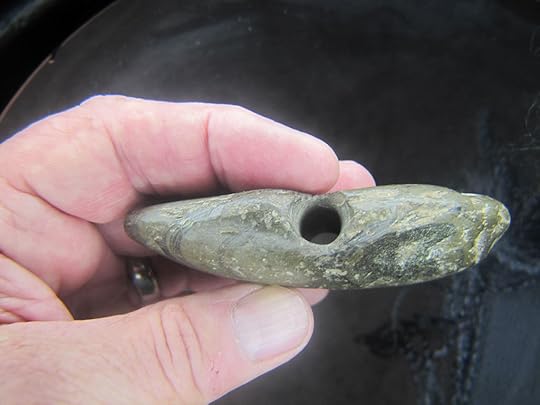
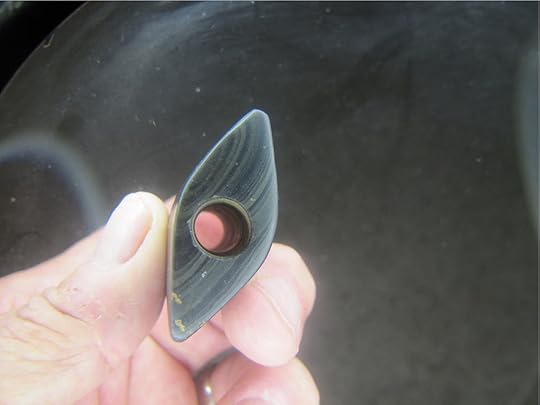
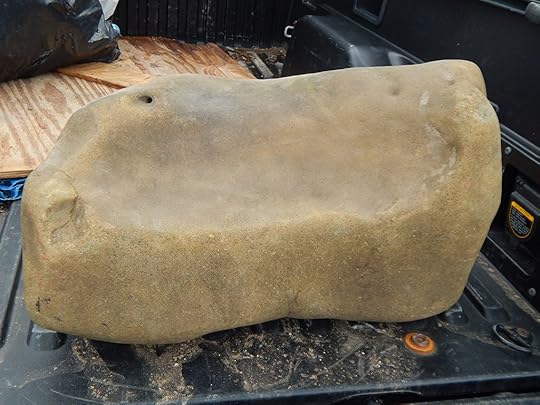
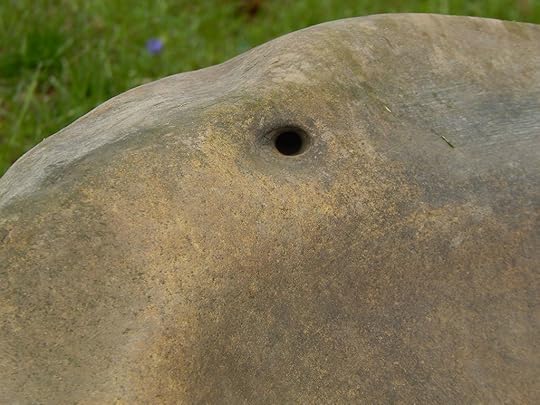
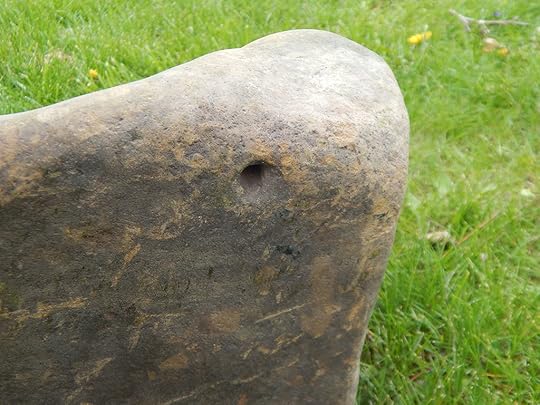
Over the last few days, I have sent pictures to Gary Fogelman, Jim Herbstritt of the State Museum, and all of you. The consensus is that we have a community grinding stone known as a metate. That part of it may be obvious. It is “worked” to form a grinding surface and that surface is different from the rock as a whole. It’s the hole in the artifact that’s a mystery.
Both experts are confounded by the hole. It actually looks good where it’s at but why the hell would it be there? Is it man-made or natural? Did they use it to secure the stone or to display something of their culture? If it’s natural, did native people see it as something special and choose the stone because of it? We’re working on these questions.
Man-made or natural is the first big question. It appears drilled on both ends because of the obvious flare at the top of the drilling. As the chert drill would get larger going up the length of it, the larger part would produce the expanded area outside the hole. In picture 1 you see the hole in the metate. In pictures 2-3 a close up of both sides. It appears drilled from both ends and that would be consistent with typical Indian drilling but over the last few days, my research has produced nothing in that length of drilling and certainly not in an object this large. If you magnify the picture (and you can do that on your computer) it is disturbingly smooth. I know rocks weather but could that happen in the very short geological time man has been here? Tombstones weather. Sometimes you can’t read them after a couple of hundred years. Can that be the answer?
Look at picture 4. This is the hole in a bannerstone ( part of the atlatl spear thrower). If you magnify you’ll see sharp edges around the drilling. It appears the hole was drilled with the typical chert drill but left these edges that you can clearly see. The last picture in all probability was drilled using the hollow reed method. By introducing abrasive grit they would turn the reed and drill a perimeter hole and actually form a core that would be knocked out. I have seen unfinished bannerstones with the core still intact. Notice there is no flaring at the top of the hole.
The drillings in the metate do not meet cleanly but the angle of the other hole forms an elbow. In Jim Herbstritt’s explanation, there might have been organic matter or softer material that might have weathered away forming the hole. Boy, if it did, why the flaring? He suggested a latex cast of the hole. We may actually do that.
Gary and I plan to travel to Jim’s house to examine this anomaly and I’m hoping that we can say soon with a certain degree of certainty that not only is the metate genuine but the drilling also. If that happens we may have one of the longest examples of Native American stone drilling anywhere.
Keep staying safe,
Tank Baird
President NCC8
The post Grinding Stone: Part 3 appeared first on Hands-on Heritage.
A Community Grinding Stone: Part 3
Last week we had an artifact found by member Jim Carn and pretty much it’s been a part-time job for me trying to validate the find ever since. Jim actually brought it to my house on the bed of his pickup. At about two feet long and really heavy, Jim was in the right place at the right time to have the artifact transported out of the woods with the help of a few gentlemen on a 4 wheel drive. Now it’s up to the society to authenticate what could be a museum piece. And let me say that where this was found is a well known Indian area. Location can be a big factor in determining validity.
Over the last few days, I have sent pictures to Gary Fogelman, Jim Herbstritt of the State Museum, and all of you. The consensus is that we have a community grinding stone known as a metate. That part of it may be obvious. It is “worked” to form a grinding surface and that surface is different from the rock as a whole. It’s the hole in the artifact that’s a mystery.
Both experts are confounded by the hole. It actually looks good where it’s at but why the hell would it be there? Is it man-made or natural? Did they use it to secure the stone or to display something of their culture? If it’s natural, did native people see it as something special and choose the stone because of it? We’re working on these questions.
Man-made or natural is the first big question. It appears drilled on both ends because of the obvious flare at the top of the drilling. As the chert drill would get larger going up the length of it, the larger part would produce the expanded area outside the hole. In picture 1 you see the hole in the metate. In pictures 2-3 a close up of both sides. It appears drilled from both ends and that would be consistent with typical Indian drilling but over the last few days, my research has produced nothing in that length of drilling and certainly not in an object this large. If you magnify the picture (and you can do that on your computer) it is disturbingly smooth. I know rocks weather but could that happen in the very short geological time man has been here? Tombstones weather. Sometimes you can’t read them after a couple of hundred years. Can that be the answer?
Look at picture 4. This is the hole in a bannerstone ( part of the atlatl spear thrower). If you magnify you’ll see sharp edges around the drilling. It appears the hole was drilled with the typical chert drill but left these edges that you can clearly see. The last picture in all probability was drilled using the hollow reed method. By introducing abrasive grit they would turn the reed and drill a perimeter hole and actually form a core that would be knocked out. I have seen unfinished bannerstones with the core still intact. Notice there is no flaring at the top of the hole.
The drillings in the metate do not meet cleanly but the angle of the other hole forms an elbow. In Jim Herbstritt’s explanation, there might have been organic matter or softer material that might have weathered away forming the hole. Boy, if it did, why the flaring? He suggested a latex cast of the hole. We may actually do that.
Gary and I plan to travel to Jim’s house to examine this anomaly and I’m hoping that we can say soon with a certain degree of certainty that not only is the metate genuine but the drilling also. If that happens we may have one of the longest examples of Native American stone drilling anywhere.
Keep staying safe,
Tank Baird
President NCC8
The post A Community Grinding Stone: Part 3 appeared first on Hands-on Heritage.
April 30, 2020
Grinding Stone: Part 2
The exciting news today is that during this pandemic Jim Carn has found a real mystery item. We have sent pictures to Gary Fogelman and at this point, he thinks it might be the real thing pending closer examination. He is also mystified about the hole.
Jim wrote last night that the hole appears elbow-shaped. The cursory look that I had appeared to me like the drillings were from both sides and meeting imperfectly. We are at present going to arrange a meeting for a second look. Because of the weight of this thing Jim has requested a trip to his house. Gary if you want to drive to see this artifact lets name a day and time. We can keep social distancing.
This might be either a great addition to Jim’s landscaping or a museum piece.
I’ll keep you posted.
Tank Baird
The post Grinding Stone: Part 2 appeared first on Hands-on Heritage.
A Community Grinding Stone: Part 2
The exciting news today is that during this pandemic Jim Carn has found a real mystery item. We have sent pictures to Gary Fogelman and at this point, he thinks it might be the real thing pending closer examination. He is also mystified about the hole.
Jim wrote last night that the hole appears elbow-shaped. The cursory look that I had appeared to me like the drillings were from both sides and meeting imperfectly. We are at present going to arrange a meeting for a second look. Because of the weight of this thing Jim has requested a trip to his house. Gary if you want to drive to see this artifact lets name a day and time. We can keep social distancing.
This might be either a great addition to Jim’s landscaping or a museum piece.
I’ll keep you posted.
Tank Baird
The post A Community Grinding Stone: Part 2 appeared first on Hands-on Heritage.
April 29, 2020
Grinding Stone: Part 1
I’m taking advantage of the sunshine (aka coronavirus killer). I went fishing and foraging. I was a hunter-gatherer. See the first picture. These are ramps They are not spring onions although many people call them that. These are leek and you can use the entire plant. They make a fine batch of potatoes and give recipes a wonderfully different taste.
Last evening our own Jim Carn visited with an artifact found in Linden somewhere near the river. I’ll leave it to him to disclose the exact location.

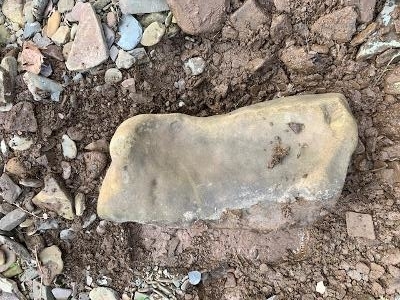
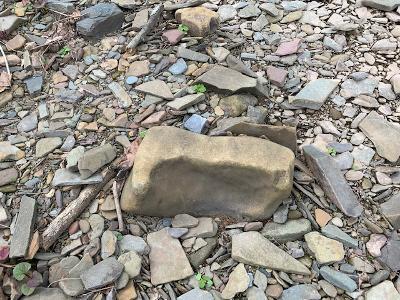
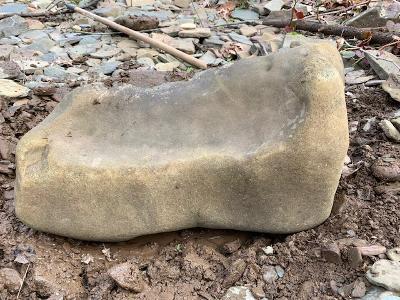
This is a big boy. It’s 2 feet long and very heavy. Not being the world’s authority on metate’s I have sent pictures to Gary Fogelman. Coincidentally, Gary had just cautioned me about metates in general as Jim arrived. There are many things that can look like a grinding stone but just aren’t and, to be honest, I’ve been fooled before. In that first picture sent the other day I thought it was much smaller and I wasn’t impressed until I saw it in the back of Jim’s pickup.
If in fact, this passes the muster with Gary then it will quickly get the nod from me. I’m inclined to think it’s real. It is an irregular shape but the “work area” is smoother than the rest of the stone. But for me, the fascinating feature is the drilled hole. I have no idea why Indians would drill a metate but there it is. Being drilled from both sides the meeting in the middle is slightly off and there is a flair on the outside of the holes, both indicating an Indian style drill was used. The holes look very weathered which bothers me a little (natural?) but the overall appearance of the object says “artifact” to me. If Gary wants to see this up close I will accompany Jim to a meeting spot.
We may all learn from this one.
Tank Baird
NCC8 President
The post Grinding Stone: Part 1 appeared first on Hands-on Heritage.
A Community Grinding Stone: Part 1
I’m taking advantage of the sunshine (aka coronavirus killer). I went fishing and foraging. I was a hunter-gatherer. See the first picture. These are ramps They are not spring onions although many people call them that. These are leek and you can use the entire plant. They make a fine batch of potatoes and give recipes a wonderfully different taste.
Last evening our own Jim Carn visited with an artifact found in Linden somewhere near the river. I’ll leave it to him to disclose the exact location.
This is a big boy. It’s 2 feet long and very heavy. Not being the world’s authority on metate’s I have sent pictures to Gary Fogelman. Coincidentally, Gary had just cautioned me about metates in general as Jim arrived. There are many things that can look like a grinding stone but just aren’t and, to be honest, I’ve been fooled before. In that first picture sent the other day I thought it was much smaller and I wasn’t impressed until I saw it in the back of Jim’s pickup.
If in fact, this passes the muster with Gary then it will quickly get the nod from me. I’m inclined to think it’s real. It is an irregular shape but the “work area” is smoother than the rest of the stone. But for me, the fascinating feature is the drilled hole. I have no idea why Indians would drill a metate but there it is. Being drilled from both sides the meeting in the middle is slightly off and there is a flair on the outside of the holes, both indicating an Indian style drill was used. The holes look very weathered which bothers me a little (natural?) but the overall appearance of the object says “artifact” to me. If Gary wants to see this up close I will accompany Jim to a meeting spot.
We may all learn from this one.
Tank Baird
NCC8 President
The post A Community Grinding Stone: Part 1 appeared first on Hands-on Heritage.
April 27, 2020
Bird Points
The weekend was pretty busy with interaction via email. We are inspiring conversations on typology, archaeology, local history, and artifact identification. Covid19 time indoors has been an opportunity for learning.
This morning, how about bird points as a topic? They are also called jewel or gem arrowheads and these would be true arrowheads developed for the bow and arrow.
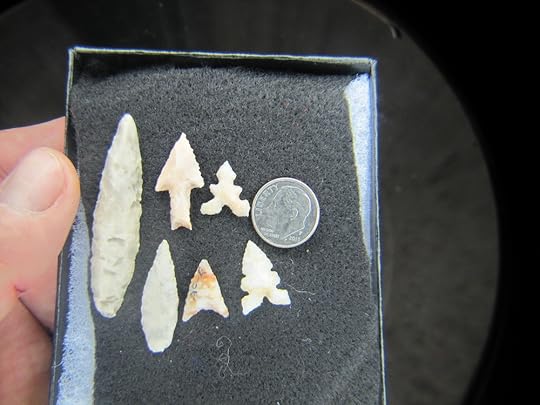
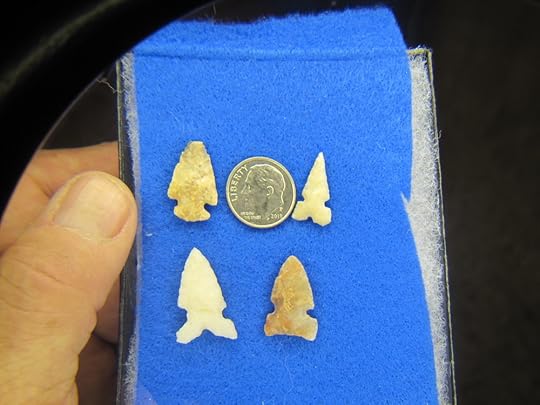
Bird points are not for killing birds. Believe it or not, they can be big game killers. Many buffalo, elk, and deer have been put down with these little guys. I put a dime in both frames not only to gauge size but also to support the fact that these are deadly.
Remember Otzi the iceman? He was a very well preserved mummy found in the Italian Alps and at over 5000 years old he was found with all his gear intact. Otzi is a treasure trove of information about ancient life. For the first 10 years of the investigation on how Otzi died everyone assumed he simply died of the exposure until they found the arrowhead buried deep inside him.
Funny, as intense as he was studied it took that long to find out that he was murdered. Why did it take that long: the arrowhead was no larger than a dime. If you can kill a man with a small point, you can kill big game. Indians like ancient Europeans were finding out that if you had a small projectile point on the arrow shaft the velocity would increase and so would the killing power.
The points pictured are from a collection that I purchased at auction. I had a problem initially even believing they were real but I have managed to find valid typology in other areas of the country. These particular points have been found in the southwest, the prairie states, and some even on the west coast. Apparently they can be very numerous in areas. Gary Fogelman told me a story about collectors panning the creeks and rivers in Oregon for these little guys. If you notice the first picture on the middle bottom row there are letters printed on the triangular point so it had to be in someone’s collection at one time.
Another advantage of small points is the preservation of resources. Small arrowhead-smaller use of chert.
If Indians wanted to knock down birds they would either net them (the extinct Passenger Pigeon in migration as an example) or use a blunt point (think small doorknob). No sticking a turkey with your arrow and having them run off with it.
There are small points found locally and yes they call them bird points but now you know that it’s a misleading name.
Tank Baird
President NCC8 SPA
The post Bird Points appeared first on Hands-on Heritage.
April 26, 2020
Surface Collecting in the Montoursville
The shared artifacts were found locally by Hunter Duffield.
Hunter has been surface collecting in the Montoursville area and Dick Snyder called me and asked that I give him a hand. So let’s look at the pictures.
Picture 1 is a couple of Archaic points the slight corner notching on the right might be a Brewerton or Brewerton like.
Picture two contains a broken drill (bottom center) two different strike-a-lites or ovate (center grey right side black chert) I see a mini ball civil war type bullet in the upper right hand next to a possible game stone game ball.
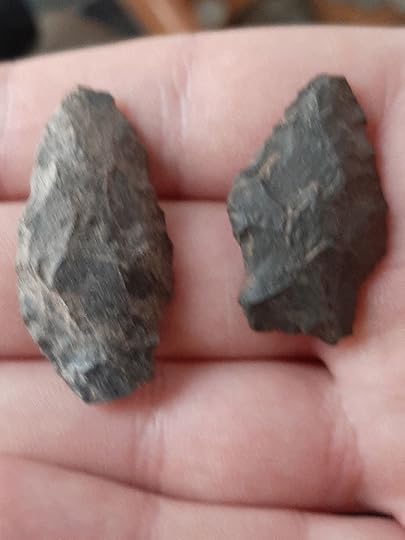
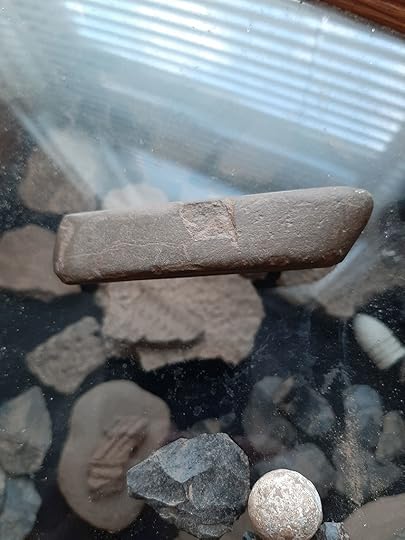
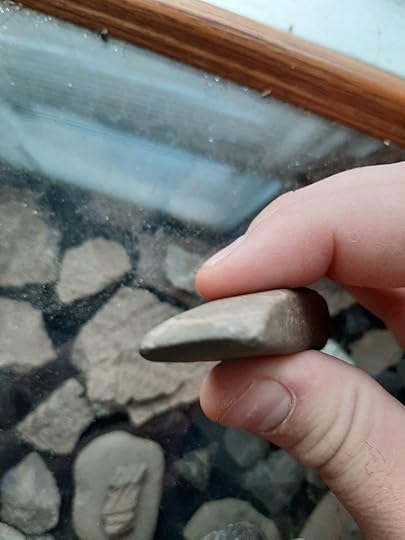
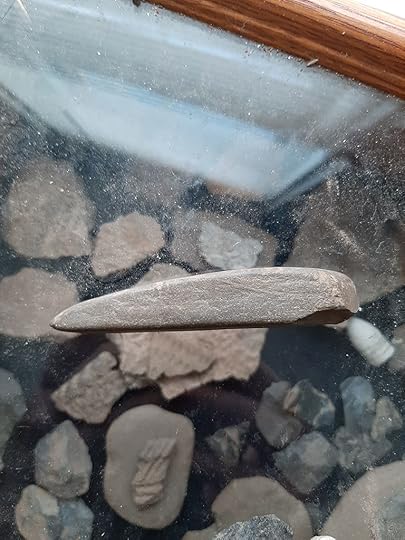
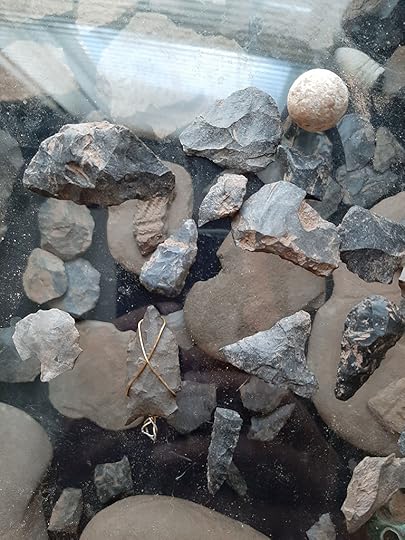
Greg, I know what you’re saying “I have one that looks just like it”. You also must consider where the ball was found. It may in fact just be a naturally rounded stone but used in a village setting as a game piece. There is a Levanna (3 point arrowhead) in the right hand lower. There is debitage and what may be a broken point. Looks like some pottery as well and a few net sinkers (notched flat stones.)
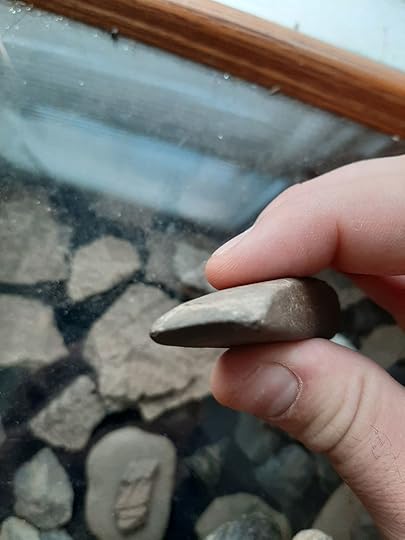
Picture 3 looks to me like an adze (woodworking tool) I can see that the blade is off-center and I do not believe this is natural. I’ll have to see it up close. Is the last picture the suspected adze? If it is, it looks natural in that picture.
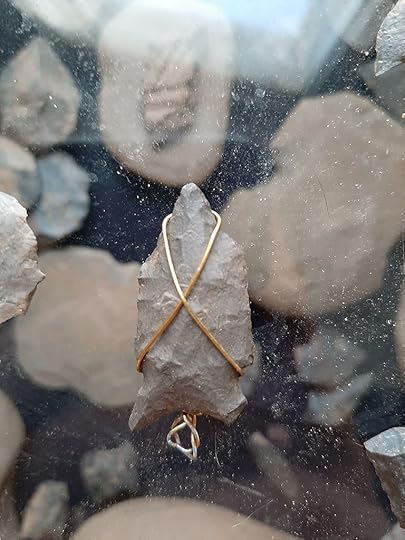
The gold wire piece is probably a gift shop piece. It defies any Northeast typology that I know of.
Thanks all and please feel free to share your opinions on the artifacts above
Tank Baird
President NCC8SPA
The post Surface Collecting in the Montoursville appeared first on Hands-on Heritage.
August 17, 2019
Ireland: Land of the People that Sorrow
When planning a trip to Ireland, don’t forget destinations that honor the torn country’s history.
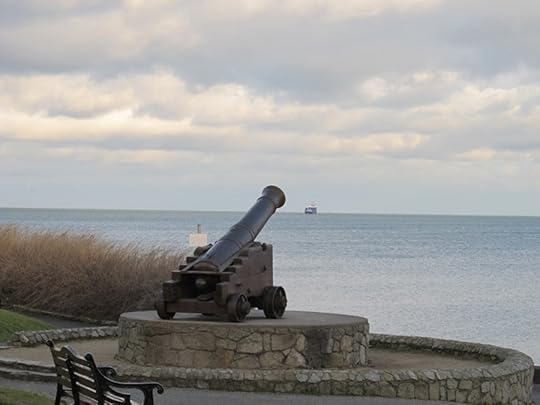
A cannon protects the coastline of Dun Laoghaire, County Dublin, Ireland.
Why “torn country,” you ask?
Ireland is a country that’s been struggling with its identity – one separate from Great Britain – for more than a century. The Irish Republican Army (IRA) and British forces fought the Irish War of Independence from 1919 to 1921.
Geographically, it is an island in the North Atlantic, separate from Great Britain.
Religion also plays into the rift, with Northern Ireland, and in particular in Tiger’s Bay in north Belfast, where employment opportunities seemed to favor Protestant workers over Catholic during “The Troubles,” which lasted three decades. The shipyards there once employed tens of thousands of predominantly Protestant workers; however, unemployment has leveled the playing field. The predominant religion in the Republic of Ireland is Christianity, with the largest church being the Roman Catholic Church.
Politics divide the country into the Republic of Ireland and Northern Ireland, which is part of the United Kingdom. Even decades after the Good Friday peace agreement, Northern Irish politics are dominated by nationalism and unionism, a power-sharing model of democracy designed for societies where there has been, or is the potential for conflict. Some people are predicting violence because of Brexit, claiming that a hard Brexit and borders between the two regions of Ireland could see a return to violence.
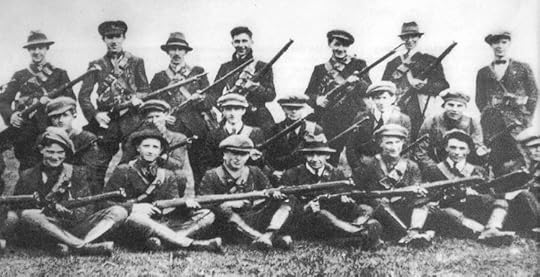
Third Tipperary Brigade Flying Column No. 2 under Seán Hogan during the War of Independence. Most of the IRA units in Munster were against the treaty.
Civil War
While in Ireland, you may hear some people hum the “Foggy Dew,” but don’t be alarmed – they’re not angling for conflict. They’re keeping the memory alive that young Irish men should have been fighting for their independence during World War I, rather than support Great Britain. Fr. Charles O’Neill, a curate at St. Peter’s Cathedral, Belfast, wrote the song’s lyrics, echoing the sentiment, “‘Twas better to die ‘neath an Irish sky than at Sulva or Sud El Bar.“
Late popularized by Sinéad O’Connor and Paddy Moloney of the Chieftains, the song chronicles the events of April 1916 when patriots led by James Connolly and Patrick Pearse proclaimed the Irish Republic and launched the Easter Rising against British rule. Great Britain crushed the rising in one week, and its commanders imprisoned and executed. The harsh response engendered support for Irish independence and in the December 1918 election, the republican party Sinn Féin won a landslide victory, and the uneasy Anglo-Irish Treaty led to the ensuing Irish Civil War
Listen to an instrumental version of “Foggy Dew.”
Listen to Sinéad O’Connor and The Chieftains perform the “Foggy Dew.”
The Troubles
Although the destinations recommended in this article are in the Republic of Ireland, if you decide to travel north and visit Belfast, you should understand the historical importance of “The Troubles,” which began during a campaign by the Northern Ireland Civil Rights Association that sought to end discrimination against the Catholic/nationalist minority.
During the late 1960s and early ’70s, NICRA members protested against the Protestant/unionist government and police brutality. Rising tensions led to violence in 1969, and the deployed British troops built “peace walls” to keep the two communities apart.
The army soon came to be seen as hostile and biased, particularly after Bloody Sunday (also the Bogside Massacre), when on January 30, 1972, British soldiers shot 28 unarmed Catholics during a protest march against internment. Fourteen people died while fleeing and while trying to help the wounded. Rubber bullets and batons injured others, and two people were run down by army vehicles.
The Troubles “officially” ended with the Good Friday Agreement of 1998.
Another song that has ear-wormed its way into the Irish political landscape is U2’s 1983 anthem “Sunday Bloody Sunday.” Despite its militaristic drumbeat and rousing lyrics, lead singer and co-writer Bono (Paul David Hewson) has always claimed is “… not a rebel song.”
Listen to U2 perform “Sunday Bloody Sunday.”
Present-Day Ireland
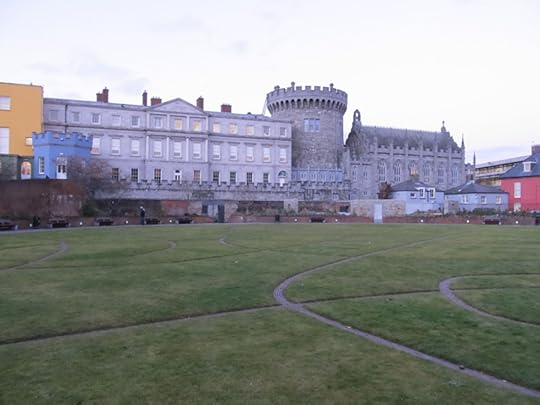
Dublin Castle
Today, most visitors begin their tour of Ireland in the global city of Dublin, founded in the 7th century by Gaels, then expanded into the Kingdom of Dublin by Vikings.
Ranked as an “Alpha” city by the Globalization and World Cities Research Network (GaWC), it is one of the top 30 cities in the world today.
Cultural divides still exist; however, with Dublin being split along a north-south axis by the River Liffey. Traditionally, Northside is considered a working-class to the middle-class area, and Southside is seen as middle class to upper-middle class.
Cultural “quarters” or districts also divide Dublin. These are of importance to tourists and include the:
Medieval Quarter – Dublin Castle, Christ Church and St Patrick’s Cathedral and the old city walls
Georgian Quarter – St. Stephen’s Green, Trinity College, and Merrion Square
Docklands Quarter – Dublin Docklands and Silicon Docks
Cultural Quarter – around Temple Bar
Creative Quarter – between South William Street and George’s Street
Keep these areas in mind when you plan your walking tour of Dublin. When traveling beyond Dublin, consider using public transportation or small tours for coastal visits. Now that you know the history of this torn country, you can appreciate not only its natural beauty but its significant historical landmarks.
Walking Downtown Dublin
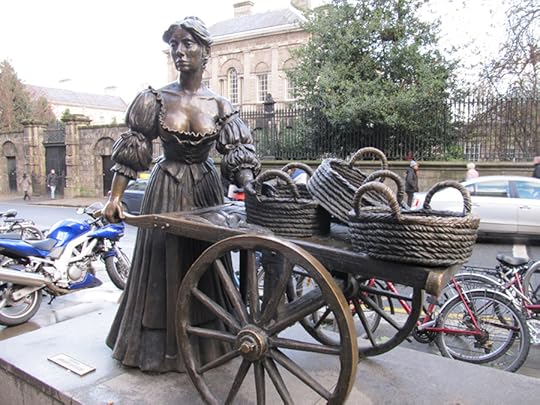
Molly Malone Statue
The Molly Malone statue, crudely known locally as “The Tart with the Cart,” was installed during the 1988 Dublin Millennium celebrations, when 13 June was declared to be Molly Malone Day. The statue was presented to the city by Jury’s Hotel Group because “Molly Malone” (also known as “Cockles and Mussels” or “In Dublin’s Fair City”) is a popular song, which has become the unofficial anthem of Dublin. The song is a fictional tale of a fishmonger who sold seafood on the streets of Dublin, but who died young, of a fever. She is typically represented as a hawker by day and part-time prostitute by night. Her statue has moved to Suffolk Street.

Justice at Dublin Castle
Justice is another controversial statue in the city, which stands above the Cork Hill entrance to Dublin Castle. Many icons have Justice blindfolded, but in this case, Iustitia’s eyes are open. Since the 15th century, the blindfold has represented objectivity and impartiality. This statue also holds scales, tilted toward the Dublin’s Tax Office. Her sword, which typically points downwards, is held upright and she looks at it with a knowing smile.
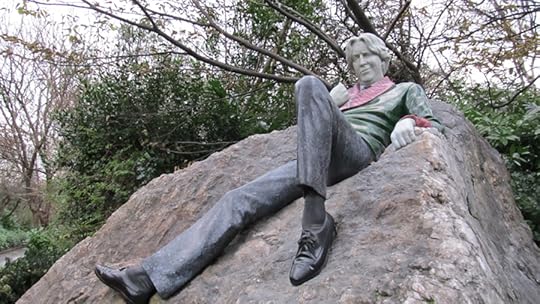
Oscar Wilde Statue in Merrion Square
Designed by artist Danny Osborne, this statue is one of three in a Memorial Sculpture Collection in Merrion Square that commemorates Oscar Wilde. The Irish poet/playwright reclines inside the park, on a quartz boulder. Wilde looks at his boyhood home where he grew up. A controversial, yet famous and beloved writer, he was arrested in 1895 and convicted for “gross indecency with men.” He spent two years at hard labor, the maximum penalty. On his release, he moved to France, where he wrote his last work, “The Ballad of Reading Gaol” (1898), a poem about harsh prison life.
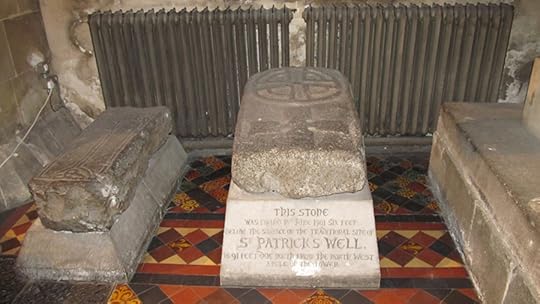
St. Patrick’s Cathedral
Founded in 1191, Saint Patrick’s Cathedral in Dublin is the National Cathedral of the Church of Ireland. One of the most popular destinations for tourists to Ireland, the Cathedral is located on the holy site of a well where Saint Patrick baptized Christian converts for more than 1,500 years. The present Cathedral building, in terms of shape and size, dates from 1220-1259. It is made from local limestone and imported stone from Bristol. It is also the tallest church in the country, with its 43-meter spire.
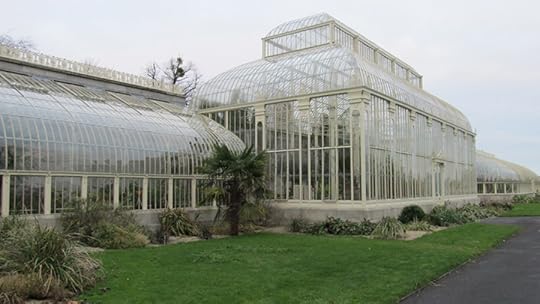
National Botanic Gardens
The National Botanic Gardens were founded in 1795 by the Dublin Society and hold 20,000 living plants and many millions of dried plant specimens. The gardens, placed into government care in 1877, include glasshouses of architectural importance, such as the Palm House and the Curvilinear Range. Today the Glasnevin gardens are free of admission and serve as a center for horticultural research and training, including the breeding of many prized orchids.
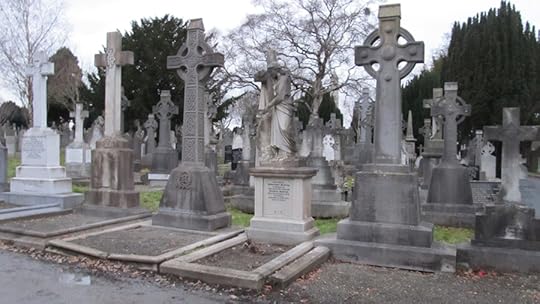
Glasnevin
Glasnevin Cemetery is the first burial ground for Irish Catholics in Dublin, because of the repressive Penal Laws of the eighteenth century. Daniel O’Connell, champion of Catholic rights, launched a legal campaign and proved that no law existed that forbid praying for a dead Catholic in a graveyard. O’Connell pushed for the opening of a burial ground in which both Irish Catholics and Protestants could give their dead dignified burial, and Glasnevin Cemetery opened in 1832. It holds the graves and memorials of many of Ireland’s most prominent national figures, including Daniel O’Connell, Charles Stewart Parnell, Michael Collins, Éamon de Valera, Arthur Griffith, Maude Gonne, Kevin Barry, Roger Casement, Constance Markievicz, Pádraig Ó Domhnaill, Seán MacBride, Jeremiah O’Donovan Rossa, James Larkin, Brendan Behan, Christy Brown and Luke Kelly of the Dubliners.
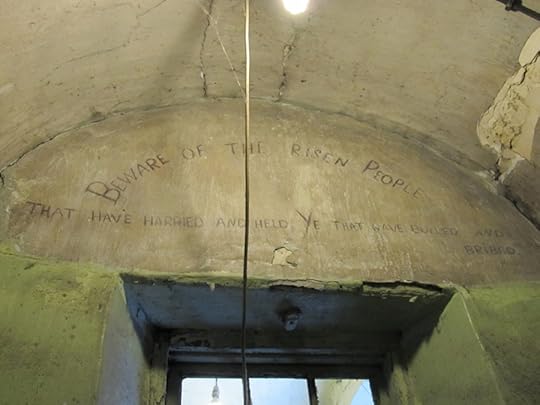
Kilmainham Gaol
Graffiti was drawn and etched in the walls of Kilmainham Gaol, marking the passage of people through the historic prison. Some graffiti was placed to be read by prison officers as well as prisoners, including this quotation by Padraig Pearse above a doorway leading into the so-called “1916 Corridor.” Pearse along with his brother and 14 other leaders of the 1916 Easter Rising were executed by firing squad at Kilmainham.
The Rebel
by Patrick Pearse
A leader of the Easter Rising in 1916, Patrick Pearse was an orator, teacher, barrister, poet, writer, separatist nationalist and political activist. Pearse, along with his brother and 14 other leaders of the rising, was executed by firing squad. Pearse came to be seen by many as the embodiment of the rebellion.
I am come of the seed of the people, the people that sorrow;
Who have no treasure but hope,
No riches laid up but a memory of an ancient glory
My mother bore me in bondage, in bondage my mother was born,
I am of the blood of serfs;
The children with whom I have played, the men and women with whom I have eaten
Have had masters over them, have been under the lash of masters,
and though gentle, have served churls.
The hands that have touched mine,
the dear hands whose touch Is familiar to me
Have worn shameful manacles, have been bitten at the wrist by manacles,
have grown hard with the manacles and the task-work of strangers.
I am flesh of the flesh of these lowly, I am bone of their bone I that have never submitted;
I that have a soul greater than the souls of my people’s masters,
I that have vision and prophecy, and the gift of fiery speech,
I that have spoken with God on the top of his holy hill.
And because I am of the people, I understand the people,
I am sorrowful with their sorrow, I am hungry with their desire;
My heart is heavy with the grief of mothers,
My eyes have been wet with the tears of children,
I have yearned with old wistful men,
And laughed and cursed with young men;
Their shame is my shame, and I have reddened for it
Reddened for that they have served, they who should be free
Reddened for that they have gone in want, while others have been full,
Reddened for that they have walked in fear of lawyers and their jailors.
With their Writs of Summons and their handcuffs,
Men mean and cruel.
I could have borne stripes on my body
Rather than this shame of my people.
And now I speak, being full of vision:
I speak to my people, and I speak in my people’s name to
The masters of my people:
I say to my people that they are holy,
That they are august despite their chains.
That they are greater than those that hold them
And stronger and purer,
That they have but need of courage, and to call on the name of their God,
God the unforgetting, the dear God who loves the people
For whom he died naked, suffering shame.
And I say to my people’s masters: Beware
Beware of the thing that is coming, beware of the risen people
Who shall take what ye would not give.
Did ye think to conquer the people, or that law is stronger than life,
And than men’s desire to be free?
We will try it out with you ye that have harried and held,
Ye that have bullied and bribed.
Tyrants… hypocrites… liars!
Around Ireland
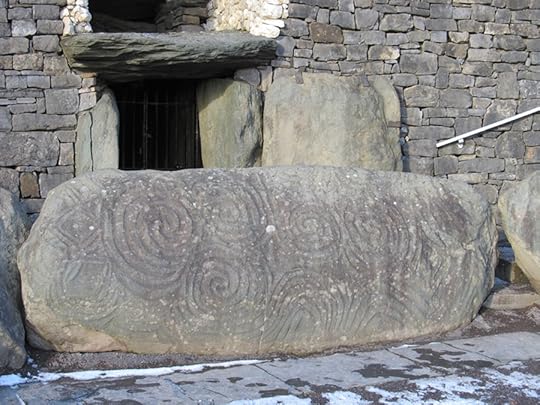
New Grange
Older than Stonehenge, and even the Egyptian Pyramids, Newgrange is a Neolithic monument. Its proper name is Brú na Bóinne, which means the “palace” of the Boyne, referring to its location within the bend of the River Boyne. A passage tomb, it was built around 3200 BC, used for several hundred years, then was lost to time until quarrying activities in 1699 led to the rediscovery of the passage and chamber. Major archaeological excavations, followed by conservation and presentation led to its status as a World Heritage Site today, close to the village of Donore, and visitors may enter the tomb only during formal tours, which leave from the Brú na Bóinne Visitor Centre.
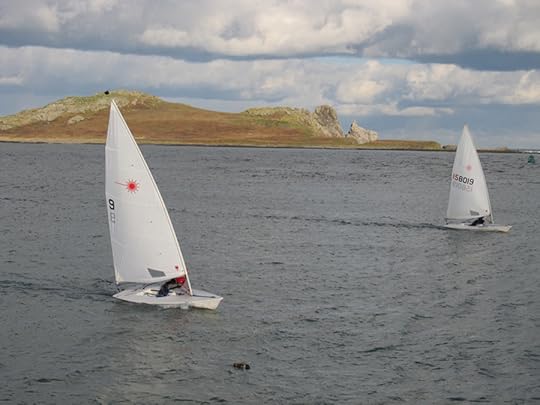
Howth
Ireland’s Eye is a small island and bird sanctuary near Howth, an Irish village east of Dublin. A clifftop trail has sweeping sea views, and sailboat racing on the calm waters here are a favorite pastime, year-round. Visitors may take a train from Dublin and while in Howth, tour the rhododendron gardens on the grounds of 15th-century Howth Castle. The 19th-century Martello Tower here is famous as the location where the fictional Leopold Bloom proposes to Molly in James Joyce’s “Ulysses.”
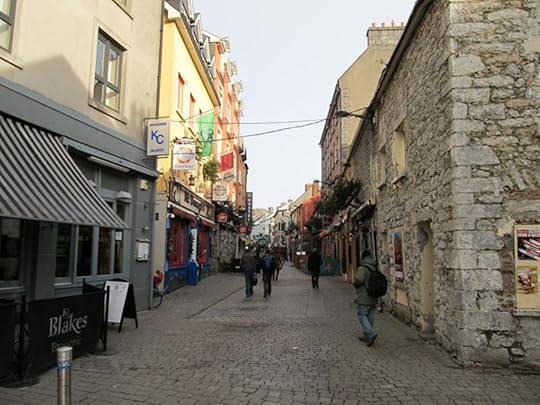
Galway
Galway is another harbor city on Ireland’s west coast, and the city’s hub is 18th-century Eyre Square. This popular spot features shops and traditional pubs that offer live Irish folk music. The Latin Quarter, which retains portions of the medieval city walls, is nearby and is filled with cafes, boutiques and art galleries. It lies on the River Corrib between Lough Corrib and Galway Bay and is the sixth most populous city in Ireland. A notable visitor, Christopher Columbus visited Galway in 1477.

Cobh in County Cork
Cobh in County Cork was often the last glimpse that millions of Irish had of their homeland before immigrating to America, or those deported to Australia. Its harbor offered natural protection, and by the 19th century, the town became prominent as a tactical center for naval military base purposes. On April 11, 1912, it was the final port of call for the RMS Titanic before she set out across the Atlantic on the last leg of her maiden voyage. A German U-boat sank the RMS Lusitania on May 7, 1915, and rescuers brought the survivors and the dead to Cobh. Many are buried in the Old Church Cemetery there.
The post Ireland: Land of the People that Sorrow appeared first on Hands on Heritage.