
Annette Batterink's Blog, page 2
June 24, 2024
Coping with Grief and Loss: Understanding the Emotional Journey
Any event that changes your circumstances can cause distress, regret or disappointment. Everyone is unique in how they experience losses and changes.
Grief
The Lord is near to the brokenhearted and saves the crushed in spirit. Psalm 34:18
What is grief?
Grief is the experience of coping with loss. It reflects what you love or are deeply attached to, so it can feel all-encompassing.
Loss is traumatic, so there can initially be emotional numbness. “Why don’t I feel anything?”. The initial shock and avoidance must wear off before the reality of the loss is genuinely felt. It may make people wonder if you even care about your loss. It’s important for those who wish to support someone to remember that they may need us more later than now.
There can also be “delayed grief”. My mother died after she had dementia for several years. In some ways, I had been losing her for a long time, so at the time of her death, I didn’t feel the loss much. It was more than a year later, when looking at some photos, that the tears flowed – and I missed her!!
Sometimes, something happens that brings back memories of your loss, and you may suddenly experience grief again, along with some of the effects on your body. Common “grief triggers” are birthdays, Christmas and any event special event that now cannot be celebrated the same way.
There are no right or wrong emotions when it comes to grief. Anger is a common emotion in grief. Some people find it hard to talk about their anger. It took a while after my divorce for me to recognize and acknowledge that I was angry at God. It was an important step in moving forward into what God had next for me.
Grief is not limited to the loss of people.
This list is some examples of loss. Those with a * are ones I have had personal experience with, and I may refer to them later.
Bereavement – loss of someone close to us*Death of a pet*Estrangement of a family member*Retirement*Change in a financial stateDeath of an abuser – memories of abuse may get triggeredDivorce*Losing a jobRelocating*AbortionChange of jobLeaving homeLoss of a friendshipPersonal injury or health*Relationship breakupSerious illness of a loved one.Some common effects on the Body
Loss is an extreme stressor affecting the nervous and immune systems. You may feel generally unwell, including:
headachesfatiguenausearestlessnessupset stomachnot sleeping or sleeping too muchjoint painsmuscle achespalpitationsand it may be easier for a person to get sick.The situation that affected me the most physically was my divorce. Initially, I had several of the symptoms listed. I also had problems concentrating at times and was blessed to have co-workers who were patient with me.
The estrangement of family members is “complicated.” I grieve their absence in my life yet maintain the hope of reconnection.
The loss of our dog, Sydney, was a sad time for my kids and me. Syd had been our constant caring companion through the days after the divorce. He was our “excuse” to get out, walk, or run about. He loved us unconditionally during a time when we had little energy to support each other. Five years later, when I lived in a different city, I still “expected” Syd to be waiting for me when I came home from work one day.
Grief can be unpredictable because it comes in waves. It’s one of the most frustrating aspects of life after loss. One day you feel mildly okay, and the next you feel as if the loss has just happened all over again. In addition to being frustrating, it can be exhausting. ~ Halle M. Thomas.
Grief do’s and don’ts.
Cast all your anxiety on Him because He cares for you. ~I Peter 5:7
Taking care of yourself physically and mentally is very important. It is important to allow yourself to grieve. I found reading self-help books very useful. It was good to know that my emotions were normal, that this, too, would pass. Guilt and shame can hold you back. When I asked myself what I was guilty of or why I felt shame, I really didn’t know. And even if there are issues to resolve, now is the time to make changes to move forward.
Be patient with yourself, but also remember not to underestimate yourself. Through trial and error, you can find things that make a day feel brighter. Walking the dog was a great way for me to get exercise. I also started paying attention to what was around me more. Focusing on the birds, trees and flowers took my mind off of other more challenging things.
One of the best things I did after my divorce was join a Divorce Care group. I had an opportunity to talk to people who understood my feelings. I had difficulty connecting with people other than the nurses I had worked with for 12 years. At Divorce Care, I could share my hurts and challenges and be understood. After our sessions were done, we continued to see each other socially. Joining a support group is a great addition to any grief recovery strategy.
After a loss, it is important to take time before making big changes in your life. Don’t cross your bridges before you get to them. Take one day at a time. If you have lost a significant other, it’s best to take time before getting into another relationship.
How can you offer help to someone after their loss?
Be present. Support them in any way they need. Offer help. Often better to offer than to ask. It may take too much energy for them to think ahead to what they might need.Signal that you are open to talking. Look for clues from the grieving person. It’s important to listen more than you talkDon’t minimize someone’s loss. Allow the person to process their feelings honestly. “It’s for the best” may be what you believe to be true. However, the grieving person may not be ready to hear that.When should a grieving person seek help?
If your feelings of sadness and despair are persistent and you are unable to experience happiness, you may be depressed. Seek help after a reasonable length of time if you are not coping with the important areas of your life and you don’t know how to move forward. Joining a support group may be a great addition to your therapy.
Sadness
When I was reading about grief, I came across some helpful comments about sadness. I have relocated several times over the years, and I soon knew that life could feel challenging for a while in a new location. I read that sadness teaches us to adapt.
To feel better in my new place, I must learn where the places I need to function are (stores, banks, etc.). Life feels better when I get settled into my new home, find out where I like to walk and am connected to a church. I evaluate what is important to me and take t action in those areas.
I can use this lesson in other ways in my life as well. When life doesn’t feel quite right: re-evaluate and change.
Final Words
Ajita Robinson, PhD. Like to look at grief as a set of phases.
Acknowledge the lossCreate space for your feelingsUnderstand that grief is a lifelong journeyKnow that there can be joy in life post-loss.Jesus said: “So you have sorrow now, but I will see you again, and your hearts will rejoice, and no one will take your joy from you”. John 16:22
(I appreciate the image at the top of this blog — the Light shines in the darkness!!)


June 13, 2024
50 Years of Nursing Memories and Transitions
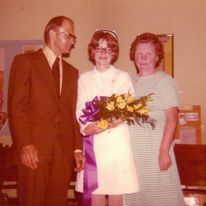
There are lots of memories surfacing these days because on June 14, 2024, it will be 50 years since my nursing class graduated. We graduated from Public General Hospital School of Nursing in Chatham, ON and from St. Clair College (Windsor, ON) Thames Campus. We started our classes at a hosptial school of nursing and ended them at a community college. Nursing schools transitioned from hospitals into Community Colleges in 1973. Two things have changed over the years. It now takes a 4-year University degree to become a Registered Nurse (I was in a two year program) and more males are entering the field of nursing (I had 2 males in my class).
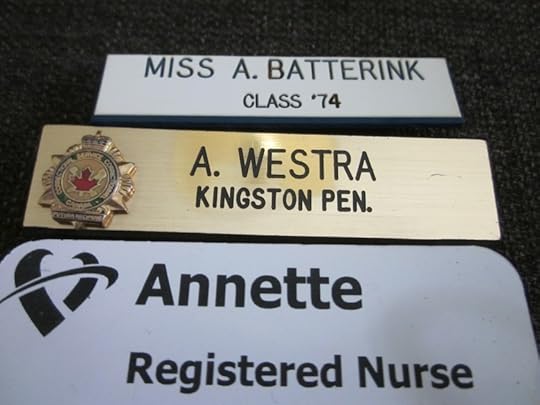
This photo shows some of my name tags: Miss A. Batterink (nursing school) A. Westra (Kingston Penitentiary) and my last one, Annette (Fraser Health Authority for my positions at Surrey Memorial Hospital and Newton Home Health, BC). They also tell a story of how differently nurses were addressed through the years.
My Transitioning Career (skip this part if it’s too boring)
Over 44 years, I worked in 12 different institutions in 4 provinces.
Hamilton General Hospital ON– Neurosurgery and Burn Unit -July 1974-June 1978*
Kyle-White Bear Union Hospital SK– general nursing -Sept. 1975- Oct. 1975* (more about that later).
Sarnia General Hospital ON -casual float nurse -(July 1978 – May 1979)
St. Jospeh’s Hospital, London ON- urology unit -June 1979 – July 1980
Kingston General Hospital ON – casual part-time float -Oct. 1980 – Sept. 1981
Kingston Penitentiary ON -Operating Room- Feb. 1984 – Aug. 1986
Hotel Dieu Hospital, Kingston ON – Surgical Intensive Care- Sept. 1984- Aug. 1986
Strathroy Middlesex General Hospital ON– Medical Floor and ICU/CCU – Sept 1986 – April 2008
Foothills Hospital, Calgary AB- Respiratory Medicine and Thoracic Surgery – part-time- May 2008 – Feb. 2009
Bow Crest Nursing Home-Calgary AB – part-time evening nurse dementia unit – March 2009 – April 2010.
Surrey Memorial Hospital BC– casual position (medical floors) -May 2010 – April 2013
Newton Home Health, Fraser Health Authority BC – April 2013- Sept. 2018
“As a nurse, we have the opportunity to heal the heart, mind, soul and body of our patients, their families and ourselves. ~ Maya Angelou
When I had my interview for my first nursing job, I said that I wanted to work in an area where I would get to know patients and their families. My first assignment was on a neurosurgical unit at Hamilton General Hospital. It was an intense place to work. Patients included those with brain tumours, new paraplegics & quadriplegics and semi-comatose patients with little hope of recovery. There were also frequent deaths. Giving emotional support in so many diverse situations stretched me in ways I had never anticipated. At the end of a year, I was ready for a change. It was an idea that my head nurse celebrated as she felt all new nurses should explore nursing.
I decided on a big transition and applied for a position I read about in The Canadian Nurse. However, between the time I was accepted for the position and the time I arrived in *Kyle SK, there was a change in doctors. The present doctor had few privileges. I felt bored and isolated and when I was offered another position at the hospital I had just left, I returned to Hamilton General Hospital, this time to the Burn Unit.*
The Burn Unit was also an intense place to work, with sometimes heart-breaking situations. Sometimes multiple members of the same family were admitted and not all of them survived. One of those people was Ronnie. He was 17 years old. His cousin’s clothes caught on fire while working in a garage. Ronnie used a fire blanket to put out his cousin’s burning clothes. There wasn’t a second blanket for when Ronnie’s clothes caught fire, too. He was severely burned. He survived for several weeks. Ronnie was a Christian and he knew I was, too. One quiet night, near the end of Ronnie’s life, I sat at his bedside for a few minutes. Ronnie said, “Annette, it’s ok if I die. I’m ready and my cousin isn’t”. I was 23 years old at that time, and Ronnie’s words have always stayed with me.
Two things changed for the better soon after I started working at Hamilton General. One was switching from glass IV bottles to IV bags. No more crashing bottles on the floor as patients stumbled out of the bathroom (We often had patients with delerium tremens on our unit). The other good change was no longer using mercury thermometers: rectal and oral ones. We spent too much time chasing those little balls of mercury around on the floor when a thermometer broke.
“Transitions are a time for reflection and a time for looking forward” ~ Roy Cooper
During these years (except for my time in SK, of course), I was living at home with my parents. It was a blessing to be so well cared for while I was transitioning into my new profession. After four years at home, I was ready to move on, but not as big a change as my venture to SK. I moved into my first apartment in Sarnia,ON. A city where I had gone to elementary school and high school. It was also close enough to spend time at my favourite lake, Lake Huron.
I worked at Sarnia General Hospital. I had a casual float position. I smiled when I had opportunities to work in the area where the delivery rooms had been when I was born. To better position myself for a full-time job, I took an in-house Critical Care course on my own time, giving up opportunites to earn money when I went to classes. They promised that we would get full-time positions on completion of the course work. That promise was broken—and I moved on again.
Transition 2
My next stop was a full-time position on a 44-bed urology unit in St. Jospeh’s Hospital in London, ON. I learned skills that would be useful later and enjoyed working with the young nurses who were my colleagues. I left when I got married and moved to Kingston, ON.
Transition 3
I had more transitions as I adjusted to life in Kingston, to life as a wife and soon to life as a mother. During my years in Kingston, I first worked as a casual float nurse at Kingston General Hospital. KGH is a teaching hospital and I learned “lots” and enjoyed the many new situations I was exposed to. I was blessed to have supportive staff help me in each new situation.
My children were born 18 months apart, so these were busy years. My first “back to work” position after my second child was born, was in the Operating Room at Kingston Penitentiary: every week on Wednesday. Working in “the Pen” was a unique experience. Getting to know our inmate orderlies and reading the files of those who came for surgery helped me recognize that every one of us “has a story”. After a few months, I also started working a casual position at Hotel Dieu Hospital in Kingston in their Surgical Intensive Care unit.
I had a huge transition in 1986 —a separation in my marriage – and a move to Strathroy, ON which is a 5-hour drive from Kingston, but where my sister and her family lived. (My husband joined the children and me 6 months later)
Let us never consider ourselves finished nurses. We must be learning all our lives. ~ Florence Nightingale.

I was soon working at Surrey Memorial Hospital. I worked there for 22 years in various part-time and full-time positions, in the Medical Unit and in ICU/CCU. It was my first time working 12-hour shifts. Strathroy was a good community to be part of and looking after “the locals” was a positive addition to the job.
All through these years, continuing education was a must. I learned how to do blood sugar testing (glucometers), how to do chest assessments to listen for abnormalities using a stethoscope. I learned how to stick needles into veins to start intravenous therapy and how to do sterile dressing changes for PICC lines (Peripherally inserted central line) and for central lines. There were many specialty skills I needed to use when working in ICU/CCU.
We seldom wore gloves in the early 70s. With the passing years, gloves were being worn more and more often. And soon nurses were using lots of hand sanitizer.
Any change, even a change for the better, is always accompanied by drawbacks and discomfort. ~ Arnold Bennett
During my career, I found it stressful when changes were made to the way we had to deliver care. When I initially worked in nursing, we followed the team nursing model of care. A team worked together to get the care done for a certain group of patients. In my last hospital job, we did total patient care. A nurse was responsible for all the care for his/her patients. I found that in Team Nursing I had to keep track of details for too many patients. In Total Patient Care it was sometimes hard to find the help I needed when I needed it.
My favourite way of doing patient care was a hybrid of team nursing and total patient care. We had some variations of that while I worked in Strathroy. I liked to know which patients I was responsible for, but I also liked to have another nurse or nurses on my team that knew we would work together when needed. I knew who was assigned to cover me for my breaks. Another thing we did on the medical unit was “rounds”. All available nurses going through the unit together getting patients up or back to bed. I enjoyed seeing the other patients I wasn’t assigned to.
John C. Maxwell said that “Teamwork makes the dream work”.
There were a big personal changes while in Strathroy
During these years, I divorced and adjusted to “single-again” me. My children completed post-secondary education, and both moved to Calgary, AB. I found out that Alberta had great part-time rotations and even better benefits. I decided it was time for a change. After spending 22 years working with many of the same people, I missed them. But I was ready to move forward into what God had next for me. I am thankful for any connections I still have.
Forgive yourself; you are not perfect. Show yourself grace; you are still learning. Show yourself patience; you are on a journey. ~ Shannon Yvette Tanner
When you first start nursing you are a “novice nurse” but as you gain experience, you work towards being an “expert nurse”. During my many job changes through the years, I was able to adjust out of the novice stage within a reasonable time frame, and start to feel comfortable.
When I moved to Calgary, I worked 8-hour shifts on a Respiratory Medicine and Thoracic Surgery unit at Foothills Hospital. Their nursing model was a bit different than I had previously experienced; it was the first time I worked with care aides.
I had often worked on medical units, so respiratory medicine wasn’t too big a challenge for me. However, this was my first time working with thoracic surgery patients and the unique situations that this involved : chest tube removals, strict pain control and post-op care.
Another challenge for me was that the staff turnover on the unit was great. This affected me and all the new nurses; some were novice nurses. I could answer some of the novice nurses’ questions but didn’t always get my own questions answered. After 9 months, I realized I “wasn’t having fun”. So, I resigned. Years before my father had told me that if I wasn’t having fun, I should find something else to do. I could, so I did!
I took a month of vacation, traveling to visit family and friends. When I got back to Calgary, I had a message on my answering machine to set up an interview for another job. Through all the challenges and changes, I was blessed that every time I needed or wanted another job, I was able to find one.
They may forget your name, but they will never forget how you made them feel.” – Maya Angelou
Soon I was working in a part-time evening position on a 77-bed dementia unit at Bow Crest Nursing Home. I enjoyed most aspects of that job, but especially tucking people into bed at night. One sweet memory is about a resident named Betty. Betty had quite advanced dementia but was still able to peddle herself around the unit in her wheelchair. There was a time when I didn’t see her for a few days because I was assigned to other patients, but Betty found me. She peddled up to me and said” If I have a birthday party, will you come?” She didn’t know my name, she probably didn’t know when her birthday was, but she considered me her friend. Such an honour.
“Every new beginning comes from some other beginning’s end” ~ Lucius Annaeus Seneca.
My children had both moved away from Calgary and I had family and friends in BC, so, without a job or a place to live, I moved there. I lived with friends initially, but soon had a job and my own apartment.
I worked 12 hour shifts at Surrey Memorial Hospital (SMH), floating to various medical units. Initially I worked day and nights shifts, but eventually was able to get enough work by only working days shifts. At SMH, the physiotherapists were more involved with the patients’ care. The multidisciplinary model of care was new for me – the added input to my patients’ care was appreciated.
One skill I learned at SMH was how to do peritoneal dialysis- a treatment for kidney failure that uses the lining of your abdomen, or belly, to filter the blood inside of your body. It can be done at home or another appropriate place by the person needing treatment.
To All Good Things There Comes an End
My final job change in my career was when I started working at Newton Home Health (NHH). During my interview for my first job, I had said that I wanted a position where I could get to know patients and their families. Over the years, hospital nursing became too busy for me to feel that connection. So even though, I didn’t too often see the same clients again and again, I enjoyed once again having an opportunity for better one-on-one communication with the people I cared for.
There was a bigger learning curve than I had anticipated in doing home health nursing. The efforts towards the adjustment were worth it. Because NHH and SMH were both part of the Fraser Health Authority, my seniority moved with me. This made it easier for me to pick the shifts I wanted to work; a surprise that was a blessing.
In the fall of 2017, I had surgery with some complications. For several months afterwards, I tried to get “back into the groove”. I worked some shifts, but thinking about needing to work the next day became stressful. Eventually I had to admit to myself that trying to get back to work was sabotaging my recovery. I resigned in the fall of 2018.
Life has a different rhythm now. I like being able to set my own pace and get involved with what I want to be involved in. I do some volunteer work; I am a member of a ladies’ group at church and I am finding time for my hobbies. I am thankful for the years that I could spend time with patients and their families. Their stories have added to the richness of my story.
June 6, 2024
Justice and Peace: Understanding and Pursuing True Flourishing
What does justice look like?
Dr. Timothy Keller said that “Biblical justice requires that every person be treated according to the same standards with the same respect, regardless of class, race, ethnicity, gender, or any other social category.”
Justice looks like treating everyone with fairness. It’s not about exacting vengeance. ““Vengeance is Mine, I will repay,” says the Lord “. (Romans 12:19) It’s not about judging others. “Judge not, that you be not judged.” (Matt. 7:1)
It is about loving our neighbour as ourselves. (Matt. 22:39).
What does peace look like?
The word “shalom” is found many times in the Hebrew text of the Old Testament. It is sometimes translated as “peace” or “welfare”. Nicholas P. Wolterstroff says in the book “Call for Justice” that he prefers the word “flourishing”. “Flourishing” can be described as healthy, propering, thriving, successful.
“Shalom consists of flourishing in all dimensions of our existence: in our relations to our fellow human beings, in our relations to the physical world, in our relations to God, in our relations to the artifacts and institutions created by human being and even in our relations to ourselves.” ~ (pg. 116 “Call for Justice” by Kurt Verbeek and Nicholas P. Wolterstroff.)
When I think of an organization that works towards flourishning, I think of the Association for a More Just Society (https://www.asj-us.org/). One of their initiatives is in the field of education. Recently , After the beginning of this school year,I got this update: I am so happy to report that 58 school days later, not a single day of class has been canceled and 2 million children have had a nutritious lunch every day. If this keeps up, these children will be in school for more than 200 days! And since the majority of children in public schools live below the poverty line, 200 days in school means 200 days of learning, 200 days of healthy lunch, and 200 days in a safe place protected from threats they may face in their neighborhoods or homes. What an opportunity for flourishing for the children of Honduras.
Justice and Peace
Without justice there can be no peace, and without peace there and be no justice. How can I make a difference?
Recently, I read this prayer by Pete Greig (Lectio 365, May 28, 2024).
God of justice and mercy, as I open my heart to You now, comfort me where I’m unsettled and unsettle me where I’m comfortable. Challenge me and change me, disturb and rearrange me, not for my own sake but for the sake of those who are hurting and helpless, ostracized and oppressed. Amen
I am challenged by this prayer.
What about me?
When I think of something that unsettles me, one thing I think of is bullying — verbal, physical, emotional or religious bullying. I want to be able to react in better ways when I, or someone else, experiences unfairness by another in this way..
I feel comfortable in a safe, familiar place, but I don’t want to be so comfortable that I resist moving from that place. It’s important that I look beyond myself to see the needs of others, the need for care and inclusion.
I need to see what I haven’t been seeing, to recognize where the things that I consider “normal” are “abnormal”. I need to recognize the places where I’m convinced my thinking is right, but it’s not.
I don’t want to be so busy looking ahead that I don’t look around me. It’s easy to miss the opportunities that God places around me every day. Rearrange my priorities. The little things matter if I want to show love to my neighbour.
Living in a right relationship with God, others and our communities requires the active pursuit of peace. ~ Emily Steen.
There are many ways we can work to bring shalom on earth: any occupation, any human interaction, any care for the planet, any prayer to our loving Father in heaven can add to the flourishing of others.
My personal efforts for peace and justice don’t feel like much sometimes. I help serve breakfast at a Meal Program once a week, being intentional about connecting with people when I can. I try to remember to smile at people when I pass them as I walk out and about. I try to offer words of encouragement when an opportunity arises. I volunteer at Recovery Church https://www.clachurch.com/recovery-church.
It’s awesome when God shows me or reminds me that somehow, I have made a bit of a difference in someone’s life. May I become more and more aware of opportunities to help people flourish. May my actions be more intentional.
Biblical Justice and Peace: Understanding and Pursuing True Flourishing
What does justice look like?
Dr. Timothy Keller said that “Biblical justice requires that every person be treated according to the same standards with the same respect, regardless of class, race, ethnicity, gender, or any other social category.”
Justice looks like treating everyone with fairness. It’s not about exacting vengeance. ““Vengeance is Mine, I will repay,” says the Lord “. (Romans 12:19) It’s not about judging others. “Judge not, that you be not judged.” (Matt. 7:1) It is about loving our neighbour as ourselves. (Matt. 22:39).
What does peace look like?
The word “shalom” is found many times in the Hebrew text of the Old Testament. It is sometimes translated as “peace” or “welfare”. Nicholas P. Wolterstroff says in his book “Call for Justice” that he prefers the word “flourishing”.
“Shalom consists of flourishing in all dimensions of our existence: in our relations to our fellow human beings, in our relations to the physical world, in our relations to God, in our relations to the artifacts and institutions created by human being and even in our relations to ourselves.” ~ (pg. 116 “Call for Justice” by Kurt Verbeek and Nicholas P. Wolterstroff.)
When I think of an organization that works towards flourishning, I think of the Association for a More Just Society (https://www.asj-us.org/). They “strive to be brave Christians, dedicated to doing justice in Honduras and to inspiring others around the world to seek justice in their own contexts“.(words taken from the front page of their website)
One of their initiatives is in the field of education. For a long time, the government of Honduras had a history of not putting priority on education, which made life feel hopeless for many people who faced an uncertain future.
Recently , After the beginning of this school year,I got this update: I am so happy to report that 58 school days later, not a single day of class has been canceled and 2 million children have had a nutritious lunch every day. If this keeps up, these children will be in school for more than 200 days! And since the majority of children in public schools live below the poverty line, 200 days in school means 200 days of learning, 200 days of healthy lunch, and 200 days in a safe place protected from threats they may face in their neighborhoods or homes.
What an opportunity for flourishing for the children of Honduras. With a more hopeful circumstance at home, perhaps fewer young people will head north to an uncertain future
Justice and Peace
Without justice there can be no peace, and without peace there and be no justice. How can I make a difference?
Recently, I read this prayer by Pete Greig (Lectio 365, May 28, 2024).
God of justice and mercy, as I open my heart to You now, comfort me where I am unsettled and unsettle me where I am comfortable. Challenge me and change me, disturb and rearrange me, not for my sake, but for the sake of those who are hurting and helpless, ostracized and oppressed. Amen.
As I read this prayer, I had some thoughts about some of the key words.
Unsettled – Bullying unsettles me, verbal, physical or emotional bullying. I want to be able to react in better ways when I, or someone else, experience bullying.
Comfortable– I feel comfortable in a safe, familiar place, but I don’t want to be so comfortable that I resist moving from that place.
Challenge me– It’s important that I look beyond myself to see the needs of others, the need for care and inclusion.
Disturb – I need to see what I haven’t been seeing, to recognize where the things that I consider “normal” are “abnormal”. I need to recognize the places where I’m convinced my thinking is right, but it’s not.
Rearrange– I don’t want to be so busy looking ahead that I don’t look around me. It’s easy to miss the opportunities that God places around me every day. Rearrange my priorities. The little things matter if I want to show love to my neighbour.
What about me? And what about you?
The ”sky is the limit” in the ways we can work to bring shalom on earth: any occupation, any human interaction, any care for the planet, any prayer to our loving Father in heaven can add to the flourishing of others,
Living in a right relationship with God, others and our communities requires the active pursuit of peace. ~ Emily Steen.
My personal efforts for peace and justice don’t feel like much sometimes. I felt God’s protection when I was going through my divorce. One of the Divorce Care leaders said, “Don’t worry, vengence belongs to the Lord”. I wasn’t comfortable with that thought as I didn’t think I should want God to “go after” my ex-spouse. Exodus 14:14; “The Lord will fight for you. You need only be still”. That idea settled much better into my thoughts and feelings. Being set free from anger and resentment was a blessing.
I help serve breakfast at a Meal Program once a week, being intentional about connecting with people when I can. I try to remember to smile at people when I pass them as I walk out and about and I try to offer words of encouragement when an opportunity arises. It’s awesome when God shows me or reminds me that somehow, I have made a bit of a difference in someone’s life.
May I become more and more aware of opportunities to help people flourish. May my actions be more intentional.
May 30, 2024
The Power of Stillness: Slowing Down, Trusting, and Healing
Were we really meant to rush with abandon toward some earthly hilltop finish line? Or was God telling us something in those whispers of “be still”, that all along, it was necessary to slow down, trust and heal”. ~ Morgan Harper Nichols
Fifteen years ago, I started a correspondence that continues to this day (though now we sometimes have in-person visits, too). The verse that started our connections was Psalm 46:10~ Be still and know that I am God. This phrase still comes up often in our conversations. Therefore, when I read the above quote, I wanted to explore it further.
Slow down
Carl Honore says that “the great benefit of slowing down is reclaiming the tranquility to make meaningful connections -with people, with culture, with work, with nature, with our bodies and minds.” Corrie ten Boom once said that if the devil cannot make you sin, he will make you busy. Busyness separates us from so many things that can enrich our lives. Busyness separates us from God and others.
Psalm 23:2,3 tells us that to refresh our souls, the Lord, our Shepherd “makes us lie down in green pastures, He leads us beside quiet waters.” We need time to re-focus, to spend quality time with others, to be still and know that He is God. In the stillness, in the quiet, He is there.
It was a very busy time when I first had my own home after my divorce. I had two children at home and was working as many nursing shifts as I could. I will always be thankful that we had a dog that needed to be taken for walks. It was my chance to get away from the busyness at home and get out into nature. Later, I made the choice to take time to read a book one morning a week. Mini-escapes can be important.
Trust
Long ago, when the Israelites were nearing the Red Sea, the Egyptians were pursuing them. They felt trapped and afraid and wished they had stayed in Egypt. They were told “The Lord Himself will fight for you. Just stay calm. (Exodus 14:14 NLT). Not only did God part the waters of the seas so the Israelites could walk through on dry land, He also drowned the enemy that was pursuing them. Be still, the Lord will fight for you.
In another situation, David was being hunted by his enemies. He had to wait patiently for the Lord to act, knowing that God “had his back.” David wrote Psalm 37:7~ Be still before the LORD and wait patiently for him; do not fret when people succeed in their ways, when they carry out their wicked schemes.” It can be hard to wait. We feel like we have to DO SOMETHING! Learning to trust God in small situations makes it easier to trust Him on the big things, too.
Staying calm in a tough situation isn’t easy for me. However, when I worked as a nurse, I had to be sure that my anxiety wasn’t transmitted to my patients. Pause, take a deep breath and do the most important thing first.
Heal
Mary Beth Eiler wrote Stillness leads to clarity as we uncover what was holding us back and how to move forward. Stillness replenishes us and creates space to hear our own thoughts. Stillness is the mediator between what we feel and our ability to express it. Stillness is where we grow quiet enough to hear God’s voice and remember we are Beloved.
To truly begin to walk toward healing, we must willingly engage in the practice of stillness as we come to terms with the reality of our present.
Many changes happen in our bodies when we calm ourselves. These changes are healthier for our hearts and our minds.
When I was diagnosed with thyroid disease, I had to learn to put more importance on my health. Diet, exercise, getting outdoors and spending time with family and friends all became important.
Final words
I am retired now and taking time for myself can be a challenge. I think “I’m not busy” or “I don’t have a lot to do” and fritter away too much of my time. It doesn’t feel good to have days when I feel like I’ve accomplished “nothing”.
I am becoming aware of the importance of having some routines in my life. Days that I plan to accomplish household tasks, set time apart to volunteer, make more effort to connect with family and friends and getting exercise consistently. When I have scheduled things to do, I feel like I am taking “me” time when I do something for myself. I am thankful that my days are starting to have some rhythm. When life feels eheavy and hard, I know I need to look to the Master,
And Jesus said: “Come to Me, all you who labour and are heavy laden and I will give you rest. Take My yoke upon you and learn from Me, for I am gentle and humble in heart and you will find rest for your souls. For My yoke is easy and my burden is light.
May 23, 2024
Building Genuine Connections
You never know when a moment and a few sincere words can have an impact on a life~ Zig Ziglar — I volunteer with the Meals Program at Surrey Urban Mission one morning a week. Many of the guests have the challenge of addiction and/or homelessness. Initially, I individually greeted the guests as I handed them a plate of food, but didn’t talk to anyone much. Slowly, I am starting to have more connection with the guests, even through all the busyness. I am learning the importance of intentionality, the importance of connection.
Most people do not listen with the intent to understand; they listen with the intent to reply~ Stephen Covey — This can happen for me. For years, as a nurse, it was my role to help people find solutions. This is not appropriate in other situations. I need to focus on listening, especially in situations where I don’t have enough knowledge to have an educated opinion.
We’re often afraid of being vulnerable, but vulnerability creates gebuine connection~ Stephen Covey — Another challenge for me is being voulnerable, sharing when I am in a “darker” place than I am comfortable with. I want to find a solution or resolution or dismissal of the problem before I share.
The single biggest problem in communication is the illusion it has taken place. ~ George Bernard Shaw — This illusion can happen for many reason, including the two I have mentioned. If I don’t actually listen, then no real connection has been made. Sharing “my logic” is not real communication. This illusion can also happen when I don’t share my vulnerabilities. The other person may feel like we have had a connection, but my needs have not been met, and I have only my relutance to share to blame.
Conflict avoidance is not the hallmark if a good relationship. On the contrary, it is a symptom of serious problems and poor communication. ~Harriet B. Braiker –This was a major problem in my marriage. I avoided conflict to be nice, initially, but later because I felt I didn’t gain anything by “stirring the pot”. After a while, I didn’t care any more. It was a serious problem. It was good when the marriage ended and I began to find my voice again.
To effectively communicate, we must realize that we are all different in the ways we perceive the world and use this understanding as a guide ot our communication with others~ Tony Robbins — I grew up in a rural community in Ontario, Canada with in the 1960s and now live in a neighbourhood on the west coast that is like the United Nations. I have had to learn a lot about how other people live, what is important to them and what is “normal” for them.
Successful relationships and marriages are built one minute at a time. One act of communication at a time. One act of sharing at a time.~ Dr. Henry Cloud
May the words of my mouth and the meditation of my heart be acceptable to you, LORD, my rock and my Redeemer.
Psalm 19:14
January 4, 2024
Embracing a Forward-Looking Perspective
Forget the former things; do not dwell on the past.
Isaiah 43:18
The beginning of a new year is a good time to be forward-looking. The world is a bit unsettled right now and thinking about that too much makes me feel “stuck”. The problems are bigger than I can do anything about.
But maybe I can make a difference in “my corner” with the people God puts in my path. Maybe what God requires of me isn’t to change the world.
And what does the Lord require of you? To act justly and to love mercy and to walk humbly with your God.
Micah 6:8
May I be able to live a life pleasing to God and others in 2024.
Embracing a Forward-Looking Perspective | Isaiah 43:18, Micah 6:8
Forget the former things; do not dwell on the past.
Isaiah 43:18
The beginning of a new year is a good time to be forward-looking. The world is a bit unsettled right now and thinking about that too much makes me feel “stuck”. The problems are bigger than I can do anything about.
But maybe I can make a difference in “my corner” with the people God puts in my path. Maybe what God requires of me isn’t to change the world.
And what does the Lord require of you? To act justly and to love mercy and to walk humbly with your God.
Micah 6:8
May I be able to live a life pleasing to God and others in 2024.
2024 – Living in a Unsettled World
Forget the former things; do not dwell on the past.
Isaiah 43:18
The beginning of a new year is a good time to be forward-looking. The world is a bit unsettled right now and thinking about that too much makes me feel “stuck”. The problems are bigger than I can do anything about.
But maybe I can make a difference in “my corner” with the people God puts in my path. Maybe what God requires of me isn’t to change the world.
And what does the Lord require of you? To act justly and to love mercy and to walk humbly with your God.
Micah 6:8
May I be able to live a life pleasing to God and others in 2024.
2024
Forget the former things; do not dwell on the past.
Isaiah 43:18
The beginning of a new year is a good time to be forward-looking. The world is a bit chaotic right now and thinking about that too much makes me feel “stuck”. The problems are bigger than I can do anything about.
But maybe I can make a difference in “my corner” with the people God puts in my path. Maybe what God requires of me isn’t to change the world.
And what does the Lord require of you? To act justly and to love mercy and to walk humbly with your God.
Micah 6:8
May I be able to live a life pleasing to God and others in 2024.


