
Linnea Tanner's Blog, page 22
April 23, 2023
Rowena Kinread The Scots of Dalriada #HistoricalFiction #ScottishHistoricalFiction #BlogTour #TheCoffeePotBookClub @RowenaKinread @cathiedunn
It is my pleasure to feature Rowena Kinread in The Coffee Pot Book Club Blog Tour being held between February 27th — May 1st, 2023. Rowena is the author of the Historical Fiction, The Scots of Dalriada, released by Vanguard Presson on 26th January 2023 (287 pages).
Below are highlights of The Scots of Dalriada , Rowena Kinread’s author bio, and an excerpt from her book.

Tour Schedule Page: https://thecoffeepotbookclub.blogspot.com/2023/01/blog-tour-scots-of-dalriada-by-rowena-kinread.html
HIGHLIGHTS: THE SCOTS OF DALRIADA
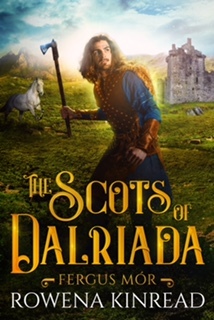
The Scots of Dalriada
By Rowena Kinread
(Blurb)
THREE BROTHERS
Fergus, Loarn and Angus, Princes of the Dalriada, are forced into exile by their scheming half-brother and the druidess Birga One-tooth.
THREE FATES
Fergus conceals himself as a stable lad on Aran and falls helplessly in love with a Scottish princess, already promised to someone else. Loarn crosses swords against the Picts. Angus designs longboats.
TOGETHER A MIGHTY POWER
Always on the run the brothers must attempt to outride their adversaries by gaining power themselves. Together they achieve more than they could possibly dream of.
Fergus Mór (The Great) is widely recognised as the first King of Scotland, giving Scotland its name and its language. Rulers of Scotland and England from Kenneth mac Alpín until the present time claim descent from Fergus Mór.
Full of unexpected twists and turns, this is a tale of heart-breaking love amidst treachery, deceit and murder.
Buy Links:
Universal Link Amazon UK Amazon US Amazon CA Amazon AU
AUTHOR BIO: ROWENA KINREAD

Rowena Kinread grew up in Ripon, Yorkshire with her large family and a horde of pets. Keen on travelling, her first job was with Lufthansa in Germany.
She began writing in the nineties. Her special area of interest is history. After researching her ancestry and finding family roots in Ireland with the Dalriada clan, particularly this era.
Her debut fiction novel titled “The Missionary” is a historical novel about the dramatic life of St. Patrick. It was published by Pegasus Publishers on Apr.29th, 2021 and has been highly appraised by The Scotsman, The Yorkshire Post and the Irish Times.
Her second novel “The Scots of Dalriada” centres around Fergus Mór, the founder father of Scotland, and takes place in 5th century Ireland and Scotland. It was published on Jan.26th, 2023.
The author lives with her husband in Bodman-Ludwigshafen, Lake Constance, Germany. They have three children and six grandchildren.
Social Media Links:
Website Twitter Facebook LinkedIn Instagram
EXCERPT: THE SCOTS OF DALRIADA
Donald sees Cartan approaching the ring. He nudges Lorcan and says, “Keep him occupied, I’ll make sure Fergus disappears.” He runs towards the stables but can’t find him anywhere.
Cartan sees Lorcan’s unmistakeable long, lanky figure and strides purposefully towards him.
“You here Lorcan, what are you doing here?”
“I could ask you the same. Why shouldn’t I be here? If you must know, I’ve been looking at the horses. Laird Donald wants a destrier, he asked for my advice.”
“Ah, any particular horse in mind? I’m looking for one myself.”
Lorcan tips the end of his nose. “Now that would be telling, wouldn’t it?” An idea forms in his mind. “Must go, I’ve business to attend to.”
He leaves Cartan standing at the ringside and ambles leisurely towards the stables.
Donald is amongst a mass of people, “I can’t find him. He must’ve seen Cartan and disappeared himself,” he tells Lorcan.
“Good. Now listen, I’ve got a plan. When the destriers are auctioned, bid for Lockwood until I rub my nose.”
“Lockwood? I thought we’d agreed on Thunderbolt.”
“Aye, I’ve no time to explain, trust me.” Lorcan finds Tormey and tells him to speak to the auctioneer. “Get him to auction Lockwood in third place, and Thunderbolt right at the end, I’ll explain later. Oh, and ask Hamish to do a demonstration on Lockwood before the bidding.”
Tormey looks a little surprised as Lorcan rushes off again, but he knows him well enough to do as bid without asking questions. Next, Lorcan goes around the ring until he finds Old Mac from the village.
“You and your friends bid for Lockwood till I pull my left earlobe.
The drinks are on me tonight.”
“Oh, right you are, leave it up to me.”
Satisfied that his plan could succeed, Lorcan takes place at the ringside and watches the sales. The auctioneer calls for attention and announces that the highlight of the fair was imminent, the auction of this year’s destriers. Eight horses are trotted around the ring whilst the auctioneer praises their compact and well-muscled build, their skill, and their swiftness, before they file out again. The first two horses achieve prices over four hundred gold pieces. Lorcan notices with satisfaction that Cartan doesn’t bid, but turns his head constantly between himself and Donald like a ball game. Hamish enters the ring riding Lockwood. Tall and majestic the powerful animal strides out with confidence. He has an elegant gait, a refined head, and an arched neck. His white coat is glossy, and his mane and tail plaited. Loud, “Oohs and aahs” accompany his movements.
Lockwood doesn’t bat an eyelid at the noise. Hamish lets him jump over two smouldering sheaves of hay. The spectators applaud. Then Hamish steers Lockwood to the middle of the ring. He demonstrates a leg yield with Lockwood moving forwards and sidewards; lifesaving on a battle field. Finally, he canters the full length of the ring, pulls Lockwood up briskly and lets him turn a pirouette to face the opposite direction. Then he trots again to the centre and rears up on his hind feet.
The applause makes Hamish’s ears ring. As he exits, the bidding begins.
The auctioneer has his instructions and begins at four hundred. Donald raises his hand, followed quickly by Cartan and Old Mac and his mates. In a matter of minutes, the bidding has reached eight hundred and fifty. Lorcan pulls his left ear lobe and Old Mac, and his friends drop out of the bidding, shaking their heads sadly.
“Eight hundred and eighty, who’ll give me eight hundred eighty?” the auctioneer bellows.
An awed silence falls over the ring. A collective holding of breath and eager expectation. The price is ridiculous, even for such a grand animal. Donald looks at Lorcan anxiously, but failing to see him rub his nose, nods to the auctioneer. The spectators let out their breath simultaneously. Lorcan grins at Cartan triumphally.
“One thousand!” Cartan shouts. A shocked silence, then enthusiastic applause.
Lorcan rubs his nose and Cartan sneers arrogantly as no one else raises his bid.
Lorcan turns on his heels quickly, and stumbling twice over stones that hadn’t been there before, rushes into the tack room. He shuts the door behind him and collapsing on a bale of straw, thrusts his fist into the air. It was a small victory but a gratifying one. Donald enters, followed by Tormey and Hamish.
“By me God, I nearly wet my truis there!” Donald exclaims. Tormey laughs and slaps Lorcan on his shoulders.
“Well done,” he says to Hamish. “You did us proud.”
“Aye, that was magnificent lad,” Donald says and Lorcan nods in agreement.
“What’s he doing now?” he asks.
There is no need to call him by name, everyone knows who he’s talking about.
“Paying the bailiff, emptying his purse,” Tormey grins wickedly. “By God, I hope that shoe holds till he’s back in Ireland. Mind you, I’d love to see his face when it falls off and he sees what’s below it.”
“Or rather the horn that’s not below it,” Lorcan grins wickedly.
“Well come on, no time for dithering, we’ve got a horse to buy.” “Oh yes, Thunderbolt, I nearly forgot!” Donald says.
Outside, the spectators are in a festive mood. When Cartan leaves with Lockwood to return to the port, a huge cheer goes up. The sale of Thunderbolt, a handsome dappled grey stallion with an unusual black mane and tail, is almost an anti-climax in comparison. Donald gets him for a fair five hundred and twenty gold pieces.
The fair is over, and everyone goes to the tavern to celebrate. Laird Douglas pays for food and drink; the evening is long. Just one person is missing, Fergus.
 Instagram Handle: @thecoffeepotbookclub


April 20, 2023
David Lawrence Blue Billy’s Rogue Lexicon #HistoricalFiction #QueerFiction #RomanticComedy #BlogTour #TheCoffeePotBookClub @cathiedunn
It is my pleasure to feature David Lawrence in The Coffee Pot Book Club Blog Tour being held between April 10th — April 21st, 2023. David is the author of the Historical Fiction / Queer Fiction / Romantic Comedy, Blue Billy’s Rogue Lexicon Eyes, which was released on February 21, 2023, by Broadbound Publishing (245 pages).
Below are highlights of Blue Billy’s Rogue Lexicon Eyes, David Lawrence’s author bio, and an excerpt from his book.

Tour Schedule Page: https://thecoffeepotbookclub.blogspot.com/2023/02/blog-tour-blue-billys-rogue-lexicon.html
HIGHLIGHTS: BLUE BILLY’S ROGUE LEXICON
Blue Billy’s Rogue Lexicon
by David Lawrence
(Blurb)
William Dempsey was a wonder among wonders.
By 18, he had risen from a gang of London street rogues to be the personal plaything of the Marquess of Argyll. Maintained in splendour, celebrated at masquerades – with everything he could wish for.
Now all has come crashing down. He is put out in the rain without patronage, his West End apartment, or a place among the ton.
So on a stormy night, he arrives at a house in Southwark. Marathon Moll’s in the Mint – the bawdyhouse he worked in during his ascent and where he earned the name Blue Billy.
But is Marathon Moll’s a place from which to rise again? For there is one in the crowd, who catches his eye. Who takes his hand and promises something better.
Or does Moll’s signify a return to his roots? For one day, a second and very different young man raps on the door. Takes his hand and asks him to return to his past.
To the cat language of vagabonds. The canting dialect of thieves.
To the schemes, and the dreams, of his youth.
Buy Links:
This title is available on #KindleUnlimited?
Universal Link Amazon UK Amazon US Amazon CA Amazon AU
AUTHOR BIO: DAVID LAWRENCE

David Lawrence is the author of two queer historical novels – ‘Hugh: A Hero without a Novel’ and ‘Blue Billy’s Rogue Lexicon’. As a writer, he loves taking a deep dive into the politics, social norms, and events of 18th century England while presenting humorous and unique coming-of-age tales.
A native of the American Southwest, David has spent much of his life in Great Britain, France, and Finland. He now lives in the American Northwest – Helena, Montana – with his Finnish partner.
By day he loves hiking under the Big Sky of his beautiful adopted state.
By night, however, he prefers wandering the byways of 18th century London…
Social Media Links:
Website Facebook Book Bub Amazon Author Page Goodreads
EXCERPT: BLUE BILLY’S ROGUE LEXICON
NOTE: The opening of the novel. It was such fun naming these chapters. The terms are taken from actual 18th century street slang I found during my research, and, thankfully, I found something to fit each chapter. Here Billy is arriving at a place he was formerly employed in, a bawdyhouse called Marathon Moll’s. He was kicked out years ago for stealing but he has fallen on hard times and hopes Moll will take him back. Chapter 1 Abram Cove
among thieves signifies a naked or poor man; also a lusty strong rogue
“And what have we here?”
“Let us in, Moll. Beast of a storm tonight, ain’t it?”
“Aye,” returned Moll, cinching her silk wrap while maintaining a hand behind the front door she’d opened just an inch. “Stormy for some by the look of it.”
The wind sent rain barrelling into this secluded yard in the Mint, taking the standing, shiftless dregs of chamber pots for an airy jaunt. Souls Yard, a misshapen cul-de-sac of three freestanding abodes consisted of a squat, squalid cottage, from which no light entered or emerged. A converted barn with modish ventilation in every wall and door, the slope of its gambrel roof rather like hands praying for intervention. And the jewel of the Yard, Marathon Moll’s: a double-fronted, two-story block tethered at east and west with slender chimneys touched with scoliosis.
“Have you lost your way tonight, Billy?”
With a look of wounded indignation, William Dempsey said, “Ain’t it enough to wish the company of an old, dear friend? ‘Old’ meaning previous-like,” he added, “nothin’ more.”
The door remained unmoved; Billy was left to shiver on the tilted stonework of the front elevation. Wiping the endless stream of August rainwater from his face, he pressed himself against the opening until their faces nearly touched. Moll’s – with its native jaundice, like dirty lemon juice upon features which arrived at too many points. Billy’s – a canvas of creamy white, flushed with health and whose boyish pout Moll herself had often declared a criminal provocation.
“‘Old’ you have defined, Billy, but how do you define ‘dear friend’?” said the bawd, pushing up her aquiline nose. “That term implies paying calls of friendship, or at least of courtesy (which are not calls to steal from my house, mind you), and I’ve not seen your pretty face these two years.”
“That Blue Billy outside?” came a second voice from within. “Let him in out the rain, for God’s sake.”
Recognising the voice of one of the house’s most devoted patrons, Dempsey said, “‘Dear friend’ I define as Dip-Candle Mary there behind you, who I hear’s set to be married next week, so I come to bestow my congratulations.”
All around Souls Yard, eyes were opening within cracks in the ramshackle barn and, one sensed without ever quite knowing, at the darkened front window of the cottage. For though a code of honour kept the inhabitants of each from inquiring into the business of their neighbours, scenes in the Yard were fair game for all.
After a moment, and a great sigh from Moll, the door withdrew just enough to allow into the vestibule Dempsey’s small, slim form. Mary hurried forward to embrace him. He was a tallow chandler from Shoreditch, Dip-Candle Mary being his house name. Such names were customary in these houses, which referenced either one’s profession or physical appearance. Indeed, Billy had never known him by any other, though the man had always been sweet on him. Sweet enough to forgive the trinkets Billy had lifted from his dressing table when staying the night. That silver-handled comb the man really didn’t need seeing as how he kept his hair so short. That errant bit of coin taken from coat pockets…
From the dark vestibule, Billy looked toward the glow of the front parlour. The room was filled with claret wallpapering before which replicas of Roman forms thought or gloried or sported in alabaster relief. Chintz upholstered sofas and settees of various conditions reclined before the fireplace, currently cold, its salt shelf crammed with crucibles of scented oil waiting to ignite on crackling nights. The parlour was lit by two fat beeswax candles stuck into halves of an antiquated urn hung over the mantle. The widely cast light lifted a glow from the gold threading of the furniture and, for a moment, a glow in Billy himself as he recalled the handful of good times he’d enjoyed while living here.
No question, Moll had come up in the world. When his eyes returned to hers, pride shone in her face as though to say: only observe all I have accomplished since I got rid of you. When Billy took a tentative step forward she held up a thin finger, forbidding him to take another step, dripping like a rainforest. He began to undress.
“You keep those sodden clothes on ‘til we fetch you a robe,” said Moll, ordering the house fiddler, presently dozing on the chintz sofa, to grab an old, dirty robe from the back of the parlour cupboard – “the one Lord Chesterfield died in whilst having a frisk with Sook Stockings.” Then she reached forward to slap at Dempsey’s hand, which, despite the injunction, had continued to open his fine Holland shirt to his navel. “Sook Stockings, Billy. The boy I discovered after I kicked you from this house despite your prediction that I could never replace you. Well, let me tell you – he not only replaced but has indeed outshon’d you.”
Billy returned to Dip-Candle Mary. The man smiled and kissed him, tugging at the stubborn tie in his long, drenched hair before venturing one large hand over his narrow belly. “Tremulous as a new calf from that chill rain,” said the tallow chandler. “Upon my word it is lovely to see you. They tell me you are kept by the Marquess of Argyll these days – he is a lucky man.”
After taking Mary’s hand for a kiss, Billy slipped from his shirt and into the filthy robe presented to him which smelled of all shades of nastiness. Stepping wide to leave his shoes, knee breeches, waistcoat, and frockcoat in a steaming pool in the vestibule, he took Mary to the spot on the crimson sofa previously warmed by the fiddler. Then, hitching up his robe, he bid the man unfasten his garters so they might peel away his silk stockings. “But do it ever so carefully. They’re my best vampers.”
As Mary reached tentatively up his thigh to begin the operation, the lady of the house entered the room, cinching her wrap violently across jutting hip bones. “Moll is my dear friend too, despite her abuse,” continued Billy. Then, addressing the man directly: “Not in a hundred years would I begrudge you another attraction; I wish you ten pairs of Sook Stockings if they fetch the cash. And now, while my Marquess tends to some important business in France for a few months, I’ve decided to make myself available to you again.”
At which point Dempsey squirmed and, touching his attendant’s shoulder, said, “Mary, a lad don’t tie garters that far up his leg.”
“Get your bloody hand outta there!” shouted Moll, and after an imposing look from his hostess, Dip-Candle Mary withdrew in a cloudy frown to the opposing end of the sofa.
Instagram: @thecoffeepotbookclub
April 12, 2023
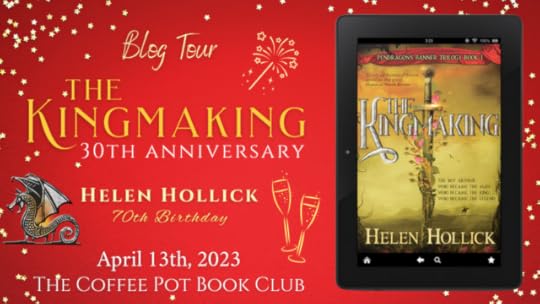
The Kingmaking 30th Publication Anniversary and Helen Hollick 70th Birthday Celebration #HistoricalFiction #KingArthur #30YearAnniversary #70thBirthday #BlogTour #TheCoffeePotBookClub @HelenHollick @cathiedunn
Special 30th Publication Anniversary and
70th Birthday Celebration!
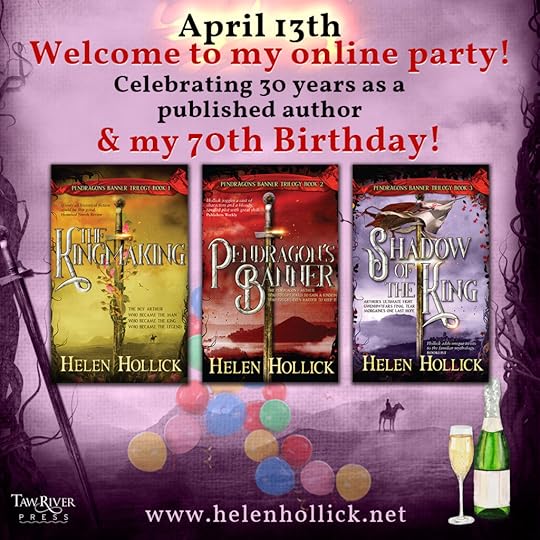
Join The Coffee Pot Book Club on tour with…The Kingmakingby Helen HollickApril 13th, 2023Publication Date: April 13th, 2023Publisher: Taw River Press
Tour Schedule Page: https://thecoffeepotbookclub.blogspot.com/2023/03/blog-tour-the-kingmaking-by-helen-hollick.html
The Pendragon Banner Trilogy
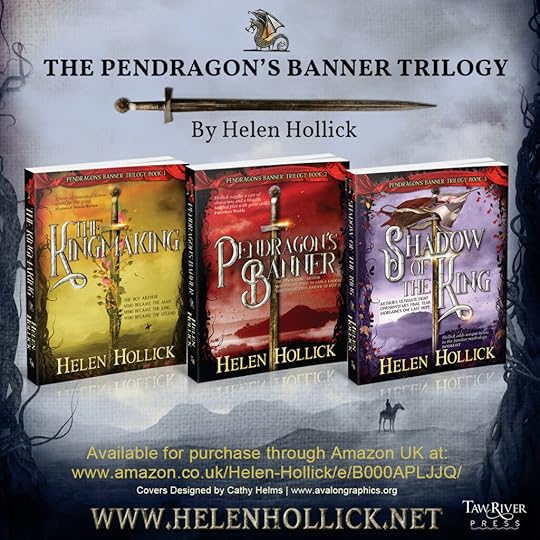
The Kingmaking: Book One
Pendragon’s Banner: Book Two
Shadow of the King: Book Three
Blurb:
The Boy Who became a Man:
Who became a King:
Who became a Legend… KING ARTHUR
There is no Merlin, no sword in the stone, and no Lancelot.
Instead, the man who became our most enduring hero.
All knew the oath of allegiance:
‘To you, lord, I give my sword and shield, my heart and soul. To you, my Lord Pendragon, I give my life, to command as you will.’
This is the tale of Arthur made flesh and bone. Of the shaping of the man who became the legendary king; a man with dreams, ambitions and human flaws.
A man, a warlord, who united the collapsing province of post-Roman Britain,
who held the heart of the love of his life, Gwenhwyfar
– and who emerged as the most enduring hero of all time.
A different telling of the later Medieval tales.
This is the story of King Arthur as it might have really happened…
“If only all historical fiction could be this good.” Historical Novels Review
“… Juggles a large cast of characters and a bloody, tangled plot with great skill. ” Publishers Weekly
“Hollick’s writing is one of the best I’ve come across – her descriptions are so vivid it seems as if there’s a movie screen in front of you, playing out the scenes.” Passages To The Past
“Hollick adds her own unique twists and turns to the familiar mythology” Booklist
“Uniquely compelling… bound to have a lasting and resounding impact on Arthurian literature.” Books Magazine
(contains scenes of an adult nature)
Buy Links:
The Kingmaking is available to read on #KindleUnlimited.
AUTHOR BIO: HELEN HOLLICK
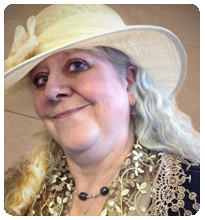
Helen is celebrating her 70th birthday and thirty years as a published author. Her Pendragon’s Banner Trilogy, a fifth-century version of the Arthurian legend, was accepted for traditional publication in April 1993 by William Heinemann (Random House UK) a week after her 40th birthday. The Trilogy has been widely acclaimed since then – and gone through several different editions.
Helen moved from Random House UK in 2006 and went ‘Indie’, now in 2023 to celebrate she has brought out her own fabulous new editions! (The Trilogy is published mainstream by Sourcebooks Inc in USA/Canada. The publisher was offered the new cover designs for free, but declined.)
Helen became a USA Today Bestseller with her historical novel, The Forever Queen (titled A Hollow Crown in the UK) with the sequel, Harold the King (US: I Am The Chosen King) being novels that explore the events that led to the Battle of Hastings in 1066.
She writes a nautical adventure/fantasy Pirates of the Caribbean series, The Sea Witch Voyages and has also branched out into the quick read novella, ‘Cosy Mystery’ genre with her Jan Christopher Murder Mysteries, set in the 1970s, with the first in the series, A Mirror Murder incorporating her, often hilarious, memories of working as a library assistant.
Her non-fiction books are Pirates: Truth and Tales and Life of A Smuggler. She lives with her family in an eighteenth-century farmhouse in North Devon with a variety of pets and horses.
Social Media Links:
Website Twitter Facebook Newsletter subscription Blog Amazon Author Page Goodreads


Instagram Handle: @thecoffeepotbookclub
April 5, 2023
Chris Tomasini Close Your Eyes: A Fairy Tale #HistoricalFiction #BlogTour #TheCoffeePotBookClub @cathiedunn
It is my pleasure to feature Chris Tomasini in The Coffee Pot Book Club Blog Tour being held between April 3rd — April 7th, 2023. Chris is the author of the Historical Fiction, Close Your Eyes: A Fairy Tale, which was released on 16th December 2021 (258 pages).
Below are highlights of Close Your Eyes: A Fairy Tale, Chris Tomasini’s author bio, and an excerpt from his book.

To follow the blog tour, CLICK Tour Schedule Page
HIGHLIGHTS: CLOSE YOUR EYES: A FAIRY TALE
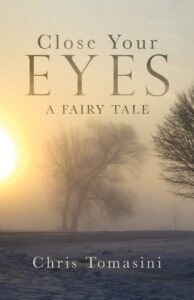
Close Your Eyes: A Fairy Tale
By Chris Tomasini
Blurb:
Set in early 1400s Europe, Close Your Eyes is a sincere, yet light-hearted and lustful, ode to love. As Samuel, the court jester, struggles to describe why his friends, Agnieszka the cook, and Tycho the story-teller, fled the King of Gora’s service, he learns that love was the beating heart behind everything that happened in the castle.
He learns as well that more ghosts than he knew of walked the midnight halls, and that the spirit of Jeanne d’Arc haunted his friend, and once slid into bed with Tycho, daring him to leave – to take to the cold roads of Europe, where he had once wandered orphaned and alone, and find his destiny there.
Buy Links:
Universal Link Amazon UK Amazon US Amazon CA Amazon AU
AUTHOR BIO: CHRIS TOMASINI

Chris Tomasini lives in Ontario, Canada. He has studied creative writing via Humber College’s “Correspondence Program in Creative Writing”, and through the University of Toronto School of Continuing Studies.
In the 1990s Chris taught English as a Second Language and had stops in England, Poland, and Japan.
Since 2000, Chris has worked in bookstores, publishing, and in libraries.
Chris is married with two children, and can often be found (though not very easily) on a bicycle on country roads in central Ontario.
Social Media Links:
Website Instagram TikTok Book Bub Amazon Author Page Goodreads
EXCERPT: CLOSE YOUR EYES: A FAIRY TALE

Tycho’s Journal
October 1430 / The Picnic
A feeling of change had been upon me since we arrived at the picnic site. As the others settled the camp, tethered horses, dug the firepit, I sat in the sand of the beach, staring at the lake, at the sunshine sparkling like diamonds upon the water – diamonds which rocked on the low waves, moving to me in quiet ebbs, before washing to rest as wave met land. It had been long since I’d seen anything so quietly beautiful, and I was struck for a moment to remember my life upon the roads of Christendom. I found, sitting by the lake, that memories of ease and beauty, of flowing rivers, rolling hills, came to me much more powerfully than those of hunger and fear. It is odd, for during that time my life was more often miserable than happy.
Chasing after Agnieszka along the beach, her dress billowing about her legs, her long brown hair dancing about her shoulders, I felt that time had frozen, or at least slowed, and I was delighted. I thought that if the afterlife is merely a moment, an image in pause, which echoes endlessly through the reaches of the universe, and if this moment upon the beach were the one chosen to represent me, then I would be content. The sun pouring down upon us, the sand under our feet, Agnieszka laughing ahead of me, the shining lake, myself in full flight – it would, I thought, be an image from my life that I’d be happy to float with into eternity.
Agnieszka turned from the lake, crossed the stretch of beach, her feet touched grass, and I followed her briefly across the field until she crashed into the high stalks of wheat. I lost her immediately. When I reached the wall of wheat and began stepping after her, I could hear her crashing ahead of me, I could see crushed stalks, discern the trail broken by her hurtling body, but soon the sounds and traces stopped. I paused and found myself lost in time again – alone in a jungle of high wheat stalks, the wind causing them to whisper together above my head, brush lightly against my body.
After an age I reached forward, parted the wheat, took one step, and then another.
She was not so far away. I perceived a pair of feet, ran my eyes along her legs to her upper body, her neck and face, and saw her eyes, shining in mischief. She lay upon the ground, on her side, her head propped upon her right hand. If it had been another woman I’d have fallen immediately beside her, wrapped my arms about her. But it was Agnieszka, and I stood uncertain for several long moments. Finally, I began to pace.
I walked circles upon widening circles about Agnieszka, breaking wheat down with my footsteps. When I had created a small clearing I sat down beside Agnes on a bed of wheat stalks. I lay down on my back and stared from our little hideaway up towards the blue sky. Under the rustling of the wind, and the distant voices of the picnic, if I listened closely, I could hear Agnieszka breathing. My eyes closed, I created a picture of her in my mind – the gentle rise and fall of her chest, the bend of her legs, the colour and texture of her dress and blouse, her head lying on her outstretched arm, the fall of her hair about her face, her hand sweeping a loose lock back behind her ear.
Then her voice.
“What are you thinking Tycho?”
Such a tender voice.
Sunshine warm like a scarf across my eyes.
You’re beautiful.
Silence.
Tycho….
Silence.
We drifted, children on a boat, rocking on gentle waves of sunshine. I slept and woke, woke and slept, and finally opened my eyes to find Agnieszka sitting against me, her knees pulled to her chest, her chin on her crossed arms, the small of her back against my side. “We need return to the others.”
The sun had placed a healthy glow upon her skin, and I lay upon my bed of wheat knowing, with a certainty I’ve never before felt, that I couldn’t, I wouldn’t, sleep with Agnieszka. I care deeply for her, but the idea of something physical between us seems brutal, a betrayal.
I wonder if this is love.
With the late afternoon sunshine pouring down upon us, I stood and offered Agnieszka my hand. Her fingertips touched my palm and she was beside me. I found her eyes on mine, and for a few moments we stood gazing at each other, then, by some unspoken but mutual consent, we looked away.
Agnieszka stepped into and through the forest of wheat. I followed, my hand in hers, dazzled by the fall of her long brown hair against her shoulders.
Instagram Handle: @thecoffeepotbookclub
April 4, 2023
Book Review Godwine Kingmaker Mercedes Rochelle #AngloSaxon #HistoricalFiction #BlogTour #TheCoffeePotBookClub @authorRochelle @cathiedunn
I am pleased to host Mercedes Rochelle again as the featured author in The Coffee Pot Book Club Blog Tour being held between January 3rd — March 7th, 2023. Mercedes Rochelle is the author of the Historical Fiction novel, Godwine Kingmaker (The Last Great Saxon Earls), released by Sergeant Press on April 4, 2015 (351 pages)
Below are highlights of Godwine Kingmaker, Mercedes Rochelle’s author bio, and my review of her novel.
To follow the blog tour, CLICK Schedule Page
HIGHLIGHTS: GODWINE KINGMAKER
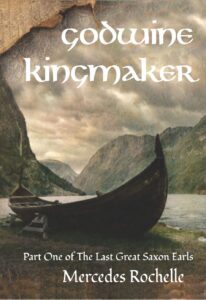
Godwine Kingmaker
(The Last Great Saxon Earls)
by Mercedes Rochelle
Blurb:
They showed so much promise. What happened to the Godwines? How did they lose their grip? Who was this Godwine anyway, first Earl of Wessex and known as the Kingmaker? Was he an unscrupulous schemer, using King and Witan to gain power? Or was he the greatest of all Saxon Earls, protector of the English against the hated Normans? The answer depends on who you ask.
He was befriended by the Danes, raised up by Canute the Great, given an Earldom and a wife from the highest Danish ranks. He sired nine children, among them four Earls, a Queen and a future King. Along with his power came a struggle to keep his enemies at bay, and Godwine’s best efforts were brought down by the misdeeds of his eldest son Swegn.
Although he became father-in-law to a reluctant Edward the Confessor, his fortunes dwindled as the Normans gained prominence at court. Driven into exile, Godwine regathered his forces and came back even stronger, only to discover that his second son Harold was destined to surpass him in renown and glory.
Buy Links:
The book is available on Kindle Unlimited
Universal Link Amazon UK Amazon US Amazon CA Amazon AU Audio
LAST GREAT SAXON EARLS SERIES

This series is available on Kindle Unlimited
Amazon UK Amazon US Amazon CA Amazon AU

AUTHOR BIO: MERCEDES ROCHELLE
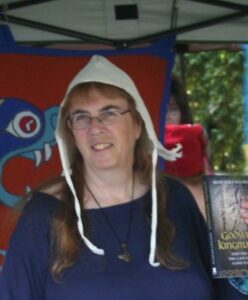
Mercedes Rochelle is an ardent lover of medieval history, and has channeled this interest into fiction writing. She believes that good Historical Fiction, or Faction as it’s coming to be known, is an excellent way to introduce the subject to curious readers. She also writes a blog: HistoricalBritainBlog.com to explore the history behind the story.
Born in St. Louis, MO, she received HER BA in Literature at the Univ. of Missouri St.Louis in 1979 then moved to New York in 1982 while in her mid-20s to “see the world”. The search hasn’t ended!
Today she lives in Sergeantsville, NJ with her husband in a log home they had built themselves.
Social Media Links:
Website Twitter Facebook Book Bub Amazon Author Page Goodreads
BOOK REVIEW: GODWINE KINGMAKER
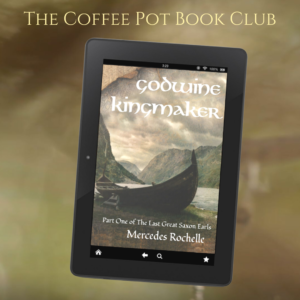
Godwin Kingmaker by Mercedes Rochelle is a historical saga about Godwin, Earl of Wessex, during the tumultuous 11th Century when King Canute ruled over the vast empires of England, Denmark, and Norway. The story begins in 1016 AD when Godwin finds Ulf, a Danish commander and the son-in-law of Canute, wandering the woods after a battle at Sherstone. A son of a disgraced Saxon aristocrat, Godwine decides to seek his fortune with the influential Dane. As a result, Godwine meets and becomes a trusted advisor to Canute. After Canute seizes the English throne, Godwine rapidly rises and becomes Earl of Sussex. Between 1019 and 1023 AD, Godwine accompanies Canute on an expedition to Denmark, where he distinguishes himself and marries Ulf’s sister.
However, everything changed for Godwine in 1035 AD when King Canute died. Godwine is swept into the disputes of Canute’s sons, each vying for the English throne. Godwine must choose loyalty between the ruling king and his family’s survival. He secures the marriage of his daughter to the last surviving son of Canute, King Edward. Ultimately, Godwine’s son, Harold, succeeds him as Earl of Wessex and is destined to become the king of England, setting the stage for the Norman invasion and Battle of Hastings.
Author Mercedes Rochelle deftly navigates Godwine’s life-long saga against the backdrop of political upheavals of Saxon and Danish kings. The historical detail in the story is evidence of the author’s meticulous research of the period. The culture and daily life of people in the Middle Ages are brought to life. Universal themes of love, the quest for power, betrayal, and redemption are explored.
The story is told from the perspective of various characters, which could shift from one to another in a scene. However, the narrative is most engaging from Godwine’s point of view. It provides insight into his meteoric rise in power and his delicate balance of demonstrating loyalty to various factions while safeguarding his family’s legacy. One of the tragedies in the story is how Godwine’s family is splintered from his sons’ rivalries with each other.
For those who enjoy learning more about medieval England or have watched the Vikings: Valhalla series, I suggest reading Godwin Kingmaker. which sheds light on historical figures who changed the course of history in northern Europe.
Instagram Handle: @thecoffeepotbookclub
March 30, 2023
Marcia Clayton The Angel Maker #Historical Fiction #Romance #FamilySaga #BlogTour #TheCoffeePotBookClub @MarciaC89111861 @cathiedunn
It is my pleasure to feature Marcia Clayton in The Coffee Pot Book Club Blog Tour being held between March 27th — March 31st, 2023. Marcia is the author of the Historical Fiction / Family Saga / Romance, The Amgel Maker (The Hartford Manor Series: Book Two), released by Sunhillow Publishing on 11th December 2020 (376 pages).
Below are highlights of The Angel Maker, Marcia Clayton’s author bio, and an excerpt from her book.

To follow the Blog Tour, CLICK Tour Schedule
HIGHLIGHTS: THE ANGEL MAKER
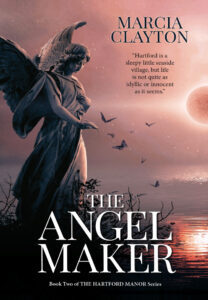
The Angel Maker
(The Hartford Manor Series)
By Marcia Clayton
(Blurb)
1884 North Devon, England
When carpenter, Fred Carter, finds a young woman in dire straits by the roadside, he takes her to the local inn where she gives birth to a daughter. Charlotte Mackie, an unmarried mother, has run away from home where she would have no sympathy from her strict parents. A few days later, Fred takes Charlotte to her aunt’s house and does not expect to see her again.
When their paths unexpectedly cross, Fred finds Charlotte distraught as her aunt has arranged an adoption behind her back. Charlotte is desperate to find her baby, and Fred promises to help. However, they are unprepared for the sinister discoveries that lay before them. Set alongside the absorbing detail of country life and budding village romances, dark forces are at work, which ultimately test the bravery and resourcefulness of the whole community.
The Angel Maker is the sequel to The Mazzard Tree and the second novel in a compelling series that follows the lives and loves of the villagers of Hartford. A rare treat for lovers of historical fiction.
The Angel Maker was the runner-up in the AllAuthor Cover Competition in January 2023.
Buy Links:
This title is available to read on #KindleUnlimited
Universal Link Amazon UK Amazon US Amazon CA Amazon AU Barnes and Noble Allauthor
All the books in The Hartford Manor Series can be ordered from any bookshop.

AUTHOR BIO: MARCIA CLAYTON

Marcia Clayton was born in North Devon, a rural and picturesque area in the far South West of England. She is a farmer’s daughter and often helped to milk the cows and clean out the shippens in her younger days.
When Marcia left school she worked in a bank for several years until she married her husband, Bryan, and then stayed at home for a few years to care for her three sons, Stuart, Paul and David. As the children grew older, Marcia worked as a Marie Curie nurse caring for the terminally ill, and later for the local authority managing school transport.
Now a grandmother, Marcia enjoys spending time with her family and friends. She’s a keen researcher of family history, and it was this hobby that inspired some of the characters in her books. A keen gardener, Marcia grows many of her own vegetables. She is also an avid reader and mainly enjoys historical fiction, romance and crime books.
Social Media Links:
Website Twitter Facebook Instagram Book Bub Amazon Author Page Goodreads
EXCERPT: THE ANGEL MAKER
“Hello, Sam; are you there?”
Charlie pushed the door open. As his eyes grew accustomed to the dimness, he could see a body huddled on the pallet Sam slept on. His fears grew as the old man showed no sign of movement, and he felt for a pulse on the old man’s neck. To his relief, Sam stirred, and then panicked, as he realised someone was bent over him.
“It’s all right, Sam, it’s all right, it’s me, Charlie. Are you poorly, or just having a nap?”
Sam opened his eyes and gazed at Charlie. He didn’t recognise him for a few moments, but as realisation dawned, he gave a weak smile. “Oh, hello, Charlie. I was fast asleep. Just a minute and I’ll get up.”
With some difficulty, the old man swung his legs to the floor and pushed himself into a sitting position, groaning loudly. He sat there for a few minutes as if summoning the strength to stand.
“Sam, what’s wrong? Are you hurt?” Charlie could see the tramp was thinner and even more unkempt than usual.
“Aye, I’m not too good. That’s why I was resting. Hold on, and I’ll come outside. There’s not much room in here.”
Charlie led the way from the hut and signalled to Eveline to dismount from her horse. He glanced back to talk to Sam and gasped in shock. Sam’s hair was crusted with blood, and there were dark purple bruises and weals all down one side of his grimy face. He swayed dangerously as he stumbled towards where the fire should be burning merrily.
“Oh, Sam, what’s happened? Has someone beaten you?”
“No, I’m all right; I fell over the other day and bumped my head, but I’m on the mend. Oh, now, my fire’s gone out.”
The sight of the cold, grey ashes seemed more than the old man could take, and suddenly tears coursed down his wrinkled cheeks. Charlie quickly pulled forward the tree stump which seemed to be Sam’s favourite seat.
“Here, sit down, Sam, and tell us what happened.”
“Nothing happened. Like I told you, I fell over.”
Charlie persisted gently. “I don’t think you did, Sam. Your injuries don’t look like the result of a fall. I think someone beat you with a stick. Tell me who did it, and I’ll give them a hiding they’ll never forget.”
Sam shook his head. “No, I don’t want you getting into trouble. How’s that dog bite?”
“Still sore, but thanks to you, it’s healing nicely. That’s why I’m here; I wanted to thank you. I might have lost my leg if it wasn’t for you. That ointment is amazing stuff, Sam. This is my friend, Eveline, she’s Annie’s aunt, and she’d like to know your secret ingredients.”
“Aye, I’ll be bet she would; well, if you come when I’m better, my dear, I’ll show you how to make it. I’ve always kept it a secret and told no one else, but maybe it’s time I did. I may not be around a great while longer.”
“Hello, Sam, I’m pleased to meet you again. I’ve seen you before when you came to the inn.”
Sam squinted at her out of his left eye which wasn’t swollen shut. “Oh, yes, I remember you. You gave me food more than once if I remember rightly.”
“Yes, I did, Sam. I’ve brought some food for you today too. Have you eaten?”
“No, I haven’t eaten for days. I’ve been too sore, and too poorly, to move from my bed.”
“In that case, see if you can manage a few mouthfuls of this pork sandwich; it’s nice and tender. Here you are.” He took half of the sandwich from her gratefully, and slowly nibbled at it gingerly, trying to avoid his split lip.
“Charlie, could you get the fire going for Sam, please? I can heat some water then and bathe his injuries when he’s finished eating. Perhaps we could make a hot drink for him too. Do you have any tea, Sam?”
“No, I don’t have any tea, but there’s some dried mint in that tin. I could have a cup of that. You too, if you like.”
Whilst he ate his sandwich, Eveline went into the hut to find some rags and then sat beside him. Charlie got the fire going and went to gather more firewood.
“Sam, tell me who did this? I won’t let Charlie go after them, but tell me. How many men were there? Did they steal much?”
At that, the old man did smile. “Nay, ‘twasn’t men. To my shame, ‘twas a woman. Fancy me getting beaten up like this by a woman, ‘tis a sad state of affairs.”
“So, who was it, and why did they beat you like this? Oh, wait a minute, was it the woman at Buzzacott House?”
“Aye, you’re a smart maid. I was doing no harm. Mind you, I was spying on her, so I suppose she had some cause. I saw another woman bring a baby to the house, and I knew Fred and Charlie wanted to know all about that, so I followed her and hid in the bushes. The girl handed over her baby to the tall woman and then made off back the way she came. Unfortunately for me, I sneezed a couple of times, and the woman heard me. She passed the baby to her daughter and came running over to find out who was there. As soon as she saw me, she set about me something vicious with a big stick she was carrying. Beat me black and blue, she did. I’m bruised all over. She said if she ever saw me near the house again, I’d be sorry, and she’d set the dog on me. I don’t want Charlie going there and saying anything to her because it’s me that will suffer for it when he’s gone. If I could move on, I would, but my hut’s here, and I’m not fit to travel. I might roam again when I’m better, but my hut’s cosy, and young Fellwood said I could stay, and that doesn’t happen often.”
“Oh, Sam, I’m so sorry. What an awful thing for her to do.”
“Aye, she showed no mercy, even though I was screaming. She’s a big woman too, almost as strong as a man, and there’s not much to me these days. Just a bag of old skin and bones.”
“Sam, will you let me bathe your wounds and put some of your ointment on them?”
He nodded. “Yes, all right. I haven’t felt well enough to attend to them myself or get food or firewood. I feel better for that pork sandwich, though. I think you and Charlie might just have saved my life between you.”
By this time Charlie had the fire burning, and the water was soon hot. He made Sam some mint tea, and Eveline bathed his wounds and daubed ointment on them, but he refused to undress and let her see his other injuries. Charlie fetched a supply of firewood and stacked it near the fire.
“Sam, we’ll come again tomorrow to see how you are. There’s enough firewood there to last you until then, and we’ll bring some more food and clothes. The ones you have on are covered in blood. Will you be all right on your own until then?”
“I will now, and thank you so much for your kindness. To tell you the truth, I’d given up and was just waiting for the end to come, but perhaps it’s not quite my time yet after all.”
“Of course, it’s not. We’ll see you tomorrow, Sam.”
Instagram Handle: @thecoffeepotbookclub
March 28, 2023
Book Spotlight Pagan King MJ Porter #TalesOfMercia #TheSeventhCentury #BlogTour #TheCoffeePotBookClub @coloursofunison @cathiedunn
It is my pleasure to spotlight the Historical Fiction/Action and Adventure novel, Pagan King (The Seventh Century) by MJ Porter, in The Coffee Pot Book Club Blog Tour that is being held on 29 March 2023. Pagan King was released by MJ Publishing on 21st April 2016 (new cover from January 2022) [300 pages].
Below are highlights of Pagan King and MJ Porter’s author bio.

To follow the blog tour, CLICK Tour Schedule Page
BOOK SPOTLIGHT: PAGAN KING

Pagan King
(The Seventh Century)
By MJ Porter
Audiobook narrated by Matt Coles
(Blurb)
From bestselling author, MJ Porter comes the tale of the mighty pagan king, Penda of Mercia.
The year is AD641, and the great Oswald of Northumbria, bretwalda over England, must battle against an alliance of the old Britons and the Saxons led by Penda of the Hwicce, the victor of Hæ∂feld nine years before, the only Saxon leader seemingly immune to Oswald’s beguiling talk of the new Christianity spreading through England from both the north and the south.
Alliances will be made and broken, and the victory will go to the man most skilled in warcraft and statecraft.
The ebb and flow of battle will once more redraw the lines of the petty kingdoms stretching across the British Isles.
There will be another victor and another bloody loser.
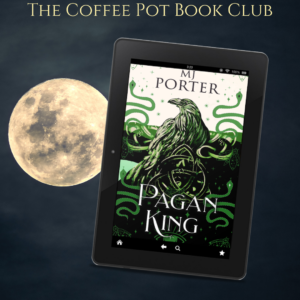
Buy Links:
Universal Link Amazon UK Amazon US Amazon CA Amazon AU
Barnes and Noble Waterstones Kobo iBooks iTunes Audio
AUTHOR BIO: MJ PORTER
MJ Porter is the author of many historical novels set predominantly in Seventh to Eleventh-Century England, as well as three twentieth-century mysteries. Being raised in the shadow of a building that was believed to house the bones of long-dead Kings of Mercia, meant that the author’s writing destiny was set.
Social Media Links (MJ Porter):
Website Blog Twitter Facebook LinkedIn Instagram Pinterest
BookBub Amazon Author Page Goodreads Linktr.ee Tiktok
Social Media Links (Matt Coles – audiobook narrator):
Instagram Handle: @thecoffeepotbookclub
March 16, 2023
Paul M. Duffy Run with the Hare, Hunt with the Hound #HistoricalFiction #IrishFiction #BlogTour #TheCoffeePotBookClub @PDufaigh @cathiedunn
Please welcome Paul M. Duffy as the featured author in The Coffee Pot Book Club Blog Tour being held between March 13th — March 17th, 2023. He is the author of the Historical Fiction, Run with the Hare, Hunt with the Hound, released by the Cennan imprint of Cynren Press on 11th October 2022 (342 pages).
Below are highlights of Run with the Hare, Hunt with the Hound, Paul M. Duffy’s author bio, and an excerpt from his book.
To follow the blog tour, CLICK Tour Schedule
HIGHLIGHTS: RUN WITH THE HARE, HUNT WITH THE HOUND
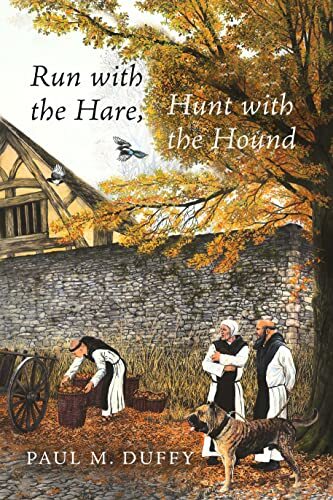
Run with the Hare, Hunt with the Hound
By Paul M. Duffy
(Blurb)
On a remote Gaelic farmstead in medieval Ireland, word reaches Alberic of conquering Norman knights arriving from England. Oppressed by the social order that enslaved his Norman father, he yearns for the reckoning he believes the invaders will bring—but his world is about to burn. Captured by the Norman knight Hugo de Lacy and installed at Dublin Castle as a translator, Alberic’s confused loyalties are tested at every turn. When de Lacy marches inland, Alberic is set on a collision course with his former masters amidst rumours of a great Gaelic army rising in the west. Can Alberic navigate safely through revenge, lust and betrayal to find his place amidst the birth of a kingdom in a land of war?
Buy Links:
Universal Link Amazon UK Amazon US Amazon CA Amazon AU Publisher website
Barnes and Noble Waterstones Walmart Kobo iBooks Book Depository
AUTHOR BIO: PAUL M. DUFFY

Paul Duffy, author of Run with the Hare, Hunt with the Hound (2022), is one of Ireland’s leading field archaeologists and has directed numerous landmark excavations in Dublin as well as leading projects in Australia, France and the United Kingdom.
He has published and lectured widely on this work, and his books include From Carrickfergus to Carcassonne—the Epic Deeds of Hugh de Lacy during the Cathar Crusade (2018) and Ireland and the Crusades (2021). He has given many talks and interviews on national and international television and radio (RTÉ, BBC, NPR, EuroNews).
Paul has also published several works of short fiction (Irish Times, Causeway/Cathsair, Outburst, Birkbeck Writer’s Hub) and in 2015 won the Over the Edge New Writer of the Year Award. He has been shortlisted for numerous Irish and international writing prizes and was awarded a writing bursary in 2017–2018 by Words Ireland.
Social Media Links:
Website Twitter Facebook LinkedIn Goodreads
EXCERPT: RUN WITH THE HARE, HUNT WITH THE HOUND
Basilia
In the orchards I walked down rows of fruiting trees until I came to the Basilia and her ladies sitting beneath a netting of branches. Cool shadow, the black soil rich with windfall exuding a fragrance of souring ale. Seeing me approach, Basilia called me forward. Men at arms keeping their distance looked for Basilia’s nod and did not impede my progress.
‘He arrives, ladies. The poet-slave. The Justiciar’s fancy. Look at that lovely young face. That dewberry. Stained with perpetual embarrassment for his crimes. The stain of impure thoughts, I am sure.’ She spoke with the powerful composure of a wealthy and handsome woman, raising in me true blushes as my eyes sought escape in the tracery of grafted branches behind her head and in the flight of wasps hovering noisily between the rotted cores. She rose from her couch, supporting her stomach with one curled hand, and said ‘Come now you are not some country stutterer afraid of the sport of a lady, I have seen you berate bishops and charm barons. Come and speak to me as we walk to the cathedral. I would know more of you and of this civitas. It is bigger than our own Vadrafjord, though more open to the elements, more mixed in its inhabitants.’
Her manner of speech perturbed me and I struggled to know how to speak to her. We began to walk down the tree-lined sward and her ladies followed several steps behind.
‘Do you not wish to tell me of yourself?’
‘I will gladly tell what you would know, ma dame.’
‘Do you write verse? You seem to have the soft heart for it, the warm eye?’
‘I cannot write, though I can read well enough the script of the Gael and also Latin to a lesser degree. I have yet to see the Engleis tongue written out, though I hope that the opportunity will present itself.’
‘No doubt,’ she said, and I divined that this was not the answer she had been looking to elicit. ‘Tell me then, you who recite the romances of the court in your young life have you loved?’
I looked behind to her ladies who followed, they affected not to hear our conversation. Again, this was something new to me and I was not sure how to answer. I was not sure of the truth of the matter and I was not experienced enough of those in love to know that they just want to hear their own flowery fantasies and agonies repeated back to them. In my uncertainty, I began to speak, words that had been waiting to fall from my lips like the heavy apples around us. Like a fruit of large sad tears.
‘I would say yes, ma dame, I have.’
She smiled a thin smile, her eyes narrowing, the freckles across her nose, delicate and speckled as a thrush’s egg.
‘Tell me of her,’ she said, leaning in conspiratorially, taking my arm. Her breath hot against my cheek.
‘We captured her on a cattle raid,’ I began and she snorted an involuntary laughter and I could hear supressed giggles from behind also.
‘Child,’ she said, ‘I do not wish to hear of your dirty carnal acts perpetrated on the poor savages of the forests.’
Sudden anger spiked into the cavities of my being. I did not heed her but continued slowly, deliberately.
‘Standing in the pre-dawn dew, her bare feet bright in the gloom, a clutch of herbs and hedge flowers at her breast. She did not move as we thundered from the thicket and she was got up onto one of the horses with little fight. As if she had been expecting it. Indeed, I would hazard to say that it was not the first time she had been carried off.’
Basilia quietened as I continued speaking, listening now with a guarded interest.
‘Sixteen of years perhaps, dark hair, pale eyes, skin like the purest snow.’
I faltered at this. The paleness of my words against the image of Ness that smouldered in my mind. ‘I am no poet. I do not have the skill to tell you of her beauty.’ And speaking of her hurt me as I had no conception it would. Words scalding my heart like charred coal. My thoughts turned against me and I grew angry at the sly amused air of this lady. Her highness, her fickleness. I continued rashly; anger unbinding words that should have remained bound. ‘Nor do I need to tell you what befell her when we returned to our tuath, for these things are universal.’
I continued on, emboldened, speaking of such low things with a high-born lady, disregarding the danger. Disregarding her stiffening gait, the exhalation of breath from her nose, the dead silence from behind me.
‘I convinced her to run away with me, into the hills and the deep forest. I told her that my people, the Engleis, were at hand and that I would bring her to them and that we would be liberated. Though in truth I knew nothing of the world beyond our small borders, nor what lay east or west, north or south. I told her all I could to make her come away with me and we wandered in the wilderness for weeks, eating what we could find. And in the end, she lay with me. She lay with me to change things.’ Basilia touched my shoulder as if to say enough but I could not stop and I continued, louder and faster, ‘Lay with me to make something happen, to do the only thing that she had known and in laying with me, I became all men and she rutted like an animal and pushed every sin that had been perpetrated upon her down onto me. She expelled a blackness and a screaming terror and she clawed me and gored me and when it was over, she had passed on.’ Basilia stopped walking and her ladies came forward, full of affronted awe, gathering around their lady.
‘Stop,’ Basilia said. Releasing my arm forcefully. But I did not stop.
‘Passed on, passed over, I do not know which. Perhaps she lies cold in the forest or perhaps torn by wolves or enslaved by another who chains her to a post and ruts her daily…’
Her slap came hard and jarring, her long, ringed fingers catching my lip so that blood spilled dramatically into my mouth and down my chin.
‘Filth’, the ladies said, ‘ordure, morveau de merde,’ and I turned away so that they would not see my tears. Basilia silenced them with a raised hand.
‘Boy, you are a fool. I knew it at the feast and you have proven it here today. You are offered liberties beyond any expectation of your station and you utter outrages.’
‘A slave has no need for decorum,’ I said. ‘Words have ever been the only freedom available to me. For good or for ill.’
Instagram Handle: @thecoffeepotbookclub
March 9, 2023
The Whispering Women Trish MacEnulty #historicalfiction #historicalmysteries #BlogTour #TheCoffeePotBookClub @pmacenulty @cathiedunn
I am pleased to feature Trish MacEnulty in The Coffee Pot Book Club Blog Tour being held between February 27th — March 10th, 2023. She is the author of the Historical Fiction / Historical Mystery, The Whispering Women (Delafield & Malloy Investigations), released by Prism Light Press on September 6th, 2022 (387 pages).
Below are highlights of The Whispering Women, Trish MacEnulty’s author bio, and her guest post about 1910s women playing a huge role in reforms in spite of (or perhaps because of) being shut out of politics.
To Follow the blog tour, CLICK Tour Schedule
HIGHLIGHTS: THE WHISPERING WOMEN
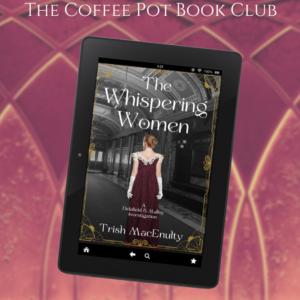
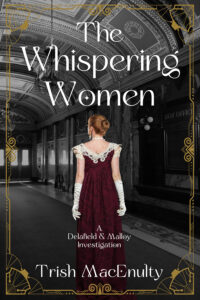
The Whispering Women
(Book #1, A Delafield & Malloy Investigation)
by Trish MacEnulty
Blurb:
“Richly drawn characters, the vibrant historical setting, and a suspenseful mystery create a strong current that pulls readers into this delightful novel. But it’s the women’s issues—as relevant today as they were in the early 1900s—that will linger long after the last page.” — Donna S. Meredith, The Southern Literary Review
Can two women get the lowdown on high society?
“Two powerless young women must navigate a soul-crushing class system and find the levers of power they wield when they combine their strengths. These women may have been taught to whisper, but when their time comes, they will roar.” — 5 Star Amazon Review
Louisa Delafield and Ellen Malloy didn’t ask to be thrown together to bring the truth to light. But after Ellen witnesses the death of a fellow servant during an illegal abortion, Louisa, a society columnist, vows to help her find the truth and turn her journalistic talent to a greater purpose.
Together, these unlikely allies battle to get the truth out, and to avenge the wrongful death of a friend.
What will our heroes do when their closest allies and those they trust turn out to be the very forces working to keep their story in the dark? They’ll face an abortionist, a sex trafficking ring, and a corrupt system determined to keep the truth at bay.
“If you like historical fiction and if you like mysteries, this one is for you!” — 5 Star Amazon Review
Was change possible in 1913?
To find out, read THE WHISPERING WOMEN today!
Buy Links:
The books in this series are available to read on Kindle Unlimited.
Universal Link Amazon UK Amazon US Amazon CA Amazon AU Barnes and Noble
BOOKS IN THE SERIES

The Whispering Women (Book #1, A Delafield & Malloy Investigation)
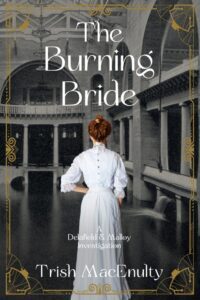
The Burning Bride (Book #2, A Delafield & Malloy Investigation)
Secrets and Spies (Book #3, A Delafield & Malloy Investigation)
AUTHOR BIO: TRISH MACENULTY

Trish MacEnulty is a bestselling novelist. In addition to her historical fiction, she has published novels, a short story collection, and a memoir. A former Professor of English, she currently lives in Florida with her husband, two dogs, and one cat. She writes book reviews and feature articles for the Historical Novel Review. She loves reading, writing, walking with her dogs, streaming historical series, cooking, and dancing.
Social Media Links:
Website Twitter Facebook Instagram Book Bub Amazon Author Page Goodreads
GUEST POST BY TRISH MACENULTY
The 1910s comprised a powerful era for reform, and women played a huge role in those reforms in spite of (or perhaps because of) the fact that they were shut out of politics.
One group, in particular, included wealthy women who had a sense of noblesse oblige and were determined to uplift society in general. Of course, not all wealthy women felt a sense of responsibility to the larger society, but enough of them did and they actually made a significant difference.
These women were especially motivated when it came to securing the right for women to vote. Here’s a wonderful tidbit from Joanna Neuman’s excellent book Gilded Suffragists:
“Kathrine Houghton Hepburn was president of the Connecticut Woman Suffrage Association and an ally of birth control advocate Margaret Sanger. As her daughter, actress Katharine Hepburn told biographer A. Scott Berg, ‘Mother’s secret was in remaining extremely feminine. She dressed beautifully, she showed off her well-groomed children. And then, while she was pouring the mayor a second cup of tea, she would discuss with great intelligence some great injustice being heaped upon his female constituents.’” (Page 4)
It’s no surprise that Katharine Hepburn, who so often played strong, willful characters, was the daughter of a feminist!
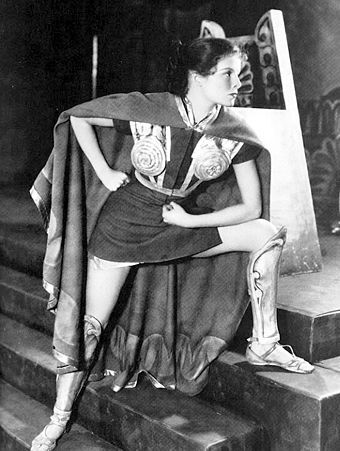
Katharine Hepburn in The Warrior’s Husband, 1932
Neuman’s informative book was a great help as I created a character named Hester French, who becomes Ellen’s lover in my book The Whispering Women. An ardent reformist, Hester typifies the sort of wealthy woman activist who visits the tenements to help the poor, advocates for children’s safety, and ardently and passionately fights for women’s suffrage.
Here’s an excerpt from The Whispering Women. It takes place during the 1913 Women’s March on Washington — for the vote!
“Ladies, we’ll be marching down Pennsylvania Avenue to the White House. Be careful, as there will be large crowds due to the inauguration tomorrow. But we have been promised police protection,” the New York marshal assured them. Hester stayed in the back with Ellen.
“Why aren’t you up there with the society girls?” Ellen asked.
“My sister and I are from Pittsburgh. We’re not old New York money even though we have as much as any of them. So we’re not accepted into their society. It drives my sister crazy. I couldn’t care less,” she said.
“You are full of surprises,” Ellen said.
Then the march began. A band at the front played a rousing march. The women stood four across and walked steadily up the broad avenue along the streetcar tracks toward a domed building.
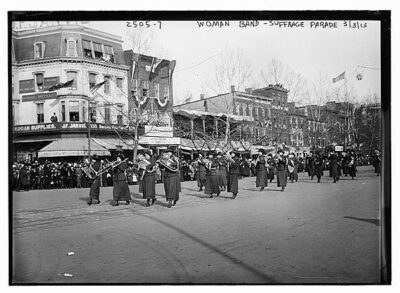
Woman Band in the Women’s Suffrage Procession
Alongside the marchers, crowds lined up behind a wire cable. Ellen marched shoulder to shoulder with her delegation behind Inez Milholland, who could have been Joan of Arc. …They hadn’t gone far when the march simply stopped. An elderly woman leaned on her cane for support. … Ellen looked around, wondering why they were stopped.
“What’s going on?” a voice cried out.
“What’s happening?”
“Why are we stopped?”
Bodies pressed around her. Word came back from the front lines that the spectators were no longer held back by the wire cables. They came in so thick that the procession could not pass. Ellen stared at the burgeoning numbers of watchers — mostly men, a sea of brown suits.
“Go home and make supper!” a man shouted, his mouth twisted in rage. Foot by foot, the woman moved forward, but the crowd grew thicker with every block. The women, who were walking four to a line, shrank together, shoulders touching. Men cat-called and laughed. The press of bodies was suffocating.
“Where are the police?” Hester asked.
“They’re not doing anything,” an angry woman yelled.
Sure enough, a policeman stood at the edge of the crowd with his arms crossed, laughing with the men who shook their fists and hollered at the marching women.
“You need a man to teach you how to be a woman? I’ll teach you,” a young man screamed at them with a hideous leer on his face.
Suddenly they surged forward, and someone shoved her hard from behind. She dropped her sign, wheeled around, ready to fight, and saw a phalanx of men, laughing and jeering and pushing the other women back. Ellen was trapped like a hunted fox, surrounded by baying hounds.
“I’ll show you what a woman’s meant for,” a pug-ugly man said, spewing rancid breath into her face. She threw a punch toward him, but another man grabbed her hand and pulled. A man with a cap pulled low over his forehead pushed through the crowd of men and glared at her. …He wasn’t drunk like the other men; his pale eyes were filled with malevolent intent. A knife blade flashed in his hand. She stepped back, tripped, and fell to the ground. The man came closer, looming over her. Her legs got tangled in her skirt as she flailed on the ground, but she rolled away as he jabbed the knife toward her.
All of a sudden, the man yowled. A cane sliced through the air and landed on the back of his skull again and again. He turned, and all Ellen could see in the melée was an elegant patent leather boot with a Louis XVI heel kicking him in the arse as he ran away. Then Hester reached for her. Ellen grabbed her hand, and felt the strength in the bones, the firm flesh, and something like sunlight breaking through clouds. She rose to her feet as other women shouted and beat back the men who had surrounded her. Hester returned the cane to an older woman who stood by, cheering.
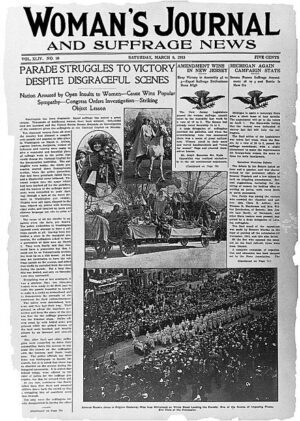
Women’s Journal, 1913
While Hester is a fictional creation, in the next two books in the series, real-life historical figures make an appearance.
In The Burning Bride, Ellen meets Emma Goldman, the founder of the anarchist magazine Mother Earth. Emma Goldman is a fascinating woman. In her early years, she planned the assassination of Henry Frick (no innocent himself!) with her lover Alexander Berkman. Their plans went awry, and she later disavowed violent tactics. In fact, she became a renowned speaker who traveled the country, advocating for women’s rights, prison reform, and the rights of homosexuals (the term LGBTQ was not in use at that time). She later opposed entering the Great War and wound up being put in prison, after which she was deported to Russia.
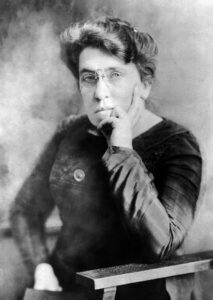
Photo of Emma Goldman
Finally, in my third novel of the series, Secrets and Spies, Ellen meets Jane Addams, the founder of Hull House, a settlement house in Chicago, and a peace activist during the Great War. (Settlement houses provided services for immigrants and sought to alleviate poverty.)
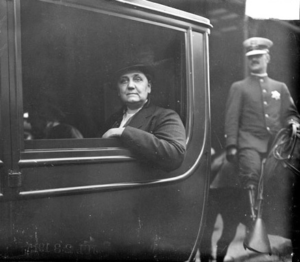
Photo of Jane Addams
Here is an excerpt from Secrets and Spies about Jane Addams’ 1915 speech in Carnegie Hall, based on primary sources:
Addams was introduced shortly and took the podium. She seemed daunted by the size of the crowd, but she quickly gained confidence as she began to speak of her experiences. She talked about the women’s conference at the Hague, how German women and French women and British women and Russian women and Belgian women and American women all came together to share their stories, to create friendships and to make resolutions, demanding peaceful negotiations among the combatants. Her voice gained strength as she became more impassioned.
Toward the end of the speech in a ringing voice, she said, “The old notion that you can drive a belief into a man at the point of a bayonet is in force once more. It is quite as foolish to think that if militarism is an idea and an ideal, it can be changed and crushed by counter-militarism or by bayonet charge!”
The audience hung on every word, nodding in agreement among themselves, but the next thing she said caused a strange hush to fall over the audience.
“And the young men in these various countries say of the bayonet charges: ‘That is what we cannot think of.’ We heard in all countries similar statements in regards to the necessity for the use of stimulants before men would engage in bayonet charges – that they have a regular formula in Germany, that they give them rum in England and absinthe in France; that they give them the ‘dope’ before the bayonet charge is possible. Well, now, think of that.”
Ellen is only one of my main characters. The other is Louisa Delafield, but Ellen is the one who is most prone to meeting activists.
Instagram: @thecoffeepotbookclub
March 6, 2023
Book Review The Yanks Are Starving Glen Craney #historicalfiction #BlogTour #TheCoffeePotBookClub @glencraney @cathiedunn
I am pleased to host Glen Craney again as the featured author in The Coffee Pot Book Club Blog Tour being held between January 3rd — March 7th, 2023. Glen Craney is the author of the Historical Fiction, The Yanks Are Starving: A Novel of the Bonus Army, released by Brigid’s Fire Press in January 2014 (561 pages)
Below are highlights of The Yanks Are Starving: A Novel of the Bonus Army, Glen Craney’s author bio, and my review of his novel.

To follow the blog tour, CLICK Tour Schedule Page
HIGHLIGHTS: THE YANKS ARE STARVING
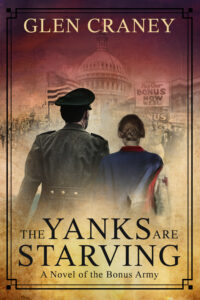
The Yanks are Starving: A Novel of the Bonus Army
By Glen Craney
(Blurb)
Two armies. One flag. No honor.
The most shocking day in American history.
Former political journalist Glen Craney brings to life the little-known story of the Bonus March of 1932, which culminates in a bloody clash between homeless World War I veterans and U.S. Army regulars on the streets of Washington, D.C.
Mired in the Great Depression and on the brink of revolution, the nation holds its collective breath as a rail-riding hobo named Walter Waters leads 40,000 destitute men and their families to the steps of the U.S. Capitol on a desperate quest for economic justice.
This timely epic evokes the historical novels of Jeff Sharra as it sweeps across three decades following eight Americans who survive the fighting in France and come together fourteen years later to determine the fate of a country threatened by communism and fascism.
From the Boxer Rebellion in China to the Plain of West Point, from the persecution of conscientious objectors to the horrors of the Marne, from the Hoovervilles of the heartland to the pitiful Anacostia encampment, here is an unforgettable portrayal of the political intrigue and government betrayal that ignited the only violent conflict between two American armies.
Awards:Foreword Magazine Book-of-the-Year Finalist
Chaucer Award Book-of-the-Year Finalist
indieBRAG Medallion Honoree
Praise for The Yanks are Starving :
“[A] wonderful source of historical fact wrapped in a compelling novel.” — Historical Novel Society Reviews
“[A] vivid picture of not only men being deprived of their veterans’ rights, but of their human rights as well.…Craney performs a valuable service by chronicling it in this admirable book.” — Military Writers Society of America
Buy Links:
Universal Link Amazon US Amazon UK Amazon CA Amazon AU
AUTHOR BIO: GLEN CRANEY

Glen Craney is an author, screenwriter, journalist, and lawyer. A graduate of Indiana University Law School and Columbia University Graduate School of Journalism, he is the recipient of the Nicholl Fellowship Prize from the Academy of Motion Pictures and the Chaucer and Laramie First-Place Awards for historical fiction. He is also a four-time indieBRAG Medallion winner, a Military Writers Society of America Gold Medalist, a four-time Foreword Magazine Book-of-the-Year Award Finalist, and an Historical Novel Society Reviews Editor’s Choice honoree. He lives in Malibu and has served as the president of the Southern California Chapter of the HNS.
Social Media Links:
Website Twitter Facebook Book Bub Amazon Author Page Goodreads
BOOK REVIEW: THE YANKS ARE STARVING

Glen Craney’s epic historical fiction novel, The Yanks are Starving: A Novel of the Bonus Army, recounts the tragic events of World War I and the Bonus March in 1932 when veterans marched on the U.S. Capital to demand the bonus promised by Congress for their services. The book is divided into Part One: No Man’s Land (1900-1919) and Part Two: Over Here (1931-1932). The stories of eight characters, who were actual historical figures or represented a distinct group, are woven together to capture the national disgrace of how the U.S. government turned against veterans seeking a bonus to help them financially during the depression. The story begins with a prologue set in December 1941, when World War I veteran Walter Waters shows up at a recruiting site for the navy. Throwing a flaming stick over a line of recruits, he warns that President Hoover came close to sparkin’ another American Revolution when he failed to deliver economic justice for destitute World 1 veterans.
Part One then goes back in time, setting the stage for social inequities, political corruption, and brave heroes who survived the carnage at the Marne in World War 1.
Part two meticulously details how jobless WWI veterans organized a group called the “Bonus Expeditionary Forces” (BEF) to march on Washington, DC. The BEF’s goal was to get the money Congress had promised in the Bonus Act. The catch was that this bonus would not pay out until each veteran’s birthday in 1945, paying out to his estate if he should die before. Walter Walters leads the veterans to set up camps and occupy buildings in various locations in Washington, DC. The largest center is a shantytown on the Anacostia Flats, across the river from Washington’s Navy Yard. When police try to move protesters out of occupied government buildings, two protestors are killed in a riot. After that, General Douglas MacArthur ruthlessly advances on the camps with tanks and tear gas to disperse the protestors permanently.
Author Craney masterfully weaves the threads of individual stories, culminating in a national tragedy when the army is called out to war on unarmed citizens. The prose is elegantly written, and the dialogue captures each character’s essence and the rawness of war and desperate events. It is a profoundly moving novel that will resonate in your mind after reading it. News reporter Gibbons summarizes the tragedy of the Bonus March as follows: “Tonight, in a dark, damp rail yard in the heart of this great country, two battles are being waged. One is for control of the economic crossroad of America. But a more desperate battle is for the souls of men and women who could be forgiven for believing that God is right behind our government in abandoning them….”
Though the individual stories seem disjointed initially, each voice is necessary to show how military leaders and politicians failed veterans. Social injustices, such as persecution against conscientious objectors, are realistically portrayed. Blacks, segregated in the U.S. army, are readily accepted by the French forces to fight alongside them. One of the most engaging characters is a Mennonite nurse, Anna, who must muster the strength to care for and comfort wounded soldiers without losing her soul.
The Yanks are Starving: A Novel of the Bonus Army is a captivating epic that realistically depicts the tragedy of how courageous soldiers who survived World War 1 were betrayed by military leaders and politicians at the time of their greatest need during the depression. Highly recommended.
Instagram: @thecoffeepotbookclub


