
Sharon Bala's Blog, page 13
March 21, 2019
Put your money where your mouth is
Last night, I saw this twitter exchange between the CBC and Chris Mitchelmore, NL’s Minister of four different things, one of which is culture:

I read those lies about me and saw red. Fire engine red. Because who moves from Ontario to Newfoundland (by way of England…what a bloody clusterfuck that was) because “the Government is supportive of artists”? NOT ME.
These absurd tweets are a diversionary tactic. The fact is funding to artists via grants has been steadily declining over the past 7 years and last week a group of artists, myself included, wrote letters to various ministers and MHAs asking them to increase ArtsNL’s budget over the next three years to $5 million. (Those letters came up in Question Period on Wednesday, cue the nonsense tweets.)
Our province is currently mired in a $12.7 BILLION boondoggle called Muskrat Falls while simultaneously offering financial sweeteners to a publicly traded Ontario-based cannabis company. So you know what? A $5 million investment in the arts, phased in over three years, is loose change between the couch cushions.
I certainly see the value of the arts and the cultural industries here in Newfoundland and Labrador. There are five thousand people contributing $450 million dollars to our economy.
— Chris Mitchelmore, MHA
There is a misconception that tax dollars spent on things like energy projects and cannabis companies are investments and tax dollars spent on the arts are subsidies. Muskrat Falls. Canopy Grow. ArtsNL grants. These are all investments and they are all subsidies. Mega projects sometimes go sour, haemorrhaging money instead of generating it. Books sometimes flop. The only difference is in the amount of tax payer dollars gambled.
My first ArtsNL grant was less than $2,000. Coincidentally, I received that cheque in 2012, the same year ArtsNL received its last funding boost from the provincial government. Since then, investments in the arts via grants have declined. How tragic for a provincial industry that according to Minister Mitchelmore himself, generates a $450 million return on a $20 million investment. That’s a 2,150% ROI. Our industry hustles to make the province richer.
I’m not on Twitter but I have my spies so I know Minister Mitchelmore likes to invoke my name on there from time to time. Usually it’s a re-tweet, something about my book or an award or a short list. I suppose he’s proud of my success and likes to share it with the world. That’s nice. I appreciate the internet high fives. That first $1,800 cheque from ArtsNL, I don’t know the dollar value on ROI to the province, but judging by his tweets and re-tweets, I’m guessing the Minister believes the investment was a good one, that it paid off. And judging by how quick, how thrilled, the government always is to celebrate our cultural successes, it’s clear they understand the value of our industry.
Five million dollars in ArtsNL funding phased in over three years. That’s all we are requesting. An increase in seed money to support the creation of new work. Stories are important? So important the government has made it the centrepiece of an expensive (and stunningly beautiful) tourism campaign? FANTASTIC. Now, put your money where your mouth is.


February 20, 2019
One Book To Rule Them All
Later this month, The Boat People will go head-to-head with Trudy Morgan Cole’s Most Anything You Please, Lisa Moore’s Something For Everyone, and Jamie Fitzpatrick’s The End of Music in NL Reads, an annual literary competition hosted by the NL Public Library. You can vote for your favourite book (hint: mine, please!) online here. On February 28, everyone is welcome to attend the debates where each book will be defended by a champion reader (details here).
My champion is super hero and local celeb Hasan Hai. He founded the hugely popular Merb’y Calendar, can be seen around town at Christmas as the hilarious Dark Elf on the Shelf, and is a phenomenal fundraiser. On a more personal note though I have really admired his commitment to goodness and community building from afar for the past couple of years. It’s going to be a tough thing not to fan girl hard when we finally meet next week. Dr. Math believes we don’t need to crunch any numbers for this competition and that I’m definitely going to win because merb’ys are magic. :)
It’s always an honour to be up for any prize but this one’s extra special because of my fellow finalists. The four of us got together last Saturday night in Trudy’s basement studio to talk books and craft. You can listen to our 1 hour convo here on Soundcloud or find the podcast Shelf Esteem: episode 22 on iTunes or your favourite podcatcher (1 hour).
February 13, 2019
Upcoming events
Book promotion begins again this afternoon with a trip to chilly Minneapolis where I’ll be speaking at the University of Minnesota tomorrow as part of their Provost’s Conversation Series. I’ve been lax about updating my events page but there are a raft of appearances posted there now. Between now and June, I’ll be in Kelowna, Torbay, and all points in between, giving keynote addresses, speaking on panels, and running workshops so keep an eye on that events page because I love meeting readers.
January 23, 2019
The hype cycle (aka. the process)
Hello. It’s 2019. Is it passe to say Happy New Year?
It’s been radio silence here for the past four weeks because…drum roll…I’ve been writing! As in actual words and sentences and paragraphs and scenes and things that could possibly even be called CHAPTERS. Every time I manage to get words on a page it really does feel miraculous.
Today I was listening to the latest episode of the podcast Zig Zag. It’s about The Hype Cycle which is a graph created by tech analyst Jackie Fenn a quarter century ago. This graph was meant to describe new technology (ie. bitcoin, Twitter, push notifications) but it’s been borrowed by other fields and its basics are a helpful way to think of the writing process.
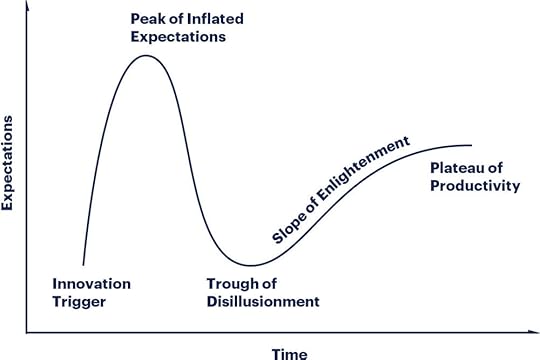
Image via Gartner
The Hype Cycle has five phases:
1. initial spark of innovation
2. peak of expectation
3. trough of disillusionment
4. slope of enlightenment
5. plateau of productivity
Every story begins with the first idea. It might not even be a very big idea but that match gets lit and it sets off a bonfire and you get so jazzed about writing this amazing thing.
That sets off phase two which is when you’re deep in the writing zone, churning out pages and pages and completely engaged with your project. It’s such a happy time, possibly the happiest time! At some point though you tumble into phase three, the pit of hell and despair. I have been thinking about the trough of disillusionment a lot because I know it is looming on my horizon but also because I’ve been evaluating manuscripts for other writers this month and I am always conscious of the need to balance critique and praise. My job is to question areas where I feel the draft is weak and offer suggestions for possible improvements. The risk is - especially with writers who I don’t know well or at all - that my comments will throw them into the trough and they won’t try to climb out.
Here’s the thing: the trough is a necessary part of the process. It’s like driving through the isthmus between St. John’s and Terra Nova National Park. Sometimes that damn isthmus is a death trap and the fog is low and there’s a horrible blizzard and you’re driving with zero visibility. But there’s literally no other way to get to the Park. You just have to white knuckle through it. The trough is the same. There’s no way to get to a better draft without seeing the flaws and feeling bad about them.
The trick is to keep calm and carry on. Don’t give up. And don’t deceive yourself into thinking the flaws aren’t there. Accept the flaws. Start trying to fix them. That’s phase four, the gradual work of revision and correction. And onward to the plateau of productivity. That initial hopeful burst doesn’t really come back. For one thing, after some time, the idea is no longer novel. But what you get instead in these last two stages is gradual improvement. Little by little. Until the end.
Sometimes you have to cycle through phases two and three several times while working on a single project. Dr. Math and I have this running joke in our house. He comes home from a day of research and I ask: “How was it?” If it’s been a good day he says: “I solved this lemma. I’m a genius!” But inevitably, the following day he’ll come home with a hang dog, downtrodden expression and tell me the breakthrough he made yesterday ended up only being a partial solution. Or he’s now discovered some other loose thread. Scientific research and fiction writing, if plotted on graphs would look much like the same rollercoaster. See the ride through to the end. That’s what I’m saying.
December 31, 2018
Lessons
TWENTY EIGHTEEN! What a tornado of a year! In this, my debut year as an author, I have learned a good many lessons, many of them the hard way. So if you are an aspiring, emerging, or about-to-become debut author allow me to be of service.
SELF PROMOTIONDecide in advance what kind of public figure you will be. Will you be active on social media and if so, which platforms? Sage advice from my publicists: Do nothing that makes you uncomfortable. If you're going to spend your time on a platform, make sure it's one you enjoy. Keeping this website dynamic (ie. updated regularly) takes up more time than you might think. But does it bring me joy? You bet. So here we are.
Prioritize. I’m not on Twitter and I’m a middling instagrammer at best. Social media is not my priority and it shows. You know what's higher up on the food chain? Replying to reader email. I bet that shows too.
THE NEXT BOOKBe head first into the second book before the first one comes out. You have no idea how well or poorly your published book will be received and it’s just psychologically helpful to already have a new imaginary world to keep you busy. And if you are lucky and up to your ears in book promotion, then it’s also helpful to have that new imaginary world where you can go to escape.
Don’t talk about it. “What are you working on now?” is a trick question. Don’t answer it.
Don’t marry your idea. Here’s something my editor (who has 20+ years of experience) told me: lots of writers have an idea for the second book long before the first one is done. And then they get attached to the idea and stick with it even when it isn’t working out. And thus you have the curse of the sophomore novel. If something isn’t working, let it go.
NUMBERSThe numbers will rob you of all sanity. Sales figures, royalty statements, number of GoodReads reviews, the bestseller list… these are not metrics; they are torture devices. Even when the numbers are good, a tiny devil in the back of your head will whisper: “just means you have further to fall.” Personally my advice is to ignore the numbers as much as possible. Does your publishing house have an author portal where you can track your sales? Good for them. Stay off it.
If you have an agent, ask them to send you a head’s up text about the royalty statement before it lands in your in-box like an undetonated grenade. Also, there is no law that says you have to read the detailed sales breakdown.
REVIEWSGuess what? You don't have to read reviews!
It's helpful to have a policy. Will you read any? Which ones? I screwed up my courage and read the major ones (while grimacing with one eye closed). But for me, GoodReads is haram. Ditto Amazon and Chapters. Several months ago, I stopped reading reviews altogether, including the ones I'm tagged in on Instagram. It's not that I've had a lot of bad reviews (just the opposite), it's that I find reviews incredibly stressful and I maxed out on overall stress around mid-May.
Finally, remember that those cranky reviewers can go fuck themselves.
TRAVELSign up for airplane rewards.
Invest in a pair of compression socks.
Often you get picked up at the airport and driven for hours to an event and there's no time to stop and get anything to eat. So here's a tip Kathleen Winter gave me: always travel with food.
Also (and I’ve learned this the hard way), close your eyes and sleep (or pretend to sleep) on those drives.
Take it from a former Catholic school girl: a work uniform is a life saver. Early in the year, I got a few dresses together. They pack light, straddle a couple of seasons, don't need to be ironed, and pair with the same three pairs of shoes.
Honour the Sabbath. The day after you return from a work trip should be a holiday. Sleep in, go for a massage, pay bills, do groceries...whatever...just don't put pressure on yourself to get back to work.
FESTIVALS AND EVENTSIf you are very busy (with work or your private life) and are trying to decide whether or not to say yes to a festival/ public reading invite here are some things to consider:
what's the speaker's fee? (In Canada the standard ranges from $125/hour at the very low end to $300/hour)
will they sell books on site? (for tiny community events in particular don't assume this is a given)
what's the event's reputation?
what are the audiences like?
how long is the travel time?
how many on stage events will you do? (Some festivals like the ones in Woody Point, Moose Jaw, and the Cabot Trail are great at offering authors multiple opportunities to appear on stage. The Edinburgh Book Fair was fantastic in this regard. I was only there for one day and they gave me two events.)
Ask your publicist and/or other authors for advice. Don't be afraid to say no. Remember: Saying yes to one thing always means saying no to something else (usually your own writing). Also: It's better for everyone if you say no up front rather than cancel later. Cancellations are a nightmare for festival organizers, most of whom are unpaid volunteers. Don’t be someone else’s nightmare if you can help it.
VIDEO CONFERENCINGIf you are asked to speak to a group via Skype, FaceTime, or some other tele/video conference software, don’t assume the technology will work. Schools block video chats (and most teachers don’t realize this). And book clubs are very rarely equipped with good sound and video systems (unless they are hosted at a library that long distance conferences with authors all the time). I’m sorry to say that 99% of the time it’s better to say no to virtual requests.
JURY DUTYBefore accepting a request to adjudicate an award or grant, ask:
how many entries will I have to read?
how long are they?
do I have to give feedback or write comments? if yes, for how many stories and how long should the comments be?
who else is on the jury?
what is the timeline for the work?
what is the compensation and when can I expect to receive it?
It’s worthwhile speaking to former jurors if you’re unsure.
READINGSMake it snappy. I got this nugget from Miranda Hill: audiences get fidgety at the 20 minute mark and 10 minutes is the most anyone can stand to listen to an author reading from a book. If I’m told I have a 20 minute slot I usually do a bit of chit-chat for 5 minutes and read for 10. If I’m given 30 minutes and am the only author on stage, I break it up into two readings with chit chat in between and aim for 20 minutes total. No one is going to complain if you shut up a little early, particularly if it means there is time for Q&As.
Practice. And time yourself. Don’t be the selfish git who hogs the mic.
You don’t have to read word-for-word. The reading copies of my books are marked up. I cross out sections that get in the way. I add dialogue tags (he said/ she said) and transition words and skip over small flashbacks. Whatever makes the reading flow smoothly.
Read from the book that is for sale. I heard this story about Margaret Atwood. It might be apocryphal but it’s an important lesson anyway. She goes up to the sales table and chats with the book sellers. Which books have you got? Which ones are you trying to sell more of? And then she chooses her readings accordingly. As authors we are SICK TO DEATH of the book that’s for sale and sometimes we are tempted to read from work-in-progress. But here’s the thing: you’re at the event to flog the book that’s for sale. And no one is going to buy a book if they haven’t heard you read from it. Even if the thing-in-progress you read has them all at the edge of their seat, bawling, they still will not buy the book you didn’t read from.
Speaking of the book sellers: introduce yourself, shake hands, offer to sign left over books.
BEING SOCIALWriting is a deeply private, introverted activity. Promoting a book is an intensively public and extroverted activity. The switch is jarring and even as an extrovert, I am always emotionally drained, mildly depressed, and vaguely agoraphobic, after intense periods of being "on." Know your own limits and respect them. Maybe that means hermiting in your hotel room before going on stage. Maybe that means saying no thank you to the signing table or the cocktail party/ author reception/ group dinner/ trivia night. It's okay to skip out on the extras. As my mother likes to say: don't be a hero; do the minimum.
BLURBSDon’t promise to blurb a book you haven’t read.
OTHER AUTHORSIf the internet is to be believed, everyone else is scoring bigger book deals, being invited to more events, and way more productive than you. In the spring I saw online that Michael Redhill (who had just won a Giller and was busy jet setting around to events) had just submitted the manuscript of his next novel to the publisher. How did he find the time? I wondered, while promptly feeling like the worst and laziest writer on the planet. Soon afterward, at a festival, I was chatting with Michael and he said he'd been working on said manuscript for years. What looked instantaneous and effortless online was actually a project long in the making.
One the most nourishing parts of this year has been candid conversations with other authors. It’s the best cure for envy because you very quickly realize that everyone is beset by all the same anxieties. Don't let comparison steal your joy. Everyone has their own struggles.
THE FALLThe Fall is hell; brace yourself. It’s the busiest time in the industry, when all the big festivals happen and all the major literary prizes are announced. It’s also when a flurry of new books hit the shelves. Everyone with a book out is stressed and on edge between September and mid to late November. And every long or short list you don’t make is a kick in the teeth. All the while you are promoting a book and going to festivals (because ‘tis the season!) and expected to look happy and unconcerned. So practice your happy and unconcerned face in the mirror and remember that everyone is in the same boat, forsaken by god, taking on water, and listing in the storm.
I’m going to go out on a short limb and say that even the authors who are winning all the awards are having a rough go of it this season. Because these short lists mean a whole ton of travel and a bazillion appearances all of which only seems fun until you have to endure it yourself (see above re: depression/ agoraphobia). Spare a thought for the writers with new babies and small children who they must leave at home (or travel with while breast feeding!).
There’s no cure for the Fall. You just have to, as Tyra Banks says, model through it.
Read this post by Kerry; it will help.
IT’S OKAY TO FEEL BADYear one will be excruciating. You put your heart and soul and hopes and pipe dreams into your first book. You dote on this book in private for years. And then it goes on sale and every loved one, nemesis, fremeny, and stranger can read and critique or (worse) ignore it. Every festival and list and review is another chance for rejection. Well meaning friends will demand to know why your book isn’t at Chapters/ Costco/ in the window display and you’ll want to hide under the nearest table. This year I have felt simultaneously on top of the world and incredibly vulnerable. Vulnerable to strangers. It’s surreal and complicated. Take heart. It’s like this for every author. Feeling awful is totally normal.
December 28, 2018
Tom's Favourite Reads
Tom read nearly 80 books this year too (including the Bible and the Koran) and when he saw that I tallied up my favourites, he went back and choose his ten best reads. The first pick, he claims, is unbiased but if you live with an author you are contractual obligated to say nice things about their work so add salt as needed. Here is Dr. Math’s top 10 in no particular order:
The Boat People - Sharon Bala
White Teeth - Zadie Smith
The God of Small Things - Arundhati Roy
Wolf Hall - Hillary Mantel
On Beauty - Zadie Smith
Runaway - Alice Munro
Do Not Say We Have Nothing - Madeleine Thien
The Waste Land - T.S. Eliot
The Bell Jar - Sylvia Plath
Birds of America - Lorrie Moore
December 26, 2018
Reading list
I’ve read 73 books (and counting) so far this year. Here are my favourites:
January
Exit West by Mohsin Hamid. Most surprising read of the year.
February
The Bell Jar by Sylvia Plath. Book I should have read years ago and will definitely read again.
Home Fire by Kamila Shamsie. One of my favourite books of all time. Full stop.
The Power by Naomi Alderman. Most empowering read of the year.
March
Next year for sure by Zoey Leigh Peterson. Lovely mediation on friendship.
Journey Prize 30. March was also the month I read and re-read all the Journey Prize stories (all 100 of them!) and the anthology contains the absolute very best of the pile. Shashi Bhat who won this year is a dream of a writer and she’s got a book in the works so BE EXCITED!
May
Gender Failure by Rae Spoon and Ivan Coyote. One of the two most delightful reads of the year.
June
Trust No Aunty by Maria Qamar. Speaking of delightful, this coffee table book/ memoir/ survival guide fits the bill. HARD RECOMMEND.
Moon Tiger by Penelope Lively. I got this book by accident! I went to the library meaning to get a Penelope Fitzgerald and somehow ended up with one of my favourite books of the year.
August
Something for Everyone by Lisa Moore. Funniest read of the year.
October
Small Change by Elizabeth Hay. Chilling and insightful book about friendship.
Wolf Hall by Hillary Mantell. Quite possibly the most skillfully written book of all time. As a reader, it is a feast. As a writer, it is a masterclass.
An Ocean of Minutes by Thea Lim. The Time Traveller’s Wife BUT BETTER.
December
I’m Afraid of Men by Vivek Sharya. ME TOO, VIVEK. ME TOO.
Little Fires Everywhere by Celeste Ng. The platonic ideal of a beach read.
December 14, 2018
New York Times!
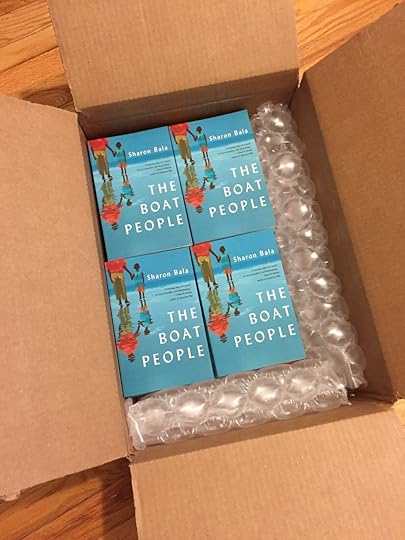
“Just send me a couple of copies,” I said to my publicist. She sent 20.
THE NEW YORK TIMES! The Boat People was featured in the December 9th issue’s “new in paperback” section alongside Emily Wilson’s translation of Homer’s Odyssey and a non-fiction about the roots of the American asylum system. Appropriate, n’est-ce pas?
The American paperback hit shelves this month and along with it came a small resurgence in publicity stateside, including the NYT mention, a lovely review in the Minneapolis Star Tribune, and some blog love too.
And late last month, LitHub asked me to curate a list of “lesser known Canadian books.” So I wrote a short essay and threw together a book list, all the while cringing at the thought of the title LESSER KNOWN CANADIAN BOOKS AS CHOSEN BY TOTALLY UNKNOWN CANADIAN. But when the piece came out I laughed out loud (and totally approved) of the title they chose. The Great White North Isn’t So White.
And speaking of lists, its end-of-the-year round up season and The Boat People was one of several books on the CBC’s Best Canadian Fiction of 2018 list, 49th Shelf’s best fiction of the year, and the best books of the year list on Pickle Me This.
December 12, 2018
Earning an income
Back in April I did a Q&A with a group of highschool students. How much do you make from a book, they asked. Is being a novelist a realistic career choice? I think the teachers were slightly mortified but I found the candid questions refreshing. Frankly, these teenagers were a hell of a lot more pragmatic than most adults.
The answers, by the way, are: not much and no, not really. As I told the teenagers, most writers have day jobs. Because even if you hit a jackpot like the Giller, you have to make that windfall last until you sell the next book. And books take years to write (I started The Boat People in 2013, 4.5 years before it came out). Advances, even when they are generous, don't amount to a whole lot when spread out over the gestation and infancy of a book.
Those of us who are full time writers usually have a bunch of side hustles and income streams. This list is not exhaustive. It is limited to my own experience and what others have told me.
BOOK SALESIf you’re lucky, your publishing house will give you an advance. A small house might give you zero dollars or a thousand or $500. Someone recently told me that a generous advance for a debut novelist is $20K. I don’t know if this is true. In any case, these numbers assume you make a Canadian sale. There is more to be made on an American sale and then of course there are other international English-language sales, plus translations.
I think everyone should at least try to get a good agent because agents know everything and have an incentive to get you the best possible deal.
An advance is an advance against earnings. Meaning you have to sell enough books to earn out your advance before you see any royalties. Royalties are usually very detailed with a whole mess of percentages. I like to think of it as 10% of the cover price but that’s not really true. There are different percentages for all kinds of things. E-book percentages for example can be renegotiated after two years (because e-book sales are ever changing!) This is also why agents are helpful. They can spot contractual bullshit at a 100 paces.
FILM/ TV RIGHTSPeople seem to think every book is being made into a movie (or at least that my book will be) to which I say: don’t hold your breath.
Writers get paid when a book gets optioned (which can happen several times over without a movie getting made) and then if the movie gets made, they get paid again for the rights and possibly also if they have some kind of role in the production. You really need an agent to get any of this done and I know nothing except that even getting an option seems pretty good because it’s cash money. And that is what we are all here for. CASH. MONEY. MAKE IT RAIN.
SPEAKING ENGAGEMENTSSome writers are on the speaker’s circuit, meaning they give key note addresses and speeches at conferences and fundraisers and large public events. The Massey Lectures are one example. But there are lots of other opportunities too (for example, law firm lunch and learns). I was asked to give a speech at Pier 21 in the spring as part of their author series and that’s when I signed up with a speaking agent. Since then my agent has found me other opportunities and looking forward to 2019, I can see that it’s going to be a key part of my income. The great thing about these events is there’s almost always a book sale table. Which means….royalties + speaker’s fee. These events are totally exhausting and hard work but they are also a great way to pay the bills.
MANUSCRIPT EVALUATIONSProviding feedback on someone’s manuscript or short story takes time and intense creative energy but it can also be a good income stream. I personally get a lot of joy out of helping other authors improve their manuscripts. (Get in touch if you’d like a quote. I’m restarting my MS evaluation service in the new year.)
EVENTSFestivals, panels, public readings, etc. The going rate ranges between $125-$300/hour. Sometimes non-writers get huge eyes when they hear this number but let’s get real: these events aren’t lucrative. There’s usually so much travel involved that it works out to pennies on the hour. You do events to sell books, get your name out, and meet readers and other writers. The pay cheque is appreciated and necessary, don’t get me wrong, but events aren’t money spinners.
WORKSHOPSIf it’s part of a festival you’ll probably get the per hour rate (say $200) but if you’re teaching a workshop in some other context (say at home for your Writer’s Guild) you can set whatever rate you like. You’re the boss. I’ve been thinking about this a lot because I’m planning to teach a workshop in the new year. Stay turned.
TEACHINGSome writers work as professors or instructors in MFA programs. Some teach out of their homes or lead one-off classes and workshops. Some act as mentors to emerging authors. Teaching can be a key part of an author’s income but again, income varies greatly depending on whether you are a tenured professor or sessional slave labour.
JURY DUTYGrants and prizes all need juries. In my experience the going rate varies a lot but no matter what, the hourly rate is never going to be great. Some proportion of jury duty is just unpaid labour. You do it for good karma or to help get your name/ the name of your book out into the world. Or you do it because you admire the prize and are honoured to be involved. Or you do it because you respect the other jurors and think you’ll enjoy working with them. Weigh the pros and cons and factor all of it against the time commitment and what else you could be doing in that time (ie. writing).
GRANTS & PRIZESGrants count as taxable income but most prizes are tax-free! Shortlisted authors sometimes get a cheque too. In both cases it’s a bit like the lottery and while I think everyone should apply to grants, it’s a mistake to count on the money.
LIBRARY LOANSLibraries that carry your book are paying a different price to the publishing house than you or I pay at the book shop. So you’re making money on those royalties. But every time someone takes out the book, you could potentially be getting a bit of money for each of those loans too. You have to sign up here.
BOOK CLUBS & CLASS VISITSSome schools are already set up with a budget for visiting authors and all you have to do is invoice. And some book clubs volunteer a payment. But often this is a case of “we have no money but will you come see us anyway?” You can choose to do this work for free or you can ask to be paid. And if the latter, you can set whatever rate you like. For an hour with a class $200-$250 is what you could expect.
Caveat: If you’re being invited to any event that charges people to attend then you should absolutely be paid.
ARTICLES/ ESSAYS/ WEB CONTENT/ STORIESRates vary so, so, so widely. And often I end up writing content for free (if the request comes through my publicist/ I think it’s worth the publicity). Over time, I’ve been doing fewer of these freebies though. It’s demoralizing and unfair to be a professional writer who writes for free.
Writing articles can be a decent side hustle and some authors turn their essays into collections (smart). Some writers have regular columns in print or online publications. Some have an editorial or managerial role. I have no idea what this kind of work pays but it seems like it could be rewarding and fun.
And then there are short stories which we write and try to sell to magazines. It’s never a ton of money. I think the most I ever got for a short story was $350 (for a story that I spent years working on and a whole lot of money submitting to various places that rejected me). Note that you can make more if a story wins a contest but contests usually cost $$$ to enter. (If you’re in NL, the Arts & Letters is free to enter and lucrative if you win)
RESIDENCIESWriter-in-residence programs are usually run out of libraries or schools. You commit to a length of time (say a semester) and in that time you read and comment on the work of emerging authors in the community, meet them individually, maybe give a public talk and teach a couple of workshops and in exchange you get a pay cheque. The idea that is you also have time to work on your own project. But you usually have to pay for your own flight and accommodations so unless the residency is in the place where you already live, it’s worth scrutinizing the economics.
SUMMATIONThis might seem like a long list but the fact is that most of these items don’t come with a big pay cheque. It’s almost always a case of cobbling things together and crossing your fingers for a windfall (grant/ prize). Some months are feast and others are famine and literally I never know from one year to the next what my total income will be. It really helps to have a sponsor or a trust fund or a life partner with a secure 9-5 or be comfortable living like an undergraduate (this is my theory for why all Canadian writers own the same rug). It also helps to be frugal and diligent about money.
In addition, we all perform a metric ton of unpaid labour. Blurbs, reference letters, interviews, book shop readings, travel, writing articles that never see the light of day, having your brain picked over coffee…. And that’s on top of the administrivia that comes with running your own business: emails, chasing down cheques, tracking finances, publicity and self promotion, writing grant applications and job proposals, submitting stories to publications and contests, waiting on hold with CRA….
So it also helps to be comfortable with the word no. You have to say no a lot. Because in addition to making enough money, you have to also set aside time to do the thing we are really here to do: WRITE BOOKS. Oh yeah…that.
December 7, 2018
Gripes
Rebecca wrote this dark comedy of a blog post recently and I was all “SING IT, SISTER.” It’s about the indignities she has endured in her years as a writer. Rebecca has been writing and publishing longer than I have so she’s had to grin and bear more, but I share indignity #4 on her list.
Anyway, like Rebecca, I’ve mostly had wonderful experiences and I know I’m incredibly lucky to even be a writer and have work published but there are also moments that make me want to shake my fist. Please enjoy some dark humour…
In March I adjudicated a short story competition. Reading stories and choosing the winner was a pleasure but then the organization tried to scam me out of my payment with the old “the cheque is in the mail” routine. It was not in the mail. Not even after I sent several emails. And then there was radio silence and I started to get seriously concerned. Fortunately, the organization was the PEI Writers’ Guild and I have an acquaintance from PEI. She intervened and then the cheque really was in the mail.
In April I took part in the book club at my local museum (The Rooms in St. John’s). People paid $15 each to attend. The evening was a delight. We had a really big and wonderful audience and the interviewer was fantastic. But the payment took months and several emails on my part. If I don’t pay the plumber within 30 days he charges interest. But some organizations seem to think writers don’t deserve to get paid on time. Anyway, good thing we have Status of the Artist legislation, huh?
Speaking of the Status of the Artist blah-blah-blah, remember this?
An organization asked me to give a key note speech at their event. Key note speeches take time, effort, and stress. I wrote back a very polite email (which I put a lot of thought into) where I laid out why I couldn’t work for free, how to get in touch with my agent and negotiate a rate, and then listed a couple of other much cheaper options for how I could help them out. Think I got the courtesy of a reply? Nope.
A group of writers asked me to teach them a private workshop for free. LOL.
FOR REAL THOUGH…WHY THE HELL DO PEOPLE THINK I WANT TO WORK FOR FREE? FOR THE RECORD: I DO NOT.
Once I was on a panel where all the authors were asked to prepare a 10 minute reading. One of the authors yammered on for about 25 minutes while the other author and I stared dolefully at each other. Finally the moderator cut him off (he hadn’t even gotten to his reading yet!). Then we did a Q&A and he kept trying to hog all the air time. Who am I kidding? Of course this happened more than once. And to paraphrase Rebecca, it’s not all male authors of a certain age but it is ALWAYS male authors of a certain age.
Writers are forever being picked up at airports and driven places by strangers. Sometimes it’s innocuous and you make pleasant small talk. Just as often it’s a bloody nightmare. Once, I got into a fight with a driver about “Hilary’s emails.” I hope he wasn’t expecting a tip. In New York, a driver with a Spanish accent complained about “Muslim foreigners.” He didn’t get a tip either. Once, soon after the miscarriage of justice that was the Coulton Bushie trial, a driver talked about why “Indian boys” deserve to get shot.
Hello older man I’ve just met. Please remove your hand from my upper back. Please stop taking every opportunity to randomly touch me as we stand at this registration table making awkward small talk while we wait for our name tags. I’m going to stand waaaaaay over here now and go out of my way to avoid you for the rest of this literary festival.
At a big event, in a room of 500 people where everyone had a copy of my book but most of them hadn’t read it yet, a woman stood to ask a question and shamelessly gave away the ending while the rest of the audience shouted her down. (Not the first time it’s happened either.)
Nasty emails from readers. Yes, really.
I agreed to take part in an event with another author. After the arrangements were made and plane tickets were bought, I found out it was an unmoderated conversation. For an hour. With an author I had previously met once for five minutes in an elevator. I happen to like this author very much and I think the feeling is mutual but it’s really unfair to make authors act as their own moderators. Promoting your own work and moderating a conversation are two very different skills and it’s impossible to move back and forth seamlessly. Fortunately, there were only 7 people in the audience.
Once after I’d given a 45 minute speech that I’d spent a very long time researching and preparing, a man in the audience said: “I haven’t read your book but let me tell you why everything you’ve just said is problematic.” LOL. When it was my turn to reply, I very politely eviscerated him to audience applause. Come at me, bro. But you best not miss.
Sharon Bala's Blog

- Sharon Bala's profile
- 140 followers

