
Sharon Bala's Blog, page 12
October 7, 2019
We are not writing for National Geographic
Writers who are not white sometimes struggle with this particular issue. How much consideration should we give to the audience? How much of the culture we are writing about should we translate for the reader? Can we assume the reader knows the definition of a salwar kameez? Must I explain that ammachi means maternal grandmother? That cousin brother is a male cousin and not in any way incestuous?
Authors, take heart. There’s a simple solution to all of this. Just assume no one will ever read your story. (The ability to do this is one of the gifts of repeated rejection) Write for an audience of one and let that one be you.
There are two good reasons for this approach. First, publication is ANGST-RIDDEN and something every author looks forward to with gritted teeth. The only part of the process you are sure to enjoy is the writing. So if you aren’t amusing yourself, what’s the point?
Second, it’s a fool’s errand to write with any particular audience in mind. Readers are special snowflakes, each with their own life experiences, culture, and ways of seeing the world. You are never going to be able to curate your work in such a way that each and every reader fully understands every word.
Remember, you are writing a story, not a National Geographic article. If you start defining every little thing, the pace will grind to a halt and that’ll be the end of the reader’s attention. Focus on the characters and the story. Include nothing that the characters would not themselves think. Forget the reader.
I promised politics in the last blog post. Here is it. When editors italicize salwaar kameez or idiyappam they are not only doing so for the benefit of an imagined reader, they are imagining a very specific reader. And herein lies the political horse manure. Because guess what skin colour that reader has? Guess what language he speaks? Guess his gender (hahah. trick question). Guess his sexuality.
News flash! Readers are all kinds of people. And it is a truth universally acknowledged that good stories, told well, transcend cultures, borders, ethnicity, language, and time. Otherwise, how do you explain the enduring appeal of Shakespeare, Austen, Jesus’ parables, or Lord Buddha’s life story? Or the fact that I have been reading Tolstoy for decades and still only have the foggiest idea what a samovar is.
Most of the words in Michael Crummey’s Galore are a mystery to me but it’s still one of my favourite books of all time. His writing is better for being true to the characters, for his commitment to their dialect. And listen, if Crummey’s not including a glossary for words like dunch and skerry and slut lamp, then neither am I and neither should you. Shake off the tyranny of the single reader. Focus on the characters. Remember: Character reigns supreme.
ps. Have you got a completed draft of a novel that could benefit from another pair or eyes? I moonlight as a manuscript evaluator and to be perfectly honest, I’m extremely good at giving thorough and constructive feedback. Character and dialogue, plot and pacing, it’s all my jam. I’m taking bookings for 2020 so get in touch for more info or a quote.


October 4, 2019
Toast is not exotic
As a rule, in my writing, I never italicize non-English words. At first, this wasn’t a conscious decision. It was just common sense. Italics indicate emphasis. And if a story is from the point of view of a Spanish-speaking character, say, then words like hijo and lo siento and hola would have no particular emphasis in the character’s mind.
When my short stories were published, editors sometimes italicized the non-English words. To be honest, I didn’t notice. Probably no one asked my permission. Or maybe they did and I was too green around the gills to know better or refuse.
But after The Boat People came out, a reader asked how I’d convinced the editors not to italicize the Tamil words. And that stopped me short. Because the fact is - bless my editors - it never came up. Speaking with other writers, hearing them tell their stories about fighting their editors on this very thing I’d taken for granted, I became more aware of the italics. And now I’m militant about them. AUTHORS! EDITORS! DON’T ITALICIZE NON-ENGLISH WORDS. CEASE AND DESIST.
Let’s say a story is written from the perspective of a character called John. If John is having toast for breakfast, would you italicize toast? No, you would not. Just look how idiotic those italics look. Italics draw attention to the word, telegraphing to the reader: “hey! look! here is something exotic!” Which…come on now, since when is warmed up sour dough exotic? We’re agreed here, right? So please let us extend the same courtesy to a character called Mahindan who is eating appam. Let him finish his meal in un-italicized peace.
This isn’t about the rules of copy editing. It’s not even political (though I’m coming to that next). This is a straight forward issue of craft and specifically point of view. The mistake editors and publishers and yes, sometimes writers, make when they italicize non-English words is to temporarily lose sight of their craft (and also, I’d argue, common sense). They lose sight of the character. And do so in favour of the imagined reader.
And now we come to the politics. Because why is the reader at the centre of the story instead of the character? And also, who is this imagined reader exactly? More on THAT in Monday’s blog post. In the meantime, here are some totally different thoughts on Toast.
ps. Have you got a completed draft of a novel that could benefit from another pair or eyes? I moonlight as a manuscript evaluator and to be perfectly honest, I’m extremely good at giving thorough and constructive feedback. Character and dialogue, plot and pacing, it’s all my jam. I’m taking bookings for 2020 so get in touch for more info or a quote.
October 1, 2019
Four ways to write a short story ending
The other day, I ran into Eva Crocker and Susie Taylor and we got to talking about short story endings. They’re so tricky to write, I complained. To which Susie said: Yeah, there are only so many times you can end a story with someone dying or getting on a plane.
Ending a novel is infinitely easier than ending a short story. Actually, almost everything about the craft of writing is easier in long vs. short form. Regardless, here are four ways to end a short story:
First off, BACKSPACE. If you’ve already written all the way to the end you might want to reconsider the last sentence, the last word, or the last paragraph. Is it really needed? Many writers, myself included, make the mistake of summarizing things for the reader, just in case they didn’t get the point. Originally, the final sentence of “Butter Tea at Starbucks” was something like: Everything feels miraculous. And my writing group said: you’ve nailed the final scene but knock it off with this dumb line, already. They were right so I did.
There are only so many times you can end a story with someone dying or getting on a plane.
— Susie Taylor, author and astute person
Sometimes the ending is lurking somewhere else in the story and the trick is to go back and find it, then cut and paste so that the ending is a flashback. I struggled with “Happy Adventure” for years before finally moving the second last scene to the very end.
Other times, the ending is a flash forward. Check out Tessa Hadley’s story “An Abduction” which ends with a big leap into the future. It’s disorienting in the best possible way.
One way to conclude a story is to take some previously innocuous image from earlier in the story and reproduce in the form of an epiphany at the end. I learned this trick after binge reading a bunch of stories by Souvankham Thammavongsa. Have a look at Souvankham’s O. Henry-prize winning story “Slingshot.” In the third last scene a character talks about a tornado. It’s a bit obscure, what he says, and for a moment the reader is left thinking: “what’s this guy on about?” but it’s also so fleeting that it’s almost forgettable. Except then at the very end, the tornado returns in an unexpected way, gloriously described so this time so we are left with a crisp image. (Read the story and you’ll understand what I’m saying)
Why does this particular sleight of hand work so well? Because a reliable way to end a story well is to surprise the reader WHILE making them feel that in hindsight the ending makes sense. And readers also like foreshadowing. Good murder mysteries do both these things well - surprise ending that also feels authentic because in hindsight you realize the gut punch was lying in wait all along.
Fundamentally, stories are about transformation. Something has to change by the end: either the character or the reader’s perception of the situation/ character or both. I don’t mean to give the impression that a neat little trick is going to be satisfying to a reader without the substance in place.
ps. Advice for improving your dialogue and the importance of ending on an emotional note.
August 27, 2019
A trick for dialogue
Recently, I was having trouble writing a scene. In this scene a man and a woman are having an argument. The scene is third person, past tense, from the woman’s point of view. So I knew more or less what she was going to say, her motivations, her fears, her desires, but I had no clue how the man would respond. Or, more specifically, I knew how he would respond but his exact dialogue and body language, all of that was a question mark.
I don’t like to write passages of dialogue unless I’m in the zone and the characters’ words are flowing freely. In my experience, forced dialogue comes out stilted and false. At the same time, this scene is pivotal and I didn’t feel I could move on until I’d gotten some kind of rough draft down. (Which is another way of saying I’ve been procrastinating on writing the difficult scenes for too long and now it’s high time).
Then one morning as I lay in bed, circling around the characters in my mind, wondering how I was going to get into the scene, I had an epiphany. Why not write the argument from his point of view? So that’s what I did. And just to break myself out of the rut I was in, I decided to write it first person, present tense. And voila! Suddenly his words and body language, his inner life, appeared. Once I was in his head, I understood his motivations, his desires, his fears. And once I knew all of those things, it was obvious exactly what he would say and do.
Exercise complete, I took another stab at the scene. From her perspective again, third person, past tense. Viola!
August 19, 2019
Boundaries
Last fall, during a particularly stressful and busy stretch, I drew a decision tree.
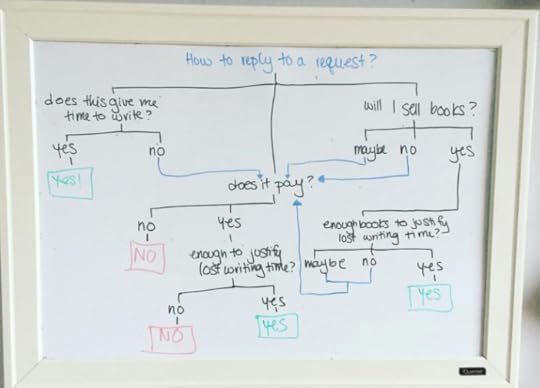
It was too late for 2018 but for 2019, this is how I thought I would manage my time. This is how I would SAY NO.
I was really cocky about this plan. And specifically about automating the process. Sure, it’ll be easy to say no, I thought. Turns out it’s difficult. Turns out that even when you make a new year’s resolution and remind yourself on a monthly basis to refer to the decision tree, to say no at least once every third or fourth time, still, still, STILL the default will be yes. The yes will fly out of your mouth even before you’ve had a chance to think about it. Or, worse, you’ll agonize and come up with eighteen reasons why it would be a shame to say no, why you must pay things forward and say yes, why the opportunity won’t come again so you’d better carpe diem.
And then fast forward to the middle of the year and all the blank pages where you meant to have scribbled at least half of the first draft of a new novel (because everyone’s favourite question is: when’s the new novel coming? Never, at this rate, thanks for asking) and you’ll be left thinking: “Okay, I just have to knock these seven things off my to-do list and then I’ll get some writing done.” And of those seven things, six will be favours and one will be an actual paid project which thank goodness because electrical bills don’t pay themselves.
You must say no, I tell other writers. You must build a fence around your writing time and patrol the boundaries, and then you must coopy down and work. Like everyone else, I’m very bad at taking my own good advice.
I know there are writers, other, better writers, who say yes to everything and still manage to write incredible books. I don’t know how they do it but I harbour no illusions that I’m of their ilk.
So. I have written the word no in my day planner once again. No more book clubs. No more interviews. No more blurbs. No more boards. No more reference letters. Not until I get a first draft banged out because see above re: everyone’s favourite question. It’s my question too: when’s the next book going to get written? Now is the answer. I’m writing it now.
August 13, 2019
On solitude and inspiration
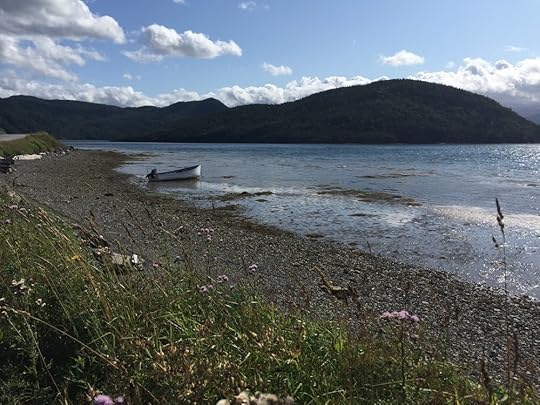
I’m on a DIY writing retreat this week, holed away in a cabin in Norris Point, Newfoundland which is a tiny community nestled in Gros Morne National Park. I’m here because Tom has a math conference which coincides with Writers at Woody Point. This part of the island is about an 8 hour drive from St. John’s and we broke the trip up by spending the weekend in Eastport at the Winterset in Summer Writers Festival.
I didn’t do a lot of writing on the weekend because I was face first into Michael Christie’s new novel Greenwood. (Sidebar: pre-order it. You won’t be sorry!) The story is enthralling but I was also paying attention to how he expertly navigates a massive cast of characters, giving us their backstories and personalities without weighing down the narrative, and thinking about how I might do the same with my own quickly expanding (read: out of control) cast.
Reading is a non-negotiable part of the work of writing. And festivals can be nourishing too. If you’re an emerging author and have a festival in your neck of the words, try to go. Sometimes, okay, yes, the panels are insipid (it’s true; don’t @ the messenger) but just as often someone on stage says something illuminating. Just one sentence that strikes a match and sets your imagination on fire.
At Winterset, I was in the audience of the new voices panel listening to my friends Susan Sinnott, Susie Taylor, and Terry Doyle talk about their debut books. And in the Q&A Terry told a story about how he took a class with playwright Robert Chafe. In this class they talked about formative experiences, the turning points in our lives, and how if you can figure out what this turning point was (often it happened early in childhood), if you can distil it down to just a single sentence (ie. I was orphaned by neglect. No one believed me. I took a big risk) you can lean into it in times when you aren’t sure what to do with your story. Later, Robert described it as a transformation. Theatre is about transformation, he said. And I thought, yes, in fiction too. By the end of the story, something has transformed. Either the character has transformed or the reader’s understanding has transformed. Or both. Ideally both, right? And if you are stuck on what the transformation is, you can look back on that single sentence that summarizes your life’s turning point and lean into that. I’m paraphrasing and probably not well. But anyway, when you’re stuck (as I am at the moment) it helps to have a question to meditate on. So I was thinking about transformation and risk in particular.
And then, I was chatting with Melissa Barbeau who is one of my favourite people to talk shop with. The week before, we had both had epiphanies about the themes of our novels. This happens sometimes. You think you are writing about love and then you realize no, the story is about death. Or vice versa. So we were talking about our books and these realizations and she asked me a series of incise and brilliant questions that kept the wheels turning. The next day Tom and I packed up and drove to Norris Point and along the way, I was still meditating on everything Terry and Robert and Melissa had said, figuring out how to apply it to my novel. Being part of an ecosystem is key for me. I could never do this work alone.
At the same time, solitude is necessary. For the past couple of days, I’ve been spending a lot of time alone, scribbling away. It’s just bits and pieces, false starts, double backs, but yesterday I scratched a bit of a fight and today I think I wrote the bones of what might be the very last scene (mind you, there’s a gaping hole in the middle of the book). It helps to be far away from home. It helps to be alone for a huge chunk of the day, in a silent cabin, on the edge of the ocean. I’ve got another day and a half of this and then I’ll start taking the ferry over to Woody Point to rejoin the ecosystem. But also I’ll be finding time to hole away in cafes or on harbourside benches, because for me it’s all about the balance.
July 24, 2019
Harper Lee Prize for Legal Fiction
The Boat People has won the 2019 Harper Lee Prize for Legal Fiction! (Yes, THAT Harper Lee). I’m so grateful to Doubleday for putting the book forward and to the jurors who obviously have a very refined literary palate. Also: the University of Alabama School of Law and the ABA Journal who administer and sponsor the prize. These things are a lot of work and labours of love.
Late next month, I’ll be accepting the award at a ceremony at the Library of Congress in Washington, DC. (I KNOW. IT’S WILD) In addition to a speech, there will be an on-stage conversation between myself and the jurors. We’ll be talking about To Kill a Mockingbird and my book and probably politics and refugees.
Refugee law, and in particular, the perfectly legal and legitimate process of coming to the border and seeking asylum, is a situation that is woefully misunderstood by the general public. It doesn't help that so many Canadian politicians - many of them lawyers by training - willfully and purposely lie. Fiction can be the antidote, translating the letter of the law into a compelling plot and using imagined characters to show readers the truth. The truth is so important. This is a federal election year and now more than ever we all have a duty to tell the truth. Loudly. And as often as possible. Awards give me and my book a soap box and a megaphone. For these gifts, I’m incredibly grateful.
July 8, 2019
There be dragons
One Saturday last summer, I was at my local nursery, pleasantly hung-over, and feel optimistic about the fact that this time I would for sure keep the new basil alive (spoiler: I did not). It was one of those sunny, hopeful mornings. And then, while in line, I made the mistake of checking email.
There was a message from a reader. The subject was in all caps, angry and accusing. The message itself was a dissertation, in length, if not quite in cogency. How do I hate your novel? Let me count the ways.
It wasn’t the first or last time a molotov cocktail has landed in my in box. But this one got to me. Something about the timing and the all caps subject line calling me a lazy writer was shocking. It felt so personal and mean, an attack on not just my writing but my whole weekend. I began to shake, right there in the nursery, surrounded by ferns and succulents and other people buying ficus plants. Instinctively, I put the phone away. I blamed myself for being the dumb ass who checks email in line. Good writers don’t distract themselves from the moment. They pay attention. Watch. Store the real world up for later. I vowed to stay off email until Monday. I thought about my new plants, how I was going to spend the day outside, potting and writing. I stopped shaking. I paid, made chit-chat with the cashier, carried my purchases to the car, congratulated myself on being so well adjusted. And then a woman came running out of the nursery waving my wallet.
Now, a year later, I can laugh about it but in the moment that reader’s anger was de-stabalizing to my work, to my ability to focus. I remembered this email the other day while reading Scaachi Koul’s excellent piece about a YA author who stalked a Goodreads reviewer. Yes, you read that right. This author got a bad review, lost all common sense, hunted down the reviewer, and showed up at her door. Let this be a lesson to all of us published authors: Goodreads is not for us.
Before my book came out, I used to be a regular lurker on Goodreads. Whenever I finished reading a book I really liked, I would go online to see what other readers were saying. My first Goodreads review was a one-star. It popped up while I was still working on the manuscript. Disturbance in the matrix? Break in the time-space continuum? Either way, my days on the site were over.
Goodreads is for readers. It’s for honest critique and dialogue and yes, sometimes, vitriol, about books. It’s for people who hate the synopsis and rate it one star. It’s for readers who want recommendations. For readers who want to keep and share to be read lists. It’s a democratizing force that bypasses the traditional gatekeepers and allows a wider range of books to gain traction. It’s for book lovers and bloggers. It’s for marketing departments. It’s for trolls (because the whole internet is for trolls). It’s a lot of things for a lot of people. BUT GOODREADS IS NOT FOR WRITERS. It’s a free internet so go on there if you like but I’m telling you right now it’s a mistake.
Because what are we on this earth to do? Write. And there is a limit to how many beatings one’s own ego can take before it begins to impact your work. And trust me, there are enough beatings to go around. There are hideous reviews that can’t be ignored. There are readers who itemize your failures via email or at a book club or event. There are rejections. Prizes you lose, lists that snub you, shops that don’t carry your book, loved ones who won’t read it. Trust me. Enough beatings. You need not go looking for more. And while I’m on the subject, for the love of god, stop googling your name. Get rid of that google alert. Leave it to your mom/ lover/ agent/ editor. GO BACK TO WORK.
July 1, 2019
Bury your tropes
Recently in a fiction workshop someone asked the question every sensible writer dreads: how do I write characters who are outside my own personal experience, who are not white/ straight/ cis? I say that every sensible writer dreads this question because in my experience the ones who steam roll right in with more bluster than caution are morons. And their lazy attitude is doing everyone - their readers, their characters, and other writers - a disservice.
HUMILITY
Begin with humility, I told the group in my workshop. Your ignorance is an uncovered manhole and if you’re not careful, you’ll topple in. For example, do you have just one gay character in your cast? Does the character die? Does the death happen soon after the character finds love? I’m not psychic. Your character is a trope (google: Bury Your Gays). This is why we must begin with humility. Because, to quote a certain blustering steamroller, of the known unknowns.
RESEARCH
What we are striving toward in our fiction is truth. Accuracy, veracity. And how can you paint a realistic portrait of, for example, a non-binary character, if you are cis? Without humility, without research, without knowledge, guess what you’ll do? You’ll make that character magical. Or die. Or both.
Friends are a great resource. I’ve been helped along the way by so many of mine. For example, In Indonesian there is one word for temperature hot and a different one for chilli hot and these words are pedas and panas and non-Indo speakers can never remember which one is which and this is such a fantastic nugget that I was like a child on Christmas when I used it in a story. And also the contraction “Indo” is wonderful. How was I ever going to know that on my own? (That story, by the way, is called Lord of the Manor and it was published in The Dalhousie Review.) So step two: have a diverse group of friends. But that’s really just life advice.
Devour books and articles and whatever you can get your hands on to help you understand the worldview and background of your character. Read other fiction featuring characters like the one you want to create. If your character is Muslim, please read books written by Muslim authors. Seek out interviews with the authors of these books. A while back I was listening to Jen Sookfong Lee on the podcast Can’t Lit. She was talking about naming her Chinese characters and the importance of choosing names that could be pronounced by Chinese parents. I immediately filed that nugget of knowledge away for later. (Thanks, Jen)
Sensitivity readers are professionals you can hire to steer you clear of those manholes. Remember the known unknowns!
A STORY
Months ago, while was casting my new novel, I created this fantastic character called Emmanuelle. She’s a 13th-generation Nova Scotian from an evangelical family with a minister father (hence her name). Em is a teacher and an extrovert. She’s got a rowdy group of friends who come to her apartment and sit around painting their nails and watching Survivor (this is circa 2001). I know her apartment, the bo-ho chic furniture and wall hangings, the sticky kitchen floor, the triangular rainbow sticker just beside the peep hole on her front door, the humid bathroom with its patch of black mould by the tub that always returns no matter how often it gets scrubbed away. I have an image of Emmanuelle too, tall with very dark skin and tight curls that spray out the top of her head like a fountain. She is wonderful. I know her so well I can hear her voice, deep, a little husky, a singer who might break out in jubilant song at any moment. She sang in her church choir for nearly two decades and though she threw over faith when she came out, she still loves all the old gospel hymns.
But then I was plotting out the book and because Em’s not the main character, because she’s a semi-minor actor who is there in service to the main character (as all the characters are of course), the plot dictated that she had to die. And at some hideous point I realized what I had been about to do. Kill my only lesbian character. Worse, kill her in order to to trigger an emotional epiphany for the straight dude. (That’s two tropes, by the way) I was in Vancouver having dinner with Dina Del Bucchia. I told her my dilemma. I probably had my hands over my head, quite possibly tugging on my hair. Dina was kind but the verdict was unanimous. So now I’m back to the drawing board with the plot. Because, I want to be fair to my characters and one gay character getting killed in a book full of gay characters is fine but what I was doing was diving face first into a manhole.
KNOW YOUR TROPES
A reliable way to make people believe in falsehoods is frequent repetition
— Daniel Kahneman in Thinking, Fast and Slow, page 62
Here is what happens. Gay and trans characters die so often in fictional stories, we see this plot point repeat over and over, and then it becomes a cliche that’s lodged into our brains as fact. (The Nobel Prize-winning psychologist Daniel Kahneman talks about this cognitive bias in chapter five of his book Thinking, Fast and Slow.)
Then when we straight/ cis writers sit down to write a gay or trans character we unconsciously reach for whatever information we have and up comes this tired refrain, which we don’t even realize is a trope, and we unthinkingly, unconsciously, repeat it on the page. It is a self perpetuating cycle. This is the danger of writing from outside of your own experience. Without caution and care, without humility, without research, you will perpetuate a lazy cycle that does everyone a disservice, most of all the community of real people who you are trying to recreate on the page. And then if your ego is fragile because you’re a special snowflake, and someone calls you on your bull shit, you’ll dig your heels in and yell: “Political correctness has gone too far! Don’t tell me what to do! This is fiction and I’m a writer!” And the rest of us will be over here, eyes rolling out of our damn heads.
And let’s pause to think about this trope for a moment. Why are all these gay and trans characters dying all the time? Is it because the rest of us have a deep buried hatred of them and are enacting mass murder on the page because we can’t do it in real life? Think on that and tell me if you still feel good about knocking off your only trans character.
I don’t know if Em will make an appearance in this book I’m writing because I’m reworking the plot. But she’s in my head now so she’s bound to turn up somewhere. I’m not killing this particular darling. I’m saving her for later.
MANHOLES TO SKIRT
It helps to know all the ways you can unintentionally fuck up. I brainstormed a few tropes to get us started. Please chime in, in the comments, if you know any others. I am still learning just like everyone else.
The magical/ wise old black man
Related: the magical Indigenous character
Indigenous characters who are described in animalistic terms. Please. NO.
The predatory lesbian (Who invented this nonsense - religion? hysterical men? all of the above?)
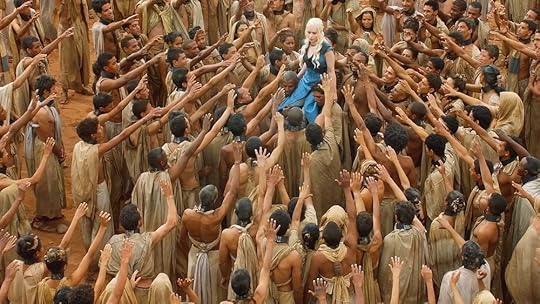
This is some bullshit right here.
I love Apu Nahasapeemapetilon and in my opinion (not every brown person’s opinion) he works because The Simpsons is a show full of tropes. That’s the whole gag. But if there’s only one brown character in your book and they are driving a cab or working at a 7-11 and have an accent then you have FAILED. Fifty points to Slytherin if said 7-11 guy dies.
The white saviour
The token. You know how on TV shows the token black or gay or brown character has all white/ straight friends? Yeah. That’s not a thing in real life.
In fantasy stories: the good guys are white, the bad guys are black. (Chandler Bing voice: Could you be more racist?)
Adorable asians. RO Kwan writes about this stereotype playing out in real life so have a read and take care with your descriptions.
SEMINAL
Last Fall Tom was reading a book by John Updike. I don’t know which one because it’s not important. Tom said: It’s about a man who leaves his pregnant wife for a younger woman. Uh-huh, I said, bored already with this predictable bit of masturbatory fantasy certain male authors seem keen to replicate. Then a few days later, Tom reported that the book had taken a dark turn. Let me guess, I said. The wife goes nuts and kills the baby? Tom was amazed by my psychic abilities. How did you know? he asked. Have you already read this book?
LOL. I’ve read enough books by male authors, particularly of a certain vintage, to know that some (#notall but #toomany) men are lazy and incapable of writing realistic female characters. To them women = hysterical, doe-eyed, back-stabbing, dangerous, sex-pot, BOOBS. They get pregnant and either terminate the pregnancy in some back alley way that results in death or they throw their babies off a cliff because…I don’t know??… bitches be cray, I guess. Or more likely because on some fundamental level these men believe we aren’t responsible enough to care for children and therefore shouldn’t have the right to decide what happens inside our uteruses. Yeah. Suck on that nasty thought for an hour.
We have a running joke in our house about these seminal authors and their jerk off fiction. It’s also the subject of ridicule all over the internet. If you’re a man writing about a woman, DO BETTER. My pal Jamie Fitzpatrick is a great example of a straight man who writes convincing, complicated, wonderful female characters so I know it can be done. It probably helps if you respect ladies and believe we are equal members of society. Once again, just some basic life advice: don’t be a raging asshole.
BE SPECIFIC
Specificity is the soul of strong writing. Real life is specific and your fiction should be too. Every time a light-skinned brown actor plays a south Indian on screen, an angel in heaven dies. Skin colour isn’t something you just slap on a character like height or glasses. Skin colour is specific. People from north India, Bangladesh, and Pakistan have lighter skin than anyone from south India or Sri Lanka. Even in Sri Lanka, there are significant differences. Tamils are darker than Sinhalese. Burghers are even lighter. Some could pass for white. And why does it matter? Because shadeism is real and pernicious and you have to know the character’s skin tone if you’re going to know the most fundamental things about them. By the way, if you don’t know what shadeism is, you have no business writing from the point of view of a brown character. Go do some homework. Ask your loved ones who are brown (not strangers or acquaintances…please don’t force strangers to teach you things you could learn on the internet). Hire a sensitivity reader.
AGENCY
Recently, I was sharing the stage with another brown author and the moderator asked her the following question, AND I QUOTE: “I was surprised by your book because your characters are from Iran but they didn’t seem oppressed.” This is the kind of bullshit non-white writers have to deal with but that’s a post for another day. Please don’t be like that ignorant moderator. Remember that everyone has agency and all your characters should have some degree of it too. This is really important, especially when you are writing about characters who come from communities that have been sidelined in the western canon. Making characters passive to their fate is lazy writing. Find where their agency lies and explore it on the page.
FINAL THOUGHTS
Diversity on the page begins with diversity off the page. Are all the radio programs and podcasts you listen to narrated by straight, cis, white people? Ditto the books and essays and magazine and online articles you read? What about television and movies? What about the people in your life? Diversify your life and you’ll find it easier to bring that richness to the page.
I’ve barely scratched the surface here. Luckily, there’s a chorus of other voices singing the same song. Here’s some further reading:
At Book Riot: 7 Manholes to skirt
At The Belladonna: a run down of some familiar tropes
At Midnight Breakfast: an illustrated guide
At Lit Hub: a wonderful essay by Claudia Rankine and Beth Loffreda
June 4, 2019
Owning the podium
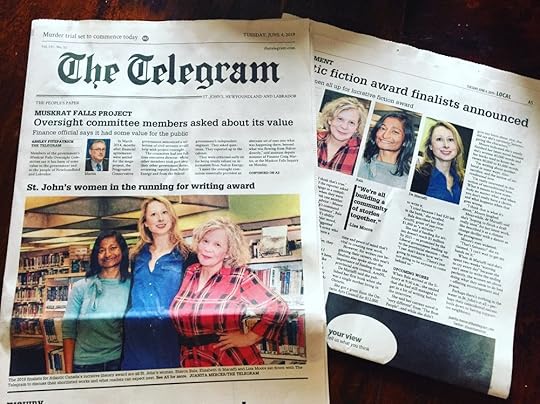
Extra! Extra!
The Boat People is up for two Atlantic Book Awards this year (yes, TWO) including the Thomas Raddall Atlantic Fiction Award. With a purse of $25,000 for the winner, it’s one of Canada’s biggest book prizes and the most generous one in the Atlantic region. My eyes are crossed from now until the gala on Thursday night. (The event is open to the public, by the way, and you can buy tickets for $20 here.)
The best part though is the competition: Lisa Moore and Elisabeth de Mariaffi! Of all the fiction books published by all the authors in all four Atlantic provinces last year, what are the odds the entire short list would come from the same postal code? Yesterday morning the three of us had a chat with The Telegram’s Juanita Mercer and you can read her article here. The fourth sentence is a genuine LOL.
The Boat People is also in the running for the Margaret and John Savage First Book Award against Nicola Davidson’s In The Wake and Susan Sinnott’s Catching the Light. Susan is in my writing group and her gorgeous book is one I’ve been championing for a while. She is also (coincidence?) a neighbour.
Elisabeth says there are more artists per capita in the A1C postal code than anywhere else in the country. I don’t know if this is true but if you are an artist and independently wealthy, there are several nice houses for sale in our neighbourhood so COME ON DOWN. But please bring all your mainland dollars because NL has more mega-project debt than fiscal sense and all of us artists are subsisting on dwindling grants and dreams of winning the lottery. Yeah, yeah. THIS AGAIN.
Prizes are wonderful for publicity. The stickers glam up book covers. We swap yoga pants for party dresses and get drunk on good cheer. But bottom line: if you win a prize, it will be a significant part of your income. The Savage First Book Award is worth $2,500 for the winner. That’s more than most advances. Probably more than a lot of royalty cheques. The Raddall Family who privately sponsor their $25K award have chosen to be generous because they want to give the winner a gift of time. Time away from paid work. Time to devote on a new book. Most Canadian authors don’t earn $25K in a year. Not on their books, anyway. Side hustles and 9-5 jobs, sure. But not books.
A few weeks ago, NL had a provincial election. A few days before that, the incumbent Liberals announced a $5-million dollar commitment to increased arts funding. I didn’t go to the press conference. I was working on a paid project and couldn’t afford to take time away to hear about a last minute amendment to a budget that, by the way, still hasn’t passed. Now the Liberals have been given a second term in office so ….fingers and eyes and toes crossed, I guess???
I could not be prouder to be on the short list for the Thomas Raddall Atlantic Fiction Award with Lisa and Elisabeth, to share space on the short list for the Margaret and John Savage First Book Award with Susan. NL authors are owning the podium at the Atlantic Book Awards this year and good on us. But can this level of output continue? What about all the emerging authors, the ones with unpublished manuscripts who are knocking on CanLit’s door hoping to get in? I’d love to say that in five, ten years from now we’ll still be seeing new and old faces on these short lists, that there will be grants and programs and paid cultural opportunities. But election promises aren’t paying anyone’s Light and Power bills. Five million by 2021. It’s what the Premier promised so let’s hold his feet to the fire until he coughs up.
Sharon Bala's Blog

- Sharon Bala's profile
- 140 followers

