Per Axbom's Blog, page 5
August 25, 2019
Hell Turdy
Worrying about the dystopian outcomes of many digital ventures these days can honestly be somewhat mood-dampening. I need to remember to find time to be silly and laugh more. One thread on Twitter the other day, started by David M Barnett, had me in stitches. It encouraged people to share embarrassing typos in formal e-mails and I kept bursting out in laughter at the cringe-worthy stories.
Then I started thinking about how I could make sure to keep enjoying the effects, and remember these mishaps to boost my well-being. I decided to do my own mashup of the responses. What if a person made all these mistakes in the same e-mail, what could that look like? So I made it happen.
I’m sure not everyone shares my sense of humour and it’s likely that some will find this offensive. Beware that there are a fair number of obscene words in here – which of course is the point. In this context it’s fair to remember that these misspellings are taken from examples of real mistakes by real people where any profanity was unintended.
This unfortunate e-mail should of course have started out as “Hello Trudy”. It is dedicated to everyone out there who is pushed to work at speed with digital tools, without time for reflective practice. Manky thanks to all the people in the thread who were willing to share.
From: Asa Botcher
To: Trudy Tucker (eyebrows)
date: Aug 25, 2019, 1:54 PM
subject: Sales Template #4 (Remember to mention the sick colleague)
Hell Turdy,
I hope you ate well and not too busty, as I don’t want to cause any incontinence. But I figured a quick massage is worth a shit.
Please refer to the flowshart detailing all the discocunts. All items are available in various quantitties. If you cuntpaste the code it will give you a fuhrer 5% reduction.
I also heard your colleague has been under the car of his doctor for some months. I am praying he gets better soon, really hope he dies.
A seedy response would be great. Manky thanks for your time, and let me know if there are any father issues I can help you with. I’d be happy to sex up a prone meeting, or I can poop around your new office.
I’ve just been peeing out the window and noticed it’s a lonely day outside. I’ll be going for my daily wank now.
Breast wishes and kind retards,
Ass Botcher
Manager, Pubic Affairs


August 21, 2019
Skolplattformen i Stockholm har stora säkerhetshål
Runt 10-tiden i morse skrev Måns Jonasson illavarslande på Twitter att han via skolplattformen lyckas komma åt personnummer och namn på alla lärare och elever i Stockholm, inklusive elevernas omdömen.
Genom att mecka lite (ytterst lite) med anropen till backend kan jag få ut personnummer på alla lärare min son har eller har haft i skolan.
snart följt av:
Förresten, det verkar som att jag kan få ut namn och personnummer på ALLA lärare i Stockholms stad.
Och elever.

August 6, 2019
Convert newsletters to Atom/RSS feeds
I found a useful tool allowing me to partake in the joy of well-written newsletters without having them fill up my inbox. The website Kill the Newsletter! (KTN) simply allows you to add them to your feed reader.
Here’s how it works when you go to kill-the-newsletter.com
Enter the name of the newsletter. This is for your eyes only but it’s generally a good idea to choose something that actually is close to the name of the actual newsletter, and maybe the provider.
KTN now provides you with a unique e-mail address for this newsletter. This is the e-mail address you use to subscribe. Do that as soon as possible.
You are also provided with a link to the Atom feed. This is the feed address you enter into your feed reader (Feedly or something like it).
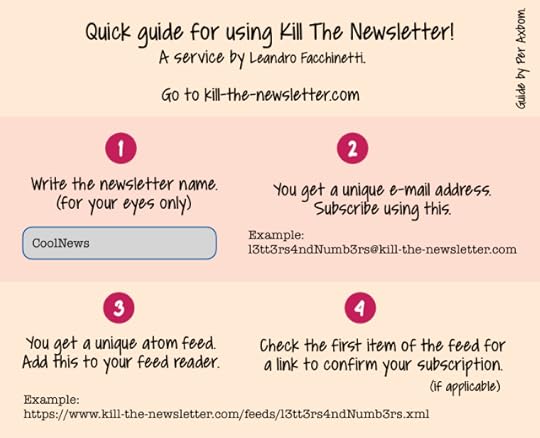
There’s one caveat to remember, a step number 4. If the newsletter is doing things right by you, they will ask you to confirm your subscription. The first e-mail will be the second item in the feed. So just load that article and cut and paste the confirmation link into your browser. Now you’re all set to read via feed.
Why is it the second item? Because the first item is the note about having started the feed, and a reminder about your unique e-mail and feed addresses.
Pro tip
You can subscribe to several newsletters using the same address, just remember they will become part of the same feed.
Additional advantage
By using a unique e-mail address you become harder to track.
Risks
The creator of this brilliant tool, Leando Facchinetti, is of course just one person. While the site has been running for years now, I would also suggest you keep a list of the newsletters you are subscribing to, in case the website has issues. Of course, if you’ve given the newsletter a good name in the first step above, you actually have this list already in your feed reader.
Time to start enjoying e-mail newsletters without the e-mail.
Bonus: 3 of my favorite newsletters
Imagine. A newsletter by The Conversation which presents a vision of a world acting on climate change.
Dense Discovery. A weekly newsletter helping web workers be productive, stay inspired, and think critically. It’s published by Kai Brach, the person behind Offscreen.
Stratechery. A paid newsletter providing analysis of the strategy and business side of technology and media, and the impact of technology on society. Written by Ben Thompson in Taipei, Taiwan. To be fair, this one actually already provides you with your own RSS feed as part of the offering – and the weekly articles (also available via feed) are free.
Would love to see you share your favorite newsletters, here in the comments or on Twitter.
August 4, 2019
The harmful myth of mentally ill shooters in the USA
Another shooting in the USA, and yet another series of talking points about reasons. One of the most common is mental health. When this talking points ensues, it enforces stigmatisation of people with mental health issues, people who are actually way more likely to be victims than offenders.
Hundreds of mass shootings take place in the US every year, when mass shooting is defined as “having four or more people injured or killed”. Many media outlets say there is now one shooting per day on average. And the majority of perpetrators are white males who act alone.
Their prevalence seem to leave little time for reflective consideration. Quick fixes and easy answers dominate public discourse. The go-to conclusion of mental illness is a comfortable one. Nobody can understand it, so the brains must be ‘diseased’. In truth, a tremendous amount of misguided beliefs are in play.
Though mental illness is not necessarily accompanied by strange behavior (and exhibiting strange and abnormal behavior does not mean you have a mental illness), the belief that it is is held by many people and so the connection is easy to make. (Psychology Today)
Portraying mass shootings as a mental health problem gravely misrepresents the evidence. In fact, people with mental health illnesses are way more likely to be victims of violence (including violence committed by police).
A 2004 analysis of more than 60 mass murders in North America, for example, found that just 6% were psychotic at the time of the killings. And when it comes to mass shootings, those with mental illness account for “less than 1% of all yearly gun-related homicides ”, a 2016 study found. Other studies indicate that people with mental disorders account for just 3-5% of overall violence in the US, (much lower than the prevalence of mental illness in the general population – up to 18%) which “still leaves you with around 96% of violence, even if you’re able to eliminate all people with mental disorders”. (BBC Future)
There is substantial research showing that the correlation between mental illness and violence is much lower than is commonly assumed and that mass shooters are not in their majority mentally ill. There is also substantial evidence that people with mental illness who do end up committing violent crimes (just as people who are not mentally ill but commit violent crimes) are also substance users, a factor which is a more reliable indication of violent behavior than the presence of mental illness. (Source: Psychology Today)
The stigmatisation of mental illness is a form of harm to innocent people, having them looked upon by society as potential perpetrators of violence. A further effect is that people in need of therapy will not seek it out, as they don’t want to be labelled as mentally ill – with all the prejudice that his entails.
It’s worrying then that people in power, like Bernie Sanders, continue to perpetuate this myth. Saying the same wrong thing over and over, day after day and year after year, won’t get America anywhere closer to managing their gun violence crisis and saving innocent lives.
Sources
Wikipedia: Mass shootings in the United States
Psychology Today: Mass Shooting and the Myth of the Violent Mentally Ill
BBC – Future – Is there a link between mass shootings and mental illness?
Stop blaming mental illness for mass shootings – Vox
• Mass shooting victims in the United States by fatalities and injuries 1982-2019 | Statista
July 25, 2019
Highlights from the Mueller hearing
On July 24, former special counsel Robert Mueller testified before two House committees. He had already in May – when announcing his retirement – said: “The report is my testimony.” This was an indication that nothing new would come forward in a hearing.
Having said that, there were some clarifications of the report that seemed to surprise some people, and a few rare moment where Mueller was more candid, saying for example: “Problematic is an understatement.”
What you need to know and understand going in:
Mueller declared in his opening statement that he would not comment ongoing investigations. There is also information that is deemed privileged that he would not comment.Mueller was careful to not misconstrue anything in the report. For this reason he can appear hesitant when asking for repetitions on wordings and citations. Also, he turns 75 years old next week. Some critics, however, took his demeanour to mean he wasn’t confident in understanding hos own findings.At the outset of the investigation there was a decision to go forward only after taking into account the OLC (Office of Legal Counsel at the Justice Department) opinion that indicated that a sitting president cannot be indicted. That is to say: a president can not be formally accused of committing a crime. This meant that the Office of Special Counsel would not pursue the determination of culpability, given that indictment is not possible. In Mueller’s words: “we made a decision not to decide whether to prosecute or not.”. This is unique, but it is also a unique situation. This is why the report does not claim to label the president as guilty or not quilty – and why the report clarifies that it does not exonerate the president. Critics took issue with this, arguing that the investigation did not fulfil its assignment. Vox explains in more detail. Some critics are saying that it was not the job of Special Counsel to exonerate or not exonerate Trump, questioning the validity of including in the report that “this does not exonerate Trump”. This ties back to the fact that the unique circumstances of not pursuing culpability. By making this decision, there was an additional decision to clarify in the report that culpability was not determined. More importantly: the entity that could determine if the president obstructed justice is Congress. Why did the counsel not subpoena Trump? The president declined to be interviewed by the investigation for more than a year. The decision to not subpoena Trump, according to Mueller, is in light of the fact that the report needed to be completed and the expectation was that Trump would fight the subpoena, instigating an appealment process that would cause the report to be significantly delayed.
Wikipedia has a useful timeline of all the events concerning the investigations into Trump and Russia.
Let’s start with maybe one of the most important moments:
This seems…big. Thanks to Republican Ken Buck for getting this on the record:
— Pod Save America (@PodSaveAmerica) July 24, 2019
Buck: "Could you charge the president with a crime after he left office?"
Robert Mueller: "Yes" pic.twitter.com/47SRauY7cz
It’s important because, later in the day, Trump denies that Mueller said this and goes on to verbally attack Paula Reid from CBS:
ME: “Mueller said you could be criminally charged after leaving office?”
— Paula Reid (@PaulaReidCBS) July 24, 2019
TRUMP: Denies Mueller said this and then when I challenge him on facts, calls me “the worst.” #MuellerDay #MuellerHearing pic.twitter.com/1v66aApQKJ
But, again – the reason for not indicting is because American law makes it impossible:
Ted Lieu: The only reason you did not indict the President was because of the opinion that you can not indict a sitting President, correct?
— Shannon Watts (@shannonrwatts) July 24, 2019
Mueller: Correct.
pic.twitter.com/3gH9YnORZN
This is what Trump did:
Former special counsel Robert Mueller confirms that President Trump asked staff to falsify records relevant to the ongoing investigation. #MuellerHearings https://t.co/3EYBMBRaoC pic.twitter.com/jcDm6KPqFJ
— CNN (@CNN) July 24, 2019
And even an unsuccessful attempt to obstruct justice is still a crime:
“An unsuccessful attempt to obstruct justice is still a crime, is that correct?”
— David Cicilline (@davidcicilline) July 24, 2019
MUELLER: “That is correct.” pic.twitter.com/S3H8iWiiWn
If you missed it, the report does not in any way exonerate the president…
Nadler: Did you actually totally exonerate the president?
— CBS News (@CBSNews) July 24, 2019
Mueller: No.
Nadler: In fact, your report expressly states that it does not exonerate the president.
Mueller: It does. #MuellerHearings https://t.co/pjOwNhYtbJ pic.twitter.com/IBKT0TgflP
For those not taking the investigation itself seriously, there was a reminder of the Trump advisors and associates who as of yet have been convicted or charged:
George Papadopoulos.
— House Intelligence Committee (@HouseIntel) July 24, 2019
Paul Manafort.
Rick Gates.
Michael Flynn.
Michael Cohen.
Roger Stone.
That's SIX Trump Campaign associates who lied to Mueller & investigators to cover up their disloyal and unpatriotic conduct.@RepSwalwell on the #MuellerReport: pic.twitter.com/OOE2YmTEXS
Speaking on Trump’s repeated promotion of Wikileaks, Mueller goes as far to say: “Problematic is an understatement.”
"I love WikiLeaks." "WikiLeaks is like a treasure trove." "Boy, I love reading those WikiLeaks." – Donald Trump
— House Intelligence Committee (@HouseIntel) July 24, 2019
Mueller's view of Trump's open embrace of a foreign adversary's cyber attack?
"Problematic is an understatement." pic.twitter.com/s2V4Jvt0xZ
For Republicans wanting to pass this off as a politically driven investigation, Mueller had a clear message:
Mueller forcefully confronts the narrative he staffed his team with 'angry Democrats.'
— Josh Campbell (@joshscampbell) July 24, 2019
“I have been in this business for almost 25 years, and in those 25 years I have not had occastion once to ask somebody about their political affiliation. It is not done.” #MuellerHearing pic.twitter.com/JqEbJdZpow
Here, Mueller clarifies how important he thinks it is for the American people to understand the significance of election interference:
Robert Mueller: "Over the course of my career, I have seen a number of challenges to our democracy. The Russia government's effort to interfere in our election is among the most serious…This deserves the attention of every American." https://t.co/K8mSy6s4pQ #MuellerHearings pic.twitter.com/PIUTCHNakW
— ABC News (@ABC) July 24, 2019
The full exchange between Adam Schiff and Mueller is wort watching. On the stolen report, “witch hunt” and blatant lies.
Here’s what Mueller said:
— Adam Schiff (@RepAdamSchiff) July 24, 2019Russia interfered in our election to help Trump.
“We should hold our elected officials to a higher standard than merely avoiding criminality, should we not?” Schiff again, rounding off.
A key moment at the end of the #MuellerHearing
— Josh Campbell (@joshscampbell) July 24, 2019
Schiff: “I gather you believe knowingly accepting foreign assistance during a presidential campaign is an unethical thing to do.”
Mueller: “And a crime in given circumstances."
Schiff: "…also unpatriotic."
Mueller: "True." pic.twitter.com/2DAvT9VEbQ
Bonus. This was a weird coincidence:
Oh my god. Watch this. #MuellerDay #mueller pic.twitter.com/AOzilLU3Uo
— Danny Deraney (@DannyDeraney) July 24, 2019
As always, Trevor Noah can give you a quick summary:
Mueller’s hearing was less of a bombshell, and more of a reminder to everyone to do their homework. pic.twitter.com/KM69xwVnck
— The Daily Show (@TheDailyShow) July 25, 2019
The collusion / conspiracy debacle
There was this point when Mueller was being questioned by Doug Collins around whether or not collusion was synonymous with conspiracy. After the the confusing exchange, Mueller had to resort to simply stating: “I leave it to the report” — which really is what his message is throughout. Many critics claimed this exchange to be a display of how Mueller didn’t have a clue about what his own report says. However, Collins’ question unfortunately lacks context, which ultimately most quotes from the report will. CNN explains:
On page 180 of volume one, the Mueller report said: “Collusion is not a specific offense or theory of liability found in the U.S. Code; nor is it a term of art in federal criminal law. To the contrary, even as defined in legal dictionaries, collusion is largely synonymous with conspiracy as that crime is set forth in the general federal conspiracy statute.”
This part of the report was talking about collusion in the sense of corporate collusion, which is when companies conspire in an illegal fashion to help each other and hurt consumers.
That is completely unrelated to “collusion with Russia,” which has been the colloquial term used over the past few years to discuss potential cooperation between the Trump campaign and the Russian government.
As always, there rarely are shortcuts to real knowledge. If you truly want to form an educated opinion, you actually do need to read or listen to the report rather than rely on sound bytes and snippets.
Report On The Investigation Into Russian Interference In The 2016 Presidential Election (colloquial: Mueller Report). Searchable Document and Index.Mueller report audio podcast. Approximately 12 hours of listening.
Have fun! 
July 1, 2019
First, design no harm
At the Adobe 99U conference there was an on-stage conversation between author Courtney E. Martin and Tim Brown, CEO of design firm IDEO. During the interview they touched upon the topic of ethics. Author and design consultant Kim Goodwin reacted to the exchange, calling out Brown’s remarks as “a disturbing statement”. I agree, and I couldn’t let it go. We need much more clarity about design ethics from design leaders, and I want to break down how Brown’s statements are misleading.
The problems start around the 23:40 mark in the recorded video where Martin tells Brown she wants to “talk about ethics a little bit because I know you’ve been deeply involved in thinking about the ethical life of designers and the ethical mandate for design as a whole”. She starts him off by alluding to the Hippocratic Oath, an oath of ethics historically taken by physicians and one of the most known Greek medical texts.
Martin to Brown:
You’ve been working with a lot of other designers thinking about what is our ethical mandate, what is our Hippocratic Oath for design. Can you talk about how you’re thinking about that these days?
Brown’s response:
Yeah, well one thing it’s definitely not, which is it’s not the Hippocratic Oath as we think about it in the medical world, because I think if we made the oath to first do no harm as designers, we would likely never do anything new. I think that would be unfortunate. I think we need systems to ensure that we don’t do too much harm, or we don’t harm intentionally. But I worry about an automatic reaction to the kind of ethical dilemmas that we have today, with technology, to be, we’re not gonna take any risks. I would rather see us make the oath to being extremely adept learners, and not disengage.
Instead of answering the question, Brown goes into defensive mode, arguing that taking risks is part of design and how he fears that the current “automatic reactions” to ethical dilemmas will remove risk-taking from design.
I want to address the distressing dissonance in those remarks.
Hearing and reading Brown’s response, he seems to make some curious assumptions:
Brown argues that an adherence to the Hippocratic Oath would mean that there is no innovation. I would argue the opposite. The original oath was written between the fifth and third centuries BC (most modern scholars do not attribute it to Hippocrates himself). Medicine has seen a fair bit of innovation in the thousands of years since then. To be fair, though, it has been modified numerous times and if used in professional settings it is often the 1964 version by Louis Lasagna that is used. More importantly, it is always supplemented or substituted with, regularly updated ethical codes. Brown argues that being ethical in accordance with the Hippocratic Oath means taking no risks. Again, it’s quite the opposite and the oath actually encourages risk-taking. Why? Because risk-taking saves lives. Primum non nocere (first do no harm) is a tenet of several versions of the oath, but there is no intervention in medical practice that does not also have risk. Thus one can not avoid risky treatments. Not doing anything can be as unethical as doing wrong. It’s about involving the patient and having their informed consent. It’s not inaction.Brown seems to imply that doing nothing is what creates the least harm. But in truth, we need innovation and new designs to reduce and mitigate the widespread systemic harm that is a daily reality for many people. To heal, we need invention and accessible distribution of curative interventions.
Ironically, the thousands of year old oath appears to actually promote much of what Tim Brown has in mind when he himself reflects on the road ahead.
The fact that ethical guidelines encourage risk-taking may seem counter-intuitive to a layperson of ethics. Given the amount of time Brown is said to have spent thinking about ethical mandates with his peers, I would have hoped for a more considered response.
Why the Hippocratic Oath matters
Courtney Martin’s original question was framed around “what is our Hippocratic Oath for design?”. It’s an open-ended question. Here are a few things I believe the design community can learn from medical ethics. Some I bring up because they address common myths. I’ll dissect the variants of the oath and more additional principles in a future post.
Use the Hippocratic Oath to serve as a reminder of who our profession serves. The phrase “First, do no harm”, although not even part of the original oath, is about the concept of serving people first. It acknowledges that we have power to harm people. In medicine this power of authority is today obvious; in digital design, many are just waking up to it. The principle stresses avoidance of intentional harm.Risk-taking to improve well-being is fine, but only with the full, informed consent of the person at risk. This same premise is for example why we have regulations around information to people trading in financial instruments. Make sure that you gather a comprehensive amount of information to assess, and communicate, risks and benefits. This is why research matters.It is not viable to always treat patients as you yourself would like to be treated. That would assume you know them to an extent that they can only know themselves. Never assume you know what individuals need or want.People have a right to make decisions that are bad for themselves. People may have lifestyles you do not agree with, or even choose not to accept treatment that could save their life. Other people’s habits and values are allowed to differ from your own. You can inform them but you can not coerce them.Be open about lack of knowledge. Never be afraid to tell people when you need their help in managing an ethical dilemma. But also, be transparent about unexplored potentials of negative impact. Allow others to point out weaknesses in your product or design.Avoiding harm is not enough, you also have to take steps to contribute to well-being. This is what design should be all about.Think about, discuss and record ethical considerations and feel confident that you can justify your decisions. In the end ethical design is a process, not a set of rules.
But can we create without generating harm?
During the Twitter conversation following Kim Goodwin’s reaction to Brown’s comment, another point was brought up. Designer Joe Lanman asked, rhetorically:
In a complex capitalist society don’t most things cause some harm somewhere? Pollution, exploitation, etc?
I think this is a valid point and a reason even people like Tim Brown may struggle to find solid ground for an ethical frameset. It’s hard to make things without someone being hurt. But the challenge of this should be an incentive to designers, not a deterrent. It is hard – let’s figure out how we can make it easier.
I can support the notion that the creation of anything – no matter how benevolent it seems – will inevitably exclude or affect a select group of people in a negative way. In fact, Sarah Mei has a lengthy thread on Twitter going deep into the impossibility of a purely positive effect. But I don’t want to support the notion that “First, do no evil” therefore is a useless tenet, or even a limiting one.
While all medicines have side-effects most of these are known, through rigorous research and testing procedures, and communicated. Hence they can affect your body in negative ways while also contributing to a healing process. Prescribing the medicine is an act of agreement between physician and patient, where an informed consent (side-effects communicated and understood) must take place.
The act of “First, do no evil” within the space of design, would for me incorporate being transparent about the considered, intended and unintended (when uncovered) negative outcomes – along with an assessment of how likely each is to occur. And how they will be managed. Only when both positive and negative impact is fully disclosed can stakeholders make considered decisions about their next step, and consciously avoid the risk of harming themselves or someone else. They decide if the known, potential harm is outweighed by the overall contribution to well-being.
In my Digital Compassion handbook I offer a framework for documenting impact that is based on tools first introduced by Impact Management Project. The idea is to regularly assess potential and real harm with parameters such as:
Seriousness – how harmful is the impact in relation to other harmsContribution – how much is our product design contributing to this negative impactVulnerability – how under-served by society are the people being affected
By regularly researching, assessing and documenting negative impact we have information that allows us to plan and prioritise our work ahead – to minimise or eliminate negative impact where possible. And please note, the answers to these questions are gained from listening to real people from the actual communities, and ideally involving them in both assessment and design work. Best-case, this documentation underpins communication and informed consent.
Of course, a person not interested in adopting a mindset of First, do no harm would find no reason to employ these types of frameworks to help guide their work. And there would be a lack of documentation when evaluating and concluding accountability. Essentially: status quo.
Rather than passively dismiss the oaths of the medical profession it would be fair to see them as an important body of knowledge to learn from. We need to be asking what insights we can can discover and make sense of, not if we can copy and paste. Physicians have been grappling with ethics, and innovating their oaths and codes, before the design community. Not doing that research may in a future be considered design malpractice.
We learn from those who have marched the paths before us and we learn from those who have been harmed. I am confident that if we want to avoid the land mines that are the ethical disasters we are witnessing in tech today, we need better maps. And we need mapmakers who actually live their lives in the disaster areas.
footnote: It really is not the case that all doctors must swear the Hippocratic Oath, as many people believe. In some cases medical schools hold a ceremony where graduating doctors swear some updated version of it. In other schools the Declaration of Geneva physician’s oath is used, or an oath individualised by the institution. The British Medical Association (BMA) drafted a new Hippocratic Oath for consideration by the World Medical Association in 1997 but it was not accepted and there is still not a single modern accepted version. (source: Ideals and the Hippocratic oath [patient.info]).
Sidenote: The Hippocratic Oath matters because it has contributed to common knowledge that physicians need to adhere to certain ethics. We need this awareness among consumers of all the products and designs we contribute to. When people have this knowledge they are in a position to make demands, and are empowered to choose the best possible path for themselves.
See also: Swearing to care, a resurgence in medical oaths
Kim Goodwin’s original thread on Twitter that set me off writing this post.
March 20, 2018
Gäst i Digitala mediepodden
Boken jag arbetar på: Misusability, samt tillhörande arbetsblad.UX Podcast där James och jag pratar…
The post Gäst i Digitala mediepodden appeared first on axbom.blog.
March 13, 2018
Sensorisk överbelastning
Debatten handlar primärt om barn som har svårt att koncentrera sig på grund av sensorisk överbelastning. Kepsen är en ofta använd och rekommenderad lösning på det problemet, som kan implementeras…
The post Sensorisk överbelastning appeared first on axbom.blog.
February 16, 2018
Mobilförbud i skolan? Vi ställer fel fråga
The post Mobilförbud i skolan? Vi ställer fel fråga appeared first on axbom.blog.
February 12, 2018
Introducing the Inclusive Panda
As part of my work on practical methods for integrating ethics thinking into your design process I am producing a set of templates and worksheets. My intent is to encourage ethical, sustainable and inclusive design in all organizations by providing clear and simple guidance on how to get started and keep going.
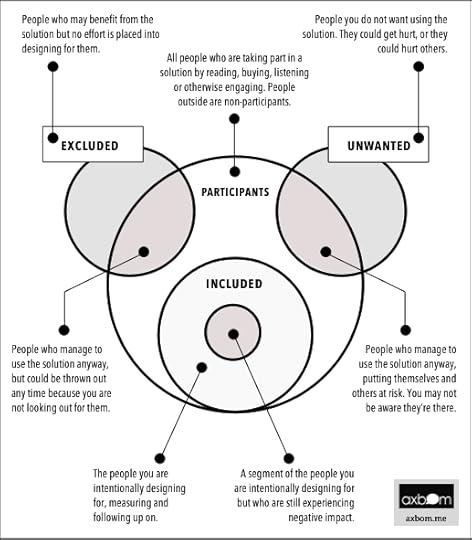
During my workshop on Managing Misusability I use the Inclusive Panda map as an aid for understanding and mapping out all the people we are not consciously designing for but who may still be impacted by your solution.
As I release my templates into the wild I also want to make it clear that they are part of a book I am currently writing on designing with a conscience. More details on using the worksheets will obviously be provided in the book, but I am also keen to allow widespread use — hence this brief introduction to the Inclusive Panda.
 Link to worksheet (PDF)
This panda story begins with the head. The large circle encompasses everyone who uses your solution. I call these people PARTICIPANTS, and this dovetails nicely with a word for the people who are not using your solution: non-participants. I intentionally avoid the word “users” as this brings to mind people who are making use of the solution in the way you intended, which is not always the case.
Inside this circle is a smaller circle which appears as the snout of the panda. This circle is labelled INCLUDED and refers to people you are intentionally designing for. These are people who match your personas and your target groups. You know who they are and it’s people from here that you invite to your usability testing sessions.
Moving on to the left ear. (Yes, I know, this is technically the panda’s right ear but I am describing it from the observer’s viewpoint.) It’s important to notice that the ear is also a circle and that it overlaps with the head circle, thus consisting of both non-participants and participants. The left ear’s label is EXCLUDED and alludes to the fact that there will be people who are knowingly excluded from the solution, although they could have benefited from it. The easiest way to think of this is through the idea of accessibility, where the solution you designed perhaps can not be used by people with certain types of disabilities.
Although they may be considered EXCLUDED, some people will find ways of using your solution anyway. In the beginning of the Facebook era there were applications built by enthusiasts to make it easier for users of screen readers to access the content on Facebook. Eventually Facebook closed down the API that made this possible. Thus there were excluded participants who found a way to take part, but then were thrown out again — becoming non-participants — as they were not a designated target group and designers missed taking them into account or just did not care enough.
The right ear mirrors the left one but carries the label UNWANTED. In this circle we find people who we consciously would not like to use our solution. There are two possible reasons for this:
They could come in harm’s way by using the solution (e.g. children or anyone who would merely waste time or simply not benefit from the solution).They could harm others by taking part (e.g. troublemakers, haters and other lost souls whose shortcomings lead to the spewing of animosity unto others)
While some may argue that “harm” is a strong word for wasting time allow me to confirm that yes, I would regard it as damaging when people lose valuable time on something that lacks potential for solving their problem.
The purpose of the right ear is to force you to think about the necessity of consciously designing to keep certain people out at the same time as you are designing for others to stay within. Failing to do so may bring those people in as participants who use up your resources in vain, become upset or drive out existing participants.
Which brings us to the nose. The nose of the panda is a smaller circle within the snout. It is there to remind us that despite our best intentions in designing for our target groups there will still be a group of people who actually did not benefit and feel worse off after participating. Now this could be because you indavertently allowed unwanted people to become participants — ruining the experience for others — or because you failed to anticipate how they would participate or how data about them could be misused in ways you have not yet imagined.
The nose circle acknowledges you that you can not anticipate every possible impact of your solution, which is why you always need to be listening, looking out for and measuring impact in a structured manner. You need to ensure that when people do get hurt, it’s something that can quickly be brought to your attention to be dealt with as soon as possible.
Why a panda?
According to legend, the panda was once a plain, snow-white bear. One day a panda cub was being attacked by a leopard and a young girl came to its rescue but lost her own life in the struggle. The pandas organized a funeral for the girl and everyone came wearing armbands of black ashes. When they wiped their tear-filled eyes, hugged each other and covered their ears in woe, the black ashes smudged onto their bodies, making the pandas black and white the way we have come to know them today.
I have always been intrigued by the panda and when the model for inclusion I was sketching began to resemble a bear face I found my eyes tearing up, as I realized I had subconsciously managed to incorporate this symbol of peace into the message I want to convey.
There are still more reasons to love pandas:
They move very slowly — reminding us to consider our decisions thoughtfully, wait patiently and enjoy the moment we are in.The panda naturally brings emotions of caring and compassion. Being rare and endangered it reminds us of the importance of caring for and protecting those who are vulnerable.While a symbol of peace, in China the panda also has the reputation of being fierce as a tiger — reminding us that not everything is as it seems. A panda can easily bite through a thick bamboo stalk. Humans will have trouble cutting the same stalk with an ax.Some Chinese philosophers believe that the panda’s black and white coloring reflects the harmony embodied in the yin and yang symbol.
You may not be surprised to see then, that I often wear a panda t-shirt when I talk about ethics and design. Be like the panda: be comfortable with yourself, show care and compassion for others, make considered decisions and be strong when you must.