Dan Leo's Blog, page 8
May 9, 2024
"The Island of Lost Poets"
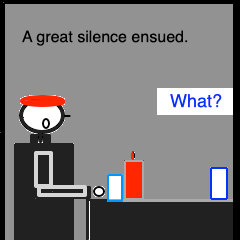
"You okay?" said Stoney.
"Yes, I think so," said Milford.
"You're not going to fall over?"
"I hope not."
It was so strange, talking to one's alter ego like this, but the strange had now become normal for Milford. He took a deep breath.
"You ready?" asked Stoney.
"Yes," said Milford.
"Don't forget your cigarettes. And your lighter."
"Oh, right, thanks."
Milford picked up the pack of Husky Boys and his lighter from the bar top, put them in his peacoat pocket.
"Good," said Stoney. "Now let's go."
Milford glanced over at the dance floor. Mr. Whitman and Miss Alcott were still dancing, vigorously.
"Don't worry about them," said his alter ego. "They're having a good time."
Milford wished he could have a good time.
"Well, keep wishing," said Stoney. "Maybe it'll happen someday."
"You heard what I thought," said Milford.
"Of course I heard it. I am you, remember?"
"Oh, yes," said Milford.
"The better part of you."
"Yes, I can see that."
"Unfortunately not the dominant part."
"Yes, I am aware of that also."
"Why are you still standing here?"
"No reason. Or, rather, a host of reasons, too many to go into in less than four hundred pages of densely printed text."
"That was funny," said Stoney. "Now move it."
"I still feel bad about just leaving like this, without a word to Miss Alcott."
"Oh, my God. Look," said Stoney. "wait here. I'll go over and speak to her."
"You will?"
"No problem. Stay right here, don't talk to anybody, and I'll be back in one minute, maybe two."
Stoney ambled confidently over to the dance floor, as the singer of the minstrel band sang.
I'm gonna jump up on that railroad train
gonna sleep in that freight car again
gonna go to Californy and jump in the ocean
gonna drown my troubles and my pain…
"Hello there," said a man with great bushy sideburns who was sitting to the right of the stool Milford had just gotten up from.
"Oh, hi," said Milford.
"My name's Longfellow. Henry Wadsworth Longfellow? Maybe you've heard of me."
"Uh, yeah, sure," said Milford.
"You don't seem so sure."
"No, I'm sure."
"Then who am I?"
"A famous poet?"
"Correct. Can you name one of my poems?"
"Uh, 'The Midnight Ride of Paul Revere'?"
"Close. The actual title was simply 'Paul Revere's Ride'."
"Sorry."
"I saw you talking with Whitman and Alcott."
"Yes."
"May I know your name?"
"Only if you won't make fun of it."
"I promise not to."
"Marion Milford."
"Marion?"
"Yes. You can blame my mother for that."
"You poor lad. I'm guessing you're a poet too."
"Yes, but I'm a bad one."
"Admirable modesty. May I buy you a libation?"
"No thanks, I was just going."
"A pity. We see so very few living poets in here. May I give you some advice?"
"Sure."
"Enjoy your life while you're alive. It doesn't last."
"Thank you."
"No, thank you for knowing who I am, and for knowing at least the title, sort of, of one of my poems."
"You're welcome."
"Makes me think that my time in the land of the living was not entirely misspent. May I shake your hand, young sir?"
The sideburned man offered his hand and Milford took it. The hand was dry and seemed almost insubstantial, like papier mâché. Milford shook it gently, so as not to crush it, and the man looked at him with eyes like distant clouds at sunset. He turned away and picked up his drink, which seemed to be red wine of some sort.
Stoney was back.
"I told you not to talk to anybody," he said, in a stage whisper.
"I'm sorry," said Milford. "It couldn't be helped. He introduced himself to me."
"Whatever. Look, I spoke with Miss Alcott, explained to her that you were very tired, and extremely high, and a little drunk, and that you really thought it best that you leave."
"What did she say?"
"She said she understood."
"What did Walt Whitman say?"
"He said that when he was a young lad in Brooklyn he would drink and dance until the taverns closed and then go out and take a good long swim in the river. He said you were a lightweight, and he was disappointed in you."
"And then what?"
"Then they resumed dancing."
"Oh."
"Listen, Milford. You have to learn, people are not staying up all night worrying about you and your little problems."
"Oh."
"They have their own worries, okay? Their own concerns."
"Yes, I guess you're right."
"They're not thinking about you."
"Right."
"They don't care."
"I get it."
"They don't give a shit."
Milford said nothing. He got it.
"Okay," said Stoney, "now let's go."
And finally Milford cast his corporeal host away from the bar, in the direction of the exit.
He made it to the door without further incident, he opened the door and went out into the corridor, the door closed behind him. He could still hear the music, the singing, and the muffled babbling of voices.
He realized he was alone again. Stoney had gone back to wherever he came from.
He started walking along the dim corridor. He had no idea how to get out of this place, but he figured as long as he kept going he must reach the street again, eventually.
He stopped.
He wondered if Stoney had really spoken to Miss Alcott and Mr. Whitman. If Stoney were actually he, and he, Milford, had remained at the bar, talking to Henry Wadsworth Longfellow, how could Stoney, if he was really he, Milford, simultaneously be talking to Mr. Whitman and Miss Alcott? Could he have been in two places at once? Or was Stoney merely a figment of his unconscious mind? Or was he a figment of Stoney's mind? Milford had no answers to these questions.
He resumed walking down the dim corridor, and after a minute the corridor came to an intersection, crossing another corridor going to the right and left, while the corridor he had been walking along continued straight ahead into shadows.
Milford stopped again, pricking up his small, shell-like ears under his newsboy's cap. Faint sounds emanated from the corridor running to the left. He hesitated for a moment, and then went that way. After two minutes the corridor came to an end, crossed by another corridor going to the right and to the left. The sounds, less faint now, came from the left, and so he went that way, even though the corridor seemed to lead into darkness. He walked into the darkness, and he no longer knew where he was going, or why, but the sounds grew louder, and after a minute he saw a dim light up ahead. He continued to walk and the light grew less dim, until he came to a door with a bare lightbulb stuck in the wall above it. From behind the door came the sound of a gentle song, and on the door was a hand-painted sign.
The Island of Lost Poets
Fine Food and Drinks
We Never Close
Welcome
Milford knew he probably shouldn't, But, he thought, that's why I should.
He turned the doorknob, the door opened, he went inside, and the door closed behind him.
It was another dimly-lit barroom, much like all the other barrooms that Milford had known in his young life. Tables and booths, and to the right a long counter with stools. A song played, apparently from a jukebox. The place was filled with people. These must be the lost poets.
Milford was lost, he was a poet, albeit a bad poet. He should fit right in here. He went over to the bar.
{Please go here to read the unexpurgated "adult comix" version in A Flophouse Is Not a Home, profusely illustrated by the illustrious Rhoda Penmarq…}


May 2, 2024
"The Bold Romancer"

Keeping his huge hand on Milford's small shoulder, Mr. Whitman signaled to the bartender with a finger of his other hand, which was also huge.
"Hey, Bret!" he shouted, boomed, declaimed. "When you get time."
"Yeah, I see you, Walt," called the bartender, who was shaking a cocktail in a shaker.
"When you get time," repeated Walt.
"When I get time," yelled the bartender.
Mr. Whitman leaned down and whispered in a voice like a hot scotch-redolent sirocco in Milford's ear.
"Bret's had a bee in his bonnet about me ever since I told him I thought his western tales had an undeniable homoerotic flavor to them."
Milford didn't care, but he didn't say so.
Instead he said, if one can be said to say the sound he made, "Um."
"This is the problem with writers," said Walt, no longer pretending to whisper, "they're so fucking sensitive. Oh, sorry, Miss Lou."
"What?" said Miss Alcott, who had been turned again toward the minstrel band and the dancers.
"Just said I'm sorry," said Mr. Whitman.
"For what?"
"I said a bad word in your presence."
"There are no bad words."
"Not even the F-word?"
"Not even that word," said Miss Alcott.
"Interesting," said Mr. Whitman. He finally took his heavy hand off of Milford's shoulder, and Milford felt that side of his torso rising up to the level of the other side, as if a great weight had been lifted from it. Which, he thought, is what had happened. "Now, tell me, dear Lou," said Mr. Whitman, "what are your thoughts on the C-word?"
Miss Alcott had turned toward the music and dancing again, and now she swiveled back around on her stool to look at Mr. Whitman, who was bringing his pipe out of the pocket of his workman's brown chore coat.
"What did you say?" she said.
"I asked you about the C-word," said Mr. Whitman.
"What about it?"
"Do you mind it being used in your company?"
From another pocket he took out a thick leather pouch.
"Are you deliberately trying to get on my last nerve, Walt?"
"Why, no," said Walt. He opened the pouch with thumb and finger and pinched out a big lump of something that looked like pigeon dung and stuffed it into the bowl of his pipe. "Just curious as to whether there are limits to what words you deem acceptable in mixed company."
"I deem no words unacceptable, be they in mixed or unmixed company."
"So you're giving me a free hand here."
"I'll give you a free back of my hand in about one second," she said.
Before a fight could break out, Bret the bartender was there.
"What do you want, Walt?"
"Ah, my good friend Bret!" boomed Mr. Whitman. He had put his leather pouch away and taken out a box of Blue Tip kitchen matches. "First off, and on my tab, another round of whatever my two friends here are drinking. What've you got there, Murphy, a grog?"
"My name's Milford," said Milford, "and I'm drinking a sarsaparilla."
"Sarsaparilla."
"Yes," said Milford. "And before you say anything, I'm pretty sure I told you before, I am an alcoholic, and so I don't drink alcohol."
"But I've seen you drink alcohol. I just saw you drink a grog back in the front bar."
"That was a mistake. I was confused, because of those mushrooms I ate, and the marijuana I smoked, not to mention that stuff in your pipe that you made me smoke."
"That "stuff' as you call it is, as I believe I told you, a blend of most excellent Kentucky burley and the finest Lebanese hashish, and it doesn't come cheap, and also I don't remember twisting your arm and forcing you to smoke it."
"I only smoked it because I was afraid you would beat me up if I didn't."
"I was only trying to be friendly."
"I'm sure you were," said Milford, although he was sure of no such thing, "but, nevertheless, um –"
"Yes?" said Walt.
"I've lost my train of thought."
"Happens to me all the time."
"Walt," said the bartender, "I'm busy. What do you want to drink."
"Oh, sorry, Bret," said Mr. Whitman. He lighted up his pipe with a kitchen match. The bartender looked annoyed, but he waited for Mr. Whitman to finish puffing. He exhaled an enormous cloud of thick musky smoke, and then said. "A nice hot grog for me. And whatever 'lady drink' Miss Lou is drinking, and another grog for my young friend Malone here."
"He was drinking sarsaparilla," said Bret.
"Give him a grog," said Mr. Whitman.
"I don't want a grog," said Milford. "Also my name is not Malone."
"Two grogs, and a lady drink for Miss Lou," said Mr. Whitman.
"Coming right up," said Bret.
Mr. Whitman turned again to Milford.
"You don't happen to have any more of those mushrooms on you, do you? The sacred mushrooms of the noble red man?"
"No."
"I wish I had some of those."
"Well, I'm sorry, I don't have any."
"Are you still feeling them?"
"I think they're wearing off, I hope they are, anyway."
"Here, take a toke of this."
He offered the pipe to Milford.
"No thanks," said Milford. "As you can see I'm smoking a cigarette."
Mr. Whitman cast a cold eye on the pack of Husky Boys on the bar, and touched it with a finger.
"Those things will kill you, son."
"Sooner rather than later, I hope," said Milford.
"Spoken like a true poète maudit! But here's the thing about this stuff," said Mr. Whitman, raising up his pipe in an admiring sort of way. "It induces the dreams from which we extract poetry. A few bowls of this mixture, and I can knock out twenty pages of immortal verse as easy as falling off a log. Come on, take a hit, it's not going to kill you."
"If I 'take a hit', will you stop pestering me?"
"I promise."
"Good, give me that pipe."
Milford took the pipe and drew deep. What did it matter? At least it wasn't alcohol, and he had to admit, there was something soothing about the smoke, something that seemed to flush away his worries, his fears, his awareness even of his own self. Mr. Whitman, smiling somewhere within his thick brindled beard, took out his box of kitchen matches again, struck one and held the flame to the bowl of the pipe as Milford continued to draw and puff.
"There you go, my lad," said the big man, who now seemed even bigger, "suck deep, my friend, deep within your lungs, but try to hold it in longer before exhaling, as long as you can."
Milford did as he was enjoined to do.
The music played, the dancers danced.
At last Milford drew upon the pipe but nothing but stale air came through the mouthpiece.
"It's kicked," said Mr. Whitman, and he took the pipe. "How do you feel?"
"Um," said Milford, because that was all he was able to say.
"Take a drink of that grog now," said Milford.
There was a metal tankard sitting there, steam floating up from the liquid in it. Milford took up the tankard and drank.
Suddenly he heard a familiar voice.
"Now don't you feel better?" said Stoney, Milford's alter ego, from not so deep inside Milford's brain.
The singer of the minstrel band was singing another song now.
Through this old world I been a-rambling
from east to west from north to south
drinking and whoring and gambling
and these are the words that escape my mouth.
Don't you drink that rotgut whiskey
or that gin that's brewed in a tub,
just float down the mighty Mississippi,
giving your manhood a gentle rub
"Oh, I love this song!" cried Miss Alcott, swiveling about on her stool again. She tugged on Milford's arm, just as he was about to raise his tankard for a second gulp. "Milford, you must dance with me!"
"Uh," he said.
"Come on, daddy-o!" cried Miss Alcott. "Are you going to live your whole life sitting out the great barn dance of life?"
"Um, yes?" said Milford.
"Never fear," boomed Mr. Whitman. "I shall dance with you, Lou!"
He held out his arm, she took it, climbed down from her seat, and off the two of them went to the dance floor.
"Okay," said Stoney, who was now standing next to Milford. "You blew that one, big time."
"I'm sorry," said Milford. "But I just couldn't."
"Hey, ya know what?" said Stoney. "It doesn't matter."
He picked up the tankard that Mr. Whitman had left on the bar, raised it up, and took a good long drink. He put the tankard back down and said, "Ahhh. Not bad. Okay. Get up, pal. We're gonna get you out of here."
"Really?" said Milford.
"Unless you want to stay."
Milford looked out at the dance floor. Miss Alcott and Mr. Whitman were dancing vigorously, Miss Alcott twirling around the big man, their raised hands touching fingers to fingers.
They were having what appeared to be a good time.
"I know," said Stoney, "I know, you were hoping to lose your virginity with her, but let's face it, pal, I don't think that was going to happen. Not tonight, anyway. Come on."
"Should I finish this tankard of grog?"
"Well, that all depends. Do you want to feel like total warmed over dogshit all day tomorrow?"
"No," said Milford.
"Then let's go, now, while you're ahead."
"I'd hate for Miss Alcott to think I was being rude."
"She'll understand."
"You think so?"
"She's a trained novelist. Of course she'll understand. Now let's go."
Milford climbed off of his stool. He wavered, and swayed, and wobbled, but he did not fall.
The singer sang.
Oh I'm a bold and brave romancer
wandering round through hill and dale.
Folks say I'm just a chancer
as I walk through snow and rain and hail.
Yes, I am a bold romancer
and I will sing my song real loud.
I am also a hearty dancer
and I do the race of man right proud…
{Please go here to read the unexpurgated "adult comix" version in A Flophouse Is Not a Home, profusely illustrated by the illustrious Rhoda Penmarq…}
April 25, 2024
"I Wisht I Was a Drop of Rain"

Miss Alcott turned again to look in the direction of the minstrel band and the dancing people, Emily Dickinson, Harriet Beecher Stowe, Nathaniel Hawthorne, and others Milford didn't recognize, although unless he was very much mistaken, that was Frank Norris and the young Edith Wharton kicking their legs in unison.
Milford wished he could lose himself in the music, in the moment, but he had never been able to escape the prison of his personhood without the aid of alcohol, and he had not consumed nearly enough alcohol tonight to do so. He took another drink of his sarsaparilla. Should he say, "Damn the torpedoes," the torpedoes of discretion, and ask the bartender to add a large jolt of whiskey to his sarsaparilla? No, that way madness lay, no, maybe not madness, but quite possibly passing out in an alleyway in the snow and freezing to death, which might not be a bad thing, but nevertheless Milford was a coward, and even though he had never enjoyed life, he was afraid of dying.
He sighed, for the twelve-thousandth and twenty-second time since reluctantly assuming consciousness that morning which seemed like well over a year ago.
The singer of the band was now singing another song.
Oh I wisht I was a drop of rain
falling off the eave
I wisht I was the baby Jesus
on that very first Christmas eve…
Milford was sitting at his desk, looking through the window with its snow-crusted muntins out at the snowflakes falling on the snow-whitened old elm tree and onto MacDougal Street, also covered with snow, and on the snow-covered cars and people going by. On the desk blotter before him was the blank sheet of vellum foolscap, the same yellowed and foxed sheet that he had stared at every morning for the past fifty years, waiting for inspiration to come, for that first word to come.
Yes, he had once been young but now he was old. He was almost as old as his mother, who was still alive, as was their faithful maid Maria, who had as usual brought him the Drip-o-lator of hot strong coffee which sat on a stained ceramic trivet to his right.
For fifty long years he had sat at this desk, waiting.
He picked up his old Montblanc fountain pen, unscrewed the cap, and replaced the cap on the barrel of the pen.
Fifty years.
The Martians had landed, but after a few weeks they had returned to their home planet, bored.
The Russians had adopted capitalism, whereas the United States had become a social democracy, with free food, housing, and medical care for all.
A thriving colony had been established on the Moon, transporting precious minerals to the earth in enormous rocket ships the size of ocean liners.
War had been declared against the Martians, and fortunately the Federation of Earthling Nations had triumphed, with human casualties amounting to just shy of fifty million.
Atomic-powered flying cars were now all the rage, but many people still preferred cars that ran on wheels on the ground.
Disease had been eradicated, and people now only died from accidents, murder, and suicide.
It had been fifty years since Milford had taken a drink, but he still missed it sometimes.
Milford recapped his fountain pen, and lighted up a Husky Boy. It was true, cancer had been eradicated, but cigarettes had still lost none of their charm.
He smoked, and gazed through the window at the falling snow.
Suddenly he had an idea.
Well, not exactly an idea per se, but a faint glimmering of a possibility of an idea.
He picked up his pen again and uncapped it.
He took a deep breath, coughed, and, at long last, he put pen to paper…
"Marvin, my boy, there you are!"
A great hand clapped Milford on the shoulder.
He turned, yanked like a yo-yo from the future back to the present.
It was Walt Whitman.
"Oh, hello, Mister, uh, Whitman," he said.
"Walt, my lad, Walt! I thought we had long gotten past the use of Mister!"
"Hello, Walt," said Milford.
"I was wondering where you'd got to, what mischief you were getting up to, you young rapscallion you! Ah, but I see you are sitting with the lovely Miss Alcott. Hiya, Lou."
Miss Alcott had turned also and was looking at Mr. Whitman.
"Hi, Walt."
"And so you have met my young friend Morgan!"
"I thought his name was Milford," said Lou.
"Is that what you told her, Muggles?"
"Yes," said Milford. "You see, my name actually is Milford."
"Are you sure?" said Walt Whitman.
For a moment Milford said nothing, as the music played and the singer sang, and all around him people laughed and shouted.
"Yes," said Milford, at a point just seconds away from rudeness, "I'm pretty sure my name is Milford."
To be honest with himself, he wasn't completely sure, but he was pretty sure, unless this all was a dream, his whole life, and he was someone else.
The singer in the band was singing.
Oh I wisht I was a flake of snow,
falling from the sky
I wisht I was the baby Jesus
with a twinkle in his eye
"My boy," said Walt Whitman, squeezing Milford's narrow shoulder with his massive hand, "my beamish boy – now, my lad, now the fun begins!"
About time, too, thought Milford, but he didn't say that.
The singer was still singing.
Oh I wisht I was a shooting star
falling from the night
I wisht I was the baby Jesus
setting the whole world right
{Kindly go here to read the unexpurgated "adult comix" version in A Flophouse Is Not a Home, profusely illustrated by the illustrious Rhoda Penmarq…}
April 18, 2024
"Hot Cross Buns"

The bartender came over.
"Would you two lovebirds care for another round?"
"What?" said Miss Alcott, who had been gazing at the minstrel band, her head swaying with the music.
"Another round, Lou?"
"Oh, yes, Bret," she said, "another one of these delicious Amontillados for me and a fresh tankard of sarsaparilla for my friend Milford.
"You got it, babe," said Bret the bartender.
"And it's on my tab."
"No!" said Milford. "Please, Miss Alcott, let me –"
"Nonsense," said Miss Alcott. "You are my guest, and I won't hear of it."
The bartender took Miss Alcott's empty glass and Milford's tankard and went away, and Miss Alcott swiveled on her stool to face Milford.
"I wonder would you care to dance, good sir?"
"Um, uh –"
"Look at Emily and Harriet out there tripping the light fantastic."
On the small dance floor, among a group of other dancers dressed in old-fashioned clothes, Emily and Harriet were lifting their skirts and kicking their legs to the sprightly music. Dancing with them, or at any rate near them, was Nathaniel Hawthorne, seemingly impersonating an excited chicken.
"Um," said Milford.
"Doesn't it look like fun?" said Miss Alcott. "They're dancing the Black Bottom. Do you know that dance?"
"I don't think so."
"A most delightful Negro dance. I could show you how to do it."
"I don't think so."
"You don't think I can show you how? Oh, but I assure you I can, and will, and shall."
"Here ya go, Lou," said the bartender, laying down a pony glass of golden liquid in front of Miss Alcott, and a metal tankard in front of Milford.
"Thank you so much, Bret," said Lou. "And now, Milford, take a quick quaff of your sarsaparilla and let us cut a rug, sir!"
"Okay, Miss Alcott," said Milford, "two things. One, I don't dance."
"Nonsense. Everyone can dance. Everyone with legs, anyway."
"I would humbly disagree, but here's the other thing."
"Oh, yes, you said two things."
Miss Alcott had been smoking a cigarette, and now she stubbed it out in the cut-glass ashtray on the bar between them.
"This is very difficult for me to say," said Milford.
"Out with it, lad."
"I have become possessed of another erection."
Miss Alcott looked downward at Milford's inguinal area, over which he was holding the front tails of his peacoat.
"Are you sure?" she said.
"Yes, I am afraid so," said Milford. "I'm trying to hide it under my peacoat, as you see."
She lifted her glass and took a sip of the golden liquid.
"I had not known that I was so physically alluring," she said. "Either that or you are a most virile young man!"
"I think it's those mushrooms I ate," said Milford.
"Oh, yes, the mushrooms."
"They are affecting me in the strangest ways."
"So you don't think you'd be able to dance?"
"I'm not even sure I could stand upright."
"What you must do is try to think of something else."
"I'm trying, but it's difficult."
"Didn't you say that some little man in the Pointers room advised you to think of your mother, and that doing so deflated your tumescence?"
"Oh, right."
"So, think about her again. Think about your mother."
"I've lived my whole life trying not to think about my mother."
"But it's for a good cause. Look, tell me about this mysterious mother of yours. Tell me about the good Mrs. Milford."
"She is a harpy. Or should I say a harridan?"
"Those are harsh words, dear Milford."
"You don't know her. She has always treated me as if I were a complete disappointment to her."
"And have you been a complete disappointment to her?"
"Yes. But still."
"Still what?"
"No one likes to be despised by his own mother."
"But have you tried not to be a disappointment to her?"
"No."
"Why not?"
"Because I want to be myself."
"Which is what?"
"A fool," said Milford.
"And why do you want to be a fool?"
"I don't want to be a fool, but that's what I am."
"And yet you still want to be yourself."
"Yes. I realize it's a quandary. But, you see, someday I hope not to be a fool."
"A noble ambition."
"Oh."
"Oh what?"
"My erection. It has subsided."
"Oh, good. Does this mean we can dance now?"
"I'm afraid not. I may be a fool, Miss Alcott, but I choose not to be a dancing fool. However, if you wish to dance without me, please, do so."
"No, I think I would rather sit here and continue to plumb your depths."
"That shouldn't take very long," said Milford.
"Are you saying you have no depths to plumb?"
"I'm saying my depths are more like a puddle than an ocean. An inch deep at best."
"I have rarely met a man so self-deprecatory."
"I am only trying to be honest."
"Trying?"
"And probably failing."
Milford suddenly realized that he hadn't smoked a cigarette in a half hour or more, he whose one consistent pleasure in life was to smoke, and who spent most of his waking hours with a lighted cigarette either in his lips or in his fingers, so much so that when he had gone for his draft physical the Selective Service doctor had dismissed him after only the most cursory soundings of his narrow chest, awarding him the precious status of 4-F, and so who was to say that smoking was bad for your health? Was it worse for your health than getting shot at? Milford thought not!
At any rate he fished out his pack of Husky Boys and his lighter, and, if nothing else, having been raised a gentleman, he offered the pack to Miss Alcott.
"Husky Boys," she said. "Are they as good as Lucky Strikes?"
"You're asking the wrong person," he said. "For me cigarettes started as an affectation but have become, more or less, my raison d'être. Taste and flavor are the least of my considerations, and I've never yet had a cigarette I didn't like."
"And are Husky Boys your cigarette of choice?"
"No, I usually smoke this English brand called Woodbines, because I saw Dylan Thomas smoking them at a poetry reading and I wanted to be like him, but then this evening the poet Wallace Stevens pointed out to me that I was being pretentious, and told me to smoke American cigarettes. And so tonight I chose Husky Boys at random from the cigarette machine."
"You lead a very interesting life, don't you?"
"Only if you're interested in case studies of terminal neurosis."
"Ha ha. Very well, I shall try one of your Husky Boys!"
She took a cigarette in her delicate fingers, and like a gentleman Milford lighted her cigarette and then his own.
The minstrel band was playing the opening bars of a new number now, "Camptown Races", or was it "Polly Wolly Doodle" or something else?
"You have still not told me of your hopes and your dreams," said Miss Alcott.
"I hope to be a great poet," said Milford. "And this is also my dream. However, one great and seemingly insurmountable obstacle stands in my way."
"And pray what is that, dear boy?" asked Miss Alcott.
"A complete and utter lack of talent," said Milford.
"Oh, my dear, dear boy," said Miss Alcott. "My dearest idealistic but, oh, so naïve boy. Look around you." She waved her cigarette at the people at the tables, on the dance floor, and sitting at the bar. "Look at Mr. Longfellow there, at Mistress Bradstreet, at Mr. Poe, at Mr. Whittier and the two young Messrs. Crane! Where would any of them be if they let a minor detail like a lack of talent stand in their way?"
Milford almost failed to hear what the lady was saying, so absorbed was he in enjoying his first cigarette in what seemed like a lifetime, but then the import of her words stormed the gates of the embattled fortress of his brain.
He coughed before speaking, his usual smoker's cough, nothing to be alarmed about, at least not yet.
"Do you mean to say," he said, "that there is hope for me still?"
"Yes," said Miss Alcott. "The unwritten great poems are out there, in the ether if you will, waiting only to be born into this world. You must only allow yourself to receive them."
"But," said Milford.
"Yes?"
"How do I allow myself to receive these poems?"
"You sit down with a pen, and paper, you let your mind go blank, or, failing that, let it wander hither and fro, and you wait."
"That's all?"
"That is all."
"And how long must I wait?"
"Perhaps a lifetime."
"So there's no guarantee."
"Of course not. It's sheerly a matter of luck."
Milford took another drag of his Husky Boy.
Tomorrow he would ask Maria the maid to make him an especially strong pot of coffee and bring it to his room. He would fill his fountain pen and put a blank sheet of foolscap on the blotter of his small desk in front of the leaded window looking out onto Bleecker Street.
He would wait.
He would hope to get lucky.
The singer of the band was singing now.
If you have no daughters,
give them to your sons.
one a penny, two a penny,
hot cross buns!
{Please go here to read the unexpurgated "adult comix" version in A Flophouse Is Not a Home, profusely illustrated by the illustrious Rhoda Penmarq…}
April 11, 2024
"Jimmy Crack Corn"

"I must say you intrigue me, Milford," said Miss Alcott. "Please do tell me of your hopes, and dreams."
"I will, if you insist," said Milford, "but here's the thing."
"Yes, darling boy, what is 'the thing'?"
"I don't quite know how to say this."
What he didn't know how to say was that her gentle hand on his thigh was causing what the popular authors called "his manhood" to grow, once again, and that if it continued to grow he might find it difficult to speak at all with any semblance of intelligence.
"Just blurt it out, lad," said Miss Alcott. "No one ever got anywhere by beating about the bush."
Ha ha, she said "bush", said that now-familiar voice in his head.
"I told you to go away!" blurted Milford.
"Excuse me?" said Miss Alcott.
"I didn't mean you, Miss Alcott," said Milford.
"Oh, I get it, it's that voice in your head again, isn't it?"
"Yes, damn him. Pardon my language."
"You are pardoned. What did he say?"
Don't tell her, whatever you do, said Milford's alter ego, "Stoney".
"I would prefer not to," said Milford. "It was very crude, and childish."
"You do realize," said Miss Alcott, "that this 'voice' is a part of you."
"Yes, I suppose so."
"A part of you that has risen from the murky depths of your mind, conjured forth undoubtedly by the sacred mushrooms of the Indians which you have ingested."
"Yes, I guess you're right."
"So, try to ignore him."
"I'm trying, but he keeps piping in, or up."
"Would you mind if I spoke to him?"
"Um, I don't know –"
"What did you say his name was? Punchy?"
"Stoney, actually."
"Very well, I shall address him now. Hello, Stoney, can you hear me in there?"
"Should I allow him to speak?" said Milford.
"Yes, please do," said Miss Alcott. "Hello, Stoney, may I speak with you?"
"Sure thing," said Stoney, through Milford's lips. Unlike Milford's nasal and weak voice, Stoney's voice was crisp and strong. "What's up, Miss Alcott?"
"Please, do call me 'Lou', Stoney. It's what all my friends call me, and I should like it if we could be friends."
"'Lou' it is then, Lou."
"Good, now, I wonder, Stoney, and I hope you won't take this as a slight, but I wonder if you would be so kind as to slip into abeyance for a time, whilst Milford and I attempt to have a civilized conversation."
"Hey, look, Lou, I'm only trying to help the guy," said Stoney.
"And I believe that you believe that," said Miss Alcott, "but still it's rather hard for us to converse if you keep butting in."
"Oh. Okay. Wow."
"And so I ask you to step offstage as it were, so that Milford and I may have at least a semblance of a normal conversation."
"You'd be better off conversing with me, Miss Alcott. Because, just between you and me and the rest of the known and unknown universe, Milford don't exactly bring a whole lot to the party, if you know what I mean."
"I find him charming."
"Hey, try living in his brain for almost a quarter of a century, and then you'll see how charming he is."
"I will take my chances, dear sir."
"Do you know he masturbates nightly to turn-of-the-century French postcards he inherited from his besotted father?"
"How could I possibly know that?"
"Do you know he has no real friends?"
"Define 'real friends'."
"Do you know he writes laughably bad poetry."
"I think he did mention that."
"He's a drip."
"I'll be the judge of that."
"You should find yourself a real man."
"I like him, real man or not."
"He's going to disappoint you."
"Like any woman, nay, like any human being regardless of gender, I am used to disappointment, and I am willing to take my chances."
"Y'know, Miss Alcott," said Stoney, "I'm starting to like you."
"And I, in a sense, like you, Stoney."
"Aw, gee."
"And now would you do me the favor of leaving Milford and myself alone for a while?"
"Well –"
"Please, Stoney."
"How long is a while?"
"Would an hour – perhaps two – be asking too much?"
"Well, okay, I guess I could do that."
"It would be most appreciated, Stoney."
"For you I will, Lou," said Stoney. "Not so much for Milford, but for you. On account of I like you."
"All right, thank you, Stoney," said Miss Alcott.
"I'll run along then. But before I go, can I just say something to Milford?"
"By all means," said Miss Alcott.
"Okay," said Stoney. "Listen, Milford, I'm gonna make like a breeze and blow now, but, look, this Miss Alcott is really nice. Like I said, I like her. And I believe you do too, as much as you're capable of liking anybody. So, and, believe me, I know this is asking a lot, but just try not to blow it, all right? Oh, and one more thing."
"Yes?" said Milford, in his own voice.
"If you get her in the sack, and if you find yourself shall we say faltering, call me, and I'll help you out. Give you a little pep talk. Okay?"
"Please go away now," said Milford.
"Okay, I'm going," said Stoney. "Really nice talking to you, Miss Alcott."
"Lou," said Miss Alcott.
"Nice talking to you, Lou," said Stoney. "And, please, be gentle with this guy, and not too demanding. He's a virgin you know. So you might have to guide him along, show him the ropes."
"Thank you, Stoney. I will try to be considerate."
"Right, I'm going to turn the microphone over to Milford now. Nice chatting with you, Lou, and if I don't catch you round, I'll catch you square."
Miss Alcott paused for a moment, looking into Milford's eyes behind the thick lenses of his glasses.
"Is he gone now?" she asked.
"Yes," said Milford. "I think so. And I want to apologize for all that."
"No need to, dear boy."
"I'm so embarrassed."
"Think nothing of it. We are not responsible for the voices that inhabit our inner beings. Would you care for another sarsaparilla?"
Milford realized his glass was empty.
"Well, if we're staying, yes, I suppose so," said Milford.
"I think I would like another Amontillado, actually," said Miss Alcott. "And look, the band has started up!"
Across the room a small string band composed of men in blackface had started singing and playing a song.
'Jimmy crack corn, and I don't care…'
Sometime during the previous conversation, Miss Alcott had removed her hand from Milford's thigh, and his incipient erection had subsided, but now, as he gazed at her womanly form turned to look at the band, he felt the downward flowing of his blood once again.
Relax, pal, said Stoney, just let it happen. Nothing more natural in the world.
"Jimmy crack corn, and I don't care," sang the singer,
my master's gone away…"
{Kindly go here to read the unexpurgated "adult comix" version in A Flophouse Is Not a Home, profusely illustrated by the illustrious Rhoda Penmarq…}
April 4, 2024
"Roll Away the Stone"

"Yo! Idiot! Wake the fuck up!"
Smiling Jack awakened to that little fellow they called "Bowery Bert" slapping his cheeks.
"Oh, hello, Bert," said Jack.
"What the fuck are you doing, freezing yourself to death in the freezing snow leaned up against a light pole? What're you, a fucking moron?"
The shabby little man in the ancient cloth cap looked up at him through the thick swirling snow, the stub of a cigar smoking in his lips.
"I must have fallen asleep," said Smiling Jack.
"Bullshit," said Bowery Bert.
"Heh heh, no, really," said Jack. "I was just standing here, looking for lost souls to give my book to –" he glanced down at the little book in his right hand, his frozen right hand –"and I guess I just, uh, got sleepy, and –"
"Listen, jackass," said Bert, and he pointed his bare finger sticking out of his ragged canvas glove, "don't give me that malarkey. You deliberately stood out here in this blizzard in a concerted and conscious effort to top yourself."
"Um, uh –"
"Did you think for one little moment that, in the words of my good friend Will Shakespeare, alias the Bawdy Bard,'the Everlasting had not fix'd/His canon 'gainst self-slaughter'?"
"Did you say Shakespeare?"
"Yeah, you ever hear of him?"
"Well, of course I've heard of him, heh heh –"
"Author of Hamlet? You know that play?"
"Um, uh –"
"What about King Lear? Macbeth? Othello? Romeo and Juliet?"
"I've heard of Romeo and Juliet –"
"Oh, you've heard of it."
"Yes, I think so –"
"So what you're telling me in other words is you've never read a word of Shakespeare or seen a single performance of one of his immortal plays."
"Well, um, heh heh, you see, I'm more of a movie fan myself. You know, Laurel & Hardy, Wheeler & Woolsey, Joe E. Brown, I used to like W.C. Fields, but then when I got sober, I, uh –"
"In other words you're an idiot. And yet you want people to read your stupid book."
"Well, my book is meant to help people, Bert. To help them realize that they have a drinking problem, but that by accepting their powerlessness over alcohol –"
"Bollocks. It's books like yours that make people want to get drunk, and who can blame them? Gimme that."
Bert grabbed the little book out of Jack's snow-covered hand. He slapped the book to get the snow off of it, then opened it up.
"Right, now I'm just gonna read the first words I see at random. Okay, I quote:
…because there is indeed a Higher Power, my friend! Some call him God, or Jehovah, some call him the Buddha. But me, I call him the Big Guy. And this Big Guy wants to be your pal. So all's you got to do is get down on your knees, and fold your trembling sweaty hands together, and say, "Hey, Big Guy, Big Fella, help me out here, pal, 'cause I'm tired of waking up every morning like I been run over by a dump truck, with a taste in my mouth like a mouse crawled in there and died, tired of hating myself, tired of hating life, tired of everybody I know avoiding me like the Black Plague, sick and tired of being sick and tired every second of every rotten day and nightmarish night…"
"Jesus Christ, man," said Bowery Bert.
"I thought that passage was pretty good," said Smiling Jack.
"Oh my fucking God," said Bert.
"You didn't like it?"
"Here," said Bert. "Take it back."
"Oh, please keep it, friend," said Smiling Jack. "Perhaps someday you will find it helpful –"
"You implying I got a drinking problem?"
"Well, no –
"Then what the hell are you implying?"
"Well, I suppose I just assumed –"
"Assumed I was an alcy because I'm out on the Bowery at midnight in a raging blizzard, and because I ain't dressed in a Brooks Brothers tweed suit and camel's hair polo coat with a Bollman's fedora on my noggin?"
"Oh, no, heh heh –"
"On accounta my fingers stick outa my gloves, and because my old cap looks like it's a hunnert years old, which it is?"
"No, not at all –"
"Well, let me tell ya, pal, I may look like a Bowery bum but I ain't a Bowery bum."
"You ain't? I mean, you aren't?"
"No, I ain't. I am an angel."
"A what?"
"You heard me. I'm an angel."
"No kidding? Because it's a strange thing, but I always thought you had an unusual quality about you."
"Yeah, that's on accounta I'm an angel, more specifically, a guardian angel, but in the guise of a Bowery bum."
"So you're my guardian angel?"
"Well, that ain't the way it works, pal. You see, there's only so many of us guardian angels around – to be exact, twelve thousand nine hunnert and twenty-two of us. And between us we got to cover the whole goddam world. So what we do is we each get a district. Me, for my sins, which I won't go into right now, I got this neighborhood."
"So that's why they call you –"
"Bowery Bert. Yes. This whole slum around here is my territory, and let me tell ya, it ain't easy, pal."
"I can imagine."
"Worst district in the world, but I got stuck with it, so what're you gonna do? Nobody wants to hear a guardian angel complain. Oh, no. We get to hear everybody else's problems, but nobody wants to hear our problems."
"Well, Bert, if you ever need an ear to be lent –"
"This ain't about me. This is about you, my friend, deliberately freezing yourself to death."
"But I'm not dead."
"Oh, ain't you? Try to move."
Smiling Jack tried to raise his arm, the arm from which extended the hand that had held his book, but he was unable to budge it. And he realized with horror that he was indeed frozen stiff.
"I'm frozen," he said.
"So you finally got the newsflash."
"But how can I talk if I'm frozen?"
"You ain't talking. You're communicating what they call telepathically."
"Oh my God. You mean I'm really dead?"
"That's what you wanted, wasn't it?"
"Well, I, I suppose I did succumb to a kind of feeling of despair, but I didn't know I would really go through with it –"
"That's no excuse."
"So I'm going to hell?"
"What do you mean, going to?"
"You mean I am in hell?"
"I mean you been in hell your whole goddam life, except for maybe when you were a kid on your birthday or Christmas or Easter, chowing down on all them chocolate eggs and bunnies. But, lookit, every once in a while we guardian angels get to help somebody out. Not often, but sometimes, and only oncet in any human's lifetime. So, if you want, I can maybe give you a break. All's you got to do is choose life over death."
"Gee."
"What's your choice?"
"So I can choose either to be dead or be alive?"
"Like I said, your choice, but I ain't got all night, and you ain't got all night. About fifteen more seconds and it's gonna be too late, and it's off to the next world for ya."
"And what is the next world like?"
"That I am not at liberty to tell ya, pal. House rules. Ten seconds you got."
"Ten seconds?"
"Now it's nine. What's your choice? Life, or what my other good friend Søren Kierkegaard called 'the great unknown'?"
"Um, gee –"
"Four seconds."
"Four?"
"Now it's three."
"Um, uh –"
"Two seconds. One –"
"Okay! Yes, I choose life!"
"Solid, Ted, 'nuff said."
And suddenly and all at once Smiling Jack felt life coursing through his body and his sluggish blood flowing through his veins.
He was cold, and shivering, but alive.
"How's it feel, buddy?" said Bowery Bert.
"It feels, uh –"
"Better than bein' croaked?"
"Yes," said Smiling Jack.
"'Cause let me tell ya something. You got all of eternity to be dead, but only just this one lifetime to be alive."
"Yes, I, um –"
"What you should do, you want my advice, what you should do now is you should go over to Ma's Diner and warm up with a good cup of joe. Maybe get some corned beef hash and eggs. Maybe a couple of them hot cross buns Ma makes, with plenty of butter on them."
"Yes. I guess you're right. A nice hot cup of coffee does sound good –"
"And then after you eat I want you to light up a smoke and look out that plate glass winda there at the falling snow, and just kind of appreciate being warm and alive."
"Yes, I should do that."
"'Cause, remember, life is short, but death is forever."
"Thank you, yes, I'll remember that, Bert, thank you."
And then Bowery Bert was gone, and where he had stood was only the heavy falling blustering snow.
Jack noticed that Bert had kept the book, his book, the book in which he had collected all of his hard-earned wisdom. He hoped Bert wouldn't just throw it away.
Smiling Jack trudged through the falling snow and the snow that covered the ground a foot high across the street to Ma's Diner. After he had sat at the counter and placed his order with Ma, a mysterious moment of panic urged him to check his pockets, and he quickly realized that his wallet was empty of money, and his pockets were empty of coins. He had also somehow lost his cigarettes, and his Zippo lighter. He called Ma over to cancel his order, explaining that he was unexplainably broke, and had even somehow lost his cigarettes and lighter, but Ma took pity on him, and told him he could have his coffee and a meal on the cuff, and she also let him have a quarter for the cigarette machine.
Little did Smiling Jack know that Ma was also a guardian angel, just not officially so, and her place was assured in the hereafter, among all the other saints and angels for all eternity.
{Please go here to read the unexpurgated "adult comix" version in A Flophouse Is Not a Home, profusely illustrated by the illustrious Rhoda Penmarq…}
March 28, 2024
"Requiem for a Snowman"

Meanwhile, some dozen or so blocks easterly and at this very instant, Gerard "Gerry" Goldsmith (known to his friends as "the Brain") emerged from Bob's Bowery Bar into the heavy and blustering falling snow. The air was bitter and cold, and the fat flakes slapped wetly into his face, but Gerry felt no discomfort, having downed some dozen glasses of Bob's basement-brewed bock over the past few hours in the company of his fellow bibulous gentlemen of shabby leisure.
Gerry looked up, at the oceans of snow tumbling down from the sky between the buildings and the tracks of the elevated train line, the snow falling as if God himself were emptying out the clouds of the heavens upon the earth and transforming the surrounding slum into a quaint small town in a glass globe.
Fortunately for Gerry, he only had to walk down the block and around the corner to get home to Mr. and Mrs. Morgenstern's tenement apartment building and to his tiny "studio" on the sixth floor, a former storage room, but quite suitable for a philosopher like himself. As well, Gerry was convinced that the six flights of stairs he had to climb up and down several times a day added five or ten years to his lifespan, as how else would he ever take exercise, never having been one for healthful walks to anywhere farther than the nearest bar. And this was New York City, thank God, and there was always a bar at least a block away.
Gerry plodded through the foot-high snow down the Bowery sidewalk, being especially careful not to fall, as who knew if he would be able to get get up again should he fall, when, suddenly, he saw the oddest sight up ahead in the pale glow of a street lamp.
A snowman.
A snowman built up against the pole of the corner light.
How extraordinary!
Gerry forged closer, through the swirling thick snow.
And there stood the snowman, amazingly realistic, he even had a snow-covered hat on his round little head. The body was short and fat, and the funny thing was that the round face of the snowman seemed somehow to be smiling.
Drunkenly Gerry extended an ungloved finger and touched the snowman's cheek.
His finger went through an inch of snow and then touched something that did not feel like snow. It felt like frozen meat, like one of those big cuts of beef rump that Gerry's late mother kept packed in dry ice in the basement box for a tasty Sunday roast.
"Uh-oh," said Gerry, aloud, and quickly he began slapping at the head and shoulders and arms and torso of the snowman, and, yes, the snowman was none other than that fellow known as Smiling Jack, the reformed drunkard and zealot of sobriety, now frozen quite stiff.
Gerry would say this for poor Jack, he still had a smile on his rubicund face, even in death. Across his chest was the strap of the leather satchel he kept his tracts in, and in fact his frozen right hand, in its worn and ragged woolen glove, still held a copy of his famous self-written little book. Gerry pulled it loose and brushed it off, looked at the cover made of the cheapest paper stock, with the childish drawing of a drunk-looking man leaning against a lamp post and holding a bottle, and in large letters
ARE YOU A DRUNKARD?
BY
“SMILING JACK”
How many times had Smiling Jack forced one of these pathetic booklets into Gerry's hands? Ten times? A dozen? And what had Gerry done with them? Used them for toilet paper, or to roll cigarettes with. He had tried to read a page now and then, but the prose was just too unbearably bad, no matter how noble the sentiments so clumsily expressed. Nonetheless you had to give Smiling Jack some credit, always earnestly and amiably trying to spread the good word despite his complete lack of literary talent. But still, you would think that even a moron like Smiling Jack would have known better than to stand out here in a blizzard trying to hand out alcoholism pamphlets until he froze to death. At least he could have taken a break now and then and just popped across Bleecker street to Ma's Diner for a cup of coffee or hot cocoa. Didn't he have the nickel for a cup of joe or cocoa?
Curiously, almost as if he were a citizen policeman, Gerry went through Smiling Jack's pockets. He found not only a pack of Lucky Strikes, minus only two cigarettes, and a working Zippo lighter, but also seventy cents in loose change, and a wallet with nine dollars in it. So Jack had had the means to go into Ma's Diner, but he had not the desire or the common sense to do so. How very odd. Was it suicide? Was it an act of penance gone accidentally too far? No one would ever know. And who would care?
Gerry felt that he should care, and he did, in his way, and he imagined (or perhaps he actually heard) Smiling Jack's genial voice saying, "Hey, help yourself, pal, what was mine is now yours," and so, after only a moment's hesitation, Gerry put the seventy cents in coin in the pocket of his old tweed trousers, then took the nine dollars out of the wallet, and put the wallet back in Jack's pocket. He then extricated one of Jack's Lucky Strikes and rolled it between his palms to take the frost off of it, then he put it in his lips and, after a few tries, successfully lighted it up with Jack's Zippo.
An automobile came trundling slowly down the Bowery through the thick falling snow, and it passed and continued on its way.
"Well, here's to you, Smiling Jack," said Gerry, silently. "I'll say this for you, you went out just the way you came in, with a smile on your face and your pamphlet in your hand, a pamphlet filled with the hard-earned wisdom of your soul, and offered to the tosspots of the Bowery one and all, for free, gratis, and for nothing. God love you, Jack, if there is a God, and surely if there is a God, he must love such a man as you. I thank you for the cigarettes, and for the Zippo, and for the nine dollars and seventy cents in U.S. currency. Sleep well, Smiling Jack, and may you keep smiling through all eternity."
Gerry shoved the little book back into Jack's frozen hand, and he pressed the fingers tight over it.
"Ta for now, Smiling Jack," said Gerry, aloud. "I'll see you soon enough, my friend."
Gerry turned back, back toward Bob's Bowery Bar. His friends would all still be there, the noble poets.
Hector Phillips Stone, the doomed romantic poet.
Seamas McSeamas, the Irish poet.
Howard Paul Studebaker, the western Poet.
Frank X Fagen, the nature poet.
Scaramanga, the leftist poet.
And last but far from least, Lucius Pierrepont St. Clair III, the Negro poet.
They would all still be there, as they were every night, at their poets' table. Gerry himself made no claims to being a poet, unless you could call the short philosophical observations he wrote poetry. For well over twenty years he had been writing ("working on") the first volume of these thoughts, currently called Pensées for a Rainy Day. But perhaps he should change the title to Snowflakes Upon a Windowpane? Or, maybe, Lucubrations of a Loon? No matter, he would decide later, when the book was finally ready to be released to an unsuspecting world.
Gerry pushed open the door to Bob's. Here they all were, the doomed and the damned and the lost and the forgotten, in this foggy thick warmth rich with the odors of tobacco smoke, of whiskey, gin, and beer, of unwashed bodies and unlaundered woolens, and there to the left was the round table where the poets sat, declaiming and laughing and shouting as the jukebox played a happy song.
Gerry pulled up a chair and rejoined his comrades in drunkenness and blather.
This time the round would be on Smiling Jack, and the next one too, and the shout after that one as well, until the last of that nine dollars and seventy cents was drunk up, saving of course a nice little tip for Janet the waitress.
Gerry had had the express intention of using the pay telephone to ring up the police to tell them of the frozen dead body at the corner of Bleecker and the Bowery, but, with one thing and another, with the laughter and the badinage, the shouting and the singing and the drinking, alas, he forgot.
{Please go here to read the unbowdlerized "adult comix" version in A Flophouse Is Not a Home, profusely illustrated by the illustrious rhoda penmarq…}
March 21, 2024
"All He Had"

That thing happened that so often happened when Milford was in the company of more than one other person, that thing which happened only slightly less often when he was with one other person, in other words the words of the other person or persons became only a distant unintelligible murmuring like the sound of the ocean when you're three blocks from the beach while his tender brain followed its own winding path to nowhere.
The three women were talking, their lips were moving, but what were they saying? Who knew? Who cared?
Look, said the voice in his brain, the voice of his alter ego, "Stoney", sure, these are famous women, brilliant women, especially Emily Dickinson, even if her poetry never did appeal to you, and, let's face it, you've never even read a word that Louisa May Alcott or Harriet Beecher Stowe wrote –
"I saw the movie of Little Women," said Milford to the voice, "the one with Katharine Hepburn, although I didn't see that more recent one –"
The one with June Allyson, said Stoney.
"Yeah, I didn't see that one. Was it any good?"
How should I know? said Stoney. I'm you, remember? Which means I didn't see it either.
"Oh, right," said Milford.
But, as I was saying, said Stoney, sure, these are famous and accomplished women, but, look, they're still women, and, let's face it, when they're with other women they're going to talk about "women" stuff, so why pay attention?
"Your point is well taken," said Milford, "but let's not forget that I find 'man talk' just as boring as 'women's talk', if not infinitely more so."
And now to you I must say, "Point taken," said Stoney. Let's face it, people are boring no matter what their gender.
"As am I," said Milford. "Let's be fair."
That goes without saying, my friend, said Stoney. After all, are you not a member of that benighted tribe we call "people"?
"Yes, nominally," said Milford.
So, relax, said Stoney. Accept the situation for what it is. They'll stop talking eventually, and then, and then –
"Then what?" said Milford.
Then, maybe, the other two will go away, and you and Miss Alcott will be alone again, and then, after some more more-or-less meaningless chitchat, perhaps – "perhaps" I say! – she will take you someplace –
"Where?" asked Milford.
How should I know where? said Stoney. But someplace. She must live somewhere, right?
"So one would think. But then she is, what did she say, one of the 'immortals'. Do immortals have places where they live? Maybe she lives here, in this bar?"
That would be really weird, said Stoney.
"Any more weird than what is already transpiring, than what has been transpiring these past several hours? Or, come to think of it, any more weird than what has transpired every second of my life ever since I was yanked, unwilling and screaming, from my mother's womb?"
Okay, I catch your drift, but let's assume – just for the sake of trying to avoid total despair – let us assume that Miss Alcott does have somewhere that she lives, and then, let us hope if not assume that if you play your cards right – "if" I say – it is within the realm of possibility that she might – "might" I say – take you to this place, and then, at long last, you might finally know what it is to make love with a woman.
"I only hope I am able to perform."
Well, I hope so too. But, hey, remember that terrific erection you had not so long ago?
"Oh, right," said Milford, "how could I ever forget? I felt as if my entire body had become an erect penis!"
Well, that was the mushrooms, but, look, the thing was, you did have an erection, and quite an impressive one, so what you want to do is to get alone with Miss Alcott, hope the erection returns, and then, you know –
"Okay, no need to spell it out. I have seen pornographic French postcards, you know."
Of course I know. So just do what they do in those postcards. How difficult can that be?
"In theory, not too difficult. But, remember, we're talking about me here. I'm the guy who has difficulty getting out of bed on my best days."
Getting out of bed is overrated. You've done some of your best thinking lying in bed.
"This is true, but you can't just lie in bed all your life."
Says who?
"Um," said Milford, and he wondered whose side his alter ego was on.
I heard that, said Stoney, and I assure you I am on your side. Remember, I am you. Or at least a far less drippy version of you.
"Okay," said Milford. "I meant no offense."
But, look, said Stoney, we're getting off the subject. What you have to do is to keep your eye on the goal. Which is to lose your virginity.
"But is it even worth it?"
There's no way of knowing that, my friend.
"Yes, I suppose you're right."
I know I'm right, said Stoney. Now listen, Miss Dickinson and Mrs. Stowe look like they're getting ready to take off finally, so try to pay attention.
"All right, I'll try," said Milford.
"It was so nice to meet you," said Emily Dickinson to Milford, and she offered her hand.
"Oh, you too, Miss, uh –"
"Emily, please."
"You too, Emily," said Milford, shaking her hand, or her fingers, since she had presented them in that horizontal way old-fashioned women did.
"Be nice to Lou," said Harriet Beecher Stowe, also offering her ladylike hand.
"I'll try," said Milford, dropping Emily's hand and taking Harriet's.
"Ta for now," said Harriet, "we're going to grab a table near the bandstand."
"Do please join us if you wish," said Emily. "There is a crackerjack ensemble performing here tonight!"
"Well, maybe," said Milford.
"Do you favor minstrel music, Mr. Milford?"
"I don't know if I've ever heard it," said Milford.
"It's Negro music, but played by white fellows wearing charcoal on their faces."
"Oh, well, uh –"
"Have a good time, Emily," said Lou. "You too, Harriet."
"Please join us, Lou," said Emily. "We can dance the Black Bottom!"
"All right, Miss Emily," said Harriet, "learn to take a hint. Come on." And she took Emily's arm.
"What do you mean, 'take a hint'?" said Miss Emily.
"I'll explain in due course," said Harriet. "Now let's go grab that table before the band comes on."
And off they went, Harriet pulling Emily by the arm.
"You were very patient," said Miss Alcott to Milford.
"I was?"
"Listening so politely to their chatter. It was very gentlemanly of you."
Don't tell her you weren't listening to a word they said, said Stoney.
"I didn't mind," said Milford.
Miss Alcott put her hand, again, on his thigh.
Okay, here we go, said Stoney.
"You can go away now," said Milford, and he felt a stirring down below.
"Pardon me?" said Miss Alcott.
"Oh, I'm sorry," said Milford, "I wasn't talking to you."
"Were you talking to the voice in your head?"
"Yes."
"And so you have dismissed him?"
"I hope so," said Milford.
I'm still here, said the voice in Milford's head, but he chose to ignore it, or at least to try to ignore it, at least for the time being, as Miss Alcott's delicate but strong fingers caressed his thigh, and he felt his sluggish blood flowing down to what served as the physical representation of his manhood, such as it was, which might not be much, but it was all he had.
{Kindly go here to read the "adult comix" version in A Flophouse Is Not a Home, profusely illustrated by the illustrious rhoda penmarq…}
March 14, 2024
"Let's Get Drunk"

Miss Alcott stubbed out her cigarette in the glass ashtray that was on the bar in front of her, next to her pack of Lucky Strikes and a blank book of matches.
"Would you like another Amontillado?" she said.
"No, I shouldn't," said Milford. "I think I mentioned that I'm an alcoholic."
"But you're so young!"
"Yes, but you can be young and still be an alcoholic."
"My dear father used to say, 'Anyone can be a drunk. That's no great accomplishment.'"
"Thus far it's the only thing I've accomplished in life."
"Milford, I like you."
"Really?"
"Yes. At least so far I do."
"Maybe I should leave now while I'm still ahead."
She lifted her small glass of sherry, took a gentle sip, and then put the glass down again. Then she turned and looked at him.
"I should prefer it if you stayed," she said.
Don't blow it, said that familiar voice in Milford's head. Don't blow it now.
"You want another Amontillado, buddy?"
This was the bartender, a man dressed in 19th century fashion, with decorative arm bands on his sleeves, an enormous moustache and mutton-chop sideburns.
"No, thank you," said Milford. "I wonder, do you have ginger ale?"
"We do have ginger ale, but if I may make a suggestion, we've got a mighty fine sarsaparilla. I brew it myself down in the sub-basement."
"Does it have alcohol in it?"
"No, sir, we brew it up specially for the temperance union folks."
"Okay, I'll have one of those then, please."
"Coming right up. What about you, Miss Lou? Another Amontillado?"
"Thank you, no, Bret, I'm still working on this one."
The man went away.
"Miss Alcott," said Milford, "may I ask you a question?"
"By all means, dear boy."
"What is this place?"
"Mr. Whitman didn't tell you?"
"Oh, Mr. Whitman. I'd forgotten about him. Yes, he said something about taking me to, to, what did he say, to Valhalla?"
"Well, that's the answer to your question."
"You mean," said Milford, "this, all this, this place, all these strange people, these endless corridors and strange men's rooms and barrooms full of sad clowns, all this, all this –"
"Yes, you have passed into the next world. Or should I say rather, another world."
"Does this mean I'm dead?"
"No, you're merely visiting."
"But then, everyone here, you, the bartender, that Nathaniel Hawthorne guy –"
"Here's your sarsaparilla, buddy," said the bartender, and he placed a metal tankard on the bar in front of Milford.
"Put it on my tab, Bret," said Miss Alcott.
"Sure thing, Miss Lou," said the man, and he went away again.
Milford picked up the tankard and took a good long drink. It was actually delicious, and quite refreshing, not cloyingly sweet the way ginger ale tended to be, especially after drinking the first four or five glasses in a desperate attempt not to gulp whiskey or gin.
"Wow, that's really good," he said.
"Trade secret," said Miss Alcott, "Bret puts just the tiniest smidgeon of ambrosia into the brew."
"Ambrosia," said Milford.
"Yes. Food of the gods."
"Oh."
Milford decided to let that go for the nonce.
"So," he said, "to get back to what we were talking about, what you're saying is that everyone in here is dead?"
"No, we're not dead. We're immortal."
Milford sighed, a shallow sigh, but a sigh.
Miss Alcott picked up her pack of Luckies, gave it a shake, plucked one out and put it in her lips.
Milford remembered his manners, dug out his lighter, and gave her a light after only five or six unsuccessful clicks. Her gentle fingers touched his hand as she drew on the flame. She exhaled slowly and looked at him through the smoke.
"I'm guessing you're the sort of chap who sighs a lot," she said.
"You guess correctly," said Milford.
"You know, Milford," she said, "once you've worked in a military hospital as a nurse, as I have done, albeit briefly, you realize there are far worse torments than spiritual ones."
"I know," said Milford. "Or, rather, in theory I know, as I have led a very coddled life."
"Far worse torments," repeated Miss Alcott.
It was all Milford could do to stifle another sigh.
"Listen, Miss Alcott, I hope you won't take this the wrong way, but I wonder if you would care to, to –"
"What?"
He wanted to ask her to relieve him of his virginity. Why was it so hard just to say it?
Just ask her, said the voice, the voice of his bold alter ego, known as "Stoney".
"I wonder," continued our hero, "if we could go somewhere, somewhere private, where we could, uh –"
"Make love?"
"Thank you," he said.
"Well, yes, we could," said Miss Alcott. "But we don't have to leave quite this second, do we?"
"Oh, no, not at all –"
"I should like at least to finish my cigarette, and my Amontillado."
"Yes, of course, please."
"So I can take my time?"
"Certainly. I didn't intend to, uh –"
"So you're not in any great hurry?"
"Oh, no, um, uh, by all means –"
He'd waited this long, what was another quarter century or so?
"Because here's the thing about experience," she said. "Once you've had it, that's it. You've had it. And you might even find that you were thinking of something else while you were having the experience. And then you're back to looking forward to the next experience, during which you will be perhaps thinking of something else, possibly even anticipating yet another experience that you won't appreciate while it's happening. Until at last comes that final experience. Your life flickering away, and as it flickers you will be thinking of all the experiences you had in your brief sojourn in your so-called life when you were thinking of something else, even as you're about to experience the ultimate experience of all. And maybe then you will realize that the something else itself is the experience."
"Hello, Lou," said a young woman, who was suddenly standing there.
"Hi, Lou," said another young woman, who was holding a cigarette.
Like Miss Alcott, they were both dressed in 19th century fashion.
"Introduce us to your new gentleman friend," said the first woman.
"Of course," said Miss Alcott. "Milford, allow me to introduce Miss Dickinson and Mrs. Stowe."
"Call me Emily," said the first woman.
"And please call me Harriet," said the other one.
Milford climbed off of his stool, not falling, and shook hands in turn with the two ladies.
Say something, said the voice in his head.
"Very, uh, pleased to meet you," he said.
"And shall we call you Milford?" said the one called Emily.
"Yes, please."
"An unusual prénom," said the one named Harriet.
Here we go again, thought Milford, But just get it over with, said the subcranial voice.
"My actual first if not Christian name is Marion," said Milford. "My middle name is even worse, Crackstone. Therefore I prefer to be called simply by my last name, which is the aforementioned Milford."
"You should I pray pardon me for saying so," said Emily, "but you have a passing strange way of speaking,"
"That might be because I am an idiot," said Milford, "lacking in the social or any other sort of graces."
"Milford's a poet," said Miss Alcott.
"That explains it, then," said Emily. "I too have been accused of strangeness. And does the strangeness come from my avocation of scribbling cryptic lines of verse, or, did the oddness inherent in my character cause me to become just such a scribbler?"
"Um," said Milford.
"Good answer, Milford," said Harriet. "And, please, resume your seat. We didn't want to crash your little party."
"Just wanted to say hello," said Emily.
Awkwardly Milford climbed back onto his stool.
Be a gentleman, said the internal voice. Offer to buy them a drink. Show some breeding.
"May I get you ladies something to drink?" said Milford.
"Thought you'd never ask," said Harriet.
"Thanks, Milford," said Emily. "I'll take a martini."
"Make that two," said Harriet. "And thank you, kind sir."
Milford lifted his narrow hindquarters from his seat, the better to extricate his old Boy Scout wallet.
Look, said Stoney the alter ego, so far you haven't totally fucked things up yet, so take my advice, if you have something stupid to say, don't say it.
Milford raised a finger in an attempt to gain the bartender's attention.
And just then, as if they were all in a movie, Milford became aware of the song playing on the jukebox, the likes of which would never be allowed by the Production Code, a woman singing:
You know my other man is out of town,
your other woman she's not around.
Now is the time to break 'em down,
let's get drunk and truck…
{Please go here to read the unexpurgated "adult comix" version in A Flophouse Is Not a Home, profusely illustrated by the illustrious rhoda penmarq…}
March 7, 2024
"Sawdust and Cigarette Butts"
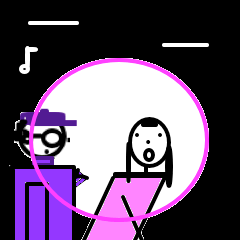
Suddenly a man was standing in the space just outside the space between their barstools.
"Hello," he said.
Milford removed his hand from Miss Alcott's, and she removed her hand from his thigh.
"I hate to interrupt," said the man.
"Then don't do it," said Miss Alcott.
"Ha ha, you slay me, Lou."
"I just might do it in the literal sense, and very soon."
"Heh heh, as risible as ever, but I just wanted to come over and say hello to the young gentleman."
"Then pray do so," said Miss Alcott. "And then begone."
"My name is Hawthorne," said the man, quickly, "Nathaniel Hawthorne." When Milford said nothing in reply the man continued. "Perhaps you've heard of me." He was dressed in an old-fashioned and old brown serge three-piece suit, and he had long grey hair falling on either side of his balding head. Under his nose was a thick moustache with what looked like pretzel crumbs in it. "But my friends call me Nat, as I hope you will too."
"Just call him Nathaniel," said Miss Alcott to Milford. "No one calls him Nat."
"Ha ha again," said the man. "Slaying, Lou, absolutely slaying, as always. And you, sir," he said cocking his head toward Milford, "if I am not very much mistaken, are none other than Mr. Marion Milford."
"Yes," said Milford.
"May I shake your hand, sir?"
"If you insist," said Milford.
"I do not insist, as that would be rude, but I ask you most humbly to shake my own modest hand."
"You're not one of these guys who tries to crush another man's hand in his, just to prove that he is not homosexual, are you?"
"Oh, far from it, dear sir! My hand could hardly crush a soap bubble!"
"Okay, then," said Milford, and he extended his hand, which the man took in his own. It felt cold, papery, but still somehow fleshy, and weak, like a recently deceased reptile of some sort. The man gave a limp shake, and Milford withdrew his hand at once.
"I have heard about you, sir," said the man.
"That surprises me," said Milford.
"But why should it surprise you?"
"Because I am nobody," said Milford.
"Oh, no, sir!"
"A nonentity's nonentity," said Milford. "My own mother
despises me as a waster and a fool. And when I get up to talk at my Alcoholics Anonymous meetings, even the most fervent reformed drunks fall asleep."
"But you are nonetheless a hero of your time, sir! Everyone has heard the legend of Milford! Why, just as Melville's Bartleby was the avatar of the mid-19th century man, so also are you, sir, the ultimate paragon of the lost and vacant man of today, the man who is without purpose or meaning, without religion or philosophy, without joy or love, in a universe that doesn't care, in short, the exemplary man in a world without exemplars. And, now, now, here you are, in person!"
"So?"
"I am all athrill, sir!"
"Look, Nathaniel," said Miss Alcott, "ask for his autograph and leave us, will you? Milford doesn't want to hear your sycophantic groveling."
"I would love to ask for Mr. Milford's autograph, Miss Lou," said the man. "But I would also like to ask him if I may be his chronicler."
"My what?" said Milford.
"I should like to tell your story, Mr. Milford, sir. And, I know, you would probably be disgusted at the idea of your name being used in a work of soi-disant literature, but I could change it if you wish. It would be an easy matter. The title I have in mind is (pace my friend Mr. Poe) The Fall of the House of Milford. But I could call it something else, like, I don't know, The Fall of the House of Dumford."
"No," said Milford.
"Rumford?"
"I don't think so."
"Bumford."
"The answer is no. My life is miserable enough as it is, without someone else turning it into a, a cheap paperback novel."
"It wouldn't have to be a cheap paperback. At least not on first publication."
"The man said no, Nathaniel," said Miss Alcott. "And now, you should pardon my lapse into the vernacular, kindly take a hike."
"I could cut you in on the royalties," said the man to Milford.
"No, thanks," said Milford.
"What would you say to, oh, twenty percent?"
"No."
"Twenty-five percent?"
"No."
"How about sixty-forty then? Forty percent for you, that is."
"I don't care about royalties," said Milford. "I care about preserving at least a small nugget-sized core of dignity somewhere deep within my wretched soul."
"Wow. Can I quote that? That was brilliant. I should love to spend a rich Boswellian season of afternoons in the coffee house of your choice, collecting just such choice bons mots which I could then salt-and-pepper throughout my proposed work, which I see running into three hefty volumes, published serially so as to optimize sales."
"I don't think so," said Milford.
"What about just some several afternoons."
"No."
"Two or three?"
"No."
"Even one would be better than nothing."
"I'm pretty busy."
"Just an hour."
"No."
"Not even an hour? I could buy you lunch."
"No, thanks," said Milford.
"What about dinner then? Have you ever been to Delmonico's? I've never been there, but I'm told their Beef Wellington is to die for."
"I've never been there either," said Milford, "nor do I want to go there."
"What about Bob's Bowery Bar? They have a really good Mulligan Stew I'm told."
"No, thanks," said Milford. "I prefer to eat at automats."
"We could go to an automat."
"See here, Nathaniel," said Miss Alcott, "can't you take a hint? The man doesn't want to have lunch or dinner with you."
"He didn't say that specifically, Lou."
"Ask him."
"Sir," said the man, "would you like to have lunch or dinner with me, anywhere, at my expense?"
"No," said Milford.
"What about an old-fashioned tavern crawl?"
"All right," said Miss Alcott, "I'm through being polite. If you don't leave Mr. Milford alone I shall have no recourse but to ask Bret to forcibly remove you."
"You split an infinitive there, Lou. I thought you were better than that."
"All right, I'm calling Bret if you don't go away at once."
"I'm a better writer than Bret ever was. His work has not a tenth of the resonance of mine. It completely lacks the spiritual element."
"Very well, that's it," said Miss Alcott. She turned towards the bartender, who was shaking a cocktail halfway down the bar. "I say, Bret! Will you kindly tell Mr. Hawthorne to stop bothering us?"
"Nathaniel!" yelled the bartender, presumably named Bret. "Leave them two alone and go back to your table!"
"Oh, all right," said Hawthorne in response, and then he turned to Milford again. "Just think about what I said, please. I can give you fifty percent of the royalties, and I promise I'll use whatever pseudonym you please. What about Bumpstead?"
"Hey!" yelled Bret the bartender. "Don't make me come down there, Nathaniel!"
"Okay, I'm going, I'm going," said Hawthorne. "Here, please take my card, sir. If I'm not in, just leave a message with my landlady."
He was holding out a calling card, so, just to get rid of him, Milford took it. The card read:
Nathaniel Hawthorne
Author and Motivational Speaker
Rates Negotiable
And under that was a MacDougal Street address.
"Really, stop by any time. Day or night," said Hawthorne. "And if I'm not at home you can usually find me here. By the way, do you think I could have your autograph? I have my little morocco bound notebook in my pocket, and a pencil."
"Sorry, but if I ever give anyone my autograph, then I'll know it's time for me to jump off the Brooklyn Bridge."
"Ha ha, such rapier wit! Again, may I quote you, sir?"
"I don't give a damn."
"Then I shall." The man noticed that the bartender was staring at him, and so he said, "Okay, great meeting you, Mr. Milford. Lou, always a pleasure. And now, before Bret throws me out, and if I may paraphrase Lady MacBeth, I shall stand not upon the order of my going, but go at once."
And finally he went away.
"He's so pathetic," said Miss Alcott. "Hasn't written anything decent in almost a century, and now he wants to ride your coattails. Do yourself a favor and rip that card to shreds."
And without hesitation Milford ripped the card up into tiny pieces and let them flutter down to the sawdust and cigarette butts and other torn-up hopes and dreams on the floor.
{Please go here to read the unbowdlerized "adult comix" version in A Flophouse Is Not a Home, profusely illustrated by the illustrious rhoda penmarq…}