Dan Leo's Blog, page 6
September 26, 2024
"Hideaway"

As they walked towards the sound of the music, suddenly Mr. Whitman burst again into song.
Oh hi ho, the merry-o, the four friends travel on,
towards the sound of merriments and joys,
of dancing the Black Bottom and the Charleston,
girls and boys, girls and girls, and boys and boys!
What awaits them in this so-called den of sin?
Will they survive until the dawn of day,
or will they be found, quite dead and frozen
in some snow-choked dockside alleyway?
"All right, Walt," said Jelly Roll, turning his head in its porkpie hat, "chill, my man, because we're almost there."
"Oh, I will be 'chill', my friend," said Mr. Whitman, "verily like the silvery tops of the mighty Adirondacks in the bracing time of winter solstice –"
Jelly Roll stopped, and turned around completely to face Mr. Whitman.
"Okay, this is exactly what I'm talking about, Walt. Please do not embarrass my black ass when we get in this place, okay? That's all I'm asking."
"But, Jelly Roll," expostulated Mr. Whitman, "am I not allowed to wax poetic – I, a poet?"
"He's saying, Walter," said Miss Blackbourne, "just try not to act like a total nincompoop."
"Oh," said Mr. Whitman. "Well."
"I know it's hard for you, buddy," said Miss Blackbourne, "but make an effort."
"That's all I'm asking," said Jelly Roll. "I don't think I'm asking a lot here."
"Look at Milford," said Miss Blackbourne.
"Who?" said Mr. Whitman.
"The boy whose arm you're grappling."
"Oh. Merford you mean," said Mr. Whitman.
"His name is Milford," said Miss Blackbourne.
"It is?" said Mr. Whitman. He turned his great head and looked down at Milford, who was looking at the floor, littered with cigar and cigarette butts, chewing gum wrappers, syringes and used condoms. "Merford, what's your name, my lad?"
"Milford," said Milford, glancing up at Mr. Whitman's enormous bearded head in his dashing sweat-stained slouch hat. "But at this point I honestly don't care what you call me."
"Well, if Melford really is your appellation, then indeed I should like to call you by your correct and rightful Christian name."
"I'm not a Christian," said Milford.
"Shall we say then your correct atheist, or theist name then?"
"Look," said Miss Blackbourne, "all I'm saying is why can't you take a hint from Milford and just try to rein it in a little."
"Just a little, Walt," said Jelly Roll.
"Rein it in," said Mr. Whitman.
"Yeah, just a little," said Jelly Roll.
"Okay," said Mr. Whitman. "I shall try to learn from my friend Megford."
"'Cause here's the thing, Walt," said Jelly Roll. "They know me in this place."
"Oh, good," said Mr. Whitman.
"They know me," said Jelly Roll, "and I got a rep here."
"A rep. Like a rep tie?" said Mr. Whitman.
"Oh, Christ," said Jelly Roll. "Look, let's go, and everybody just try to be cool, all right?'
"And by everybody," said Miss Blackbourne, "he means you, Walter."
"Me?" said Mr. Whitman.
"Yes, you," said Miss Blackbourne.
"Just be cool, Walt," said Jelly Roll. "Do you think you can manage that?"
"That depends," said Mr. Whitman. "Define cool."
"It means not acting like a jerkoff, Walter," said Miss Blackbourne."
"Oh," said Mr. Whitman. "Wow."
"Okay, then," said Jelly Roll. "Now that we got that settled, let's go."
He turned and started walking down the dim corridor again, and Miss Blackbourne walked with him, slipping her arm into his.
"Gee," said Mr. Whitman, in a low voice, to Milford. "Do I really act like a 'jerkoff', Mungford?"
Milford sighed, his twelve-thousandth and thirtieth-first sigh since awakening with a sigh the previous morning.
"Okay," said Mr. Whitman, "a nod is as good as a wink to a blind horse, and sometimes a single sigh says as much as a weighty tome. I shall rely on you, my friend. If I get out of hand, please give me a nudge, a sharp elbow to the ribcage, or a stomp upon my instep with your stout workman's brogans. Will you do that for me?"
"Sure, Mr. Whitman," said Milford.
"Mr. Whitman was my father, may the great Buddha rest his soul. Please, call me Walt."
"Okay, Walt."
"Or Walter if you feel a touch of formality is appropriate."
"Okay, Walter."
"And may I call you Mel?"
"What?"
"May I call you Mel. Unless of course you prefer your full pantheistic prénom of Melvyn?"
"No," said Milford, swallowing a sigh, "Mel is fine."
"Splendid. And now let us hie ourselves hence and catch up with Margaret and Jelly Roll."
The big poet dragged Milford quickly down the corridor towards the increasingly loud music, and soon they turned a corner and caught up to Miss Blackbourne and Jelly Roll, who had reached a wooden door on which hung a sign with the faded painted legend
"THE HIDEAWAY"
Leave your cares behind
and your bullshit too.
Ring the bell and wait.
"Did you ring the bell?" said Mr. Whitman.
"Yeah," said Jelly Roll.
"Ring it again," said Mr. Whitman.
"No, once is enough," said Jelly Roll.
"I'll ring it again," said Mr. Whitman, and he stepped forward with his finger raised.
Jelly Roll grabbed Mr. Whitman's wrist.
"Listen, Walt," said Jelly Roll, "I respect you, man, and I consider you my friend. But if you don't cool it we're gonna have a problem."
"Ow," said Mr. Whitman, "you really have quite the strong grip, my friend!"
"Strong enough to snap your wrist like a twig, big guy."
"Okay, okay! Now can I have my wrist back?"
"I ain't gonna warn you again, Walt."
"Okay, okay, I get it."
"Nobody in this joint gives a shit if you're the great American troubadour."
"No?"
"Far as they're concerned you're just another loudmouthed honky."
"Oh."
"You get out of line in here, don't count on me to rescue your pasty white butt."
"Um," said Mr. Whitman.
"So you're gonna be cool?"
"Okay, okay, I'll be cool, now please let go of my wrist, Jelly Roll!"
Jelly Roll opened his hand and Mr. Whitman pulled his wrist away, rubbing it with his other hand.
"Jeeze," he said.
Just then the door opened and an enormous black man stood there, dressed in a railroad man's overalls and cap. Behind him swelled and roared music and shouting and laughter.
"Jelly Roll," said the man, in a voice like thunder across the mountains and the plains.
"John Henry," said Jelly Roll, and the two men shook hands as music and dark laughter and shouting poured and tumbled out into the corridor.
{Please go here to read the "adult comix" version in A Flophouse Is Not a Home, profusely illustrated by the Schaefer Award short-listed rhoda penmarq…}


September 19, 2024
"Four Friends, All Stout and True"

They were walking down yet another long dim narrow corridor.
Mr. Whitman walked to Milford's left, his brawny arm in Milford's thin arm, pulling him along.
Ahead of them walked Miss Blackbourne and the Negro man called Jelly Roll, and they also walked arm in arm.
Mr. Whitman was singing, and his song was thus:
Four friends, all stout and true
striding along through the hallways of life,
they know not wherefore, nor where to,
but on they stroll, through peace and strife.
Will they find what they are looking for?
And will they know it if and when they do?
Will they find satori behind that final door,
or will they find it leads to another one too?
Will they sing yippy-yi-ki-yay, and whoopsie-do,
or will they sigh and groan, oh no, not again,
as they realize that it matters not what or who,
and the time is not now, nor was it even then?
Mr. Whitman stopped singing suddenly, and said, "Hey Jelly Roll, you sure you know where we're going?"
"Yeah, man," said Jelly Roll, turning his head, "pretty sure. Keep singing, Walt."
"I'm just wondering if we might have taken a wrong turning back there."
"Maybe," said Jelly Roll, "but don't sweat it, buddy. We're bound to get somewheres sooner or later."
"Walt gets nervous when he goes more than five minutes without a drink in his great hairy paw," said Miss Blackbourne. "Ha ha."
"I'm not nervous, exactly," said Mr. Whitman, "but I could definitely go for a tankard of hot steaming and fragrant grog, as quaffed by the proud hearty sailors of the Royal Navy, or, alternatively, of a rich strong cold India pale ale, its head foaming over the brim like the waves of my beloved Brooklyn Harbor in a December nor'easter, flooding the quays where the brawny stevedores toil."
"Keep your shirt on, Walt," said Miss Blackbourne. "Jelly Roll knows the way, don't you, Jelly Roll?"
"Uh, yeah, sure, Miss Margaret," said Jelly Roll. "Okay, here we go."
The corridor continued straight ahead, but they had come to another corridor crossing the one they were walking along.
"All right," said Jelly Roll. "Let's hold up a minute."
They all stopped.
"Um," said Milford.
"What is it, Mumphrey?" said Mr. Whitman.
"It's Milford," said Milford.
"Sorry," said Mr. Whitman. "Milford or whatever, what is it?"
"Why are we stopping?" said Milford.
"Ask Jelly Roll," said Mr. Whitman.
"Why are we stopping, Mr. Jelly Roll?" asked Milford.
"I just want to light up another reefer, my man," said Jelly Roll. He showed Milford the fat brown cigarette he held in his brown hand, then he put it in his lips. Miss Blackbourne had just lighted up one of her silver-tipped black cigarettes, and she gave Jelly Roll a light with her slim ebony-enameled lighter. Mr. Whitman took the opportunity to take out his leather pouch and he proceeded to pack the bowl of his pipe.
"Smoke 'em if you got 'em, Milford," he said.
What could Milford do? He took out his pack of Husky Boys, and soon enough all four of our friends were standing at this shadowed windowless conjunction of corridors, smoking.
"Okay," said Jelly Roll, exhaling a great lungful of thick smoke in Milford's direction. "I got a confession to make."
"What's that, Jelly Roll?" said Mr. Whitman.
"I got absolutely no fucking idea where we are," said Jelly Roll.
"Oh, great," said Mr. Whitman. "I knew it."
"You knew no such thing, Walter," said Miss Blackbourne.
"Okay," said Mr. Whitman, "maybe I didn't know it, Margaret, but I suspected it."
"Then why the fuck didn't you speak up when you first suspected it?"
"I don't know," said Mr. Whitman. "I didn't want to presume. And, anyway –"
"Anyway what?" she said.
"I was busy singing my song," said Mr. Whitman.
Milford sighed, a cigarette smoke through the nose sigh, his twelve-thousandth and thirtieth sigh since emerging from his dreams the previous morning, into the dream he called life.
"You okay, Milford?" said Miss Blackbourne.
In answer Milford only sighed again.
"Relax, man," said Jelly Roll. "One of these corridors must be the right one."
"Or the wrong one," said Miss Blackbourne.
"Now, Margaret," said Mr. Whitman, "let's not be pessimistic." He was puffing on his pipe, holding the flame of one of his Blue Tip kitchen matches to the bowl.
"I think we make a left here," said Jelly Roll.
"You think," said Margaret.
"Well, I can't be a hundred percent certain."
"We can't be a hundred percent certain about anything in this life," said Mr. Whitman. "Or the next life." He was puffing away on his pipe. "If there is a next life."
"This is the next life," said Miss Blackbourne.
"Point taken," said Mr. Whitman, after holding in a lungful of smoke for a minute, and then letting it all out in an enormous cloud that enveloped all four friends from head to toe.
"What point?" said Jelly Roll, emitting his own enormous cloud of thick sweet smoke.
"I forget," said Mr. Whitman.
"Fuck it," said Miss Blackbourne, "let's just go."
"Which way?" said Mr. Whitman.
Without a word Miss Blackbourne headed down the corridor to the left.
"Well, I guess we're going that way then," said Jelly Roll, and he followed after Miss Blackbourne.
"Let's go, Guilfoyle," said Mr. Whitman, and he took Milford's arm and pulled him along in the footsteps of Miss Blackbourne and Jelly Roll.
Mr. Whitman began to sing again:
Four friends, one named Walt, one called Jelly Roll,
a lad named Gifford, and a lady, Margaret Blackbourne,
embarked together on an endless midnight stroll;
they knew not why they lived, or why they were born.
But on they rambled, arm in arm, down a dim corridor,
smoking and talking, together, yes, but also alone,
knowing only that the journey led at last to a door
behind which lay Kierkegaard's Great Unknown…
They walked on.
Eventually Mr. Whitman stopped singing, and they walked in silence.
Milford finished his cigarette, and he hated to throw his butts on floors, but there was nothing else to do, and so he flicked his Husky Boy stub away. He noticed that there were lots of other cigarette and cigar ends on the grey unvarnished wood of the flooring, and so he felt slightly less guilty.
After several minutes more of silent walking, silent but for the hollow footsteps of the four companions, Milford heard a faint distant sound.
"I think I hear something," he said.
"What?" said Mr. Whitman.
"I don't know," said Milford.
"Wait a minute," said Jelly Roll. "Let's stop."
He cocked his head.
"I hear something too," said Miss Blackbourne.
"What is it?" said Mr. Whitman.
"It's music, man," said Jelly Roll. "I hear music."
"Oh, my God," said Milford. "Let's go!"
"I told you I knew where we was going," said Jelly Roll.
"You didn't know shit, Jelly Roll," said Miss Blackbourne. "But, yes, let's go."
"Oh, thank God!" said Mr. Whitman, "or the Buddha, Vishnu, or the Great Spirit of the noble indigenous red man!"
And on they went, Miss Blackbourne and Jelly Roll, Mr. Whitman and Milford, down the dim corridor, towards the sounds and vibrations of music, echoing from who knew how far away, but growing louder with each step our four friends took.
{Please go here to read the unexpurgated "adult comix" version in A Flophouse Is Not a Home, profusely illustrated by the illustrious rhoda penmarq…}
September 12, 2024
"A Man Called Milford"

Milford lifted the cup of sweet fragrant tea again, and drank, and then he drank again, and once more, and the cup was now empty.
He sighed, his twelve-thousandth-and-twenty-ninth sigh since awakening from a troubled nightmarish sleep the previous morning into a troubled and nightmarish long day and seemingly endless night.
"Walter," said Miss Blackbourne, apparently in response to something Mr. Whitman had said, something Milford hadn't caught because he had a bad habit of not listening to people, "don't you ever get tired of pontificating?"
"Ouch!" cried Walt.
"Burn!" said the Negro man called Jelly Roll. "Burn, baby, burn!"
Milford wondered if he should pour himself another cup of tea from the blue and white teapot.
"Ah, dear Margaret," said Mr. Whitman, "it is an occupational hazard of the poetic sage, this urge to spout wisdom and platitudes."
"Spout bullshit you mean," said Miss Blackbourne.
"Heh heh," said Mr. Whitman, lifting his tankard to his wet-whiskered lips.
"Look at Jelly Roll there," said Miss Blackbourne, "you don't see him going on with all this godhead and brotherhood of man baloney."
"Thank you, ma'am," said Jelly Roll. "Murder ballads and cat house cantos are more my style."
"That's because you're not full of crap like Walt," said Miss Blackbourne. "I mean, don't get me wrong, Walter, you're a great poet and all that, but Jesus Christ, man, give the fucking pomposity a rest now and then."
"I shall try, dear Margaret," said Mr. Whitman, tilting his great hairy head under that slouch hat of his. "It's hard for me, but it's just that I am so overflowing with what the Greeks called agape, that is to say brotherly love, although I suppose there is something to be said for sisterly love as well –"
"Can it," she said. "Look at Milford there, he knows how to keep his trap shut."
"You mean Mulgrew?" said Mr. Whitman.
"I thought it was Milford," said Miss Blackbourne.
"I think it's Milltowne," said Jelly Roll.
"What's your name, pal?" said Miss Blackbourne, addressing Milford.
"What?" said Milford. He was still wondering if he should pour himself some more tea.
"I asked you what your name is," said Miss Blackbourne.
Milford wanted more tea, but on the other hand he knew that if he kept on drinking the delicious and restorative tea he would have to go to the men's room again, and he was afraid of going back to that men's room, he was afraid of going to any men's room ever again.
"Milford?" said Miss Blackbourne.
"Yes?" Milford managed to say.
"I asked you a question."
"What was it?"
"Miss Margaret wants to know what your name is, man," said Jelly Roll.
"It's Mulvaney, right?" said Mr. Whitman. "Tell her, Mahoney."
"It's not Mulvaney," said Miss Blackbourne. "Nor Mahoney. Milford, if that really is your name, tell us what your name is."
"My name?"
"Yes," said Miss Blackbourne. "It's a simple question. What's your name?"
"I'm pretty sure it's Moxton," said Mr. Whitman. "Or Moxley."
"What's your name, man?" said Jelly Roll.
Suddenly Milford realized that he couldn't remember his name. What was his name?
"Um," he said.
"Uh-oh," said Jelly Roll. "I seen this before."
"Um, uh," elaborated Milford.
"It's Mulgrave, right?" said Mr. Whitman.
"It's not God damned Mulgrave, Walt," said Miss Blackbourne. "Milford, didn't you tell me your name was Milford?"
"I, uh," said Milford.
"He's too high," said Jelly Roll. "Can't remember his own name. Too much muggles and hash, too many magic mushrooms, too much jimson weed and John the Conqueroo and ayahuasca and laudanum, and probably too much good old-fashioned lush, and now it looks like your special tea just sent him right over the edge. What'd you put in that tea anyway, Miss Margaret?"
"It's just plain ordinary Assam tea," she said. "I would never dose someone I'd just met."
(Milford suddenly remembered that he had also drunk some sarsaparilla supposedly spiked with ambrosia, the mystical viaticum of the gods, but it seemed too much effort to share this memory with his companions.)
Miss Blackbourne reached across the table and touched Milford's hand with the fingers of her hand, the nails of which were long and sharp and painted the color of fresh glistening blood.
"Darling, just tell us your name."
"His name is Murgatroyd I think," said Mr. Whitman.
"Still thy tongue, Walt," said Miss Blackbourne, and now she touched Milford's cheek, which had grown even more pallid than usual. "What's your name, buddy?"
"My name is," said Milford, but then he stopped.
He stood up, almost knocking his chair over, but Jelly Roll grabbed it.
"Hey, where you going, McGraw?" said Mr. Whitman.
"Sit down, my good man," said Miss Blackbourne. "We only want to know what your name is."
"It starts with an M, I'm pretty sure of that," said Jelly Roll. "What about Mulligan?"
Milford reached under his peacoat and into the side pocket of his dungarees, brought out his old Boy Scout wallet, and opened it up.
"Now what are you doing?" said Miss Blackbourne.
Milford looked into the wallet's compartment where he kept a few cards and scraps of paper, ideas for poems, drafts of suicide notes and such, and there was his library card. He took it out and looked at it.
"'Marion Milford,'" he read, aloud.
"See, I told you guys," said Miss Blackbourne. "Marion Milford, but he goes by Milford because Marion is a girl's name."
Milford sat down again.
"Can I see that card?" said Mr. Whitman.
Milford handed him the library card, and Mr. Whitman took a pair of wire-rimmed glasses from inside his workman's jacket and put them on, then looked at the card.
"Yes, it does say 'Marion Milford'," he said. He looked at Milford over the rims of his glasses. "Is this your library card?"
"Um," said Milford.
"I mean," said Mr. Whitman, "is it your card and not someone else's, or a forgery perhaps?"
"I, I –" said Milford.
"Of course it's the boy's card," said Miss Blackbourne. "Why else would he have it in his wallet?"
"That's what I'm trying to find out, Margaret," said Mr. Whitman. "Take your time, Mulliford. All we want to know is if this is actually and in truth your own and proper library card."
"Yes," said Milford, after only a brief pause. "I think so."
"You think so."
"Yes. Unless –"
"Unless what?"
"Unless I dreamt that it's my library card. Unless my whole life has been a dream. Unless I'm in someone else's dream. Unless I'm dreaming what's happening now."
"Wow," said Jelly Roll. "That's some heavy ass shit right there."
"It's his fucking library card, Walt," said Miss Blackbourne, "now give it back to him before the poor boy loses whatever of his mind he has left."
Mr. Whitman looked at the card one more time then proffered it across the table to Milford, who took it and put it back in his wallet. Then he stood up again, almost knocking his chair over again (Jelly Roll grabbing it again), and he put the wallet back into the side pocket of his jeans, and sat down, again.
"Milford," said Mr. Whitman, and he took off his glasses.
"I told you, Walt," said Miss Blackbourne.
"My man Milford," said Jelly Roll. "He knows his own name."
"I guess he does, Jelly Roll," said Mr. Whitman. "I'll warrant he does." He folded up his glasses and put them away. "Don't you, Mugford?"
"Walter!" said Miss Blackbourne.
"Aw, I'm just fucking with the kid, Margaret," said Mr. Whitman. "Come on, let's finish our drinks and blow this popsicle stand."
"I'm down with that," said Miss Blackbourne. "Do you want to go somewhere else, Milford?"
"Yes," said Milford, because he always wanted to be somewhere else, except when he was in bed
"Do you want another cup of tea first?"
"No," he said, and he felt as if he were emerging from a thick fog, out of a dark cobbled alleyway, into a street where there were lights and motors and people and the sounds of laughter and music, a living and sparkling city of night. "Let's just go."
"Right, let's roll," said Jelly Roll. "And I know just the place to go."
And soon enough our four friends got up from the table and left.
And where to?
To another bar, of course.
{Please go here to read the unexpurgated "adult comix" version in A Flophouse Is Not a Home, profusely illustrated and with additional dialogue by the illustrious rhoda penmarq…}
September 5, 2024
"Ode to Joy"

Out of the thickly falling midnight snow and into Ma's Diner came Gerry "the Brain" Goldsmith, the gentleman philosopher.
The usual assortment of stumblebums and bindlestiffs sat at the booths and the counter, and down there in the middle perched on a stool was Smiling Jack.
Gerry brushed some snow off his old camel's hair chesterfield, took off his twenty-eight-year-old fedora and flapped it against his side, loosened his frayed and worn Andover rowing-team muffler, and then went over to where Smiling Jack sat.
"Hello, Jack, anyone sitting here?"
"Why, no," said Jack, smiling, "take a seat, my friend!"
Gerry took the seat. Yes, Smiling Jack was alive, hale and hearty as ever. The remains of what looked like corned beef hash and eggs were on a plate before him, and Jack had just lighted up a cigarette with a match torn from a book on which were printed the words
MA'S DINER
Where the Food Could Not Be Finer
The matchbook reminded Gerry of the Zippo lighter in his pocket, the lighter he had taken from one of Smiling Jack's pockets, along with a pack of Luckies and nine dollars and seventy cents, when, less than an hour ago, he had found Jack's frozen body leaning up against a streetlight pole, Smiling Jack lifeless but still smiling, the blank eyes slightly open, the eyelashes crusted with ice.
Gerry reached into his coat pocket and brought out the Zippo.
"I say, Jack, look what I found just inside the doorway."
"A lighter?"
"Yes. A Zippo."
"So it is –"
"Don't you own a Zippo?"
"I do, yes, but somehow I lost it tonight."
"Maybe this is your lighter, Jack."
"I suppose it might be."
"Here, take it."
"Oh, but it could be anyone's lighter."
"Most likely it's yours."
"But you found it, Gerry. You should keep it."
"I want you to have it, Jack. Something tells me it's yours."
"What do you mean by something?" said Smiling Jack, who believed as a matter of principle in a higher power.
"It's just a feeling," said Gerry.
"Ah, but one thing we learn in the program, Gerry, is that feelings are not facts."
"In this case I think my feeling is a fact, Jack."
"But how can you be sure?"
Ma was standing there behind the counter listening to all this.
"Oh, hello, Ma," said Gerry. "I wonder if I could have a cup of your most excellent chicory coffee, and as well I think I'll go for –" he glanced at the bill of fare posted on the blackboard up on the facing tiled wall, "oh, I suppose I'll go for the All Day Deluxe Breakfast, with eggs sunny side, scrapple and home fries, please."
"You got it, Mr. Goldsmith," said Ma, and she went away.
Gerry turned back to Smiling Jack, and held out the Zippo.
"Please take the lighter, Jack."
Jack took the lighter and examined it.
"Y'know, it does somehow look like my lighter."
Ma came back with a cup and saucer in one hand and a coffee pot in the other. She filled the cup for Gerry, and topped off Smiling Jack's cup.
"Finished with your breakfast, Mr. Jack?"
"Yes, Ma," said Smiling Jack, "thank you very much, it was excellent.
Ma took away the plate, and Jack flicked back the cap of the lighter and thumbed the wheel, and a vibrant blue and yellow flame emerged.
"Strange," he said, shutting the cap, "but it even feels like my lighter."
"I want you to have it," said Gerry.
"Well, only if you insist," said Jack. "It's funny, but not only did I somehow lose my lighter tonight, but I thought I had some money in my wallet, and some change in my pocket, but when I came in here it was all gone. I also had somehow lost a pack of Luckies I was sure I had. Fortunately for me, Ma let me have a meal on credit, and she even lent me a quarter for a pack of Luckies."
"Ma is a very good person," said Gerry.
"She is indeed," said Smiling Jack. "A living saint."
"Yes," said Gerry.
Ma would never go through the pockets of a man she found frozen to death leaning up against a light pole in a raging blizzard. And then head directly to the nearest bar.
Gerry added sugar to his coffee from the dispenser, and milk from the little metal pitcher, then stirred it all up, and sipped.
He still owed Smiling Jack nine dollars and seventy cents, as well as a pack of Lucky Strikes, but all in good time, if the universe granted him the time. But here's what he would do, what he should do. As usual he had blown through his monthly remittance before the end of the month, but what he would do, tomorrow he would look for a transit authority token in the little tray where he kept pennies and nickels and sometimes even dimes on the little table by the door of his room, and he would go out into the cold and the snow and take the subway up to 52nd Street and the offices of Goldstein, Goldberg and Gold, and he would ask Mr. Goldstein for a modest advance, fifteen or twenty dollars. Then he would just have to find a subtle way to get the nine dollars and seventy cents to Smiling Jack, without admitting of course that he had lifted that amount from the frozen Jack's pockets. No, make it an even ten dollars, because he had also taken that pack of Luckies…
In the meantime all he could do was to sit here and talk with Smiling Jack, as insanely boring as the man was. This would be his penance, and when Jack inevitably offered him one of his anti-alcoholism pamphlets (Are You a Drunkard?) from his leather satchel, he would say yes, thank you very much, Jack. Which wasn't to say he would actually read the thing, but he would take it, because it was the least he could do, the very least.
Jack had been talking, but what was he saying? It didn't matter, people had to talk, some more than others, and Jack seemed to love to talk more than most, perhaps it was his way of proving to himself that he was still alive, or at any rate not dead and in the ground, not yet anyway.
And then Ma was there, laying down that great warmed plate of food, the eggs glistening with butter like two suns, the smells of the spiced potatoes and the scrapple and the eggs and butter uniting in a symphony, or, if not a symphony, an ode, an ode to joy.
{Please go here to read the unexpurgated "adult comix" version in A Flophouse Is Not a Home, profusely illustrated by the illustrious Rhoda Penmarq…}
August 29, 2024
"What Pope Innocent III Once Said"
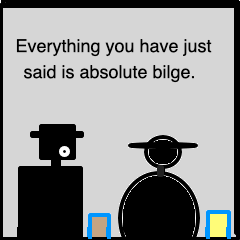
It felt as if it had taken him a week to cross the crowded smoky barroom, and when finally the Professor reached the bar and climbed up on a stool, he looked to the right and to the left for someone to expound to. This was the longest bar he had ever sat at, it seemed to extend to infinity to both the right and the left. Was he at the middle of the bar? It was hard to say. But what mattered was that he was at a bar, which was all he had ever wanted in all his life.
"Whaddaya want?" said a bartender, a big fellow in shirt sleeves and a bowtie.
"Hello," said the Professor. "How are you?"
"Who gives a shit how I am?" said the bartender. "I'm a fucking bartender, that's how I am, for my sins, which were many, apparently. Now what the fuck do you want, because as you can see I am busy back here."
"I wonder do you have a bock beer."
"You can stop wondering, because, yes, we have a bock beer."
"Splendid," said the Professor. "And my second question is –"
"And I hope it's the last," interpolated the bartender.
"Ha ha, yes," said the Professor, "my second question, and I shall try to make it my last, is I wonder if I may run a tab."
"Relax, big guy, all the drinks here are on the house."
"Oh, dear God," said the Professor. "Then is it true, am I in paradise?"
"I'll let you be the judge of that."
"Ha ha, yes, well then, could I have a bock draft?"
"Sure."
"Could I have a large one?"
"You can have whatever the fuck you want."
"Then I'll have the largest glass of bock beer you have, please."
"One imperial pint of draft bock, coming up."
The bartender went away.
"First time here?" said a man to the Professor's left.
"Yes," said the Professor.
The man's face was the color of an old gunny sack, and it appeared to be of the same texture. He wore glasses which magnified his eyes in such a way that they appeared to be two mud-colored amoebae pressing against the lenses. But he wore a jacket and tie, and a concrete-colored trilby hat and so presumably he was a gentleman.
"I take it you are an academic," said the man.
"Yes," said the Professor, although it had been over two decades since he had been fired from his last teaching job.
"So also am I," said the man. "I wonder if perhaps you read my article, 'The Semicolon; Is It Really Moribund?' It was in the Reader's Digest Digest."
"The Reader's Digest Digest?"
"Yes, it was a short-lived offshoot of the Reader's Digest, aimed at readers who wanted material even more digestible than those in the parent publication."
"Well, I'm sorry to say I missed that article."
"A pity. I truly believe it was the last word on the semicolon. What is your own line of country, if I may be so bold as to ask?"
"European History, primarily pre-Renaissance. Perhaps you read my monograph, 'The Albigensian Heresy: Its Mysterious Origins', which appeared, in regrettably severely truncated form, in The Late-Medieval Quarterly?"
"Sounds utterly fascinating, but, alas, I'm afraid I've never even seen a copy of the Late-Medieval Quarterly. Oh, your libation is here."
The bartender had laid down a great tall swooping glass before the Professor, filled with a dark liquid and topped with a thick foaming white head.
"There's your bock, buddy," said the bartender.
"Oh, thank you, good sir," said the Professor, and he quickly took the enormous glass in both hands, lifted it, brought its brim to his lips, and drank.
Yes, he was in paradise.
When he laid the glass down, one-third of it now empty, he turned to his new friend.
"They call me the Professor," he said.
"My name is Doktor," said the man with canvas-colored skin, and he spelled it out. "I am also a doctor, of philology, therefore I am known as Dr. Doktor."
"May I clasp your hand in donnish good fellowship, sir?" said the Professor.
"It would be my pleasure, Professor," said Dr. Doktor.
The fingers of his right hand had been touching the stem of a partially-emptied martini glass, but now he disengaged them, and he took the professor's proffered hand. Dr. Doktor's hand was thin and bony, the Professor's hand was fat, but the two mismatched appendages embraced, briefly, with neither trying to overpower the other, and then they separated, with a faint husking sound.
"I can envision us having many long and in-depth conversations," said Dr. Doktor.
"I also," said the Professor.
"Because what is life but the wagging of tongues, the pretending to listen to the blatherings of others while one waits for one's own turn to blather?"
"Fueled by the alcoholic beverage of one's choice," said the Professor.
"Of course," said Dr. Doktor. "And let us not forget cigarettes. Speaking of which –" He lifted a pack of cigarettes from the bar top. "May I offer you a Husky Boy?"
"Don't mind if I do," said the Professor.
And soon the two gentlemen were smoking and drinking and gabbing like old friends, neither of them listening to the other, because what did it matter what anyone said? It was the talking that mattered, not the words that were said.
At last the Professor had found his place in the universe, and, as Dr. Doktor droned on about dangling participles and the subjunctive mode, the Professor could feel in his bones the great droning boredom of all the other people in this enormous bar, talking, not listening, drinking, smoking, talking some more about nothing and everything, repeating the same old phrases ad infinitum, and, yes, this, this was heaven, at long last.
"Don't you agree, Professor?" said Dr. Doktor.
"Oh, yes, entirely," said the Professor. "It reminds me of something Pope Innocent III once said. Would you like to hear it?"
"Yes, of course," said Dr. Doktor, and now once again it was his turn to let his mind wander where it would, and to enjoy his martini and his cigarette while the Professor's voice droned on, blending with the voices of all the other bores in this heavenly establishment.
{Please go here to read the unexpurgated "adult comix" version in A Flophouse Is Not a Home, profusely illustrated by the illustrious Rhoda Penmarq…}

August 22, 2024
"The Albigensian Heresy"

"All right, Professor," said Hector Philips Stone, the doomed romantic poet, "take a hike."
"I beg your pardon?" said the Professor.
"You heard me. Unless you're willing to buy a round, beat it."
"Well, I never –"
"Scram, Prof," said Lucius Pierrepont St. Clair III, the Negro Poet.
"How dare you," said the Professor.
"Hitch up your pony and ride, Professor," said Howard Paul Studebaker, the western poet.
"Am I to be attacked on all fronts?" said the Professor.
"Stand not upon the order of your going, Prof," said Frank X Fagan, the nature poet. "But go at once."
"I have never been so insulted," said the Professor.
"Make like a breeze, Professor," said Scaramanga, the leftist poet, "and blow, daddy, blow."
"Bolshevik!" cried the Professor.
"Ah, feck off, Professor" said Seamas McSeamas, the Irish poet. And turning to Angie, the retired prostitute, he said, "You should pardon my language, Angie, but sometimes harsh words are necessary."
"Don't apologize to me, Seamas," said Angie, "I can't stand this tinhorn bum."
"And you a common trollop," said the Professor to Angie.
"Professor," said Father Frank, the whiskey priest, "that is no way to speak to a lady."
"I shall speak to her any way I please," said the Professor.
"You be nice to Angie, Professor," said Gilbey, the demented mystic. "Jesus don't like it when you ain't nice."
"But why must I be exiled from the table?" said the Professor. "I don't see Angie and Father Frank or Gilbey offering to buy a round."
"They're not obnoxious know-it-alls like you," said Hector Philips Stone. "Now hop it."
"Oh, very well," said the Professor, and he heaved his round body up from his chair. "I won't linger where I'm not wanted. You can all go to hell as far as I am concerned."
He waddled over to the bar and found an empty stool, and Bob came over.
"Bob," said the Professor, "I wonder if I might have a glass of your excellent basement-brewed house bock."
"You got a nickel?"
"In point of fact, Bob," said the Professor, "I am temporarily financially embarrassed, but if you would let me have a glass of bock 'on the arm' as they say, I should be most obliged."
"No," said Bob.
"Very well, that is your prerogative as the proprietor of this fine establishment, but let me ask you then if I may start a tab. I am expecting a check tomorrow, and as soon as the post arrives I will hurry here at once, and –"
"You're a professor, right?" said Bob.
"Retired, yes," said the Professor, which sounded better than fired.
"So you can read."
"Of course," said the Professor.
"You see that sign?" said Bob, and he pointed with his thumb to the placard on the wall behind the bar, the one that said NO TABS. THIS MEANS YOU.
"Oh," said the Professor.
"Now get out," said Bob.
"Just one glass?" said the Professor.
Bob rapped his Marine Corps ring against the bar top.
"Next time I rap this ring it's gonna be on your nose," he said.
The professor had seen Bob rap his ring on men's noses, the blood gushing, the tears cried. But still he couldn't help himself.
"It's snowing out," he said.
Bob raised his mighty fist. This would not be a backhanded rap, no it would be a straight right to the button, and the Professor had seen Bob's straight right before as well, huge dockworkers sent sprawling backwards to the sawdust and cigarettes on the floor.
He climbed off the stool.
"So be it," he said. "I shall leave, and –"
"Good," said Bob. "And don't come back."
"What?" said the professor.
"You heard me," said Bob. "Get out of my bar and don't come back."
"You mean ever?"
"That's right."
"But why? Because I requested to have one small glass of bock on credit?"
"No," said Bob. "Because you're the most annoying motherfucker I've ever met."
"Well," said the Professor, "as the young people say, 'Wow.' That's all I can say."
"Out."
"I don't think you're being very fair."
Bob didn't say anything, but even the Professor, as dense as he was, possessed enough of an instinct for self-preservation to know that he'd better accept defeat and beat a retreat in silence and with at least a semblance of dignity.
He turned and shambled slowly toward the exit, through the smoke, through the shouting and laughter and the music of Bob's recently installed juke box.
Why did everyone treat him so?
He made it to the door and opened it, the heavy cold snow falling down harshly from the uncaring dark heavens, and he went out into it.
It was so unfair. Life was so unfair. That it should come to this. And he, an educated man, a scholar, author of a published monograph on the Albigensian Heresy!
It was a two blocks' walk to his room in the Parker Hotel. Two blocks, but it might as well have been two miles, because he suddenly felt weary, weary to his soul, if he had one, and he wasn't sure that he did.
To the left of Bob's was a dark alley, filled with garbage cans and discarded boxes on which the Professor had sat on fine evenings, drinking from a bottle of muscatel, or, if he was in funds, Taylor port. The alleyway seemed to beckon him, and he went in and sat down in the snow, his back against the brick wall, the fat snowflakes falling down all around him, and on him.
I'll just rest here a moment, he thought, a brief rest, and then I'll get up and go home to the hotel.
He closed his eyes, and his head sagged forward, and he fell into oblivion.
When he awoke he was standing below a enormous gabled mansion on a hill, and he followed the winding brick path up to a broad columned porch. He floated up the steps, and St. Peter, dressed in a faded canvas jacket and smoking a pipe, sat at a table.
"Name?"
"They call me the Professor."
St. Peter ran his finger down the page of a great book.
"Oh," he said. "You."
"What does it say about me?"
"Irritating. Boring. Opinionated. Not funny. Shall I go on?"
"No, thank you."
St. Peter wrote something on a pad with a quill pen, ripped the sheet of paper off the pad and handed it to the Professor.
"Go in, cross the big hall, follow the corridor to the very end, then go through the last door you see and show this slip to the doorman. Can you remember that?"
"Yes, I think so."
"Good. You can go in now."
"Thank you."
St. Peter said nothing, but picked up a paperback book and began reading it.
After what seemed like endless days and nights the Professor came to the last door. He opened it and inside was what appeared to be a cavernous smoky barroom, filled with the low murmur of voices. A man sat on a stool by the doorway, chatting with another man, and they both looked at the Professor.
"I was told to show this slip to the doorman," said the professor, proffering the piece of note paper.
The man took the paper, glanced at it, then handed it back.
"Fine," he said. "Sit anywhere."
The Professor made his way through the smoke and the babble of voices to the bar.
Perhaps here he would find someone to whom he could explain his theories on the origins of the Albigensian Heresy.
{Please go here to read the unexpurgated "adult comix" version in A Flophouse is Not a Home, profusely illustrated by the illustrious Rhoda Penmarq…}
August 15, 2024
"The Undiscovered Country"

It was amazing how fast you could spend money even in a joint like Bob's Bowery Bar, which had the reputation of being the cheapest saloon not only on the Bowery but in the entire country, this "land of liberty" as Gerry called it, "a land where all men are free to take liberties, within reason".
Exactly forty-eight minutes ago, Gerry "The Brain" Goldsmith, gentleman philosopher, man of leisure, and cheerful tippler extraordinaire, had come back into Bob's with the mighty windfall of nine dollars and seventy cents, which he had relieved from the wallet and pockets of the anti-alcoholism crusader known as Smiling Jack, whose snow-covered corpse Gerry had found standing leaning against the lamp post down the corner at Bleecker and the Bowery. Apparently Jack had frozen to death in the thick falling snow, willingly or not, no one would ever know, except for God, if there was a God, the existence of whom, or Whom, was one of the many questions Gerry attempted to "delve into", tentatively, in his magnum opus in progress, currently titled Pensées for a Rainy Day, which he had been "working on" for, lo, these past two decades and more.
Had Gerry hesitated to take the money from the deceased crusader of sobriety? Perhaps he had, but only for a fraction of a moment, because he had heard (or imagined he had heard) Smiling Jack's genial voice saying, "Hey, help yourself, pal," after all the money wouldn't do Jack any good now, nor would the tarnished old Zippo lighter and the almost full pack of Lucky Strikes Gerry also helped himself to. Jack's leather satchel with its collection of his cheaply-printed self-penned pamphlets (Are You a Drunkard?), Gerry left hanging on its strap across the poor man's chest. Perhaps these small volumes would be buried with Jack in the potter's field on Hart Island.
But now all but one dollar and seventy cents of Gerry's windfall was gone, thanks to rounds of pitchers of bock bought for the poets at the big round "poets' table", namely Hector Phillips Stone (the doomed romantic poet), Seamas McSeamas (the Irish poet), Howard Paul Studebaker (the "western" poet), Lucius Pierrepont St. Clair III (the Negro poet), Frank X Fagen, (the nature poet), and, last but no more least than the rest of them, Scaramanga (the leftist poet). (It should be noted that Gerry was not, nor did he claim to be, a poet, but he loved to "hang out" with poets.) The prices at Bob's were so cheap (only fifty cents for a large pitcher of Bob's basement-brewed bock), that one would think that eight dollars would last longer than forty-eight minutes, but word of free bock gets around quickly in a place like Bob's, and the poets' table had been invaded by Father Frank (the defrocked "whiskey priest"), Angie (the retired prostitute who now sold flowers from a street cart), Gilbey (the deranged mystic who claimed to have seen God,
whom he called "the Big Fella"), and the fat old man everybody called "the Professor".
Gerry could put up with a lot (after all, he was a philosopher), but the Professor was just too much even for him. The Professor would think nothing of correcting your grammar or your choice of words in mid-sentence, never ceased to bore you with his familiarity with all the great books, and there was nothing he seemed not to know all about and to have an opinion on. The one thing he didn't know was how annoying he was. He was also a shameless moocher, and for the past half hour he had been sitting squeezed in tight right next to Gerry, and driving him up a wall with tedium.
"You know you're wrong about Joyce, Gerry," said the Professor. "Not as wrong as you are about Kant, but nearly so."
"That may be true, Professor," said Gerry, "but I just can't with Kant, although I do rejoice in Joyce."
"Buy us another couple of pitchers and I will explain why you're wrong," said the Professor, completely oblivious to Gerry's bons mots.
Fuck you, thought Gerry, as loudly as he could think, but in so-called real life he merely said, "Some other time, Professor. My humble cot is calling me."
"Oh, but don't go, Gerry," said the Professor, who had never bought a round in his life and wasn't about to start now.
"Sorry," said Gerry, "but 'sleep, gentle sleep, Nature's soft nurse' calls me."
The Professor said nothing, but looked discomfited, not just because the source of free bock was leaving, but because he couldn't identify Gerry's Shakespearean quote.
And to hell with you, Professor, thought Gerry, rising from his chair. He was about to put the last dollar bill on the table as a tip for Janet the waitress, but he didn't trust the Professor not to snatch it, and so he handed it to Hector Philips Stone and asked him to give it to Janet (with whom Hector was rumored to have had concupiscent relations with).
A smattering of goodnights and even a few thanks, and thus Gerry staggered over to the door and outside into the freezing cold snow falling as hard as ever.
Well, at least he still had seventy cents in his pocket, which was seventy more cents than he'd had the last time he walked out of Bob's. It occurred to Gerry that he had not eaten since fourteen or fifteen hours earlier, when he had had a cinnamon bun with his morning bottomless cup of coffee down the street at Ma's Diner. Seventy cents! If Bob's was the cheapest bar in the country, Ma's might well be the cheapest diner, and seventy cents would be enough for the All-Day Deluxe Breakfast, and he would still have twenty cents left over for a tip!
Gerry knew just what options he would go for: two eggs "sunny side up", hash browns instead of grits or home fries, scrapple instead of bacon or "country ham", and baked beans rather than the succotash.
Or should he rather go for the Johnnycakes Deluxe Special, a tall stack, slathered with fresh butter and drowned in maple syrup, and criss-crossed with a half-dozen rashers of "country bacon"?
Or what about a great bowl of Ma's Hobo Stew, with a few thick slices of fresh-baked black bread?
Or – but, wait, what was this?
Gerry had reached the corner, and its streetlamp, its light pale and yellow through the thick falling snow, but where was the deceased Smiling Jack, his snowman's body propped against it? It was gone, he was gone.
Had a policeman in a passing patrol car seen the unfortunate corpse, prized it free with a tire iron from the pole, and taken it to the morgue? Yes, that's what must have happened. Just another dead drunk on the Bowery, probably nothing unusual for the men in blue at the Ninth Precinct. They probably picked up a half dozen dead men every night of the week.
Well, thought, Gerry, this was good, that Smiling Jack hadn't been left out in the blizzard all night long, not that Jack would care, being beyond all care for all eternity.
"So long, old friend," he said, silently, "I'm glad you're out of the freezing cold and the snow, even if it is only to be taken to a slab in the morgue. Thanks again for the nine dollars and seventy cents, for the Lucky Strikes, and for the lighter, and every time I use that Zippo, I shall think of you, and your bright smile."
With no further ado, Gerry hated long goodbyes, he trudged through the snow to the curb, and, after waiting patiently for the green light, even though there was no traffic this time of night, he tramped across Bleecker towards the blood-red neon sign that said MA'S DINER and the smaller sign that read "Where the food could not be finer".
Imagine Gerry's surprise, when, on the opposite snow-piled sidewalk, he looked through the frosted plate-glass window, and saw, sitting alone at the counter and smoking a cigarette,, none other than Smiling Jack himself!
So, thought Gerry, this it. A genuine miracle, and a frozen solid dead man brought back to life.
Now he must revise the whole section of his work-in-progress that concerned the supernatural, and the existence of God, or, if you will, a Higher Power.
But, first things first, which was what God himself must have said on that first First Day, and Gerry slogged through the snow to the entrance door, having changed his mind again and decided on corned beef hash, topped with two fried eggs, with a hot cross bun on the side.
{{Please go here to read the unexpurgated "adult comix" version in A Flophouse Is Not a Home, profusely illustrated by the illustrious Rhoda Penmarq…}
August 8, 2024
"Falling in Love Again"

For perhaps the next thirty minutes Milford existed as a very small child does, or a very senile old man, or a dog or a cat, experiencing to the full each moment and then forgetting each moment in a moment's time, but suffice it to say that he began to exist in a more usual fashion when he became aware that he was staring at a surface of wood one inch from his eyes and that something was patting him on the back.
"I say, Milford, rise and shine, young chap," said a woman's voice.
Milford lifted his face away from the wood, which he saw was a table top, and he turned to see a beautiful dark-haired woman's face.
"Hello?"
"Drink this, you'll feel better," she said.
"Poor little guy, he's all tuckered out," said the big man with a beard.
"Stoned to the gills," said the smiling Negro man in the porkpie hat.
The woman was proffering a chipped floral teacup.
"Go ahead, drink it," she said.
Milford took the cup in both hands and sipped. The tea was hot, milky and sweet. He gulped, swallowed, gulped and swallowed, gulped and swallowed greedily again.
"There's a good lad," said the big man, and Milford remembered he was Walt Whitman, or at least claimed to be so.
"He's comin' round, he's young, ready to start up all over again," said the Negro man, what was his name? Pork Roll?
"Delicious, isn't it?" said the lady. "Would you like some more?"
"Yes, please," said Milford.
The lady took the cup from Milford's fingers. What was her name? There was a blue and white floral teapot on the table, and she lifted it and poured a light brown steaming liquid into the cup.
"Milk and sugar, darling?"
"Yes, please," said Milford.
"Nothing like a nice cup of fresh-brewed tea," she said, adding a dollop of white liquid from a small pitcher into the cup, "and not that dreadful stuff that comes in bags. This is good strong Assam tea, fragrant, rich, and possessed of a certain resuscitative je ne sais quoi, and all I know is that it's just the thing when you have a drop too much partaken."
"I don't think it was a drop too much partaken, Miss Margaret," said the Negro man, and he brandished a fat cigarette, "it was one of these bad boys!"
"Shame on you, Jelly Roll," said the lady. She pointed to a little bowl with a tiny pair of metal tongs sticking out of it. "One lump or two, Milford? I put two in that last cup."
She had called him by his correct name! Milford felt suffused with a feeling that he knew to be none other than love, true love at last.
"Take your time deciding, dear boy," she said.
"Two please," said Milford.
She tonged two cubes of something white from the bowl and into the cup, and then she took a spoon from the table top and stirred the mixture.
"It feels good to be taking care of a man," she said. "Even one so barely a man."
She handed the cup to Milford, and he took it again in both hands and drank.
"Thank you," he said, after a gulp and a long sigh. This would have been his twelve-thousandth-and-twenty-eighth sigh since dragging himself from his comfortable bed the previous morning which now seemed like another lifetime ago, but he may have lost count of his sighs during the previous half hour or was it an hour when he was more in the world of dreams than not.
He looked at her beautiful face.
"Oh, no," she said, "I know that look."
"Abject worship," said Mr. Whitman.
"Head over heels," said the Negro man, was it Egg Roll, or Jello?
"The look of love," said the woman. "Are you in love with me, Milford?"
"Yes," said Milford, putting down the cup onto a saucer that was there. "And I would like to propose to you. If it's not impertinent of me."
"You poor boy," she said.
"I feel somewhat ashamed even asking you to marry someone like me, without talent or gainful employment, and who still lives at home, but someday my mother must die, and when she does I should inherit our house on Bleecker Street, as well as all her money and stocks and savings bonds. Unless she disinherits me, as she has often threatened to, and leaves it all to the St. George's charitable society."
"Well, I hope she doesn't do that!" said the lady.
"So also I," said Milford. "However, I'm afraid I have something embarrassing to say."
"Even more embarrassing than what you've already said?"
"Yes."
"Then there's nothing to be done but just to get it out. Think of me as a female priest in a confessional who has heard it all, to the point not only of indifference but boredom."
"I feel so ashamed."
"Out with it."
"I can't remember your name," said Milford.
"I just said her name," said the Negro man.
"What was it?" said Milford.
"Miss Margaret," said the Negro man.
"Miss Margaret," said Milford, and he turned to the lady. "I love you, Miss Margaret."
"You'd better call me Miss Blackbourne, Milford, at least until we get to know each other better, and I'll tell you when."
"Miss Blackbourne," said Milford. "I love you."
"Now that's quite enough of that," she said. "That's Jelly Roll's cigarette talking, that's what that is."
"You want another toke, sonny?" said the Negro man, Jelly Roll, that was his name. He held out the fat cigarette. And suddenly Milford remembered smoking the cigarette while standing at the urinal, and his head turning into a universe of dreams slipping into oblivion as soon as they were dreamt.
Milford looked at the Negro man's cigarette, almost as big as a cigar, a tendril of thick smoke rising up from its tip. He started to reach for it, but then stopped his hand in mid-air.
"Go ahead, boy," said the man called Jelly Roll. "I got a whole pouch in my poke."
Milford lowered his hand, but reluctantly, because he wanted those fleeting dreams again.
"No, thank you, sir," said Milford.
"Call me Jelly Roll," said the man.
"Jelly Roll," said Milford.
"Ah," said Mr. Whitman, "this, this is what it's all about, is it not, friends?" He raised a large metal tankard. "Friends, stout and true, both black and white, male and female, united in good fellowship!"
"Oh, Walt, will you cool it?" said Miss Blackbourne, lighting a black cigarette with an ebony lighter. "You know what your trouble is? You've always got to talk about how great something is while it's happening. I'll bet you're the kind of guy has to talk nonstop while you're making the beast with two backs."
"Guilty as charged," said Mr. Whitman, with a smile through his beard, his moustaches dripping with foam. "God, you know me like a book, Margaret!"
"A very tedious book," said Miss Blackbourne.
"Boom!" said the man called Jelly Roll.
"Maybe I should go," murmured Milford.
"Nonsense!" said Mr. Whitman.
"We just getting started, Wilfrid," said Jelly Roll.
"It's Milford," said Milford, "and I'm sorry, but I have drunk alcohol, which I shouldn't have, because I am an alcoholic, and also I have smoked marijuana and hashish, and as well I have eaten the sacred mushrooms of the American Indians, and then I smoked that cigarette in the men's room –"
"My special blend," said Jelly Roll, "made up for me by a conjurer lady down in New Orleans by the name of Madame Marie, consisting of Bull Durham tobacco, Acapulco gold and Panama red, jimson weed, John the Conqueroo, ayahuasca, and laudanum."
"Yes, that," said Milford, "and I think it was that which really pushed me over the precipice, and so now I think I should find my way home."
"I thought you were in love with me," said Miss Blackbourne.
"Yes, I am," said Milford. "So do you think I should stay?"
"Listen, Milford," she said, "I'm going to tell you something very important." She took a drink from a highball glass, and then she looked into Milford's eyes. "You only get one crack at this game called life, my boy. So you can live your life like a scared little rat, or you can live it like a man. Now what do you want to do?"
"Live it like a man?" said Milford.
"Hear, hear!" cried Walt.
"My man," said Jelly Roll.
Miss Blackbourne nodded. She took a drag from her black cigarette.
"Good," she said. "Now do me the favor, Milford, and take all this talk about going home. Wrap it up in a ball. And then toss it over your shoulder."
Milford paused, and then, unwillingly, he found himself making the motions with his two hands of rolling a snowball, rolling it, packing it tight, and when it was hard and tight and round he tossed it over his shoulder.
"Hurrah!" cried Mr. Whitman.
"Bully for the boy!" cried Jelly Roll.
"Good lad," said Miss Blackbourne, and she took another drag from her black cigarette, and then slowly exhaled a great cloud of fragrant smoke in Milford's face, which he greedily inhaled as much of as he was able to, and he fell in love all over again.
It occurred to him that this must have been the fourth or fifth or sixth time he had fallen in love during the past eighteen hours, which felt like eighteen months, but why stop now? It wasn't as if he had anything better to do with his time…
{Please go here to read the "adult comix" version in A Flophouse Is Not a Home, profusely illustrated by the illustrious rhoda penmarq…}
August 1, 2024
"A Man Called Jelly Roll"

But as his urine streamed from him like a gushing yellow river, Milford suddenly felt as if he himself were streaming out of himself, splattering against the stained porcelain of the urinal and down into the drain.
So this is it, he thought, this is how it ends, swirling down into the drain of a men's room urinal. Or was it the end? Would his essence flow through the pipes and reassemble itself somewhere else? Where did the pipes lead to? The river? Which river was closest, the Hudson or the East? Not that it mattered. His being would flow into the river, and down through the harbor and thence into the ocean, where he would become part of the aquatic universe, insentient, uncaring, unknowing and unknown. Or would he become a fish? And like a tiny fish he swam through the dark green depths, through the ruins of sunken ancient cities, past the hulks of torpedoed ships, through valleys between mossy mountains higher than the Himalayas, yes, this was freedom, free at last, but then directly before him loomed an enormous white killer whale, its cavernous sawtoothed mouth agape and then the mighty jaws closed over him and all was darkness.
"Hey, buddy, you all right?"
The top of Milford's head in its newsboy's cap was pressed against the tiles above the urinal. He lifted his head and turned to see who had spoken, which was apparently a light-skinned Negro in a porkpie hat and with a large cigarette in his mouth.
"What?" was all that Milford could bring himself to say.
"You look like you's about to pass out, man."
"I, yes, I'm afraid it's been a long night."
"You're pissing like a champ, though."
"Yes, I really had to go."
"And you're still going."
"Yes, I think I will be finished soon."
The Negro man was also urinating, Milford could hear his urine splashing and gurgling, but he dared not look.
"I hope you don't mind standing next to a Negro," said the man.
"No, not at all."
"Because I can move if it bothers you."
"No, please!"
"I'll button up my Johnson and move, posthaste."
"No!"
"Wouldn't want to offend your fine sensibilities."
"Please, sir! I am a firm believer in the equality of races."
"So I guess you have lots of black friends."
"Well, no –"
"Ha ha, I knew it."
"But –"
"But what?"
"I don't have any friends."
"Now that's not true, Montaine," said Mr. Whitman, standing at the urinal to Milford's left. He held his pipe in his left hand, and, presumably, his generative member in his right (although of course Milford didn't look to make sure). "I'd like to think we are friends, and good friends, my boy. By the way, hi there, Jelly Roll."
"My man, Walter, how you doing, you old reprobate, you?" said the Negro man.
"I'm doing great," said Mr. Whitman, and, transferring his pipe to his mouth, and apparently switching his left hand to the wielding of his male organ, he extended his great right hand past Milford's chest, and the Negro man took the hand in his own. "And how are you, Jelly?"
"Never better, Walt, never better, been working on a new epic ballad called 'Whore House Hannah and the Butcher Boy from Baton Rouge', I think you'll like it."
"I should love to hear it, my friend!"
The two men continued to shake each other's hands right in front of Milford's chest. Milford's stream had stopped abruptly.
"Um," said Milford. "Uh."
"What's the matter, buddy?" said the Negro man.
"I don't mean to be rude," said Milford, "but I can't urinate with you two shaking hands right in front of me like this."
"So you are prejudiced," said the Negro man.
"No!" said Milford. "Not at all! It has nothing to do with your race, but it's just that I can't urinate while you two are shaking hands in front of me like this."
"In other words you're prejudiced."
"No! Look, I'll just find another urinal, and then you two can shake hands and talk all you want to."
"Kid," said the Negro man.
"Yes?"
"Relax. I'm fucking with you."
"Ha ha!" laughed Mr. Whitman. "Quite risible, Jelly Roll!"
At last the brown-skinned man and Mr. Whitman disengaged their mutual hands.
"Introduce me to your buddy, Walt," said the Negro man.
"Of course!" said Mr. Whitman, who was still urinating, as was the Negro man. "Merlin, I'd like you to meet the distinguished musician and composer, Mr. Jelly Roll Morton."
"Pleased to meet you, Merlin," said the man called Jelly Roll Morton. "Slip me some skin, son." He offered his powerful-looking hand.
"Okay, uh, two things," said Milford. "One, my name is Milford, not Merlin. And two, I can't shake your hand."
"Because I'm a Negro."
"No, it has nothing to do with you being a Negro! It's just, as you can see, I'm trying to finish urinating."
"So switch your johnson to your left hand the way me and Walt are doing and slide me five, Clive."
"But, but –"
"But what?"
"It's unsanitary to shake someone's hand when you're trying to pee."
"I don't have cooties, boy."
"I'm not saying you do, but, can't you wait at least until we're all finished urinating, and we've washed our hands, at least?"
"So you think you might have cooties?"
"No!"
"Well, you must think one of us has cooties. Perhaps me, because I am a Negro?"
"Mondragoon," said Mr. Whitman. "Stop being such a tightass and shake the man's hand."
"Oh, my God," said Milford. "Okay, look, Mr., uh –"
"Call me Jelly Roll," said the Negro man.
"Okay, look, 'Jelly Roll', if I shake your hand will you both just please allow me to finish urinating?"
"No one's stopping you, Mel," said the man called Jelly Roll. "Look, me and Walt are both still pissing away with no complaints."
"Jelly Roll's got a point, Melton," said Mr. Whitman. "Look at us, like two prize race horses, happily emptying our bladders on the rich verdant bluegrass of Kentucky."
"Oh, my God," said Milford, again, "okay, here, Jelly Roll, here is my hand. Please, take it."
He offered his pale weak hand and Jelly Roll took it in his strong brown hand.
"You got a soft and delicate hand," said the man, "just like a lady's. But don't worry, I'm not going to crush it."
"Thank you," said Milford.
True to his word, the man did not crush Milford's hand in his, and after a brief squeeze, he freed it.
"You know what you need?" said the man.
"I need many things," said Milford.
"Maybe so, but what you need right now is a drag of this."
He took the cigarette out of his mouth and offered it to Milford.
"No thank you," said Milford. "I have my own."
"This is special," said the man. "My own special blend, hand-rolled."
"Well, thank you," said Milford, "but I really prefer my own."
"Oh, okay, I get it. You don't want your lips to touch something a Negro's lips have touched."
"No!"
"Then take it, sonny."
"Go ahead, Mitchell," said Mr. Whitman. "You're gonna hurt Jelly Roll's feelings."
Milford sighed. By his count this was his twelve-thousandth-and-twenty-seventh sigh since he had reluctantly dragged his corporeal host from his bed the previous forenoon. But he took the cigarette from the brown-skinned man called Jelly Roll and put it in his thin lips and drew in a smoke thick and sweet and filled with dreams of gentle glory.
{Please go here to read the unexpurgated "adult comix" version in A Flophouse Is Not a Home, profusely illustrated by the illustrious rhoda penmarq…}
July 25, 2024
"Five-and-Dime Daisy"

On they marched, following the tiny man singing his song
Oh, I knowed a dark haired lady
way down in Saskatchewan,
and such a dose she gave me
I thought I couldn't go on,
but a croaker named Doc Benway
shot me full of penicillin
and soon I was up and back in play
with any old gal that was willin'…
"Look, Mr. Whitman," said Milford, "if you don't mind, I'm just going to grab one of these empty urinals, because –"
"Wait, Millard, what did you call me?"
"Mr. Whitman?"
"Yes. And what did I ask you to call me?"
"Oh, I'm sorry, I forgot – 'Walt' –"
"Walt," said Mr. Whitman, taking his pipe out of the thicket of his beard. "Now don't make me tell you again, Martin, or you're gonna hurt my feelings, because I thought we were buddies."
"Okay, Walt, then," said Milford, "and, by the way, I know it's not important, but my name is not Martin, or Millard, or Mumford, or Mervyn, or Melvoin –"
"It's not?"
"No."
"Then what is it?"
"Again, and for the hundredth time, it's Milford, okay? Milford. Why is that so hard to remember?"
Mr. Whitman stopped, and turned to look down at his young friend.
"Say it again for me."
"Milford," said Milford.
"You're sure?"
"Of course I'm sure. Why wouldn't I know my own name?"
"I don't know. I suppose you might have your reasons, and who am I, a humble poetaster, to question them?"
"Well, I am pretty sure that I know my own name."
"Okay, well, now it's my turn to say I'm sorry."
"All right," said Milford. "Anyway –"
"But there's no need to get upset, my friend."
The tiny man, who was now ten yards ahead, stopped singing his song and turned around.
"Hey, what's the hold-up back there?"
"Sorry, Benny!" called Mr. Whitman, and he touched Milford's arm. "Come on, we're lagging behind."
"It wasn't I who stopped, Mr. Whit-, um, I mean, Walt –"
"Let's not play the blame game, Milfred," said Mr. Whitman. "We're both better than that. At least I'd like to think we are."
"I'm waiting," yelled the tiny man.
"Come on, buddy, let's not keep Benny waiting," said Mr. Whitman.
"Look," said Milford, "I'm just going to take this urinal right here," and he pointed to an unoccupied urinal immediately to his right.
"No!" said Mr. Whitman, and his mighty hand tightened on Milford's not mighty biceps muscle.
"But, Mr. Wh-, I mean Walt, I have to go!" said Milford, his voice breaking.
"But you'll get Benny upset, Mimfern," said Mr. Whitman, in a loud stage whisper. "His instructions were, specifically, to find us two adjoining urinals, and, I don't know if you noticed it, but he takes his job very seriously."
"I don't care!"
"Wow," said Mr. Whitman. "Just – 'wow' is all I can say to that. Because that's no way to be. Where would we be if none of us cared about what other people cared about?"
"We'd be exactly where we are, in a living hell."
"That's a little extreme."
"Hey, youse two!" yelled Benny. "Get the lead out. I got two adjoining urinals for yez right up here."
"Coming!" said Mr. Whitman, and he turned to Milford. "See? That wasn't so bad, was it?"
Milford said nothing, rather than screaming, and allowed Mr. Whitman to pull him forward until they closed the distance to the tiny man.
"There yez go," said the tiny man, pointing with his tiny thumb in its white glove. "Two urinals, adjoining."
"Thanks so much, Benny," said Mr. Whitman, and, putting his pipe in his teeth, he took his change purse out of his baggy workman's trousers and opened it. "Shit, all the coin I got is a nickel and some pennies."
"That's okay, Mr. Whitman," said the tiny man. "You can catch me the next time."
"Nonsense," said Mr. Whitman. "Melphries, do you have, oh, I don't know, fifty cents or so?"
Milford started to check his pockets, but then stopped.
"No, sorry," he said, "I just remembered I'm all out of small change, because when I went to buy some cigarettes from the machine –"
"Look, it's okay," said Benny. "Next time."
"Benny," said Mr. Whitman, "I wouldn't hear of it. Here, just give me a second." He put the change purse away and dug his hand in his back pocket and brought out a wallet, old and worn, and almost as large as a woman's purse. He opened it and peered within. "I don't believe it," he said, thumbing through the thick wad of bills inside the wallet. "All's I have is twenties. Mungford, you wouldn't have a single on you, would you?"
In desperation Milford brought out his own old wallet, fashioned by himself during his brief tenure as a Cub Scout, and opened it. "No, I don't have any singles, sorry –"
"What do you have?" said Mr. Whitman, peering down into the wallet.
"Just, uh, a couple of fives, tens –"
"Okay, give Benny a five then, and I'll pay you back."
"Mr. Whitman," said Benny, "that ain't necessary."
"Nonsense," said Mr. Whitman, and, taking charge, he dipped his thumb and finger into Milford's wallet, picked out a five-dollar bill, and handed it to the tiny man.
"Gee, thanks, Mr. Whitman," said the little fellow.
"Don't mention it, Benny. Spend it well, my friend!"
"You bet I will!" said the tiny man, folding up the bill. "I knows a little lady who will appreciate this fin, that's for sure. And I will appreciate what she gives me for it, if ya know what I mean."
"Oh, I think I do, you scamp," said Mr. Whitman.
"I'm talking about what they call a Baltimore handshake, Mr. Whitman. And from one of the prettiest little midget gals you ever seen."
"I'm sure she is, Benny," said Mr. Whitman.
"They calls her Five-and-Dime Daisy, on accounta she charges five for a Baltimore handshake, and ten for a –"
"Okay, look," said Milford, putting away his wallet, "if it's all right, I'm just going to take one of these urinals."
"Well, that was kind of rude," said the little man. "Just interrupting me like that."
"I'm sorry," said Milford, "but I have to go!"
"Oh, okay," said the small man. "Don't let me stop you."
He stuck the bill, folded into eighths, into the breast pocket of his red jacket.
Mr. Whitman once again put his great hand on Milford's arm.
"Milphrum, aren't we forgetting something?"
"What?" said Milford, through a film of tears.
"Shouldn't we thank Benny?"
"That ain't necessary, Mr. Whitman," said the tiny man.
"Yes it is," said Mr. Whitman.
"Okay, thank you!" cried Milford.
"You're very welcome," said the tiny man, and he turned to Mr. Whitman. "See ya on the way out, Mr. Whitman."
He set off in the opposite direction, back towards the entrance of the men's room, which was so far away it was barely visible.
"I think you hurt his feelings," said Mr. Whitman.
Milford said nothing to this, but he realized that Mr. Whitman still held onto his arm.
"Mr. Whitman, could you let go of my arm? I really have to pee now, or I'm going to burst."
"Oh, of course," said Mr. Whitman, and he loosened his grip. "Which urinal do you want?"
"I don't care. At this point I would gladly pee on the floor, or against the wall."
"I would prefer the one on the left. Is that okay with you?"
"Yes, fine."
"Very well then," said Mr. Whitman, and without another word, Milford staggered the few steps over to the urinal on the left, unbuttoning the fly of his dungarees with desperate fingers as he did so.
Just barely in time he disinterred his allegedly virile member and soon he knew an ecstasy he had never known before, and the likes of which he was fated never to know again.
{Please go here to read the unexpurgated "adult comix" version in A Flophouse Is Not a Home, profusely illustrated by the illustrious Rhoda Penmarq…}