Mary Kingswood's Blog, page 10
May 12, 2024
Review: Petteril’s Wife by Mary Lancaster (2024)
 These books are a constant delight, and thank goodness Mary Lancaster is such a prolific author that hopeful readers never have to wait too long for the next instalment of that ill-assorted pair, Piers and April.
Here’s the premise: Lord Petteril’s cousin, Major Bertie Withan, has disappeared in Portugal in the very short time between arriving in Lisbon and leaving to join his regiment. Since then, nothing has been heard of him, and the locals all think he must be dead. Piers (Lord Petteril) is determined to find out one way or the other, so off he goes to Lisbon with his trusty helper, former thief April, to find out. To deflect awkward questions, Piers is pretending to be a lowly clerk, with April as his wife, although they very chastely step around each other to avoid unnecessary intimacy on the sea voyage to Portugal and at their hotel.
I’ll be honest, and say that I could have done with a bit more background at the start of the book to explain exactly what was going on. I’m never good at remembering plots and characters from earlier books, so I struggled a bit with this one, starting as it did more or less without any explanation. However, the plot burbles along merrily, and we soon have a fine array of locals and military sorts who might have seen Bertie shortly before his disappearance. One of the local aristocracy was murdered on the same night, and there’s a rumour of a duel – but do these mean anything, or are they merely distractions? Or is the key to be found at a local and very unsavoury bordello? As Piers and April investigate, April’s past as a thief and survivor of some pretty unsavoury situations of her own stand her in good stead to make discoveries in her own unorthodox way.
The mystery isn’t really terribly mysterious in the end, but of course the fun is in getting there, and then there’s a surprising little twist at the end although I’m not sure quite how I feel about it. Big, big ramifications for future books, at the very least. If I have a complaint at all about these stories, it’s that April’s progression from uneducated street urchin to a passable sort of lady, complete with accent, manners and reading/writing skills, is simply not credible, and certainly not at the speed depicted here. But that’s my only grumble, and to be honest, the unique relationship between Piers and April far outweighs the implausibility. The mysteries are fun, but I keep reading to see how this unlikely couple eventually resolve the differences between them and find the happy ending they both deserve. An excellent five stars.


May 9, 2024
Review: Piqued And Repiqued by Judith Hale Everett (2023)
 There’s never any knowing what will drop from the creative pen of this author, but I know for sure it will always be interesting, and beautifully written. After a run of slightly oddball and frankly curious books, this is a stellar return to the form of the very first of this series.
Here’s the premise: Jonathan Blysdale is barely a gentleman, since his father was a wealthy man but in trade. Jonathan, however, has been raised to something different, with the education and manners of a gentleman, and no need to sully his hands with anything remotely resembling work. He has determinedly risen in society, and although the highest sticklers don’t accept him, he is received pretty much everywhere. When he sees the lovely Lady Athena Dibbington, he decides that making her his wife will be his ultimate triumph. But Athena is the coolest of cool customers, born to marry a marquess to compensate for her Mama’s failure in that direction, and there is no way she is going to look at a man like Jonathan Blysdale. She knows how to depress the pretensions of a man like that!
Jonathan, however, is not deterred in the least. Athena’s mother is even more set against him than Athena is, but Jonathan sets out to win the friendship of first her father and then her friends, and uses whatever means he can dream up to discover where Athena goes to and which parties she will attend, so that he can accidentally bump into her several times a week. And he’s such a charming, well-mannered man that she begins to be won round. Not that she intends to marry him, because her marquess is already circling around her, but she sees enough to be able to compare the two men and not to the marquess’s advantage.
From here on, it’s no great spoiler to say that Athena slowly crumbles into love, but there’s no plain sailing to the happy ending, with plenty of twists and turns to keep the reader turning the pages. I loved the gradual transformation of Athena, I loved Jonathan facing up to the consequences of his actions and above all I loved the unusual character of Iris, Athena’s friend who sets out to ensure her happiness. A wonderful, intelligent book that I highly recommend. Five stars.
Review: A Lady’s Guide To Fortune Hunting by Sophie Irwin (2022)
 This is one of those books that must have had the agent chuckling reading the synopsis. It sounds such a delightfully amusing romp, but it’s the execution that falls a bit flat initially. Fortunately, it acquires some depth just in the nick of time.
Here’s the premise: Kitty Talbot is the eldest of five sisters left in dire straits by the death of her parents. Fortunately, she’s betrothed to a neighbour, so he’ll take care of them, won’t he? But the opening scene of the book (which is perhaps its zenith) shows the neighbour rather grumpily jilting Kitty. Now what’s she to do? If she doesn’t find a way to rescue their finances in three months flat, they’ll all be out on their ear, and then what will they all do? But Kitty is a resourceful woman; she’ll go up to London and find herself another husband rich enough to keep the sisters and their home afloat. There’s an ‘aunt’ (a friend of their mother’s) who will help to introduce them into society, younger sister Cecily can go too, for the experience, and how hard can it be, really? But at the very first outing, a trip to the theatre, where they are introduced to some likely suitors with reasonable incomes, Kitty sees the fabulously wealthy de Lacy family and a chance meeting with them soon afterwards releases all her ambition. Never mind the reasonable incomes, she wants a rich husband, and Archie de Lacy will do very well.
At first things go swimmingly. Archie, who’s young enough and innocent enough not to realise he’s being manipulated, is soon head over heels in love with Kitty, his suspicious mother is brought round Kitty’s thumb too, and all is looking rosy, when Archie’s older brother, Lord Radcliffe, arrives from darkest Devonshire to put a spoke in Kitty’s wheel. Somehow, she manages to wheedle her way around him, too – not to allow her to marry Archie, but Radcliffe will help ease her into their higher level of society and find the rich, complaisant husband she needs.
At this point, neither of the principals is very appealing. Kitty is single-mindedly pursuing a rich husband, the very worst kind of fortune hunter, and Lord Radcliffe (James to his family) is only reluctantly drawn from his Devonshire home, having successfully avoided London society and, to a large extent, his own family ever since he returned from the continent after Waterloo. So yes, this is a very much a soldier dealing with PTSD, but it’s handled very lightly, and in a proper Regency way, so that’s fine. And there are Daddy issues, too, but again, it’s not laid on with a trowel. But still, he’s very detached from his own family, and I really don’t like him very much at this point.
It’s worth mentioning here that the version of the Regency the author creates is not one I recognise. It’s true that every author creates his or her own vision of the Regency. Georgette Heyer may have been the first, but her ideas are not cast in stone, and there’s plenty of scope for alternative visions. However, when you are talking about the upper levels of society, the class system is baked into everything. Amelia and Archie de Lacy, for instance, would not have been walking in the park every day; they would have ridden or driven in a barouche or something equally stylish, to distinguish themselves from the riff-raff with less money. Nor would Kitty, Cecily and their ‘aunt’ ever have been admitted into any of the fashionable balls; admission was only to those known to the hostess, and, to be honest, all those in society recognised instantly those who were not of their class. Clothes, jewels, accent, manners all kept the penniless masses at bay. Kitty’s remarkable success in inveigling her way into all the fashionable squeezes (and even Almack’s!) makes a good story, but I didn’t find it remotely plausible.
So up to the halfway point, I was not really enjoying this at all. But then something interesting happens. The two protagonists, Kitty and James, despite being sworn enemies, start to open up to each other in interesting ways, and become much more real and yes, even sympathetic. Finally, some real depth to the characters. The ending is rather elegant with not one but two dramas to be resolved, and a fine, romantic ending for our hero and heroine.
The writing is strong, although infested with anachronisms (stablehands, for instance, instead of ostlers or grooms). There are one or two odd word choices. For instance, ‘outfitted yourself well’ which should be acquitted. My biggest complaint, though, is the use of titles that actually exist. There’s a Duke of Leicester, for instance, even though there’s a real Earl of Leicester. Lord Montagu and the Cavendish family are also real entities that existed in the Regency and are still in existence today. To my mind, it’s very rude to use the names of real, identifiable people as fictional characters. But that apart, this is an interesting and unusual story. It’s not quite as whimsical or amusing as it might think it is, however, but the more intense notes later in the book manage to lift it above the ordinary. I was torn between three and four stars, but since this is a debut, I’ll be generous and give it four stars.
Review: Bath Scandal by Joan Smith (1991)
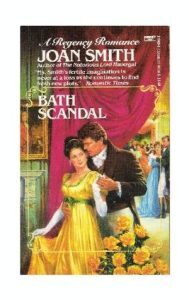 Another winner from Joan Smith, with a charming heroine, an initially grumpy but soon melting hero, some amusingly horse-mad minor characters and a creative ending.
Here’s the premise: eligible Lord Southam is betrothed to manipulative Deborah Swann, but the marriage is being delayed by his eldest half sister, Gillian, who cordially dislikes Deborah, and the feeling is mutual. Deborah has sworn she won’t marry Southam until Gillie is safely married and out of the house. But where to send her? The girl’s head is full of horses and not much else, she’s too gauche to be set loose on the London marriage mart and there are no suitable relatives. But there’s the widow of Southam’s cousin, Beatrice Searle, who lives in Bath, and is also an old school friend of Deborah’s. She would do, and it would get Gillie out of the house for a few weeks. After all, what can she possibly get up to in Bath?
Bea Searle is delighted with the idea. She remembers Lord Southam very well, since he flirted with her outrageously at her own wedding, knows that he’s not yet married and sees a perfect opportunity to weigh up the possibility of a second, and very agreeable, husband. She’s very put out when it’s not Southam himself who brings Gillie to Bath, only her former governess, Miss Pittfield. For a while, she lets her peevishness sour her relationship with Gillie, but she soon sees that the girl is homesick and in need of some gentle mothering, and her sympathies are aroused.
After this, they get along swimmingly, as Bea introduces Gillie to her horsiest acquaintances, manages to smarten her up a little and takes her off for some gentle evening entertainments. But Southam is concerned by the seemingly raffish nature of Gillie’s new horsey friends, and decides to drive to Bath to take a look at them, and this is where the book really takes off. Bea and Southam, after a chilly start, soon rediscover the fun of flirtation, the raffish friends turn out to be a duke and his uncle, and Southam starts to make unfavourable comparisons with his future wife. Deborah’s managing ways are not nearly so agreeable as Bea’s lively, not to say welcoming, nature.
Once the project to marry Gillie to the equally horse-mad duke gets underway, there’s a trip to Bournemouth, where Southam makes the mistake of a heavy-handed nocturnal approach to Bea, and gets the sharp end of her Irish temper. Happily, he’s too far along the road to being in love with her to let things stand, so the story becomes the familiar one: how to escape his now unwanted betrothal to Deborah? I have to say, Southam’s methods are ingenious.
This was a thoroughly enjoyable read, despite a number of anachronisms and Americanisms. The banter between Bea and Southam is delightful, Gillie and her duke are great fun, and even Miss Pittfield is given a spirited personality. As ‘villains’ go, Deborah is as entertaining as they come, and no doubt she’ll find some other muggins to manipulate into marriage. A great read. Five stars.
Review: Petteril’s Portrait by Mary Lancaster (2024)
 Another good outing for our likeable but improbable sleuths, Piers and April. Not a lot of progress on their relationship, but I suspect the author’s going to milk it for all its worth. I have to say, I don’t quite see where the inevitable happy ending is coming from, but we’ll see.
Here’s the premise: new viscount Piers, Lord Petteril, is asked to call in at a friend’s house instead of going direct to his own estate. A portrait of his late father has been damaged, and it’s upsetting for everyone, not least his stepmother, Lady Haggard. His ex-thief ‘assistant’, April, hates the idea; Piers wanted to leave her with Lady Haggard to be trained as a servant, and was only dissuaded after some effort on April’s part. Now she wonders if she should trust him. But Piers is getting a reputation for solving mysteries, so to Lady Haggard’s house party they are to go.
The mystery is the usual thing – a range of suspects, and a great deal of careful questioning and observation by Piers and April. April is able to move between upstairs and downstairs, which makes her particularly useful, and her background as a ne’er-do-well, always looking out for trouble coming her way, makes her very observant. Piers’ relations are well to the fore, as well, including his obnoxious aunt, and his cousin Gussie, a young lady who seems to attract undesirable types like a magnet and frankly is very poorly chaperoned. House parties are notorious for shenanigans, and this one has inordinate numbers of people wandering the upper corridors at night.
The mystery takes a neat twist towards the end of the book, with an explanation that I didn’t see coming but was very satisfying. A very enjoyable five stars, but I still wonder where Piers and April will end up.
Review: The Country Gentleman by Fiona Hill (1987)
 This is an odd sort of book, one where I hated the heroine for most of it, found the hero incomprehensible and thought many of the events implausible, yet I still enjoyed it thoroughly. Partly, that’s because of its age; it doesn’t conform to modern standards and so I found it surprising in a multitude of ways, and that’s far better than being predictable. There are some spoilers below, so don’t read on if you don’t want to know.
Here’s the premise: Anne Guilfoyle is a spinster of twenty-eight, living happily in London surrounded by friends, especially her admirer and the man she has loved for ten years, Lord Ensley. Unfortunately, she has only a very small portion and he needs to marry wealth, so he can’t marry her, but they’ve drifted merrily through the years so far, so why should that change? But change it does, for three things happen more or less simultaneously. Firstly, Lord Ensley is about to marry a suitable (and rich) young lady. Secondly, Anne’s lawyer, who has been managing her funds, has lost the lot. And thirdly, she has been left a small estate in Cheshire. You see what I mean about implausible? Two of those things I might accept, but three? No.
Be that as it may, it forces Anne to leave her beloved London (or civilisation, as she sees it) and her equally beloved Lord Ensley, and decamp with her widowed companion, Maria, to Cheshire. Here she finds the house provincial and the nearest neighbour, one Mr Henry Highet, a country bumpkin. He is single and lives with his very managing mother.
It should be noted at this point that Anne is a raging snob. She lives for sophisticated society, of which she is a leading light on account of her incisive wit, and that kind of frivolous banter is sadly lacking in Cheshire. She despises Mr Highet, although when it comes to learning how to manage her newly acquired estate, she finds that he’s both knowledgeable and willing to help her. Thus she discovers that there’s more to him than she’d originally suspected.
Into this bucolic existence comes the aforementioned Lord Ensley, who’s exerting all his persuasive powers to drag Anne back to London. He misses her, you see, and he’ll quite happily fund her. Some of her other London friends arrive for a visit, and decamp after a couple of days, finding it too dull for words. But she’s beginning to find sources of pleasure, even so far from London, so she sends Lord Ensley away with a flea in his ear.
So now we come to the spoiler. On the precise day that Lord Ensley is due to marry his heiress, Mr Highet makes a proposition to Anne. If they marry, he will make a settlement on her which will allow her to return to her life in London, and in exchange, he gets her estate. It will be a marriage of convenience only, since he’s perfectly content with his mother for company. For Anne, it’s perfect. She gets her life back, and also the company of her beloved Lord Ensley, who seems prepared to continue indefinitely with their cosy companionship, despite his marriage.
But why does Henry suggest such a thing? It’s fairly obvious to the reader that he’s in love with Anne, but if so, it’s a huge risk he’s taking. I’m not sure I believe in a man who’s so selfless that he’d sacrifice his own happiness entirely for the woman he loves. After all, once she’s settled in London, she might never come back at all, and his mother certainly doesn’t want her to.
Of course, once back in town, Anne discovers that Lord Ensley is a shallow, strutting coxcomb, whom she doesn’t even like very much, and this sudden revelation is perhaps the most implausible part of the whole book. She’s been in love with him for ten years, for heaven’s sake, and now she isn’t? Usually when ‘the scales fall from the eyes’ in that dramatic way, it’s because the object of affection has done something unspeakable, a betrayal of some sort. But no, Ensley’s the same as he’s always been, and we’re supposed to believe that a few months of Henry’s simple country goodness has been enough to effect this transformation? Well, whatever, and it has the desired effect because Anne hotfoots it back to Cheshire for the romantic reconciliation.
And despite all my grumbles about plausibility, I still enjoyed this enormously. I do like these older books that surprise my twenty-first century self at every turn. So four stars, and I recommend it on the grounds that these issues won’t bother most people in the slightest.
Review: Petteril’s Ladybird by Mary Lancaster (2023)
 The third part of this series of short cosy/Regency mysteries, which are best read in sequence. This episode worked even better than the previous two – not sure whether the author’s getting into her stride now, or whether the characters have just reached a more interesting stage of their relationship, but I have to say I enjoyed this a lot.
Here’s the premise: Piers, the new and still uncertain-in-his-role Viscount Petteril, returns to London with his former thief ‘assistant’ April to solve a murder. An earl’s son has been shot in the home of his mistress, and the main suspect is the mistress’s former protector, and Piers’ friend. As usual, there’s a wonderful array of suspects, surrounded by quirky upper-class characters (somehow it’s never the lower classes who do the murdering), and the solution is satisfying on a number of levels. There’s a nice (if rather surprising) little romance on the side.
But the main interest (for me, anyway) is the development between Piers and April. The murder is loosely connected to April’s past, so we learn a little bit of her history, although I suspect there’s more to come. The two have always had an unusually close relationship for an aristocrat and an uneducated employee, rooted in the fact that they met when they were both at low points in their lives. They helped each other to move forward, and because of that have developed an intimacy that is clearly problematic. Something happens in this book that throws this into stark relief and they have to decide whether to continue their odd relationship or not. Needless to say (because there’s at least one more book to come, and the series could be spun out indefinitely) they stay together. But it remains to be seen whether that will work out, and how they resolve the problem in the end.
A most enjoyable read, without the implausibilities and pesky editing errors that plagued book 2, so I’m going for the full monty this time. Five stars.
March 10, 2024
Review: Petteril’s Corpse by Mary Lancaster (2023)
 This is book 2 in the series, and although this could be read as a stand-alone, it will certainly be more meaningful if you read the first book beforehand. This is another short read, an intriguing murder to solve, some interesting locals in the frame, a mini-romance on the side and (the star attraction) the developing and most unusual relationship between the hero and heroine.
Here’s the premise: Piers, Viscount Petteril, is getting used to the title he’s unexpectedly inherited which has dragged him away from an academic life at Oxford. Having tidied up his London house, it’s time to turn his attention to his country seat. I couldn’t quite work out where this was (if a county was mentioned, I missed it) but since he drove there in his curricle without difficulty, it’s got to be close to London. Although I was a bit surprised to hear that the countryside was devoid of humans – only fields and woods, apparently. Whatever happened to all the villages strung along every road in England?
Piers chooses to take his reclaimed thief from book 1 with him, now reluctantly assuming her proper identity as a girl (April instead of Ape), complete with long skirts and a servant’s cap. She’s his ‘assistant’, apparently, despite having only just begun learning to read and write. Just as they come within the environs of Piers’ land, April smells smoke and not the healthy kind – someone’s burning clothes, and her gutter-bred soul is outraged by this waste. But when they investigate, they find it’s a lot worse than that – a man’s naked body, stabbed through the heart. Without his clothes, how can they possibly identify him?
Thus begins the murder investigation, which goes the way such tales usually go. There’s a range of possible suspects, all with motives to possibly want the man dead, but which of them did it? I have to say, I didn’t find this one difficult to work out, but then the fun of a book like this is not the identity of the murderer, but the hoops the protagonists have to go through to get there.
Along the way, Piers is tentatively getting to know the neighbours, who remember him as the runty youngest of the cousins, who was pushed around a lot and no one thought would ever amount to anything. April is finding her feet as an ‘assistant’, while also helping out in a multitude of different ways around the house. She it is who takes over the organisation of an afternoon party from the housekeepers, and this is one of the bones of contention I have with this book. April has (presumably) spent her whole life in the gutter, living from hand to mouth, and mingling with the worst sort of lowlifes in the slums of London. But give her a hand out of there, teach her a bit of reading and writing, and in no time she’s taking copious notes for Piers, and telling the housekeeper (a woman trained over many years in the ways of the aristocracy) how to organise a party. The words ‘Mary Sue’ hover in very close proximity to her head.
Piers isn’t much better. Runty academics tend not to know much about dead bodies, but Piers talks quite happily about rigor mortis to the magistrate, and arm-waves it away with a casual reference to knowing some medical students at Oxford. His other superpower is not recognising people’s faces unless he’s seen them a lot, but this is something that flickers on and off, as the plot requires it. He also appears to be an Oscar-worthy actor, again, when the plot requires it. So what with that and April’s astonishing learning ability, there’s quite a bit of suspension of disbelief required.
One other (minor) complaint. There’s quite a bit of sloppiness in the writing, as if the author forgot a final edit. There are words missing, incorrect punctuation, repetition (we’re told a character has no grey in her hair twice just a few paragraphs apart). It’s not a big deal, it just looks untidy.
But overall, this was a fun read, and for anyone who likes a blend of cosy mystery in a Regency background, I recommend the series. Only those over-powered main characters keep this to four stars.
Review: Petteril’s Thief by Mary Lancaster (2023)
 NOTE: not a Regency romance as such, more of a Regency cosy mystery.This book had a difficult start – the hero is first encountered on a high balcony, contemplating suicide. Although he doesn’t jump (obviously!) and goes on to behave far more sensibly, I found it hard to get past that opening. Can a man who is suicidal really recover his spirits so quickly? Creative licence, perhaps, but to me it was a jarring note.
Here’s the premise: Piers Withan is an academic at Oxford, happily buried in his books and not interested in the world outside. But when a number of family deaths lead to him inheriting a viscountcy, he reluctantly leaves the world of academia and returns to London to take up his role as head of the family. This is where we first see him, so miserable that he contemplates ending it all. But he’s rescued from the brink by the unlikely person of Ape, a sneak thief, sent into the seemingly empty house to steal whatever could be found. There’s not much – the Withan family have already been through it helping themselves, including swiping a valuable ruby necklace.
This sets in train the mystery. Piers tracks down Ape and recruits the thief to help, with a job as a groom and as the tiger who rides on the back of his curricle. Piers has to try to decide which of his resentful and greedy relations actually stole the necklace, and he finds himself increasingly drawn into their convoluted affairs. They, in turn, realise that he might be small and bookish, but he’s cleverer than they are and won’t be pushed around.
This is a short book but it covers a lot of ground, setting up the two principal characters of Piers and Ape as well as the basic plot. Book two sees them off to the country to see what’s brewing at Viscount Petteril’s estate, which I have already bought and plan to read immediately. This would be five stars but for that dismal opening, so four stars it is.
March 2, 2024
Review: Holiday in Bath by Laura Matthews (1981)
 Oh dear. Two fairly hard-to-like principals, a very uneven plot, some over-the-top silliness from the heroine, and a rabbit-from-the-hat romance (you know how this one goes: I don’t like you… I don’t like you… oh, I’m in love). I kept reading because… well, I’ll get to that, but boy, was it a slog, sometimes.
Here’s the premise: Trelenny Storwood is the only child of her parents. Cranford Ashwicke is the only son of the neighbours. So naturally they’re expected to marry. Cranford is dutifully courting Trelenny… no, wait a minute. What sort of name is Trelenny? If this was set in Cornwall, I could just about accept it, but in Westmorland? And Cranford isn’t much better. This at a time when half the baptisms in England were for Anne, Elizabeth, Mary or Charlotte (for girls) or John, Edward, William or George (for boys).
Anyway, Cranford is courting Trelenny, even though he thinks she’s a hoyden and every time he meets her, he ends up correcting her behaviour. As for Trelenny, she just thinks he’s dull, not to mention old (at twenty-eight!). They snipe at each other constantly, more like brother and sister than a courting couple, so although Cranford has officially asked permission to pay his addresses, he hasn’t officially asked her yet because he’s pretty sure she’ll refuse.
So the big question is – why on earth is he even bothering with this courtship, when neither of them is very keen on the other? I confess, that’s the question that pulled me along through the swamps of implausibility that bogged down much of this book. We don’t get an answer until almost the end, when there’s a rush of revelations, some of which actually made some sense. But by then it was a bit too late to redeem things.
Here’s one of the more problematic elements, for me. Quite early in the book, Cranford pays a visit to a very classy brothel, where he has dinner, plays some cards and then beds his favourite lady. He seems to have a very cosy relationship with her, is fond of her and regrets that he isn’t rich enough to keep her as his mistress. She tells him not to worry because she’d rather work at the (very classy) brothel and have friends around her. Which is all very cosy and all, but what is the hero of a Regency romance doing in a brothel anyway? Nor is this a final farewell before he settles down to marriage and faithfulness. So yuk to that.
Then there’s the uncle who turns up and immediately starts pawing Trelenny (and her mother!), and neither of them makes a fuss because the father has heart trouble and the stress might make him pop off. So instead, they take off for Bath with Cranford, something that Trelenny has been angling for for a while, having had a very curtailed rural life and quite understandably wanting to see a bit of life before she settles down to domestic bliss. Or marriage to dull Cranford.
But then on the journey there’s an outbreak of stupidity on Trelenny’s part that almost broke the silly-o-meter. It involves her dressing up in men’s clothes, roaming the streets at night and eventually getting roaring drunk, and all because she’s too silly to say no. There’s an eloping couple involved, and although they do have a small part to play later, I’m going to say that I think the whole point of this whole episode was so that Cranford had to undress the drunk-unconscious Trelenny and get her into her nightgown and into bed. Yuk to that, too.
Bath gets quite interesting, because Trelenny discovers to her dismay that it’s not at all like her dreams and really, it’s all a bit hit and miss, just like every other part of real life. This was really nicely done. Meanwhile Cranford is being pursued with vigour by a former squeeze, and he actually does the right thing here and rejects her, but for the wrong reason (because he’s got his little friend in the brothel if he wants that sort of thing). So yuk again. And he’s also hanging out with an old friend, Lady Jane, who seems to Trelenny’s eyes to be a much better match for him, so she’s convinced that she’s lost him for good.
I’ll spare you the details of the rest of it. Naturally it all comes right in the end, and reasons are given for the various misunderstandings and motivations, but I was really past caring at that point. There were some nice lines – Bath is described as a ‘mushroomy watering hole’, for instance, but there are a number of Americanisms, like stoop, visit with and ‘on High Street’ (Brits would say ‘on the High Street’). I never warmed to Cranford and his dodgy moral compass, but I quite grew to like Trelenny in the end, even if she was made to veer between utter stupidity and common sense to suit the purposes of the plot. Ultimately there were too many yuks and the plot was too uneven for me to give this more than three stars.