Kari Chaplin's Blog
June 26, 2026
Traditional Writing vs. High-Concept Thriller Prose: Why One Tells a Story and the Other Tightens the Noose
Some stories invite you in gently.
Others lock the door behind you.
That is the emotional difference between traditional writing and high-concept thriller prose.
Both can be beautiful. Both can be powerful. Both can break your heart if they are written well. But they move differently on the page. Traditional prose often lingers. It gives the reader atmosphere, emotional reflection, description, and space. High-concept thriller prose still cares about beauty, but it sharpens every sentence until it feels like something dangerous is hiding under the floorboards.
Traditional writing says, Come closer. Let me tell you what happened.
High-concept thriller prose says, Come closer. But don’t trust the room.
What Is Traditional Writing?Traditional writing is usually more grounded and emotionally open. It allows the character to think, feel, notice, and process. The prose may be elegant, descriptive, and layered. It often moves at a steadier rhythm, giving the reader time to sit inside the scene.
The emotional effect is intimacy.
The reader understands what the character feels because the writing gives them room to breathe.
Traditional writing is not boring. Let’s be clear on that. Bad writing is boring. Traditional writing can be gorgeous. It can feel like candlelight, old letters, rain on windows, and grief sitting politely at the table.
It is often built from:
Rich descriptionInternal reflectionEmotional claritySlower tensionA sense of realismBeauty in the sentence itselfTraditional writing lets the reader understand the emotional truth.
What Is High-Concept Thriller Prose?High-concept thriller prose is built for pressure.
It takes a strong, gripping premise and writes every scene as if there is a secret bleeding through the wallpaper. It does not simply describe what is happening. It weaponizes what is happening.
The emotional effect is unease.
The reader may not know why they feel nervous yet, but they do. That is the magic trick. Or the knife trick, depending on the book.
High-concept thriller prose is often built from:
Shorter, sharper sentencesEmotional contradictionSuspicion beneath ordinary momentsA strong hook or premiseTension in every detailA feeling that the truth is close but not fully visibleBeauty with a blade inside itTraditional writing may say, She was afraid.
High-concept thriller prose makes the reader afraid before the character admits she is.
The Same Scene, Written Two WaysLet’s use the exact same basic moment:
A woman wakes in the middle of the night and hears a sound downstairs.
Simple scene. Classic setup. Nothing fancy.
Now watch how the emotional experience changes.
Version One: Traditional WritingI woke to the sound of something moving downstairs.
For a moment, I stayed still beneath the blankets, listening to the quiet house settle around me. The bedroom was dark except for the faint blue light from the alarm clock on the nightstand. Beside me, Daniel slept heavily, one arm thrown over his face, his breathing slow and even.
The sound came again.
A soft scrape.
I sat up carefully, not wanting to wake him too quickly. The old house made noises at night. Pipes shifted in the walls. Wind pressed against the windows. Sometimes the floorboards creaked when the temperature dropped.
Still, my heart began to beat faster.
I reached for my robe and slipped out of bed, pausing when my feet touched the cold floor. The hallway stretched ahead of me, shadowed and still. Downstairs, everything was quiet again.
“Daniel,” I whispered.
He didn’t move.
I told myself it was nothing. A branch. The ice maker. The house breathing in its sleep.
But when I reached the top of the stairs, I saw the kitchen light was on.
How Traditional Writing FeelsThis version is atmospheric and emotional. It lets the reader settle into the moment with the character. We know what she hears, what she thinks, how she rationalizes it, and how fear slowly rises in her body.
The tension is present, but it is controlled.
The prose gives us a believable human reaction: she listens, explains it away, tries not to panic, and slowly moves toward the source.
This version creates suspense through patience.
It feels like walking through a dark hallway with one hand on the wall.
Version Two: High-Concept Thriller ProseThe first sound woke me.
The second made me stop breathing.
Beside me, Daniel slept with one arm over his face, peaceful as a man with nothing to hide.
That was what I told myself then.
The house was old. Old houses complained. Pipes knocked. Wood shifted. Wind dragged its nails down the siding.
Then came the scrape again.
Not outside.
Downstairs.
I sat up.
The bedroom held its breath with me.
Daniel didn’t move.
“Daniel,” I whispered.
Nothing.
Of course nothing.
I slid from bed, the floor cold under my feet, and reached for the robe hanging on the chair. My fingers missed the sleeve twice before I caught it.
At the top of the stairs, I saw the kitchen light glowing below.
We always turned it off before bed.
Always.
Except tonight, apparently.
Except on the night I would later learn Daniel had not been asleep when I woke.
How High-Concept Thriller Prose FeelsThis version does not simply describe fear. It creates suspicion.
The same facts are there: the woman wakes, hears a sound, Daniel sleeps beside her, the house is dark, the kitchen light is on.
But the emotional engine is different.
The line “peaceful as a man with nothing to hide” changes everything. Suddenly, Daniel is not just sleeping. He is being framed by suspicion. The ordinary detail becomes dangerous.
Then the final line widens the scene beyond the moment: “Except on the night I would later learn Daniel had not been asleep when I woke.”
That is high-concept thriller prose doing its dirty little job.
It makes the reader ask:
Why was he pretending?What does he know?Was the sound meant for her?Is the danger downstairs, or in the bed she just left?High-concept thriller prose is not just about what happens.
It is about what the reader fears might be happening.
The Emotional DifferenceTraditional writing often gives the reader emotional access.
High-concept thriller prose gives the reader emotional instability.
In traditional prose, the reader walks beside the character.
In thriller prose, the reader walks beside the character while quietly checking every mirror, doorway, husband, memory, and sentence for blood.
Traditional writing says:
This is what she felt.
High-concept thriller prose says:
This is what she felt, but she was wrong about why.
That difference is everything.
Traditional Writing Wants BeautyTraditional prose can be lush. It can be elegant. It may take time with a room, a memory, a gesture, a smell, a season. It trusts the reader to stay because the emotional world is rich.
A traditional sentence might sound like this:
The house was quiet in the strange, tender way old houses became quiet at night, as though every room had folded itself into sleep.
That is beautiful.
It creates mood.
It invites the reader to linger.
High-Concept Thriller Prose Wants Beauty That BitesThriller prose can still be beautiful, but the beauty should feel unsafe.
A high-concept thriller sentence might sound like this:
The house was quiet in the way a liar is quiet after saying too much.
That sentence does not simply describe the house.
It accuses it.
That is the difference.
In high-concept thriller prose, description should carry threat. A room is not just a room. A smile is not just a smile. A husband sleeping peacefully may be the most terrifying image in the chapter.
The Best Thriller Prose Has Two Stories Happening at OnceThis is where high-concept thriller prose earns its keep.
On the surface, one thing is happening.
Underneath, another thing is being suggested.
Surface story:
A woman hears a noise downstairs.
Hidden story:
Her husband may be lying.
The house may not be safe.
The ordinary world may already be broken.
The truth may have been in the room before she ever opened her eyes.
That layered tension is what gives thriller prose its pulse.
Every scene should feel like it has a visible body and a buried skeleton.
So Which Style Is Better?Neither.
But they serve different gods.
Traditional writing serves depth, beauty, reflection, and emotional truth.
High-concept thriller prose serves tension, momentum, suspicion, and revelation.
The strongest books often use both.
They give us traditional beauty so we care.
Then they use thriller prose to ruin our sense of safety.
That is where the magic lives.
You make the reader comfortable enough to fall in love with the world.
Then you tilt the floor.
Final ThoughtTraditional writing opens a door.
High-concept thriller prose opens the same door and makes you wonder who unlocked it from the other side.
Both styles can be emotional. Both can be literary. Both can be unforgettable.
But if the goal is to make a reader turn pages with their pulse in their throat, high-concept thriller prose has to do more than sound pretty.
It has to haunt.
It has to suggest.
It has to make every ordinary thing look guilty.
Because in a thriller, the scariest sentence is rarely the one with blood in it.
It is the one that makes the reader realize the blood was there three chapters ago, and they missed it.


May 24, 2026
Writing the Way People Feel
You’ve probably noticed something about my writing by now.
The pauses.
The sharp turns.
The one-word lines.
The dashes where some people would use commas—or semicolons—or those floating little three dots that trail off into nowhere.
That isn’t accidental.
Not one bit of it.
I write the way people feel.
And feelings are rarely neat and orderly.
Your heart does not beat in perfect grammar. Grief does not arrive in tidy paragraphs. Desire does not politely wait its turn. Fear interrupts. Love stumbles. Trauma repeats itself. Longing lingers in the doorway long after the conversation is over.
So when you read my work, I want you to feel that humanity breathing beneath every sentence.
I want you there.
Not standing outside the story looking through a window like some distant observer with a cup of coffee and mild curiosity. No. I want you sitting at the table with them. I want your chest tight during the arguments. I want your pulse to pick up during the almost-kiss. I want you to miss the characters when you close the book like they were real people who once occupied space beside you.
Because to me—they are real.
And when you enter one of my worlds, you matter there too.
You are not just a reader passing through. You are the heartbeat keeping the lights on in those worlds. Every page is written with the hope that somewhere, somehow, a line will crawl under your skin and whisper, “You understand this too, don’t you?”
That connection matters more to me than rigid perfection ever will.
Yes, grammar matters. Structure matters. The old rules became old rules for a reason. They built the bones of literature. But storytelling is more than diagramming sentences under fluorescent classroom lights while somebody tells you there is only one correct way to bleed onto paper.
There isn’t.
Sometimes the most devastating line in a chapter is two words long.
Sometimes a sentence needs to unravel slowly—beautifully—like silk slipping through trembling fingers because the emotion itself refuses to hurry.
And sometimes?
A dash cuts harder than a comma ever could.
That pause—that interruption—that sharp inhale in the middle of a thought—that is rhythm. That is tension. That is human.
I use every tool available to me. The classic ones. The modern ones. The broken little fragments some people insist are “wrong” despite the fact that they make readers feel everything all at once.
Because the goal was never to sound academic.
The goal is obsession.
Immersion.
Connection.
I want you invested. Completely.
I want you staring at the ceiling at two in the morning replaying a single line over and over because it struck something inside you that you weren’t prepared to face.
If you don’t ache with the characters…
if you don’t yearn…
if you don’t feel haunted after the final page…
then I haven’t done my job.
And I take that personally.
So yes, my writing bends when the emotion demands it. It sharpens when the scene needs blood in its teeth. It softens when a moment deserves tenderness. It becomes poetic when poetry is the truest language available.
Because stories are alive.
And alive things do not move in straight lines.
Neither do you.
That’s why you belong here.
March 21, 2026
My Father's Last Gift: The Flower That Built a World
Read the full cover history here → The Story Behind the Darkness Awakens Cover
<A Flower Drawn in GoodbyeSome stories begin with an idea.
This one began with a goodbye I could feel coming long before I could say it out loud.
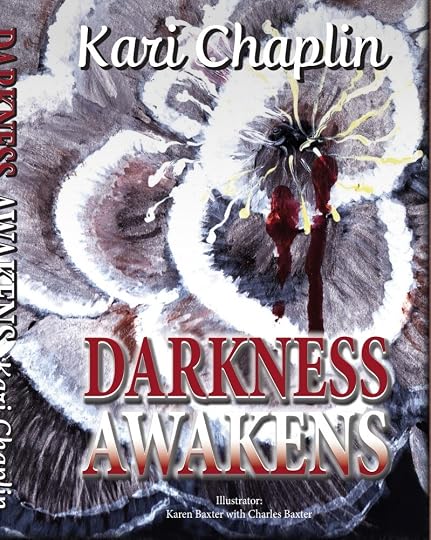
My father drew the flower for Darkness Awakens—not as decoration, not as branding, but specifically for the cover, specifically for me. He made it knowing he wouldn't have time for grand speeches or long explanations. So he gave me what he could give: a piece of his hand, his heart, his love—pressed into something that could outlive his body.
When I rushed Darkness Awakens into publication, there was no marketing plan, no strategy, no polished rollout. There was only urgency—pure and shaking. I wasn't trying to “launch a book.” I was trying to get it into my dad's hands while he was still here, while he could still see the proof that I finished something. That I made it real.
I got the book to him one week before he died.
He held it and broke—proud, overwhelmed, undone. He cried the way people cry when something matters so much it doesn't fit inside their chest. And in that moment, I thought I was giving him a book.
Little did I know I was giving him a way to stay.
That first edition carried his flower on the cover. It was raw. It was real. And it was enough—because the flower wasn't just a drawing anymore.
It became a keeper.
The keeper of his soul.
The keeper of his life.
The keeper of his love.
And every time one of his kids—or one of his grandkids—opens that cover, the flower does what it was made to do: it brings him back, quietly, faithfully, for one more breath. For one more moment.
Not just for me.
For all of us.
le="font-family:serif;color:#d4af37;margin-top:2.5rem;">From One Book to a SeriesWhen Kissed by Darkness expanded the story into a full series, the covers needed to evolve. The narrative had grown—two books now breathing the same mythology, the same emotional architecture. They needed to look like they belonged together.
So the final Darkness Awakens cover was redesigned to match the series visual identity. The tones shifted. The typography unified. But through every iteration, the flower remained.
It became the series seal. The signature. The thing that whispers, across both covers: this came from somewhere real.
The Cover Series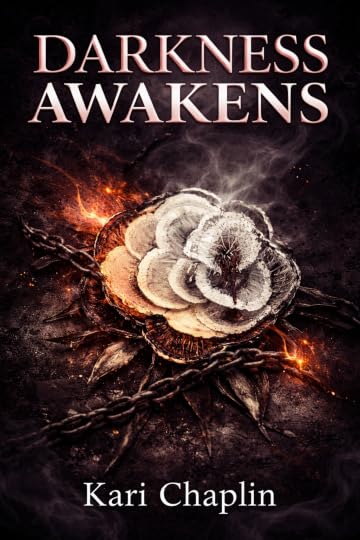
Book 1: Darkness Awakens
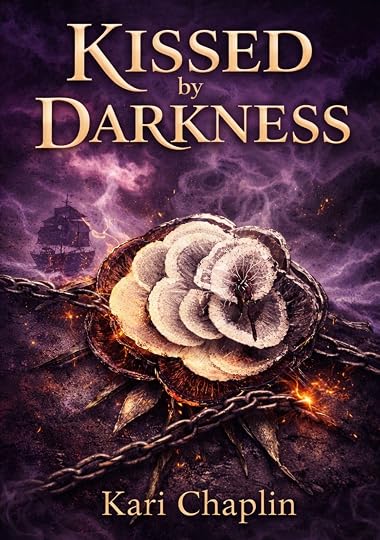
Book 2: Kissed by Darkness
Two covers. One flower. One legacy.
The Flower Lives OnEvery time someone picks up one of these books, they're holding a piece of my father. They don't know it—but the flower knows. It was drawn by a man saying goodbye, carried by a daughter who refused to let it disappear.
That's the real story behind these covers. Not design trends or market strategy. Just love, pressed into ink.
Choose your favorite retailer—Amazon, Apple Books, Barnes & Noble, Kobo, and more.
Buy the Series (All Stores) Browse All Kari Chaplin BooksThe Story Behind the Darkness Awakens Cover
Every book begins with words. But for readers, it begins with a cover — that first, split-second invitation to step inside a world they've never seen.
The cover of Darkness Awakens has been through more transformations than I can count. Each version marked a different chapter in my own evolution as an author — from the raw nerve of self-publishing to the polished identity of a series that finally felt like mine.
The Covers Through the Years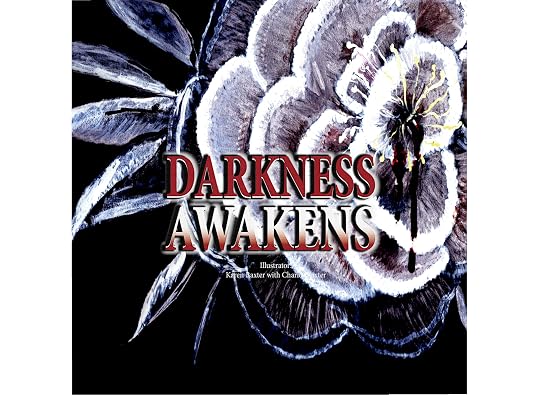
First Edition
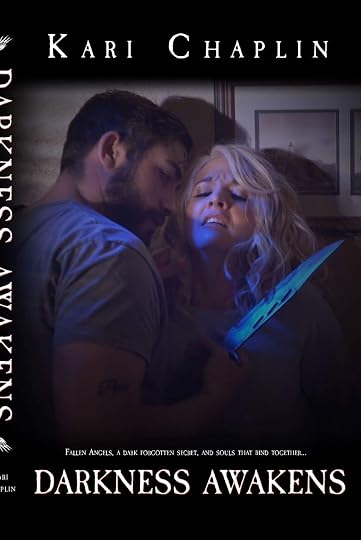
Professional Upgrade
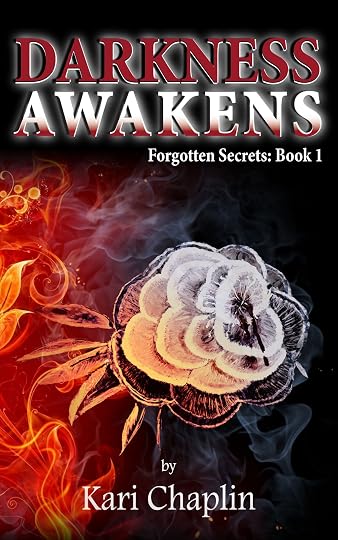
Trailer Era
I Thought It Was the Final Series Cover
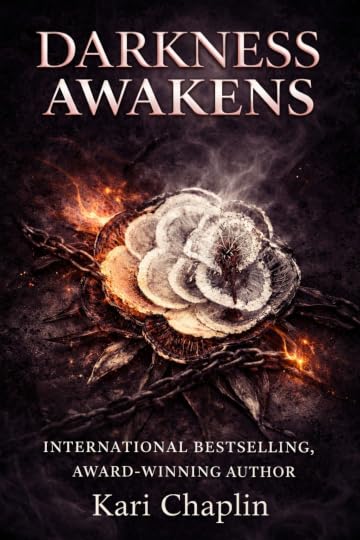
Final Series Cover
Looking at them side by side, I can see the story they tell — not just of a book, but of a writer learning to trust her own vision. The first edition was bold and imperfect. The professional upgrade gave it polish. The trailer era made it cinematic. And the final series cover? That one finally felt like home.
The Trailer That Changed EverythingSomewhere between the third and fourth cover, I made a book trailer that captured the atmosphere I'd been chasing all along — the night orchids, the pull of something ancient, the danger that feels like desire. This is the one:
Watching it now still gives me chills. It's the moment the series stopped being just a book and started becoming a world.
What Comes NextThe next chapter of this story is the cover series — how Darkness Awakens and Kissed by Darkness became one visual mythology.
February 13, 2026
So… Here I Am
Why I Write the Way I Do
Every writer develops a rhythm. A fingerprint. A pulse beneath the prose that makes it unmistakably theirs.
Mine happens to breathe in pauses.
And yes — I use dashes.
On purpose.
Not because I don't know grammar. Not because I'm careless. Not because a machine is writing for me.
Because I understand timing.
The dash — the em dash in particular — is a legitimate literary tool. It signals interruption, hesitation, revelation. It can sharpen tension. It can delay a truth just long enough to make it sting. It can create a dramatic beat that a period simply cannot.
A period ends a thought.
A dash holds it hostage.
When I write:
He stepped closer — too close — and I forgot how to breathe.
That pause isn't accidental. It forces the reader to feel the proximity. It stretches the moment. It lets the body react before the brain catches up.
That's not artificial.
That's craft.
There's an assumption floating around lately that frequent dash usage equals AI writing. That somehow the presence of an em dash is evidence of automation instead of intention.
That's not only incorrect — it misunderstands the history of writing itself.
Writers have used dashes for centuries. Emily Dickinson practically lived inside them. They allow voice to feel conversational, urgent, fractured, emotional. They mimic how people actually think — not in clean, textbook-perfect sentences, but in layered reactions and interrupted realizations.
I write stories that are dramatic, psychological, emotionally loaded. My characters don't think in tidy paragraphs. They spiral. They pause. They catch themselves mid-thought. They hesitate before a truth they don't want to admit.
The dash is the closest punctuation mark to breath.
And breath matters.
I care about pacing. I care about how a sentence lands in the body. I care about the silence between words as much as the words themselves.
Sometimes a comma is too soft.
Sometimes a period is too final.
Sometimes only a dash can carry the weight of what's unsaid.
If my work feels cinematic — that's intentional. If it feels like something is building beneath the surface — that's intentional. If a line makes you pause before moving on — that's intentional.
Writing is not just grammar.
It's rhythm.
It's timing.
It's tension.
And the dash is one of the sharpest tools in my toolbox.
So no — it's not AI.
It's voice.
And I'm not giving it up.
January 24, 2026
Welcome to the Blog
Hello, lovely readers!
Welcome to this little corner of the internet where I'll be sharing everything from writing updates and book announcements to the occasional glimpse behind the scenes of my creative process.
What to ExpectHere's what you'll find in this space:
Updates – News about upcoming releases, cover reveals, and publishing milestonesBehind the Scenes – The messy, caffeinated reality of being a writerEvents – Signings, readings, and other appearances where we can meet in personWriting – Thoughts on craft, inspiration, and the stories that haunt me"Every book is a journey, and I'm grateful you're here to take this one with me."
Thank you for being here. Whether you've been with me since the beginning or you're just discovering my work, I'm so glad you found your way to this page.
Stay tuned for more updates, and don't forget to join the newsletter to get exclusive content delivered straight to your inbox.
With ink-stained fingers and caffeine-fueled dreams,
Kari
September 22, 2017


Darkness Awakens had been Nominated!
I’m am excited to announce that Darkness Awakens has been nominated for Reader’s Choice Award. What an honor. I want to first of all thank my current readers. Without this nomination wouldn’t even be possible. I would like to invite those who have not discovered this wonderful book to visit KariChaplin.com/books to view the trailer & more! It is available on all ebook platforms and in print just visit karichaplin.com for more details on purchasing options. Please vote at https://www.tckpublishing.com/readers-choice-voting


July 9, 2017
Week 4-What do you see?
“Are they near?” I asked Cecelia.
“Coming from our left, get ready,” she advises our group.
“Let’s finish this!” I say as our enemies come into view. “Ready?”
“As ready as ever,” Steve replied with an ornery smirk. As the enemy clan encircled us, I felt a surge of strength and power wash through my frame.