
Rachel Neumeier's Blog, page 14
April 20, 2025
Update: FINISHED AT LAST!

By which I do not mean actually finished-finished. I mean: the draft is finished, but the back half is rough. Rough-ish. The front half, until we get through the pass and into the starlit land, is fairly well polished, though I’m still, you know, tweaking. I’m trimming a bit and tightening a bit and reading through my notes and going OH, RIGHT and tweaking some more. This is fine. I rather enjoy this part, in fact.
Then we get through the pass into the starlit country and I start to draw in the Tarashana people and naturally I found out a lot more about them en route to the ending, so of course they are not sufficiently consistent all the way through this part of the story. I am vividly aware of this, but straightening it out is going to be (a) a nuisance and a half, and (b) imperfect, I would bet, and therefore I’m expecting to send the earliest version of the polished draft to readers who are especially good at continuity earlier rather that later in the beta process. That way, these early readers can say, “Wut?” and “But on page 400 it says thus-and-so, which directly contradicts this bit on page 602,” and “Wait, wait, if the Tarashana ________, then why can’t they also ________?” and so forth.
On the other hand, getting through the last chapter was an absolute bear and therefore I’m pretty darn pleased to have gotten through it. Various things happened that I just did not see coming very far in advance, so framing it in my mind was hard. What I mean is, in contrast, let me see … All right, so RIHASI also went long in draft and parts of it were much more difficult than other parts, so it makes a good comparison.
When I started to write RIHASI, I didn’t have the first chapter in my mind, and that was difficult and slow. Ditto for some of the other earlier chapters. But that scene or series of scenes at the end, where Rihasi finally lays out her case for Lord Aras? I had a huge proportion of that scene in my head, right down to some of the specific dialogue, for months before I got there. So when I finally did get there, whoosh, straight through, very fast.
For HEDESA, it was completely the other way around, so I knew exactly how I was going to do chapter two, complete with a lot of the essential dialogue, long before I wrote it. But I didn’t know anything much about the ending chapters. Very different experience! I like it better the other way, like RIHASI. Working toward something I have very clearly in my head is more fun than fumbling toward something that I don’t have a clear picture of.
Well, whatever, I’m through it now and into primary revision. Primary revision USUALLY does not take that long, so I hope I will be sending the draft to early readers by May 1, though it might take a little longer.
However, the whole first half is in pretty good shape, and it won’t be any trouble to continue dropping half a chapter or a full chapter into my Patreon every week until I finally drop the whole complete thing.
Please Feel Free to Share:


The post Update: FINISHED AT LAST! appeared first on Rachel Neumeier.


April 17, 2025
What Makes a Bad Book Popular? Pacing.
This is a perennial question, isn’t it? Of course it is! Generally it’s pronounced in a tone that is envious, angry, or both, but let us try to restrain that sort of unhelpful emotional reaction and rephrase the question in a way that is both more helpful and more positive:
What do bad books do well, so that they appeal to readers even though they are not well-written?
I do think that’s a much more helpful way to ask the question.
Badly written: The Last Druid by Terry Brooks, where Brooks shoves the reader away by using a ton of “She was reminded of how precarious her situation was” and “She forced herself to concentrate, to stop the rambling flow of her thoughts,” types of phrases, plus a lot of unnecessary place and character names, plus a lot of thoughts about the backstory.
Here is Amazon’s currently top review for this book:
The Last Druid was a fitting … end to the Shannara Series as a whole. … It was fast paced and picked up right where The Skaar Invasion ended. Everything about the book was great, and really the only thing I can say is that this was yet another great ending to a Shannara Series.
It was fast paced. And the top review is (sorry!) boringly written, vague, and repetitive , which implies that this reader may not tend to be bothered by those qualities in fiction. I realize that is an inference that could be wrong, but it sort of struck me. You can click through and read the whole review; that’s why I linked it.
Badly written: The Da Vinci Code, where the writing inspired this parody for, one presumes, a reason. I haven’t read the book, only the parody and various reviews, such as this one, which is especially helpful here. This is most of the review, but click through to read the rest of it.
Let’s get one thing out of the way up front: the writing…is terrible. Astonishingly terrible. Make ESL students stitch 120,000 words together on their first day of class kind of terrible. I recommend wielding a pen while reading this novel, because you’ll constantly stop and underline sentences that are loaded with badness. My personal favorite: “The fond memory caused Sophie a pang of sadness as the harsh reality of the murder gripped her again.” Cliché sandwich with a side of corny triteness anyone? But, as you may have noticed, this is a four star review. Why? Well, because it’s ridiculously entertaining. … Twist after twist, revelation after revelation, the plot becomes a tangled net of intrigue as the characters race toward a showdown where truths and identities are shockingly uncovered. The book’s strongest quality is its ability to introduce esoteric history and facts without ever slowing down the pacing.
I will just note that “The fond memory caused Sophie a pang of sadness as the harsh reality of the murder gripped her again” is bad both because it’s using the same distancing report about Sophie that we saw in the book by Terry Brooks and because it’s just a silly sentence.
Badly Written: When the Moon Hatched, and here the badness is in the silly, overwrought pseudo-poetic sentences, such as Rayne fell upon the ground in a billion yearning teardrops of unrequited love, puddling in Bulder’s dips, filling his gorges with her gushing affections, although it’s hard to pick out one sentence because they’re all like that.
Here is the unbearably overwraught title, in full, as listed on Amazon: When the Moon Hatched: A Fast-Paced Romantasy with Undeniable Chemistry in a Stunning Immersive World
AND PLEASE STOP. This tendency to stuff the entire tagline, opinions and all, into the TITLE, should thankfully be on its way out. This is done in an attempt to screw with Amazon’s algorithms. According to posts like this one, stuffing allllll the keywords you can think of into the title should now be penalized by the algorithms, and I wish to heaven that change had been made before When the Moon Hatched was published (May 2024), because now they’re stuck with that title, and so are the rest of us. We will have to look at that title for the rest of time. THAT TITLE ALONE SHOULD DRIVE READERS AWAY, but last year, stuffing keywords into the title was rewarded by the algorithms, apparently.
So that may be part of why this book became popular — I mean, pure algorithm manipulation. However, I have seen references to a few influencers on social media platforms pushing this book upward. I don’t know for sure that this happened, but it seems likely. Or at least plausible.
Interestingly, looking at the 10% of the reviews of When the Moon Hatched that mention pacing, just about exactly half say the pacing is great and the other half say the pacing drags, especially in the first part (this is a summary from the AI overview at the top of the reviews). I guess we can’t declare that pacing was the single characteristic that bounced this book up to the top. Some reviews indicate it’s fairly steamy, but it doesn’t seem to be full-on smut like Fifty Shades, so that’s not it.
Though, as far as that goes, Fifty Shades demonstrates that pure smut can also make a book popular. (Very, very popular.) That’s not even unusual, as for example Laurel K Hamilton’s books shifted from novels to hard-core-plus-torture-with-a-thin-coating-of-story years and years ago (I’m not kidding) (or exaggerating). And they’re still going strong, thousands of ratings for each of the recent ones in this series. But setting that sort of exaggerated steaminess aside, how about OTHER books?
And I think the single quality that links those other books is pacing. That’s what I think does it, more than any other feature.
Or, okay, pacing and luck. Those two qualities. Luck, if the right social media influencer picks up a book and raves about it, and because social media influencers, like the rest of us, probably run this gamut —

And therefore plenty are on the left side of that curve and there you go, When the Moon Hatched, boom, popular. But without that kind of luck, then maybe it’s mostly down to pacing.
What do you think? Do you all have lots of counter examples springing to mind?
***
What contributes to the perception that the pace is fast? Some of the elements that contribute are stylistic and some are in the storytelling. Let me see how many I can hit in a rapid list:
1) Short paragraphs.
2) Short chapters.
3) Easy-to-read language.
4) Chapters that end with a mild (or serious) cliffhanger.
5) Chapters that begin with strong foreshadowing of approaching danger.
6) A good balance of interwoven exposition, description, internal thought and reactions, and external action, with the external action tending to come toward the end or beginning of each chapter. This is sort of a restatement of the two points above, I guess.
7) And, the part that I think is what people may think of first, every time the reader’s attention starts to drift away, something exciting happens. This isn’t the same thing as “lots of action,” but sure —
8) Lots of action, with the caveat that action can be direly boring and often is. Meaningful action involving characters we care about, plus the writing is good enough that we don’t just get lost, but can keep track of what’s going on.
I’m getting close to ten, so let’s see if I can’t make this a Ten Things That Make a Book Feel Fast list. How about:
9) Shallow rather than deep worldbuilding and sense of place. I mean, how much do you linger along the way? Does the author give you a chance to stroll at a leisurely pace and sniff the flowers? Or does the world barely exist as you zip through the story?
10) Rhythm. Does the story bounce along at a perky clip, or does it unfold more gradually? Does the tension rise and fall steeply, or gently?
Creating this list made me think of a book I read a long time ago — listened to, actually — and hated. This was a time when I had books on CDs, not on my phone (I don’t think I had a smartphone yet), so I couldn’t just stop and listen to a different audiobook, plus I was mildly curious to see how certain things would resolve. Anyway, what came to mind right now was that one of this book’s many weaknesses was horrible action scenes that dragged on and on. The action scene I’m thinking of in particular was a fight that took place on a bus.
The scene wasn’t hard to follow, that wasn’t the problem. It was slooooooow. The author described this fight in such a way that I kept thinking, “How can this fight STILL be going on? ???” I don’t mean this thought occurred to me once near the end. I mean for a very large percentage of the fight scene, I couldn’t believe it wasn’t over yet. How long does it TAKE for the bad guy to stalk the length of a bus? They aren’t that big! This may count as the worst-written fight scene I have ever read, only to be matched by many other problems with the writing, all of which were exacerbated by the audio format. Should I mention this book by name? I’m sure you’re curious. Fine, okay, it was Hero by Perry Moore.
A much better-written example for a lot of this fast-pace stuff is Wild Night by Patrick Lee. The link goes to my post where I took the novella apart as thoroughly as I could. I know I mentioned a lot of the features in this list.
Another book that comes to mind for me here, that I doubt very much you’ve read, is Truth Lies Bleeding by Chris Dolley, which I beta read … last year, I guess. Looks like it just came out a couple weeks ago. Anyway, my point here is, there are various things about this story that would not ordinarily have worked for me, BUT, every single time my attention started to drift, BOOM!
The Hunger Games is a good choice for #6. Also, I did not pay attention to this when I read the Scholomance trilogy, but since that trilogy had it all, and I read it fast, it probably had basically all the above lined up.
Other examples where a fast pace seems to me to lead to popularity: James Patterson for sure. Stephen King, even, maybe. Perhaps horror usually entails a lot of cliffhangery moments. I’ve never specifically noticed whether those tend to come at the ending of chapters, but perhaps they do.
What do you all think about the hypothesis that fast pace –> popularity? Or, I guess, it’s really that
[fast pace + luck + smut] –> popularity of not-great books
because that’s actually where I started. I bet there are counterexamples, though. Anybody got one?
Please Feel Free to Share:

The post What Makes a Bad Book Popular? Pacing. appeared first on Rachel Neumeier.
April 16, 2025
Poetry Thursday: Dante Gabriel Rossetti
You know that startled recognition when you click through to a poem because you like the title and go, Oh, right, that one! — or has that never happened to you? It sometimes happens to me when I’m looking for poems to post on Thursdays. I’m like, “I’m sure I’ve read poems by Dante Gabriel Rossetti, but hmm, what were they?”
Well, one of them was this poem — except I only remember the first stanza. I think perhaps I saw just this stanza quoted somewhere, or maybe it was used as an epigraph in some novel, I don’t know. It leaped off the page at me, though.
Sudden LightI have been here before,
But when or how I cannot tell:
I know the grass beyond the door,
The sweet keen smell,
The sighing sound, the lights around the shore.
You have been mine before,
How long ago I may not know:
But just when at that swallow’s soar
Your neck turned so,
Some veil did fall – I knew it all of yore.
Has this been thus before?
And shall not thus time’s eddying flight
Still with our lives our love restore
In death’s despite,
And day and night yield one delight once more?
*****
So, how about finding another poem by Rossetti. Let me see. All right, here’s one. I’m not sure I have ever in my life seen a poem with such dedicated alliteration and repetition. I do like it. It’s a little long, but broken up into easy-to-read stanzas. I sort of feel this one would be fun to read with a child. It’s not that it’s childish. It’s that the alliteration and repetition might be fun for children.
ChimesI.
HONEY-FLOWERS to the honey-comb,
And the honey-bee’s from home.
A honey-comb and a honey-flower,
And the bee shall have his hour.
A honeyed heart for the honey-comb,
And the humming bee flies home.
A heavy heart in the honey-flower,
And the bee has had his hour.
II.
A honey-cell’s in the honeysuckle,
And the honey-bee knows it well.
The honey-comb has a heart of honey,
And the humming bee’s so bonny.
A honey-flower’s the honeysuckle,
And the bee’s in the honey-bell.
The honeysuckle is sucked of honey,
And the bee is heavy and bonny.
III.
Brown shell first for the butterfly,
And a bright wing by and by.
Butterfly, good-bye to your shell,
And, bright wings, speed you well.
Bright lamplight for the butterfly
And a burnt wing by and by.
Butterfly, alas for your shell,
And, bright wings, fare you well.
IV.
Lost love-labour and lullaby,
And lowly let love lie.
Lost love-morrow and love fellow
And love’s life lying low.
Lovelorn labour and life laid by,
And lowly let love lie.
Late love-longing and life-sorrow
And love’s life lying low.
V.
Beauty’s body and benison
With a bosom-flower new-blown.
Bitter beauty and blessing bann’d
With a breast to burn and brand.
Beauty’s bower in the dust o’erblown
With a bare white breast of bone.
Barren beauty and bower of sand
With a blast on either hand.
VI.
Buried bars in the breakwater
And bubble of the brimming weir.
Body’s blood in the breakwater
And a buried body’s bier.
Buried bones in the breakwater
And bubble of the brawling weir.
Bitter tears in the breakwater
And a breaking heart to bear.
VII.
Hollow heaven and the hurricane
And hurry of the heavy rain.
Hurried clouds in the hollow heaven
And a heavy rain hard-driven.
The heavy rain it hurries amain
And heaven and the hurricane.
Hurrying wind o’er the heaven’s hollow
And the heavy rain to follow.


The post Poetry Thursday: Dante Gabriel Rossetti appeared first on Rachel Neumeier.
Chirp series sale: GGK
Just letting you all know that the Fionavar trilogy is currently for sale at Chirp for $4 per audiobook.

Sorry! Because I bet you all have enough stuff to listen to and building an audio library with a hundred titles, WHICH IS WHERE THIS IS LEADING, is probably a little over the top.
However, I love this trilogy, I haven’t read it for decades, the language is beautiful, I bet it will work really well in audio format, so yes, I picked up this trilogy. If you would also like it, here it is.
My impression, which could be wrong, is that Chirp usually runs a deal for a month, not a day or five days. However, I have no clue when this particular sale started, so if you’re interested, you might want to click through. AND, if you use this link, I think you can get the last book of the trilogy for $2, so if you’re interested in picking up this trilogy, try that.
Please Feel Free to Share:

The post Chirp series sale: GGK appeared first on Rachel Neumeier.
April 15, 2025
Recent Scammers
A couple scammers have been brought to my attention recently, or have brought themselves to my attention. Let me show you something. This is an email I received in March. I meant to post about it earlier, but it slipped my mind until now.

My response: Oh, the growing demand for book-to-film projects, eh? Mm-hm, I’ve sure seen hordes of movies produced from random good lesser-known MG novels. Why, you can’t turn around without tripping over movie adaptations of The Lost Conspiracy by Hardinge or Jinx by Sage Blackwood or The Magic Thief by Sarah Prineas. That’s why you’re sending me a letter about a book that’s been out (does rapid arithmetic) FOURTEEN YEARS. A book that was optioned by somebody or other at the time it was published. (This is common and seldom goes anywhere, by the way.)
I didn’t actually say that. I said, “Sure, that totally sounds plausible. If you’re for real, then this book is still under contract to Random House and you would need to contact my agent. Somehow, I don’t expect to hear back from you asking for her contact information.”
I didn’t say, “Barbara Walters, huh?” even though I’m aware this is surely a fake name. I did google “Hollywood Talent Agency,” which at the time had a website, though I see it seems to have vanished, which didn’t take long, since it’s only been a few weeks.
The coherent English sort of makes this look like it could be legitimate, especially if the name “Barbara Walters” doesn’t ring any bells and especially if you find a website when you search on Google. However, obviously this is a scam, and not one I had personally seen before.
***
The reason I thought of this was that today I received this email from S&S —
Dear Simon & Schuster Author,
We have become aware of an increase of scams targeting authors. These scams can take many forms. For example, bad actors have set up accounts on social media (X, Facebook, Instagram, Threads, and more recently Bluesky) pretending to be established authors, and using these accounts to target prospective authors, offering fake services to facilitate introductions to editors at Simon & Schuster and elsewhere.
This is a new one on me. The email continues:
In some instances, a scammer will impersonate an agent/editor/author requesting versions of a prepublication manuscript. In other instances, scammers have impersonated Simon & Schuster employees to gain personal information from authors or demand payments for fake services or certifications. These scammers will make phone calls pretending to be a Simon & Schuster employee, or they may use our logos and signatures to send letters or emails from domains that look very similar to our official domains, as listed below. In some cases, these scams incorporate detailed information that make the communication feel more authentic, such as the name of an agent, the names of Simon & Schuster employees, or details about the author’s publication history.
Even if you don’t intend to become a regular user of a new social network, claiming an account under your name can help thwart bad actors who might set up impersonation scams. Your marketing team can help you navigate these new social networks, how to set up an account, and resources for best practices.
That last is a good suggestion, which I hadn’t thought of, but even though I don’t really do anything with social media, now I’m glad I claimed my own name on Blue Sky. Then S&S provided the short list of legitimate website addresses that are truly theirs and warned that scammers often use addresses that are off by one letter, which I knew, but it’s a good warning.
***
One more: here’s a 2021 post from Victoria Strauss at Writer Beware, because sometimes scammers pretend to be major studios and work with the author not to propose a movie to studios, but to actually produce the movie, for A LOT of money.

This is what I thought of first when I received the email from “Barbara Walters.”
Victoria Strauss says:
This is not the way things work: literary agents aren’t “assigned” to represent you without your knowledge, and major film studios don’t randomly stumble on books and reach out to agencies you never heard of, which then cold-call you. In fact, real agents only very rarely reach out to writers directly. For scammers, on the other hand, it’s their main recruitment method.
Any out-of-the-blue solicitation or offer should be treated with suspicion.
These are, basically, words to live by.
Please Feel Free to Share:

The post Recent Scammers appeared first on Rachel Neumeier.
April 14, 2025
Older SFF
From Book Riot: 5 Great Older SFF Books To Revisit
I will say up front, I find this post surprising, and not in a good way. I bet you can guess why, can’t you? That’s right, it’s because the definition of “older” on display in this post is rather startlingly non-older.
These may be fine books, but older, no. Their first choice? The Haunting of Tram Car 015, which was first published in 2019. SIX YEARS AGO. Raise your hand if you think six years is enough to justify dropping this book into the category “older SFF.” Anybody?
Nor is this a fluke. The second and third books on the list — 2015. The fourth and fifth books — 2020. It’s as though the person who put this list together thinks SFF sprang into existence in 2010 and we are therefore looking back a loooong way when we look all the way back to 2015.
Now, this isn’t wholly astonishing to me, because Book Riot’s definitions of categories can be somewhat idiosyncratic. I swear I did not set out to find another Book Riot post with a weird definition of some normal category, but here we are.
Naturally, this makes me want to mention five SFF novels that deserve revisiting that are actually older. I’ll just note that I’m picking works because I liked them or admired them, with no attempt to figure out what works by the same author were actually the earliest. These are all in the order they occurred to me, so in other words, in no order.
Gaia trilogy — John Varley — published 46 years ago. I thought of this series first because Varley gets my vote as “older author most certain to be popular today if his books were just now being published.”
Chanur series — CJC — Pride of Chanur published 44 years ago.
The Integral Trees — Niven — published 42 years ago. It’s the setting, not the story, as far as I’m concerned. On the other hand, it’s a stunning setting.
Public Service Message to Publishers: IF YOU HAVE A WHELAN COVER, NEVER CHANGE IT. You will never again have a cover as good as the Whelan cover you threw away. Just a tip! Here’s the art for the original cover of The Integral Trees.
The Dispossessed — Le Guin — published 51 years ago.
Up the Walls of the World — “James Tiptree Jr.” — published 47 years ago. Wow, I loved this novel. I skipped all the human parts of the story because I was far more interested in the aliens. Not sure how old I was before I read the novel properly, from front to back, without skipping the human parts.
Xenogenesis — Octavia Butler — published a mere 38 years ago, so maybe I shouldn’t have included it. Of course many of her books were written earlier, I just particularly love this series. Well, let me make up for the youth of this choice by adding —
Instrumentality of Mankind — Cordwainer Smith — “Scanners Live in Vain” was published 75 years ago. Now THERE is an older SF story that is worth seeking out. Modern readers who have never encountered Cordwainer Smith have missed something unique in the field.
Oh, wait, I overshot the five I planned on linking because oops, there are SO MANY OLDER SF NOVELS THAT IT’S HARD TO STOP. It’s not like it’s difficult to think of great books from that era. There is no need to stick a trembling hand back five years, tap a book that just barely came out yesterday, and say, “Here, modern readers shouldn’t forget older novels,” as though five years is a noticeable stretch of time. Honestly, every time I blink, there goes another five years.
For crying out loud, MY first novel was published SEVENTEEN years ago, and I don’t go around saying it’s OLDER FANTASY.
What ARE some OLDER fantasy titles? Well, let me see what immediately springs to mind. I’m not trying to pick anything in particular, just works that occur to me that I think readers today would probably like a lot if they weren’t so focused on the past ten years that everything before that is (apparently) completely beyond any possibility of consideration. All right, five titles –>
Amber series — Zelazny — Nine Princes in Amber was published 55 years ago.
Dark is Rising — Cooper — published 52 years ago.
Tombs of Atuan — Le Guin — published 55 years ago. It’s sort of cheating to mention Le Guin twice, but the fact is, I didn’t like The Dispossessed. I included it because Le Guin is a genuinely important author from that time. I did like THIS book, so I’m including it, even though I would say that objectively it was not one of her important or primary works. But I really love it and have read it many times, so here it is.
Riddlemaster of Hed — McKillip — published 49 years ago.
And you know what, since I’ve mentioned Book Riot and it’s therefore on my mind:
Watership Down — Adams — published 53 years ago.
It’s astounding that anyone would call novels published in 2020 “older.”
All right, what is one older SFF novel you think should be drawn to the attention of younger readers?
Please Feel Free to Share:
The post Older SFF appeared first on Rachel Neumeier.
April 13, 2025
Update: Two steps forward, one step back; or, whoops, that’s not working
An example of It’s Not Working, BIG PROBLEM:
You take the story in a specific direction and then find yourself moving more and more slowly, more and more reluctant to keep going, until you find yourself stuck. Generally speaking, this means you went the wrong way with the plot.
Solution One: Back way up, to the part of the story where you were happy. Read from there until you hit the part where you feel uneasy or unhappy. Cut everything from there forward and rename the new file Working Title 2. (Or 3, 4, 5, 6, 7, or in my case 8 is the highest I ever got with this problem, and it was painful.)
Anyway, now that you have gotten rid of the part that probably wasn’t working, read the whole manuscript to the part where you now stop. Then take the dogs for a long walk, or go for a walk by yourself, I guess, while you listen to music, not a podcast or audiobook. Doodle around with ideas for where the story might go. Jot down a very casual outline. Or, if you normally outline, then maybe take a stab at revising the current outline extensively.
Once a different idea occurs to you, hopefully it will immediately feel better, much more right for the story. There you go, problem solved. Complete the story. If a different idea doesn’t occur to you, go to Solution Two.
Solution Two: Put the WIP away for a year and write something else. Then try knocking the troublesome WIP into better shape again. (This is how I generated Invictus 8 before I got to the right direction for the story. This is why that took years.
An example of It’s Not Working: SMALL PROBLEM:
You’re going in the right direction, but you’re increasingly unhappy anyway. You move more and more slowly and become more and more reluctant to move forward at all.
For me, this means, you’re doing the scene wrong. And in particular what it means is: You’re trying to skip over something that’s too important to leave out.
As you have realized, HEDESA has now overshot the length I wanted to hit in draft (210,000 words). It’s 20,000 words beyond that. I had ONE chapter to write last week, and by gum I still have ONE chapter to write now, and this is annoying. What happened?
Well, I got impatient and tried to speed things up and get to the ending. Then I got increasingly unhappy. Saturday night I realized why: I was summarizing stuff that needed to be on the page. How did I figure this out? By getting uncomfortable with typing “had this” and “had that.” I love the past perfect and I get annoyed when authors WILL NOT USE IT WHEN THEY SHOULD, because for crying out loud, it is a LEGITIMATE VERB TENSE that EXISTS FOR A REASON. However, if you find yourself using a lot of past perfect, that means —
–You’re summarizing something, meaning telling about it after the fact.
–You’re in a flashback, and need to really pay attention to smoothing out the verb tenses in that flashback, maybe slide into simple past tense for most of it, with the past perfect for the entry and exit. Have fun! Because this sort of fiddling work with verb tenses is not for the timid! (Meaning, I personally have to really focus and take this seriously in order to smooth out the flashback.)
But say it’s the former. Then are you summarizing something unimportant? Great. But if you’re summarizing something that ought to carry impact — I mean, emotional heft of any kind — then maybe you should think again about whether summarizing is the right decision. If you’re unhappy about it, there you go: it was the wrong decision.
Or that’s pretty much how it works for me, as far as I can tell. As soon as this occurred to me — as I say, Saturday night — I sighed and shut the laptop, and Sunday morning I knew exactly what I wanted to do, meaning back up and pull the important part into story-present rather than summarize so much of it. So I did, and then I selected a place to end chapter 27 and started chapter 28, because naturally this increased length. So now I’m thinking 28 chapters, not counting a probable short epilogue-ish chapter to bring this story to a conclusion and set up the next installment.
Easter Weekend is coming up. It’s a four-day weekend and I am determined to finish this draft NO MATTER WHAT, so I hope nothing dire will unexpectedly interfere.
Meanwhile!

Magnolia ‘Woodsman,’ the very latest of my spring-flowering magnolias to bloom. Obviously it’s nothing like as showy as a white-flowering magnolia that flowers before the leave open, but it’s so interesting and I do appreciate its odd greenish-tannish-pinkish flowers.
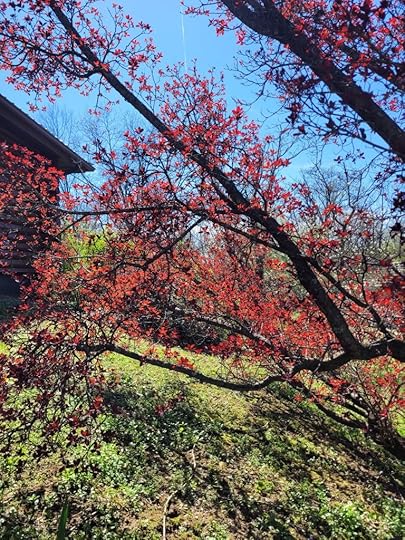
A smoke tree (Continus), unfurling her leaves. This particular smoke tree does not “smoke” very well. The flowers never fluff out the way they’re supposed to. Why not? Because the nursery sold me a female plant, and this was dishonest of them and if I remembered which nursery it was, I would tell you because people should be irritated when nurseries pull a fast one and sell plants that are not true-to-name. However her leaves are still pretty, even if her flowers are nothing to admire.
We’ll wind up wit a dog pic, in the theme: Oh no, I would never CAGE my DOG! Crate training is bad because dogs hate crates!

This crate is never closed. It’s there because first, it helps frame the “foyer,” which keeps dogs from dashing out the front door, and second, because the dogs really, really like it. The other day, Maximilian was on top of this crate and poor Connor could not get up there and he gave me SUCH a pathetic look. However, I heartlessly allowed the cat to stay there, since he got to that spot first.
Morgan is just as likely to go on top as below. Joy and Haydee both vastly prefer being inside the crate. Haydee is distressed here because she wants to curl up in this crate, but with Morgan and Joy, she doesn’t have room.
Digression:
In case anybody wonders, sure, dogs prefer to have the door open rather than closed. However, crate training means they’re not upset when the door is closed. This is handy, for example, post-disc surgery, when the neurosurgeon tells you, “If she jumps off the couch, that could be catastrophic, so seriously, keep her confined for six weeks. I’m not kidding here.”
And yes, I actually use an x-pen rather than a crate post-surgery most of the time, but that is still confinement and even then, crates are a crucial tool, and I do wonder how dog owners handle this kind of thing when they refuse to crate their dogs. Simply allow catastrophic reinjury? Do super-fast crate training under highly non-ideal circumstances, with a dog who was not taught to accept confinement earlier in life and is now both post-surgery and upset at being confined? I’ve needed to do serious confinement multiple times, and I can definitely state that a dog who accepts confinement easily and is only bored rather than upset will have a much easier time when confinement is not optional. Trazadone is fine and great and very useful, but will not compensate for the distress created by failure to crate-train earlier in life.
Please Feel Free to Share:

The post Update: Two steps forward, one step back; or, whoops, that’s not working appeared first on Rachel Neumeier.
April 10, 2025
Translation
That recent post about translation means that this post at Reactor caught my eye: Five Stories About Translation and the Power of Languages
There’s one book in this post that I’ve read:
Turning Darkness Into Light by Marie Brennan
When Lord Gleinheigh recruits Audrey to decipher a series of ancient tablets holding the secrets of the ancient Draconean civilization, she has no idea that her research will plunge her into an intricate conspiracy, one meant to incite rebellion and invoke war. Alongside dearest childhood friend and fellow archeologist Kudshayn, Audrey must find proof of the conspiracy before it’s too late.
I really enjoyed the Lady Trent series, and I liked this book as well, though I found some elements of the series somewhat implausible. Nevertheless, sure, great series, and I did like this book. Here’s a tip: coloring your baby dragons in bright primary colors that totally match the dragons from Pern is going to cause a lot of your readers to feel your story should be Pern adjacent in some way. Also, these are not realistic colors for real animals MOST of the time, though I grant that some snakes do have surprising color variation.
Here’s a bit from a review of Turning Darkness into Light:
The translations are beautifully done and the scholarly exploration of the ancient religion compared with the modern variant is perfectly achieved, with the mythological stories so well written, it was a struggle at times to remember they were a fantastic conceit nested within a novel. The initial pacing is leisurely, but once the enormity of what is going on began to emerge, I simply couldn’t put this one down. While the theme of prejudice and bigotry was all too evident, the theme that caught my attention, was the way that intellectual arrogance is also a snare that caught most of the main characters in some way.
Oh, the above is part of a review by Sjhigbee, whom I’m familiar with because I’ve checked out her blog Brain Fluff from time to time. She wrote a nice review of Tuyo a few years ago. Regardless, good book.
How about the other books from this Reactor post? One is a short story, which is available online:
“ A Pale Horse ” by M Evan MacGriogairThe world is going to end. Our protagonist watches the horizon over the waves, looking for something, though she’s not sure what, as she thinks about the silences in the world, the fire alight in the Amazon, the species going extinct. As she heads home, she spots a car window with a phrase scribbled across it, reading “seeking a friend for the end of the world,” along with words from a language she was just thinking about. She writes back with her number and receives a sound file, a piece of music that seems to reflect a deep understanding of what she’s been looking for. In return, she sends the stranger a video of the view from her window.
So begins an exchange in recording and sharing the beauty of the world. It’s a beauty that infuses pictures and music and language, connecting people without needing meaning, offering a way to preserve the world, its sights, its music, its languages. I have read many short stories about both beauty and the end of the world, but I have never read something so deeply immersive, so gentle, so optimistic, something whose prose has the feeling of gauzy curtains in the summer or a hazy winter’s walk. Beautiful.
Here’s the first bit of the story —-
Thig crìoch air an t-saoghal ach mairidh gaol is ceòl.
Come the end of the world, love and music will endure.
She sits by the water’s edge, listening for a song to prove that point.
She came out here to the edge of Loch Fada to see…something.
All she sees is water and hills.
There is only the wind in her ears, only the lapping of the waves on the beach against rounded rocks. There are no words to weave music from here. And love left a long time ago.
The sun is about to set and take with it the remaining heat of the day like a cloak it wraps around itself through the night, leaving only the moonlight to promise tomorrow’s dawn. She does not notice the chill tonight. The cold does not touch her lately.
She thinks as she walks back up the beach to her car that she has turned to ash and failed to notice her own immolation. Or perhaps sea glass, tossed against the sand so long it has lost its shine. People like sea glass. She herself used to collect it, hold it in her hand until her skin warmed its surface. Nice, he’d say, and then he’d turn away, back to his phone, back to the endless demands of Reddit and the scroll like an anchor that never finds the shoal.
Dulled and blunted. That’s her after years of being sanded down.
Across the planet, the Amazon is burning.
She thinks it is strange that so large a piece of Earth could be on fire without the smell of smoke reaching her nose even here, on a Scottish beach thousands of miles from Braisil. She looks to the southwest as if smoke will appear like an apocalyptic smudge on the horizon, but it doesn’t.
When she turns back, there is a gleaming white horse on the beach, one hoof nudging a clump of seaweed. The sight gives her heart a thump. A water-horse, an each-uisge—for a moment, it could be. It is incandescent in the sun’s dying light. A mythical being, so alive she thinks she could feel its warmth if she put out her hand.
***
Nice imagery. You can click through if you would like to read the whole thing.
Meanwhile, I’m surprised to see a post about translation that doesn’t mention Embassytown.
In the far future, humans have colonized a distant planet, home to the enigmatic Ariekei, sentient beings famed for a language unique in the universe, one that only a few altered human ambassadors can speak. Avice Benner Cho, a human colonist, has returned to Embassytown after years of deep-space adventure. She cannot speak the Ariekei tongue, but she is an indelible part of it, having long ago been made a figure of speech, a living simile in their language. When distant political machinations deliver a new ambassador to Arieka, the fragile equilibrium between humans and aliens is violently upset. Catastrophe looms, and Avice is torn between competing loyalties: to a husband she no longer loves, to a system she no longer trusts, and to her place in a language she cannot speak—but which speaks through her, whether she likes it or not.
I didn’t quite feel this book worked, but I thought it was very interesting, engaging at the intellectual language more than the emotional level.
Of course one should really think of Foreigner, until recently my very favorite SF series ever. Maybe it still is despite bobbles in the latest few books. Regardless, Bren is of course a translator — that’s his main role to begin with, though later, of course, his job expands a bit. Watching him establish communication with the other nonhuman species — I think that happens in the 6th book, Explorer — is one of my favorite parts.
Oh, and how about Hellspark by Janet Kagan? What a wonderful story this is. As a murder mystery, it’s okay. As a book about people and trying to understand nonhumans, it’s top-notch. Delightful AI computer, one of my favorite characters in the story.
And there’s Project Hail Mary by Weir. I liked it a lot, though not as much as I liked The Martian.
Honestly, now that I pause to think about it, there seem to be A LOT of SFF novels where translation is a major plot element — more than I thought to start with. It only took a few minutes to think of the above. Instead of a post about five novels and stories, it looks perfectly possible to do a post about ten, or twenty. Probably more.
If you can think of an SFF novel where language and translation are super important, drop it in the comments! I bet there’s a bunch I haven’t thought of!
Please Feel Free to Share:

The post Translation appeared first on Rachel Neumeier.
Up for Preorder, 235 days in advance
I bet I never again put a book up for preorder this far in advance, but here it is.

There you go, it is VERY clearly a Christmas story, which I thought was appropriate.
I expect I’ll drop it at my Patreon later this month. I felt I’d better ask a couple skilled proofreaders to just read through it first.
It’s a little odd to recall that I’ll still be dropping three or so chapters into my newsletter before I start putting a different story into the newsletter. Then I’ll have to decide what that should be — “Sekaran” or something super short that’s self-contained, 6000 words or however much.
Please Feel Free to Share:

The post Up for Preorder, 235 days in advance appeared first on Rachel Neumeier.
April 9, 2025
Poetry Thursday: George Williams Russell
It looks like George Williams Russell was a fairly influential and well-known Irish poet, whom I don’t remember ever hearing about. Quite possibly I’ve seen some of his poems, but if so, I didn’t remember Russell’s name. Here’s the very first one I clicked on —
BenedictionNOW the rooftree of the midnight spreading,
Buds in citron, green, and blue:
From afar its mystic odours shedding,
Child, on you.
Now the buried stars beneath the mountain
And the vales their life renew,
Jetting rainbow blooms from tiny fountains,
Child, for you.
In the diamond air the sun-star glowing,
Up its feathered radiance threw;
All the jewel glory there was flowing,
Child, for you.
As within the quiet waters passing,
Sun and moon and stars we view,
So the loveliness of life is glassing,
Child, in you.
And the fire divine in all things burning
Seeks the mystic heart anew,
From its wanderings far again returning,
Child, to you.
***
I like it — I like the sound of it, I like the rhythm and the repetition, I like the imagery and the tone. Maybe I never did happen across any of Russell’s poems after all! They’re rather easy to remember with these short stanzas and simple rhymes. Let me poke around … here’s another:
***
Now the quietude of earth
Nestles deep my heart within;
Friendships new and strange have birth
Since I left the city’s din.
Here the tempest stays its guile,
Like a big kind brother plays,
Romps and pauses here awhile
From its immemorial ways.
Now the silver light of dawn
Slipping through the leaves that fleck
My one window, hurries on,
Throws its arms around my neck.
Darkness to my doorway hies,
Lays her chin upon the roof,
And her burning seraph eyes
Now no longer keep aloof.
And the ancient mystery
Holds its hands out day by day,
Takes a chair and croons with me
By my cabin built of clay.
When the dusky shadow flits,
By the chimney nook I see
Where the old enchanter sits,
Smiles and waves and beckons me.
***
One more —
***
I will not follow you, my bird,
I will not follow you.
I would not breathe a word, my bird,
To bring thee here anew.
I love the free in thee, my bird,
The lure of freedom drew;
The light you fly toward, my bird,
I fly with thee unto.
And there we yet will meet, my bird,
Though far I go from you
Where in the light outpoured, my bird,
Are love and freedom too.
The post Poetry Thursday: George Williams Russell appeared first on Rachel Neumeier.


